Moon Window

Joanna Ellen Briggs (usually called JoEllen or Jo) lost her father five years ago, when he died in a car accident. Since then, it’s just been her and her mother. Jo has adjusted to the loss, and she and her mother have been happy together. At least, that’s what Jo keeps telling herself. Now, her mother is getting remarried, and Jo feels like her life has been completely turned upside down. Her new stepfather, George, is a nice man, but Jo can’t stand the idea of her life changing. George is a law professor, and Jo’s other relatives like him, but Jo is afraid of what this marriage will mean for her. She and her mother will be moving to George’s house in Boston, and she is afraid that nothing will ever be the same again.

At the heart of her worries is the fear of losing her mother, just as she lost her father. The truth is that Jo has never fully adjusted to her father’s death. She participates in a wide range of classes and activities, but it’s not because she really loves any of these subjects or activities. Her gymnastics, choir practice, piano lessons, and the host of other classes and hobbies that she pursues with so much energy and perfectionism are to keep her mind occupied so she won’t have to think about her father or her worries about what might happen to her if something happens to her mother. Ever since her father died, there has always been the lingering fear of something happening to her mother, and that’s why Jo fears change in her life. She has settled into a routine that makes her feel relatively safe and keeps her from thinking too much about what might happen in the future. George’s entry into their lives has broken the routine, will bring even more changes, and has caused Jo’s tightly-controlled feelings to creep to the surface.

Even during the wedding, Jo privately hopes something will happen that will stop the ceremony and keep all of these frightening changes from happening, but nothing does. However, Jo’s grandmother has noticed how upset Jo is, even though Jo tries to keep a blank face and hide her feelings. Her grandmother realizes that Jo is bottling up her emotions, and she sees the moment when Jo finally lets loose, just as her mother and George leave on their honeymoon. Instead of throwing birdseed after the car, like everyone else, she turns and throws her little bag of birdseed at one of George’s young nephews, hitting him in the eye.

Originally, the plan had been for Jo to stay with George’s brother and his family while her mother and George are on their honeymoon. However, because of her bad behavior toward George’s nephews, the boys’ mother refuses to have her as a guest. Jo’s grandparents hurriedly consider other arrangements for Jo. They would take her themselves, but they will soon be traveling to a conference they are attending. Jo’s grandmother laments about Jo’s behavior and moods, and that reminds her of Witch Ellen, an ancestor in an old painting at Winterbloom, the old house where her frail great-aunt lives. Granty Nell, as they call her, is actually a distant cousin and is over 100 years old, but she loves children. Jo’s grandmother remembers that one of Jo’s cousins recently visited Granty Nell at Winterbloom and had a wonderful time. Winterbloom is a strange old house near Walpole, New Hampshire, but Jo’s grandmother has fond memories of the place, and Granty Nell has live-in help, so she won’t be dealing with Jo alone.

Granty Nell accepts Jo as a visitor, but Jo is stunned that she has so suddenly been dumped with a relative she doesn’t even know, in an old stone house in the middle of the woods. At first, Jo plans to run away and go back to the apartment where she and her mother have been living and stay there until her mother comes to get her so her mother will regret leaving her and think twice about ever leaving her again. However, Winterbloom is no ordinary place, and leaving is much more difficult than Jo realizes.

Granty is unexpectedly sharp in spite of her age, and she can read Jo like a book, noting her thinness and chewed fingernails. She speaks openly to Jo about her feelings about her new stepfather on her first day at Winterbloom. Granty lets her speak and doesn’t criticize her feelings. Instead, she tells Jo a little about the house and their ancestors, and she offers to let her explore the house and choose one of the guest bedrooms for herself. When she decides which room she wants, she can tell the housekeeper, Mrs. Craig. Mrs. Craig’s husband Thomas and son Tom take care of the grounds and garden of Winterbloom. The three of them live in a little cottage nearby, so only Granty and Jo will be living in the big house.

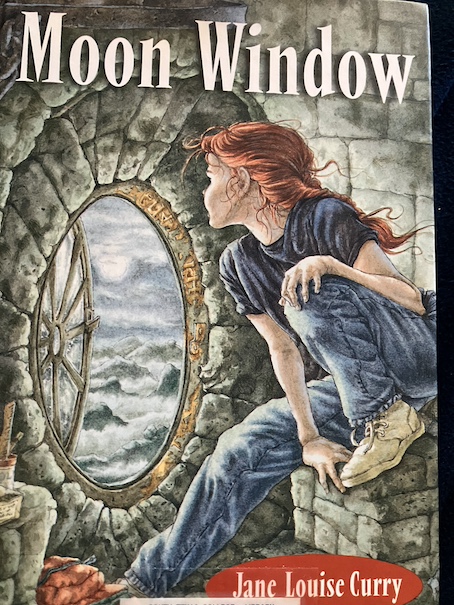
As Jo explores the old house alone, she notices that the furnishings are rich but old and shabby. She wonders why Granty hasn’t replaced them because she is supposedly wealthy. Each of the bedrooms has a fireplace that has an iron Franklin stove fitted inside and wardrobes instead of closets. The furnishings are all old-fashioned and a little shabby, but there is something in every room that catches Jo’s attention, like an interesting painting or an embroidered stool. In spite of herself, Jo finds herself liking things or becoming intrigued by them, although she is still determined to run away. Then, while exploring the attic, she finds an old turret room with a round window, the kind that her mother likes to call a “moon window.” Jo tries to open the window, but she discovers that someone has painted it shut. She manages to pry it open anyway, using a knife that she finds in Granty’s desk drawer. Outside the window, there is a large tree, good for climbing. Jo realizes that, with her gymnastics skills, it would be easy for her to climb down the tree and escape when it’s time for her to run away.

Thinking that she’ll probably only stay for one night before running away, Jo chooses the yellow bedroom, the one with a high bed with yellow brocade curtains that has a step stool for climbing into it. Granty tells her that is the room where her grandmother stayed when she came to visit Winterbloom when she was young. Winterbloom is undeniably charming, in spite of its shabbiness, and Jo can’t help but think that the dining room, with its tapestries and long, candlelit table looks like it’s set for a fairy tale feast.

To Jo’s surprise, Granty tells her a little of her own history at dinner. Like many of the women in their family, Granty’s first name is Ellen, although the younger generations think of her as Granty Nell. Jo had assumed that Granty had grown up at Winterbloom, but actually, she originally lived in New York. Like other young girls in the family, she also came to visit Winterbloom as a child when the woman that she once called Granty lived there. When Granty Nell was 17 years old and having one of her visits to Winterboom, both of her parents died in a flu epidemic. (I thought at first that she was referring to the 1918-1919 Influenza Epidemic, but later events in the story show that the dates don’t line up. Her parents must have died earlier.) As an orphan, she continued living at Winterbloom with her Granty until the following September, when she went away to college. She was a schoolteacher for a time until her Granty died, leaving her Winterbloom and all of her money, on the condition that she change her last name to Macallan, which is the family’s maternal surname. Granty Nell wasn’t originally happy about having to change her name, but she did it anyway because she loved Winterbloom. Jo wishes that someone would give her a house to live in so she wouldn’t have to live with George. George’s house in Boston is very modern and definitely not charming. Granty Nell tells her to be careful about what she wishes for because, since she returned to Winterbloom, she hasn’t traveled very far from it, and there are many interesting places she has never seen. Clinging too much to one particular place can keep a person from moving on to other, more exciting places.

Although someone (possibly Mrs. Craig or Granty) has tried to make the yellow room more cozy for Jo by moving all the things that she admired in the other rooms into that room, Jo is still determined to run away. She almost resents how comfortable Winterbloom is for her, making it difficult for her to leave. Early in the morning, Jo slips out through the moon window in the attic and climbs down the tree from the house. She originally planned to ride her bike the two miles from Winterbloom into town because her grandparents left her bike there for her to use, but she can’t find the bike when she reaches the ground. She assumes that the Craigs must have moved it and that she’ll have to walk to town to catch the bus.

However, during her early morning walk to town, it slowly begins to dawn on her that something isn’t right. She overhears some children talking about a cannon, which is strange. Then, she has an encounter with a man on horseback, who talks like he’s a local doctor who’s been out to see patients. Since when do doctors ride around on horses to see their patients? Jo becomes more uneasy, and when she reaches the town, she realizes why. The town doesn’t look the way it did when she passed through it with her grandparents. Suddenly, there is no Interstate highway, and there is a covered wooden bridge that isn’t there anymore in Jo’s time. Somehow, it looks like going through the window has sent Jo back in time, although she’s not sure when or if that’s really what is happening. Disoriented and terrified, Jo returns to Winterbloom and climbs back up to the moon window, leaving her knapsack hidden in some bushes to retrieve later.

The next day, Jo tries to tell herself that what happened early that morning was only a dream, but there are hints that it wasn’t. Not only is her bike exactly where she left it, like it never moved, but the bush where she left her knapsack isn’t there anymore, and there’s no sign of the knapsack. Jo searches the area to check if she was just mistaken about where she left the knapsack, but it really isn’t there. When Granty suggests that they go into town for lunch, Jo sees that the gate to Winterbloom isn’t the same in the present as it was in the past, and the road to town is paved while the road she walked along in the early morning wasn’t. Yet, there are aspects of the countryside that are eerily familiar, which indicates that what she experienced wasn’t just a dream. She might have been able to dream about the road and town as they were in the past, but she shouldn’t have been able to accurately dream about features of the area that she hadn’t seen before and that have been there for a long time.

Their trip to town is cut short because Granty becomes ill. Young Tom, who is driving them, says that Granty suffers from agoraphobia, which is why she gets ill or panics when she gets too far from Winterbloom. This is part of the reason why she has not traveled very far since she inherited the house. Granty later says that this isn’t entirely the case, but through many years of living at Winterbloom, it has become more and more difficult for her to leave it.

Jo still plans to run away, and she realizes that she left her flashlight in her knapsack, wherever that is now. She decides to search the attic for something she can use instead. In spite of herself, she finds the old clothes in the trunks in the attic charming and decides to try wearing some of them. Then, at the bottom of one of the trunks, she finds her knapsack! The knapsack isn’t the way it was when she last saw it, though. It has clearly aged, and so have the things inside. The flashlight no longer works, the clothes are yellowed with age, and the leather and rubber on her hiking boots has hardened and cracked. It’s like they’ve been stored in the attic for more than 100 years! The boots are wrapped in a newspaper, now deteriorated, but when Jo examines it, she finds the date of July 1809 and references to some of the people and things she encountered during her early morning excursion. Now, Jo is really scared.

Jo races to the turret room and looks out the moon window, but what she sees frightens her more. Although it’s afternoon in Winterbloom, it’s dark outside the moon window. More than that, there’s no tree outside the window, and the countryside that she sees isn’t the woods that surround Winterbloom. Jo recognizes what she sees as the same scene in a painting in her room at Winterbloom. The moon window is no ordinary window. It looks out on different times and places.

Once she gets over her fear, Jo is intrigued at this “window of time” and wants to know more about how it works. She even thinks that, if she can learn to control it, she might be able to go back in time to just the right moment to keep her mother from getting married again, which she thinks will solve all of her problems. However, the next time she tries the window, she finds herself meeting a young Granty Nell in 1897, when she was just a girl about her age called Nell, which is short for Ellen. Nell catches her sneaking around in a dress that looks very much like her dress. (Really, it’s the same dress, just aged about 90 years because Jo found it stored in the attic and tried it on.) Jo attempts to explain to her who she is and how she got there, taking Nell to the turret room in the attic and showing her the moon window. Jo is curious where the moon window will lead if they go through it in the past, wondering if it will take them to the future, but it ends up leading them further into the past. Jo and Nell end up in 1764, when the house was first being built. They are both caught sneaking around by a young Indian (Native American) and the stonemason who is building the house for Ellen Hawke. Ellen is a common name for women in their family, and this Ellen was the one who created Winterbloom and the one for whom all the other Ellens were named, including JoEllen. She is also considered a “wise woman”, and she is the Witch Ellen who appears in a painting at Winterbloom. Jo recognizes the stonemason’s last name as her grandmother’s maiden name, making her wonder if they are also somehow related. She wonders if maybe the stonemason will marry Ellen Hawke, making him her distant ancestor.

As Jo begins to consider people’s complex relationships across time, it occurs to her that, if she and Nell aren’t careful, they might accidentally change something in the past that will endanger their own existence. For the first time, she also begins to wonder what might happen if she successfully changes things so her mother never meets or marries George. Is it possible that she would be preventing the potential birth of a half-sibling, and if so, is that what she really wants to do?

Back in the present day, Granty Nell begins remembering an incident from her youth that she always thought of as a dream with a girl named Joanna and a trip back in time, and she begins connecting it with some strange questions Jo has been asking her. Years ago, Granty Nell had removed the furnishings from the turret room (the ones which Jo had delighted in and are now her the Yellow Bedroom that she is using) and scattered them through the house. She had the moon window painted shut and kept the door to the turret room locked, sensing that the moon window was magical and dangerous. Now, in spite of Nell’s precautions, things are coming full circle, and Jo is doing what Nell realizes she has done before.

Although Granty Nell loves having Jo at Winterbloom, she begins to realize that she must get Jo away from the place as soon as possible, before Jo becomes trapped in the same web that has kept Nell herself tied so tightly to Winterbloom all these years. Solving the mysteries of Winterbloom and the spell it has on the other Ellens in the family means exploring the past of the first Ellen, Witch Ellen.

The book is available to borrow and read for free online through Internet Archive.

I enjoyed this story and its atmosphere! I think fans of Cottagecore would enjoy Winterbloom, with its old-fashioned, comfortable shabbiness and rooms with quaint, magical touches. This is also one of those books that mentions what the characters eat. I’m not much of a foodie, but there were a couple of things that interested me about their meals at Winterbloom. I find it interesting when books mention unusual dishes or foods that they call by unfamiliar names. At one point, they have what Granty calls “Indian cake” for lunch. It’s described as a type of corn bread, so I think it’s named for Native Americans rather than Indians from India. (I ask that question almost every time I see “Indian” in writing, unless it’s specified.) I’d never heard of that before, so I tried looking it up, and from the description, I think it might be similar to this recipe for a corn bread pound cake from 1827. I’m not 100% sure it’s the same thing, but it seems reasonable because it’s described as both a corn bread and a cake. As charming as Winterbloom is, though, it also has a dark side that Jo must confront.

Jo’s immediate problem is obvious from the beginning of the story. There have been many other children’s books about children adjusting to changes in their lives, including the remarriage of a parent. It’s understandable that children who are accustomed to having only one parent might cling to that parent and be afraid of changes that might cause them to lose that parent or experience less of that parent’s attention and affection. Although adults might say that coming to love someone else doesn’t mean loving other people less, but Jo already knows that, when her mother spends more time with George, she spends less time with Jo. Her mother still loves her, but Jo feels neglected and forgotten, fearful of what this will mean for her future and her relationship with the only parent she has left. Even before her mother married George, there were times when her mother was so preoccupied, thinking about George, that she forgot to get breakfast for Jo or buy groceries, as she normally did, making Jo nervous about her mother still providing for her through this relationship with George. I’m sure that her mother doesn’t mean to give Jo this feeling. It’s just part of the awkwardness of making a major change in their lives and adjusting to a new normal. I’ve reviewed others on this theme before, including The Haunting at Cliff House, which also features time travel.

There are a couple of things that make this story different from others that I’ve read. One that surprised me at first is that Granty Nell knows about the magic of the window. In many books for kids that involve magic and time travel, the adults don’t know what’s going on and never learn. The magic or time travel is meant to give the children in the stories perspective on their lives and problems and teach them lessons, not to do anything for the adults. Typically, the adults either don’t know what’s going on, while the children learn about the magic or face their problems on their own, or the adults don’t find out what’s been happening until after the child has resolved the situation, like Rose in The Root Cellar, which is about an orphan adjusting to a new life with her relatives. In this story, Granty Nell has known about the magic of the moon window since she was young, when she first met Jo on one of her time travel excursions. At first, Nell thought that Jo was a dream, but through her years with the house, she came to understand the dangers of the window and the hold that the house can have on people, particularly on young girls named Ellen, who are coping with the loss of a home or a parent.

It isn’t obvious right away, but this is also a story about generational trauma, but with a magical/supernatural twist. Like other Ellens in the family, the first Ellen, Ellen Hawke (maiden name Ellen MacAlpin, also called Ellen MacAllan or Witch Ellen) also suffered the lost of her father and home early in life. The family’s ancestral home, Castle MacAlpin in Scotland, was destroyed by fire, and her father died in the fire. Ellen wanted to save him, but she couldn’t. The MacAlpins were unusual people, who possessed real magic, and Nell thinks that they might actually be descended from elves. After her father died, Ellen married, and later in life, after her husband died, she went to New Hamsphire to start over. People were always nervous about her and her magical abilities, so whenever it looked like people might be about to put her on trail for being a witch, she would move and start over.

Like Granty Nell, Witch Ellen has also lived an unnaturally long life, and (spoiler) she is still living secretly in Winterbloom. At least some of the other Ellens in the family were also her, pretending to be one of her own descendants. When she came to New Hampshire, she built a new version of the home that she had lost, which is Winterbloom. The shabby, old-fashioned belongings in the house are actually a clue to the house’s true problem. Granty can’t change things too much, even when she wants to, because Witch Ellen won’t let her. The house is a monument to her old life, and she can’t let go of it. However, Ellen eventually discovered that Winterbloom was a poor substitute for her lost home. It’s undeniably a charming house, but it’s not the original castle, so it just couldn’t be the same and would never feel the same to Ellen.

When Jo finally speaks to Witch Ellen directly, she admits that, rather than bringing her solace, Winterbloom haunts her because it can’t be what she wants it to be. Witch Ellen tells Jo that, for a long time, she has been waiting for a descendant of hers to undo a terrible mistake that she made years before, which has kept her bound to the house. That is, assuming that Witch Ellen is telling the truth.

For most of the book, readers don’t know what’s behind the magic of the house or if the witch in the family is in control of what’s happening. I expected at first that Witch Ellen would be a sympathetic character who would help Jo to understand the magic and maybe teach her something to help her cope with her situation, but that isn’t the case. Jo must confront the question of whether the mission that Ellen gives her would really break the spell of Winterbloom or if the curse of Winterbloom was always Ellen’s inability to accept life as it came and to try to control the outcomes. Ellen was always a controlling person, and her own children left her and Winterbloom years ago because she frightened them. Witch Ellen was never satisfied with her life, even the parts that were really good, because she couldn’t let go of the old home that she lost. Her new home, the men she married, and even her own children were never good enough for her because she was clinging to her memories of her old life and her plan to get it back. It was an obsession with her, and it has guided everything she has done. When Ellen became Nell’s guardian as her “Granty”, she began controlling her, keeping her bound to Winterbloom all these years to accomplish what she wanted. When Nell wouldn’t do it, Ellen began searching for another descendant who would, which is why she keeps inviting other young descendants to visit Winterbloom.

Jo is capable of doing what Ellen asks, but she has begun to see Ellen’s selfishness for what it really is. Ellen is prepared to sacrifice the lives and futures of her descendants to change the past, without regard for what that would mean for anyone else. Jo is different because she can see the bigger picture, and she does care about other people. She worries about her future, and that’s why she is afraid of the changes brought by her mother’s remarriage, but she has come to see that there are limits to what she’s prepared to do about that because of her concern for the welfare of other people. Jo realizes that she doesn’t want to be trapped at Winterbloom forever or to endanger her very existence and the existence of other people in her family to accomplish Ellen’s mission.

In many books about children coming to accept stepparents, the children come to suddenly love the stepparents at the end of the book, or at least find something about them to appreciate or an ability to see things as the adults around them do. That isn’t the case with this book. Maybe Jo will come to appreciate George once she becomes more accustomed to him and her new life, but for now, she has come to see that trying to control other people’s lives can be truly damaging, not just to them but also to other people around them and even to herself, and that it isn’t healthy to remain stuck in the past. Although accepting change can be difficult and can sometimes mean accepting bad outcomes along the way, Jo comes to see that she would rather keep moving forward in life and letting others move forward.

If something bad hadn’t happened in their family centuries before, maybe none of them would even exist now. Maybe accepting her mother’s marriage to George will one day mean accepting a younger half-sibling and having to share her mother with George and that sibling, but Jo recognizes that this half-sibling has the right to exist as much as she does. The half-sibling is only a potential idea at this point, not a firm reality, but the knowledge that there could potentially be one someday causes Jo to think about the effect that her decisions can have on people, including possible future generations. Letting her mother, George, and the potential half-sibling have their lives will mean having to make some changes to her own life, but Jo sees that it also allow her room to consider new possibilities for her own life in the future and to keep moving forward. The contrast between having the ability to move forward and being stuck in the past is enough to convince Jo to stop fighting her mother’s marriage and to focus on moving forward and seeing what life holds.

This is one of those children’s books that also references other children’s books. Because generations of children have visited Winterbloom, Jo finds old children’s books on the shelves there, like The Five Children and It by E. Nesbit and a Nancy Drew book from the 1930s. When Jo reads The Five Children and It, she reads a part about how people can make themselves wake up at a particular time without an alarm clock by really focusing on the time they want to wake up before they go to bed. I haven’t read this book yet, but I have done that before, made myself wake up at a particular time because I had it in my mind that was when I wanted to get up. It does seem to work at least sometimes, although The Five Children and It says that it only works if you really, really want to wake up at that particular time. If you don’t really want to get up, it won’t work. When Jo reads the Nancy Drew book, she tells Granty that she’s surprised that Nancy Drew is that old, and Granty tells her how the Nancy Drew books are periodically rewritten to update them with the current time and habits, changing language and technology to be current. This is true, and I’ve talked about that on this site before. As this story notes, in the original books, people were driving roadsters and using typewriters, and in the updated versions, they have sports cars and computers.
The Mystery of the Invisible Dog

The Three Investigators

Shortly after Christmas, a frightened man, Fenton Prentiss, calls the Three Investigators to his apartment to help him. Mr. Prentiss is an elderly art collector, and he says that he is being haunted. Things in his apartment get moved around when he’s not there, and he can tell that someone has been reading the mail in his desk. Sometimes, he even sees a shadowy figure when he is home, although he’s never gotten a good look at it before it disappears. He swears that it can’t be another person because he’s the only one who has a key to his apartment. He is also sure that there are no secret passages in his apartment building and that there’s no way for any living person to enter his apartment without being seen by someone. Mr. Prentiss could just be imagining the haunting, but Jupiter is intrigued, and if the boys don’t have a mystery to work on during the holidays, they know that Jupiter’s aunt will just assign them a bunch of chores.

They tell Mr. Prentiss that they need to talk over the assignment together before they accept his job, but Jupiter’s mind is made up when he also sees a shadowy figure that he initially mistakes for Pete just before they leave the apartment. However, Pete is not in the room where Jupiter saw the shadow. Did Jupiter just see Mr. Prentiss’s mysterious ghost?

When the boys get outside the apartment, they hear a loud bang and running feet and see a man in a ski mask running away. Pete tries to follow, and the police stop him, thinking that he might have something to do with a burglary that has just taken place. Fortunately, Mr. Prentiss speaks up for Pete, saying that the boys only just left his apartment and couldn’t have anything to do with what the police are talking about. The police think that the suspect who ran away could have gone into a nearby church, but he seems to have vanished. Mr. Earl, the janitor and caretaker of the church swears that he was in the church the whole time and no one came in, although the housekeeper at the rectory, Mrs. O’Riley, says that Mr. Earl is practically deaf and wouldn’t have heard anybody.

The place that was burgled turns out to belong to a deceased artist friend of Mr. Prentiss. His friend’s death is part of the reason why Mr. Prentiss is so on edge because it was very upsetting to him. The artist’s brother, Charles, hadn’t finished clearing out his brother’s house when it was robbed. He tells the boys that his brother was a sculptor, and his best piece was based on a legend of a ghostly, demonic hound from Eastern Europe. This is the sculpture that was stolen. It’s a bitter blow to Mr. Prentiss because the artist made this sculpture especially for him.

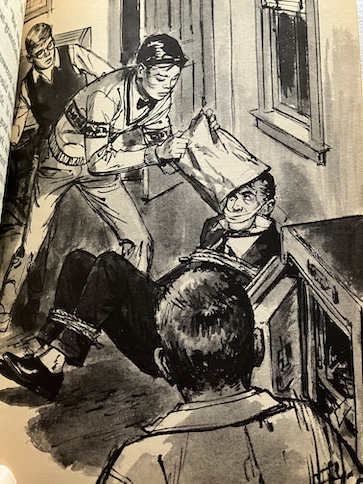
Jupiter believes Mr. Prentiss that someone has been sneaking into his apartment, so he sets a trap that will cause the intruder’s hands to be stained. Mr. Prentiss leaves for a while with the boys, and when they return, his nosy landlady’s hands are stained, indicating that she has been the intruder. Mr. Prentiss confronts her, and she admits that she had a spare key made for his door. The landlady has a long-term habit of spying on her tenants. Mr. Prentiss confiscates her spare key and thinks that his problem is over, but really, it’s just beginning.

Having seen the shadow in Mr. Prentiss’s apartment himself, Jupiter knows that the mysterious shadowy figure was not the landlady. For Jupiter to have mistaken the shadowy figure for Pete, he knows that the person is male and of similar size to Pete. Jupiter is not surprised when Mr. Prentiss calls them up to say that he’s seen the shadow again. The landlady was undoubtedly snooping, but there must also be a second intruder. At first, Jupiter thinks that he knows who the second intruder must be because there is another person in the apartment building who vaguely resembles Pete and who also seems to know about things that Mr. Prentiss owns when he’s supposedly never been in Mr. Prentiss’s apartment before. However, this person is accounted for when the intruder makes another appearance. Jupiter investigates the nearby church when he sees a light there, and he has a frightening encounter with a figure that Mrs. O’Reilly believes is the ghost of the former pastor.

Mr. Prentiss soon gets a ransom demand from the person who stole the sculpture. Then, strange misfortunes start to befall Mr. Prentiss’s neighbors. Some of these misfortunes look like accidents while others are direct attacks. Someone is apparently attacked by the thief, someone else is poisoned, someone’s apartment catches fire, and someone else’s car is sabotaged, and people are ending up in the hospital. It seems like someone who is close to these people is responsible for sneaking around Mr. Prentiss’s apartment, stealing the valuable sculpture, and harming the neighbors, but who is doing these things and why?

The book is available to borrow and read for free online through Internet Archive (multiple copies).

I enjoyed this mystery because it has many different facets. First, there is a wonderful cast of eccentric characters. All of Mr. Prentiss’s neighbors/suspects are eccentrics. There’s the nosy, sneaking landlady and a guy who takes care of stray cats. Mrs. O’Reilly at the church believes that the church is haunted by the ghost of a former pastor, adding another haunting figure to the mystery. Another resident of the apartment house works nights at the local market and is saving up money so he can go to India and find a guru to help teach him the secrets to life. His father wanted him to be a dentist, but instead, he wants to study meditation so he can see through life’s illusions and be truly awake, achieving the ultimate level of consciousness. It’s ironic because he’s so tired from working nights that he often falls asleep while meditating. The mystery somewhat resembles a classic old dark house mystery in the sense that it takes place in a contained area with a very definite set of suspects who are also either victims or potential victims.

Second, I enjoyed the layers of the mystery. We have a mysterious intruder (or intruders), the theft of a valuable sculpture, a possible haunted church, and a series of mysterious accidents or attacks on residents of the building. Are these things all connected or are some of them unconnected incidents that confuse the issue? Readers have the feeling that there are at least some connections, but it’s not clear for most of the story what the connections are and who’s responsible for what. On the one hand, books with several different mysterious happenings can feel a little cluttered and confusing to readers, but on the other, figuring out which of these incidents are connected to the main issues provide clues to the identity of the real villain.

There is a surprising supernatural element to the story that the Three Investigators discover when they consult a parapsychologist at a university. There was a strong interest in parapsychology during the 1970s and 1980s, which is why the subject of psychic abilities and people who study it appears in children’s books and tv shows around this time period. (Spoiler) It seems that the guy who is studying meditation has some psychic ability, and the things he experiences while meditating aren’t just him falling asleep and dreaming, although it seems like that at first. Because he really wants to get away from his boring life and dead end job when he meditates, he’s actually been using a kind of astral projection without being fully aware that’s what he’s doing. The characters realize this because he knows things that he shouldn’t really have any way of knowing from places where he shouldn’t have been and how he can sometimes appear in certain places when he’s actually somewhere else. Some of the strange things that people see around the apartment building at due to his astral projection, possibly including the ghost in the church, although part of that is left unclear at the end. However, there is a real thief and villain in the story who is unrelated to the psychic phenomena, and incidents that harm people in the building are related to the thief’s attempts to keep people away from the hiding place of the stolen sculpture. I thought both the psychic angle and the solution to the theft were clever, and I kept guessing all the way through the book who was responsible for what.

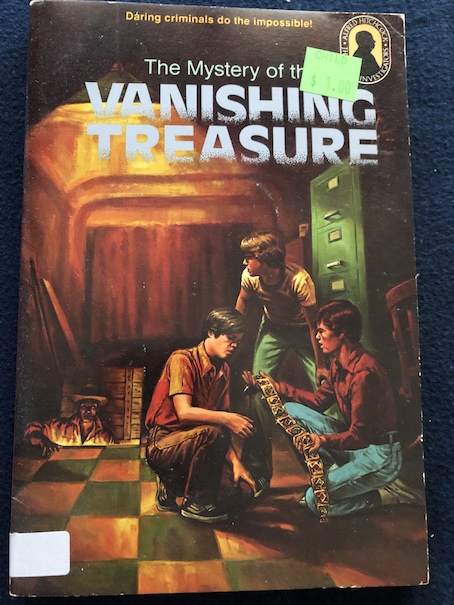
The Mystery of the Vanishing Treasure

The Three Investigators

The Three Investigators don’t have a case at the moment, so Jupiter entertains himself and his friends with an intellectual exercise – figuring out how someone could steal the Rainbow Jewels from an exhibit at the Petersen Museum, an exhibit that has been promoted in the local papers. Pete and Bob object that they solve thefts, not commit them, but Jupiter says that figuring out how a theft could occur would be useful in helping them understand thefts that actually occur. The boys go to the museum to see the exhibit and study it for security weaknesses.

While they are at the museum, a theft actually occurs, but not in any of the ways that Jupiter predicted that a theft could occur. It happens in broad daylight, with a room full of people and security, and the object that was take, a golden belt, was actually the heaviest and least portable object in the exhibit. Jupiter and his friends witness the start of the crime when Jupiter runs into an old acquaintance from his childhood acting days. This actor gleefully tells Jupiter to watch the stunt that he’s going to pull. He pretends to feel faint and then drops a fake jewel that looks like one of the real ones. This is a distraction for the guards, who are all focused on him when the real theft happens. The actor is in trouble for providing the thieves with a distraction, but he tells the police that he was hired to do it both to prove himself for a role in a movie and as kind of a publicity stunt. Of course, the movie wasn’t real, and he was just duped into helping the thieves.

Jupiter is intrigued by the theft and offers the Three Investigators’ services to the man in charge of the exhibit, but he turns them away because they’re kids. However, they soon have another mystery to consider. An elderly children’s author thinks that she is being stalked by gnomes. She lives in the same old house where she grew up, and she is known for writing books about gnomes, inspired by stories that her old Bavarian nanny told her. Years ago, she used to invite neighborhood children to her house for parties, playfully calling them her “gnomes”, and she would read to them from her books. However, the old families have grown up and moved away, and many of the old houses around her have been torn down and replaced with shops and businesses. The author doesn’t want to sell her house, even though she’s been pressured to sell by a developer, but lately, strange things have been happening at the house. She keeps seeing little men dressed like gnomes, and they play mean tricks on her. She swears that she’s not dreaming or crazy, which is what her nephew seems to think. She does genuinely believe in gnomes, but what’s been happening could also be someone playing a trick on her.

The Three Investigators might think that she was imagining things, except that Bob sees one of these gnomes out the window while they’re talking to the author. The boys try to chase after it, but it disappears before Jupiter and Pete can even get a look at it. They consider the idea that Bob could have imagined the gnome, based on his reading about them and the author’s stories, but he swears he didn’t. They decide to approach the situation from the assumption that someone is playing tricks on the author, and Jupiter and Pete decide to spend the night at the author’s house to see what happens.

While the boys are exploring the area, they decide to check out the defunct movie studio next to the author’s house. There, they overhear the developer who wants to buy the author’s house talking to the security guard at the old studio. What they say makes Jupiter wonder if they could have something to do with the theft of the gold belt, but when they discover the boys listening, they insist that Jupiter misheard them.

The son of the man in charge of the exhibit at the museum comes to consult the Three Investigators about theft of the belt, having overheard them offering their services to his father. Jupiter gives him a suggestion to check on while the Three Investigators look into the matter of the gnomes. Jupiter’s first guess about the theft of the belt isn’t quite right, but it turns out that there is a connection between the gnomes and the theft. The gnome incidents could be part of an effort to pressure the author into selling her house to the developer, but the digging sounds that accompany the gnomes make Jupiter realize that the gnomes have other motives.

The book is available to borrow and read for free online through Internet Archive (multiple copies).

Many of the Three Investigators mysteries are a little like Scooby-Doo mysteries, with ghosts, monsters, or other supernatural phenomena that have logical or human explanations. I like this mystery because gnomes are an unusual mythological creature to find in that kind of story. There are plenty of mystery stories with faked ghosts but few with staged gnome appearances. It’s a little bit of a spoiler to say that the gnomes are fake, but not much of one because that is really the assumption from the beginning. The children’s author believes in gnomes, but nobody else does, and even the author isn’t convinced enough to stop her from hiring the investigators to look into the situation.

The introduction of the theft of the golden belt from the museum at the beginning of the story introduces the idea that the theft is somehow related to the gnome appearances, and that is the case. What complicates the situation is that there are different people involved with both the gnome appearances and the thefts, and not everyone who’s involved in one plot is necessarily involved in the other. One of the complications of the story is figuring out who is involved in what and who is the ultimate mastermind behind the main mystery.

The gnome appearances also put this mystery into the category of mysteries that I call Mysterious Happenings – where something strange is happening with no obvious explanation, and much of the mystery involves figuring out the motive behind the mysterious happenings, which is usually related to an actual crime that is initially unknown to the investigators. A classic example of a Mysterious Happenings mystery is the Sherlock Holmes story, The Red-Headed League, which involves a man who is invited to join a club that requires him to do some meaningless busy work for money but which he suddenly discovers is fake. In that case, the mystery is figuring out the purpose of the club and why someone would play such an elaborate prank on this particular man. This Three Investigators story has a similar premise to the Sherlock Holmes story in the sense that someone is playing an elaborate prank on the author with the gnome appearances, and the question is why anyone would do that. Part of the reason that I mention the Sherlock Holmes story is that the motive behind the prank in the Sherlock Holmes story is the same as the motive for playing the prank with the gnomes, making me think that the author was inspired by The Red-Headed League.

As for who/what the gnomes are, the presence of the old movie studio and the use of a hired actor to create a distraction in the museum are clues. It’s also important to the story that it was children’s day at the museum, so there were a lot of kids on the scene when the theft happened. I suspected who was playing the part of the gnomes from the beginning, but I didn’t guess the full motive for the crime, even though The Red-Headed League is one of my favorite Sherlock Holmes stories. There’s a dramatic scene at the end of the book where the “gnomes” storm the kids’ headquarters at the salvage yard to retrieve the golden belt from Jupiter after Jupiter figures out where they hid it.

The Mystery of the Green Ghost

The Three Investigators

Bob and Pete are looking at an old, abandoned house that’s in the process of being torn down when they hear an unearthly scream from the house! There are stories that the old house is haunted, and the boys run away, only to be stopped by a group of local men, who ask them what’s going on. When the boys explain, the men talk about calling the police or going inside the house to investigate. The men decide to just go in and have a look around themselves, in case someone’s hurt and needs help right away. They tell the boys that they can leave because they will handle the situation, but the boys decide that they can’t leave without having a look themselves.

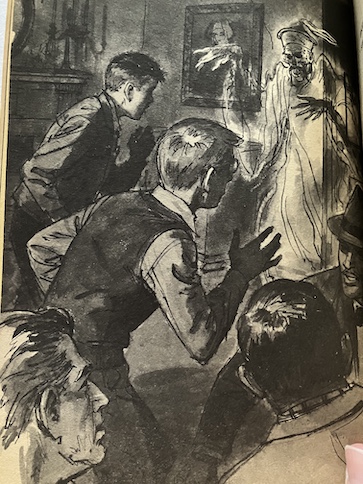
As they take a look around inside, they see the remains of the ornate wall paper and impressive features of the once-rich house, and the men talk about Mathias Green, who used to live in the house. At first, the searchers can’t find anything, but then, they spot a greenish figure on the stairs. Thinking that there’s some prankster in the house, the searchers go upstairs to confront the person, but they can’t find whoever it was. The boys suggest that they have a look at the dust on the floor and try to follow the person’s footprints, but the only footprints the searchers can find are their own. Could they have seen a ghost?

The searchers do notify the police about what they’ve seen in the house, but the police don’t take it too seriously … at first. However, they soon begin receiving other reports from various people around the city who claim to have seen a greenish, ghostly figure. Even then, the police might not have take the reports too seriously, except that a couple of officers on patrol witness a greenish, ghostly figure in the cemetery … at the burial site of Mathias Green, who died falling down the stairs in his house, 50 years before.

While Bob and Pete were at the house, Bob had his tape recorder with him, and he plays the recording of the scream they heard for their friend and fellow investigator, Jupiter. Jupiter is willing to believe it could be the scream of Mathias Green’s ghost, and the boys review the information they know about Mathias Green. Mathias Green was once the skipper of the ship, and he sailed to China. For reasons that nobody fully understands, he had to leave China suddenly, and the rumors were that Mathias’s wife was a Chinese princess and that Chinese nobles had a grudge against Mathias. Mathias brought his wife back to the United States with him, and they built their house in Rocky Beach after Mathias had a fight with his sister-in-law, and they moved away from San Francisco. They had some Chinese servants, but when Mathias was later found dead, apparently from an accidental fall down the stairs, the servants and his wife disappeared. People assumed that they left for fear that they would be blamed for Mathias’s death, and Mathias’s sister-in-law inherited the house. Recently, Mathias’s niece decided to sell the house to a developer, who is planning to tear it down and build more modern houses.

Local newspapers have picked up the stories about the green ghost and its apparent connection to the old Green mansion, and some of them have implied that the ghost is looking for a new place to haunt now that its house is being torn down. The Three Investigators have access to more information than most people because Bob’s father is one of the reporters covering the ghost incidents. The police chief tells them, off the record, that he witnessed the ghost himself, in the cemetery, and it looked like it disappeared by sinking down into Mathias’s grave. Then, the police chief learns that the workmen tearing down the house have discovered a hidden room. Bob’s father and the boys are allowed to come with him to see what the room contains.

The discovery is a shock. The hidden room contains an ornate coffin, holding the skeleton of Mathias’s Chinese bride, dressed in elaborate robes and with an unusual necklace of gray pearls, called ghost pearls. The story is that the reason why Mathias and his bride had to suddenly flee China was that Mathias reportedly stole the pearl necklace to give to his bride. When she died in Rocky Beach, he couldn’t bear to be parted from her, so he “buried” her secretly in his house, along with the necklace.

The discovery of Mathias’s wife’s hidden burial chamber doesn’t lay the ghost to rest, though. Bob and Pete get a phone call from Mathias’s niece, Lydia, asking them to visit her at the vineyard where she lives, to talk about what they witnessed at the house. She says that the ghost has actually appeared at her vineyard! Jupiter is not invited to the vineyard because he didn’t witness the appearance of the ghost with the others, but he couldn’t go anyway because he’s temporarily in charge of his uncle’s salvage yard while his uncle is out of town. He tells Bob and Pete to go ahead and meet with Lydia and let him know what they learn.

At the vineyard, Bob and Pete meet Lydia’s distant cousin, Harold, and Lydia’s great-nephew, Charles, who is actually the great-grandson of Mathias Green and the real heir to Mathias’s estate. Charles, who is called Chang, grew up in China, and they explain that he is descended from Mathias’s first wife, who died of an illness in China. After the death of his first wife, Mathias put his young son into an American missionary school in China and left him there as a boarding student. When he married his second wife and had to flee China, he left his son behind. His descendants remained in China since then, until it became unsafe for Americans or people of American descent in China. Then, Charles, who is an orphan and part Chinese (hence his nickname of Chang), was sent to live with Lydia in the United States. Until that point, he knew very little about his ancestors and his relatives in America. Technically, Mathias’s estate should have come to Chang’s side of the family when Mathias died, but they were living in China at that time and were not in touch with the rest of the family. Lydia says that Chang should even technically own the vineyard that she and Harold have built with the family’s money, but Chang doesn’t want to take it from them, so Lydia says that she is leaving it to Chang in her will. Chang is satisfied with this arrangement, but the family has debts, and if they don’t resolve them, they might lose the vineyard entirely.

Lydia believes that the green ghost is Mathias’s ghost, and he is haunting them because he’s angry with her for selling his old house to be torn down. The ghost has been scaring away workers at the vineyard, and if they can’t get the harvest processed, they won’t be able to keep the vineyard. However, Chang doesn’t believe that his great-grandfather would want to hurt his own family. Chang might be willing to believe that the ghost is an evil spirit, masquerading as his great-grandfather. That’s not the only possibility, though. There could be a human being with a motive for wanting to ruin the vineyard. Then again, there is the question of who really owns the ghost pearl necklace. If Mathias’s family owns the necklace, they could sell it to cover their debts, but it might really belong to the family of Mathias’s Chinese wife. Her family is more difficult to trace, but one person has stepped forward, claiming to be her heir. Then, someone attacks Harold and steals the necklace from him. Was the necklace always the ghost’s target, from the beginning? Meanwhile, back in Rocky Beach, Jupiter has a revelation. There was a dog present when Bob and Pete were searching the Green mansion with the men, and the dog … didn’t do anything. That might be the most important clue of all!

The book is available to borrow and read for free online through Internet Archive (multiple copies, including some in other languages).

I enjoyed the mystery and the reference to Sherlock Holmes about the dog that did nothing in the nighttime. In this story, Jupiter takes the dog’s non-reaction as a sign that there was no supernatural presence in the house because animals are supposed to react to the presence of ghosts. There is definitely a human behind all the spooky happenings, and I was partly right about who it was. However, the author threw in a complication by inserting another mysterious villain who kind of usurped the original plotter’s plot for his own purposes and partly distracts the characters from the original villain for part of the story.

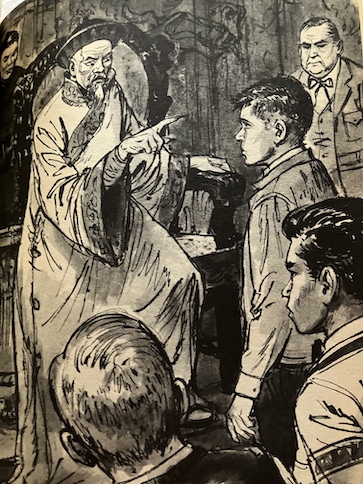
This added villain is a mysterious old man from China who claims that he’s 107 years old and that he wants the pearls because drinking dissolved ghost pearls is the key to immortality. This mysterious old man is wealthy, and he has bought up the family’s debts, meaning that he will get control of the vineyard, if they can’t pay their debts. However, he’s not really interested in the vineyard for its own sake. He just wants those pearls. Although he does some criminal things in the story, nothing much seems to happen to him at the end, and he works out a deal with Lydia, so she can keep the vineyard. It’s left open whether or not he truly ended up with the pearls or whether the pearls actually have properties for preserving someone’s life, but it seems that he truly believes it, and he has no other motivations for his part in the story.

This almost Fu Manchu style character, who uses hypnosis to control people, adds an element of exoticism to the story that I thought wasn’t really necessary. I liked the ghost mystery well enough with its original villain and without him, and I felt like the introduction of the extra villain sent the plot a little off the rails, but he does allow the story to end on a somewhat creepy and ambiguous note. We don’t entirely know who he is, and we never really find out what happens to him. We don’t know if he’s really as old as he says he is or if he continues much further in his quest to live forever. He just disappears after getting what he can of the pearls, presumably to go hunting for more elsewhere.

As far as I’ve been able to determine, the ghost pearls aren’t real, and the legend about them prolonging people’s lives isn’t real. However, there are legends and superstitions from around the world about pearls being associated with wisdom and longevity and having healing powers. Pearls can be dissolved in an acidic liquid and drunk by a human, as in the famous story about Cleopatra drinking a pearl in vinegar, which was supposed to be an aphrodisiac.

Getting back to the mystery, though, I did like the Scooby-Doo-like mystery, and I was satisfied by the original plot, and the villain’s methods and motives. I was looking at that character with suspicion for a number of reasons. Perhaps, if the part about the pearl necklace, the ancient man who drinks pearls, and Mathias’s bizarre room with his dead wife weren’t in the story, the solution would be too obvious, but overall, I enjoyed it. I also appreciated how Jupiter worked out some of the details of the first haunting by visiting the house and studying the scene while his friends were at the vineyard. He comes to some conclusions about how that first haunting occurred that Bob and Pete didn’t think about, and his solution also provides a reasonable answer to the question of why that group of men happened to show up outside the house on the evening the haunting happened, to witness it.

The Case of the Phantom Frog

McGurk Mysteries

Mrs. Kranz, an elderly sculptor, has been looking after her nephew’s 7-year-old son, Bela, because his parents were in a car accident and are still in the hospital. She consults the McGurk Organization because strange things have been happening since Bela came to live with her. At first, she is reluctant to say what is really bothering her. She was referred to the McGurk Organization by Willie’s mother, and she frames her request as hiring the kids to watch Bela while she’s working. McGurk turns down the offer, saying that the oldest members of the McGurk Organization are only 10 years old, not really old enough to babysit, and babysitting isn’t the kind of job they handle anyway. Wanda tries to refer Mrs. Kranz to a regular babysitter she knows, but Mrs. Kranz is strangely desperate and insists that she wants the McGurk Organization.

Because they’re reluctant to accept the job, Mrs. Kranz finally admits that there is a mystery connected to Bela. She starts by telling them that she’s afraid of frogs, like some people are really afraid of bugs or rats or other creatures. Ever since Bela came to stay with her, Mrs. Kranz has been hearing an unusually loud frog sound in her house, particularly in the evening, after Bela is in bed. Bela insists that he never hears it, but it’s giving Mrs. Kranz the creeps. She’s tried to search the house as best she can, but she can’t find the frog anywhere. It’s not the kind of thing that she can go to the police about, but it’s driving her crazy. The real reason why she wants the McGurk Organization to spend time with Bela is to see if they hear the frog, too, and if they can figure out where it is.

This time, McGurk is intrigued enough to accept the case, plus Mrs. Kranz offers them a larger fee for their services than they usually have. They consider the idea that Mrs. Kranz could be making up the story about the phantom frog she hears just to get them to accept her babysitting job, but they decide that isn’t likely, both because of the generous amount of money she’s paying them and because she seems genuinely frightened.

When they get to Mrs. Kranz’s house, it’s a big place that looks almost castle-like, and it’s surrounded by trees. Mrs. Kranz invites them in and introduces them to Bela. Bela was born in Hungary, where Mrs. Kranz was from originally. He doesn’t seem glad to meet the members of the McGurk Organization. In fact, he tries to ignore them and talk to them as little as he can. He doesn’t really want to talk to them about the frog when they ask him about it. He just says that maybe he’s heard a frog and that his aunt has frogs on the brain.

McGurk is annoyed with the kid, so he teases him about his name, saying that Bela sounds like a girl’s name. Bela defends his name, saying it’s Hungarian. Joey tries to defuse the situation, saying that Bela Lugosi was a famous actor in old horror movies, and he was also Hungarian. McGurk is intrigued by the mention of old horror movies because he loves them, and he starts asking Bela about whether there are things like vampires and werewolves in Hungary. Bela says that monsters are just stupid kid things. Brains is inclined to agree with Bela because there’s no scientific evidence that such things exist, and McGurk gets irritated with both of them.

When McGurk consults with the other members of the organization about Bela, he says that he thinks Bela is hiding something. His theory is that Bela is making the frog sounds himself to scare his aunt as a prank and that his hostility toward their presence and their questions is to cover up for what he’s doing. Wanda takes a different view because she thought that Bela seemed scared of something when they were talking to him, and she thinks that Bela is covering up his fear. Maybe he’s afraid of the frog or the frog sound and doesn’t want to admit it. Brains thinks that the sound could have some ordinary explanation, like sounds from the plumbing system that have been misidentified.

Aside from his hostility toward their questions, Bela seems like a well-behaved kid to watch. When it’s time for bed, he doesn’t argue with the older kids or make a lot of special requests or excuses to stay up later. In fact, he seems eager to go to bed. His only requests are that they leave the lights on and the window slightly open for air. As soon as Bela is in bed, the members of the McGurk Organization station themselves at strategic points around the house, waiting to see what they can hear and where it seems to be coming from.

They do hear the frog, and it sounds unnaturally loud, like it’s a monster frog! Most of them aren’t sure where the sound came from, but Brains is pretty sure that it came from Bela’s room. When they go inside, Bela seems like he’s asleep, and they don’t see a frog anywhere. They’re convinced that Bela is faking that he’s asleep, although Bela puts on an act like he was really asleep. McGurk knows that he must have been awake while they were out of the room because they left the light on for him, and when they first entered the room, the light was off. At some point, Bela must have gotten up and turned it off himself, although they don’t know why he would do that. For some reason, he also shut his window.

It seems pretty clear that Bela has something to do with the frog noise. The next night, they rig up a microphone in Bela’s room so they can monitor the sounds there. When they hear a loud frog sound, they hurry up to Bela’s room and find a frog sitting on his pillow .. and there is no sign of Bela! McGurk stuns the others when he makes the announcement that Bela is a werefrog! McGurk thinks that Bela has the transformation powers of a werewolf, but he’s turning into a frog instead of a wolf. They go to the kitchen, where McGurk finds some garlic, and when they return to Bela’s room, the frog is gone, and Bela is back in bed. Is Bela really a werefrog, or is there another explanation for what’s happening?

The book is available to borrow and read for free online through Internet Archive.

I remember reading this book when I was a kid, and I did a book report on it for school. I even did a little diorama about the story that looked like Bela’s bedroom, with a little frog made out of modeling clay. It was cute, but I can’t show it because I don’t have it anymore.

I found the story pleasantly creepy when I first read it as a kid. Even though I was sure that there must be some logical explanation for the phantom frog and Bela’s apparent transformations, I honestly wasn’t sure what it was at first. The mystery isn’t that complicated for an adult, but it’s creepy and mysterious for a child.

It sometimes seems to me that kids in the McGurk books are a little mean to each other and call each other names too much. I didn’t like it that McGurk was teasing Bela about his name in this book. However, it does serve a purpose in this story because the discussion of Bela’s name is what introduces the mention of Bela Lugosi and the idea that there might be a supernatural explanation for the phantom frog and that Bela might be a werefrog. Mrs. Kranz doesn’t suggest that idea to the kids when she first consults them about the frog. McGurk is the one who thinks of it because he’s really into old horror movies, and Bela being Hungarian, like Bela Lugosi, suggests a connection to the supernatural to him.

Not all the others are really as convinced as McGurk is, but they are creeped out by the phantom frog that appears and disappears and Bela’s odd behavior. Brains is the least convinced of everyone that there’s a supernatural explanation for the frog, reminding everyone that he invented an “invisible dog” in a previous book. He knows that it’s possible to create some pretty convincing illusions. He’s the one who convinces McGurk to investigate the possibility that Bela is faking everything somehow.

I like to take note of times when characters in books reference pieces of pop culture from the time when they were written. At one point, the kids in the story are watching a Peanuts special on tv, based on the characters from the comic strip. That comic strip was still being written and published at the time this book was written, and I remember watching Peanuts specials on tv myself as a little kid in the 1980s.

The Case of the Invisible Dog

McGurk Mysteries

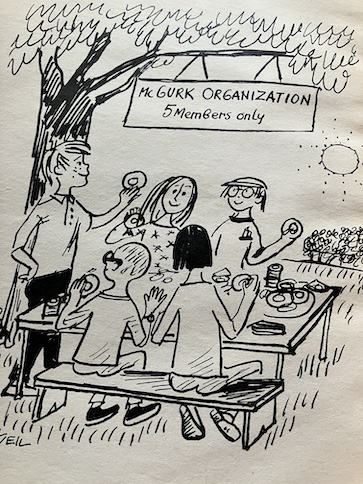
The members of the McGurk Organization are having their annual picnic in McGurk’s backyard when, suddenly, a doughnut leaps off the table and begins traveling through the bushes and grass. None of them can understand what’s happening because they can’t see anything that would cause the doughnut to move like that.

They go after the doughnut to see what happened, and they find Brains Bellingham, the nephew of Miss Bellingham, who lives next door. Brains has been staying with his aunt while his parents are out of town, and he always has a put-down for the members of the McGurk Organization. Brains is holding his aunt’s Yorkshire terrier, Dennis, and the missing doughnut, which has apparently been chewed by the dog. Brains apologizes for the dog ruining their “crummy” picnic, but he says that Dennis can’t resist doughnuts. However, that explanation doesn’t satisfy the McGurk Organization because none of them saw a dog carrying the doughnut, just the doughnut moving by itself. Brains makes an excuse about the dog being small and blending in with his surroundings, but the others can tell that he’s hiding something.

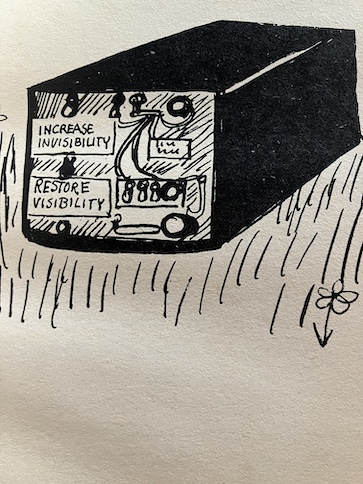
When Brains leaves for a moment because he says his aunt is calling him, they spot a strange black box in the grass. The box has dials and switches on it, and there are two labels: “Increase Invisibility” and “Restore Visibility.” Brains is known for building various inventions, so they know this is probably something he made, but does this device really make things invisible? Is that why they couldn’t see the dog when he stole the doughnut? They have a look inside the device, but since none of them is particularly good with electronics, they just know that it contains a bunch of wires and seems to be powered by batteries, and there is some kind of light inside the box. There are also doughnut crumbs inside the box.

When Brains sees them messing with the box, he yells at them to stop snooping. Joey, the organization’s secretary, knows that part of Brains’s problem with the organization is that he’s jealous because he really wants to join. He’s hinted before that they need a laboratory man to help them with forensics. McGurk might have taken him up on the offer except that Brains was condescending and insulting in the way he made it, calling them “dummies.” He’s a little younger than the rest of them, too, so his condescending attitude makes him seem even more like an annoying little kid. McGurk tries to ask Brains about his strange device, but Brains just refuses to answer and takes the box and the dog away.

The members of the McGurk Organization return to their picnic, but they can’t stop wondering about Brains, his strange invisibility device, and how he accomplished the trick with the dog and the doughnut. Most of the organization members are pretty sure that there must be some kind of trick to it, but they can’t figure out how Brains did it. While they discuss it in their basement meeting room, they hear what sounds like the jingle of dog tags, and Willie, who has a very sensitive nose, says that he smells a dog. They search the basement and find a dog’s rubber bone. Then, Brains shows up, looking for Dennis. To their astonishment, Brains seems to pick up an invisible dog, who seems to be struggling and making dog noises, growling and jingling tags!

When the organization goes to confront Brains about what just happened, they find him with his strange box. The box appears empty on the inside, but they hear dog sounds from it. Brains operates the controls and opens the box again, and Dennis comes out! Brains claims that he invented the invisibility box by accident while he was trying to develop a treatment for getting rid of Dennis’s fleas and ticks using light rays. Brains says that there is a side effect where Dennis sometimes turns invisible at random times without Brains intentionally turning him invisible but that he’s working on the problem.

McGurk is thrilled at the possibility that Brains might be able to build a machine big enough to turn a person invisible, and he even offers Brains membership in the organization if he can do it. Brains says he could, but to everyone’s surprise, he turns down the membership offer. He says that he knows they don’t really want him in the organization; they just want his machine. It’s a little embarrassing, but it’s true.

The members of the McGurk organization consider ways that they could get Brains to change his mind. McGurk considers blackmail, but Wanda says that wouldn’t be right for a detective organization. Wanda thinks McGurk should apologize to Brains for the way he turned Brains away when he tried to join earlier, but McGurk can’t stand the idea of apologizing. Willie thinks they could offer to pay Brains, but they don’t really have anything they could pay him. They all ponder what would happen if they let word of Brains’s invention get out to the public or even the government.

Then, Brains comes to them, asking for help. He says that Dennis has turned invisible again, and he’s run off! Can the McGurk Organization find an invisible missing dog?

The book is available to borrow and read for free online through Internet Archive (multiple copies).

I didn’t read this book when I was a kid, although I read many others in the series. Because I didn’t read this book before, I didn’t really know the story of how Brains joined the McGurk Organization. There are some references to it in some of the later books in the series, so I knew that, when the other members of the organization first met Brains, they were investigating him for some trick he’d played on them. I was used to Brains being their friend, so it seemed odd to see him as the antagonist/suspect they are investigating in this book.

During the story, the members of the McGurk Organization are pretty sure from the beginning that Brains is playing some kind of trick, but they’re not sure how. He does manage to convince them temporarily that he has successfully developed an invisibility device, but McGurk soon realizes that something Brains has said contradicts what’s happened. Then, he and the others reexamine what happened to figure out how Brains staged his tricks. They’re a little mad at being tricked, so they pull one more trick on Brains to get even before they all forgive each other. Brains shouldn’t have called the others “dummies” or been condescending to them, and the others shouldn’t have been too quick to write him off just because he’s a year younger than they are. In the end, McGurk says that anybody who’s clever enough to work out a complicated trick like this one deserves to be a member of the organization, and they hold another picnic to celebrate their new member.

The Case of the Tricky Trickster

The Bobbsey Twins

Before I begin, I’d like to acknowledge Sean Hagins, for supplying me with photos of this book! Usually, I take pictures of books myself, but I just couldn’t find a physical copy of this one. Sean is a big fan of the Bobbsey Twins, particularly the New Bobbsey Twins mysteries, and you can see some of his video reviews as well as videos about his photography work on his YouTube channel, SJHFoto. Thanks, Sean!

The PTAs at the schools the Bobbsey Twins attend, elementary and middle school, are holding a variety show to raise money, with students showing off their talents. A boy in Freddie and Flossie’s class, Brian, is going to put on a juggling act, but Freddie and Flossie are going to help another friend, Teddy, with his magic act. Nan and Bert have a rock band with some friends called the Aliens, and they’re going to be performing, too. Danny Rugg, the school bully, even has an act where he’s going to play the accordion.

However, things soon start going wrong with the show. During the rehearsal, someone turns on the Aliens’ amplifier, making a loud sound that startles everyone. Then, a pole falls and almost hits a student while she’s singing. Then, Brian slips on some floor wax. Freddie and Flossie suspect Danny of playing pranks on everyone because he was near the places where the pranks occurred, and it seems like the kind of thing he might do, but there are other suspects.

Some of the other students seem nervous about performing their acts or think that the show won’t really be that good. Could someone be trying to sabotage the show to get out of performing? Then again, there seems to be some kind of rivalry between the music teacher who is directing the show and Mr. Horton, the fifth grade teacher. Mr. Horton seems resentful that he wasn’t given the chance to direct the show, and he keeps trying to prove that the music teacher is doing things wrong and that he could do them better. Just how far would he go to prove that he would be the better director?

The book is available to borrow and read for free online through Internet Archive.

I thought that the mystery was good, although I also thought that the culprit was obvious about halfway through the story. It might take kids longer to figure out who it is, but there is one person who gets more than their share of the sabotage, and some of the tricks are ones that a person could only play on themselves. There is a student who is trying to get out of having to perform, but once the Bobbsey Twins figure out why, they manage to work things out so that the student is able to go ahead with their act.

The story reminded me a little of The Tap Dance Mystery in the Eagle-Eye Ernie series, although the mysteries aren’t the same. What reminds me of the other book is that both stories involve family expectations. Performing in front of classmates is enough to make anyone nervous, but having family with high expectations present puts a great deal of pressure on a child performer. There is a bit more than that because there are reasons why the student doesn’t think they can live up to everyone’s expectations, but fortunately, a little help from a friend can go a long way!

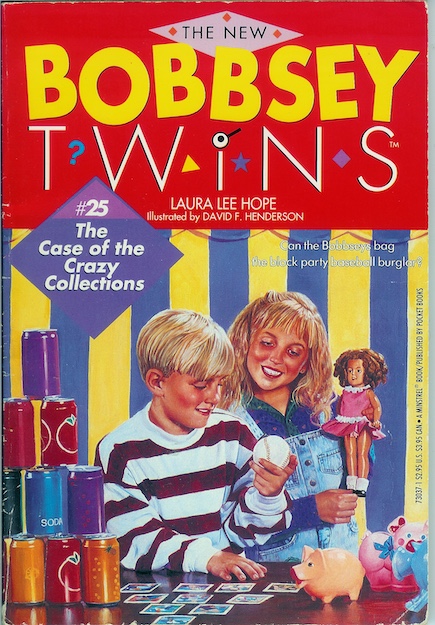
The Case of the Crazy Collections

The Bobbsey Twins

Before I begin, I’d like to acknowledge Sean Hagins, for supplying me with photos of this book! Usually, I take pictures of books myself, but I just couldn’t find a physical copy of this one. Sean is a big fan of the Bobbsey Twins, particularly the New Bobbsey Twins mysteries, and you can see some of his video reviews as well as videos about his photography work on his YouTube channel, SJHFoto. Thanks, Sean!

The Bobbsey twins’ neighborhood is having their annual block party, and the Bobbsey twins and their parents are helping to set up for it. As part of the party, the neighborhood has rented a tent, where kids from the neighborhood are displaying their collections. The neighborhood kids collect all kinds of things, like baseball cards, comic books, soda cans, autographs, and coins. One boy, Kevin, has an autographed baseball that his grandfather gave to him. The neighbors are charging people money to see the exhibit of collections, and the money will be used for a pizza party later.

Later, Kevin’s autographed baseball disappears. Could the baseball thief be Mr. Sher, a visitor staying with their neighbor, Mr. Andersen? Mr. Sher tried to buy the baseball from Kevin earlier, but Kevin turned him down. Then again, Kevin’s cousin, Steve, was jealous that Kevin has the baseball. Steve turned down the offer of some of his grandfather’s old collectible items in favor of a savings bond, which he has already cashed in and spend on video games. Steve tried to borrow more money from Kevin earlier, but Kevin turned him down because Steve hasn’t yet repaid him for money Kevin loaned to him before. Danny, the neighborhood bully, was also mad at Kevin earlier. He’s a friend of Steve’s and didn’t want to have to pay to see the collections. Then again, another local girl, Jennifer, collects autographs, and they see her at a collectors’ shop. Would she know the value of an autographed baseball, and was she trying to sell it? With so many people coming and going from the tent where the collections were on display, it’s hard to say who might have taken something. The thief may have even been the Bobbseys’ own dog, Chief, who has developed a habit of collecting and hoarding baseballs.

Then, another boy realizes that his prized hologram sticker is missing. Could the thief have taken that, too? Their clues are an unexplained slit in the back of the tent, some footprints, and a pin with Greek letters on it. Can the Bobbsey Twins find the valuable baseball and return it to Kevin?

The book is available to borrow and read for free online through Internet Archive.

Something I thought was interesting about this story was that it brings up the concept of collecting things for fun or sentimental value vs. collecting things because of their monetary value. Most of the kids in the neighborhood collect things just for fun. At first, Kevin doesn’t seem to fully realize the value of the autographed baseball. His attachment to the baseball is because he got it from his grandfather. When he had the offer to sell it to Mr. Sher, he refused because the baseball reminds him of his grandfather.

I had a strong suspicion about the identity of the baseball thief early in the story, and my guess turned out to be right, but I liked it that there were plenty of other suspects to consider. There are child suspects, adult suspects, and even the Bobbseys’ own dog. Any of these could be plausible. When they realize that the hologram sticker is missing, it raises the question of whether the person who took the baseball also took the sticker, if the sticker was taken by someone else, or if the missing sticker is just a red herring. Overall, I enjoyed the mystery, and I liked the abundance of suspects.

The Case of the Bicycle Bandit

A Jigsaw Jones Mystery

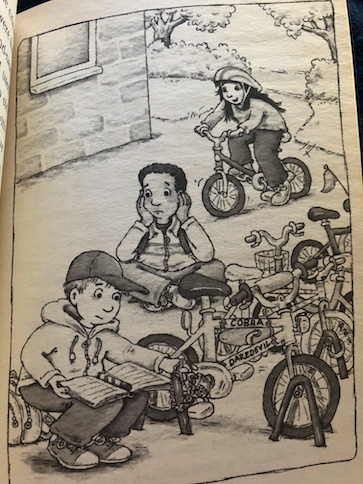
Jigsaw Jones and his friend, Ralphie, have to go to the library to get books for a book report at school. While they are at the library, somebody steals Ralphie’s bike!

First, it’s strange that Ralphie’s bike was stolen because Ralphie is sure that he locked it up using the same chain that he used to also lock up Jigsaw’s bike. How could someone take a bike that was chained up, and since the two bikes were chained together, why is Jigsaw’s bike still chained up, as if the lock was never opened?

Second, if someone could get the chain open to take one of the bikes, why did the thief take Ralphie’s bike? Jigsaw’s bike is new and in good condition, while Ralphie’s bike, which he calls “Old Rusty”, is old, beat-up, and always breaking in some way. Ralphie is fond of “Old Rusty”, which was a hand-me-down from his older brother, but if some stranger had a choice of stealing one of two bikes, wouldn’t it make more sense to take the one that’s in better condition?

Jigsaw Jones calls his friend, Mila, to help him investigate and find Ralphie’s missing bike, and they get some help from a classmate who is good at drawing portraits to interview witnesses and do sketches of suspects. Their most likely suspect is a skateboarder whose face nobody saw clearly. But, how did the skateboarder know how to open the lock on the bike chain, and why did he take only the old bike and lock up the newer one again?

The book is available to borrow and read for free online through Internet Archive (multiple copies).

Books in this series are easy, beginning chapter books with pictures that accompany the story. The mystery in this book is pretty simple, although it might seem more difficult to younger readers. I liked the way the characters reasoned it out, logically confronting the problem of how the thief opened the bike chain and why the thief took the older bike instead of the new one. I also enjoyed their use of an amateur sketch artist to find one of their suspects.

Even after Jigsaw does a stakeout and realizes who is responsible for taking the bike, he doesn’t seem to quite understand the motive until the thief explains it, although the motive was what I figured it was. Revealing the culprit in this book also includes a spoiler for an earlier book in the series.

I was amused when Jigsaw said that he charges a dollar a day for his detective services. At first, I thought that shows the inflation that’s happened since Encyclopedia Brown charged his clients a quarter. Then, Jigsaw checks out an Encyclopedia Brown book from the library, showing that Jigsaw is familiar with the books and also giving kind of a nod to an earlier boy detective who may have somewhat inspired this series. I always appreciate children’s books that reference other books.

The Pet Day Mystery

This book is part of the Sherlock Street Detectives series.

It’s Pet Day at school, and twins Walter and Ann are bringing their dog, Watson, and their cat, Fuzz Face to school with them. Watson is really Walter’s dog, and Fuzz Face is Ann’s cat. The school bus is chaotic and noisy because the other children have their pets with them, too.

At school, each of the kids tells the rest of the class about their pet. When it’s time to go to lunch, the kids give their pets food and water and leave them in the classroom.

When they come back from lunch, a pair of hamsters are missing, and their owner, Tina, thinks that Fuzz Face might have eaten them. Ann points out that Fuzz Face couldn’t have eaten the hamsters because Fuzz Face was in his cage during lunch.

The kids figure that the hamsters are probably hiding somewhere in the room, and they ask Tina to tell them everything she knows about the hamsters so they can find them. They use what Tina tells them about the habits of hamsters to figure out where they are.

The book is available to borrow and read for free online through Internet Archive.

It’s a fun picture book mystery, but it’s also educational, like other books in the series. The information the kids give about their pets is true. Some of them say where their pets originally came from, like Pedro, who says that his pet parrot is a breed that comes from South America. Ann mentions that her cat takes vitamins and has to go to the vet sometimes, like people have to visit their own doctors. I liked how the characters use facts about the behavior of hamsters to figure out where the hamsters went.

I was a kid about the age of the characters at the time this book was published, although I don’t remember reading this book at the time. When I was in kindergarten, the year before the book was published, we had a special pet event in my class, but we didn’t do it like the class in this book. As I recall, different people brought in pets on different days so it was less chaotic and there was no chance of one pet eating another, which is a real risk. Also, all pets had to be in cages to keep them from running away or causing trouble, and they were never left unattended. My mother helped me bring our pet birds to class, and she took them home with her immediately afterward, so they weren’t left sitting around the classroom.

The book has a vocabulary list and glossary in the back.