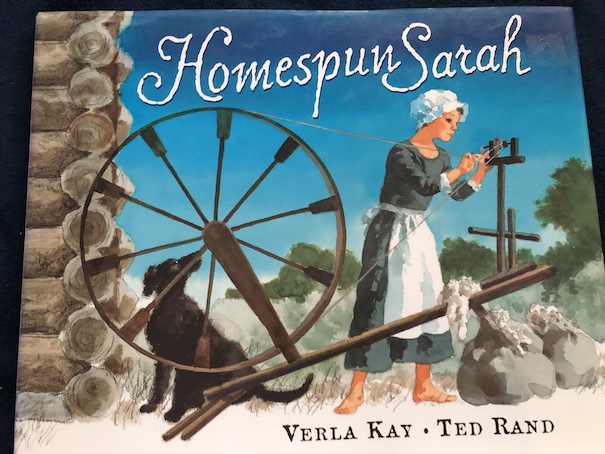
Homespun Sarah

This picture book tells a story in rhyme about a girl living in 18th century Pennsylvania and what she and her family do to make her a new dress when she begins outgrowing her old one.

As Sarah gets dressed one morning, her old dress is noticeably tight, and it’s beginning to get too short for her. Because her family lives on a farm, they must produce most of what they need themselves, and that includes clothing. For Sarah to have a new dress, they must make one themselves entirely from scratch, which is what “homespun” means – they make the dress from homemade cloth from yarn that they have spun themselves.

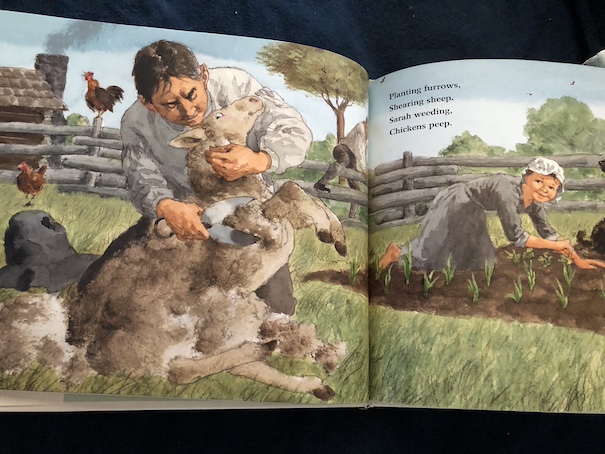
Various family members carry out different household chores, and as the story continues, readers see how everything they do is not only a part of the family’s daily life but also contributes to the creation of the new dress. The family raises sheep, so they must start by sheering the sheep to get the wool for the dress.

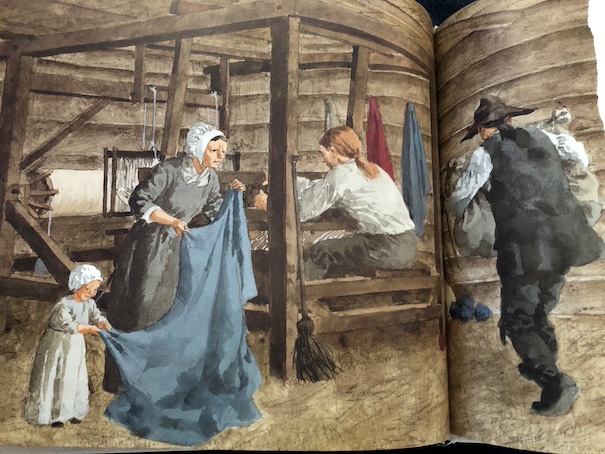
In between doing routine chores, like doing the laundry and making new candles, they card and comb the wool and spin it into yarn with their spinning wheel. The family also owns a large loom, which is how they weave the wool yarn and flax into cloth called linsey-woolsey. The cloth they make is blue and red, dyed using plants that they have produced and gathered.

Once they’ve made the homespun cloth, Sarah’s mother measures her to plan the size of the dress and sews the dress. Sarah gets a new red dress, while her younger sister gets a blue one. Sarah is excited about her new dress, which fits her much better than the old one, and spins around to show it off!

The author’s note at the beginning of the book says that the story is set in Pennsylvania during the 1700s, and she wanted to show how people lived during that time, having to produce everything or almost everything they used by themselves. It also shows various aspects of family life, from where and how they slept to what they ate. The characters in the book, even the children, are shown drinking beer, but the author explains that is because water wasn’t considered entirely safe to drink. The beer they drank back then was very weak and “barely alcoholic”, which was why the children could have it. (We have water treatment facilities and devices available in the United States in modern times to ensure the quality of the water, so this isn’t something that we typically do now, especially with children, and I have more to say about this in my reaction.)

The book is available to borrow and read for free online through Internet Archive.

When I was a kid, I often skipped over prefaces and author’s notes because I just wanted to get to the story, but the author’s note really adds some historical depth and helps to clarify some aspects of the story that children might misunderstand. For example, I thought that the clarification about the mention of the characters drinking beer was important. Alcohol, chemically speaking, is actually a mild poison. It’s mild enough that humans can have it in small amounts without dying or even becoming ill (although we can get sick or die from large amounts, and some people have a greater or weaker natural tolerance to it, compared to each other), but even weak alcohol might kill germs in water and make it safer for humans to drink. This is the way it’s being used in this book. Because this book is for children, it’s helpful to explain this so that child readers understand that what the characters have isn’t quite the same as modern beer and that it’s not okay for children to drink modern beer in the same way. I think this is good book for parents or other adults to read with kids, so the adults can point this out to kids and help them to understand other historical elements of the story that they might miss or misunderstand.

The author’s note also explains that, because people during the time the story is set, had to make their own clothes by hand, and making was a very time-consuming, labor-intensive process, people had far fewer clothes back then than they do now. It was common for someone to have only one set of clothes that they wore every day until they were no long usable. Getting a new set of clothes was an exciting occasion, and that’s what the story in the book tries to capture. When readers see what this family goes through to create just one new dress for a girl who is outgrowing her last one, they can understand how much that dress means to the girl who receives it.

I love books that show how things are made, so I appreciated this book for the process it shows. However, because the story is told in short, simple rhymes and focuses on the how the process would look to a casual observer without getting too detailed, I felt like there were many parts of the process that were implied rather than stated. For example, they don’t explicitly mention that the red and blue dyes for the cloth came from the red berries the girls gathered or the blue flowers of the flax plant, but it’s implied by the earlier mentions of these plants and the way the book showed the characters gathering them. That could be enough for a casual reader, but I’m the kind of person who likes hearing the details of the process, so I would have liked more detailed explanations.

I did appreciate the way the book showed aspects of daily life in the 18th century. Some of them are explained in the author’s note, but there are also other parts of daily life to notice in the pictures. One of my favorite ones was the way that the youngest child in the family is tied to her mother or older sister’s apron strings to keep her from wandering away and getting into trouble while they’re doing their chores.

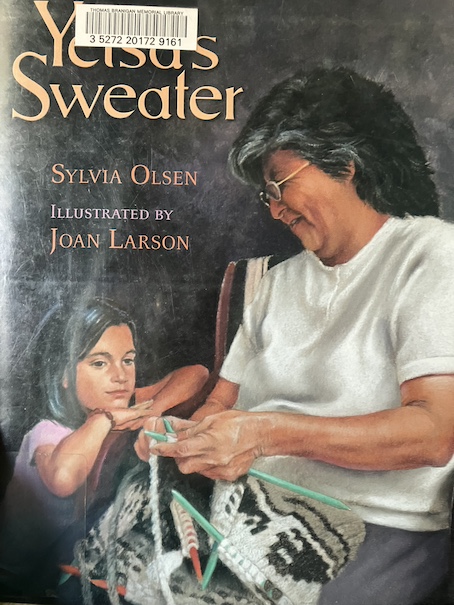
Yetsa’s Sweater

Yetsa and her mother go to her grandmother’s house to help her prepare wool for making a sweater. Yetsa is getting too big for the sweater she’s wearing, but she still loves it because her grandmother knitted designs in it that have personal significance to her and her family.

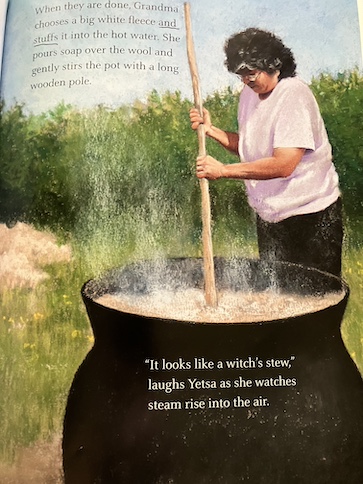
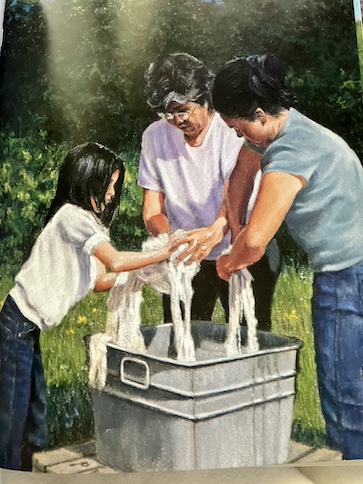
Yetsa’s grandmother builds a fire and brings a large pot for the wool. They have to sort through the fleeces they received from Farmer McNutt and remove any little twigs or hay or anything that doesn’t belong. Yetsa yells when she finds some sheep poop stuck in the fleece. After they’ve removed the debris as best they can, they wash the fleece in hot water over the fire. Then, they rinse it in cool water and wring it out.

While the wool dries on the clothesline, they take a break and have some bread and blackberry jam.

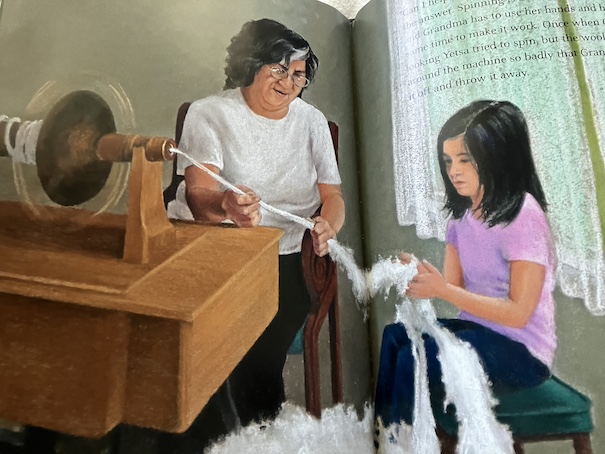
The following week, they begin pulling apart the fibers of the wool, making it fluffier, a process called “teasing.” Then, Yetsa’s grandmother runs the wool through a carding machine, and they begin spinning it into yarn with a spinning machine.

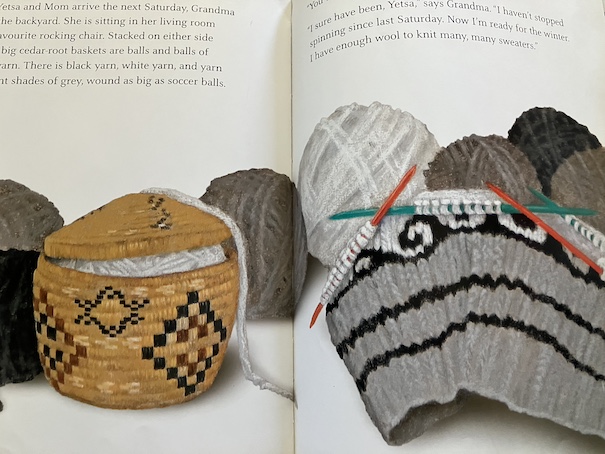
When the spinning is finished, Yetsa’s grandmother has enough wool to make many sweaters.

In the back of the book, the author explains that Yetsa is her own granddaughter and that knitting is a traditional skill for Coast Salish women. They learned knitting from Scottish settlers who came to British Columbia, and the sweaters they made came to be called Cowichan sweaters, after the largest tribe in the region. Children like Yetsa begin learning how to prepare wool and knit at a fairly young age.

The book is available to borrow and read for free online through Internet Archive.

I love books that show people making traditional crafts, and I enjoying following this one from beginning to end! Readers get to see each step in the process of making the sweater, starting with the wool and ending with the finished sweater. I’ve been knitting from a young age, but I’ve never tried spinning my own wool, and I liked seeing the intricate patterns of the sweater.

When I was a kid, I often ignored authors’ explanations because my focus was on the story, but as an adult, I like the added details of author’s explanations. This is a family story because Yetsa in the story is based on the author’s own granddaughter.

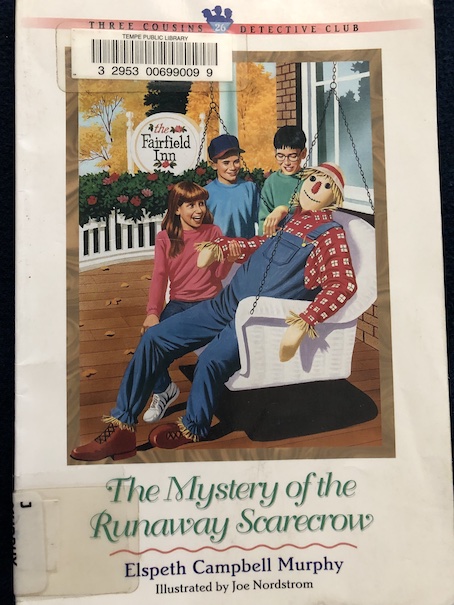
The Mystery of the Runaway Scarecrow

Three Cousins Detective Club

#26 The Mystery of the Runaway Scarecrow by Elspeth Campbell Murphy, 1999.

Sarah-Jane astonishes her cousins when she tells them that Buster, the scarecrow her mother made, which has been sitting outside of a local restaurant, has gone “on vacation. Scarecrows don’t just get up and go on vacation, and when they say that, Sarah-Jane says that Buster left a note saying that he had gone on vacation. The boys don’t believe scarecrows can write notes any more than they can go on vacation. Sarah-Jane admits that scarecrows don’t write notes, but someone else wrote a note on Buster’s behalf and left it behind when Buster disappeared. The note says that Buster is going on vacation and will be back when someone figures out where he’s gone. That’s weird enough, but Sarah-Jane says that Mr. Wesley, who owns the restaurant where Buster was, has been receiving pictures of Buster on his trip in the mail since he disappeared.

It seems like someone is playing a bizarre prank or maybe setting up some kind of treasure hunt involving the scarecrow. The town mayor says that Buster’s “vacation” has created more publicity for the town’s upcoming Fall Festival, so it could even be a publicity stunt. However, it’s been a few days since the last pictures of Buster arrived, and Mr. Wesley is inviting Sarah-Jane and her cousins to investigate Buster’s disappearance and find him because he knows that they like to solve mysteries.

The kids study the pictures for clues to Buster’s whereabouts, but the pictures are pretty generic. They show him outside a motel, at a gift shop, and at a gas station, but the locations aren’t very distinctive and could be found in any number of cities. The postmarks on the envelopes that pictures came in are all still in the area, so it seems like Buster didn’t go very far. They need to hurry if they’re going to find Buster in time for the town’s parade because the parade is tomorrow!

Then, Sarah-Jane reveals that something else mysterious has happened in the area recently. Someone stole a rare coin from Mr. Clark. This is also an intriguing mystery, but they don’t have many clues to start. Mr. Clark isn’t exactly sure when the coin disappeared because he doesn’t get out his coin collection very often.

For some strange reason, an older boy in Sarah-Jane’s neighborhood, Billy, seems very concerned about whether Sarah-Jane and her cousins have made any progress in finding Buster. Could Buster’s disappearance also have something to do with the missing coin?

Theme of the Story:

“The land has produced its harvest; God, our God, has blessed us.”

Psalm 67:6

The book is available to borrow and read for free online through Internet Archive.

My Reaction and Spoilers

I liked the way the person who took the scarecrow used the pictures to provide clues to their treasure hunt. Readers won’t be able to figure it out right away without explanation from the characters because the book doesn’t show all the pictures, but I liked the concept for how the culprit worked a series of clues into the pictures. There’s also a fun backstory behind the scheme. The prankster doesn’t have a sinister motive. The scarecrow caper is meant as a kind of prank/game/harmless publicity stunt.

I guessed pretty quickly who had taken the scarecrow, based on motive, but I liked the addition of Billy and the coin because it complicated the story and provided a second mystery on top of the first. There is a genuine crime in the story, but it’s not the one that the kids start out investigating.

The story takes place during October, but it’s not on Halloween. The town’s Fall Festival just seems to kick off the fall season in general.

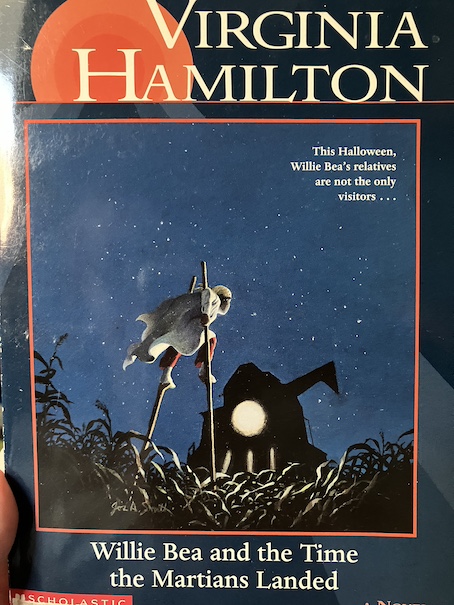
Willie Bea and the Time the Martians Landed

It’s Halloween 1938, and Willie Bea’s relatives have gathered at the old family farm, near where she lives. Money is tight because of the Great Depression, but one of her aunts lives and works in the city, making more money than the others, and is willing to help fund family dinners and provide a little extra for her nieces and nephews when they need something, like new clothes. The aunt is a little scandalous in their family for her multiple marriages, but the others appreciate her generosity, and the nieces and nephews like getting some extra attention and a few treats from her.

The family gathering is a bit chaotic with children running around and getting into trouble. One of Willie Bea’s cousins gets into particular trouble with her mother for using his bow and arrow set to shoot a pumpkin off of Willie Bea’s younger brother’s head. Their mother panics when she catches them doing it because he could have missed and killed the little boy, but Willie Bea tries to calm her mother. Willie Bea was less worried because she knows her cousin’s archery skill and that he wasn’t going to miss, but she understands that adults think of the risks and aren’t fully aware of what the kids are capable of doing. (I’m siding with the mother on this one. Even people who are very good at something can miss now and then, and it’s a big risk to take with someone’s life.) Willie Bea also realizes that the decision to use her little brother for the William Tell act actually came from another cousin because the cousin doing the archery wouldn’t have thought of it himself, and it’s not fair that her mother doesn’t know to blame this other cousin.

Willie Bea talks to her father about the incident, hoping that he’ll understand how unfair it is. However, her father tells her that what her cousin did was dangerous, no matter why he did it. Even though he has a reputation for being good with archery, even people who are good can still miss, and accidents can happen. (See?) Her father lets Willie Bea know that he’s aware that she and her cousins do risky things sometimes when they’re playing with each other, but as an adult, he and the other adults have a responsibility to tell them when something they’re doing is too risky and to put a stop to it. No matter how many times they’ve done some of these things without having an accident, some things are just accidents waiting to happen. They should never assume that an arrow can’t go wrong just because it hasn’t yet or that they can’t fall from a high place just because they haven’t fallen yet.

Willie Bea is a little embarrassed by the talk and feels like her father still doesn’t understand. However, Willie Bea herself has been starting to understand a few things about her relatives this Halloween, things that she either hasn’t noticed before or only half noticed. She can see that one of her cousins is too manipulative, noting the little tricks she uses to get her way and the things she says and does when she wants to be spiteful. She can see that her other cousin has trouble asking up for himself and is particularly vulnerable to manipulation.

Willie Bea also begins to notice things about the adults in the family and their relationships with each other. Aunt Leah, the aunt who has more money than the others and has been married multiple times seems glamorous and fascinating to Willie Bea. Aunt Leah is into horoscopes and fortune telling, and when she reads Willie Bea’s palm, she predicts something special for her. Although Willie Bea loves her own mother, she is intrigued by the family gossip that her father was seeing Aunt Leah before falling in love with her mother, and Willie Bea fantasizes about what it would be like to live with Aunt Leah in the city. She imagines that it would be exciting, and she asks her father why he chose her mother instead of Aunt Leah. Her father knows that Willie Bea doesn’t entirely understand what it’s like to make that kind of choice and what living with a woman like Aunt Leah would really mean. (It occurred to me that the multiple divorces Leah has had might be a clue.) He just explains to Willie Bea that his choice became clear after he got to know her mother as well as her sister, Leah. He knew her mother was the right choice because she was the kind of steady woman who would always be there for him.

That evening, while Willie Bea is putting together her hobo costume and the ghost costumes for her younger siblings and her parents are listening to the radio, Aunt Leah suddenly bursts in and starts having hysterics about it being the end of the world! It takes Willie Bea’s parents a while to get a clear answer from Aunt Leah about why she’s so upset. When she recovers enough to explain things, she says that she was listening to the radio, and she heard that Martians have invaded New Jersey! She describes the horrible, terrifying reports that the radio announcer made about the Martians destroying army troops with their deadly heat ray. Aunt Leah was so terrified by what she heard that she not only turned off the radio but unplugged it, and she says that she’ll never plug it in again, which might be a moot point, if aliens really are here to destroy the world. (If you know what was infamously broadcast on Halloween 1938, you know what Leah heard and that it’s not what she thinks it is.)

While Willie Bea’s parents are trying to decide what to make of Aunt Leah’s story, Willie Bea’s Uncle Jimmy arrives. He says that the rest of the family has also heard what Aunt Leah heard and that they’re all gathering at the old family farm. Rumor has it that people have seen the terrible invaders over at the Kelly farm. Willie Bea’s mother gathers the children and heads to the family farm that Willie Bea’s grandparents own to be with the rest of the family, while Willie Bea’s father tries to see if he can find the station that Leah was listening to and hear the reports for himself. It occurs to him that it might not be an invasion of the Martians but could actually be Germans and German war machines because they’ve all heard about the Nazi takeover of Germany, and he remembers the horrible Hindenburg disaster. If Germans could make a blimp that explodes into a fiery terror like that, then he thinks maybe they could make something that resembles an alien invasion.

At her grandparents’ farm, Willie Bea watches as various relatives panic, cluster around the radio, trade rumors, and try to figure what’s going on. Rumor has it that there are Martians on the Kelly farm, so Willie Bea convinces young Toughy Clay to go over there and try to see them for themselves. At Willie Bea’s insistence, they use the stilts that the children like to walk on to give themselves longer legs, so they can get there faster. Nothing is as it seems this Halloween, and Willie Bea’s expedition to see the Martians definitely doesn’t go as planned.

The book is available to borrow and read for free online through Internet Archive (multiple copies, including a short picture book version).

Almost of the characters in this book are African American. I don’t think it’s ever stated directly because there’s no need in the story to describe them, compared to anyone else, but I think it’s subtly implied. There is only one point in the story where race is mentioned at all, and that’s when Willie Bea is hurt, and the doctor comes to see her. Willie Bea describes the doctor as an old man who delivered most of the babies in her family and knows everybody in the community, and she says that he visits everyone, black or white, rich or poor. Willie Bea’s family is at the poorer end of the community because the doctor knows that people like them don’t normally call the doctor unless it’s something that they really can’t handle by themselves.

I found the family relationships in the story confusing at first. The kids are all referred to by nicknames, and when they are first introduced, it’s difficult to keep it straight who is whose sibling and who is a cousin, and who is older and who is younger. At least, that’s how it seemed to me. Relationships are explained gradually as the story continues, along with characters’ real names as well as nicknames, but it takes some time to get to the explanations.

The story has a slow start, and the real adventure doesn’t begin until about halfway through the book. In some ways, it’s a coming of age story for Willie Bea because she finds herself seeing her family in ways that she never has before, becoming more aware of different sides of their personalities and gaining more insights into their relationships with each other. She also comes to see firsthand what her father means about the stunts that she and her cousins pull and how she should never assume that they can’t get hurt just because they haven’t before. Much of this book is what I would call “slice of life”, a sort of glimpse into Halloweens of the past in a rural community, especially one particular Halloween that would have been memorable for anyone who was alive at the time in the United States.

The radio broadcast that has Willie Bea’s family and others in the community panicking over an alien invasion is The War of the Worlds, a play based on the novel of the same name by H. G. Wells. This type of panic over this particular radio performance was a real, historical incident because the radio play was presented in the format of news broadcasts at the time, and some people who tuned into the program late misunderstood what they were hearing and thought that it was a real news broadcast about an actual emergency. It wasn’t a widespread panic because, first, people who started listening to the broadcast from its beginning knew what they were listening to, and second, not everyone was listening to the broadcast at all. Still, there was enough panic over the radio performance that it became newsworthy and has become a piece of American history and lore.

I enjoyed the historical details in the story, particularly all the radio play references throughout the story. Willie Bea’s family likes to listen to radio shows, and I’m familiar with some of them because I also enjoy old radio plays. Her family likes to listen to The Shadow and Little Orphan Annie. Willie Bea likes to amuse her siblings by imitating people from the radio, singing theme songs and reciting jokes from Jack Benny, like the famous “your money or your life” joke.

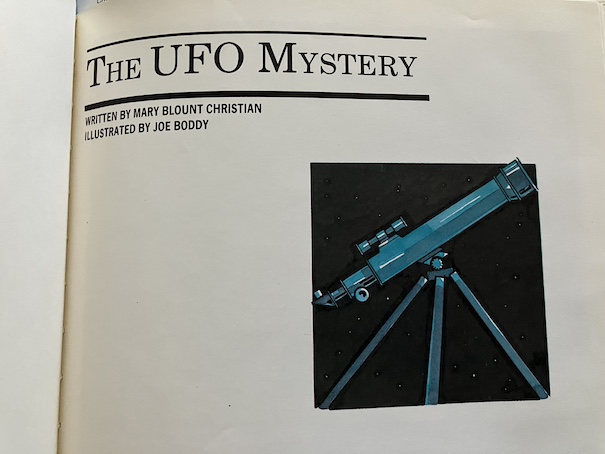
The UFO Mystery

This book is part of the Sherlock Street Detectives series.

Halloween is approaching, and the Sherlock Street Detectives are talking about their costumes. David is going to be a bear, and he made his costume out of an old rug. Pedro is going to be a clown. Walter and Ann, who are twins, refuse to tell anyone what their costumes are because they want it to be a surprise.

Then, David says that he has to go home because it’s dinnertime, and after dinner, he’s going to look for a comet with his telescope. Pedro says that he’s never used a telescope before and asks if he can look, too. David says he can, and Pedro says that he will come back to his house when it’s dark.

When David and Pedro meet to use the telescope, David shows Pedro how to use a star map to find the constellations. While Pedro is looking through the telescope, he thinks that he sees a UFO! At first, David doesn’t believe him. It’s too early to see the comet, so he thinks maybe Pedro saw a meteor. Pedro insists that it was a UFO, and David points out that UFO stands for Unidentified Flying Object. That means that anything that “unidentified” can be a UFO. Pedro can’t identify exactly what it was he saw, but that only means that he didn’t recognize the object. It doesn’t have to be an alien spacecraft, just some normal thing he didn’t recognize, like a meteor, a comet, or even just a firefly.

Since David’s dad works for NASA, Pedro says that they should ask him if it could have been a comet other than the one they were expecting to see. However, David’s dad confirms that there should only have been one comet that night and that the comet should have been in a different part of the sky. The boys talk about getting Walter and Ann to help them investigate, but then, they see some strange creatures in the bushes!

What did Pedro really see through the telescope, and could those weird creatures really be aliens?

The book is available to borrow and read for free online through Internet Archive.

This is fun mystery picture book! Figuring out what/who the aliens are is the easiest part of the mystery, since this is before Halloween and the twins were being mysterious about what their costumes are, although it might seem harder to young children. The answer to what Pedro thought he saw through the telescope is revealed first, although I wasn’t entirely sure what to think of it myself. At first, I thought that the “aliens” might have been throwing around some glowing toy or something, but they would have to have thrown it really high to get it in front of the telescope because the boys were using the telescope on the roof. There’s a perfectly logical explanation behind the phenomenon, and David figures it out by noting where the object was and it was moving. David’s father confirms David’s guess with a call to NASA.

One of the nice things about this simple mystery story is that it introduces some real concepts for stargazers and amateur astronomers. There is a vocabulary list and glossary in the back of the book.

This series also offers good representations for racial diversity. Racial issues don’t enter into the story. The kids are just a bunch of kids who happen to live in the same neighborhood and are friends and like to solve mysteries, but they are a mixed racial group, and that’s nice to see. David is black, Pedro is Hispanic, and the twins are white. The children’s races are not referred to in the text of the story, but they are shown in the pictures.

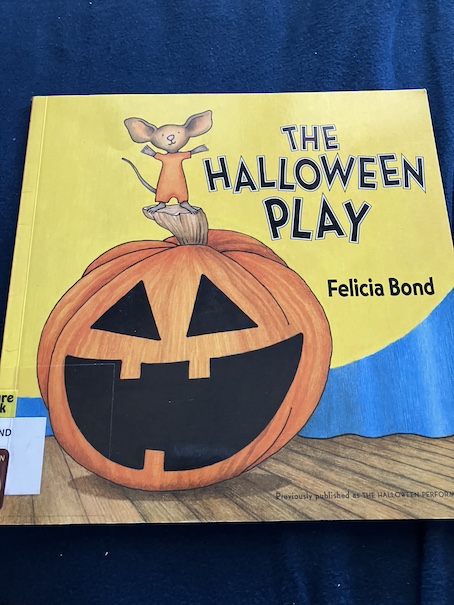
The Halloween Play

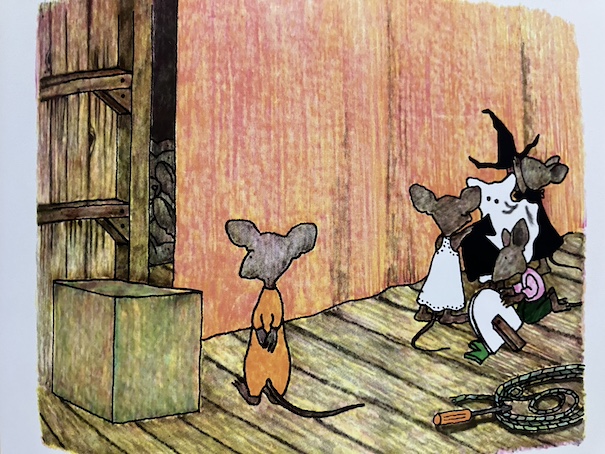
Halloween is coming, and the students in Roger’s class at school are preparing for their Halloween play. The class rehearses their play every day, and they make invitations to the play to send out to people in town.

On the night of the play, the school’s auditorium is full of people waiting to watch the play, and Roger waits backstage for his turn to go on stage. He doesn’t have a big role in the play, but his role is important.

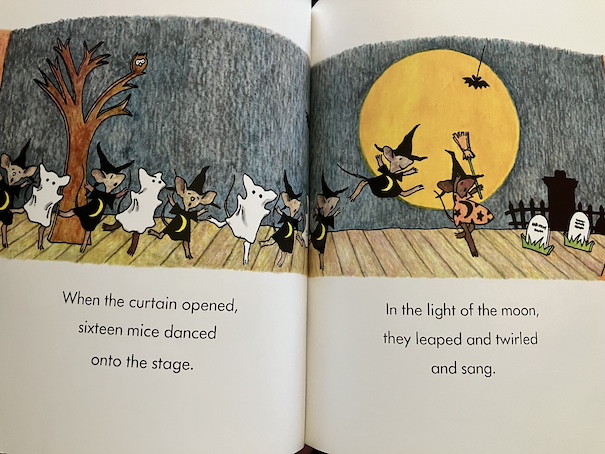
The other students in Roger’s class go on stage, dressed as witches, ghosts, and skeletons. They perform the songs and dances they’ve rehearsed. The audience laughs at the funny parts, and everyone is enjoying the play.

All the time, Roger is backstage, listening and preparing for his part. He counts down the lines until the moment comes when Roger steps on stage for the play’s finale!

The book is available to borrow and read for free online through Internet Archive (multiple copies).

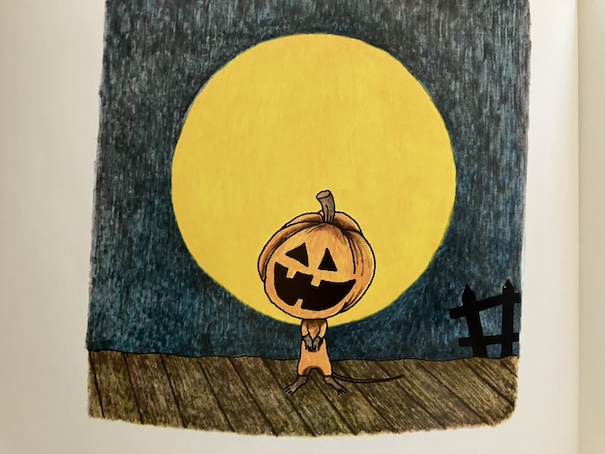
I remember reading this book when I was a little kid, and it was a Halloween favorite of mine! Felicia Bond is better known today as the illustrator (but not the author) of If You Give a Mouse a Cookie, which was originally published two years after this particular picture book. The art style between the two books is noticeably similar, but the book about the Halloween play is different because this is about mice who live like people and do not interact with humans. I was also amused that one of the student mice in this book was dressed in an orange shirt with a black zig-zag and black shorts, like the cartoon character Charlie Brown, who wears a yellow shirt with a black zig-zag and black shorts. The tv special It’s the Great Pumpkin, Charlie Brown was known for popularizing the concept of Halloween tv specials, and Roger the mouse plays a large pumpkin in his class’s Halloween play, although Roger isn’t the mouse wearing the Charlie Brown style clothes. Roger is the one in the sweater with an R on the front. I was just amused by this little detail in the pictures of his class.

This picture book is a sweet little story about a mouse boy and the Halloween play given by his class. School plays on a wide variety of themes are a common experience for human children attending both public and private schools, and they are often memorable points in children’s school experiences. They can also be very emotional experiences. Students can be nervous about plays and being on stage in front of an audience, and sometimes, there are conflicts about which students get the best parts. This cute little picture book doesn’t have any drama in it and doesn’t talk about stage fright, although there are other children’s books that address these issues.

Instead, the story is more about a magical evening and the small but important role played by one particular student. Much of the story shows the build-up to the play, and when the play begins, Roger only appears on stage at the end of the play. The rest of the time, he’s listening to the other students from back stage, waiting for his cue to step into the spotlight. We don’t know exactly what the play is about, but it’s not that important. Those quiet moments of anticipation backstage are magical, and Roger will never forget how exciting this evening has been!

Everyone Goes as a Pumpkin

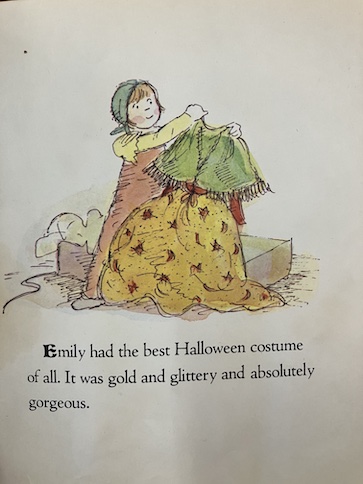
Emily thinks that she has the best costume for the upcoming Halloween party! It’s a beautiful dress that makes her feel elegant and magical.

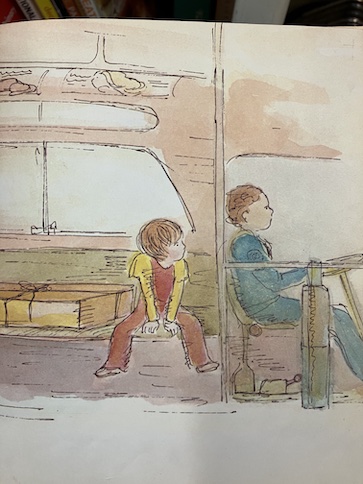
Emily takes the costume on the bus to show her grandmother, but somehow, the box with the costume in it disappears during the ride. Emily is upset at losing the costume and doesn’t know what to do. She doesn’t want to go to the party as something ordinary, like a pumpkin.

Then, her grandmother suggests that she just go as herself. As herself, Emily is truly unique!

I liked the grandmother’s unorthodox solution to the problem of the missing costume. I can understand a kid loving a particular costume so much that it seems like nothing else will do, but showing Emily that she’s just fine going to the party as herself is a good way to show her that she is just fine as she is, just being herself. Emily would have liked going with the costume she loved, but she doesn’t need any costume in particular because she is good enough by herself.

Spooky Sleepover

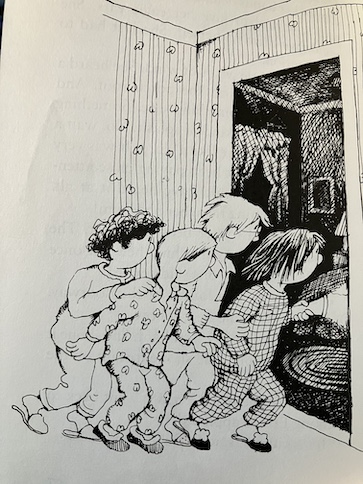
A couple of weeks before Halloween, Ernie decides to have a sleepover party for her friends. The kids enjoy scaring each other with ghost stories, and a thunderstorm adds to the spooky atmosphere.

Michael, in particular, keeps insisting that an old witch called Mrs. Maloney used to live in Ernie’s house with a bunch of cats. When spooky things happen during the course of the evening, Michael says that Mrs. Maloney and her cats have returned to haunt Ernie’s house. The kids try to stay up until midnight because ghosts are supposed to appear at midnight, but there’s no telling what they might actually see.

The kids fall asleep, but they wake up around midnight when they hear a crashing sound from the basement. Although they are afraid, they take their flashlights and go down to see what it is. Will they find a ghost?

The book is available to borrow and read for free online through Internet Archive.

This is one of those stories that has a pretty simple explanation, but the adventure seems bigger to the kids because their imaginations run away with them. I remember liking this series when I was a kid, and I think this is one of the books I read back then. I liked the creepy-cozy atmosphere of the story. Even though the kids have been scaring each other with ghost stories, they’re still just at a sleepover in an ordinary, safe house, and there’s nothing there that is harmful. It’s that kind of safe scariness that Halloween represents to young kids. They can enjoy the spookiness, knowing that there’s a logical explanation for everything. Adults and older kids will figure out pretty quickly what’s really going on.

Frankenstein Moved In on the Fourth Floor

Frankenstein Moved In on the Fourth Floor cover

Frankenstein Moved In on the Fourth Floor by Elizabeth Levy, illustrated by Mordicai Gerstein, 1979.

Frankenstein Moved In on the Fourth Floor new neighbor

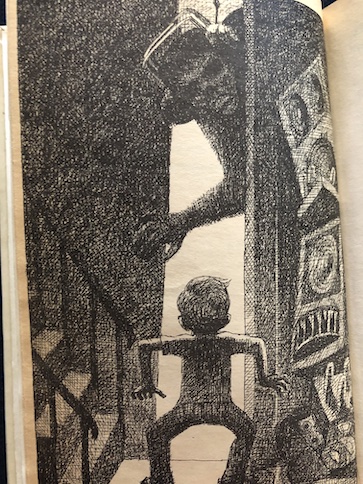
Sam lives with his brother and mother on the 19th floor of a large apartment building. One day, when he and his mother are going to meet his brother at a friend’s house, they try to take the elevator down to the ground floor, but it doesn’t seem to be working. With no other choice, they take the stairs, and when they reach the fourth floor, they discover the reason why the elevator isn’t working.

A new neighbor, Mr. Frank, is moving into the apartment building, and he’s stopped the elevator at his floor to unload all of his stuff. He has boxes and boxes of wires and other electronic components, and he gets really upset when anybody else touches them. He has refused all offers of help to unload the boxes, he’s kept the elevator tied up, and he’s been rude to his new neighbors about these things.

Frankenstein Moved In on the Fourth Floor reading book

Sam thinks that Mr. Frank is frightening. He looks weird with those strange headphones with an antenna he keeps wearing. When he and his mother go to pick up his brother, Robert, Sam tells him about Mr. Frank and his theory that Mr. Frank is actually a monster. Sam thinks that Mr. Frank looks like Frankenstein. Both of the boys are into movie monsters, but Robert thinks at first that Sam is making it up. The boys have a debate about whether Mr. Frank would actually be Frankenstein the scientist or the monster that Frankenstein created in the book and movie because, although many people call the monster Frankenstein, that was actually the name of the monster’s creator. When the boys consult an abridged version of Frankenstein, Sam becomes convinced that the book’s description of Frankenstein the scientist sounds like Mr. Frank.

Frankenstein Moved In on the Fourth Floor walking up stairs with candle

The next day, the boys go down to the apartment house’s basement, where tenants have storage rooms. Sam wants to see what Mr. Frank is storing in his storage room, but when the boys start talking about the possibility that he might keep bodies in there, they chicken out. In the meantime, Mr. Frank gets on everyone’s nerves at the apartment house. He’s always bringing in new boxes of stuff and leaving empty ones around. Neighbors hear weird noises coming from his apartment that sound like moans and groans. Mr. Frank claims that the noises are his music. Then, he overloads the electrical circuits in his apartment and causes the entire building to black out. Nobody knows what he’s doing with all that electrical equipment of his. Mr. Frank’s weird electrical experiments make Robert think maybe Sam was right about Mr. Frank being Frankenstein.

Frankenstein Moved In on the Fourth Floor discovering the Dracula doll

The boys decide that it’s important for them to take a look in Mr. Frank’s storage room, but when Robert accidentally leaves his Dracula doll behind, they realize that Mr. Frank will find out that they’ve been snooping. They may have to face the wrath of Frankenstein!

The book is available to borrow and read for free online through Internet Archive (multiple copies). There is a sequel to this book called Dracula is a Pain in the Neck.

My Reaction and Spoilers

Frankenstein Moved In on the Fourth Floor confrontation

This story is a kind of mystery story because the boys are trying to figure out if Mr. Frank is actually Frankenstein and if he’s making monsters with his electrical experiments. However, it really reminds me of the The Adventures of the Bailey School Kids, a series about kids who suspect various people in their town of being different supernatural creators. This book is older than that series, and from the way the story goes, there are more logical explanations for Mr. Frank’s behavior. However, like with The Adventures of the Bailey School Kids, the kids don’t really get firm answers at the end. It looks like Mr. Frank is probably just some weird, temperamental musician who likes to experiment with electronics, but the story leaves it open to interpretation.

Stonestruck

It’s WWII and Jessica knows that she will be evacuated from London soon, along with other children from her school. She doesn’t want to leave London and her mother, even though the bombings have gotten increasingly worse and frightening. Her father has already gone away to the front, and she has no idea if he will ever return. Then, one night, the unthinkable happens: their house is destroyed in a bombing. Jessica and her mother survive the bombing by sheltering in their basement, but Jessica’s pet cat is nowhere to be found. She doesn’t know if he survived the bombing and ran away somewhere or if he is buried somewhere in the rubble of their house. Jessica is traumatized, but with their home gone, her mother makes the decision to send Jessica away from London early. Jessica’s mother has decided that she will volunteer for service as an ambulance driver.

Jessica is terribly upset and worried about what will happen to her when her mother sends her away to Wales alone, but her mother assures her that she will be fine and that she will soon be joined by the other children from her school. They are being sent to a Welsh castle, where they will have classes together. Jessica’s mother tries to tell her that it will be fun and exciting, going to school in an old castle, but Jessica is too frightened and traumatized to think that this will be a fun adventure.

When Jessica’s train arrives at the station in Wales, she is met by Mr. and Mrs. Lockett, the gardener and housekeeper at the castle. They are friendly and welcoming to her, but on their arrival at the castle, Jessica hears a frightening scream. The Locketts don’t explain to her what the sound is and act like they haven’t heard a thing. When Jessica wakes up early the next day, she is relieved to see a peacock on the castle grounds, who gives the same strange cry that she heard the night before.

She is satisfied that the weird scream she heard has a logical explanation, but then, something else frightening happens. Although the morning is clear, there is one, strange, dense patch of mist on the castle grounds. Jessica thinks that it’s strange to see such a dense patch of mist in only one spot when there’s no mist anywhere else. Then, she hears a voice calling her name from the mist and the sound of children’s laughter. Jessica is confused because she’s only just arrived and hasn’t met anyone else there except the Locketts, and the rest of her classmates from her school in London aren’t there yet. It gives her an uneasy feeling, and when she sees a hand reach out of the mist and beckon to her, she becomes terrified and runs away.

At breakfast, Mrs. Lockett is cheerful and behaves in a perfectly ordinary manner. She expresses sympathy to Jessica over her ordeals during the bombings in London and the loss of her house and asks her what she plans to do before the other children arrive. She confides that she and her husband are not accustomed to children because they have none of their own, confirming that Jessica should be the only child in the castle right now. Jessica assures her that she can entertain herself. She asks Mrs. Lockett about the peacock that made the screaming sound, but Mrs. Lockett says that there are no peacocks on the ground and that she didn’t hear any scream. Mrs. Lockett is very disturbed by Jessica’s mention of a peacock. She says that the family that owns the castle won’t have peacocks on the grounds because they’re bad luck, and she sternly tells Jessica not to imagine things. Then, Mrs. Lockett gets a call that a train with 30 evacuees will be arriving, and she needs to help arrange accommodations for them. She leaves Jessica to entertain herself, but she warns her to stay out trouble and to stay away from the pond.

Jessica explores the grounds of the castle and meets Mr. Lockett again. Mr. Lockett, who prefers to be simply called Lockett, is kind to her, and she asks him about the peacock. Lockett seems to believe Jessica that she saw a peacock and finds it worrying. He says the same thing that Mrs. Lockett said, that peacocks are bad luck. He says that, for most people, a peacock’s cry means coming rain but that it means tears at the castle. He says that he knows that Jessica is sad right now, but he says that she should remember that she won’t always be sad. Some day, she will be happy again. He also cautions her to be careful what she wishes for.

When Mrs. Lockett returns, she says that she’s made arrangements for the evacuated children who are coming. She is sympathetic to the evacuees. Arranging housing for them is a hassle, although she says it’s for their own good to be evacuated. Lockett says that it’s good up to a point. He doesn’t speak much, but he observes that, while it’s necessary for the children to be sent away from the bombings, it isn’t so good that they’re being separated from their parents. He says that he’s sure that Jessica would rather be with her mother. Jessica is surprised that he understands how she feels. She says that, while the castle is nice and definitely safer than London right now, she really misses her her mother. Mrs. Lockett doesn’t want to dwell on that. Instead, she encourages Jessica to come with her to meet the evacuees’ train. She says that these new children from London will be friends and company for her. Jessica isn’t so sure because these children are strangers to her, not friends from her school, but she does go to meet the train with Mrs. Lockett.

People from the village have gathered to meet the other evacuated children. Some of the women have prepared food for children’s arrival, and some are talking about how many children they’ve been told to accept into their homes and their fears that some of them will have lice. When the children get off the train, Jessica can see that they are all hesitant and scared. Among the crowd, Jessica sees a boy she recognizes from the night of the bombing, standing outside of a burning house. She doesn’t know his name, but she feels a kinship with him because he also lost his home. Unlike the other children, he has no bags with him. Then, suddenly, the boy vanishes in the steam from the train. No one else seems to notice that he was there or that he’s now missing. Jessica wonders if she just imagined him.

The children’s teacher is checking the children’s names off a list as they are assigned homes, but Mrs. Lockett stops her, saying that she’ll see to it herself. However, Jessica notices that Mrs. Lockett puts it off. Jessica asks Mrs. Lockett how many evacuees there are, and she vaguely says about 20 or so, when she had said 30 before. When Jessica asks her again exactly how many there are, Mrs. Lockett says that it’s an old superstition in their town, that no one should ever count children twice. Jessica asks her why that is, but she brushes off the question. Later, Jessica sees Mrs. Lockett burning the list of evacuees. With the list gone, no one will be able to count how many evacuees there are.

After her mother calls the castle to check on her and tries to pretend that things are fine when Jessica knows they’re not, Jessica feels the need to go for a walk by herself. Mrs. Lockett lets her go, warning her to be back before dark. As Jessica explores the castle grounds, she experiences more strange phenomena. She sees the peacock and the mist again and hears a voice calling her name. She sees a boy on a horse vanish into the mist. Then, a troop of phantom children charge past her, laughing and calling her name, and Jessica is shocked to see that one of them looks like her!

Jessica knows that she’s not just imagining the things that she’s been seeing, and she struggles to understand what’s happening and what it means. She realizes that, every time something strange happens, she either sees the peacock or hears its cry. She also remembers that, the first time she heard its cry, she had the strange feeling that, while she went into the castle, a part of herself stayed outside. Is that other part of her the phantom girl that she saw, being chased by the other phantom children? It looked like her, but it also felt alien, like it isn’t really her.

Jessica discovers that the boy who vanished at the train station ran away and has been hiding out on the castle grounds. He was afraid to let himself be sent to a strange home with the other evacuees because he’s heard that evacuees are treated horribly. Jessica tells him that she’s been treated kindly at the castle. Before she can learn the boy’s name, he runs away again, frightened by a strange old woman.

The old woman is frightening and seems to know who Jessica is. She says that she’s going about her rounds, leaving food out for the children. She knows about the phantom children, who run around in the mist with their hands linked. She refuses to tell Jessica her real name, just telling her to call her Priscilla, and she warns Jessica to keep repeating to herself that things aren’t always what they seem.

Jessica asks Mrs. Lockett if she ever played chain tag, the type of tag game where children join hands whenever they’re caught and then continue chasing other children. Mrs. Lockett says that the children around here call that game Fishes in a Net. When there are four or more children in a chain, they surround other children to trap them. She says that she played it in another place as a child, but not here because their mothers would never allow them to. Jessica asks why, and Mrs. Lockett hesitates to answer, but she makes a reference to a boy she knew when she was young, who apparently played the game too many times and disappeared. Before he disappeared, he talked about the peacocks, which was why they decided to get rid of the peacocks on the grounds. Mrs. Lockett says that the Green Lady wanted him for her own. When Jessica asks her about the Green Lady, Mrs. Lockett suddenly brushes it off as an old legend that doesn’t mean anything. Lockett the gardener says that some stories build power with the telling, and that’s why people don’t want to tell them.

However, Jessica realizes that there is truth to the legend that Mrs. Lockett doesn’t want to explain. Mrs. Lockett knows that there’s enough truth to it to destroy the list of evacuated children so it will be harder to keep track of who’s there and who isn’t. The people of this town don’t count children twice because something that lurks in the mist vanishes children away, and no one wants to notice it or admit it’s happening, that it’s been happening for generations. As long as they don’t count children twice, they can tell themselves that no one is missing and nothing is wrong, even when it is. Jessica begins writing about all of her strange experiences in the journal that her mother gave her, trying to solve the mysteries of the castle and the mist. Something in the mist is after her, beckoning her to come to it, and like the others before her, if she goes to it, she will never come back.

At Jessica’s urging, Lockett tells Jessica what he knows about the story of the Green Lady. The Green Lady isn’t human. She’s a shapeshifter with a heart of stone. Years ago, she kidnapped the young lord of the castle, Harry, because he was a beautiful boy, and she wanted him for her own son. However, Harry was desperately lonely, living only with someone who had a heart of stone. He refused to speak aloud again until he had a human playmate. So, the Green Lady began stealing playmates for him, but it was never enough. There is one playmate in particular that Harry is waiting for, the one whose name he calls in the mist. That’s Jessica. Because only Jessica, frightened and lonely in a strange land, has the ability to break the spell.

The book is available to borrow and read for free online through Internet Archive (multiple copies).

Some reviewers on Goodreads have pointed out that this book is very similar in plot to an earlier book by the same author, Moondial. In Moondial, as in this book, there is a young girl who is sent away from home and encounters mysterious phenomena that involves children in past times who are suffering and need her help to free them. However, the two stories are not identical, and I like the way this particular book is framed around WWII child evacuees from London.

It is important to the plot that the child evacuees from London are scared because of the war and have been wishing that they can go home, but that they haven’t been raised in the atmosphere of fear and superstition that the children in Wales have been. They have worries, but they’re not the same worries as the Welsh people have. Jessica learns from Lockett that it is the wishing themselves away that splits the children’s spirits and leaves them vulnerable to being captured by the trapped spirit children. Lockett understands what is happening better than anyone and how the unhappy children from London feel because he was also once an unhappy child. He was abused at home when he was young, and he also wanted to get away. However, when confronted by the spectral children whose hearts have also turned to stone, he changed his mind and escaped their clutches. He explains to Jessica what she has to do to reclaim that part of her that split off from her when she wished that she could go home, and from there, Jessica realizes what she needs to do to end this ghostly game of tag and free the other trapped children. The first step is reconciling herself to her situation as it exists and no longer wishing herself away. In doing so, she is doing what all of the adults around her have been failing to do, both about the supernatural phenomena and about the current war – facing up to the situation and not trying to pretend like it is less serious than it really while no longer wishing it away. Then, she realizes that the only way to end the spectral children’s game is to beat them at it, and for that, she needs help from other children.

When one of the other child evacuees from London has been captured and spirited away, Jessica and the boy who has been hiding out convince the other child evacuees to help them get him back and free the other children who have been taken across the generations. They have some work convincing the other evacuees of what is happening, but when they do, they form their own team for chain tag or Fishes in a Net and face off against the team of spectral children. It has to be the evacuee children who end this curse because the Welsh children are too afraid to do it, and the Welsh children’s parents would never risk them in the attempt. The Welsh people aren’t as careful about the evacuee children, and some of them have been bullying and abusing some of the evacuees. There is some concern when they realize what the evacuee children are going to do, but no one stops them.
It isn’t entirely clear what happens when the evacuee children free children who were taken from previous generations because these older children simply vanish. Even Jessica isn’t entirely sure whether the children returned to their own times or if they’ve simply passed on. However, the people of the Welsh town realize that the children have finally been freed and that the spell is broken, and they are grateful.

Parts of the story were stressful to read. First, I found the loss of Jessica’s cat upsetting. They never learn exactly what happened to the cat during the story. Then, Jessica finds out that the other boy who lost his home also lost his mother and siblings in the bombing, showing her that her own losses, while serious, aren’t the worst ones. There are also instances where the local children bully the London children, and the Welsh parents blame the London children for it. Some of the Welsh people are kind to the evacuees, but some also bully and abuse them, seeing them as only rough, poor children who are troublemakers and an inconvenience to them.

Even Mrs. Lockett says that she feels lucky that she got Jessica as an evacuee because she is gentle and well-behaved, not like the other London children. Jessica realizes that this is an unfair prejudice. Although she does not consider herself a brave person, she finds her courage when she begins to confront some of the adults around her about the way they look at the London children and how they treat them. She asks the adults directly if they realize that the London children also don’t want to be there and that no one asked them if they wanted to be sent away from their parents. The adults, confronted with the reality of the the children’s feelings and the reasons for their being there, entrusted to their care, are embarrassed. They don’t have real reasons for their prejudices against the evacuees, only their unfair feelings and bad behavior, and they realize that when they are confronted directly with the realities of the situation and their own behavior. Really, I think that facing up to realities, even ones that are strange and scary, is one of the major themes of the book. It is Jessica’s realization that she can do that, when even the adults around her can’t or won’t, that gives her the courage to do what she needs to do to end the spell and save herself and other children.