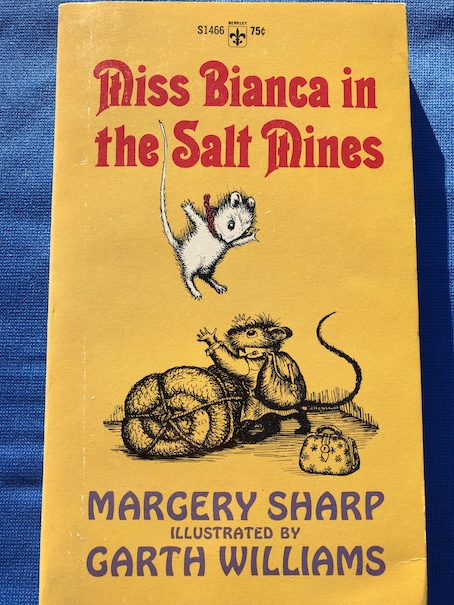
When this story begins, Miss Bianca, who is Perpetual Madam President of the Mouse Prisoners’ Aid Society, is evaluating candidates for the Tybalt Stars award, which is given for mice who are brave in the face of cats. Bernard, the secretary of the society, is helping her. Each of the candidates is undeniably brave, but Miss Bianca notices that each of them also had a self-serving motive behind their bravery, which seems disappointing for a benevolent society. When they stop for lunch and Bernard goes to fetch some salt for them, he finds a note in the salt that says, “Someone please get me out of the salt mines.” The note is signed “Teddy (age 8).” Naturally, Miss Bianca is eager to help the poor boy! Bernard is a little more doubtful about the mission because the salt mines are about a thousand miles away, extremely dangerous, and extremely well guarded. Nevertheless, the Mouse Prisoners’ Aid Society cannot refuse to help a prisoner, and neither can its President.
Soon, Miss Bianca has members of the society trying to learn anything they can about a missing boy named Teddy, but apparently, no one has reported a boy by that name or age as missing. Bianca uses the lessons of the boy who owns her to learn more about the salt mines and how to get there. In order to get to the salt mines, they’d have to go by train, and it’s a very dangerous route. At the next meeting of the society, Miss Bianca asks for volunteers to go rescue Teddy, but everyone is reluctant to go, and many members of the society don’t like it that Miss Bianca doesn’t even seem to have any facts about Teddy or his situation that could help them. Miss Bianca says that, even though she can’t be more specific about Teddy’s background or how he came to be in the salt mines, the important fact is that he shouldn’t be there, and he needs help getting out. Since no one else wants to volunteer for the rescue mission, Miss Bianca says that she’ll go herself, and of course, Bernard insists on coming with her.
To Miss Bianca’s surprise, her biggest opponent, a curmudgeonly mouse called the Professor (his real name is George) who teaches mathematics, also volunteers to join the mission. Bernard and Miss Bianca are even more surprised when the Professor insists on bringing his friend Caerphilly along. Caerphilly is very elderly, but he’s also a professor of geology. Caerphilly has never actually been to the salt mines before, but he’s always wanted to see them and study them. Bernard and Miss Bianca aren’t sure that Caerphilly is up to handling the dangers that they’re likely to encounter on the mission. Miss Bianca reminds Caerphilly that this is supposed to be a rescue mission, not a scientific expedition. Caerphilly is unconcerned, saying that they can handle the rescue, and he’ll handle the science. Miss Bianca says that the Professor should warn his friend just what risks a rescue mission involves, but the Professor is also unconcerned, saying that the geology department at the university thinks too much of itself, and he wouldn’t mind seeing his friend chased by bloodhounds. (Some friend he is.) Miss Bianca is concerned both because of the danger and because their self-serving motives are just what she was concerned about before.
In spite of that, they decide to proceed with the mission, bringing the two professors. They take some time to make their preparations. Bernard and Bianca research the trains they’ll need to take. The Finance Committee allows them to take along the society’s Treasure – there’s only one, a single gold coin they found in a ruined building. Teddy might need this to pay for his train fare after they get him out of the mines. The Ladies’ Guild also knits mittens for the unfortunate boy because the salt mines are reportedly very cold. Miss Bianca tells the boy she lives with not to worry if he doesn’t see her for a week or so because she’s going to be writing an epic poem and needs privacy.
As they finally set out on their mission, the Professor is pessimistic, but the train journey is uneventful. When they arrive at the salt mines’ train station, it’s a very bare and gloomy building. Bernard finds a wooden door with some steps heading down.
At the bottom of the steps, they find themselves in an underground cavern filled with stalactites and stalagmites. There is also an underground lake surrounded by crusts of salt. The Professor realizes that they have entered the salt mines through a disused and forgotten entrance. In the distance, they hear the sounds of prisoners mining the salt.
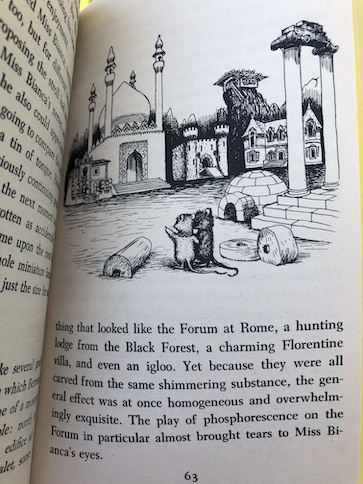
It’s a long walk to the active part of the mine, but along the way, they make an important discovery – a mouse-sized city carved out of salt! Each of the buildings in the miniature town are unique and resemble famous buildings from around the world. Miss Bianca thinks that the buildings were probably carved by prisoners who made buildings to resemble the places where they used to live. It’s the perfect place for the mice to stay, though.
Bernard, inspired by this strange place, tries to write a poem for the first time in his life, which isn’t very good. Miss Bianca tries to be nice about it, but he can tell that she doesn’t like it. Bernard is upset enough to try to drown himself (that part of the story struck me as rather shocking, although it’s handled so matter-of-factly as just a product of the weird atmosphere of this place), but he can’t because he just floats in the salt water. It seems like most of the members of the expedition temporarily forget about Teddy. Only Miss Bianca isn’t affected by this strange little town because she lives in a porcelain pagoda at home that her boy gave to her, so these buildings are very much like what she already knows.
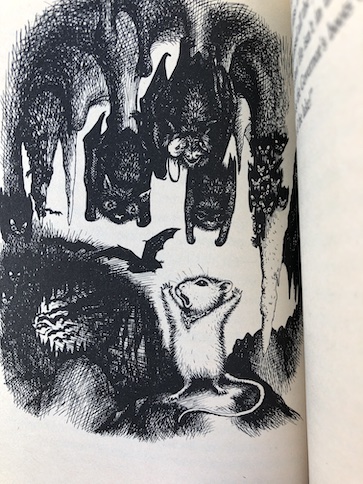
Fortunately, the expedition gets some help from some friendly bats who live in the mines. The younger bats in the group say that they’ve seen little Teddy serving the governor of the salt mines, who tends to stay apart from most of the prisoners because the prisoners have attacked him before. This is fortunate news because it means that Teddy is closer to the little salt town than they thought, and it won’t be as difficult to find him as they anticipated. He’s on an island in the middle of the lake of salt water, and that’s not too difficult to reach because Bernard has already proven that it’s easy to float in salt water.
Once they find Teddy, they also have to get him onto a train to get him away from the salt mines, which may not be as easy.
The book is available to borrow and read for free online through Internet Archive (multiple copies).
My Reaction and Spoilers
I generally prefer the plots of the Disney movies to the original books in this series, but this was still a fun story. I was a little disappointed that they never actually used the two professors’ specialties. I thought at first that they would use the geology professor to spout some interesting and useful facts about caves or mines, but they didn’t, and there was nothing in the story where a mathematics professor would be particularly useful. It just seems like a missed opportunity there.
There were some funny moments in the story. I liked the part where one of the bats, not really seeing Bianca clearly because bats are near-sighted, comments to another that, whatever it, if it moves, you should salute it, and if it doesn’t, you should paint it. Bianca takes that as a sign that this particular bat has completed his National Service, also noting that being near-sighted isn’t a barrier for bat National Service because, if it was, no bat would be able to participate.
In a twist at the end of the story, it turns out that Teddy used to live with his uncle and that Teddy’s uncle is the tutor for the boy that Miss Bianca lives with. Once Teddy is restored to his uncle, he comes to the house with his tutor and becomes friends with Miss Bianca’s boy.
I remember reading this book in elementary school. It’s about Benjamin Franklin’s friendship with a talking mouse (fictional, of course), and how his mouse friend helped inspire him in his work.
The book begins with the author saying that this manuscript, supposedly written by Amos the mouse, was found in a small compartment in a room in an old house that was being renovated. The little compartment was furnished with miniature pieces of Colonial style furniture. The author goes on to say further that the manuscript has been authenticated as being early American and that the National Museum of Natural History has confirmed that the handwriting of the manuscript was done by a mouse. (I’d love to see comparisons of different animals’ handwriting and hear their explanation of how the handwriting of a mouse differs from the handwriting of other members of the rodent family, but trust us, kids, this is all very scientific.) The author says that this account of Benjamin Franklin’s life differs from the stories told by later scholars, but he trusts the descriptions of this mouse who was so close to Benjamin Franklin. (Yeah, sure, why not?)
In the “manuscript”, Amos says that he’s writing not long after the death of his friend, Benjamin Franklin, and some people have attempted to write about the life of Benjamin Franklin, but Amos isn’t satisfied with their accounts of his life and wants to write the truth himself. (Benjamin Franklin also wrote a famous autobiography, but they don’t mention that. I know that this is a story about a talking, writing mouse, but I’m just saying.) Amos says that, much as he liked Ben Franklin, Franklin was kind of stupid at times and that, as Franklin’s secret adviser, he was actually the source of many of Franklin’s greatest ideas.
Amos says that he was born into a large family of poor church mice. Then, during the winter of 1745, food grew scarce, and as the oldest of his siblings, Amos decided to set out to seek his fortune and maybe a way to help provide for the rest of his family. It’s a cold night, and lured by the smell of cheese, Amos finds his way into the house where Ben Franklin lives. He finds Franklin sitting and sneezing in a chilly room near a small fireplace. Ben is trying to write, but because of the sneezing, he’s not making much progress. Amos, cold and tired, climbs up on Ben and curls up in his fur cap and goes to sleep.
When Amos wakes up in the morning, the fur cap is hanging on the bedpost, and the room is still cold. Amos talks to Ben, recommending that he put more wood on the fire. Ben doesn’t question why a mouse is talking to him and just retorts, “Waste not, want not.” Amos points out that there will be plenty of waste and extra expenses if the cold makes him sick. Ben agrees with that and decides to use more wood on the fire. Then, Amos points out to him that the fireplace would be more effective at heating if it was in the middle of the room, explaining how his family used to gather around a hot chestnut to warm themselves. Ben is intrigued by the idea, and they discuss how a fireplace could be located in the middle of the room and how to handle the smoke from the fire. Ben excited sets to work building the stove according to Amos’s suggestions. His first attempt is a bit crude, but the stove works much better at heating the room than the fireplace did, and Ben is pleased. He shares some bread and cheese with Amos, and the two of them become friends.
Ben begins writing about the design of the stove as if he had created it all by himself, but Amos points out that Ben had acknowledged his contribution. Amos doesn’t care about getting fame or public credit for his contribution, but he needs food and has a large family to help provide for, so he and Ben work out an agreement: in exchange for Amos’s companionship and help, Ben agrees to leave regular supplies of food at the church for Amos’s family and to provide Amos and any descendants he may have food and a home in his fur cap. Ben sews some special compartments in the fur cap so that Amos has secure places to sleep and store a little food. There’s also a little compartment near Ben’s ear where Amos can quietly whisper suggestions to Ben.
Life with Ben isn’t easy. Amos hates it when Ben goes swimming and leaves his cap on the ground. One day, a dog steals the cap (along with Amos), and Ben has to chase the dog in order to get the cap and Amos back. Ben promises not to take the cap off his head ever again.
Amos also doesn’t like Poor Richard’s Almanack and doesn’t consider the facts or maxims it offers to be worth much. Ben points out that people do use his paper and its predictions of sunrise, sunset, and high and low tide, and the money the paper makes helps support them both. It also seems weird to Amos that Ben attributes everything to do “Poor Richard” when there is no such person. Amos starts substituting his own name for “Poor Richard” in the paper, and he also changes some of the predictions of times for the tides. It turns out that this is one area where Ben knows better than Amos because Amos predicts the wrong time for high tide and some ships are stranded. Confronted by the angry men from the ships, Ben points out that the paper with the wrong time says “Amos” instead of “Poor Richard”, so it can’t be his work. The angry people realize that Ben is right, and Amos realizes that he shouldn’t interfere with the paper.
Amos also hates it when Ben starts to experiment with electricity and Ben shocks him. He tells Ben to leave him out of his electrical experiments. However, Ben continues his experiments with a group of other interested people, disappointed that Amos doesn’t seem to understand what he’s trying to accomplish. Amos finally reads Ben’s writings about electricity and his experiment, and when a boy Ben got to assist him at one of his meetings uses Ben’s electrical device to shock the governor, Amos urgently whispers to Ben to stop the boy. Ben doesn’t consider the experiment to be a failure because it very effectively demonstrated how electricity affects human beings, although some people, including the governor, start avoiding Ben after the experience.
Then, Ben starts wondering if lightning and electricity are the same thing. Amos says he doesn’t care because both to those things should be avoided, whether they’re the same or not, and Ben says that he has “no vision.” Ben’s first experiment with lightning rods is frightening, even terrifying Ben to the point where he modestly refuses to take credit for the invention. In spite of that scare, Ben continues to wonder about the nature of lightning. He starts taking Amos with him while he flies kites for fun, and he rigs up a little car on the kite string for Amos so Amos can ride on the kite and come down when he wants to. Ben suggests that Amos that he could get a better view of lightning and describe it to him if he stays on the kite during a storm, and Amos refuses to consider it, but one day, Ben tricks him into doing it anyway. Amos is angry at Ben for making him suffer through the storm while he took shelter in a shed and refuses to discuss what he experienced with him. Burned with electrical shocks from the storm, Amos returns to his family at the church, where they dress his wounds, and he rests.
Ben comes to see Amos about their earlier agreement. Amos tells him that the electrical experiments were never part of the agreement and he will never return to him while he is doing these things. Ben agrees to stop all of the electrical experiments, and he and Amos write a new agreement with each other.
At this time, troubles are arising between England and the Colonies, and Ben is concerned. He tells Amos that he needs his skills for gathering information and asks him to accompany him to England to present the Colonies’ case before the King and Parliament. Amos initially agrees to go, but he backs out of the voyage when he sees that Ben has attached lightning rods to the ship. Pointing out to Ben that the lightning rods are a violation of their agreement, he returns to the church and lets Ben go to England alone.
While Ben is gone, Amos hears the people of Philadelphia talking about current events, like the stamp taxes, and how they feel about them. Amos finds himself siding with the colonists and wanting to do something to help, and he realizes that Ben is his best chance for helping to accomplish something. When Ben returns from England, Amos rejoins him, and he goes with Ben to the committee meetings he attends, including the one for writing the Declaration of Independence. Amos helps Ben by gathering information from other people. Amos meets another mouse named Red, who comes to Philadelphia with Thomas Jefferson and starts preaching revolution to the mice in town. Amos borrows some of the pieces of writing from Red’s Manifesto and tells them to Ben, who in turn, tells them to other members of his committee so they get included in the Declaration of Independence.
Then, George Washington says that the Colonies could really use some help and support from another country. Amos persuades Ben to suggest France. George Washington accepts the suggestion, and Amos accompanies Ben to France to ask for help from the French government. Ben enjoys the attention he gets from the ladies in France, frequently dining with his admirers. Amos is afraid of the ladies’ pet dogs and cats, though, so he persuades Ben to put most of his attention on a woman who doesn’t have cats. It turns out that this lady also has a mouse who lives with her named Sophia. Sophia is actually married, but her husband has been exiled to the United States, and her children are being held in the palace of Versailles. Amos wants to help Sophia, but he’s not sure how until after the Revolutionary War ends and Red arrives in France with Thomas Jefferson. Amos explains the situation to Red, and Red is more than eager to help assemble a force to stand up to the oppressive aristocratic French mice.
The mouse battle that follows terrifies the human French court, but the mice successfully rescue Sophia’s children. Ben suddenly finds himself a social outcast for bringing mice to the royal court, so he’s ready to return home, bringing Sophia and her children with them. Ben is welcomed home as a hero by the humans. Sophia is reunited with her husband, and Amos remains a friend of the family. Three of Sophia’s oldest children marry Amos’s three youngest siblings, tying their families together.
The story ends with the mice giving Ben a nice, new hat for his birthday. Ben keeps the old one just as a house for Amos to live in, but Amos is mostly retired, his time occupied by teaching his young nieces and nephews.
The book is available to borrow and read for free online through Internet Archive (multiple copies). There is also a Disney film based on the book that is also on Internet Archive (about 21 minutes long).
My Reaction
I remembered liking this story when I was a kid, but I’m not as fond of it now. I don’t like books with intentionally stupid characters, and in this case, the intentionally stupid character is a real, historical person, which doesn’t seem fair. I know it’s supposed to seem humorous, but it just doesn’t seem to hold up after all these years.
I also hated the part where Ben intentionally kept the poor mouse up in a kite for half an hour during a terrifying storm. It’s just so cruel, even though it’s supposed to humorous. What can I say? I have a soft spot for cute, fuzzy animals, and I just don’t like to think of any little animal suffering, even if it’s in blatantly ridiculous circumstances.
I had forgotten about the Disney cartoon, although I think I remember seeing that when I was a kid, too.
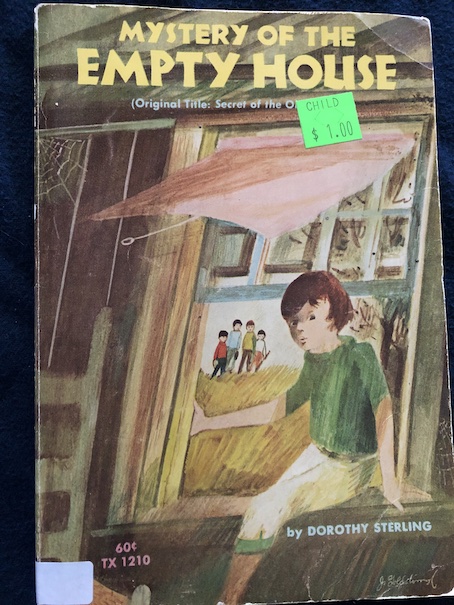
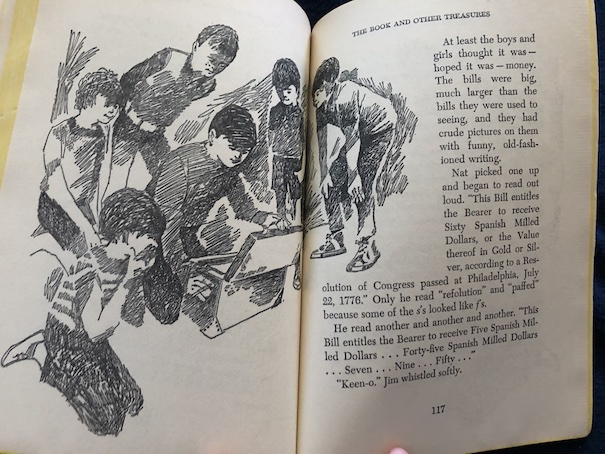
Mystery of the Empty House by Dorothy Sterling, 1960.
Patricia Harrison’s family has recently moved from their apartment in New York to a house in Haven. Her father used to live in Haven when he was a boy. His mother still lives in town, and he still knows some of the other people who live there. Patricia, called Pat, is still unpacking her belongings when a boy from across the street, Jim Gray, calls to invite her to play ball with him and some of his friends in the field behind her house because his mother used to know his father when they were kids. Pat isn’t very used to playing with boys because she went to an all-girls school when she was in New York, but she agrees to go play ball with the boys.
When she goes to meet the boys, some of the other boys, the Paine brothers, don’t want her to play with them. When Jim said they were meeting “Pat”, they assumed that “Pat” was another boy. Jim says he doesn’t care if Pat is a girl or not because they could really use another player. Pat thinks they’re rude, and since they don’t seem to want her, she starts to leave, but Jim stops her and persuades her to stay. Even though Pat is usually good at baseball at school, she finds herself making clumsy mistakes when she plays with the boys, probably because she feels uncomfortable with them. Finally, she hits a home run, which is great, but there’s a problem. She accidentally hit the ball into the window of an old, abandoned house nearby that looks haunted.
The boys are mad because it’s the only baseball they have. Pat says they could just go get the ball, but the boys say they can’t. When she asks them if they’re scared, they say that’s not the problem; they’ve just promised that they won’t go near the old house. Pat says that, since she didn’t promise, she can just go get the ball, but Jim stops her from going into the house. He tells her that they can just buy a new ball. When Pat asks him why he doesn’t want her to go in, Jim says that it’s a secret having to do with the Paines. Pat says that she’s sick of the Paines and insists on going into the old house.
The old house is dark and spooky. When she climbs in through the window, Pat is startled when she runs into another person inside. At first, she can’t see the other person too clearly because it’s dark, but when she asks the girl who she is, the girl tells her that she’s Patricia Harrison. Pat is shocked and tells her that she can’t be Patricia Harrison because that’s her name. The girl finally laughs and admits that her real name is Barbara Thomas. Barbara lives next door to Pat’s grandmother and decided to stop by and meet her. When she saw Pat playing with the boys, she decided to go explore the old house instead.
Barbara is the one who explains the history of the house and the Paines’ attitude to Pat. The Paine family used to live in the old house. It’s the oldest house in town, dating back to the Colonial era. Nat Paine, the oldest of the Paine boys, was always proud of his family’s old home and used to brag about how George Washington and Lafayette visited the house during the Revolutionary War. It was even occupied by British soldiers at one time. Unfortunately, the father of the Paine boys was killed during the Korean War several years earlier (dating this story to the late 1950s or 1960, the year it was published). Since then, the family has fallen on hard times, and they’ve been unable to pay the taxes on the house. Now, because of the unpaid taxes, the town council is threatening to sell the old house to pay the unpaid taxes. The Paines have been forced to move out of the house and into a much smaller place, and Nat is very upset about it. Plus, he’s been going through this phase where he’s decided that he hates girls because he’s just getting into middle school, where all the boys either start developing crushes or decide that they hate girls. His younger brothers are being pests because they’re following his lead.
Barbara says that her father felt bad about what happened to the family and tried to convince other people in town to help the Paines pay the taxes on the old place. They could have helped, but they’ve made it plain that they just don’t want to. As Barbara’s father put it, “people in Haven are a bunch of rock-ribbed, rugged individualists who wouldn’t help their own grandmas.” (I have strong feelings about that, and I’ll explain them in the reaction section.) Barbara reveals right away that the secret Jim is keeping for the Paine brothers is that Nat made his brothers take a vow with him that they wouldn’t enter that house again “until it was rightfully theirs.” Barbara says that Nat’s sense of pride talking, and “You know how boys are.” She thinks Nat’s being overly dramatic, although she sympathizes with the family’s plight. When Pat suggests that maybe they shouldn’t be in the house, either, Barbara says that she comes there all the time to explore. Barbara thinks the old house is fascinating and that there might be a secret passage somewhere. She invites Pat to help her look for it sometime.
At dinner that night, Pat finds out that her parents already know about the death of the boys’ father and the trouble that the family is having over their old house. Pat’s mother says that the old house is a good example of the saltbox style of house that was popular in Colonial New England. (I remember my old high school history teacher explaining how the slope of the roof was meant to help snow slide off during the winter, but the uneven slope also allows more living space to be added onto an existing house.) However, Pat’s mother says that there probably aren’t any secret passages in the house because houses from that time were built pretty simply and didn’t even have closets or bathrooms. She doesn’t think that there’s any place in the old house to conceal a secret passage.
Now that Pat knows the issues with the Paine family, she begins to feel better about them, and they start being nicer to her. As Pat begins settling in, she becomes better friends with Barbara and is happy that she has another girl as a friend. They ride their bikes downtown together, and Barbara sleeps over at Pat’s house. As the girls are getting ready for bed, Pat looks out the window and sees a light in the old Paine house when no one is supposed to be there. Barbara says that whoever’s in the house is probably looking for the secret passage and the treasure. When Pat asks what she means by “treasure”, Barbara says that there’s a rumor that there’s treasure hidden in the house from Revolutionary times. The family used to be rich, but after the American Revolution, when the children of the family returned to the house after their parents were killed, the family fortune had vanished. People think that the ancestors of the Paines hid their fortune somewhere during the war and that it’s still waiting to be found. (I already had some misgivings about the people of Haven and their intentions in kicking the Paines out of their house, and now, suddenly, my suspicions are even worse.)
Barbara says that they can’t just let this mystery sneak steal what should rightfully belong to the Paines and ruin the only chance they have left of regaining their house. The girls sneak over to the house to spy on the intruder, and they end up frightening him away. The girls tell the boys about what they witnessed the next day, and they persuade the Paine brothers to come into the house with them in spite of their “vow” to look around and see what the intruder was searching for. As they inspect the kitchen fireplace, where the man was searching, and look at the flashlight he dropped, the man shows up again. It turns out that he’s a college student doing research on the Paine family.
Back in Revolutionary times, the family that lived in the house was the Woodruff family. (A Paine ancestor married into the Woodruff family, changing the family name, but the Woodruffs are also ancestors of the current Paines. It’s the same family.) The college student, Robert Popham, found some old papers that indicate that the head of the Woodruff family, the first Nathaniel Woodruff, was a Tory. Nat, who was named for this ancestor (full name Nathaniel Woodruff Paine IV), angrily denies it, saying that his family was known to associate with George Washington and Lafayette, hosting them at their house. Robert explains more about the papers he found, but he also says that the last letter Nathaniel Woodruff wrote to his wife before he was killed indicates that he feared for his life and left something hidden in an old post box to pass on to his young son. However, as Nat points out, the date on this final letter was shortly after Nathaniel Woodruff’s wife was murdered by unknown assailants. (She was found scalped, so people blamed her death on American Indians, but it’s also possible that she was killed by someone else who just wanted to make it look that way to cover up the real reason for her murder.) Nathaniel Woodruff didn’t know his wife was already dead, and since she never got the letter and he was also killed soon after, the box is probably still hidden somewhere. Robert thinks that what Nathaniel hid was proof that he was actually a spy for the Patriots and that he feared for his life because he suspected that the British knew he was a spy. He says that he wants to find this hidden box and the information it holds because it would make a fantastic historical research paper.
The kids are completely on board with the search for the hidden box, both because the Paines want to preserve the reputation of their ancestors and because there may be valuables hidden in the box that will help the Paines pay their taxes and keep their home. However, they only have until August 15, the date that the town council has set for selling the Paine house. They only have until the end of summer to figure it out!
To begin with, I didn’t like the people of Haven right from Barbara’s description of them as “rugged individuals who wouldn’t help their own grandmas.” It is pretty cold to turn out a war widow who is working as an underpaid nurse in the community and her children after their father was killed serving his country. I completely agreed with Barbara’s father’s assessment of the townspeople’s levels of generosity from the first. I suppose at least some of the townspeople of Haven probably thought they were actually being kind, giving Mrs. Paine several years after her husband’s death to come up with the mounting tax money, while doing nothing to help her and not actually paying her enough to manage and letting her family sink deeper into the hole until there was no way for them to escape, but in realistic terms, that’s not really kind at all.
We don’t actually hear the townspeople express their own feelings because the children don’t talk to the adults about their search and discoveries until they’re sure of what they found. When Barbara explained how her father felt about the townspeople’s unwillingness to help the Paines, I was also a little suspicious of their motives, and when Barbara mentioned that there’s been a popular rumor about hidden treasure in the Paine household for years and everyone has heard of it, I got really suspicious. Basically, I started looking for thieves among the townspeople. I immediately suspected that the “rugged individuals”, or at least some influential ones in the community, wanted to steal some historical treasure from a veteran’s widow and orphans because people who would would kick the widow and orphans out of their home might as well be out to steal their legacy, too.
If that was part of their plan, they weren’t very good at it, and they never even show up in the story. Perhaps I’m judging them a bit harshly, although in a way, I’m a little disappointed because that kind of Machiavellian plot would have made the story much more exciting. From the way the story goes, the townspeople might just not believe that there’s any treasure to be found because that rumor has been going around for so long and nothing has come of it. Still, I was suspicious of them for a good part of the book because it looked like the author was setting them up to be suspicious.
I was also annoyed by the townspeople because I found them ineffectual and uncreative in their approach to a community problem. They miss opportunities, and worse, they deny opportunities to others because they’re apparently stuck in their “rugged individual” mindset and won’t even entertain ideas that might help themselves as well as others when people like Barbara Thomas’s father suggest them. I often think that high-and-mighty rugged individualistic attitude cuts out so many genuinely fun, creative, and amazing possibilities that can make a community rich in character as well as money. It’s maddening to a person who thrives on creativity and likes to consider possibilities.
When I started getting really irritated at the townspeople, I guessed that, before the end of the story, they would do something to redeem themselves that would simultaneously leave me unsatisfied. I figured that the point where the townspeople finally come together would probably result in something that I thought they should have been working on from the beginning, and then, they’d act like it was such an amazing idea that they’d never thought of before and I’d be really irritated with them all over again because I thought of something like it very early in the story. Actually, that’s not how the story goes, and it’s still irritating to me.
So, what would I want them to do in this situation? Basically, the community wants its tax money, and the family wants to keep their house with a living wage that can support them. Fine. So, I asked myself, why not make this historic house, which is known to be the oldest house in town, into a community project which would actually contribute to the common good of the community (I don’t think “common good” is a dirty word, although I’m aware that some “rugged individualists” think so) and provide the Paine family with an additional source of income? If the town council invested in fixing up the house, which is also known to contain some very interesting Colonial antiques as well as fascinating architectural details and a unique history, the house could be turned into either a museum or a period bed-and-breakfast to encourage local tourism. (Sleep where George Washington and Lafayette slept!) Since it does have original furnishings and actual bedrooms, it probably wouldn’t take a lot to make the conversion for either of those projects.
The town and its business owners would benefit from the tourism, giving them an actual monetary return on their investment, and the Paine family could stay on with the house as its caretakers, receiving additional wages from visitors. People couldn’t say that the Paines simply received a handout because they would be doing valuable community work to support the town’s image and industry. It would satisfy Nat Paine’s family pride because he could talk to tour groups on the weekends and during the summer about his family’s great legacy to the history of his town. The whole community could even expand on the idea to further attract visitors, setting up a sort of local living history center, where people can learn Colonial crafts and recipes (something like what the Townsends demo on their YouTube channel), and schools from neighboring towns and cities could book field trips. Local business owners could support it with a themed restaurant and shops selling Colonial-era replicas and memorabilia and books about the time period. The town could hold special celebrations a few times a year to draw in more visitors, like a big Fourth of July parade or a Colonial Christmas celebration (although I known not all of the American colonies actually celebrated Christmas) or a re-creation of old harvest parties (more historically accurate) with plays by the local theater group (if they don’t have one, they could form one) or dramatic readings from Washington Irving at the local library or a themed fair with people selling local artisan crafts. They wouldn’t have to do all of this at once, but they could start with the matter of the house and build up from there. It’s an idea that has the potential for future expansion. This story is even set pre-Bicentenniel, so imagine what the town could do if they already had everything up and running by July 4th, 1776! Doesn’t anybody plan ahead? That’s creative use of resources. That’s community action. That’s job creation. Even if it’s not as big as Plimoth Plantation (now called Plimoth Patuxet to better incorporate the Native Americans) or Colonial Williamsburg (which both already existed by the time this story was written and could have provided inspiration), it’s still a money-making industry that is inherently built into the town’s very nature and won’t disappear tomorrow because some outside business decides to move or close a job-providing factory or something. Even if they didn’t get national or international attention, they would probably still be a destination for people from around their state and neighboring ones, and there’s potential for continued development. The project just need to be supported and promoted by the community.
Unfortunately, that’s not what they do. My griping aside, I guess if the solution was really that simple and the townspeople were more thoughtful and pro-active, we would lose the source of tension and the obstacle that our heroes have to overcome. The August 15th deadline is what pressures the kids to hurry up and find the treasure, so as irritating as it is to me, I have to put up with it.
The treasure hunt part is a lot of fun, and I liked the children’s logical, methodical approach to their search. When the children eventually find the hidden box, the story isn’t over. There are coded messages in the box that they have to decode to learn the full truth about Nathaniel Woodruff. Part of the story explains how they figure out how to decode the substitution code and the book code that compose parts of the message. The story they learn about Nathaniel Woodruff is better than anything the Paines had originally thought.
So, did they save the old house and do anything cool, like start a unique museum? Yes, and no. Although they don’t find any jewels, gold, or traditional sort of treasure, the letters that they find in the box are worth quite a bit. They sell them to a wealthy local business owner, and he donates them to a local university library. (So, you know, the wealthy business owner who never makes an actual appearance in this story and who wouldn’t have helped a war widow and her orphans for their sake can buy their family legacy and present it as his magnanimous gift to the university. I can’t say that he’s terrible for doing this because it does help, but I still think my idea was better.) The Paine family has enough money to keep their house and fix it up. It’s a pretty good ending, but I still prefer my vision. The story points out that it’s not a matter of everyone living happily ever after because they’re all their imperfect selves and still have some problems, but one lesson that they all learned from this experience is how to create their own book code to use for passing notes in class. It’s not profound, but codes are fun.
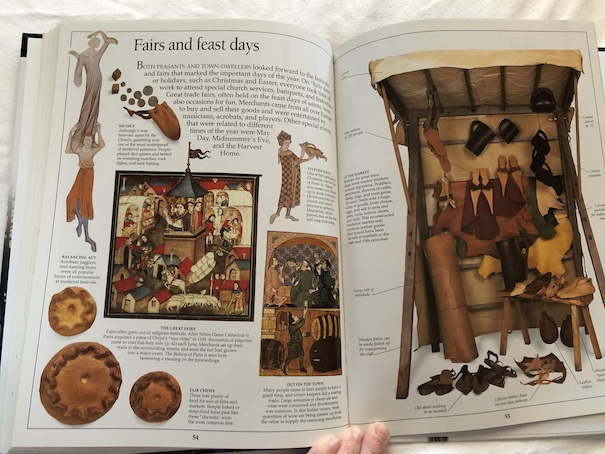
This book takes a unique approach to explaining life in the Middle Ages. It focuses on the types of places where people spent their time and what they did there. I like it that the author doesn’t rely on just one country for the descriptions of places, providing examples from various places around Europe, including Germany, France, Italy, and Iceland.
The book is available to borrow and read for free online through Internet Archive. There is also a companion book to this one about Medieval People. The author has also written other books about people and places in different time periods.
The places described in the book are:
The Field
During the Middle Ages, most people lived in small farming communities, making their living through farming. This chapter describes the agricultural year and the feudal system, where peasants worked fields belonging to lords and gave the lords their services and food they produced in return for use of the land.
The Peasant’s Cottage
This chapter explains what a peasant’s house and living conditions were like.
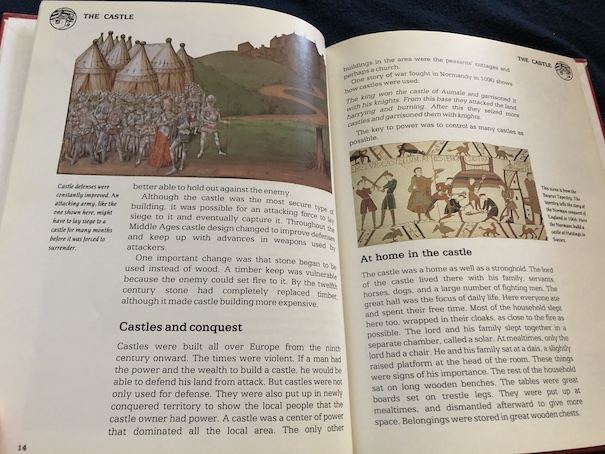
The Castle
This chapter explains how castles were built and how they were used to control territory. There is also a brief description of what life in a castle was like.
The Battlefield
This chapter describes how warfare and sieges were conducted and what types of weapons were used.
The Forest
People hunted animals in forests for sport and food, but there were rules regarding who could hunt where and what types of animals they were permitted to hunt. Anyone caught breaking these rules would labeled a poacher and could suffer serious consequences.
The Law Court
There were different types of law courts in different places, and they could handle different types of cases or offenders. For example, clergy were often tried in special courts. Punishments for offenders varied with the nature of the offense. Prison wasn’t typically a punishment by itself. Dungeons were more for holding prisoners until their case was tried. After the trial, another punishment would be assigned, possibly a fine or some form of public humiliation. For more severe offenses, offenders might have a hand or an ear cut off or might be executed. However, there were some law breakers who had so many supporters that no one was ever able to bring them to justice.
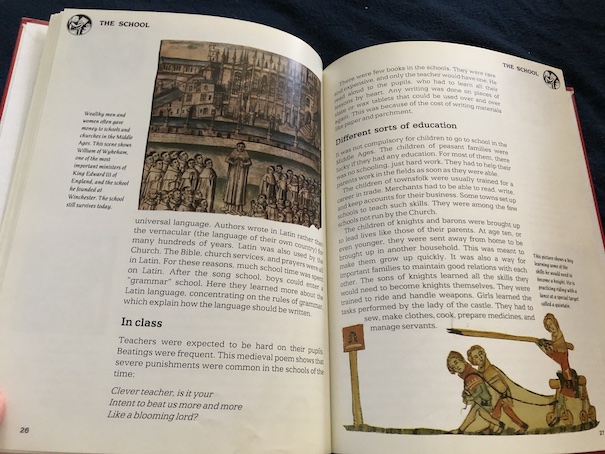
The School
Most schools were church schools held in monasteries, cathedrals, and other churches. There, students would be taught Latin (the universal language of educated people all over Europe during the Middle Ages) and religious lessons. Students practiced writing lessons on wax tables or pieces of slate that could be reused. School was not a requirement, and most lower-class children did not attend, either simply helping their families on their farms or learning a trade. There were some secular trade school run by towns to teach the children of merchants some basic skills, like reading, writing, and keeping accounts.
The University
The format for modern universities began during the Middle Ages. Particularly skilled teachers, often ones who taught at church schools, who gained a reputation for their teaching ability sometimes attracted a following of scholars, and people would travel to the location where they were teaching in order to study with them. Universities grew because of the excellent reputations of individual teachers, who attracted students to come. As they grew, they developed sets of rules, sort of like the a trade guild, organizing courses for students to study and exams to test them on what they had learned. There were no age requirements for students, but they always started by studying some general knowledge subjects, like Latin and mathematics, before choosing a specialty to study, such as law, medicine, or theology.
The Road
There were various reasons why people had to travel during the Middle Ages. Nobles had to travel to to visit different parts of their estates, and peasants had to travel to bring their produce to markets. Merchants would travel in search of customers for their trades. Criminals and judges both had to travel to law courts. Messengers would carry letters. There were also soldiers and religious pilgrims. People from every level of society could be on the roads. However, the roads were rough, making travel uncomfortable, and there was always the danger of robbers.
The Port
People also traveled by ship, and merchants brought goods from other countries through ports.
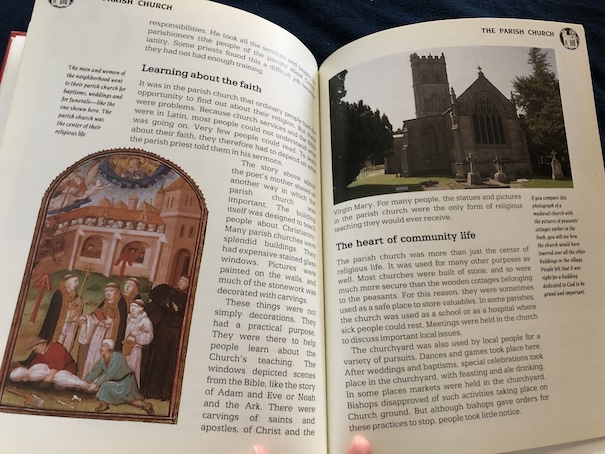
The Parish Church
Local parish churches were important centers of life and religion in the community. The local church would perform baptisms, marriages, funerals, and other services for the parishioners. Because most people couldn’t understand Latin and many couldn’t read at all, priests had to use sermons and scenes painted on the walls of the church to teach people Biblical lessons. Sometimes, church buildings and the churchyards surrounding them were also used for other important community functions, like schools, hospitals, meetings to discuss local matters, and even markets, dances, and games.
The Market
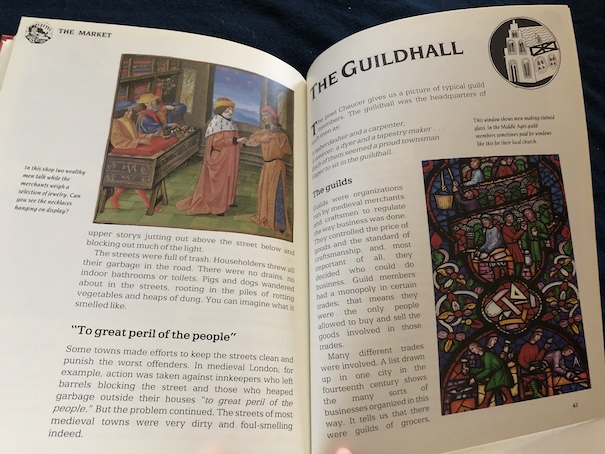
People in towns practiced trades other than farming, so towns held regular market days when village farmers could come and sell their produce.
The Guildhall
Various types of merchants and craftsmen formed guilds to organize and regulate the standards for their trades and how much their goods and services would be worth. Guilds were also responsible for arranging apprenticeships for those wanting to learn specific trades.
This book looks at Medieval history in terms of the different types of people in Medieval society and what their lives were like. It has examples from different countries focusing mainly on western Europe.
The book is available to borrow and read for free online through Internet Archive. There is also a companion book to this one about Medieval Places. The author has also written other books about people and places in different time periods.
The types people included in the book are:
The Chronicler
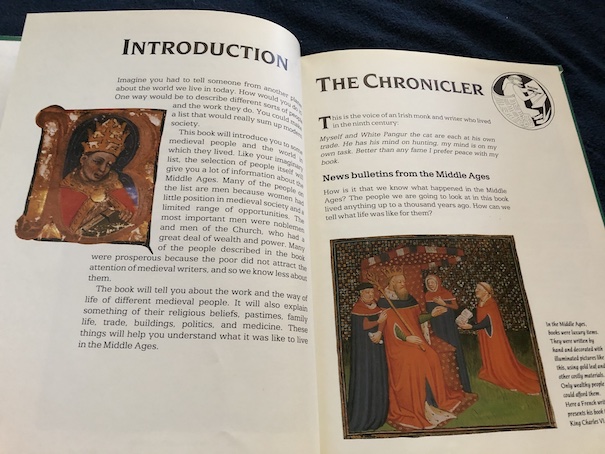
This is an important chapter because it explains how we know many of the things we know about the Middle Ages. Some people kept chronicles of events that happened in their time. Most of the chroniclers were monks because they were usually the ones who had both the education and the time to keep written chronicles. That’s part of the reason why many chronicles have religious overtones. People who wrote chronicles not only recorded events but also considered why certain important events may have happened, and they interpreted events through their religious beliefs.
The King
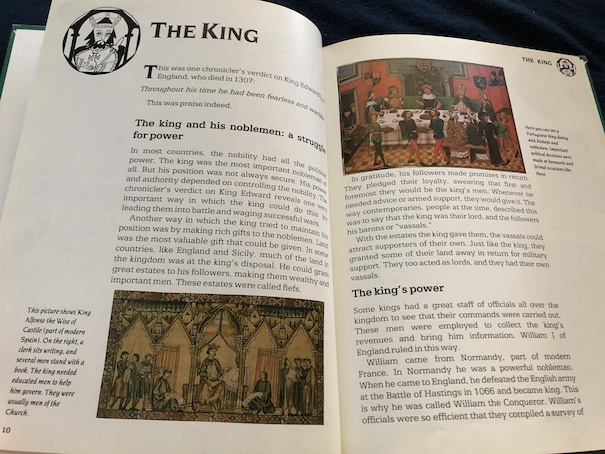
Medieval society was structured in levels, and the king was the person who held the most power and authority. However, he also depended on the nobles who supported him, so he had make sure that they were satisfied with his rule and rewarded for their loyalty. A successful king had to be a successful military leader, and he rewarded the nobles who served him with gifts of land. In turn, the nobles had to serve the king militarily and successfully manage their estates, and they could attract other people to serve them by granting them some of the land that they received from the king.
The Pope
The pope is the highest leader in the Catholic Church, and during the Middle Ages, Catholicism was the major Christian denomination in western Europe. (The Greek Orthodox Church was the major Christian group in eastern Europe, and Protestantism wasn’t an option until the Reformation.) Medieval popes were different from modern ones because they were political leaders as well as spiritual ones, and they clashed with secular kings about whose authority was greater.
The Bishop
Bishops were below the pope and the archbishops in authority, but they oversaw the lower religious officials within their territory or diocese. A bishop would make sure that church buildings in his diocese were being built and properly maintained and that the clergy were doing their jobs correctly and teaching and leading their parishioners properly. He would also oversee the training of new priests. In some ways, his position would be somewhat like that of a noble within the church, answerable to people higher than himself and in charge of people below him, but aside from his position in the church, a bishop would also have obligations to the king, owing services to him. Kings often used bishops as ambassadors and advisers and even as military leaders because they were among the most educated people available. However, this sometimes put bishops in an awkward position when their kings’ demands conflicted with their orders from the pope.
The Knight
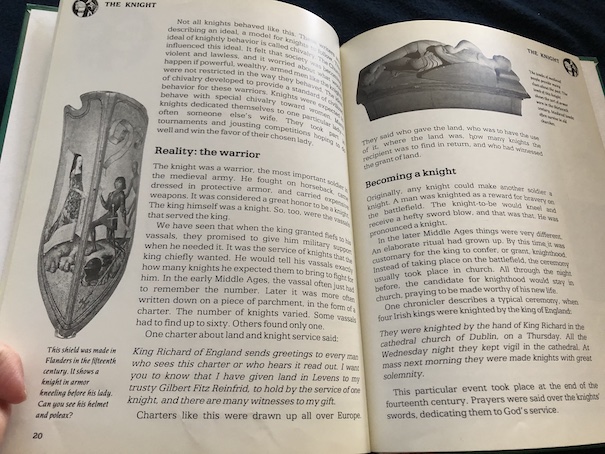
A knight was a warrior who fought on horseback. Part of the service that nobles owed to their king in exchange for grants of land was supplying him with knights when he needed them. In the early Middle Ages, the status knighthood was a reward for excellent performance as a soldier, but later, there were rituals associated with knighthood, including that knighthood could only be granted by a king.
The Pilgrim
Pilgrims were travelers going to religious shrines. Some shrines were fairly close to the places where they lived, and some were far away, in major cities like Rome and Jerusalem. Pilgrims hoped to spiritually connect with the saints associated with the shrines they visited in order to ask for their help with some special purpose, such as recovery from an illness or the forgiveness of their sins.
The Lady
Women in Medieval society were subject to the authority of their fathers up until their marriage, and then, they were under the authority of their husbands. Money was a consideration when marriages were arranged, and marriages could be arranged for wealthy heiresses when they were very young. Married women had the task of managing their husband’s household and accounts, supervising the servants, and making cloth and clothing for her household. Women who did not marry might become nuns. Some liked the religious and scholarly life of a nun, but others simply became nuns because they had no other options and their families didn’t know what else to do with them.
The Herald
Knights always wore full armor when they fought, including a visor that covered the face. In order to know who was who, knights had special crests or coats of arms, which included identifying symbols and colors. Knights could wear their coat of arms on a tunic over their armor, have it displayed on a banner, and on coats on their horses. The herald was the person who kept track of everyone’s coat of arms, ensuring that they were all unique and settling disputes between knights who tried to claim the same combination of colors and symbols.
The Monk
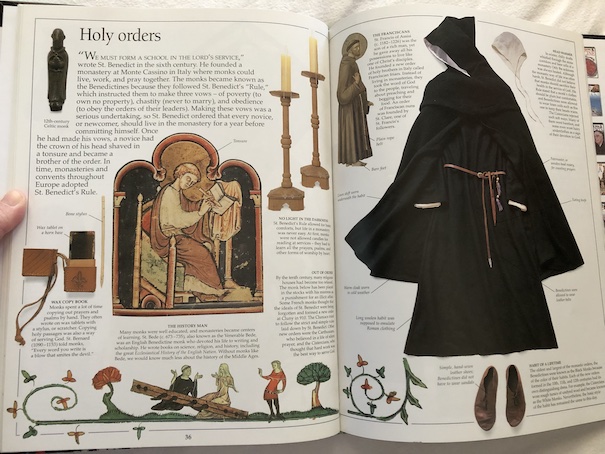
Monks and nuns devoted their lives to prayer and meditation. Their days were organized around prayer, but they also performed manual labor, producing food for the monastery where they lived. Other tasks involved copying the Bible or prayer books and making clothing or medicine for the poor.
The Doctor
There were many dangers from illness during the Middle Ages, particularly the Black Death in the 14th century, when about a third of the population of Europe died. Doctors often didn’t understand the causes of illness, and not all doctors and healers even had any formal training. Wealthy people could afford doctors with more training. Cures often included combinations of herbs and various experimental substances, like crushed bugs or even gold and pearls. They had reasons for choosing the substances they did to put in medicine, but because they were lacking knowledge of the true nature of disease, their choices were often flawed.
The Heretic
Although the Catholic Church was the major form of Christianity in western Europe and widely regarded as the “true” Christian religion, religious beliefs were not completely uniform in the population. People whose beliefs seriously conflicted with the Church would be labeled as “heretics.” Because the Church believed that heretics’ souls were in danger, they could use severe punishments and even execution or the threat of it to force them to change or to stop spreading their messages to other people, thus endangering their souls.
The Mason
Masons were responsible for the great building projects of the Middle Ages, like castles and cathedrals. Some of these great buildings kept a staff on site to handle repairs, but some masons were itinerant, moving from site to site as necessary.
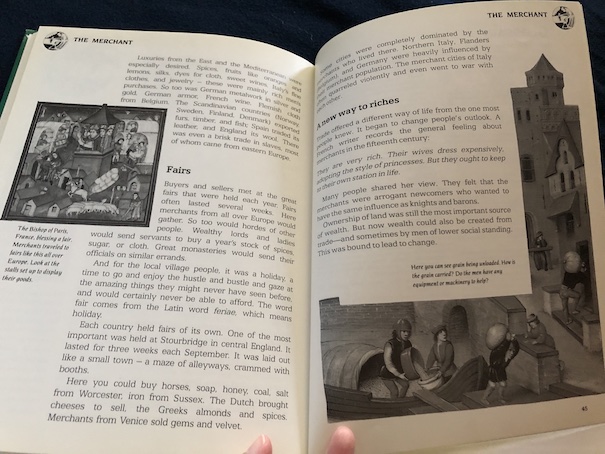
The Merchant
Merchants had to travel frequently to obtain and trade goods, some of them even from other countries. Towns would hold fairs at regular intervals where merchants would gather to sell their goods. Merchants with highly desirable goods could become very wealthy, and some people thought that they often got above their station in society, living like nobility.
Medieval Life by Andrew Langley, photographed by Geoff Brightling and Geoff Dann, 1988, 2004.
I love books that explain the details of daily life in the past, and I especially like Eyewitness books because they include such great photographs to show objects that people would have used in the past.
This book begins by explaining the time period of the “Middle Ages”, which was the period between Ancient Greece and Rome and the Renaissance, when culture and knowledge from Ancient Greece and Rome came back into vogue. The Middle Ages lasted about 1000 years, roughly from 400 to about 1540 AD. (Estimates of the start and end dates vary because this was a period defined by cultural changes, which are gradual and don’t have precise start and end dates.) This long period of time can also be divided into smaller periods and contained many important events that helped to shape society and culture, including The Crusades and The Great Plague.
Medieval society was hierarchical and was based on land ownership. The king and the highest nobles controlled the land and allowed people in lower levels of society to use it or grant farming rights to peasants in exchange for rent in the form of their services and a share of what they produced. The peasants or serfs were tied to the land they farmed, and the land was owned by the lords they served. They were not regarded as “free” people, and they couldn’t leave their lord or the land except by raising enough money to buy some land for themselves or by marrying a free person from a higher level of society.
A lord’s manor included not only his manor house or castle but the nearby village, church, and the farmland where his serfs worked. Often, villages and manors had little contact with the outside world, so the people who lived there had to make most of what they needed themselves. Most people never left their land or were only able to travel a short distance from it, so the only new people they might meet would be traveling peddlers, soldiers, or pilgrims.
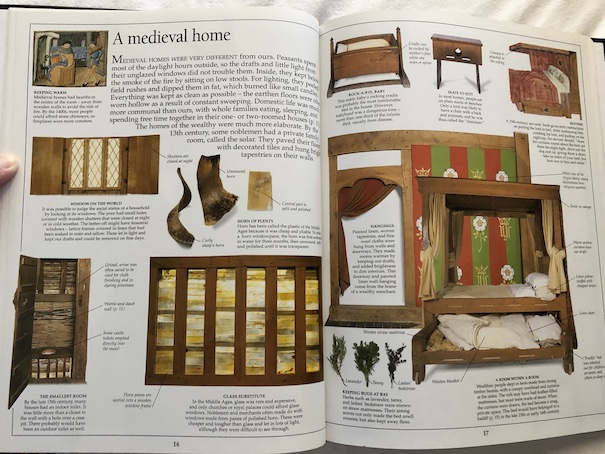
The book explains what would be found in a typical Medieval home. Poor people lived in houses that had only one or two rooms for the entire family. Few people could afford to buy glass windows. Poor people only had wooden shutters to cover their windows. Others might have tallow-coated linen over a lattice frame, which would let in light, and some wealthier people had pieces of polished horn in their windows, which also let in light, although you couldn’t really see through them well. What people ate varied depending on their social status. Wealthier people could afford a wider variety of foods, and poor people mostly ate what they produced themselves.
Women’s lives also varied depending on their social status. Pleasant women farmed and provided for their families alongside their husbands. Women in families of craftsmen and tradesmen often worked alongside the men in the family business. Wealthy women managed their husbands’ households or could rise to rank of influential abbess if they joined religious orders. However, the highest ranks in society were occupied by men.
While peasants served their lords, lords also owed services to higher nobles and, ultimately, to the king, although sometimes the king struggled to control powerful nobles and assert his authority over them. The king generally had to keep his nobles satisfied with his rule if he wanted to retain their loyalty because, while he was the source of their land and authority, they were effectively ruling over their own smaller lands with their own troops. While nobles owed their king military service and support, if they were dissatisfied with the state of their lands or were just unoccupied with other battles to fight and saw an opportunity, they would sometimes use their troops to raid the lands of neighboring nobles. Part of the king’s job involved preventing his nobles from being dangers to him and to each other. The king also made and enforced laws, settled disputes, and oversaw the collection of taxes.
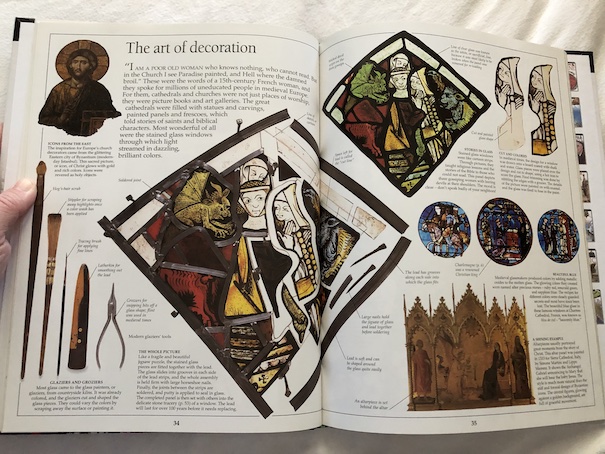
Christianity, specifically in the form of Catholicism, was central to the lives of people in the Middle Ages. During this time, stonemasons and craftsmen developed new techniques for building impressive cathedrals that still stand today. These cathedrals were lavishly decorated with statues, frescoes, and stained glass windows that depicted Biblical stories and the lives of saints. These works of art were important for helping to teach people who did not have the ability to read the Bible themselves about their religion.
Religious orders of monks and nuns performed important functions for society, such as caring for people who were poor or sick, providing safe places for travelers to stay, and copying written texts by hand. In the centuries before the printing press was invented, there were only handwritten books, and they took time and skill to produce. It could take an entire year for someone to copy an entire Bible. Few people were able to own personal books, and much of the schooling in this period was provided by religious orders.
The book describes the rise of Islam during the early Middle Ages, increases in trade and commerce, the growth of towns, and guilds that controlled different professions. It also describes Medieval music and entertainment, such as plays and parades. One of my favorite parts of the book is about fairs and feast days.
The book ends by describing the beginning of the Renaissance and the rediscovery of classical Greek and Roman culture as well as the beginning of the Reformation and the development of new scientific discoveries and artistic styles.
The book is available to borrow and read for free online through Internet Archive (multiple copies).
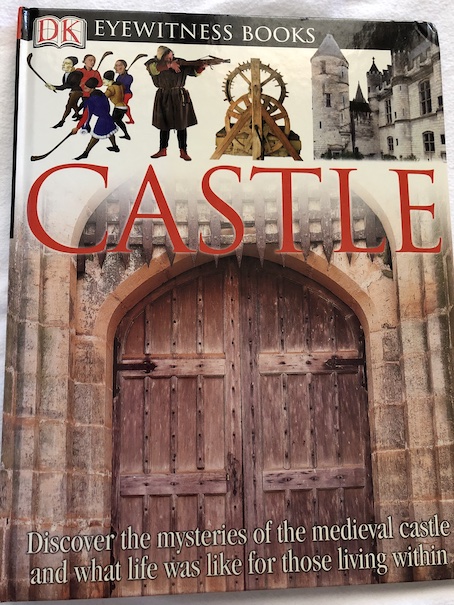
Castle by Christopher Gravett, photographed by Geoff Dann, 1994, 2004.
Eyewitness books are always great for the photographs that they use to illustrate the concepts in the book!
This book is all about Medieval castles. It starts by explaining the evolution of castle-building from early wooden motte-and-bailey castles to the great stone castles that we often think of as being the classic Medieval castle. However, stone castles could come in different shapes and styles, depending on where they were located.
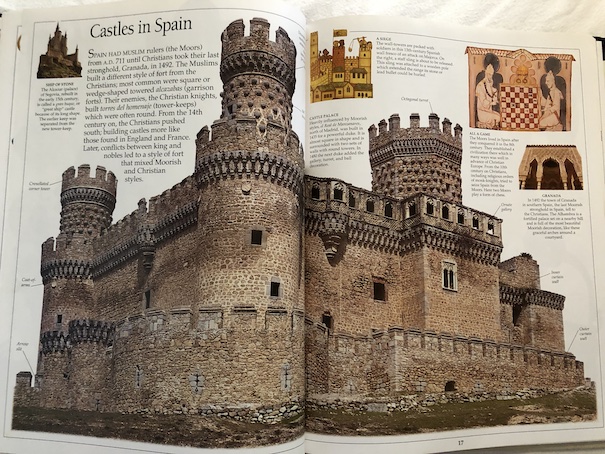
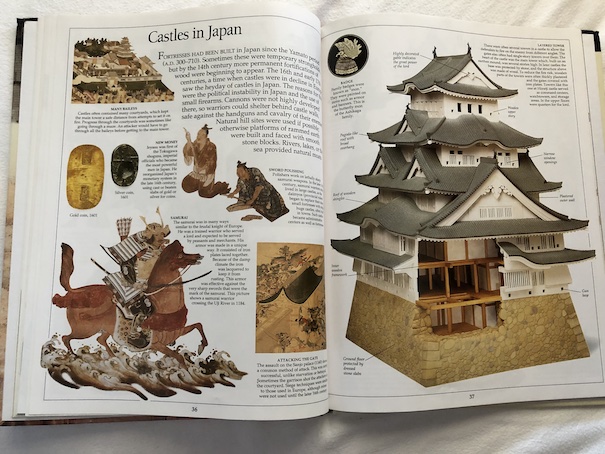
The book shows examples of castles in different countries. Most of the focus of the book is on castles in European countries, including Spain, Germany, and France. However, the book also includes information about castles in Japan.
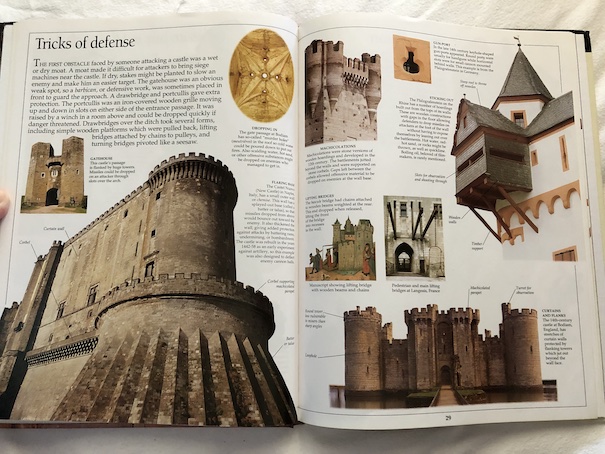
Castles were built for defense, and the book explains the types of defenses that castles would have, such as gatehouses, murder holes, lifting bridges, battlements with corbels and machicolations, and loopholes. It also explains what a siege was like, what types of weapons would have been used, and what knights and soldiers were like.
The parts of the book that I liked best were the parts that described the rooms in a castle and the daily lives of the people in a castle. Among the rooms in a castles were the great hall, kitchen, and chapel. I like how they show the objects that would be found in different rooms and how they would be used.
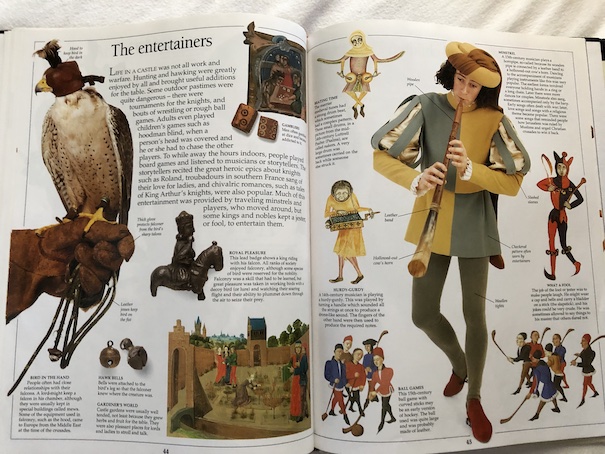
The book explains the lives of the lord of the castle and women and children who lived there. There is information about the types of foods they would eat in a Medieval castle and the types of games and entertainment they would have enjoyed.
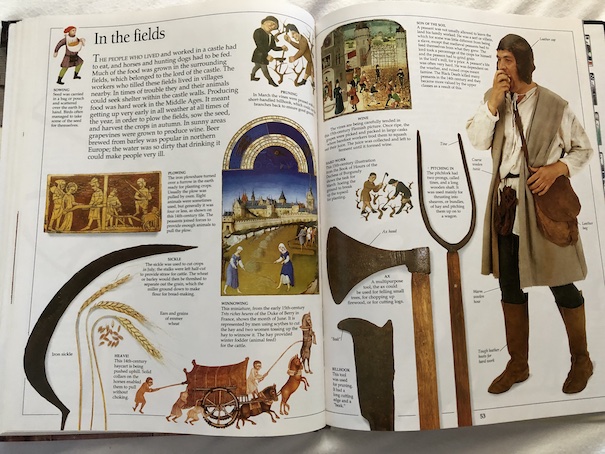
There is also information about other workers in and around the castle, including the castle builders and people who tended the castle’s animals and worked in the agricultural fields around the castle, producing food and textiles for the population.
There are sections in the back of the book with additional facts and information about castles and the people who lived in them and a glossary.
The book is available to borrow and read for free online through Internet Archive (multiple copies).
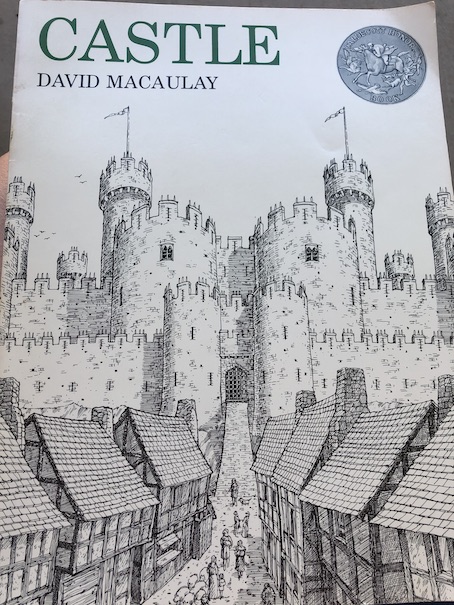
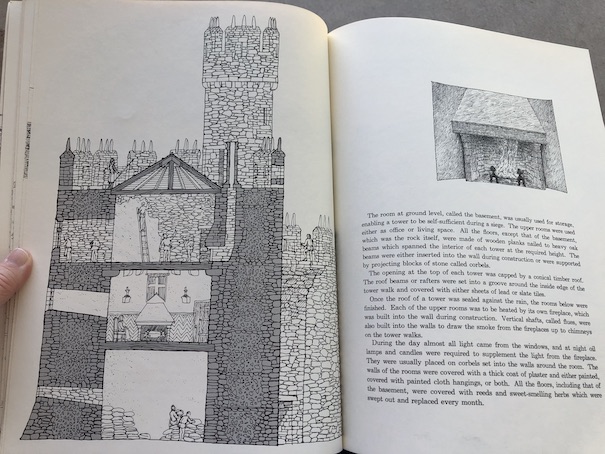
Castle is one of David Macaulay’s books about historical architecture, and like his earlier book, Cathedral, it has detailed and realistic drawings to explain each step in the building process.
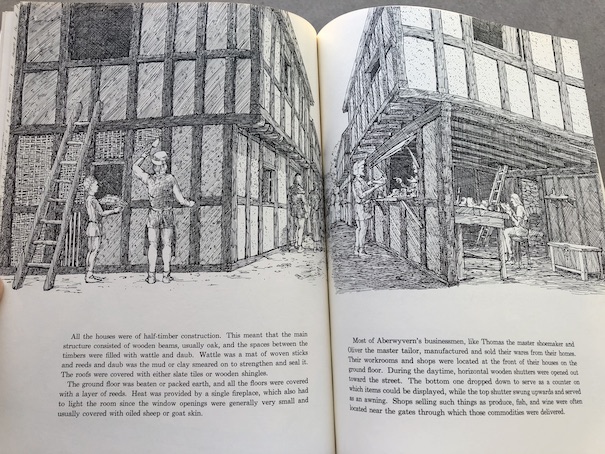
The castle in the story is fictional, but it’s based on real castles built by English lords during the conquest of Wales, circa 1277 to 1305. The process for constructing the castle and the military strategy behind it are historically accurate. The English, under King Edward I, used a strategy of establishing permanent towns and castles in Wales to dominate the Welsh. The construction of these castles and their accompanying towns took years, but it was part of a long-term political and military strategy that actually aimed at avoiding direct armed conflict. The purpose of the castles and towns was not only to support the occupying English forces and settlers, but also to provide economic centers that the Welsh would also find beneficial. The idea was that the Welsh, while initially opposed to the interlopers, would eventually come to rely on the presence of the new towns for business and trade and not want to force the newcomers out. This strategy is in keeping with the nature of castles themselves because they are defensive structures, designed for holding off attackers in order to maintain territorial control, shielding the people within the castle so they cannot be forced out. The fictional castle in the story is built with a fictional town called Aberwyvern and belongs to a fictional nobleman, Lord Kevin.
The beginning of the book explains the military strategy of Edward I and how he appointed noblemen to build castles in Wales. When choosing the site for a castle, they would take into account the natural landscape and its defensive capabilities. For example, Lord Kevin’s castle will be built on a high outcrop on the edge of a river. The high ground and the surrounding water will make the castle harder to attack.
The book shows a plan of the castle that will be built and explains the different craftsmen who will be working on the construction, along with the tools they will use. The book then describes the various stages of construction, beginning with the preparation of the site and the digging of a moat that will separate the section of rocky outcropping where the castle will be built from the land around it, where the town will be located. The moat is important because it provides an extra defensive feature.
My favorite parts explain the living quarters of the castle. People think that castles must have been uncomfortable with bare stone walls, but actually, the walls are only bare in ruined castles that were exposed to the elements over time. When a castle was inhabited, the walls were covered with plaster. The plaster would be painted and/or hung with tapestries for decoration. Reeds and nice-smelling plants would cover the floors as a kind of carpeting, and the plants would be swept out and replaced regularly.
The castle and town take years to finish, and the pictures show how they look at each stage of construction, both in aerial view and up close.
Toward the end of the book, King Edward visits the castle and warns Lord Kevin that there have been some Welsh uprisings. Lord Kevin and his people make sure that they have enough food and supplies to last through a siege, and the following year, the castle’s defenses are put to the test when they do have to withstand a siege.
Eventually, the Welsh attackers are forced to retreat when they are unable to take the castle and they receive word that more English forces are coming.
Over time, the community includes people of Welsh and English descent, living side-by-side, and the town extends beyond the original town walls. The town walls are no longer necessary for defense. By that point, the castle itself is mostly neglected, and people sometimes scavenge stones from it for other buildings.
This book is a Caldecott Honor Book. It is available to borrow and read for free online through Internet Archive (multiple copies). There is also an animated film version of this story, which is available online through Internet Archive.
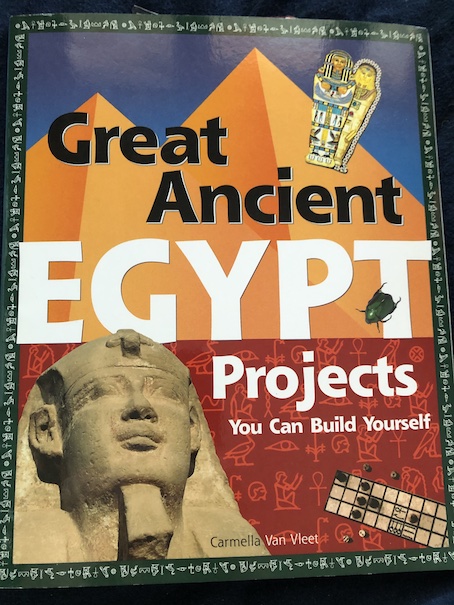
Great Ancient Egypt Projects You Can Build Yourself by Carmella Van Vleet, 2006.
I love this book because it combines lessons about history with hands-on projects and craft activities!
The book starts with a general timeline of Egyptian history, a brief introduction, and then a chapter about The Foundations of Ancient Egypt, which explains about the climate of Egypt, the role of the Nile in Egyptian civilization and farming, jewelry and other products produced by Egyptian artisans, pyramids and mummies, and forms of entertainment that the Ancient Egyptians enjoyed, like games and music. After this first chapter provides a general overview of Egyptian civilization, the other chapters go into more detail on different subjects related to Egyptian civilization with accompanying activities and projects. Each of the activities or projects comes with a list of materials needed and an estimate of the amount of time needed to finish.
Below is a list of the chapters in this book and descriptions of the types of projects that you will find in each section:
Boats
Boats were an important form of transportation of people and goods up and down the Nile. This chapter explains how the Ancient Egyptians made boats and has instructions for making your own miniature boat out of drinking straws in a similar manner as the Egyptians made papyrus boats.
Farming
This chapter describes the Egyptian flooding, growing, and harvesting seasons and the types of crops the Ancient Egyptians planted. The project for this chapter is how to build a shaduf, which is a device the Ancient Egyptians used for irrigating their crops.
Papyrus
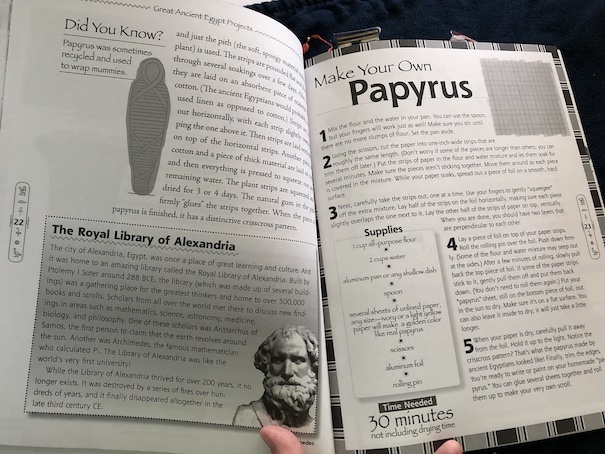
The Ancient Egyptians found many different uses for papyrus plants, including boats, baskets, mats, ropes, sandals, food, medicine, perfume, and paper. This chapter discusses how the Ancient Egyptians made papyrus paper and formed it into scrolls. The activity is to make your own papyrus-style paper using strips of regular paper instead of papyrus. It also has a recipe for a berry-based ink. It mentions that the Egyptians would have used different colored minerals, but the berry ink is easy for a beginner.
Homes
I always like books that discuss the lives of ordinary people and their homes. This chapter explains how Ancient Egyptian homes were made, how the homes of common people and wealthy people differed from each other, how homes were decorated, and the arrangement of rooms for sleeping, storing goods, and cooking. There are three activities for this chapter: making your own mud bricks, making a cat statue, and making a “soul house” – a miniature house or layout of rooms out of plaster of Paris.
Bread
This chapter is about what people ate in Ancient Egypt, and it particularly describes how the Ancient Egyptians made bread. An interesting fact in this chapter is that people in Ancient Egypt typically bartered for food instead of using money. This chapter includes two recipes, one for bread and one for date (fruit) candy.
Games
This is one of my favorite chapters! It’s about toys and games played by children in Ancient Egypt. It also describes board games that could be played by people of all ages, like Mancala, Hounds and Jackals, and Senet. The book provides instructions for making your own Senet board game and rules for playing.
Tunics and Fashion
This chapter is about what people wore in Ancient Egypt. Clothes at the time weren’t as much about modesty as in modern society. Clothing in Ancient Egypt could be pretty minimal, and it was common for Egyptian children to simply go naked. This chapter also discusses clothing accessories and wigs. The activities for this chapter are to make your own simple tunic, sandals (basically decorating a pair of flip-flops), and nemes (head covering).
Jewelry
This chapter explains the decorative and religious aspects of jewelry and the types of gems and minerals included in Egyptian jewelry. The projects are making paper beads and a wesekh collar (type of necklace).
Amulets
This chapter is about how Ancient Egyptians used amulets that they believed had the power to protect them from illness and other dangers. It describes different types of amulets and what they were supposed to do for people who had them. Part of this chapter covers The Book of the Dead, which was a collection of texts that provided a guide to funeral rituals and the afterlife. (You can actually get copies of this book today, translated into English.) The activity for the chapter is to make your own amulet out of a dough made from water, flour, and sawdust.
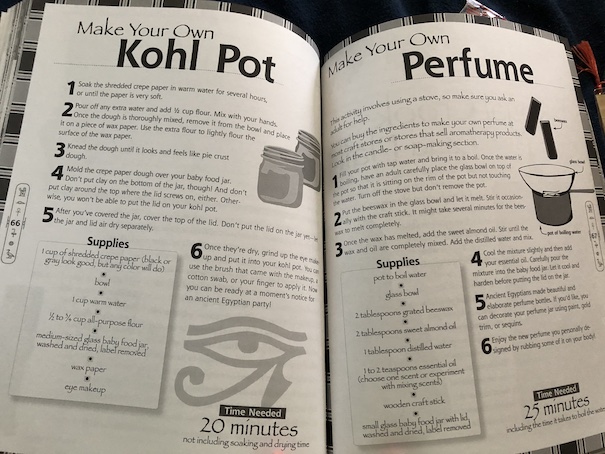
Kohl and Perfume
This chapter is about the makeup that people used in Ancient Egypt. Kohl is the substance that Egyptians used around their eyes. It was made from the mineral galena, and it may have helped the Ancient Egyptians protect their eyes from eye infections or provided some shielding from the sun’s glare. This chapter includes instructions for making a simplified version of kohl using black crepe paper, water, and flour and for making perfume out of beeswax, almond oil, and different essential oils. (The perfume activity looks the best of the two. Health food stores that also carry cosmetics, like Sprouts, probably have all or most of the ingredients, and if they don’t, you could probably get whatever’s missing from Amazon.)
Royal Crook and Flail
Pharaohs are often depicted holding a symbolic crook and flail. This chapter explains the meaning behind these symbols (the crook resembles a shepherd’s staff and was meant to represent the ruler of the king because he was supposed to look after his people like a shepherd looks after his sheep, and the flail is the same design as one that was used in harvesting and may have represented the pharaoh overseeing the fertility and prosperity of the land) and also discusses the duties of an Egyptian king or queen and what their subjects expected of them. The chapter also gives information about famous kings and queens and the crowns they wore. The activities for the chapter are making your own crook and flail and your own throne (by decorating an old chair, like one you might find at a garage sale).
Pyramids
This chapter covers Ancient Egyptian tombs and pyramids, how they were built, and how they were decorated. The activities for the chapter are building your own pyramid out of poster board and building a sledge of the type that the Ancient Egyptians used to transport stone blocks.
Temples
This chapter discusses Ancient Egyptian gods and their temples. It explains how the Ancient Egyptians would worship their gods. The activities are making your own foam obelisk and a miniature temple sanctuary scene in a box.
Mummies
This chapter explains how Ancient Egyptians made mummies and what they believed about the afterlife. The activities are making your own shabti (little figurines that were supposed to perform tasks on behalf of the deceased) out of a bar of soap and making your own funeral mask (like Tutankhamen’s famous mask).
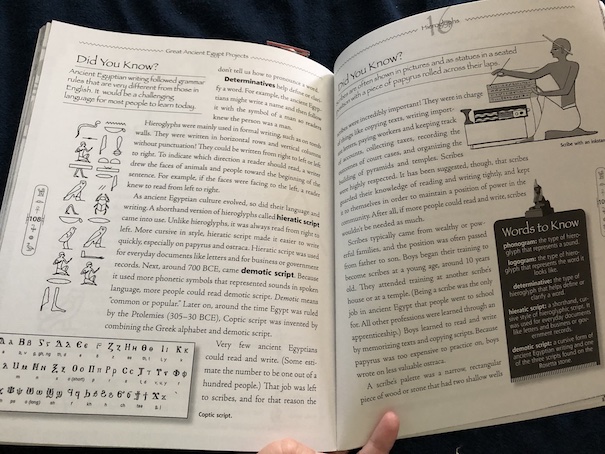
Hieroglyphs
This chapter explains how the Ancient Egyptian systems of writing worked and how modern people learned to read hieroglyphs by studying the Rosetta Stone. Th activities are making your own ostraca (piece of pottery used as a writing surface), mural, and cartouche.
I haven’t seen this particular book available to read online, but there’s a very similar by the same author on Internet Archive.
The Pharaohs of Ancient Egypt by Elizabeth Payne, 1964, 1992.
This is a book for kids about the lives of Egyptian pharaohs, including Hatshepsut, Akhnaton, and Rameses the Second. It also includes details of Ancient Egyptian history, daily life, and religion. I would put the difficulty level of the book around the middle school level. It’s a chapter book with very few pictures and more dense writing than others I’ve read in the same series. It’s one of the Landmark Books (called Step Up Biographies in earlier printings).
Egypt is among the world’s oldest civilizations, having a long history, extending over thousands of years. The Ancient Egyptians created a powerful legacy that has influenced other civilizations for millennia.
In the early days of Egyptian civilization, groups of small villages that early settlers had established along the Nile joined together to form kingdoms. At first, there were three of them:
The Bee Kingdom in Lower Egypt — at the Nile delta, on the Mediterranean
The Reed Kingdom in Middle Egypt — near the site of modern Cairo
The Hawk Kingdom in Upper Egypt — near the rapids that lay between Egypt and the Nubians to the South
If you’re wondering why “Lower Egypt” was in the northern part of Egypt and “Upper Egypt” was in the south, it’s because the Ancient Egyptians weren’t concerned about north and south with regard to their kingdoms. They lived along the Nile, their major source of water and transportation, and when they thought about the relations between cities and kingdoms, they were most concerned about whether they were upriver or downriver. So, “Upper Egypt” was the kingdom farthest upriver, and “Lower Egypt” was the one that was farthest downriver. The Nile just happens to flow from south to north.
Then, around 3200 B.C., the Hawk King known as the Scorpion conquered the kingdom in Middle Egypt. His successor Menes (also called Narmer), who ruled both Middle and Upper Egypt, conquered Lower Egypt as well, turning Egypt into a single nation with a single king. However, there were still rivalries between Upper and Lower Egypt, and the people in different regions spoke different dialects.
The Ancient Egyptians believed that their kings, called Pharaohs, were half-human and half-god. Part of the reason for this belief may have been because the Egyptians believed that a partially-divine ruler could help ensure that life in the Nile Valley could continue smoothly by appealing to his godly relations and partly because, if the king wasn’t completely human, he could be considered above the rivalries between the different regions and remain a unifying figure for the Egyptian people, no matter which region he had come from originally.
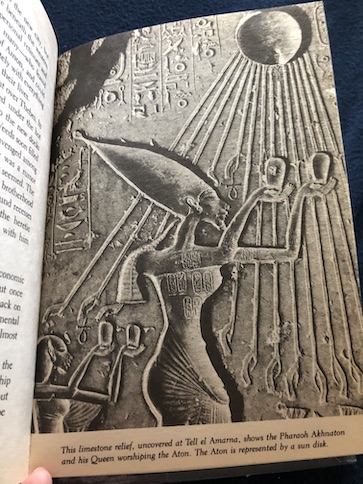
Although most Ancient Egyptians were polytheistic, like other ancient civilizations, there was one pharaoh who believed in only a single, all-powerful god. This pharaoh was Akhnaton, the father of Tutankhamen. (The book refers to Tutankhamen as a younger half brother of Akhnaton, but later sources say that he was Akhnaton’s son, although there is still some dispute about that. Either way, the two were related, and Tutankhamen was Akhnaton’s successor.) Akhnaton worshipped the sun, calling the sun god Aton. Part of the reason for this conversion to the worship of a single sun god instead of the many gods of the Ancient Egyptian pantheon may have been due to a power struggle between the pharaoh and the High Priest of Amon. However, Akhnaton seemed to genuinely believe in the Aton and was devoted to it, establishing a new capital city and outlawing worship of other gods. Unfortunately, his health was frail, and worship of the Aton didn’t extend beyond his death around the age of 42, with Egyptians returning to worship their old gods. Tutankhamen, who had been born Tutankhaton, changed his name and moved the capital away from Akhnaton’s city. Tutankhamen’s reign was short. He died in his late teens. (The cause of his death has never been precisely determined, although it seems likely that it was a combination of ill health, possibly a congenital condition due to inbreeding in the royal family, malaria, and a physical injury.) Tutankhamen’s main source of fame is his tomb, found largely intact in November, 1922.
Dynasties of Egyptian Pharaohs ruled Egypt for thousands of years, although in the later centuries of Ancient Egypt, foreign rulers moved in and took control for long periods. Then, in 332 B.C., Alexander the Great conquered Egypt, bringing it under Greek and Macedonian control and ending the reign of Egyptian Pharoahs forever.





























 Jestress's Forgotten Books and Stories
