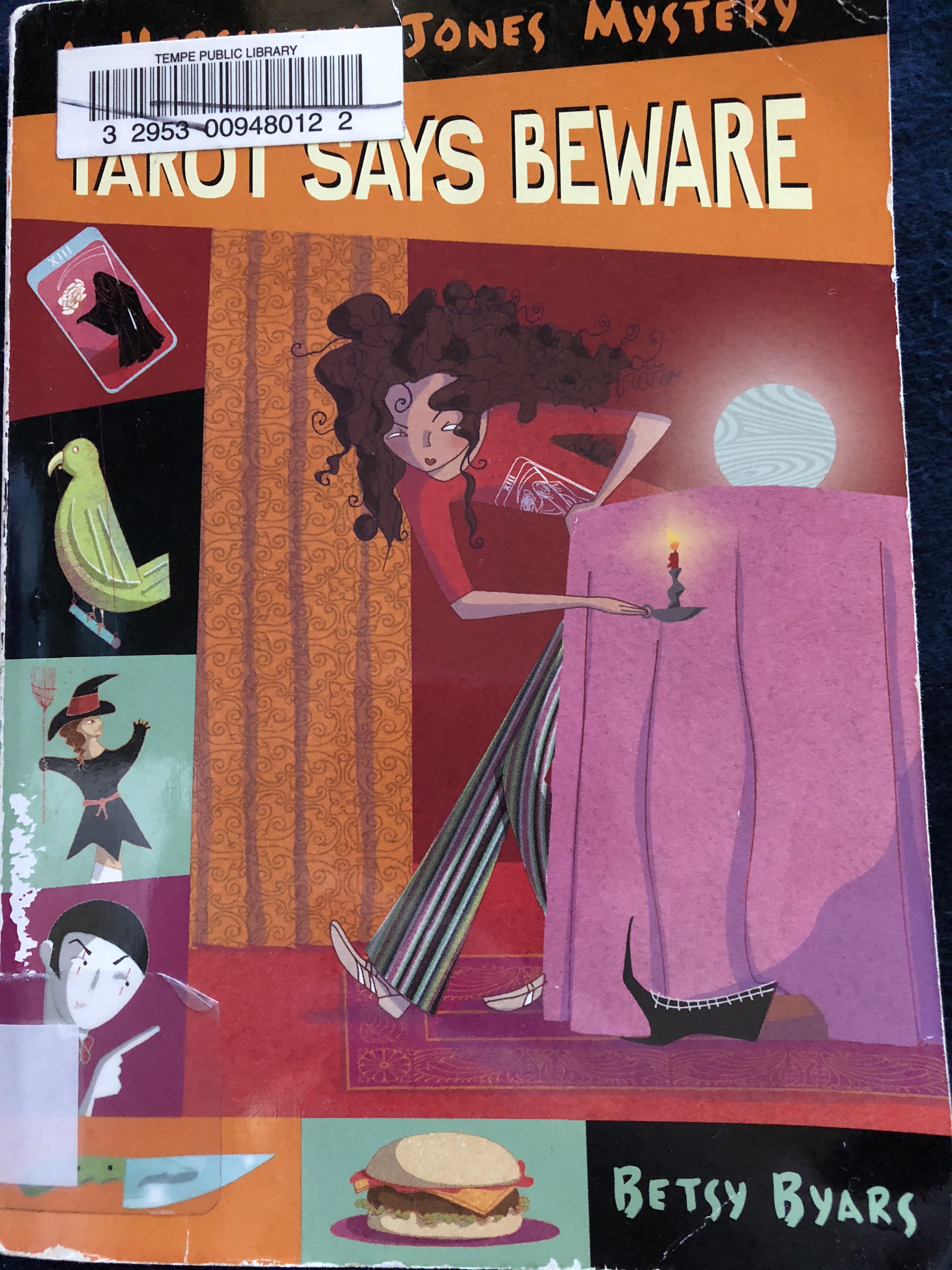
Madame Rosa is a fortune teller and one of Herculeah’s neighbors. Herculeah has been taking care of Madame Rosa’s pet parrot, Tarot, when she goes out of town. One day, Herculeah notices that Tarot has gotten loose and is sitting on the porch, so she goes to retrieve him. When she takes the parrot back into the house, she doesn’t see Madame Rosa. After investigating further, she finds Madame Rosa dead and calls her father, a police officer.
Herculeah is very upset about Madame Rosa’s death. She had considered her a friend. Even Meat said that he once consulted her for information about his father. She told Meat that his father danced, and Meat’s mother was very angry when she found out because she never wanted Meat to know anything about her ex-husband. She even said that she “could kill that woman.” But, who would really want Madame Rosa dead, badly enough to murder her? Was there someone else who didn’t like their fortune? Did Madame Rosa know something that someone was afraid that she would tell?
It turns out that Herculeah’s mother holds an important clue. Madame Rosa came to see her about a troubling client. A woman visited Madame Rosa to ask if her son could kill someone. The woman’s son had threatened her, and she wanted to know if he was capable of acting on his threats. Madame Rosa had asked her to bring something that belonged to her son, and the woman brought her the knife that the son had used to threaten her. That was when Madame Rosa had a vision of her own death. It frightened her so much that she fainted, and when she woke up, the woman was gone. Herculeah’s mother asked Madame Rosa what she’d like her to do, and Madame Rosa told her that she didn’t think anything could be done. Later, Madame Rosa was murdered with a knife.
So, now Herculeah suspects that the woman’s son came and murdered Madame Rosa, but she has no idea who the woman or the son are. Then, when Herculeah and Meat go to snoop around Madame Rosa’s house, Herculeah thinks that she sees Madame Rosa. Is she a ghost, or could Madame Rosa really be alive?
The title of the book comes from the fact that Tarot the parrot always says “Beware” to strangers, but not to Madame Rosa herself.
The book is available to borrow for free online through Internet Archive (multiple copies).
Once Upon a Dark November by Carol Beach York, 1989.
Katie Allen likes her part-time job helping Mrs. Herron with her housework. One of the best parts of the job is that she gets to see Mr. Herron, her English teacher, at home. Katie has a crush on Mr. Herron, although no one but her best friend knows it.
One day, while she’s at the Herrons’ house, Mrs. Herron tells her that her cousin Martin is coming for a visit. She says that Martin hasn’t been in Granville in years, although he used to live with their aunt when he was young. Their aunt is Miss Gorley, the creepy lady who lives across the street from Katie’s house. When Martin arrives, he turns out to be pretty creepy himself. He never says very much to anyone and spends a lot of his time just staring out the window. Mrs. Herron is not happy to have him there and wishes that he would leave.
One day, Martin disappears, and the next day, Miss Gorley is found murdered in her house. Did Martin return to Granville just to murder his aunt? Where is he now, and who is that mysterious person who tried to attack Katie at her house, dressed in a Frankenstein costume? Did Katie see something that she wasn’t meant to see? Katie doesn’t remember seeing anything important, but now she has to figure out what it was before it’s too late!
This book is not for young children. It would be best for kids in middle school (about 12 and up). There is murder and attempted murder, including the attempted murder of Katie, who is a child, because the murderer of Miss Gorley thinks that she knows too much. There is also some discussion of child abuse, which was part of the motive behind Miss Gorley’s murder. Katie did see some things that are important to the case, but their full importance doesn’t occur to her until the attempt on her own life. People are not quite who they seem to be, and some of Katie’s initial impressions were closer to the truth than someone wants her to know.
The book is currently available to borrow for free online through Internet Archive.
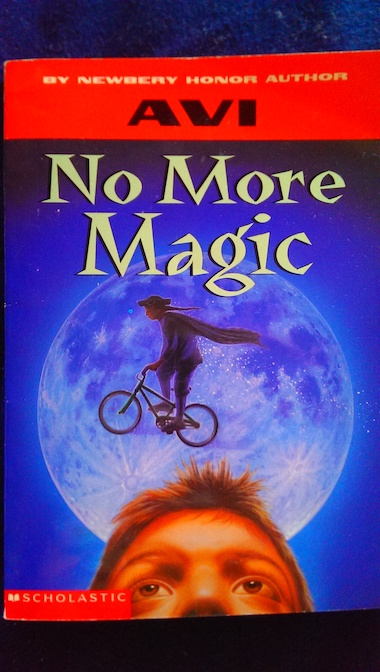
Chris has a fun time on Halloween with his best friend, Eddie. The two of them are dressed as superheroes. Eddie is Batman, and Chris is the Green Lantern. However, the next morning he discovers that his bike is missing.
Chris loves his bike because of its wonderful green color. He thinks of green as a magical color, and the bike has a great shimmery kind of green paint that reminds him of the Green Lantern. Although his green bike was a little old and his mother gets a good deal on a newer yellow bike, Chris misses his old one and begins investigating, trying to figure out who could have taken it.
At first, the challenge seems difficult. On Halloween night, lots of people were running around in costume. However, Chris’s community isn’t too big, and he is able to identify many of the people who came to the house around the time that the bike disappeared. One kid that he doesn’t know well is Muffin, a new girl at school, who came to the house in a nurse costume. There was also a mysterious kid who came in a warlock outfit, with a cape and a tri-cornered hat.
When Chris interviews Muffin to see if she knows anything about his missing bike, he learns that the warlock costume originally belonged to her. She had made it herself and was proud of it, but someone stole it while it was hanging up to dry. The nurse costume was a last-minute substitute. Chris thinks that whoever was wearing the warlock outfit is the most likely suspect for stealing his bike because the local police chief told him that a man had complained that someone riding a bike like his and wearing a costume like the warlock costume ran into him. He suggests that the two of them team up to find the mysterious warlock/thief and get their stuff back.
Muffin is kind of a strange girl and is oddly evasive about her life and family. At first, all she will tell Chris is that her real name is Maureen (but she doesn’t like that name) and that she has come to town to live with her aunt because her parents “aren’t around.” Her aunt seems somewhat strict, and Chris donates some of his own money to Muffin to help her buy a used bike so the two of them can ride around together, looking for clues.
One of the first things they learn is that the person wearing the warlock costume won the prize for the best costume at the Halloween parade downtown. Chris didn’t attend the Halloween parade, but his friend, Eddie, says that he went. However, Muffin and Chris notice that Eddie’s name wasn’t on the list of attendees. When they try to ask Eddie about it, he becomes strangely angry. Chris doesn’t want to think that his best friend could have stolen his bike or the warlock costume or both, but why would he try so hard to avoid answering their questions if he didn’t have something to hide?
Then, Chris learns why Muffin is so secretive about her life. The school counselor has noticed that Chris has made friends with Muffin, which she thinks is good, but she tells Chris’s mother about Muffin’s circumstances because she thinks that they should know. Muffin’s parents recently split up. For unknown reasons, her mother walked out on her father. Muffin’s father was distraught when his wife left, and he decided that he should go after her and try to straighten things out with her. He left Muffin with her aunt and went to try to find his wife, although no one really knows exactly where they went or when Muffin’s father might be back to get her. The part that worries the school counselor is that Muffin seems to be blaming her parents’ problems and their mysterious absence on magic. She thinks that magic made her mother go away and that magic is what’s keeping her father away. The school counselor thinks that being friends with Chris, who is a pretty practical kid (even though he also believes in magic a little), will help bring Muffin down to Earth, and Chris’s mother encourages him to be nice to Muffin and bring her over for dinner.
Still, Chris can’t shake the thought of magic from his head. He has the strange feeling that, somehow, his magic bike and the magic that Muffin is looking for to get her parents back are connected. One night, he even thinks that he sees the warlock flying across the sky with his bike, although his father thinks that he dreamed the whole thing. Neither of his parents believes in magic, and Chris even comes to question whether Muffin is to be trusted. However, as Chris’s father says, it’s often a matter of asking the right questions before ending up with the wrong answers.
Muffin’s belief in magic comes from what her father said after her mother left. He said that “the magic had gone,” and he blamed himself for being too self-centered to realize it. Adults would realize that “the magic” the father was talking about is the romantic feelings that come with love, but Muffin had interpreted the phrase literally. When her father decided to go after her mother and try to work things out, he said that he was going to “go and find the magic and make it work again.” Again, Muffin believed that was literally what he was going to do.
It turns out that there are perfectly logical explanations for what happened to both Chris’s bike and the warlock costume, and the two missing objects are not necessarily connected. Much of what happened on Halloween night involved a series of coincidences, deceptions, and misunderstandings, but even when the full truth becomes known, Chris and Muffin can’t shake the thought that there was a kind of magic behind it all. Plus, as the kids had guessed, Muffins parents return when they find Chris’s magic bike.
The book is available to borrow online for free through Internet Archive.
In a Dark, Dark Room and Other Scary Stories retold by Alvin Schwartz, 1984.
This is
a collection of classic scary stories based on folktales from around the
world. A special section in the back of
the book explains more about where the stories came from.
This book was a favorite scary book of mine when I was a kid, and the stories are the type that kids commonly like to tell at camp or at sleepovers to spook each other. Stories like these stay with you for years!
Sometimes, you can find individual stories from this book read aloud on YouTube. The book is currently available online through Internet Archive.
Stories in the Book:
The Teeth – A boy meets a series of strange people with increasingly long teeth. Based on a story from Suriname. (Here is a video of someone reading this story as an example.)
In the Graveyard – A woman sees bodies carried into a graveyard. Based on the song “Old Woman All Skin and Bone.”
The Green Ribbon – A girl wears a green ribbon around her neck for her entire life, refusing to explain to even her husband why she wears it, until she is old and about to die. Based on a European folk tale. Originally, it was a red thread.
In a Dark, Dark Room – Classic slumber party story! “In a dark, dark wood, there was a dark, dark house.” What will it all lead to? It is known in Europe and America.
The Night It Rained – A man gives a boy a ride home on a rainy night. When he returns the next day to pick up the sweater he loaned the boy, he gets an eerie surprise. Based on a class of ghost story known as “The Ghostly Hitchhiker,” which has many variants.
The Pirate – When Ruth visits her cousin’s house, her cousin tells her that her room is haunted by the ghost of a pirate. Based on a British folktale.
The Ghost of John – A short poem. The author of this book first heard this from a young girl in California in 1979.
The Wicked, Wicked Ladies in the Haunted House by Mary Chase, 1968.
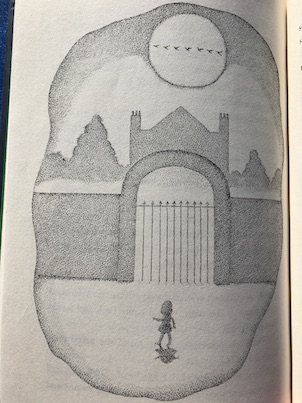
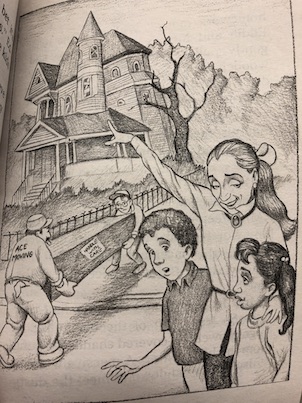
Nine-year-old Maureen Swanson has a bad reputation in her neighborhood, mostly deserved. The other kids don’t like her because she tells lies and picks fights with them. Maureen is fascinated by an old, abandoned house in her neighborhood where the wealthy Messerman family used to live. Sometimes she likes to pretend that she lives there herself.
One day, while trying to avoid
punishment for her latest antics, she finds her way inside the Messerman
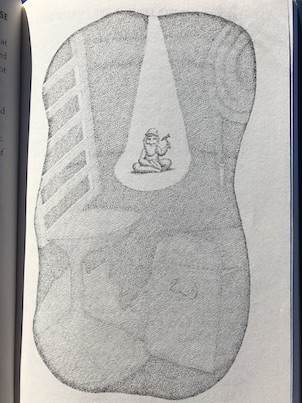
estate. There, she meets a little man
who turns out to be a leprechaun. He
tells her that she should leave immediately and not come back, but instead, she
ends up exploring inside the house. To
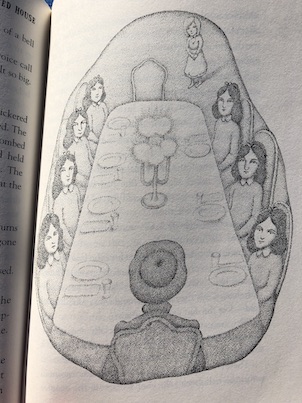
her amazement, she finds paintings of the seven Messerman sisters, who
disappeared from the house long ago, and the ladies in the paintings move when
she turns her back on them.
When Maureen tries to tell others about it, no one believes it. When she leaves the house, Maureen takes with her a strange bracelet that she finds on the ground, the same one that she had seen on one of the ladies in the paintings, a gold chain with pigeon feathers. Later that evening, the same lady from the painting shows up at Maureen’s house, asking for her bracelet back. The rumors Maureen has heard about the Messerman house being haunted are more true than she knows, and the wicked Messerman girls will stop at nothing to get what they want.
Years ago, the leprechaun came to the Messerman house along with a maid who was from Ireland. Mrs. Messerman was a very kind woman, and Nora, the maid, was his friend, so he decided to stay. However, the Messerman girls were always selfish and wicked. One day, the eldest of the girls stole the leprechaun’s magic bag of tricks and turned herself and her sisters into birds so that they could always go where they wanted and do what they wanted without anyone stopping them. Mr. and Mrs. Messerman were broken-hearted when their girls disappeared. Years later, after their parents were dead, they finally returned. They were not sad at all, but continued their selfish and wicked ways. Because of the magic, they never age and can turn into birds whenever they like.
Maureen is afraid to admit that she has the bracelet because she knows that her parents will punish her for trespassing on the Messerman property. The next day, the women trick her into entering the estate again, only this time, Maureen enters the estate as it was in the past, when the girls were young. Mr. and Mrs. Messerman are very kind to Maureen and offer to look after her until they can find where she lives. Mrs. Messerman seems to know that her daughters are mean but doesn’t seem to know what to do about it. She asks Maureen to help them if she ever has the chance. It’s a touching moment for Maureen, who suddenly realizes that no one has ever asked her for help before.
Maureen, frightened by the girls, finally gives back the bracelet, and they all fly off again, leaving her alone in the past. How is Maureen going to get home?
This book also goes by the title The Wicked Pigeon Ladies in the Garden. It is available to borrow and read for free online through Internet Archive.
My Reaction and Spoilers
This is partly a story about personal transformation. Maureen has definitely been the resident mean girl, but she gains a new perspective on her own life and behavior when confronted with the frightening wickedness of the Messerman girls.
The leprechaun tells Maureen that the only way to get out of the pretend past created by the Messerman girls is to think about what is going on in the real world. When Maureen thinks of her mother, she hears her mother calling her and returns to her own time. The leprechaun catches the birds in a net and almost drowns them in a pond, but Maureen stops him, telling him that Mrs. Messerman had asked her to help them. The leprechaun releases the birds and tells Maureen that they will continue to be, literally, flighty birdbrains, but that their mother’s love will always be with them. Maureen, having seen how cold and cruel the sisters were, never appreciating their mother’s love, learns to appreciate her own family more and to behave better. At the end of the story, she acknowledges that she heard her mother calling her and that call, the product of her own mother’s love and concern for her, was what helped her to return home. Maureen ends up better off than the wicked and flighty Messermans because she not only has a home where people care for her but she has learned to appreciate that home and those people and will now treat them better.
One of the things that I appreciated most about this book was the unusual way the leprechaun was used in the story. The story starts out seeming like it will be about ghosts in a haunted house, but that’s not quite what’s happening. Also, when leprechauns appear in stories, they usually have a pot of gold or play tricks on people, but the leprechaun’s role in this story isn’t quite the same.
#1 Vampires Don’t Wear Polka Dots by Debbie Dadey and Marcia Thornton Jones, 1990.
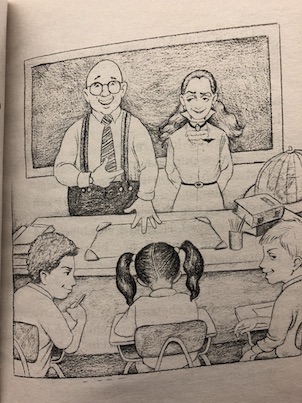
The kids in the third grade class at Bailey Elementary School have been pretty hard on their teachers. Their last teacher resigned when she suffered a nervous breakdown due to their misbehavior and pranks. Now, the kids have a new teacher, Mrs. Jeepers.
Mrs. Jeepers has just moved to their city from Transylvania, and everyone in class agrees that she’s not a normal teacher. She seems to have a hypnotic power over people, and her mysterious green brooch seems to glow and have magic powers. Not only that, but she has moved into a creepy old house in the neighborhood with a long box that could contain a coffin. Could Mrs. Jeepers be a vampire? No one knows, but none of the kids want to risk making her angry, except maybe Eddie, the class trouble-maker.
Mrs. Jeepers lays down the class rules on the first day. The rules are basically that the students should treat her and each other nicely, talk only when appropriate, and walk instead of run. Eddie asks her what happens if they break the rules, and Mrs. Jeepers only replies, “I hope you never have to find out.” Most of the other students are nervous about creepy Mrs. Jeepers and do their best not to make her angry, but Eddie is annoyed by how good the others are being and tries to various antics to get Mrs. Jeepers angry and make the other kids goof off, like normal. Sometimes, Mrs. Jeepers stops these antics, apparently with the power of her mysterious brooch.
Mrs. Jeepers is strangely evasive about her past, although she mentions that her husband is dead. He is the one who gave her the bat charm bracelet that she wears. Eddie and Melody try sneaking into Mrs. Jeepers’ house one night to see if they can get a look at the long box that might be a coffin, but they are unable to actually open the box, which seems to be locked from the inside.
The question of whether Mrs. Jeepers is really a vampire is never settled. Unlike most mythological vampires, she seems to have no problem going outside during the daytime. When the kids test garlic on her, it makes her sneeze. She does seem to have a strange power to make the children behave themselves, but that is partly because they are afraid of making her angry. At the end, Eddie finally causes Mrs. Jeepers to lose her temper. She takes him out of the classroom for a moment to talk to him, and when they return, Eddie seems to have been badly frightened by something. He never tells the others exactly what Mrs. Jeepers said or did, but he says that she is not normal and that he’ll never do anything to make her angry again.
When the book ends, it says that the children got through the rest of the school year with Mrs. Jeepers without getting her angry or seeing her brooch glow again, making me think that the book wasn’t always intended to be part of a series. However, for the rest of the series, the kids are still in the third grade with Mrs. Jeepers as their teacher.
The fact that the kids can never really prove that Mrs. Jeepers is a vampire, although they continue to believe it throughout the series, sets up the pattern for the books that follow it. Throughout the series, the kids encounter other people (including some relatives of Mrs. Jeepers) who seem strange and may be creatures from mythology or folklore or other supernatural beings, but the books always leave some room for debate. Mrs. Jeepers is the only one of these strange people to remain with the kids throughout the entire series. Other characters come and go, although there are a few recurring characters.
I always like it when children’s books reference other children’s books. In the beginning of the book, after their first teacher leaves, the kids worry about who their new teacher will be, and they make a reference to Miss Viola Swamp from the Miss Nelson books.
The book is available to borrow for free online through Internet Archive.
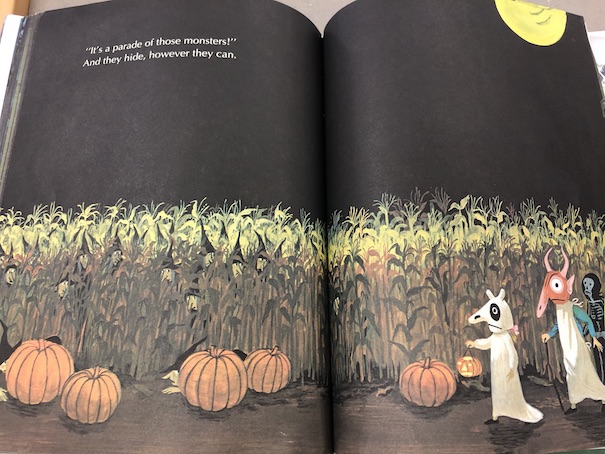
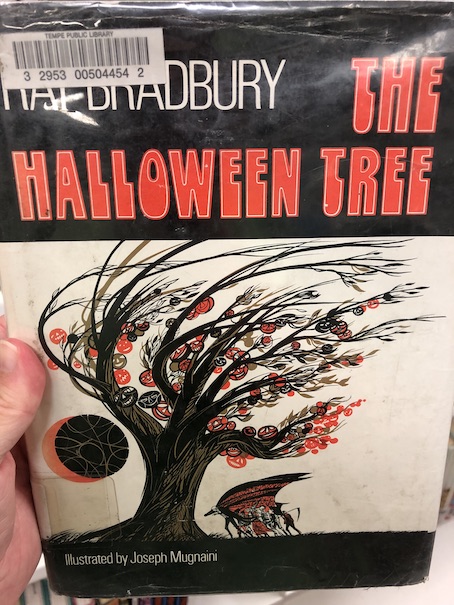
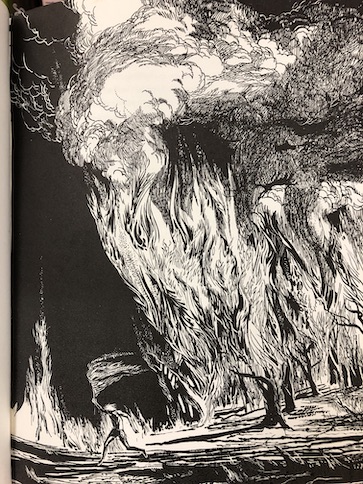
A group of neighborhood boys want to go trick-or-treating on Halloween night, but they’re upset because it looks like a friend of their, Joe Pipkin, won’t be coming with them. When they get to Pipkin’s house, he seems ill and is clutching his side. His friends worry that he’s sick, but he valiantly reassures them that he’ll be fine. He sends them on, telling them that he’ll catch up with them and that his costume will be great. Specifically, he tells them to “head for the House” which is “the place of the Haunts.”
The
house that Pipkin is talking about is the creepiest house in town. It’s large, so large that it’s hard to tell
how many rooms it has. The boys knock on
the creepy-looking door knocker on the front door, and a man answers the door. When the boys say, “trick or treat,” the man
says, “No treats. Only—trick!” Then, he slams the door without giving them
anything.
Not knowing what else to do, the boys walk around the side of the house and see a large tree, filled with jack o’lanterns. This is the Halloween Tree. The strange man they saw before rises up from a pile of leaves and scares the boys, giving them the “trick” that he promised them earlier. He finally introduces himself as Carapace Clavicle Moundshroud. He begins talking to them about the history of Halloween and asks them if they understand the real meanings behind the costumes they have chosen. The boys admit that they really don’t know the meanings behind their costumes, and Moundshroud points off into the distance, calling it, “The Undiscovered Country.” He says that out there likes the past and the history of Halloween and that the boys will learn the answers if they’re willing to go there. The boys are interested, but they say that they can’t go anywhere without Pipkin, who promised that he would come.
Pipkin suddenly appears in the distance, by a dark ravine, holding a lit pumpkin. He says that he doesn’t feel well, but he knew that he had to come. Pipkin trips and falls, and the light in his pumpkin goes out. From a distance, the others hear him calling for help. Moundshroud says that something bad has happened. Pipkin has been taken away to The Undiscovered Country by Death. Moundshroud says that Pipkin may not be taken permanently but perhaps held for ransom and that, if they follow Pipkin to The Undiscovered Country, they might be able to get his soul back and save his life.
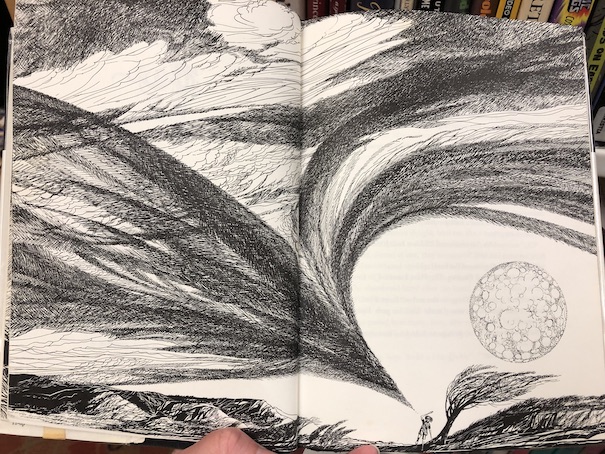
Moundshroud has the boys build a kite that somewhat resembles a pterodactyl, and they use it to travel into the far distant past. The first place they arrive is Ancient Egypt, where the boys learn about mummies and how the Ancient Egyptians viewed the dead. They see Pipkin as a mummy, being laid to rest in a sarcophagus, surrounded by hieroglyphs, telling the story of his life. (Or, as Moundshroud says, “Or whoever Pipkin was this time around, this year, four thousand years ago,” hinting that Pipkin has been reincarnated before and what they are seeing during their journey are his past lives and deaths.) Pipkin calls out to his friends for help. Moundshroud tells the boys that they can’t save Pipkin now, but they’ll have a chance later.
They
continue their journey through time and around the world, seeing glimpses of
Halloweens past in Ancient Rome and the British Isles, where they learn about
druids, Samhain, and witches. Moundshroud
describes how the Romans supplanted druidic practices with their own
polytheistic religion until that was eventually replaced by Christianity. All along, they can still hear Pipkin calling
to them, and he seems to be carried off by a witch. As they pursue him, Moundshroud teaches them
the difference between fictional witches and real-life witches, which he
characterizes as being more like wise women, who don’t really do magic.
From there, they go to Notre Dame to learn about gargoyles. They continue to see Pipkin in different forms, even as a gargoyle on the cathedral. Pipkin tells them that he’s not dead, but that he knows that part of him is in a hospital back home.
In Mexico, the boys experience Dia de los Muertos and learn about skeletons and a different kind of mummy from the ones they saw in Egypt. They find Pipkin, held prisoner in the catacombs by the mummies, and Moundshroud tells the boys that the only way to save him is to make a bargain, both with him and with the dead: each boy must give one year from the end of their lives so that Pipkin may live. It is a serious decision, for as Moundshroud says, they won’t miss that year now, being only about 11 or 12 years old, but none of them knows how long they will actually live. Some of them who were destined to die at 55 would now only make it to 54, and as they reach the end of their lives, the year will seem that much more important to them. Even those who live longer will still want every day they can possibly have. However, each decides that he is willing to make the sacrifice because, without that sacrifice, Pipkin has no chance, and they can’t just let him die.
They
make the bargain and are soon returned home.
When they go to Pipkin’s house to check on him, they are told that Pip
is in the hospital because he had his appendix taken out, just in time to save
his life. At the end of the story, Tom
(who is the leader of the boys through most of the story), wonders silently who
Moundshroud really was, and he hears in his mind, “I think you know, boy, I
think you know.” Tom asks him if they
will meet again, and Moundshroud says that he will come for Tom many years from
now, confirming that Moundshroud was Death all along, which was why they had to
make the bargain with him.
I saw the animated movie version of this story long before I read the book, and it really gave me the creeps! Moundshroud is creepy because he is kind of two-faced. On the one hand, he seems somewhat helpful in helping the boys to find Pipkin and teaching them about the history of Halloween, but on the other, he does not admit to the children that he is Death until the very end, that he is the very thing that they need to save Pipkin from, and that they can only do it by offering a sacrifice of years from their own lives. Although it does occur to me that Moundshroud may not be quite as two-faced as he seems because Pip’s illness and potential death may not have been planned by him but simply the fated situation for Pip, and Moundshroud might have just taken it upon himself to provide a way for Pip’s friends to save him in the least painful way. By not telling them that a sacrifice of part of their lives would be necessary until the very end, after they had come to a better understanding of life and death in the history of Halloween, he may have made the choice easier for them to make. Also, he never says exactly how much time they bought for Pip with their sacrifice. The implication is that Pip is now free from his early appointed death date and will now live a full life, similar to what his friends will have. The exchange does not seem to be an even one, a year for a year, with the children needing to decide how many years they will donate to Pip. Although the kids still don’t know at the end how many years each of them will live, it seems that none of the rest of them is in danger of dying in childhood, and they will all live for many more years.
I wouldn’t recommend this book for young children (it still gives me the creeps, and I’m in my 30s), but it is interesting how they take a journey through the origins of Halloween. The book and the movie were somewhat different, partly because there were more kids in the group in the book and partly because the group of kids in the movie also had a girl in a witch costume. In the book, the kid in the witch costume was also a boy.
Both the book and the animated movie are available online through Internet Archive.
Who Knew There’d Be Ghosts? By Bill Britain, 1985.
Tommy Donahue and his friends, Wendy “Books” Scofield (the smartest kid in their class as well as being pretty tough) and Harry “the Blimp” Troy (known for being the tallest and biggest kid in their class), prefer playing around the abandoned Parnell house instead of at the park because they like to play games of pretend, based on adventure stories that Tommy has read. It’s hard to play games of pretend in such a public place as the park because other people either laugh or think that they’re just getting in the way. Almost nobody goes near the old Parnell house because people think that it’s haunted. They’re right; it is haunted.
Some people in their town have been trying to arrange for the Parnell house to be turned into a museum because the Parnells were the founding family of their town, but the movement hasn’t been able to raise the money needed to renovate the place. Now, Tommy’s father, a lawyer, has been recruited to arrange for the house to be purchased by a private citizen who says that he wants to renovate the house and use it as his own residence. However, Tommy and his friends overhear the buyer, Avery Katkus, and a confederate talking as they look over the house. Mr. Katkus isn’t interested in the house at all; he wants something valuable that is hidden inside. When they hear the two men plotting to sneak into the house at night to do some searching for this mysterious something, the kids decide that they will come back at night and watch for them to find out what they’re looking for. The kids don’t want anything bad to happen to the house because they’ll lose their private playground.
Tommy
is the first to go and check out the Parnell house at night, and that’s when he
meets the ghosts, Horace and Essie Parnell.
At first, Horace tries to scare Tommy away, but when Tommy explains that
he only came to keep watch, Horace asks him what he means by that. Tommy explains to him about Mr. Katkus, and
Horace says that he could use Tommy’s help.
Years ago, Horace’s father made a dying wish that all members of their
family should be buried in the family cemetery on the property of the house. Most of the members of the family are buried
there, but Horace, who was killed during the Revolutionary War, and Essie, who
accidentally fell overboard from a riverboat and was permanently lost in the Mississippi
River, were only two Parnells who were not buried on the property, so their spirits
are now bound to the house. Naturally,
Horace and Essie are concerned with the future of the house.
Tommy tries to tell his friends about the ghosts, but they don’t believe him until they see the ghosts for themselves. When the three kids return to the house the next night, Horace saves them from being attacked by Mr. Katkus’s hired confederate. Now convinced of the ghosts’ existence, Harry and Books are eager to help save the house, and the key in doing so is discovering what kind of hidden treasure the house holds.
The book is available to borrow for free online through Internet Archive.
#1 The Secret of Terror Castle by Robert Arthur, 1964, 1992.
In the first book in the series, Jupiter, Pete, and Bob form the Three Investigators, an organization dedicated to solving all kinds of mysteries. It was particularly Jupiter’s idea. They have been friends for a long time, and they used to have a club dedicated to solving puzzles. Now, they’ve decided that they want to solve more complicated problems and mysteries. Jupiter has won the use of a Rolls Royce and chauffeur for a month by entering a contest at an auto rental agency, so he thinks that it would be a good time to get started because they will have transportation to anywhere in the city.
Jupiter also has an idea for their first case, something that will help them get publicity for their new investigative organization. There is a rumor that a director, Reginald Clarke, is looking for a genuine haunted house to be the setting of his next movie. Jupiter manages, through some clever trickery, to get an interview with Reginald Clarke and persuades him to introduce this account of their first case if he and the other investigators can find a genuine haunted house right in town. Clarke takes them up on it, not because he thinks they will succeed, but because he sees it as the only way to get Jupiter to stop doing an unflattering impersonation of him.
Jupiter, however, is confident that they will be successful because he already knows the perfect place to investigate. Terror Castle is a large mansion that was built years ago by an old actor who was in silent films. All of his movies were scary ones, and since his death under mysterious circumstances, no one has succeeded in staying in the castle very long. Strange apparitions have been seen there, and anyone who tries to spend the night there is overcome by inexplicable terror. As far as Jupiter is concerned, all they have to do is prove that the castle is really haunted, and that means that the Three Investigators must visit it themselves.
In the original books, the director that Jupiter tries to find a real haunted location for was Alfred Hitchcock. Alfred Hitchcock introduced the early books in the series and played minor roles in some of them, and The Three Investigators capitalized on his reputation. When the series was re-released, however, Alfred Hitchcock was replaced by a fictional director, and his role in later books was taken by a fictional mystery author named Hector Sebastian. In the re-released version of the first book, Reginald Clarke refers the boys to Hector Sebastian at the end of the story so they can help a friend of his to find his missing parrot, which leads directly into the subject of the next book.
The haunting in this story (as with others in the series) has a reasonable explanation, not a supernatural one. In fact, one of the things that I always found memorable about this book was the explanation of how the inexplicable feelings of terror people experienced were created using sound waves which could be felt but which were beyond the normal range of human hearing. I’m not sure whether the book was completely correct about the science behind this technique, but I have heard about sounds being used to create odd or even harmful effects on human beings in real life. As for the reasons behind the haunting, they concern the original owner of the castle and the life he lived.
This is one of the books in the series which was made into a movie, The Three Investigators and the Secret of Terror Castle, but the movie was very different from the original book. In the movie, the owner of the castle was an inventor, not an actor. Part of the plot also concerned Jupiter’s deceased parents and a mystery that they had been investigating. Jupiter’s parents were not part of the original book at all. A villain who appears in some of the other books in the series also makes an appearance in the movie, although he had nothing to do with this particular story in the original series. Overall, I don’t recommend the movie for fans of the original series. The changes don’t seem to be for the better, and I think people who remember how the original story was and liked it would be disappointed in the movie.
There are multiple copies of this book available to borrow for free online through Internet Archive, both the original version with Alfred Hitchcock and the updated one.










 #1 The Secret of Terror Castle by Robert Arthur, 1964, 1992.
 Jestress's Forgotten Books and Stories