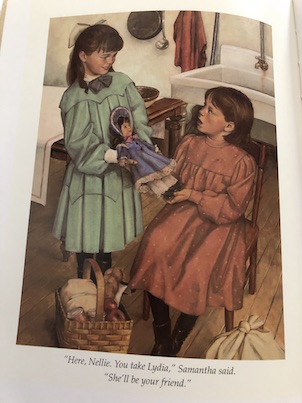
Samantha Learns a Lesson

American Girls

Samantha Learns a Lesson by Susan S. Adler, 1986.

This is part of the Samantha, An American Girl series.

Samantha attends Miss Crampton’s Academy for Girls in Mount Bedford. She is doing well and has some friends at school, but she misses her friend Nellie. She knows how poor Nellie’s family is and worries about how they are doing.

One day, Samantha comes home from school to a surprise: Nellie has returned to town with her family. Samantha’s grandmother recommended Nellie’s family to a friend, Mrs. Van Sicklen, who has hired Nellie’s father as a driver and Nellie’s mother as a maid. Nellie and her sisters will also be helping with household chores. They will also get the chance to go to school, although they will be attending public school and not the private school that Samantha attends.

When they begin attending school, Nellie’s younger sisters do fine in the first grade, where they are expected to be beginners, but Nellie herself has trouble in the second grade. Nellie is a little old for second grade, so the other children make fun of her for being there, and she is so nervous that she makes embarrassing mistakes in front of her teacher and the other students. Nellie thinks that perhaps she’s too old to start going to school, but Samantha realizes that what she needs is a little extra help.
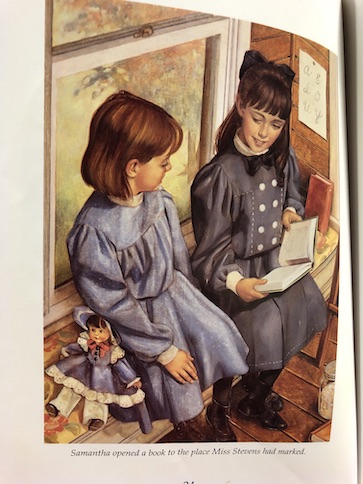
Samantha talks to her own teacher and explains the situation. She says that she would like to help teach Nellie what she needs to know, but she is not sure what Nellie needs to know in order to pass the second grade. Samantha’s teacher, Miss Stevens, thinks that it is nice that Samantha wants to help Nellie and gives her a set of second grade readers to study with pages marked for assignments. Samantha tells her grandmother what she is planning to do, and she says that it is fine, as long as the extra tutoring doesn’t interfere with Nellie’s house work too much.

Nellie accepts Samantha’s help at their secret, private “school” that Samantha calls “Mount Better School.” During their lessons, Samantha discovers that Nellie is very good at math because she used to have to help her mother with shopping and had to keep track of her money. Nellie cannot always come for lessons because of her work, but Samantha’s tutoring helps her to improve.
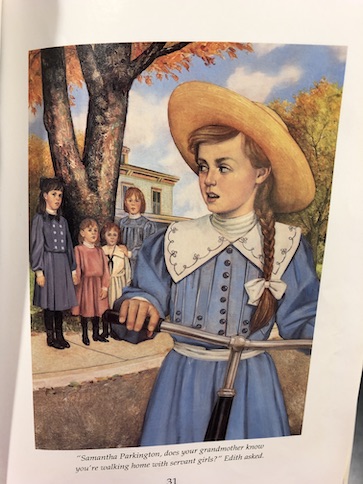
One day, when Samantha is walking home from school with Nellie and her sisters, a mean girl from Samantha’s school, Edith, sees them and criticizes Samantha for spending time with servants. She says that her mother would never allow her to play with servants. Samantha asks her grandmother what Edith means, and her grandmother says that Edith is a young lady. When Samantha asks why she is allowed to play with Nellie, her grandmother says that they are not really playing, that Samantha is helping Nellie, which makes it different. That explanation doesn’t entirely satisfy Samantha.

However, her grandmother is both understanding of the help that Samantha has been giving to Nellie and serious about the need to help others. When Edith’s mother and other ladies of the neighborhood come to visit and complain about Nellie’s family and how Samantha is spending time with them, Samantha’s grandmother defends them and says that Samantha is doing good.

Meanwhile, Samantha’s school is preparing for a public speaking contest with the theme “Progress in America.” To prepare for her speech, Samantha asks her grandmother, her Uncle Gard, and other people what they think about progress and what the best inventions are. They mention inventions like the telephone, electric lights, automobiles, and factories. Samantha is fascinated by the idea of factories and the variety of products that they can make. However, when Samantha reads her speech to Nellie, Nellie is not nearly so enthusiastic about factories as a sign of progress. Nellie used to work in a factory herself, and she knows that they are not pleasant places. She tells Samantha how factories are noisy and how dangerous the machines are for the workers. The factory workers are also very poorly paid, which is why the products they make are so cheap.

Nellie’s stories about factories bother Samantha. When it is time for the public speaking contest, Samantha delivers a changed version of her speech in which she discusses the dangers of child labor and how some form of progress, particularly ones that endanger children, are not good forms of progress. Samantha’s thoughtful speech wins the contest, and her grandmother understands that Samantha has been learning things from Nellie even while teaching her.

In the back of the book, there is a section with historical information about education and child labor during the early 1900s.

The book is currently available to borrow for free online through Internet Archive.

Meet Samantha

American Girls

Meet Samantha by Susan S. Adler, 1986.

This is the first book in the Samantha, An American Girl series.

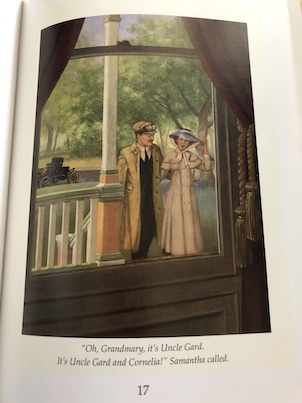
Samantha Parkington is a nine-year-old orphan. She belongs to a wealthy family and lives with her grandmother, called Grandmary, in the Hudson Valley in New York. Grandmary is often strict with Samantha, trying to teach her to be a proper young lady, but Samantha finds it difficult. Samantha’s grandmother loves her, but she has very old-fashioned ideas about how girls should behave. When Samantha wants to try making and selling boomerangs in order to earn money to buy a doll, using instructions from The Boys’ Handy Book, her grandmother stops her, saying that young ladies do not earn money. She would rather that Samantha earn the doll as a reward for doing what she is told and practicing her piano lessons. Samantha also has an uncle, Uncle Gard, who has a girlfriend named Cornelia. Cornelia is a more modern woman, who would see nothing wrong with Samantha wanting to earn some money.

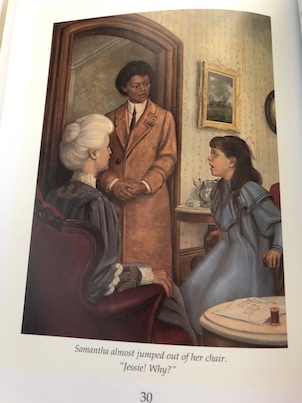
One of her grandmother’s servants, a black woman named Jessie, is kind and motherly to Samantha. Jessie often patches Samantha up after her various escapades and mishaps. Jessie’s husband, Lincoln, is a train porter, and Jessie tells Samantha exciting stories about the places that Lincoln has seen in his work, like New Orleans. Sometimes, Lincoln brings Samantha post cards from these places.

Samantha soon learns that a new girl her age is coming to a neighbor’s house. She has been wanting a playmate, so she goes over to the neighbor’s house to introduce herself. The new girl’s name is Nellie, but she has come to be a servant for the neighbors, the Rylands. Nellie’s family is poor, so Nellie needs to work as a maid help her parents earn money and support her younger sisters. Samantha is surprised when Nellie describes her family’s circumstances in New York City. Samantha has never been poor, and she doesn’t know what it’s like to be cold and hungry. Nellie says that the air in the countryside is better for her, and she gets better food working for the Rylands. Nellie tells Samantha that she has never been to school, and Samantha offers to teach her.

Then, Jessie suddenly announces that she is leaving her job at Grandmary’s house. Grandmary doesn’t seem surprised, but Samantha is. Jessie offers no explanation for leaving, and when Samantha tries to ask, Grandmary and the other servants do not want to talk about it. Samantha tells Nellie about Jessie leaving, coming up with fanciful reasons why she might leave her job, but Nellie offers the practical explanation that Jessie might be having a baby. Nellie knows more about it than Samantha because she has younger sisters, but she acknowledges that adults of this time period do not like to talk about people having babies, particularly in front of children. Neither Nellie nor Samantha entirely knows why.

However, Samantha is still concerned about Jessie. Samantha doesn’t know where Jessie lives, but Nellie does. The two girls sneak out one evening to visit Jessie and learn for themselves what the matter is. This is the first time that Samantha has been to the part of her town where black people live, further opening her eyes to the lives of people from lower classes of society. Nellie is a little surprised at how Samantha, who is more educated, sometimes knows so little about the ways that other people live.

It turns out that Jessie does have a new baby. Jessie reassures Samantha that she and the baby are fine, but since her husband needs to travel because of his job as a train porter, she needs to stay at home with her baby now. Samantha thinks of a way to help Jessie keep her job and care for her baby at the same time, persuading her grandmother to let Jessie come back. Unfortunately, Nellie soon has to leave because Mrs. Ryland doesn’t think that she’s strong enough to work as a maid and decides to send her back to her family in New York City. Samantha gives Nellie her new doll as a going-away present, and she is very concerned about how Nellie and her family will manage.

In the back of the book, there is a section with historical information about how wealthy people and their servants lived during the early 1900s.

Something that occurred to me later is that Jessie is about the right age to be Addy‘s daughter, from another American Girls series. I don’t think that there’s a real connection between Jessie and Addy because the Samantha books were written before the Addy series. However, when I stopped to think about their relative ages (Addy would be about 49 years old in 1904, and Jessie is probably in her 20s), it occurred to me that if Addy had a daughter, she would probably be an adult at this time, and she might be doing something very similar to what Jessie is doing, working as a seamstress.

The book is currently available to borrow for free online through Internet Archive.

The Secret School

The Secret School by Avi, 2001.

The year is 1925, and what 14-year-old Ida Bidson wants most is to graduate from her community’s small, one-room schoolhouse so that she can go to high school in a nearby city.  She dreams of becoming a teacher when she grows up, and she knows that she can’t do that without more education.  The problem is that, in her rural community in Colorado, not everyone thinks that higher education is important, especially for girls.

When their teacher’s mother becomes ill toward the end of the school year and the teacher has to leave, the man in charge of the local school board, Mr. Jordan, doesn’t want to bother to hire a new teacher to finish off the year.  In fact, it seems a little dubious about whether they’ll even get a new teacher in the fall.  Ida is crushed because, without a teacher, she can’t graduate this year as planned, and she had just about persuaded her parents to let her attend high school in the fall.  Her friend, Tom, is in a similar position.  More than anything, he wants to work with radio, the latest technological development of their time, and he also needs to attend high school.  (So far, he’s just been teaching himself by reading Popular Mechanics – the magazine started in 1902 and is still in circulation today.)  However, Tom comes up with a plan that could help everyone: What if Ida becomes their teacher?

Ida knows that there’s no way that Mr. Jordan would actually hire her as the new teacher.  Everyone knows that he’s a miser and that a large part of the reason they’re not getting a new teacher is that he doesn’t want to have to pay for one.  Besides, what school board would hire a 14-year-old girl who hasn’t yet graduated?  After discussing it with the other children, they make the decision to keep their school open secretly with Ida as their secret teacher.  Although Ida confesses the truth about what they’re doing to her parents, most of the others don’t, figuring that they’ll wait to tell them when the school year officially ends in another month.

Although it’s a daunting challenge, going from student to teacher while still continuing her own studies, Ida sees it as the only way to get what she wants.  She does her best to act out the part of teacher, telling her friends to call her “Miss Bidson” when she’s teaching instead of “Ida”, giving them their assignments to study, and checking their work. 

Most of the other children agree to her terms as their new, secret teacher, although one boy, Herbert, deliberately gives her a hard time.  Herbert’s future ambitions don’t include higher education, and he was originally looking forward to having an early summer break.  At first, he delights in trying to push Ida, to see how she’ll deal with him as a discipline problem.  Ida partly earns his cooperation by pointing out with him that their secret school is voluntary, that no one is making him come, that they had all voted to make her the teacher, and that if he makes problems for the other students, they can also vote him out of the school.  The thought of being rejected by his friends for making problems keeps him more or less in line.

Then, a woman from the County Education Office, Miss Sedgewick, comes to the school and finds Ida teaching there.  She is the one who administers tests to graduating students, and she has come to ask how many students will be tested this year.  Ida is forced to admit her circumstances to Miss Sedgewick.  Miss Sedgewick is surprised to discover that Ida is both teacher and student and says that she isn’t quite sure if she can give the exams if the local school board has officially closed the school.  She leaves, promising to look into the matter.  What she eventually tells them is that they can keep the school open with Ida as the teacher, but in order for the children to get credit for their work, they will all have to take exams at the end of the year, not just Tom and Ida.

As the end of the school year approaches, Ida does her best to prepare the other children for the exams and thinks about how her relationships with them have changed.  Tom, her best friend, has become more her student and less her friend, which feels uncomfortable to her.  She also has her own studying to do if she hopes to pass the exams herself, which is difficult both with her teaching work and the work that she must do on her family’s sheep farm.

Then, Herbert’s father, who doesn’t value education at all and just wants Herbert home to work their farm, finds out what they’re doing and gets Mr. Jordan to shut the school down for good.  Ida feels like all her dreams and hard work have been for nothing.  However, a talk with Herbert changes her mind.  Herbert knows that his father fears his education.  Herbert’s father is afraid that Herbert will look down on him for not having as much education or that Herbert will want to leave him.  Herbert admits that he’s been very unhappy at home because his father is a bitter, angry man who doesn’t treat him much better than he does other people.  Herbert has actually learned more than he pretends at school and really does have plans to leave home.  Herbert also tells Ida that his father and Mr. Jordan are planning a secret meeting to close the local school permanently, purposely telling only people they know will agree about it, not local people who value education. 

Knowing about the secret meeting gives Ida’s parents, as well as other parents in the community who support their children’s education, to show their support for their children’s hard work.  Faced with their opposition, Mr. Jordan agrees to let the school remain open while the children take their final exams.  Ida not only does better on the final exam than she had feared, but she finds an ally in Miss Sedgewick, who will help her fulfill her wish to attend high school and become a real teacher.

The book is available to borrow for free online through Internet Archive (multiple copies).

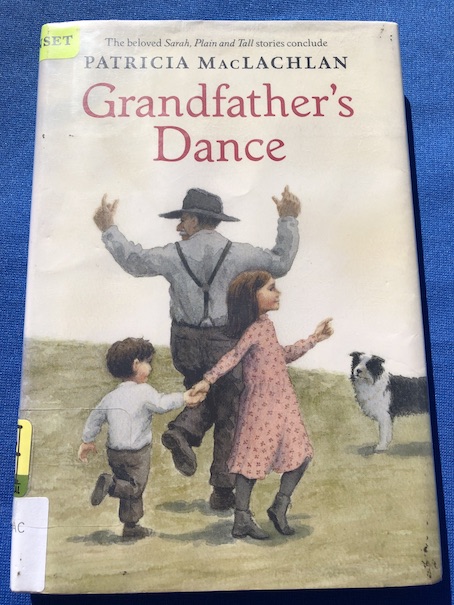
Grandfather’s Dance

Grandfather’s Dance by Patricia MachLachlan, 2006.

This is the final book in the Sarah, Plain and Tall series.

Cassie is now in the fourth grade, and things are changing in her family. Cassie has come to love her little brother, John, called Jack, who is now a young child who likes to follow their grandfather around and imitate him. Caleb has gone away to school, and Anna is getting married, which is the major event of the story. Through the planning and anticipation that precedes the wedding, Cassie still keeps her journal, with its occasional flights of fancy.

Anna’s wedding brings new excitement to the family farm and thoughts of both the future and the past. Cassie, unlike her older half-siblings, has never been to Maine or met her relatives there, but Sarah’s brother and aunts are coming to the farm for Anna’s wedding. The others remember the last time they saw these relatives, and Cassie looks forward to seeing them.

Cassie wonders about why people get married, and she can’t imagine anyone she loves enough to marry and spend her life with, except maybe her dog. She tries to picture her own future wedding, with a dog as the groom, but it bothers her that she can’t picture her grandfather at her wedding. At first, she can’t quite figure out why she’s having trouble picturing him in the future, but the more she thinks about it, the more she realizes how old her grandfather is. He even comments on his age, saying that he’s getting older every day. Her grandfather seems to be increasingly feeling his age and his heart condition. Before Anna’s wedding, Cassie and her grandfather talk about her future wedding, and her grandfather tells her that he might not be there when she is married. Cassie tries to convince him that he will be, but he says, just in case he can’t, maybe they should have a wedding for Cassie now. He has Cassie put on the nice dress that she will wear to Anna’s wedding, and they stage a mock wedding for Cassie and their dog, Nick, so her grandfather can say that he was at Cassie’s wedding, too.

Anna’s wedding is beautiful, and Cassie and the others enjoy having Sarah’s brother and aunts visit. After the wedding, they have a picture taken of the whole family together. Sadly, it is the only picture of all of them together. Soon after, Cassie’s grandfather dies. All of the wedding guests are still visiting, so they attend the funeral. Jack is still a little boy and upset and confused by their grandfather’s death, but Cassie assures him that their grandfather loved them and that they won’t forget him. The title of the book comes from a little dance that their grandfather did for Jack earlier in the story, which Jack later imitates after his death.

In the back of the book, the author explains how her family was the inspiration for the family in the book. The grandfather in the story was based on the author’s father, and part of the dedication is to him. The author’s father died two years before this book was published. The farm and landscape around it are kind of a combination of the places where her family has lived in North Dakota, Kansas, and Wyoming, which is probably why the books in the series never specify which state they’re in.

The book is available to borrow and read for free online through Internet Archive (multiple copies).

More Perfect Than the Moon

More Perfect Than the Moon by Patricia MacLachlan, 2004.

This is the first book in the Sarah, Plain and Tall Series that is narrated by Cassie, the younger daughter in the family. 

By this time, Cassie is about eight years old, and her grandfather, who rejoined the family in the previous book, has been living with them for a few years.  Caleb has also found a girlfriend (Violet, Maggie and Matthew’s daughter).  When Cassie writes entries in the family’s journal (started by Anna in the first book), they are partly fantasy, like when she thinks that Caleb and his girlfriend will someday marry and go to live in Borneo, where they will eat wild fruit.  When Caleb tells her that the things she’s writing aren’t the truth, she says, “It is my truth.”  (Oh, criminy!  I hate it when people say that.  Well, she doesn’t really mean it in the sense that I’m sick of hearing it.  I like games of pretend, but only those where the people playing them realize that it’s both a game and pretend.)  Fortunately, it’s just that Cassie is an imaginative child, and most of what she imagines is wishful thinking about things she would like to see happen.  With Cassie, the journal becomes not just a documentary of family events but of her feelings about them and what she imagines.

As Cassie grows more observant because of her writing, she notices that her mother’s behavior is changing.  Sarah is sleeping a little more, and she doesn’t always want to eat. Cassie worries that she’s sick.  Then, one day, Sarah faints.  Jacob takes Sarah to the doctor, and in the journal, Cassie writes about how her mother is well and will bring home a perfect present for her, “More Perfect than the moon,” in the hopes that it will come true.

When Sarah comes home and Cassie tells her what she wrote, Sarah says that it is true because she is pregnant.  Her perfect present will be a new baby.  Cassie doesn’t think that a baby sounds like a perfect gift.  She doesn’t want the baby because she doesn’t want things to change.  She is determined not to love the new baby.  Anna (who is now engaged to her boyfriend, Justin) tells Cassie that she didn’t love her at first, either, but she came to love her.  When Cassie asks Anna what made her love her as a baby, she says that she couldn’t help it and that she’ll understand when the new baby arrives.  All the same, Cassie can’t help but wish her mother would give birth to a cute little lamb instead.

Then, Cassie hears Sarah telling her friend, Maggie, that she thinks she’s too old to have a baby.  Cassie knows that Anna and Caleb’s mother died giving birth to Caleb, and she worries that the same thing could happen to her mother.  She thinks that the “terrible baby” is putting her mother’s life in danger.  Sarah tells her that’s not really the case, that she just thinks that it will be difficult to run after a young child again.  Still, Cassie worries and tries to keep an eye on her mother.  Sarah tells her that it isn’t necessary and that she will let her know when she needs her, like when the baby is going to be born.

As everyone guessed, Cassie’s feelings about the baby change once he arrives and she sees him for the first time.  At one point, Cassie admits to Sarah that some of the things she writes in her journal are nasty, but Sarah understands and says that one of the reasons to keep a journal is “To put down feelings. That way they don’t clutter up your head.”  Sarah knows that Cassie has a lot of worries about the new baby and the changes that will come in their family, and she knows that the journal is a way for Cassie to sort out her feelings. Once Cassie gets her worries and bad feelings out of the way, she is better able to move on to better things. Journals can be therapeutic.

The book is available to borrow and read for free online through Internet Archive (multiple copies).

Caleb’s Story

Caleb’s Story by Patricia MacLachlan, 2001.

This book is part of the Sarah, Plain and Tall Series, but while the first two books are narrated by Anna, this book is narrated by her brother, Caleb.

When the book begins, Caleb says that Anna is now going to live in town, finishing school and working for the local doctor.  Her boyfriend, Justin, is the doctor’s son, and he has gone to Europe to fight in World War I.  Sarah worries about Anna because of the influenza epidemic.  Anna has given him a journal in order to write about the things happening on the farm while she’s away.  Caleb isn’t as much of a writer as Anna, and he can’t imagine what he’ll find to write about, but Anna assures him that he’ll find something.

While Caleb is play hide and seek with his little half-sister, Cassie (who is now four and a half years old), Cassie says that she saw a man behind their barn who asked her about their father.  At first, Caleb thinks that Cassie imagined the whole thing, but she insists that she didn’t.  However, Caleb later finds the man in the barn, suffering from cold.  The family brings him inside to warm up, and he says that his name is John.  They try to ask John about who he is and where he came from, but he is evasive at first.  He says that he used to be a farmer, and he starts to help a little with farm chores.

The truth about John comes out when Jacob returns from taking Anna to town.  John is actually John Witting, Jacob’s father.  For years, Jacob believed that his father was dead.  It comes as a terrible shock to see him suddenly, after all this time.  Jacob is angry that John apparently abandoned his family and left him to believe that he was dead.

The children have many questions about their grandfather and where he’s been all these years, but John remains evasive for some time.  Sarah tries to encourage Jacob to talk to his father and learn what he needs to know about him, but Jacob resists because he’s too angry.  Caleb notices his grandfather taking pills, and Sarah discovers that it’s heart medicine.

The imagery in the story is pretty bleak, compared to the other books, even the drought descriptions from Skylark.  It’s winter, and people are dying during the influenza epidemic.  People have black wreaths on their doors, some because of influenza deaths and some because they have relatives who died fighting in World War I.  At one point, they see a bonfire in the cemetery because the ground is frozen, and they need to thaw it enough to dig a new grave.  When they get closer, they see that it’s a baby’s coffin, which upsets Sarah.

When Jacob finally demands that his father explain himself and his presence there, John says that he wanted to see how things turned out.  The two men argue and push each other, and Jacob accidentally falls over a plow and breaks his leg.  John sets the broken leg, saying that he’s done it before, but Jacob is still angry with him.

Eventually, John talks to Caleb about his past, admitting that he was wrong to leave years ago and saying that he can’t really blame Jacob for how he feels about it because his bad decision has affected Jacob’s whole life.  John quarreled with his wife years ago, and he felt like the two of them couldn’t live together anymore. (I have to admit that, after John had earlier tried to tell Jacob that things weren’t the way he thought they were, I was really disappointed because this explanation is exactly the way I figured it was.)  Jacob keeps saying that John could have at least written, but the truth is that John can’t read or write until Caleb begins teaching him. (If this is what John meant by things not being the way Jacob thought they were, it’s a little less disappointing.)  When Sarah is accidentally lost in a snow storm outside, and John helps Jacob save her, the father and son finally make peace with each other.

The movie version of this book is called Winter’s End, and it is the last of the series to be made into a movie. Actually, I think that the movie may have actually been made before the book (I’m a little confused by the movie’s date, but it looks like it was first). The movie and the book are pretty close to each other. The book is available to borrow and read for free online through Internet Archive.

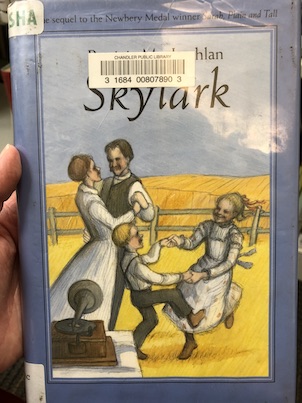
Skylark

Skylark by Patricia MacLachlan, 1994.

The second book in the Sarah, Plain and Tall Series picks up about two years after the first book, shortly after Sarah marries Jacob, the father of Anna and Caleb.  That summer is very dry, and people worry about when it will rain next.  If there is no rain, their farms will be in danger.  Some people have been known to simply abandon their farms and move on during especially long dry spells.  Jacob says that their family won’t leave, no matter what, because “Our names are written in this land,” meaning that they have a commitment to it because they were born there and make their lives from the land.  However, Sarah was born in Maine, and Caleb worries that, if the dry spell goes on too long, Sarah will want to return to Maine.

The year goes on, and Sarah settles in to life on the farm.  Her cat, Seal, has kittens.  Sarah reflects on the baby animals and seems thoughtful about babies.  However, people are becoming ever more concerned that the water in the wells is lower than usual.  As people keep hoping for rain, Sarah gets a letter from Maine, saying how lovely and green everything there is.  The land around the farm is dry and brown, and the family has had to ration their water carefully, their supplies running increasingly low. 

Eventually, a family from the area has to pack up and leave because their well is dry.  Sarah is upset, trying to think of some way around the problem, but there is nothing to be done.  Everyone’s supplies are running low, and they’re already doing everything that can be done.  Sarah hates feeling helpless against the problem.  When Sarah’s best friend, Maggie, talks about leaving with her family, Sarah says that she hates the land because it takes so much and gives nothing back.  Maggie tells her that she’s like a lark that hasn’t come to land yet and that, if she is hoping to survive in this land and make a home there with Jacob, she will have to write her name in the land, just as he has.

Although the characters become increasingly distressed, in a way, I like the story for that.  Sarah is a strong, capable woman, but even she doesn’t have all the answers to every problem.  It’s upsetting for her to realize that, but it’s very human.  After the family’s barn catches fire and burns down, Jacob persuades Sarah to take the children and visit her family in Maine.  While they are gone, he will take care of the animals and try to keep the farm going, waiting for rain.

In Maine, Sarah and the children stay with Sarah’s aunts.  Aunt Mattie, Aunt Harriet, and Aunt Lou, who have never married, are called “The Unclaimed Treasures.”  They shower the children with affection.  Still, the children miss their father and worry about what is happening on the farm.  Sometimes, the children have bad dreams in which their father is unable to find them.

In the end, the rain comes on the prairie, and Jacob comes to Maine to collect his family.  Then, the family learns that Sarah is expecting a baby.  Anna worries a little because her mother died giving birth to Caleb, but Jacob and Sarah reassure her that everything will be fine.  When they return home, Sarah writes her name in the dirt, signaling her commitment to her new life on the prairie.

There is a movie based on the book that follows the story very well. In fact, some of the dialog is almost word-for-word from the original. The book is available to borrow and read for free online through Internet Archive (multiple copies – including one in Spanish).

Sarah, Plain and Tall

Sarah, Plain and Tall by Patricia MacLachlan, 1985.

This is a popular book to read in schools in the United States, the first in a series.  It’s a Newbery Award winner, and it shows aspects of farm life during the early 20th century and the concept of mail-order brides, a practice from American frontier days where men living in the West or Midwest, where there were not many available women in the population, would write to agencies or advertise for a bride from the East.  The process for arranging these marriages could vary, but it typically started with written correspondence before the man and woman would meet in person.  In this book, the man looking for a bride, Jacob Witting, is a widower with two children who has a farm on the Great Plains.  The story is narrated by his older child, Anna. The book isn’t very long, and it’s a pretty quick read, but it’s filled with colorful imagery and emotion.

Anna has had to help take care of her little brother, Caleb, since he was born.  Their mother died shortly after giving birth to him, and Caleb frequently asks Anna questions about what their mother was like.  Anna’s memories of their mother are fading because she was still very young when she died, but she really misses her.

Then, Jacob tells the children that he has advertised for a bride from the East, the way a neighbor of theirs did.  The children like their neighbor’s new wife and wouldn’t mind having a mother like her.  The father has received a reply to his advertisement from a woman in Maine, Sarah Wheaton.  Sarah has never been married, and now that her brother is getting married, she feels the need for a change in her life.  She loves living by the sea in Maine, but she is willing to move to start a new life.  She says that she would like to know more about Jacob and his children.

Jacob and the children write letters to Sarah, getting to know her better.  They come to like each other, but the children worry about whether Sarah will change her mind about coming to see them or whether she’ll like them or their farm when or if she comes.  When Sarah tells them that she’s coming during the spring, she says that they will know her because she will be wearing a yellow bonnet and describes herself as being plain and tall (the title of the book).

Sarah will stay with the family for a time while they decide if they can be a family together and if she will marry Jacob that summer.  There are adjustments that they will all have to make.  Life on the prairie is very different from what Sarah is used to, and the children still worry that she won’t want to stay.  Sarah brings seashells from Maine to show them, and they teach her about the local wildflowers.  One of my favorite scenes was where Sarah cuts Caleb’s hair, and they put the hair clippings out for birds to use in their nests.  Caleb was particularly concerned about whether Sarah would sing like their mother used to, and Sarah does. 

Through it all, the children can tell that Sarah really misses the sea.  Sarah does say that the land around the farm kind of rolls, a little like the sea, and they play in a haystack, like it was a dune by the sea.  When they visit their neighbors, Sarah talks with Maggie, the mail-order bride who came from Tennessee.  Maggie understands Sarah feels, missing her home in Maine, and it upsets Anna to hear them talk about missing their old homes.  However, Sarah says that things were changing at home, and Maggie comments that, “There are always things to miss, no matter where you are.”  What the women realize is that, although they miss their old homes, they have grown to love the new people in their lives and would miss them if they tried to go back to where they came from.

At one point, Sarah goes to town alone, and the children worry that she won’t come back, but she does.  She just went to town to buy colored pencils in her favorite sea colors.  Sarah does stay and marry Jacob, setting up the rest of the series.

The book is available to borrow and read for free on Internet Archive (multiple copies).

My Reaction

There is a movie version of this book, which follows the story pretty well. The book wasn’t specific about the time period, although it seems to take place during the early 1900s. The movie and its sequels are set during the 1910s, which makes sense for the rest of the series. The book also didn’t say exactly where the farm was, but the movie clarifies that it’s in Kansas. The movie also emphasizes how much the whole family, particularly Jacob and Anna, misses the mother who died.  In the movie, Jacob forbids the children to use any of his dead wife’s things and doesn’t want to talk about her.  However, when Sarah realizes that trying to avoid his wife’s memory is hurting Anna, she brings out some of the dead wife’s belongs to use, helping the family to make peace with the past and prepare for the future. 

In the movie, Jacob’s pain over his wife’s death is partly about guilt as well as grief. The book doesn’t really talk about why Anna’s mother died after childbirth, but in the movie, Jacob has a painful discussion with Sarah about how he blames himself for his wife’s death because the doctor had warned them that they shouldn’t have any more children after Anna.  Apparently, Anna’s birth had been difficult and caused complications because his wife was so young, and the doctor had said that having another child would be dangerous.  However, after a few years went by, they decided to try for a son to help run the farm, thinking that enough time had gone by for it to be safe.  When his wife died giving birth to Caleb, Jacob felt terrible, thinking that he should have taken the doctor’s warning more seriously and not tried to have another child.  Confessing all of this to Sarah helps Jacob to make his own peace with what happened.  However, none of this discussion appears in the book.

In both the book and the movie, Jacob also has to adjust to Sarah’s different personality.  Sarah is more stubborn and independent than his first wife, with her own way of doing things.  Living with her is different from living the mother of his children.  However, Jacob comes to love Sarah for the person that she is.

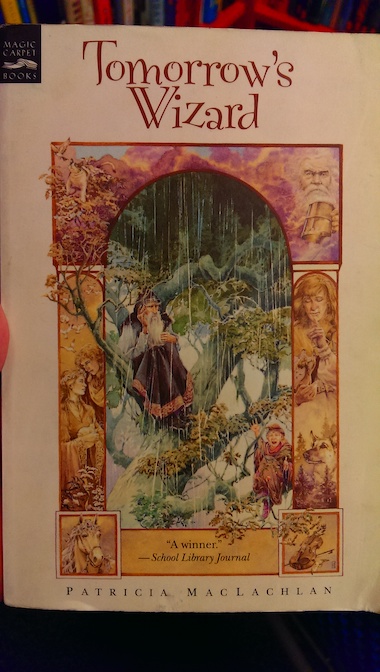
Tomorrow’s Wizard

TomorrowsWizardTomorrow’s Wizard by Patricia MacLachlan, 1982.

In a way, this story is a collection of shorter stories, but they are all tied together. In the beginning, Tomorrow’s Wizard (that’s actually his name, he’s also called Tomorrow) has just been given an apprentice wizard named Murdoch. Their job is to listen for important wishes to grant. Each of the shorter stories in the book involves a different wish and how Tomorrow and Murdoch grant it.

The First Important Wish – Rozelle is a pretty girl but wild and given to fits of temper. Her parents had her later in life and never disciplined her, so she has never had a reason to learn to control herself. However, her tantrums drive everyone else crazy. Rozelle’s father, acknowledging how difficult it is to deal with Rozelle, wishes that he could find a man who was willing to marry her. Tomorrow hears the wish and sends a variety of suitors to meet Rozelle, but she doesn’t like them, and none of them really like her, either. Then, another possibility occurs to the wizards: the villagers have been complaining that they are afraid of a nearby giant. Tomorrow knows that he giant is really harmless and gentle, just lonely. Could it be possible that Rozelle is the company that he needs?

Three-D – Miller Few and his wife, Mona, are nasty people, two of a kind. Because he’s the only miller in town, Miller Few (known to his neighbors as Three-D for Dreadful Dastardly Demon) freely cheats his customers. He and his wife have no friends because they’re so awful. Then, one day, Three-D saves Murdoch’s life. To reward the miller, Murdoch agrees to grant him a wish. The miller and his wife decide that they want a nice, sweet child who would do their work for them. The child Murdoch grants them is indeed sweet. A little too sweet. Not only does little Primrose look pretty and do the housework, but she helpfully reminds the miller about his debts and the other things her parents do wrong. The miller and his wife become more careful and agreeable and gain new friends because of Primrose, but they aren’t very happy. They aren’t really being themselves, and they’re tired of being on their best behavior all the time. But, perhaps there is one thing that can stop Primrose from being overly sweet: the miller’s old cat, Clifford.

The Comely Lady and the Clay Nose – Geneva is a very beautiful young woman and has many admirers, but she knows that they are more in love with the way she looks than with who she is. It worries her, and she wishes for someone who would love her for the person she is. To help solve her problem, Tomorrow makes an ugly clay nose for Geneva to wear, telling her that it will help her to find the person she is looking for. When she puts it on, her former admirers flee, and for awhile, Geneva is very lonely, but she perseveres and ends up finding the love that she is looking for.

The Perfect Fiddle – Bliss, the fiddle-maker, is ironically an unhappy man. The reason is that, no matter how good his fiddles are, he can never make one that’s completely perfect. After Bliss tries several crazy schemes to capture perfection in his fiddles, Tomorrow goes to visit Bliss’s wife, Maude. Like Tomorrow, Maude has seen the problem with Bliss’s approach to his fiddles and finally asks Bliss the question that makes him reconsider whether perfection should be his goal.

The Last Important Wish – Although Tomorrow is impatient with his apprentice, Murdoch, he does like having him live with him, and he has also grown attached to the horse that lives with them both. However, he has come to see that the life of a wizard isn’t the one that Murdoch is really suited for. More than anything, Murdoch wants the experience of being born and living among humans. The horse, too, wishes for a kind master and a family. Tomorrow sees that it’s time to grant both of their wishes, giving the horse and Murdoch (as a baby) to a kind farmer with a wife and other children.

The book is currently available online through Internet Archive.

Wizard’s Hall

Wizard’s Hall by Jane Yolen, 1991.

Henry hadn’t seriously considered becoming a wizard.  It was just one of a number of things he considered being when he was young.  However, when he suggests the possibility when he is eleven years old, his mother unexpectedly jumps on the idea and immediately packs him off to Wizard’s Hall, the school for young wizards.  Although Henry expresses doubts, his mother tells him that it’s only that he try that counts.  Being a dutiful son, he immediately sets out for Wizard’s Hall to enroll.  He has a moment when he gets worried and tries to turn back, but he discovers that he can’t because his destiny is at Wizard’s Hall, the road there won’t let him turn back.

At Wizard’s Hall, the Registrar (after consulting with a strange bird or animal in a cage called called Dr. Mo) changes Henry’s name to Thornmallow, saying that he’s prickly on the outside but squishy on the inside.  Henry isn’t happy about being given a new name, but he accepts it as part of what he has to try at the school.  The Registrar and the teachers also refer to Thornmallow oddly as what they “desperately need.”  Something is deeply wrong at Wizard’s Hall, and the teachers are hopeful that Thornmallow will be the one to save them, although he doesn’t appear to have much aptitude for wizardry.

On his first day, his teachers discover that he is tone-deaf, which is unheard of for wizards.  Wizards have to recite their spells in the proper tones, and Thornmallow can’t do it.  When one of his teachers tries to help him by covering his years while he attempts to recite, Thornmallow accidentally recites a spell that produces an avalanche of snow and roses.  It’s more powerful than anyone expects of a beginning student, especially one like Thornmallow, who has no prior knowledge of spells and doesn’t show much aptitude in other ways.  Thornmallow wonders briefly if he might have some special, hidden talent for wizardry, but he is unable to produce the same results when he is alone.

Although Thornmallow feels lonely and out-of-place at his new school, he persists because he promised his mother that he would try, and the teachers at the school also say that trying is important.  He also makes his first real friends his own age at the school.  A couple of other first-year students, Tansy and Willoweed (called Will for short) are assigned to be his Guardians, helping him to become acquainted with the school and its rules, and another girl, Gorse, also becomes his friend.  Thornmallow realizes that he would miss his new friends if he were to leave, although he briefly considers it, having the feeling that his first spell was just a fluke and that he doesn’t have any real talent for magic.

However, just when Thornmallow goes to tell his teachers that he thinks that his admittance to the school was a mistake, he overhears them talking about the serious threat to the school: the school is in danger from an evil sorcerer and his Quilted Beast (a “quilted beast” doesn’t sound particularly threatening because quilts are soft and comfy, but it’s way worse than that).  The teachers don’t know how to defeat the Master and his Beast, but they know that it’s vitally important for the school to have its full quantity of students, 113.  They were almost full when they sent out a call for the final student and got Henry/Thornmallow.  Although they aren’t sure why Thornmallow is the proper final student, it seems that he has some important role to play in the situation. When he learns the danger that they’re in, Thornmallow realizes that he has to stay and try to help them as best he can.

The book is available to borrow and read for free online through Internet Archive.
My Reaction and Spoilers:

Master Hickory, one of the teachers, explains to Thornmallow and his friends that the Master was one of the original founders of the school years ago.  The main founder had been Doctor Morning Glory, and she sent out a call for others to help her, bringing 13 sorcerers to found the school.  However, one of the others, Nettle, was prickly in every sense of the word.  He enjoyed using his words (and words are very important in magic and in the story) to sting and hurt others.  Eventually, the other 13 founders pushed him out of the school, and he turned to dark magic to get revenge. 

The Quilted Beast is made out of the dark pieces of the souls of each of the other founders, all “quilted” together.  Master Hickory explains that everyone has a little darkness in them in the form of very deep emotions, the kind that can tempt people to do bad things, if they let them get out of control.  I particularly liked the explanations of how people have their dark sides and how mature people deal with them.  At first, Thornmallow struggles to understand why the teachers are so upset that their dark sides have been removed because he thinks that would make them better.  However, Master Hickory explains that by “dark side,” he doesn’t mean the parts that are necessarily evil; he means the parts that could become evil, some of which are actually good.  Master Hickory says that some of the strongest human emotions can turn to evil if they aren’t kept under control.  For example, ambition out of control can become greed, or admiration out of control can become envy.  Having these feelings isn’t evil by itself; it’s the way people respond to their feelings that determines that.  Even love, which is considered good, is a deep emotion that can turn to something evil if used improperly, and so can count as part of a person’s dark side.  Mature people learn to deal with their feelings and control them, using them in the best ways.  People who aren’t mature, don’t.  Thornmallow, who often quotes his mother’s words of wisdom throughout the story, says, “Good folk think bad thoughts; bad folk act on ‘em.” 

I find those words of wisdom familiar because that’s something that my own parents impressed on me, “You can feel anything, but you don’t have to act on it.  You never have to act on it.” It was okay to have feelings and to say how we felt, but just “feeling like it” wasn’t an excuse for misbehavior. Everything has limits. You can’t hit your sibling just because you feel like it, and you can’t call people names just because you’re mad.  You can feel any way you want, but no matter what you’re feeling, you still have to behave, within the rules. If you don’t, there will be problems, and those problems won’t go away because of how you “feel.”  This probably explains a lot of my impatience toward people who don’t control themselves and don’t have limits for their behavior.  It’s not that I think it’s always easy or that people are always completely successful; it’s more that I have no respect for those who think it’s impossible and don’t even want to try, which brings us back to the story …

Master Hickory says that the teachers who had the smallest dark sides have still been basically functional since having them taken away, but those of particularly strong feelings have been damaged by the attack, including Morning Glory, who was both the most loving and the most ambitious of all the teachers.  What happened to Morning Glory isn’t fully explained until almost the end of the story, but the loss of her has been devastating to the school. When Thornmallow tells his friends about the problem, the kids are scared, but if there’s one thing that Thornmallow believes in, it’s trying. He and his friends are determined to try and save the school from the Master and the Quilted Beast, but time is running out.

The importance of trying is the theme of the story. Thornmallow/Henry doesn’t know his real talents or abilities, but just by showing up and trying to help, he learns that he possesses a special ability that makes him the right person to stop the evil wizard. Although he is not good at magic, not an enchanter, he has the ability to act as an enhancer for the abilities of others. The times when Thornmallow succeeds in his spells are when he’s working with, especially touching, one of the other wizards. He is able to use the talents of others and magnify them to be greater than anything either of them would do by themselves. By himself, Henry isn’t particularly special, but he can unite his friends and combine the talents of others, just by trying.

Another interesting aspect of the story is that the magic at Wizard’s Hall is largely based on word play. The characters play off words, using special names to point to the true natures of people and to change situations to be what they need them to be, which turns out to be part of the solution to their problem. Words spoken aloud at Wizard’s Hall have power and can change reality. For example, the names that everyone is given when they arrive at Wizard’s Hall are clues to the kind of people they are and what their abilities are. Thornmallow’s name is already explained, and at first, he puzzles a little over Tansy’s name when he meets her. Tansy is a black girl, and Thornmallow knows that tansy is a bright yellow flower. Gorse later explains to him that Tansy got her name because of her sunny personality. It’s not about what she looks like but what she is. Gorse describes herself as being small and prickly, and she seems proud of it because she’s comfortable with herself as she is. Before they can defeat the Master, who is really Nettle, they realize that they need to learn more about what Nettles are, which gives Thornmallow a clue as to what he needs to do and the words he needs to use.