The Camp-Out Mystery

The Boxcar Children

#27 The Camp-Out Mystery by Gertrude Chandler Warner, 1992.

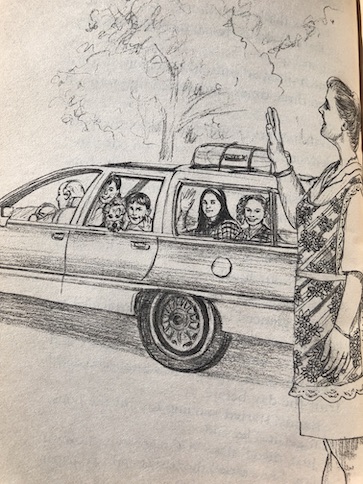
The Alden family has decided to go on a camping trip to a campground at a state park.  From the moment that they arrive, though, strange things seem to be happening.  When they stop for supplies, a woman Mr. Alden knows, Doris, seems oddly evasive when he tries to ask her about her sister, Hildy, and she makes the odd comment that she hopes nothing will spoil their trip.  As they pull into the state park, they discover that the arrow on the sign pointing to the rangers’ station has been reversed to point the wrong way.  Mr. Alden shrugs the incident off as a prank, but it’s only the beginning of the strange happenings.

The Aldens get to their camp site and notice that the place is a mess.  Either the previous campers were pretty messy, or they left in a hurry.  The Aldens clean up the site and set up their tents.  (The description of how they set up camp is actually somewhat educational because they talk about things to look for when choosing a campsite, how they have to check the ground for rocks and tree roots before setting up their tents and why they should avoid places where it looks like rain water might pool and why it can be dangerous to set up a tent under a tree if there is a lightning storm.)  Later that night, Violet is woken by the sound of music.  At first, she thinks that it must be some nearby campers, but it sounds too loud and too close.  When she and Jessie get up to investigate, the sound stops.

Later, the kids see strange lights in the woods, and things disappear or are moved around at their campsite.  When Mr. Alden realizes that someone has been sneaking into their camp and taking things, he suggests that they might want to leave the park, but the kids say that they’d rather stay because they’re still enjoying themselves.  Then, Mr. Alden injures his ankle when he’s startled by another blast of loud music and part of the path he’s on gives way because the dirt was loosened by rain.  The children are prepared to leave when their grandfather is injured, but to their surprise, Mr. Alden says that he’d rather stay, too.

Who is doing all of these things and why?  Is it the unfriendly Hildy, who lives alone in a cabin and wants everyone to leave her alone?  Or maybe her seemingly-helpful neighbor, Andy, for reasons of his own?  Could Doris be responsible?  What about the Changs, a family camping nearby who seemed disappointed that they didn’t have the campground to themselves?

There are some environmental themes and lessons in the story.  The Aldens frequently pick up litter that other campers and hikers leave behind.  There is also an explanation that the reason why part of the path Mr. Alden was on collapsed due to erosion because there are no trees along that section of path; tree roots help secure the soil so that it doesn’t wash away.  After the mystery is solved, Mr. Alden decides to donate some trees to the park, and the kids talk about adding more trash cans and a recycling center to help solve the litter problem.

The book is available to borrow and read for free online through Internet Archive.

The Yellow House Mystery

The Yellow House Mystery by Gertrude Chandler Warner, 1953, 1981.

This story in the Boxcar Children series picks up the following spring after the previous book.  The children’s cousin, Joe, is arranging for the excavation of the cave where the children found their Native American artifacts.  They’ve decided to use dynamite to blast open the roof of the cave to make excavation easier (I’m not sure if this is really the best way to get at artifacts that were sheltered safely for years in their cacve and were easily being dug up by children in their current situation, but okay), and although he had told the children that they couldn’t be there for the blasting, he’s changed his mind.  He’s even going to let seven-year-old Benny be the one to push down the handle that will set off the blast.  (Because this is one of the early books in the series, the children are aging from the first book in the series – Henry is sixteen years old, Jessie is now fourteen, and Violet is twelve.)

One of the people who will be working on the excavation is Alice, an old school friend of Joe’s.  Everyone can tell that Joe is in love with her, and soon, he proposes to her.  They get married and decide to spend their honeymoon camping out in the barn on the island, just like the children did the previous summer.

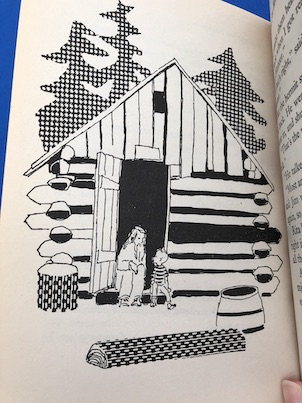
However, the children have started to wonder what the story is about the old yellow house on the island.  For some reason, it makes their grandfather sad, and he doesn’t like to talk about it.  Eventually, their grandfather tells them that their housekeeper, Mrs. McGregor, used to live in that house with her husband, Bill.  Bill used to take care of Mr. Alden’s father’s race horses.  He was a nice man, but weak-willed.  His brother, Sam, and his brother’s disreputable friends were often able to persuade Bill to do things that would get him into trouble, and Bill was never able to stand up to them.  One day, he vanished mysteriously from that house, and neither his wife nor the Aldens have any idea what happened to him.  There are only two clues about the reason for Bill’s disappearance.  One is money that Bill was supposed to give to Mr. Alden’s father for the sale of two horses that he managed on his behalf.  Mr. Alden assumes that Bill’s brother did something with the money and that Bill probably left because he was afraid to face Mr. Alden without the it.  Sam died soon after Bill disappeared, so they were unable to ask him about what he knew.  The other odd thing that happened before Bill disappeared was that Mrs. McGregor heard strange sounds in the night.  When she went to investigate, her husband was apparently just reading a newspaper, and he claimed that the noise was nothing unusual.  But, what was Bill really doing?

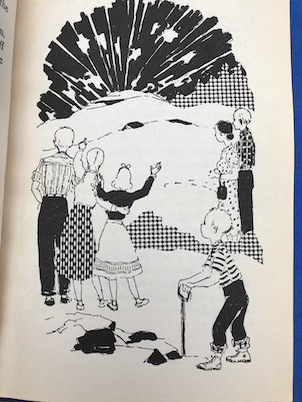
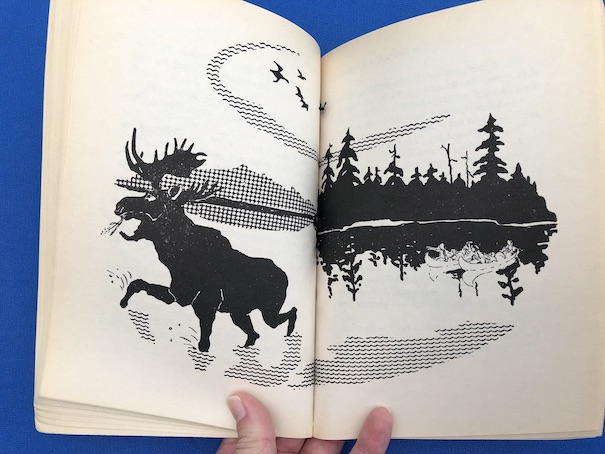
The kids want to investigate Bill McGregor’s mysterious disappearance, and their grandfather and Joe and Alice enter the house with them to have a look for more clues.  In a hiding place behind one of the fireplace bricks, they find a letter from Sam to Bill about the money from the horse sale.  Sam promised Bill that he would be able to pay him back more than the money he owed and tells Bill to meet him at a house in Maine near Bear Trail.  The kids persuade their grandfather to let them to go Maine with Joe and Alice over the summer to try to find the house on Bear Trail so they can find out what happened to Bill.  The trip will involve camping, hiking, and canoeing, but they’re up to the challenge!

Joe is familiar with Bear Trail because he used to work as a trail guide when he was in his teens.  They are also joined by another trail guide, Mr. Hill, and have adventures that include a storm and a real bear.  However, the real answers to the mystery lie at the Old Village at the end of the trail.

The book is available to borrow and read for free online through Internet Archive. There are multiple copies of the book. In order to check out a book through Internet Archive, you need to sign up for an account. The account is free, and you read the books in your browser.

My Reaction

In a number of ways, this book is more adventure than mystery.  It doesn’t take long for the kids to realize discover Bill McGregor’s new identity.  However, what happened to the money is more of a puzzle.  Even Bill has been unable to find where his brother hid it years ago.  Benny discovers it by accident while watching a toad. 

One thing that had made me uncomfortable was how long Bill had stayed away from his wife.  When the kids confront him about his real identity, it turns out that Sam’s disreputable friends had lied to him, telling him that his wife had died shortly after he disappeared.  He is overjoyed to discover that she is still alive, and she is glad to see him when he finally returns home.

Surprise Island

The Boxcar Children

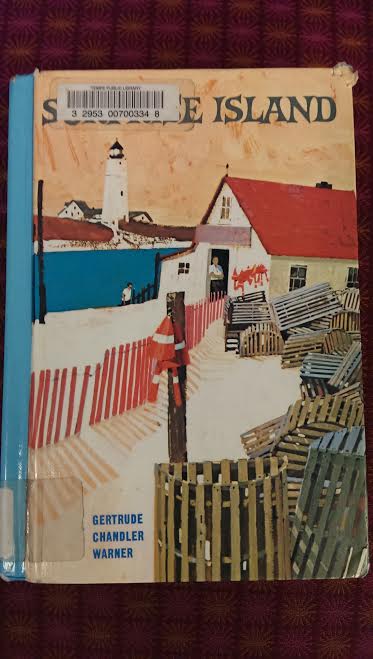
Surprise Island by Gertrude Chandler Warner, 1949.

Mr. Alden has promised his grandchildren a special surprise for their summer vacation. He tells them that, years ago, his father bought a small island because he kept horses and wanted a quiet place for them.  The island has only one little yellow house, a barn, and a fisherman’s hut where Captain Daniel lives.  Captain Daniel operates the motorboat that can take people to the island.  Mr. Alden plans to take his grandchildren to the island to look over the house, and if they like, they can spend the summer there.  The children think that it sounds like fun.

When they get to the island, the children decide that they want to stay in the barn instead of the house.  Captain Daniel also tells them that he has a young man staying with him, a friend who hasn’t been feeling well.  The Aldens’ old friend, Dr. Moore, has come to see the island with them, so he looks in on the young man.  It turns out that the young man was in an accident and had lost his memory for a time, although he has been gaining it back.  He says that he used to live with an uncle but that he didn’t want to go home again until he was sure that he was completely well.  He is going by the name of “Joe”, which is short for his middle name, Joseph.  Captain Daniel says that he’s known the young man all his life, and Dr. Moore also seems to know him, but Joe doesn’t seem to want to talk about himself to Mr. Alden.

The kids enjoy setting up housekeeping in the barn.  It reminds them of when they used to live in an old boxcar.  They use old boxes for furniture, dig for clams, and eat vegetables from the garden that Joe and Captain Daniel have tended for them.  Their grandfather allows the children to stay on the island in Captain Daniel’s charge, but they are mostly allowed to take care of themselves.  Joe sometimes brings them supplies that they ask for from the mainland.  (One of the themes of the Boxcar Children Series is self-sufficiency.  At one point, Jessie comments about how much better things seem “when we have to work to get it.”)  For fun, they go swimming, and Joe spends time with them, telling them about different types of seaweed.  They are surprised at how knowledgeable Joe is.

Henry gets the idea that they can set up a kind of museum of interesting things that they find on the island, like samples of different types of seaweed, shells, flowers, pictures of birds that they’ve seen, etc.  The other children think that it sounds like fun, and they begin thinking about the different types of things that they can collect.While they’re searching for things to collect and add to their museum, the children find a cave and an old arrowhead and ax-head.  They are authentic Indian (Native American) relics!  When they show Joe what they’ve found, he gets very excited, especially when they tell him that they saw a pile of clam shells, too.  Joe explains to the children how Native Americans used to use shells as money called wampum.  He thinks that what they saw was wampum, which the people who used to live there might have made after drying the clams to eat later.  Joe explains to the kids some of the process they would have used to turn the shells into wampum.  He’s eager to go to the cave and look for more Native American artifacts with them, but he urges them not to say anything to anyone else about it because other treasure hunters will probably show up if they do.  The children agree to keep their find a secret until their grandfather returns.

When they return to the cave with Joe, they make an even more incredible find: a human skeleton with an arrowhead inside.  It looks like they’ve found the bones of someone killed by an arrow!

The book is available to borrow and read for free online through Internet Archive.

My Reaction

As with some other vintage children’s mystery series, the early books in the series were more adventure than mystery.  The most mysterious part of this book concerns the real identity of the young man they call “Joe.”  The truth begins to come out when a strange man who calls himself Browning comes to the island in search of a young man who disappeared the year before while doing some exploring for him.  The young man he’s looking for worked for a museum.

This is the book where Violet first learns to play the violin.  This is a character trait that stays with her for the rest of the series.

The Boxcar Children

The Boxcar Children

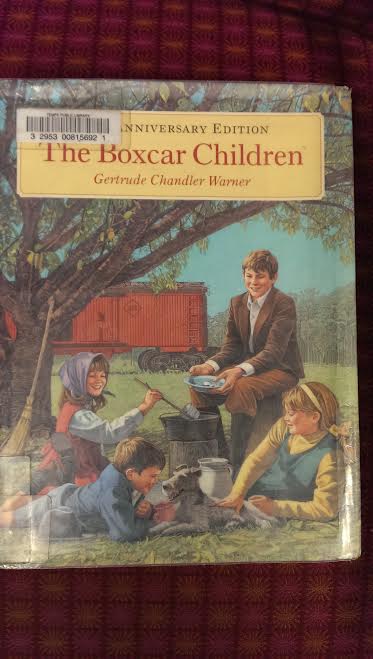
BoxcarChildren#1 The Boxcar Children by Gertrude Chandler Warner, 1924, 1942.

“One warm night, four children stood in front of a bakery.  No one knew them.  No one knew where they had come from.”

These are the words that begin not only this story but a series that has been loved by generations and continued well beyond the death of the original author.

The four Alden children are on the run following the deaths of their parents.  Their nearest remaining relative is a grandfather they have never met, and although he should have custody of the children now, none of the children want to go live with him.  All that they know about him is that he is apparently a mean old man who opposed their parents’ marriage.  Henry, the eldest at fourteen, and Jessie, who is twelve, have taken charge of the two younger children, ten-year-old Violet and seven-year-old Benny.  They have a little money, and they’re now traveling on foot in search of a new home.

The first place they stop is a bakery in a nearby town where no one knows who they are.  They don’t have much money, but they know they are going to need supplies for their journey.  The stingy baker and his wife agree to give the children some food and a place to sleep for the night in exchange for some help in their shop.  The children are willing to work and accept the offer.  However, Henry and Jessie overhear the couple talking about them.  They like having the children to help in the shop, but Benny is too young to be of much help.  They are considering taking Benny to an orphanage and keeping the others.  Not wanting to be separated, Henry and Jessie wake Violet and pick up Benny, moving on.  Now, they have a second set of people they’re avoiding, besides their grandfather.

Seeking a place where they can stay while not being noticed by people around them, the children eventually find an old, abandoned boxcar on a disused piece of train track on the edge of some woods.  They take shelter there from the rain and decide that they can turn it into their new home.  There are blackberries growing nearby that they can eat and a stream where they can keep milk cold.  Henry finds odd jobs in a nearby town to earn more money, and the others discover an old dump where they retrieve some old, cracked dishes and other useful items.

It seems like an idyllic life at first.  The children are free of adult control, although they do have to work to create a household for themselves and find food.  They adopt a stray dog they call Watch (he’s their new watchdog), and Henry makes friends who appreciate what a hard worker he is.  However, some of these new friends start to wonder about Henry, where he comes from, and where his parents are.

The children soon realize that someone is spying on them.  Is it someone from the town?  Could the baker and his wife still be looking for them?  Or is it someone sent by their grandfather?  When Violet is suddenly taken ill, the others realize that they need help and someone to trust.

Getting help for Violet does mean that the children’s secret is revealed to everyone, although they learn some important things in the process.  They discover who was spying on them and why and also discover that their grandfather is a nicer person than they thought and truly cares for them.

Although this series is very popular, most people don’t know that the story they read as children was actually a shortened version of the original story that was written in 1924.

The newer, popular version of the book is available online through Internet Archive.  The older version is now public domain and available online through Project Gutenberg.

Comparisons to the Older Version and My Reaction

Along with shortening and simplifying the story from original the 1924 version, the newer version from 1942 changed some of the characters’ names (the children had the same first names, but their family name was originally Cordyce, not Alden) and removed some parts that might be objectionable for young children.

Although the original story doesn’t completely clear up some questions that were left unresolved in the current version, like what the children’s parents were like, precisely how they died, and why they quarreled with the children’s grandfather in the first place, it did supply a few more details in the first chapter.  The original story begins when the children move to a new town with their father.  No one knew exactly where they came from, and the children pointedly refuse to say.  However, they do tell their neighbor, a baker, that their mother is already dead.  Their father is drunk, and the baker thinks that he looks like he’s in such bad condition that he isn’t likely to last much longer.  That turns out to be true when he dies (apparently from alcohol-related causes) soon after.  When they question the children about whether or not they have other relatives, young Benny blurts out that they have a grandfather before the others silence him.  The adults press the children for answers, and they reluctantly admit that there is a grandfather, but they say that he did not like their mother and would treat them cruelly if they were sent to him (or so, apparently, their parents had led them to believe).  The only one of the children who has even seen the grandfather is Jessie (actually called Jess in this version of the story), and it was only from a distance because her father happened to see him passing by and pointed him out.  Later, the children hear the baker and his wife talking, saying that they have no choice but to try to find the grandfather, and the children decide to run away to avoid going to live with him.  The questions of how their mother died and why the grandfather didn’t like her in the first place are never answered.

James Cordyce (the children’s grandfather in the original book, their grandmother is also apparently dead) is a wealthy man who owns steel mills, and he is impressed by the children’s ingenuity and resourcefulness at managing their own affairs while living on their own.  He tells Henry that he wants him to take over the steel mills one day, and the book says that Henry does so when he grows up and does a wonderful job of managing them.  Mr. Cordyce tells the other children that he wants them all to go to college, and then they can do whatever they like when they grow up, which the book says also happens.

Although the books never actually say so, my theory is that Mr. Cordyce/Alden was a hard-headed businessman, particularly when he was younger, driven to succeed and not emotionally demonstrative, and that this attitude caused a rift between him and his son, who may not have shared his father’s business skills and interests.  The grandfather may have wanted his son to follow in his footsteps when the son had other ambitions.  The son may have seen his father as a cold and ruthless businessman and conveyed that impression to his own children after marrying a woman his father disapproved of (Because her family was poor? Because they were unambitious?  Because she had some objectionable personal habit?  There’s no telling), but because he may not have told the children the whole reason why he thought that the grandfather was cruel, the children imagined that he was worse than he really was.

We don’t know what the children’s father did for a living after his feud with his father or exactly where they lived (perhaps in Greenfield or close by so that Jessie was able to catch sight of her grandfather one day).  Why the father took to drinking is also never explained, but I think it may be implied that he did so out of grief for his dead wife.  I think that Henry and Jessie probably had to manage the household for their parents following their mother’s death (and maybe before that if she suffered from ill health), which is part of the reason why the children are so self-sufficient and seem more tied to each other than to any adult.  In any case, the original book says that Mr. Cordyce is interested when the doctor who befriends the children says that Henry and Jessie have business management skills, so I think it sounds like he was thrilled to find out that he might have more in common with his grandchildren than he did with his son and hopeful that Henry would make a better successor in the family business.  But, that’s just the way I read it.

One other point that the original book covered was Watch’s origins.  The later version just has Watch as a stray who the children adopt, but the original story explained that he had just been purchased from a kennel by a wealthy woman when he was lost.  The kennel owner tries to reclaim the dog (kennel name Rough No. 3) on behalf of the woman, but the grandfather offers to buy the dog for much more than the original price.  The kennel owner says that it’s up to the woman who bought him, and they invite the woman to the house.  After hearing how attached the children have become to Watch, the woman allows them to keep him.

The Bear That Was Chicken

The Land of Pleasant Dreams

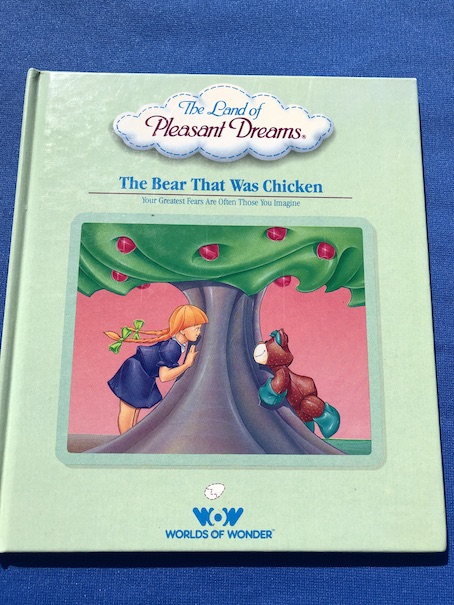
The Bear That Was Chicken by Ane Weber, Ron Krueger, Tony Salerno, 1986.

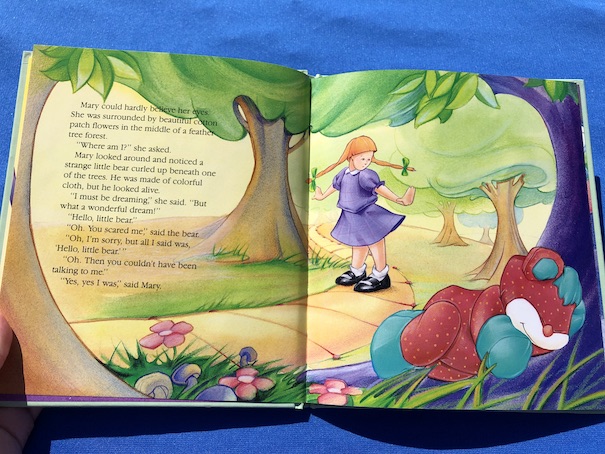
In her dream, Mary meets Threads the Bear.  When she meets him, he’s trying to sleep under a tree.  He’s sad and tells Mary that he thinks he’s a chicken and that all of his friends say so.  (It’s not a nice thing for friends to say, and I wish the story had said so.  There’s a song about it on the tape that accompanies the book with the words given in the book, but it bothers me because calling people “chicken” is something that I associate with people who are trying to goad people into doing things that they really shouldn’t do. I don’t think that it’s good to teach children to react to being called “chicken” or any other insulting names.)

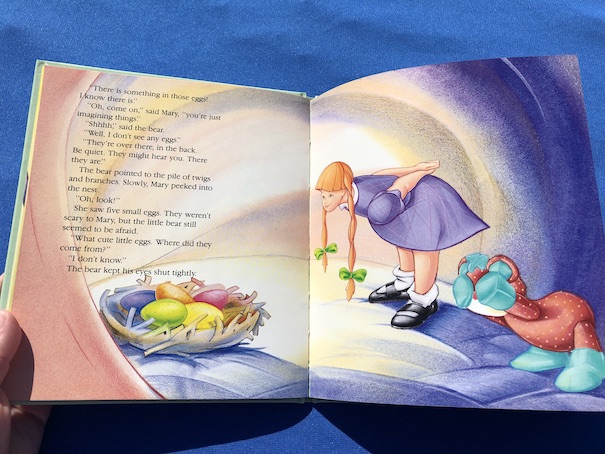
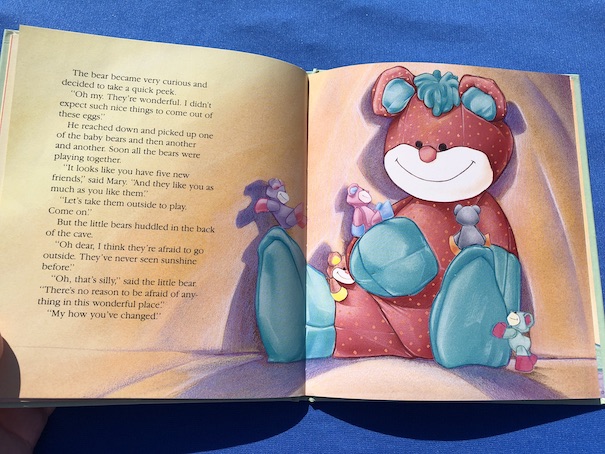
Mary thinks that Threads’ imagination is getting the better of him and that’s why he’s so afraid of so many things.  However, Threads tells Mary something that isn’t imaginary: there are some strange eggs in his cave that appeared there suddenly and mysteriously.  That’s why he’s sleeping in the forest, because he doesn’t know where the eggs came from or what they are.  Mary bravely offers to go with him to have a look at the eggs.

When they go to look at the eggs, Mary thinks that they look pretty harmless.  They’re kind of cute and colored like Easter eggs.  Threads is still worried about them and what they might hatch into.  Mary says again that Threads is imagining the worst and volunteers to sit with Threads while he takes his nap and keep an eye on the eggs to see what happens.

The eggs do hatch, and it turns out that they contain tiny teddy bears, very much like Threads.  When Threads sees the little bears, he loves them and thinks that they’re adorable.  The little bears seem worried when Threads wants to take them outside to play, but Threads encourages them, telling them that there’s nothing to be afraid of.

Moral: Your Greatest Fears Are Often Those You Imagine.

The main message of the story is that it’s better to face your fears than imagine the worst. However, I found some of this story a little confusing as a kid, and some of the implications are a little alarming when you begin to analyze it.  Where did those little bear eggs come from?  Did Threads lay them himself in his sleep? Are those little bears his children?  Did Threads lay eggs because he was a “chicken”?  But, Threads is a boy bear!  Then again, this is supposed to be a dream, so I guess it doesn’t really have to make sense.

I still don’t like that the story uses “chicken” as an insult and in a way that implies that people who are called “chicken” should try to prove that they’re not. This just seems like a recipe for disaster, encouraging children to accept dares.

The book is available to borrow and read for free online through Internet Archive. This book is currently available online through Internet Archive. It was made into an episode for the tv show version of this series with puppets.

A Fence Too High

The Land of Pleasant Dreams

A Fence Too High by Jeanine Bartelt, Jeff Parker, and Tony Salerno, 1986.

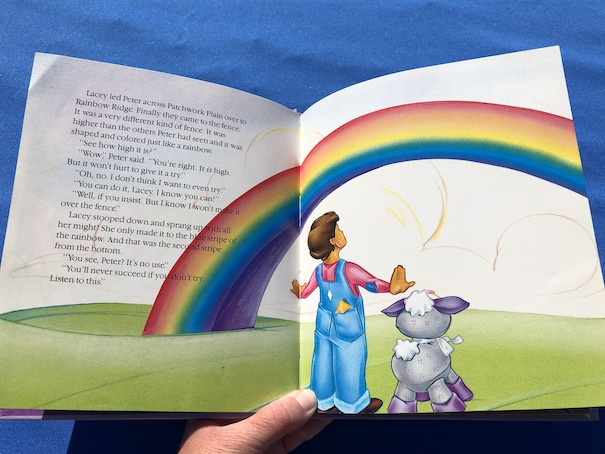
Peter falls asleep while counting sheet jumping over the fence and meets Lacey the Lamb in his dream. Lacey the Lamb is sad and worried because, even though she’s growing up to be a fence-jumping sheep, there is one fence that she just can’t get over. Peter offers to take a look at the fence with her and see if he can help. When he does, it turns out to be a giant rainbow.

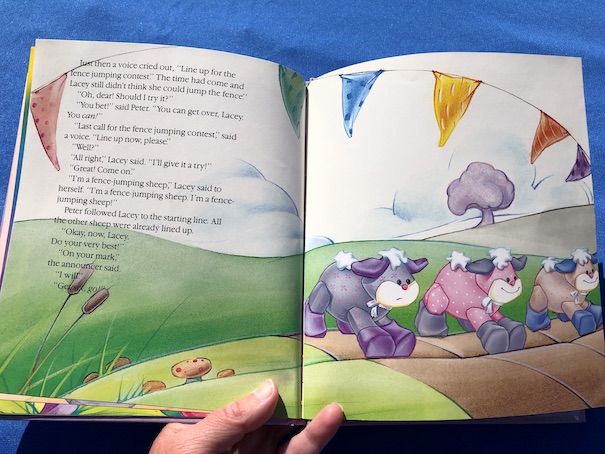
It’s important that Lacey make it over this fence because she is taking part in a fence-jumping contest in less than an hour. Lacey doesn’t think that she can learn to jump this fence in so little time. However, Peter encourages Lacey to try again.

After a few more tries in which she hits the blue stripe on the rainbow and then the yellow stripe and then the orange stripe, Lacey is ready to give up. She thinks that it’s hopeless. Peter points out that it isn’t hopeless because each time that Lacey has tried, she has improved, gradually hitting higher and higher marks on the rainbow. He doesn’t think that Lacey should give up so easily.

Even though she’s still feeling very unsure of herself, she decides to participate in the contest. This time, Lacey does make it over the fence, and she feels much better about herself because of her success. She thanks Peter for giving her the encouragement to try one more time.

Moral: If At First You Don’t Succeed, Try, Try Again.

It’s a nice story about the importance of making an effort, trying again, and not giving up just because there are obstacles and challenges. Life has many challenges, and just because something is difficult doesn’t mean that it’s impossible or not worth doing. People don’t need to be perfect; it’s enough to be willing to improve.

This book was made into an episode for the tv show version of the series with puppets.

Is It Soup Yet?

The Land of Pleasant Dreams

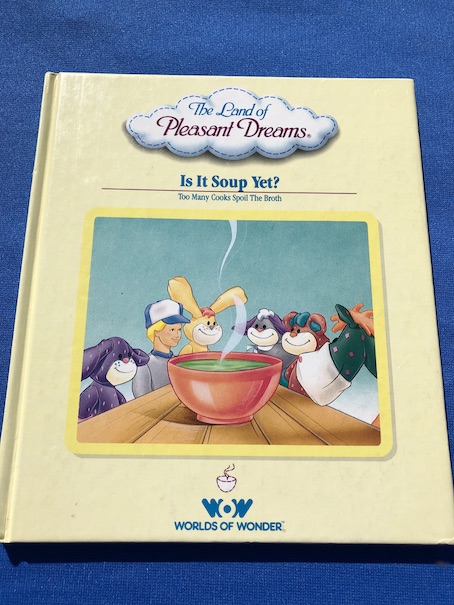
Is It Soup Yet? By Ane Weber, Ron Krueger, and Tony Salerno, 1986.

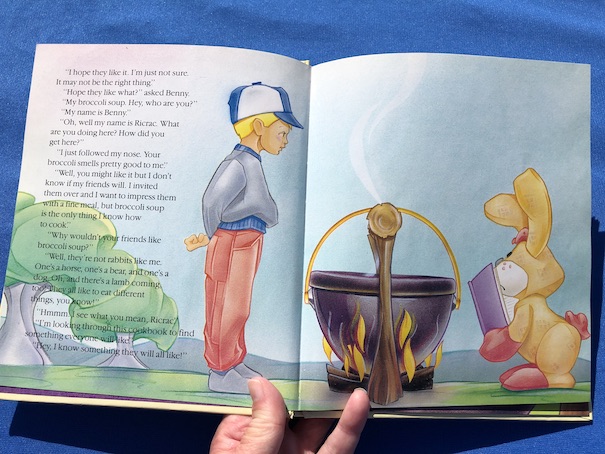
When Benny enters the Land of Pleasant Dreams, he meets Ricrac Rabbit.  Ricrac is trying to cook something for his friends, but he’s worried because the only thing he knows how to make is broccoli soup, and he doesn’t know if his friends will like it because they all have different tastes.

Because Benny’s father is a chef, he suggests that Ricrac try his recipe for black bean broth because everyone loves that when his father makes it.  Ricrac decides to give it a try, adding the black beans to his broccoli soup. 

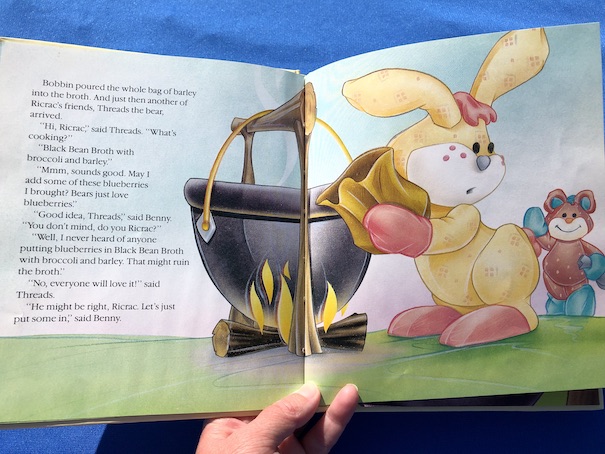
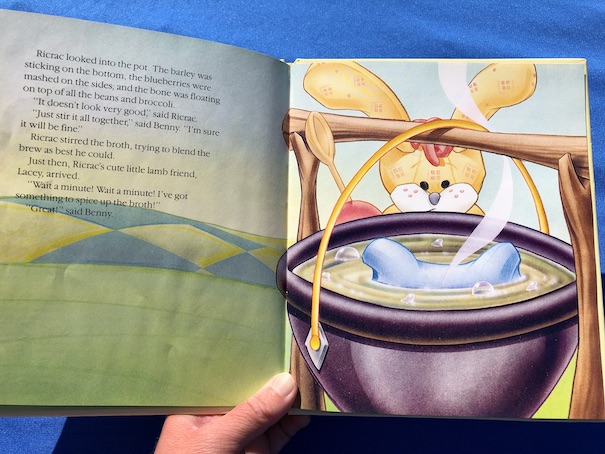
However, as each of Ricrac’s friends arrive, they also decide to bring their favorite ingredients with them.  Bobbin the Horse brings barley, and Threads the Bear brings blueberries.  Then, Snips the Dog brings a bone, and Lacey the Lamb brings buttercups.  In an effort to please everyone, Ricrac adds each ingredient to the soup.

When they finally try it, the soup is horrible.  At first, everyone argues about which ingredient ruined the soup, but Benny realizes that their real mistake wasn’t trying the soup according to Ricrac’s original recipe.  When they try the broccoli soup as it was supposed to be made, without the extra ingredients, it’s really good.

Moral: Too Many Cooks Spoil the Broth.

The point of the story is that trying to please everyone often means pleasing no one.  When planning a project, if you try to stretch it in too many different directions, it’s difficult to accomplish anything because you’re not focusing on anything in particular. In the end, you have to pick one way and stick with it, focusing on what you can do best.

The book is available to borrow and read for free online through Internet Archive. This book was made into an episode for the tv series with puppets. Sometimes, you can find it or clips of it on YouTube.

Can’t You Sleep, Little Bear?

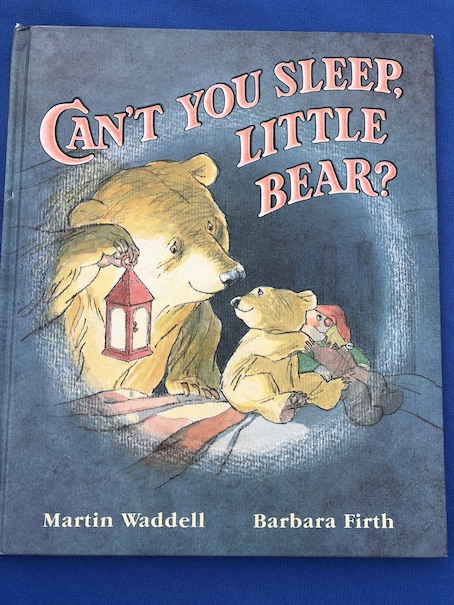
Can’t You Sleep, Little Bear? By Martin Waddell and Barbara Firth, 1988.

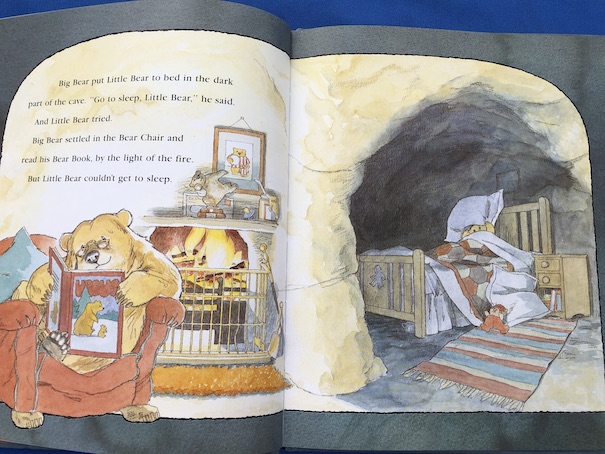
Big Bear and Little Bear live in their Bear Cave.  (Big Bear is apparently the father of Little Bear, but they don’t call him that.)  After Big Bear puts Little Bear to bed at night, Little Bear has trouble sleeping.  Little Bear says that he can’t sleep because he’s afraid of the dark.

Big Bear gives Little Bear a lantern, but that doesn’t work.  Little Bear says that the lantern isn’t big enough.  Big Bear tries to bring two larger lanterns, but neither of those helps, either.

Little Bear says that the dark beyond the cave bothers him.  To prove to Little Bear that the darkness outside isn’t scary, Big Bear takes him outside.

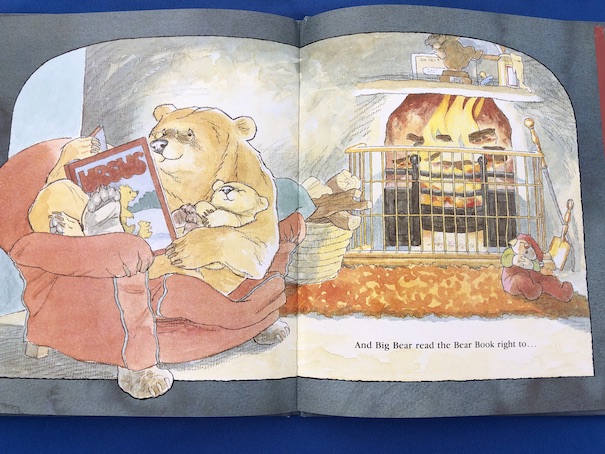
Outside, he shows Little Bear the moon and the stars, so he’ll know that it’s not completely dark.  Little Bear falls asleep in Big Bear’s arms.

This is one of those cute bedtime stories that can help to reassure young children at bedtime. Sometimes, it is a big, scary, dark world out there, but it’s not always as dark as it seems when you take a second look, especially if you’re with someone you can really trust. Because the bears appear to be father and son, it also makes a nice father/son story.

The book is currently available online through Internet Archive. There is also an animated version of this story. I haven’t seen it for sale (if anyone knows where to get it, let me know), but it sometimes appears on YouTube (link repaired July 18, 2024).

For Those Thinking of Notre Dame …

Sometimes, current events remind me of the events of children’s books. I debated about bringing this one up because I haven’t gotten hold of this particular book recently (partly because I’m probably not the only person who’s thinking about it right now), and I don’t have a proper post prepared for it, but years ago, a teacher introduced my class to Cathedral by David Macaulay. David Macaulay wrote a series of children’s books, explaining the architecture of historical buildings, including one about the construction of Gothic cathedrals, like Notre Dame in Paris.

The pictures in these books are fascinating, which is why I’m sorry that I don’t have a proper post prepared with example pictures. (I’ll probably do one later, when I can get hold of the book again) The book is available in multiple copies through Internet Archive, although there is a waiting list to get it right now.

However, the book was also made into a documentary film. Part of the story-line involves a fictional Medieval town replacing their cathedral after their first cathedral was destroyed by fire. (In the book, the cathedral was damaged by lightning, not destroyed by fire. The two stories aren’t the same.) This fictional cathedral serves as an example of the process of constructing a Medieval cathedral and the difficulties and dangers it might involve. The story of the town alternates with explanations about the history and architecture of cathedrals. This short clip explains the basic architecture of a Gothic cathedral, using Notre Dame as an example toward the end.

One of the aspects of the story that I find most inspiring is the dedication that the people who funded and built the cathedral showed. The construction of a cathedral in the Middle Ages could take a lifetime or even longer, and not everyone who began the task would live to see its completion. Their motivation was not mere personal gain but a glorious accomplishment that would both honor their beliefs and last far beyond them.

I’m not sure how long it will take to complete the renovations after the fire that damaged Notre Dame, but whatever it takes, I’m sure it will be worth it.

Old Bear

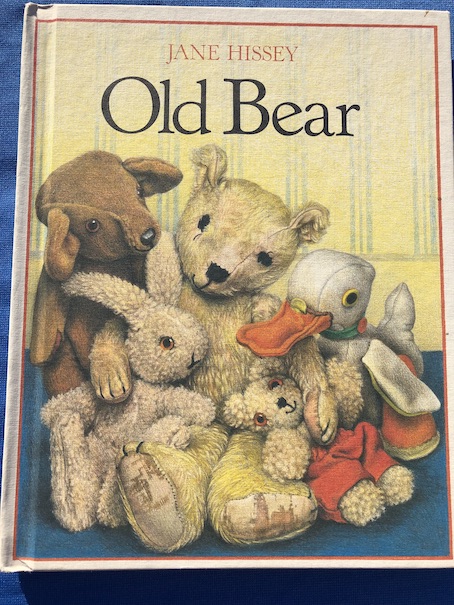
Old Bear by Jane Hissey, 1986.

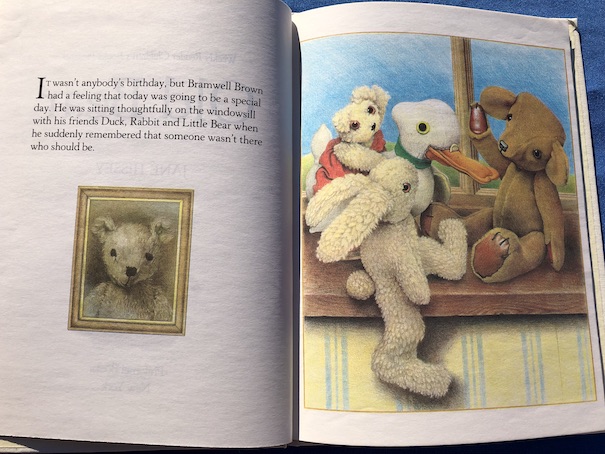
A group of stuffed animals remember that an old friend of theirs, Old Bear, was put up in the attic because he was an old toy and the children of the house were too rough with him.  The other stuffed animals miss him and worry that the humans in the house have forgotten about him, so they try to think of a way to get him out of the attic.

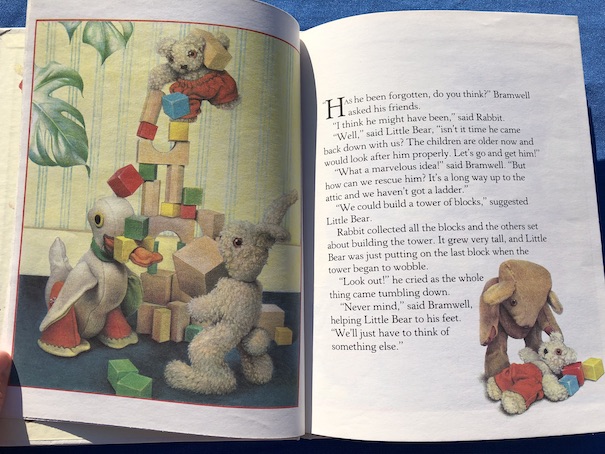
The problem is that the entrance to the attic is in the ceiling, high above their heads.  The stuffed animals try various tricks to get up to the attic, from building a tall tower of blocks to jumping on the bed.

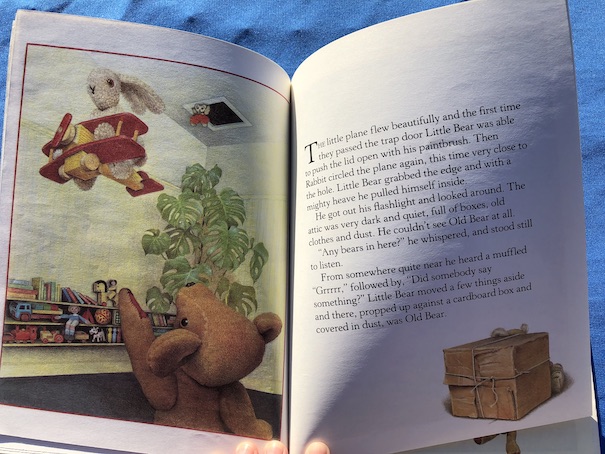
Eventually, they are successful when they use a toy airplane.  After Little Bear finds Old Bear in the attic, they use parachutes made of handkerchiefs to parachute back into the playroom to rejoin the other stuffed animals.

Old Bear says that he spent most of his time in the attic sleeping, but he is glad to be back with his friends.

I remember my mother reading this book to me when I was a young child in the 1980s! One of the things that I like about this book is the detailed pictures. The textures on the stuffed animals are excellent, giving readers the feeling that they could reach into the book and touch the fluffy Little Bear, Bramwell’s paws (which look like they’re made of vinyl), and the Duck, who looks like he’s made of felt.  The stuffed animals’ schemes to reach the attic are also fun and clever, using other children’s toys.

The book is part of a series originally published in the UK. The series was later made into a British television series during the 1990s. This particular story is one of the episodes, and you can see this episode on the author’s YouTube channel.

The book is available to borrow and read for free online through Internet Archive. (To borrow a book through Internet Archive, you have to sign up for an account, but it’s free, and then you read the book in your browser window.)