The Moorchild

When Saaski was only a few months old, her grandmother, Old Bess, started to notice that she didn’t look right, compared to the rest of the family or even compared to the way she looked when she was a newer baby. The grandmother tried to brush those thoughts aside, thinking that children change as they grow, and people of the village think that she’s odd herself as a widow who lives alone and knows about herbs. All the same, Saaski seems unusually fussy and throws tantrums, becoming a child who’s difficult to control. It could just be colic, or it could be something stranger.

Old Bess begins to put the pieces together about Saaski’s strange behavior. Saaski seems to hate or fear her own father, and Old Bess realizes that it’s because he is a blacksmith and wears an iron buckle on his belt. Saaski has an aversion to iron. She also has an aversion to salt, and only honey seems to soothe her. Saaski’s eyes change color from time to time, and Old Bess realizes that Saaski not only isn’t her grandchild but that she isn’t even human. Saaski is a changeling, a fairy child switched out for the human child before her christening.

When Old Bess tries to tell her daughter and her husband that Saaski is a changeling, her daughter refuses to believe her. Her husband seems to consider that Old Bess might be right, but he absolutely refuses to do the cruel things to the child that Old Bess tries to tell them will cause the fairy folk to take the changeling back and bring them their real daughter. Old Bess says that Saaski must either be made to tell her true age, which she cannot do because she cannot talk yet, or the parents must do cruel things to her, like beat her, burn her, or throw her down a well. The parents say that they cannot do such things to a baby, no matter what kind of baby it is, and they no longer want to discuss the matter, forbidding Old Bess to tell anyone else of her suspicions.

However, in this case, Old Bess is correct. The child known as Saaski is a changeling, and she knows it herself. Although she is in the form of a human baby, she knows that she is not really a baby. Her fairy name was Moql. She doesn’t know her true age, but she knows that she is a fairy youngling and that she used to live among the other fairies in the fairy mound. She doesn’t like being part of this human family, and she wishes that the fairies would take her back, but she knows that, whatever happens, they never will reclaim her. Even if this family treats her cruelly and the fairies decide to remove her from their house, she knows that they will just place her with a different human family.

The problem is that, unlike other fairies, Moql has no ability to hide from humans. Other fairies can change their shape or color, fade, or just wink out of human vision entirely, but Moql can’t. The fairies discovered it one day when Moql was unable to hide from a human shepherd. She is able to escape from the shepherd, but her blunder isn’t forgiven by the other fairies. Moql’s inability to hide from humans was considered a danger to whole band of fairies. She was taken before the prince of the fairies. When he sees that Moql cannot hide from humans, he remembers that a human man entered the fairy mound some time ago and stayed awhile with a fairy woman. Moql’s mother was a fairy, but her father was that human. As a half-human, Moql will never have the abilities that the other fairy younglings have.

When Moql is considered a danger to the other fairies, they feel little attachment to her or desire to keep her. They don’t consider a half-human likely to work out among the fairies, so they decide to swap her for a human child who might make a good servant to the fairies. They’ve done this before with other younglings like Moql. Moql is frightened because she doesn’t know how to be human. Life in the fairy mound is all that she knows. She is only half human, and if she’s not working out as a half fairy, how can she possibly work out as a human? What if she can’t work out as a human? Will she belong anywhere? What if she belongs nowhere?

The fairies tell her that she will start life all over again as a human baby and that she will forget all about the mound and her past life. The other fairies think nothing of casting her out. None of them really care about her. The fairies don’t feel emotions like humans do, and they don’t feel very much about anybody. Moql’s birth mother doesn’t feel anything for her but a mild curiosity and no concern for her future. Fairy mothers don’t really develop an attachment to their children, who are raised communally in the fairy nursery and school. Most fairies don’t even know who their parents are, and they don’t really develop feelings for their parents any more than parents feel attached to their children. Even fairy couples don’t stay together very long, forgetting about each other when they become bored with the relationship and moving on to others. Fairies don’t really care that much about relationships, like brother and sister, and fairies don’t even have a sense of what being a “friend” means. So far, even Moql hasn’t felt that much for anybody, either. Moql’s first human feelings come with her despair about being torn away from everything and everyone she’s ever known, made worse from realizing that nobody else feels anything for her. In their position, she might not feel anything for the loss of one of them because that’s the fairy way, but the human part of Moql longs for belonging and fears what will happen to her if she can’t find a place or people to belong to.

When Moql wakes the next day, she finds herself as the baby Saaski, but in spite of what the fairies said, she still retains her memories of her fairy life. Everything in this human household is strange. She fears the people who are supposed to be her parents, and most of the things that they offer her to soothe her aren’t soothing to a fairy or half-fairy, which is why she screams and throws tantrums. When she hears Old Bess describe her as a changeling and tries to urge her parents to do things to get rid of her, Moql realizes that she is stuck as a human, no matter what happens. Her only hope is to make herself forget or at least pretend that she doesn’t remember being a fairy and to try her best to be the human baby Saaski. It means pretending that she doesn’t have the ability to do things that a human baby shouldn’t be able to do and that she doesn’t know things that she actually does know. It’s not easy, but Saaski’s memories do fade a bit with time. She has vague memories of her past life, but the longer she lives as a human, the less she remembers of her past.

Time passes, and Saaski grows into a child, but the humans around her have an odd feeling about her. They whisper about her behind her parents’ backs. She doesn’t look like other human children, and odd things seem to happen around her. Saaski doesn’t trust Old Bess because she knows that Old Bess has always suspected she was a changeling. Other children in the village have heard their parents whispering about Saaski, and they start asking her if she really is a changeling. By that point, Saaski isn’t sure anymore what that means.

Old Bess does look for an opportunity at first to get the fairies to take back the changeling, considering shoving her into a pond at one point. However, when she realizes that Saaski has real feelings, she cannot bring herself to do it. She realizes that Saaski is also a victim of the switch when she was exchanged for the real Saaski. She doesn’t really belong among them, Saaski knows it, and Old Bess can tell that it hurts that she’s different and that others don’t accept her. Old Bess isn’t sure how much she understands about herself, her past, or her situation, but it’s been as unfair to her as it has been to the real Saaski and her family. The sense of belonging Saaski craves eludes her.

The only place Saaski really feels at home is out on the moor by herself, although she doesn’t really remember why anymore. That is where she first meets the orphan boy, Tam, who travels with the tinker. Tam knows what other people say about Saaski, but he isn’t afraid of her and likes her anyway. He is the first person who really seems to accept Saaski. For a time, her father forbids her to go on the moor again after she has a distressing encounter with a shepherd, who seems to recognize her as being a fairy.

Surprisingly, Old Bess turns out to be an ally of Saaski’s, urging her parents to let her go to the moor again. She knows how restless Saaski has been, confined to their home. The only thing that has soothed her is the old bagpipes that once belonged to her father’s father. She seems to know how to play them without anyone ever teaching her. Eventually, her parents allow her to return to the moor, partly so she won’t keep playing the bagpipes at home. When she’s able to see Tam again, he is happy to see her, and she shows him how she can play the bagpipes.

There are other things that Saaski seems to know without knowing how she knows. She sometimes sees strange symbols that no one else seems able to see. When Old Bess realizes that she can see these symbols, called runes, the two of them discuss it. Old Bess can’t see them herself, but she knows about them. She learned a lot about such things from an old monk she once cared for and from the books he left behind, which is also where she gained her knowledge of herbs.

Old Bess admits to Saaski that, like her, she is considered strange and that she doesn’t quite belong to the village where they live. She was brought to the village as an infant after she was found abandoned in a basket at a crossroads. They left her at the miller’s house, and she was raised by the miller and her wife. She doesn’t know who her birth parents were, where they came from, or why she was abandoned as an infant, and she was told that the gypsies who found her almost drowned her as a changeling before deciding to leave her in the village.

Saaski also knows that she doesn’t belong in the village, although she can’t think where she does belong. She can’t explain how she is able to see and understand fairy runes or do the other things that she seems able to do, apparently without anyone teaching her. Over time, she gradually discovers or rediscovers the things she could do and knew as a fairy. She discovers that she can see fairies when she spots one stealing Tam’s lunch. Later, a group of fairies try to steal her bagpipes. To Saaski’s surprise, she is able to understand their language, and they seem to recognize her.

Then, after the children in the village bully Saaski again, an illness comes to the village, afflicting all of the children but Saaski. Old Bess says it’s a normal childhood illness she’s seen before, and the children probably got it from the gypsy band who recently passed through town. However, the villagers, who have always been suspicious of Saaski whisper that Saaski is responsible, that she has cursed the other children. Saaski denies is, but the villagers are becoming increasingly hostile. They want her out of the villager, but if Saaski can’t stay there, where can she go?

When Saaski tries to bargain with a fairy for some help to hide from the villagers, the fairy reminds her that she was a fairy herself and that she was never able to disappear. Saaski is stunned at this confirmation of the villager’s suspicions about her being a changeling. When she tells Old Bess about it and about the memories that are now returning to her, Saaski realizes that she really doesn’t belong in this human village, at least not fully. Yet, she remembers that she doesn’t fully belong among the fairies, either. Once again, it leaves her the question of where she does belong. Saaski is going to have to take her fate into her own hands, but before she does, she wants to do something for the family that raised her and has loved her, in spite of everything: find the original Saaski in the fairy mound and return her to her parents.

The book is a Newbery Honor Book.

I enjoyed the story because it is a unique portrayal of the folkloric idea of changelings. Another book I read on the same topic, The Half Child, is told from a real world, historical point of view, without fantasy. In that book, changelings are disabled children or children who aren’t “normal” in some way who are labeled as being something other than human or “real” children because people of the past couldn’t understand why they were different or what was wrong with them.

The Moorchild, however, is fantasy and builds on the folklore concept. In other books with changelings, we see the changelings from the point of view of other people, who wonder about their true nature, but this book includes multiple viewpoints, including that of the changeling herself. In folklore, it isn’t entirely clear why the fairies would want to change their children with human children, leaving them to be raised by other people and possibly never seeing them again. This book builds on that concept, portraying the changeling children as being half human and/or flawed in some way, compared to the other fairies. They do use the human children they gain in the swap as servants, which is a folkloric concept, but this story explains why the fairy child left in exchange for the abducted human child is an acceptable loss to the other fairies.

Fairies in this story don’t have the same types of feelings as humans. In fact, they don’t seem to feel much at all, making most of their lives literally care-free because they just don’t care that much about others or the consequences of their actions. However, they don’t feel much emotional attachment to each other, either. Saaski/Moql’s birth mother doesn’t feel much of anything for her daughter or for the man whose life she changed and worsened through her seduction and rejection. She is completely unconcerned about what has happened to them or what will happen to them because of her. Later, Saaski realizes that the fairies are aware that Saaski is blamed for pranks they played, but they don’t mean it spitefully. They genuinely don’t care whether Saaski or someone else is blamed for things they do as long as they never get caught themselves. When Saaski realizes that the other fairies genuinely don’t care about her or what happens to her, she knows that they will never take her back and that she will never rejoin them.

Saaski feels more emotion than full fairies feel, but she doesn’t always respond in acceptable or predictable ways to the humans she lives with because she doesn’t share all of the emotions they feel. She craves a sense of belonging, but she doesn’t really know how to get it or create it. At times, she feels love and gratitude without being entirely sure what she’s feeling or how to express it. Strangely, she also doesn’t experience hate and resentment in the same way humans do. Tam tries to explain it to her, and Saaski recognizes that the children in the village who bully her feel hatred and resentment to her, but she doesn’t feel those emotions herself. She doesn’t like it when they bully her, and she feels hurt by them, but the emotion of hating and wanting to hurt them back isn’t there. I thought that was an interesting concept, exploring someone with non-conforming emotional reactions. Saaski’s emotions in the story are explained by her fairy heritage, but what made it interesting to me is that neurodivergent humans also have different ways of experiencing and showing emotions that can change the way they are accepted by or interact with other people, which brings the idea of changelings full circle, back to the concept of children who aren’t like other children from birth or a young age.

I thought it was fascinating that we get to see things both from Saaski’s point of view and from the point of view of other people, particularly Old Bess. Old Bess is the first to realize that Saaski is a changeling and not her “real” granddaughter. She understandably wants her real granddaughter back, and she knows the folklore that fairy folk will take back a changeling who has been abused. However, Saaski’s parents, even knowing or suspecting that Saaski might be a changeling, cannot bring themselves to do anything cruel to her, and Old Bess comes around to that point of view herself. By observing Saaski, she sees that Saaski is a child, if not an entirely human child, and an innocent victim of the switch herself, with feelings and a difficult life ahead of her because she doesn’t fit in with this community.

Old Bess also recalls and admits to Saaski that her own past isn’t quite normal and that she also doesn’t quite fit in. I wondered if we would ever get the full story of Old Bess’s past, but unfortunately, we don’t. We know that she was abandoned as an infant, apparently rejected by her birth family or guardian, but we never learn why. I had wondered at first if Old Bess would turn out to be a grown-up changeling. It seems that people once suspected that about her, but apparently, she isn’t because she can’t see the fairies or fairy writing in the way Saaski does. It seems that Old Bess is fully human and not half fairy. In the end, the important point is that, when Old Bess is honest with herself and Saaski about her past, her story has some elements in common with Saaski’s situation. They have both known rejection and abandonment, the difficulties of trying to fit in when they don’t entirely fit in, and the love of people who accepted them and cared for them in spite of it all.

I appreciated that Saaski’s parents do their best to love and care for Saaski even when they know she’s strange and may not be their daughter. They stand up to the people who bully their daughter and pressure them to get rid of her. In fact, in the end, even after Saaski and Tam set out into the world together and they have their birth daughter back, they still think of Saaski and miss her sometimes. Saaski was no replacement for the daughter they lost when they were switched, but at the same time, they realize that their birth daughter doesn’t entirely replace Saaski in their lives and affections. In the end, it’s like they’ve had two daughters, both of them “real”, although one didn’t fit in and eventually left to start a new life elsewhere.

The Diamond Princess and the Magic Ball

The Jewel Kingdom

Demetra is the Diamond Princess, and she lives in the White Winterland. She and each of her sisters has a different castle and region to rule over in their parents’ kingdom, but they still spend time together. After a visit with her parents, Queen Jemma and King Regal, at the Jewel Palace, Demetra finds herself worrying about how she measures up to her sisters. It seems like each of them has done something special for the people in their region, but Demetra can’t think of anything special she’s done. She talks about it with her friend, Finley the fox, but she can’t think of anything really special to do.

On the way home, they see a wagon with performers giving a show. Princess Demetra wants to stop and watch the show, but Finley warns her that it could be dangerous because they’re near the Mysterious Forest, which is a dangerous region. Demetra insists on stopping anyway, and she meets a fortune teller called Madame Zara. Madame Zara says that she can see that Demetra is a princess, and a boy from the audience says that’s not much for a fortune teller to see because Demetra is obviously wearing her crown.

Madame Zara says that she knows who the boy is, too. His name is Wink, and Madame Zara says that he’s a failed student wizard, rejected by the Wizard Gallivant. Demetra also knows Gallivant because he appointed her as the Diamond Princess. Madame Zara could have figured out Wink’s identity because his wizard robe is peeking out from his pack and has his name on it, but the part that’s harder to figure out is how she knew that the frog hidden in Wink’s shirt is actually his dog. Wink accidentally turned his dog into a frog.

Demetra decides that’s good enough proof that Madame Zara knows things other people don’t, so she asks her to tell her fortune. Madame Zara shows her a beautiful snow globe that looks like it has a scene of the White Winterland inside. Demetra can even hear the voices of people she knows inside it. Madame Zara says that the magic ball tells the future and asks Demetra if she would like to have it. Demetra says she would, although Wink tries to warn her not to trust Madame Zara. However, Demetra lets Madame Zara take a lock of her hair in trade for the magic ball.

As Demetra continues on her way home, she begins to see that the snow that always covers the White Winterland is melting! Something is terribly wrong, and it may have something to do with the magic ball!

The book is available to borrow and read for free online through Internet Archive.

I never actually read any of the Jewel Kingdom books when I was young, but I remember them being sold in stores along with little jeweled charms. It doesn’t take too long to get into the lore and backstory of the series, even though I’ve read the few books I’ve read out of order.

There are recurring villains in this series, especially Lord Bleak and his minions, called Darklings. When the Darklings appears in this story, the book explains who they are and about Lord Bleak’s backstory. Lord Bleak was an evil tyrant who used to rule the Jewel Kingdom, until he was vanquished by Queen Jemma and King Regal. Since then, he’s been trying a series of evil schemes to regain control. The Darklings used to be beautiful, but they were corrupted by evil, and now they’re hideous creatures in dark robes.

Because this story is meant for young children, Demetra makes the mistake of entering into a suspicious trade with a shady character, apparently not having had the “stranger danger” warnings and not heeding her friends’ concerns. Of course, it turns out that the lock of hair she traded for the magic ball was important because it gives the person who holds it power over her and her kingdom. To save her kingdom, she has to get her lock of hair back.

I enjoyed the story, though. It has a colorful setting, and I liked their trip to the Bizarre Bazaar.

Princess Megan

The Magic Attic Club

Meg and her friends are planning to perform a short play of Peter Pan at a local nursing home. Her friends chose her to be their director, and Megan is really looking forward to it. Then, her mother does something that threatens to derail the project.

Megan’s mother is a lawyer, and she frequently has to work late. The problem is that, this time, she’s going to have to work on Saturday, interviewing witnesses for a trial. However, that Saturday, Megan’s mother was supposed to be at the high school, receiving donations for a food drive. She asks Megan to take care of the food donations, but the problem is that the play Megan and her friends are supposed to perform is also on Saturday. Helping with the food drive would make it difficult for Megan to get to the play on time. Megan’s mother is tired and in no mood to listen to Megan’s objections that it wouldn’t be fair to derail her project with her friends. Her mother just wants Megan to take care of her obligations for her.

While Megan is fuming about the unfairness of the situation and worrying about what to do, she decides to visit their neighbor, Ellie Goodwin. Megan and her friends have a standing invitation to visit and explore her attic, which has the ability to send them to other places and times when they put on different costumes and look at themselves in the mirror.

This time, Megan tries on a purple princess dress, and she finds herself in a Medieval village in France, near a castle. She meets a peasant girl named Michelle. Michelle tells her that there’s been trouble over the matter of the unicorn and the feast.

When Megan asks what she means, Michelle explains that Lord Claude and Lady Helene are hosting a feast and joust at their castle and that the king (who is supposedly Megan’s father in this world) has been invited as an important guest. At the end of the feast, they want to give the king a unicorn’s horn as a gift, but the problem with that is that they have to kill the unicorn to do that. Alternatively, it is possible to befriend a unicorn and get filings from its horn that also have magical powers, but Lord Claude and Lady Helene want to give the king the whole horn. Michelle confesses to Megan that her mother, who works in the castle’s kitchen secretly released the unicorn that they’d captured for the purpose. If they knew she was the one who did it, she would be in serious trouble.

Megan wants to help Michelle and her mother, and as someone who supposedly has the rank of princess, she should have some authority. However, she’s not entirely sure what kind of influence she can have because she knows that she’s not a “real” princess. Everyone thinks that she’s the king’s daughter, but Megan knows that she’s not. Can Megan find another way to save the unicorn’s life and Jacqueline from punishment, without revealing herself as an imposter princess?

The book is available to borrow and read for free online through Internet Archive.

Some children’s books that involve time travel have real, historical information for educational value, but this one, and others in the series, are pure fantasy. Megan doesn’t visit real Medieval France. This is a fairy tale version of the Middle Ages with a unicorn and an invisibility cloak. There are a few accurate details for the Middle Ages, like the practice of using straw or other plants on the floors and the fact that intricate tapestries took years of work to complete. However, the focus is definitely on fantasy.

The invisibility cloak is critical to Megan’s plan to save the unicorn and make the king realize the value and beauty of the unicorn before someone can kill it on his behalf. When the king sees the unicorn for himself and reads the note that Megan wrote for him, he accepts the living unicorn and its presence as his gift instead of the horn. The problem with the unicorn is resolved pretty quickly, and so is Megan’s situation with her mother.

At first, I was expecting that the situation that Megan encountered in the fantasy world would have more of a direct parallel to Megan’s situation in her regular life, but it doesn’t really. It mostly serves as its own adventure, although it does highlight that Megan is creative when it comes to problem-solving and can be relied on in difficult circumstances. What Megan really needs to do is to explain to her mother why it would be difficult for her to take over her mother’s project without compromising her own. When Megan finally explains, it turns out that her mother didn’t know about her project with her friends. Handling both of their projects requires some careful scheduling and a little help from a friend, but they manage to work it out.

I really like the pictures in the Magic Attic Club books because they remind me of the ones in the American Girls books. They have a similar quality.

Amelia Bedelia Bakes Off

Amelia Bedelia Bakes Off cover

Mr. Rogers has been watching a tv show called What’s Cooking? with Chef Du Jour, and there’s going to be a Bake-Off contest in town! Because Amelia Bedelia is so good at baking, Mr. and Mrs. Rogers think she should try to enter the contest.

Amelia Bedelia Bakes Off contest announced on the tv show

She is a good baker, but Amelia Bedelia has already agreed to spend the day taking care of the bakery called Grace’s Cookie Jar with her Cousin Alcolu while Grace is out of town. Even though Amelia Bedelia is good at baking, it turns out that she isn’t any better at following someone else’s baking and recipe instructions than she is at following any other to do list written by someone else.

Amelia Bedelia Bakes Off - Amelia meets her cousin at the bakery

When Amelia Bedelia meets Cousin Alcolu at the bakery, they read the notes that Grace left for them. The first note tells them to “start every recipe from scratch”, so of course, they have to scratch each other’s backs before they begin cooking. From there, Amelia Bedelia thinks that cutting a recipe for chocolate chip cookies in half means that they have to literally cut the recipe paper in half. Then, for good measure, Amelia Bedelia thinks they should cut all the chocolate chips in half, too.

Amelia Bedelia Bakes Off - Amelia literally cuts a recipe in half

When Grace’s instructions ask them to bake “twelve pound cakes”, she assumes that she wants a cake that weighs 12 pounds instead of baking 12 small pound cakes. Fortunately, because that seems like such a big task, Cousin Alcolu suggests that they bake twelve one-pound cakes and just stack them, which is closer to what they’re actually supposed to do.

Amelia Bedelia Bakes Off - Amelia and her cousin stack pound cakes

Amelia Bedelia and Cousin Alcolu get creative with decorating the cheesecakes because Amelia Bedelia doesn’t want to top them with cherries, like Grace asked. She just doesn’t think that cherries and cheese go together. Instead, they decorate them on the theme of cheese. Even though they don’t go about their baking in quite the way they’re supposed to, the things they make are still good.

Amelia Bedelia Bakes Off - Amelia and her cousin decorate cheesecakes

At the end of the day, Amelia Bedelia is tired, but she bakes one last cake for the Bake-Off. Since she’s so tired, she uses that a creative theme for her “sheet” cake! The book includes the recipe for Amelia Bedelia’s Sheet Cake.

The book is available to borrow and read for free online through Internet Archive.

Amelia Bedelia Bakes Off - Amelia decorates a cake to look like a bed

Amelia Bedelia books are supposed to be ridiculous, playing off of expressions and words with multiple meanings. They aren’t really supposed to make sense so much as poke fun at Amelia Bedelia’s literal interpretations or confusion over instructions that other people give her.

I found this one a little out of character for Amelia Bedelia because one of her signature traits is that she’s good at baking. In other books, her baking skills often save her job or diffuse people’s anger at other instructions that she’s misinterpreted. Of all the things that Amelia Bedelia might understand, you would think she would know how to read a recipe. Although, admittedly, this isn’t the first time that she’s misunderstood something that someone else asked her to bake because she once cut up a calendar when she was asked to bake a “date cake”, apparently not understanding that dates are fruit. Now that I think about it, Amelia Bedelia also seems to bake her best dishes from memory, not usually consulting a recipe. Above all, though, there are a lot of baking and cooking expressions that would be fun to see Amelia Bedelia misinterpret (like when Amelia Bedelia pinches Cousin Alcolu when a recipe calls for a pinch of salt), and that’s what’s really the point of the story.

I did enjoy that, even though Amelia Bedelia and her cousin misinterpret Grace’s instructions, the things they make still taste good, and most of them are more or less what they’re supposed to be, like the cookies and the pound cakes.

Amelia Bedelia Goes Camping

Mr. and Mrs. Rogers are going camping, and they take along their maid/housekeeper, Amelia Bedelia. Amelia Bedelia has never been camping before, and she brings along her unique habit of taking things too literally or misinterpreting instructions as Mr. and Mrs. Rogers explain to her what she needs to do while camping.

When Mr. Rogers tries to teach her how to catch a fish, he doesn’t tell her right away that they need to use fishing poles, so Amelia Bedelia just jumps right into the stream and grabs a fish right out of the water. It’s actually kind of an amazing accomplishment, but Mr. Rogers is stunned when Amelia Bedelia lets the fish go, not realizing that they were supposed to keep what they catch. She thought the activity was only about catching.

When Amelia Bedelia is sent to “pitch the tent”, she meets some boys, who say that they’ve heard of Amelia Bedelia. Even knowing that she’s pitching the tent wrong, by simply throwing it and letting it come down wherever it lands, the boys happily participate. When they suggest to Amelia Bedelia that maybe they should move the tent or throw it again when it lands in the bushes, Amelia Bedelia says that isn’t necessary because the tent is conveniently out of the way there.

Amelia Bedelia also gets confused about starting a fire with pine cones because Mr. Rogers didn’t say to use a match, and she thinks “rowing a boat” means to put all the boats in a row. She also doesn’t understand that tent stakes aren’t the same as meat steaks and thinks that sleeping bags are bags that are asleep. The only order that I know that Amelia Bedelia refuses to obey is Mr. Rogers’s order to “go jump in the lake”, and that’s only because she is out of dry clothes! Fortunately, where Amelia shines is preparing a picnic feast for Mr. Rogers’s birthday!

The book is available to borrow and read for free online through Internet Archive.

The Amelia Bedelia books all poke fun at words with multiple meanings and the literal ways that Amelia Bedelia misinterprets various expressions. As with some of the other Amelia Bedelia books, though, the whole premise of the book is based on Amelia Bedelia not only getting confused about the proper meanings of words but also having no knowledge of the subject at hand. Amelia Bedelia doesn’t know what tent stakes are or what pitching a tent involves because she’s never been camping before. In spite of that, even knowing that Amelia Bedelia has no experience in camping and how she usually interprets instructions she doesn’t fully understand, Mr. Rogers assigns her tasks which he should know that she has no idea how to do. Not only does Amelia Bedelia never learn to check her understanding of what other people mean, Mr. and Mrs. Rogers never really learn that they have to teach Amelia Bedelia what she needs to know to do a task and check to make sure that she understands.

As with other books in this series, though, Amelia Bedelia’s cooking skills save the day and her job with Mr. and Mrs. Rogers! Maybe Amelia Bedelia should have just gotten a job in a bakery or something, but then again, she also messes up cooking instructions whenever she tries to do what someone else told her rather than just doing things the way she’s accustomed to doing them.

Amelia Bedelia

Amelia Bedelia is just starting her new job as a maid with Mr. and Mrs. Rogers! Mr. and Mrs. Rogers can’t be there to supervise her on her first day, but Mrs. Rogers leaves her a list of things to do and tells her to do exactly what the list says. Little does Mrs. Rogers know just how literal Amelia Bedelia can be!

When Amelia Bedelia reads that she’s suppose to “change the towels”, she thinks that she’s supposed to change the way they look instead of replacing them with new ones. To Amelia Bedelia “dust the furniture” means to add dust to the furniture instead of removing it. The instruction to “draw the drapes” sounds like she should draw a picture of them instead of closing them.

When Mr. and Mrs. Rogers return to see how Amelia Bedelia is doing, they are shocked at what she’s done!

There is only one thing that can save Amelia Bedelia’s job: her ability to make an amazing lemon meringue pie!

The book is available to borrow and read for free online through Internet Archive.

This is the very first book in the Amelia Bedelia series, and I remember reading it when I was a kid. The point of the Amelia Bedelia books is to introduce kids to expressions and words that have multiple meanings. They’re pretty funny to read, although even as a kid, I had trouble believing some of the phrases that Amelia Bedelia takes literally. For example, when she “dusts” the furniture, she thinks that Mrs. Rogers should have told her to “undust” the furniture instead. I see what the author is saying, that it’s funny that we say “dust” the furniture when we’re actually removing dust instead of adding it, but I’ve never heard anybody in real life use the term “undust” the furniture. Amelia Bedelia is funny, but sometimes, it seems like it’s reaching a little to find terms she can credibly misinterpret.

I also don’t think I fully understood the parts about trimming the fat on the steak and dressing the chicken as a kid because I wasn’t used to cooking. I think I got the concept that she was supposed to cut the fat off the steak rather than decorate it as one might trim a Christmas tree (a concept that Amelia Bedelia interprets the opposite way in her Christmas story). What she was supposed to do with the chicken she ended up “dressing” in clothes was a little more confusing. When I was a kid, I knew that people make stuffing or dressing to put in poultry, like chicken or turkey, when they cook it, or they can rub herbs and spices under the skin for flavoring, and I think that’s what Amelia Bedelia was supposed to do here. Even so, there are different types of stuffing or dressing to make and different mixtures of herbs and spices to use, and Mrs. Rogers doesn’t say what kind she wants. Of course, if she was more specific, Amelia Bedelia couldn’t have gotten so confused, and that’s really the point of the story.

I don’t know whether any teachers still use Amelia Bedelia books as examples of words and phrases with multiple meanings, but they are fun in that fashion. A good accompanying activity for these books is a project that I had when I was in school and that I’ve heard students still do – explain how to make a peanut butter sandwich (or any other kind of sandwich) to someone from another planet, who has no idea what a sandwich is or how to make one. Students doing this activity need to be as careful and detailed as they can because some phrases are easy to misinterpret if you assume that the person you’re talking to has no idea how anything works. I remember my old teacher would act out our instructions literally, almost like Amelia Bedelia. For example, if you said, “Put peanut butter on bread” without saying that you need to open the jar first and remove the peanut butter from the jar with a knife, the teacher would set the whole jar of peanut butter on top of the bread and just stare at it. If you explain the peanut butter sandwich instructions well enough that there’s no room for misinterpretation, you may have a future in technical writing!

The pattern established in this first book continues through other books in the series. In many other Amelia Bedelia stories, Amelia Bedelia misinterprets instructions she’s given by taking things too literally or misunderstanding words with multiple meanings, but she always manages to keep her job because she’s really good at baking and makes cakes, pies, and other treats that Mr. and Mrs. Rogers love.

If you read the 50th Anniversary edition of the book, there’s a section in the back about the Amelia Bedelia series and how it’s changed over the years!

A My Name is Alice

I remember this book from when I was a kid! I always liked the pictures in the book, which are by Steven Kellogg, who also did the pictures for The Day Jimmy’s Boa Ate the Wash.

This book isn’t a story. It’s based on a talking game that’s often played on car rides called A My Name is Alice or Alphabet Chant. Like many casual folk games or childhood playground/car games, it goes by different names and has variable rules. In the back of the book, the author, Jane Bayer, says that she learned the game on a playground when she was a child in the 1950s. When she played it, they would bounce a ball while playing. This book was a favorite of mine when I was little because it was the first place I learned about this game.

This game is an alphabet game where players have to follow the alphabet, giving the names of people, objects, and places all according to which letter of the alphabet they were currently on, using the following format: “(Letter) my name is (female name) and my husband’s name is (male name). We come from (place name), and we sell (object name).” (Because the rules vary, some people who have played this game with a slightly different format, possibly using the male name first.) First, you give all A names and words in this format, then you do the same for the letter B, then C, and so on to the end of the alphabet. (Or until you reach your destination, get stuck, get bored, etc.)

The fun of the game is that you can be as silly as you want with the names, places, and things to sell. The challenge is that it’s harder to think of names, places, and objects for certain letters than it is for others. Many kids playing this name will use the most common words they can think of first, took keep the game going quickly. However, the author deliberately goes for silly and unusual, which makes the book and the pictures fun and interesting.

She also adds the element that all of the “people” she’s talking about are animals, and the types of animals they are also fits the alphabet theme. It can be difficult to think of animals for certain letters of the alphabet, but again, she goes for the unusual ones. The husband/wife pairs being named aren’t always the same animal, either. When they match, it’s usually because it was too difficult to come up with two different animal names for particular letters. The types of animals are given under each picture.

X is always the most difficult letter in an alphabet game because there aren’t many words or names that start with X. However, I liked the way the author dealt with it, just using aliens!

The book is available to borrow and read for free online through Internet Archive.

The Christmas Eve Ghost

Bronwen and Dylan are two young children who live in Liverpool. They moved there from Wales with their mother after their father died in a mining accident. The family is poor, and their mother works out of her home as a laundress. When she has some free time, she tells the children exciting stories about dragons and ghosts.

The family living next to them, the O’Rileys, are also poor, but the children’s mother discourages the children from being too friendly with them. The children don’t fully understand why, but it has something to do with the fact that the O’Rileys go to a different church. Bronwen’s mother tells her that the O’Rileys are not their kind of people and that she doesn’t want her to go near their church.

As Christmas approaches, “times are hard”, and the children’s mother doesn’t have much money. She saves what she can to give the children a bit of a treat, but she can’t spare much. Although their mother doesn’t like leaving her young children home alone, on Christmas Eve, the children are tired, and she needs to do a little more shopping. She tells the children to be good, play nicely, and not open the door for anyone and that she will be back soon.

Things are fine at first, but then, the children begin hearing a strange sound. They can’t figure out what it is, but it seems to be coming from their mother’s wash house. Based on their mother’s stories, they think maybe it’s a ghost! In a panic, Bronwen and Dylan run out of their house and straight into Mrs. O’Riley. Fortunately, Mrs. O’Riley knows what the sound is, and as a mother herself, knows what to do.
The book is available to borrow and read for free through Internet Archive.

Although this story never explains what year it takes place, it appears to be set during the Great Depression. (Although the Great Depression started in the United States, and this story is set in England, economies all over the world are and have been connected to each other. When one country’s economy experiences something catastrophic, it affects everyone else. The Great Depression was a worldwide event.) The setting is partly in the way people are dressed but also in their circumstances. The way the mother does the laundry is an old-fashioned, labor-intensive process. More tellingly, not only is the children’s widowed mother poor and struggling to get by as a laundress, but the O’Rileys are struggling, too. The children in the story know that Mr. O’Riley and his grown sons often work at the docks, and when there’s no work for them there, they hang out on the street with other men looking for work, and they don’t always find it. This is a time when everyone is poor and suffering. In the back of the book, the author explains that the story was based on her own memories of growing up in Liverpool in the 1930s.

The book doesn’t explicitly identify what the O’Rileys’ religion is because the story mainly focuses on young Bronwen and her perspective. The Irish name is a clue, but Bronwen also says that she once looked inside the church that the O’Rileys attend, out of curiosity, and she saw stained glass, candles, and statues, far more decoration than she normally sees in the comparatively plain church she attends with her mother. These are features of Catholic churches that aren’t always found in Protestant churches, at least not to the same degree, especially in more strict Protestant churches. The religious symbols in the O’Rileys’ house also confirm that this is a Catholic family. The issue between Bronwen’s mother and the O’Rileys is the conflict between Catholics and Protestants, and Bronwen’s mother fearing that the O’Rileys and their different ways might have a negative effect on her children.

In real life, in the modern world, I wouldn’t recommend small children going into a neighbor’s house without their mother’s knowledge and approval, but in the story, it works out for the best. When Bronwen and Dylan’s mother finds out how Mrs. O’Riley helped look after the children when they were alone and scared, she realizes that she can trust the O’Rileys. Mrs. O’Riley even offers to look after the children sometimes when their mother needs to go somewhere, and the children’s mother is grateful. It’s difficult for her, being on her own and not living near other relatives, who could help look after the children. She needs someone to rely on for help sometimes, and the key to finding someone is being open to getting help from people around her, regardless of their religion.

I thought was also telling that the neighbors’ last name is O’Riley. That’s an Irish name. Bronwen and Dylan’s family moved to Liverpool, England from Wales, but it seems like the O’Rileys have probably moved there from Ireland. We don’t know the history of the O’Riley family and how long they’ve lived in Liverpool, but it seems likely that both of these families are from somewhere else, living in an area that probably has a lot of immigrants who are struggling to get established and look for new opportunities in a new place during economically rough times. Aside from the religious differences, their positions are probably pretty similar.
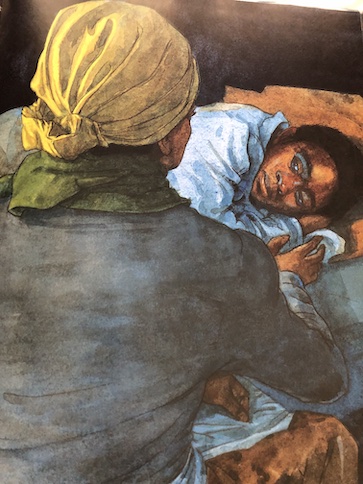
I enjoyed the old-fashioned charm of the pictures in the story. The family lives in a small, old-fashioned house, and they are obviously poor, but at the same time, it’s charming and cozy.
Lucy and Tom’s Christmas

This British children’s picture book shows a young brother and sister enjoying Christmas and celebrating many popular British Christmas traditions.

Before Christmas, Tom and Lucy help their mother make a Christmas pudding, each of them making a wish as they stir it. They see the postman delivering Christmas cards and packages, and they make Christmas cards of their own. They also help their mother to decorate the house.

Each of them also has small presents for each other and other people in their family. They also write letters to Father Christmas and “post them up the chimney.” (In Britain, it’s traditional to burn letters to Father Christmas or Santa Claus because he can read their wishes in the smoke.)

They enjoy listening to carol singers and buying a Christmas tree in the market. On Christmas Eve, they hang their stockings at the foot of their beds for Father Christmas to fill with presents.

On Christmas morning, the excited children wake up early and play with the presents in their stockings. When their parents wake up, they unwrap their other presents.

Later, they go to church, and friends and family come to their house for a turkey dinner. After dinner, they open Christmas crackers (party favors that open with a bang and have little prizes and paper hats inside – they aren’t as common in the United States as in Britain, but you can get them here). They give their guests their presents and play party games. It’s a Merry Christmas for everyone!

The book is available to borrow and read for free online through Internet Archive.

I enjoy seeing different types of traditions from around the world, and this picture book reminded me of a YouTube video I saw about British Christmas traditions. Many of the traditions mentioned in the video were also shown in the book, including burning letters to Father Christmas, hanging up stockings on the beds instead of by the fireplace, and opening Christmas crackers.

I loved the pictures in the book, showing the children participating in all of the Christmas activities. They are colorful and cheerful, and I enjoyed noticing little details among the children’s Christmas presents. In one picture, it looks like Tom has received a little R2-D2 robot.

An Ellis Island Christmas

A six-year-old girl, Krysia Petrowski, knows that her family is preparing to leave Poland for the United States. Her father went ahead to America to establish a home for the rest of the family, and she knows that she, her mother, and her brothers will soon follow him. She doesn’t want to leave her home and her best friend, but her mother explains that life will be better in America because there is more food and there are no soldiers in the streets.

When the family begins packing to leave for America, they cannot bring everything with them because they have a long walk to get to the ship that will take them to America, and they can only bring what they can carry with them. The girl can only bring one of her two dolls with her, and she is sad at having to leave one behind.

When they board the ship, the conditions are cramped and cold. The food isn’t good, either. The voyage is rough and stormy, and many people are seasick. The one bright point is that Krysia meets another girl she knows from school, Zanya, so she knows that she won’t be going to America alone and friendless. Krysia and Zanya play together on the ship when the weather is better.

Finally, they reach Ellis Island on the day before Christmas. Everyone lines up, and the family has to show their papers to the immigration officials. Doctors look at them to make sure they are healthy enough to go ashore and into the city. Fortunately, they pass the health tests, although Krysia sees another woman who is told that she will have to go into the hospital or back to Poland because she is ill. The family converts their money to American money and buys some food. A man has to explain to them how to eat a banana because they’ve never seen one before.

Because it’s Christmas Eve, there is a big Christmas tree, covered with lights and toys. There is also a man dressed like Santa Claus, although Krysia thinks of him by the Polish name, Saint Mikolaj. They don’t receive any new presents, but Krysia’s mother does have a surprise for her. The best part is when Krysia’s father comes for them and takes them to their new home.

The book ends with a section explaining the history behind the story.

The book is available to borrow and read for free online through Internet Archive (multiple copies).

The focus of this story is all on the feelings and experiences of the immigrant family, especially little Krysia. Krysia’s impressions of the journey and the arrival at Ellis Island are all a child’s impressions, and she often needs explanations of what’s happening and what’s going to happen next, which is helpful to child readers.

The historical context for the story is provided in the section of historical information at the end and in some hints during the course of the story. The section of historical information in the back of the book discusses the peak years of US immigration, from 1892 to 1924. They don’t say exactly what year this story takes place, but it mentions 48 stars on the American flag. That means that this is the early 20th century, after Arizona and New Mexico were admitted as states in 1912. During that time, 70% of US immigrants came through the immigration center on Ellis Island, just off the coast of New York City. Of those who arrived at Ellis Island, about a third stayed in New York, and the others spread out across the US. The family in the story seems to be going to stay in New York, but because the focus of the story is mainly on the journey, there are still few details provided about this family’s background and circumstances. The section of historical information also explains a little more about the traveling conditions of immigrants around that time and what typically happened at Ellis Island, so readers can understand how the experiences of the characters in the story fit into the experiences of other, real-life immigrants. (For more details, I recommend reading If Your Name Was Changed at Ellis Island and Immigrant Kids, nonfiction books which echo many of the details included in this book.)

There is some discussion in the section of historical information about the reasons why immigrants left their homes, and we told in the beginning of the story that there are shortages of food in Poland and soldiers everywhere, but there is more that I’d like to say about this. Because I like to add context to historical stories, I’d like to talk what was happening in early 20th century Poland and what’s behind the circumstances the characters describe. During the 19th century, parts of Poland were under the control of three different European empires: Russia, Prussia (a German state), and the Austro-Hungarian Empire (while later dissolved into Austria and Hungary). The oppressive control of these imperial powers accounts for the soldiers the family describes on the streets. There were Poles who resisted the control of these forces and wanted to reunify their country, so the soldiers were to keep the population under control and put down resistance. Around the turn of the 20th century, Polish territories were also suffering from unemployment and land shortages, which explains the food shortages the family experiences. Because of these conditions, there was massive immigration from Poland to the United States during the late 19th century and early 20th century. The Petrowski family in the story would have been on the tail end of this wave of immigration because circumstances changed for Poland after World War I (1914 to 1918), when Poland became an independent country again. Some Polish immigrants to the United States intended to stay only for a relatively short time, hoping to save up money and return to their homeland with the money to purchase land or improve their family’s circumstances, but many of these people remained in the United States anyway.

Because the main character, Krysia, is only six years old, she likely wouldn’t understand the full background of her family’s circumstances and the political causes of the hardships in her country, but I like to explain these things for the benefit of readers. I think it’s also interesting that this story is a Christmas story. We are never told what the religion of the characters is, although it seems that they are Christian because they care that it’s Christmas. Many people from Poland were Catholic, so it’s possible that this family was Catholic, too, but it’s never clarified.

If you read the short biographies of the author and illustrator of the story, the author reveals that the inspiration for the story was the story of her own family’s journey from Poland. The illustrator says that he went on a tour of Ellis Island to prepare for producing the illustrations, and he tried to capture the “awe and anticipation” of the immigrants and the high vaulted ceilings and views of the New York skyline through the windows. I’ve also been to Ellis Island, and the illustrations in the book brought back memories of my trip there. I thought that the illustrator did a good job of capturing how big, impressive, and bewildering the Ellis Island compound would be to a young child.