The Mystery of the Green Ghost

The Three Investigators

Bob and Pete are looking at an old, abandoned house that’s in the process of being torn down when they hear an unearthly scream from the house! There are stories that the old house is haunted, and the boys run away, only to be stopped by a group of local men, who ask them what’s going on. When the boys explain, the men talk about calling the police or going inside the house to investigate. The men decide to just go in and have a look around themselves, in case someone’s hurt and needs help right away. They tell the boys that they can leave because they will handle the situation, but the boys decide that they can’t leave without having a look themselves.

As they take a look around inside, they see the remains of the ornate wall paper and impressive features of the once-rich house, and the men talk about Mathias Green, who used to live in the house. At first, the searchers can’t find anything, but then, they spot a greenish figure on the stairs. Thinking that there’s some prankster in the house, the searchers go upstairs to confront the person, but they can’t find whoever it was. The boys suggest that they have a look at the dust on the floor and try to follow the person’s footprints, but the only footprints the searchers can find are their own. Could they have seen a ghost?
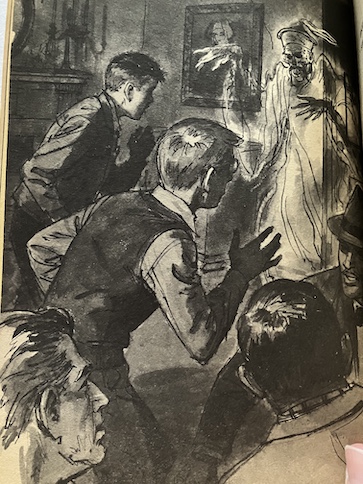
The searchers do notify the police about what they’ve seen in the house, but the police don’t take it too seriously … at first. However, they soon begin receiving other reports from various people around the city who claim to have seen a greenish, ghostly figure. Even then, the police might not have take the reports too seriously, except that a couple of officers on patrol witness a greenish, ghostly figure in the cemetery … at the burial site of Mathias Green, who died falling down the stairs in his house, 50 years before.

While Bob and Pete were at the house, Bob had his tape recorder with him, and he plays the recording of the scream they heard for their friend and fellow investigator, Jupiter. Jupiter is willing to believe it could be the scream of Mathias Green’s ghost, and the boys review the information they know about Mathias Green. Mathias Green was once the skipper of the ship, and he sailed to China. For reasons that nobody fully understands, he had to leave China suddenly, and the rumors were that Mathias’s wife was a Chinese princess and that Chinese nobles had a grudge against Mathias. Mathias brought his wife back to the United States with him, and they built their house in Rocky Beach after Mathias had a fight with his sister-in-law, and they moved away from San Francisco. They had some Chinese servants, but when Mathias was later found dead, apparently from an accidental fall down the stairs, the servants and his wife disappeared. People assumed that they left for fear that they would be blamed for Mathias’s death, and Mathias’s sister-in-law inherited the house. Recently, Mathias’s niece decided to sell the house to a developer, who is planning to tear it down and build more modern houses.

Local newspapers have picked up the stories about the green ghost and its apparent connection to the old Green mansion, and some of them have implied that the ghost is looking for a new place to haunt now that its house is being torn down. The Three Investigators have access to more information than most people because Bob’s father is one of the reporters covering the ghost incidents. The police chief tells them, off the record, that he witnessed the ghost himself, in the cemetery, and it looked like it disappeared by sinking down into Mathias’s grave. Then, the police chief learns that the workmen tearing down the house have discovered a hidden room. Bob’s father and the boys are allowed to come with him to see what the room contains.

The discovery is a shock. The hidden room contains an ornate coffin, holding the skeleton of Mathias’s Chinese bride, dressed in elaborate robes and with an unusual necklace of gray pearls, called ghost pearls. The story is that the reason why Mathias and his bride had to suddenly flee China was that Mathias reportedly stole the pearl necklace to give to his bride. When she died in Rocky Beach, he couldn’t bear to be parted from her, so he “buried” her secretly in his house, along with the necklace.

The discovery of Mathias’s wife’s hidden burial chamber doesn’t lay the ghost to rest, though. Bob and Pete get a phone call from Mathias’s niece, Lydia, asking them to visit her at the vineyard where she lives, to talk about what they witnessed at the house. She says that the ghost has actually appeared at her vineyard! Jupiter is not invited to the vineyard because he didn’t witness the appearance of the ghost with the others, but he couldn’t go anyway because he’s temporarily in charge of his uncle’s salvage yard while his uncle is out of town. He tells Bob and Pete to go ahead and meet with Lydia and let him know what they learn.

At the vineyard, Bob and Pete meet Lydia’s distant cousin, Harold, and Lydia’s great-nephew, Charles, who is actually the great-grandson of Mathias Green and the real heir to Mathias’s estate. Charles, who is called Chang, grew up in China, and they explain that he is descended from Mathias’s first wife, who died of an illness in China. After the death of his first wife, Mathias put his young son into an American missionary school in China and left him there as a boarding student. When he married his second wife and had to flee China, he left his son behind. His descendants remained in China since then, until it became unsafe for Americans or people of American descent in China. Then, Charles, who is an orphan and part Chinese (hence his nickname of Chang), was sent to live with Lydia in the United States. Until that point, he knew very little about his ancestors and his relatives in America. Technically, Mathias’s estate should have come to Chang’s side of the family when Mathias died, but they were living in China at that time and were not in touch with the rest of the family. Lydia says that Chang should even technically own the vineyard that she and Harold have built with the family’s money, but Chang doesn’t want to take it from them, so Lydia says that she is leaving it to Chang in her will. Chang is satisfied with this arrangement, but the family has debts, and if they don’t resolve them, they might lose the vineyard entirely.
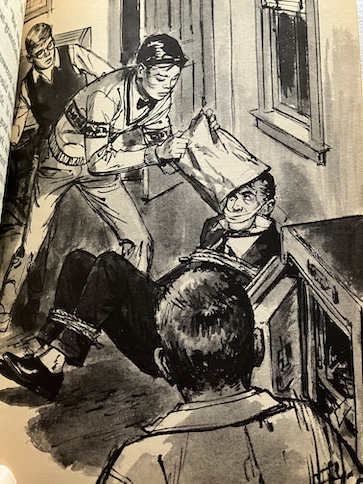
Lydia believes that the green ghost is Mathias’s ghost, and he is haunting them because he’s angry with her for selling his old house to be torn down. The ghost has been scaring away workers at the vineyard, and if they can’t get the harvest processed, they won’t be able to keep the vineyard. However, Chang doesn’t believe that his great-grandfather would want to hurt his own family. Chang might be willing to believe that the ghost is an evil spirit, masquerading as his great-grandfather. That’s not the only possibility, though. There could be a human being with a motive for wanting to ruin the vineyard. Then again, there is the question of who really owns the ghost pearl necklace. If Mathias’s family owns the necklace, they could sell it to cover their debts, but it might really belong to the family of Mathias’s Chinese wife. Her family is more difficult to trace, but one person has stepped forward, claiming to be her heir. Then, someone attacks Harold and steals the necklace from him. Was the necklace always the ghost’s target, from the beginning? Meanwhile, back in Rocky Beach, Jupiter has a revelation. There was a dog present when Bob and Pete were searching the Green mansion with the men, and the dog … didn’t do anything. That might be the most important clue of all!

The book is available to borrow and read for free online through Internet Archive (multiple copies, including some in other languages).

I enjoyed the mystery and the reference to Sherlock Holmes about the dog that did nothing in the nighttime. In this story, Jupiter takes the dog’s non-reaction as a sign that there was no supernatural presence in the house because animals are supposed to react to the presence of ghosts. There is definitely a human behind all the spooky happenings, and I was partly right about who it was. However, the author threw in a complication by inserting another mysterious villain who kind of usurped the original plotter’s plot for his own purposes and partly distracts the characters from the original villain for part of the story.
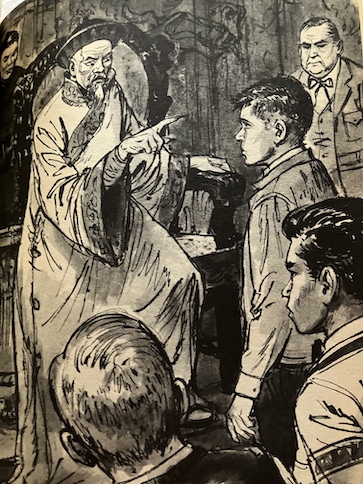
This added villain is a mysterious old man from China who claims that he’s 107 years old and that he wants the pearls because drinking dissolved ghost pearls is the key to immortality. This mysterious old man is wealthy, and he has bought up the family’s debts, meaning that he will get control of the vineyard, if they can’t pay their debts. However, he’s not really interested in the vineyard for its own sake. He just wants those pearls. Although he does some criminal things in the story, nothing much seems to happen to him at the end, and he works out a deal with Lydia, so she can keep the vineyard. It’s left open whether or not he truly ended up with the pearls or whether the pearls actually have properties for preserving someone’s life, but it seems that he truly believes it, and he has no other motivations for his part in the story.

This almost Fu Manchu style character, who uses hypnosis to control people, adds an element of exoticism to the story that I thought wasn’t really necessary. I liked the ghost mystery well enough with its original villain and without him, and I felt like the introduction of the extra villain sent the plot a little off the rails, but he does allow the story to end on a somewhat creepy and ambiguous note. We don’t entirely know who he is, and we never really find out what happens to him. We don’t know if he’s really as old as he says he is or if he continues much further in his quest to live forever. He just disappears after getting what he can of the pearls, presumably to go hunting for more elsewhere.

As far as I’ve been able to determine, the ghost pearls aren’t real, and the legend about them prolonging people’s lives isn’t real. However, there are legends and superstitions from around the world about pearls being associated with wisdom and longevity and having healing powers. Pearls can be dissolved in an acidic liquid and drunk by a human, as in the famous story about Cleopatra drinking a pearl in vinegar, which was supposed to be an aphrodisiac.

Getting back to the mystery, though, I did like the Scooby-Doo-like mystery, and I was satisfied by the original plot, and the villain’s methods and motives. I was looking at that character with suspicion for a number of reasons. Perhaps, if the part about the pearl necklace, the ancient man who drinks pearls, and Mathias’s bizarre room with his dead wife weren’t in the story, the solution would be too obvious, but overall, I enjoyed it. I also appreciated how Jupiter worked out some of the details of the first haunting by visiting the house and studying the scene while his friends were at the vineyard. He comes to some conclusions about how that first haunting occurred that Bob and Pete didn’t think about, and his solution also provides a reasonable answer to the question of why that group of men happened to show up outside the house on the evening the haunting happened, to witness it.

The Case of the Phantom Frog

McGurk Mysteries

Mrs. Kranz, an elderly sculptor, has been looking after her nephew’s 7-year-old son, Bela, because his parents were in a car accident and are still in the hospital. She consults the McGurk Organization because strange things have been happening since Bela came to live with her. At first, she is reluctant to say what is really bothering her. She was referred to the McGurk Organization by Willie’s mother, and she frames her request as hiring the kids to watch Bela while she’s working. McGurk turns down the offer, saying that the oldest members of the McGurk Organization are only 10 years old, not really old enough to babysit, and babysitting isn’t the kind of job they handle anyway. Wanda tries to refer Mrs. Kranz to a regular babysitter she knows, but Mrs. Kranz is strangely desperate and insists that she wants the McGurk Organization.

Because they’re reluctant to accept the job, Mrs. Kranz finally admits that there is a mystery connected to Bela. She starts by telling them that she’s afraid of frogs, like some people are really afraid of bugs or rats or other creatures. Ever since Bela came to stay with her, Mrs. Kranz has been hearing an unusually loud frog sound in her house, particularly in the evening, after Bela is in bed. Bela insists that he never hears it, but it’s giving Mrs. Kranz the creeps. She’s tried to search the house as best she can, but she can’t find the frog anywhere. It’s not the kind of thing that she can go to the police about, but it’s driving her crazy. The real reason why she wants the McGurk Organization to spend time with Bela is to see if they hear the frog, too, and if they can figure out where it is.

This time, McGurk is intrigued enough to accept the case, plus Mrs. Kranz offers them a larger fee for their services than they usually have. They consider the idea that Mrs. Kranz could be making up the story about the phantom frog she hears just to get them to accept her babysitting job, but they decide that isn’t likely, both because of the generous amount of money she’s paying them and because she seems genuinely frightened.

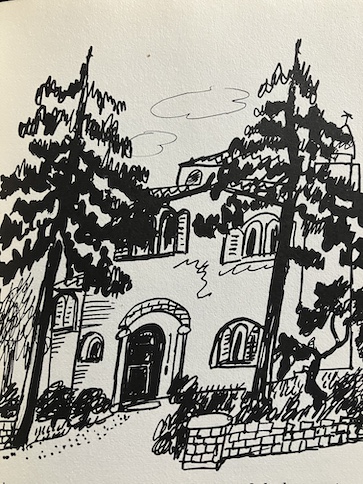
When they get to Mrs. Kranz’s house, it’s a big place that looks almost castle-like, and it’s surrounded by trees. Mrs. Kranz invites them in and introduces them to Bela. Bela was born in Hungary, where Mrs. Kranz was from originally. He doesn’t seem glad to meet the members of the McGurk Organization. In fact, he tries to ignore them and talk to them as little as he can. He doesn’t really want to talk to them about the frog when they ask him about it. He just says that maybe he’s heard a frog and that his aunt has frogs on the brain.

McGurk is annoyed with the kid, so he teases him about his name, saying that Bela sounds like a girl’s name. Bela defends his name, saying it’s Hungarian. Joey tries to defuse the situation, saying that Bela Lugosi was a famous actor in old horror movies, and he was also Hungarian. McGurk is intrigued by the mention of old horror movies because he loves them, and he starts asking Bela about whether there are things like vampires and werewolves in Hungary. Bela says that monsters are just stupid kid things. Brains is inclined to agree with Bela because there’s no scientific evidence that such things exist, and McGurk gets irritated with both of them.

When McGurk consults with the other members of the organization about Bela, he says that he thinks Bela is hiding something. His theory is that Bela is making the frog sounds himself to scare his aunt as a prank and that his hostility toward their presence and their questions is to cover up for what he’s doing. Wanda takes a different view because she thought that Bela seemed scared of something when they were talking to him, and she thinks that Bela is covering up his fear. Maybe he’s afraid of the frog or the frog sound and doesn’t want to admit it. Brains thinks that the sound could have some ordinary explanation, like sounds from the plumbing system that have been misidentified.

Aside from his hostility toward their questions, Bela seems like a well-behaved kid to watch. When it’s time for bed, he doesn’t argue with the older kids or make a lot of special requests or excuses to stay up later. In fact, he seems eager to go to bed. His only requests are that they leave the lights on and the window slightly open for air. As soon as Bela is in bed, the members of the McGurk Organization station themselves at strategic points around the house, waiting to see what they can hear and where it seems to be coming from.

They do hear the frog, and it sounds unnaturally loud, like it’s a monster frog! Most of them aren’t sure where the sound came from, but Brains is pretty sure that it came from Bela’s room. When they go inside, Bela seems like he’s asleep, and they don’t see a frog anywhere. They’re convinced that Bela is faking that he’s asleep, although Bela puts on an act like he was really asleep. McGurk knows that he must have been awake while they were out of the room because they left the light on for him, and when they first entered the room, the light was off. At some point, Bela must have gotten up and turned it off himself, although they don’t know why he would do that. For some reason, he also shut his window.
It seems pretty clear that Bela has something to do with the frog noise. The next night, they rig up a microphone in Bela’s room so they can monitor the sounds there. When they hear a loud frog sound, they hurry up to Bela’s room and find a frog sitting on his pillow .. and there is no sign of Bela! McGurk stuns the others when he makes the announcement that Bela is a werefrog! McGurk thinks that Bela has the transformation powers of a werewolf, but he’s turning into a frog instead of a wolf. They go to the kitchen, where McGurk finds some garlic, and when they return to Bela’s room, the frog is gone, and Bela is back in bed. Is Bela really a werefrog, or is there another explanation for what’s happening?

The book is available to borrow and read for free online through Internet Archive.

I remember reading this book when I was a kid, and I did a book report on it for school. I even did a little diorama about the story that looked like Bela’s bedroom, with a little frog made out of modeling clay. It was cute, but I can’t show it because I don’t have it anymore.

I found the story pleasantly creepy when I first read it as a kid. Even though I was sure that there must be some logical explanation for the phantom frog and Bela’s apparent transformations, I honestly wasn’t sure what it was at first. The mystery isn’t that complicated for an adult, but it’s creepy and mysterious for a child.

It sometimes seems to me that kids in the McGurk books are a little mean to each other and call each other names too much. I didn’t like it that McGurk was teasing Bela about his name in this book. However, it does serve a purpose in this story because the discussion of Bela’s name is what introduces the mention of Bela Lugosi and the idea that there might be a supernatural explanation for the phantom frog and that Bela might be a werefrog. Mrs. Kranz doesn’t suggest that idea to the kids when she first consults them about the frog. McGurk is the one who thinks of it because he’s really into old horror movies, and Bela being Hungarian, like Bela Lugosi, suggests a connection to the supernatural to him.

Not all the others are really as convinced as McGurk is, but they are creeped out by the phantom frog that appears and disappears and Bela’s odd behavior. Brains is the least convinced of everyone that there’s a supernatural explanation for the frog, reminding everyone that he invented an “invisible dog” in a previous book. He knows that it’s possible to create some pretty convincing illusions. He’s the one who convinces McGurk to investigate the possibility that Bela is faking everything somehow.

I like to take note of times when characters in books reference pieces of pop culture from the time when they were written. At one point, the kids in the story are watching a Peanuts special on tv, based on the characters from the comic strip. That comic strip was still being written and published at the time this book was written, and I remember watching Peanuts specials on tv myself as a little kid in the 1980s.

The Case of the Invisible Dog

McGurk Mysteries

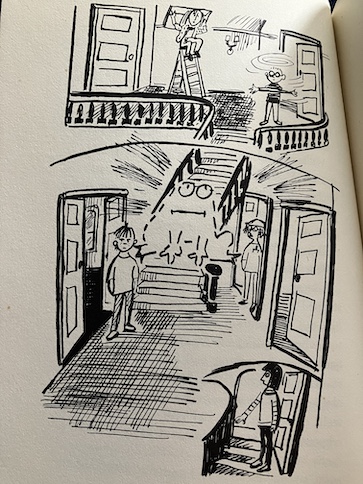
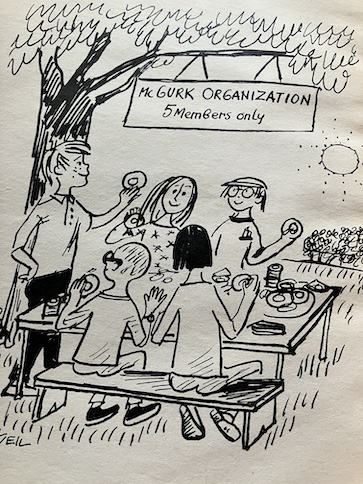
The members of the McGurk Organization are having their annual picnic in McGurk’s backyard when, suddenly, a doughnut leaps off the table and begins traveling through the bushes and grass. None of them can understand what’s happening because they can’t see anything that would cause the doughnut to move like that.

They go after the doughnut to see what happened, and they find Brains Bellingham, the nephew of Miss Bellingham, who lives next door. Brains has been staying with his aunt while his parents are out of town, and he always has a put-down for the members of the McGurk Organization. Brains is holding his aunt’s Yorkshire terrier, Dennis, and the missing doughnut, which has apparently been chewed by the dog. Brains apologizes for the dog ruining their “crummy” picnic, but he says that Dennis can’t resist doughnuts. However, that explanation doesn’t satisfy the McGurk Organization because none of them saw a dog carrying the doughnut, just the doughnut moving by itself. Brains makes an excuse about the dog being small and blending in with his surroundings, but the others can tell that he’s hiding something.

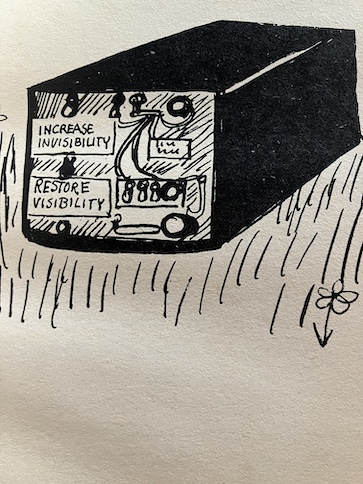
When Brains leaves for a moment because he says his aunt is calling him, they spot a strange black box in the grass. The box has dials and switches on it, and there are two labels: “Increase Invisibility” and “Restore Visibility.” Brains is known for building various inventions, so they know this is probably something he made, but does this device really make things invisible? Is that why they couldn’t see the dog when he stole the doughnut? They have a look inside the device, but since none of them is particularly good with electronics, they just know that it contains a bunch of wires and seems to be powered by batteries, and there is some kind of light inside the box. There are also doughnut crumbs inside the box.

When Brains sees them messing with the box, he yells at them to stop snooping. Joey, the organization’s secretary, knows that part of Brains’s problem with the organization is that he’s jealous because he really wants to join. He’s hinted before that they need a laboratory man to help them with forensics. McGurk might have taken him up on the offer except that Brains was condescending and insulting in the way he made it, calling them “dummies.” He’s a little younger than the rest of them, too, so his condescending attitude makes him seem even more like an annoying little kid. McGurk tries to ask Brains about his strange device, but Brains just refuses to answer and takes the box and the dog away.

The members of the McGurk Organization return to their picnic, but they can’t stop wondering about Brains, his strange invisibility device, and how he accomplished the trick with the dog and the doughnut. Most of the organization members are pretty sure that there must be some kind of trick to it, but they can’t figure out how Brains did it. While they discuss it in their basement meeting room, they hear what sounds like the jingle of dog tags, and Willie, who has a very sensitive nose, says that he smells a dog. They search the basement and find a dog’s rubber bone. Then, Brains shows up, looking for Dennis. To their astonishment, Brains seems to pick up an invisible dog, who seems to be struggling and making dog noises, growling and jingling tags!

When the organization goes to confront Brains about what just happened, they find him with his strange box. The box appears empty on the inside, but they hear dog sounds from it. Brains operates the controls and opens the box again, and Dennis comes out! Brains claims that he invented the invisibility box by accident while he was trying to develop a treatment for getting rid of Dennis’s fleas and ticks using light rays. Brains says that there is a side effect where Dennis sometimes turns invisible at random times without Brains intentionally turning him invisible but that he’s working on the problem.

McGurk is thrilled at the possibility that Brains might be able to build a machine big enough to turn a person invisible, and he even offers Brains membership in the organization if he can do it. Brains says he could, but to everyone’s surprise, he turns down the membership offer. He says that he knows they don’t really want him in the organization; they just want his machine. It’s a little embarrassing, but it’s true.

The members of the McGurk organization consider ways that they could get Brains to change his mind. McGurk considers blackmail, but Wanda says that wouldn’t be right for a detective organization. Wanda thinks McGurk should apologize to Brains for the way he turned Brains away when he tried to join earlier, but McGurk can’t stand the idea of apologizing. Willie thinks they could offer to pay Brains, but they don’t really have anything they could pay him. They all ponder what would happen if they let word of Brains’s invention get out to the public or even the government.

Then, Brains comes to them, asking for help. He says that Dennis has turned invisible again, and he’s run off! Can the McGurk Organization find an invisible missing dog?

The book is available to borrow and read for free online through Internet Archive (multiple copies).

I didn’t read this book when I was a kid, although I read many others in the series. Because I didn’t read this book before, I didn’t really know the story of how Brains joined the McGurk Organization. There are some references to it in some of the later books in the series, so I knew that, when the other members of the organization first met Brains, they were investigating him for some trick he’d played on them. I was used to Brains being their friend, so it seemed odd to see him as the antagonist/suspect they are investigating in this book.

During the story, the members of the McGurk Organization are pretty sure from the beginning that Brains is playing some kind of trick, but they’re not sure how. He does manage to convince them temporarily that he has successfully developed an invisibility device, but McGurk soon realizes that something Brains has said contradicts what’s happened. Then, he and the others reexamine what happened to figure out how Brains staged his tricks. They’re a little mad at being tricked, so they pull one more trick on Brains to get even before they all forgive each other. Brains shouldn’t have called the others “dummies” or been condescending to them, and the others shouldn’t have been too quick to write him off just because he’s a year younger than they are. In the end, McGurk says that anybody who’s clever enough to work out a complicated trick like this one deserves to be a member of the organization, and they hold another picnic to celebrate their new member.

The Case of the Tricky Trickster

The Bobbsey Twins

Before I begin, I’d like to acknowledge Sean Hagins, for supplying me with photos of this book! Usually, I take pictures of books myself, but I just couldn’t find a physical copy of this one. Sean is a big fan of the Bobbsey Twins, particularly the New Bobbsey Twins mysteries, and you can see some of his video reviews as well as videos about his photography work on his YouTube channel, SJHFoto. Thanks, Sean!

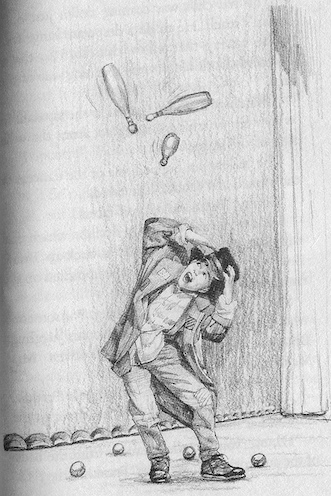
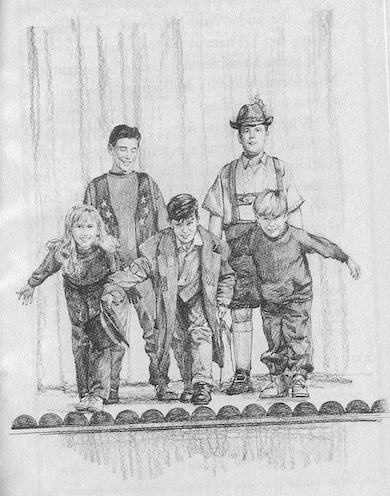
The PTAs at the schools the Bobbsey Twins attend, elementary and middle school, are holding a variety show to raise money, with students showing off their talents. A boy in Freddie and Flossie’s class, Brian, is going to put on a juggling act, but Freddie and Flossie are going to help another friend, Teddy, with his magic act. Nan and Bert have a rock band with some friends called the Aliens, and they’re going to be performing, too. Danny Rugg, the school bully, even has an act where he’s going to play the accordion.

However, things soon start going wrong with the show. During the rehearsal, someone turns on the Aliens’ amplifier, making a loud sound that startles everyone. Then, a pole falls and almost hits a student while she’s singing. Then, Brian slips on some floor wax. Freddie and Flossie suspect Danny of playing pranks on everyone because he was near the places where the pranks occurred, and it seems like the kind of thing he might do, but there are other suspects.

Some of the other students seem nervous about performing their acts or think that the show won’t really be that good. Could someone be trying to sabotage the show to get out of performing? Then again, there seems to be some kind of rivalry between the music teacher who is directing the show and Mr. Horton, the fifth grade teacher. Mr. Horton seems resentful that he wasn’t given the chance to direct the show, and he keeps trying to prove that the music teacher is doing things wrong and that he could do them better. Just how far would he go to prove that he would be the better director?

The book is available to borrow and read for free online through Internet Archive.

I thought that the mystery was good, although I also thought that the culprit was obvious about halfway through the story. It might take kids longer to figure out who it is, but there is one person who gets more than their share of the sabotage, and some of the tricks are ones that a person could only play on themselves. There is a student who is trying to get out of having to perform, but once the Bobbsey Twins figure out why, they manage to work things out so that the student is able to go ahead with their act.

The story reminded me a little of The Tap Dance Mystery in the Eagle-Eye Ernie series, although the mysteries aren’t the same. What reminds me of the other book is that both stories involve family expectations. Performing in front of classmates is enough to make anyone nervous, but having family with high expectations present puts a great deal of pressure on a child performer. There is a bit more than that because there are reasons why the student doesn’t think they can live up to everyone’s expectations, but fortunately, a little help from a friend can go a long way!

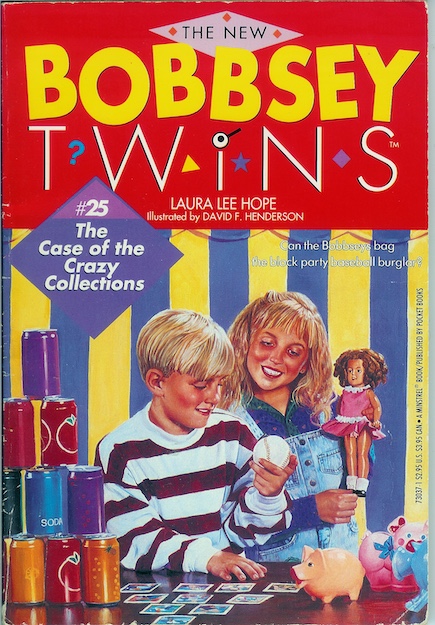
The Case of the Crazy Collections

The Bobbsey Twins

Before I begin, I’d like to acknowledge Sean Hagins, for supplying me with photos of this book! Usually, I take pictures of books myself, but I just couldn’t find a physical copy of this one. Sean is a big fan of the Bobbsey Twins, particularly the New Bobbsey Twins mysteries, and you can see some of his video reviews as well as videos about his photography work on his YouTube channel, SJHFoto. Thanks, Sean!

The Bobbsey twins’ neighborhood is having their annual block party, and the Bobbsey twins and their parents are helping to set up for it. As part of the party, the neighborhood has rented a tent, where kids from the neighborhood are displaying their collections. The neighborhood kids collect all kinds of things, like baseball cards, comic books, soda cans, autographs, and coins. One boy, Kevin, has an autographed baseball that his grandfather gave to him. The neighbors are charging people money to see the exhibit of collections, and the money will be used for a pizza party later.

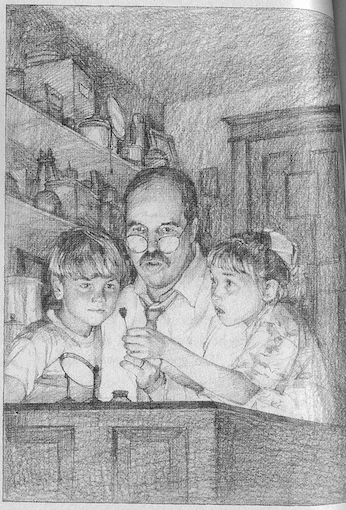
Later, Kevin’s autographed baseball disappears. Could the baseball thief be Mr. Sher, a visitor staying with their neighbor, Mr. Andersen? Mr. Sher tried to buy the baseball from Kevin earlier, but Kevin turned him down. Then again, Kevin’s cousin, Steve, was jealous that Kevin has the baseball. Steve turned down the offer of some of his grandfather’s old collectible items in favor of a savings bond, which he has already cashed in and spend on video games. Steve tried to borrow more money from Kevin earlier, but Kevin turned him down because Steve hasn’t yet repaid him for money Kevin loaned to him before. Danny, the neighborhood bully, was also mad at Kevin earlier. He’s a friend of Steve’s and didn’t want to have to pay to see the collections. Then again, another local girl, Jennifer, collects autographs, and they see her at a collectors’ shop. Would she know the value of an autographed baseball, and was she trying to sell it? With so many people coming and going from the tent where the collections were on display, it’s hard to say who might have taken something. The thief may have even been the Bobbseys’ own dog, Chief, who has developed a habit of collecting and hoarding baseballs.

Then, another boy realizes that his prized hologram sticker is missing. Could the thief have taken that, too? Their clues are an unexplained slit in the back of the tent, some footprints, and a pin with Greek letters on it. Can the Bobbsey Twins find the valuable baseball and return it to Kevin?

The book is available to borrow and read for free online through Internet Archive.

Something I thought was interesting about this story was that it brings up the concept of collecting things for fun or sentimental value vs. collecting things because of their monetary value. Most of the kids in the neighborhood collect things just for fun. At first, Kevin doesn’t seem to fully realize the value of the autographed baseball. His attachment to the baseball is because he got it from his grandfather. When he had the offer to sell it to Mr. Sher, he refused because the baseball reminds him of his grandfather.

I had a strong suspicion about the identity of the baseball thief early in the story, and my guess turned out to be right, but I liked it that there were plenty of other suspects to consider. There are child suspects, adult suspects, and even the Bobbseys’ own dog. Any of these could be plausible. When they realize that the hologram sticker is missing, it raises the question of whether the person who took the baseball also took the sticker, if the sticker was taken by someone else, or if the missing sticker is just a red herring. Overall, I enjoyed the mystery, and I liked the abundance of suspects.

A One-Room School

Historic Communities

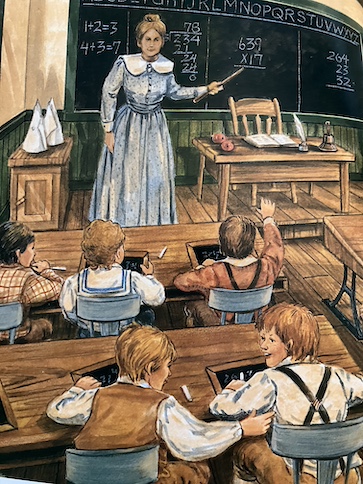
The book begins by saying that there was a time when not all communities had schools at all. In areas where the population was low, children had lessons at home or from a neighbor, if they had lessons at all. Towns and villages needed enough children living there to support even a small school. (The book doesn’t describe exactly when or where they’re talking about, but it’s implied that this is the United States or the American frontier.) When there were enough settlers in an area for a school, they might make a small log cabin for the school. As populations grew and there were more students, they would build better schools.

Requirements for teachers were different back then than they were today. Most teachers were men because married women were not allowed to be teachers. Only single women could teach. Teachers were also often required to handle rough students as well as teach them, and all ages and grades of students would study together in one-room schools. The teacher would manage the different grade levels by having them dividing them into groups based on their levels and having the different groups take turns reading aloud to her while other students did quiet work, like practicing writing. The teacher would set some students quiet tasks to do while focusing on a different group, and then, they would switch. Teachers were also responsible for the cleaning and maintenance of their school, but they typically assigned students chores to help with that. Local families would provide room and board for the teacher of their community, and they would also contribute toward the teacher’s salary.

Lessons were basic and focused mostly on the “three Rs” – reading, writing, and arithmetic. (Those three subjects contain the letter ‘R’ near the beginning, even if they don’t all start with that letter.) There was often little time to teach anything else, and these were the subjects that were most important to people with the most common jobs, such as farmer, craftsperson, or storekeeper. In schools that taught a wider range of subjects, students would also learn history (mainly focused on the United States), world geography, and grammar.

Small schools often had few books or supplies. Because paper was often in short supply, children would memorize lessons and verbally recite them back to the teacher and would practice writing on slates (small blackboards). When students were able to buy paper, they bought a blank notebook they called a copybook. The paper in the copybook wasn’t lined, so if they wanted lined paper, they had to draw the lines themselves, using a ruler.

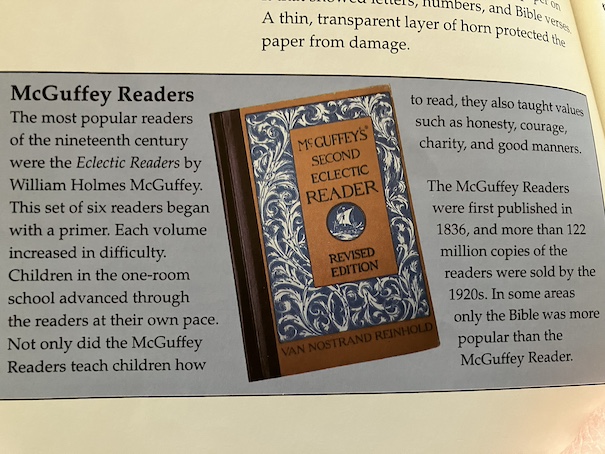
A small school might also only have two books for the students to study: a primer for beginning readers (which showed the alphabet, numbers, and some basic spelling words and poems) and a copy of the Bible. The most popular series of books for building reading skills in the 19th century was McGuffey’s Eclectic Readers. The series started with a primer and continued with six readers, each one at a higher reading level than the last one to build more advanced reading skills. In the small, one-room schools, students would work through these books at their own pace. (Since all ages and grade levels were together in one room, there was little concern about each student moving to the next grade at the exact same time as their peers since they were all still going to be in the same room with the same teacher anyway. As long as a student was continuing to come to school and make progress, it didn’t really matter how fast or slow the progress was.)

The book describes the daily routines of students at small, one-room schools, including how they would get to school each day and what they would do at lunchtime and recess. Most children simply walked to school, although they often had to walk long distances to get there. Sometimes, they might ride a horse to school or get a ride from an adult in a wagon or sleigh, if it was winter. Children brought their lunches from home, but some schools also maintained a school garden. Most of the children from these small schools would grow up to be farmers, so gardening was a valuable skill for them to practice, and the students would also eat what they grew in the school’s garden. During the winter, they could make a soup with vegetables they grew on the stove in the schoolhouse (which also kept the schoolhouse warm) that everyone would eat for lunch. The schoolhouse stove could also be used to heat up foods that the children brought from home. Besides their lunch break, the students would also have two short recess breaks during the day. During recess, they could walk around outside, talk to their friends, play games, or play with toys they brought from home, like marbles. Toys were often homemade or easily improvised, such as using string to play Cat’s Cradle.

Sometimes, students would play pranks on their teacher or fellow students, such as hiding bugs and spiders to scare someone, pouring water on their seat if they got up, or covering the schoolhouse chimney to fill the school with smoke and smoke everyone out of the school. The last prank was dangerous.

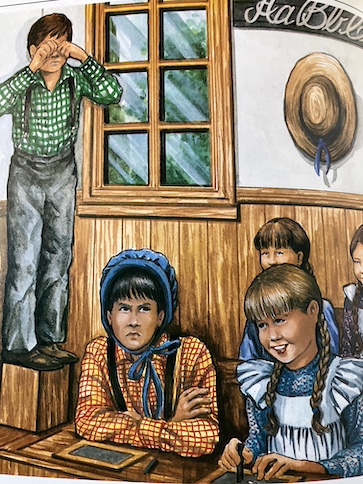
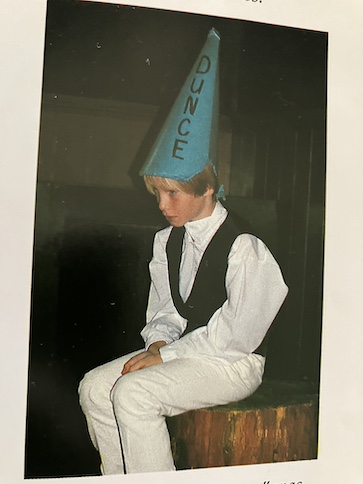
Punishments for pranks and misdeeds, such as being late or falling asleep in class, were at the teacher’s discretion. They could take whatever form the teacher thought was appropriate for the situation, and they could be as harsh and strict as the teacher thought was necessary. Sometimes, they could be a form of poetic justice, designed to fit the crime. We aren’t told why one misbehaving boy was told to put on a girl’s bonnet and sit with the girls in class, although it might have been a fitting punishment if his misdeed was teasing the girls. (That was just a guess of mine, that the teacher might have decided that, if he wanted to tease girls, he should try sitting in their place for awhile.) Some punishments were meant to teach lessons and reinforce the idea that children should not repeat certain behaviors, such as having the children repeatedly write lines, sentences that spelled out what they were supposed to do or not do. (For example, a student who was late to school could be assigned to write, “I will not be late to school” or “I will be on time to school from now on” a certain number of times.) Other punishments were purely for humiliation, like having a student wear a cap that labeled them as a “dunce”, in the hopes that the embarrassment would keep them from misbehaving again. (This could also be the goal of making a boy wear a bonnet and sit with the girls.) Punishments could even include physical punishments. Teachers were allowed to whip their students, if they though it was necessary, and some teachers even punished children who were physically fighting by making them take turns whipping or hitting each other with a stick. The book doesn’t explain the motive for doing this, but I think that they were probably emphasizing the idea that people who fight get hurt and that getting hurt is unpleasant to discourage them from fighting more in the future. I also suspect that the point of making them take turns hitting each other was to make it equal, so it wasn’t just one person beating up on the other, but that’s just a guess. When the students got home, and their parents found out about what they had done at school that day, they might even get a second punishment, on top of whatever punishment the teacher assigned them!

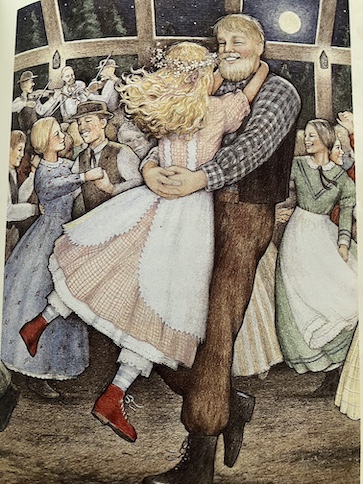
Sometimes, schools had special events for holidays or academic events that involved members of the wider community. For example, schools sometimes had spelling bees, including some where adult members of the community would watch or participate. Schools often had Christmas pageants, where children would sing songs or recite poems they had memorized or perform a play written by the students themselves. At the end of the school year, students would have oral exams in front of their parents and other community members, followed by a picnic with games.

The book ends with a section of games and activity suggestions designed to show modern kids what it might be like to be a student in an old-fashioned one-room school and compare their own schools to old-fashioned schools.

The book is available to borrow and read for free online through Internet Archive.

Books in the Historical Communities series focus mostly on the 1800s in the United States, but they don’t always mention exactly what time period they are describing. It’s often more implied than stated, and that’s true of this book, too. The book mentions the 19th century once or twice, but it doesn’t mention any specific date or date range.

The pictures in the book are a combination of drawings and photographs of real people in historical costumes, reenacting scenes at schoolhouses and the lives of the students. I liked the combination of real people and drawings to illustrate different concepts about life and education in old-fashioned, one-room schools.

There are some concepts of education in a one-room school that fit with the educational concepts of the modern Montessori system, such as having students of different levels being taught together and having students progress at their own rate in different subjects. In a way, I think that the Montessori system hearkins back to this one-room school style of education, and that’s examined in more detail in the classic children’s book Understood Betsy, which is by Dorothy Canfield Fisher, who was an early advocate of the Montessori method of education in the United States.

Kirsten Saves the Day

Kirsten, An American Girl

It’s summer, and for a frontier family, the summer chores can be the most fun! Kirsten and her younger brother, Peter, are going fishing. They’re hoping to get enough fish for their family and their Uncle Olav’s family to have for supper. There is plenty of trout in the stream, and they should be able to get enough fish, although sometimes, disasters happen on their fishing trips. Once, Peter chased a skunk, and their mother also warns them to be careful of snakes and bears. Kirsten wears a whistle around her neck that she can blow if they get into trouble. Kirsten thinks her mother worries too much.

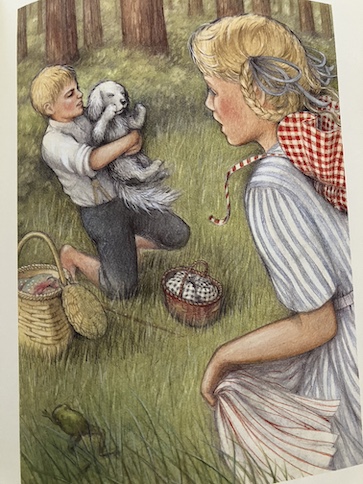
The children take their dog, Caro, fishing with them. Kirsten is a little concerned because Caro likes to chase things, but Peter insists that he can watch the dog and fish at the same time. When they don’t seem to have much luck getting big enough fish in the stream, they decide to go upstream to the pool. The fishing goes well, but Caro is stung by a bee.

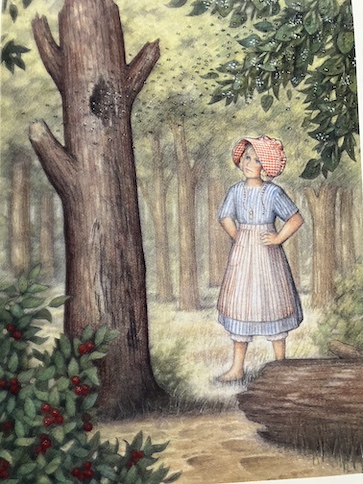
Kirsten realizes that Caro must have found a “bee tree”, a tree where bees have built their hive. Kirsten is interested in finding the tree because it’s a source of honey and honeycomb that their mother can make into special treats. If they can collect enough honey, their father might even be able to sell some and buy some of the things the family needs. They need to be careful while looking for the tree, though, or they might get stung themselves. Kirsten is pleased when she finds the tree, but she notices that there are marks on it from a bear’s claws, so it looks like a bear was trying to get the honey, too. Kirsten could ask her father how to get the honey and get him to help, but she wants to figure out how to do it herself and surprise everyone. She asks Peter to keep the bee tree a secret while she tries to figure out how to get the honey, and Peter reluctantly agrees.

Meanwhile, Kirsten’s cousins tell her about the town’s Fourth of July celebration. Kirsten’s family hasn’t lived in America for very long, so her cousins have to explain the significance of the holiday to her. Every year, the nearby town holds a parade and picnic with music and games. A lot of the local farmers also bring things to sell, like pies, butter, or preserves, and they use the money they make to buy things they need. Kirsten thinks again about the honey tree and the things her family could buy. She really wants a straw hat, like her cousins wear.

Later, when Kirsten is picking berries with her cousins, she sees a little black bear cub. She thinks it’s adorable, but Lisbeth says they have to leave the area immediately. If the baby is near the berries, its mother is sure to be somewhere nearby, and mother bears get dangerous if they think someone might hurt their cubs. Kirsten doesn’t really take the warning seriously until she tries to take Peter and Caro back to the bee tree with her to get the honey, and they meet the mother bear face-to-face!

The book ends with a section of historical information about the wilderness on the American frontier in the 1800s. Wild plants and animals were sources of food, but they were also sources of danger, like the bears in the story. The attempts of the pioneers to control the land were about securing sources of food and reducing sources of danger. There is information in the book about how pioneers cooked and how they dealt with changing seasons and weather. It also discusses the Fourth of July and how trips to town were rare treats for pioneer farming families.

The book is available to borrow and read for free online through Internet Archive (multiple copies).

It’s a good story about the difference between bravery and being foolhardy. From the beginning, even young Peter reminds Kirsten that being brave and being foolish are not the same thing. After their hair-raising encounter with the bear, in which the children have a narrow escape and their dog is injured (but fortunately not killed), the children’s father lectures Kirsten about putting both her life and her little brother’s life in danger. When Kirsten explains what she was trying to do with the bee tree, her father also tells her that she doesn’t really know what she’s doing. She took his equipment, but if she had carried out her plan the way she was thinking of doing it, she would have both destroyed the hive and ruined the honey as well as getting badly stung. Kirsten should have just gone to her father as soon as she found the tree and got his help from the beginning. Kirsten is ashamed for getting their dog hurt and putting herself and her brother in danger and almost ruining her special find, and she apologizes.

Because Kirsten’s father now understands the situation, he gets Kirsten’s older brother, Lars, to help him move the colony of bees to their farm. He knows how to set up hives and keep bees long term, so instead of this being just a one-time find and honey harvest, they will be able to get honey from the bees regularly. Kirsten goes with her father and Lars to watch them move the bees. She does it because she’s been having bad dreams about the traumatic escape from the bear, and she thinks it will help her to recover if she goes to the area again and sees it with her father and brother, when it’s safe.

Kirsten still feels bad that she wasn’t able to get the honey all by herself and that her attempt to do it was a disaster, but her mother consoles her. She says that she and Kirsten’s father understand that Kirsten was just trying to help and that her discovery has helped them. She just needs to learn to be careful as well as being brave. I thought that it was also a lesson in learning to share the glory instead of trying to take all the credit by going it alone and risking the success of the project, but the book didn’t quite say that. Kirsten wanted to be the one to say that she did it all herself, but because she couldn’t really do it all herself, everything went wrong. She could have accomplished her goals by talking to her father in the beginning and still been the heroine who found the bee tree, as her mother pointed out. She still gets credit for what she did without needing to take credit for what she couldn’t do alone.

The book ends with the family enjoying the Fourth of July celebration. Thanks to the discovery of the bees, they are able to buy the things they need.

Happy Birthday, Kirsten

Kirsten, An American Girl

It’s spring, and Kirsten’s family is planning to build a new barn on the farm that they share with Uncle Olav and his family, and her mother is expecting a new baby.

One day, while they are outside, working, dark clouds come, the wind picks up, and Aunt Inger thinks it might be a tornado. She urges everyone to get into the root cellar for safety. Miss Winston, the school teacher who is staying with Uncle Olav and Aunt Inger, joins them in the cellar. She brings her quilt with her for comfort and because it reminds her of home, so she wouldn’t want to lose it to a tornado.

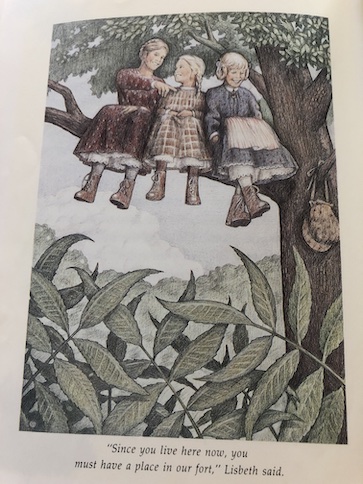
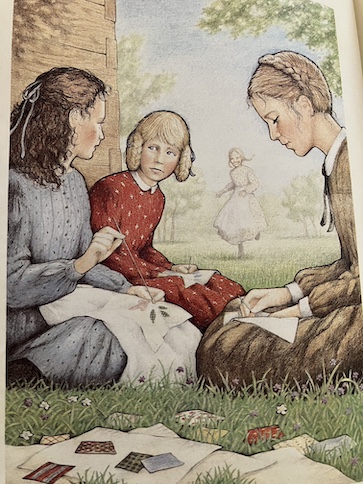
She tells Kirsten and her cousins that her mother and other women and girls in her family made the quilt for her as a present when she left Maine. The scraps of cloth in the quilt came from clothes members of her family used to wear and things she used to wear when she was younger. Everyone who worked on the quilt signed it, making it a “friendship quilt.” Kirsten and her cousins ask Miss Winston if she could teach them to make a quilt like this one, and she agrees. She says that she will give them some muslin for the backing, but they’ll have to supply the scraps of cloth for the designs themselves. Because it takes a lot of work to make a big quilt, she suggests that they each make a square. Quilts are an unusual concept to the Swedish family because people in Sweden during their time usually use woven blankets. Kirsten’s mother also reminds her that she will need her help to sew more clothes for the new baby. Kirsten’s cousins, Anna and Lisbeth, suggest that they do their quilt sewing during recess at school, and Miss Winston agrees.

At school, the girls trade cloth scraps with each other and invite other girls to join them in quilting. One of the other girls, Mary Stewart, has done quilting before, so she helps the others. While the girls sew, they talk, and Kirsten talks about the baby that her mother is expecting. Mary says that the little girl her family calls her little sister is actually her cousin. She was born as one of a set of twins to Mary’s aunt, but the other twin died at birth, and their mother died shortly after, so Mary’s mother took the baby to raise with her family. Stories like that worry Kirsten because she worries that something might happen to her mother or the new baby.

Mary also brings up the topic of whether or not Miss Winston will move on. She’s been going to Powderkeg School for four years, and every year, the previous teacher moves on, and they get a new one. Although Kirsten initially had trouble with Miss Winston, she has become fond of her, and she wouldn’t like to see her go. With all the other changes happening in Kirsten’s life, she doesn’t want any other major changes now. Kirsten suggests to the other girls that they turn their quilting project into another friendship quilt for Miss Winston, signing it like her family members signed their quilt. The other girls debate about whether they could manage to finish a quilt like that by the end of the summer term. Lisbeth thinks they could, but Mary doesn’t want to rush the project because the best part of making a quilt is sewing it with your friends.

The talk then turns to Kirsten’s birthday. She will be turning ten years old soon. She didn’t celebrate her last birthday because that was during their voyage to America. Mary says that ten is a more important birthday anyway, although Kirsten isn’t sure if her family will do anything for her birthday this year, either. Everyone’s attention is taken up with preparations for the new baby.

When Kirsten’s mother tells her that the new baby is about to be born, she also tells her that she remembers the day Kirsten was born, too. She says that she will never forget that day because she had been hoping for a daughter, and she knows that Kirsten’s birthday is coming in two more weeks. Kirsten is happy that her mother remembers, and she hurries to get her aunt to help with the birth of the baby.

Fortunately, Kirsten’s new sister is born safely, although Kirsten has to take some time away from school to help her mother with the new baby and household chores. However, her mother tells her that her friends from school will be coming to the raising of the new barn, which is the day before Kirsten’s birthday, and she will allow Kirsten to have her birthday free to have fun with her friends.

At the barn raising, Kirsten and her friends have a chance to work on their quilt again. Kirsten is behind on making her quilt square, but her friends have arranged a special surprise for Kirsten’s birthday.

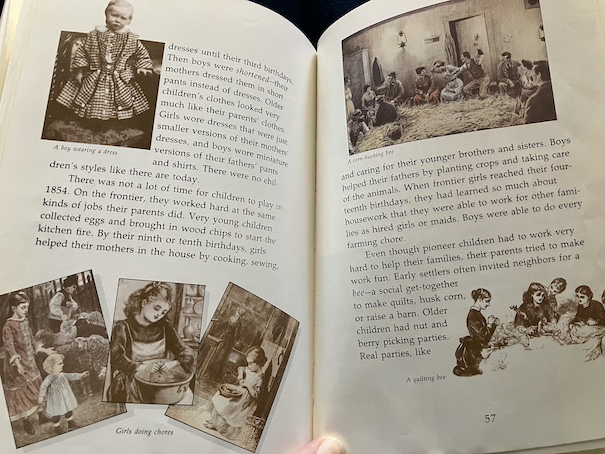
There is a section in the back of the book about babies and young children on the frontier during the mid-1800s. Children were born at home then, with the help of family members and midwives because there were few doctors and hospitals on the frontier. With limited access to medicine and without some of the modern medicines we have today, childbirth and early childhood were often risky. It was sadly common for families to lose a child or two before they were five years old. Because accidents as well as illness posed a threat to young children, parents were often strict with discipline so their children would listen to them and follow their instructions to avoid disaster.

This part of the book also talks about the phases of a child’s life on the frontier. Older children wore clothes that looked like smaller versions of their parents clothes, and they would often do the same kinds of chores that their parents did on their farms. Most children expected to become farmers or farm wives, like their parents. They were raised doing farm work, and they didn’t expect to do anything else when they were older.

Although their lives were filled with chores, there were still some opportunities for fun. Sometimes, neighbors would turn chores into social occasions, called “bees.” These work parties could center around any kind of chore that the community needed to do and could do together, like raising a barn or making quilts, like the characters in the story. Along with accomplishing their task, it was a chance for friends and neighbors to get together and talk and have a little fun.

The book is available to borrow and read for free online through Internet Archive (multiple copies).

I don’t think I read this particular book in the Kirsten series when I was young. I wasn’t as fond of the Kirsten books as I was other series in the American Girls franchise because there are some really sad parts in the series. However, I really enjoyed this particular book. Kirsten is worried at first about the welfare of her mother and her family’s new baby because she knows that life on the frontier can be dangerous, and sometimes mothers die in childbirth, and babies don’t always survive. Fortunately, everything turns out well for Kirsten’s mother and new little sister.

This is a happy spring story with a focus on new life and friendship. Even the smallest kitten in the new litter seems like it’s going to be fine. I liked it because, while life on the frontier could be very hard, it’s nice to see that not everything turned out as a tragedy. The book ends with the barn raising and birthday celebration for Kirsten.

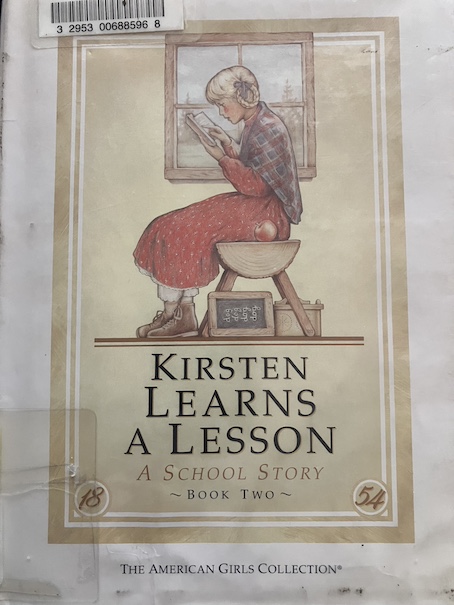
Kirsten Learns a Lesson

Kirsten, An American Girl

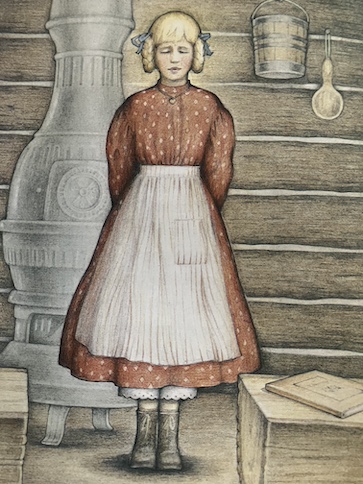
It’s November, 1854, and now that nine-year-old Kirsten’s family has settled in their new home in Minnesota and the harvest season is over, it’s time for the children to go to school. Kirsten and her brothers, Lars and Peter, will go to the small local school with their cousins, Lisbeth and Anna. Powderkeg School is a one-room schoolhouse in a little log cabin. Lisbeth and Anna’s stories about what Powderkeg School is like worry Kirsten. They talk about how strict their teacher, Mr. Coogan, is. Sometimes, the boys in class get rowdy and fight, and Mr. Coogan uses physical punishment on them. However, the girls tell Kirsten that she probably won’t have any problems with Mr. Coogan because he likes children who are well-behaved, and Kirsten is well-behaved. Still, Kirsten is nervous about what her new school will be like.

When they get to school, they learn that Mr. Coogan was injured in a fall from his horse, so they will have a replacement teacher, Miss Winston, who has only recently arrived from Maine. When one of the mean boys in class says he hops the horse also stepped on Mr. Coogan, Miss Winston tells him that nobody talks out of turn in her class and, although they live in the country, “we are not savages like the Indians.” (This is a 19th century attitude toward Native Americans, but this concept is challenged later in the story.)

Miss Winston has each of the children in class introduce themselves so she can get to know everyone. When it’s Kirsten’s turn to say her name, she forgets to address her teacher as ma’am, like the other students. Miss Winston insists that she say “ma’am”, and when she sees Kirsten struggling with the language, she asks Kirsten if she speaks English. Kirsten says that she speaks a little, and her cousins explain that her family just came from Sweden and that they speak Swedish at home. Miss Winston says that “practice makes perfect”, so Kirsten will practice her English in school. For now, she will have the easiest lessons and share seven-year-old Anna’s schoolbook.

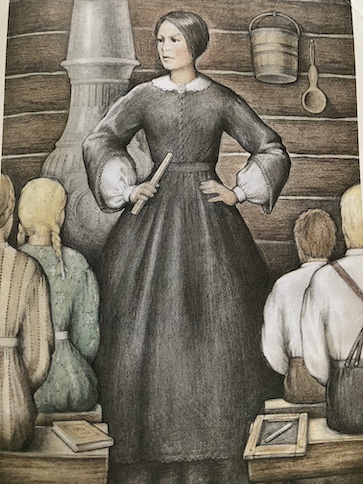
When the mean boy, Amos, laughs at Kirsten, Miss Winston glares at him and strikes the school’s iron stove with her ruler, startling the students. Miss Winston says that her father was a ship’s captain, so she knows how to be in charge of her students, like he was in charge of his crew. Then, she deconstructs the sentence “Miss Winston hit the stove”, pointing out which words are the subject, verb, and direct object of the sentence. Then she warns the class to “Be careful that the direct object of hit isn’t the student.” The implication is that Miss Winston is just as willing to use physical punishment against her students as Mr. Coogan was.

When Amos introduces himself to Miss Winston, we learn that he is nineteen years old, the same age as the new teacher, but the new teacher says that, in spite of being the same age, she’s still the teacher, and he’s the student. In spite of being more a young man than a boy in age, Amos has only just finished the third reader, and Miss Winston says her role is to help him read and do math like a man would, embarrassing Amos. (He can’t use his age to put himself on an equal footing with the new teacher because they are not intellectual equals. She’s the same age, but she has graduated from her own school and become a teacher, and he’s still struggling along with low level math and reading.)

Anna helps Kirsten with her lessons, and Miss Winston praises her for helping to teach Kirsten, but she doesn’t praise Kirsten for doing a good job. At the end of the school day, Kirsten and her cousins talk about the new teacher. Anna thinks that Miss Winston seems nice, but Kirsten thinks that Miss Winston doesn’t like her and that she seems very strict. She asks if that was what Mr. Coogan was like, and Lisbeth says he was worse. The best part of the day for Kirsten was lunchtime, when the children were allowed some play time. When she ran around and played tag with the other children, it didn’t matter if she didn’t speak much English.

When the girls play school with their dolls, Anna imitates Miss Winston and her comment about “savages.” Kirsten asks the other girls what that word means. They say it means “wild.” Kirsten asks them if the Indians (Native Americans) are really like that, and they say that some people say they’re kind and will help people if they need food but others day that they’re “cruel and bloodthirsty.” They’ve seen an Indian man before. He came to their house when their mother was roasting meat, and he left when their mother gave him some. They thought he looked pretty “savage” because his face was painted, and he had eagle feathers in his hair. The girls say that Native Americans also wear knives and live in tents. As a farmer, their father is concerned about the Native Americans. He knows that, if the farmers take too much of their usual hunting grounds for farming, it will drive away the animals, and the Native Americans will be starving and angry. While he is happy that he has been able to secure some farmland for his family (I explained a little about the famine conditions and lack of farmland in Sweden around this time that caused people like the Larsons to leave their country when I covered Meet Kirsten), he is aware that the Native Americans also need land for their survival.

At school, Miss Winston announces that each student will memorize a poem and recite it for the class. When they recite their poems, she wants them to say them with feeling and show the emotions their poem is trying to convey. Kirsten worries about this assignment because she’s still learning English. It’s hard enough for her to learn to read anything in English and understand the meaning of the words. She doesn’t know how she can also learn to memorize an entire poem and say it in front of everyone. Miss Winston gives Kirsten a short poem to learn, but having even a short one doesn’t seem to help Kirsten.

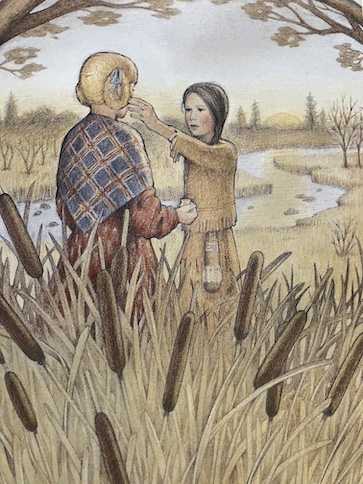
Meanwhile, Kirsten has her first encounter with a Native American when she spots an Indian (Native American) girl watching her while she’s getting water from the stream. The girl runs away, but Kirsten finds a blue bead that she dropped. Kirsten takes it and leaves her a little pretend cake that she and her cousins made for their dolls. Later, she finds that the cake is missing and that there’s a green duck feather in its place. She and the Indian girl trade little objects in this way, gradually becoming friends.

Kirsten’s secret friendship with the Native American girl becomes a comfort to her when school is stressful. Frontier teachers often board with families who live near the school, and when Miss Winston comes to stay at Kirsten’s aunt and uncle’s house, Kirsten feels like school is following her home. What’s worse is that Kirsten’s family will be joining them for dinner, and they will practice English during the meal. Kirsten knows that the meals, instead of being comfortable family time, will now be like lessons, and they will struggle to say things they would want to say because her family still hardly knows English. Worse yet, Miss Winston is cross with Kirsten because she can’t seem to memorize even her short poem.

Sneaking away to visit the Native American girl, who is called Singing Bird, gives Kirsten an escape from her struggles with English. Somehow, Kirsten and Singing Bird manage to communicate well enough with each other, even though neither of them speaks each other’s language. Then, Singing Bird takes Kirsten to see her village. To her surprise, Kirsten realizes that she has been gradually teaching Singing Bird English words without realizing it. However, Singing Bird’s people are going to be moving on soon. Kirsten’s uncle is correct that farming is driving away the animals the Native Americans depend on for food, and they’re suffering for it. Singing Bird invites Kirsten to come with her tribe when they leave, and it’s tempting to think of living an exciting life, traveling with Singing Bird and not going to school. But, is that what Kirsten really wants?

The book ends with a section of historical information about frontier schools in the mid-1800s.

The book is available to borrow and read for free online through Internet Archive (multiple copies).

Along with the first book in the series, this is the book that I remember the best of the Kirsten books. I think I either didn’t read the others or didn’t finish them because there are some sad things in the Kirsten stories that I didn’t like. In the first book, Meet Kirsten, another child Kirsten befriends on the journey to Minnesota dies of cholera. It’s historically accurate that some children died of disease on the journey west, but it was still hard to take. I also talked about how the reason why families like Kirsten’s wanted to come to America was that Sweden was experiencing famine around this time. The first book didn’t say much about that, but in this book, Kirsten remembers experiencing hunger in Sweden when her father’s crops failed and how her little brother cried from hunger.

Kirsten understands the plight of the Native Americans when they have to move to a new area when their food supplies run low. However, when Singing Bird invites Kirsten to come with them, she realizes that would mean leaving the rest of her family, and she can’t do that. While it’s tempting to go with her friend and escape the problems in her life, Kirsten can’t do that without also giving up the good things in her life and trading the problems in her life for a different set of problems. Although there are appealing aspects to their lives, the Native Americans also have their own struggles. To use an old adage, the grass isn’t always greener on the other side of the fence. People say it in different ways, but just because someone else’s situation is different doesn’t always mean that it’s better.

In this book, we also see what it’s like for Kirsten’s family as they begin learning English, so they can communicate with other people in their new country, and the children begin going to school. The little frontier school is different from other schools they’ve experienced before, and the teachers are strict. They have to be strict because some of the students are rough and fight with each other physically, and they have to make it clear that they’re not going to put up with that. This is a real-life aspect of schools from this time period. Fortunately, we never see the teacher actually using physical punishment against anybody. She just threatens to do it so her students will think twice about misbehaving.

When Miss Winston comes to board with Kirsten’s relatives, Kirsten thinks that everything is going to be worse, that she’s constantly going to be bombarded with lessons and the problems she’s been having at school. However, it turns into an opportunity for Kirsten and Miss Winston to get to know each other better. At first, Miss Winston can’t understand why Kirsten is having such a difficult time remembering her poem, even though it’s pretty short and easy. It’s partly because she’s still having difficulties with her English, but also, the content of the poem has no relation to anything currently happening in Kirsten’s life. It doesn’t interest her, and her mind is preoccupied with all the changes happening in her life, making it difficult for her to focus on the poem and remember it. When Miss Winston shows Kirsten a model of her father’s ship, it brings back memories of the ship Kirsten’s family traveled on when they came from Sweden. Miss Winston realizes that Kirsten has strong memories of the ship, so she gives her a different poem to memorize, one about a ship. Kirsten finds this poem easier to remember because it connects to memories she already has.

Although Miss Winston can be tough, she genuinely does care about Kirsten and looks for ways to help her learn. It just takes time to figure out the best way to help her, and Kirsten also needs time to adjust to her new language and new home. Once Kirsten sees that it’s possible for her to learn and for her new home to begin feeling like home, she begins to feel better about her new life in Minnesota.

I enjoyed the realistic aspects of the story and the references to historical events and real life conditions on the frontier. I think I liked this story better as an adult because I understood more about the historical background than I did when I was a kid. Parts of this series are still sad. Kirsten remembers people being sick and dying on the journey to America, and although she doesn’t go into detail about it, her family did suffer genuine hardship in Sweden.

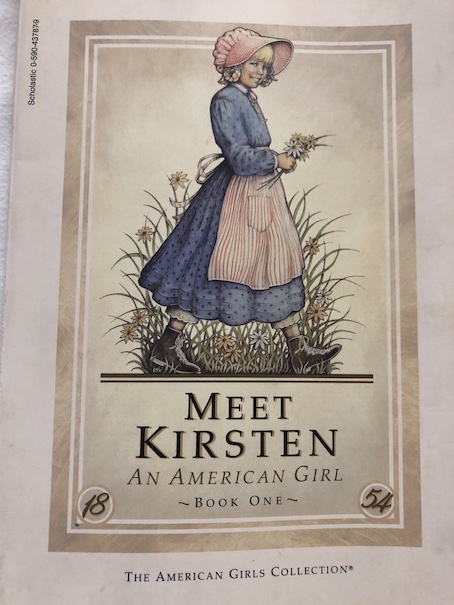
Meet Kirsten

Kirsten, An American Girl

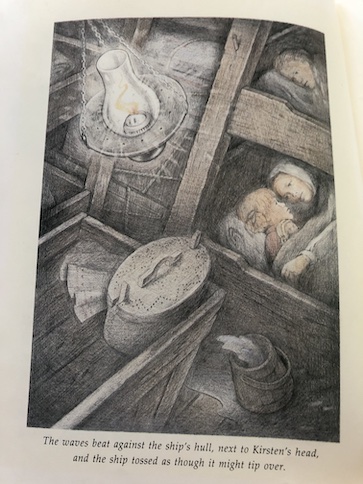
It’s the summer of 1854, and Kirsten Larson is traveling by ship to America from Sweden with her family. There have been storms during the voyage, and the sailing has been rough. It’s crowded on the ship, and people have been seasick. On board the ship, Kirsten makes friends with another girl her age, Marta. The two girls play with their dolls together and talk about the things they’ll do when they finally reach America. The reason why the Larsons are traveling to America is that Kirsten’s Uncle Olav is already there. He has established a farm in Minnesota, and he has married a widow with two daughters. He wrote to the Larsons and asked them to join him and his new family in Minnesota and help on the farm.

When their ship finally reaches America, it docks in New York. No one is allowed to leave the ship until the health inspector declares that they are healthy. Health inspectors will not allow anyone with a serious, contagious disease, like cholera or typhoid, to go ashore. When they are allowed ashore, Kirsten’s father finds an agent to help them change their money at a bank and buy train tickets for their trip west. The agent, who is also from Sweden, will even accompany the family to the Mississippi River as a guide. The family needs help because they can’t speak English yet.

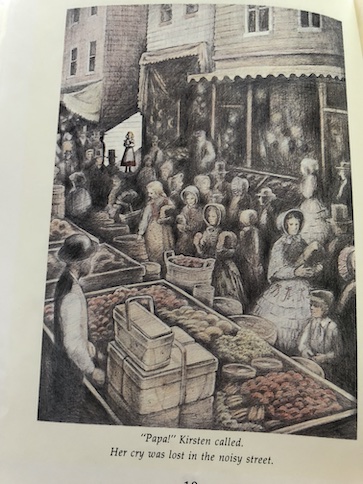
When they go to buy food in New York, Kirsten is accidentally separated from her father and gets lost. Because she can’t speak English, nobody understands what she’s saying, so Kirsten can’t ask for directions. Kirsten is frightened, but a kind lady sees her distress and tries to ask her what’s wrong. Kirsten can’t tell her, but then, she realizes that she can draw a picture, so she draws a picture of a ship. The lady leads Kirsten back to the dock, and she manages to find the rest of her family in the nearby Battery Park.

The next day, Kirsten says goodbye to Marta because the Larsons are leaving the city before Marta’s family. Because Marta’s family is also going to Minnesota, they hope that they will meet again there or somewhere on the way.

Kirsten has never seen a train before, and her first ride on one is frightening at first. The trip lasts for days, but finally, they arrive in Chicago. There, they will meet up with other pioneers heading to the Mississippi River. At the boarding house in Chicago, Kirsten reunites with Marta, whose family will also be traveling with them!

The pioneer families take wagons to the Mississippi River, and then, they board a riverboat. Kirsten’s mother worries because, when they boarded the riverboat, she was sailors burying a passenger who died of cholera. (A disease caused by ingesting contaminated food and water.) Cholera is a serious risk, and her worries are justified. On their third day on the boat, Marta becomes ill with cholera and dies from it.

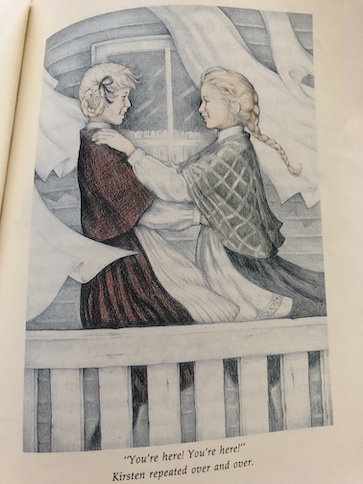
Kirsten is distressed at Marta’s sudden death, but fortunately, the Larsons all make it to Minnesota. All along, Kirsten has been struggling with homesickness and is still grieving the loss of the only friend she had in America, but she is cheered when she is greeted by her new cousins, Anna and Lisbeth. With her cousins as her new friends, Kirsten thinks that Minnesota might come to feel like home after all.

The book ends with a section of historical information about immigrant families, like Kirsten’s.

The book is available to borrow and read for free online through Internet Archive (multiple copies).

Although I liked the American Girl books when I was a kid, I didn’t like the Kirsten books, partly because of Marta’s death. I don’t think any of the other American Girl books has a child death in the first book. In fact, I don’t even remember any other children dying in any of the series, unless it happens in one of the newer books I haven’t read yet. It is realistic for a child to die while traveling west. Diseases like cholera were a real-like risk to pioneers. I’ve visited places along the old Oregon Trail, and I’ve seen the graves of real pioneer children who died of disease. There’s also a doll at one of the local historical museums in my area that once belonged to a little girl who died on the trip west. I know that children died on the journey west in real life, but it’s still depressing to read about, which is what bothered me about the Kirsten books. For this reason, I don’t think I read all of the Kirsten books when I was a kid, or at least, I don’t remember much about most them.

Reading this book again as an adult, I found it easier to deal with Marta’s death. I knew it was coming, so there was no shock to me. Marta’s illness is only a small portion of the book, and Kirsten doesn’t see Marta dead. We do get a picture in the book of the riverboat sailors carrying Marta’s coffin away for burial.

I always appreciate the sections of historical information in the back of American Girl books. This one discusses immigrants, the reasons why they wanted to move to a new country, and the conditions they encountered during their journey.

Earlier, when I covered Rasmus and the Vagabond, I mentioned that the characters hide in an abandoned village, and Oscar tells Rasmus that the reason that the village is abandoned is because, years before, the people in the village all decided to emigrate to America together, specifically Minnesota (a popular destination for Scandinavian immigrants).  The Library of Congress has more information about Swedish immigrants and the major periods of immigration.  Around the time that Kirsten’s family emigrated to the United States, Sweden was suffering problems from overpopulation, lack of adequate tillable farm land, and famine. We don’t hear the Larsons describe any particular problems they had in Sweden or suffering. We are told that they had a farm in Sweden with a house with a maple tree near the door and a barn, but we don’t know if the family was suffering in spite of owning the farm. The important point is more that conditions in general were bad in Sweden, so the promise of rich farm land in Minnesota was attractive to them. The historical information included in the back of Meet Kirsten doesn’t cover this information about conditions in Sweden. Instead it focuses on what immigrant families might pack to bring with them on such a journey and what the traveling conditions would have been like.