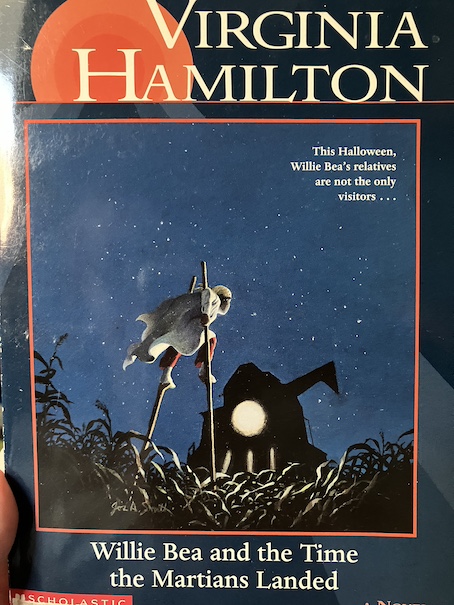
Willie Bea and the Time the Martians Landed by Virginia Hamilton, 1983.
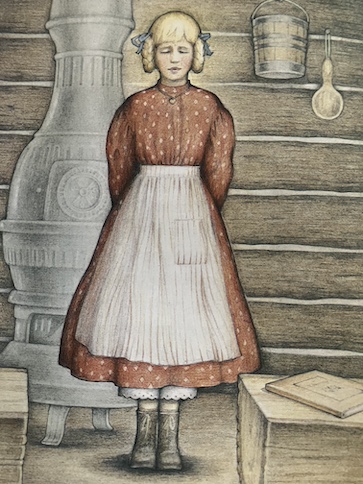
It’s Halloween 1938, and Willie Bea’s relatives have gathered at the old family farm, near where she lives. Money is tight because of the Great Depression, but one of her aunts lives and works in the city, making more money than the others, and is willing to help fund family dinners and provide a little extra for her nieces and nephews when they need something, like new clothes. The aunt is a little scandalous in their family for her multiple marriages, but the others appreciate her generosity, and the nieces and nephews like getting some extra attention and a few treats from her.
The family gathering is a bit chaotic with children running around and getting into trouble. One of Willie Bea’s cousins gets into particular trouble with her mother for using his bow and arrow set to shoot a pumpkin off of Willie Bea’s younger brother’s head. Their mother panics when she catches them doing it because he could have missed and killed the little boy, but Willie Bea tries to calm her mother. Willie Bea was less worried because she knows her cousin’s archery skill and that he wasn’t going to miss, but she understands that adults think of the risks and aren’t fully aware of what the kids are capable of doing. (I’m siding with the mother on this one. Even people who are very good at something can miss now and then, and it’s a big risk to take with someone’s life.) Willie Bea also realizes that the decision to use her little brother for the William Tell act actually came from another cousin because the cousin doing the archery wouldn’t have thought of it himself, and it’s not fair that her mother doesn’t know to blame this other cousin.
Willie Bea talks to her father about the incident, hoping that he’ll understand how unfair it is. However, her father tells her that what her cousin did was dangerous, no matter why he did it. Even though he has a reputation for being good with archery, even people who are good can still miss, and accidents can happen. (See?) Her father lets Willie Bea know that he’s aware that she and her cousins do risky things sometimes when they’re playing with each other, but as an adult, he and the other adults have a responsibility to tell them when something they’re doing is too risky and to put a stop to it. No matter how many times they’ve done some of these things without having an accident, some things are just accidents waiting to happen. They should never assume that an arrow can’t go wrong just because it hasn’t yet or that they can’t fall from a high place just because they haven’t fallen yet.
Willie Bea is a little embarrassed by the talk and feels like her father still doesn’t understand. However, Willie Bea herself has been starting to understand a few things about her relatives this Halloween, things that she either hasn’t noticed before or only half noticed. She can see that one of her cousins is too manipulative, noting the little tricks she uses to get her way and the things she says and does when she wants to be spiteful. She can see that her other cousin has trouble asking up for himself and is particularly vulnerable to manipulation.
Willie Bea also begins to notice things about the adults in the family and their relationships with each other. Aunt Leah, the aunt who has more money than the others and has been married multiple times seems glamorous and fascinating to Willie Bea. Aunt Leah is into horoscopes and fortune telling, and when she reads Willie Bea’s palm, she predicts something special for her. Although Willie Bea loves her own mother, she is intrigued by the family gossip that her father was seeing Aunt Leah before falling in love with her mother, and Willie Bea fantasizes about what it would be like to live with Aunt Leah in the city. She imagines that it would be exciting, and she asks her father why he chose her mother instead of Aunt Leah. Her father knows that Willie Bea doesn’t entirely understand what it’s like to make that kind of choice and what living with a woman like Aunt Leah would really mean. (It occurred to me that the multiple divorces Leah has had might be a clue.) He just explains to Willie Bea that his choice became clear after he got to know her mother as well as her sister, Leah. He knew her mother was the right choice because she was the kind of steady woman who would always be there for him.
That evening, while Willie Bea is putting together her hobo costume and the ghost costumes for her younger siblings and her parents are listening to the radio, Aunt Leah suddenly bursts in and starts having hysterics about it being the end of the world! It takes Willie Bea’s parents a while to get a clear answer from Aunt Leah about why she’s so upset. When she recovers enough to explain things, she says that she was listening to the radio, and she heard that Martians have invaded New Jersey! She describes the horrible, terrifying reports that the radio announcer made about the Martians destroying army troops with their deadly heat ray. Aunt Leah was so terrified by what she heard that she not only turned off the radio but unplugged it, and she says that she’ll never plug it in again, which might be a moot point, if aliens really are here to destroy the world. (If you know what was infamously broadcast on Halloween 1938, you know what Leah heard and that it’s not what she thinks it is.)
While Willie Bea’s parents are trying to decide what to make of Aunt Leah’s story, Willie Bea’s Uncle Jimmy arrives. He says that the rest of the family has also heard what Aunt Leah heard and that they’re all gathering at the old family farm. Rumor has it that people have seen the terrible invaders over at the Kelly farm. Willie Bea’s mother gathers the children and heads to the family farm that Willie Bea’s grandparents own to be with the rest of the family, while Willie Bea’s father tries to see if he can find the station that Leah was listening to and hear the reports for himself. It occurs to him that it might not be an invasion of the Martians but could actually be Germans and German war machines because they’ve all heard about the Nazi takeover of Germany, and he remembers the horrible Hindenburg disaster. If Germans could make a blimp that explodes into a fiery terror like that, then he thinks maybe they could make something that resembles an alien invasion.
At her grandparents’ farm, Willie Bea watches as various relatives panic, cluster around the radio, trade rumors, and try to figure what’s going on. Rumor has it that there are Martians on the Kelly farm, so Willie Bea convinces young Toughy Clay to go over there and try to see them for themselves. At Willie Bea’s insistence, they use the stilts that the children like to walk on to give themselves longer legs, so they can get there faster. Nothing is as it seems this Halloween, and Willie Bea’s expedition to see the Martians definitely doesn’t go as planned.
The book is available to borrow and read for free online through Internet Archive (multiple copies, including a short picture book version).
My Reaction
Almost of the characters in this book are African American. I don’t think it’s ever stated directly because there’s no need in the story to describe them, compared to anyone else, but I think it’s subtly implied. There is only one point in the story where race is mentioned at all, and that’s when Willie Bea is hurt, and the doctor comes to see her. Willie Bea describes the doctor as an old man who delivered most of the babies in her family and knows everybody in the community, and she says that he visits everyone, black or white, rich or poor. Willie Bea’s family is at the poorer end of the community because the doctor knows that people like them don’t normally call the doctor unless it’s something that they really can’t handle by themselves.
I found the family relationships in the story confusing at first. The kids are all referred to by nicknames, and when they are first introduced, it’s difficult to keep it straight who is whose sibling and who is a cousin, and who is older and who is younger. At least, that’s how it seemed to me. Relationships are explained gradually as the story continues, along with characters’ real names as well as nicknames, but it takes some time to get to the explanations.
The story has a slow start, and the real adventure doesn’t begin until about halfway through the book. In some ways, it’s a coming of age story for Willie Bea because she finds herself seeing her family in ways that she never has before, becoming more aware of different sides of their personalities and gaining more insights into their relationships with each other. She also comes to see firsthand what her father means about the stunts that she and her cousins pull and how she should never assume that they can’t get hurt just because they haven’t before. Much of this book is what I would call “slice of life”, a sort of glimpse into Halloweens of the past in a rural community, especially one particular Halloween that would have been memorable for anyone who was alive at the time in the United States.
The radio broadcast that has Willie Bea’s family and others in the community panicking over an alien invasion is The War of the Worlds, a play based on the novel of the same name by H. G. Wells. This type of panic over this particular radio performance was a real, historical incident because the radio play was presented in the format of news broadcasts at the time, and some people who tuned into the program late misunderstood what they were hearing and thought that it was a real news broadcast about an actual emergency. It wasn’t a widespread panic because, first, people who started listening to the broadcast from its beginning knew what they were listening to, and second, not everyone was listening to the broadcast at all. Still, there was enough panic over the radio performance that it became newsworthy and has become a piece of American history and lore.
I enjoyed the historical details in the story, particularly all the radio play references throughout the story. Willie Bea’s family likes to listen to radio shows, and I’m familiar with some of them because I also enjoy old radio plays. Her family likes to listen to The Shadow and Little Orphan Annie. Willie Bea likes to amuse her siblings by imitating people from the radio, singing theme songs and reciting jokes from Jack Benny, like the famous “your money or your life” joke.




 Jestress's Forgotten Books and Stories