Cinderella

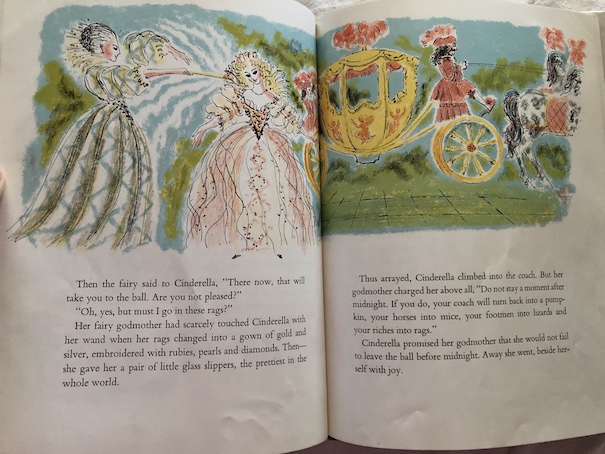
Cinderella translated and illustrated by Marcia Brown, 1954.

This is a retelling of the classic Cinderella story, translated from the French Perrault version by Marcia Brown, the author and illustrator of many other classic fairy tales and folktales for children.

As in the classic story, Cinderella is a girl with a cruel stepmother and a pair of spoiled stepsisters, who force her to do all of the work of the house and make her wear rags. Her father never stands up for her because he is too attached to his second wife to oppose her.

When it is announced that the king’s son is holding a ball and that the stepsisters are invited, they hurry to get ready, and they make Cinderella help them. Of course, nobody thinks that Cinderella should go to the ball, and the stepsisters laugh and tease her about it.

When they head off to the ball, Cinderella watches them go and cries. Then, her fairy godmother appears and tells her that she is going to help her. The fairy godmother turns a pumpkin into a fine coach, mice into horses, and a rat into a coachman. She gives Cinderella a beautiful dress to wear and a lovely pair of glass slippers. However, she warns Cinderella not to stay at the ball past midnight, when her magic spells will end, and everything will become what it was before.

At the ball, Cinderella charms the prince and has a wonderful time. She is even nice to her stepsisters when she encounters them. They don’t recognize her in her new finery. Everyone keeps wondering who the girl who appears to be a beautiful princess could be. Shortly before midnight, she leaves the ball abruptly and returns home before her stepsisters do. She tells her godmother everything that happened and that the prince invited her to a ball to be held on the next night.

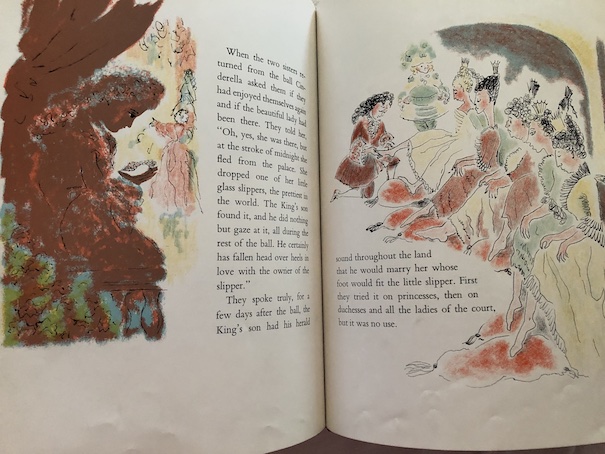
The next ball is also wonderful, but Cinderella loses track of the time and runs away suddenly when the clock begins to strike midnight. In her haste to get away, she accidentally leaves one of her glass slippers behind. The prince finds it and decides to use it to find this beautiful, mysterious girl he has already come to love.

Many young ladies try on the shoe, including Cinderella’s stepsisters, hoping that it will fit them. However, it will only fit Cinderella, and only Cinderella has the other slipper in the pair.

This is a Caldecott Medal Book. It’s available to borrow and read for free online through Internet Archive.

My Reaction

The story follows the classic Perrault version of the Cinderella story. There are many variations of this fairy tale, but this one is often the best-known. In some versions of the story, Cinderella’s father is also dead, which is why she is left at the mercy of her stepmother and stepsisters, but in this one, he is still alive and is just unconcerned about Cinderella’s treatment. He is never shown in any of the pictures and plays no role in the story.

I enjoyed the illustrations in this book. They’re an unusual style. Objects and people in the pictures are only party defined by pen lines. Many of their edges are more softly defined by color.

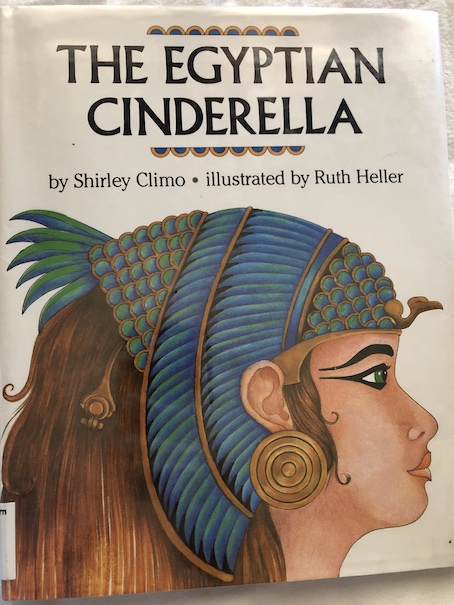
The Egyptian Cinderella

The Egyptian Cinderella by Shirley Climo, illustrated by Ruth Heller, 1989.

Rhodopis is a slave girl in Egypt. When she was young, she was abducted from her home in Greece by pirates, who sold her into slavery. Her blonde hair and green eyes make her look very different from the Egyptian servants, and none of them like her.

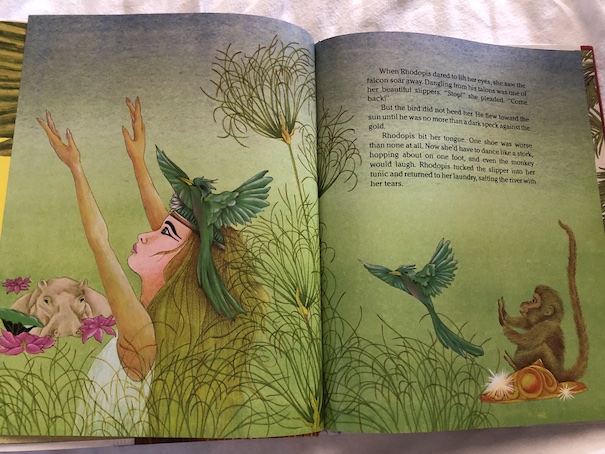
Most of Rhodopis’s friends are animals, and in the little free time she has, she likes to dance. The elderly man who owns her sees her dancing and has a special pair of rose-red gold shoes made for her so she can wear them while she dances. However, the Egyptian servants are all jealous of her for getting this special gift.

One day, the servants all leave her behind when they go to a special court held by the Pharaoh. While they are gone, a falcon snatches one of Rhodopis’s slippers and flies away. The falcon flies to the court and drops the slipper in the Pharaoh’s lap. The Pharaoh takes this as a sign from Horus that the girl who owns that shoe is destined to be his wife and immediately begins searching for her.

When he finds Rhodopis, the servant girls protest that she is not Egyptian and is only a slave, but the Pharaoh compares her green eyes to the color of the Nile, her light hair to papyrus, and her pink skin to a lotus flower. In his eyes, there could not be any other girl who could represent Egypt, and her slave status doesn’t matter.

The book is available to borrow and read for free online through Internet Archive (multiple copies).

My Reaction

I remember loving this book when I was a kid! I always liked fairy tales and folktales, and I think this was one that was introduced to me by our school librarian, probably around the time it first came out in 1989. For a long time, I was unaware that the same author also wrote other books based on variations of the Cinderella story: The Korean Cinderella, The Persian Cinderella, and The Irish Cinderlad. One of the fascinating things about the story of Cinderella is that variations of the story about a girl (usually, it’s a girl, although there are some variations with a boy) who is abused by her stepmother and stepsisters but who triumphs in the end when she marries a king or a prince, who identifies her as the girl he loves by a lost shoe, have appeared in cultures around the world. The classic one that most of us know is the French version by Perrault, but there are other versions of the story that are older.

There is an author’s note in the back of the book that explains that this Egyptian version of the Cinderella story is one of the oldest known Cinderella stories. The Roman historian Strabo recorded the story in the first century BC. The story is legend, but according to the author, Rhodopis was a real slave girl who married the Pharaoh Amasis in the sixth century BC (although accounts of her vary, and it can be difficult to separate history from legend).

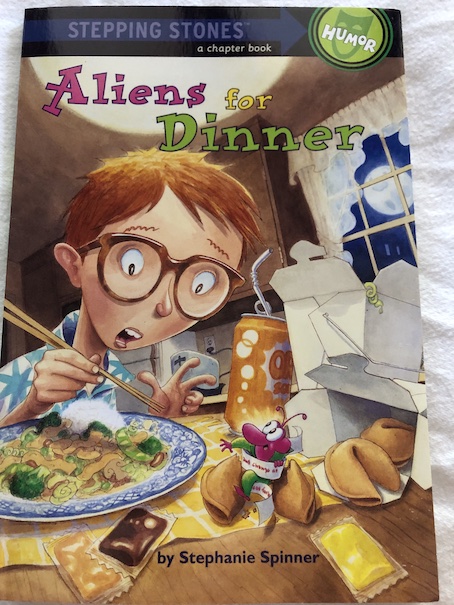
Aliens for Dinner

This book is part of the Aliens for Breakfast Trilogy, a short, easy chapter book series for elementary school children.

Richard Bickerstaff is unhappy because his mother has started dating a man named Bob Baxter. Richard thinks that Bob is weird, and he has an annoying habit of repeating himself. Then, one evening, when Bob is having dinner with Richard and his mother, Richard’s small alien friend, Aric, arrives with their Chinese food, hidden in a large fortune cookie. Aric is a commander of the Interspace Brigade, and they operate on a shoestring budget, so they often transport Aric in some form of food to save money.

Richard manages to slip away from his mother and Bob and takes Aric to his room, where Aric tells him about his latest mission. Earth is in danger from aliens from a planet called Dwilb. Dwilbs have a bizarre love of pollution, and pollution problems have gotten bad enough on Earth to attract their interest. The Dwilbs want to make Earth even more polluted so they can turn it into a pollution-themed amusement park for themselves called Toxic Waste Funland. Aric says that they’re so confident in their plan that they’re already running advertisements. Aric will need Richard’s help to stop them!

Richard asks Aric questions about what the Dwilbs are like. Aric says that they look like humans, but they have an odd habit of saying everything twice, and the repetition seems to have a hypnotic effect. Richard thinks that sounds familiar, and he remembers why when his mother and Bob come to say goodnight to him. Bob repeats himself! Richard starts to think that his mom might be dating an alien!

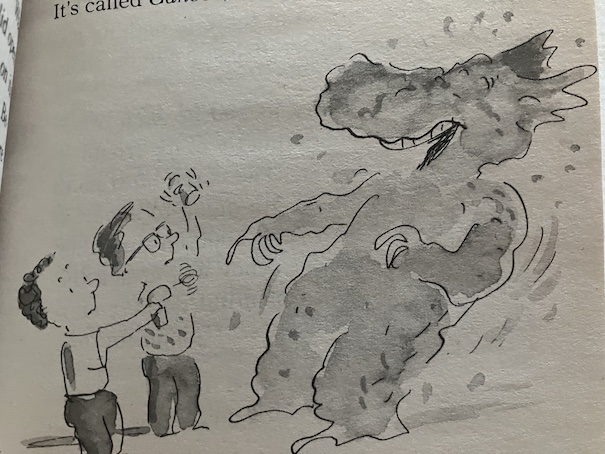
Meanwhile, the Dwilbs have caused a major oil spill nearby as part of their plan to pollute the planet further. Local people have been trying to help with the cleanup, but it seems like it’s just getting worse. Richard goes to take a look and sees Dwilbs splashing about in the oil, having fun! They love the oil spill, the exhaust from cars, and everything that’s dirty.

Richard asks Aric what they can do to stop the Dwilbs, but as often happens when Aric travels in the bizarre ways that Interspace Brigade sends him, has trouble remembering the Dwilbs’ weak point. While Aric struggles to remember, the Dwilbs start influencing the kids at Richard’s school, getting them hooked on a treat they call Sludgies. Under their influence, the kids start littering and stop caring about the environmental efforts their teacher is trying to talk to them about. Even Richard’s friend, Henry, is under their power and in no state of mind to help Richard.

Fortunately, there is a secret weapon right there at Richard’s school: the school principal and his ability to bore everyone almost to death. In the case of the Dwilbs, boredom is a serious threat!

The books in the Aliens for Breakfast Trilogy are humorous sci-fi stories, and the solutions to defeating the aliens always have some comic twist. The solution in this case is getting the school’s principal to speak to them and bore them out of their minds. Richard has to arrange for his principal to speak at a place where he knows all the aliens will hear him.

Richard has run into situations in previous books where strange people he knows turn out to be sinister aliens in disguise, and in this case, he thinks that Bob is one of the Dwilbs. However, there is a twist to this story. Bob isn’t one of the aliens. He’s a little odd, but he’s a human. His quirks just happen to resemble the Dwilbs. He has a habit of repeating himself, but he’s not at all bored by the way the principal speaks or the way Richard speaks when he imitates his principal. Bob is often a little boring himself. By the end of the book, Richard feels better about Bob when he discovers that Bob likes comic books as much as he does. The two of them start bonding by sharing comics. Bob has a collection of older comics that Richard has been wanting to read, and he lets Richard borrow them.

I like the references in the story to real franchises that fans of science fiction and comic books would know. Richard has a collection of X-Men comics.

The book was published in the 1990s, when I was still in school. I remember my teachers talking to us about environmental issues back them, especially about pollution and the importance of recycling. They often urged us to get involved and do our part to recycle and not litter. The environmental messages in this story, especially the ones Richard hears at school, bring back memories for me.

Aliens for Lunch

Aliens for Lunch cover

This book is part of the Aliens for Breakfast Trilogy, a short, easy chapter book series for elementary school children.

It’s spring break, and Richard and his friend Henry are bored. It seems like all of their friends have all gone somewhere for vacation, but they’re stuck at home. Richard’s mother leaves the boys home alone, telling them that there’s food for lunch in the refrigerator and a new sample of popcorn that arrived in the mail. The last time that a sample of a new kind of food arrived in the mail, Richard’s alien friend, Aric was hiding inside, and the same is true this time, too! Aric is back, and he needs Richard’s help!

Aric tells Richard and Henry that a valuable shipment of XTC-1000 was hijacked by aliens called the Graxians. XTC-1000 is the secret substance that makes all desserts taste wonderful. (I always thought that was sugar, but okay.) Aric’s planet ships XTC-1000 to other planets, and each shipment is supposed to last for thousands of years, but the Graxians are greedy, and they used up their supply too quickly, which is why they hijacked a shipment bound for another planet. It’s a real problem because, if that other planet’s desserts suddenly turn bland because they’ve run out of XTC-1000, they’re bound to start raiding desserts from other planets, like Earth.

Aric’s Interspace Brigade was supposed to send weapons to help Aric and Richard face off against the Graxians, but as always, they’re on a strict budget, and the weapons they sent somehow failed to arrive. Richard and Henry do the best they can to improvise weapons with things they find in Richard’s kitchen, but they’re not very terrifying. The Graxians take Aric, Richard, and Henry prisoner after they board the ship. Can the boys manage to free Aric and discover what they need to subdue the Graxians?

I don’t think I read this book as a kid, although I remember reading the first book in the series. The Aliens for Breakfast Trilogy is a short series of funny science fiction stories as Richard and his alien friend do battle against the villains of the galaxy with food! I like the fact that even the aliens they fight find their efforts laughable when they try to use things that just don’t make sense, like when they try to use the kitchen gadgets as weapons. I also enjoyed the pun that the secret substance that makes desserts good is “XTC”-1000. (No, I don’t think they mean the illegal drug.) There is also a running gag that Aric’s space organization is always operating on a shoestring budget, which is why they often have to improvise weapons and modes of travel. The stakes are high but laughable at the time time, and somehow, they always manage to save the day! There is an extra joke at the end of this book where Aric gives both of the boys jackets from his space organization, telling them that girls find them irresistible. When the boys try wearing them for the first time, they come to the conclusion that neither one of them is ready to be irresistible.

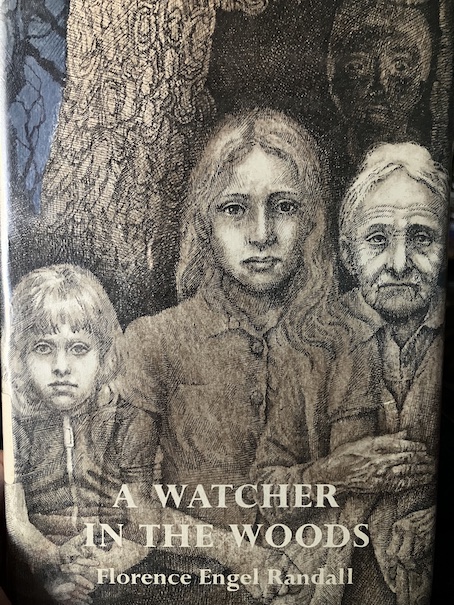
A Watcher in the Woods

The Carstairs family is moving from Ohio to a small town in Massachusetts because Professor Carstairs will be taking a new job as head of the English department at the local college. Fifteen-year-old Jan knows that she will find the move harder than her parents or her younger sister. Her father will be busy with his work, and her mother will make friends with the wives of other faculty at the college. Jan knows that her little sister, Ellie, is still very young and in elementary school, and she won’t find changing schools as difficult as she will. Jan isn’t looking forward to trying to fit in at the local high school.

The family’s first difficulty in moving is finding a house in this new town that they like. Because it’s a small town, their options are limited, and it seems like there’s something wrong with each of the houses they see. Then, their realtor suggests that they view the old Aylwood place outside of town. Living there would mean a longer distance to drive to the college and the girls’ schools, but it’s a nice, big house with some land attached to it. The land includes woods and a pond. Elderly Mrs. Aylwood can’t afford to maintain the place anymore, but she has been reluctant to sell the house. She is very attached to it and she wants to make sure that, if she sells, that she will sell it to the right kind of people, who will take care of the land and woods.

From the first time that Jan and her family visit the house, it gives Jan a strange feeling. She has the oddest feeling that someone (or something) is watching them from the woods, and it frightens her. However, when she tries to explain her uneasy feelings to her mother, her mother thinks that it’s her imagination. Jan can’t deny that the house and wood give her the feeling of a fairy tale and that Mrs. Aylwood reminds her of a fairy tale witch.

For some reason, Mrs. Aylwood becomes more welcoming to the Carstairs family after she sees Jan, and she begins asking Jan some rather odd questions about herself. Mrs. Aylwood admits that Jan reminds her of her own daughter, Karen, who she lost 50 years ago when she was only 15 years old. Jan begins to understand that Mrs. Aylwood’s attachment to the house is because it’s a link to her daughter’s memory, but she soon begins to realize that there’s more to it than that. Mrs. Aylwood asks Jan what kind of person she is and makes a cryptic comment about how Jan is a human but there are other things besides humans.

Jan’s uneasy feeling of being watched continues, and mirrors in the house are inexplicably broken in an x-shaped pattern. When she befriends a neighbor, Mark, and talks to him and his mother about the house, she learns that Karen did not die but that she disappeared 50 years ago. She apparently went out for a walk to the pond in the woods one summer morning and simply vanished with no explanation. Searches for her never lead anywhere. Most of the local people believe that Karen ran away from home, although it would have been out of character for her to do that. Jan begins to wonder if the watcher she senses in the woods could be Karen, somehow hiding out or having returned after all these years, although Mark says that doesn’t make sense. Then, remembering Mrs. Aylwood’s comment about things that aren’t human, Jan wonders if the watcher could be Karen’s ghost. What if she died all those years ago, and her spirit haunts the woods?

It seems like someone or something is communicating with Ellie. Ellie seems to hear something speaking or humming when Jan can’t. Something even suggests to Ellie that she name her new puppy Nerak, which Jan realizes is “Karen” spelled backwards. Is Karen trying to communicate with them, or is it something else?

The book is available to borrow and read for free online through Internet Archive. This book has been made into movie versions twice, but the Disney movie from 1980 is more faithful to the original story. I’ll explain why below, but it involves spoilers.

When talking about my opinion of this book, I really need to include some spoilers. This is a very unusual book because it isn’t obvious until about halfway through what kind of story it really is. From the beginning, it’s set up like a ghost story, with Karen’s mysterious disappearance, the sense of something watching the house and family from the woods, and something trying to communicate through Ellie. It’s very suspenseful and mysterious, but this is not actually a ghost story. It’s really science fiction.

Karen isn’t dead, but she has been trapped in an alternate dimension since she disappeared 50 years ago. A being from that other dimension has also been trapped in our world since then. This other being is the mysterious watcher in the woods. Jan correctly senses that this other being is also female and a child, although beings of its kind live extraordinarily long lives because time works differently in their dimension. What has been 50 years for everyone else has only seemed like a day to her. She wants to return home, but she has had to wait for conditions to be right. She also wants to help Karen, and she has been struggling to communicate with Mrs. Aylwood and Jan and her sister so she can tell them what they need to do.

In the Disney movie, there are a couple of major changes from the original book. The first is that the location is changed from the US to England, although Jan and her family are Americans. It also features a kind of initiation ritual that Jan was undergoing just as her switch with the creature from the other dimension happened, adding an element that seems supernatural, although it is still science fiction. At the very end of the Disney movie, Jan brings Karen back from the other dimension, but in the book (Spoiler!) Mrs. Aylwood goes to join Karen in the other dimension instead.

In the book, Jan’s mother worries about what life would be like for Karen if she returns, aged 50 years in what must have seemed like only a day, having lost most of her life, or what it would be like if she has not changed at all but her mother has aged 50 years, and the world has been through so many major changes since she left. It isn’t clear whether or not Karen has aged in the other dimension, but Jan’s mother’s point is that the world she came from has definitely changed. Karen can’t go back to her old life, and there is some sadness about that and about what Mrs. Aylwood has been going through since Karen disappeared. However, Mrs. Aylwood decides to join Karen in this other world, where she’s been. We don’t really know what Karen’s condition is in the other dimension because we don’t see her. She may have aged very fast there, although I think they imply that she has not aged at all because time works differently in the other dimension. Since time works differently there, it seems like they either won’t age further there or will do so much more slowly than they would on Earth.

Between the two movie versions, the Disney movie version of this book from 1980 is more faithful to the original story because it maintains the concept that this is a science fiction story and that the watcher in the woods is a being from another dimension. The movie version from 2017 turns the story into a ghost story with no science fiction elements. In the ghost story version, Karen is also still alive and hasn’t aged after being gone for many years, but the watcher in the woods is a ghost who is holding her captive. It’s a spookier version, but I think the logic of the original book, with its science fiction theme, makes more sense. 

The premise of the ghost story didn’t make as much sense to me because the ghost’s motives seem confused. First, the ghost takes Karen captive because she was staging a stunt for some friends where she appeared to be mocking the way he died. Then, he seemed to want to keep a girl for company, which is weird because it doesn’t seem like he interacts with Karen while he has her. He tries to make a bargain where he would be willing to release Karen in exchange for Ellie, but in the end, it turns out that human company isn’t really what he wants. (Spoiler!) He wants a ritual for his death that he was deprived from having when he was killed. The story just seemed to be all over the place with the ghost’s motives and desires. Is he out to punish Karen for her disrespect, lonely without human company, or just trying to get attention from the living to fulfill his final wishes? Even he doesn’t seem clear about that, which is why I prefer the sci-fi version. 

I also thought that the premise of the sci-fi story was more original, and I enjoyed the twist of a story that seems like a ghost story but really isn’t. If any sufficiently advanced technology might look like magic to someone who had never seen it before, as Arthur C. Clarke said, it makes sense that any being who was sufficiently different from the human experience might appear to be some kind of supernatural creature to human beings who didn’t know what they were perceiving.

The Disney version from 1980 actually has multiple endings because the first endings they filmed didn’t quite work and didn’t get a good reaction from audiences. If you’re curious about what the three endings are like, Jess Lambert explains them in her YouTube review of the movie.

The Power Twins

Fritz (real name Richard) and Helen Price are twins, and their mother runs a seaside guesthouse. Their younger cousin Jonathan, called Tubs (a nickname that annoys him), comes to visit during the summer, although the twins find him annoying. It isn’t really Tubs’s fault; it’s just that he’s three years younger than they are, and they find him childish. Then, one day, Tubs tells them that Uncle Grigorian is coming to visit.

Fritz and Helen say that they’ve never heard of Uncle Grigorian before, and they ask their mother about him. She says that Uncle Grigorian hasn’t come to see them since the twins’ father died in a car crash, and Uncle Grigorian came to the funeral. The twins’ father originally came from Poland as “more or less an orphan”, and his family was split apart during “the war.” Even he wasn’t sure exactly how many brothers he had, and he never heard from the rest of his family after he arrived in Britain.

(The implication is that he was probably one of the children brought to Britain by the Kindertransport, which transported refugee children from Nazi Germany and Germany-occupied territories, including Poland, to Britain between 1938 and 1940 and placed them with foster families or in temporary homes. The Kindertransport prioritized particularly vulnerable children, especially Jewish children whose parents were already in concentration camps or who were homeless, living in poverty, or were already orphans. The hope was that many of these children would be reunited with their parents after the war, but many of them never saw their families again and continued living with their foster families because their parents were likely killed during the Holocaust. The father in this story was likely very young at this time or even an infant and so didn’t understand his family’s full situation, didn’t have many memories of them, and never learned their ultimate fate. None of this is stated explicitly in the story, but it fits with the father’s apparent age, the time period, and Poland during “the war.”)

Uncle Grigorian was living in Germany at the time the father died about 10 years earlier, but he said that he happened to be on a business trip in England at the time the father died and saw the notice in the newspaper, so he came to pay his respects and check on the family. Now, Uncle Grigorian has bought a farm in Wales, and since he will be living in Britain, he would like to spend more time with the children and get to know them better. Although Tubs is related to the twins on their mother’s side rather than their fathers and isn’t a blood relation to Uncle Grigorian, Uncle Grigorian invites all three children to visit him on his farm. The children’s mother admits that the guesthouse is very busy at this time of year, and a family has shown up with more children than they originally said they would bring, so it would be helpful if the children went on a visit, and the children are excited about seeing the farm.

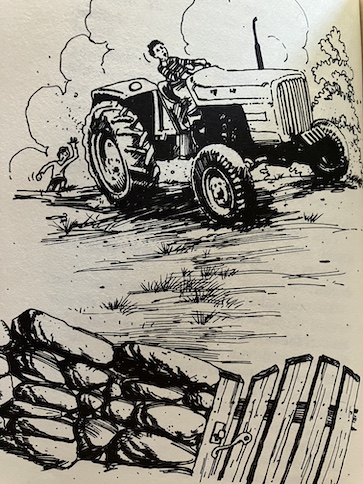
At first, this seems like just a fun farm visit. Uncle Grigorian is indulgent with the children, letting them eat as many chocolate cookies as they want, teaching the boys how to drive a tractor, and letting Helen play with the lambs. A man named Mr. Rhys manages the farm, and Mrs. Rhys is his cook and housekeeper, making them all a big, traditional, full English breakfast. Things get complicated when Tubs asks Uncle Grigorian what he does while Mr. Rhys manages the farm.

Uncle Grigorian shows the children his office in the farmhouse. At first, it just seems like an ordinary office. Then, Uncle Grigorian opens the filing cabinet, which contains dials and switches instead of files. The room changes so the ceiling and walls become transparent, and the children have a view of Earth from space. Tubs says that it looks like they’re on the moon. Fritz thinks that it’s just a trick with projectors, but Uncle Grigorian says that Tubs is actually correct, and they are on the moon. At first, Fritz doesn’t believe him, so Uncle Grigorian changes their location again, taking them to Trafalgar Square in London. Since they’re on Earth now, he invites Fritz to step outside and check their location. He does, and to his astonishment, they really are in Trafalgar Square. He buys a newspaper, and it has the current date on it.

Uncle Grigorian explains to the astonished children that the office actually contains his spaceship, which is about the same size as the room itself. He can travel through space easily, but traveling around Earth is more tricky because he can’t risk colliding with other objects. He has to know the exact coordinates for where to land, so it’s best for him to go to rooms that he has already rented as office space, where he will know the exact coordinates and knows that the room will be the right size for the spaceship.

At this point, Fritz begins to suspect that Uncle Grigorian, whose oddly-positioned thumbs were already a source of curiosity for them, might not actually be human. Tubs had earlier joked about those thumbs meaning that he’s from outer space, and once again, Tubs is more right than anyone else suspected. Uncle Grigorian admits to the children that they’re not actually related at all. Uncle Grigorian is a kind of sociologist from a planet called Klipst, and he’s also a kind of secret agent for the Galactic Empire. He studies societies on different planets and keeps an eye on planets that are just starting to discover space travel. He latched onto the children’s family as a cover for his identity and activities, specifically because their father had been a war orphan who didn’t know much about his family or what happened to them. Most people would be suspicious about an unknown relative suddenly turning up, but with their family, it would be entirely plausible for them to have an uncle they knew nothing about. He says that Earth is getting close to discovering hyperdrive travel, and when it does, the Galactic Empire will need to decide whether or not to admit Earth to the community of planets.

The reason why Uncle Grigorian is telling them all of this is that he needs the children’s help. There is a dispute that needs to be settled between planets, and he asks the children to be arbiters in the dispute. The planets involved specifically want the arbiters to come from outside the Empire, and they don’t want politicians, who would probably be motivated by biases and self-interest. They have decided that they want child arbiters to hear the dispute because children have a great sense of fairness, and adults are often hardened to the unfairness of life in general. Children would be completely unbiased in this situation and not have a jaded point of view. Uncle Grigorian tells the children that it’s up to them whether they would be willing to accept this mission or not. Tubs is eager to accept and go to outer space, but the twins are more hesitant. They’re not sure if they know enough or would be able to be arbiters in an intergalactic dispute. Uncle Grigorian tells them that, if they accept the mission, he will give them something that will change that, and they decide to accept.

Uncle Grigorian says that he will give them “the Powers”, which is a special mental weapon that’s only been recently developed. It works a little different for everyone, but it enhances people’s mental abilities. Anything that a person has as talent will be enhanced so they become a natural expert in it. To gain these powers, the children have to sleep for the night in Uncle Grigorian’s spaceship while wearing special earpieces.

In the morning, he checks on them and asks them if they notice anything different about themselves. Helen can tell right away that Fritz isn’t telling the truth when he says no because she has acquired the ability to read people’s emotions and body-language like an expert. Uncle Grigorian calls her a Reader because of her ability to read people. Further, Helen can tell that the reason why he denied noticing anything was because he wanted to hear what the others would say first. Fritz admits that this is true. He says that what he has noticed is that he went to sleep trying to figure out how the ship can travel such long distances so quickly, and when he woke up, the answers just came to him. Uncle Grigorian calls him a Synthesist, someone who can put together pieces of information quickly, seeing how things relate to each other and how they work.

At first, Tubs can’t figure out if anything about him has changed or not, but Uncle Grigorian tries giving him a small, round, fuzzy creature called a Petball. (Sort of like one of the Tribbles from Star Trek.) Tubs loves it immediately. It also seems to like him, and Tubs gives it the name Glob. Uncle Gregorian says that his attachment to the creature is a sign that he’s a Maverick. Petballs are strange creatures, and they don’t like everyone, but they do like Mavericks. Maverick Powers are difficult to understand because people who have them have an odd way of saying or doing unusual things that turn out to be the right decision or reaching conclusions that turn out to be unexpectedly correct. It’s hard to say exactly when or how Tubs will use his Power, other than getting along well with Glob, but Uncle Gregorian says that it will be there at the right time for him to use it.

Tubs’s Power begins to show after they arrive at Palassan, the capital of the Galactic Empire. A strange girl comes up to them soon after their arrival and tries to offer a flower to Helen. Without him being able to explain exactly why, Tubs automatically reaches out and knocks the flower to the ground. When it hits the ground, it breaks, and they realize that is it really an electronic device that was supposed to transmit a subliminal message to Helen. Someone is already trying to influence the children as arbiters in the dispute. Soon after that, Fritz begins to notice how closely they’re being guarded, but are the guards there for their safety or because they’re now prisoners?

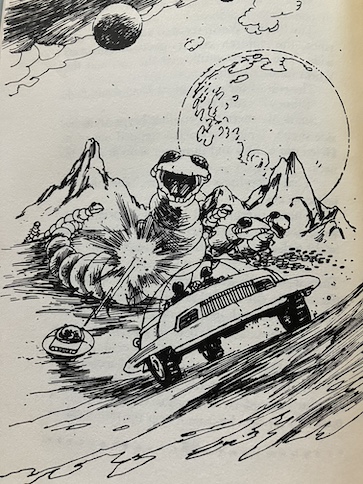
When the kids begin hearing about the dispute, they are told that a new planet has been discovered in a place where there has not been any planet before. It is not near any star, and there doesn’t seem to be any explanation of how it got there. An expedition to the planet discovered that what looks like “clouds” is actually some kind of vegetation that emits light, and there are worm-like creatures living on the surface. The problem is that these large Worms spin a substance called Unilon, which is very valuable. Since the Worm World was discovered, people have flocked to the planet to harvest it for selling. Some of them have captured Worms and forced them to spin continually until they die. The League of Life says that it is concerned about the welfare of these creatures, and the Unilon Harvesters Association says that it’s concerned about jobs. With her Power, Helen can tell that neither side in this dispute is telling the truth. Fritz does some research and uncovers some ulterior motives and hidden sides to both sides of the dispute. He decides that finding a solution means going to the Worm World itself, but learning the secrets of the mysterious world will put them all in danger.

The book is available to borrow and read for free online through Internet Archive.

I thought that the premise of this story was interesting, a mysterious “uncle” who is actually an alien in disguise who gives the kids a mission in space and special powers. The secret of the Worm World is also intriguing. It turns out (spoiler) that the world itself is alive, and they have to find a way to communicate with it. It’s a plot that sounds a little like some of the early Star Trek episodes or maybe inspired by them.

Most of the emphasis of the story is on the twins, even though there are three kids involved. Tubs helps in the story, but I was expecting that he would be more central to the solution of the problem or that the solution would be more of a cooperative effort than it was. I was a little disappointed at how quickly the story ended.

One thing I’d like to point out that, even with their enhanced “Powers”, the kids aren’t perfect at them. Fritz puts information together pretty easily, but he still has to do research and observe things directly to get the information he needs. Even when he has it, he doesn’t necessarily understand its full significance right away. His comment about how it looks like they’re being held prisoner rather than being simply guarded for their protection turns out to be more accurate than I thought it might be at first, but he doesn’t seem to have fully realized the reason why or who they can’t trust. Even Helen, with her ability to read people’s emotions and body-language doesn’t realize at first that their guard isn’t trustworthy. She could tell that he was uneasy, but she attributed his uneasiness to the wrong reason.

Actually, I think the part about Helen not being perfect at reading people is a good callback to the argument between the children about Tubs’ nickname at the beginning of the story. Helen argues that Tubs shouldn’t mind his nickname because Fritz never complains about his, but Helen hasn’t accurately read even her own twin’s feelings about his nickname. The truth is that Fritz doesn’t like his nickname any more than Tubs likes his, but the book says that he’s old enough to have figured out that, if he makes a fuss about not liking it, people will use it even more. I know that people can be like that, but being even older than Fritz is, I’m old to have figured out that this rule only holds true as long as the people involved decide it does. This isn’t something everyone does naturally or all the time; it’s a thing that some people do habitually because they’re pushy and like provoking reactions from people. When they get a negative reaction from someone, they just push harder to get more reactions rather than realize that they’re getting on that person’s nerves and cutting it out. What I’m saying is that Fritz seems to have correctly realized that Helen is that type of pushy person, which is why he doesn’t complain to her about how much he hates his nickname, while Helen has totally missed both Fritz’s real feelings and the fact that he’s figured her out. We’re supposed to accept that Helen already had a natural ability to read people even before getting her enhanced “Powers”, but the whole nickname incident had me rolling my eyes about Helen’s ability to read even her own family members and wishing that she would get a clue.

I expected that the characters would eventually revisit this situation with Tubs’ nickname before the end of the book and that Tubs would do something to help the situation that would earn his cousins’ respect. However, neither of those things happened. Fritz is the one who mainly solves the problem, and he does so rather quickly toward the end of the book. I was surprised at how quickly the book ended. Because the kids all keep their powers and Tubs is able to keep Glob at the end of the story, I wondered if maybe the book was originally intended to be the first in a series, with further adventures and more character development in later books, but if that was the case, I can’t seem to find anything about it.

I found the issue of language in the story interesting. People in the Galactic Empire speak a common language that Uncle Gregorian describes as being sort of like Esperanto, no matter what planet they come from. The treatment that gave the children their powers also gave them the ability to speak and understand this language, even when they’re not fully aware that they’re doing it. I liked the idea of a common language that’s a kind of conglomerate of other languages with Esperanto as the inspiration. Because the characters aren’t fully aware of that they’re hearing or speaking this language, we don’t have any hints of what it would be like, but I just thought the concept was interesting.

Double Trouble

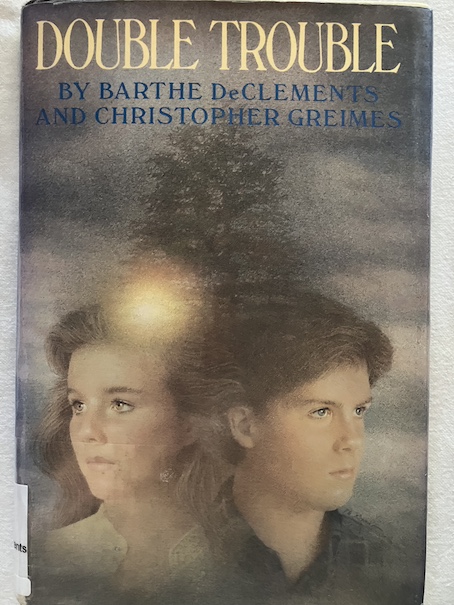
Faith and Phillip are twins and the only members of their immediate family who are alive. Their parents and their older sister were killed in a car accident. Faith was taken in by their aunt, but their aunt didn’t think that she could manage to care for two children, so Phillip was sent to a foster home. The story is written in the form of letters to each other (this is called epistolary style) after their separation.

Separating is cruel, especially when they’re orphans, but there is something about Faith and Phillip that other people don’t know. They have psychic powers, and they have the ability to communicate their feelings to each other with their minds. They have to communicate specific information to each other in writing because their psychic abilities only communicate their general mood and circumstances, but their psychic link to each other makes them feel less alone when they’re apart. Apart from dealing with their grief over the loss of their parents and the changes to their lives, each of them is also in a troubling situation.

In her first letter to Phillip, Faith tells him about a disturbing encounter with a teacher at her new school. Faith was selling candy with another classmate, Sue Ellen, to support the school band. Sue Ellen gets the idea of going by Mr. Gessert’s apartment. Mr. Gessert is their social studies teacher and is considered one of the cool teachers in school. Faith can tell that Sue Ellen has a bit of a crush on him. He buys one of their candy bars, and Sue Ellen asks to use his bathroom. When Sue Ellen seems to be taking awhile, the teacher goes to see if everything is okay, and he catches Sue Ellen snooping around. He gets especially angry when Faith is about to touch his cane near the door. He grabs both girls by the arm and throws them out of the apartment. Although snooping in someone’s private rooms is rude, the girls are startled by how angry Mr. Gessert is. Faith asks Sue Ellen what she saw in his apartment, and Sue Ellen says that she didn’t see anything. She had just started to open the door to a room when he found her. The next day, Sue Ellen brags to other kids at school about having been in the teacher’s apartment, but Faith is still concerned about how angry Mr. Gessert was.

When Phillip replies, he says that he can understand why the teacher would be annoyed at someone snooping through his stuff, and he tells Faith about his new foster parents, the Wangsleys, Howard and Cynthia. He’s now living in Seattle, about 50 miles from where Faith is living. Phillip also got picked on at school by a bully, but a girl named Roxanne spoke up for him. He thinks Roxanne is pretty, and he describes her aura as being indigo. (The twins also have the ability to see people’s auras and use them to learn things about other people.) His new foster parents don’t take his vegetarianism seriously, trying to convince him to eat meat. They say that God put animals on Earth for people to eat and that he has to eat like they do. Their house is shabby, and Howard keeps Cynthia on a tight budget. That surprises Phillip because he thinks Howard must be making decent money at the shipyards. He wonders how Howard spends his money, if it’s not on his wife or home. He knows that Howard and Cynthia belong to some kind of religious group and that, whenever they return from one of their meetings, they act strangely, and their auras are weird. He’s still grieving their parents and sister, and with all the stresses of his new home, the only time he feels better is when he’s using astral projection, to get away from it all.

The twins learned their psychic skills from their sister Madalyn and Madalyn’s friend, Roger, who is an archaeologist. Faith doesn’t quite have Phillip’s ability with astral projection, but she can sometimes get visions of other people and what they’re doing. She uses this ability to try to learn more about Mr. Gessert, and she sees that his cane is actually a gun. She watches him loading it. Why would a teacher have a cane with a hidden gun?

Faith is still angry that her aunt didn’t take Phillip, too. She also hesitates to ask her aunt for things she needs because she doesn’t want to seem like a charity case. She has a part-time job taking care of her neighbors’ dogs while the neighbor is on vacation, and she uses the money to buy a pair of second-hand boots. When Aunt Linda finds out that Faith bought second-hand shoes, she says that Faith should have told her that she needed shoes because she doesn’t want people thinking that she isn’t taking care of her niece. Still, after she cleans them up, they don’t look bad, and she gets compliments on them at school.

The next time she sees Mr. Gessert in class, he seems normal at first. He gives the class a lesson on the Donner Party of pioneers, who were trapped by a snowstorm and resorted to cannibalism to stay alive. (This is actually described in gruesome detail in the book. Some kids like a good gross-out, but I never did.) After Mr. Gessert describes all the gory details in class, one of Faith’s other classmates comments that Mr. Gessert seems crazy. Faith knows that he was telling them the truth about what happened, but she finds it disturbing how much he seemed to enjoy recounting all the grossest parts, and other classmates agree. Phillip is concerned about Faith’s description of the teacher, so he uses astral projection to spy on him, and he agrees that Mr. Gessert gives off weird vibes.

Both Faith and Phillip connect with other kids at their schools who have an interest in psychic abilities. Faith meets a boy named Jake, who is intrigued because his father has been reading a book about remote viewing, which is what Faith does. As Phillip becomes friends with Roxanne, who is interested in the topic of astral projection. When Phillip confides in her about his astral projection abilities, she asks him to teach her how to do it.

One day, when Phillip and Roxanne are at the library, they see Mr. Gessert there. Mr. Gessert has an interest in Spanish treasure, and there is a special exhibit at the library with some very valuable pieces. Soon after that, the Spanish treasure is stolen from the library. It doesn’t take a psychic to see that Mr. Gessert, who has already been established as creepy and suspicious, might have a motive to steal it, but he’s not the only suspect. Working separately, with the help of their friends, Phillip and Faith use their special mental abilities to get to the bottom of Mr. Gessert’s secrets.

The book is available to borrow and read for free online through Internet Archive.

There are a lot of metaphysical themes to this story with the kids exploring their psychic abilities. It is revealed that their old family friend, Roger, is a kind of archaeologist/treasure hunter, but he is regarded as unorthodox by his colleagues because he uses his psychic abilities to guide his discoveries. Roger is the one who taught the twins and their older sister how to use their abilities.

In the story, the people who are open to developing their psychic/spiritual/metaphysical sides are the heroes, and they thrive when they connect to other, like-minded people and share what they know with each other, helping each other to develop. However, there are unhealthy forms of spiritual development in the story. Phillip is unnerved about the Wangsleys and their religious group from the beginning because the Wangsleys always act strangely after one of their meetings. Initially, I was concerned that this group might be doing drugs or something like that, but that’s not the case. It’s a little vague exactly what group the Wangsleys are part of, but it seems to be a very conservative Christian group with a cult-like devotion to their leader, and the the Wangsleys have an unhealthy relationship with it.

I don’t think it’s an unhealthy group for being Christian, but it seems like devotion to this particular group encourages overly harsh discipline and emotional manipulation and that Howard and Cynthia’s relationship with each other is troubled because of disagreements about their level of devotion to the group’s standards. I sometimes think that people who don’t have a religion imagine that all Christian groups are like that, but I’ve been to various Christian churches throughout my life, and most are not like this. There are some extreme groups like this, but this is definitely an extreme group. It seems to be an isolated group that isn’t part of a larger denomination. It seems to have just one charismatic leader. I think it’s implied, although not directly stated, that the reason why Howard isn’t spending more money on keeping up his house is that he’s contributing a large portion of his income to this religious group. I’m a little suspicious about the money issue and the long periods that the group’s leader seems to spend in Hawaii, ostensibly on religious business. While it isn’t stated explicitly, and I could be wrong, I think there are some implications about the Hawaii trips and the money of this group that make them seem suspicious.

Besides the metaphysical elements, there are themes of children adjusting to loss and trauma and major life changes with the deaths of the twins’ parents and their adjustments to their new homes. Initially, Faith doesn’t have a very good relationship with her aunt. She’s angry that her aunt didn’t accept her twin brother and sent him into the foster system, and she finds her aunt’s manners cold. She doesn’t trust her aunt enough to ask for the things she needs, even basic clothing, and her aunt gets upset about that. Things improve between them when they learn to communicate more openly with each other. Aunt Linda does care about Faith, but she’s also dealing with her own feelings and uncertainties about raising her niece. She has never married or had children, and while she does want Faith living with her, becoming a single parent is a major adjustment for her.

The Wangsleys are completely unsuitable as guardians for Phillip. They don’t accept his vegetarianism and complain about having to make special things for him. They keep trying to convert him, both to eating meat and to their religious group. I feel like their religious affiliation should have been disclosed from the beginning and that there should have been some discussion between them, Phillip, and Phillip’s caseworker about the differences between their lifestyle and the lifestyle that Phillip is accustomed to living, so they could all reach an understanding about what living together would mean for them before he actually went to life in their house. Phillip does describe some meetings with the Wangsleys and his caseworker during his time with the Wangsleys, where the caseworker tries to mediate circumstances between them and offer suggestions, such as ways they can deal with Phillip’s vegetarianism. Cynthia does make some efforts to accommodate Phillip’s eating habits, but they’re kind of half-hearted, and the Wangsleys absolutely cannot accept that Phillip doesn’t want to join their religious group. They heavily pressure him to convert, and when they discover Phillip’s astral projection activities, they’re convinced that he’s having visions given to him by the devil and demons. They tell Phillip’s caseworker that they want to adopt him, but Phillip finally speaks out about what life with them is really like. In the end, Roger decides that he will take Phillip, and the Wangsleys are forced to relinquish him to his caseworker.

From now on, Phillip will be living with a family friend who understands him and shares his lifestyle, and there are even hints of a possible romance between Roger and Aunt Linda. The hints of romance with Roger and Aunt Linda feel awkward, partly because the kids know that Aunt Linda is about 10 years older than Roger, a significant although not insurmountable age gap. Mostly, it just feels awkward to me because it seemed like there had been a romance relationship between Roger and the twins’ deceased elder sister. Switching attention from the niece to the aunt, even if the niece is now dead, just feels odd. Although, it’s not definite that their relationship will really be romantic. It might just end up being friendly.

The authors, Barthe DeClements and Christopher Greimes, are a mother and son team, and the inspiration for this story came from their own shared interests in psychic phenomena and “nontraditional methods of expanding awareness.”

I remember reading this book when I was a kid, and I was fascinated with the idea of communicating psychically with other people or being able to do astral projection. I don’t really believe in all of the metaphysical ideas that the book presents, but I think most children go through a phase where they’re interested in things like ESP and try to test themselves to see if they can do it. I actually had an English teacher in middle school who tested the whole class for ESP after we read some science fiction or fantasy story, just for fun. I can’t remember which story that was now, although I don’t think it was this one. I think it might have been a story about a typewriter that predicts the future, although I can’t remember the name of that one. I didn’t do very well on most of the tests, although there was one in particular where I did pretty well. After thinking it over for about 30 years, I’ve decided that it wasn’t because I had any significant psychic ability. The one test I did well involved predicting another person’s actions, and I think anybody could do that fairly well if you know something about the other person’s personality. The teacher did say that people do this activity much better if they do it with close friends, implying that friends have a special connection to each other, but I think it’s more the case that friends understand each other’s thinking better.

I can’t remember whether I read this particular book before or after I was tested for ESP, but I think it was after. I still had an interest in the subject, and I remember, one night, I tried my own experiment in astral projection. When I did it, I had a vision of space aliens. It was probably because I was dozing off in bed at night, and I was going through a sci-fi phase at the time, but I got spooked. You see, the punchline to this story is that I grew up in Arizona, and the night of my experiment happened to be the night of the Phoenix Lights. I was so creeped out the next day, when people were talking about UFOs that I stopped the astral projection experiments. Although I’m sure that it was all a coincidence, just a dream brought on by my own fascination with science fiction and space aliens, I decided that, while I was curious about how such things worked, I didn’t really want them to work for me. I might have been a cowardly child with a habit of spooking herself, but I was also a cowardly child who decided that there was no point in continuing to do things that she knew would spook her. I had my fun with that phase, and then it was time to move on to my next obsession.

Cold Chills

Fourteen-year-old twins Ryan and Chris Taylor are on a ski trip in Colorado with their parents, their eight-year old sister Lucy, and their friend, Billy Maguire. Although Billy is a friend of both of the twins, he’s really closer to Chris because the two of them are interested in sports. Ryan is more of an intellectual than either of them, and they tease him about not being as good at sports as they are. When the three of them get together, Ryan often feels left out, although he argues with them that he can do decently well at physical activities; he just cares more about other things.

The ski resort where they will be staying is called Moosehead Lodge. It used to be a very exclusive resort, but it’s fallen on hard times in recent years. The reason why they’re going there is that the current owner is an old friend of Mr. Taylor’s from college, and he’s asked Mr. Taylor to write a travel article about the lodge for a magazine to attract new customers.

It turns out that Dede and Wendy, two girls who attend the same school as the boys, will also be staying there over winter break. The twins have crushes on the girls, but they’re also at the age where they still think girls are weird or likely to spoil their fun, so they have mixed feelings about the girls joining them on the ski trip. The boys consider trying to avoid the girls for the entire trip and make them wonder what happened to them, but Ryan thinks that sounds like something a little kid would do. Billy says that, if the twins are going to hang around with girls, he wants a girl for himself, too.

When they arrive at the lodge, the girls greet them right away, so the hiding scheme definitely won’t work. The girls are enthusiastic that there will be a lot of fun things for them all to do. The lodge includes several stores for the guests to shop in, which the girls and Mr. and Mrs. Taylor find intriguing. However, the boys think that the lodge looks haunted. With all the old-fashioned furniture and paintings, it reminds them of something from a movie.

At their first ski lesson, Chris brags that he doesn’t really even need lessons because he’s such an athlete. However, skiing doesn’t come as naturally to him as soccer does. In spite of his bragging, he is clumsy at his first attempts. He apologizes to the instructor, saying that he’s just eager to get going because he knows that they’ll only be staying there a short time. The instructor says that he understands but that the instructions he’s giving them are important for keeping them safe while they have fun.

When the boys return to the lodge, Mrs. Taylor is very upset because a pearl necklace that’s a family heirloom is missing! When Mr. Taylor and the boys go to the manager to report the loss of the necklace, they find out that other pieces of jewelry have been stolen from other guests. The manager has hesitated to contact the police about it because he’s been hoping that the jewelry was merely misplaced and would turn up. The lodge is suffering financially, and if they have a bad season, they might have to close down. Mr. Taylor likes the lodge and wants to help his old friend, but the thefts have to be cleared up for the lodge to continue functioning. The twins decide that they’re going to be the ones to find their mother’s necklace, bring the thief to justice, and save the ski lodge!

The book is available to borrow and read for free online through Internet Archive.

I liked this book better than the last book I read in the series. It’s more of a mystery than the last one, although there’s still plenty of excitement and adventure. Unlike the other book I read, where the boys know right away who the villains are, in this story, the boys have no idea who the thief is for much of the book. They have to investigate different suspects, and their first suspects turn out to be completely wrong. The boys undertake a deliberate investigation into their suspects, moving from person to person. There are enough potential suspects with apparent odd behavior to keep readers guessing along with the amateur detectives. A skiing accident and a blizzard and avalanche add excitement and adventure to the story.

When the girls argue with the boys about one of their subjects, the boys say that girls would be more likely to fall in love with a jewel thief than to either be a jewel thief or catch one themselves. The kids turn their investigation into a contest, boys against girls, to see which of them can solve the mystery first. The competition between boys and girls gets carried over to the adults, and it even influenced some of my theories about the identity of the jewel thief. Part of what I suspected turned out to be true, but saying what it was would be a spoiler. 

The boys do solve the mystery before the girls, although the solution does disprove some of what the boys said earlier. Considering some of what they said, I would have liked to see more acknowledgement about that, but the book ends a little abruptly after the final solution is revealed. Overall, I liked the story, but I could see some room for improvement in the ending. Although I understand that part of the premise of this series is that the twins can sense each other’s thoughts, that doesn’t really enter into the story, either, which was also a disappointment.

Dangerous Play

Thirteen-year-old twins Ryan and Chris Taylor are visiting Kansas State University during homecoming week because their parents used to attend the university, and the boys are looking forward to getting their first look at life on a college campus. They’re also looking forward to the big football game. At least, Chris is looking forward to the game. Ryan isn’t as athletic and doesn’t see the appeal of sports as much as Chris does. Ryan is more studious. However, both of the boys are hoping to meet Trent Dasher, the star quarterback on the Kansas State football team. Chris wants to ask him for sports advice, and Ryan is hoping to get some pictures of him for their school’s newspaper. Meanwhile, their parents are looking forward to reliving their college years. They met in college, and they spent their honeymoon at the same hotel where they are now staying with the boys.

The twins go in search of Trent Dasher. They contacted him before arriving, so he should be expecting them, but they discover that he is missing. When they go to his dorm room, his roommate doesn’t know where he is. Then, the boys overhear a conversation between Coach Butler and Dean Murray in the athletic offices, in which the coach says that Trent has been behaving oddly recently, and now, he can’t find him. The twins ask Trent’s roommate, Danny, for more information about Trent and if he knows anything about where he might be. Danny says that he and Trent don’t really confide in each other. Even though they’re sharing a dorm room, they’re both pretty busy with their own activities. Danny has noticed that Trent has been unusually nervous recently and that he’s missed some classes, which is out of character for him. Danny suggests that they look for Trent at the Wildcats’ Lair, a snack bar in the University Union where Trent likes to hang out.

Before they leave Trent’s dorm room, the boys sneak a look at Trent’s belongings, and they learn a few things about him. Trent has a girlfriend named Jeannie who lives in their town and has written letters to him. He’s also in danger of failing his chemistry class if he doesn’t get some extra help, and if he fails chemistry, he could lose his scholarship. The boys figured that his problems with his classwork and the threat of losing his scholarship are probably what was worrying him so much.

When the boys go to check out the Wildcats’ Lair, they meet a girl who says that she’s Trent’s girlfriend. Unfortunately, she isn’t Jeannie. When the boys address her as Jeannie, assuming that she’s the one who wrote the letters, she says that’s not her and gets angry. The twins are embarrassing, thinking that they might have just accidentally created a new problem for Trent by complicating his love life.

The boys finally locate Trent talking to a tutor called Wilson about getting help to pass his chemistry exam. It seems like the mystery of the missing athlete is over, but then, Wilson tells Trent that the way he “helps” students is by selling them the test answers. Trent gets angry and refuses to cheat. The boys try approaching Trent, but he doesn’t want to talk to them because he has too much on his mind.

The twins are a little offended at being brushed off by Trent since he knew they were coming and had agreed to meet them, but they can also see that Trent is in trouble and could use some help. They decide to go after him, and they hear him talking to someone on the phone about a special “deal.” Since they just heard him turn down an opportunity to cheat by purchasing test answers, what kind of “deal” is he looking into to solve his problems?

The boys follow Trent and see him meeting with Coach Hatfield from Flint Hills University, Kansas State’s rival. It seems that Coach Hatfield has made Trent an offer to come play for their team, or at least, that’s how Trent interpreted his offer. With his scholarship to Kansas State in danger, Trent is considering the possibility of switching schools. However, it turns out that Coach Hatfield wants something very different. He wants to bribe Trent to throw the upcoming homecoming game and make sure his team loses! He says that he’ll make sure that Trent has enough money for his tuition if he does. Trent is appalled and refuses.

The twins continue to follow Trent as he goes to talk to his girlfriend, Cindi, who is the girl they met earlier. She asks him about Jeannie, but Jeannie is just a high school girl from his home town who has an unrequited crush on him. He’s really serious about Cindi. Trent tells Cindi everything about the troubles he’s been having and the unethical offers he’s had. She asks him why he hasn’t gotten help from the legitimate tutors or from his professor, but he says that the chemistry tutor quit and hasn’t been replaced yet and that his professor seems to have a prejudice against athletes. Trent is thinking that maybe he should just quit college and get a construction job so that he and Cindi can get married, but Cindi doesn’t think that’s a good idea.

Even if Cindi can help Trent find a solution to his problems in chemistry, Trent’s football problems are just beginning. He turned down Coach Hatfield’s proposition, but the Flint Hills football team isn’t going to take no for an answer. They’re prepared to use violence to make sure that the upcoming football game goes their way. Chris and Ryan witness some of them kidnapping Trent! They’ve got to get help and prove that Trent is in trouble to save him!

The book is available to borrow and read for free online through Internet Archive.

There wasn’t really much mystery to the story, which was a disappointment to me. The boys figure out where Trent is and directly witness his kidnapping, so there’s nothing really for them to figure out. It’s more about how they manage to rescue him. It’s more of an adventure story than a mystery. Part of the premise of this series is also that the twins have a kind of psychic connection and can sense each other’s thoughts, but that didn’t really enter into this particular story. The resolution of the situation didn’t depend on them having this ability, and for most of the story, the twins just talk to each other openly about everything without a need to communicate anything silently.

Things turn out okay in the end because Trent is able to make it to the football game and help his team win. The book doesn’t mention any of them going to the police about the coach and football team participating in an actual kidnapping, which made me feel a little weird. It’s great that the boys were able to rescue Trent and that he was able to win the football game honestly. Trent never compromises his values, in spite of the pressure he’s experiencing from all sides, and in the end, there’s an honest solution to his problems with his grades, but still, kidnapping is a serious crime, and I thought that there should have been serious consequences to go with it.

As for Trent’s troubles with chemistry, it turns out that his chemistry professor is actually an old friend of the boys’ parents, and he isn’t really against athletes. The only reason why he hasn’t noticed Trent failing and helped him to get the extra tutoring he needs is that, at a large university, classes are made up of hundreds of students, and professors rely on graduate assistants to help manage the grading. The professor doesn’t know that much about how individual students are doing. They mainly help when students approach them for help, which Trent hasn’t done. When the twins explains Trent’s problems to the professor, the professor talks to Trent, telling him that he should have come to him earlier and that he will help him improve his grades, not because he’s a star athlete but because he’s a student in need of help to complete his degree.

Although I wasn’t thrilled by the mystery itself because it wasn’t much of a mystery, there are some interesting points in this story about both prejudices people have about athletes and the system of success/failure at universities. First, the prejudice part is an obvious one. Many people assume that people are either smart and good at studying or that they’re not smart and that’s why they’re mainly good at sports – like life’s options are brain vs. brawn, with no in-between. The twins themselves represent this notion because Ryan is the studious one and Chris is the athletic one. This seems to be how other people think of them and how they think of themselves. 

Ryan in particular has this view. He’s good in school subjects, better than his brother, but not that good at sports and has no interest in sports. Chris is offended that his brother seems to think that his athletic prowess also makes him the dumber twin and that Ryan is often telling him that he needs to read more and study more or he’s not going to make it in college. Chris argues with Ryan and tells him that just because he’s into sports and not as good at studying as Ryan is doesn’t mean that he can’t manage. Ryan is correct that a student athlete can’t just be all about sports and neglect his school work, as Trent’s situation indicates, but he does underrate the athletes’ abilities to manage and think their way through problems. The boys also have some prejudices against girls, with Ryan particularly thinking of cheerleaders as being brainless, but Cindi, who is also a college cheerleader, comes through for them and helps to rescue her boyfriend. I didn’t like the way the boys talked about girls in the story, but Cindi’s role helps to highlight that theme of underestimating people and their abilities.

Success and failure are major themes in the story. Trent is a successful athlete, and generally, a pretty good student, apparently. However, the failure of one single class could endanger his scholarship and end his entire university career. As the chemistry professor points out later, it’s not just a matter of Trent losing his scholarship because of failing that class; this is a class that is required to complete his degree. We don’t actually know what Trent’s major is, but he apparently needs to understand at least some chemistry for it. Failure of this particular class is just not an option. A student whose scholarship was assured or who had other resources for paying for their education could simply retake a failed class and try to pass the next time, but there’s pressure for Trent because he really relies on his scholarship. Without it, there won’t be a next time for him. What the story points out is that it’s not just Trent’s failure but also the system’s failure. Professors with hundreds of students, and also the pressure of having to do their own researching, writing, and publishing on the side, just can’t keep up with every individual student and give them all the support they need. They rely on graduate assistants and tutors to fill in the gaps and provide that support. Trent falls through the cracks because the chemistry tutor left and hasn’t been replaced yet, and he was reluctant to talk to his professor about it. His lesson is one about how the university system functions and his need to go to his professor about his problems to get the help he needs.

It turns out that Trent isn’t the only one whose future hangs by a thread because of one possible failure. The reason why Coach Hatfield and his players are so desperate to win this upcoming football game is that Coach Hatfield will be fired if they don’t. The Flint Hills football players are desperate to save their coach. They see it as loyalty and as avoiding having to get a new coach that they won’t like as well, but that doesn’t justify engaging in a serious crime to accomplish their goals. In real life, they would be endangering their own futures by pulling this kidnapping stunt. The fact that the coach is willing to go along with such a thing may be a sign of why his career has reached this desperate point in the first place. It might not be just that he’s been unable to deliver the football victories that his university wants but that he also engages in reckless, irresponsible, and unethical behavior. At the very least, we know that he is likely to lose his job because his team lost the football game, but I still think that there are serious legal consequences for his actions.

The Mystery of the Blazing Cliffs

The Three Investigators

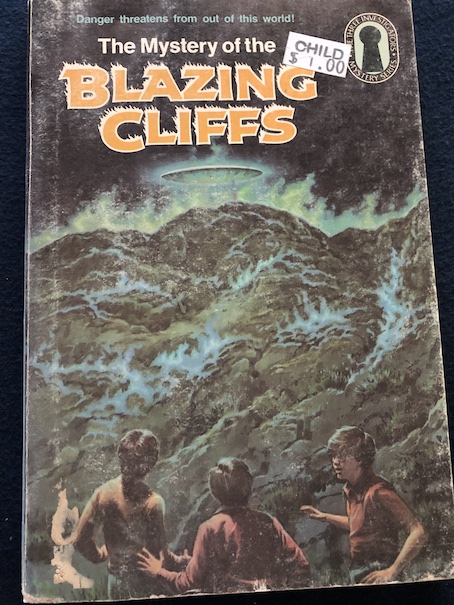
Jupiter Jones and his friends are helping out at his uncle’s salvage yard when they have a strange encounter with a disagreeable customer and his wife. Mr. Barron is a very demanding customer who throws a fit whenever something goes wrong, blaming other people when he’s at least somewhat at fault for what happens. He gets upset when one of the employees of the salvage yard tells him that they need to move his car because they’re expecting a delivery truck, and his car is in the way where he parked it. Mr. Barron gets angry because he parked his car “perfectly”, and he calls them incompetent for making him move.

The only reason why Mr. Jones puts up with Mr. Barron is that he’s buying a large amount of stuff, and it’s stuff that few other people would want, like a buckboard wagon, an old stove and stovepipes, and a broken butter churn. The weird thing is that Mr. Barron doesn’t seem interested in these things as antique collectibles or unique pieces of vintage decor, which would be what most people would use such things for. (I’m thinking of those restaurants where they have miscellaneous farm implements, wagon wheels, and antique/vintage items on the walls, and I think that’s what they’re thinking about, too.) Mr. Barron actually seems to want to fix them up and use them for their intended purposes.

Mrs. Barron glosses over her husband’s rudeness and talks about her belief in aliens as described by a popular book called They Walk Among Us. This book describes “the time for deliverance”, when our planet will be in danger from some kind of disaster, and aliens from the planet Omega will arrive to rescue people from the human race so our species won’t be lost. Mr. Jones thinks that the Barrons are crazy, but his own wife interrupts the conversation before Mr. Jones can say something that will ruin the sale.

Jupiter is intrigued by these weird people, and he persuades his uncle to let him and his friends go along on the trip to deliver all of the things they bought to their ranch up north. Jupiter’s friends are a little reluctant to see the Barrons again, but Jupiter points out that going on the delivery trip will allow them to also go on a buying trip at the same time, something that his uncle has promised them they can do. Jupiter has been wanting to take charge of a buying trip, but he also wants to learn more about the Barrons.

Before they leave, the boys do some research on Mr. Barron and learn that he came from a wealthy business family in the Midwest. However, he has been in and out of trouble with every business he’s ever run. He did pretty well at first after he inherited his family’s business, which made tractors, but then, workers went on strike for better pay and working conditions. Mr. Barron was forced to give them what they wanted, but he was so angry about the strike and being forced to make concessions that he sold that business and bought a different one. In his next business, he had problems complying with government anti-pollution regulations, so he sold that business and bought another one. In his third business, he was sued for discriminatory hiring processes, so he once again sold out and tried another business.

Since then, he has had a string of different businesses, and each and every time, he ran into some kind of problem with government regulations or labor disputes. Every time he has any kind of problem in business, he immediately quits that type of business entirely rather than sticking to it and working things out. He just can’t accept imperfection in any form, and he defines imperfection as anybody or anything that goes against what he, personally, wants to do, regardless of circumstances. He denies that he could be imperfect himself, that he needs to adjust to new or changing situations, or that he needs to improve in any way, blaming everyone else for all of his problems. Finally, unable to find any business where everything goes absolutely perfectly all the time, where there are no rules or standards to follow other than his own and nobody to check that he’s following them, and where he never gets any form of negative feedback, Mr. Barron decided to sell off his remaining business interests and buy a ranch in California, which is where he is now. He’s planning to use the ranch to experiment with new crops and self-sufficient living.

When the boys arrive at the ranch with one of Mr. Jones’s delivery drivers, Konrad, they realize that the ranch is a kind of commune. The people who work for Mr. Barron and live at the ranch show them around and explain how the ranch has its own power supply and water supply. Elsie, who is the cook at the ranch, tells them that Mr. Barron seems to be preparing for some kind of “revolution”, when there will be some kind of catastrophe and society falls apart. (Remember, for Mr. Barron, society and all other humans besides Mr. Barron are idiots and incompetents, so of course, everything is falling apart.) Most of the people at the ranch don’t really believe that’s going to happen. They’re there mainly because Mr. Barron hired them to work there. However, it seems like the Barrons are deep into this notion of a coming disaster.

Konrad thinks that this ranch is very weird, and he wants to leave, but the boys persuade him that they should accept Mrs. Barron’s invitation to stay for dinner. Konrad chooses to eat with the staff rather than face Mr. Barron again. During dinner, the boys are treated to Mr. Barron’s negative attitude about everything, from his disappointment in his adopted sons (and, by extension, in young people in general) to “the evils of plastic in almost any form”, from synthetic leather to polyester clothing. By contrast, Mrs. Barron is very fond of her adopted sons, one of whom is part of a rock band and the other of whom is a poet who supports himself by making wooden clogs. Mrs. Barron says that the rock drummer son will be coming to the ranch in August for the Blue Light Mission convention, a meeting of other people who also believe in aliens who will save humanity. The author of They Walk Among Us will also be there as a guest speaker. 

Although Mr. Barron seems to have at least some belief in the idea that society is falling apart because of “anarchists and criminals who want to take over”, his criticism of people in general also extends to his wife and the other people who attend these alien conventions and believe in They Walk Among Us. Even though he’s hosting this convention for his wife’s sake, he thinks that the convention attendees are a bunch of kooks and crazies who would victimize his wife if he didn’t keep an eye on her. Basically, both of the Barrons are conspiracy theorists, but they’re not following quite the same conspiracy theories. Mrs. Barron is the more positive and hopeful of the two of them, believing that things will somehow turn out okay when the aliens show up, cheerfully ignoring her husband’s negativity, and continuing to talk about how much she’s looking forward the convention and meeting other, like-minded people. By contrast, Mr. Barron thinks society is just going to fall apart, and it will be everyone for themselves, and that’s about it.

The Three Investigators’ involvement with the Barrons would have ended after their delivery errand and dinner, but when they try to leave the ranch, they are stopped by army officers. The officers tell them that the roads are closed because of orders from Washington. The boys and Konrad are forced to return to the ranch, and Mr. Barron is angry about the roads being closed. The army officers tell Mr. Barron that they are just following orders. They further say that something has happened in Texas, and because of that, there is no electrical power, and the telephones, televisions, and radios aren’t working. Elsie has a battery-operated radio, and she turns it on to find out what’s happening. They hear a speech, apparently from the US President, about unidentified aircraft being seen around Texas, New Mexico, and California and possible landings in those states.

Naturally, when confronted with this serious situation, Mr. Barron is ready to take charge and deal with it in his usual way – by immediately finding someone to blame, dishing out criticism, and calling other people stupid and incompetent. He complains that the President gave a stupid speech that doesn’t provide any useful information and that he can’t understand how this guy ever got elected in the first place. Then, he goes off on a rant against communists and anarchists. (Seriously, that’s how both this book and his thought processes go. In a way, he’s very 2020s, a man decades ahead of his time.) Elsie points out that the people at the ranch are safe, no matter what’s happening, because the ranch is designed to be self-sufficient. Mr. Barron may be an angry mess of paranoia and negativity, but he is thorough and has been planning ahead for disaster this entire time.

The military officers say that the roads are being blocked off to the public so they can be used for military vehicles. Mr. Barron becomes convinced that either some disaster has happened or that the politicians believe that one is imminent. He also thinks that the politicians blocked off the road to the ranch so they can come and shelter at his amazing, self-sufficient ranch themselves. (Once again, everyone else, from the government to the general public, is incompetent, and only Mr. Barron does things right. He further assumes that the rest of the world must somehow secretly know this, quietly envies him, and plots to take advantage of him.) There’s no sign of anyone else arriving, at least not yet, but Mr. Barron, who has a deep disdain for fools of all kinds, doesn’t like the idea of welcoming a bunch of political fools. However, he does show sympathy to the boys and Konrad because he can recognize that nothing that’s happening is their fault. He tells them that they’re welcome to stay at the ranch until this situation, whatever it is, is cleared up.

The Three Investigators decide that they need to find out what’s really happening in the cities outside of this ranch and verify what they’ve been told about the situation because everything was fine when they left home. Since they can’t leave by the road, they do a little scouting around the area to see if there’s a route they can use to walk to another town. Since it’s getting dark, they decide that it would be too dangerous to try hiking and climbing in the area at night. They plan to wait until morning to actually leave, but while they’re looking around, they witness something very strange. They see what looks like blue fire on the cliffs near the ranch and some kind of silver, oval-shaped object in the sky! Have they really witnessed a flying saucer? Is what Mrs. Barron believes about aliens coming to Earth true?

The book is available to borrow and read for free online through Internet Archive (multiple copies).

I love this Three Investigators mystery because the premise was so unusual! Three Investigators mysteries are often what I call Pseudo-Ghost Stories, like the mysteries in Scooby-Doo because any supernatural inevitably turns out to be faked in some way for some ulterior motive. This also applies to science-fiction other-worldly phenomena, like aliens. The great thing about this book is that the phenomena is so over-the-top that it’s difficult to think of a plausible way that it could be faked or a reasonable reason why someone would even do it. In this case, we know immediately that the boys see what looks like blue flames and a flying saucer, and there are either military personnel or people pretending to be military personnel blocking the roads out of the ranch. This is a plot that would seem to involve some impressive special effects and a significant cast of conspirators, and the purpose behind it doesn’t seem obvious.

Pretty early in the story, I had a couple of theories about who could profit from faking a UFO, but I had doubts about it because of the relatively small audience involved and because it seemed like there would be much easier methods of them accomplishing their goals. It is a pretty over-the-top plot, although it’s partially explained because Mr. Barron is a rather over-the-top figure to target. It is his paranoia and reluctance to call in authorities and outside help with anything that sets him up for this. Mr. Barron’s attitude that anything that contradicts him or his view of anything is inherently wrong cuts him off from the kind of reality checks he needs, even though he understands that his own wife can use some reality checks outside of her group of fellow alien enthusiasts. 

I knew that, for anybody to get the idea of doing this type of hoax and to plant the evidence to create the illusion of alien landings, one or more of the conspirators would have to be directly involved with the ranch. One of them is obvious, when you think about it, because it’s one of the people who directly supplies some of that evidence. Part of the mystery is about who else is involved. I could see multiple ways that could have gone, and I considered different possible masterminds for the scheme and different motives behind it. Most of what I considered turned out to be wrong, although my theory that Mrs. Barron could have engineered the whole thing with the help of her adopted sons and some friends from the alien conventions with the goal of demonstrating to Mr. Barron just how vulnerable his own paranoia and obsession with his personal conspiracy theories has made him would have been fun. Mrs. Barron may be gullible when it comes to her favorite alien conspiracy theory book, but I would have enjoyed a little role reversal, where she turns out to be more clued about human nature than Mr. Barron, who is so self-obsessed and ultra-skeptical about other people, refusing to receive information, advice, or criticism from anyone else, that he routinely fools himself without outside help. 

Alternatively, I though that the Barrons’ sons could have teamed up to pull this off to make both of the Barrons see the folly of their ways. In a way, I think that Mrs. Barron’s belief in the aliens is partly as a remedy to her husband’s relentless negativity. She believes him that disaster is impending because she actually thinks a lot of her husband and trusts his opinion on the way society is going, but being a more hopeful and trusting person, she has latched onto the idea of rescuing aliens because her husband doesn’t believe in fellow humans. Of course, Mr. Barron disdains that theory because he can tell that it comes from fellow human beings, who are all varying degrees of stupid, incompetent, and scheming, but Mrs. Barron clings to it as a hopeful thing that binds her to like-minded people because she needs that sense of hope and connection. At least, that’s how I read the situation. Mrs. Barron believes everything, even things she shouldn’t, and Mr. Barron refuses to believe anything, even things he should. There is a happy medium between believing everything other people say and allowing them to lead you around by the nose and being so paranoid that everyone is either wrong or out to trick you that you refuse to engage with the real world and turn aside legitimate sources of help and outside information. Neither of the Barrons represent that happy medium, and I would have liked the conspiracy to bring that to light. In a way, it does, but that’s not really the main focus. It’s more about taking advantage of the Barrons and their eccentricities.

I also considered the idea that the entire plot could have been a publicity stunt by the author of Mrs. Barron’s favorite book and the convention organizers. I even thought that Mrs. Barron might have been in on it as a true believer, trying to get her husband and others to believe. However, that’s not the case. The book and the convention just supply the inspiration for the conspiracy.

In a way, this story reminds me a little of the Sherlock Holmes story The Red-Headed League, where there’s a seemingly outlandish scheme to cover an ordinary theft. There is a twist to this one because nobody but Mr. Barron knows exactly where the thing they’re trying to steal is. In the end, only Jupiter reasons it out because he has really come to understand the way Mr. Barron’s mind works.

The mystery is intriguing because there are so many possibilities to consider. In a way, I preferred all the possibilities to the eventual resolution of the mystery, but the solution does make sense. It’s still an over-the-top plot that involves a significant number of people, equipment, and special effects, but it does appeal to my inner Scooby-Doo fan, who enjoys a good, complicated scheme and a villain behind the mask.