#21 The Deserted Library Mystery by Gertrude Chandler Warner, 1991.
Mr. Alden tells his grandchildren that a friend of his in a nearby small town, Pete, is concerned about their local library. The town is really too small to support a library, and when the last librarian left, they weren’t able to replace her. The library has fallen into disrepair and is in danger of being torn down. However, the building is old and has historical significance. It might be preserved as a historical landmark, but it needs some cleaning and organizing. Mr. Alden asks his grandchildren if they would be interested in the project, and they say they would. Pete spends part of the year living at his restaurant in town, so the Aldens can use his house while they’re working on the library project.
When they get to Pete’s house, they have to do a cleaning job there because Pete hasn’t been there in a while, and the place seems a bit spooky to them. The library seems a little spooky to them, too, when they begin looking around, but they soon begin finding some significant treasures. The children find a sword hilt from the Civil War along with a letter about the sword being awarded to a soldier by General Lee, but for some reason, the blade of the sword is missing! They children know that, if they can find the sword blade, it would be of great historical significance.
Then, strange things start happening in the library. Food that they bring for lunch disappears, and the kids start feeling like they aren’t along in the building. They search the library and find a 10-year-old boy named Miguel Morales. Miguel explains that his mother is dead and that he heard his father’s fishing boat sank. If his father is dead, he has nowhere to go and is afraid of being put in an orphanage or children’s home. The Boxcar Children sympathize with Miguel because they were once in a similar position, but they also tell Miguel that the situation might not be as bad as he thinks. They don’t know for certain whether Miguel’s father is dead or not. He can’t hide in the library forever, so they invite Miguel to stay with them and help with the library project while they check and see for certain what really happened to Miguel’s father. Henry contacts his grandfather to ask for his help and to see if he can learn anything about Miguel’s father. Mr. Alden agrees to help Miguel and is thrilled to hear about the Civil War sword.
Finding Miguel seems to clear up the mystery of who has been in the library, but the children soon begin to realize that there is a second intruder. The kids find a gray work glove in the library that doesn’t belong to any of them, and Jessie hears someone humming when no one is supposed to be there. Then, someone tries to trap them in Pete’s house by putting a big branch in front of the door, and when they get out and return to the library, they find the place trashed! Someone has thrown all the books around and torn them and turned the furniture over. Later, someone sneaks into Pete’s house at night, while the children are there but asleep, to search the place. Henry is pretty sure that the mysterious intruder is searching for the Civil War sword, the most valuable thing they’ve found so far.
My Reaction
I like the location and set-up of the story. An abandoned library makes a nice, spooky place to have mysterious things happening and people lurking around. Although this book was written by a ghost writer after Gertrude Chandler Warner’s death, it has a lot of the flavor of the original books in the series – opportunities for the Alden children to show off their self-sufficiency and community-oriented volunteer work, another child who is on his own and needs some help, and a mystery that is more adventure in some ways than mystery.
I liked the idea that the kids think they’ve solved the mystery of who’s been lurking around the library when they find Miguel, only to realize that there’s someone else snooping around. It was a little disappointing that we seem to know what the mysterious lurker is looking immediately for because there’s only valuable item associated with the library, and there’s no twist to it. We also don’t really get to to know the culprit as a character outside of his lurking. This isn’t the case that there are multiple people to suspect. By the time we learn the culprit’s identity, we already know him as the culprit. I would have preferred more mystery with a choice of known suspects, but something that does complicate the mystery is also that the antique sword is broken, so the kids have to find the other part of it.
The side plot with the question of whether or not Miguel’s father is alive adds some suspense. Although the Boxcar Children are optimistic that Miguel’s father survived his boat sinking, and Mr. Alden says that he will take care of Miguel, Miguel privately thinks to himself that, if it turns out that his father isn’t among the survivors, he will run away again. Readers are left in suspense because we are told that there were survivors from the boat, but we aren’t told whether Miguel’s father is one of them until the end.
#10 Schoolhouse Mystery by Gertrude Chandler Warner, 1965.
It’s June, and the Aldens are trying to decide what to do for the summer. Benny says that his friend Max remarked that the Aldens always seem to find something exciting everywhere they go, but Max doesn’t think anybody could find anything exciting about the little village where his father likes to go fishing. Max says that it’s a tiny and isolated village on an island with little to do, and he doubts even the Aldens would find anything interesting or exciting there. The only people who usually go there are summer visitors going fishing, like Max’s dad. Mr. Alden has been thinking over other plans for the summer, but he says that, if the children want to take a short visit to his village, called Port Elizabeth, to test out Max’s theory of how boring the place is and see if they can find something exciting about the place, it’s fine with him. The Aldens think that purposely visiting a dull town and seeing what they can find there sounds interesting by itself, so they decide to go.
When they arrive, they find that the place is as small as Max described. It doesn’t take them long to explore the town. There is a small store, but it’s well-stocked with all the food they need. There’s a big old house that seems to be abandoned, and there’s a quaint little schoolhouse with a bell and an odd-shaped chimney.
The people of the town seem suspicious of them at first. They don’t get many outsiders coming to their town, and they can tell immediately that the Aldens are rich because of their car and their clothes. However, because the Aldens are friendly and polite visitors, people gradually begin warming up to them.
The Aldens learn that most people in town work for the local sardine factory. There aren’t many other job prospects in the area, and they don’t have access to higher education or even outside sources of information, like television, so the local kids don’t aspire to much more. Local kids work, too.
One day, a pair of twins approach Violent while she’s painting a picture and start talking to her about painting. They’ve never really owned any proper art supplies themselves, only some crayons, but they’ve been interested in learning to paint since a professional artist came to town to paint the seaside. They also tell Violet and her siblings that the town has had trouble keeping teachers. Most people don’t want to stay in the town very long because it’s so small, and there’s so little to do. Because they change teachers so often, the kids never really advance much in their classes. Every teacher basically keeps starting over in their lessons. The last one told them to study this summer to make progress and prevent themselves from forgetting what they’ve learned, but the local kids don’t really know how to study or what to study, and they’ve never had a teacher who taught any of the really fun subjects, like art.
The local kids ask the Aldens if they could help them study this summer, and the Aldens get the idea to set up their own summer school in the local schoolhouse. They speak to the lady who owns the schoolhouse, Miss Gray, and she gives her permission. The Aldens recognize her as a famous author, but now, she lives like she’s a recluse in her big, old house. She also asks the Aldens whether or not they know a blond man who smiles a lot, but the Aldens don’t know who she’s talking about.
The people in town don’t have much money, and they save what they can in cash rather than using a bank. However, something odd has happened recently because a man has bought a couple of coins from some of the locals for more than the face value of the coins. The locals don’t know why he was willing to do this, but they’re always grateful for anything extra they can get. The locals have started calling this blond man “the money man” because he not only buys coins but also various other odd, old things that most of the locals think of as junk. They don’t know why he wants these things, but they’re just glad he’s willing to pay something fro them. Mr. Alden is very interested in this man and wants to know more about him.
The Alden kids buy some art supplies and school supplies so they can get started with lessons for their summer school. Even though they provide some supplies and have some textbooks in the schoolhouse, they find that there are things they need because previous teachers in town haven’t left some of the things they need, like easy reading books. They improvise as best they can, with Benny helping the kids in class write simple stories about themselves and their lives to use for reading lessons. The local children talk more about the “money man” and how he trades them new toys for old ones they’ve had. The children think that’s great, but the Aldens are suspicious about the “money man’s” apparent generosity.
It isn’t long before Mr. Alden and the children have an encounter with the blond “money man.” The man, called Freddie, notices that Mr. Alden has a rare penny on his watch chain and offers to buy it. He explains that he deals in coins and antiques. Mr. Alden can tell that Freddie is knowledgeable but slick when it comes to buying collectible items. Mr. Alden refuses to sell the man his coin or his watch, and after he leaves, the children tell their grandfather what they know about his dealings with the local people.
It has become apparent that Freddie is cheating the locals, buying antiques and collectibles from them while either paying them much less than what they’re really worth or trading them for newer but cheaper items. Because this town is relatively isolated and the people don’t have much money, they’ve spent generations keeping and reusing antique items without knowing how valuable they’ve become. The local children are thrilled when he lives them newer and more colorful toys in exchange for their old ones, because they don’t know how much their antique toys are worth. Technically, Freddie hasn’t done anything illegal because the people he’s been buying from and trading with have agreed to the deals so far and been satisfied with what they’ve gotten, but that’s only because they don’t know that they could have gotten much better deals from someone else. Freddie’s dealings aren’t really fair or ethical, and Mr. Alden and the local author have become concerned that he may take even bigger advantages of the local people than he already has.
When some valuable collectors’ books disappear from the little village’s neglected library, the author, Miss Gray is convinced that Freddie is responsible. How can they catch him and prove to everyone what he’s been doing?
My Reaction
As with many of the earlier Boxcar Children books, there is an element of mystery but more emphasis on the adventure and the kids’ summer experiences than on the mystery. We have an obviously suspicious right at the beginning, and we have a sense of what he’s doing that’s a problem pretty quickly. This is one of those mysteries where the protagonists have an obvious villain and a good understanding of what’s going on, but the mystery is about getting the evidence and proving it. Part of the issue at first is that duping people into trading things with him or selling them to him for less than what they’re really worth is more unethical than illegal because, as long as the participants are satisfied with the trade and willingly agree to it, it’s difficult to prove that they were deceived. It’s when the villain crosses the lines and actually steals something nobody agreed to give him or sell him that they can really start to nail him for what he’s been doing.
Part of the solution felt a little contrived because it turns out that the villain has been hiding his ill-gotten gains in a location that is right under the children’s noses, and there is something special about the place that allows them to watch the villain without being observed. It’s an interesting set-up, but I usually prefer a more traditional style mystery where there’s more for the amateur detectives to figure out.
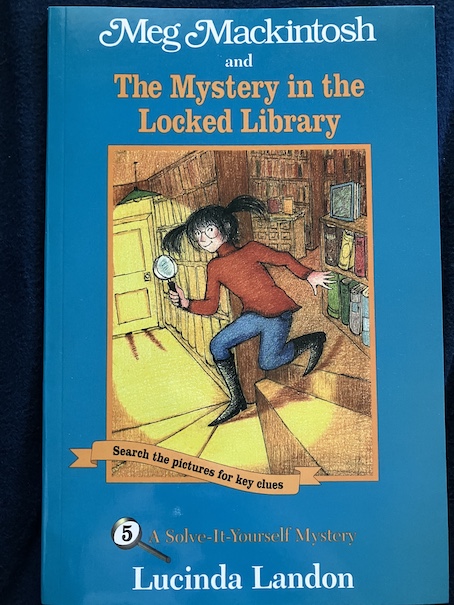
Meg Mackintosh and The Mystery in the Locked Library by Lucinda Landon, 1993.
Meg, her brother Peter, and their grandfather are visiting their grandfather’s cousin, Alice, who was introduced in the first book of the series as the one who created the treasure hunt to find his missing Babe Ruth baseball when they were young. Grown up Alice is now a librarian, and she has created another treasure hunt for them.
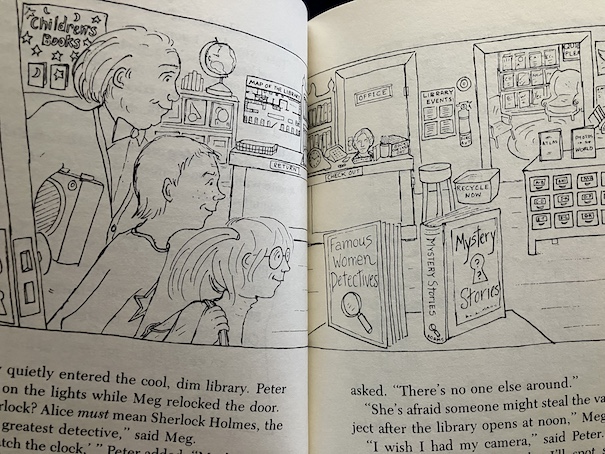
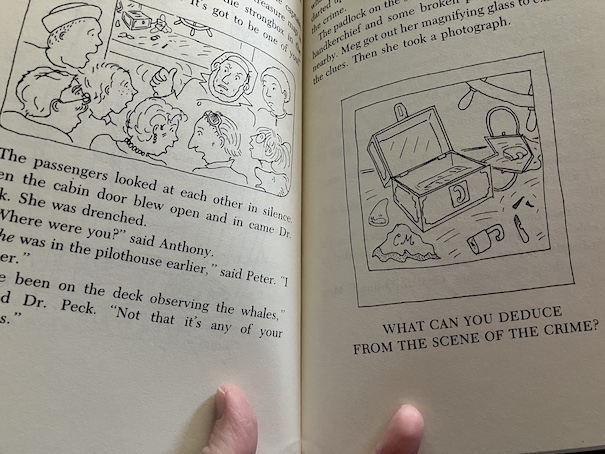
One morning, she leaves them a note saying that she has a dentist appointment, but she wants them to go to the library and find something valuable that she’s hidden there before the library opens at noon. Readers follow along with the clues that Alice has left for them to solve and the pictures in the book, seeing if they can solve each part of the mystery along with Meg. In keeping with the library and book theme of the story, the clues are based around books, particularly Sherlock Holmes books.
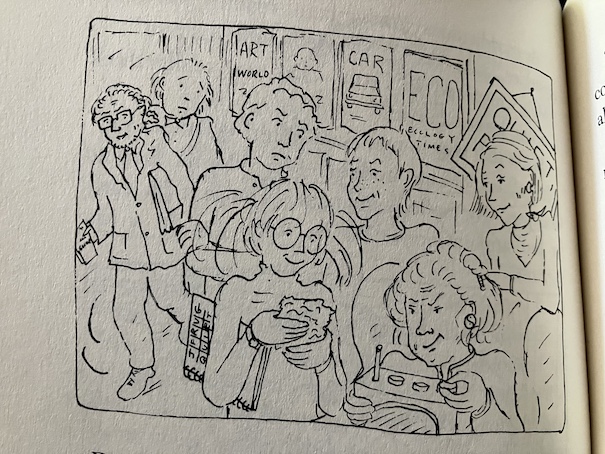
When Meg and her family arrive at the library and begin following the clues, they discover that there are other people in the library, even though the library isn’t officially open yet. Caroline is the assistant librarian, and Gerry also works there. Then, a man named Horace Plotnik shows up, saying that he’s an antiques expert and that Alice asked him to come to appraise something.
They discover that Alice didn’t make it to her dentist appointment because someone locked her in the library’s book repair room. It turns out that the valuable item that Alice hid was a first edition of The Adventures of Sherlock Holmes by Sir Arthur Conan Doyle that recently came to the library in a donation of books, but when Meg and Peter finish the treasure hunt and go to the place where Alice did the book, it’s gone! Was it stolen by the person who locked Alice in the book repair room, and if so, who was it?
The Book is available to borrow and read for free online through Internet Archive (multiple copies).
My Reaction
I always enjoy treasure hunt stories, and like other Meg Mackintosh mysteries, this story gives readers the opportunity to figure out the clues and puzzles along with Meg. The information readers need is in the pictures of the story. When I was a kid, I particularly liked puzzles based around solving a secret code, and there is a secret code puzzle in this book that readers can solve themselves.
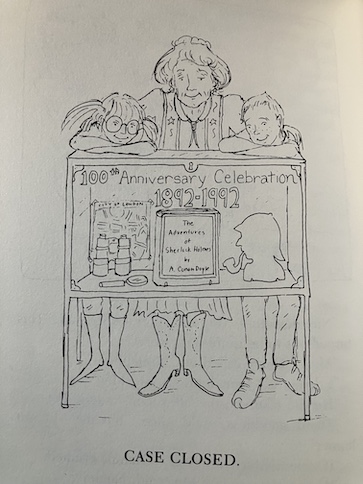
This treasure hunt is fun because it’s based around library and book themes, particularly focusing on Sherlock Holmes. The idea of hunting for a lost copy of a first edition Sherlock Holmes book was timely for when the book was originally written because, as the story indicates at the end, the book was written around the 100th anniversary of the character of Sherlock Holmes!
Meg Mackintosh and The Mystery at the Soccer Match by Lucinda Landon, 1997.
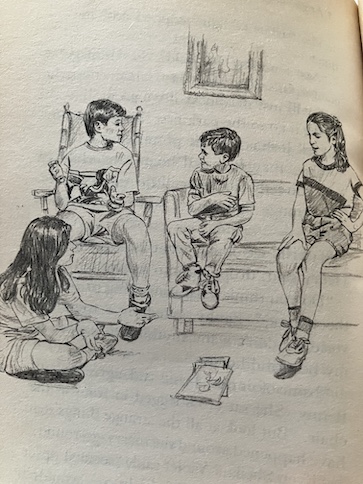
Meg and her brother Peter play on opposing soccer teams, the Hawks and the Panthers. Peter is brags about how good he is at being a goalie, and Meg hopes that, in this game, she can score a few points off him. There are prizes for this soccer team, and the winning team will get to keep a medal that Coach Lee won playing international soccer until next year’s game. Everybody admires the medal, which is displayed on the awards table.
Meg’s teammate, Alex, is less thrilled about the game. He has an injured leg and can’t play, and his mother is busy campaigning against awarding prizes for children’s soccer. She thinks that giving prizes isn’t fair and hurts the feelings of kids who don’t get prizes.
It’s true that there is some pressure from the parents for their children to play harder to win prizes than the kids really want. Peter accidentally collides with one of his teammates, Heather, and they both end up with scrapes and are temporarily removed from the game for first aid. Heather’s father pressures her to get back in the game as soon as possible and win, but Heather privately admits to Peter that she doesn’t really feel like playing anymore. She only does it because she knows her dad would feel bad if her team doesn’t win.
It starts to rain during the game, and the adults and kids cover the awards table with a blanket. When they remove the blanket later, the gold medal is gone! Who could have taken it? Meg invites Alex to join her detective club and help investigate the mystery while she plays soccer!
The book is available to borrow and read for free online through Internet Archive.
My Reaction
Meg inviting Alex to help her investigate the case and consider motives makes this book a little different from other books in the series, where Meg usually does that herself. The mystery is good because there are several suspects to consider, each of whom was seen near the table and left signs of their presence there. Did Heather’s dad take the medal because he once almost won a similar soccer medal and was jealous that Coach Lee won the prize he didn’t? He certainly seems very prize-oriented. Did Alex’s mother take it because she disapproves of sports prizes and wanted to make a statement about it? Could one of the children have taken it, either because they wanted to claim the prize they didn’t think they could win honestly or because they wanted to impress one of their parents?
As with other books in the series, readers are given the chance to review the evidence Meg and her friends have collected and see if they can spot the clues along with them in pictures taken at the scene. There was a clue that I thought was pretty obvious in one of the pictures but which Meg and the other kids didn’t spot at first. They only notice it when another clue makes them take a second look at one of the pictures. I think many young readers might also spot the clue I did, although if they do, it might make them feel clever for noticing something before Meg and her friends do.
When I first noticed that clue, I was inclined to think the solution to this mystery was too obvious, but there is another twist to the story that makes it more interesting. The medal was actually stolen twice. After the original thief put it back, someone else took it again, so there are two thefts to figure out instead of one.
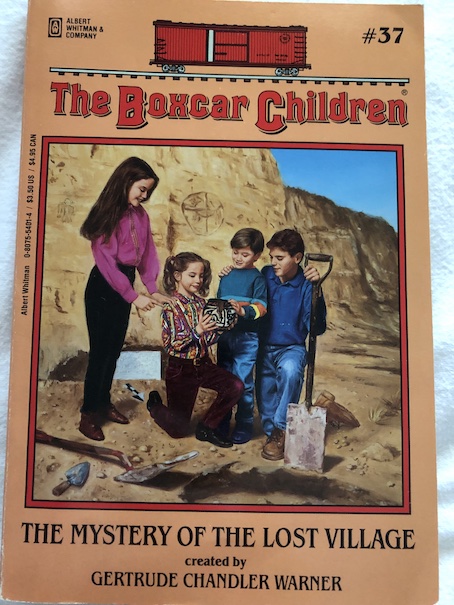
#37 The Mystery of the Lost Village by Gertrude Chandler Warner, 1993.
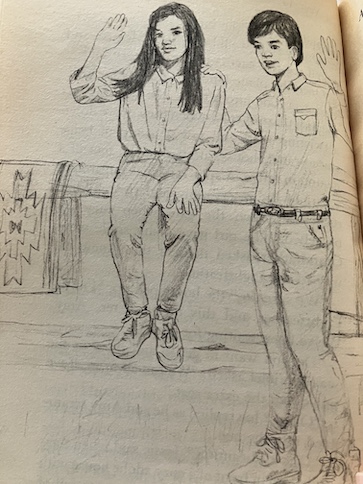
Grandfather Alden is going on a fishing trip with a friend, and he arranges for his grandchildren to stay with a family on a Navajo reservation. They’ve never been to a reservation before, and there will be hiking and a powwow. The kids are all eager to go!
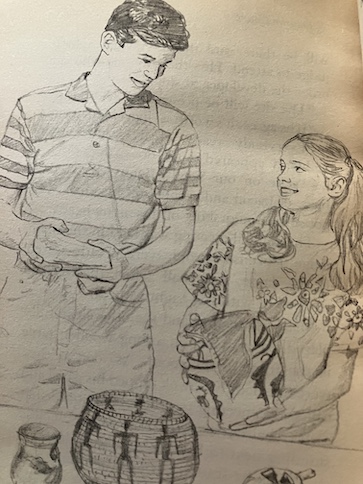
The family the Aldens are staying with is the Lightfeathers, and they have two children about the same age as the Aldens, Joe and Amy. The Lightfeathers tell the Aldens interesting things about Navajo history, culture, and crafts. What grabs their attention the most is a story about an ancient village nearby that was abandoned due to drought. The stories that have been passed down through the generations tell them roughly where the village was supposed to be, but the remains of the lost village have never been found.
Joe, Amy, and the Aldens ask if they could try digging for the lost village. Mrs. Lightfeather once studied archaeology, and they ask her if she can help them. Mrs. Lightfeather says that, although the village may be gone, traces of it should be left. The children begin laying out an orderly dig and start their search. They find some arrowheads and pottery, but when they show Mrs. Lightfeather what they’ve found, she says that they can’t continue their dig for much longer. The adults have just heard that a developer is taking over the land to build vacation homes. The children are dismayed when they find out that the developer is going to clear all of the trees. Of course, if the children can find signs of the lost village, the site would become an archaeological site, and the developer would have to stop. They only have two weeks to find some evidence of the lost village before the development starts!
There are some suspicious people hanging around. Michael Runningdeer, who works for the real estate developer, has been checking the boundaries of the reservation to check where they can develop. While they’re working on their dig, the kids meet a woman called Rita Neville, who says that she’s working on a documentary. Ted Clark is a genealogist who says that he has come to the reservation to trace his family’s roots, but Amy thinks it’s strange that he doesn’t seem to know things that someone with Navajo roots would usually know.
As the children work on their dig, they start finding more things, but someone also starts filling in places where they’ve been digging. In other places, someone has been digging where they haven’t dug yet. Then, someone steals an impressive bowl that Violet found. Is someone trying to prevent them from making a discovery that would stop the development, or is this a case of greed for Native American artifacts?
My Reaction
I liked this mystery as a kid, but I have a bone to pick with this story now. Perhaps the rules have changed since the book was written, but I know from living in Arizona that it’s routine to call in professional archaeologists to survey sites before digging and development take place. Because this area was inhabited by different groups over the centuries, archaeological finds can be just about anywhere.
I was attending ASU when they build the bio-sciences building, and people were allowed to watch the archaeologists survey the site. They did find an old Native American burial ground on the site. It didn’t stop the development completely, but they did record and catalog all of their finds before reburying them in the same locations where they were found. The logic of that is that Arizona is a very dry climate, and it preserves things buried in the ground very well. Putting a building over the site will prevent the site from being disturbed again for a long time. In the future, there may be better archaeological tools and scientific techniques that can be used to reevaluate the site and the things in it, and by then, the building may no longer be there.
What I’m saying is that there are rules and practices regarding archaeology and development in this region. Because this book was written about 30 years ago, when I was a kid, I’m not sure how different the rules were then, but I’m sure that archaeological surveys of this type were conducted back then, too. One of my old college teachers was an archaeologist, and he told us about digs he participated in around one of the reservations years before. I’d be surprised that development so close to a reservation, as in this story, would be allowed to go ahead without an archaeological survey from one of the universities or other archaeological organizations in the state. I just think that there should have been professionals working in the area before the kids started their dig.
I liked the pieces of information that the Lightfeathers explain to the Aldens about Navajo history and culture. My favorite piece of trivia was the explanation about how, rather than putting clay cooking pots directly over the fire, historical Navajos would heat a stone in a fire and then put the stone into a pot of water to heat the water for cooking. I think it’s a creative solution to cooking in a vessel that can’t be used directly over fire.
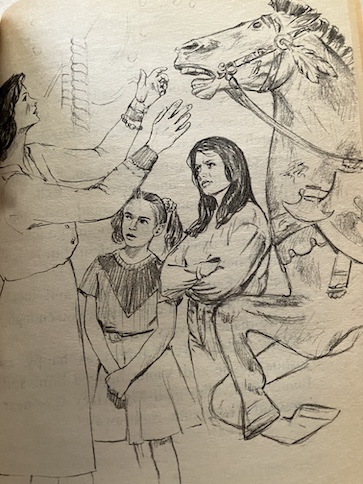
Jessie is allowed to participate in a dance at the powwow as a guest of a Navajo family, and Amy helps her put together regalia for the dance. (See Jingle Dancer for an example of this in a different tribe.) I sometimes find it a little cringey now when characters in stories too easily participate in Native American events and are quickly called honorary members of the tribe, but in this case, the Aldens do help make an important discovery.
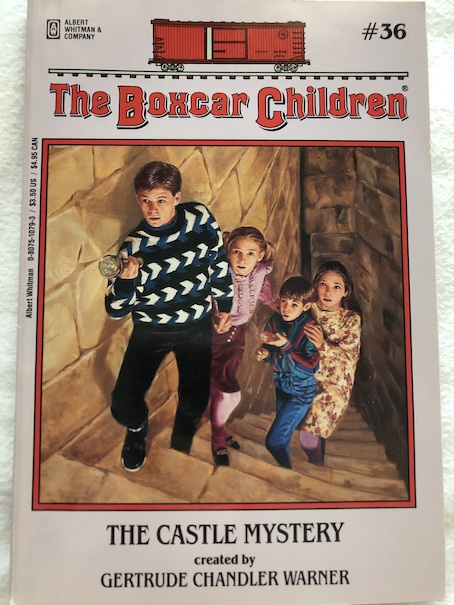
#36 The Castle Mystery by Gertrude Chandler Warner, 1993.
Mr. Alden takes his children to Drummond Castle because an old friend of his is helping to clean and organize the place before it becomes a museum. The Drummond family used to live there, and they had the castle built to look like a castle in Germany. However, the last of the Drummond family has died, so turning the mansion into a museum will give the place new life. When the Aldens first arrive, they think the castle looks more like something from a scary story than a fairy tale, but Mr. Alden’s friend, Carrie, shows them some of the more whimsical elements of the place.
However, Carrie’s assistants aren’t happy about the Aldens helping. None of them really seem like team players, even with each other, and they’re not sure how much help the Alden children can be. There are a lot of things that the assistants won’t let the Aldens do when they try to help. They also seem a little suspicious of each other because a valuable Stradivarius violin that once belonged to the Drummond family has disappeared. Carrie insists that they don’t know that the violin has been stolen. The last of the Drummonds may have just hidden it somewhere, and they will find it when they’ve finished cleaning and organizing the place.
Then, the Alden children begin to notice strange things happening in the castle. They see lights in parts of the castle where no one is supposed to be and hear violin music coming from somewhere. Sometimes, the furniture covered in dust sheets gives them the feeling that someone is hiding under the sheets. When it seems like the kids are poking around the castle too much, the assistants all suddenly find tasks for them to do.
The kids catch one of the assistants, Mr. Tooner, looking for something under the floorboards in their grandfather’s room. He claims that he was fixing the floor, but Mr. Alden says that nothing was wrong with the floor. Sandy, another assistant, seems to know her way around the castle better than the others, but she’s oddly defensive about why she knows the place so well. She also makes an odd comment about how it would be nice to hear the Stradivarius “again”, but she dodges questions about when she heard it the first time. Tom is the antiques expert, and he insists that his work is highly specialized and that he wants to work alone.
The Aldens explore the spooky castle, the girls get trapped in the cave under the castle, and they find a secret, hidden room that brings them closer to the solution of the mystery. Each of these assistants has a previous connection to Drummond Castle that they don’t want to discuss, but only one of them is a thief.
My Reaction
I remember liking this book as a kid, although I’d forgotten what the solution of the mystery was until I reread it. It holds up pretty well, and I enjoyed how everyone associated with the castle has their own secrets and past connections to the place. It makes them all really great suspects and also gives readers some subplots to figure out along with deciding who the violin thief is!
The castle setting is also great! Technically, I suppose that it’s really more of a castle-like mansion, but it has all the trappings of a castle, some fanciful, some whimsical, and some spooky. There is also a cave under the castle, which features in a part of the story where Jessie and Violet get locked inside the cave because there is a gate that closes it off. One of the best parts of the book is the discovery of a hidden room because what castle would be complete without one!
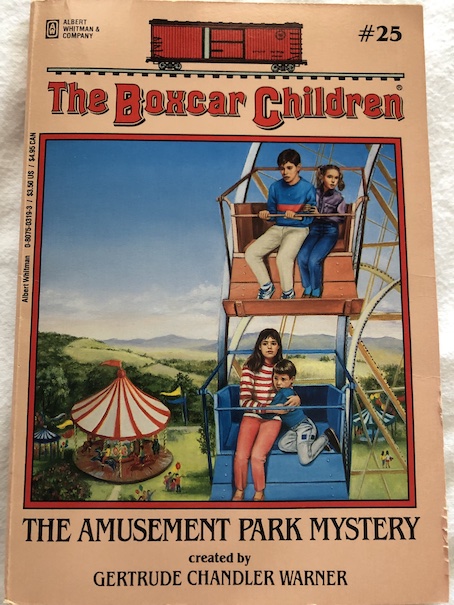
#25 The Amusement Park Mystery by Gertrude Chandler Warner, 1992.
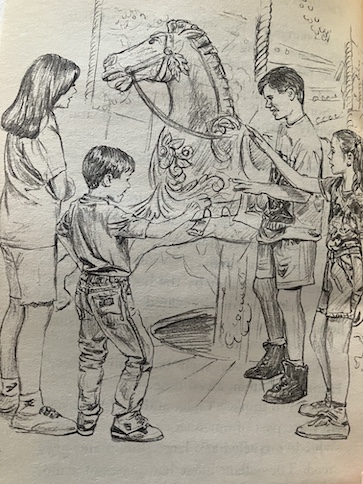
The four Alden children go to visit their cousin Joe and his wife Alice. They work at a museum, but one of the best parts of visiting them is the amusement park nearby. The amusement park has a charming, antique carousel with hand-carved horses. The horses are valuable antiques, and Alice says that they are wonderful examples of Americana (American folk art).
The Aldens, especially Benny, think the carousel is wonderful, but not everyone feels the same away about it. When they talk to the owner of the amusement park, Joshua, they learn that he loves the antique carousel but his daughter, Karen, who works with him, thinks that they should get rid of old rides like that and add newer, more modern ones. What she really wants to do is add a roller coaster to the park, something that would appeal to older kids and adults rather than young children. The Aldens don’t see how she can add a roller coaster because the park isn’t very big, and a roller coaster would take up about half the park. They hear Karen later talking about it again with her boyfriend, who is a golfer. They notice the boyfriend doing some sketches of horses that he doesn’t seem to want to let them see.
The first time the Aldens ride the carousel, they have a great time, and Benny chooses a dappled gray horse as his favorite. However, when they return to ride the carousel again later, it seems like something is wrong with the horse. It used to bob up and down during the ride, but now, it doesn’t move. When they return again, a couple of days later, the dappled gray horse moves but now has a long scratch on its side that wasn’t there before. The Aldens also begin to notice problems with other horses. Another gray horse has stopped moving, and a chocolate brown one oddly has an unpainted stomach when they were sure it was painted before.
They talk to Joshua about the horses, and he becomes concerned. He has an expert examine them, and the expert assures him that these are the authentic antique horses that were always there, but the Aldens are sure that something suspicious is going on.
If someone has been taking the original horses and substituting fakes, why did the so-called expert say that they were the original horses? Who could be behind it? Is Karen trying to sabotage the carousel to get the roller coaster she wants? Her boyfriend seems to need money, so he could be selling off the horses. What about the cotton candy seller and his disagreeable wife or the man who actually runs the carousel ride?
My Reaction
I thought the book did a good job of providing readers with multiple suspects to consider. We know Karen isn’t fond of the carousel and wants more exciting, modern rides, so she could be selling off antique carousel horses to fund her ideas. Her golfer friend also needs money, and his sketches of horses might be for planning how to create counterfeits of the originals. Then again, the cotton candy seller and his grumpy wife are always around and acting suspiciously, and the man who runs the carousel ride has obvious access to the horses. I like mysteries where there are multiple suspects to consider!
The concept of the antique carousel reminded me of the Nancy Drew computer game The Haunted Carousel, but that computer game was based off of a Nancy Drew book, not this one. It’s interesting to notice some themes that appear in different children’s series. Not every kids’ mystery series features an antique carousel, making it a charming and uncommon theme. However, amusement parks are common themes in children’s books, and a mysterious, antique ride offers that element of both quaint nostalgia and spookiness together.
Meg Mackintosh and The Case of the Curious Whale Watch by Lucinda Landon, 1987.
Meg and her brother, Peter, are going on a whale watch trip with their grandfather. As they board the boat, their grandfather tells them that the captain is well-known as a treasure hunter, looking for pirate treasure.
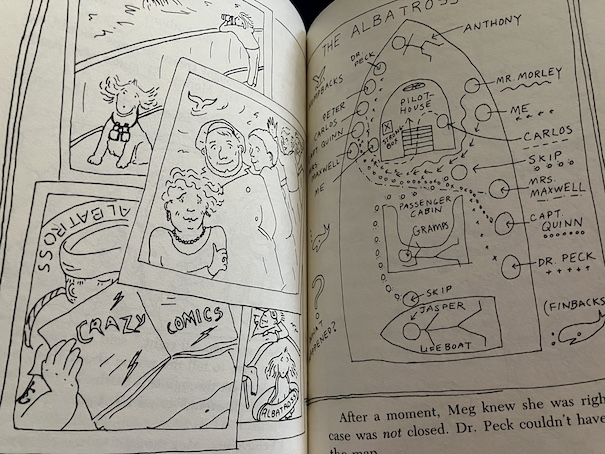
On board the Albatross, they are greeted by Captain Caleb and meet his mate Jasper, and the other whale watch guests. The guests are Mrs. Clarissa Maxwell and her nephew Anthony, who seems to like gambling; a man named Oliver Morley, who likes stamps; a college student called Carlos de Christopher; and a marine biologist, Dr. Susan Peck.
Meg asks Captain Caleb about his treasure hunting, and he shows everyone an old map that’s been in his family for many years. The sailor who gave it to them also gave them a whale’s tooth with a scrimshaw carving of a whale on it. It’s supposed to help explain where the treasure is hidden. Some of the members of the expedition debate about how much money the treasure of the map would be worth, but Dr. Peck is completely opposed to treasure hunting because it’s disruptive to the environment.
The group enjoys watching the whales, although Meg’s grandfather has to go lie down for a while because he’s seasick, and lazy Jasper spends his time reading comic books in the lifeboat. When they encounter a storm, and everyone goes into the cabin to get out of the rain, they discover that the map is missing!
Who could have taken it? Various members of the whale watch have talked about their need for money, and Dr. Peck said that she thought the map should be destroyed to prevent damage to the environment. Meg goes over the pictures she’s take to find the thief!
The book is available to borrow and read for free online through Internet Archive (multiple copies).
My Reaction
I like the Meg Mackintosh books because it’s fun to solve the mystery along with the heroine. Like other books in the series, readers are supposed to use the story and the clues in the pictures to solve the mystery. At various points in the story, the story pauses for readers to figure out something about what’s happening, and these are good points for readers to check that they’re on track and to review the information they know so far. The story isn’t very long, but there are multiple points for readers to figure out something about what’s going on.
I did figure out the answer to this one very quickly. It’s partly because I’m an adult and this is aimed at children, but more importantly, I’ve seen the movie Charade with Audrey Hepburn, which used a similar plot device. The story did a good job of making all the suspects look like they had a motive, but when you figure out what the thief’s real goal was, there’s only one person who qualifies. Kids in early elementary school would probably find the mystery more challenging.
#23 The Mystery of the Invisible Dog by M. V. Carey, 1975.
Shortly after Christmas, a frightened man, Fenton Prentiss, calls the Three Investigators to his apartment to help him. Mr. Prentiss is an elderly art collector, and he says that he is being haunted. Things in his apartment get moved around when he’s not there, and he can tell that someone has been reading the mail in his desk. Sometimes, he even sees a shadowy figure when he is home, although he’s never gotten a good look at it before it disappears. He swears that it can’t be another person because he’s the only one who has a key to his apartment. He is also sure that there are no secret passages in his apartment building and that there’s no way for any living person to enter his apartment without being seen by someone. Mr. Prentiss could just be imagining the haunting, but Jupiter is intrigued, and if the boys don’t have a mystery to work on during the holidays, they know that Jupiter’s aunt will just assign them a bunch of chores.
They tell Mr. Prentiss that they need to talk over the assignment together before they accept his job, but Jupiter’s mind is made up when he also sees a shadowy figure that he initially mistakes for Pete just before they leave the apartment. However, Pete is not in the room where Jupiter saw the shadow. Did Jupiter just see Mr. Prentiss’s mysterious ghost?
When the boys get outside the apartment, they hear a loud bang and running feet and see a man in a ski mask running away. Pete tries to follow, and the police stop him, thinking that he might have something to do with a burglary that has just taken place. Fortunately, Mr. Prentiss speaks up for Pete, saying that the boys only just left his apartment and couldn’t have anything to do with what the police are talking about. The police think that the suspect who ran away could have gone into a nearby church, but he seems to have vanished. Mr. Earl, the janitor and caretaker of the church swears that he was in the church the whole time and no one came in, although the housekeeper at the rectory, Mrs. O’Riley, says that Mr. Earl is practically deaf and wouldn’t have heard anybody.
The place that was burgled turns out to belong to a deceased artist friend of Mr. Prentiss. His friend’s death is part of the reason why Mr. Prentiss is so on edge because it was very upsetting to him. The artist’s brother, Charles, hadn’t finished clearing out his brother’s house when it was robbed. He tells the boys that his brother was a sculptor, and his best piece was based on a legend of a ghostly, demonic hound from Eastern Europe. This is the sculpture that was stolen. It’s a bitter blow to Mr. Prentiss because the artist made this sculpture especially for him.
Jupiter believes Mr. Prentiss that someone has been sneaking into his apartment, so he sets a trap that will cause the intruder’s hands to be stained. Mr. Prentiss leaves for a while with the boys, and when they return, his nosy landlady’s hands are stained, indicating that she has been the intruder. Mr. Prentiss confronts her, and she admits that she had a spare key made for his door. The landlady has a long-term habit of spying on her tenants. Mr. Prentiss confiscates her spare key and thinks that his problem is over, but really, it’s just beginning.
Having seen the shadow in Mr. Prentiss’s apartment himself, Jupiter knows that the mysterious shadowy figure was not the landlady. For Jupiter to have mistaken the shadowy figure for Pete, he knows that the person is male and of similar size to Pete. Jupiter is not surprised when Mr. Prentiss calls them up to say that he’s seen the shadow again. The landlady was undoubtedly snooping, but there must also be a second intruder. At first, Jupiter thinks that he knows who the second intruder must be because there is another person in the apartment building who vaguely resembles Pete and who also seems to know about things that Mr. Prentiss owns when he’s supposedly never been in Mr. Prentiss’s apartment before. However, this person is accounted for when the intruder makes another appearance. Jupiter investigates the nearby church when he sees a light there, and he has a frightening encounter with a figure that Mrs. O’Reilly believes is the ghost of the former pastor.
Mr. Prentiss soon gets a ransom demand from the person who stole the sculpture. Then, strange misfortunes start to befall Mr. Prentiss’s neighbors. Some of these misfortunes look like accidents while others are direct attacks. Someone is apparently attacked by the thief, someone else is poisoned, someone’s apartment catches fire, and someone else’s car is sabotaged, and people are ending up in the hospital. It seems like someone who is close to these people is responsible for sneaking around Mr. Prentiss’s apartment, stealing the valuable sculpture, and harming the neighbors, but who is doing these things and why?
The book is available to borrow and read for free online through Internet Archive (multiple copies).
My Reaction and Some Spoilers
I enjoyed this mystery because it has many different facets. First, there is a wonderful cast of eccentric characters. All of Mr. Prentiss’s neighbors/suspects are eccentrics. There’s the nosy, sneaking landlady and a guy who takes care of stray cats. Mrs. O’Reilly at the church believes that the church is haunted by the ghost of a former pastor, adding another haunting figure to the mystery. Another resident of the apartment house works nights at the local market and is saving up money so he can go to India and find a guru to help teach him the secrets to life. His father wanted him to be a dentist, but instead, he wants to study meditation so he can see through life’s illusions and be truly awake, achieving the ultimate level of consciousness. It’s ironic because he’s so tired from working nights that he often falls asleep while meditating. The mystery somewhat resembles a classic old dark house mystery in the sense that it takes place in a contained area with a very definite set of suspects who are also either victims or potential victims.
Second, I enjoyed the layers of the mystery. We have a mysterious intruder (or intruders), the theft of a valuable sculpture, a possible haunted church, and a series of mysterious accidents or attacks on residents of the building. Are these things all connected or are some of them unconnected incidents that confuse the issue? Readers have the feeling that there are at least some connections, but it’s not clear for most of the story what the connections are and who’s responsible for what. On the one hand, books with several different mysterious happenings can feel a little cluttered and confusing to readers, but on the other, figuring out which of these incidents are connected to the main issues provide clues to the identity of the real villain.
There is a surprising supernatural element to the story that the Three Investigators discover when they consult a parapsychologist at a university. There was a strong interest in parapsychology during the 1970s and 1980s, which is why the subject of psychic abilities and people who study it appears in children’s books and tv shows around this time period. (Spoiler) It seems that the guy who is studying meditation has some psychic ability, and the things he experiences while meditating aren’t just him falling asleep and dreaming, although it seems like that at first. Because he really wants to get away from his boring life and dead end job when he meditates, he’s actually been using a kind of astral projection without being fully aware that’s what he’s doing. The characters realize this because he knows things that he shouldn’t really have any way of knowing from places where he shouldn’t have been and how he can sometimes appear in certain places when he’s actually somewhere else. Some of the strange things that people see around the apartment building at due to his astral projection, possibly including the ghost in the church, although part of that is left unclear at the end. However, there is a real thief and villain in the story who is unrelated to the psychic phenomena, and incidents that harm people in the building are related to the thief’s attempts to keep people away from the hiding place of the stolen sculpture. I thought both the psychic angle and the solution to the theft were clever, and I kept guessing all the way through the book who was responsible for what.
#4 The Mystery of the Green Ghost by Robert Arthur, 1965.
Bob and Pete are looking at an old, abandoned house that’s in the process of being torn down when they hear an unearthly scream from the house! There are stories that the old house is haunted, and the boys run away, only to be stopped by a group of local men, who ask them what’s going on. When the boys explain, the men talk about calling the police or going inside the house to investigate. The men decide to just go in and have a look around themselves, in case someone’s hurt and needs help right away. They tell the boys that they can leave because they will handle the situation, but the boys decide that they can’t leave without having a look themselves.
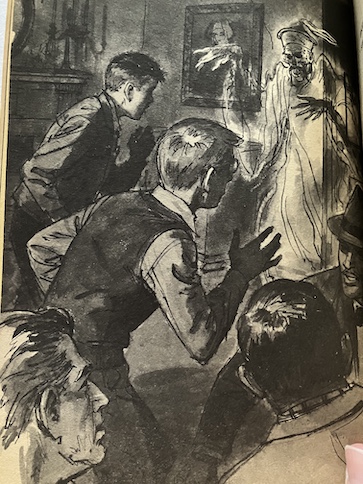
As they take a look around inside, they see the remains of the ornate wall paper and impressive features of the once-rich house, and the men talk about Mathias Green, who used to live in the house. At first, the searchers can’t find anything, but then, they spot a greenish figure on the stairs. Thinking that there’s some prankster in the house, the searchers go upstairs to confront the person, but they can’t find whoever it was. The boys suggest that they have a look at the dust on the floor and try to follow the person’s footprints, but the only footprints the searchers can find are their own. Could they have seen a ghost?
The searchers do notify the police about what they’ve seen in the house, but the police don’t take it too seriously … at first. However, they soon begin receiving other reports from various people around the city who claim to have seen a greenish, ghostly figure. Even then, the police might not have take the reports too seriously, except that a couple of officers on patrol witness a greenish, ghostly figure in the cemetery … at the burial site of Mathias Green, who died falling down the stairs in his house, 50 years before.
While Bob and Pete were at the house, Bob had his tape recorder with him, and he plays the recording of the scream they heard for their friend and fellow investigator, Jupiter. Jupiter is willing to believe it could be the scream of Mathias Green’s ghost, and the boys review the information they know about Mathias Green. Mathias Green was once the skipper of the ship, and he sailed to China. For reasons that nobody fully understands, he had to leave China suddenly, and the rumors were that Mathias’s wife was a Chinese princess and that Chinese nobles had a grudge against Mathias. Mathias brought his wife back to the United States with him, and they built their house in Rocky Beach after Mathias had a fight with his sister-in-law, and they moved away from San Francisco. They had some Chinese servants, but when Mathias was later found dead, apparently from an accidental fall down the stairs, the servants and his wife disappeared. People assumed that they left for fear that they would be blamed for Mathias’s death, and Mathias’s sister-in-law inherited the house. Recently, Mathias’s niece decided to sell the house to a developer, who is planning to tear it down and build more modern houses.
Local newspapers have picked up the stories about the green ghost and its apparent connection to the old Green mansion, and some of them have implied that the ghost is looking for a new place to haunt now that its house is being torn down. The Three Investigators have access to more information than most people because Bob’s father is one of the reporters covering the ghost incidents. The police chief tells them, off the record, that he witnessed the ghost himself, in the cemetery, and it looked like it disappeared by sinking down into Mathias’s grave. Then, the police chief learns that the workmen tearing down the house have discovered a hidden room. Bob’s father and the boys are allowed to come with him to see what the room contains.
The discovery is a shock. The hidden room contains an ornate coffin, holding the skeleton of Mathias’s Chinese bride, dressed in elaborate robes and with an unusual necklace of gray pearls, called ghost pearls. The story is that the reason why Mathias and his bride had to suddenly flee China was that Mathias reportedly stole the pearl necklace to give to his bride. When she died in Rocky Beach, he couldn’t bear to be parted from her, so he “buried” her secretly in his house, along with the necklace.
The discovery of Mathias’s wife’s hidden burial chamber doesn’t lay the ghost to rest, though. Bob and Pete get a phone call from Mathias’s niece, Lydia, asking them to visit her at the vineyard where she lives, to talk about what they witnessed at the house. She says that the ghost has actually appeared at her vineyard! Jupiter is not invited to the vineyard because he didn’t witness the appearance of the ghost with the others, but he couldn’t go anyway because he’s temporarily in charge of his uncle’s salvage yard while his uncle is out of town. He tells Bob and Pete to go ahead and meet with Lydia and let him know what they learn.
At the vineyard, Bob and Pete meet Lydia’s distant cousin, Harold, and Lydia’s great-nephew, Charles, who is actually the great-grandson of Mathias Green and the real heir to Mathias’s estate. Charles, who is called Chang, grew up in China, and they explain that he is descended from Mathias’s first wife, who died of an illness in China. After the death of his first wife, Mathias put his young son into an American missionary school in China and left him there as a boarding student. When he married his second wife and had to flee China, he left his son behind. His descendants remained in China since then, until it became unsafe for Americans or people of American descent in China. Then, Charles, who is an orphan and part Chinese (hence his nickname of Chang), was sent to live with Lydia in the United States. Until that point, he knew very little about his ancestors and his relatives in America. Technically, Mathias’s estate should have come to Chang’s side of the family when Mathias died, but they were living in China at that time and were not in touch with the rest of the family. Lydia says that Chang should even technically own the vineyard that she and Harold have built with the family’s money, but Chang doesn’t want to take it from them, so Lydia says that she is leaving it to Chang in her will. Chang is satisfied with this arrangement, but the family has debts, and if they don’t resolve them, they might lose the vineyard entirely.
Lydia believes that the green ghost is Mathias’s ghost, and he is haunting them because he’s angry with her for selling his old house to be torn down. The ghost has been scaring away workers at the vineyard, and if they can’t get the harvest processed, they won’t be able to keep the vineyard. However, Chang doesn’t believe that his great-grandfather would want to hurt his own family. Chang might be willing to believe that the ghost is an evil spirit, masquerading as his great-grandfather. That’s not the only possibility, though. There could be a human being with a motive for wanting to ruin the vineyard. Then again, there is the question of who really owns the ghost pearl necklace. If Mathias’s family owns the necklace, they could sell it to cover their debts, but it might really belong to the family of Mathias’s Chinese wife. Her family is more difficult to trace, but one person has stepped forward, claiming to be her heir. Then, someone attacks Harold and steals the necklace from him. Was the necklace always the ghost’s target, from the beginning? Meanwhile, back in Rocky Beach, Jupiter has a revelation. There was a dog present when Bob and Pete were searching the Green mansion with the men, and the dog … didn’t do anything. That might be the most important clue of all!
The book is available to borrow and read for free online through Internet Archive (multiple copies, including some in other languages).
My Reaction and Some Spoilers
I enjoyed the mystery and the reference to Sherlock Holmes about the dog that did nothing in the nighttime. In this story, Jupiter takes the dog’s non-reaction as a sign that there was no supernatural presence in the house because animals are supposed to react to the presence of ghosts. There is definitely a human behind all the spooky happenings, and I was partly right about who it was. However, the author threw in a complication by inserting another mysterious villain who kind of usurped the original plotter’s plot for his own purposes and partly distracts the characters from the original villain for part of the story.
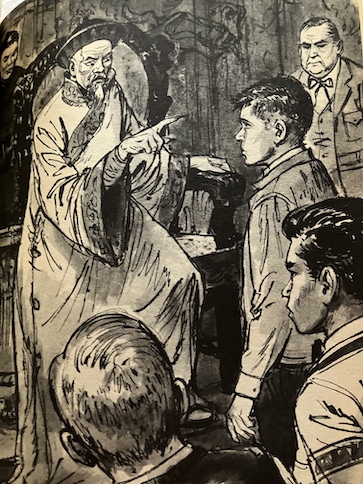
This added villain is a mysterious old man from China who claims that he’s 107 years old and that he wants the pearls because drinking dissolved ghost pearls is the key to immortality. This mysterious old man is wealthy, and he has bought up the family’s debts, meaning that he will get control of the vineyard, if they can’t pay their debts. However, he’s not really interested in the vineyard for its own sake. He just wants those pearls. Although he does some criminal things in the story, nothing much seems to happen to him at the end, and he works out a deal with Lydia, so she can keep the vineyard. It’s left open whether or not he truly ended up with the pearls or whether the pearls actually have properties for preserving someone’s life, but it seems that he truly believes it, and he has no other motivations for his part in the story.
This almost Fu Manchu style character, who uses hypnosis to control people, adds an element of exoticism to the story that I thought wasn’t really necessary. I liked the ghost mystery well enough with its original villain and without him, and I felt like the introduction of the extra villain sent the plot a little off the rails, but he does allow the story to end on a somewhat creepy and ambiguous note. We don’t entirely know who he is, and we never really find out what happens to him. We don’t know if he’s really as old as he says he is or if he continues much further in his quest to live forever. He just disappears after getting what he can of the pearls, presumably to go hunting for more elsewhere.
As far as I’ve been able to determine, the ghost pearls aren’t real, and the legend about them prolonging people’s lives isn’t real. However, there are legends and superstitions from around the world about pearls being associated with wisdom and longevity and having healing powers. Pearls can be dissolved in an acidic liquid and drunk by a human, as in the famous story about Cleopatra drinking a pearl in vinegar, which was supposed to be an aphrodisiac.
Getting back to the mystery, though, I did like the Scooby-Doo-like mystery, and I was satisfied by the original plot, and the villain’s methods and motives. I was looking at that character with suspicion for a number of reasons. Perhaps, if the part about the pearl necklace, the ancient man who drinks pearls, and Mathias’s bizarre room with his dead wife weren’t in the story, the solution would be too obvious, but overall, I enjoyed it. I also appreciated how Jupiter worked out some of the details of the first haunting by visiting the house and studying the scene while his friends were at the vineyard. He comes to some conclusions about how that first haunting occurred that Bob and Pete didn’t think about, and his solution also provides a reasonable answer to the question of why that group of men happened to show up outside the house on the evening the haunting happened, to witness it.



















 Jestress's Forgotten Books and Stories