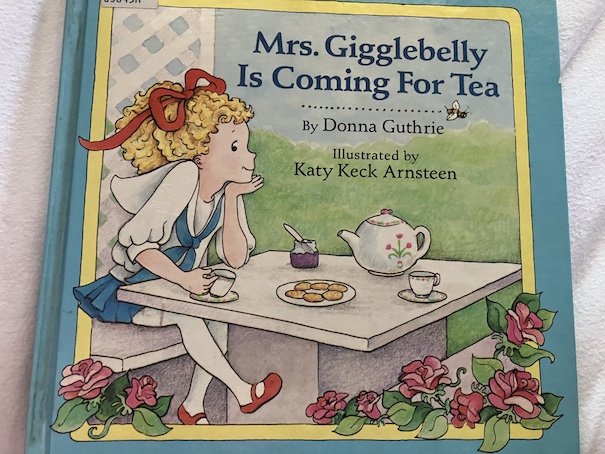
Mrs. Gigglebelly is Coming for Tea by Donna Guthrie, illustrated by Katy Keck Arnsteen, 1990.
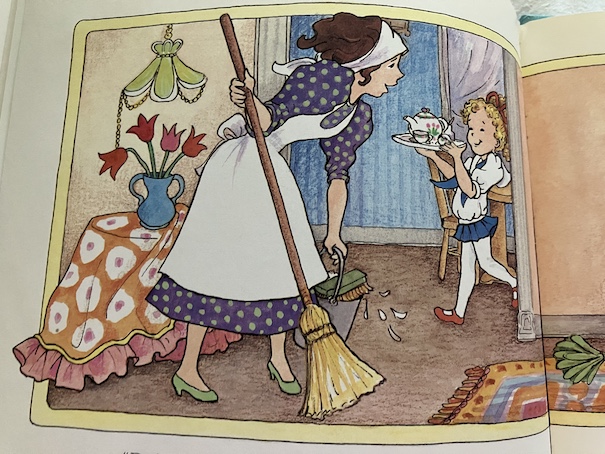
Elizabeth Ann tells her mother that Mrs. Gigglebelly is coming for tea today, but her mother says that she’s in the middle of her spring cleaning and doesn’t have time to prepare for Mrs. Gigglebelly today. In fact, she suggests that Mrs. Gigglebelly might be busy today, but Elizabeth Ann says that Mrs. Gigglebelly always has time for tea with her.
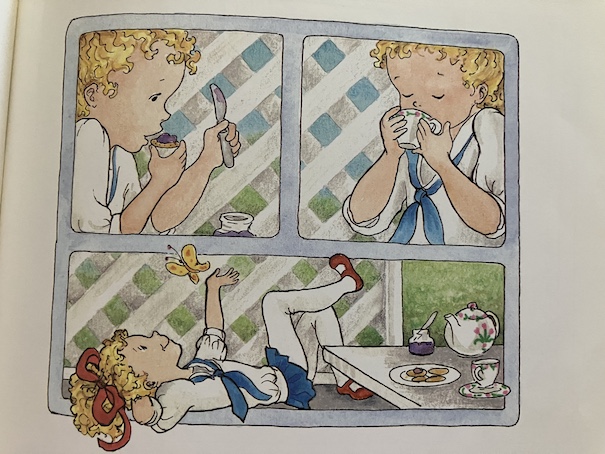
Since her mother is busy with chores and can’t prepare tea or a cake for Mrs. Gigglebelly, Elizabeth Ann fixes some lemonade and crackers with grape jelly for their “tea.” While Elizabeth Ann waits in the garden for Mrs. Gigglebelly, her mother dashes about, doing her chores.
At first, it seems like Mrs. Gigglebelly isn’t going to come, but she eventually arrives because she always has time for Elizabeth Ann … so does her mother.
My Reaction
This is a cute story about a mother who makes time for her child, even when she’s busy. “Mrs. Gigglebelly” seems to be a game of pretend the mother and daughter play together when they have their tea parties. On this particular day, the mother is very busy, but she still throws together a costume for their game. The book doesn’t say that “Mrs. Gigglebelly” is Elizabeth Ann’s mother, but it’s implied in the story, and in the last picture, readers can see pieces of “Mrs. Gigglebelly’s” improvised costume around the room.
I thought it was sweet that the mother in the story took time for a little fun and silliness and a special moment with her daughter, even though she had work to do. Some mothers might just lecture their child about how they’re busy and the child just has to accept that, but this mother understands that her attention is important to her child. Sometimes, it’s the little moments that mean a lot, even if it’s just pausing to share a snack. She does make her daughter wait because there are things she has to do, but the wait is worth it because the mother follows through and makes the effort to make time for her daughter.
Elizabeth Ann also doesn’t nag her mother about hurrying up or try to convince her mother to drop everything she’s doing and play with her instead of doing her cleaning. Instead, she waits patiently, confident that her mother will have time for her eventually because her mother has already established that her daughter is a priority and that she will make time for her. It looks like this mother-daughter pair understands each other well and that they have a good relationship with each other, and I like that.
Whose Garden Is It? by Mary Ann Hoberman, illustrated by Jane Dyer, 2001.
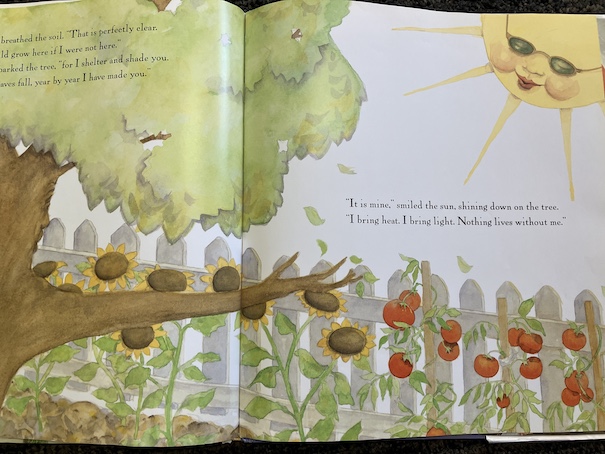
This is a cute picture book, told in rhyme, about who is the real owner of a garden.
One day, Mrs. McGee goes for a walk and passes a beautiful garden. She wonders aloud whose garden it is. Of course, the owner of the garden, who is tending the plants speaks up, but he’s not the only one.
A small rabbit also tells Mrs. McGee that the garden belongs to him because he’s lived there his whole life, and he eats the vegetables. Then, a woodchuck says that’s nothing because he eats everything that grows in the garden. A bird chimes in, saying he eats the worms from the garden. Then, a worm says that worms are there to make the soil in the garden better, so he’s the real owner of the garden.
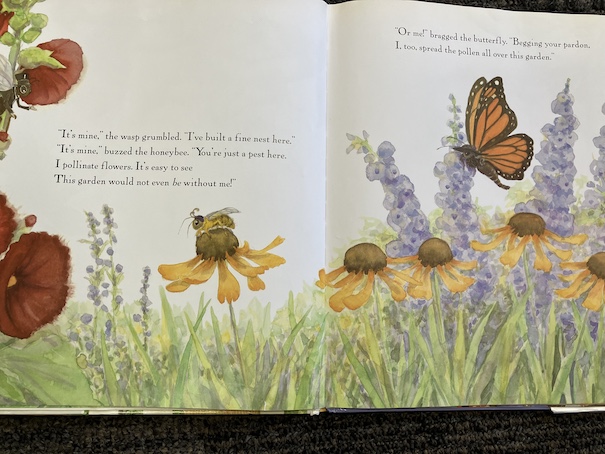
Various other creatures, big and small speak up, each of them pointing out that they live in the garden, what they’ve done for the garden, and what the garden has done for them. The bees and butterflies pollinate the flowers.
But what about the plants in the garden? They have a strong argument that they are what makes the garden a garden. Then again, the soil is where the plants grow, and the plants need the sun and rain to grow. Also, all plants grow from seeds, so the garden exists for the seeds that will be the future plants.
It seems that the answer to Mrs. McGee’s question isn’t as easy as she might have thought.
My Reaction
This is a charming story about how various plants, animals, creatures, and forces of nature are interconnected. The book doesn’t use the word “ecosystem“, but that’s the concept being described here. The garden’s ownership and the reason for its existence is much more than the gardener who owns the land and planted and tended the garden; it’s everything that’s growing in it, everything that contributes to its growth, and everything that depends on the garden. Without all of these creatures and natural forces put together, the garden wouldn’t be what it is.
The book doesn’t attempt to get scientific about the details of this garden ecosystem, and the animals wear clothes and talk, so the story isn’t meant to be entirely realistic. However, it is thought-provoking about how many different parts of nature affect each other. It could be a good book for introducing the topic to young children before teaching them about the science of ecosystems later. The rhyme scheme makes the story fun to read.
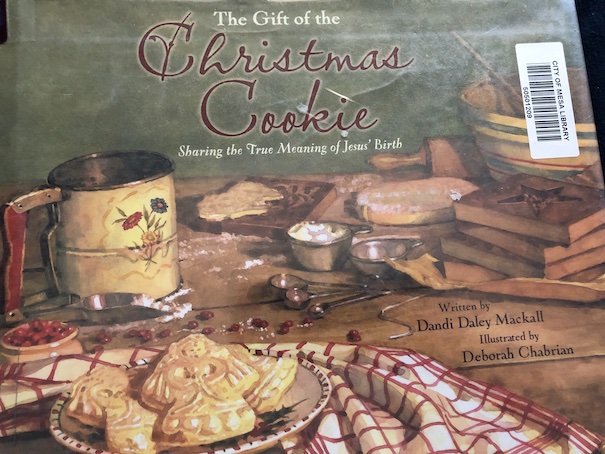
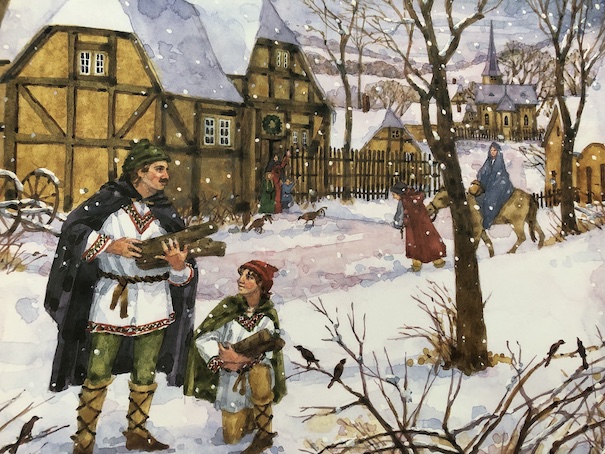
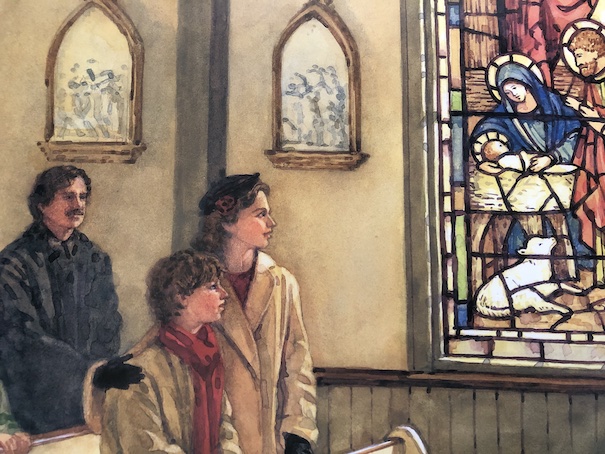
The Gift of the Christmas Cookie by Dandi Daley Mackall, illustrated by Deborah Chabrian, 2008.
This is a sweet Christmas story that discusses the meaning of Christmas along with the history of Christmas cookies.
The story doesn’t provide a year, but it seems to be implied that it takes place during the Great Depression because Jack’s father is described as hopping a freight train to find work and send money home. Since then, Jack and his mother have lived alone, saving every penny that Jack’s father sends to them.
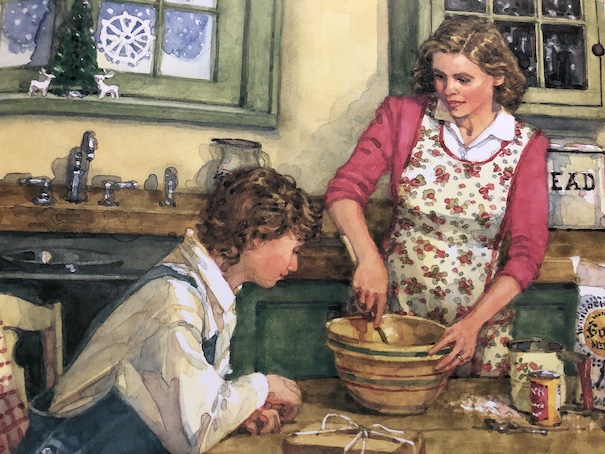
Then, before Christmas, Jack arrives home to find his mother making cookies. Jack is thrilled at the idea of having a rare treat, but his mother says that the cookies are for the needy at church. It’s disappointing because Jack has been feeling rather needy himself.
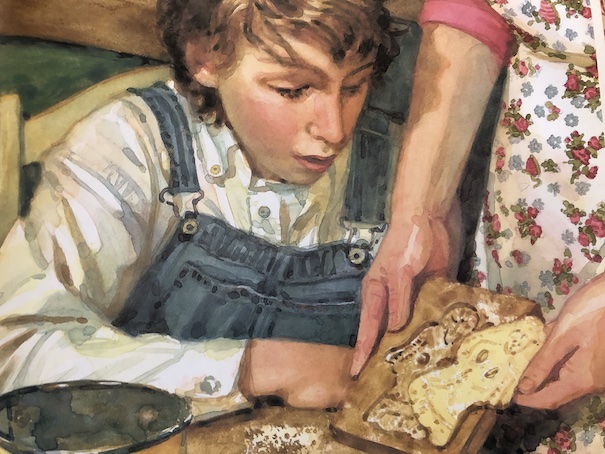
Then, his mother shows him the wooden cookie board molds that they will use. They are big with elaborate carvings of Christmas symbols. Making the cookies is labor-intensive, and Jack wonders why they’re working so hard to make such elaborate cookies that people will just eat anyway.
Jack’s mother tells him a story that takes place in the “Old Country” of their ancestors during the Middle Ages. (It’s in Germany, although Germany didn’t exist as the single country it is today back then.) Times were very hard, and people couldn’t afford much, but one family wanted to do something special for their neighbors for Christmas. The father of the family was a woodcarver, so he considered carving Nativity figures, but his wife said that many people were hungry, so it would be better to bake something they could eat. The woodcarver made wooden molds in the shapes of figures associated with Jesus’s birth, and his wife made the sweet dough to put in them, and they made cookies to share with their neighbors.
Jack’s mother saves one cookie from their batch in the shape of an angel for Jack so he can have a treat, but when a hungry man comes beginning for something to eat, Jack considers his own father, who might be traveling and hungry.
Jack is inspired to share his special Christmas cookie with someone who might need it more than he does and to pass on the story that goes with it.
My Reaction
I like stories that include some history, and I enjoyed this story about the origins of Christmas cookies and a lesson in generosity, giving to someone else as he hopes other people will be generous with his father. The invention of Christmas cookies can’t be traced back to any particular family, like the story in the book tells it, and Christmas cookies might have actually originated in Medieval monasteries because the monks would have had greater access to the sugar and spices needed than most people. However, the general concept of Christmas cookies made with molds is accurate. There is a brief note in the back of the book about the cookie boards or springerle molds that come from the Schwabian region of Germany, Switzerland, and Austria and how these molded cookies have had religious shapes since the Middle Ages. The book also notes that some cookie molds take the form of specially-carved rolling pins rather than the flat boards shown in the book, and this was the type of cookie mold that my grandmother used to use. When she made molded cookies, they were anise-flavored, which is traditional and tastes like licorice, although I prefer to make ginger cookies with my cookie mold rolling pin. The book includes a simple recipe for cookies that you can use with cookie molds or cookie cutters, and it uses the traditional anise flavoring.
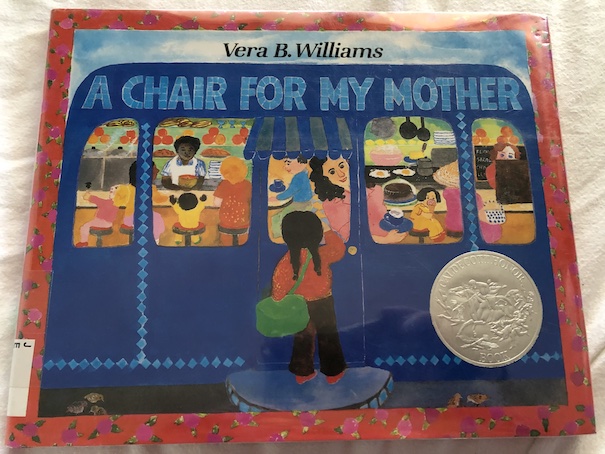
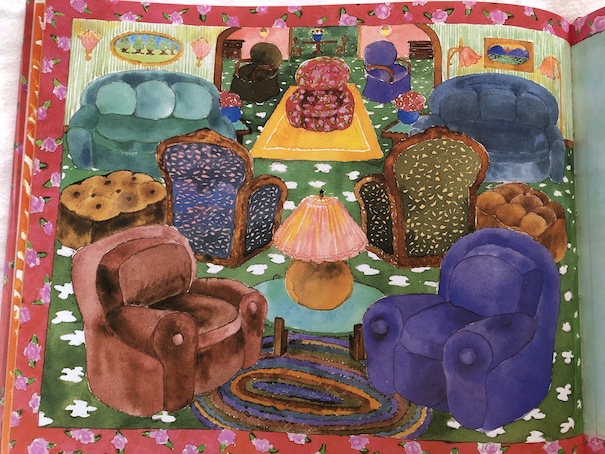
A girl explains how her family is saving up for a new chair after a fire destroyed all the furniture in their old home. The fire happened before the story really begins, but the girl explains how she and her mother returned from a shopping trip and discovered that their home was on fire.
The girl’s grandmother and the family cat escaped from the fire, but everything they had in the house burned.
The girl, her mother, and her grandmother all moved in with the girl’s aunt and uncle until they could move into a new apartment. However, they didn’t have any furniture in the apartment. Their relatives, friends, and neighbors all helped them by giving them food and pieces of furniture they didn’t need anymore.
It was a big help, however, a year later, they still don’t have a sofa or comfortable armchairs. The girl’s mother works in a restaurant, and when she comes home, she’s very tired from being on her feet all day. She wishes that they had a comfortable armchair where she could rest after work.
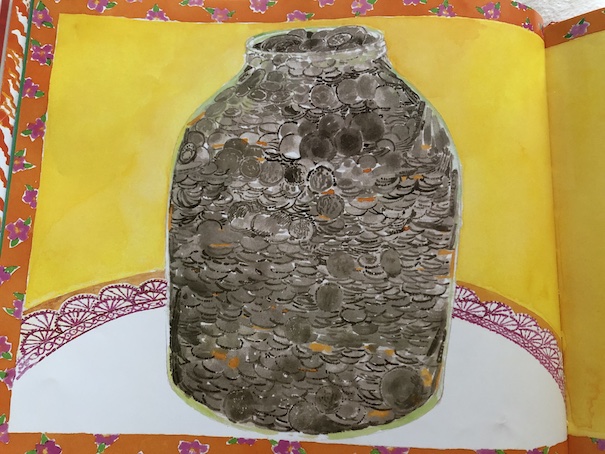
The mother starts saving part of her tips from the restaurant in a coin jar to save up for a new chair. Sometimes, the restaurant owner even pays the girl to do little chores, and she saves part of her money for the chair. Whenever the girl’s grandmother saves money on food she buys, she also puts the savings into the jar. They say that when the jar is full of coins, they will buy the new chair they want.
Eventually, the jar is completely full. They count the coins, roll them in coin wrappers, and take them to the bank to change them for ten-dollar bills. Then, they go shopping for a new chair! There are many chairs to choose from, but they know exactly what kind of chair they want.
The book is a Caldecott Honor Book. It’s available to borrow and read for free online through Internet Archive (multiple copies, including one in Spanish).
My Reaction
I remember this book from Reading Rainbow when I was a kid! The pictures are bright and colorful, and the story offers comfort and hope.
The people in the story have been through a tragedy where they lost almost everything they had, but the book shows how they recover. Although the fire was sad, the story starts after the fire happened, and the girl talks about the help they’ve received and what they’re doing to make their new home more comfortable. They’re over the initial shock of the fire and concentrating on improving their situation from there. This book felt both comforting and very real. I liked how it showed the family recovering from their ordeal through a combination of help from relatives and friends and their own efforts. Other people help them with some basic household items as they move into a new apartment, and they also save up their money for the chair they want to make their new place feel more like home.
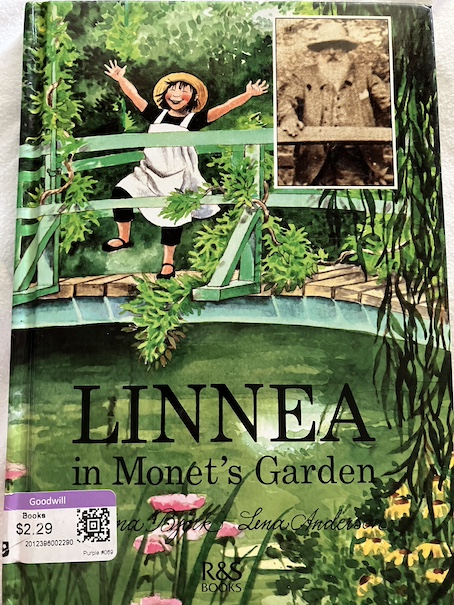
Linnea in Monet’s Garden by Christina Bjork, drawings by Lena Anderson, 1985, 1987.
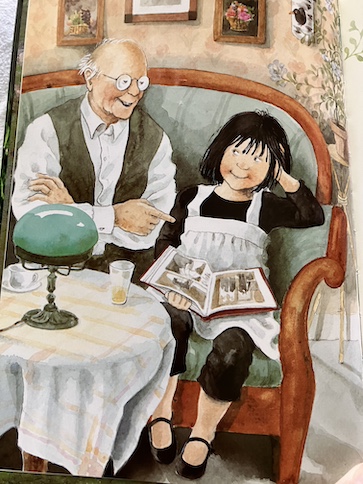
Young Linnea loves plants and flowers. Linnea’s upstairs neighbor, Mr. Bloom, used to be a gardener before he retired. He knows all about plants, and she likes to talk to him about them. Mr. Bloom has a particular book that Linnea likes about the French artist Claude Monet and his garden. Monet was famous for his paintings of the flowers and water lilies in his garden, and the book also has photographs of him, his wife, their children, and their garden. When Linnea looks at that book, she likes to imagine that she really knows the Monet family and that she’s visiting their garden.
One day, Mr. Bloom tells her that it’s possible to really go visit the garden because it still exists. Monet’s house had become run down and the garden was overgrown, but they have since been restored and turned into a museum. They could visit the garden if they go to Paris. They live a long way from Paris, but Mr. Bloom arranges with Linnea’s family for her to go on the trip with him.
Linnea and Mr. Bloom stay at a tiny, old hotel on the River Seine in Paris that was built in 1640. They can see the Notre-Dame Cathedral from the hotel, and it reminds Linnea of The Hunchback of Notre-Dame.
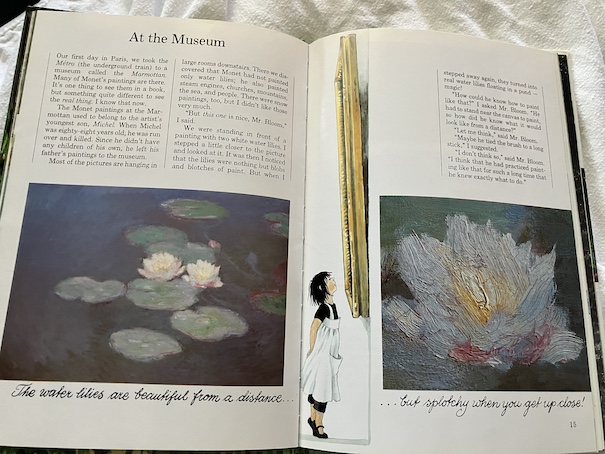
On their first day in Paris, Linnea and Mr. Bloom go to the Marmottan Museum to see Monet’s paintings. Monet’s youngest son left his father’s paintings to the museum when he died because he had no children of his own to inherit them. Mr. Bloom explains to Linnea that Monet painted in the impressionist style, which means that he tried to capture the rough images and impressions of the moment rather than creating detailed, completely realistic paintings. (I’m nearsighted, so impressionist paintings always look to me like what I see when I’m not wearing my glasses. I see colors and rough shapes, but everything is fuzzy with no sharp lines or fine details. I can still tell what objects are without my glasses, but nothing is distinct. I have impressions of things.) Mr. Bloom says that Monet particularly liked to show how light reflects off water and other objects in his paintings.
The next day, they take a train to the town of Vernon, and from there, and from there, they take a taxi to Giverny, where the Monet house and garden are. Along the way, they also buy some food for a picnic. Then, they go to see Monet’s garden.
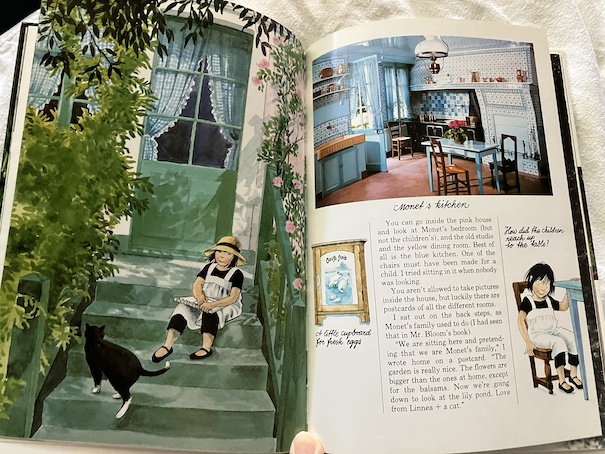
When Linnea sees the garden in person for the first time, it’s much bigger than she had imagined from the pictures in the book. Mr. Bloom tells Linnea all the names of the different flowers, and they take pictures of them. Then, they go inside Monet’s house. They’re not allowed to take pictures inside the house, but they get some postcards of the house’s interior.
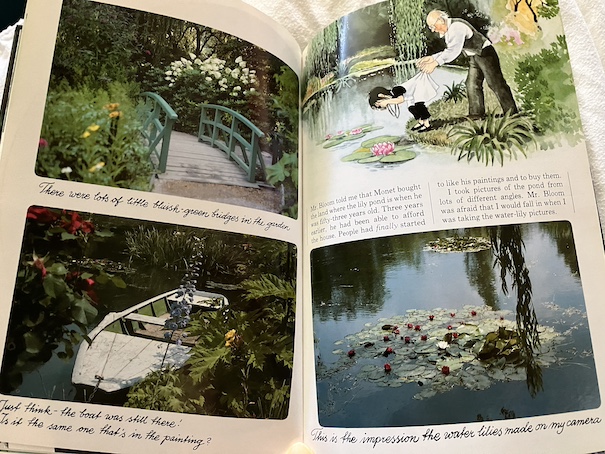
One of the best moments for Linnea is that she is able to stand on the Japanese bridge in the garden, over the lily pond, as she always imagined she could do when she looked at the pictures in Mr. Bloom’s book! Monet painted pictures of that bridge multiple times. Each painting looks different because he painted them at different times and in different weather, so had different impressions of the bridge each time. The book shows Monet’s paintings of the bridge and how different they are from each other, and Linnea tries to capture her own impressions of the bridge.
They aren’t allowed to have their picnic lunch inside Monet’s garden, so they have lunch by the nearby river. Then, they return to Paris.
Back in Paris, they visit the Jeu de Paume museum to see more impressionist paintings. At the Orangerie, they try to see Monet’s giant water lily painting in the Water Lily Rooms. At first, they are told that the exhibit is closed for repairs, but when Mr. Bloom explains that they have come a long way to see them and Linnea starts to cry, the museum staff decide to make an exception.
For the last day of their trip, Linnea and Mr. Bloom decide that they want to return to Giverny. When they make their second visit, a man recognizes them as return visitors, and he turns out to be a member of Monet’s family, his step-great-grandson, Jean-Marie Toulgouat. He lives nearby, and he is also an artist, although his art style is very different from Monet’s. He talks to them about Monet’s life and family, and it also turns out that his wife was the author of the book about Monet that inspired Linnea and Mr. Bloom to take this journey!
When they return home, Linnea and Mr. Bloom go through all the pictures they took in France, and Linnea puts up a bulletin board with postcards and pictures from their trip. She also has a little wooden box with other souvenirs.
In the back of the book, there is a family tree for the Monet family and a timeline of events from Monet’s life. There is also a section of information about museums and sites in Paris and a list of books about Monet.
The book is available to borrow and read for free online through Internet Archive (multiple copies, including one in Chinese). The book was originally written in Swedish and published in Sweden in 1985. The English translation was published in 1987.
My Reaction
This is a lovely book about travel, art, and the beauty of nature and plants. Initially, Linnea becomes interested in Monet because of her love of plants and flowers, and when her neighbor says it’s possible to visit the garden Monet painted, she becomes interested in Monet’s life and work. I grew up learning about art and famous artists because my mother used to teach art lessons through a special program at my school. I don’t remember seeing this book at that time, although it is old enough that I could have. I found it by accident at a thrift store, and it reminded me of the art books that my mother kept around the house when I was a kid.
I enjoyed how the book brought a historical person to life, explaining Monet’s life story as well as his art and showing child readers that it’s possible to see the setting of his paintings in person. The book shows pictures of Monet’s art and photographs of the garden and flowers he painted so children can see the connection between the artwork and the real places and objects. Although not everyone can go to France just on a whim, the book does show what such a trip would be like, and it also shows kids how they can delve deeper into subjects that interest them and even go to places connected with their passions. The journey in the book is a magical trip that even adult armchair travelers can enjoy!













 Jestress's Forgotten Books and Stories