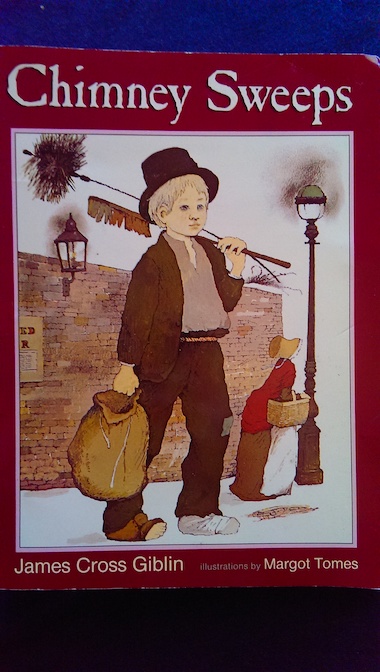
Chimney Sweeps by James Cross Giblin, 1982.
This book explains about the history and traditions of chimney sweeps. I love books that cover odd topics from history like this!
It starts by explaining the origins of chimneys in the Middle Ages. Before they were invented, people would have to have simple holes in the roofs of their houses to let out smoke from heating and cooking fires, or they would have had to rely on windows or doors to perform the function of venting smoke. Chimneys vent smoke more efficiently, but the more they are used, the more soot collects inside them, and they need to be cleaned out from time to time. If they aren’t cleaned, the build-up inside could either block air from getting to the fire in the fireplace, causing the fire to go out sooner, or it could pose a fire risk because the build-up inside the chimney is still flammable. Sometimes, home owners could clean their own chimneys, if they weren’t very tall, but the taller the chimney is, the more professionals are needed to clean it.

Modern chimney cleaners have vacuums that they can use to clean soot out of a chimney, but originally, people were basically relying on brushes. The book explains the evolution of the profession and variations in the profession between England, Germany, and the United States. Germany is significant to the profession because it was one of the first places where chimney sweep became a recognized profession and there were laws even in the 1400s that all chimneys had to be cleaned twice year. (Remember that chimneys that haven’t been cleaned can be a real fire risk, posing a danger not only to you but your neighbors, especially during a time when most buildings are made of wood and other highly flammable materials.) When chimney sweep became a recognized profession during the Middle Ages, members of the profession formed a guild (as was traditional for different professions in general during the Middle Ages) and established rules and standards for the profession. One of the responsibilities of a guild was to decide on the training and qualifications that the profession requires, and in the case of chimney sweeps, the only way to learn was by serving an apprenticeship. The apprentice would live with a master sweep for three years, learning the trade, and at the end of his training, he would have to prove that he could clean a difficult chimney all by himself with thoroughness and reasonable speed.
There are many traditions and superstitions that came to surround the profession of chimney sweep. One of them that you can still sometimes see even in modern times is the image of the chimney sweep in a top hat. The exact reasons for adopting a top hat and tailcoat as part of their uniform are uncertain, but it began back in the 1500s in Europe. The sweeps often got their top hats and tailcoats as secondhand clothing from undertakers (yes, really). Part of the reason for wearing them might have been as an effort to look professional, but the color black was also suitable for a person who was going to end up covered in soot. According to superstition, the top hat would help to protect the chimney sweep from falling when he was on the roof of a house. Chimney sweeps were often thought to be lucky because their jobs were dangerous, yet they survived.
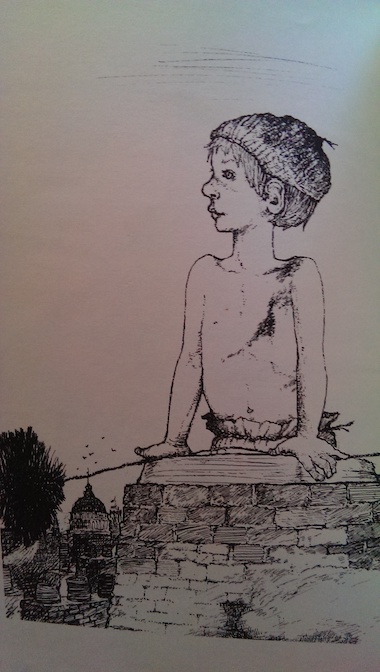
However, chimney sweeps’ lives and work were often hard. In 18th century England, their jobs became more difficult because chimneys were purposely being built in narrow, crooked zigzags. The idea behind the crooked chimneys was that they would keep more heat in, but that made them much harder to clean. Because brushes couldn’t make it around the bends of these chimneys and adults couldn’t get into the narrow flues, sweeps became reliant on young boys to climb up into them and clean them by hand. Although the law required boy apprentices to be no younger than eight years old, many sweeps used boys as young as four or five. Sometimes these boys were official apprentices with the permission of their parents (typically from poor families with many children) or even the sweep’s own children (sometimes, they used their daughters because girls were often smaller than boys). If they couldn’t get children any other way, sometimes sweeps would get children from orphanages or might even resort to kidnapping. The author of this book includes a short story about what a day in the life of a child chimney sweep was like.
The plight of child chimney sweeps came to light during the early 19th century, when people were starting to become concerned about child labor of all kinds. At first, there was strong opposition to banning child chimney sweeps and using new cleaning devices because the adult chimney sweeps saw it as a threat to their livelihoods and home owners were worried that new methods would be more expensive for them (of the two, I think I’m more offended at the home owners’ attitudes because of the implication that they were more upset about a possible slight increase in expense than the risk to the lives of the children they knowingly endangered). Many of the child chimney sweeps suffered severe and permanent health problems because they were forced to do this kind of work at an early age, while they were still growing, and because they inhaled and were covered with soot for such long periods.
In the back of the book, there is a poem by William Blake called “The Chimney Sweeper,” which was published in Songs of Innocence in 1789. Knowing the risks to young children, like the little boys in the poem, makes the poem seem pretty disturbing, which may actually be the author’s intention. Eventually, after long years of struggles in which children were still exploited in chimney sweeping spite of regulations against it, in 1875, Parliament tightened regulations against child labor even further, forcing chimney sweeps to apply for licenses in order to practice their trade, listing each of their apprentices and their ages.
Chimney sweeping in American history was a little different from the way things were done in Europe. The American colonists sometimes tried some strange tactics for cleaning their chimneys. One of the oddest methods was to tie a rope to a goose’s feet and lower it down the chimney. The goose would become frightened and flap its wings, thus knocking the soot loose. When the job was done, the home owner would pull the goose out of the chimney and wash it off. Another tactic was to actually burn the excess soot out of the chimney, although there was a risk of simply setting the house on fire. Later, American cities had official chimney sweeps who were licensed and regulated. On Southern plantations, slaves were used as chimney sweeps, and some of them continued to work as chimney sweeps after they gained their freedom.
Later, when homes began to be heated by other sources than fireplaces, chimney sweeps were in less demand, although there was increased demand in the 1970s, during the energy crisis, because people started using their fireplaces more instead of relying on other heating methods that involved scarce or expensive fuel. Chimney sweeps can also perform other duties beyond simply cleaning chimneys, depending on where they live. For example, in Germany, sweeps perform inspections of factories and homes to make sure that they are using fuels efficiently, looking for sources of needless pollution, which can lead to fines for the owners of the buildings if the problems are not corrected. Some people might also become chimney sweeps as a seasonal part-time job, while they also have another career.
The book is available to borrow and read for free online through Internet Archive.
 Jestress's Forgotten Books and Stories