Day of the Dragon King

Magic Tree House

Day of the Dragon King by Mary Pope Osborne, 1998.

Since Jack and Annie first found the magic tree house full of books, they have managed to solve the ancient riddles and become Master Librarians. The owner of the tree house, Morgan Le Fay, has sent them on missions to retrieve lost stories from ancient libraries. This time, Morgan is sending them to ancient China to retrieve a legendary tale before the Imperial Library is destroyed. They have a guide book about the first emperor, called the Dragon King, to help them, but Morgan tells them that they will need the legend they are retrieving to rescue themselves in the end.

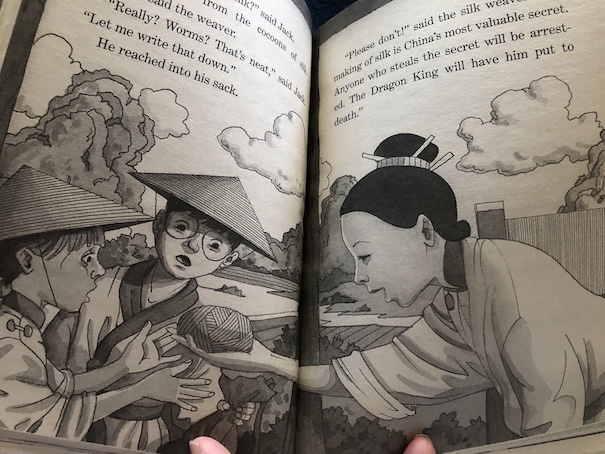
When they arrive in the past, a man asks them to take a message to the silk weaver as a favor. They agree and ask him where they can find the Imperial Library. The man doesn’t answer them, but he acts scared and tells them to beware of the Dragon King. They take the message to the silk weaver, telling her to meet the man at twilight, and she thanks them by giving them some silk thread. They ask her about how silk is made, and she tells them a little about it, but she also says that the method of producing silk is supposed to be a secret. If the Dragon King finds out that they know, they might be put to death!

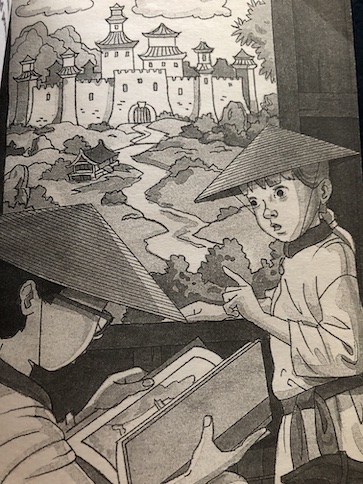
When someone spots them talking to the silk weaver and chases them, Jack and Annie hide in a cart, and they are taken into the emperor’s city. To their surprise, the driver of the cart turns out to be a scholar in disguise. Scholars have gone into hiding because the emperor fears them and their learning. He wants to control people’s knowledge, and to keep people dependent on him, he has decided to burn all the books in the Imperial Library! When the scholar sees their Master Librarian cards, he understands who they are and promises to help them save the legend from the library before it is burned.

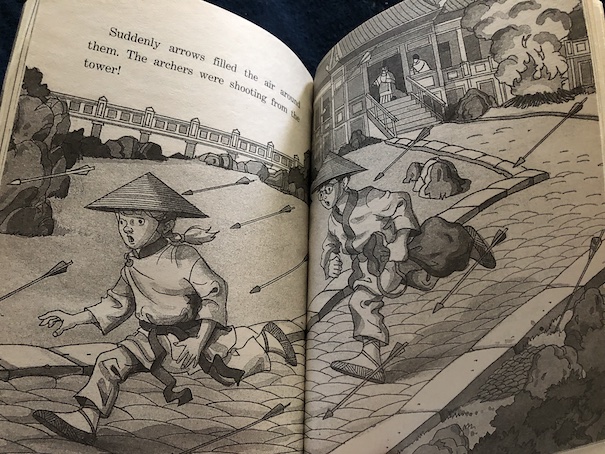
Unfortunately, the burning of the library has already started. Annie grabs the book they’re looking for, and the children are forced to run away from the king’s soldiers, who chase them and shoot arrows at them! When they take refuge in a tomb, they are shocked to see something that neither of them expect.

The book is available to borrow and read for free online through Internet Archive (multiple copies).

My Reaction

The surprising discovery the children make is the collection of terracotta soldiers that the Dragon King has prepared to populate his tomb. Although there is no paint left on the statues now, the children describe seeing them with their original, life-like paint. The same is also true of Ancient Greek statues. People think of classical statues as being just plain marble, but when they were first made, they were also painted with life-like colors.

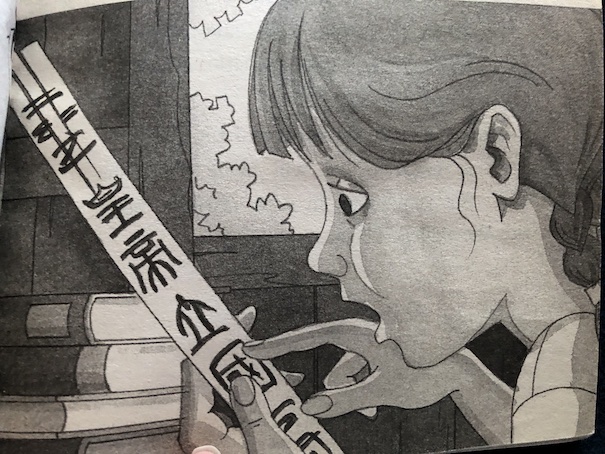
Jack and Annie are able to save the book they came to find, which is in an unusual format, made with bamboo strips. Before Morgan le Fay sends them on their mission, she tells them a little about the history of paper and books. The reason why the book they find is made with bamboo strips is that is what Chinese people used to make books before they invented paper.

Unfortunately, Jack and Annie can’t prevent the burning of the rest of the Imperial Library. I didn’t know before about the burning of the Imperial Library by the Dragon King, and I was fascinated to find out about this other side of the reign of the emperor who commissioned the creation of the terracotta soldiers.

The Fourth Question

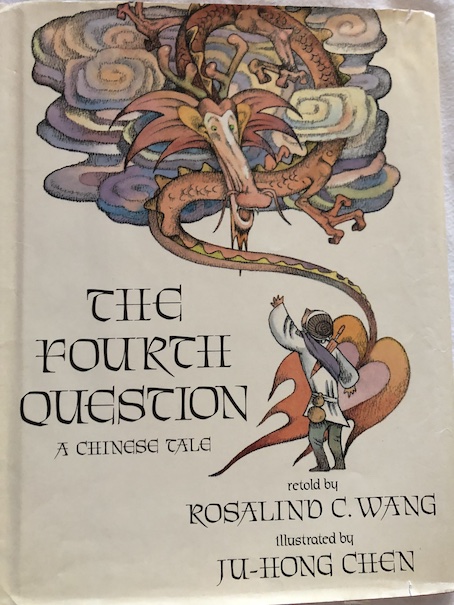
The Fourth Question retold by Rosalind C. Wang, illustrated by Ju-Hong Chen, 1991.

This is a retelling of a Chinese folktale.

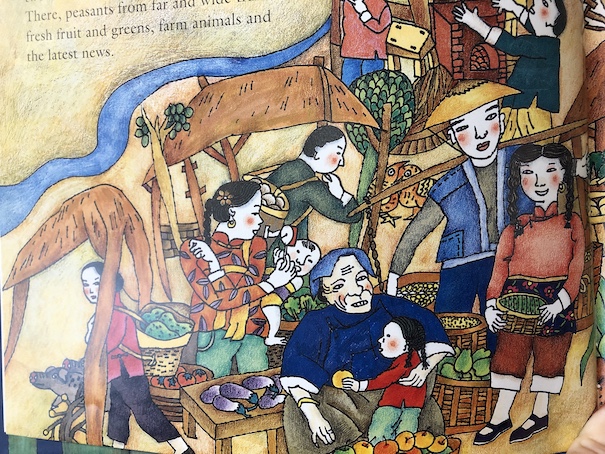
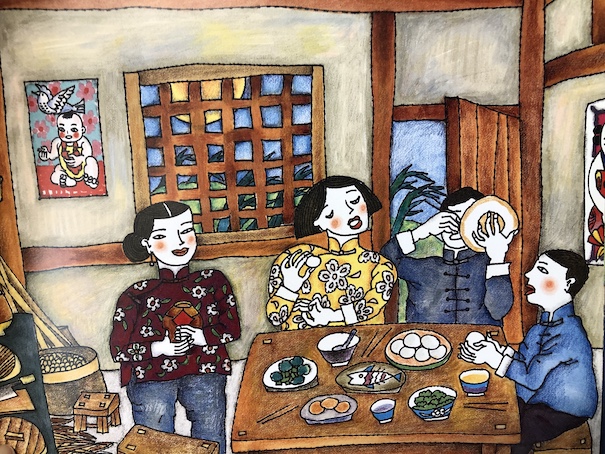
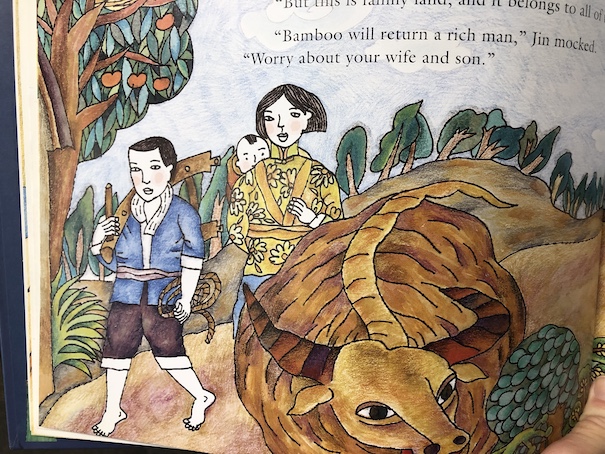
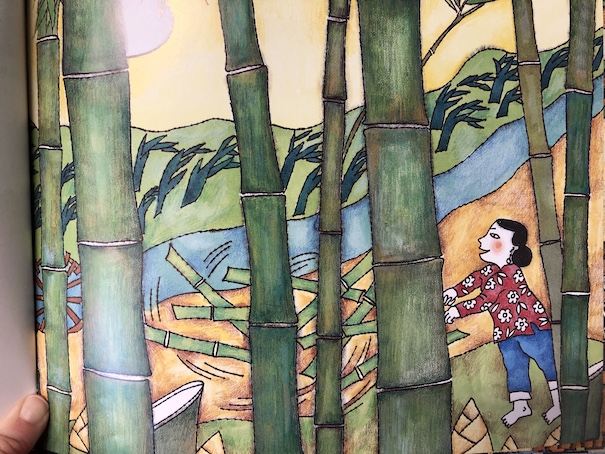
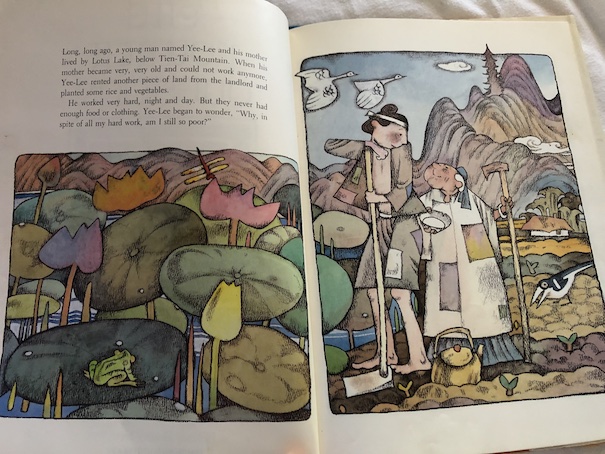
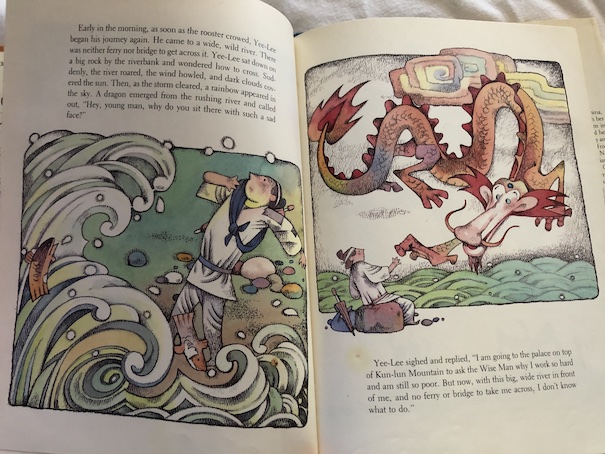
There was once a poor young man, Yee-Lee who lived with his mother. Even though Yee-Lee works very hard, he can barely make enough money to keep him and his mother alive. He wonders why he has so little money even though he works so hard and decides to go to the Wise Man of Kun-lun Mountain to seek the answer and his advice so he and his mother can have a better life.

It’s a long way to reach the Wise Men, and along the way, he encounters other people who also needed help. A kind old woman who gives Yee-Lee some water and food has a daughter who is unable to speak and wants to know how to help her. An old man has a tree in his orchard that won’t bear fruit, and he can’t figure out why. A dragon who helps Yee-Lee to reach the mountain cannot manage to fly to heaven even though he has lived a good life. Yee-Lee has sympathy for all of these people and the dragon and appreciates the help they give him, so he promises that when he reaches the Wise Man, he will seek the answers to their problems as well.

However, when Yee-Lee finally reaches the Wise Man, he is told that he is only allowed to ask three questions during his visit. It’s a problem because Yee-Lee now has four questions to ask, the three that he promised to ask for others plus the original question that he wanted to ask for himself. He has to decide which of the questions will go unanswered.

Yee-Lee’s question is important to him, but when he thinks about the other people who are now depending on him to come back with answers for him, he reluctantly decides to forget his own question and answer theirs. However, in solving the problems of others, Yee-Lee finds the solution to his own problem. Like the heroes of other folktales, Yee-Lee is rewarded for his good deeds!

The book is available to borrow and read for free online through Internet Archive.

Games People Play: China

Games People Play: China by Kim Dramer, 1997.

This book is part of a series about games played around the world. The series also covers sports and other, related activities. This book is specifically about the traditional games and sports of China.

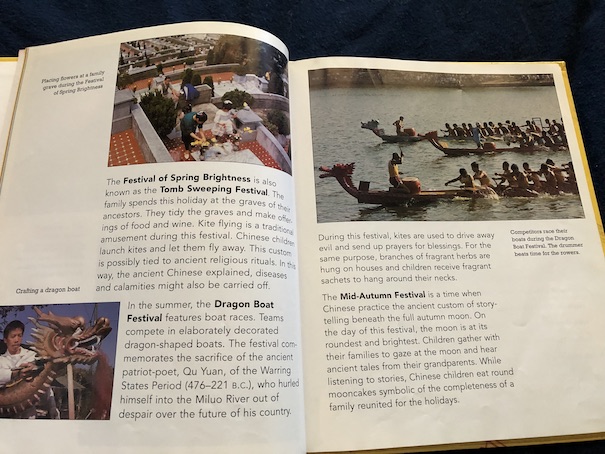
China’s history goes back thousands of years, and so does the history of games and toys enjoyed there by generations of children. The book begins with a brief history of China. This book was written in the 1990s, and it contains a brief description of China’s one-child policy, which controlled the sizes of Chinese families and impacted the way in which children were raised. It also explains some important Chinese festivals, such as the Lunar New Year, Lantern Festival, and Dragon Boat Festival. It explains the origins of these festivals and how people celebrate, including the roles of children in the celebrations.

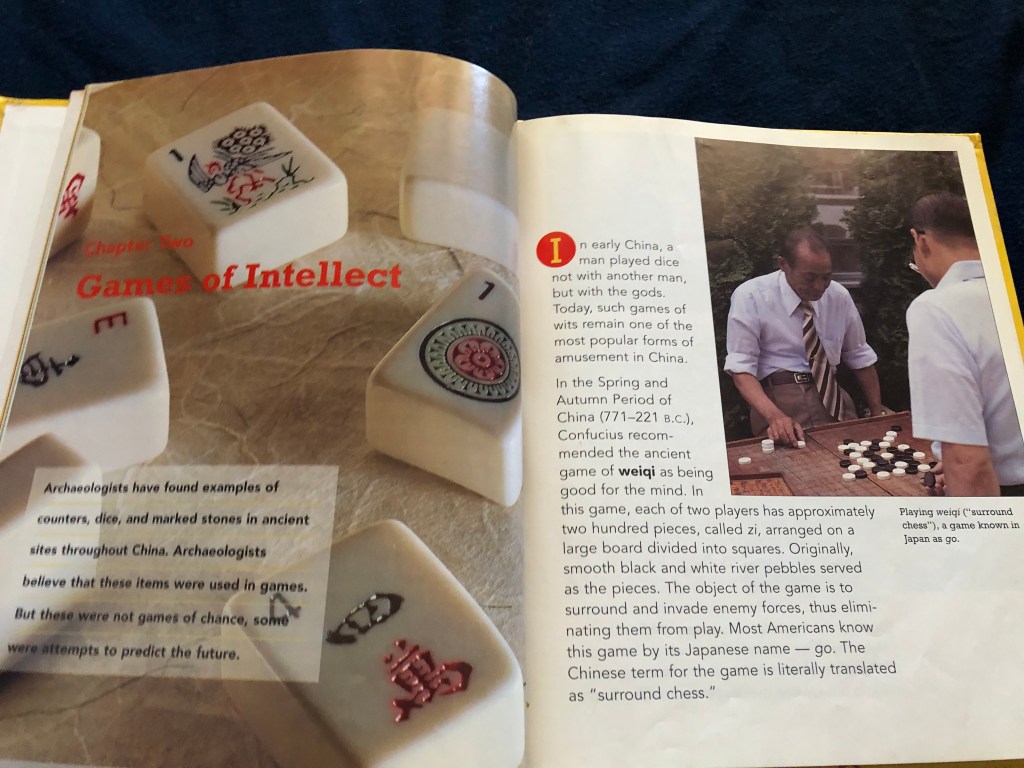
I most enjoyed the sections about board games. Some of the oldest board games in the world come from China. Some of these games are also played in Japan under different names. For example, the game Weiqi is known as Go in Japan, and this is the name that is also most familiar to Americans. Chinese Chess uses different pieces from the international form of chess. The book mentions Chinese Checkers also, but it doesn’t explain that it was not actually invented in China, even though it is played there today. (The “Chinese” in the title was a marketing gimmick in the United States, to make the game seem more exotic. It’s actually a German variation of the American game Halma, which was based on an older English game called Hoppers.) Majiang (called Mah-Jongg in the United States) is another well-known Chinese game. Sometimes, in the United States, people play it as a solitaire game on their computes, but the real-life board game is a multiplayer game with several variations.

When I was in school, I had a teacher who was fond of tangrams, which is a kind of puzzle game that involves using a set of basic shapes to produce different forms or pictures of objects. The book demonstrates how to make a tangram set and how to use it.

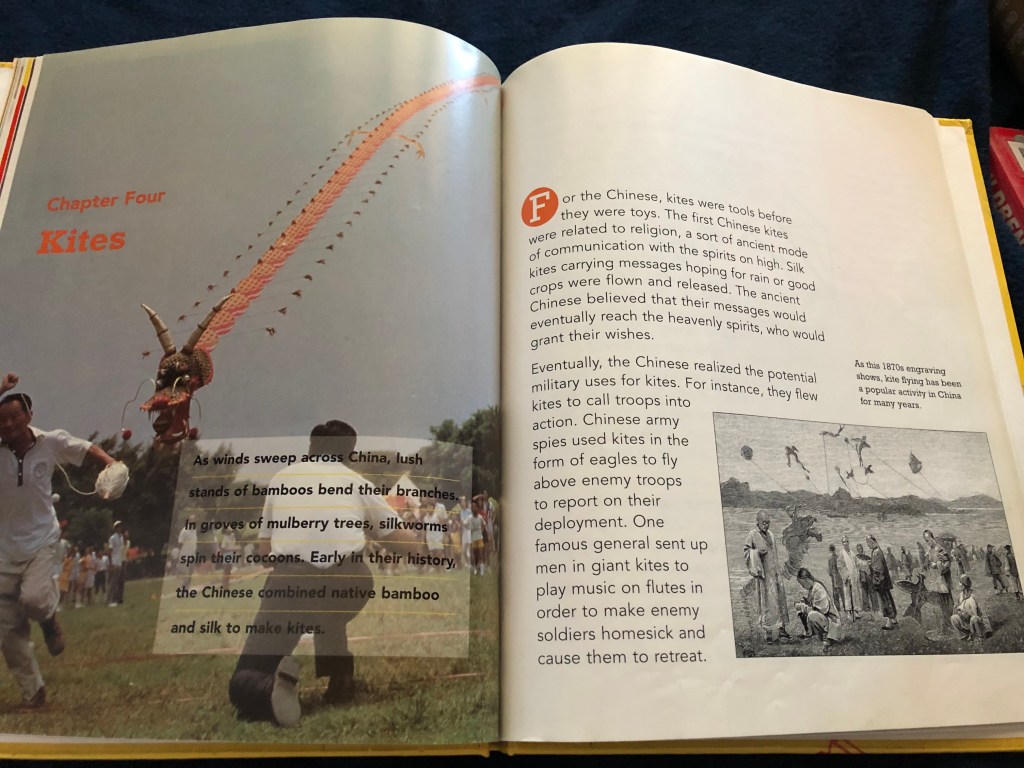
The earliest kites made in China were made for serious, religious purposes, sending prayers, signs, or messages to the heavens. Later, the Chinese also used them to give military signals. Later, paper kites became a popular form of amusement and folk art. They can be made in many different forms. Some of them even make musical sounds, caused by the wind passing over holes placed in the bamboo frame of the kite.

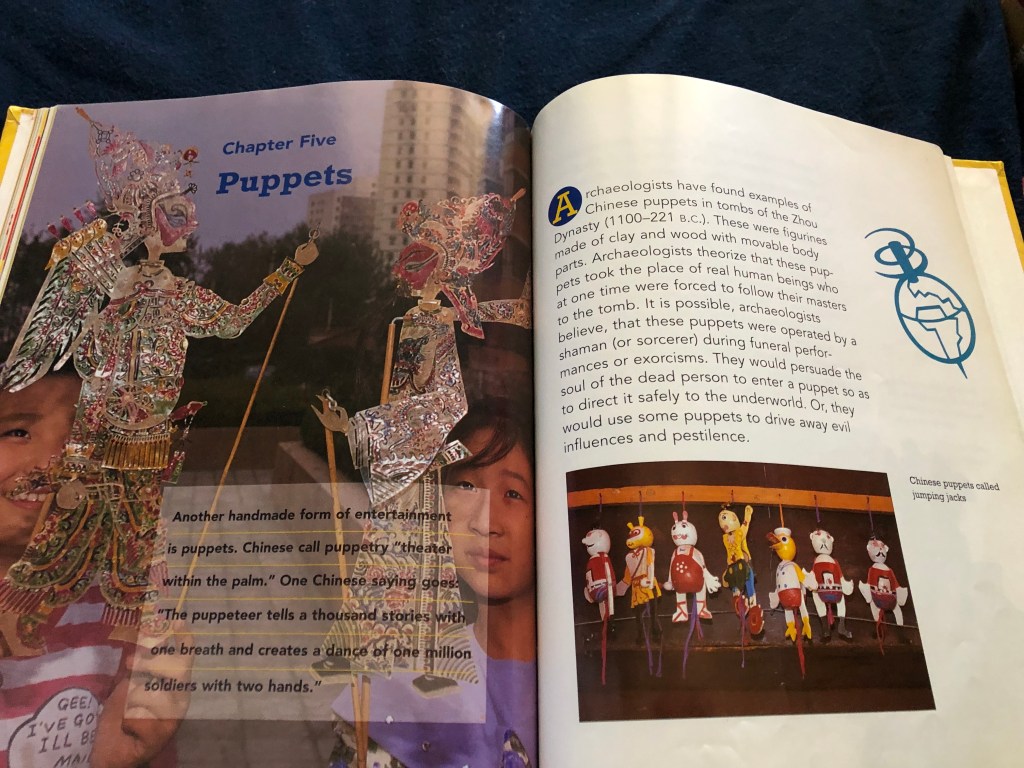
The Chinese also use puppets in different styles. The history of puppet theater also goes back thousands of years, and puppets made for puppet theaters can be very elaborate. Sometimes, plays are performed with shadow puppets controlled by sticks and sometimes with marionettes or hand puppets. The appearance of a puppet and provide clues to the puppet’s character. For example, puppets with red faces represent brave characters while ones with white faces may be cunning and treacherous and ones with black faces are loyal.

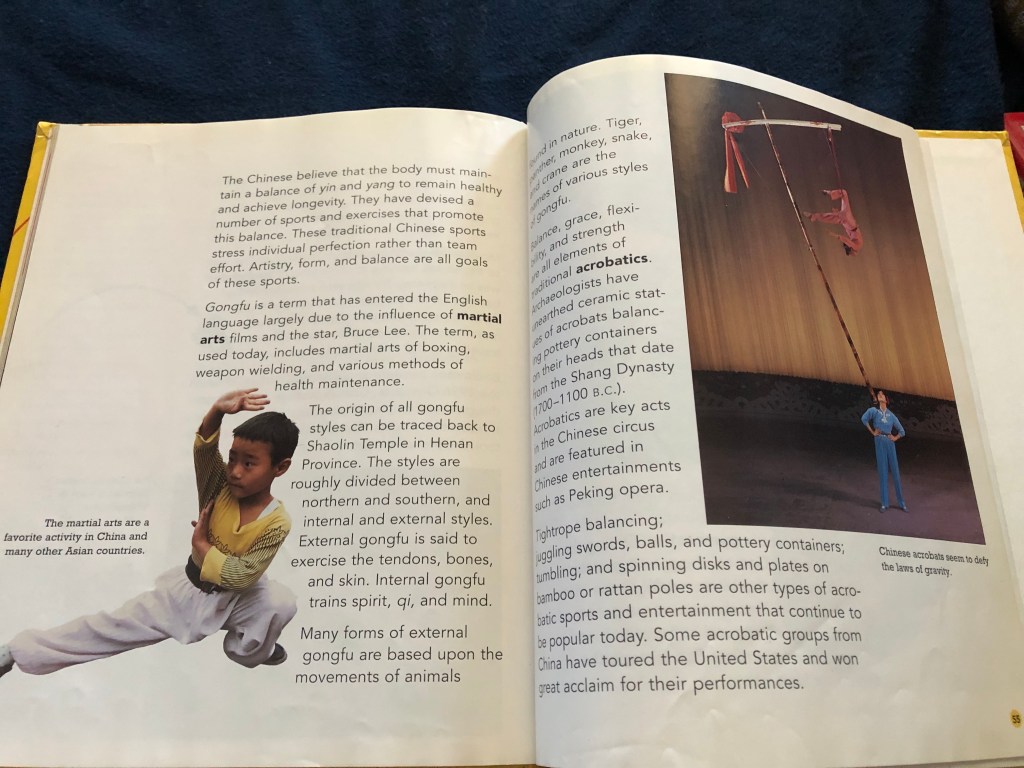
Popular sports in China include soccer (called “football” everywhere but in North America) and badminton. China is also famous for its martial arts and some spectacular forms of acrobatics.

The Story About Ping

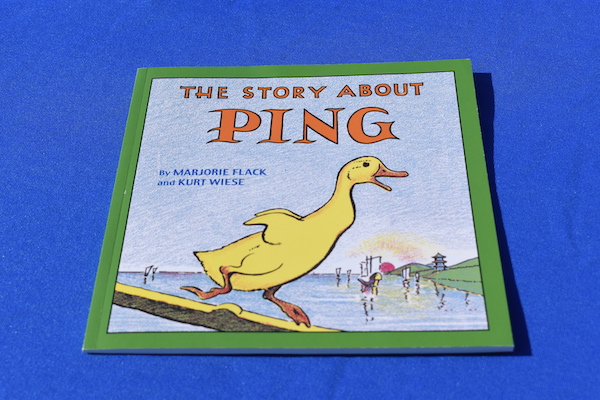
The Story About Ping by Marjorie Flack and Kurt Wiese, 1933.

Ping is a small duck who lives with his family on a boat on the Yangtze River in China.  Every morning, the master of the boat lets the ducks out to look for food on the river, and every evening, he calls them back. 

However, Ping hates it that the master gives the last duck to return at the end of the day a spank on the back, so when he realizes that he is late to return one day, he hides and is left behind.

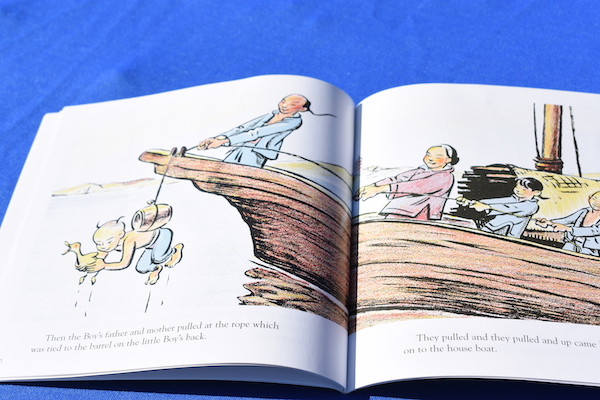
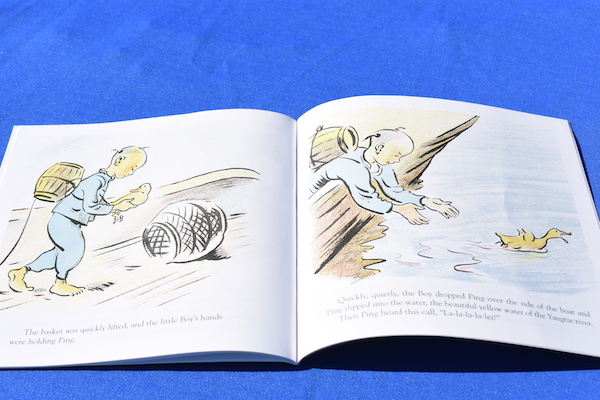
After sleeping on the river bank overnight, Ping sets out to find his family the next day.  However, there are many different boats on the river, and he has trouble finding the one where his family lives.  As he searches, he is captured by a boy who brings him onto his family’s boat.

To Ping’s horror, the family who captured him plans to eat him for dinner!  However, the boy who grabbed Ping out of the water thinks that he’s “too beautiful to eat.”  Without letting his family know, the boy frees Ping from the basket where he is being held captive.

As Ping swims away from the boy’s boat, he hears the master of his family’s boat, calling out for the ducks to return.  This time, Ping does return to his family’s boat, even being willing to take a spank for being late, glad just to be safe with his family.

In a way, this little story reminds me of one of the short humor stories in Wayside School is Falling Down.  In that story, a boy at a very strange school gets tired of following the school’s rules.  Some mysterious men explain to the boy that the rules are meant to keep the students safe and choosing whether or not to follow the rules means choosing between freedom and safety.  The story and the boy’s choice are meant to be humorous, but it is a good point about the purpose of rules.  Probably, the reason why the master on Ping’s boat spanks the last duck is to give all of the ducks a reason to hurry back to the safety of the boat.  Ping doesn’t really appreciate that until he sees the dangers that wait for a small duck, alone on the river.  In the end, he is willing to accept some discipline because he wants the safety it promises.  It’s not the usual message in a lot of modern children’s books, especially in the United States, where people and book characters tend to value freedom over safety (the choice made by the boy in the Wayside School book).  However, in this book, Ping and his family have something between total freedom and total captivity – they are allowed to swim pretty freely during the day as long as they return to the boat for safety at night. They get both some freedom and safety in exchange for following the master’s routine. Ping’s danger only comes when he breaks away from that entirely.

But, if you think that analysis is getting too deep, Ping’s adventures and his return to the safety of his family are endearing for lovers of animal stories. Kids who encounter this story will be reassured that Ping is still able to return to home and safety after his adventures!

The story has appeared in film and on television more than once. The book is available to borrow and read for free online through Internet Archive (multiple copies).

The Five Chinese Brothers

FiveBrothers

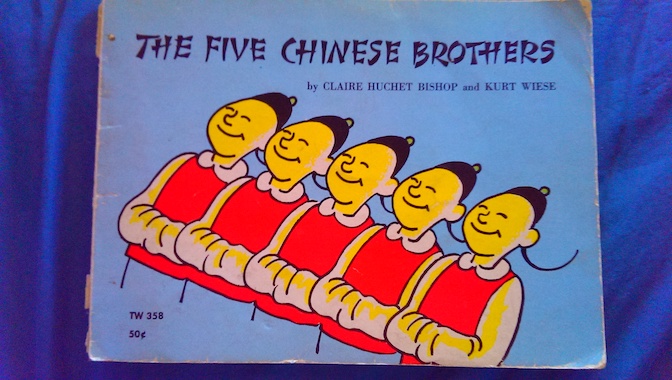
Although this picture book has faced some criticism for promoting Asian stereotypes (largely about the way the characters are drawn), it has nostalgic appeal for some people and is still in print.  What I find interesting about it is that it is actually based on an old folktale, Ten Brothers.  Folktales of this type, where people with different types of super-human powers must help each other to overcome obstacles, can be found throughout the world.  Another story on this theme is How Six Made Their Way in the World.

In this story, there is a family in China with five brothers who look alike, except that each brother has a unique super power (listed by birth order):

  • One can swallow the entire sea, although only for a limited amount of time.
  • One has a neck as strong as iron.
  • One can stretch his legs extremely far.
  • One is impervious to fire.
  • One can hold his breath for an unlimited amount of time.

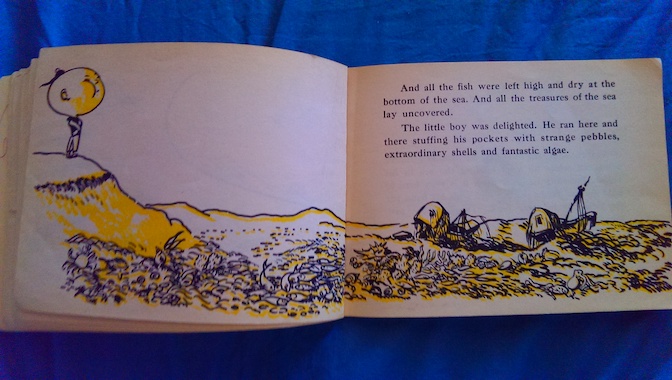
They live in a village by the sea and make at least part of their living by fishing.  One day, a young boy asks to go fishing with the brother who can swallow the sea (they don’t have names in the story, they’re just referred to by ability or birth order).  At first, the brother is reluctant to allow it, but when the boy begs, the brother agrees only on the condition that the boy obey him and return to his side as soon as he gives the signal.  The brother swallows the sea and allows the boy to collect as much fish as he likes from the empty sea bed.  However, the boy gets too wrapped up in all the amazing things he finds on the empty sea bed and ignores the brother’s frantic signals to return.

FiveBrothersSeaSwallow

Finally, the brother cannot hold back the sea any longer and releases it.  The boy drowns, and the brother is arrested for the boy’s death.  The judge decrees that the brother will be executed by having his head cut off.  Before the execution, the brother has a last request: that he be allowed to return home to say good-bye to his mother.  The judge allows it, and the brother switches places with his brother who has a neck like iron.

FiveBrothersHead

Needless to say, the execution doesn’t go as planned, and everyone is astonished when the executioner cannot cut off the brother’s head.  The judge decrees that he will be executed by drowning instead.  However, he does grant the brother’s request to say good-bye to his mother once again, giving him the chance to switch places with another brother who can safely face the next ordeal.

FiveBrothersBurn

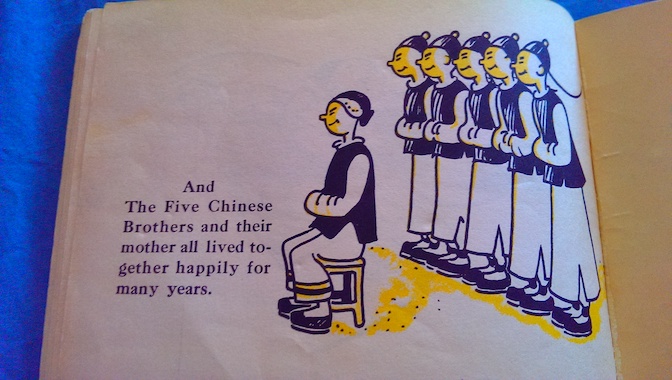
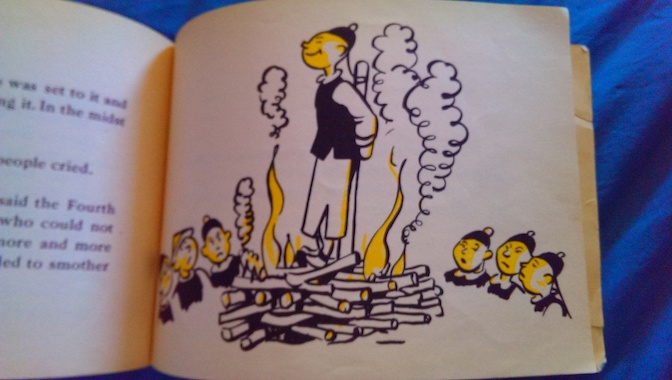
The process continues through one form of execution and another as each of the brothers survives, using his own special power.  Finally, the judge decides that if the man (he doesn’t know there’s more than one, apparently) cannot be killed, he must be innocent and pardons him.

The book is currently available online through Internet Archive (multiple copies).

FiveBrothersFamily

Christmas Around the World

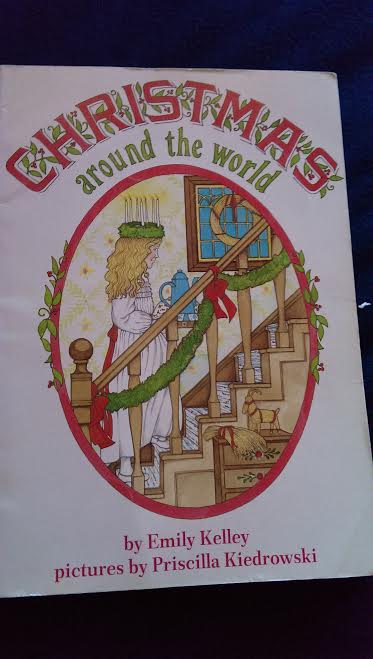
christmasworldChristmas Around the World by Emily Kelley, 1986.

This is a non-fiction book that describes Christmas customs from various countries around the world.  There is some history and folklore associated with different Christmas traditions in every country.  The main countries described are Mexico, Iran, China, Sweden, Iraq, Spain, and Norway, although there is a section in the back that briefly mentions a few other countries.

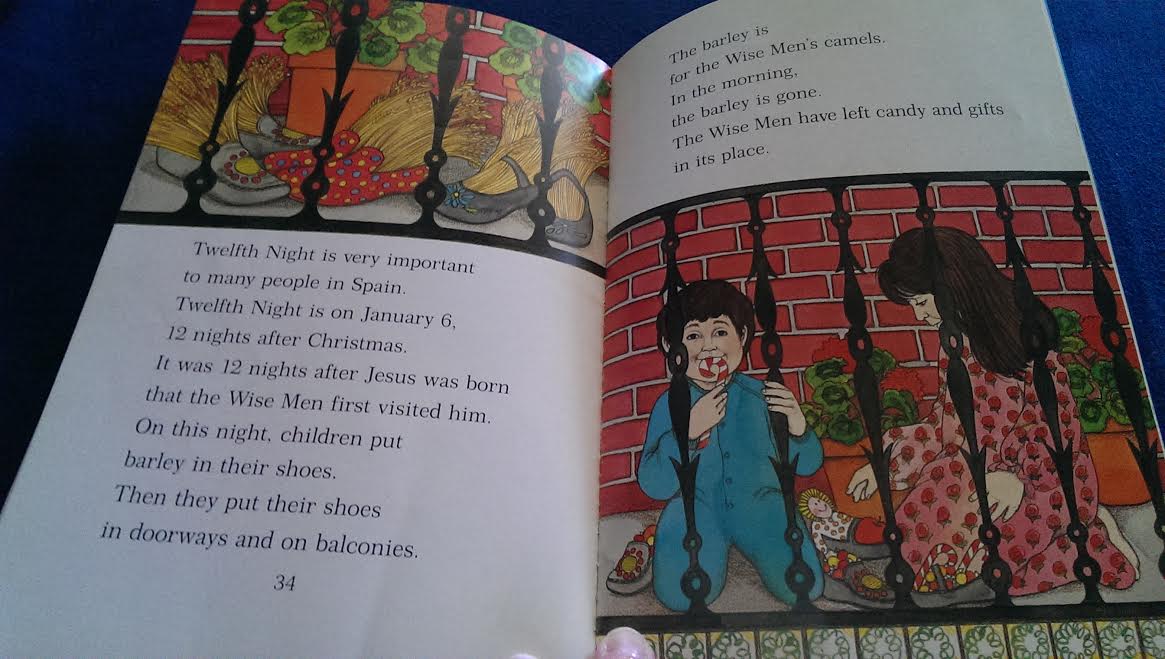
In some countries, children leave out their shoes instead of their stockings in the hopes of receiving small presents in them.  Sometimes, the gifts are from Santa, and sometimes, they’re from someone else, like the Wise Men.  In other countries, people do not give gifts on Christmas, except maybe new clothes for the children.
Some of the traditions described are older ones, based on folklore, like the one about hiding brooms and tools from witches and bad spirits in Norway.  In countries in the Southern Hemisphere, Christmas is associated with summer instead of winter, changing the way people celebrate the holiday.  Each country has their own special foods associated with the holiday, too.

christmasnorway

The book also describes traditions that are associated with other special days related to Christmas, such as St. Lucia Day in Sweden (December 13) and Twelfth Night, when the Wise Men came to visit Jesus (January 6).  These special days are kind of an extension of the Christmas season in different countries.

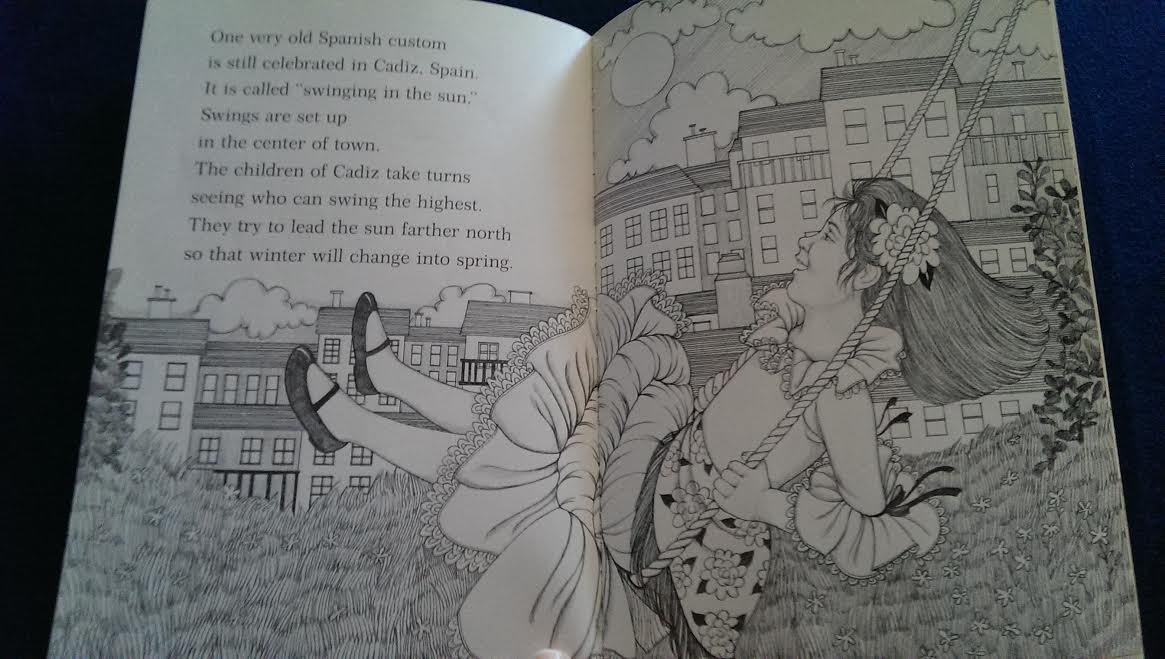
christmasspain

christmasspain2

The pictures in the book are beautiful.  Some of them are in color and some are in black and white.

christmasmexico

In the back of the book, there are jokes, a craft project, and a recipe for Christmas cookies.

The book is available to borrow and read for free online through Internet Archive.