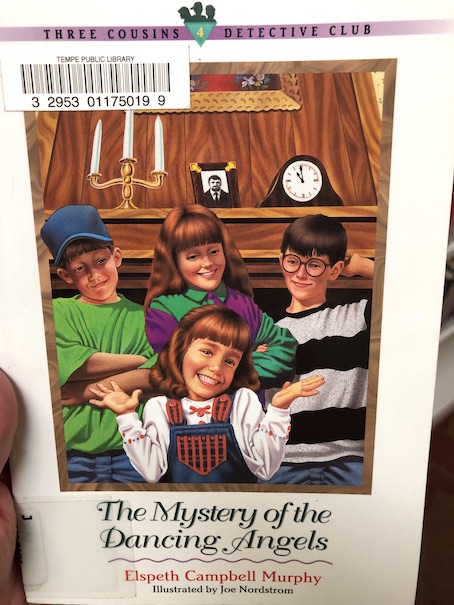
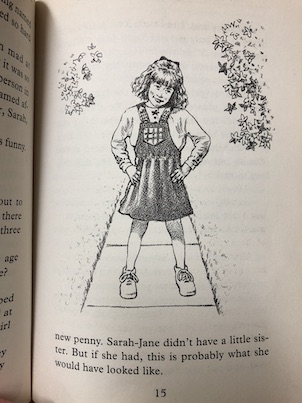
The Mystery of the Dancing Angels

Three Cousins Detective Club

#4 The Mystery of the Dancing Angels by Elspeth Campbell Murphy, 1995.

Sarah-Jane, Timothy, and Titus are visiting their grandparents over the summer when their grandmother’s cousin comes over to discuss some information she has found about their family’s genealogy. The kids’ great-great-great-grandfather was a woodcarver, and he did some work in a large house that is now being restored. There is a story that an expensive ruby necklace that belonged to the former owners of the house may be still hidden somewhere on the property.

The prospect of exploring the old house and maybe finding the missing necklace sounds exciting, but the kids also must spend their time looking after their distant cousin, Patience, who is only four years old and has a tendency of getting into trouble.

When little Patience disappears inside the house, the kids are worried, but she soon returns with the answer to a riddle that has been passed down in their family for generations. Dealing with little kids requires patience, but Patience herself notices details in the woodwork in the house that the adults and older children haven’t noticed.

The theme of the story is patience.

The book is available to borrow for free online through Internet Archive.

The Mystery of the Silent Nightingale

Three Cousins Detective Club

#2 The Mystery of the Silent Nightingale by Elspeth Campbell Murphy, 1994.

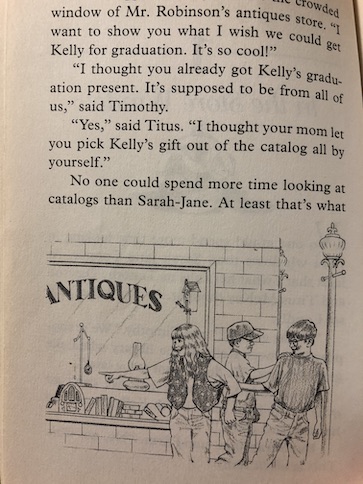
Sarah-Jane’s baby-sitter and friend, Kelly, is graduating from high school. Soon, she will be going away to college. Sarah-Jane is sad that she is leaving, but she is happy her family was able to find her a nice graduation present.

After they pick out their present, Sarah-Jane sees a locket with a nightingale on it in a store window. The nightingale is a Christian symbol for joy, and Sarah-Jane thinks that it would have made a nice present for Kelly if they didn’t already have one.

To everyone’s surprise, someone else buys the locket and leaves it at Kelly’s house. Sarah-Jane feels a little strange that someone else took the idea that she’d had for Kelly’s present. However, it is even more mysterious that there is no note or card with it to say who it is from. Kelly asks the cousins to help her find out who gave her the locket so that she can thank them. As it turns out, the present isn’t just an ordinary graduation present. It’s actually a thank you from someone who has been grateful to Kelly for a long time for a kindness she wasn’t even aware that she had done. Sarah-Jane even had a hand in it herself although she also wasn’t aware of it. Sometimes, it’s the smallest good deeds that can make the biggest difference in someone’s life.

The theme of the story is joy.

The book is available to borrow for free online through Internet Archive.

Themes and Spoilers:

The person who left the present for Kelly is Janice, who works for Kelly’s father. The kids had wondered why she seemed to recognize them when they stopped by Kelly’s father’s office early to show him Kelly’s graduation gown. It turns out that Janice has been grateful to Kelly for years for something kind that Kelly did for her when the cousins were very young. Kelly always used to read to the cousins when they were small, particularly Sarah-Jane. She took Sarah-Jane and the others to the library the day that Sarah-Jane got her first library card. That same day, Janice was also at the library.

Janice had never learned to read and was unable to finish her education. For a long time, she was ashamed to admit to anyone that she couldn’t read. Then, she heard about classes at the library for adults who had never learned to read and decided to go there. When she got to the library, she didn’t know where the classes were being held. She couldn’t read the signs, and she was too embarrassed to ask the librarian. There were some people she knew in the library, and she was so afraid of any of them finding out why she was there that she almost left. Then, Janice saw Kelly with Sarah-Jane and the boys. She saw how happy Sarah-Jane was to get her new library card, and she decided that she really wanted to learn to read, too. Janice knew that Kelly wouldn’t look down on her like some adults would, so she asked Kelly to help her find the class. Kelly helped her, even though she forgot about it later, and Janice was grateful to her for keeping her from backing out.

After Janice learned to read, she was able to finish her education. When she realized that the girl who had helped her years ago was her boss’s daughter, she wanted to give her a present. She wanted it kept secret at first because she was still embarrassed that it took her so long to learn to read. She was worried about what her boss would think of her. However, Kelly’s father doesn’t hold it against her, and Janice’s strict supervisor, Dorothy, even asks her to help tutor her grandson, who has been having learning difficulties.

Home for Christmas

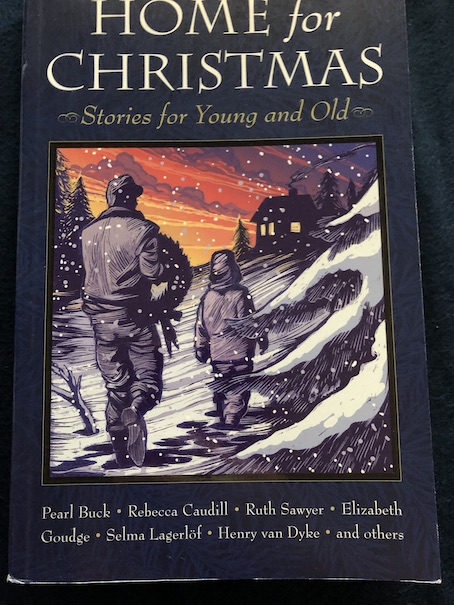
Home for Christmas: Stories for Young and Old compiled by Miriam LeBlanc, 2002.

Disclosure: Plough Publishing House sent a copy of this book to me for review purposes, but the opinions in the review are my own.

This is a collection of short Christmas stories written by famous authors from around the world. One of the things that I found interesting about the selection of authors in the book is that many of them are better known for writing on very different themes. Among the authors in this book are Madeleine L’Engle, who is known for writing science fiction, such as A Wrinkle in Time; Elizabeth Goudge, who wrote the mid-20th century classic children’s fantasy story The Little White Horse (later made into the film called The Secret of Moonacre); Katherine Paterson, known for her children’s novels, including Bridge to Terabithia, Jacob Have I Loved, and historical novels set in Asia, such as The Master Puppeteer; and Pearl S. Buck, author of The Good Earth.

Although the book is intended for children and families and many of the authors are known for writing for children and young adults, I think that many of the stories wouldn’t particularly appeal to children, especially younger children, because children wouldn’t be likely to understand them or they have darker themes, like bitterness that must be overcome and grief at the death of a child. The stories generally end well, but for young children, something simpler and lighter in subject matter, like the short stories in Merry Christmas from Eddie, would be more appealing. Really, I think this book would be best for adults, although I noted some of the more child-friendly stories.

One thing that I wished the book included is sections of information that explain a little more about the stories behind the stories. I recognized the historical references behind some of the stories, but other readers, particular children, might require a little more explanation to fully appreciate them. I think that’s another good reason why the stories might appeal more to adults.

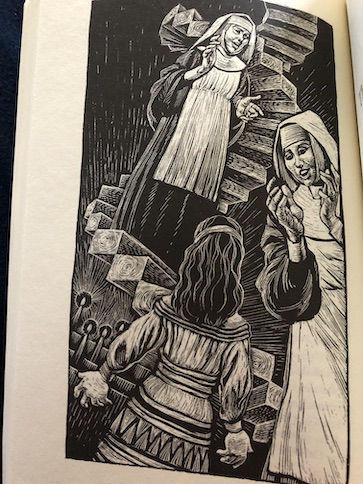
There are 20 stories contained in the book. Each of the stories in the book has one black-and-white picture in an old-fashioned woodcut style.

I don’t think that there are any copies of this book available to read for free online, but this book is available for purchase through Plough Publishing House.

The stories contained in this book are:

Brother Robber by Helene Christaller

A young monk sends three robbers away without food before Christmas because they are violent criminals, but an older monk convinces him to have compassion and to find them and give them the food they have asked for.

The compassionate brother, Brother Francis, is St. Francis of Assisi, although it is not explicitly explained in the story, and the younger brother, Brother Angelo, is the main character. The story of St. Francis, Brother Angelo, and the robbers is an old one that has been told before in other forms, but this is a good rendition.

Three Young Kings by George Summer Albee

Three boys at a school in Cuba are given the role of playing the Three Kings in their school play as well as delivering presents to the rest of the children in their community, giving them presents that their parents have already bought for them. However, their task proves harder than they thought when they see how upset the poor children are that they pass their houses and leave nothing because their parents couldn’t afford presents. What can they do?

This is a good book for talking about making choices. In the end, the community is satisfied with the boys’ choice, but a good topic for discussion after this story would be what the community will choose to do next year, when new boys become the Three Kings.

Transfiguration by Madeleine L’Engle

A nun in New York City struggles to answer a poor man’s questions about why Christmas should be so “merry” when there are so many poor people and bad things happening in the world. The real answer comes to her after the man tries to rob her.

The Cribmaker’s Trip to Heaven by Reimmichl

Willibald Krautmann spends his life making manger scenes for Christmas, and he is sure that his work will earn him a place in Heaven. Unfortunately, when he dies, he is not received in Heaven as he thought and, confronted with the history of his faults that prevents him from entering, he must seek an advocate to help him plead his case. However, it’s not too late for him to mend his ways, and the reader is left to imagine how much was real and how much was dream.

The Guest by Nikolai S. Lesskov

Timofai was a bitter young man, an orphan defrauded of his inheritance by his uncle. After a violent fight with his uncle, he is sent into exile in Siberia. Even after his life improves and he marries and has a family of his own, he still finds himself bitter about the injustice that was done to him. Is there anything that his friend and brother-in-law can say that will help him? When he finally meets his uncle again, after many years, will they both get the closure they really need?

Christmas Day in the Morning by Pearl S. Buck

An older man and his wife decide how to spend Christmas now that their children are grown and living their own lives, separately. As the man reflects on Christmases past, he realizes that love is what makes Christmas special and what you do to show other people how much you love them.

This is one of those stories that I think adults would understand more than children, although it’s a good thought to explain to older children.

The Other Wise Man by Henry van Dyke

The story of a wise man who set out to follow the star at Christmas, like the others, but didn’t arrive at Bethlehem with them because he stopped to help someone. Although he arrives too late to see the Christ Child, he is in the right places to help people because he set out on the journey. At the end of his life, this wise man does actually see Jesus at his crucifixion.

This is a famous 19th century story.

The Miraculous Staircase by Arthur Gordon

In Santa Fe, New Mexico, in 1878, an unusual carpenter promises that he can build a staircase to a church choir loft, even though the original architect didn’t leave space for stairs. Even though other carpenters had failed to find a solution to the problem, the mysterious stranger solves it. But, who was that mysterious carpenter, and how did he do it?

This is actually based on a true story! I’ve been to the church in Santa Fe, the Loretto Chapel, and I’ve seen this staircase myself! The short story ends with a few details about the history of the event.

No Room in the Inn by Katherine Paterson

When an eighteen-year-old boy’s parents leave him alone at the family’s inn, which is closed for Christmas while they visit his sister’s family, he’s a little sad at spending Christmas alone but also looking forward to some freedom to relax. However, a mysterious stranger who needs a place for the night changes his plans.

The Chess Player by Ger Koopman

The Christ Child must help an old man to forgive his estranged daughter on Christmas. Can the Christ Child soften a hardened heart over a game of chess?

The Christmas Lie by Dorothy Thomas

A poor young girl from a large family invents a story that some friends have invited the whole family to join them for Christmas dinner when, in fact, no invitation has been made. It had really been more of an impulsive wish that they had been invited, but when her family believes her and begins preparing for the event, can the girl find the courage to admit the truth? What will happen when everyone realizes that she lied?

This is one of the better child-centered stories in the book.

The Riders of St. Nicholas by Jack Schaefer

A group of cowboys have to decide which of them are going into town to celebrate Christmas and which of them will be staying on the ranch. The ones who get left behind plan a small feast for themselves as consolation for being left out of the fun. However, their plans change when they rescue a neighbor who got drunk and almost froze in a snowstorm.

Grandfather’s Stories by Ernst Wiechert

An old coachman tells stories that his grandfather told him. One Christmas Eve, his grandfather’s grandfather was driving a coach and saw a strange, smiling boy who seemed to be asking for something. Although his employer wanted him to drive on, the coachman gave the boy a ride, and it turns out to be the beginning of a miracle. In another story, a cruel master is changed for the better when he sees that the victim of his cruelty is Christ.

The Vexation of Barney Hatch by B.J. Chute

A panhandler gets recruited as a store Santa and helps a poor boy who only wants a harmonica.

The Empty Cup by Opal Menius

King Herod, knowing of a prophecy that a new king would be born, attempted to kill the new king to preserve his own power. Unable to tell which baby would be the prophesied king, Jesus, he ordered all of the boy babies in the area to be killed.

This story focuses on a man whose only child was killed. His wife seems unable to get over the shock and grief of their son’s death until another little boy teaches her how to get over a loss.

The Well of the Star by Elizabeth Goudge

The Well of the Star is a well where legend has it that the Wise Men stopped on their way to see Jesus. David is a poor shepherd boy who is left behind when the other shepherds go to see the baby Jesus. He is visited by the archangel Michael, who sends him to join the others, meeting the Wise Men on the way.

This is one of the better child-centered stories in the book.

A Certain Small Shepherd by Rebecca Caudill

Jamie’s mother died shortly after his birth, and for much of his young life, Jamie is unable to talk. When he begins going to school, he does well, except that he can’t answer questions out loud in class and not at all if he doesn’t know how to spell the word that he wants. It’s frustrating. However, when his teacher makes him a shepherd in the school Christmas play and his family has some unexpected visitors in a snowstorm, things change.

This is one of the better child-centered stories in the book.

The Carpenter’s Christmas by Peter K. Rosegger

The carpenter’s wife thinks that he isn’t be pious enough on Christmas, but he has an important job to do for someone less fortunate.

What the Kings Brought by Ruth Sawyer

In Spain, the tradition is that the Three Kings bring presents to children on Twelfth Night. A traveler in Spain shortly before Twelfth Night meets a poor young boy who is desperately trying to raise money to buy a new burro to help his father on his farm. The traveler and his friend come up with an idea to help the boy without it seeming like charity.

This is one of the better child-centered stories in the book.

The Christmas Rose by Selma Lagerlof

A Robber Mother trespasses on monastery ground and angers the monks when she tells them that their beautiful herb garden cannot compare to the way the forest looks on Christmas Eve. Abbot Hans decides to pay the Robber family a visit on Christmas, although it ends up being his last.
Prayers at Eastertime

PrayersEastertime

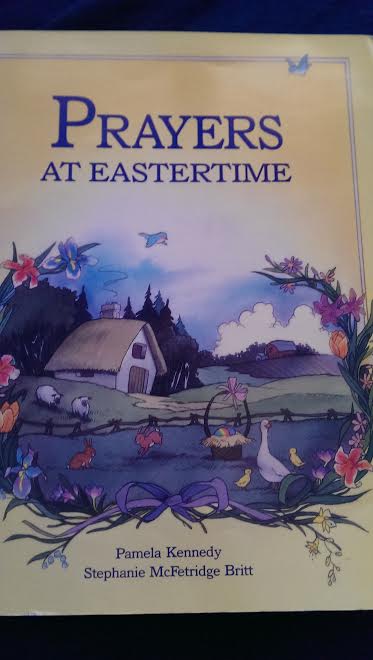
Prayers at Eastertime by Pamela Kennedy and Stephanie McFetridge Britt, 1989.

This was a present given to me one Easter many years ago, and I always liked it, especially because of the nice pictures.  Some of the prayers and accompanying Bible quotes are specifically for Easter and springtime, but others are just more general.

There are multiple copies of this book available online through Internet Archive.

Happy Easter!

PrayersEastertimePic1

PrayersEastertimePic2

PrayersEastertimePic3

Mandie and the Forbidden Attic

MandieForbiddenAttic#4 Mandie and the Forbidden Attic by Lois Gladys Leppard, 1985.

Mandie is unhappy because her mother and Uncle John are sending her to a boarding school in Asheville. It is the same school her mother attended years ago, and her grandmother lives in the same town. Mandie is upset about leaving all of her friends and family behind, but Uncle Ned says that he will still visit her.

By the time that Mandie arrives at her new school, everyone else already knows each other, and none of them seem interested in making friends with her. One girl in particular, April Snow, takes a dislike to Mandie, which is difficult because they have been assigned to the same room.

Things change when Celia Hamilton comes to the school. She and Mandie become best friends, and Mandie is allowed to share a room with her. Then, strange things start happening. Mandie and Celia keep hearing strange noises during the night from the attic floor above them, and some of Mandie’s clothes disappear. At first, they suspect that April Snow may be playing a mean trick on them, but it turns out that she is not actually at fault. There is someone at the school who doesn’t belong, but finding this person may get Mandie and Celia into trouble.

This adventure requires Mandie to meet with her grandmother again.  Mandie is nervous about seeing her grandmother because her grandmother helped break up her parents’ marriage and sent her away with her father when she was a baby. Surprisingly, Mandie’s grandmother seems to like her and her friend Celia. She admires their spirit and even says that Mandie reminds her a little of herself when she was young.  This meeting helps the granddaughter and grandmother to make peace with each other and the past.

The book is currently available online through Internet Archive.

Mandie and the Ghost Bandits

MandieGhostBandits#3 Mandie and the Ghost Bandits by Lois Gladys Leppard, 1984.

Mandie and her family are going to proceed with the plan to create a hospital for the Cherokees with the gold that they found in the cave. To do that, they need to take the gold to a bank in Asheville.  They decide to take the gold secretly on a train. Uncle Ned stays in the baggage car to watch the gold as they set out on their journey.

When the kids decide to leave their car to go visit him, strange things begin to happen. They see riders dressed as ghosts out the window. Then, the car with Uncle Ned and the gold inside is disconnected from the rest of the train, crashing into a ravine. The train comes to a stop, and the kids jump off to see if they can help Uncle Ned.

Before they can find him, the train starts up again, leaving them behind, and they are taken prisoner by the mysterious ghost bandits. They are after the gold in the baggage car, but how did they know it was there when Mandie’s family tried so hard to keep it a secret? Mandie and her friends must escape and find the others before it is too late!

In some respects, I would call this more of an adventure story than a mystery, although there is still the question of how the bandits knew where the gold was in order to steal it.

The book is currently available online through Internet Archive.

Mandie and the Cherokee Legend

MandieCherokeeLegend#2 Mandie and the Cherokee Legend by Lois Gladys Leppard, 1983.

Mandie is going to visit her Cherokee relatives with her mother and Uncle John. Mandie is eager to meet her relatives, and she hopes that they all like her. The Cherokees all knew her father well, and most of them are eager to meet her. All except for her cousin, Tsa’ni, that is.

Tsa’ni knows the stories of how white men have oppressed the Cherokees and forced them to move off of their land years ago, and he resents all white people because of it. The others tell him that he is wrong to hate all white people because of what some of them did in the past and that Mandie and her Uncle John are good people. However, Tsa’ni doesn’t listen to them, and he plays a mean trick on Mandie, Joe, and Uncle Ned’s granddaughter, Sallie. He offers to show them a cave, but then he abandons them inside.

The three kids have to find their own way out, but they discover a fortune in gold nuggets in the process. First, the children have to make it back to Uncle Ned’s house after a frightening night in the woods. Mandie, Joe, and Sallie accidentally stumble onto a still (machinery for making alcohol) that belongs to a white couple while they are wandering around in the woods after leaving the cave. The couple are worried that they will tell people about their illegal still, so they hold the kids prisoner.

Although the kids manage to escape, they must return to the cave to find the treasure again (while dodging Tsa’ni’s tricks to foil their efforts) and keep it safe (from the still operators and anyone else who might want to steal it) until they can decide what to do with it. As far as Uncle Ned and the other Cherokees are concerned, gold is bad luck because it was the discovery of gold which forced the Cherokees out of their old homeland. However, the origin of this gold may help to change their minds.

This book is one of the Mandie Books.  It is currently available online through Internet Archive.

Mandie and the Secret Tunnel

MandieSecretTunnelMandie and the Secret Tunnel by Lois Gladys Leppard, 1983.

Young Amanda Shaw is almost twelve when her father dies, leaving her with a bully of a sister and a mother who doesn’t really love her. Her only friends are Joe, who is the son of the local doctor, and Uncle Ned, a Cherokee Indian. Amanda and her father are part Cherokee, and Uncle Ned helps to look after her now that her father is gone. Then, Amanda’s mother remarries and sends her to live with another family who want someone to help them look after their young son. However, the family is rather mean to Mandie, exploiting her for cheap labor, and Uncle Ned offers to take Mandie to live with her uncle in the town of Franklin.

Mandie never knew that her father had a brother (Uncle Ned is Mandie’s “uncle” by affection, not blood), but she readily agrees to go to him. Uncle Ned and some other Cherokees help Mandie to sneak away in the middle of the night and make the journey to Franklin. When she arrives at her uncle’s house, she is taken in by the servants, but she is told that her uncle is away in Europe.  Mandie’s uncle turns out to be rich, and Mandie is very happy in his house. She gets new dresses for the first time in her life and makes friends with Polly, the girl next door.

Then, word comes that her uncle has died in Europe. Her uncle’s will is missing, and no one knows exactly what will happen to her uncle’s property or to Mandie until it is found. Strangers come to the house, saying that they are also relatives of Mandie’s uncle, but Mandie wonders if they really are who they claim to be. With the help of Polly and Joe, who comes to visit her, Mandie searches for her uncle’s missing will and accidentally finds a secret tunnel leading out of her uncle’s house.

As Mandie and her friends investigate this mysterious situation, where things and people aren’t what they claim to be, Mandie learns that her own past isn’t what she believed it was.  Her family has kept many secrets from her, and learning these secrets leads her to a better future than she’d ever imagined.

This book is one of the Mandie Books.  It is currently available online through Internet Archive.

Valentine Blues

valentinebluesValentine Blues by Jeanne Betancourt, 1990.

This book is part of the Aviva Granger Stories series.  (It’s the only one I have in the series right now.)

In the last book, Aviva’s best friend, Josh, came to live with her, her mother, and her step-father.  Josh was living in an orphanage before that, and since he and Aviva were close, her mother and stepfather thought that it would be natural to invite him to be part of the family.  At the time, Aviva thought that it was a good idea, but being friends with someone doesn’t mean that it will be easy living with them, and Aviva’s family life is already complicated!

Aviva’s parents are divorced, and both her mother and father are already in new relationships.  Her mother has remarried, and Aviva not only has a stepfather but a half-sister (college age) and half-brother (baby) living in the same house.  Aviva’s father has a girlfriend, Miriam, and Aviva doesn’t get along well with her.  Miriam would like it if she and Aviva’s father had a child of their own.

When Josh comes to live with Aviva’s mother and her family, Aviva realizes that sharing a family and house with him makes things even more complicated.  He takes too long in the bathroom and makes her late to school.  He’s one more person for her mother to pay attention to, so Aviva gets less attention.  Even her dog seems to like Josh better now!

Then, shortly after Valentine’s Day, Aviva overhears Josh and his friend Ronnie Cioffi talking about girls and giving them ratings based on their looks.  Out of 10 points, Cioffi rates Aviva as a 2, and Josh agrees.  Josh has a crush on Louise, a girl they know from school, and she has a much better figure.

It isn’t that Aviva is in love with Josh, who she sees more as a friend/brother, but it hurts that he seems to be taking her place in the family and doesn’t even really appreciate her, joining in with his friend in making fun of her body.  With her time divided between two households, two parents who hardly seem to have time for her these days, and Josh moving in and taking over, Aviva worries that maybe she doesn’t really belong anywhere or to anybody.

It takes a night when Aviva sleeps out in the barn without telling anyone where she is to make the people closest to her realize how much she needs them.  A sleepover at Louise’s house (where the girls candidly discuss their own ratings for the boys they know) and Aviva’s anonymous question in sex ed class also help to put the rating system into perspective for all the kids.

The book has some Christian themes because the children go to a Catholic school, although this book mostly focuses on family life and girls’ and boys’ perceptions of each other.  The kids are eighth graders, and there is also some talk about sex ed.

Abigail

abigailAbigail by Portia Howe Sperry and Lois Donaldson, 1938.

Susan is a little girl living on a farm in Kentucky during the 1800s.  Her family has recently decided to move to Indiana, which is the new frontier of the United States.  Her uncle and his family are already living there, and he has persuaded Susan’s parents of the opportunities that await them.

As the family packs up to leave, Susan’s grandmother gives her a special present that she and Susan’s aunt made for her: a new doll.  Unlike Susan’s old wooden doll, this doll is a soft rag doll that she can sleep with.  They made the doll to look like Susan herself, but Susan names the doll Abigail after her grandmother.

Abigail accompanies Susan on her adventure as the family heads west to Indiana in their covered wagon.  Susan is sad and a little afraid at first, but when she thinks of what Abigail would say to her about her need to be brave and to explain to her all the strange things they will encounter on the journey, Susan regains her courage.

The family does have adventures on their two-week trek to Indiana.  They have to cross rivers, face down a bear, and worry about whether they will encounter unfriendly Indians (Native Americans).  Even after they arrive in Indiana, joining their other relatives, they will still have to get used to life in a new place.

Throughout the book, there are little side-stories, poems, and hymns that the family sings and tells each other.  Through it all, Abigail is Susan’s constant companion, helping her to feel at home in her new home.  I loved this book when I was a child because I always loved dolls.  This book was a bigger part of my youth than the Little House on the Prairie series, but it would probably appeal to Little House on the Prairie fans.

The book is available to borrow and read for free online through Internet Archive.