The Christmas Doll

Young Lucy and Glory Wolcott are orphans in London during the Victorian era, 1848. Their parents died during a disease epidemic, and the penniless girls now live in a work house for orphans. They’ve been living there for 5 years, doing sewing for their support, although they are kept in terrible conditions there, with bad food. Then, another girl who lives in the work house dies of an illness, and people worry about the disease infecting others, as it did during the epidemic. Soon, other girls in the work house get sick. Lucy worries about her little sister, who is only 6 years old and already too thin from the bad food, will get sick and die, too. People begin saying that it may be safer living on the streets than being cooped up with the sickness.

The only comfort that Lucy and Glory have in their lives is each other and the story that Lucy tells Glory of her memories of Christmas with their parents. Glory was too young when their parents died to remember their parents or what life was like when their parents were alive, when they had someone to take care of them and actually had proper food. Glory loves the story that Lucy tells about the doll named Morning Glory that their mother gave her for Christmas but which was left behind when the girls were sent to the alms house and then to the work house when their parents died. Glory dreams that, someday, they’ll find that doll again. Lucy tells Glory that, when she finds her doll again, she’ll recognize her.

As more children at the work house die, Lucy increasingly fears that her sister will get sick and die. She thinks about running away from the work house with her sister, but she’s afraid of what they would do on their own. They don’t receive much food or care in the work house, and they’re subject to beatings and abuse, but what would they do on the streets, and how would they survive?

When Glory develops a cough, Lucy is sent to the sick ward at the work house, and Lucy is terrified that she will never come back. Both Lucy and Glory know that none of the girls who are sent to the sick ward with this cough have come back. Terrified, Lucy thinks that the only way to save Glory is to rescue her from the sick ward and get her out of the work house.

The two girls successfully run away, but once they’re on the streets, they have nowhere to go and don’t know what to do. They have nowhere to stay, and they have to sleep in the cold. Without food or money, Lucy trades a small pair of scissors that she brought from the work house for a couple of crumpets from a muffin seller, although a boy later tells her that the scissors were worth much more than that and that the seller took advantage of her. Lucy worries that they have no way to survive on their own because they don’t know what to do and have nothing else that they can sell or trade.

A kind washerwoman suggests to the girls that they go down to the river to join the mudlarks, who spend their days hunting for things to scavenge and sell in the mud at the river’s edge. Sometimes, she say, they find truly amazing things. With nothing else to do, the girls try it. The mud is smelly and disgusting, and at first, all they find are some old bones and bent nails. They’re about to give up when they find something that is truly amazing – a doll!

The doll is worn out, but its head is still good, and immediately, Glory declares that this is Morning Glory, the lost doll that has come back to them, just like the stories that Lucy has told her. With a heavy heart, Lucy realizes that they’re not going to be able to keep the doll. They have nothing else they can sell for money, and if they don’t sell the doll, they will have nothing to buy food and shelter.

At the suggestion of a rag and bone dealer, who is kind enough to let little Glory sleep by her fire for a time, Lucy takes the doll to a dollmaker. She hates having to do it and knows that it will break little Glory’s heart, but they are starving, and their lives are at stake. The doll is in such bad condition that only the head is worth something, and the dollmaker is prepared to offer Lucy a penny for it. That’s not much, but it’s more than Lucy was expecting. Then, something happens that changes everything for the better for Lucy and Glory.

The dollmaker notices the little morning glory flower embroidered on the apron Lucy is wearing. It’s actually Glory’s apron, and Lucy embroidered the flower for her because Glory was named after the morning glory flowers, just like her doll. The dollmaker asks Lucy who did the embroidery, and Lucy timidly admits that she did. At first, she worries that she shouldn’t confess that because she used thread from the work house to do it, and she would surely be punished for stealing if anybody knew. However, the dollmaker is impressed with Lucy’s sewing skills.

Then, before Lucy can leave the shop, the dollmaker gets word that Mary, the girl who sews the hearts on the dolls has been taken seriously ill and isn’t expected to survive. The disease that afflicted the girls in the work house is everywhere. The dollmaker worries because this particular doll shop is known for the signature hearts that are sewn onto their dolls, and the tradition is that only a girl can sew them, not an adult. Losing the girl who sews the hearts isn’t just sad but also serious for the doll shop because it’s only two weeks to Christmas, and they have a lot of orders to fill. If they can’t find another girl who can sew or break the tradition of the doll hearts, they won’t be able to complete their orders and will lose their shop’s reputation. Of course, it doesn’t take the the dollmaker long to realize that the solution to the problem is literally standing right in front of them.

Lucy is stunned when the dollmaker, Miss Thimbleby offers her the job of sewing the hearts on the dolls. It would only be through Christmas, but it would be regular work, something Lucy definitely needs. However, Lucy worries about what she will do with Glory. There doesn’t seem to be a place for her in the shop. Miss Thimbleby will let Lucy stay overnight in the shop to tend the fire, but Lucy isn’t supposed to let anyone else in after the shop is closed. Could she persuade Miss Thimbleby to let Glory in with her, or could Lucy find a place for Glory to be?

When Lucy returns to the rag and bone shop to talk to Glory, she discovers that the husband of the kind lady is much less charitable and has turned Glory out into the streets. In a panic, Lucy searches for her, losing their only penny out of her pocket. Eventually, she finds Glory with the boy who had told her that she was cheated over the matter of the scissors, Nick. Glory has told him about their escape from the work house, and Lucy sadly confesses her sale of the doll to Glory. Fortunately, Nick sees how Lucy’s new job at the doll shop can help them all.

Since the job requires Lucy to spend every night in the doll shop, tending the fire and keeping warm, Nick points out that Lucy can sneak him and Glory in after hours. In return for being allowed to sleep in the warm doll shop with the girls, Nick says that he will look after Glory during the day and that she can help him to make a little money that will help support them all. Nick is also a homeless orphan, and he get money catching rats and doing acrobatics on the streets. Glory doesn’t like the idea of the rats much, but Nick has her passing the hat while he performs on the streets. Her pitiful cough will help them get more charity.

It’s not an ideal situation, but Lucy agrees that this is the best way to manage things. Lucy continues to worry about her little sister, running around in the cold with Nick during the day, although they do have a warm place to sleep now. At night, Lucy lets Glory hold the doll Morning Glory, although she reminds Glory that the doll now belongs to the shop.

While working at the shop, Lucy notices that Miss Thimbleby also has a favorite doll, one that is never for sale. She calls this doll Charlotte and talks to it when she thinks nobody can hear here. The other women who work in the doll shop explain to Lucy that Charlotte, the real Charlotte, was Miss Thimbleby’s little sister. The sisters were orphans, like Lucy and Glory. Charlotte was much younger than Miss Thimbleby, and Miss Thimbleby raised her. Charlotte was the original hearts girl of the shop, the one who always sewed the signature hearts on the dolls and started the tradition. Sadly, Charlotte died young of an illness. The doll Charlotte was the very last one that the girl Charlotte gave a heart to before she died, and that’s why Miss Thimbleby refuses to sell it and sometimes talks to it, like she’s talking to her sister.

As Christmas approaches and Glory’s illness becomes worse, Lucy increasingly fears for her life. Glory’s illness is particularly bad on Christmas Eve. Miss Thimbleby has promised Lucy that, as part of the tradition of the hearts girl, Lucy may choose any unsold doll in the shop for herself on Christmas Eve. Lucy has her sights set on Morning Glory so she can return her to Glory, but a series of unexpected events and a generous, good-hearted decision from Glory lead to marvelous changes for the girls.

The book is available to borrow and read for free online through Internet Archive (multiple copies).

This story, set in a Dickensian London in the mid-19th century is touching and sometimes a bit tear-jerky, but it’s full of old-fashioned Christmas spirit! The book doesn’t minimize the risks to the children’s lives. The lives of poor people in this period were harsh, and children were vulnerable to being orphaned or even dying young of disease. The story even talks about children being taken advantage of by unscrupulous and uncaring adults, whether it’s being cheated out in a trade for food or the talk of children on the streets being kidnapped and forced into servitude as chimney sweeps. Parentless children on the streets wouldn’t know which adults to trust, and those realities are shown in the story. The children’s worries and hardships make the happy ending of the story touching.

Some readers might guess at the likely, most happy ending for the girls because there is one adult in the story who would have sympathy for a pair of orphaned sisters. The eventual fate of Morning Glory and whether her loss or gain would help Glory hangs in the balance for most of the story. The role Morning Glory plays in the ending of the story is important, and it’s Glory’s decision about Morning Glory that helps determine the girls’ fate and also touches two other lives. Don’t worry about the doll, though. The story works out well for the doll, being with someone who truly needs and appreciates her. The lives of all three children are changed for the better in the end, too.
Christmas Trolls

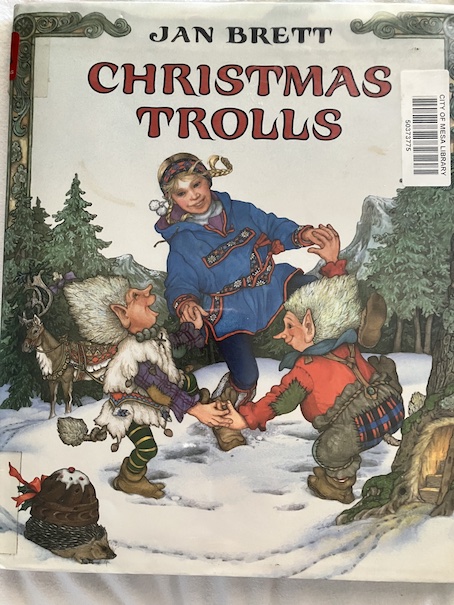
In this Scandinavian Christmas story, young Treva and her brother Sami are getting ready for Christmas when strange things start to happen.

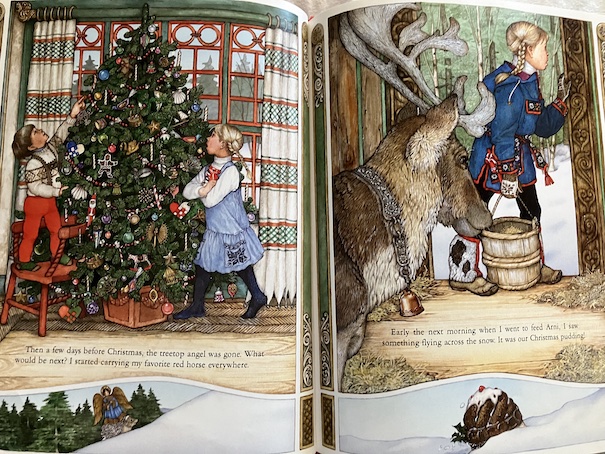
First, Treva feels like someone is watching them when they go to pick out a Christmas tree in the forest. Then, after they start decorating for Christmas, some of their decorations start to disappear. They had already wrapped Christmas presents and hidden them away, but they discover that those are gone, too!

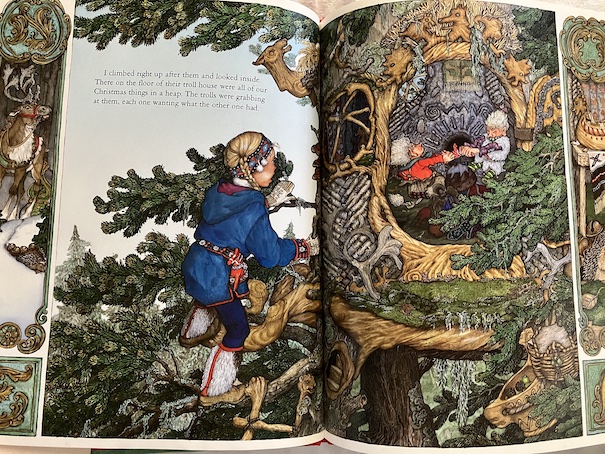
Treva begins to realize what is causing these disappearances when she spots their Christmas pudding, apparently moving quickly across the snow, stuck to the back of a hedgehog! Treva follows the hedgehog and pudding into the forest, where she finds two trolls, pulling the pudding up into their tree house.

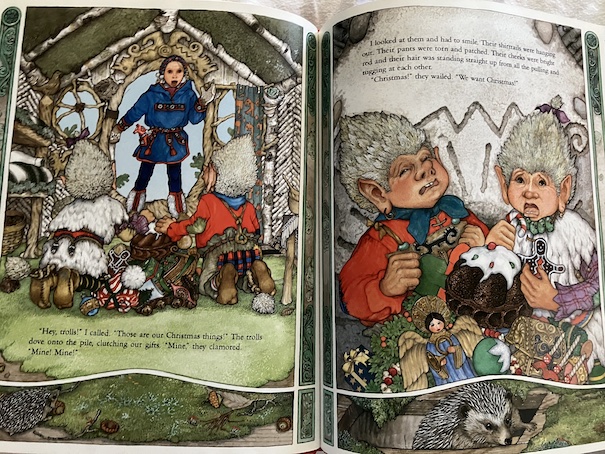
In the tree house, Treva finds the trolls arguing over all of the Christmas things they’ve taken from Treva’s family. Treva confronts them about stealing their Christmas things. The trolls say that they just want Christmas. They’re like small children who want something but don’t know how to get it or make it for themselves, so they just started trying to take it from other people.

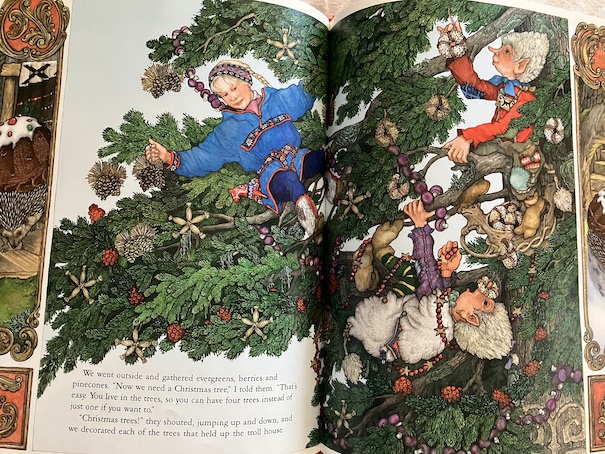
Treva tells them that she will show them what to do for Christmas. She helps them clean up their little house, make decorations, and decorate their tree for Christmas.

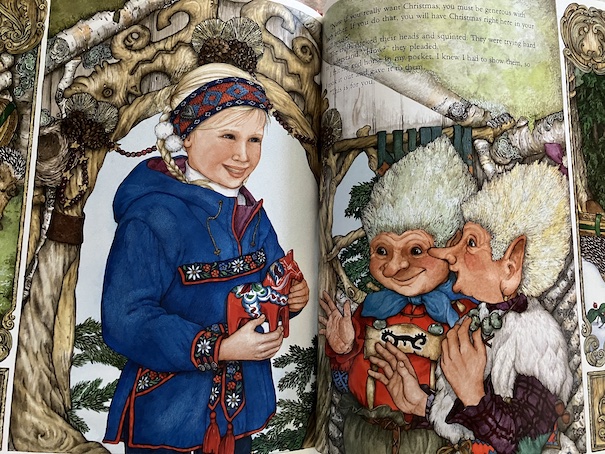
She also explains to them that arguing and being greedy isn’t the proper Christmas spirit, and it’s been ruining their mood. She tells them to try cooperating with each other and playing nicely together while they decorate. Finally, she teaches them that Christmas is about being generous and giving something to each other, not just taking things. To demonstrate what she means, she gives them their first Christmas present, her favorite Christmas decoration.

With the trolls now able to have Christmas on their own, Treva is able to reclaim the rest of her family’s Christmas presents and decorations. However, the trolls and their hedgehog friend have one more special Christmas present to give now that they understand what giving is.

The book is available to borrow and read for free online through Internet Archive (multiple copies).

This is a fun Christmas story with beautiful, colorful illustrations! I really loved the pictures in the book, with all the colorful Christmas decorations. The designs of the family’s Christmas decorations are traditional Scandinavian decorations. The side and bottom panels of the illustrations also explain some of what’s happening even before the main character understands.

I also loved the designs of the troll and their fun hedgehog friend. Around the time this story was published, troll dolls, which have existed since the late 1950s, were having a rise in popularity. The trolls in this story somewhat resemble troll dolls, with their fluffy hair rising to a point, although the troll dolls have more colorful hair options. I enjoy stories that use fantasy creatures, especially ones that aren’t especially common. The trolls in this story are troublesome, but in a little kid manner, not overly threatening. They’re more about mild magical mischief and lessons they have to learn.

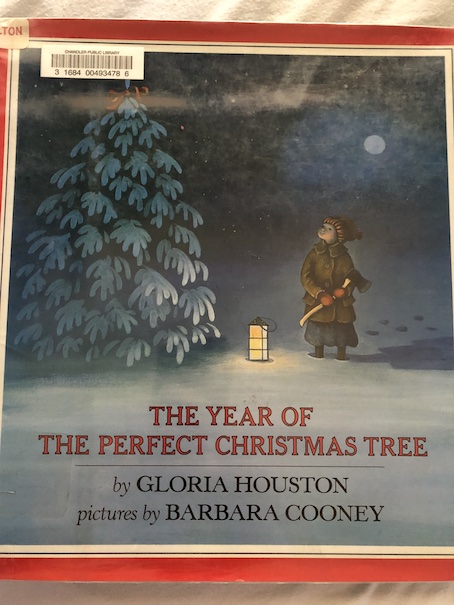
The Year of the Perfect Christmas Tree

The Year of the Perfect Christmas Tree by Gloria Houston, pictures by Barbara Cooney, 1988.

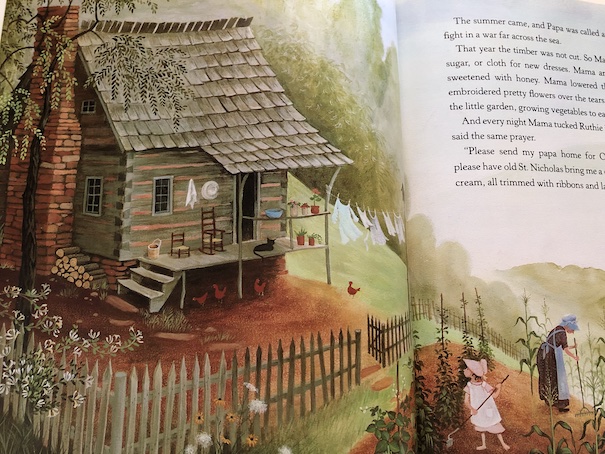
Ruthie is a little girl living on a farm in Pine Grove in the Appalachian Mountains during World War I. (The story calls it The Great War because that was its name before WWII.) During the spring, Ruthie’s father selected a tree for the village church’s Christmas celebration. The local families take turns providing the tree, and it’s their family’s turn. Ruthie goes with him to pick out the right tree and mark it with a red ribbon.

However, during the summer, Ruthie’s father has to go away to be a soldier overseas. Ruthie and her mother tend the farm while her father is away, but money is tight. Ruthie thinks ahead to Christmas and prays for her father to come home and for a special Christmas present for herself – a pretty doll with a cream-colored dress with ribbons and lace.

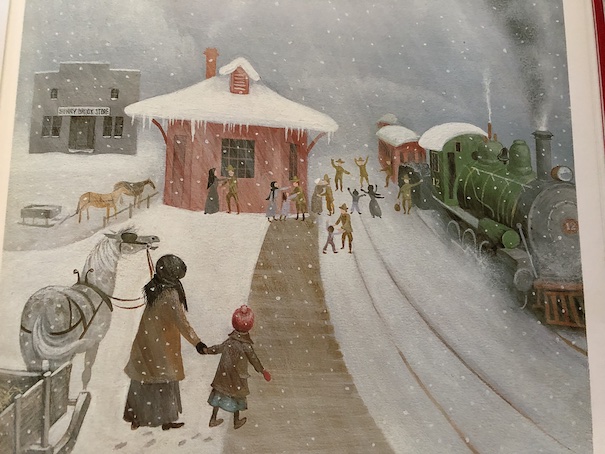
In the fall of that year (1918), Ruthie’s father writes a letter, saying that the Armistice has been signed, meaning that the war is over, so he’s sure he’ll be home for Christmas. Ruthie and her mother keep waiting for him to arrive any day, but he doesn’t seem to come, and they don’t know exactly when to expect him.

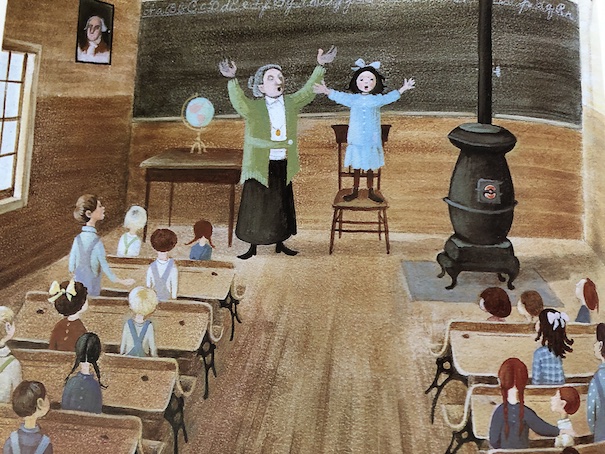
At school, Ruthie is told that she will have the role of the heavenly angel in the Christmas play and that they are still expecting Ruthie’s father to supply the Christmas tree. Ruthie is looking forward to it, but Ruthie and her mother don’t have enough money for a new dress for the angel costume, and there is still the worry about when her father will return home, and if he will make it in time to cut the Christmas tree and take it to the church.

The local preacher tells them that the person who is due to provide a Christmas tree next year is willing to do it this year instead, if Ruthie’s father can’t get home in time, but Ruthie’s mother is still sure that their family can manage the tree. Ruthie’s mother decides that she and Ruthie will go get the tree themselves. It isn’t easy, but they manage it, and Ruthie’s mother also finds a way to make a dress for Ruthie’s angel costume.

However, there are two more things that would make this Christmas perfect for Ruthie – if her father returns home in time for Christmas and if she somehow receives the doll of her dreams.

The book is available to borrow and read for free online through Internet Archive (multiple copies).

My Reaction

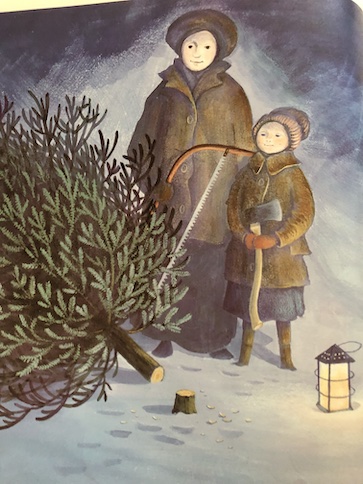
This is a sweet, old-fashioned Christmas story about wishes coming true. Wishes coming true at Christmas is a popular theme in Christmas stories, and in this book, they come true because Ruthie’s mother and Ruthie do what they need to do to make everything work out the way they want it to. They could have let someone else provide the Christmas tree, and no one would have thought less of them for doing it because the father of the family was still away, but they were determined to see their family’s promise to provide the Christmas tree through. The mother also uses her old wedding dress for the material for Ruthie’s angel costume, and it’s implied that she also made the angel doll for the top of the Christmas tree that becomes Ruthie’s special Christmas present.

The pictures are charming, and they fit well with the Cottagecore aesthetic that’s been popular in recent years.

The Mystery of the Golden Reindeer

Three Cousins Detective Club

#30 The Mystery of the Golden Reindeer by Elspeth Campbell Murphy, 2000.

Titus doesn’t really like to go Christmas shopping. The department store is always crowded around Christmastime, and he’d really rather just stay home, where it’s comfortable and quiet, and eat popcorn and watch videos. However, his mother really wants to go to the department store and so do his cousins, so they persuade him to come along. The three cousins are allowed to browse in the toys without adult supervision, as long as they stay together. They make arrangements to meet Titus’s mother for lunch in the store’s restaurant.

When they get to the toy department, they hear an announcement about a lost child, and to their surprise, their younger cousin, Patience, suddenly appears. She had been shopping with her grandmother when she spotted her cousins and started following them. As far as Patience is concerned, she wasn’t lost because she knew where she was. It was her grandmother who was lost, and she points out that she found her cousins instead of them finding her. The cousins manage to find Patience’s grandmother and reunite the two of them, and they invite them to come to the restaurant with them for lunch.

When they meet up with Titus’s mother, they all are surprised when she tells off Titus for wandering around the department store by himself when he was supposed to stay with his cousins. They all insist that Titus was with them the entire time. Titus’s mother was sure that she saw him riding the escalator alone, but none of them were on the escalator because Patience is afraid of escalators. Patience suddenly speaks up and says that she must have seen the “other Titus”, not the “real Titus.”

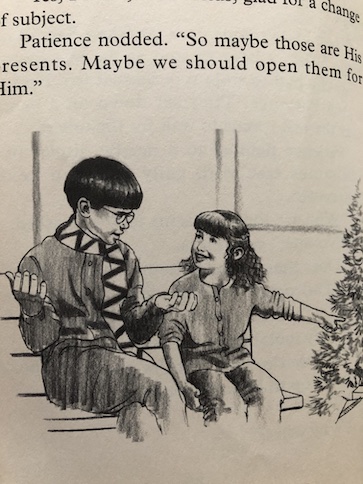
They enjoy the restaurant, which has a large Christmas tree, decorated with golden reindeer. During lunch, Patience tries to point out the “other Titus” to them, but nobody else spots who she’s pointing to. Patience is known for having an imaginary friend named Amy and for making up tall tales. She sometimes mixed up things she’s imagined with things that are real, so they’re not sure if she really saw the “other Titus” or not. (Personally, I thought this was silly on their part because they already know that Titus’s mother saw someone who looked a lot like him. Titus is wearing a distinctive black-and-white scarf, so I figured at this point that there’s someone wearing a scarf that’s also black-and-white.) Titus feels a little uneasy that there might be another him wandering around.

Titus’s mother wants to look at some furniture after lunch, and she asks Patience’s grandmother if she could come with her and give her opinion. The three cousins would rather go look at store windows instead of furniture, and Patience insists that they take her with them. The older cousins know that Patience can be a handful to look after, but Sarah-Jane knows that she would feel badly if they didn’t take Patience somewhere where she would have more fun than she would have looking at furniture. Patience promises that she’ll stay with her cousins and not run off anywhere, so the adults agree to let her go with them.

While Titus and Patience are looking at the Christmas tree together, Titus is surprised by a teenage boy who comes up to him and starts talking to him as if he knows him. The teenager says that he has a message for him and tells him, “Happy Birthday. The golden reindeer. Dish towels. Christmas tree.” Titus asks him what he’s talking about, and the teenager says that he was paid to deliver that message to him and that he must have been expecting him. When the other cousins come back from the restrooms, Titus and Patience tells them what happened, and they’re equally confused. All they can think is that this bizarre message was meant for the “other Titus.” But, who is the “other Titus”, and what does the message mean?

Theme of the Story:

“What you get from wisdom is better than the finest gold.”

Proverbs 8:19

The book is available to borrow and read for free online through Internet Archive.

My Reaction and Spoilers

This mystery does involve a lookalike for Titus. However, the mystery doesn’t quite end when they meet the other boy. He tells them that he got a phone call telling him to come to the department store for a special message about something that belongs to his family that was stolen. When the other kids tell him the message that was given to Titus, he finds it just as confusing as they do.

It’s Patience who really solves the mystery of what the clues in the message mean, and that’s both because she is nosy and because, as a young child, she doesn’t take certain things for granted, the way an adult or older child would. Sometimes, people see not what’s actually there but what they expect to see. Titus’s mother didn’t really see him on the escalator alone; she saw the other boy, who happened to be wearing a different black-and-white scarf. She just figured it was Titus because she expected the boy with the black-and-white scarf would be her son, and she didn’t look closer to notice that it wasn’t the same boy and that the scarf actually had a different pattern. It was the same with the teenager who was looking for the other boy. In the case of the clues, all of the older kids assume that the packages underneath the decorative Christmas trees in the department store are just empty boxes, wrapped up for decoration. Because Patience wants to check to see if they’re all empty, she’s the one who realizes that one of the packages isn’t like the others.

We never learn who stole the object that the other boy was looking for, but he does get it back. Also, Patience learns to get over her fear of the escalator.