Christmas Farm

Wilma has grown flowers for years, but now, she’s decided that she wants a change. She thinks about what she would like to do with her garden next spring while she’s getting ready for Christmas. Going out to cut a Christmas tree makes her think that maybe she would like to grow Christmas trees instead of flowers.

She starts by ordering 62 dozen small balsam trees (744 trees, for those who are counting), and she gets the boy from next door, Parker, to help her prepare the site for them. They use string to lay out rows for planting the trees.

Wilma knows that it will take longer than a year for the trees to grow big enough to be Christmas trees. As the trees grow, Wilma has to mow around them and take care of them, with young Parker helping her more as he also grows bigger. Wilma loses some trees to pests and weather conditions every year, but by the time the trees are big enough to sell, she has 597 left.

In the months leading up to Christmas that year, people reserve trees, and they also get a buyer who owns a Christmas tree lot in the city. Most of the trees are sold, but there are still some left. They know that the trees that were cut down will sprout again, but they’re also going to order some new ones.

In the back of the book, there is a section that explains more about growing Christmas trees with a chart showing how long it takes the trees to grow.

I thought this book was a sweet and fun look at Christmas tree farms. It takes years to grow trees big enough for Christmas trees, so there is a considerable time investment, and farmers know that they will lose some of their trees to pests or bad weather condition during that time. It’s a project that requires long-term planning and investment.

I always feel a little sorry for the trees when they’re cut down, but I liked how this book explains that, because the stumps of the cut trees are still there with their roots, even cut trees will regrow. The end of this book touches on the cycle of replanting and regrowth, with Wilma and Parker planning for their next phase of planting and cultivating new trees.

I also thought the addition of Parker to the story helps to show the passing of time and the growth of the trees because the boy grows a few years older during the time when they’re letting the trees grow bigger. By the time they’ve sold their first crop of Christmas trees, Parker is getting old enough to take more of an active role in planning the next crop.

The Little Fir Tree

A little fir tree feels lonely among the large trees in the forest, but something happens that changes his life forever – he is chosen to be a living Christmas tree for a little boy!

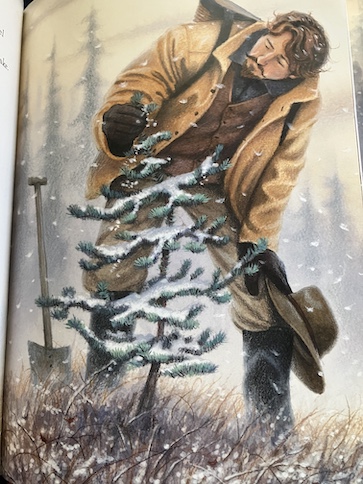
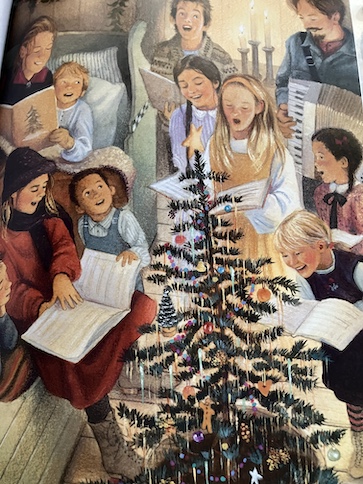
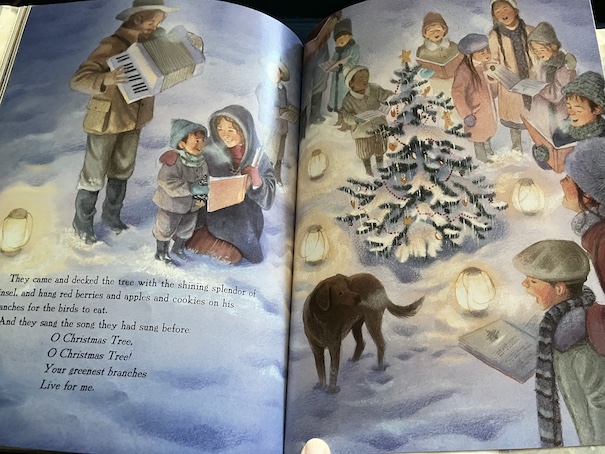
One winter, the boy’s father carefully digs up the tree and brings it home to his young son, who cannot walk because of a lame leg. The boy has been wanting to see the trees in the forest, but since he can’t go to the forest himself, his father has brought a free to him. The little fir tree loves being decorated, and the next evening, guests come and gather around him, singing Christmas carols.

In the springtime, the boy’s father takes the tree back to the forest, where he found it, and he plants the tree again so it will continue to grow. However, the following winter, the boy’s father returns to dig up the tree again and take it back to the boy for Christmas.

The little fir tree loves this ritual of visiting the boy and his family and being their Christmas tree every winter, but the next winter after that, the man doesn’t come to dig him up. The little tree is disappointed and lonely, but he is in for a surprise. This winter, the boy and his family come to see him in the forest!

The book is available to borrow and read for free online through Internet Archive, although that copy has different illustrations.

I mainly know Margaret Wise Brown for Goodnight Moon and The Runaway Bunny, but I found this Christmas story charming. I don’t like Christmas stories from the point of view of trees that are cut down, like the Hans Christian Andersen story, The Fir-Tree, which has a really depressing ending. I like it that this family in this book keeps the tree alive, returning it to the forest every year to continue growing. Things change for both the boy and the tree over the years, as they both continue to grow, but they change for the better, and they continue to be fond of each other and a source of inspiration for each other.

When I was a kid, our elementary school had a large tree on a hill on the kindergarten playground, and the story behind it was that it was once a living Christmas tree from the very first kindergarten class at the school. That tree is still there and alive today, about 50 years after it was first planted there and more than 30 years after I used to play under it. I like to imagine that it will be true of the little fir tree, too, that it will continue growing over the years.

Earlier versions of this book had different illustrations, but personally, I love the illustrations in this printing because they’re detailed and realistic. The version on Internet Archive has illustrations by Barbara Cooney, who is known for Roxaboxen and Miss Rumphius. Cooney’s illustrations are also good, but not as realistic as Larmarche’s, and they’re in a limited color range.

One other difference between versions of the book is that the earlier version also included the musical notes for the carols that the children sing and additional songs that aren’t included in the later version of the book. I enjoy books that include actual music and lyrics, like books that include recipes, because they are fun extras and add an extra dimension to the story by providing an accompanying activity. Although I like the more detailed and realistic illustrations of newer edition of this book, I do prefer the actual music and wider range of songs from the older version.

Mr. Willowby’s Christmas Tree

Mr. Willowby’s Christmas Tree by Robert Barry, 1963, 2000.

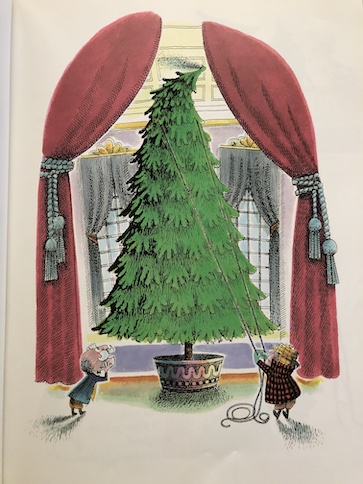
Mr. Willowby lives in a large house, and he orders a large Christmas tree by special delivery. It’s large and wonderful, but it’s just slightly too tall for the room where Mr. Willowby wants to put it.

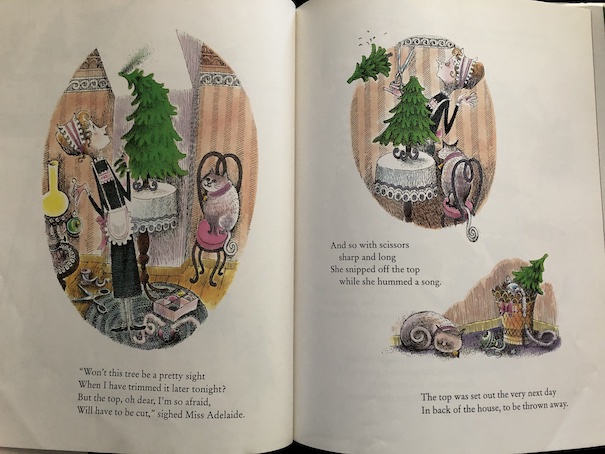
Mr. Willowby’s butler solves the problem by chopping the top off the tree, and because he doesn’t want the top to go to waste, he gives it to Mr. Willowby’s maid.

The top of the tree is about the right size to make a small Christmas tree for the maid’s room, but it turns out that it’s just slightly too tall again. The maid also clips the top off her tree.

From there on, the tree top moves on to other people and animals. The gardener spots the top that the maid throws out and decides it would make a nice, small Christmas tree. Like everyone else, though, he finds that the tree needs a little clipping for it to go where he and his wife want it to go.

As the top of the tree gets smaller, it starts drawing the interest of animals. Even animals enjoy having a Christmas tree as grand as Mr. Willowby’s!

The story is cute and told in rhyme! The book is available to borrow and read for free online through Internet Archive (multiple copies).

My Reaction

I remember this book from when I was a kid! I remember liking how several people and animals get Christmas trees out of just the top of one large Christmas tree. It’s a fun story about how one person’s trash is someone else’s treasure and nothing needs to go to waste. Mr. Willowby’s Christmas tree ends up helping everyone. In the end, everyone is happy because they all get a nice Christmas tree.

The illustrations in this book are full-color, but some older version of the book are in limited color – black, white, and green.

The Year of the Perfect Christmas Tree

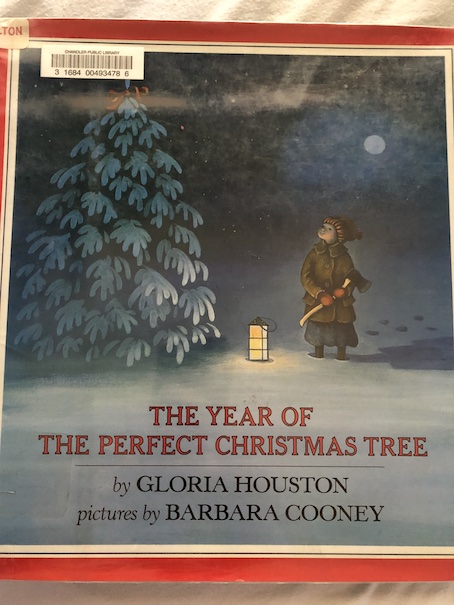
The Year of the Perfect Christmas Tree by Gloria Houston, pictures by Barbara Cooney, 1988.

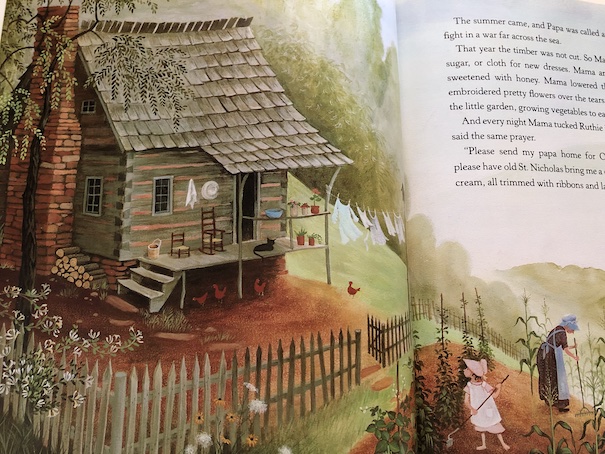
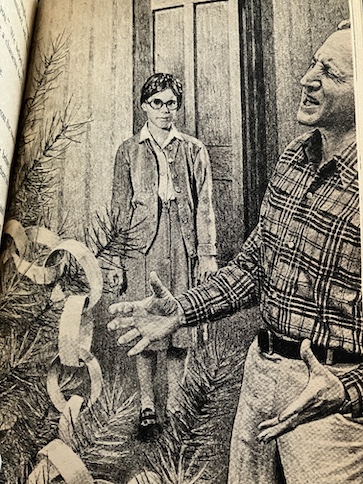
Ruthie is a little girl living on a farm in Pine Grove in the Appalachian Mountains during World War I. (The story calls it The Great War because that was its name before WWII.) During the spring, Ruthie’s father selected a tree for the village church’s Christmas celebration. The local families take turns providing the tree, and it’s their family’s turn. Ruthie goes with him to pick out the right tree and mark it with a red ribbon.

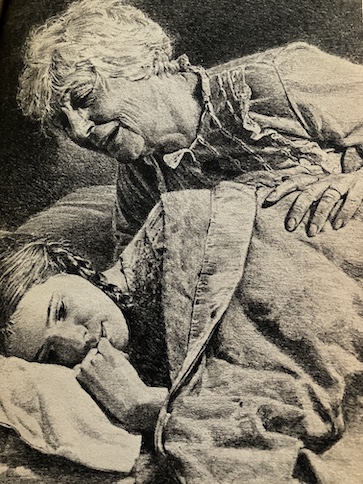
However, during the summer, Ruthie’s father has to go away to be a soldier overseas. Ruthie and her mother tend the farm while her father is away, but money is tight. Ruthie thinks ahead to Christmas and prays for her father to come home and for a special Christmas present for herself – a pretty doll with a cream-colored dress with ribbons and lace.

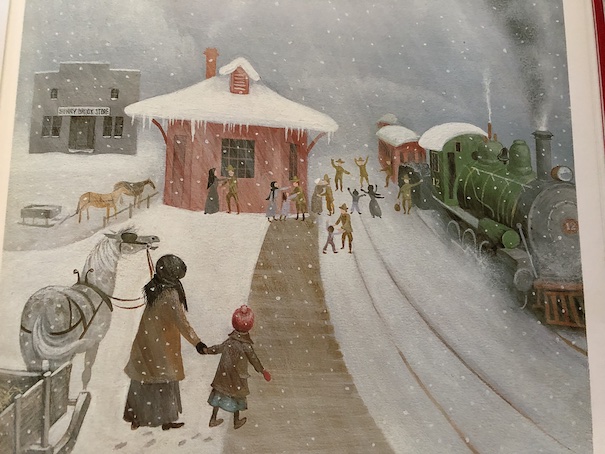
In the fall of that year (1918), Ruthie’s father writes a letter, saying that the Armistice has been signed, meaning that the war is over, so he’s sure he’ll be home for Christmas. Ruthie and her mother keep waiting for him to arrive any day, but he doesn’t seem to come, and they don’t know exactly when to expect him.

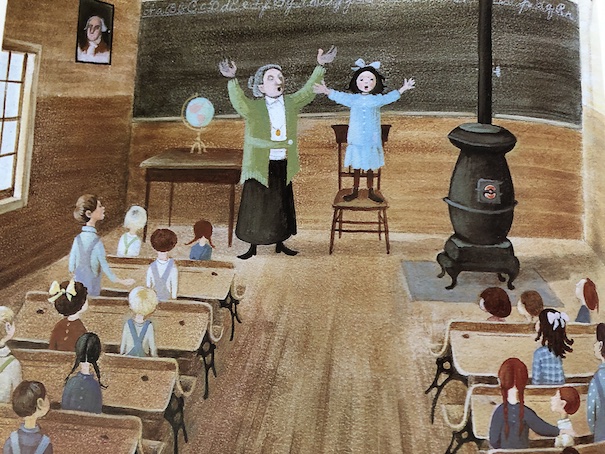
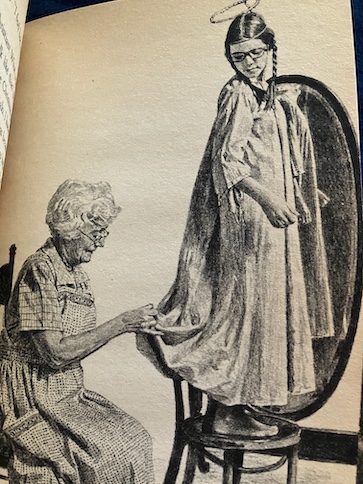
At school, Ruthie is told that she will have the role of the heavenly angel in the Christmas play and that they are still expecting Ruthie’s father to supply the Christmas tree. Ruthie is looking forward to it, but Ruthie and her mother don’t have enough money for a new dress for the angel costume, and there is still the worry about when her father will return home, and if he will make it in time to cut the Christmas tree and take it to the church.

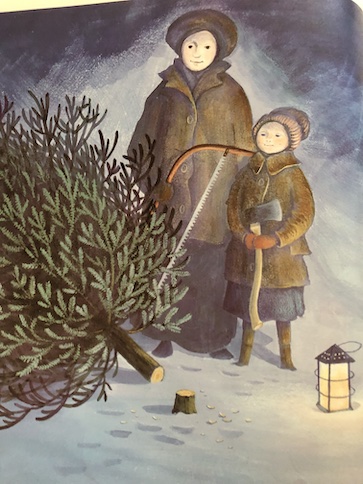
The local preacher tells them that the person who is due to provide a Christmas tree next year is willing to do it this year instead, if Ruthie’s father can’t get home in time, but Ruthie’s mother is still sure that their family can manage the tree. Ruthie’s mother decides that she and Ruthie will go get the tree themselves. It isn’t easy, but they manage it, and Ruthie’s mother also finds a way to make a dress for Ruthie’s angel costume.

However, there are two more things that would make this Christmas perfect for Ruthie – if her father returns home in time for Christmas and if she somehow receives the doll of her dreams.

The book is available to borrow and read for free online through Internet Archive (multiple copies).

My Reaction

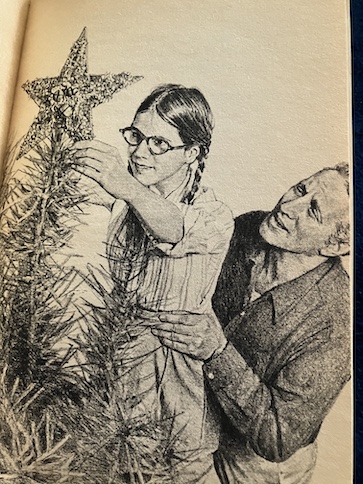
This is a sweet, old-fashioned Christmas story about wishes coming true. Wishes coming true at Christmas is a popular theme in Christmas stories, and in this book, they come true because Ruthie’s mother and Ruthie do what they need to do to make everything work out the way they want it to. They could have let someone else provide the Christmas tree, and no one would have thought less of them for doing it because the father of the family was still away, but they were determined to see their family’s promise to provide the Christmas tree through. The mother also uses her old wedding dress for the material for Ruthie’s angel costume, and it’s implied that she also made the angel doll for the top of the Christmas tree that becomes Ruthie’s special Christmas present.

The pictures are charming, and they fit well with the Cottagecore aesthetic that’s been popular in recent years.

The Christmas Tree Mystery

The Christmas Tree Mystery by Wylly Folk St. John, 1969.

A couple of days before Christmas, twelve-year-old Beth comes running to her 10-year-old sister Maggie, saying that she’s in trouble and needs her help. Beth doesn’t know whether Maggie can help at all, but she thinks she’s done something wrong and needs somebody to listen to her. Someone stole the family’s Christmas tree ornaments the day before, and Beth saw someone running out of their backyard right after the theft. She was sure that the person she saw was Pete Abel, and that’s what she told everyone. However, the girls’ older stepbrother, Trace, says that it couldn’t have been Pete. Beth thinks that it would be awful if she’s leapt to the wrong conclusion and wrongly accused Pete of theft, but then again, she can’t be sure that Trace is right, either. Trace says that Pete was somewhere else at the time, but he doesn’t want to say where because, for some reason, that might also get Pete in trouble. Beth doesn’t know whether to believe him or not.

The kids are part of a blended family that has only been together for less than a year, so the children are still getting used to each other and their new stepparents. Beth likes their new little stepsister, Pip, but teenage Trace is harder to get used to. Trace is frequently angry, and much of his anger comes from his mother’s death. Beth knows sort of how Trace feels because her father died three years ago. She knows what it’s like to miss a parent, and try to keep their memory alive. Even though Beth doesn’t think of her stepfather, Champ, as being her father, she tries to be fair toward him and accept that he’s doing his best to take care of them. Sometimes, she wishes she could talk about it all with Trace, but Trace has made it clear that he doesn’t want to talk. Trace doesn’t like to talk about his mother and gets angry when anyone else even mentions her.

Beth thinks that Pete was the thief because the boy she saw running away was wearing a jacket like the one Pete has and has the same color hair. However, she didn’t actually see his face, and Maggie points out that other kids have similar jackets. Also, they found an old handkerchief of the house with the initial ‘Z’, and that wouldn’t belong to Pete. Beth has to admit that she may have been mistaken about who she saw. However, she can’t think of anybody whose name begins with ‘Z’, either. She worries that if she was wrong to say it was Pete that she saw she may have broken one of the Ten Commandments because she was bearing false witness. All that Beth can think of to make things right is apologize to Pete for being too quick to accuse him and try to find the thief herself, but she needs Maggie’s help to do that.

Why anybody would steal Christmas ornaments right off a tree is also a mystery. Some of the ornaments that belonged to Champ had some value and could possibly be sold for money, but most did not. The thing that Beth misses the most is the little angel that she had made for the top of the tree years ago. Its only value is sentimental, and Beth worries that a thief might just throw it away if he didn’t think it was worth anything. Also, if Trace is so sure that Pete is innocent, why can’t he explain where Pete really was when the theft occurred? Trace is sneaking around and seems to have secrets of his own. Then, after the family gets some new ornaments and decorates the tree again, the ornament thief strikes again! The new set of ornaments disappears, but strangely, the thief brings back Beth’s angel and puts it on top of the tree. If it had just been a poor kid, desperate for some Christmas decorations, they should have been satisfied with the first set. Is anybody so desperate for ornaments that they would take two sets, or is it just someone who doesn’t want this family to have any? And why did the thief return the angel?

The book is available to borrow and read for free online through Internet Archive (multiple copies).

My Reaction and Spoilers

The idea of somebody stealing Christmas ornaments sounds like a whimsical mystery for the holiday, but even though I’ve read books by this author before, I forgot that Wylly Folk St. John can bring in some of the darker sides of life. Much of this story centers around getting ready for Christmas, but there are some truly serious issues in the story. This is a book that would be better for older children. For someone looking for someone for younger children or a lighter mystery for Christmas, something from the Three Cousins Detective Club series would be better. (See my list of Christmas Books for other ideas.) It’s an interesting story, and I enjoyed the book, but I wouldn’t call the mood light.

The ways this new blended family learns to get along with each other and Trace learns to cope with his grief at the loss of his mother are major themes in the book. The parents try to be conscientious of the children’s feelings, making joint decisions and rules for the children as “The Establishment” of the house so none of the children feel like a stepparent is discriminating against them. The reason why the stepfather is called Champ is because he’s a chess champion, and Beth knows that her mother gave him that nickname so the girls wouldn’t feel awkward, wondering whether to call him by his name or refer to him as their dad. Beth is grateful for the nickname because, although she likes and appreciates Champ as a person, she does feel awkward about calling anybody else “dad” while she still remembers her deceased father. Trace calls his stepmother Aunt Mary for similar reasons, and Beth understands that. What she doesn’t understand is why Trace insists on wearing the old clothes that were the last ones his mother bought for him, even though they no longer fit him. Aunt Mary has bought him some nice new clothes that would fit him better, but he won’t wear them, and he even insists on washing his clothes himself, without her help. Beth asks her mother about that, but she says it doesn’t bother her because, if Trace is willing to help with the laundry, that’s less for her to do. Beth says that they ought to just donate all of Trace’s old clothes so someone else who can actually wear them can have them, but her mother doesn’t want to be too quick to do that because she doesn’t want to upset Trace. I can understand that because Trace is still growing, and it won’t be much longer before he won’t be able to wear those old clothes anymore anyway. The day that he can’t pull one of those old shirts over his head or put on old pants without splitting them will be the day he’ll be ready to get rid of them. Time moves on, and eventually, Trace won’t be able to help himself from moving on with it, and I think Aunt Mary understands that.

Part of the secret about Trace and his grief is that his mother isn’t actually dead, although he keeps telling people that she is. The truth is that his parents are divorced and his mother left the state and has gone to live in Oklahoma with her relatives. At first, Beth’s mother doesn’t even know that Trace has been telling the girls that his mother died, but when Beth tells her mother that’s what Trace said, her mother tells her the truth. She doesn’t want to explain the full circumstances behind why Champ divorced Phyllis and why she left, but she says that she can understand why Trace might find it easier to tell himself and others that she’s dead instead of accepting the truth. There is an implication that Phyllis did something that Beth’s mother describes as something Trace would see as “disgraceful” (I had guessed that probably meant that she had an extramarital affair, but that’s not it) that lead to the divorce. So, Trace is actually feeling torn between losing his mother and learning to live without her and his anger at her for what she did. He both loves and hates his mother, and that’s why he finds it easier to think of her as dead and gone and refuse to talk about her any further than deal with these painful, conflicting emotions. Beth’s mother also indicates that Phyllis was emotionally unstable, saying that the atmosphere in the household wasn’t healthy for Trace and his little sister because Phyllis “kept them all stirred up emotionally all the time”, and that’s why she didn’t get custody of the children and isn’t allowed to see them now. It turns out that there was a lot more to it than that, and that figures into the solution to the mystery.

When I was reviewing an earlier book from the 1950s by a different author about children coping with grief and a new blended family, Mystery of the Green Cat, I talked about how books from the 1950s and earlier tended to focus on the deaths of parents when explaining why children lived in households with stepparents and step-siblings and how books from the 1960s and later started to focus more on the issue of divorce. This book kind of combines aspects of both of those types of stories. Beth understands the grief of a parent dying, and Trace has to come to terms with his parents’ divorce, which is a different kind of loss, although it’s still a loss. As I explained in my review of that earlier book, in some ways, divorce can be even more difficult for children to understand than death. Both are traumatic, but divorce involves not just loss but also abandonment (a parents who dies can’t help it that they’re no longer there, but it feels like a parent who is still living somehow could, that it’s their choice to leave their children and live apart from them, which leads to feelings of rejection) and the complicated reasons why people get divorced, including infidelity and emotional abuse. In this case, it also involves drug abuse.

I was partly right about the solution to the mystery. I guessed pretty quickly who the real thief was, but there’s something else I didn’t understand right away because I didn’t know until later in the book that Trace’s mother was still alive. Before the end of the book, Trace and Beth and everyone else has to confront the full reality of Phyllis’s problems. They get some surprising help from Pete, who has been keeping an eye on things and has more knowledge of the dark sides of life than the other children do. (Whether his father ever had a problem similar to Phyllis’s is unknown, but it seems that at least some of the people his father used to work with did, so it might be another explanation for Pete’s family’s situation.) Because Pete has seen people in a similar situation before and knows what to do. I had to agree with what Beth said that much of this trouble could have been avoided if Champ had been more direct with Trace before about his mother’s condition, but Beth’s mother says that sometimes children don’t believe things until they see them themselves. Champ was apparently trying to protect his children from Phyllis before, but because Trace had never seen his mother at her worst, he didn’t understand what was really happening with her. There is frightening part at the end where the children have to deal with a dangerous situation, but it all works out. Trace comes to accept the reality of his mother’s condition and that things will never be the same again, but he comes to appreciate the stepsisters who came to his rescue and brought help when he needed it.

The House Without a Christmas Tree

Addie Mills starts the story reminiscing about a special Christmas that she had when she was young and living in a small town in Nebraska with her father and grandmother in the year 1946. The story talks about the things that she did with her friends while they were getting ready for Christmas and buying presents for each other and such, but it mostly centers on how badly Addie wants a Christmas tree.

Addie is ten years old, and she can’t remember ever having a Christmas tree in the house. Apparently, the last time there was a tree in the house was when Addie’s mother was still alive, when Addie was a baby. Addie tries to talk to her father about it, but he just gets angry. Addie’s father doesn’t want a Christmas tree because it reminds him of Addie’s mother, and he still misses her.

Addie feels self-conscious because other families have Christmas trees, and she schemes to find a way to get one. When Addie wins a tree in a guessing contest at school, beating a girl from a needier family, Addie’s father gets angry and makes a scene, which makes Addie feel terrible. She gives the tree to the other family, and worries that her father doesn’t really love her. 

Seeing Addie’s desperation, Addie’s grandmother lectures Addie’s father, saying that his grief over his dead wife is keeping him from being happy and is making his daughter miserable too.  In the end, Addie’s father sees the importance of the tree to Addie and decides that it’s time the family had one again.

This book is a little unusual in that the movie version came first, and then the book was written.  Sometimes, you can find the movie or clips of it on YouTube.  The book is currently available online through Internet Archive.  There are also other books in the Addie Mills series.

Some people in real life also struggle with Christmas because Christmas can sometimes bring out sad memories or highlight losses. Christmas is often a time of reflection, the last major holiday before the end of the year and a very sentimental and idealized time, but life isn’t always idea. People who have suffered a loss or are unhappy with their lives in some way tend to reflect on what they don’t have, whatever or whoever is missing from their lives. This is how Christmas is for Addie’s father at the beginning of the story, and Addie’s grandmother is correct that either wallowing in sad memories or trying to hard to avoid them is holding Addie’s father and Addie herself back. It’s time for them to move on and build new memories with each other.

I like the story because the characters are very realistic. Addie and her father, like real people, often find it difficult to communicate and understand each other, but in the end, family love wins over the situation. Addie does get the tree she’s been longing for, and for the first time, her father talks to her about her mother. The Christmas tree and coming to terms with the memories of Addie’s deceased mother help the family to heal old wounds and establish better relationships with each other.

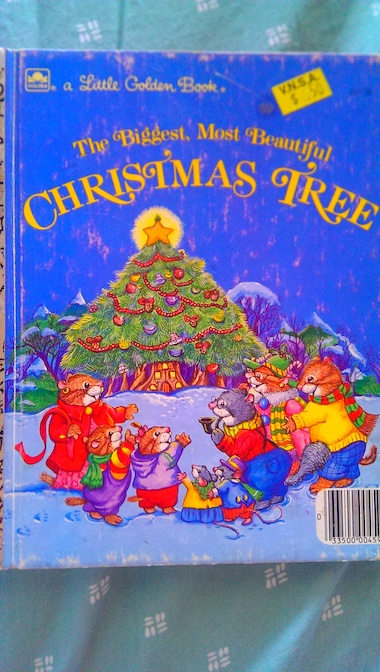
The Biggest, Most Beautiful Christmas Tree

BiggestChristmasTree

The Biggest, Most Beautiful Christmas Tree by Amye Rosenberg, 1985.

This is a Little Golden Book.

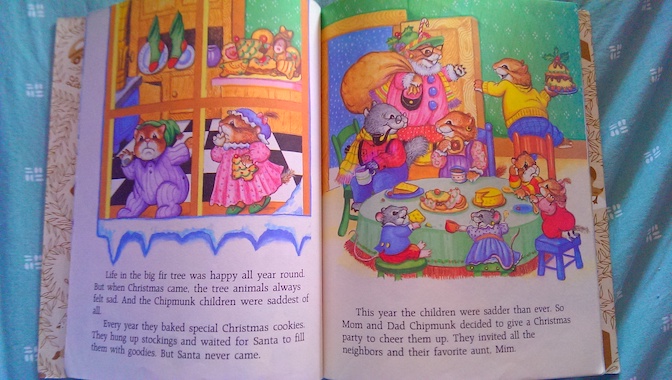
Every year at Christmas, the Chipmunk children, Nina and Nutley, are disappointed because Santa doesn’t visit their home in a large fir tree in the forest.  They always hang up their stockings and put out cookies, but for some reason, Santa never comes.

BiggestChristmasTreeDisappointment

However, this year, their Aunt Mim has figured out the reason why Santa passes them by and what to do about it.  Aunt Mim has realized that Santa can’t find their tree because it looks like every other tree in the forest.  What they have to do is to decorate their tree so that Santa can find it among all the others.

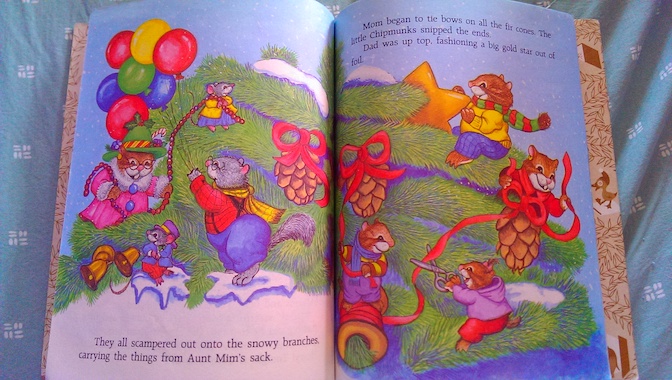
Aunt Mim brings lots of things they can use as decoration, and all of the other animals who live in the tree help with the decorating.  They tie bows on the pine cones, hang strings of berries, and paint balloons to look like large Christmas tree ornaments.

BiggestChristmasTreeDecoration1
BiggestChristmasTreeDecoration2

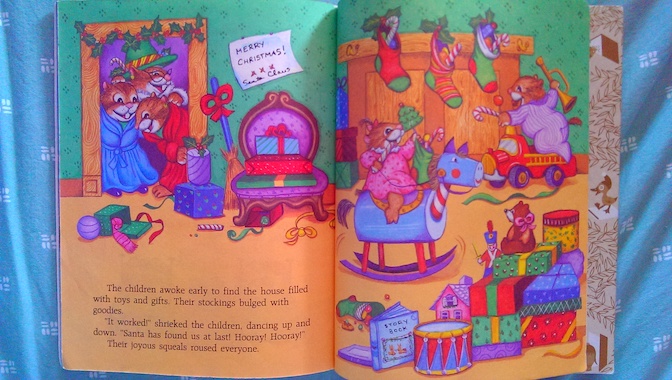
Sure enough, once Santa knows how to find the Chipmunk children, they get the kind of Christmas they’ve been waiting for!

BiggestChristmasTreePresents

This is just a cute picture book that I liked when I was young.  It is available to borrow and read for free online through Internet Archive.