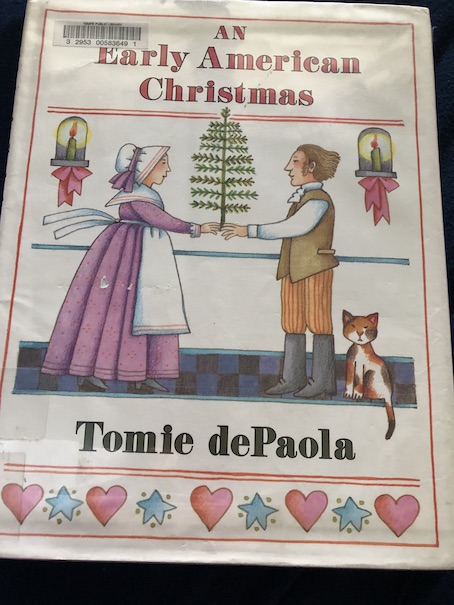
An Early American Christmas by Tomie dePaola, 1987.
A note at the beginning of the book explains the story behind the book, which is based on the history of early Colonial America. Although Christmas is now a popular American holiday with lavish celebrations, many early colonial groups didn’t celebrate Christmas much at all. Even among Christian groups, Christmas was not regarded as a major holiday. In particular, groups like the Puritans, Presbyterians, Quakers, and Baptists tended to avoid celebrating Christmas, seeing it as a frivolous sort of celebration. However, there were other groups, like Catholics, Lutherans, and Episcopalians, who did celebrate the holiday in a festive fashion. The author of this book imagines what it would have been like for a family that celebrates Christmas if they moved to a New England community that didn’t during the early 1800s. In particular, he used New Hampshire as his inspiration.
The beginning of the story describes a New England town that doesn’t celebrate Christmas with decorations or songs. Then, a new family comes to the village. They were originally from Germany, and they had lived in Pennsylvania before coming to the village. (This would make them Pennsylvania Dutch.) They are usual because of their festive Christmas celebrations.
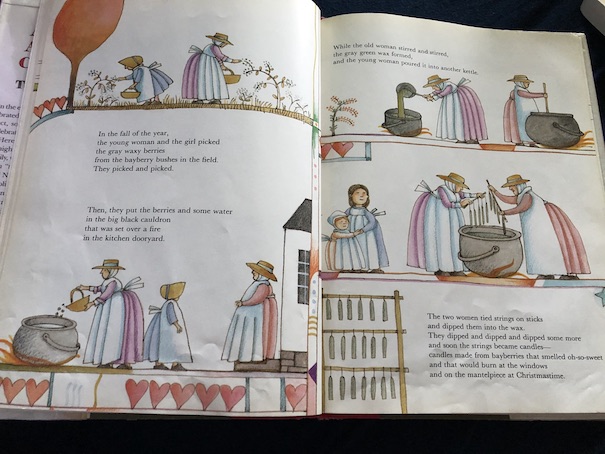
They begin planning for their Christmas celebration in the fall. The women and girls pick bayberries and use them to make candles. They say that bayberry candles bring good luck when they’re burned on Christmas.
The men and boys gather the crops that they will need for their feast. The grandfather of the family carves figures for their manger scene.
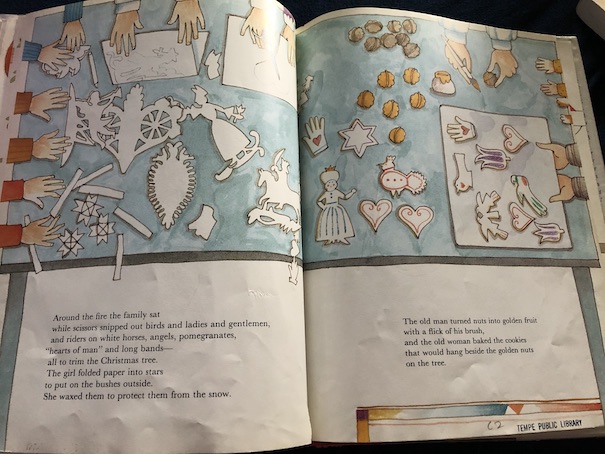
In December, the whole family makes paper decorations and specially-shaped cookies. I liked the variety of baked goods that they show in the pictures. They pick out a tree and make strings of popcorn and dried apples.
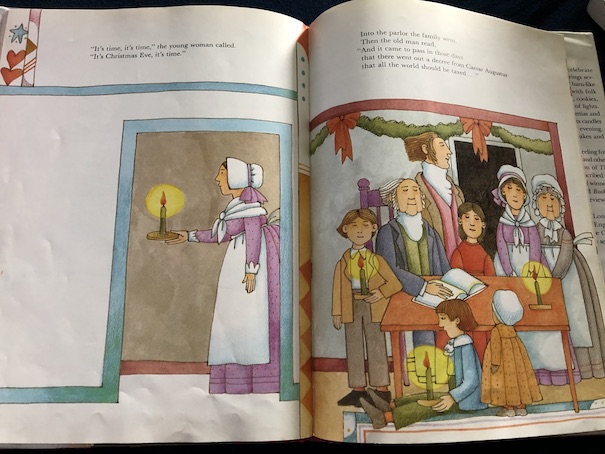
On Christmas Eve, they read the story of Jesus’s birth and decorate their home with all of the decorations they have prepared.
As the years go by and other people in town see what the Christmas Family is doing, they begin to celebrate Christmas, too.
The book is available to borrow and read for free online through Internet Archive.
Once in awhile, I feel like circumstances require me to make some comment about current events. Christmas this year is weird. There’s no denying that. This year has been dominated by the Coronavirus Pandemic, an event unforeseen at this time last year. In fact, the very first book post I made when this year began focused on the Influenza Pandemic of 1918, and I didn’t do it on purpose. I just happened to be reading Charlotte Sometimes around Christmas last year because it was a book many people said was good, and I’d been meaning to get around to reading it. I didn’t know on New Year’s Day 2020 that it was going to turn out to be weirdly appropriate.
So, everyone’s lives this year have been affected by the current pandemic. Many people aren’t going to spending Christmas like they did last year. Not everyone can travel to visit relatives, and some people, sadly, will be missing people who were with them last year. It’s okay to be sad about it. Circumstances aren’t good, and it’s okay to have feelings about it. It’s okay to be sad or angry and get those feelings out. Christmas tends to bring out strong feelings even in ordinary years because it’s the last major holiday before the New Year. It’s an event that not only marks a major Christian event, but also kind of caps off the year. It’s a time when people take a pause, and when people pause, they also tend to think. They think about what’s happened during the last year, where they are in their lives, where they expected to be, and what they expect or hope for during the next year. When I was in high school, a teacher warned us that it’s normal for some people to get depressed around this time of year, even though it’s usually considered a happy time. There are different reasons for that. Sometimes, it’s partly the weather, if you live in a place that gets dark and snowy around this time of year, but quite often, it’s about personal expectations. We all have expectations about our lives and how we think events are going to go, and it’s disappointing and sometimes frightening when things don’t go according to plan. Some people feel like they’ve failed when things in life don’t work out the way they wanted them to, and that’s depressing. They feel like they should have been able to control things better in the year leading up to Christmas and have the expectation that Christmas should be this perfect day where everything goes smoothly and everybody is perfectly happy. But, that’s not really how life goes, and not everything in life can be helped. Everyone encounters circumstances beyond their control that occasionally derail their plans, and that’s okay because it’s human, and that’s something that’s at the heart of the Christmas story, too.
For those who believe in the Christmas story, Jesus was born in a stable because there was no room at the inn for his parents to sleep in. There was literally nowhere else to go for them but the street, and the stable was a step up from that because it at least had some straw to lie on instead of the hard ground. It looks cute in nativity scenes with all the animals around, but anybody who’s been in a real stable or barn knows that they are smelly. Stables are for animals to live in, and animals poop. That’s one of the reasons why barns and stables have straw on the floor, to make it easier to clean up the animal poop and pee as well as providing animal bedding. In nativity scenes, Mary typically looks unusually clean in white and blue robes for someone who just gave birth while lying in a pile of straw. In real life, straw probably would have gotten all over her clothes and into her hair. This wasn’t a hygienic maternity ward with clean white sheets and soft pillows. It was a glorious event, but far from “perfect”, and even calling it “ideal” would be stretching it a little. It was what it needed to be for the people involved and the circumstances they were in. This is a story about people making something wonderful happen because they were doing the best they could with what they had in difficult circumstances. In a way, that’s part of what’s compelling about this story. If it had been a normal birth where everything went as one would expect, with no complications or unusual circumstances, it wouldn’t be special, would it? Everything about this story centers on the fact that this birth was unusual, not anything anybody would have expected. It was all surprising, from a prophetic star overhead to angels telling shepherds about the birth to wise men showing up with gifts to a homicidal king who starts looking for the baby, forcing the family to flee, to who this baby turned out to be. Nothing about this situation was normal. If it had been, we probably wouldn’t have a major holiday to celebrate it, and it wouldn’t be a story worth telling.
By the way, that’s my grandmother’s old Nativity set in the picture, and if you look at it closely, it’s also far from perfect. That picture isn’t the greatest, but also the figures are a mixture of pieces from different sets that my grandmother probably bought on sale or at a garage sale because she did things like that. You can kind of tell that it’s not just one set from the different styles of the figures and the bases that don’t match each other. Some are stamped “Made in Japan” and some are labeled “Made in West Germany.” Yep, West Germany. Some of the figures are broken. The guy in the back on the left is missing a hand, and some of the animals have to lean on something to keep from falling over. The angels aren’t in the picture, but they’re on top of the box that contains the scene, and one of them is missing a wing. We still use this set every year because we’ve had it for years and are attached to the pieces, even the broken ones. It’s possible to love something that isn’t perfect.
There are all kinds of expectations, and the type that really makes Christmas special is the expectation not that things will be perfect but that we will be pleasantly surprised by what happens. Pleasant surprises come when circumstances aren’t perfect, but good things still happen, and we have something to celebrate anyway. This is true even in the middle of a pandemic. So, forget what this year and this holiday were “supposed” to be! A lot of things have happened this year that nobody wanted (no matter what the conspiracy theorists say). It’s been hard for everyone, but there is some comfort in realizing that, no matter what you’ve been through this year, there are people around the entire world who have been going through the same thing with you every step of the way. You’re far from alone, and during this last week of the weirdest year of our lives, there are still some things to be glad about and some time to arrange a few last-minute treats for yourself and some nice surprises for other people.
Remember the Little Things
Life is in the details, and even in the midst of every insane thing that’s happened this year, there are still some little things that have gone right. Did you learn something new this year? Revive an old hobby during quarantine? Reconnected with an old friend online? Take care of some things you’ve been meaning to do but just never got around to doing until you just couldn’t get out to doing anything else? If you did, celebrate it! If you didn’t, you’ve still got about a week to do whatever it is you want to do before the year ends and then celebrate it!
Since my family started quarantining, I’ve gotten used to Zoom (which I’d been meaning to learn how to use and this year, I really had to). I managed to complete an internship remotely, and I’ve finished my final class to get the degrees I wanted. My dog has finally let my brother pet her because he’s been around more, and she’s finally started to trust him more. These are things that make a difference to me, and if you think about it, there may be things that you did that have changed your life for the better while you were worrying about larger events. Even just managing your life through a major pandemic is an accomplishment by itself. Think about the positive things you’ve done, big and small. Maybe write them down so you can see them and remind yourself of the good you’ve done.
I can’t say that I accomplished everything I wanted to do this year … or, even half of it. But, that happens every year. I just roll over all my uncompleted projects to the next one and add some more as the year goes on. It’s routine. It doesn’t matter how long I live, I’m the kind of person who thinks of more to do than I’m ever going to find time to do, and I’m used to that. As the year comes to a close, take a little time to appreciate the things you have done instead of brooding about what you didn’t or couldn’t. There is satisfaction in knowing that you’ve done things and taken care of what you needed to do. If, like me, your to do list is never-ending, then take a moment to appreciate being an ideas person with a constant supply of interesting projects and that you’ll never lack for direction in your life.
Celebrate an Old Tradition or Start a New One
Traditions can be a source of comfort, even if you’re not sharing them with the people you normally would. Traditions connect people with the past and the people who have shared those traditions before. They also remind us that there have been other Christmases before, and there will be more to come. This is just one year out of many. Whatever your situation is/was this year, it will probably be different by this time next year. Take comfort in that, and take some time do the things that you’ve enjoyed doing on Christmases before.
Watch some of the movies that you’ve liked on Christmases past, or if you’re just not feeling it this year, try something different. A simple Google search will show you just how many Christmas-themed movies there are to choose from. You don’t even have to watch something Christmas-specific, if you don’t feel like it. If it would make you happier to watch Star Wars tomorrow, do that instead. (I’d rather watch that than It’s a Wonderful Life any Christmas. Even though it has a happy ending, I find it wrenching to go through to get there.)
Most of my blog is about books, specifically nostalgic ones. Revisit some childhood favorites, or check out some of the ones I’ve reviewed! Most of the ones I’ve reviewed are also available online through Internet Archive, so if you don’t have them, you can get them with a couple of mouse clicks. (Internet Archive requires you to sign up to borrow books online and read them in your browser, but it doesn’t cost any money, and you might also find some old favorites there that I don’t know about yet.) Read them with your kids or just by yourself to relive the nostalgia!
Favorite books from Christmases past (plus more on my list of Christmas books):
The adventures of a group of neighborhood children, leading up to Christmas. This are just calm, slice-of-life adventures that make nice bedtime reading, like the one about Eddie’s cookie mix-up and the time he played Santa for his family and how a toy horse became a zebra in the school’s toy drive. One of the Betsy and Eddie books by Haywood.
The Herdmans, the worst kids in town, unexpectedly show up at Sunday school (mostly to raid the snacks) and become interested in the Christmas pageant. What will happen when the Herdmans decide that they want the starring roles? Part of The Herdmans Series. This humorous book brings up what I mentioned earlier about the situation in the First Christmas not being perfect, and there’s also a movie version.
Amelia helps Mr. and Mrs. Rogers get ready for Christmas while they go to pick up Aunt Myra, who will be spending the holiday with them. As in all of her books, Amelia goes through her to do list taking absolutely everything literally, from “trimming the tree” by clipping its branches to “stuffing the stockings” with the same kind of stuffing that she would use to stuff a turkey. Part of the Amelia Bedelia Series.
The chipmunk children are disappointed because Santa has trouble finding their house among the other trees in the forest, so the animals decide to turn their home into a big, decorated Christmas tree. A Little Golden Book.
A young girl receives a magical nutcracker for Christmas and learns how to break the spell that has changed him from a human prince. By E.T.A. Hoffmann, retold by Anthea Bell.
This book explains Christmas customs in various countries around the world. I’ve read it and reread it around Christmas since I was a kid! If you like this book, I also recommend the Anglophenia YouTube video about Christmas in Britain.
Some other books that I haven’t reviewed yet on my blog are:
This is a collection of the Christmas scenes from different books in the Little House on the Prairie series. There are some good Christmas stories in those books, where people often had trouble getting together, and the family had their own, homemade fun and enjoyed simple pleasures.
Many people feel nostalgic about special foods and treats around Christmas. Even if you can’t get together and eat with as many people this year, you can still enjoy old favorites, and baking special Christmas cookies and making candy and other treats can be a good activity and something you can enjoy with children.
Of course, a classic Christmas activity is making a gingerbread house. Or, if you’re like me, using the shortcut of making one out of graham crackers or pop tarts. (Remember, it doesn’t have to be perfect, it just has to be fun. It’s always a little messy, and you’ll notice mine has old Valentine candy on it because it’s more fun to read candy hearts than eat them.) If you don’t have proper piping bags for the icing, you can always do what I do and put the icing in a sandwich bag or freezer bag and snip off one corner.
If none of these activities sound like your traditional activities, or if you don’t feel like doing what you ordinarily would do, consider starting a new tradition! Make a new kind of craft or try a new recipe you’ve never tried before. All traditions were new once, and if you like it, it might just catch on.
Be Good to Yourself
Whatever you decide to do this year, do things that make you happy. Christmas is a day to celebrate, to enjoy what you have and give yourself a special treat. Ask yourself what would make you the happiest and make it a point to do things that you enjoy. Read a favorite book (whether it’s about Christmas or not), eat your favorite snacks, have a bubble bath, make a pillow fort with the kids (or, heck, just make one for yourself – who’s gonna know?), run around in the park, drink hot chocolate, play games, whatever you like. Give yourself permission to relax for one day.
Even if you’re spending Christmas alone this year, there are still things you can do to be happy. Take advantage of the freedom of being alone to watch movies, listen to music, or eat foods you like but nobody else really does. Call people and wish them Merry Christmas. If you haven’t sent everyone a card yet, this is a good time to do that.
Surprise Someone
Hopefully, you’ve done all of your Christmas shopping, but there’s still time to surprise someone with something special. If it’s not a gift, it can be just something nice that you do for someone. Call or write to someone you haven’t talked to in awhile and let them know you’re thinking of them. Call into a local radio station and request a song you can dedicate to someone else. Arrange to do yard work for someone to help them even if you can’t have close personal contact with them. Seeing that you can do little things to help people and make them smile may make you smile, too.
If you want a sense of accomplishment, do something to help someone else or make plans to do it for the New Year. There are many groups to donate to, from pet shelters to organizations that help foster children. Do a little research and find out what’s happening in your community and look for a cause you’d like to support. You could donate money to help the homeless or make toys out of no-sew fleece for the local pet shelter. If you’re feeling lonely, there are even some organizations (like this one) that will match you up with a pen pal, like a home-bound senior, who could also use some companionship and emotional support. To find these groups, Google “write to the elderly” and add in your location to find a senior pen pal near you. Consider ways to connect with your community and the people in it, even if you can’t exactly gather yet. Nothing lasts forever, and by the time the pandemic eases, you may have made some new friends by connecting with a good cause.
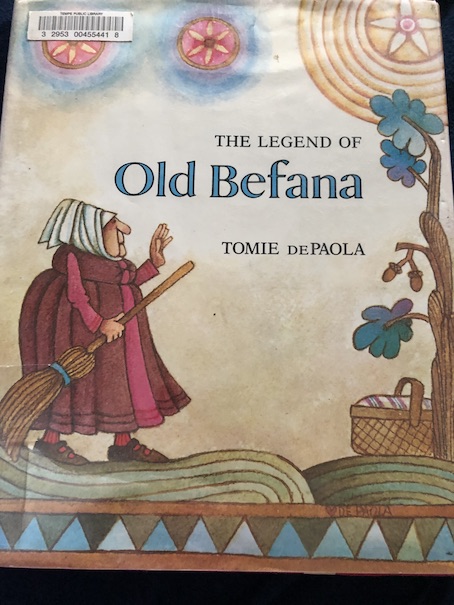
The story is based on a Christmas story from Italian folklore. According to Italian tradition, Old Befana visits the houses of children on January 6th, the Feast of the Three Kings, and leaves treats and gifts. Legend has it that she is on an eternal search for The Christ Child.
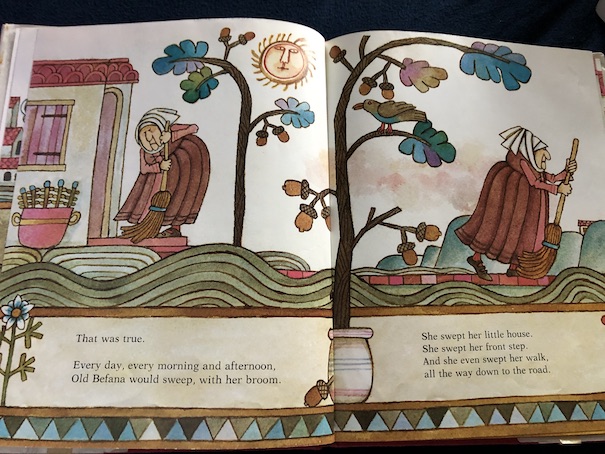
Old Befana is a strange old woman who living in a village in Italy. She is a grumpy woman who spends almost all of her time sweeping. Sometimes, she bakes good things to eat and sings lullabies, although she lives alone, so there’s no one for her to bake for or sing to. People think that she is crazy.
One night, Old Befana wakes up to see a bright light. There is a dazzlingly bright star in the sky, and it makes it difficult for her to sleep.
The next day, as she is doing her usual sweeping, she hears the sound of bells. A strange and beautiful procession comes over the hill. Among the procession are three men in royal robes.
The three kings stop and ask Old Befana if she knows the way to Bethlehem. She says that she has never heard of the place. The kings say that they are looking for “the Child,” but Old Befana doesn’t know what child they mean. They explain to her that this Child is a king and that His appearance was signaled by a bright star in the sky.
Old Befana confirms that she has also seen the star. A boy among the procession tells Old Befana that they are bringing gifts to the Child because He has come to change the world. The boy urges Old Befana to come with them, but old Befana says that she is only a poor woman and continues her sweeping.
After they leave, however, Old Befana continues thinking about what they said, and she starts to think that maybe she should go see the Child. She bakes all kinds of cookies and candies as gifts. She also decides to take her broom so that she can sweep the Child’s room because His mother will be tired. However, she stops to do her usual sweeping before she leaves her home.
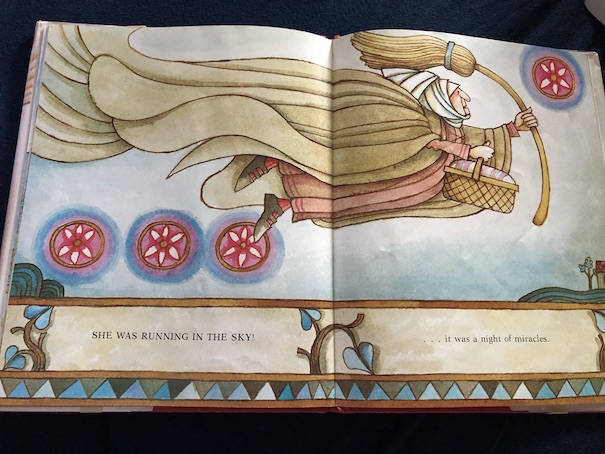
By the time she is finished with her sweeping, the procession is so far ahead that she is unable to catch up to them. Just as Old Befana laments that she cannot catch up to the procession, the angels declare that, “This is the night of miracles.” Suddenly, Old Befana can run fast, even running across the sky.
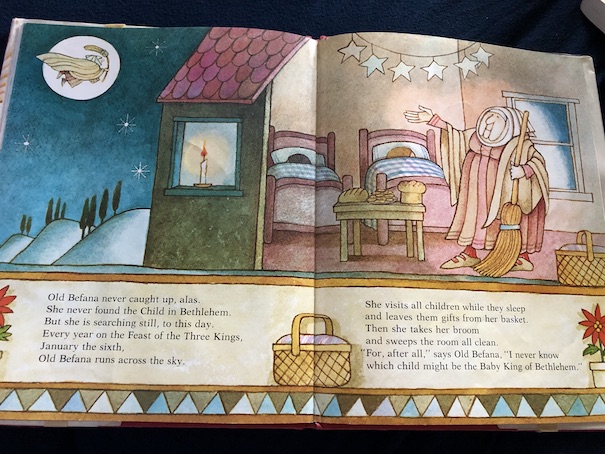
Unfortunately, Old Befana still doesn’t know the way to Bethlehem or who the Child is, so she doesn’t get to see the Christ Child. However, she still continues her search. Every year on January 6, she runs across the sky, carrying her broom and her basket of treats. At every house she finds with a child, she sweeps the room clean and gives the children gifts and treats because she never knows for sure which of them might be the Child she is seeking.
The book is available to borrow and read for free online through Internet Archive.
The book begins with a note that the story is based on an old French legend, although the story actually takes place in Italy.
A young boy named Giovanni has no parents and must live as a beggar, but he knows how to juggle. He juggles fruit and vegetables in the marketplace, and the produce sellers give him food in exchange for drawing people’s attention to their wares.
One day, Giovanni sees some actors putting on a play, and he asks for a job with the troupe. After he demonstrates his juggling ability, they agree to take him on in exchange for food and a place to sleep.
Over time, Giovanni’s juggling act becomes more elaborate. Eventually, he becomes famous in his own right and leaves the troupe to become an entertainer for many important people.
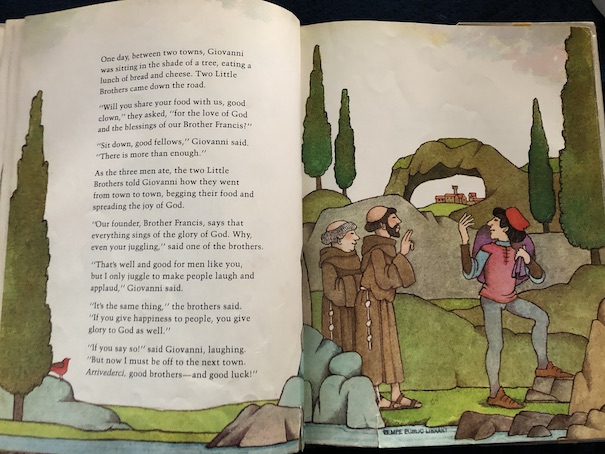
During his travels, he meets two monks, who ask him if he is willing to share his food with them. He agrees, and they tell him about Brother Francis, the founder of their order. (St. Francis of Assissi. They are Franciscan monks.) They say that everything in the world is a sign of God’s glory, even Giovanni’s juggling. Giovanni says that he never thought of it like that before. He just likes making people happy with his performance. The monks say that making people happy is a way of glorifying God.
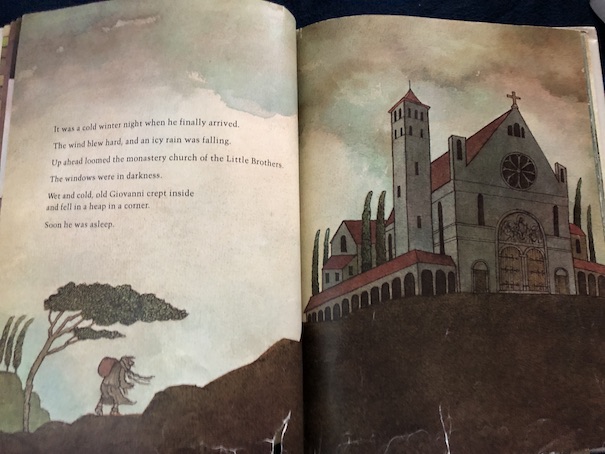
Giovanni continues his performances, but as he gets older, people get tired of his act, and one day, he actually drops one of his juggling balls. For a time, he has to live as a beggar again. However, he eventually finds his way to the monastery where the Franciscan monks live.
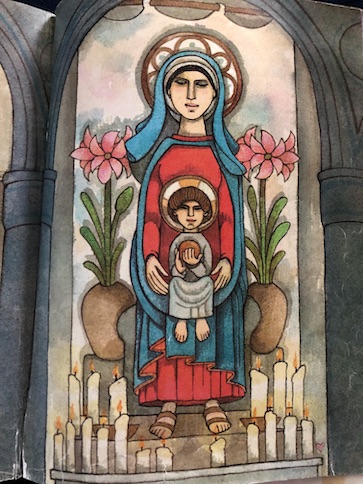
He arrives at the monastery at Christmas, and there is a special procession where people are offering gifts to the Christ Child, placing them in front of a statue of Jesus and Mary. Giovanni is struck by how serious the Christ Child looks in the statue, and so he decides to perform the act that used to make everyone smile.
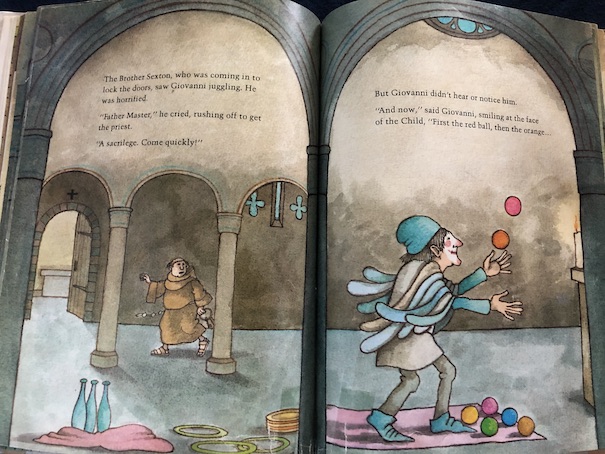
When one of the monks sees him juggling in front of the statue, he thinks that it’s a sacrilege and calls the priest to come see what Giovanni is doing.
The story is sad because Giovanni’s exertion in giving the best performance of his life causes him to have a heart attack and die. However, the priest and the monk notice that, suddenly, the statue is smiling and holding Giovanni’s special golden ball.
The story is about using talents to the fullest. The juggler’s talent, as the monks said, was a gift from God. For as long as he could, he used it to make people happy, and when he was too old to do so anymore, he gave his last, finest performance for Jesus.
The book is available to borrow and read for free online through Internet Archive.
The Puppy Who Wanted a Boy by Jane Thayer, illustrated by Lisa McCue, 1958, 1985.
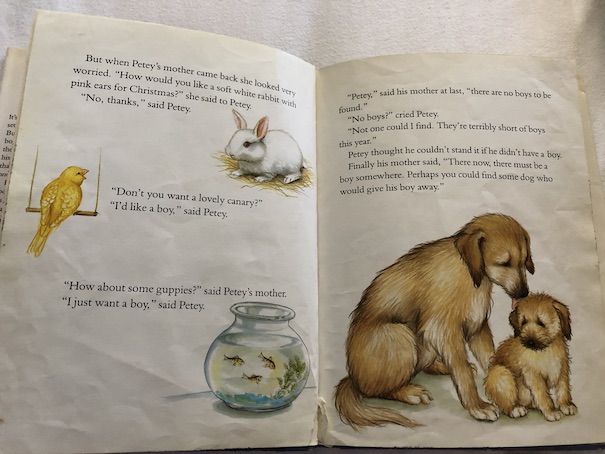
A puppy named Petey tells his mother that he wants a boy for Christmas. His mother says that he might get one if he’s good, and when Petey is a good puppy, his mother tries to find one for him.
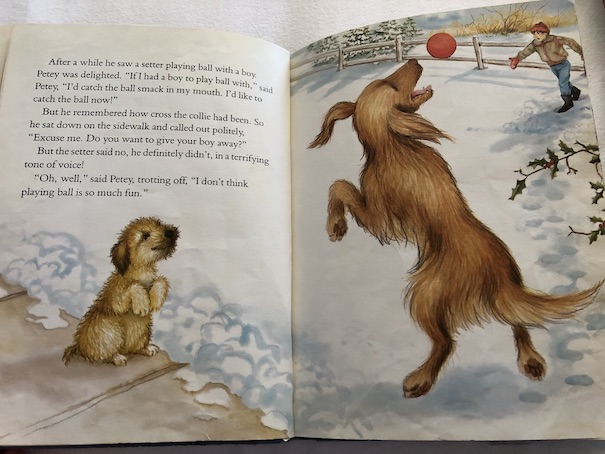
Unfortunately, Petey’s mother just can’t seem to find a boy for Petey anywhere. She suggests trying to see if any other dog is willing to part with his boy. However, no other dog wants to give up his boy.
Eventually Petey comes to an orphanage with a sign that says Home for Boys. Petey decides that if the boys have no parents, maybe they could also use a dog. It’s Christmas Eve, and most of the boys are inside are singing Christmas carols, except for one boy, sitting by himself outside.
Petey jumps into the lonely boy’s lap, and the boy loves him right away. When a lady comes to check on the boy, the boy asks if he can bring the puppy in, and she says yes.
All of the boys in the home love Petey and want to keep him. The lady says that Petey can stay if his mother lets him, and Petey knows that she will. Instead of getting just one boy for Christmas, Petey found fifty!
The story was first published in 1958, but my edition is from 1985 and has different illustrations. In the older book, the puppy looked like a beagle.
The book is available to borrow and read online through Internet Archive (multiple copies).
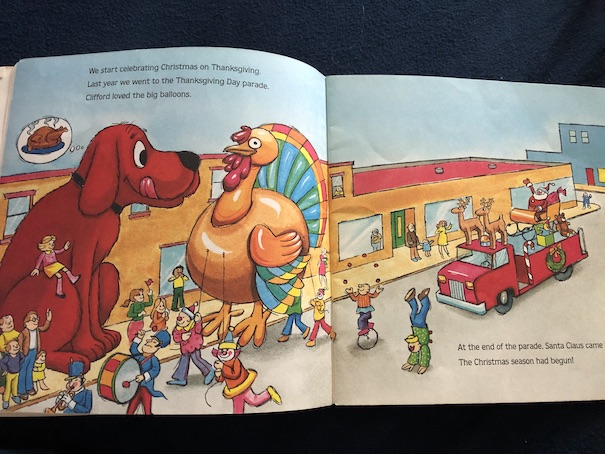
Christmas is coming, and Emily Elizabeth and Clifford are ready to celebrate! Emily Elizabeth talks about how the Christmas season begins with Thanksgiving. (That’s not how everyone regards it, but it is a common way to mark the season in the United States. The day after Thanksgiving, Black Friday, is considered the start of the Christmas shopping season, with people looking for bargains on Christmas presents.)
When it starts to snow, Emily Elizabeth, Clifford, and their friends have fun playing in the snow. They get a Christmas tree, prepare their stockings, and participate in other holiday activities leading up to Christmas. Clifford even gets a kiss under mistletoe!
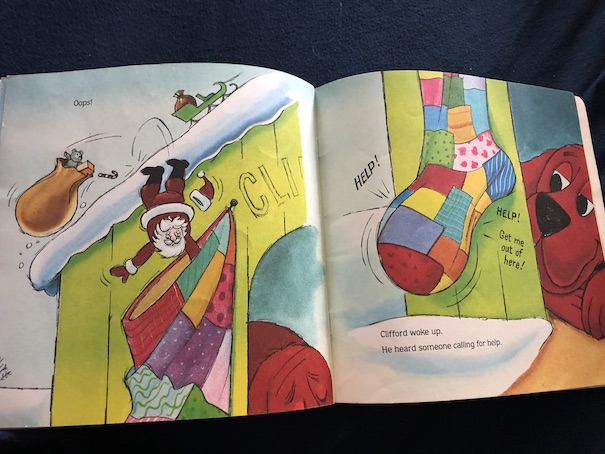
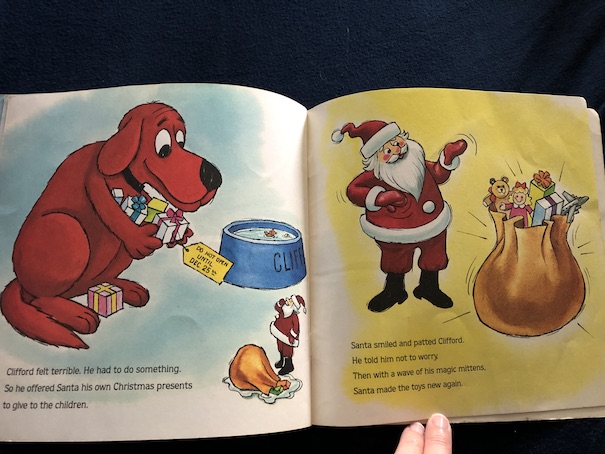
When Santa comes, he lands on the roof of Clifford’s dog house and accidentally falls into Clifford’s stocking, dropping his sack of toys. Clifford has to rescue him.
The toys fall into Clifford’s water bowl, but Santa fixes them with his magic. No harm done, and it’s a Merry Christmas after all!
This is just a cute Christmas story with a popular children’s books character. I loved the Clifford books when I was a kid, but I have to admit that they don’t look as good to be now as an adult. The entire plot of Clifford books revolves around Clifford’s enormous size, which is the very idea of the series. However, the plot of this is light, the problem is both caused and immediately solved by Clifford’s large size, and I think I’m just not interested in the usual trope of Famous Character Saves Christmas In Some Way anymore. I think that some Christmas stories with popular characters are still good, but for them to work, they usually have to have deeper, more clever, more interesting plots. This book isn’t bad, but I just didn’t think it was particularly great.
The book is available to borrow for free online through Internet Archive.
This time, Larry has come to visit Kipper and his family on their farm in Kansas while his father attends a police convention in Florida and will be spending Christmas with them. At first, Kipper thinks that Larry probably regrets this visit because Kansas isn’t very exciting, and it’s snowing while Larry’s father is in sunny Florida.
The situation gets worse when Kipper gets into a fight with his friend Scooter when Larry and Kipper were supposed to be spending the night at Scooter’s house. Scooter apparently cheated at a game, and Kipper got so mad that he said that he and Larry would just go home. The problem is that the boys have to walk a couple of miles to reach the farm where Kipper’s family lives, and the snow has turned into a blizzard.
The boys start to get scared that they might freeze to death when Larry spots a light from a house nearby and heads toward it. Kipper thinks that it’s a dangerous mistake because the house with the light is the old Morgansterne house, and it’s been empty for years. However, when the boys reach the house, there are oil lanterns burning in the windows and a fire in a wood-burning stove. Out of desperation, the boys let themselves into the house to warm up, but then they start to wonder who lit the fire and the lanterns. They search the house to see if there’s anyone there, but they don’t find anyone. The only thing they find upstairs is an old box of Christmas ornaments.
The boys spend the rest of the night in the house without seeing anyone and continue to the farm in the morning. When they explain to Kipper’s mother what happened and where they spent the night, she’s concerned, both because the boys were out in the snowstorm and because nobody should be in the old Morgansterne house. Old Miss Morgansterne, who owns the house, has been living in a retirement home, and no one else is supposed to be there. Kipper’s mother decides to call the sheriff and have him look into it.
The sheriff comes and questions the boys about what they saw in the house, and they ask him about a robbery at a jewelry store in town that the family heard about on the radio while waiting for him to arrive. Larry wonders if there’s a connection between the robbery and the supposedly empty house that seemed to be occupied by someone before they arrived. The sheriff doesn’t see why there would be a connection between the two events, but Kipper’s younger brothers think that maybe the robbers were in the house the whole time, hiding in some kind of secret passageway, like in books and movies. The sheriff thinks that the boys have overactive imaginations.
However, there is more to the theory that the house and the robbery are connected than the sheriff thinks. Soon, the sheriff is alerted that the car that is believed to belong to the robbers has crashed into a pond near a dangerous curve in the road and the two men inside the car are dead. When they search the car, they find some of the jewelry from the robbery, the less expensive costume jewelry, so it seems that they were correct that these men were the robbers, but strangely, the most expensive jewels from the robbery, diamonds, are still missing. The sheriff says that it’s almost like they melted away, like the diamond-like snow that Larry commented on earlier.
It makes sense to the boys that the robbers were in the Morgansterne house before they were. They remember seeing a car like the robbers’ car along that road before the snow storm got bad, and it would explain why the house was empty all that night. The robbers accidentally saved the boys’ lives by lighting the stove in the house for them, but they never returned to their hideout in the empty house because they had their car accident. But, somewhere along the way, the diamonds they stole seem to have vanished. Can the boys figure out how?
The book is available to borrow and read for free online through Internet Archive.
My Reaction
Overall, I liked the story. I had more than one theory about where the diamonds were, and one of them turned out to be correct, but there was enough doubt in my mind to keep the story interesting until the end.
Ramona and Her Father by Beverly Cleary, 1975, 1977.
It’s September, and second-grader Ramona Quimby is already making out her Christmas list. However, Christmas this year might not be what Ramona expects. Her father comes home and explains that he’s been laid off from his job because a larger company bought the company he worked for and laid off the extra workers. Mrs. Quimby has a part time job, but it doesn’t pay much. Everyone in the Quimby family soon becomes worried about money.
Mrs. Quimby finds another job that’s full time, but Mr. Quimby still struggles to find work. Ramona doesn’t like to see her father so worried and stressed, and she tries to think of some way she could also earn money. When her father comments about how much money a boy on a television advertisement must have made, Ramona sets herself to memorizing various advertising phrases and repeating them, hoping to be discovered and hired to make an ad herself. Unfortunately, things that people say on ads don’t work in real-world settings, especially when you tell your teacher that her wrinkled stockings look like elephant skin.
The family has to eat food that they don’t particularly like in order to save money, and they start buying cheaper cat food for their cat. Picky-picky refuses to eat the cheap cat food, and before Halloween, he eats part of the girls’ jack o’lantern in desperation. Beezus, upset at the idea that their cat is apparently starving and desperate, angrily asks her father why they can’t afford Picky-picky’s usual cat food when they seem to have enough money for his cigarettes. (It’s a valid question. During my first semester of college, I totaled up a classmate’s expenses on cigarettes and realized that what she spent on them for a year was about the same as full-time student tuition at our community college, by early 2000s standards.) Her father tells her that’s none of her business, and Beezus retorts that it is her business. Cigarettes are harmful, and Mr. Quimby is spending money on them that the family desperately needs.
Ramona is worried because this is the first time that she’s heard that cigarettes are bad, although Beezus says that she learned it in school. Ramona tries to ask her father if what Beezus said is true, and he just says that he expects to be an old man someday, the kind that tells reporters on his hundredth birthday that he owes his longevity to cigarettes and whisky. This joke doesn’t reassure Ramona. Ramona decides that she’s going to get her father to stop smoking.
Ramona gets Beezus to help her make anti-smoking signs. At first, their father tries to ignore the signs, and then he starts getting annoyed with them. Ramona worries that she’s been mean to her father and upset him too much, but he later admits that she was right and that he’s going to try to quit smoking. Ramona takes him at his word and throws his cigarettes away, although he said that he would rather have cut down gradually. Still, his wife and daughters are happy about him quitting. For awhile, Mr. Quimby is edgy and irritable as he tries to get used to not smoking as well as still looking for a job.
As Christmas approaches, the girls’ Sunday school begins preparing to put on a Nativity play. Beezus gets cast as Mary, which pleases her because Henry Huggins is going to play Joseph. Ramona is so excited about the play that she wants a creative role for herself, and after the shepherds are cast, she says that she wants to be a sheep to go with the shepherds. The Sunday school teacher says that sounds like a good idea, but they’ve never had any sheep in the play before and don’t have a costume for her. Ramona says that her mother could make her one, and other children also say they want to be sheep.
However, as Beezus points out, now that their mother is working full time, she doesn’t really have time to sew a costume. Their mother also says that they can’t afford to buy new cloth for a costume, and the best she can do is an old white bathrobe that she might be able to alter into costume. Ramona’s father snaps at her that she’s been inconsiderate for expecting her to do something like this without asking first. Ramona feels badly and overhears her father calling her a spoiled brat. With his irritability, he’s been picking at her for various things, and one day, Ramona argues with him when she comes home from school and smells cigarette smoke.
Ramona’s father reassures her that he hasn’t purchased any new cigarettes. He just found an old one in a pocket that he forgot that he had and decided to smoke it to see if it would help him feel better. The two of them have a heart-to-heart talk about Ramona worrying about why they can’t be a happy family. Ramona’s father tells her that their family is happy. It’s just that no family is perfect and nobody’s life is perfect, and everyone goes through hard times now and then. The people in Ramona’s family still love each other and do their best for each other even when things are hard and they don’t always get along.
Things improve for the Quimbys as Christmas approaches. Mr. Quimby finally finds a new job. Ramona almost backs out of the Nativity play because her mother didn’t have time to make her a full costume, and she feels silly with what she’s wearing, but she changes her mind with the help of three older girls who were recruited to replace the Three Wise Men who backed out of the play.
One thing that kind of surprised me in the story was that Ramona’s parents seemed mildly scandalized when Ramona and Howie sang “99 Bottles of Beer on the Wall.” Beezus, who learned the song at summer camp and taught it to Ramona says that the neighbors will probably think they’re beer guzzlers after hearing Ramona and Howie sing it all up and down the street. It struck me as weird because I remember that everyone knew that song when I was a kid in the 1980s and 1990s, and nobody thought anything of it. I certainly never heard of anyone being scandalized by it. It’s just a silly counting song, and nobody really thought that any kid singing it had ever had beer. In fact, it was a common song for parents to get their kids to sing on long car trips because it takes a long time to finish, and during that time, the kids aren’t complaining or asking, “Are we there yet?”
The book is available to borrow and read for free online through Internet Archive (multiple copies).
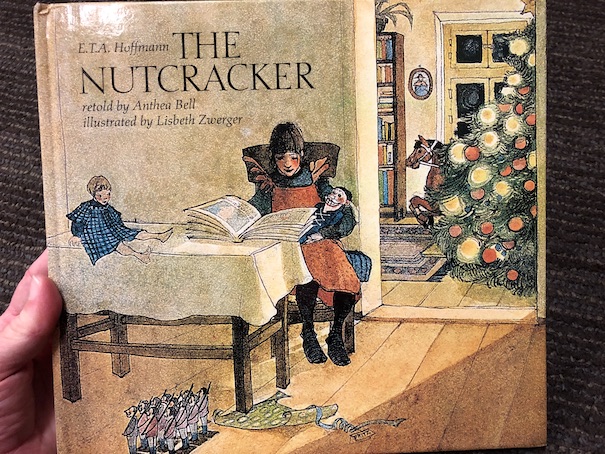
The Nutcracker by E.T.A. Hoffmann, retold by Anthea Bell, 1816, 1987.
The reason for the two dates of this book is that the original Nutcracker story was written by a German writer, E.T.A. Hoffmann, in 1816, as the novella The Nutcracker and the Mouse King. Some places, including the back of this book note different publishing dates for the original story because it was published more than once during the 1810s, as part of different story collections. This article gives more details about the original version of the story and different publications. Since then, it has been retold many times and in many different forms, including the famous ballet based on the story. In ballets and plays, the name of the heroine is often Clara, but in this picture book, as in the original story, the heroine’s name is Marie.
In the beginning of the book, which is set in the 19th century, Marie and her brother Fritz, are opening their Christmas presents on Christmas Eve. (The book explains that opening presents on Christmas Eve is a German tradition. A friend in Germany also explained that to me once because, in Germany, presents are supposedly brought by the Christ Child, not by Santa Claus. Since then, I’ve read that explanation may vary, depending on whether the household is Catholic or Protestant.) The children receive many wonderful presents, including a toy castle from their godfather, Mr. Drosselmeier. Marie’s favorite present is a nutcracker that looks like an odd little man. When Fritz is too rough with the nutcracker and breaks it, Marie takes care of it.
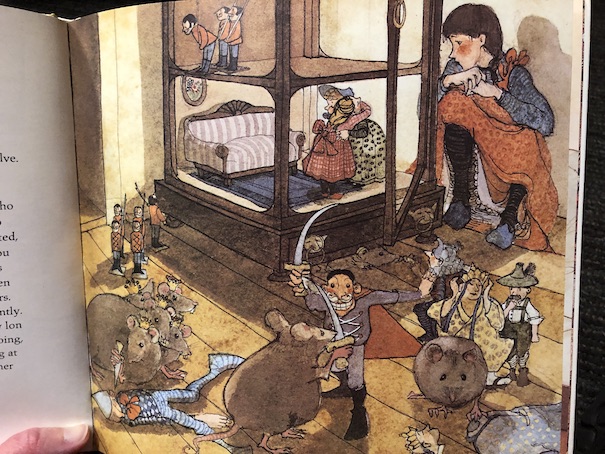
Marie stays up late, and when she finally puts the nutcracker away at midnight, she is astonished to see an army of mice coming out of the floorboards. The leader of the mouse army is the Mouse King, who has seven heads. The Nutcracker leads an army of toys against the mouse army. The mouse army appears to be winning, so, to save the Nutcracker, Marie takes off her shoe and throws it at the mice. Then, her arm hurts, and she apparently faints.
When Marie wakes up, she is in her own bed, and her mother tells her that she apparently put her arm through the glass door of the toy cabinet, cutting herself badly. When Marie tries to tell her mother about the battle between the toys and the mice, her mother and the doctor think that she’s ill and confine her to her bed for a few days. Mr. Drosselmeier repairs the Nutcracker and returns it to Marie, telling her the reason why nutcrackers look so strange and ugly, calling it The Tale of the Hard Nut.
Year ago, there was a royal banquet given by the King and Queen who were the parents of Princess Pirlipat. A mouse who claimed to be the queen of Mousolia demanded some food from the banquet as the Queen was preparing it. The King was angry that the mouse took some of the food and wanted revenge. The King asked his Court Watchmaker, who was also named Drosselmeier, to build some mousetraps to catch the mouse queen’s seven sons. When the sons were caught, the mouse queen vowed that she’d take her revenge on Princess Pirlipat. Princess Pirlipat was a pretty baby, but the mouse queen turned her ugly. The King took out his anger on the Court Watchmaker, ordering him to find a way to change Princess Pirlipat back to normal and threatening to behead him if he failed. After consulting the Court Astronomer, the Court Watchmaker learned that the key to breaking the spell on the princess was a special nut, which had to be cracked by being bitten by a man who filled certain special requirements, which all happened to be met by the son of the Watchmaker’s dollmaker cousin. The King had promised that the person who could break the spell could marry his daughter, but the mouse queen interrupted the last part of the ritual, causing the young cousin to turn ugly himself. When pretty Princess Pirlipat saw her rescuer turn ugly, she didn’t want to marry him anymore. The Court Astronomer said that the only way to break the spell on the young man was for him to defeat the new Mouse King – the mouse queen’s youngest son – and for him to find a woman who would love him regardless of his appearance.
Marie knows that the story is true because she has seen the Mouse King herself. She loves the Nutcracker and wants to help him. The Nutcracker returns to visit Marie during the night and makes repeated demands of her for her candy and toys. Marie knows that, no matter what she gives him, the Mouse King will keep returning to demand something else. The Nutcracker tells her that he needs a sword to fight the Mouse King. They borrow one from a toy soldier, and the Nutcracker successfully defeats the Mouse King, giving Marie his seven golden crowns.
As a reward for helping him, the Nutcracker takes Marie to the land where he is from, leading her there through a magic staircase in an old wardrobe. The Nutcracker’s land is beautiful, filled with candy and sweets and gold and silver fruit. (The Christmas Wood that they pass through reminds me of the woods in the wardrobe in The Lion, the Witch, and the Wardrobe.) The Prince Nutcracker’s home is Marzipan Castle in Candy City, where his beautiful princess sisters live. They welcome Marie and the Nutcracker home.
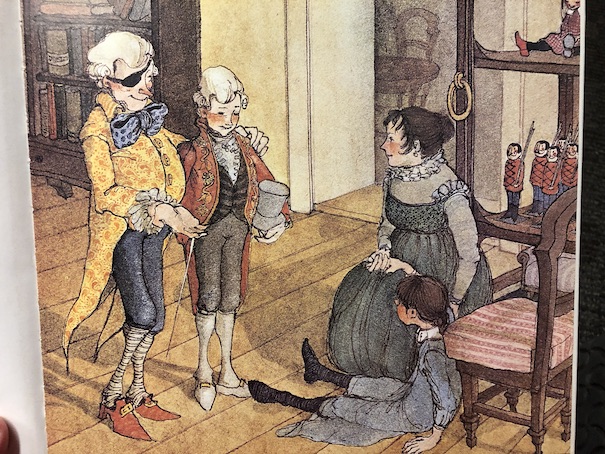
Then, suddenly, Marie wakes up, as if it were all a dream. However, Marie knows that it wasn’t a dream because she still has the Mouse King’s crowns. Marie tells the Nutcracker that she loves him. There is a sudden bang, and Marie faints. When she wakes up, she is told that Mr. Drosselmeier’s nephew has come to visit them. The nephew is the Nutcracker, restored to human form and now a handsome young man, thanks to Marie’s love. Marie later marries the nephew, and the two of them rule magical Kingdom of Sweets.
There is a section in the back of the book that explains a little more about E.T.A. Hoffmann and the original version of the Nutcracker story.
This book is available to borrow for free online through Internet Archive.
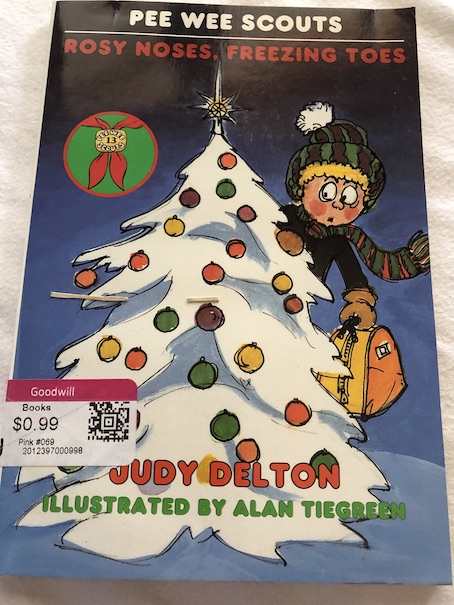
#13 Rosy Noses, Freezing Toes by Judy Delton, 1990.
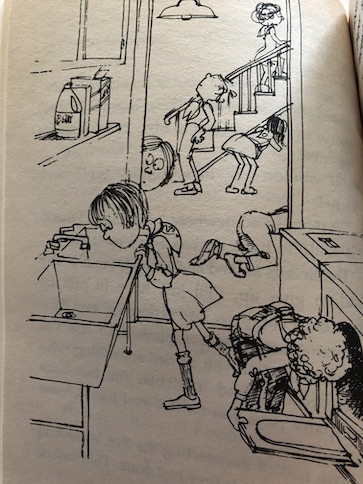
At one of the scout meetings, Mrs. Peters, the troop leader, says that her antique vase is missing. It’s a family heirloom, and Mrs. Peters wants to ask the scouts if they know anything about its disappearance or if they have any idea of what could have happened to it. None of them knows, but they’re fascinated by the mystery. After they search the house and can’t find it, Mrs. Peters says that she’ll just have to report its disappearance to the insurance company. Mrs. Peters is willing to let the matter go at that, but the scouts keep wondering what happened to the vase and if one of them could have taken it.
Mrs. Peters tells the scouts that the next badge they will earn will be their music badge. To earn the badge, the children will have to sing or play an instrument or tell the group about the life of a composer. Some of the children already play instruments and know what they’re going to do, but others aren’t sure. Since it’s December, Mrs. Peters suggests that some of them could sing popular Christmas songs or a Hanukkah song.
Sonny Betz declares that he doesn’t want to participate because he can’t play an instrument and over the next few days, he seems upset and nasty with people. Molly asks him what the matter is, and Sonny tells her that his mother is forcing him to take violin lessons. Mrs. Betz has always wanted Sonny to learn to play the violin, and his new violin teacher has assured her that Sonny will be able to learn the first line of Jingle Bells in time for the scouts’ music show, even though it’s coming up fast. Sonny isn’t happy about it, and to make him feel better, Molly tells him that he’s lucky because nobody else will be playing the violin and it will make him different. Unfortunately, the other kids tease him and call him “Maestro,” so he starts feeling bad.
Molly doesn’t like the way the others keep teasing Sonny, and when Tracy says that Sonny is a baby, Molly tells her that it’s not his fault because his mother is the one who makes him take violin lessons and keep the training wheels on his bike even though he’s in the second grade and all the other things that people tease him about. Mrs. Betz doesn’t realize how much Sonny hates some of the things that she makes him do and how much the other kids tease Sonny about these things. Molly overhears her mother saying that Sonny will “be a handful by the time he gets to high school,” probably because she’s imagining that Sonny will rebel against all things his mother has been making him do once he’s a teenager. Actually, it’s not going to take that long.
Mrs. Peters uses the insurance money from her vase to buy a piano. The scouts’ music show goes okay at first, although none of the kids are spectacular at music. Molly, Mary Beth, and Lisa paint their noses red and sing Rudolph the Red-Nosed Reindeer. Kevin whistles. Roger plays White Christmas on the drums with no other accompaniment, confusing everyone about what song he’s actually playing. Poor Sonny has to go last, when everyone is starting to get tired of the entertainment, but he doesn’t play well. The other scouts cover their ears, and the screeching of the violin makes the dog bark and Mrs. Peters’s baby cry. Sonny is so upset that he runs away from the show and has a fit.
The next day, Molly learns that Sonny has run away from home completely, leaving behind a note that he’s heading to Alaska. Everyone is searching for Sonny and getting worried about him being outside alone in the snow. However, Molly soon discovers that Sonny hasn’t gone as far as everyone fears and he’s certainly not on his way to Alaska. She discovers Sonny hiding in her family’s bathtub. Sonny explains to her that he didn’t have the money to go to Alaska, but he couldn’t bring himself to go home, and he picked Molly’s house to hide in because Molly is the only one who didn’t tease at him. Molly promises not to turn him in, but she says that he won’t be able to stay in her bathtub forever. His mother has called the police to report his disappearance, and Molly’s parents are bound to find him eventually. Sonny swears that he can’t go home because he hates playing the violin so much. What can Molly do to help him change his mind?
I didn’t like the way the other scouts were so mean to Sonny in the book. Sonny does do childish things, like being mean to the younger kids on the playground when he’s upset and throwing fits when things go wrong. However, Molly tries to be understanding with Sonny, even when he’s being fussy and whining, and she recognizes that Sonny is in a difficult position. His mother has certain expectations of him, and Sonny doesn’t think that anything will change her mind. The way things work out, though, makes it seem like Sonny never really explained to his mother how upset he was about the violin lessons and maybe not even how upset he’s been about some other things. Part of Sonny’s difficulty and the reason why he seems babyish to the other kids is that he seems to have trouble managing and articulating his emotions, including standing up for himself and what he really wants. Some of the other scouts help Molly to convince Sonny that running away isn’t the solution, and Molly calls Mrs. Betz to tell her that Sonny is okay but won’t come home until she promises that he can stop playing the violin. Sonny declares that he wants to see that in writing, and his mother gladly writes him a note that says that he doesn’t have to play the violin again.
So, what about the antique vase mystery from the beginning of the story? Before the end of the book, they do locate the missing vase (not really stolen, more misplaced and forgotten), but Molly accidentally breaks it. Mrs. Peters says that it’s okay because, with the vase broken, she doesn’t have to give the money back to the insurance company, and she gets to keep her new piano. She’s been wanting a piano, and the truth is that she never really liked the vase, even though it was a family heirloom. Yay? Merry Christmas!
The book is available to borrow for free online through Internet Archive.




















 Jestress's Forgotten Books and Stories