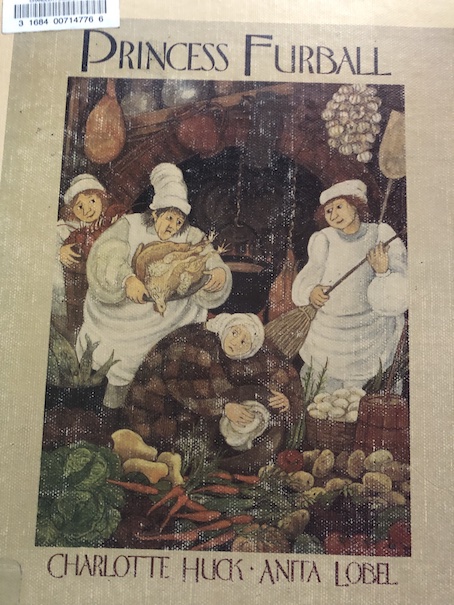
Princess Furball

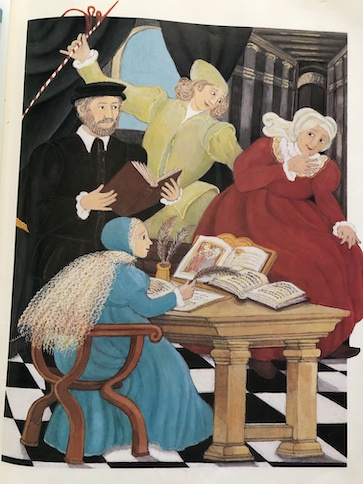
There was a princess whose mother died when she was only a baby and whose father never paid much attention to her. In spite of this misfortune, she had a happy childhood because her nurse loved her and let her play with other children. She arranged lessons appropriate to a princess with skilled tutors and let the princess learn how to cook in the royal kitchen.

However, when the princess was grown, the old nurse died, and the princess was very lonely. Her father only cared about the money he could get from the princess’s marriage, and to the princess’s horror, he arranged a marriage to an ogre who promised him fifty wagons of silver in exchange for the princess.

Unable to face the prospect of such a horrible marriage, the princess requests a special gift from her father for her wedding. She asks for three dresses: one golden like the sun, one silver like the moon, and one as sparkling as a the stars. She also asks for a special fur coat made of a thousand different types of fur. At first, the princess doesn’t think the king will be able to meet her demands, but to shock, he sets his people to accomplishing the task and presents her with everything she asked for.

Deciding that there is no other option but to run away, she takes the three dresses with her along with three small golden treasures that belonged to her mother: a ring, a thimble, and a tiny spinning wheel. She also takes along her favorite soup seasonings, which she got from the castle’s cook. Then, she puts on the bulky fur coat and flees into the woods.

In the woods, she is found by the hunting party of a neighboring king. At first, they mistake her for some kind of strange animal. When they find out that she’s a person, they take her back to their castle and put her to work in the kitchen. There, they make her do all the messy cleaning jobs. Nobody knows her real name, so everyone just calls her Furball after her strange, bulky coat made of a thousand patches of fur.

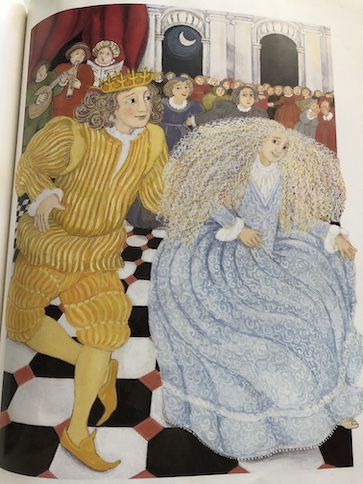
The princess always wears the fur coat as a disguise, but one day, she finds out that the young king of this kingdom is having a ball. She slips away from her kitchen duties and dresses in her dress like the sun. When she is unrecognizable as the kitchen servant, she is able to meet and dance with the king. Being herself is essentially a disguise!

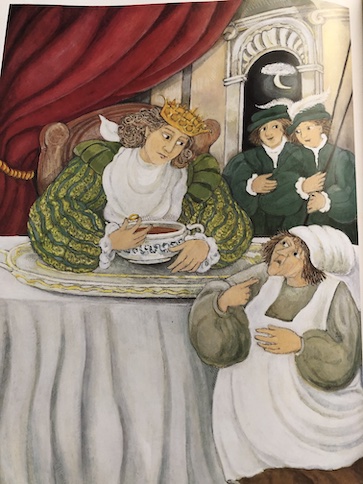
When she slips away from the king and returns to the kitchen, the cook has her make soup for the king, and she uses her special blend of seasonings. When no one is looking, she she also puts her golden ring into the king’s bowl. When the king finds the ring, he asks the cook about it. The cook admits that Furball made the soup, so the king questions her about the ring, but she doesn’t explain.

At the king’s next ball, the princess repeats the same performance, this time wearing the dress like the moon. This time, she slips the golden thimble into the king’s soup when she returns to the kitchen. Again, she doesn’t explain when the king questions her about the thimble.

As in many fairy tales, it’s the third time that’s the charm. When the princess shows up to a ball dressed her her dress like the stars and doesn’t have time to completely change when she gets back to the kitchen that all is revealed, and there’s a happy ending!

The book is available to borrow and read for free online through Internet Archive (multiple copies).

I remember reading this book when I was a kid in elementary school! I think I read it when I was about 7 years old, when the book was pretty new. I always liked fairy tales. There is a brief explanation at the beginning of the book that the story is a Cinderella variant. This version is very similar to the English folktale Catskin and to the tale of Many Furs or Thousand Furs by the Brothers Grimm.

Like so many little girls, I was fascinated as a kid with the concept of the dresses that resemble the sun, the moon, and the stars. The fur coat made of many animals is a little alarming to me now, but it makes a good disguise in the story. I love the illustrations that show the princess in all of her different dresses and the Furball disguise!

The story doesn’t explain why the princess put her treasures into the soup, but my guess was that she wanted an excuse to see the king again and a way to keep him intrigued about her identity and her relationship to the mysterious princess who keeps showing up to his balls. It’s only after the king decides that he really loves the mysterious princess that it’s safe to reveal her identity.

Cinderella

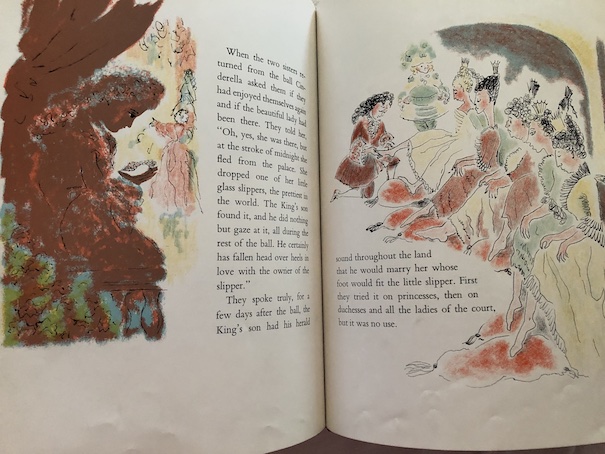
Cinderella translated and illustrated by Marcia Brown, 1954.

This is a retelling of the classic Cinderella story, translated from the French Perrault version by Marcia Brown, the author and illustrator of many other classic fairy tales and folktales for children.

As in the classic story, Cinderella is a girl with a cruel stepmother and a pair of spoiled stepsisters, who force her to do all of the work of the house and make her wear rags. Her father never stands up for her because he is too attached to his second wife to oppose her.

When it is announced that the king’s son is holding a ball and that the stepsisters are invited, they hurry to get ready, and they make Cinderella help them. Of course, nobody thinks that Cinderella should go to the ball, and the stepsisters laugh and tease her about it.

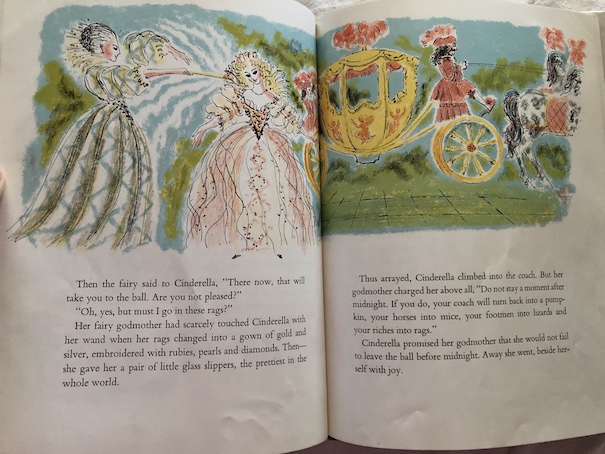
When they head off to the ball, Cinderella watches them go and cries. Then, her fairy godmother appears and tells her that she is going to help her. The fairy godmother turns a pumpkin into a fine coach, mice into horses, and a rat into a coachman. She gives Cinderella a beautiful dress to wear and a lovely pair of glass slippers. However, she warns Cinderella not to stay at the ball past midnight, when her magic spells will end, and everything will become what it was before.

At the ball, Cinderella charms the prince and has a wonderful time. She is even nice to her stepsisters when she encounters them. They don’t recognize her in her new finery. Everyone keeps wondering who the girl who appears to be a beautiful princess could be. Shortly before midnight, she leaves the ball abruptly and returns home before her stepsisters do. She tells her godmother everything that happened and that the prince invited her to a ball to be held on the next night.

The next ball is also wonderful, but Cinderella loses track of the time and runs away suddenly when the clock begins to strike midnight. In her haste to get away, she accidentally leaves one of her glass slippers behind. The prince finds it and decides to use it to find this beautiful, mysterious girl he has already come to love.

Many young ladies try on the shoe, including Cinderella’s stepsisters, hoping that it will fit them. However, it will only fit Cinderella, and only Cinderella has the other slipper in the pair.

This is a Caldecott Medal Book. It’s available to borrow and read for free online through Internet Archive.
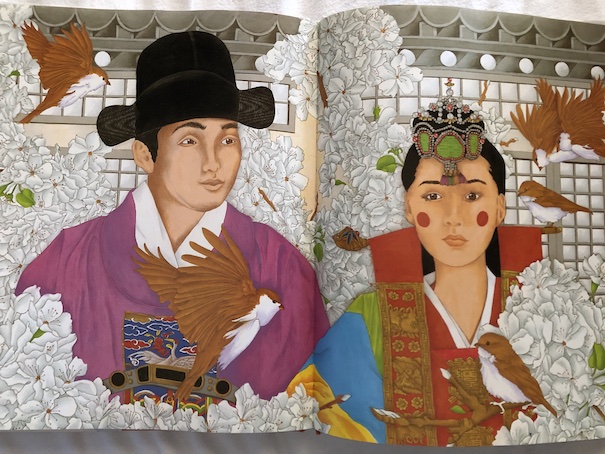
My Reaction

The story follows the classic Perrault version of the Cinderella story. There are many variations of this fairy tale, but this one is often the best-known. In some versions of the story, Cinderella’s father is also dead, which is why she is left at the mercy of her stepmother and stepsisters, but in this one, he is still alive and is just unconcerned about Cinderella’s treatment. He is never shown in any of the pictures and plays no role in the story.

I enjoyed the illustrations in this book. They’re an unusual style. Objects and people in the pictures are only party defined by pen lines. Many of their edges are more softly defined by color.

The Egyptian Cinderella

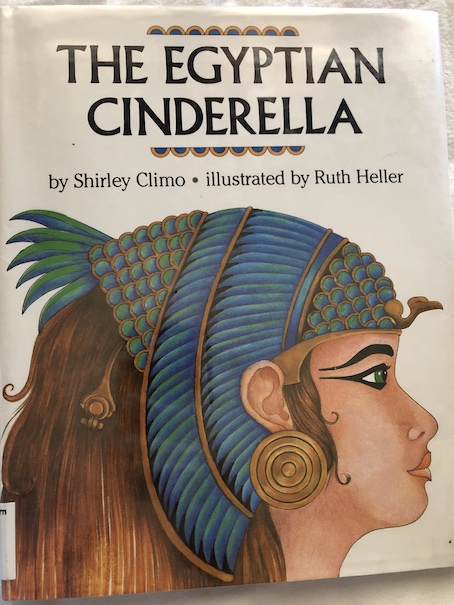
The Egyptian Cinderella by Shirley Climo, illustrated by Ruth Heller, 1989.

Rhodopis is a slave girl in Egypt. When she was young, she was abducted from her home in Greece by pirates, who sold her into slavery. Her blonde hair and green eyes make her look very different from the Egyptian servants, and none of them like her.

Most of Rhodopis’s friends are animals, and in the little free time she has, she likes to dance. The elderly man who owns her sees her dancing and has a special pair of rose-red gold shoes made for her so she can wear them while she dances. However, the Egyptian servants are all jealous of her for getting this special gift.

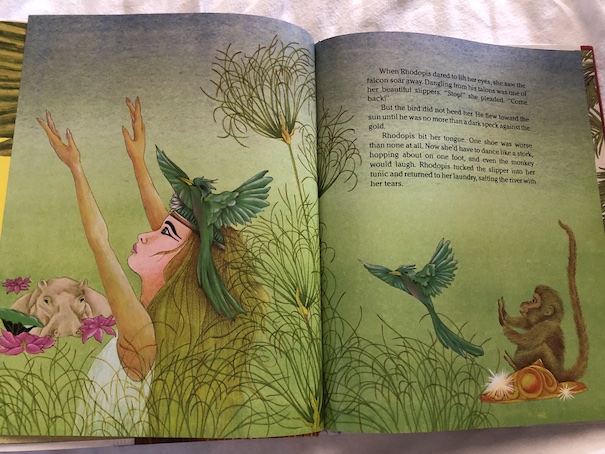
One day, the servants all leave her behind when they go to a special court held by the Pharaoh. While they are gone, a falcon snatches one of Rhodopis’s slippers and flies away. The falcon flies to the court and drops the slipper in the Pharaoh’s lap. The Pharaoh takes this as a sign from Horus that the girl who owns that shoe is destined to be his wife and immediately begins searching for her.

When he finds Rhodopis, the servant girls protest that she is not Egyptian and is only a slave, but the Pharaoh compares her green eyes to the color of the Nile, her light hair to papyrus, and her pink skin to a lotus flower. In his eyes, there could not be any other girl who could represent Egypt, and her slave status doesn’t matter.

The book is available to borrow and read for free online through Internet Archive (multiple copies).

My Reaction

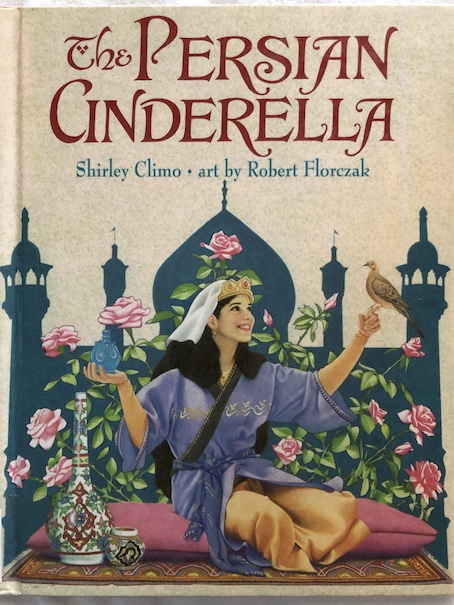
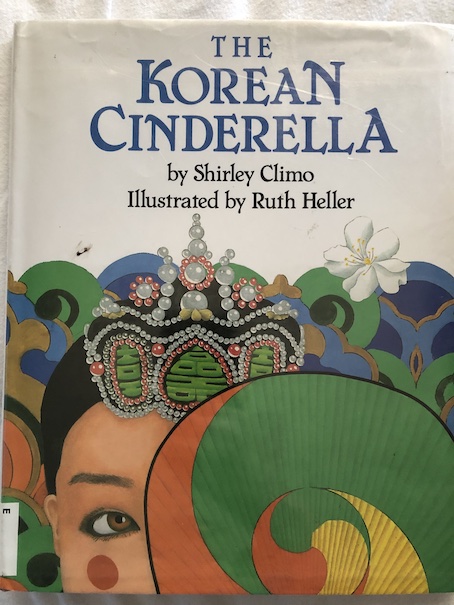
I remember loving this book when I was a kid! I always liked fairy tales and folktales, and I think this was one that was introduced to me by our school librarian, probably around the time it first came out in 1989. For a long time, I was unaware that the same author also wrote other books based on variations of the Cinderella story: The Korean Cinderella, The Persian Cinderella, and The Irish Cinderlad. One of the fascinating things about the story of Cinderella is that variations of the story about a girl (usually, it’s a girl, although there are some variations with a boy) who is abused by her stepmother and stepsisters but who triumphs in the end when she marries a king or a prince, who identifies her as the girl he loves by a lost shoe, have appeared in cultures around the world. The classic one that most of us know is the French version by Perrault, but there are other versions of the story that are older.

There is an author’s note in the back of the book that explains that this Egyptian version of the Cinderella story is one of the oldest known Cinderella stories. The Roman historian Strabo recorded the story in the first century BC. The story is legend, but according to the author, Rhodopis was a real slave girl who married the Pharaoh Amasis in the sixth century BC (although accounts of her vary, and it can be difficult to separate history from legend).