Five Go Off in a Caravan

The Famous Five

Five Go Off in a Caravan by Enid Blyton, 1946.

The children (Julian, Dick, Ann, George) and their dog, Timmy, are all looking forward to the summer holidays.  They’re not sure what they want to do, but they think that it would be more fun to go somewhere without the adults instead of going home, but they can’t think of anywhere they can go without adults.  They doze off in the sun while talking about it, but Timmy wakes them when a circus procession passes by.

The children are fascinated by the circus and call to a boy traveling with them, Nobby, asking him where they’re going to be performing.  Nobby says that the circus is on a break, and they’re going to be spending some time at a lake that allows them to camp there with their animals.

As the children watch the caravans of the circus going by, they think that it would be great if they could hire a caravan (horse-drawn travel trailer) and travel in it themselves.  They have a horse, Dobby, who could pull one.  The children ask their mother if they can hire a caravan, and she says that she’ll have to talk to their father about it.  It turns out that their father needs to go up north for part of the summer and wants their mother to come with them, so he thinks that it’s alright if the children want to take a caravan and camp out while they’re away.  The parents decide that the children will need to hire two caravans and borrow an extra horse because they don’t think one caravan will be enough for the four children and their dog, and they insist that the children sent them a message every day to tell them where they are and how they’re doing.

As the children discuss their plans in more detail, they decide that it will be fun to go to the lake where the circus is and get to know Nobby better.  Nobby lives with his uncle, who is the chief clown of the circus, and the children didn’t like what they saw of him before because he didn’t seem jolly at all, but they think it would be fun to be friends with Nobby and get another look at the circus animals. 

The children are eager to get started, but their parents make them pack and plan properly.  When the caravans arrive, the girls choose the red one, and the boys get the green one.  The girls take the new horse, Trotter, and the boys take Dobby for their caravan.  The adults give the children a map of places where they’re allowed to camp.  On their way to the lake, the children camp on farms that allow caravans.

When the children arrive at the lake, Nobby is glad to see them, and he introduces them to his chimpanzee, Pongo, and his terriers, Barker and Growler.  Nobby is friendly, but his Uncle Dan (called Tiger Dan) and Lou the acrobat are rough and unfriendly and don’t want the kids around.  When the children camp near the circus that night, Tiger Dan and Lou try to run them out of the campgrounds, but the children send their dog after them.  The campgrounds are public property, and there isn’t any reason why the children can’t be there.  The children think that Tiger Dan and Lou stumbled on their campsite by accident when they were trying to have some kind of secret meeting.

The next day, the children decide to go camp in the hills, as they had already planned because they know it will be cooler in the hills.  Lou takes an interest in where the children are going, but they don’t want to tell him much because they don’t want Lou and Tiger Dan coming after them to harass them again.  They find a nice place to camp up in the hills on some land belonging to a pleasant farmer and his wife, who also provide the children with food.

However, it isn’t long before Tiger Dan and Lou locate the children’s campsite and try to talk them out of camping at that spot also.  Nobby doesn’t know why Tiger Dan and Lou are up in the hills anyway.  The circus people have been buying some of their food from the farmer, but Nobby says that it’s always the women who go to the farm to buy things, not the men.  It seems like Tiger Dan and Lou are up to something suspicious, but the children don’t know what.

Then, suddenly, the men seem to change their views of the children, encouraging Nobby to be friends with them and to bring the children to visit the circus camp.  The children are suspicious and leave Timmy to guard their caravans while they visit the circus camp, just in case the men try to mess with their camp while they’re gone.  When they return to their own camp, the children discover that the men have tried to poison Timmy with tainted meat!  Fortunately, Timmy didn’t eat the meat, but unfortunately, one of Nobby’s dogs eats some and is violently ill.  The children aren’t sure whether the little dog will survive or not, and they don’t know why the bad men want to get rid of them so badly that they would try to kill their dog.  Whatever’s going on is serious, and they need to get to the bottom of it!

The book is available to borrow and read for free online through Internet Archive (multiple copies).

My Reaction

Traveling without parental supervision is the stuff of vintage children’s books and the dreams of children from every era! The kids in the Famous Five series have far more independence that modern children have, and in fact, the authorities might be concerned about children their age traveling without their parents. Actually, I would think that few adults even at the time of the writing of this book would even consider letting their children travel alone like that. That’s part of the appeal of this type of story, children being able to do things that real children never do.

I didn’t like the part about the dog being poisoned because I always hate it when bad things happen to animals in stories, but don’t worry! Nobby’s dog is fine in the end!
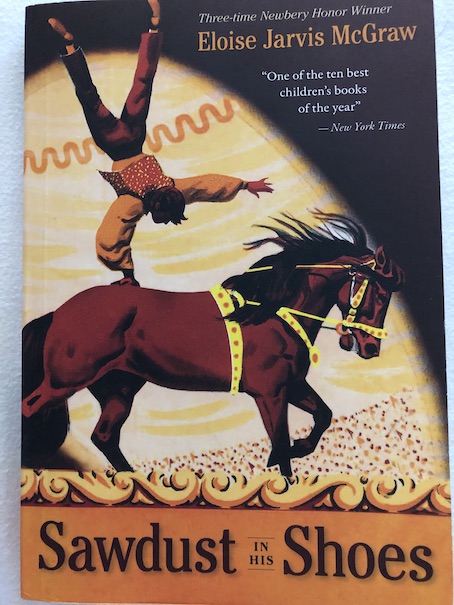
Sawdust in his Shoes

Sawdust in his Shoes by Eloise Jarvis McGraw, 1950, 1977.

Disclosure: I am using a newer edition of the book, published by Plough Publishing House.  Plough sent a copy to me for review purposes, but the opinions in the review are my own.

At fifteen years old, Joe Lang is a rising star in the circus, a trick rider. Circus life is the only life he’s ever known because his father is a lion tamer. Many of the children whose parents work for the circus also work for the circus, competing for the spotlight and top billing, and Joe loves that type of life, even though it means hard training, an element of risk, and constantly moving.

Unfortunately, things change for Joe when his father is killed during an accident in one of his performances. (Mercifully, the accident is not described in the book. Joe does not witness his father’s death. In the story, he hears screams from the circus patrons and is shortly informed that his father has been killed.) Because Joe is still only fifteen, his father’s death raises the question of who will have custody of Joe. Joe’s mother is dead, and his stepmother, who did not grow up with the circus herself, was never fond of circus life or of Joe. After the death of Joe’s father, his stepmother leaves to go live with her sister, and Joe never hears from her again. Mo Shapely, an older man who works for the circus as a clown, wants to assume responsibility for Joe, and Joe would be happy with that because Mo is an old family friend who helped raise and train him. However, the local authorities are not convinced that Mo is a suitable guardian for the boy because of his age, his unsettled lifestyle, and lack of savings.

Mo waits in town with Joe while the authorities make up their minds, but they soon run short of money, and Mo is forced to catch up with the circus and return to his job. Since Joe’s guardianship is still unsettled, the authorities send him to the County Industrial School for Boys, where he will stay until Judge Reynolds has completed his inquiries into Mo’s background. The boarding school offers vocational training, but Joe finds the place dull and bleak and the people unfriendly. When the other boys find out that he used to be with the circus, they are envious and tease him, and even the teacher mocks him. Only one boy tries to be friendly with him, and Joe asks him if any boys ever escape from the school. The boy tells him that some have tried, but no one has succeeded. However, Joe realizes that he just can’t stand life at the school, and all he wants to do is run away and try to rejoin the circus.

When Joe runs away from the school, he cuts across some farmland, loses his way, and ends up getting caught on some barbed wire, where he is found by the Dawson family. The Dawsons treat his wound, and Joe despairs, realizing that he has gone the wrong way and that he has no chance to catch up with the circus before they move on. The Dawsons ask Joe what his name is and offer to help him get home, but Joe is reluctant to tell them the full truth because he doesn’t want to be sent back to the horrible school. Instead, he tells them that he has no home or parents but that he’s worked before, since he was young, and that he hopes to find a job when he’s recovered from his wounds and exhaustion. The Dawsons are concerned about Joe and curious about his mysterious past and vague answers, but Mr. Dawson decides to offer Joe a position as farm hand. Joe is surprised at the offer and a little suspicious, and he asks Mr. Dawson why he’s so willing to take in a perfect stranger. Mr. Dawson answers him in an equally vague way, saying that if Joe really feels like he needs to steal their silver, he must need it more than they do, and he’s welcome to it. Joe decides to accept Mr. Dawson’s offer of employment.

Joe isn’t used to farm work, but he’s strong from his work with the circus (Mr. Dawson had noticed his athletic build), and he is good with horses and other animals. Although Mrs. Dawson is concerned that they know so little about Joe or his background, Mr. Dawson tells his family to allow Joe to have his privacy and not question him too much about his past. Still, Joe can’t resist showing off and trying one of his old tricks on horseback one day, accidentally making his injury worse because it isn’t healed yet. He begins to worry that the injury might be bad enough that he’ll never be able to be a trick rider again. By the time he has fully recovered, he is also long out of practice.

Eventually, Joe’s secrets are exposed, and he must make some choices about his future. Although Joe had lived many different places when he traveled with the circus, living on the Dawsons’ farm provides him with new experiences and broadens his horizons in unexpected ways. He had never had much respect for non-circus people before (partly because of his bad experiences with his non-circus stepmother). He still dislikes some of the Dawsons’ neighbors for their unfriendliness and suspicious toward him, but the Dawsons themselves are very different from most of the people Joe has met before. Joe comes to realize that he has not forgotten everything that he learned from his old life and that he can apply his old skills in new ways. He even starts to consider that there are more ways of living than he had previously thought, and he begins to see the appeal of non-circus life. Still, the circus is what he always loved first, and he feels torn between what he’s always wanted and the people who have loved and supported him when he needed it the most.

Children today probably don’t look at the circus in the same way as past generations. Some of the larger, mainstay circuses, like Ringling Brothers and Barnum and Bailey, have closed. People make jokes about how scary clowns are, and animal acts aren’t considered humane to the animals. Circuses still exist in the early 21st century, but they’re not quite what they used to be, and they aren’t looked at in quite the same way. Even when I was a young child, in the 1980s and early 1990s, I wasn’t particularly wild about the circus. A large part of that is temperament. I’m not fond of loud noises or large crowds, and I tend to avoid places where there are both. I’m very different from my grandmother, who absolutely loved circuses and parades and excitement of all kinds, dragging her children with her, even when they didn’t always feel like going. In my grandmother’s youth (1910s and early 1920s), there were few things more exciting than a circus coming to town!

However, this story isn’t just about love of circuses or a look back on the forms of entertainment that people used to enjoy. There’s always some nostalgia of that type to vintage books, but this book is about more than that. This is about a person finding his way in life and facing an unpredictable future, who has to decide what’s really important to him. I’m sometimes fascinated by people who seem to know what they want to do in life from an early age. They are born to parents with a profession they want to follow or who have connections to a profession they want to follow, and they start training very early for something they truly love. At first, that seems to be Joe’s situation in life. He loves the circus, he was born into that kind of life, he gets that early training, and there’s nothing else he would rather do. Some people like that become early success stories, just being lucky enough to be born in the right place and with the right connections for the life they want to live, and it all looks like smooth sailing. Most people aren’t that lucky, though, and even for people who think they know what they want, life has a way of throwing a monkey-wrench into their plans. That is what this story is really about.

Joe’s life abruptly changes when his father dies and his guardianship remains in limbo. Things often happen in our lives that we can’t fully control, taking us down paths we never thought that we’d travel. There are times when many of us start to question what we really want out of life, whether our first choices were really the best ones, or if there’s something else that we really want. Sometimes, these unexpected detours make us feel like we’re headed for a dead end, like when Joe fears that he has lost his skill and he’ll never live the life he once dreamed he would. However, sometimes, these things are just a temporary bend in the road. In some ways, an adult who has been through this sort of process would understand it better, but even children know what it is to have a dream and not know whether or not it will become reality.

Children need time to discover and develop their talents, and, as they grow and step into the wider world, they routinely discover that they have to make other decisions that they knew nothing about before. Children also know what it’s like to be at the mercy of adults who can either help guide them on their way or who stand as an obstacle to their dreams and efforts, like the judge who takes so long to decide what he thinks is best for Joe that Joe feels he must take his fortune into his own hands. Right up until the very end, Joe’s ultimate choice remains uncertain as readers wonder what he’s really going to decide to do and what his destiny is going to be. At first, Joe seems like he’s in a bad situation, with limited options, but his experiences show him that his options in life are broader than he thinks. It seems like saying yes to one of the choices confronting him means saying no to something else he cares about, but even that isn’t as straight-forward as it seems. I think this is one of those timeless books that can appeal to all ages because what it’s really about is a person finding his way in life and discovering that a difficult, unpredictable path may be just the path he needs to take.

In the end, it’s not just about what Joe chooses or where he ends up; it’s about what he does along the way. When Joe runs away from the school, he is the one who is injured and in need of help, but he also has a positive impact on the people who were kind enough to help him when he needed it. In fact, there are some situations that would have turned out much worse for everyone if Joe hadn’t been there and been able to help. Joe’s unexpected detour in life changed everyone else’s lives as well, and it was well worth doing, in spite of the struggle.

This book is available to borrow for free online through Internet Archive, but it’s also back in print and available for purchase through Plough. If you borrow the book and like it, consider buying a copy of your own!

Toby Tyler

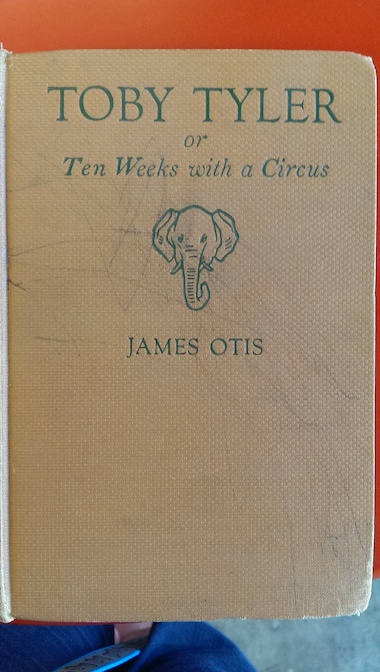
TobyTylerToby Tyler; Or, Ten Weeks with a Circus by James Otis, 1881.

Toby Tyler is an orphan who lives with a church deacon he calls “Uncle Daniel.” Uncle Daniel isn’t really his uncle, but he raised Toby after he was abandoned as a baby. Toby doesn’t know anything about his parents. Uncle Daniel is stern with him and says that Toby eats more than he earns, making it a hardship to care for him. Toby is cared for, but life with Uncle Daniel isn’t exactly happy.

Toby has a fascination for the circus, although Uncle Daniel says that the show isn’t any good, and it’s all a waste of time and money. The circus is certainly cheap, as Toby can see from the first. When he tries to buy some peanuts, he only gets six for the penny he gives, and all or most seem to be bad. The lemonade is basically water with lemon peel in it. But, to Toby’s surprise, the man who sells the snacks at the circus, Mr. Lord, offers him a job. He says that people who work for the circus get to see the show as often as they like, and he could use a boy to help him as an assistant.

TobyTylerPicToby think that it sounds like an exciting offer, and Mr. Lord persuades Toby that the best way would be for him to sneak away at night because his Uncle Daniel might disapprove and stop him from taking the job. Not taking that as a warning, Toby agrees. Toby feels a little guilty about running away and surprisingly homesick, but he decides to stand by the agreement he made with Mr. Lord and see what possibilities life with the circus might have for him.

Life with the circus turns out to be very different from what Toby is used to and what he expects. It’s noisy and dirty, and no one seems to particularly care about Toby or his welfare. Mr. Lord also turns out to be even sterner than Uncle Daniel, not even telling Toby what he expects him to do, just expecting him to do it. Toby works hard, and Mr. Lord acknowledges that he’s better than the other boys who have helped him, but he’s still a temperamental man and hard to please. Like Uncle Daniel, he fusses about how much Toby eats. Toby also has to sell snacks inside the big top under the watchful eyes of Mr. Jacobs, who threatens him with violence if he doesn’t make sales or if people try to cheat him.

However, Toby does succeed in making a few friends in the circus. The first friend he makes is a monkey that he calls Mr. Stubbs. Mr. Treat, who plays the part of the Living Skeleton in the circus sideshow, and his wife, who is the Fat Lady, have seen Mr. Lord mistreating other boys, and they intervene to make sure that Toby is all right, giving him food when Mr. Lord doesn’t. Unlike everyone else Toby has known, Mrs. Treat lets him eat as much as he wants without worrying, saying that some people just need more food than others. Like her husband, Toby seems to have the ability to eat a lot while still being small and skinny.  Mrs. Treat herself maintains an enormous size while hardly eating anything. She says that’s just how some people are.

When Mr. Castle teaches Toby to do trick riding, his status goes up in the circus, and he is no longer under Mr. Lord’s thumb. As far as the Treats are concerned, Toby could stay with them forever. However, life in the circus isn’t what Toby had once thought it was, and Toby can’t get rid of the thought that he’s made a terrible mistake by running away from Uncle Daniel. He wants to go home and make things right with him.

In the Disney movie, Toby stays with the circus, doing well with his trick riding act and having happy adventures with his monkey friend. Unfortunately, in the book, Mr. Stubbs is accidentally shot by a hunter and dies. The book was meant to teach moral lessons about responsibility, whereas the movie was just about fun and adventure.

In the end of the movie, Toby stays with the circus even while being reunited with the people who raised him and missed him when he ran away, giving an all-around happy ending. In the book, Toby feels terrible about the death of Mr. Stubbs (although it wasn’t really his fault), and the hunter who shot him is very sorry because he hadn’t realized that he had shot someone’s pet. To make up for it, he helps Toby to get back to Uncle Daniel. At first, Toby is unsure that Uncle Daniel will want him back, but he misses his old home so much that he says he doesn’t care if Uncle Daniel whips him for running away. However, Uncle Daniel has also missed Toby since he disappeared. As stern and harsh as he could be before, Uncle Daniel genuinely cares about Toby and welcomes him back with open arms.  The ending implies that Toby’s future with Uncle Daniel will be happier than the past because they have much greater appreciation for each other now.

The book is now in the public domain and is available on Project Gutenberg.