This book is a classic piece of children’s literature! This is the first book in a series of about the adventures of the Banks children with their magical nanny, Mary Poppins.
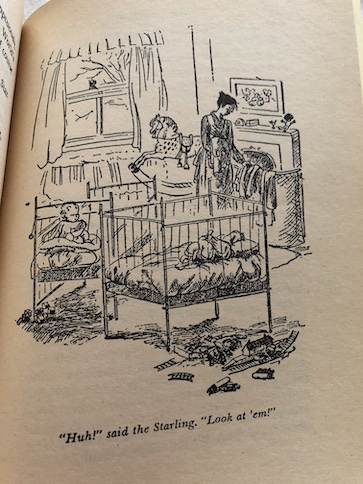
Mr. and Mrs. Banks of Cherry-Tree Lane have four children: Jane, Michael, and the infant twins, John and Barbara. When the story begins, the children’s nanny has just suddenly left her job with no real explanation. Mrs. Banks is beside herself, wondering what to do about this household upheaval, and Mr. Banks offers the practical suggestion that she should advertise for a new nanny in the newspaper. Mrs. Banks decides that’s a good idea, but a strange wind from the East brings an unexpected answer to this domestic problem.
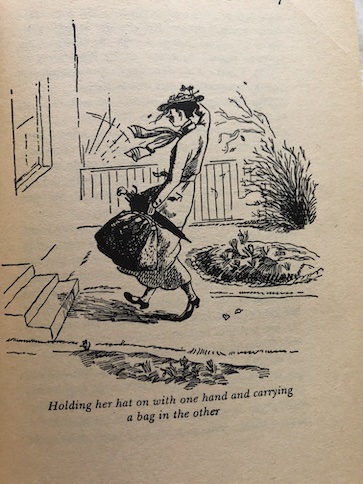
When Mary Poppins arrives at the Banks’ house to take the position of nanny, it seems like she was blown there by the wind. When the children ask her, she says that’s indeed what happened, but she offers no other explanation. Mrs. Banks discusses the position of nanny with her, but it turns out that it’s more like Mary Poppins is interviewing her and evaluating the children to see if they’ll do. Mary Poppins refuses to provide references when Mrs. Banks asks for them (I would find that worrying), saying that people don’t do that anymore because it’s too old-fashioned. Mrs. Banks actually buys that explanation and doesn’t want to seem old-fashioned, so she stops asking. Mary Poppins basically grants herself the position of nanny as if she were doing the Banks’ family a favor. Maybe she is.
Jane and Michael can tell right away that Mary Poppins is no ordinary nanny. When she begins unpacking her belongings, it seems at first that her carpet bag is empty, but she soon starts pulling many different things out of it, including some things that should be too big to be in the bag at all. Then, she gives the children some “medicine” (she doesn’t say what kind of medicine it is or what it’s supposed to do) that magically tastes like everyone’s favorite flavor.
From there, the story is episodic. Each chapter is like its own short story.
On her day off, Mary Poppins meets up with the Match Man called Bert, who also paints chalk pictures, and when he doesn’t have enough money to take her to tea, they jump into one of his chalk paintings and have a lovely tea there. The children aren’t present for that adventure, but they do go to tea at Mary’s uncle’s house.
Mary’s uncle, Mr. Wigg, is a jolly man … maybe a little too jolly. It’s his birthday, which has filled him full of high spirits, and he literally can’t keep his feet on the ground. When they arrive, he’s hovering in the air. He says that it’s because he’s filled up with Laughing Gas because he finds so many things funny. It’s happened to him before, and he can’t get down to earth again until he thinks of something very serious. The whole situation is so funny that Jane and Michael begin to laugh and find themselves floating in the air, too. Even though Mary isn’t amused and doesn’t laugh, she makes herself float in the air also and bring up the tea table so they can all have their tea in midair. The merriment only ends when Mary Poppins finally tells the children that it’s time to go home, which is very serious indeed.
Mary Poppins understands what animals are saying, helping to sort out matters for a pampered and over-protected little dog who desperately wants a friend to come live with him. Then, when the children see a cow walking down their street, Mary Poppins says that cow is a personal friend of her mother’s and is looking for a falling star. On Mary Poppins’s birthday, she and the children attend a bizarre party in the zoo where the animals are their hosts.
There is an episode in the book which has some uncomfortable racial portrayals. It takes place when Mary Poppins shows the children how a magical compass can take them to different places around the world, and they meet people who are basically caricatures of different racial groups. (This episode has resulted in the book being banned by some libraries. P. L. Travers received complaints about it in her lifetime, and she revised the scene in later printings of the book, which is why you’ll see books labeled as “Revised Edition.” I have more to say about this scene, but I’ll save it for my reaction.)
Mary Poppins and the children visit a bizarre shop where the owner’s fingers are candy and grow back after she breaks them off and gives them to the children. (That’s actually pretty freaky.) The children save the gold paper stars from the gingerbread they buy at the shop, and later, they see Mary Poppins and the shop owner and her daughters putting the stars up in the sky.
There is a story about the babies, John and Barbara, and how they understand things that the adults and older children don’t, like what animals, the wind, and sunshine are saying. They are sad to learn that they will forget these things as they grow up.
Toward the end of the book, Mary Poppins takes the children Christmas shopping, and they meet Maia, one of the Pleiades (here she is considered to be a star as well as a mythological figure, and she looks like a young, scantily-clad girl), who has come to Earth to do her Christmas shopping as well.
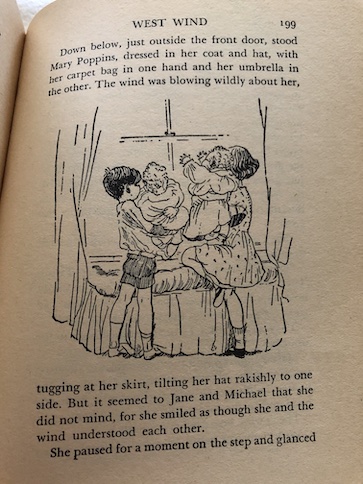
In the end, Mary Poppins leaves the Banks family suddenly when the wind changes directions, flying off into the sky on the wind with her umbrella. She does not say goodbye, and the children are very upset. Mrs. Banks is angry with Mary Poppins for her sudden departure on a night when she was counting on her to be there to take care of the children. The children try to defend her, though, and say that they really want her back, even though she’s often cross with them. However, she does leave behind presents for the children that hint that she may come back someday.
The book is available to borrow and read for free online through Internet Archive (multiple copies).
My Reaction
In some ways, the Mary Poppins in the original books isn’t quite as pleasant as Julie Andrews in the Disney movie version. The Mary Poppins in the book is vain and stuck up. She can be intimidating in her manner, refuses to answer questions, and even gets rude and snippy with the children. She was a little like that in the movie, but in the book, she’s even more so. After any strange or magical thing happens and the children want to talk about it, Mary Poppins gets angry at them and denies that any such thing happened at all. I found that rather annoying because it’s kind of like gaslighting, denying things happened when they really did happen. I think we’re meant to assume that’s because the adults aren’t allowed to find out that magical things have happened because they might put a stop to it or because Mary Poppins realizes that the children can only enjoy this kind of magic for a brief phase of their lives and that they’ll have to grow up in the more mundane world, just like the little twins can’t help but lose their ability to talk to animals. It’s a little sad, but I think it’s meant to provide some kind of rational explanation about how magic can exist in the world but yet go unnoticed by most people.
I’d like to talk more about the racially-problematic episodes with the magic compass. A compass that can take people to different areas of the world just for asking is a good idea, but the people they meet in the places they go are all uncomfortable caricatures of different races. The one part that I’m not really sure about is how seriously these were meant. When I was trying to decide what to say about this, I considered the idea that aspects of this part of the story may have been meant as a parody of things from other children’s books and popular culture at the time. I have seen even older vintage children’s books that poke fun at concepts from earlier stories, so it occurred to me that this book might be making fun of concepts about people from around the world that young children of the time might have from things they’ve read in other books. There is a kind of humor throughout the book that involves puns and plays on certain ideas, like the way her uncle insists that he floats when he’s in a humorous mood because he’s buoyed up by “Laughing Gas”, which is not what real “Laughing Gas” is. It’s like what a child might picture as “Laughing Gas”, if they didn’t already know what that term means. It’s possible that part of this scene might be parodying other children’s fantasy books about magical travel, but it’s still very uncomfortable to read the original version of this scene, if you don’t have one of the revised editions of the book.
On the other hand, I suspect that the author isn’t really that thoughtful or self-aware by the way the adult characters speak throughout the book series. At the end of the book, when Michael is upset at Mary Poppins suddenly leaving and he throws a fit and argues with her, his mother tells him not to act like a “Red Indian.” I’m not entirely clear on what that comment was supposed to mean in that context, but Mrs. Banks uses it as if she does, so it seems that there is some implied insult there, maybe equating Michael’s behavior to being “savage” or “uncivilized” or something of that nature. Even Mary Poppins herself uses racial language throughout the series, using words like “hottentot” or “blackamoor” to criticize the children when they misbehave. It makes me think that the author was accustomed to that kind of talk herself. If Mary Poppins can get snooty as a character, I think I have the right to express my disapproval of her behavior as well.
While I like the basic character of a magical nanny who takes children on magical adventures, I don’t like either those comments or the compass scenes because the obvious caricatures are uncomfortable, and I don’t think they make good story material for children. I would recommend saving that version for adults who are interested in reading or studying nostalgic literature and use the revised versions for children, who would probably just prefer to have a story they can enjoy for fun without needing a lesson on racial attitudes of the past to understand it. If they’re curious, they can always have a look at the original later, when they’re old enough to understand it better and put it perspective. In the revised compass scenes in later books, some printings still have people but some of the offensive words removed, and in later printings, the children meet different types of animals instead of people.
A Child’s Garden of Verses by Robert Louis Stevenson, illustrated by T. Lewis and Sara Gutierrez, 1989.
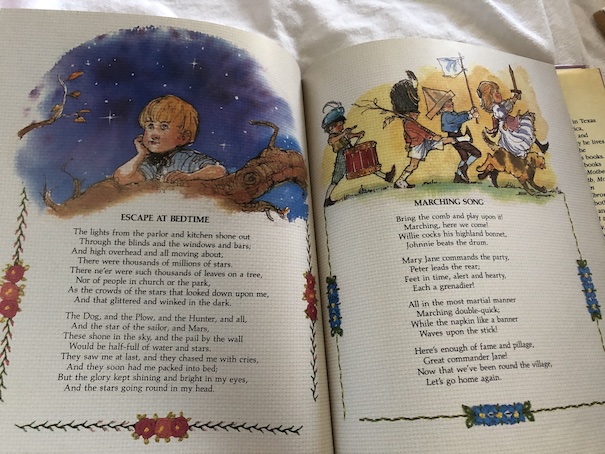
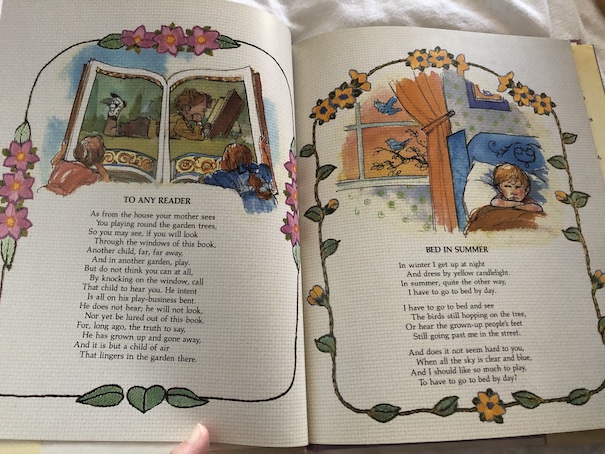
This is a reprinting of the classic collection of children’s poems by Robert Louis Stevenson first published in 1885 as Penny Whistles. What makes this edition of the book different from other printings is the illustrations, which are an unusual combination of watercolors and embroidered borders. Mary Pope Osborne, author of the Magic Tree House series wrote an introduction to the book about the life of Robert Louis Stevenson and his youth in Scotland in the 1850s, which inspired his poems for children. (See my list of Books from 1850s for the types of books children were reading during this time period, but remember that they also would have read books that were published in previous decades.)
The poems have gentle themes from the lives and fantasies of children, like games of pretend, bedtimes, and the little things that children notice and that adults often take for granted, like shadows and the beauty of stars. Some of them have things that are now anachronistic, like lamplighters, but they’re still imaginative and enjoyable for all ages.
I’ve always liked Robert Louis Stevenson’s children’s poems, and this book has my favorites! My personal favorites are:
To Any Reader – Robert Louis Stevenson speaks to children reading these poems about the child he used to be and how the poems are like a window on his childhood, although his own youth is long gone. Escape at Bedtime – About a child who sneaks out of bed at night to look at the stars. The Swing – I mentioned this one before because it’s included in another collection of poems, and I’ve often thought of it when I’ve been on swings. Picture Books in Winter – A child enjoys picture books indoors when it’s cold outside. The Land of Storybooks – About the adventures that children who love books enjoy in their imaginations.
However, my mother’s favorite children’s poem is Bed in Summer because it reminds her of her own childhood and having to go to bed while the sun was still shining in summer and other children in the neighborhood were still playing outside. (I didn’t have this experience when I was growing up because I never lived in a place that had daylight savings time, which changes the clocks by one hour, providing an extra hour of daylight before sunset. Arizona is very hot, so there’s a benefit for doing things after the sun has set, and few people have any interest in pushing back time to maximize the scorchingly hot daylight hours. My childhood memories include going to parks with my parents after the sun set and being put to bed after we got home.)
There are many copies of this book available in various printings online both at Internet Archive and Project Gutenberg because the text of the original book is now public domain. I didn’t see this particular printing with these illustrations available online, but if you just want to read the poems, there are plenty of other copies of the book to choose from!
The story of Alice in Wonderland is over 150 years old, and the sequel, Through the Looking Glass, is now 150 years old, as of 2021. These books have been reprinted in many different languages and editions. The edition that I’m using for this review is actually a combined edition of the two from 1960 with added notes by Martin Gardner. (Although I used a cover image from a different edition above.) I like editions with added notes because there is quite a lot to explain about both Lewis Carroll and his stories.
I explained a lot of Lewis Carroll’s background and some of the controversies surrounding his life in my review of Alice in Wonderland. One important point about the Alice stories is that they are full of puzzles, riddles, word games, in-jokes, and parodies of poems that were popular in the author’s time. Lewis Carroll (real name Charles Dodgson) was a mathematician and scholar at Oxford, and he liked to play with logic puzzles and word games. Sometimes he would hide people’s names within poems or parts of the story by rearranging the letters of their names or using them as the beginning of lines in a poem, as an acrostic. There is an acrostic poem which is dedicated to Alice Liddell, the real girl who inspired Alice in Wonderland. This poem is printed as part of some editions of Through the Looking Glass, including the one that I’m using. The acrostic poem also references Row, Row, Row Your Boat, which is apparently older although its origins aren’t completely certain. If you read down the beginning letters of the poem, you find out that Alice’s middle name was Pleasance.
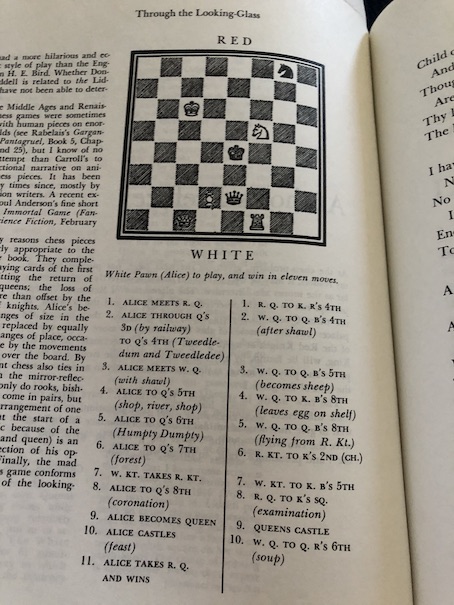
The chess game in Through the Looking Glass is meant to be part of an actual chess game with real moves that can be mapped out on a board. The game and the moves in the story are explained in the preface of my copy of the book. Alice begins as a white pawn in the game, but when she reaches the other side of the board, she becomes a queen, which is part of the rules of chess – pawns that successfully reach the opponent’s side may be exchanged for other pieces. The colors of the chess pieces in Alice’s game are red and white instead of black and white because red and white are old traditional colors. Although black and white are common today, many different color combinations have been used, and the red and white combination dates back to the Middle Ages.
The story begins on the day before Guy Fawkes’ Night. (Alice has been watching the bonfire preparations out the window.) Alice is trying to wind some yarn, and her pet cat Dinah’s little black kitten keeps playing with it. Alice chastises the kitten, and then begins talking to the kitten about the way it was watching her play chess earlier in the day. Alice likes to play games of pretend, and she starts to pretend that the kitten is the red queen from the chess game. The kitten doesn’t cooperate in posing like the chess queen, so Alice holds it up to a looking-glass.
As they look in the mirror, Alice gets the idea of a “Looking-glass House” – a house on the other side of the mirror that can be reached by stepping through it. Alice starts to imagine what it would be like to enter the world on the other side of the mirror. She gets up on the mantle over the fireplace and steps through the mirror into the looking-glass house to see what is there.
Things in the looking-glass house are very strange. The clock and the pictures seem to be alive, and so are the chess pieces. Alice helps the pieces back onto their table after they’ve been knocked off, but they don’t seem to understand what has happened and are alarmed. Alice then picks up a book on the table near the chess board and reads the poem Jabberwocky, which is about the defeat of a horrible monster. The poem is written in backwards writing, and Alice has to hold it up to a mirror to read it. The poem is a nonsense poem that contains many made-up words, which are explained later on in the story.
Alice decides to see what is outside the house. She discovers that the flowers can talk to her, but they are rude and insulting. Then, Alice encounters the Red Queen, who has grown taller than she was in the house. (The flowers say that it’s because of all the fresh air outside.) The Red Queen is both commanding and contradictory, but she gives Alice directions to other “squares”, addressing her as a chess pawn.
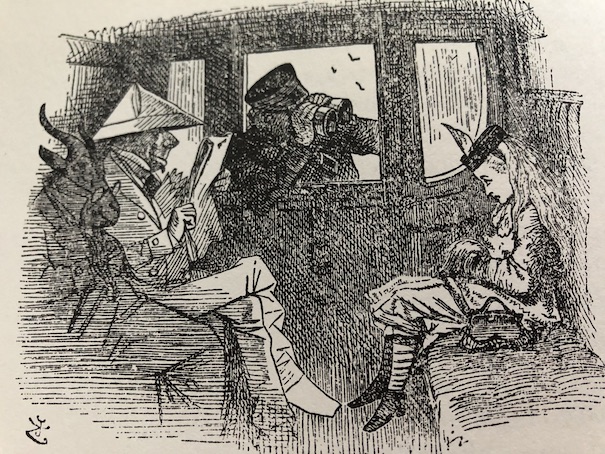
Pawns get to move two squares on their first turn, so Alice gets to go by train. In the train carriage, Alice meets many strange characters, including a gentleman dressed in white, a Goat, a Beetle, and a Gnat, who keeps whispering in her ear and suggesting that she make jokes based on puns. Through the Gnat, Alice meets other strange insects, like the snap-dragon-fly, the rocking-horse-fly, and the bread-and-butterfly. The Gnat tells Alice that the creatures in the woods don’t have names, and when Alice goes through the woods, she temporarily forgets her name, getting it back again on the other side.
Soon after, Alice meets Tweedledum and Tweedledee. (Lewis Carroll didn’t invent these characters. They are nursery rhyme characters.) They ask Alice if she likes poetry, and they tell her the tale of The Walrus and the Carpenter. (This is one of the most-quoted poems in the Alice stories – many people remember the part where they “talk of many things” – “Shoes and ships and sealing wax and cabbages and kings.”) At the end, Alice can’t decide which of the two characters she likes the best because both are sneaky and eat the oysters that trusted them, so she decides that she doesn’t like either of them. (Yeah, I can think of others stories where I’ve felt the same way.) Alice hears a strange sound, and they tell her that it’s the Red King snoring and that the Red King is actually dreaming about her right now. Tweedledum and Tweedledee insist that Alice isn’t a real person, only part of the Red King’s dream, and that she’d disappear if he were to wake up, which upsets Alice. Alice starts to cry, which she thinks is proof that she’s real, but they claim that those aren’t real tears. Finally, Alice decides that they’re just talking nonsense and that there’s no point in crying over it. Tweedledum and Tweedledee want to have a battle (as in their poem), but a large crow interrupts them and frightens them away by producing a great wind.
Alice catches hold of a shawl that was being blown away by the wind and returns it to its owner, the White Queen. The White Queen speaks very strangely, and she says that it’s an effect of living backwards. Because she lives backwards, her memory works both ways, and she can remember things that haven’t happened yet. The White Queen screams with pain before she pricks her finger, so she doesn’t have to do it again after her finger is hurt. Alice cries when she talks about how lonely she is in the woods, and the White Queen distracts her by telling her to consider things because no one can think of two things at once (which is true). The White Queen talks about considering and believing impossible things (sometimes she believes “six impossible things before breakfast” – one of the most famous lines that is often quoted from this story).
As Alice asks the White Queen if her finger is better, she suddenly and inexplicably finds herself in a shop and talking to a sheep, who asks her what she wants to buy. Alice tries to look around, and the Sheep asks her if she’s a child or a teetotum (a kind of spinning top used in old games, sometimes by itself and sometimes as a replacement for dice or a spinner – dreidels are a kind of teetotum) because of the way she’s turning around. The Sheep is knitting and keeps picking up more needles to knit with. For awhile, the shop disappears, and Alice finds herself in a boat with the Sheep, but then the shop returns, and the Sheep asks her again what she wants to buy.
Alice decides to buy an egg, and the egg that she buys turns into Humpty Dumpty when she approaches it. Humpty Dumpty is a bit rude and insults Alice’s name because he doesn’t think it means anything. Alice mistakes Humpty Dumpty’s cravat for a belt because he’s egg-shaped and doesn’t have a true neck for wearing a tie. Humpty Dumpty reveals that the cravat was an un-birthday (a concept that Lewis Carroll invented) present from the White King and Queen. All through the conversation, Humpty Dumpty uses words in unusual yet strangely nit-picky ways, making words mean only what he wants them to mean in the moment. Because he’s so particular about the meanings of words, Alice asks Humpty Dumpty about all the strange words in the Jabberwocky poem, and he explains what the made-up words mean. Humpty Dumpty recites another poem for Alice that doesn’t seem to have a true ending and then abruptly dismisses her.
As Alice leaves, she meets the king with all of his horses and men (from the Humpty Dumpty nursery rhyme) and is introduced to one of his messengers. Alice is amused by the name and description of the messenger and starts playing a game of “I Love My Love” out loud with the messenger’s name. (The two messengers are called Haigha and Hatta and are shown looking like the March Hare and Mad Hatter from Alice in Wonderland in the illustrations.) The messenger informs the king that the lion and the unicorn are fighting for the crown again (another nursery rhyme reference). The king says that it’s all a joke because the crown is his and neither one of them is going to get it no matter which of them wins the fight.
The unicorn is amazed to meet Alice because he never knew that children were real before. As at the end of the rhyme, they are given plum cake, and they hand the dish to Alice for her to cut the cake. However, Alice finds that she can’t cut it, so they ask her to hand the cake around first and then cut it afterward, which surprisingly works.
After the others are drummed out of town, also as part of the rhyme, the Red Knight attempts to capture Alice, but the White Knight shows up to save her. The White Knight tells Alice all about his inventions, none of which make any sense, and sings her a song which apparently has several names and is set to the tune of a song Alice recognizes as “I give thee all, I can no more” (which is another name and the first line of the song which is really titled My Heart and Lute, which is part of the on-going joke about the song’s real name).
Then, Alice reaches the final square of the board and becomes a queen, finding a crown suddenly on her head. The Red Queen and the White Queen appear suddenly, and the Red Queen tells her that she must pass an examination before she can truly become a queen. The queens ask her a series of questions that are supposed to be math questions but are actually a combination of riddles and nonsense. Their general knowledge questions are a combination of nonsense and puns. Eventually, the Red Queen and White Queen both fall asleep to a parody of “Rock-a-bye Baby.”
Alice finds herself in front of a door labelled “Queen Alice,” but the old frog who comes to the door doesn’t seem to want to let her in. Alice enters anyway and sits next to the Red Queen and White Queen. They introduce her to the food being served at the feast, but they don’t actually allow her to have any because it isn’t polite to cut and serve something you’ve been introduced to, and the plum cake verbally protests when Alice tries to serve it anyway.
The White Queen tells Alice a riddle in poem form about fish. The riddle is never answered, but everyone drinks to Alice’s health. The Red Queen tells Alice that she should make a speech, and as she gets up, many strange things begin happening in the room. Alice thinks that the Red Queen is responsible and grabs hold of her, threatening to “shake her into a kitten.” Alice suddenly wakes up, holding her little black kitten.
Like in Alice in Wonderland, everything that Alice experienced was a dream. However, the end of the book poses the question of whether the dream was Alice’s or the Red King’s. The question is never answered; it’s just something to make the readers think. That’s actually what I like most about the Alice stories, that they are partly meant to make the reader think. The stories are somewhat disjointed and constantly changing, kind of like dreams do, but I appreciate all the references and parodies in the stories.
Alice’s Adventures in Wonderland by Lewis Carroll, 1865.
The beginning of the story is famous. Alice is sitting with her sister (unnamed in the book, but probably based on Lorina because Lorina was older than Alice) by the river, and she is bored by the book that her sister is reading because there are no pictures or conversations. As Alice is sitting there drowsily, she suddenly spots a white rabbit who seems like he’s running late for something. Curious to see where he is going, Alice follows him and falls down a rabbit hole which is like a deep well.
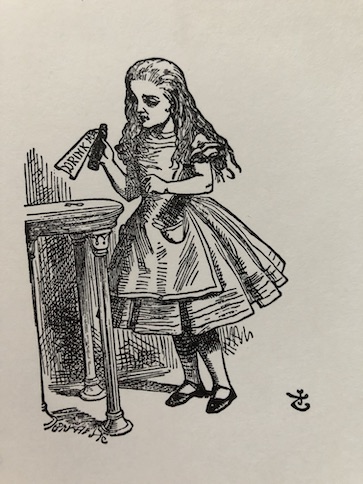
It takes her a long time to fall (causing Alice to wonder if she’ll pop out on the other side of the world eventually), and when she reaches the bottom, she finds herself in a dark hallway with a small door that is too small for her to go through. She manages to shrink herself by drinking from a mysterious bottle that says “Drink Me,” but she forgets the key to the door on the table above her, so she has to make herself bigger by eating cake from a box labeled “Eat Me.” When Alice is big, she cries so much, worrying that she is no longer herself but someone else she would rather not be because so many strange things are happening, that she makes a sea of tears, and when she is small again, she has to swim.
She meets a mouse, who swims to shore with her, where they meet a bunch of other animals (including the Dodo), who all seem somehow familiar to Alice (probably because they’re all parodies of people Dodgson and the Liddells knew – A Lory (type of parrot) argues with Alice and tells her that it’s older than she is and “must know better” than she does – possibly another reference to Alice’s older sister Lorina).
Alice and all of the animals are wet, so they try to dry themselves. The Mouse begins telling a very dry history of England (ha, ha), but that’s not good enough. The Dodo suggests that they have a Caucus-race (Alice’s childish misunderstanding of certain words and concepts leads to some of the jokes and puns in the story) to dry themselves out, and they all start running in a circle. After awhile, they all stop, and since there is no obvious winner, the Dodo decides that everyone has won and that everyone should receive a prize. Alice gives all the animals pieces of candy from her pocket. Alice’s prize is her own thimble, which is the only other thing she has in her pocket.
The Mouse starts to tell a story about why it hates dogs and cats, but it gives up when Alice doesn’t pay attention and becomes confused. Then, Alice makes the mistake of mentioning her pet cat and how it likes to chase mice and birds, and all of the other animals become offended and leave. However, the White Rabbit appears and, apparently mistaking Alice for his maid, asks her to bring him his gloves and fan. Alice goes into his house to look for them. Finding another bottle like the first one, she drinks it and becomes so big that she gets stuck in the house. The White Rabbit and his friend, Bill the Lizard, become alarmed at her large arm sticking out of the window and talk about burning the house down. They throw pebbles at Alice which turn into cakes, and Alice eats them to become smaller.
Alice makes her escape from the house, distracting a puppy much larger than she is by throwing a stick, and meets a caterpillar, who is sitting on a mushroom and smoking a hookah. The Caterpillar asks her to explain herself, but Alice says that she can’t because she isn’t really herself. Alice tells him that she keeps changes sizes and can’t remember things that she thinks she should remember. The Caterpillar asks her to recite the poem about Father William, and Alice recites Carroll’s parody version instead of the original poem. The Caterpillar agrees that Alice said the poem wrong. He asks Alice what size she would like to be and gets offended when Alice says that being only three inches tall is awful because that is the Caterpillar’s height. However, he does tell Alice that one side of the mushroom will make her taller and the other will make her shorter, not explaining which is which. Alice experiments with bits of mushroom until she finally becomes her normal size again. She keeps the mushroom pieces so that she can change size again, if she needs to. (Has anyone ever made a video game version of Alice in Wonderland where the player, as Alice, has to become bigger or smaller to get through different levels? If no one has, I think someone should.)
Alice soon makes herself small again so that she can go into a little house. Alice speaks to the footman of the house, who has just accepted an invitation for the Duchess to join the Queen for croquet. The footman rambles on about how there’s no use in Alice knocking because they’re both on the same side of the door and everyone inside is making too much noise to hear her. Not getting any straight answers about whether or not she’s allowed to go inside, Alice decides that the footman is an idiot and just lets herself in. The Duchess is sitting inside with a baby while her cook makes pepper soup. The Duchess’s cat, the Cheshire Cat, grins at Alice in a strange way. (The Cheshire cat comes from an expression that was popular in the 19th century – “grinning like a Cheshire cat” – although the origins of the phrase are uncertain. The Cheshire Cat wasn’t actually in the original version of the story.) Alice becomes alarmed when the cook begins throwing things at the Duchess and the baby, but the Duchess tells her to mind her own business. The Duchess is rough with the baby and throws it. Alice catches it and takes it away, worrying that the Duchess might kill it, but the baby turns into a pig, and Alice has to let it go. Alice thinks that it would have been a very ugly child and is better off as pig, which reminds her of other children she knows. (Ouch.)
Alice spots the Cheshire Cat and tries to ask it for directions. It directs her to the Mad Hatter and the March Hare, telling her that they’re both mad. (These also come from old expressions, “mad as a hatter” and “mad as a March hare.”) Alice says that she doesn’t want to “go among mad people”, but the Cheshire Cat says that can’t be helped because everyone is mad here, including Alice, because she wouldn’t be there if she wasn’t. He says that he will see her later when she plays croquet with the Queen. Before the Cat vanishes completely, he asks her what happened to the baby, and when Alice says that it turned into a pig, the Cat says, “I thought it would.”
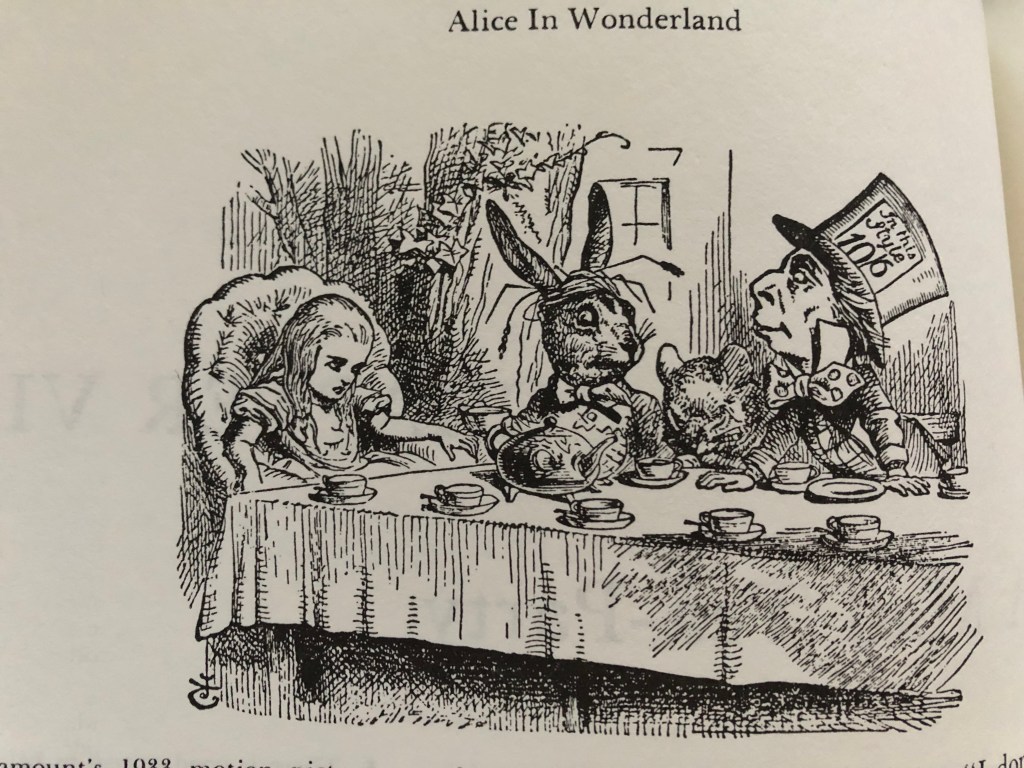
Alice ends up at the tea party that the March Hare and the Mad Hatter are having with the Dormouse. (This tea party also was not part of Carroll’s original version of the story.) Although they tell her there is no room at the table for her, Alice notes that it’s a big table with a lot of chairs, so she sits down, uninvited. The conversation is confused, and the Mad Hatter tells Alice a riddle without knowing the answer to it himself. Alice says that he’s wasting time, and the Mad Hatter says that Time won’t do anything he wants now because he was accused of “murdering the time” when he sang “Twinkle, twinkle, little bat!” before the Queen of Hearts (he messed up with the timing of the song), and now it’s always six o’clock and always tea time (that’s when people, including the Liddells, used to have tea time when the story was written). This gives them no time to clean up between tea times, so they just keep moving around the table. Alice tries to ask them what they do when they get back to their original positions at the table, but the March Hare changes the subject. The Dormouse begins telling the story of the three sisters who lived at the bottom of the Treacle Well and were learning to draw things that begin with the letter ‘M’. (As the March Hare says, “Why not?”) Alice tries to ask questions, and starts to say, “I don’t think-” The Mad Hatter says, “Then you shouldn’t talk.” Alice gets offended and decides to leave.
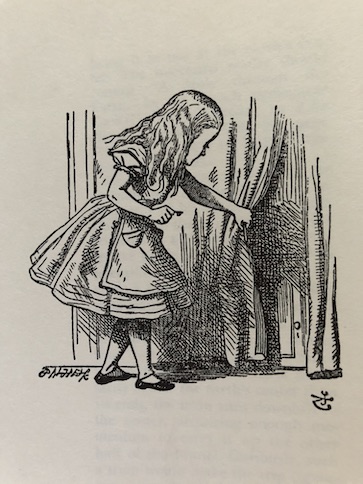
She finds a door that takes her back to the hallway where she was in the beginning, and she is able to open the door that she couldn’t before, which leads her into a beautiful garden. There, she finds some playing cards painting the roses. It turns out that they accidentally planted white roses, and the Queen wants red ones, so they’re just painting the roses so she won’t find out. The King and Queen of Hearts enter the garden, and the Queen begins demanding to know who Alice is and who the cards are. Alice gives a flippant remark, and the Queen screams, “Off with her head!” (Which, I think, is about the third time in the story that someone has said that. The Duchess was the first.) The King points out that Alice is only a child. The Queen invites Alice to play croquet. The White Rabbit explains that the Duchess isn’t coming because she’s supposed to be executed for boxing the Queen’s ears.
In this game of croquet, the mallets are flamingos (ostriches in the original version) and the balls are hedgehogs. The card soldiers have to bend themselves to be the arches. Alice can’t control her flamingo or hedgehog, nobody waits for their turn, and the Queen keeps ordering people’s heads to be taken off. Alice is very worried, and when the Cheshire Cat appears, Alice tells him that nobody is playing fairly. She notices that the Queen is listening, so she comments that the Queen is likely to win, which pleases her. The King says that he doesn’t like the Cat and wants him removed. The Queen orders its execution, but the Cheshire Cat makes its body disappear. The executioner doesn’t know what to do because he’s used to removing heads from bodies and can’t deal with a bodiless head. Alice suggests asking the Duchess because it’s her cat.
The Duchess seems glad to see Alice, and as Alice’s mind wanders, the two of them have a discussion about what the moral of the situation is. (Victorian children’s books often had a moral to the story. All of the Duchess’s and Alice’s suggested morals are proverbs that don’t fit the situation at all or are parodies on popular sayings. “Take care of the sense, and the sounds will take care of themselves” is a parody of “Take care of the pence, and the pounds will take care of themselves.”) The croquet game continues until everybody has been arrested except for the King, Queen, and Alice.
The Queen asks Alice if she’s met the Mock Turtle yet (which is supposedly what mock turtle soup is made from). Alice hears the King pardon everyone who was arrested. The Queen orders the Gryphon to take Alice to the Mock Turtle, and the Gryphon tells her that nobody ever really gets executed when the Queen orders an execution – it’s all just the Queen’s fancy.
When the Gryphon introduces Alice to the Mock Turtle, the Mock Turtle explains that he used to be a real turtle. He talks about his youth and the lessons he had when he was young. (The “extras” that he and Alice describe – French, music, and washing – are a parody of British boarding schools at the time and a play of the word “extra.” These things were not provided as free “extras”, and of course, washing isn’t a lesson – they would cost extra at boarding school and the additional costs would be added on to the fees.) The Gryphon and the Mock Turtle describe the Lobster-Quadrille dance to Alice, demonstrating it (while singing a song that is a parody of The Spider and the Fly). They ask Alice about her adventures, and she tells them everything that’s happened to her so far. When she mentions not being able to recite poems correctly, they have her try another, and she recites “‘Tis the voice of the Lobster” instead of “The Sluggard” by Isaac Watts. The Mock Turtle sings “Turtle Soup”, which is a parody of the song “Star of the Evening” by James M. Sayles.
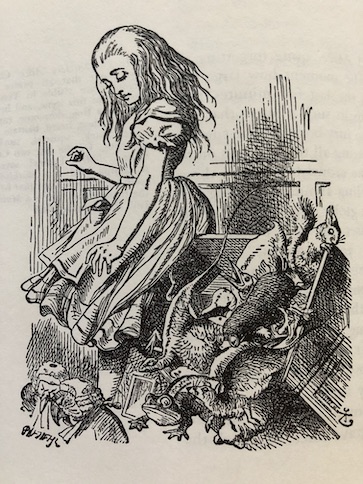
Then, they hear that a trial is beginning. It turns out that it’s a trial for the Knave of Hearts who stole the Queen’s tarts. During the trial, which is basically nonsense, Alice feels herself growing larger. She is called to give evidence, but because she is becoming too tall, she is told to leave the court. The King says that it’s Rule Forty-Two and is the oldest rule in the book, but Alice points out that the oldest rule should be Rule One. The White Rabbit presents a letter, supposedly written by the defendant, which is a nonsense poem. (This one is a shortened version of another nonsense poem by Carroll which loosely parodied the song “Alice Gray” and isn’t recognizably close to the original here.) The King and Queen try to figure out what the poem means, but Alice doesn’t think it means anything. The Queen wants to give the sentence first and the verdict afterward, and Alice says that’s nonsense and she doesn’t care what they think because they’re just a pack of cards. The cards come flying at her, and Alice wakes up.
Apparently, the entire adventure was a dream, and Alice feel asleep on the river bank with her sister. Alice tells her sister about the dream, and her sister is enchanted. Alice’s sister imagines Alice in years to come, telling other children the same story.
The story of Alice in Wonderland is over 150 years old, as of this writing, and it has been reprinted in many different languages and editions. The edition that I’m using for this review is actually a combined edition with the sequel, Through the Looking Glass, from 1960 with added notes by Martin Gardner. I like editions with added notes because there is quite a lot to explain about both Lewis Carroll and his stories. This is going to be a very long review, and there are a number of things I want to explain before I even start summarizing the story.
Lewis Carroll, real name Charles Dodgson, was actually a mathematician at Oxford in England. His modern reputation is somewhat dubious because one of his hobbies was photography, and among the pictures he took were pictures of children, including many in various states of undress, some nude or partially nude and some in nightgowns. Charles Dodgson never married and never had any children of his own, and his sexuality (or relative lack thereof, as some have also speculated) is debatable. He was known for being friendly with the children of many of his friends and colleagues, and he enjoyed spending time with them, talking to them, telling them stories, and teaching them things … and taking pictures of them. The parents of the children knew about the photographs, including the nude ones, and gave permission for them to be taken, even keeping copies themselves.
Scholars debate about Dodgson’s photographs and the intention behind them. Not all of the pictures feature children who are undressed; some are just wearing ordinary clothes and others are dressed in fanciful costumes, like characters from stories. However, the nude or partially nude pictures are troubling because the children in those pictures were not babies, like the ones in modern Anne Geddes photographs. By modern standards, there would be no innocent reason for taking pictures of unclothed children like that. However, some scholars point out that photography was a relatively new hobby at that time, and people were taking pictures of things and other people in ways that people wouldn’t now because they were so eager to try out this new technology. People were realizing that they could use photography to immortalize loved ones in ways that they never could before. (Look up 19th century post-mortem photography only if you’re not easily startled or disgusted.)
There is some evidence that Victorian people were not scandalized by the idea of nude photographs of children, perhaps considering them a preservation of a state of innocence that would gradually disappear as the children grew up, almost like how some people today still photograph nude babies. Dodgson wasn’t the only one taking pictures of nude children at the time, and he apparently did so with the full knowledge and approval of the children’s parents, giving them photographs to keep. On the other hand, without knowing Dodgson’s real intentions, it’s difficult to say whether or not these pictures were really as innocent as they were once supposed, and some people consider that Dodgson may have taken advantage of the innocence of both the children and parents involved for his own purposes. After his death, some of his relatives removed some of the pages in his diaries, censoring them before they could be made public, so it’s difficult to say what they removed and why. This censorship could have had something to do with his photography hobby and how he felt about it, or it could be unrelated, maybe covering up his romantic feelings for someone else or maybe personal or professional quarrels that might have proved embarrassing to people still alive at the time he died. Without the missing diary pages, there isn’t really much to go on, and the speculation is really just speculation.
Not what Alice Liddell really looked like.
One of the favorite child friends of Dodgson’s was Alice Liddell, one of the daughters of the ecclesiastical dean of Christ Church, Oxford. Dodgson often visited the Liddell family and took Alice and her sisters on outings. On one of their outings together, when he and a friend took the Liddell girls on a boating trip on the Thames, Alice begged Dodgson to tell a story, and he began making up the story that became Alice in Wonderland, making Alice herself the heroine. Dodgson was still friends with the Liddell family at that point, although he later had a falling out with the family for reasons that are still unknown. The reasons for the falling out were apparently part of the pages removed from his diary, and some people have speculated that Dodgson may have behaved improperly toward one or more of the girls, although that’s not the only possibility; Dodgson may have had a different type of romantic indiscretion at that time, possibly involving the children’s governess or Alice’s older sister Lorina, and he may have also quarreled with the dean over college politics. Dodgson was a contemporary of another famous author of children’s fantasy books, George MacDonald. (I’ll be talking about him more when I get to The Light Princess and The Princess and the Goblin.) The two of them were friends, and MacDonald was the one who urged Dodgson to publish Alice in Wonderland after his own children read it and liked it. (MacDonald’s children were also among the ones photographed by Dodgson.)
This documentary has more details about the history Lewis Carroll, his photography, and his writing. Overall, I think that probably the most accurate answer in the documentary to the question of what was really going on in Oxford in the mid-1800s is “Who knows?” Some people gave much more definite-sounding responses to the question, but there are equally vehement opinions that take completely opposite views of the situation, and with the obvious gaps in the available information, I don’t think that level of certainty is warranted. The documentary covers various viewpoints and ends with a photograph that is potentially damaging to Lewis Carroll’s reputation, one that would have been scandalous even in the Victorian era if it was really taken by Carroll (it wasn’t proven definitely, but the experts’ conclusions were that seems likely or at least credible, and its time period and quality are in keeping with Carroll’s work) because the subject of the photograph (possibly Lorina Liddell) would have been too old for the photograph to be considered “innocent” even back then. The girl in that photograph would have been above the minimum age of consent for her time but still below the age of consent for ours, making that photograph suspicious by everyone’s standards.
My Reaction
This is not sexy, Martin Grotjahn.
My theory about the issue? I kind of doubt that Carroll was a pedophile. Kind of. Partly, my reasoning is based on listening to and reading the different arguments on each side, and it seems to me that those who express doubt about the accusation have more concrete evidence to support their points (they reference other photographers who took pictures similar to Carroll’s, they discuss the age of consent in the Victorian era, they note inconsistencies in the reported ages of Carroll’s female friends, they provide details about different sources of information, etc.) than the people who insist that he “obviously” and “without doubt” was sexually attracted to little girls, who seem to be largely reactionary and make I statements like “I can’t believe” that there was anything innocent going on and “it makes me angry.” (Some of the people interviewed the Timeline Documentary speak like that.)
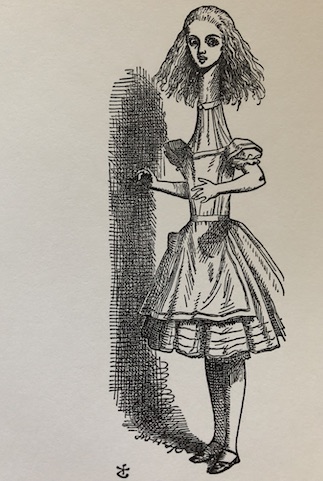
Between the two choices, I’d be more inclined to go with reasoned arguments and cited sources more than gut reactions. My reviews here on this site are full of my personal feelings and gut reactions on a number of topics because that is the nature of opinion-based reviews, but I’ve had training in evaluating historical sources and writing research papers. Feelings change over time, and you can’t cite gut reactions as evidence in a thesis paper. The first essay that postulated that Alice in Wonderland may contain sexual symbolism, written by A.M.E. Goldschmidt in the 1930s, may have actually been written as a parody of contemporary psycho-analysis, and some of the “obvious” sexual symbols cited in later essays and analysis make no sense to me. In 1947, a psychoanalyst named Martin Grotjahn said that the scene where Alice’s neck suddenly grows longer is a symbol “almost too obvious for words.” No, it’s really not. I had to sit and think for awhile about why a person with a giraffe-like neck would be considered sexy, and then, it occurred to me that he’s probably really thinking of a piece of male anatomy instead of a girl’s neck, which doesn’t make any sense for the context of the story. Even now, I’m still not completely sure if that’s what he’s really getting at, and if I have to ponder it that much, it’s not that “obvious.” It’s about as bad as all the “that’s what she said” jokes I’ve heard. Quite a lot of unrelated things can be made to sound raunchy if you add “that’s what she said” after them, and the more times you hear that, the more annoying and less funny that kind of joke becomes. When a scholar does something like that in literary criticism, I’ve noticed that people are reluctant to question it because they assume that the scholar knows something they don’t, but I really don’t understand that comment and I don’t mind saying that I don’t think it makes much sense.
Also, I can’t help but notice in the descriptions of Carroll’s interactions with the Liddell girls that he visited them in different locations and took them on outings in different locations and that they were in the company of different people during these visits. The Timeline documentary mentions that the children’s governess would have been with them, even if the parents weren’t, and on the day that he took them on the boat trip where he began composing Alice in Wonderland, they were accompanied by his friend, Robinson Duckworth. I’m not a specialist in Carroll’s life, but it isn’t clear to me, from their descriptions, whether or not he was ever completely alone with the girls or with any child in particular, with no other witnesses. He may have been, but it seems to me from others’ descriptions that they were often chaperoned by different people. If some form of abuse or suspicious behavior were going on, it would be more difficult to evade or fool multiple witnesses. In 1932, when Alice was 80 years old, she went to New York to receive an honorary doctorate from Columbia University for her participation in the creation of a piece of iconic children’s literature and to take part in a centennial celebration of Dodgson’s birthday. I would think that if she had bad memories of Dodgson, she would have been less likely to take such a long journey at her advanced age in order to attend this celebration. On the other hand, that’s still just a guess of mine, and the suspicions about Dodgson, now raised, really can’t be proven either way. It still remains a possibility, and that’s why I only “kind of” think that Dodgson’s intentions might have been innocent.
In the end, I don’t have a firm theory so much as a conclusion: if you need to have definite answers, without debate, qualification, or reservation, in order to acquire knowledge, history probably isn’t your field. My first degree was in history, and I’ve noticed so many times that people discount historians and historical knowledge because the field doesn’t make firm, definite statements on many debatable aspects of history like this, and times when historians and private individuals have tried, they have often been proven wrong in some respect. However, that’s exactly the point: serious, professional historians don’t make definite statements unless and until they have definite proof because they know that there’s always a chance that they could be proven wrong at a later date when new information surfaces. It’s happened before, so true professionals are usually cautious. It’s not that they don’t know anything, it’s just that they’re aware of the limits of their knowledge, and they are careful in how they present what they really know in order to prevent people from drawing the wrong conclusions too quickly. It would be irresponsible to tell people that something is definitely true when the circumstances aren’t definite, so instead, they tell people about the information they know they have and the things are “possible,” “likely,” or “probable,” which irritates people who expect definite answers from experts. We know some things, and we also are aware of what we don’t know and what pieces we’re missing, which is also very important.
It doesn’t matter so much in modern times that we can’t completely prove Dodgson/Carroll’s intentions regarding his photography one way or the other as that we understand that the controversy exists. Without the diary pages, which would have been proof of his thoughts and intentions (and which were probably destroyed long ago), the most we could say is that the photographs suggest a possibility. Because, as scholars have pointed out, Dodgson wasn’t the only person who took photographs of children like that without apparently causing scandal, I wouldn’t say that it’s “definite” that his behavior or intentions were inappropriate. The final photograph in the documentary above is bad, but because they never proved definitely that he made it, I’d hesitate to call it “probable,” even though it seemed to me that the documentary makers were fishing for that so they could have a compelling revelation for their documentary. I don’t know for certain whether Charles Dodgson was or was not a pedophile, but I do know that it’s possible that he may have been one or at least had feelings or urges in that direction. There are enough indications that it remains possible, even though it’s unprovable. If you’re okay accepting as fact that an idea is “possible,” but probably not “probable” and certainly not “certain” … you could do well studying history, and just getting through my explanation (if you managed all that) means that you’re more than ready to tackle the logic puzzles of Alice in Wonderland. They’re kind of like that when you turn them around in your head.
Parodies, In-Jokes, and Literary References
There are a couple of things that are easier to prove about Alice in Wonderland than whether or not Lewis Carroll may have been attracted to the real Alice, and these more easily provable aspects of the story are what make it particularly interesting for me. First, parts of the Alice stories are actually parodies of popular stories and rhymes from the 19th century. Dodgson/Carroll particularly liked to poke fun at didactic stories and rhymes that were used to teach children useful lessons and morals. He liked to twist those more serious stories and rhymes into things that were basically nonsense. Modern readers are more likely to focus on the nonsense and less likely to notice the parodies in the Alice stories because they are not familiar with the original rhymes and stories being parodied, as the original readers of these books would have been. The original readers would have known immediately what he was making fun of. For example, “How Doth the Little Crocodile” is a parody on “Against Idleness and Mischief” by Isaac Watts, which is about the importance of using time well. “You are Old, Father William” or “Ballad of Father William” is a parody on “The Old Man’s Comforts and How He Gained Them” by Robert Southey, which gives advice to the young about how to behave so that they may enjoy a happier old age. These types of poems would have been given to Victorian children as something to read and memorize during their lessons, and so they would have noticed that Carroll was poking fun at them. That’s why I like editions of the Alice books that come with extra notes, pointing out the parodies and original references, so I can be in on the joke. On the other hand, modern readers will have no trouble recognizing the source of “Twinkle, Twinkle, Little Bat” as “Twinkle, Twinkle, Little Star” or “The Star” by Jane Taylor (first published in 1806, although modern readers think of it as the song instead of the poem, and not all of them know all the verses). It’s pretty common throughout history for bored students to make jokes about the things that they’re required to learn in their lessons, and many of these poems are old enough for Carroll himself to have learned them when he was a student. It’s possible that he may have started playing with parodies of his school lessons or popular songs long before he started writing Alice in Wonderland, although that’s just my personal guess, based on my own school years. I did things like that, and some of my friends did, too. (People older than me also remember On Top of Spaghetti and Joy to the World, the School Burned Down – not Carroll parodies and much cruder than his work, but examples of the way kids can twist things that are commonly known for the amusement of their friends.)
The second important point about the Alice stories is that they are full of puzzles, riddles, and word games. Remember that Lewis Carroll /Charles Dodgson was really a mathematician and scholar, and he liked to play with logic puzzles and word games. There are a lot of puns in Alice in Wonderland, some of which reference places in and around Oxford, like the Treacle Well where three sisters supposedly live – Lacie (anagram of Alice), Elsie (her older sister was Lorina Charlotte – L.C. Liddell), and Tillie (her younger sister Edith’s nickname). Alice in Wonderland is full of inside jokes, riddles, and puns like this. There are many in-jokes for people who are familiar with places in Oxford, and there are many in-jokes that Dodgson and the girls had with each other. Some of the strange characters in Wonderland are apparently parodies of people that Dodgson and the Liddells actually knew. Dodgson himself explained that he is the Dodo in the story. Dodgson spoke with a stutter, and when he would introduce himself to people, his name would often come out, “Do-Do-Dodgson.” “Dodo” Dodgson was an in-joke that the Liddells would have recognized.
Part of the trouble with analyzing Alice in Wonderland is that it’s possible to take it too far. Some of the parodies are obvious to people who are familiar with 19th century literature and poetry, and the references to places in Oxford are noticeable to people who are familiar with Oxford, but there are so many in-jokes in the story that might not be possible for modern readers to understand them all because we might not know all the in-jokes that Dodgson and the Liddells had with each other. So many strange and surreal things happen in the story that it’s possible to read too much into all of it. Some of it may have simply been meant to be silly references to other stories that Dodgson told the children before Alice’s story, long-standing in-jokes, or random silliness, and may not have any deeper meaning than that. When I read other reviews and analysis of the stories, I sometimes get the feeling like the critics are trying too hard, reaching and reading too much into everything. There’s a lot to enjoy about the story just as it is, without over-analyzing it to death, looking for hidden psychology that might not actually be there because a major part of it was based on parody and in-jokes in the beginning. If you want to spend some time appreciating the logic puzzles and word play and comparing the parody poems to their originals, that’s fine, but it’s also fine to just enjoy the book for the imaginative nonsense. It’s a long, strange trip, and I think it’s perfectly okay to just sit back and enjoy.
Note About the Illustrations and Original Version
Something else I’d like to mention before starting on the story itself is that the Alice who is depicted in the classic illustrations is not actually the original Alice Liddell. The illustrated Alice is a blond girl, but Alice Liddell was a brunette with shorter hair. Lewis Carroll apparently suggested that the illustrator use a picture of Mary Hilton Badcock as the model for the book illustrations, and Mary Hilton Badcock did look similar to the finished illustrations, although it’s also possible that the illustrator used a different child with a similar appearance as his model.
Also, the story as Carroll originally wrote it was called Alice’s Adventures Underground. Carroll did his own illustrations in the original version, showing Alice more like the real Alice, and there were a number of differences in the story. For example, in the original version, the White Rabbit drops a nosegay of flowers, which Alice smells, and that causes her to shrink, something that didn’t happen in the later version. If you want to read the original, it’s available through Project Gutenberg.
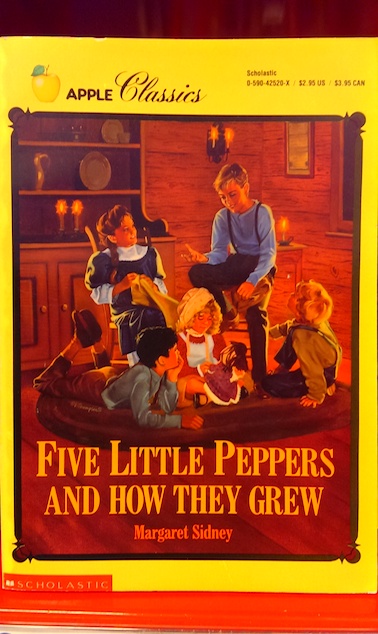
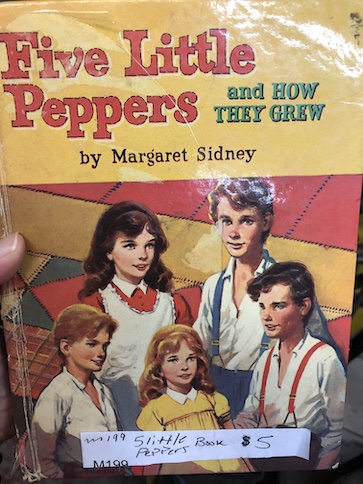
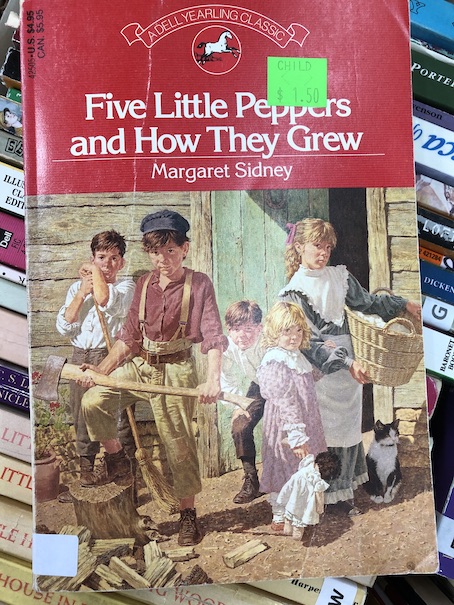
Five Little Peppers and How They Grew by Margaret Sidney, 1881.
Mrs. Pepper is a widow who lives with her five children in a little brown house. Since her husband died when their youngest was a baby, she has supported the family by sewing. The children try to help, but they are still very young. The oldest, Ben, is eleven years old, and Polly, the next oldest is ten. Their mother worries about providing them with an education, but they are barely scraping by as it is.
The family manages to get by, helping each other through crises, such as the time when everyone was catching measles. Sometimes, they also get help from friends.
One day, when Phronsie (short for Sophronia), the youngest Pepper, about four years old, wanders off by herself, she is found by a boy named Jasper King and his dog, Prince. They look after her until her brother, Ben, comes to take her home. Jasper enjoys meeting the Pepper family. He doesn’t have any siblings himself, and he thinks that it must be fun to live in a family of five. Jasper and his father are spending the summer at a hotel in nearby Hingham, and Jasper thinks that it’s dull. The Pepper children invite him to come visit again, saying that they will teach him how to bake like Polly does.
Jasper isn’t able to return to their house right away because he gets a cold, and Jasper’s father has been ill. Phronsie thinks that it would be nice to make him a gingerbread man. Together, the children make up a little basket of goodies for Jasper and his father. The Kings are charmed by the gift, and Mr. King decides that he would also like to visit the Pepper family. Unfortunately, due to Mr. King’s poor health and some business he has in “the city”, their visit to the area is cut short. The Pepper children are sad that Jasper will be leaving so soon, but they invite him to return next summer.
Jasper continues to write letters to the family while he’s in the city, studying with the private tutor he shares with his cousins. He remembers the Pepper children telling him that they don’t really celebrate Thanksgiving or Christmas because they never have enough money to buy a feast or Christmas presents. However, he urges them to try to celebrate Christmas this year, even if it’s only in a small way. The Pepper children make small presents for each other, like paper dolls, doll clothes, toy windmills, and whistles, and put some greenery around for decoration. Jasper also sends the family some surprise presents.
However, Jasper’s father says that he doesn’t want to visit Hingham again because he doesn’t think that the climate there is good for him. Instead, Jasper persuades his family to let him invite Polly for a visit. It takes some persuasion for the Peppers to agree because Mrs. Pepper is hesitant to accept favors and Polly worries about homesickness, but they are persuaded when Jasper says that he has been unwell and that Polly’s visit would cheer him up. In the city, Polly gets her first taste of formal education, even having a music teacher. However, she does get homesick, so the King family sends for little Phronsie to cheer her up. The King family is charmed by both of the girls, and Mr. King gives Phronsie many dolls to play with.
One day, when Polly realizes that she has forgotten to write a letter to their mother because she was so busy with her lessons, Phronsie decides that she will write one herself and mail it. She doesn’t really know how to write, but she scribbles something as best she can and slips out of the house to find the post office. She is almost run over in the street, but fortunately, Mr. King finds her and brings her home. She isn’t hurt, but the incident worries Mr. King.
After some thought, Mr. King decides to invite the rest of the Pepper family for a visit. The day that the rest of the Peppers arrive, Phronsie surprises a pair of thieves in the house. The thieves get away, and the excitement from the incident makes the Peppers’ arrival less exciting than it should have been.
The Peppers fit so well into the household that Mr. King invites the family to live with them permanently. He offers Mrs. Pepper a job as housekeeper and says that he will help the children with their education. Mrs. Pepper accepts, and it leads to the surprising revelation that Mrs. Pepper and John Mason Whitney, the father of Jasper’s cousins, are actually cousins, making them all cousins of the King family as well.
This book is mentioned in the book Cheaper By the Dozen as a book that Mrs. Gilbreth liked to read to her children.
The book is currently available online through Internet Archive. It is part of a series.















 Jestress's Forgotten Books and Stories