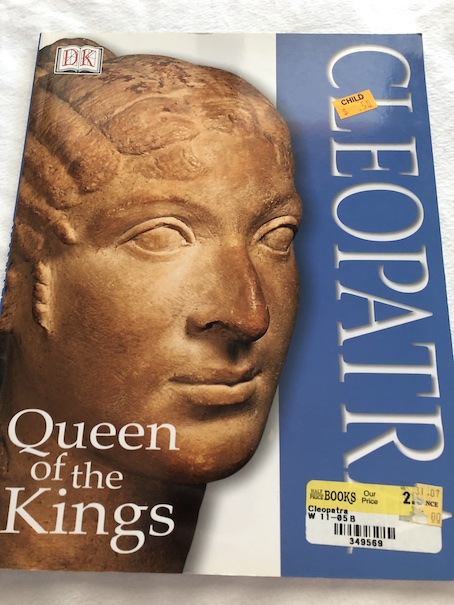
Cleopatra: Queen of the Kings by Fiona MacDonald, illustrated by Chris Molan, 1998, 2003.
I always like books from DK Publishing because they have great illustrations, and they do a good job of helping to explain nonfiction topics, including different periods of history. However, one thing that’s important to realize is that you really have to read all of the small text that accompanies even the small pictures in order to get the full story. If you don’t, you may miss important details. Although this is a picture book, the detailed nature of the information and some of the dark subject matter make it inappropriate for young children.
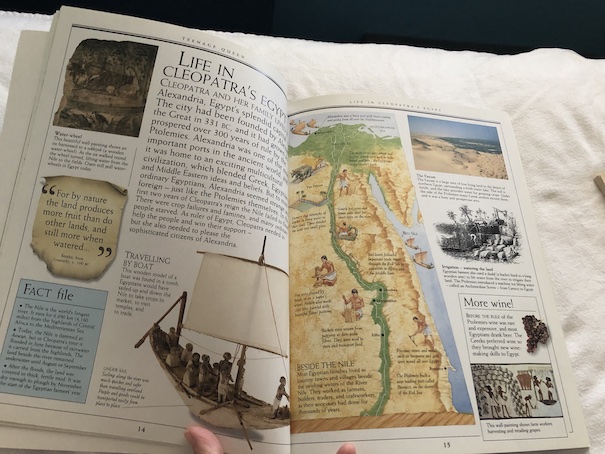
This particular book is about the life of Cleopatra, the famous Egyptian queen. The queen we know as simply Cleopatra was actually Cleopatra VII. She was part of a dynasty of Egyptian rulers who were originally from Macedonia, a region of Greece. This dynasty was known as the Ptolemaic Dynasty because all of the kings in the dynasty were named Ptolemy, including Cleopatra’s father, Ptolemy XII. There were certain names that were repeated in every generation of the family and even within generations, like Ptolemy (Cleopatra’s two brothers both had this name), Cleopatra (Cleopatra also had a sister who was also named Cleopatra), and Arsinoe (Cleopatra’s younger sister). The book doesn’t fully explain why they came from Macedonia, but one of Cleopatra’s ancestors, Ptolemy I, was a Macedonian nobleman and a friend of Alexander the Great. Ptolemy I went with Alexander the Great on his military campaigns. Through his service to Alexander the Great, Ptolemy I was made the Greek governor of Egypt, ruling from the city Alexandria, which had been established by Alexander the Great. Alexandria was an important port city as well as the seat of the royal family. It was a gathering place of traders, scholars, and people from different cultures in Egypt, although average Egyptian citizens viewed it more as city of foreigners, just as the royal family itself was also foreign. That’s an abbreviated explanation of the family’s history, but it helps to understand that, while the family ruled Egypt for generations, they remained culturally Greek. The book mentions that most of the members of Cleopatra’s family only spoke Greek and that Cleopatra departed from the norm by learning to speak Egyptian.
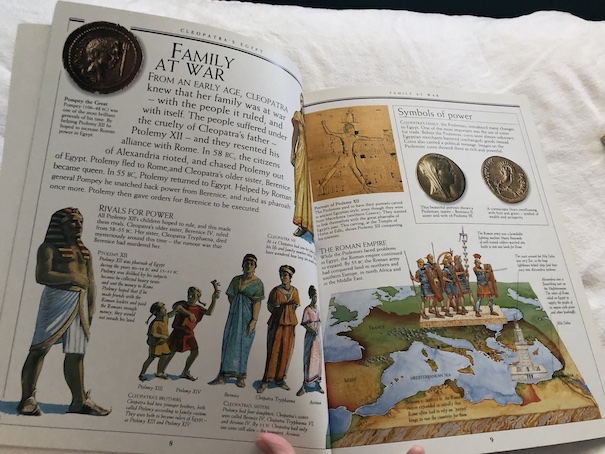
Cleopatra was born into tumultuous times in the history of Egypt and her family. Her father was known as a cruel ruler who taxes his people heavily and sent large amounts of money to Rome, attempting to befriend Roman leaders and bribe them not to invade Egypt. In 58 BC, Alexandrian citizens had enough of Ptolemy XII and the way he catered to Rome, and they revolted, forcing Ptolemy XII to flee the city for Rome. Cleopatra was only fourteen years old at the time. Members of the family were left behind in Alexandria when Ptolemy XII fled, and Cleopatra’s oldest sister, Berenice claimed the throne in her father’s absence. The Ptolemies were always focused on maintaining their power, even in the face of competition or opposition from family members, and they were not afraid to fight or even kill each other to maintain control. Berenice may have murdered another of her sisters during her time as queen because she died under mysterious circumstances. However, when Ptolemy XII returned to Egypt a few years later, he had Berenice executed as a rival for the throne. By then, Cleopatra was the oldest surviving child of the family, with only her youngest sister and her brothers still alive.
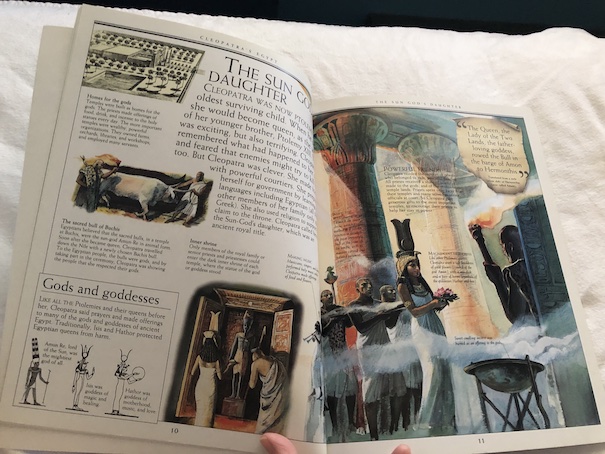
A few years later, Ptolemy XII died, and Cleopatra acted quickly and prudently to secure both her life and her power. Her younger brother, Ptolemy XIII, had a claim to the throne, but he was still only twelve years old, and Cleopatra was eighteen. Asserting her authority over her child brother, Cleopatra took the throne as the oldest remaining offspring of Ptolemy XII and married her brother in order to turn her brother from a rival for power into a further source of her own authority. She could then rule on her brother’s behalf as his wife as well as his older sister. (Other Egyptian rulers had married close relatives for reasons like that. Tutankhamen was similarly the result of an incestuous royal relationship.) As queen, Cleopatra called herself the Sun God’s Daughter, an old royal title that tied her image to rulers of the past and the gods of Ancient Egypt.
From the beginning, being queen was a difficult task for Cleopatra. There were famines in Egypt during the beginning of her reign, and Cleopatra had to manage a response that would satisfy the citizens that she was doing her job as ruler. Family rivalries were also an ever-present danger. Cleopatra knew that she had enemies in her court, including people who favored her brother over her. As her brother got older, he became dissatisfied with the way his sister was ruling without sharing power and authority with him. For a time, Ptolemy XIII forced Cleopatra to flee Egypt and go to Syria. Cleopatra took her sister Arsinoe with her, both to protect her from their brother and to prevent her from trying to seize power herself. (In the Ptolemy dynasty, either could be a possibility. When family members weren’t in danger from each other, they could be a danger to each other.)

In the meantime, Julius Caesar came to Egypt to collect a debt that he claimed that Cleopatra’s father had owed him. He arrived during the power struggle between Cleopatra and Ptolemy XIII, and he decided that it would be for the best to try to mediate peace treaty with the two of them. He wanted to meet with both Cleopatra and Ptolemy XIII together, but Cleopatra knew that there was a risk that she might be killed if she showed up for a meeting. Yet, she did want to meet with Caesar because she recognized that he could be an important friend and source of protection for her. She ended up visiting Caesar in secret. According to legend, she had herself delivered to Caesar’s room in a rolled-up carpet. Caesar was charmed by Cleopatra and became her ally. When the news of their alliance spread, it tipped the balance of power in the royal family. Caesar learned that Ptolemy XIII’s adviser was plotting against him and had him executed. Ptolemy XIII fled with Arsinoe to join the Egyptian army and was later killed and found dead in Alexandria’s harbor. Getting rid of her brother/husband and his advisers secured Cleopatra’s position. She had one remaining brother, Ptolemy XIV, who was only eleven years old at the time, so she married him, too, further solidifying her power. As her ally (and possible lover), Caesar provided her with guards for her safety.
Cleopatra had a son named Caesarion, who was rumored to be Caesar’s son as well. However, Romans feared that Julius Caesar would proclaim Caesarion as his heir. They didn’t want him as the future ruler of Rome, citizens were appalled at the way Arsinoe was paraded through the streets as a war prize, and people generally began to fear that Caesar was becoming too powerful. In 44 BC, Caesar was assassinated by a group of senators. Cleopatra was in Rome when Caesar was killed, and she fled back to Egypt with her son. Around this time, Ptolemy XIV disappeared, and he may have been murdered by Cleopatra. With a son to inherit her throne, Cleopatra no longer needed Ptolemy XIV. However, her Roman protector was now gone, and Cleopatra still had enemies at court. Cleopatra’s remaining sibling, Arsinoe, sided with Caesar’s enemies and plotted against her sister and Caesarion.
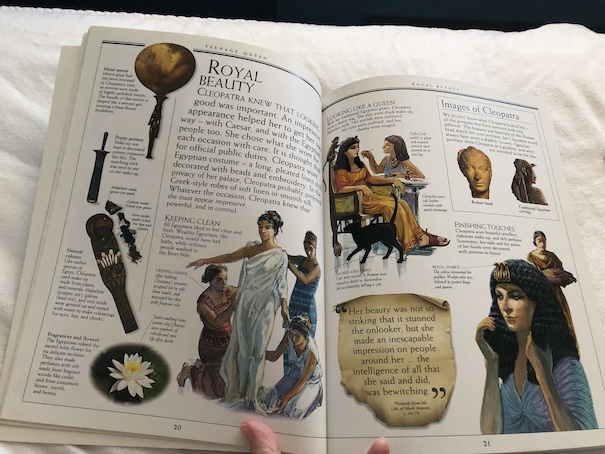
Nobody knows exactly what Cleopatra looked like (statues and carvings of her don’t always look alike, and they may have been idealized images of her), but she took care of her appearance as part of her image as queen. Apparently, Cleopatra was more striking than beautiful, and what struck people about her the most was her intelligence and personality. Her charm was one of her most important tools in winning allies, and she used it again to win over a new ally to replace Caesar. She found a new ally in Marcus Antonius (also known as Mark Antony), one of the candidates to replace Caesar in Rome.

Mark Antony needed the control of Egypt and its resources and the support of Cleopatra for his own political purposes. To win his support for her purposes, Cleopatra began a romantic relationship with Mark Antony that eventually became a major part of the legends around Cleopatra. Although Mark Antony already had a wife in Rome, he became devoted to Cleopatra and fathered a set of twins with her and, later, a third child.

When Caesar’s nephew, Octavian, learned that Antony had divorced his wife and was conspiring against him, he declared war on Egypt to take down both Antony and Cleopatra. Cleopatra and Antony’s forces were defeated at the Battle of Actium although the two of the escaped. Feeling that the end was probably near, Cleopatra had stoneworkers hurry to complete her tomb. She began experimenting with poisons, and she and Antony swore to each other that they would die together. When Antony’s soldiers turned against him and refused to fight, Antony was disgraced and forced to flee. He ended up taking his own life by stabbing himself. Cleopatra had retreated into her own mausoleum, planning to die, but Octavian allowed her to remain there as a prisoner while she arranged Antony’s funeral. The exact cause of Cleopatra’s death has never been confirmed, but according to legend, she arranged her own death by the bite of an asp and sent a note to Octavian, asking that she be buried with Antony.

It’s a tragic end to a story that was full of treachery and family rivalries from the very beginning. Octavian refused to allow any of Cleopatra’s children to assume the throne of Egypt, ending the reign of pharaohs forever. Rome took control of Egypt, and Cleopatra’s children were sent to be raised by Antony’s first wife in Rome, Octavia (who was also Octavian’s younger sister). Caesarion tried to flee to Syria, but he was caught and executed by Octavian’s orders. No one knows what happened to Cleopatra’s other two sons because they disappear from historical records after this point, so they may have died young (or were murdered, given how things went in the powerful circles in which they lived). However, Cleopatra’s daughter survived, grew up, and eventually married the King of Mauretania, a region in North Africa. The book mentions that she had a son that she also named Ptolemy, but it doesn’t mention that this Ptolemy was the last king of Mauretania and was assassinated by Caligula. Caligula and Ptolemy were distant relatives of each other because Ptolemy of Mauretania was a grandson of Antony, and Caligula was descended from both Antony and Octavian. In many ways, it seems like this family’s greatest misfortunes were themselves and each other. Fortunately, the death of death of Ptolemy of Mauretania didn’t end the family line. It’s unknown whether or not Cleopatra has living descendants today, but Ptolemy of Mauretania did have a sister (the details of her life are unknown) and a daughter named Drusilla, who apparently grew up, married, and continued the family line. Further down the family tree, relationships and offspring become harder to trace.
Something I particularly liked about this book was the separation between the legends of Cleopatra and the her known history. As with other ancient historical figures, the history and legends go hand-in-hand, and it can become difficult to separate the two. The book is pretty open about which parts of her life are known, what can’t be firmly established, and which parts of her story come to us from legend and may or may not be reality. The final section in the book discusses the known facts and fiction about Cleopatra and possible confusions between her and other Cleopatras in her family (which may be another reason why not all of the images of Cleopatra look alike). It also explains the information about Cleopatra in Plutarch‘s biography of Mark Antony and how his stories inspired Shakespeare’s play and modern movies about Cleopatra.
The book is available to borrow and read for free online through Internet Archive.
 Jestress's Forgotten Books and Stories