The Wouldbegoods

The Wouldbegoods by E. Nesbit, 1901.

“We are the Wouldbegoods Society,
We are not good yet, but we mean to try,
And if we try, and if we don’t succeed,
It must mean we are very bad indeed.”

By Noel Bastable

The previous book in the Bastable Children series, The Story of the Treasure Seekers, ended with the children and their father going to live with their “Indian uncle.” The uncle isn’t identified by name, but he is apparently their real uncle, and he had only recently returned from living in India in the previous book, when he invited the Bastables to come live with him at Christmas. Since then, he has been helping the children’s father with his business, and the children are once again going to school, but not boarding school because their father doesn’t believe in boarding schools. However, the six Bastable children are still motherless and not accustomed to being supervised much in their free time.

During the spring, the children of one of their father’s friends come to stay for a visit. The Bastable children don’t like the other children much at first because they seem too timid and too well-behaved. The imaginative Bastable children decide that what these other kids need is a good game of pretend to get them out of their shells. One of the Bastables’ favorite books is The Jungle Books by Rudyard Kipling, so they decide to make their own jungle and act out scenes from the book. They give their guests the book to read, pointing out parts that they want to act out, while they go set up the jungle. They use the garden hose to create a waterfall, and they haul a bunch of their uncle’s taxidermy animals out of the house to set the jungle scene. They also set loose some guinea pigs and a pet tortoise and cover their dog in coal dust so he can be a wolf. Their father’s friend’s son, Dennis (called Denny), starts really getting into the game, but his sister, Daisy, prefers just to read the book. Matters come to a head when the boys frighten Daisy too much with their tiger costumes, and she faints. It is at that moment that their father and uncle arrive with some friends, seeing the children all gathered around Daisy, whom they first fear has died of fright. Some of the boys are nearly naked, their skin covered in brown dye so they’ll look like Mowgli from the book (no modern children should dye their skin for a costume like that, and that should be something adults explain to them, if they read this book), the taxidermy animals are all wet from the hose, the coal-covered dog is on the sofa inside, and the tortoise and one of the guinea pigs are never seen again.

Naturally, the adults are angry at the situation, and the children admit that their game went too far. The uncle swats the boys with his cane (not the girls because it would be ungentlemanly to hit a girl), and all of the children are sent to their rooms and put on a temporary diet of bread and water as punishment. Their father briefly talks of the possibility of boarding school, which shocks the children because they know how he feels about it. What the adults decide to do instead is to send the children to the country for the summer. Their friend from the previous book, Albert’s uncle, is an author, and he has rented a house in the country, where he will be writing. He always appreciates the children’s imagination and playacting, and he agrees to take all eight children, both the six Bastables and Denny and Daisy. (Albert isn’t there, so he’s probably somewhere with his mother.) Of course, since Albert’s uncle (who is never identified by any other name) will be writing much of the time, readers can guess that the children will have little supervision in the country.

The old manor house that Albert’s uncle has rented is a fascinating place. It has a moat around it, and a secret staircase, although it’s not really secret anymore because people already know about it. The eight children immediately begin doing things wrong in the country because they don’t know what they’re supposed to do and what they aren’t supposed to do, and adults usually only tell them what they’re not supposed to do after they’ve already done it. They ring a bell that is only supposed to be rung in emergencies, and they play in some hay that the horses are supposed to eat. Then, the girls in the group bring up an idea they’ve had.

The girls are still feeling guilty over the earlier bad behavior that got them sent to the country in the first place, so they’ve decided that it’s time for them all to reform their characters. Daisy in particular suggests that they form a society to do it because she knows that when people are serious about undertaking a good cause, they form a society for it. The boys aren’t as enthusiastic about the idea of forming a society around just being good, which doesn’t sound very fun or interesting, but the girls talk them into it. Oswald wants to know how it will be organized and who will be in charge, so they begin setting out some rules. Basically, all of the children are in the society, and nobody is allowed to leave it without telling the others. As long as they are in the society, they must always try their best to be good, and every day, they must try to do some good deed, which they will record in special book. After a debate about the name of their society, they decide to call it the Society of the Wouldbegoods. They also decide that this society must be kept secret from the adults, which is a major reason why their efforts turn out the way they do.

The first evening after they form the society, the children are unusually well-behaved but glum because they’re working so hard to be good. Albert’s uncle notices their odd mood, but they can’t explain to him why they feel this way, and he doesn’t press them. They also quickly have trouble finding good deeds to do, especially ones that are fun or interesting.

Dicky’s first good deed effort is to try to fix a window that seems broken to him, but it turns out that he doesn’t understand the reason why the window is the way it is. Because he changes it, a milk pan accidentally falls out the window into the moat. Oswald decides that the only good deed they can do is to retrieve the milk pan and fix Dicky’s mistake. They immediately recruit the other children to help them drag the moat, but none of them really knows how to do that, and by the terms of the society, they can’t ask the adults or tell them what they’re
trying to do. The only thing they can find to use for dragging the moat is a bed sheet, which they ruin by getting it dirty and tearing it, and it still doesn’t help them retrieve the milk pan. Failing that, they decide to make a raft and use it to reach the pan. This works better, but when they reach for the pan, the raft overturns and dumps everyone in the water, and Dora hurts her foot badly on an old tin in the water. Fortunately, the cook sees them fall in the moat, and she hurries to get Albert’s uncle, who gets the boat from the boathouse and rows out to rescue the children. (Apparently, the kids didn’t know there was a boat before they built the raft.)

Their next good deed goes better, although they don’t entirely think of it as a good deed. The children become fascinated with some soldiers who are training nearby. They like to watch the soldiers as they ride by and have their drills and exercises. When they wave to the soldiers, the soldiers blow kisses to the girls, which gives them a thrill. The kids dress up as soldiers and ask Albert’s uncle if they can borrow the old armaments that are decorating the walls of the old manor house as their weapons, and he says yes. (Oh, Good Lord, why? Nothing bad happens to the kids because of those old weapons, and they apparently don’t damage any of the antiques, but given their track record, this was taking a real risk.) The soldiers are amused by the children, and the next time they pass by, they stop and take a rest with the children. The captain of the soldiers takes some time to explain the soldier’s weapons to the children and tells them that they will soon be sent to the front overseas. (This is way too early to be World War I, and they refer to the Southern Hemisphere, so I think they’re talking about the Second Boer War, which was happening while this book was being written and published.) Before the soldiers leave, the children decide that they want to give them a parting gift, so they get some money from their father and give each of the soldiers a pipe and some tobacco, because the soldiers were all smoking during their rest break. Modern children’s books wouldn’t have the kids encouraging their smoking habit, but in this turn-of-the-century book, the gift goes over well. Sadly, the children never see any of the soldiers again after they leave for the front and don’t know what happened to them. Still, they did something nice for the soldiers.

The children’s experiences with the soldiers sets up their next attempt at a good deed, with mixed results. Part of it gets very uncomfortable, but it has a happy ending. The children notice an older woman who also watches the soldiers and seems to get very emotional when she sees them. They find out that her son is also a soldier who is already at the front, and she is very worried about him. The children decide that they should do something nice for her, so they try to weed her garden without permission. The problem is that the children
don’t know how to tell the difference between vegetables and weeds, so they also pull up her turnips and cabbages. The woman is angry with them, but they apologize and say that they’ll talk to their father about making things right with her.

Then, the children have to bring her a postcard addressed to her that was accidentally delivered to them with the mail for the manor house. They don’t even read it ahead of time although they could because they don’t want to do anything else wrong. This is a rare serious moment in this series because the postcard is from the army, and it says that the woman’s son is dead. The woman is very upset, and the children sympathize with her.

Then, the children decide that they can do something else nice for the woman by making a tombstone for her son. They know that he must have been buried at the place where he was killed on the battlefield, so he won’t have a normal tombstone in England, and they think it would be nice to make a memorial for him. The concept of making a memorial for someone who is buried elsewhere is actually a real thing. It’s called a cenotaph (although I don’t think these children know that word because they keep calling it a “tombstone”), and they are commonly done for soldiers who are killed overseas and buried there or whose bodies can’t be retrieved. (The musician Glenn Miller has one because his plane went down in the English Channel during WWII, and his body was never recovered.) Making a memorial of this type for the grieving family of a soldier would be a nice gesture, if it was done well and with the input of the soldier’s family. The kids do the best they can, carving a wooden tombstone and inscribing a beautiful message on it, but they don’t tell the soldier’s mother about it until after they’re finished. At first, the older woman thinks that they’re making fun of her grief, but Alice persuades her that’s not the case and convinces her to take a look. They decorate the tombstone with flowers and offer a lovely message about the soldier’s service to his country. The soldier’s mother is touched, and she appreciates the sentiment, although she has the children move the memorial to a more private spot. She likes it that the children continue to put flowers on the memorial, and she becomes friendly with them.

This episode also has a happy ending because it turns out that the reports of the soldier’s death were wrong. He was actually missing and injured, not killed. His mother and the children learn the truth when he comes home and sees the children decorating his “tombstone.” Fortunately, he is amused by the memorial and the touching sentiment expressed by the children, and his mother is overjoyed at his return. The children celebrate by chopping up the tombstone and using it for a bonfire.

Around this time, the children realize that they don’t have very many good deeds to record in their book, so they decide that they can make notes about any good thing that they notice someone else doing. Nobody is allowed to write about themselves or to persuade someone else to write something about them because bragging about their own good deeds wouldn’t be good or noble. It’s a fortunate decision because many of the children’s other adventures in the country aren’t directly related to the Society of the Wouldbegoods or their good deed efforts, but they count some of the things that certain children do during their adventures as good deeds (and Oswald gripes about things he did which he thought should have been counted but weren’t).

One day, the children are sent out on a long walk because Albert’s uncle has a headache and the children are making too much noise in the house. They decide to check out a tower that has some spooky local legends about it because it contains a tomb about halfway up the tower. The others credit Denny for a good deed because he offers to go first into the spooky tower. (This tower is somewhat based on a real landmark, but the
author took some creative liberties with it. The man who is supposedly entombed there, Richard Ravenal, isn’t a real person. He was created for this book, but he gets a mention in the lore of The League of Extraordinary Gentlemen.) The children have a frightening encounter there with a beggar. They give him a coin as a good deed, but he sees that the children have more money with them, so he locks them in the tower from the outside, telling them that he won’t let them out until they give him the rest. Oswald notices that there are bolts on the inside of the tower door as well as the outside, so he quickly locks them to make sure that the beggar can’t get inside. This turns out to be a good decision because, when the children toss the rest of their money to him, it isn’t as much as he thought they had, and he pounds angrily on the tower door. (Oswald thought that the others should have counted his locking the door as a good deed because it saved them, but they decide not to because it was really more “clever” than “good.” Oswald thinks that’s an unfair technicality.) The children are safe inside the spooky old tower until the beggar leaves, and they are able to signal to someone else to unlock the door from the outside. This incident wasn’t the children’s fault (for a change), but the adults insist that, from this point on, they take the dogs with them when they go very far from the house.

The children make some other attempts at doing good deeds on purpose, but again, they go horribly awry because the children don’t know what they’re doing, and they don’t talk to anybody else about their ideas before they do them. After they cause a disaster that ruins a fishing contest and wrecks a barge full of coal, which costs their father a lot of money to fix, Albert’s uncle explains to them the full consequences of what they did and how much trouble they caused for a lot of people. The children feel terrible about it, and Alice starts to cry. She doesn’t fully reveal the existence of their society to Albert’s uncle, but she does say that they’ve been working so hard at being good and doing good things, but nothing they do works out. She says that they must be the worst children in the world and dramatically says that she wishes they were all dead. Everyone is shocked by this, and Albert’s uncle calmly tells her that they’re not the worst children in the world. He says that he knows they’re all feeling bad about what they’ve done, and he does want them to feel badly because they have seriously caused some real problems, and he doesn’t want them to do these things again. However, he says that he doesn’t want them to give up on the idea of being good because that’s something that they will learn better how to do over time. Also, he notes that, in all the time he’s known then, none of them have ever done anything intentionally mean or wicked, they’ve never lied about what they’ve done, and they’ve always been sorry when things have gone wrong. Being truthful and genuinely regretful for causing harm are worthy qualities.

Oswald feels bad abut that part because he has realized that there’s one thing he’s done that caused a disaster, and he hasn’t admitted it to the others yet. What he did was unintentional, and he didn’t know the incident was his fault at first, but he’s been trying to work up the courage to confess since he realized what he did. Albert’s uncle’s kind words make Oswald confess right away, and Albert’s uncle is appreciative of his honesty for that, too. The others call credit Oswald’s confession as a good deed. He doesn’t think it is, but they say it counts because it was a difficult thing for him to do, and technically, he didn’t have to do it. At that point, nobody had guessed that he was responsible for one of the problems, and if he had kept quiet, it wasn’t likely that anybody would have found out. He had been honest because he simply wanted to be honest and do the right thing, even knowing that people might get mad at him or punish him for what he did.

Albert’s uncle forgives the children, although he still expects them to learn from their misadventures. At this point, the children also begin to consider just how far the Society of the Wouldbegoods will go. So far, it hasn’t been a great success, but they do appreciate what Albert’s uncle says about not giving up on the idea of trying to be good. Still, the children (especially Oswald), decide that it’s time to set an ending point for the society. They decide that each of them will try to do one more good deed of some kind, and when each of them has
one more deed to their name to put in their book, they’ll dissolve the society. From that point on, if any of them want to be good, they’ll do it on their own, when and how they choose do it. (The boys in the group are particularly relieved at this idea, although they’ve all been feeling some strain from the society.)

The children’s escapades still continue, some related to good deed efforts and some just part of summer activities that they do for fun. They try to hold a circus with some farm animals, which get loose. There’s a bonfire that gets out of control and burns a farmer’s bridge (although the children put it out themselves before it gets worse). Dora finds a baby who’s been left alone in his carriage and kidnaps/cares for it. At first, she thinks that maybe he’s the long-lost heir of a noble house who was kidnapped by gypsies, like in books,
and has been abandoned, so she must adopt him and care for him until he can be reunited with his family. Like many of the children’s good deeds, it has mixed results, but this one ends up being more on the side of good. She shouldn’t have just taken the baby from its carriage, and he technically wasn’t kidnapped until she took him. However, it turns out that his nanny was neglecting him, leaving him all alone while she flirted with her boyfriend. When the adults discover that the children have the baby and why they have him, the nanny’s neglect is exposed, and she gets fired.

A couple of the boys later buy a pistol, which they make all the children promise not to tell the adults about. (I thought at first that it was a toy pistol, but it apparently fires real bullets. God only knows why anybody thought it would be a good idea to sell these boys a real gun.) The boys were thinking at first that it would be handy to have if there was a burglar, but one of the boys accidentally shoots a fox with it and kills it. The other children, although they were pretending to be fox hunters, are upset at finding a real dead fox and bury it with a proper funeral before they know that it was one of the other boys who killed it. They get into some trouble over it from the master of fox hounds. The boy who shot the fox explains that, at the time he shot it, it was caught in a metal trap, and it bit him when he tried to let it loose, which is when he accidentally shot it. Albert’s uncle confiscates the pistol because none of this would have happened if the boys hadn’t been playing with a gun, and Oswald thinks that it would serve him right if they really did get a burglar in the house and were unable to fight him off. (I’m pretty sure that they’d be more likely to accidentally shoot one another or one of their own dogs before they shot anybody else.)

Toward the end of the summer, Albert’s uncle agrees to be a host for an antiquities society that wants to see the old manor house and investigate a nearby site for possible Roman ruins. Albert’s uncle is beside himself when he discovers that, rather than being host to a small club, more than 100 people show up to accept his invitation to have tea before touring the grounds. The children, inspired by a book called The Daisy Chain, decide that it would be amusing to bury some pottery that they made themselves, just so the antiquarians will definitely have something to find. That part turns out fine because the antiquarians can easily tell the pottery made by the children from actual antiquities, and they are amused by the children’s “relics.” The problem is that the children also decide to bury some pottery they found in the library along with their own pottery, and those were real relics. The antiquarians get excited when they find those, but Albert’s uncle realizes that those pieces of pottery belonged to the real owner of the rented manor house. The children have to go to the head of the antiquarian society to admit what they’ve done to get the antique pottery back.

From there, the children are inspired by something a tramp says to them to open up a stand offering free drinks (lemonade and tea), but it goes wrong when some people take advantage of their kindness. They also take part in some war games without realizing that it’s all a game or training exercise. Then, while acting out the pilgrimage from The Canterbury Tales, they meet a kind lady, who turns out to have a romantic past with Albert’s uncle! They’re not sure that they like the idea of Albert’s uncle getting married, but they’re willing to try to help him reconnect with his lost love if it will make him happy and for goodness’s sake!

THE EPITAPH

‘The Wouldbegoods are dead and gone
But not the golden deeds they have done
These will remain upon Glory’s page
To be an example to every age,
And by this we have got to know
How to be good upon our ow—N.’

by Noel Bastable

The book is now public domain, so it is available to read online through Project Gutenberg and Internet Archive (multiple copies, including audiobooks). There is also a LibriVox Audiobook on YouTube.

My Reaction

This book reminds me of a couple of more modern books, The Adventures of the Red Tape Gang by Joan Lowery Nixon from the 1970s and Why Did the Underwear Cross the Road? by Gordon Korman from the 1990s, which are both books about kids trying to do good deeds with unintentional and hilarious results.

Just as in the first book in the Bastable Children series, much of what the children do in this story is due to the children’s naivety and imagination and a lack of adult supervision. Oswald makes it a point to say that they were not entirely neglected by the adults while they were in the country. Although Albert’s uncle frequently had to spend time writing, he did spend plenty of time with the children, and their father and Denny’s father came to see them regularly, along with some other adults. The children enjoyed spending time with the adults and doing things with them, but Oswald doesn’t describe much of what they did with the adults because the things they did on their own were the most interesting. (In the sense of dangerous and disastrous, but also exciting.) At various times in the story, they meet up with adults who are happy to talk to the children and explain things about their business or how things work, but the children also like acting on their own initiative, without asking adults for advice or opinion or taking time to really prepare for things they want to do, like when Oswald didn’t want to take the time to actually train an animal to do something when the children decided that they wanted to have a circus with animals. The children’s innocence and ignorance are played for comedy, but child readers would probably appreciate the children’s sense of independence. Few modern children would be given even half of the opportunities the Bastables have to do things on their own and cause as much trouble as the Bastables do.

Racial Issues

In the first book of the series, I talked about some racial issues in the story, and there are also issues with racial language and attitudes in this book. I don’t know whether or not this book has been reprinted with altered language, like the first one. Some of the incidents in this book might take more editing than the first one, like where the kids darken their skin for acting out scenes from The Jungle Books or giving pipes and tobacco to the soldiers.

There is an instance of the use of the n-word in this book, and this time, it’s something Oswald says rather than something the adults say. Basically, he was talking about hard the children were working, and he was trying to imply that they were working like slaves, but instead of saying the word “slaves”, he says the n-word. Children’s word choice is influenced by the books they read reads and the things adults say around them, and we’ve already established that adults around them use the n-word in a casual way.

Again, this brings up the question of whether or not the author herself this that using the n-word is acceptable or if she’s just trying to portray the way some people around her talked. In a way, I think she does address this topic indirectly, although that might be unintentional. There is a point in the story when the children talk about unpleasant things found in poetry, like death and the devil, and they note that a person doesn’t always have to like the things they read or write about. It struck me that, perhaps, the author was trying to explain that she doesn’t always like, advocate, or believe in things that occur in her stories. This conversation isn’t directly related to the use of the n-word, so I’m not sure whether that would be one of the things that the author didn’t really like or not. It might have been a more general notion, like when authors write about sad things that happen or the things the children do that they really shouldn’t. It is a reminder, though, that characters are not exactly the same as their characters, and they may differ in important ways. The nature of the characters suits the story, but may not be a reflection of the author’s life and attitudes.

There is also one instance of an anti-Catholic attitude, but it’s played for humor. The kids are on a tour of Canterbury Cathedral, and their tour guide says, “This is the Dean’s Chapel; it was the Lady Chapel in the wicked days when people used to worship the Virgin Mary.”

(I’ve heard this accusation about Catholics worshiping the Virgin Mary before, all too many times, mostly from my Protestant grandmother. I belong to a family of mixed religions, and I had experiences like this from a very young age. Catholics don’t worship Mary. Catholics honor Mary, which is different. We also have a sense that those who were bound together by faith never lose that spiritual connection to the living members of the church when they die, so living Catholics can still communicate with the departed spiritually through prayer, which is what the whole thing about praying to saints is about. It’s about communication and spiritual support rather than worship. Catholics don’t have to do this if they don’t want to, but it’s always an option, if they feel the need of spiritual support from another soul who might understand their situation, because there is a sense that the spiritual connection is always there. Mary and the other saints are not substitutes for God or Jesus but rather part of an extended spiritual family that supports its other, younger, and more vulnerable living members in a spiritual way as they all, living and dead, serve and worship the same God. I suppose a simpler way of putting it is the concept that those who love us never leave us, or as C. S. Lewis put it in the The Chronicles of Narnia, once a king or queen of Narnia, always a king or queen of Narnia. Some bonds are unbroken by death. The punchline to the tour guide’s comment is in H. O.’s response.)

When the children think about the connotations of changing the name of the chapel from Lady Chapel to Dean’s Chapel because of changing worship styles, H. O. speculates, “I suppose they worship the Dean now?” You can imagine how well that question is received. Yeah, do they worship the Dean, or is the Dean just someone they’ve honored by naming something after him? You tell me if there’s a difference.

War and Soldiers

The scenes with the soldiers and war games remind me of something that the author couldn’t have known when she wrote the book. In the following decade, Britain would be involved with World War I (called the Great War before WWII), and many boys, like the kids in this story, would end up going to war. Oswald thinks that it would be exciting to be a soldier, but real war isn’t a game, and he might have many of his illusions shattered. Knowing what I know about this generation’s future, I have some real concern for the children in this story. There’s a very real risk that they could be killed in battle, just as the young soldier in this book that they built that tombstone for in this story could have died in the war that was being fought during his time. This story doesn’t go that dark because the Bastable Children series is a humor series, but there are moments of real sentimentality in the stories. E. Nesbit couldn’t have known about the war that was coming, but she did know about wars that existed during her lifetime. Introducing the children to the soldiers in this story introduces some serious concepts to the children, who are largely naive about many aspects of life, still thinking of many dangerous things as sources of excitement and adventure. We don’t know what happened to any of the soldiers the children befriended, but the knowledge that the old woman’s son almost died brings it to the children’s awareness that death is a very real possibility in that type of “adventure.” It’s a lesson that will accompany them into their future.
The Mad Scientists Club

The Mad Scientists Club Series

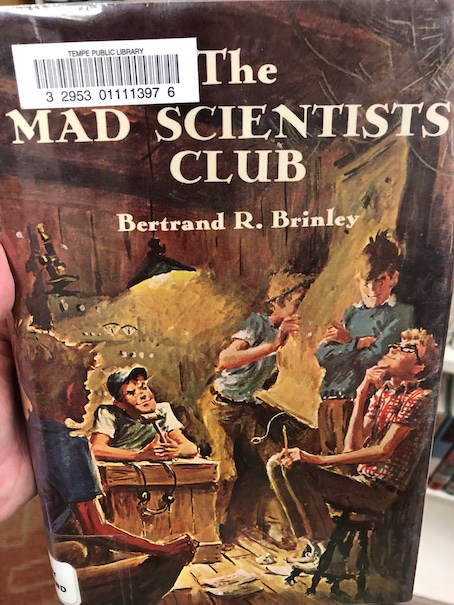
The Mad Scientists Club by Bertrand R. Brinley, 1965, 2001.

The Mad Scientists Club series is about a group of boys who like science and make things in their clubhouse laboratory. Their inventions are often part of pranks that they play on their town, Mammoth Falls, but the boys also use their inventions and skills to help people. People in town are aware that the boys pull pranks and stunts, but they are often unable to prove the boys’ involvement in particular pranks, and the boys typically keep the methods they use secret.

Henry is the idea man of the group, and the club’s rival is a former member named Harmon. Harmon’s cousin is still a member of the Mad Scientists Club, and Harmon likes to spy on them and pump his cousin for information so he can mess up their plans out of spite.

Each chapter in the book is its own short story about the club’s antics. Some of the stories originally appeared in Boys’ Life magazine in the 1960s. The stories are a good fit for Boys’ Life because some of the skills the boys use are skills that are taught in Boy Scouts, like what to do when someone is injured and how to tie different types of knots.

The stories reference scientific and mathematical principles, and the boys are methodical in their approaches to the problems in each story. The technology is old by modern 21st century standards (and so are some cultural references, like McGee’s closet), but the principles are sound. There are no projects for readers to do themselves in the book, but it does occur to me that these types of stories could work well with some included activities or nonfiction accompaniment.

The first story in the book was made into a live action tv movie by Disney, The Strange Monster of Strawberry Cove (1971), but the movie has different characters from the ones in the book. The Disney movie uses the same set of characters they used for their movie version of Secrets of the Pirates’ Inn (based on The Secrets of the Pirate Inn). The plot of The Strange Monster of Strawberry Cove is also very different from the original story because, in the Disney movie, the kids don’t know what the “monster” is at first and need to investigate it, whereas the boys in the Mad Scientist Club know exactly what the monster is in their story because they built it themselves. You can watch the movie online through Internet Archive, but unfortunately, I couldn’t find an online copy of the book.

Stories in the Book:

The Strange Sea Monster of Strawberry Lake

Dinky accidentally starts a town-wide rumor about a sea monster in the lake when he makes up a story about seeing a strange creature in the lake when he needs an excuse for arriving home late. His friends know it’s just a story, but they decide to play along and build a monster of their own out of canvas and chicken wire and scare people as a prank. Even though people in town are scared of the monster, the attention the town receives is so good for local businesses, the boys can’t bring themselves to stop their prank. Instead, they decide to make their monster more elaborate, and things start to get out of hand. How can they end the hoax while saving the town’s image and avoiding punishment?

Night Rescue

An Air Force plane explodes near the town of Mammoth Falls. The pilot escaped from the plane, but he’s now lost in the woods. The local authorities are searching for him, and the boys in the club want to help. The mayor doesn’t want the kids involved, knowing their usual pranks and stunts, but the Air Force colonel is willing to let them help, if they think they can, because he just wants his pilot rescued. The boys use a flare to determine which way the parachuting pilot would have drifted, and then, they calculate about how far he would have drifted to find him.

The Unidentified Flying Man of Mammoth Falls

The boys find an old department store manikin and keep it in their clubhouse until Henry gets the idea for how they can use it in an elaborate prank on the town’s Founder’s Day. They’re going to make the manikin fly!

The Secret of the Old Cannon

The town’s old cannon from the Civil War is a local landmark now. (We don’t know what state Mammoth falls is in, but there are statues of Confederate soldiers next to the cannon.) Years ago, the town filled the barrel with cement, so it can never fire again. Around the time that the cannon was filled in, there was a bank robbery in town, and some of the boys in the Mad Scientists Club think that the money might have been hidden in the cannon before it was filled with cement. The boys try to figure out how they can prove whether or not the money’s in there without removing all of the cement. Someone else also wants to know the answer to that, and the answer may be important to the upcoming race for mayor.

The Great Gas Bag Race

Henry has an idea for a new kind of balloon that he thinks will help the Mad Scientists Club win the balloon race, but the club’s rival, Harmon, is also entering the race.

The Big Egg

The boys are digging for fossils in the local quarry when they find a dinosaur egg! At first, they’re not quite sure what to do with it. They consider selling admission for people to come see it or maybe turning it over to a museum, but Henry announces that he has another idea. Henry wants to bury the egg in the ground and see if it hatches. It seems unlikely, but the other boys agree to try it. Then, when a couple of the boys go to check on the egg, they discover that it’s missing! They bring their friends back to look at it, and suddenly, the egg is there again! What’s going on? Did someone take the egg and then return it? Is this another one of Harmon’s tricks?

The Voice in the Chimney

One day, some of the boys in the club see Harmon throwing stones at an old, abandoned house in town while some girls watch him. Wondering what he’s doing, they get closer and hear him challenging the ghost that supposedly haunts the old house, trying to impress the girls with his bravery. The boys are disgusted because they know Harmon isn’t really that brave, and they hate seeing him show off for the girls. When they hear Harmon brag that he’s going to come back to the house at night, they tell the rest of their club, and the boys decide to put on a haunted house act of their own to scare Harmon. In the process, they also end up scaring the mayor and the chief of police!

Gone-Away Lake

Gone-Away Lake by Elizabeth Enright, 1957.

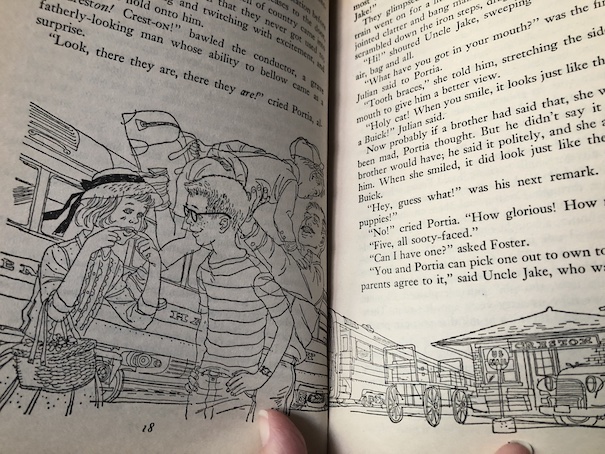
Eleven-year-old Portia and her six-year-old brother Foster are traveling alone by train to visit their aunt and uncle and twelve-year-old cousin Julian in the country for the summer while their parents are on a trip. Portia likes spending time with Julian because Julian is an amateur naturalist and tells her things about animals and birds. When Portia and Foster arrive, their aunt, uncle, and cousin tell them that their dog has had puppies. Portia is allowed to name them, and if her parents agree, she and Foster will even be able to keep one!

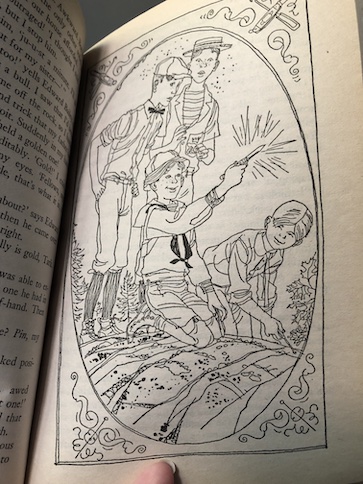
While Portia is out exploring the countryside with Julian one day, they find some garnets in a rock. They start chipping some out to take to Julian’s mother, and they find a carved inscription in Latin on the rock with the date July 15, 1891. They’re not sure what the Latin words mean. They figure out that part of the inscription refers to the Philosopher’s Stone, which was supposed to turn different substances to gold. Portia asks if this stone could be the real Philosopher’s Stone, but Julian says that’s impossible because they’ve been using knives to pry out the garnets, and they haven’t turned to gold. They continue to wonder what the inscription really means and why someone put it there.

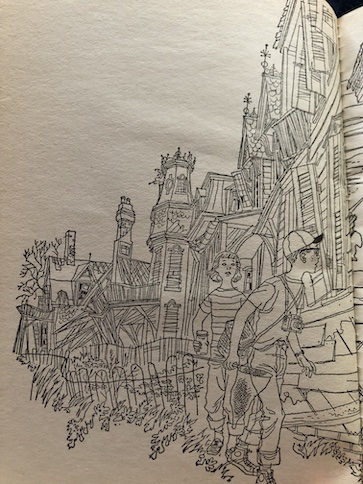
They explore the countryside further, getting lost. They aren’t too worried because they don’t need to be back soon. They follow a brook and find themselves in a swampy area. Strangely, they stumble over an old rowboat. Then, they spot a row of old, abandoned houses. The houses are in bad condition, but the kids can see that they were built in elaborate Victorian styles. The children wonder why those houses are there on the edge of swamp. Portia finds it a little creepy, but Julian wants to get a better look.

Then, the children hear a voice. Strangely, the voice is repeating an advertisement for medicine for indigestion. The children think it’s funny because no ghost would say something like that. Taking a closer look at the houses, they notice that one seems to be in better condition than the others that it has animals and a garden, so someone must be living there. Thinking about it more, Julian says that the swamp was probably once a pond or a lake, and that’s why it had houses and a rowboat. He hasn’t heard of a lake in the area, but he and his parents haven’t lived in the area for long. The children wonder who lives in the house and decide to find out.

They find an old woman in old-fashioned clothing, listening to a radio. The old lady is surprised to see them but welcomes them, saying that it’s been a long time since she has seen children. She invites them to come inside her house, and the children find themselves in a cluttered and chaotic parlor with each wall covered in a different kind of wall paper. The woman introduces herself as Minehaha Cheever.

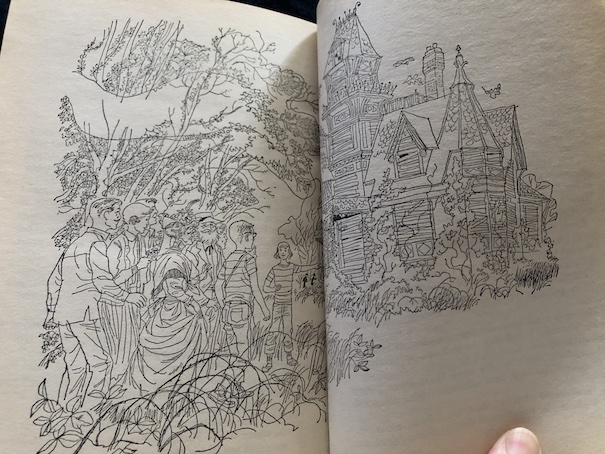
The children explain how they ended up there by coming through the swamp, and Mrs. Cheever says that they shouldn’t go through the swamp because there is a dangerous sinkhole there that they call the Gulper. She says that when it’s time for the children to go home, she’ll have her brother show them a better and safer way. Mrs. Cheever says that there used to be a lake there, and that her family and about a dozen others had summer houses there, but the lake largely dried up when a new dam was built. After that, the summer houses were abandoned, and many of them were vandalized. However, her father and another woman locked up their houses with the furniture inside, thinking that they would come back and move them, but they never did. The large and fancy old Villa Caprice is still untouched, but Mrs. Cheever says that she supposes that much of the contents is probably deteriorated. She says that the Villa Caprice gives her the creeps.

The children ask Mrs. Cheever why she’s there, and she says that she used to live somewhere else. After her husband died, she didn’t have much money, and she remembered that the house at the former lake was still there. Her brother, Pindar, also wanted to retire somewhere quiet, so they decided to go live in their family’s old summer house. There was enough furniture and old clothes left there for the two of them, and it suits them. They keep animals. Pindar still has their old car, so he can sometimes go into town for things they need. “Pindar” was one of the words in the inscription on the rock.

Pindar explains that he and his best friend when he was a kid, Tarquin (another of the words on the rock), were the ones responsible for the inscription on the rock. Tarquin was three years older than Pindar, but they were still close friends. However, they had a temporary falling out when Tarquin was 13 years old. Tarquin had gone away to boarding school for the first time, and the next time they met at their summer homes, Tarquin had brought a friend from his new school with him, Edward. Tarquin and Edward were putting on airs and showing off how sophisticated they were because they were 13 years old and knew so much more now that they had been to boarding school. Pindar felt bad about his old friend shunning him and treating him like a little kid, so he started hanging out with his other best friend, Barney. Then, Pindar had the idea of showing Barney the big rock with garnets stuck in it where he and Tarquin used to meet and hang out together.

When Pindar and Barney got to the rock, they discovered that Tarquin and Edward were already there, and the older boys said that they had claimed the rock for themselves. They called the rock the philosopher’s stone and wrote the inscription labeling it as the philosopher’s stone in Latin, which they had learned at their boarding school. The older boys said that the younger ones were too little to be philosophers, like the two of them. Pindar’s feelings were hurt all over again, and he told his father about the situation. Pindar’s father was amused by the older boys and their sophisticated philosopher talk. He said that there was no age limit on who could be a philosopher and explained to Pindar what a philosopher’s stone was supposed to be and how it was supposed to turn things to gold. Then, he suggested a prank that Pindar and Barney could play on the older boys, convincing them that the stone really did have the power to turn things to gold. The older boys were temporarily fooled by the trick. At first, Tarquin was angry about being tricked, but then, he had to acknowledge that he had provoked Pindar and that the trick was a clever one. Tarquin made up with both Pindar and Barney, and he added Pindar’s name and his own to the inscription on the rock. Pindar still considers Tarquin and Barney to be his best friends, and they still write letters to each other in their old age.

Julian and Portia are fascinated by the stories that Pindar tells about the childhood summers he and his siblings and friends spent at this now-vanished lake. Mrs. Cheever said that she loves having children around the place again, and she suggests that Julian and Portia could use one of the old houses that is still in reasonably good condition as a kind of clubhouse. Julian and Portia love the idea, and Pindar and Mrs. Cheever suggest that they use the old house where Tarquin and his family used to stay. It’s in disrepair, but it’s much better than some of the other houses. There is plenty of furniture in the attic that the children can use, too. The children decide to invite some other kids to join them, and they call their club the Philosopher’s Club, after Pindar and Tarquin’s old group of friends.

Julian and Portia invite some other local children to join the Philosopher’s Club and spent a magical summer exploring this abandoned community, picking blackberries, learning about local plants and their uses, and scavenging things from old houses and trying on the clothes from Pindar and Mrs. Cheever’s youth. The boys help Pindar build a bridge over the large sinkhole they call “the Gulper” after Foster falls into it and has to be rescued. When Julian and Portia’s parents meet Uncle Pin and Aunt Min (as they come to call Pindar and Mrs. Cheever) and come to see Gone-Away Lake, the adults also experience the magical, dream-like qualities of this place, and Portia’s parents consider plans that may make the children’s future summers magical.

The book is available to borrow and read for free online through Internet Archive (multiple copies – including a couple of copies of the sequel, Return to Gone-Away).

My Reaction

I remember a teacher reading this book or part of it to us when I was in elementary school, but I couldn’t remember much about the story except for the lake that had gone away and caused the town to be largely deserted. For some reason, I had thought this story was a mystery story, but it’s not.

In many ways, I think this is the perfect nostalgia book because a large part this story is about the nostalgia that the elderly brother and sister in the story have for the place where they used to have their childhood summer adventures, even though the place isn’t what it used to be. Through the stories that they tell the children and the children’s own adventures and explorations of this largely abandoned summer community, they begin building their own attachments to the place and their own nostalgic summer memories.

Because the story takes place in such a unique location, I think it would make a fun kids’ movie with a vibe of nostalgic summer adventure. Although, because the story is largely low-key slice-of-life and the flashbacks of Uncle Pin and Aunt Min to incidents in their youth, I can see that the story might have to be changed a bit to fit the usual movie format, focusing on one definite problem or a particular adventure to give the story its climax. I picture the kids and their Philosopher’s Club making it their mission to preserve this vanishing community, which fits with the way the original story goes, although the kids in the book enjoy the old community for the magic of its dilapidated state rather than wanting to fix it up and restore it to its former glory. I think they could lean into promoting the preservation of nature and the ecosystem of the area, with Julian in particular pointing out what makes this environment unique and how it has become home to animals and insects since the lake changed to a swamp and most of the people left. The Philosopher’s Club might connect with a local naturalist society, and they could build the bridge in the story together to make the swamp safer to traverse for nature lovers and bird watchers. Uncle Pin and Aunt Min could remain on the site as its caretakers. Perhaps, the kids might even find some old notes and drawings in one of the old houses that show some interesting aspects of how the environment has changed and some of the unique animals that make their home there. That didn’t happen in the book, but it would be a sort of environmentally-connected treasure the children could find.

Ruth Fielding at Briarwood Hall

Ruth Fielding

Ruth Fielding at Briarwood Hall by Alice B. Emerson, 1913.

Since Ruth and her friends have helped her Uncle Jabez to recover his stolen cash box in the previous book, Uncle Jabez has decided to send Ruth to Briarwood Hall, the boarding school that her best friend, Helen Cameron will attend, so the two of them can stay together. Briarwood Hall is an exclusive school, where the primary entrance requirements are academic records and teacher recommendations. Ruth has already graduated from the local school in her uncle’s town although she is a little younger than Helen, and she is ready for the high school level. Helen’s twin brother, Tom, will be attending a military academy close to the girls’ boarding school.

The three of them travel alone to their schools, without adult chaperones. They amuse themselves by seeing if there are other students bound for their schools traveling on the same train and steamboat they take to their boarding schools, but they can’t find any. However, they do see an interesting older lady with a veiled hat who attracts their attention because she looks doll-like and speaks French. For some reason, this lady seems greatly upset by a strange man with a harp who is part of a musical group entertaining passengers on the steamboat.

The mysterious French woman turns out to be the girls’ new French teacher at Briarwood Hall. She seems very nice to the girls when they are introduced to her as they’re riding in a coach to the school after they get off the boat. Mary Cox, a fellow student who is older than Ruth and Helen, rides to the school with the girls and the French teacher. On the way to the school, Ruth notices that Mary seems to oddly ignore the French teacher, speaking only to her and Helen.

Mary is a Junior at the school, and tells the girls about the school clubs. The two main clubs at Briarwood are the “Upedes” and the “Fussy Curls.” I was glad that Ruth and Helen thought that these sounded by strange names for clubs, too. Mary explains that they’re just nicknames for the official club names. The Upedes are members of the Up and Doing Club, a group of girls who like lively activities. There are other groups at school, like the basketball players, but the Upedes and Fussy Curls have a particular rivalry for members. Mary is a member of the Upedes, although, in spite of the groups’ rivalry for gaining new members, Mary strangely doesn’t invite Ruth and Helen to join her group and doesn’t seem to want to explain what the rival group does.

When the girls leave the coach, Mary says that she doesn’t like the French teacher because she’s a poor foreigner, and Mary doesn’t know why she’s at the school. (Mary sounds like she’s rather a snob.) Mary says that she thinks it’s strange that the French teacher never wears any nice clothes and doesn’t seem to have any personal friends or relations. (Yeah, definitely a snob toward someone who just seems a bit unfortunate, like it’s some kind of moral failing, not having nice clothes or personal connections to show off.) Helen says that the French teacher does have personal acquaintances because she seemed to know the harp player on the boat, something that seems to interest Mary. Ruth has the uneasy feeling that they shouldn’t have mentioned it, not knowing exactly what the teacher’s connection to the harp player is. Helen likes Mary, but Ruth has reservations about her friendship.

Mary Cox shows the girls where their dorm room is. Helen and Ruth are sharing a room by themselves. Another girl, a senior named Madge Steel, comes by to talk to the girls and invites them to a meeting of the Forward Club (known as the “Fussy Curls” because of its initials) that evening. Ruth wants to go to that meeting because Madge seems very nice, and the Forward Club includes members of the school faculty. However, Helen says that she’d rather attend the meeting of the Upedes that evening that Mary told her about. Helen thinks that they owe Mary their loyalty because she was the first to meet them and was helpful in finding their room. Besides, the Upedes have no teachers in their club, and Helen thinks that it sounds more exciting and free from supervision than the Forward Club. Ruth thinks that she would prefer to get closer to her new teachers and some well-behaved girls instead, and it’s the first major disagreement that the friends have. Mary talks Ruth into going to the meeting of the Upedes that evening because that was the invitation that they received first, but Ruth says that she won’t join any club officially until she’s had a chance to see the other girls involved and learn what the clubs are really like. Ruth’s stance seems to be the wise one as the school’s headmistress tells the girls that joining clubs on campus are fun but that they should beware of getting involved too much with girls who don’t take their studies seriously and waste their time, and they learn that Mary Cox’s nickname at school is “the Fox”, suggesting that she’s as sly as Ruth has sensed. Although Mary didn’t mention it to the girls before, she’s actually the leader of the Upedes.

That evening, the girls are introduced to other students, and at the meeting of the Upedes, the school’s very own ghost story. Briarwood wasn’t always a school. It used to be a private mansion, and a wealthy man lived there with his beautiful daughter. The wealthy man was the one who commissioned the creation of the fountain with the marble statue that still stands on the school’s grounds. Although people on campus say that nobody really knows what the statue of the woman playing a harp in the fountain is supposed to represent, the ghost story claims that the figure was modeled after the beautiful daughter of the mansion’s former owner. However, according to the story, the girl fell in love with the man who sculpted the statue of her, and the two of them eloped, leaving her father alone and sad. Rumor had it, though, that the girl and her new husband must have died somewhere after they ran away because people started hearing mysterious harp music at night on the grounds of the mansion. Eventually, Briarwood was sold, and the school’s founders, the Tellinghams, bought it, and sometimes, people still hear harp music on the school grounds. Every time something strange or momentous happens at the school, people hear the twang of the harp.

That night, Ruth and Helen become the targets of a frightening hazing stunt by the Upedes that seems to bring the ghost story to life, but when something happens that frightens even the hazers, it brings into question how much of the ghost story is really true.

The book is now public domain and available to read for free online in several formats through Project Gutenberg. There is also an audio book version on Internet Archive.

Spoilers and My Reaction:

I liked this story much better than the first book in the series because it is more directly a mystery story than the first book, and Ruth makes a deliberate effort to untangle some of the puzzling things happening at her new school.

It’s pretty obvious that there is a connection between the ghost story of the girl with the harp and the French teacher’s apparent discomfort at the suspicious harpist. Ruth finds out pretty quickly that the harpist from the boat is lurking around the school. That revelation explains the frightening happenings at the hazing incident, although it still leaves the question of the connection between the harpist and the French teacher. At first, I thought that it was going to turn out that there is some truth to the ghost story the Upedes told, but that actually has nothing to do with the real situation. In some ways, I felt like the real situation was a little to straight-forward and resolved a bit too quickly at the end, considering the build-up they’d had about it. It is interesting that, of the students at the school, only Ruth comes to learn the full truth of the French teacher’s secret. Even Helen doesn’t know what Ruth eventually discovers, partly to save the French teacher’s reputation and partly because Ruth and Helen’s friendship is suffering for part of the book.

Unlike newer series produced by the Stratemeyer Syndicate, characters in the older Stratemeyer series, including the Ruth Fielding series, grow, age, and develop their lives and personalities. In this book, when the girls go away to boarding school, the differences in Helen and Ruth’s backgrounds and personalities become more obvious. It leads them to clash in some ways, and they both worry about endangering their friendship with each other, but by the end of the book, each of the girls develop a greater sense of who they are and what they really stand for.

Helen is more familiar and comfortable than Ruth is with the traditional rituals of boarding school, even taking some glee in the mean hazing ritual of the Upedes, and she badly wants to fit in with the cooler older girls at school, willing to put up with their mean bossing to take part in their schemes for the fun and excitement. However, Ruth, is naturally more serious and shy and less accustomed to having things her way or telling others what to do anywhere she’s lived than the wealthy Helen. Ruth overcomes some of her shyness and learns to be more assertive as she stands up for herself and the other new girls at school, called “Infants” by the older girls. Ruth decides to refuse to join either the Forward Club, which has a reputation of being made up of girls who toady up to the school faculty, or the Upedes (which was initially founded as a protest group to the Forward Club, which is why most of the activities of their club involve breaking various school rules and instigating pranks), after experiencing their mean pranks and bossiness. Instead, she takes a joke of Helen’s seriously and decides to form a secret society of her own. She talks to some of the other new girls at school, and they feel the same way they do, that they don’t want to choose between either the Upedes or the Fussy Curls and would rather have a club of their own, where they won’t be dominated or hazed by the older girls. Helen gets upset at Ruth starting this new group because she thinks that they won’t gain any new friends or have any real fun or really be a part of this school if they don’t join an already-established group. Helen thinks that a group of new girls would look ridiculous because they wouldn’t know what to do with their club and will look like a group of babies. However, Ruth realizes that this is nonsense. There are enough interested girls among the newcomers to give them a good group of friends and they can think of their own things to do where they can be the leaders. Ruth turns out to be more of a leader and Helen more of a follower, and Ruth is also more creative, thinking of new possibilities in life instead of stuck with someone else’s creation. I wish that the book had gone into more details about what Ruth’s club actually does. She and some of the other girls periodically go to meetings of their club, but they don’t say much about what they do at the meetings.

Helen and Ruth temporarily go separate ways at school. Helen joins the Upedes, and Ruth and some of the other new girls carry out the plan to form a new club that they call The Sweetbriars. The other girls who help form The Sweetbriars are as independently-minded and creative as Ruth and like the idea of forming their own school traditions. Helen criticizes Ruth for being a stickler from the rules because she doesn’t want to take part in school stunts that might get her in trouble, but although Helen is more inclined to break rules in the name of fun, she is still less independent in her mind than Ruth because her rule-breaking is done following the dictates of the Upedes and the traditional school stunts of having midnight feasts with other girls in their dorm rooms. They are not stunts of her own creation or particularly imaginative, and while she is brave about school demerits, she is not very brave about what other people think about her. After the Upedes have treated Ruth very badly and spread rumors about her, Ruth finds the courage to tell Helen how hurt she is that she continues to be friends with people who have treated her so badly when she wouldn’t have put up with people mistreating a friend of hers. She doesn’t ask for an apology and says that she’s not sure that one is even warranted, but she wants Helen to know how she feels. Helen has felt like hanging around Mary Cox has made her act like a meaner person, and she feels like she can’t help herself in Mary’s company. Understanding how Ruth really feels reminds Helen that she risks damaging her relationship with her best friend if she doesn’t do something about her behavior, and when Mary is ungrateful and lies to Helen after Ruth and Helen’s brother help save her life during a skating accident, Helen begins to see Mary for what she really is.

In the second half of the book, the Mercy Curtis from the first book in the series reappears. In the first book, she spent most of the time being bitter because she had a physical disability that prevented her from walking, and she was overly sensitive about how people looked her. However, at the end of the first book, Mercy received some treatment from a surgical specialist that has enabled her to regain her ability to walk. She still walks with crutches, but her spirits have improved now that she is able to move more easily on her own, without relying on her wheelchair. Because she had previously spent much of her time alone, studying, she qualifies for admittance to Briarwood and decides that she would like to join her friends, Ruth and Helen. When Mercy comes to the school, she is still sharp-tongued, although less bitter about herself. She rooms with Ruth and Helen and joins the Sweetbriars. She adds a nice balance to Ruth and Helen’s friendship. Ruth gets to spend some time with Mercy and the other Sweetbriars when Helen is with the Upedes, and Mercy is very serious about her studies, so she insists that her friends not neglect theirs, keeping then on task in the middle of their social dramas.

As a historical note, there is a place in the story in, Ch. 22, where the book describes Ruth as wearing a sweater, defining it as if readers might not know exactly what a sweater was, calling it “one of those stretching, clinging coats.” The reason for that is that sweaters were actually a relatively new fashion development for women in 1910s, although men had worn sweaters before. Women often wore shawls in cold weather before sweaters became popular, but sweaters left a woman’s arms more able to move freely than a shawl would allow, as this video about women’s clothing during World War I from CrowsEyeProductions explains.

The Green Toenails Gang

Olivia Sharp, Agent for Secrets

The Green Toenails Gang by Marjorie Weinman Sharmat and Mitchell Sharmat, 2005.

Olivia’s best friend, Taffy, who left San Francisco and moved to Carmel just before the beginning of the first book in the series, writes a letter to Olivia and invites her to come for a visit.  In her letter she mentions that there is a club in Carmel that she doesn’t want to join.  Olivia senses that Taffy is upset about something and decides to visit her for the weekend.

When Olivia visits Taffy, Taffy tries to persuade her at first that nothing is bothering her, but Olivia correctly guesses that the club she was talking about is one that refuses to let her in and that she’s upset about it.  Taffy calls the club “stupid,” and Olivia says that “lots of clubs are stupid. Like, if three people have green toenails they form a green toenails club and leave everybody else out.” (I like the way Olivia puts things.)  Taffy is inspired by what Olivia says, and she suggests that they should really form a green toenails club and exclude everyone, including the members of the other club.  Olivia thinks that the idea is interesting, but the problem is that there is only the two of them (three, if they can persuade Olivia’s chauffeur to join them) and that when Olivia goes back to San Francisco, Taffy will be the only member of her club in Carmel.

Olivia questions Taffy about the members of the other club and what they do.  Taffy says that a lot of it is secret, but the members are all girls her neighborhood, and they all wear shirts with their first initials on them.  Olivia and Taffy begin to spy on the girls to learn more about them and to see how they can help Taffy to fit in with their club.

When they see the girls riding bicycles, Olivia thinks that they must be a bicycle club.  She buys Taffy a bicycle and teaches her how to ride it.  Riding a bike works to get the other girls’ attention.  Olivia and Taffy ride their bikes past the other girls and stop to talk to them.  The other girls seem friendly enough, and they invite Taffy to go riding with them later.  However, to Olivia’s surprise, one of the club members calls her later and invites her to join the club, not Taffy.  The girl, Nettie, tells her that they aren’t really a bicycle club and that only members are allowed to know the true purpose of the club and the conditions for joining.  Olivia fits the conditions, but they’ll only explain it to her if she agrees to join.  Nettie also says that they all like Taffy but that they’re “not ready for her” and that they’ll be one step closer to inviting Taffy if Olivia joins.  What is this club really about, and how will Olivia joining help Taffy to join?

I guessed, even before Olivia did, that names are important in the club.  The girls were very interested when Olivia told them her name, and there is a reason why they all wear shirts with their first initials on them.  The five girls in the club are: Jasmine, Katrina, Leah, Millicent, and Nettie.  In order to get Taffy in, Olivia has to point out that Taffy’s last name is Plimpton.  (Get it?)  There, I was a little surprised because I had expected that the name Taffy would turn out to be a nickname and that Olivia would tell them that her real name is Patricia or something.  I had forgotten what Olivia said her last name was.

I thought that Olivia made some good points about the nature of clubs and exclusivity.  The reasons for a lot of exclusive groups are really silly and arbitrary because the main point of those group is just to be exclusive, not to fulfill any other purpose.  That this particular club rides bikes could have been their main purpose, and that would be a purpose that actually involves doing something, but their real requirement for joining is much more arbitrary and is mostly based on random chance, making it very difficult for them to ask new people to join even when they want to invite them.  Taffy would have had exactly the same problem if her name had been Abigail or Wendy.  I’m not really sure what they would have done if she had been Jessica or Linda.  Either they’d have to allow some duplication, or they might say that they couldn’t have her at all.

Olivia says, “I hate clubs. All those secret handshakes and pins and meetings and all that rot.” To Olivia, the whole thing is just silly, and she thinks that they should just be friends with people without all the silly secrecy and ritual.  I liked that stuff more when I was a kid myself, and I remember forming clubs with varying degrees of secrecy with kids in elementary school, but to tell the truth, none of them did very much or lasted very long because they had little other purpose to them besides just being a club and the routine of meetings with all the trappings that annoy Olivia take more effort to maintain than they’re worth. The best solution to having a lasting club would probably be to give the club a purposeful activity or set of activities that all of the members could enjoy and that would allow them to recruit new members easily.  If this club eventually focuses more activities like bicycling, it would be likely to last longer and leave them open to more members than they currently have whenever they want to add them.

The book is currently available online through Internet Archive.

The Secret of Terror Castle

The Three Investigators

TITerrorCastle#1 The Secret of Terror Castle by Robert Arthur, 1964, 1992.
In the first book in the series, Jupiter, Pete, and Bob form the Three Investigators, an organization dedicated to solving all kinds of mysteries.  It was particularly Jupiter’s idea. They have been friends for a long time, and they used to have a club dedicated to solving puzzles. Now, they’ve decided that they want to solve more complicated problems and mysteries. Jupiter has won the use of a Rolls Royce and chauffeur for a month by entering a contest at an auto rental agency, so he thinks that it would be a good time to get started because they will have transportation to anywhere in the city.

Jupiter also has an idea for their first case, something that will help them get publicity for their new investigative organization. There is a rumor that a director, Reginald Clarke, is looking for a genuine haunted house to be the setting of his next movie. Jupiter manages, through some clever trickery, to get an interview with Reginald Clarke and persuades him to introduce this account of their first case if he and the other investigators can find a genuine haunted house right in town. Clarke takes them up on it, not because he thinks they will succeed, but because he sees it as the only way to get Jupiter to stop doing an unflattering impersonation of him.

Jupiter, however, is confident that they will be successful because he already knows the perfect place to investigate. Terror Castle is a large mansion that was built years ago by an old actor who was in silent films. All of his movies were scary ones, and since his death under mysterious circumstances, no one has succeeded in staying in the castle very long. Strange apparitions have been seen there, and anyone who tries to spend the night there is overcome by inexplicable terror. As far as Jupiter is concerned, all they have to do is prove that the castle is really haunted, and that means that the Three Investigators must visit it themselves.

In the original books, the director that Jupiter tries to find a real haunted location for was Alfred Hitchcock.  Alfred Hitchcock introduced the early books in the series and played minor roles in some of them, and The Three Investigators capitalized on his reputation.  When the series was re-released, however, Alfred Hitchcock was replaced by a fictional director, and his role in later books was taken by a fictional mystery author named Hector Sebastian.  In the re-released version of the first book, Reginald Clarke refers the boys to Hector Sebastian at the end of the story so they can help a friend of his to find his missing parrot, which leads directly into the subject of the next book.

The haunting in this story (as with others in the series) has a reasonable explanation, not a supernatural one.  In fact, one of the things that I always found memorable about this book was the explanation of how the inexplicable feelings of terror people experienced were created using sound waves which could be felt but which were beyond the normal range of human hearing.  I’m not sure whether the book was completely correct about the science behind this technique, but I have heard about sounds being used to create odd or even harmful effects on human beings in real life.  As for the reasons behind the haunting, they concern the original owner of the castle and the life he lived.

This is one of the books in the series which was made into a movie, The Three Investigators and the Secret of Terror Castle, but the movie was very different from the original book.  In the movie, the owner of the castle was an inventor, not an actor.  Part of the plot also concerned Jupiter’s deceased parents and a mystery that they had been investigating.  Jupiter’s parents were not part of the original book at all.  A villain who appears in some of the other books in the series also makes an appearance in the movie, although he had nothing to do with this particular story in the original series.  Overall, I don’t recommend the movie for fans of the original series.  The changes don’t seem to be for the better, and I think people who remember how the original story was and liked it would be disappointed in the movie.

There are multiple copies of this book available to borrow for free online through Internet Archive, both the original version with Alfred Hitchcock and the updated one.

Queen of the Sixth Grade

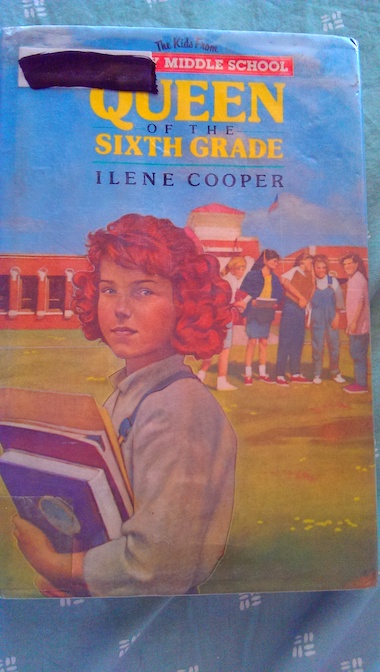
QueenSixthGradeQueen of the Sixth Grade by Ilene Cooper, 1988.
This is part of The Kids From Kennedy Middle School series.

Robin Miller has been best friends with Veronica for years, although it hasn’t always been the easiest friendship. Veronica can be exciting. She gets lots of interesting ideas and her apparent confidence in herself can be contagious. Unfortunately, she isn’t really a nice person, not even to her closest friends. She likes to call Robin “Curly” because of her hair, which Robin hates, but she tolerates the nickname for Veronica’s sake. The way Veronica teases and bullies other people makes Robin uncomfortable, too, but Robin hesitates to speak up about it both for the sake of maintaining her friendship with Veronica and because she doesn’t want to get on Veronica’s bad side herself. However, now that the girls are in sixth grade, things are about to change.

Veronica has decided to start a kind of club with some of the girls in their class called the Awesome Kennedy Girls (or AKG for short). Of course, Robin is a member. Veronica chooses the other members herself from the girls in the class that she thinks are the coolest, at least by her standards.

Then, Veronica tells Robin that she has a crush on Jonathan Rossi, a cute boy in their class. Robin likes him herself. In fact, she’s had a serious crush on him for some time, although she’s never told Veronica about it. It’s been Robin’s good fortune that she and Jonathan have been assigned to be partners for an oral book report in class. While working on the project together, Robin and Jonathan discover that they have some interests in common and start becoming friends. However, somewhat like the love triangle in Cyrano de Bergerac, Veronica asks Robin to use her influence with Jonathan to tell him that Veronica likes him and wants him to be her date for the Halloween party she’s planning. Because she always does what Veronica wants, Robin does attempt to do so, even though it pains her. But, Jonathan really likes Robin and misunderstands what Robin is saying, agreeing to be Robin’s date for the party. That’s when Robin’s real problems begin.

Veronica is used to getting what she wants and having people do thing her way. Instead of accepting Jonathan’s decision that he likes Robin completely on his own, she decides that Robin has “stolen” Jonathan from her. Immediately, Robin goes from being Veronica’s best friend to her worst enemy. Worse still, Veronica starts spreading terrible rumors about Robin to the other girls in class. Soon, no one in class wants to be friends with Robin, and the other girls in the AKG go out of their way to make life miserable for her with their bullying.

At one point in the story, Robin remembers back to when she and Veronica first became friends in the third grade. Before she met Veronica, she was friends with Gretchen, a fat girl who is now one of Veronica’s favorite people to bully. While Robin is on the outs with Veronica and shunned by most of the rest of the girls in class, she tries to become Gretchen’s friend again out of loneliness, but to her surprise and shame, Gretchen tells her that she is no longer interested in her friendship. Gretchen correctly realizes that Robin is still too much attached to Veronica and the way she does things. There were many times when she could have stood up to Veronica and defended Gretchen, but she chose not to. Gretchen points out to Robin that if Veronica decided that she wanted to be friends with her again, she’d be off like a shot after Veronica, dropping Gretchen and forgetting all about her like she did when they were younger. Robin is ashamed when she realizes that everything Gretchen says is true. In becoming friends with Veronica, Robin lost part of the nice person she used to be. Although she is not as mean as Veronica, Robin isn’t completely nice and, in some ways, has become rather shallow. If getting dumped and bullied by a former best friend hurts, it hurts even more when Robin realizes that she partly deserves it because of the kind of person she’s been and the type friendships she’s chosen.

However, there is hope for Robin in realizing the mistakes she’s made. She comes to admire Gretchen for her ability to put up with the bullying she’s endured and for continuing to stand on her own, not come crawling to the first person who offers her friendship. Gretchen is sometimes lonely and she did once fall for a trick of Veronica’s when she pretended to offer her a place in the AKG, but Gretchen still respects herself, in spite of the bullying she’s endured. In a way, she has better self-esteem than Robin does. Gretchen has her problems, but she doesn’t define herself solely by her relationships with other people, like Robin does at first. When Gretchen can’t find friends who appreciate her, she simply does the best she can without them, pursuing her own interests by herself. In a way, that attitude becomes the solution to Robin’s problems. At her mother’s urging, Robin begins pursing new interests in life.

Robin’s mother correctly points out that Robin needs to develop her own interests for her own sake and to look for friendship beyond her cramped little circle of “cool” kids. There are many other options for good friends around her, but Robin has been stuck in a mindset that hasn’t allowed her to see them. By getting out, finding new interests, and learning to be her own person again after spending the last few years mainly being Veronica’s sidekick/puppet, Robin develops new confidence and new insights on herself and the people around her.

Robin is successful at finding new friends when she takes a drama class. She even connects with another girl from her school who was neither part of the in-crowd nor the bullied ones in her class, Sharon. For a time, Robin still feels badly about what happened to her friendship with Veronica, but the more time they spend apart, the less Robin misses her and the more she begins to see Veronica, her behavior, and the problems in Veronica’s life for what they are. In the process, she begins to recover a bit of her old self, the nicer, freer person she was before she became Veronica’s friend.

When a drama project allows Robin to meet a celebrity, she becomes something of a celebrity in her class. Suddenly, people who had shunned her before are anxious to be her friend again, making Robin feel awkward because she knows their motives are self-serving, not honest or sincere. At the same time, Veronica’s controlling behavior and the one-upmanship she encouraged in her little club backfire on her. The other girls get fed up with her behavior, and Veronica is put in the uncomfortable position of appealing to Robin for help. With her former best friend and tormentor at her mercy, Robin has to decide if she will use the opportunity to take revenge or if she will go forward with her efforts to be a better person and use her new popularity for good instead of evil. There is power in popularity, but there is also power in knowing who you are and what you really stand for.

The book is available to borrow and read for free online through Internet Archive.  I’d also like to give special kudos to this book for mentioning other books that Robin likes, including Where the Wild Things Are, The Wolves of Willoughby Chase, and The Westing Game (the book Robin and Jonathan use for their book report, which they both like).

The Mystery of the Midnight Visitor

MorganMidnightVisitor

The Mystery of the Midnight Visitor by John and Nancy Rambeau, 1962.

One day, Gabby is going fishing on the beach at Morgan’s Landing. Miss Wellington, a family friend, owns the property along with the old mansion known locally as Morgan Castle. She has given permission to Gabby to fish there, but Gabby is surprised to meet a stranger on the beach as well. This stranger is an old man who says that his name is Admiral Lavendar. When Gabby tells him that he’s on private property, the old man moves on. Then, Gabby spots smoke coming from Morgan Castle!

When Gabby goes to investigate, he finds that someone has shut Miss Wellington in a closet and that there is a fire in the bedroom that had once belonged to Mrs. Morgan, the former lady of the house. He gets Miss Wellington out of the closet, and they call the fire department. The firemen put out the fire and tell Miss Wellington that it was apparently caused by a dropped candle.


Morgan Castle was once owned by the wealthy Morgan family that gave Morgan Bay its name. However, the house has become shabby over the years. Miss Wellington inherited the house after Mrs. Morgan died because there were no other Morgans left. However, she doesn’t actually live in Morgan Castle because she has a house of her own. People have been saying that perhaps the house should be torn down because of its poor condition. Miss Wellington doesn’t have much money and says that she would find it difficult to manage the upkeep of the house.

Gabby and his brother Bill and sister Vinny don’t want to see the old beautiful old mansion destroyed, and there is still the mystery of who dropped the candle and why to consider. A small silver box that Gabby found on the beach turns out to be a jewelry box that once belonged to Mrs. Morgan. Mrs. Morgan wasn’t particularly interested in jewelry, but she did own one particularly fine emerald necklace that was never found after her death. Perhaps the person who dropped the candle was looking for it!

To give Morgan Castle a new purpose and prevent it from being torn down, the kids convince Miss Wellington to let them turn it into a Historical, Boat, and Tennis Club, dedicate to celebrating local history and providing entertainment for local people.

At first, the mysterious Admiral Lavendar looks like a likely suspect for the person sneaking around Morgan Castle, but he turns out to be very helpful to the children and their plans. There is another stranger in town who has the knowledge to seek out Mrs. Morgan’s lost necklace.

MorganMidnightVisitorThief

This book is part of a series that were once used as classroom readers.

The Codebreaker Kids

CodebreakerKidsThe Codebreaker Kids by George Edward Stanley, 1987.
Dinky Lakewood likes living in Washington, D.C. because it’s such an interesting place, and he loves the stories about spies and government intrigue that appear in the local newspaper.  His father, who deals in plumbing supplies, thinks that all this sneaking and spying is awful and threatens to move his family somewhere else when he hears about another spy being caught, but Dinky decides that he’s going to get in on the action because he has a special skill that the spies really need.

The newspapers say that the reason why the latest spy was caught was because he and his associates were so bad at cryptology — they either picked codes that were way too hard or way too easy to decode.  Although Dinky’s parents don’t like spies, they did give him a book about secret codes for his birthday: The Complete and Total Book of All the Secret Codes That Have Ever Been Devised and That Ever Will Be Devised.  Dinky has worked his way through all of the codes in the book, so he feels qualified to open his own Secret Code Service, helping spies to encode and decode their secret messages.

Dinky recruits his best friend Wong and a girl he knows from school named Lulu to be part of his organization.  Lulu is a little strange, but Dinky knows that she’s always wanted to be a spy, so he figures that she would be good for dealing with real spies.  Wong is more interested in the money because he wants to get a new bike.

Their first clients are a little strange.  One of them is an elderly lady, Emma, who wants to stop her younger sister from snooping in her diary.  She turns out to be a repeat visitor because her sister turns out to have a talent for breaking codes.  The next client is Boris, the world’s worst Bulgarian spy.  He admits that he’s horrible with codes because he cheated at spy school, copying off of a cute female spy.  Dinky and his friends help him, although they start to question whether they’re doing the right thing since he is obviously spying on their country and they might be guilty of treason.

They decide that Boris is protected under their pledge of confidentiality, but soon, Dinky is approached by someone from the State Department, who turns out to be tracking Boris the Bulgarian.  Can Dinky and his friends continue their service, helping both sides at the same time?  Also, will they ever figure out a code that Emma’s sister can’t break?

The premise of the story is a little corny, with spies and government agencies going to a kid’s backyard clubhouse for help with some pretty simple codes, but the book is a lot of fun and doesn’t take itself seriously.  It’s a good introduction to cryptology for children, starting out with very simple Caesar ciphers (basic substitution codes) and gradually moving on to more difficult ones, like Trithemius’s Square Table.  There are points in the story where readers are given the chance to decode messages before Dinky does, and in the back, there are some additional secret messages to decode using the codes presented in the book.

The book is currently available online through Internet Archive.  There is a sequel to this book, but unfortunately, I don’t have it and never read it.

The Mystery Off Glen Road

Trixie Belden

tbglenroad#5 The Mystery Off Glen Road by Julie Campbell, 1956.

When their clubhouse is damaged by a storm shortly before Thanksgiving, the Bob-Whites realize that they will have get some money to fix it soon before the really bad winter weather comes. The Wheelers’ gamekeeper has recently quit, so they offer to patrol Mr. Wheeler’s game preserve for awhile to earn some extra money.

While Trixie and Honey are patrolling, they find a dead deer. They don’t tell anyone about it right away because their dogs, Patch and Reddy, were with the carcass when they found it. If the dogs killed the deer, they might be killed because people would be afraid that the dogs would go wild and start killing more animals. However, Trixie later finds signs that a human butchered and hauled away the carcass. There seems to be a poacher in the wood, and the dogs are innocent of the deer’s death, but how can Trixie and Honey tell the others about it when they tried to cover up the crime in the first place?

To make the situation more complicated, Trixie’s brother, Brian, wants to buy a used car from Mr. Lytell but doesn’t feel that he can spare the money until the clubhouse is fixed. To keep Mr. Lytell from selling the car, Trixie gives him an expensive ring that Jim gave her as security for the car. Since Trixie normally isn’t interested in jewelry at all, she pretends that she wants to wear it to impress Honey’s cousin, Ben, who is visiting for Thanksgiving. Trixie doesn’t actually like Ben at all, but it was the only excuse she could think of for getting her parents to take the ring out of her safe deposit box in the first place. Trixie’s reluctant efforts to fake a crush on Ben and act more girly add humor to the story.

The book is currently available online through Internet Archive.