Meg Mackintosh Mysteries
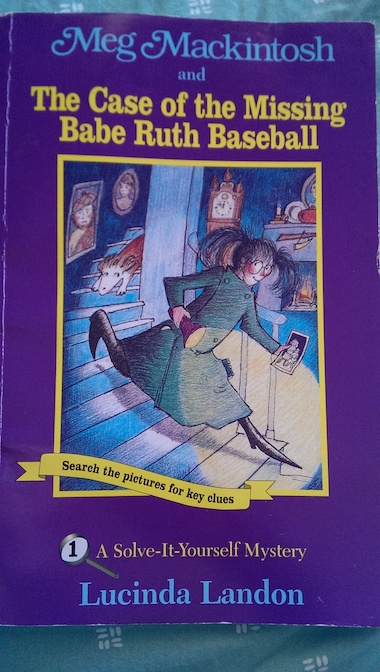
Meg Mackintosh and The Case of the Missing Babe Ruth Baseball by Lucinda Landon, 1986.
 This is the first book in the Meg Mackintosh series, and it was the first mystery story that I ever read, when I was about seven years old. It started a life-long love of mysteries!
Meg’s grandfather shows Meg and her friend Liddy some old family photographs and tells them about the time when his cousin Alice took his prize possession: a baseball autographed by Babe Ruth. Alice was a bossy girl who always liked to tease him, and so she created a kind of treasure hunt, challenging him to solve it in order to get the baseball back. Unfortunately, he could never figure out the clues and still doesn’t know what happened to the baseball.
Meg’s brother, Peter, has a Detective Club, but he refuses to allow Meg to join, saying that she needs to prove that she can solve a mystery. Seeing this as her chance, Meg decides that she’s going to solve this old puzzle and find the Babe Ruth baseball! However, she also has competition from Peter, who thinks that he’s the better detective and tries to send Meg off in the wrong direction.
The book is currently available online through Internet Archive.


My Reaction
All of the books in the Meg Mackintosh series allow readers to try to solve the mysteries along with Meg, stopping periodically to ask them if they’ve noticed a clue that Meg has noticed or if they know what the significance of a clue is. There are pictures to help, and readers are invited to stop and study the details before moving on. I think this is a good way to introduce children to puzzle-solving and help them develop critical thinking skills and an ability to notice details. I would recommend adults reading these books, or at least the first one or two along with children, so they can discuss the stories and clues with them, helping them spot clues as they begin to get used to the format of the books.
This is an excellent series for introducing children to the mystery genre for the first time! When I was young and just learning what mysteries were, I was fascinated to discover that I already had all of the knowledge I needed to solve this mystery along with Meg because all of the clues to Alice’s treasure hunt had to do with nursery rhymes. If you can recognize the rhymes in the book, you’re well on your way to solving the mystery!
 Key to the Treasure by Peggy Parish, 1966.
 Together, the three children quietly work on the clues, following each to the next. They hope to surprise their grandfather with the solution to this old family mystery. But, can they?
 Jestress's Forgotten Books and Stories