Coat of Many Colors

It’s fall, and a little girl needs a new coat. Her family doesn’t have much money, but someone gives her mother a box of rags, which her mother sews into a patchwork coat for the girl.
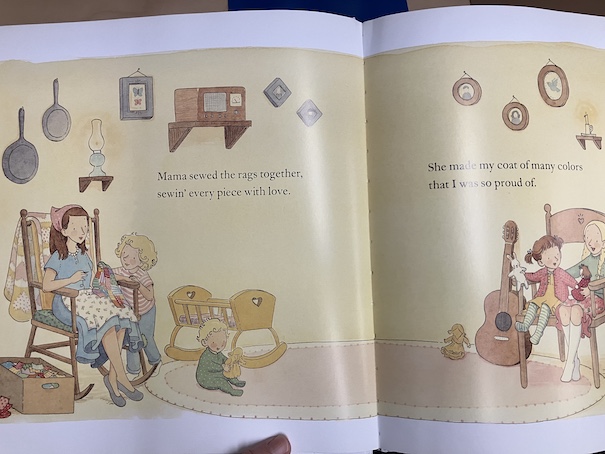
As she sews, the mother tells the girl the Bible story of Joseph and the Coat of Many Colors. The little girl loves her new coat, associating it with the Bible story and her mother’s love for her.
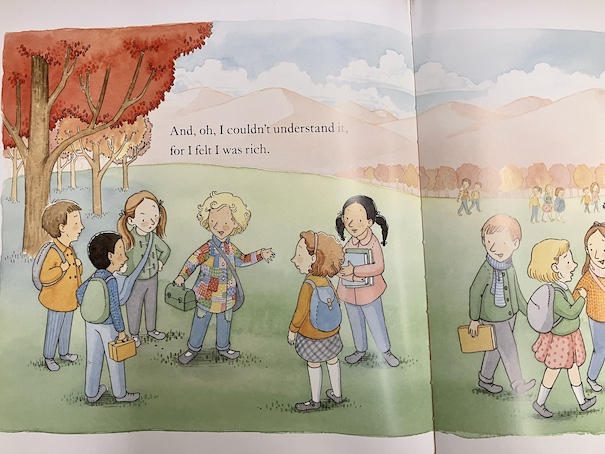
When the girl goes to school in her new coat, other kids tease her because having an improvised coat made from other people’s rags is a sign of poverty. The other kids know that her mother made her that coat because she couldn’t afford to buy one.
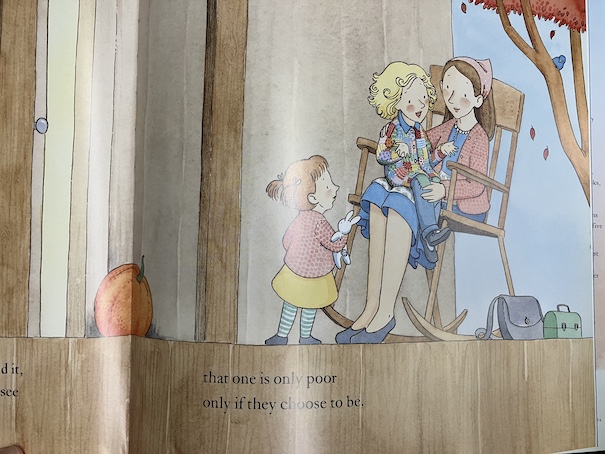
However, the girl looks at the situation differently. Rather than focus on what her family couldn’t buy, she loves what they gave her. The coat is a sign of her mother’s love and sewing skill. Whether a person is rich or poor depends not just on what they have but on their feelings about what they have. When a person looks at the good points of what they have rather than what they don’t have, they feel rich.

The reason why I put multiple copyright dates for this book is that the story has been printed in multiple versions. The text of the book is from a song called Coat of Many Colors written by Dolly Parton in 1969 (listen on YouTube). The text is literally the words of the song, and it’s fun to listen to the song and read the book together! The other two copyright dates are because the story has been printed as a picture book more than once, with different illustrators. The illustrations I show here are from the latest version, from 2016.

There’s a very similar story to this one that I reviewed earlier, The Rag Coat, which is also a picture book about a girl with a patchwork coat who is teased by other kids at school. The Rag Coat was published a few years before Coat of Many Colors was first published as a book, but years after Coat of Many Colors was published as a song, and a note in The Rag Coat acknowledges the song as part of the inspiration for the story. The story in The Rag Coat doesn’t take quite the same turn as Coat Many Colors because it doesn’t relate the girl’s coat to the Bible story and because the way the girl in that book reconciles herself and the other students at school to her rag coat is pointing out that the rags that make up her patchwork coat came from their families and that she knows the stories behind each of them, the stories of her classmates’ lives. It’s a little longer story with a little more depth and backstory behind the coat, but I like Coat of Many Colors for its lighthearted approach to the idea of what makes a person rich or poor and depths that are more implied than stated.

The connection to the story of Joseph and the Coat of Many Colors is important because, in the Bible story, Joseph’s colorful coat was a sign of his father’s love for him, and in this picture book, part of what makes the patchwork coat made of rags important to the girl is the fact that her mother made it for her and it’s a sign of her mother’s love. There is a section in the back of the book where Dolly Parton explains that the story is based on a real incident from her life, and that’s why the song she wrote about it has always been special to her. She also wants people to consider what it really means to be rich or poor. In both the story and in real life, Dolly’s attitude was focusing on the richness of what she had (like an original coat, handmade by a loving mother) rather than the things she couldn’t afford, and that’s what she recommends to other people.

Actually, it occurs to me, too, that in the early 21st century, a bespoke patchwork coat might actually be considered both more stylish and more valuable than any ordinary coat bought off the rack from any store. It’s the stuff of cottagecore fans and Etsy aficionados! Sewing is a time-consuming hobby that requires skill and can cost considerably more than buying a cheap coat at Walmart. People who can do it really well can charge a fair amount for their work. The only ways to get something like that these days are either to do it yourself, know someone who’s willing to make it for you, or be willing to pay for it. (I wrote this in July 2025, and I checked the going rate for a patchwork coat on Etsy. It was about $100 at that time. The cheapest options were about $84 dollars, and some were more than $200, with some vintage coats priced at more than $300.)

I find this hilarious, that what the kids who went to school with Dolly Parton back in the day teased her about as a sign of poverty would cost quite a lot to buy from someone else these days, with older “vintage” ones costing the most of all. With the rise of cottagecore and other pop culture influences, some of their grandkids would probably have begged to own something like that. (Remember when Harry Styles wore a patchwork sweater, and a bunch of people made their own versions or sold patterns to make them? I do!) Their families might not have the skill to pull off making such a thing themselves, which may be yet another way of looking at who’s poor and who’s rich. Remember this the next time someone’s wearing something that seems a little odd or improvised. It might turn out to be ahead of its time, a smarter use of money, a unique demonstration of real skill, and a far more interesting or timeless fashion statement than something that’s more generically trendy that will look cringy in yearbook photos in 5 to 10 years. Take the long view!

Dolly Parton said that the original “coat of many colors” that her mother made for her when she was a child wore out long ago and was probably remade into something else, like a quilt, because her family never wasted anything. However, there is still a picture of young Dolly wearing the coat, and after she wrote her song about it, her mother made another one similar to it, as best she could remember, to show what it was like. This replica coat, made by her mother, is the one on display in Dolly’s Chasing Rainbows Museum. In 2015, this story was made into a television movie, although the movie had some darker themes in it, with the family coping with the death of Dolly’s baby brother.
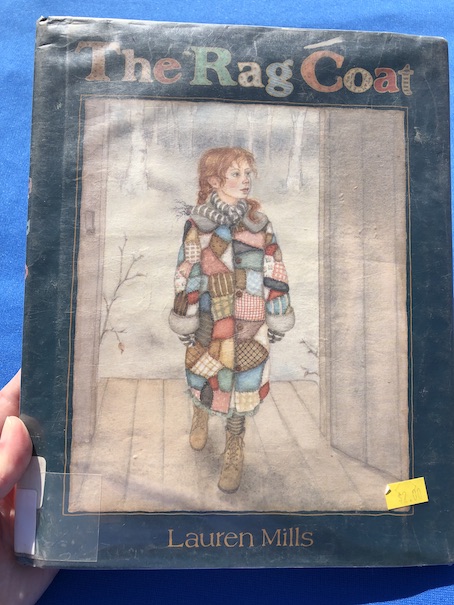
The Rag Coat

Minna is a poor girl, the daughter of a coal miner.  Her father has been ill with the miner’s cough, so Minna has to help her mother to make quilts that the family can sell for money.  She wants to attend school, but she can’t because she is needed at home and her family can’t afford a warm coat for her when winter starts.  It’s too bad because Minna really wants to make some friends her own age, and she would meet other children at school.  Her father says that he will find a solution to the problem, but he dies before he can.

After Minna’s father’s death, some of the other women in the community come to the house to work on making quilts with Minna’s mother.  When the women say that the quilt pattern they are using is named after Joseph’s Coat of Many Colors, Minna wishes again for a coat.  When the other women, who are mothers themselves, realize that Minna cannot go to school until she has a coat, they decide to make one for her.  They don’t have much money, but they do have plenty of quilting scraps.  They decide to make a new, quilted coat for Minna out of their old scraps.

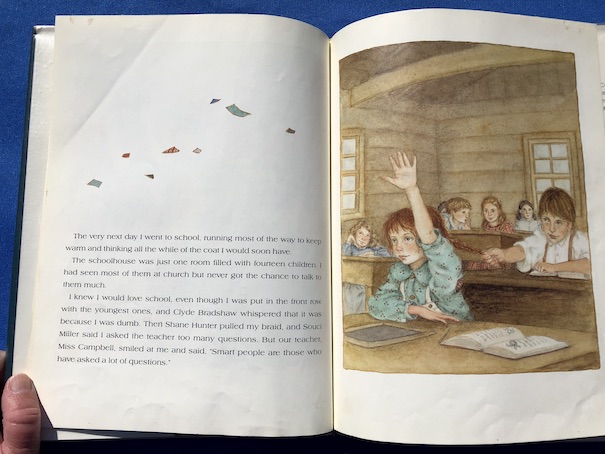
Minna starts going to school and does well, although she gets some teasing because, as a new student who has never been to school before, she has to sit with the youngest children, and Shane pulls her braid.  Something that Minna particularly likes at school is Sharing Day (what my school always called “Show and Tell”), where students are given the chance to show special things to the class and talk about them.  Minna decides that when her coat is ready, she will show it to the class during Sharing Day.

As the coat is being made, Minna admires all of the beautiful colors of the cloth scraps in the coat and adds a piece of her father’s old jacket as well.  Each of the other scraps in the coat also has a story that goes with it.  The cloth pieces come from old clothes and blankets that people in the families of the quilting mothers have used, and they memories attached to them.  The mothers tell Minna all of the stories as they work on the coat, and Minna loves it.

However, when Minna wears the coat to school for the first time, the other kids make fun of her for wearing rags.  Minna is really upset and runs away into the woods.  After thinking about it, Minna remembers what her father said about how people really need other people, and she decides to go back to school.  There, she tells the other students that the rags in her coat are actually their rags, and she begins reciting the stories that go with them.

One of the scraps is from Shane’s old blanket from when he was a baby.  He was born so small that everyone was afraid that he’d die, but the blanket kept him warm, and he later carried it around with him until it fell apart.  Shane is happy, seeing the scrap of his favorite blanket again in Minna’s coat.  Everyone else gathers around Minna, looking for their scraps in the coat and listening to the stories behind them.  Each of the scraps in Minna’s coat is like an old friend that none of them ever thought they’d see again.  The other children apologize to Minna for their teasing and Minna says that friends share and that it took all of them to make her coat warm.

The book doesn’t say when this story is supposed to take place, but based on the children’s clothing, I think it’s about 100 years ago or more. It doesn’t say exactly where this story takes place, either, but a note on the dust jacket says that it takes place in Appalachia. The author said that she was inspired by Appalachian crafts that she learned from the women in her family and a patchwork coat that she wore as a child. However, years later, the author revisited this story and rewrote it in a longer version, and some of the explanations that accompany the new version of the story elaborate more on the background.

The author rewrote this story in a longer, novel form called Minna’s Patchwork Coat (2015). In the back of that book, the explanation behind the story mentions that the year of the story is 1908. It also discusses some cultural references and songs included in the expanded version of the story that were not part of the original. It states that the inspiration for this story came not only from the author’s experiences but from a song written by Dolly Parton, Coat of Many Colors, which was made into a picture book itself after the publication of this book.

There is also an expanded retelling of the story called Minna’s Patchwork Coat, and I’d like to talk about some of the differences. For example, the ending message of the story is slightly changed in the longer version, or at least the emphasis of the moral is different. The original book emphasized how much “people need people” and how the goodwill of many people (in the form of the quilting mothers and their hard work and scraps, cast-off from all of their children) changed Minna’s life. They emphasize it at the end, talking about how Minna’s coat is the warmest of all of them and that it took a lot of people to make it that way. However, in the expanded version, Minna also explains that when she started school, she liked her classmates better than they liked her because, thanks to their mothers’ stories as they made her coat, she already knew who the other children were, but none of them really knew anything about her. The message of the expanded version is that it is important to learn others’ stories to learn who they really are and to become friends with them.

Actually, I don’t like the second version of the story as well as the original. I thought that the moral and the story were stronger when the focus was on how people benefit from having relationships with other people because people can do great things when a lot of people contribute a little. Remember, it took a lot of people to make Minna’s coat warm because each of them contributed at least one scrap to it and others took the time to put them all together. It was their stories that made the coat special, more than just an ordinary coat. The expanded story has that element, too, but more emphasis is placed on Minna needing to share her story with the other children to win their respect and approval. I didn’t like the notion that Minna needed to win their approval by telling her story. Also, this story takes place in a small mining community. I find it difficult to believe that the other kids wouldn’t basically know her story already. Her mother knows their mothers. Their families see each other at church before Minna goes to school. The disease that took her father’s life isn’t terribly unusual for coal miners, and probably, a number of the other children are the children of coal miners as well. It seems to be the major industry in the area. Minna’s family might be more poor than the others’ since her father’s illness and death, but I don’t see why their circumstances would be so different and incomprehensible to people who must have seen her and her family around and who knew them from church or through their parents’ associations. One thing that small towns and communities are known for is everyone knowing everyone else and their business, so why didn’t they all know Minna’s story already? Even if the quilting mothers didn’t talk about helping to make the coat for Minna, the other kids should have known about the family’s money circumstances and the tragic death of Minna’s father. I don’t see why the other kids would have known so little about her or thought that she was so unusual.

The expanded version of the story also features a Cherokee midwife and a biracial friend for Minna who did not appear in the original story. This friend, Lester, is also something of an outcast among the other children, and Minna and the stories from her coat help the other children to be more accepting of him as well. It’s a nice thing, I guess, but it felt a little artificial to me because I knew that it wasn’t part of the original story. I hesitate to criticize it too much because the basic message of the story isn’t bad, but I guess that the way the second version came out just doesn’t have the same feel to me. The author put things into it that weren’t in the original, and with that change in emphasis on the ending, it makes the story and characters feel a little less natural to me now. I often feel the same way when I see a movie version of a story that adds things that weren’t in the original book.

The Purple Coat

PurpleCoat

The Purple Coat by Amy Hest, 1986.

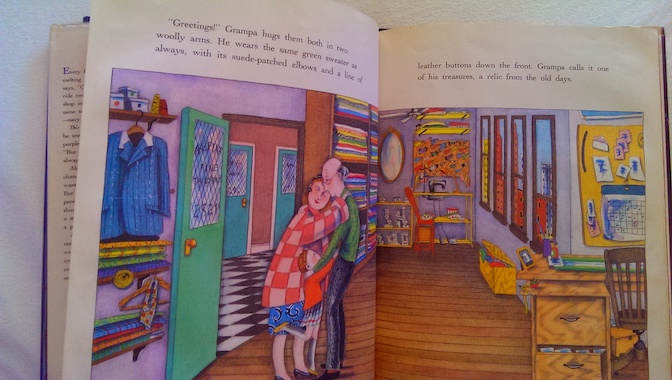
Every year in the fall, Gabrielle and her mother travel to the city to visit her grandfather’s tailor shop. While her mother shops at other stores, Gabby and her grandfather have lunch together (Gabby always eats the same kind of sandwich), and her grandfather makes her a new coat. Gabby always gets the same kind of coat, and it’s always navy blue.

PurpleCoatTailorShop

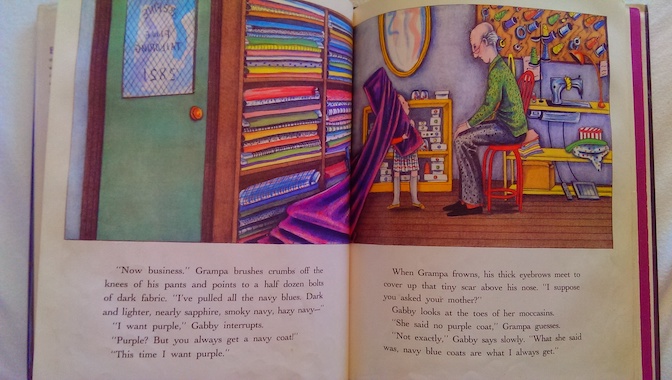
However, this year, Gabby wants something different. She wants a purple coat! She also wants it in a different style than her other coats, and she wants it to have a hood. At first, her mother and grandfather can’t believe that she really wants something so different from what she usually gets, and they point out that navy coats are classic, but Gabby is insistent.

PurpleCoatRequest

Gabby worries that her mother won’t let her get the coat that she really wants, but her grandfather remembers that when her mother was little, she once wanted something really unusual herself: a tangerine-colored dress. Sometimes, people do want to do different things, just to have a change and try something new. He also thinks of a way to give Gabby what she wants while allowing her to go back to her classic navy when she feels like it. Gabby’s new coat is reversible!

This is a Reading Rainbow book.  It is currently available online through Internet Archive.