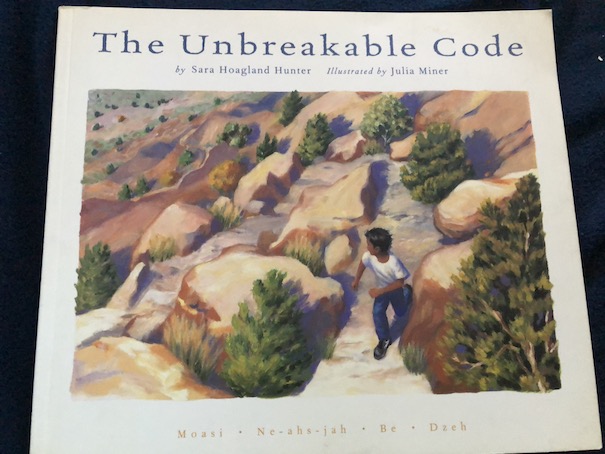
The Unbreakable Code by Sara Hoagland Hunter, illustrated by Julia Miner, 1996.
A young boy, John, is upset because his mother has recently remarried, to a man from Minnesota. Now, John is faced with the prospect of moving to Minnesota, and he doesn’t want to go. He would much rather stay with his grandfather on his farm on the Navajo Reservation. His grandfather points out that he’ll return in the summer, but that hardly seems good enough. Then, his grandfather tells him that he’ll be okay because “You have an unbreakable code.”
John asks what his grandfather means by that, and he says that the Navajo language is the unbreakable code. John worries that he’ll forget how to speak Navajo, but his grandfather says that he never did even though he had to attend a government boarding school at a young age and that the language saved his life during World War II. John’s grandfather was a code talker.
John’s grandfather tells John the story of how he became a Code Talker, starting with when he was at boarding school. The purpose of the government “Indian Schools” was to assimilate Native Americans into white American culture. They were known for forcing their students to abandon traditional clothing, cut their hair, take English names, and speak only English. John’s grandfather describes having to chew on soap whenever he was caught speaking Navajo. He was only allowed to return home during the summer to help his family with their sheep and crops.
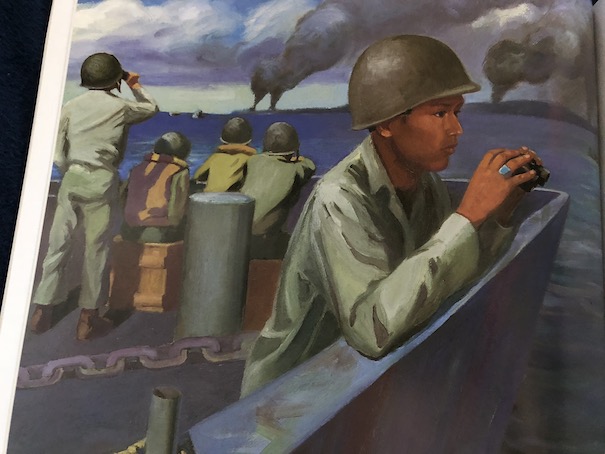
Then, when he was in his teens, during World War II, he heard an announcement on the radio that the Marines were looking for young Navajo men who could speak both English and Navajo. Seeing it has a chance to escape, he ran away from school and enlisted. After life at a harsh boarding school, the military marches and drills were no problem, and all of the Navajos already had wilderness survival skills.
After they had completed basic training, they were told that they were needed for a secret mission in the Pacific. The Japanese had intercepted American radio transmissions and broken the codes they were using. The Marines wanted Navajo speakers because the language was almost unknown outside of the United States, not many non-Navajos had ever learned it, and at that point in its history, the language had not been recorded in writing, so there was no way that the Japanese could research it and learn it. The Marines and code talkers developed a system of code words in Navajo and military terms to use, so it wasn’t as simple as just speaking the language plainly. The system was highly effective.
John’s grandfather goes on to tell John about how bloody the war was and how his life was constantly at risk. Once, another American soldier even mistook him for a Japanese spy because he didn’t know what language he was speaking. Fortunately, one of his friends intervened and saved his life.
The code was never broken during the war, and John’s grandfather eventually made it home safely. However, the code talkers were not hailed as heroes because, for many years, the government wanted to keep the code a secret. No one was allowed to talk about it. John’s grandfather was glad to return to a peaceful life on his farm.
His grandfather’s story gives John the courage that he needs to face moving to a new place. After all, his grandfather had been to far more frightening places and faced them with courage. Knowing his family’s history gives John a new sense of his own identity and the knowledge that his identity and language will remain with him wherever he goes.
This book is available to borrow and read for free online through Internet Archive.
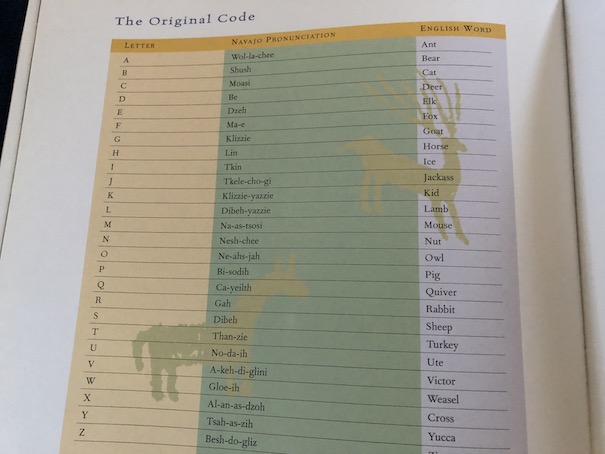
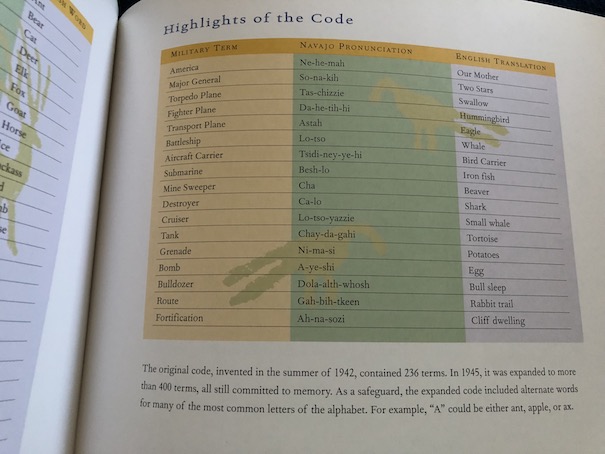
Even though this is a picture book, it isn’t really a book for very young children. There are descriptions of the blood and violence of the war that would be more appropriate for older children. There is a brief note from the author at the beginning of the book that explains a little about World War II and code talkers, and at the end of the book, there are charts that demonstrate how the code worked. This book is an a good way to introduce students to the topic of code talkers if they have never heard of them before.
In modern times, there is a written form for the Navajo language, and since I grew up in Arizona, the colleges I attended had classes in Navajo for those who wanted to study the language. I used to see the books for the classes in the school book stores, although I never studied Navajo myself. I met one of the code talkers once when he came to speak at our college. I believe that there are a few who are still alive at the time of this writing.






 Key to the Treasure by Peggy Parish, 1966.
 Together, the three children quietly work on the clues, following each to the next. They hope to surprise their grandfather with the solution to this old family mystery. But, can they?
 Jestress's Forgotten Books and Stories