Alvin’s Secret Code

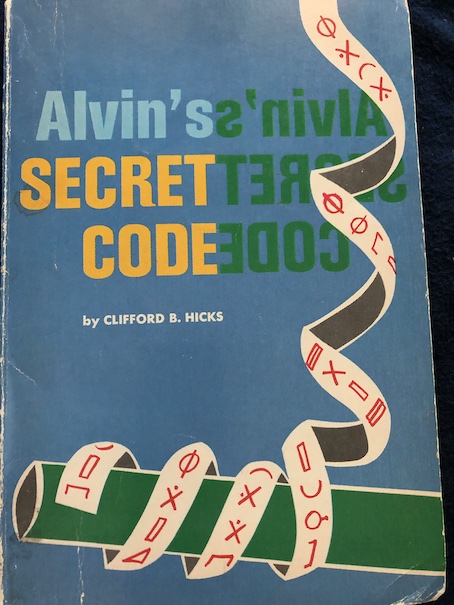
Alvin’s Secret Code by Clifford B. Hicks, 1963.

This book is part of the Alvin Fernald series.

Alvin has been reading a book about spies, and now, he and his best friend, Shoie (a nickname, his real name is Wilfred Shoemaker), are playing at being spies. One day, as the boys are walking home from school, Shoie stops to pick up another bottle top for his collection, and he finds a scrap of paper with a strange message on it. The words in the message don’t make any sense, and it looks like it’s some kind of secret code.

When Alvin gets home, his mother insists that he clean his room before he does anything else. Shoie helps him, and Alvin’s little sister, Daphne, insists that she wants to help, too, because she wants to see what the boys are doing. Daphne is fascinated by the things her older brother does and always wants to be included. When Daphne finds out that they’re being spies and have found a secret message, she also insists that she wants to be a spy and look at the message with them. They let her see the message, but they insist that she can’t be a spy because it’s dangerous and “work for men.” (That attitude comes up in mid-20th century kids’ books, especially ones for boys. I’d just like to point out here that, while dealing with spies would actually be dangerous, too dangerous for a young kid like Daphne, the fact is that both Alvin and Shoie are only twelve years old, so technically, they don’t count as “men”, either.) At first, the kids think maybe the message is meant for a secret Russian spy ring targeting the nearby defense plant. (This book was written during the Cold War, so that would be one of the first possibilities they would consider.)

Alvin comes to the conclusion that they need to investigate Mr. Pinkney, a relative newcomer to their town, because they found the message near his house, the message mentions an oak, and there’s one growing nearby. Alvin also thinks that they might need some help to break the code in the message, so he suggests that they visit Mr. Link, a WWII veteran who was also a spy during the war. He’s now an invalid who has a housekeeper who takes care of him, but he could still advise them about what to do with the mysterious message. Although the boys tell her that she can’t be involved with what they’re doing, Daphne still tags along with them when they go to see Mr. Link.

When the kids ask Mr. Link about his time as a secret agent during the war, he calls spying a “dirty, dirty business” but “something that must be done”, saying that he’s glad that it’s all over now. However, he’s perfectly willing to talk about secret codes and ciphers. Mr. Link has even written a couple of books on the subject. This story is a nice introduction to codes and ciphers for kids because it explains some of the terms and how codes and ciphers work. As Mr. Link points out, much of what people think of as secret codes are actually ciphers. The difference is that ciphers are actually secret alphabets that can be used to compose messages. When Mr. Link asks them if they’re trying to compose a cipher themselves, the kids tell him about the secret message and their suspicions that there could be a spy in their town.

Mr. Link doesn’t reject the possibility that there could be a spy in the area, but he tells them that they’re wrong to suspect Mr. Pinkney of being a spy because Mr. Pinkney is a friend of his, and he knows him very well. For a moment, Alvin wonders if they should suspect Mr. Link too, but Mr. Link anticipates the thought and says that he can prove that he’s trustworthy by telling them more about Mr. Pinkney and breaking the code for them. Mr. Link explains that Mr. Pinkney was lonely when he first came to town, and that’s how the two men started playing chess together regularly. Mr. Pinkney owns a factory that makes electronic devices, like transistor radios and intercoms, and one day, he told Mr. Link that he had a problem with his business. He suspected a business spy of trying to intercept his messages to his product distributors in Europe, and he needed a way to make his messages more secure. Naturally, Mr. Link suggested using a code, and he recognizes the coded message the kids found as one that Herman Pinkney sent to his distributors. Mr. Link shows the kids how each word in the strange message stands for another word or concept. Only someone who knew what the code words were supposed to mean would be able to read it.

Alvin is a bit embarrassed about jumping to the wrong conclusion, and Mr. Link says that he’s learned a couple of important lessons from this experience. First, you shouldn’t jump to conclusions about people if you don’t know them very well, and second, people who are full of tricks and deception are easily confused when they encounter straightforward honesty. In other words, while Alvin was spinning imaginative spy tales in his head, he overlooked the possibility that there could be a more innocent explanation. Alvin is still embarrassed, but he takes the lessons to heart, and Mr. Link tells them more about codes, how they have been used in history, and how codes are around them all the time, every day.

I liked Mr. Link’s explanations about how codes aren’t just for spies. He says that codes are used for all kinds of communications where only certain people are meant to read and understand messages. He explains about the product codes on things that the kids buy and wear everyday, showing them how to read the size codes on their shoes. Codes can indicate where and when products were made, and we still use product codes for that purpose in the 21st century. I used to work in a textbook store, and we used the codes on textbooks to tell which edition of a book students needed or whether a student needed just the textbook or if they needed books that came bundled with other, supplemental materials. Mr. Link says that ordinary people can sometimes figure out what product codes mean by studying them and looking for patterns that they recognize, like dates or sizes.

Since this book was written in the 1960s, they don’t talk about computers or the Internet, but that’s a major use of codes in the 21st century, and anybody can study and learn computer coding. Computer programming involves “coding” because, like with the other codes that Mr. Link describes, programming languages are also codes, using certain words and symbols to represent concepts that not everybody needs to read in order to use a computer, but which the computer can interpret so it knows what the programmer and user want it to do. Communications and transactions over the Internet also involve cryptography to protect the users’ information, using algorithms to convert a sender’s plaintext message to ciphertext to conceal its true meaning from any third party who might try to read the message and then back into plaintext so the intended recipient can read it. Codes really are around us all the time, even when we’re not fully aware of them or paying close attention to them.

The kids are fascinated by Mr. Link’s stories about how codes were used in history and the unusual methods people used to send secret messages, like writing them on someone’s head and then letting their hair grow out and cover it. He also shows them scytales, round pieces of wood that can be used for reading secret messages. The message would be written on a long strip in what appears to be jumbled letters. The message only makes sense when the strip is wrapped around the scytale so that the letters will align in the proper order to be read. That’s what’s shown on the cover of this book, although the picture also shows a message written with code symbols.

It’s all fun and games until a woman named Alicia Fenwick shows up in town with a puzzle that puts the kids’ abilities to the test. She comes to see Alvin’s father in his professional capacity with the police, looking for a man named J. A. Smith. Miss Fenwick explains an incident that happened to her family during the Civil War. The Fenwicks used to own a Southern plantation with slaves. (Daphne says that she doesn’t like the part of the story about the slaves, and Miss Fenwick says she doesn’t either although her great-great grandfather was apparently kind to his … which is what they all say, isn’t it? More about that in my reaction section below.) During the Civil War, her great-great grandfather was an old man. All the young men went away to fight in the war, but he stayed at home. When there were rumors of marauding bandits, he got worried that the plantation with would be a prime target for them with all the young men gone. He enlisted the help of a former slave he had freed before but who was still a friend to help him hide the Fenwick family’s valuables. They put everything they could into a chest and buried it. Unfortunately, when the bandits came, they forced the former slave, Adam Moses, to reveal the location of the chest by threatening to kill his young son. After they dug up the chest, they took Mr. Moses prisoner and forced him to help them take the chest with them further north. Eventually, Mr. Moses escaped from the bandits after they tried to kill him, and he wrote a letter to the Fenwicks saying that he was now in Indiana and that the bandits had forced him to help them rebury the chest. He said that he would try to retrieve the chest and return home with it, but sadly, he was later found murdered close to Riverton, the town where the children now live, probably killed by the same bandits who took the chest. However, the leader of the bandits was also killed shortly after that, so they never enjoyed their ill-gotten gains. The treasure chest was never recovered. The story was passed down in the Fenwick family for generations as an unsolved mystery until recently, when Miss Fenwick received a letter from J. A. Smith asking her for any information she might have about about the treasure. She told this person about the letter from Mr. Moses but didn’t hear from him again, so she’s trying to trace J. A. Smith and find out what he knows about the treasure.

Sergeant Fernald, Alvin’s father, says that there are people in town with the last name of Smith but nobody who has the initials “J. A.”. However, the kids say that Miss Fenwick’s story might explain some of the stories told by local kids about an area outside of town called Treasure Bluffs. Rumor has it that there was a treasure buried there years ago, although nobody knows exactly why or where. The kids start to think that the story really points to the location of the Fenwick treasure, but the bluffs cover a lot of territory, and before they can really search for the treasure, they have to find a way to narrow down the search area.

The kids’ new lessons in code-breaking pay off when they spot a man at the local library using the code books that Mr. Link donated. The strange man is trying to break a message that will reveal the secret hiding place of the Fenwick treasure. Can Alvin and his friends figure out who the man is and break the code themselves before he does?

The book ends with a section explaining more about codes and ciphers. One of the codes they explain is the pigpen cipher, which is a popular one for children and appears in other children’s books. This book says that it was used in the Civil War, which is true, but it’s actually older than that.

The book is available to borrow and read for free online through Internet Archive.

My Reaction and Spoilers

There are some elements in this story about boys thinking that they’re more capable than girls, like in the way that Alvin and Shoie talk to Alvin’s little sister, but Alvin also acknowledge, to his irritation, that sometimes Daphne thinks even faster than he does. When Mr. Link is explaining the size codes on the children’s shoes, 8-year-old Daphne actually catches on a little faster than 12-year-old Alvin and comes up with the answer to a problem Mr. Link poses before Alvin’s “Magnificent Brain” does. I liked that touch of imperfection on Alvin’s part and the acknowledgement of Daphne’s abilities, which help thwart any overconfidence or arrogance that Alvin might have about his “Magnificent Brain.”

I appreciated that, although Alvin is clever, he’s not a complete genius, and he is noticeably fallible. He’s not good at everything, like some heroes of children’s books. He is terrible at spelling, and when he tries to write that he’s a cryptographer, he spells it “criptogruffer,” which doesn’t inspire professional confidence. Daphne knows the correct spelling and spells it aloud for him, much to Alvin’s embarrassment and annoyance. Alvin is still pretty clever, and he breaks the final code that reveals the hiding place of the treasure, but it is nice that he’s not unbelievably perfect.

The final code in the book is easy enough that anybody could actually break it with minimal effort. I spotted it pretty quickly because there’s something that I always do with secret messages in books, and it often pays off. (There are one or two things in the Harry Potter books that this works on as well.) I’m not going to spoil it here, although I’ll give you a hint: When I was a kid, I read and liked a book about Leonardo Da Vinci.

I genuinely enjoyed the parts of the story about codes, which run through most of the book. Mr. Link is full of helpful information, and the section at the back of the book with more information about codes is a nice introduction to some basic types of codes. As I said above, I like the practical applications of the lessons, showing kids how they can read parts of product codes, if they understand what to look for. That’s a useful skill, and you can use similar techniques to interpret the expiration dates on food products when they’re only stamped with a code instead of an explicit date.

Like Daphne, I also didn’t like the part of the story about slaves. This book was written during the Civil Rights Movement, which makes its takes on the Civil War, slaves, and race interesting. The author wants to tell a story that bears on the Civil War, so he has to address this is some fashion, and he tries to get pass the uncomfortable issue of families owning slaves as quickly as he can to get to the adventure part of the story.

The Civil War and its associated legends of battles, ghosts, secret passages, hiding places, hidden treasures, and secret messages are staples of American children’s literature. It’s completely understandable because the Civil War was a major event that shaped life and history in the US, it was a traumatic event whose impact is still felt even into the 21st century, and it gave rise to many stories and legends that have further helped shape our culture. The idea of treasures hidden during the war and later forgotten is a popular trope and so are coded messages that point to secrets from the past. I’ve seen these tropes used in other children’s stories, like The Secret of the Strawbridge Place, The House of Dies Drear, and Mystery of the Secret Dolls, and they’re always fun. However, stories with a Civil War backstory can sometimes feel a little uncomfortable because they’re almost impossible to tell without involving slavery in some way because slavery was at the heart of the war.

When Daphne says that she doesn’t like hearing about slavery and owning slaves, they deal with the issue quickly, with Miss Fenwick saying she doesn’t like it, either, and adding that her great-great grandfather was apparently nice about it, and then continuing with the story. As I said above, yeah, right, that’s what they all say. In stories (and sometimes real life), when there are characters whose families owned slaves and plantations, they almost always add the idea that, while slavery was bad and horrible and slaves were mistreated elsewhere, this particular family was special and treated their slaves with kindness, and it was almost like they were one big, happy family. Yeah, right. To be honest, I probably would have accepted that as a kid and let it pass. As an adult, I’m not letting it pass without at least a few pokes in the side as it goes.

The idea of the grateful slave or ex-slave who loves the family he served has been a trope since the anti-Tom literature of the 1850s. I can’t swear that no slave never felt any kind of affection for members of the family that owned them because human nature is varied and unpredictable, surprising relationships can spring up, and if all else fails, Stockholm Syndrome also exists, so I suppose it could happen, but at the same time, I just don’t buy that whole “slavery is bad, but my family is kind, and our slaves loved us” type of narrative. Even if a given slave-owning family was “above average” in treatment of slaves, that doesn’t mean that they were “good” so much as “less bad” among a group of people perpetrating something bad. The “average” in this situation is so bad that there’s quite a lot above that level that still wouldn’t qualify as good, whether the descendants of slave owners believe those old school textbooks promoted by the United Daughters of the Confederacy (some of which were still in use during the Civil Rights Movement – children are shaped by the things they read and the people who gave them those books, and history is not written by the “winners” but by the people who write) or have really thought this through all the way or not. (You don’t have to take my word for it. You can hear about it from people who actually were slaves.) I suppose I can suspend my disbelief about this fictional family for the sake of this kids’ story, which is mostly about secret codes and a treasure hunt and spends little time on racial issues, but I’d just like to point out that I definitely do have a sense of disbelief about this that requires suspension.

Of course, I can see why the author had to include it. In order for us to be invested in the treasure hunt and care about the Fenwick family getting their fortune back, we have to believe that they’re great people, sort of removed or distanced from the responsibility for choosing to own slaves (“in those days, it was accepted throughout the South” is the only explanation we’re given), who were as kind to their slaves as possible, so kind that at least one loved them so much that he gave his life attempting to recover the family fortune, and that they will now use the treasure for some beneficial purpose. (We are told that the family now operates an orphanage, which badly needs money, although we’re also told that one of their former charges has since become a US Senator, so you’d think he could help raise some.) If we didn’t like this family at all, we might see the fortune that came from their plantation as the ill-gotten goods of exploiting someone else’s labor, its loss as poetic justice, and the profit from its recovery as probably something that should either go toward the slaves who did the work on the plantation or maybe some public cause, like a museum or something.

We are told that Adam Moses’s son survived the experience with the bandits, escaped from them when his father was captured, and was adopted by another family, but we are not told anything further about his descendants. While I was reading the book, I halfway wondered if a descendant of the Moses family would surface with some important clue to the situation and get some acknowledgement, but that doesn’t happen. Instead, there’s a person who’s related to one of the bandits, who thinks that he has a right to the treasure because his ancestor stole it from someone else. The characters in the story scoff at that logic, but when I consider the full context of the situation, it makes me think.

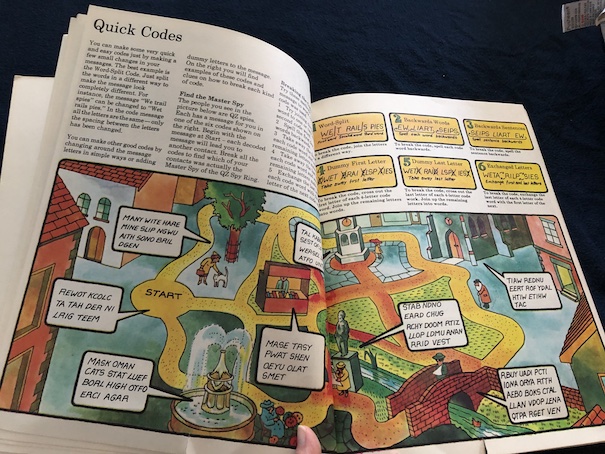
The FunCraft Book of Spycraft

The FunCraft Book of Spycraft by Falcon Travis and Judy Hindley, 1975, 1976.

This book is a part of a series of craft and hobby books that was first printed in Britain. It’s meant for kids who like to play at being spies, and it teaches kids how to use secret codes make disguises, and other tips and tricks for being a spy.

Much of the book focuses on different types of secret codes and techniques for sending secret messages. In fact, I would say that there is more about secret codes and messages than there is about anything else, but what they have to say is interesting. Most of the codes in the book are fairly easy, which is good for kids who are just beginning. The book explains popular codes like the pig-pen code and gives instructions for making simple code machines, like the popular code wheels for alphabet shifts. However, I enjoyed the variety and creativity of other codes and methods of sending secret messages, like the code based on music notes and the suggestion of using clocks or watches to represent semaphore figures.

The book not only explains some well-known and standard codes and signals, like semaphore and Morse code, but also explains how to adapt these codes in new ways. Morse code messages could be shown in a sequence of knots on a rope or in the placement of objects in a picture.

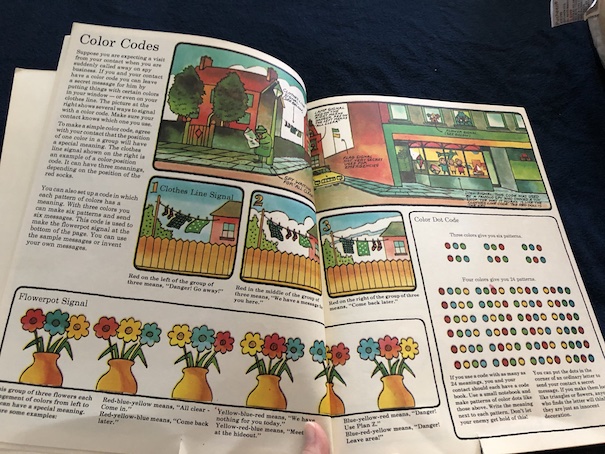
Some methods of sending secret messages don’t rely on codes so much as pre-arranged signals, like the placements of certain objects or arrangements of certain colors. These objects or color patterns might look completely ordinary to most people, but they can have special meanings to those who understand what each signal stands for.

The book also covers other topics related to spies, like how spy rings are organized, where messages can be concealed, types of equipment spies use, how to make maps, how to spot and interpret clues, and how to set traps.

There are also disguise tips. The book points out various ways that people can make themselves look different, like changing the way they comb their hair, changing their hair color, or trying to make themselves look older or fatter. One piece of advice about changing your skin tone by rubbing talcum powder on it to make it look lighter or cocoa powder on it to look darker sounds messy, and I’m not sure I’d recommend it, but the other parts seem okay. There are instructions for making a false beard, nose, and glasses and a bald-headed wig. None of these would really be convincing disguises, but they could be entertaining for kids to try to make and might be useful for Halloween costumes.

There is also a spy-themed board game in the book where one player controls a pair of spies and the other controls a pair of spycatchers. The player controlling the spies has to evade the spycatchers in order to win.

Overall, I think that the book is pretty entertaining, and kids who are really into spies and spy games would find it fun. With all of the different codes, disguise ideas, and the board game, there are plenty of fun activities to try!

The book is available to borrow and read for free online through Internet Archive (under an alternate title – The Knowhow Book of Spycraft).

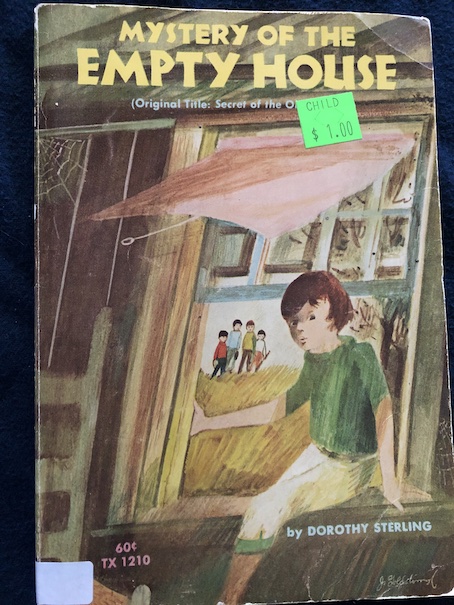
Mystery of the Empty House

Mystery of the Empty House by Dorothy Sterling, 1960.

Patricia Harrison’s family has recently moved from their apartment in New York to a house in Haven. Her father used to live in Haven when he was a boy. His mother still lives in town, and he still knows some of the other people who live there. Patricia, called Pat, is still unpacking her belongings when a boy from across the street, Jim Gray, calls to invite her to play ball with him and some of his friends in the field behind her house because his mother used to know his father when they were kids. Pat isn’t very used to playing with boys because she went to an all-girls school when she was in New York, but she agrees to go play ball with the boys.

When she goes to meet the boys, some of the other boys, the Paine brothers, don’t want her to play with them. When Jim said they were meeting “Pat”, they assumed that “Pat” was another boy. Jim says he doesn’t care if Pat is a girl or not because they could really use another player. Pat thinks they’re rude, and since they don’t seem to want her, she starts to leave, but Jim stops her and persuades her to stay. Even though Pat is usually good at baseball at school, she finds herself making clumsy mistakes when she plays with the boys, probably because she feels uncomfortable with them. Finally, she hits a home run, which is great, but there’s a problem. She accidentally hit the ball into the window of an old, abandoned house nearby that looks haunted.

The boys are mad because it’s the only baseball they have. Pat says they could just go get the ball, but the boys say they can’t. When she asks them if they’re scared, they say that’s not the problem; they’ve just promised that they won’t go near the old house. Pat says that, since she didn’t promise, she can just go get the ball, but Jim stops her from going into the house. He tells her that they can just buy a new ball. When Pat asks him why he doesn’t want her to go in, Jim says that it’s a secret having to do with the Paines. Pat says that she’s sick of the Paines and insists on going into the old house.

The old house is dark and spooky. When she climbs in through the window, Pat is startled when she runs into another person inside. At first, she can’t see the other person too clearly because it’s dark, but when she asks the girl who she is, the girl tells her that she’s Patricia Harrison. Pat is shocked and tells her that she can’t be Patricia Harrison because that’s her name. The girl finally laughs and admits that her real name is Barbara Thomas. Barbara lives next door to Pat’s grandmother and decided to stop by and meet her. When she saw Pat playing with the boys, she decided to go explore the old house instead.

Barbara is the one who explains the history of the house and the Paines’ attitude to Pat. The Paine family used to live in the old house. It’s the oldest house in town, dating back to the Colonial era. Nat Paine, the oldest of the Paine boys, was always proud of his family’s old home and used to brag about how George Washington and Lafayette visited the house during the Revolutionary War. It was even occupied by British soldiers at one time. Unfortunately, the father of the Paine boys was killed during the Korean War several years earlier (dating this story to the late 1950s or 1960, the year it was published). Since then, the family has fallen on hard times, and they’ve been unable to pay the taxes on the house. Now, because of the unpaid taxes, the town council is threatening to sell the old house to pay the unpaid taxes. The Paines have been forced to move out of the house and into a much smaller place, and Nat is very upset about it. Plus, he’s been going through this phase where he’s decided that he hates girls because he’s just getting into middle school, where all the boys either start developing crushes or decide that they hate girls. His younger brothers are being pests because they’re following his lead.

Barbara says that her father felt bad about what happened to the family and tried to convince other people in town to help the Paines pay the taxes on the old place. They could have helped, but they’ve made it plain that they just don’t want to. As Barbara’s father put it, “people in Haven are a bunch of rock-ribbed, rugged individualists who wouldn’t help their own grandmas.” (I have strong feelings about that, and I’ll explain them in the reaction section.) Barbara reveals right away that the secret Jim is keeping for the Paine brothers is that Nat made his brothers take a vow with him that they wouldn’t enter that house again “until it was rightfully theirs.” Barbara says that Nat’s sense of pride talking, and “You know how boys are.” She thinks Nat’s being overly dramatic, although she sympathizes with the family’s plight. When Pat suggests that maybe they shouldn’t be in the house, either, Barbara says that she comes there all the time to explore. Barbara thinks the old house is fascinating and that there might be a secret passage somewhere. She invites Pat to help her look for it sometime.

At dinner that night, Pat finds out that her parents already know about the death of the boys’ father and the trouble that the family is having over their old house. Pat’s mother says that the old house is a good example of the saltbox style of house that was popular in Colonial New England. (I remember my old high school history teacher explaining how the slope of the roof was meant to help snow slide off during the winter, but the uneven slope also allows more living space to be added onto an existing house.) However, Pat’s mother says that there probably aren’t any secret passages in the house because houses from that time were built pretty simply and didn’t even have closets or bathrooms. She doesn’t think that there’s any place in the old house to conceal a secret passage.

Now that Pat knows the issues with the Paine family, she begins to feel better about them, and they start being nicer to her. As Pat begins settling in, she becomes better friends with Barbara and is happy that she has another girl as a friend. They ride their bikes downtown together, and Barbara sleeps over at Pat’s house. As the girls are getting ready for bed, Pat looks out the window and sees a light in the old Paine house when no one is supposed to be there. Barbara says that whoever’s in the house is probably looking for the secret passage and the treasure. When Pat asks what she means by “treasure”, Barbara says that there’s a rumor that there’s treasure hidden in the house from Revolutionary times. The family used to be rich, but after the American Revolution, when the children of the family returned to the house after their parents were killed, the family fortune had vanished. People think that the ancestors of the Paines hid their fortune somewhere during the war and that it’s still waiting to be found. (I already had some misgivings about the people of Haven and their intentions in kicking the Paines out of their house, and now, suddenly, my suspicions are even worse.)

Barbara says that they can’t just let this mystery sneak steal what should rightfully belong to the Paines and ruin the only chance they have left of regaining their house. The girls sneak over to the house to spy on the intruder, and they end up frightening him away. The girls tell the boys about what they witnessed the next day, and they persuade the Paine brothers to come into the house with them in spite of their “vow” to look around and see what the intruder was searching for. As they inspect the kitchen fireplace, where the man was searching, and look at the flashlight he dropped, the man shows up again. It turns out that he’s a college student doing research on the Paine family.

Back in Revolutionary times, the family that lived in the house was the Woodruff family. (A Paine ancestor married into the Woodruff family, changing the family name, but the Woodruffs are also ancestors of the current Paines. It’s the same family.) The college student, Robert Popham, found some old papers that indicate that the head of the Woodruff family, the first Nathaniel Woodruff, was a Tory. Nat, who was named for this ancestor (full name Nathaniel Woodruff Paine IV), angrily denies it, saying that his family was known to associate with George Washington and Lafayette, hosting them at their house. Robert explains more about the papers he found, but he also says that the last letter Nathaniel Woodruff wrote to his wife before he was killed indicates that he feared for his life and left something hidden in an old post box to pass on to his young son. However, as Nat points out, the date on this final letter was shortly after Nathaniel Woodruff’s wife was murdered by unknown assailants. (She was found scalped, so people blamed her death on American Indians, but it’s also possible that she was killed by someone else who just wanted to make it look that way to cover up the real reason for her murder.) Nathaniel Woodruff didn’t know his wife was already dead, and since she never got the letter and he was also killed soon after, the box is probably still hidden somewhere. Robert thinks that what Nathaniel hid was proof that he was actually a spy for the Patriots and that he feared for his life because he suspected that the British knew he was a spy. He says that he wants to find this hidden box and the information it holds because it would make a fantastic historical research paper.

The kids are completely on board with the search for the hidden box, both because the Paines want to preserve the reputation of their ancestors and because there may be valuables hidden in the box that will help the Paines pay their taxes and keep their home. However, they only have until August 15, the date that the town council has set for selling the Paine house. They only have until the end of summer to figure it out!

The book is available to borrow and read for free online through Internet Archive. The book is also known by the title Secret of the Old Post Box.

My Reaction and Spoilers

To begin with, I didn’t like the people of Haven right from Barbara’s description of them as “rugged individuals who wouldn’t help their own grandmas.” It is pretty cold to turn out a war widow who is working as an underpaid nurse in the community and her children after their father was killed serving his country. I completely agreed with Barbara’s father’s assessment of the townspeople’s levels of generosity from the first. I suppose at least some of the townspeople of Haven probably thought they were actually being kind, giving Mrs. Paine several years after her husband’s death to come up with the mounting tax money, while doing nothing to help her and not actually paying her enough to manage and letting her family sink deeper into the hole until there was no way for them to escape, but in realistic terms, that’s not really kind at all.

We don’t actually hear the townspeople express their own feelings because the children don’t talk to the adults about their search and discoveries until they’re sure of what they found. When Barbara explained how her father felt about the townspeople’s unwillingness to help the Paines, I was also a little suspicious of their motives, and when Barbara mentioned that there’s been a popular rumor about hidden treasure in the Paine household for years and everyone has heard of it, I got really suspicious. Basically, I started looking for thieves among the townspeople. I immediately suspected that the “rugged individuals”, or at least some influential ones in the community, wanted to steal some historical treasure from a veteran’s widow and orphans because people who would would kick the widow and orphans out of their home might as well be out to steal their legacy, too.

If that was part of their plan, they weren’t very good at it, and they never even show up in the story. Perhaps I’m judging them a bit harshly, although in a way, I’m a little disappointed because that kind of Machiavellian plot would have made the story much more exciting. From the way the story goes, the townspeople might just not believe that there’s any treasure to be found because that rumor has been going around for so long and nothing has come of it. Still, I was suspicious of them for a good part of the book because it looked like the author was setting them up to be suspicious.

I was also annoyed by the townspeople because I found them ineffectual and uncreative in their approach to a community problem. They miss opportunities, and worse, they deny opportunities to others because they’re apparently stuck in their “rugged individual” mindset and won’t even entertain ideas that might help themselves as well as others when people like Barbara Thomas’s father suggest them. I often think that high-and-mighty rugged individualistic attitude cuts out so many genuinely fun, creative, and amazing possibilities that can make a community rich in character as well as money. It’s maddening to a person who thrives on creativity and likes to consider possibilities.

When I started getting really irritated at the townspeople, I guessed that, before the end of the story, they would do something to redeem themselves that would simultaneously leave me unsatisfied. I figured that the point where the townspeople finally come together would probably result in something that I thought they should have been working on from the beginning, and then, they’d act like it was such an amazing idea that they’d never thought of before and I’d be really irritated with them all over again because I thought of something like it very early in the story. Actually, that’s not how the story goes, and it’s still irritating to me.

So, what would I want them to do in this situation? Basically, the community wants its tax money, and the family wants to keep their house with a living wage that can support them. Fine. So, I asked myself, why not make this historic house, which is known to be the oldest house in town, into a community project which would actually contribute to the common good of the community (I don’t think “common good” is a dirty word, although I’m aware that some “rugged individualists” think so) and provide the Paine family with an additional source of income? If the town council invested in fixing up the house, which is also known to contain some very interesting Colonial antiques as well as fascinating architectural details and a unique history, the house could be turned into either a museum or a period bed-and-breakfast to encourage local tourism. (Sleep where George Washington and Lafayette slept!) Since it does have original furnishings and actual bedrooms, it probably wouldn’t take a lot to make the conversion for either of those projects.

The town and its business owners would benefit from the tourism, giving them an actual monetary return on their investment, and the Paine family could stay on with the house as its caretakers, receiving additional wages from visitors. People couldn’t say that the Paines simply received a handout because they would be doing valuable community work to support the town’s image and industry. It would satisfy Nat Paine’s family pride because he could talk to tour groups on the weekends and during the summer about his family’s great legacy to the history of his town. The whole community could even expand on the idea to further attract visitors, setting up a sort of local living history center, where people can learn Colonial crafts and recipes (something like what the Townsends demo on their YouTube channel), and schools from neighboring towns and cities could book field trips. Local business owners could support it with a themed restaurant and shops selling Colonial-era replicas and memorabilia and books about the time period. The town could hold special celebrations a few times a year to draw in more visitors, like a big Fourth of July parade or a Colonial Christmas celebration (although I known not all of the American colonies actually celebrated Christmas) or a re-creation of old harvest parties (more historically accurate) with plays by the local theater group (if they don’t have one, they could form one) or dramatic readings from Washington Irving at the local library or a themed fair with people selling local artisan crafts. They wouldn’t have to do all of this at once, but they could start with the matter of the house and build up from there. It’s an idea that has the potential for future expansion. This story is even set pre-Bicentenniel, so imagine what the town could do if they already had everything up and running by July 4th, 1776! Doesn’t anybody plan ahead? That’s creative use of resources. That’s community action. That’s job creation. Even if it’s not as big as Plimoth Plantation (now called Plimoth Patuxet to better incorporate the Native Americans) or Colonial Williamsburg (which both already existed by the time this story was written and could have provided inspiration), it’s still a money-making industry that is inherently built into the town’s very nature and won’t disappear tomorrow because some outside business decides to move or close a job-providing factory or something. Even if they didn’t get national or international attention, they would probably still be a destination for people from around their state and neighboring ones, and there’s potential for continued development. The project just need to be supported and promoted by the community.

Unfortunately, that’s not what they do. My griping aside, I guess if the solution was really that simple and the townspeople were more thoughtful and pro-active, we would lose the source of tension and the obstacle that our heroes have to overcome. The August 15th deadline is what pressures the kids to hurry up and find the treasure, so as irritating as it is to me, I have to put up with it.

The treasure hunt part is a lot of fun, and I liked the children’s logical, methodical approach to their search. When the children eventually find the hidden box, the story isn’t over. There are coded messages in the box that they have to decode to learn the full truth about Nathaniel Woodruff. Part of the story explains how they figure out how to decode the substitution code and the book code that compose parts of the message. The story they learn about Nathaniel Woodruff is better than anything the Paines had originally thought.

So, did they save the old house and do anything cool, like start a unique museum? Yes, and no. Although they don’t find any jewels, gold, or traditional sort of treasure, the letters that they find in the box are worth quite a bit. They sell them to a wealthy local business owner, and he donates them to a local university library. (So, you know, the wealthy business owner who never makes an actual appearance in this story and who wouldn’t have helped a war widow and her orphans for their sake can buy their family legacy and present it as his magnanimous gift to the university. I can’t say that he’s terrible for doing this because it does help, but I still think my idea was better.) The Paine family has enough money to keep their house and fix it up. It’s a pretty good ending, but I still prefer my vision. The story points out that it’s not a matter of everyone living happily ever after because they’re all their imperfect selves and still have some problems, but one lesson that they all learned from this experience is how to create their own book code to use for passing notes in class. It’s not profound, but codes are fun.

The Mystery of the Other Girl

The Mystery of the Other Girl by Wylly Folk St. John, 1971.

It’s a rainy Saturday in Florida for the Barron family when Stevie (short for Stephanie) gets a strange phone call from Mobile, Alabama that’s meant for her ex-boyfriend, John Henderson. Stevie just broke up with John, who likes to call himself “Ian” because he thinks it sounds classy, the day before, and she has no idea who the strange girl on the phone is or why she’s trying to reach John/Ian at her number. Stevie asks the girl for her name, and she says that she’s Morna Ross, but suddenly, the girl screams and is cut off, like someone put a hand over her mouth, and then someone hangs up the phone at her end. Stevie is disturbed by the call, fearing that something bad happened to the other girl, but she doesn’t know what to do about it because she doesn’t know Morna Ross and doesn’t know exactly where she was calling from or why she wanted to talk to Ian.

Since Stevie already has a date to go dancing with friends at a place where Ian and his band are performing that night, she tells her friends about the weird phone call and asks them what she should do. They say that they’ve never heard of Morna Ross and tell her that she should talk to Ian about it. However, Stevie feels too awkward about the breakup to talk to Ian and asks a couple of her friends to do it for her.

That evening, Stevie and her friends run into Stevie’s old friend, Hope. She and Hope haven’t seen too much of each other lately because she’s not interested in dancing and dating and other things that Stevie wants to do. This evening, though, Hope is out with a visiting cousin from Mobile, Alabama named Phil Walters. Stevie is glad that Phil is getting Hope to come out of her shell a bit. Stevie and Phil say that the style of dancing popular with teenagers today is better than older styles of dancing because they don’t have to take any lessons to learn it – it’s just moving to the music, like everyone else. On impulse, she asks Phil if he’s heard of Morna Ross, but he says he hasn’t. Stevie’s friends say that when they asked Ian, he claimed not to know Morna Ross at first, but then he said something about her being a girl who’s “crazy about him.” Apparently, he dated her before he dated Stevie, and since he and Stevie broke up, he decided to invite her to the Old Seville Festival that’s happening next week, a local celebration of the history of their town. Stevie thinks it’s strange that Ian didn’t mention that Morna lives in Mobile, since that’s the place she was calling from. Stevie’s friends think maybe Ian was lying about Morna being crazy about him and that he probably doesn’t really know her because Ian is always bragging about things, like how great his family is. Hope thinks Ian makes up things to brag about because he wishes they were true even though he knows they really aren’t. After she thinks it over, Stevie thinks that’s true, that Ian likes to keep up appearances and a superior attitude because, underneath it all, he’s actually a very insecure person. But if he made up his relationship with Morna, and he doesn’t really know her, why was Morna trying to call him?

Before the evening is over, Ian confronts Stevie and reminds her that their first date was almost a year ago, at the last Old Seville Festival and that he’s planning to see her there again this year because they promised each other that they would see each other during the festival every year. In return, Stevie confronts Ian about Morna. Ian says that she’s just another of the girls who have come to see his band perform and likes him. When Stevie asks why nobody’s met Morna at any of the teenage hangouts in town, he says that they like to hang out at the more adult spots. He begins spinning a story that Stevie is sure is at least half fiction about how he and Morna order non-alcoholic drinks at adult nightclubs but they sneak in some gin to mix in with it and how they’ve tried marijuana. (Keep in mind that marijuana was illegal everywhere in the US at this time.) Ian says that he and Morna don’t really want to become potheads, but they see trying these things as part of growing up, “to experience everything and then make a choice.” Stevie pauses to wonder about the word “everything.” (That is always a good thing to wonder about when someone talks about wanting to try “everything.” Define “everything.”) Stevie asks him where Morna lives, and he says that she lives across town, but her family has moved around a lot because her father deals in real estate and sometimes even sells their own house and moves his family to a different one. (Ian sounds like he thinks that’s clever. I thought it sounded really suspicious, like maybe Morna’s family is actually involved with the mafia or something and has to keep on the move.) Stevie doesn’t really believe any of this, but she pries a few more details out of Ian about what Morna looks like. Although she thinks that Ian made up most of the things he said about Morna, there is still the girl who called her earlier and screamed like she was in trouble. She was a real person, even if what Ian said about her wasn’t all true.

When Stevie gets home, she tells her mother what Ian said about Morna and how Ian likes to make up things. Stevie is still concerned about the girl who called and wants to find out who and where she is and if she’s okay. Her mother says that her father will be coming home from a business trip the next day, and they can ask him what to do about it. Stevie’s father is a fingerprint expert at the police department, so he knows about police procedures and can make inquiries. Stevie wishes that she had Morna’s fingerprints so her father can analyze them himself, and in another weird development, she gets that opportunity.

The next day, Stevie gets a letter from Morna. The letter is addressed to her and not Ian. Morna didn’t know her home address, so she addressed it to the high school she attends, and the letter was forwarded to her from there. Stevie handles it carefully so she won’t disturb any fingerprints. The letter even has Morna’s return address, so she knows where she lives in Mobile. The contents of the letter are strange. Morna talks about her school band and how they’re always short of instruments. She says that she’s liked Stevie since she saw her playing with her school band in a competition (Stevie really is in her school’s band) and wonders if her school would be willing to sell spare instruments. The letter is oddly worded, the word “see” is underlined twice, and there are doodles all over page. Also, the specific instrument Morna says that she wants is written in French and doesn’t sound at all familiar to Stevie. Stevie looks up the term Morna uses, and it turns out to be a French horn. But, if Morna meant “French horn”, why didn’t she just say that? Also, the price she mentions for the French horn is far less than what an actual French horn would cost. It seems like Morna is either crazy or trying to say something else in her letter.

Stevie has a younger brother named Lyle who is really smart, and he suggests that the letter might be in some kind of code. As they talk it over, Stevie realizes that the French horn refers to Ian because he plays the French horn in her school band. Lyle wants to study the letter more to see if he can figure out other parts of the code, and Stevie decides to invite her friends over to see it, too, because most of them are also in the band and might notice something else in the message that’s music-related. Little by little, the kids begin working out the real meaning of Morna’s message. First, the amount of money that didn’t make sense is meant as a clue the reader that there’s more to this message than just an inquiry about musical instruments. Second, Morna phrases sentences oddly in order to work certain words into the message and put them in the right order for her hidden message. Third, the doodles around the message are the beginnings of pieces of music. Stevie and her friends providing their musical knowledge and Lyle coaches them through code-breaking techniques. After awhile, Lyle goes to his room to work on the code alone because he finds it easier to think by himself and likes surprising people with his discoveries. When he returns, she has the final solution.

Morna’s message says that she has to get in touch with Ian. She says that she is being watched and her mail is being read, which is why she has to communicate in this way. Morna asks Stevie to write to her in the same way, promising to explain the situation later. Stevie remembers that Ian wanted to see her at the Old Seville Festival, so she decides to tell Morna when and where to come if she wants to see Ian. Shortly after Stevie mails the letter, Morna calls again, saying that she needs to warn Ian because someone might try to kill him. Then, she screams and someone hangs up the phone again.

At first, Stevie’s father thinks that Morna is some kind of prankster or maybe having some kind of paranoid fantasy because she’s into drugs or something, but Stevie is sure that Morna really is scared. The danger is real, and Stevie’s family realizes it when Lyle is kidnapped at the Old Seville Festival.

The book is available to borrow and read for free online through Internet Archive.

My Reaction

I was pretty sure, for much of the early part of the book, that the whole thing with Morna’s mysterious phone calls and messages was just an act that Ian dreamed up and got someone to do for him as one of his dramatic bids for attention. It seemed weird to me that Morna second phone call ended exactly the same way as her first, like it was part of a rehearsed routine. Also, someone who wanted to interrupt Morna’s phone calls and keep her from talking could do it in easier ways that wouldn’t involve dramatic screams that would get attention. They could have just unplugged the phone or held down the hang up button. (Remember, this is the early 1970s. Morna’s using an older style of telephone that has to plug into the wall, and there are buttons where the handset rests that hang up the phone. That was the first type of phone I ever used as a kid, and I know that you can push those buttons down with your hand to end a call even if someone is still holding the handset.) I would think that if a sinister person was watching Morna, they would cut her off that way rather than try to put a hand over her mouth while she screams. Also, if they really didn’t want her to communicate with anyone, I don’t think they’d let her write any kind of letter, not even one that just seems to be about band instruments. Even if they couldn’t figure out the code, I doubt that they’d want to take the chance that she might communicate something to the wrong person. It all just seemed too theatrical and not realistic. So, I couldn’t really blame Stevie’s father for initially thinking that the whole thing might just be some kind of prank. However, I did wonder why he didn’t just phone the Mobile police department and ask a colleague to do a welfare check on the girl at the address on the envelope to find out if it was a prank or not. Better safe than sorry, and if it turned out to be just a prank, knowing that the police knew about it would probably be enough to get the girl to stop.

As it turns out, it’s not just a prank. There is something genuinely sinister going on, although I wasn’t sure what it was for quite awhile. I thought it might have something to do with drugs because there were repeated references to drugs in the story, but that’s not what’s going on. It turns out that Ian/John has been having trouble with his self-image and even self-identity because he’s adopted. He’s aware that he’s adopted, which is why he secretly worries that he doesn’t really fit in with his family or friends and makes up fantasies about himself to impress people while being inwardly insecure. However, there’s quite a lot that Ian/John doesn’t know about his past, not even his birth name, and the truth of Ian’s past is even stranger than anything that he’s ever imagined. His blood relatives love him and didn’t forget about him, even though they couldn’t take care of him when he was a baby, and now, they’re trying to protect him from a very real threat. Finding out the truth comes as a shock to Ian, but it’s an important step in making peace with himself and realizing just how important he is just for being himself, not only to his adoptive family but to the family who gave him up for adoption and to the friends who cared about him even when he was a bit of poser and who took great risks to protect him and help him find the truth.

Lyle is fun as an eccentric genius character who has a pet walking catfish. I hadn’t actually heard of a walking catfish before reading this book, but that’s part of the fun. I enjoy stories that bring up interesting facts that I didn’t know before. Walking catfish can actually survive out of water for long periods of time and move across land. The walking catfish ends up playing a role in catching the bad guys in a way that actually makes sense, which is nice. I also like that, although Lyle is pivotal in solving the mystery, he didn’t get all the answers too easily, like some geniuses in stories, and he needed some specialized knowledge from other people. That makes him a more realistic character.

I would like to discuss the costumes that the characters wear to the Old Seville Festival, though. They explain that it’s common for people attending the festival to dress in historical costumes from different time periods in the town’s history to get into the spirit of the event. Ordinarily, I would think that’s fun and be completely supportive, but there’s one exception that I think crosses the line a little. Some people, including Lyle, dress in Native American costumes. I’m not Native American myself, but I know that real Native Americans are usually not too happy to see traditional forms of dress being used as costumes. I would cut the characters more slack for it if they confined themselves only to wearing clothes like traditional Native Americans, but what pushes it over the line for me is that Lyle is described as darkening his hair and his skin as part of his costume. He also does some kind of warpaint on his face, but it’s the skin coloring that he does that I think is unacceptable. I think that’s going too far, and that’s what pushes this costume into the realm of the tasteless and offensive. A little more restraint, just sticking to the clothes might have been okay, but looking like one of those white actors trying too hard with makeup to pass for a minority in an old black-and-white movie is just too much. It’s one of the things that really dates this book because fewer people today would be willing to take it that far, at least not without some embarrassment or criticism from other people. It was published in the early 1970s, and may possible take place a little earlier, in the 1960s, because no exact year is given. I’ve heard some people claim that it was normal for them to wear racial face makeup as part of costumes when they were kids, and never having seen that even once when I was a kid in Arizona during the 1980s and 1990s, I’ve wondered just when and where kids did that of their own free will when they were given the opportunity to wear literally anything else, and I think I have at least a partial answer here. Lyle carries a tomahawk as an accessory to his costume and gives war cries. He also comments about how hippies are bringing Native American style headbands back into style, which further dates the story.

I should also explain that Lyle is not just dressing as any random Native American; he is trying to be a real historical figure. He is specifically trying to be William Weatherford, a mixed-race plantation owner known for his involvement in the Creek War in the 1810s. I like the part where Stevie wonders about the authenticity of Lyle’s costume. Apparently, Lyle got some help from someone at the local museum, but Stevie realizes that nobody else at the festival is going to know (or care) whether Lyle’s war paint designs are accurate or not, and even if he’s dressed accurately as a Native American of the area, the real William Weatherford probably typically dressed in the British style favored by other plantation owners of the era because he was living in the same manner as fully white plantation owners and going by his English name rather than his Native American name. I’m not actually sure how the real William Weatherford dressed because this isn’t a part of history that I know much about, but Stevie’s logic makes sense. My guess is that he probably wore a variety of different clothes in his life, depending on his circumstances at the time. (After all, various other historical figures did. Emperor Hirohito was photographed at various times wearing traditional Japanese ceremonial clothing, Western-style suits, and military uniforms, depending on the event.) One thing I could state with confidence is that William Weatherford probably didn’t have a pet walking catfish on a leash, which Lyle does because he insists on bringing his pet to the festival with him.

It’s part of the plot that Lyle is wearing an outlandish costume and has his walking catfish with him when he’s kidnapped, but I still think that there are equally outlandish historical costumes that he could have chosen that could have chosen that would have worked. It’s important that Lyle dyed his hair for the costume, so he had the same hair color as Ian on the day he was kidnapped when his ordinary hair color is much lighter, but I think there could be other ways around that or maybe he could have worn a hat so his hair wasn’t visible at first. I wouldn’t mind if he just dyed his hair, but the skin coloring is just too much.

Personally, I prefer the costumes that Stevie and her friends wear to the festival. They decide to dress as Gibson girls from the late 1800s and early 1900s. They basically wear old-fashioned-looking skirts and blouses and put their hair in the typical Gibson Girl hairstyles. Historical costumes that are based on wearing different clothes and hairstyles are the type of costumes I favor.

Aside from the costume issue, I really liked the story. I honestly wasn’t sure what the real problem was until the very end of the book. I had several theories, but Morna really surprised me when she explained who she really was and why Ian was in danger. I thought that she might turn out to be a relative, but the situation wasn’t what I expected.

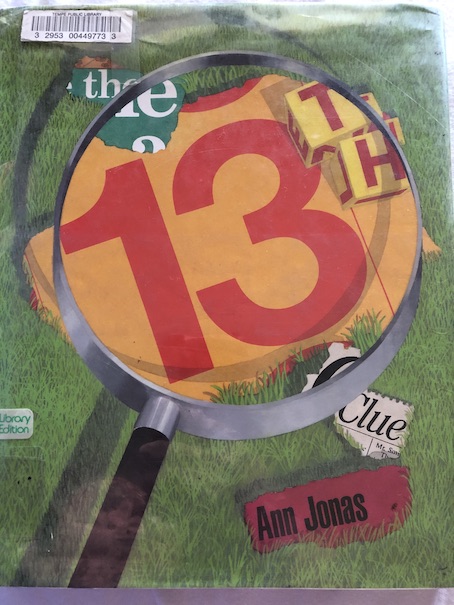
The 13th Clue

The 13th Clue by Ann Jonas, 1988.

This picture book is almost entirely pictures. The pictures present clues to a treasure hunt and reveal the true story of the book.

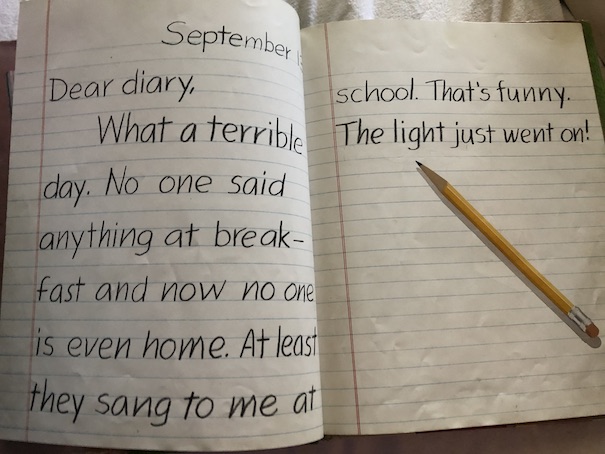
The book begins with a diary entry. At first, we don’t know who is writing it, but this person writes about what a bad day it’s been. We know that the person must be a kid because they mention school, and I guessed that it was the person’s birthday because people sang to them at school. But, she thinks that others have forgotten her birthday. The diary entry breaks off when the person notices a light going on in the house when, supposedly, no one else is home.

From this point on, until the very end of the book, the text is presented in the form of clues for our birthday kid (who turns out to be a girl, as shown in shadows and a reflection in water in later illustrations) to follow that lead to the place where her friends are waiting to give her a surprise party. Readers can figure out the clues along with the girl, some of which are easier and more direct than others.

I love puzzle books, and I thought that it was interesting how we don’t even know who the main character of the book is, only finding that out as the book continues. I liked the challenge of figuring out the clues as the book went along, although none of them were particularly difficult. They aren’t written in any kind of code, just kind of hidden in plain sight, most of them using objects that are part of the rest of the scene. Some of the letters of words are jumbled and have to be unscrambled. I’m sure it would seem harder to children.

This is a pretty easy book, but not one that would be suitable to read to children who can’t read themselves. There are no solutions provided to the puzzles, but that’s okay because, first of all, they aren’t very hard, and second, there are no opportunities for the reader to make choices based on the puzzles, so there is nothing for the reader to get wrong. The end of the story is obvious. Most of the fun is just studying the pictures to see the cute ways her friends decided to hide their “secret” messages. The hardest message to spot is the one written in the hillside.

The book is available to borrow for free online through Internet Archive.