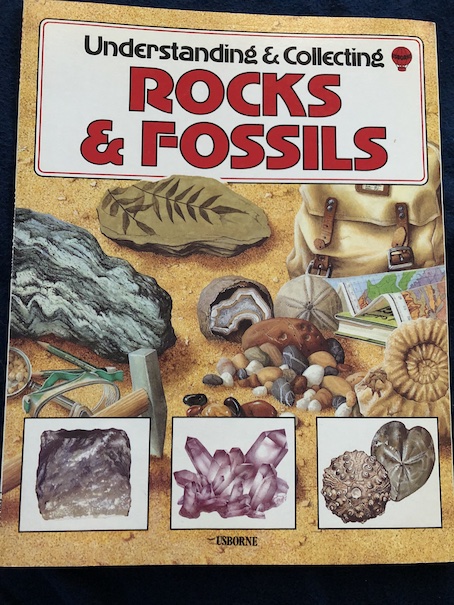
Understanding and Collecting Rocks and Fossils

Understanding and Collecting Rocks and Fossils by Martyn Bramwell, 1983.

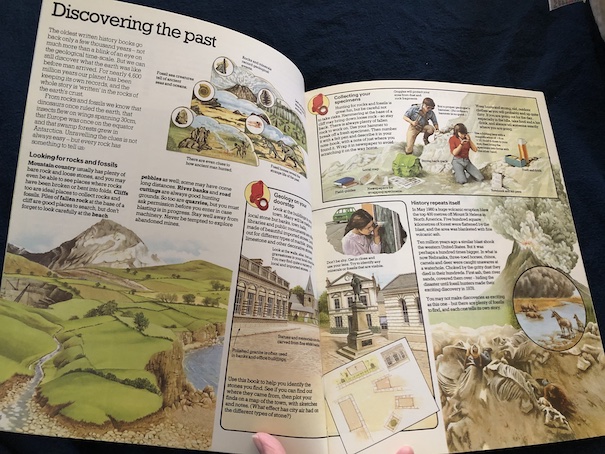
This book is part of a series of beginning hobby guides for kids. It explains how to collect and study rocks and fossils and some of the deeper aspects of geology. The book emphasizes that studying geology helps us to understand the story of the Earth and the forces that have shaped our landscapes and formed the rocks and minerals we use. All through the book, there are suggested activities and experiments for readers, marked with the symbol of a red magnifying hand-lens.

The book explains some the large geological forces, like how the continents move and the plates that make up the Earth’s crust shift. Then, it explains the different types of rocks, igneous, sedimentary, and metamorphic, with examples of each type.

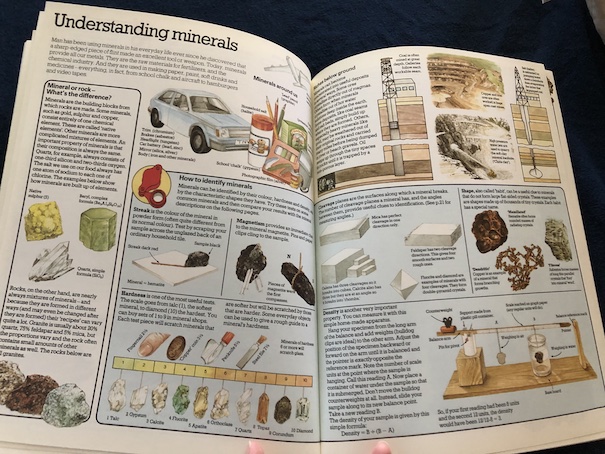
One of the sections I found particularly interesting is the one that explains about how to identify different minerals and what they’re used for. The activity on that page explains how to identify a mineral based on a series of factors, like whether or not it’s magnetic, the color of a streak it might leave when scraped against tile, and its hardness, which you can test by seeing what implement will scratch it.

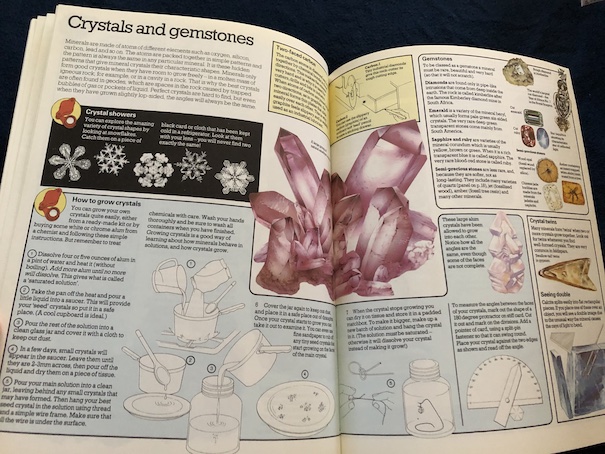
I also liked the section about crystals and gemstones. There are instructions for growing your own crystals.

The section about fossils explains how to collect fossils, clean them, make plaster molds of them, and identify what organisms made the fossils. The book explains how fossils are made and had a timeline of past eras on Earth and the creatures that existed in each era.

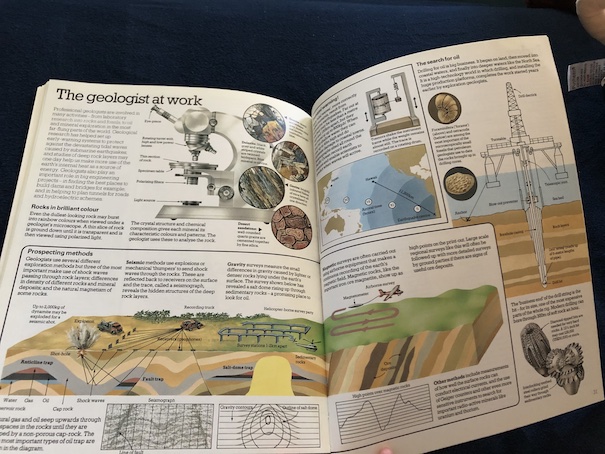
The last section of the book explains the types of work that geologists do and the types of geological surveys they carry out to predict earthquakes and tsunamis and finding useful deposits of ore, minerals, oil, and natural gas.

There’s quite a lot of information to take in. Even though this is a pretty beginner guide to rock collecting and geology, I would say that the book would be better suited to older children than younger ones.

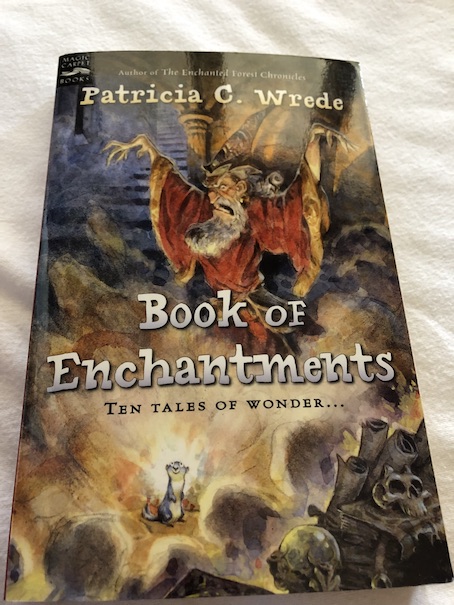
Book of Enchantments

Book of Enchantments by Patricia C. Wrede, 1996.

This is a collection of short fantasy stories, some of them based on other writings and series by the same author.  Many of them are also humorous. There is a section in the back of the book that explains the stories behind the stories and how they relate to her other works.

The stories included in this book:

Rikiki and the Wizard – A greedy wizard, unsatisfied with his success in life, attempts to summon a god to make him even more wealthy and famous so that he will never be forgotten. In exchange, he offers his daughter in marriage to the god who will help him.  Most of the gods recognize the wizard’s greedy and selfish purposes and refuse to cooperate, but Rikiki, the blue chipmunk god, is rather absent-minded and shows up to answer the summons. However, Rikiki, although having the powers of a god, is mostly obsessed with finding nuts, and how he interprets the wizard’s wishes (in exchange for the nuts the daughter feeds him, not for marrying the daughter) technically fulfill the requests but not in the way that the wizard had hoped.

The Princess, the Cat, and the Unicorn – This story takes place in The Enchanted Forest from one of the author’s series.  Things don’t go as expected for fairy tales in the fairy tale kingdom of Oslett, and it often bothers the king’s councilors.  Even though the princesses of the kingdom have a stepmother, she is a very kind and motherly person instead of the wicked stepmother usually found in folktales, and the princesses love her.  The princesses even get along well with each other instead of having the usual rivalries and jealousies between the oldest princesses and their pretty younger sister.  The middle princess, Elyssa, gets tired of being nagged about what the councilors think she should do and says that she’d like to go out and seek her fortune.  It’s not usually a thing for the middle princess to do, but well in keeping with what goes on in their kingdom.  She is accompanied on her journey by a talking cat who directs her to The Enchanted Forest, where the stuff of fairy tales happens.  There, the princess must escape the clutches of a vain unicorn, who is looking for a princess to adore it, and help the cat, who is not quite what he seems.

Roses by Moonlight – A modern retelling of The Prodigal Son story in a modern setting and with sisters instead of brothers and a fantasy twist.  Adrian is jealous of the party that her family is giving for her sister Samantha, the prodigal daughter returned.  As she sulks outside, her mother talks to her about her sister and the choices people make in life and enigmatically says that, while she is satisfied with her own choices and life, it occurs to her now that there may have been other choices that she had never considered before.  Instead of asking Adrian to come back inside and try to enjoy Samantha’s party, she asks her to stay outside for a while and see if someone shows up, mysteriously adding that if she is offered a choice, she should be careful and not choose too quickly.  Adrian does indeed meet a strange woman who offers her the choice of her destiny.  In a magical rose garden, Adrian may pick a rose which will represent the course that her life will take.  She is allowed to smell each one first and see what they have to offer.  Given the choice of any possible future, what will she choose?

The Sixty-Two Curses of Caliph Arenschadd – Also in A Wizard’s Dozen.

Earthwitch – A king whose kingdom is besieged appeals to the Earthwitch for help. He learns that the current Earthwitch is his former lover, and while the magic of the earth can help solve his problem, it will cost him to use it.

The Sword-Seller – A strange merchant gives a swordsman a free sword at a fair and recommends a woman to him who needs to hire a swordsman to accompany her on a journey to see her aunt, apparently fleeing problems with her other relatives. Her other relatives seem to behave oddly about the journey, and the swordsman isn’t sure why. He agrees to take the job and discovers the real reason why the merchant was willing to give him the sword.

The Lorelei – On a class trip, a girl has to save her classmate from the call of the Lorelei.

Stronger Than Time – This story is about what would have happened if the prince had been killed before rescuing Sleeping Beauty.

Cruel Sisters – A retelling of an old folk tale about jealous sisters, one of which evidently killed the other.  The story is told from the point of view of their other sister.

Utensile Strength – The last story in the Enchanted Forest Chronicles. When an enchanter makes a mistake while trying to make a magical weapon and accidentally casts the spell on a frying pan, the king and queen of the Enchanted Forest hold an unusual tournament of warriors to find the person who is destined to wield this very strange but powerful weapon.  The story is followed by the winning recipe from the cooking portion of the tournament, Quick After-Battle Triple Chocolate Cake.

The book is currently available online through Internet Archive.
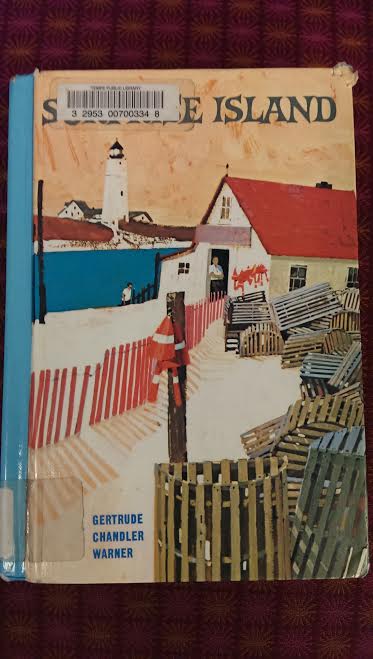
Surprise Island

The Boxcar Children

Surprise Island by Gertrude Chandler Warner, 1949.

Mr. Alden has promised his grandchildren a special surprise for their summer vacation. He tells them that, years ago, his father bought a small island because he kept horses and wanted a quiet place for them.  The island has only one little yellow house, a barn, and a fisherman’s hut where Captain Daniel lives.  Captain Daniel operates the motorboat that can take people to the island.  Mr. Alden plans to take his grandchildren to the island to look over the house, and if they like, they can spend the summer there.  The children think that it sounds like fun.

When they get to the island, the children decide that they want to stay in the barn instead of the house.  Captain Daniel also tells them that he has a young man staying with him, a friend who hasn’t been feeling well.  The Aldens’ old friend, Dr. Moore, has come to see the island with them, so he looks in on the young man.  It turns out that the young man was in an accident and had lost his memory for a time, although he has been gaining it back.  He says that he used to live with an uncle but that he didn’t want to go home again until he was sure that he was completely well.  He is going by the name of “Joe”, which is short for his middle name, Joseph.  Captain Daniel says that he’s known the young man all his life, and Dr. Moore also seems to know him, but Joe doesn’t seem to want to talk about himself to Mr. Alden.

The kids enjoy setting up housekeeping in the barn.  It reminds them of when they used to live in an old boxcar.  They use old boxes for furniture, dig for clams, and eat vegetables from the garden that Joe and Captain Daniel have tended for them.  Their grandfather allows the children to stay on the island in Captain Daniel’s charge, but they are mostly allowed to take care of themselves.  Joe sometimes brings them supplies that they ask for from the mainland.  (One of the themes of the Boxcar Children Series is self-sufficiency.  At one point, Jessie comments about how much better things seem “when we have to work to get it.”)  For fun, they go swimming, and Joe spends time with them, telling them about different types of seaweed.  They are surprised at how knowledgeable Joe is.

Henry gets the idea that they can set up a kind of museum of interesting things that they find on the island, like samples of different types of seaweed, shells, flowers, pictures of birds that they’ve seen, etc.  The other children think that it sounds like fun, and they begin thinking about the different types of things that they can collect.While they’re searching for things to collect and add to their museum, the children find a cave and an old arrowhead and ax-head.  They are authentic Indian (Native American) relics!  When they show Joe what they’ve found, he gets very excited, especially when they tell him that they saw a pile of clam shells, too.  Joe explains to the children how Native Americans used to use shells as money called wampum.  He thinks that what they saw was wampum, which the people who used to live there might have made after drying the clams to eat later.  Joe explains to the kids some of the process they would have used to turn the shells into wampum.  He’s eager to go to the cave and look for more Native American artifacts with them, but he urges them not to say anything to anyone else about it because other treasure hunters will probably show up if they do.  The children agree to keep their find a secret until their grandfather returns.

When they return to the cave with Joe, they make an even more incredible find: a human skeleton with an arrowhead inside.  It looks like they’ve found the bones of someone killed by an arrow!

The book is available to borrow and read for free online through Internet Archive.

My Reaction

As with some other vintage children’s mystery series, the early books in the series were more adventure than mystery.  The most mysterious part of this book concerns the real identity of the young man they call “Joe.”  The truth begins to come out when a strange man who calls himself Browning comes to the island in search of a young man who disappeared the year before while doing some exploring for him.  The young man he’s looking for worked for a museum.

This is the book where Violet first learns to play the violin.  This is a character trait that stays with her for the rest of the series.

I Like Things

I Like Things by Margaret Hillert, illustrated by Lois Axeman, 1982.

This is a cute little picture book about the fun of collecting things.  A young girl talks about the things that she collects and why she likes them.

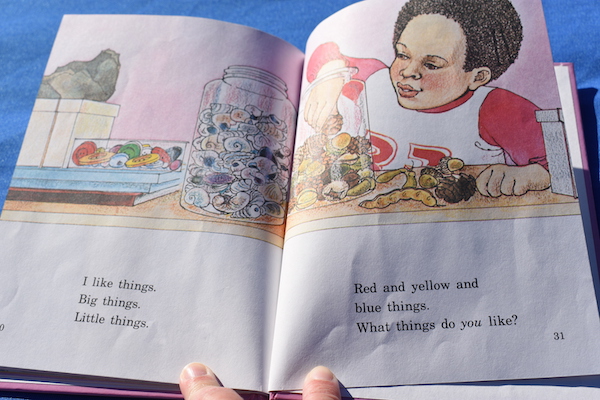
She enjoys collecting all kinds of things with different shapes, sizes, and colors.  Sometimes, she likes to sort the things in her collections, like buttons, by color or size.

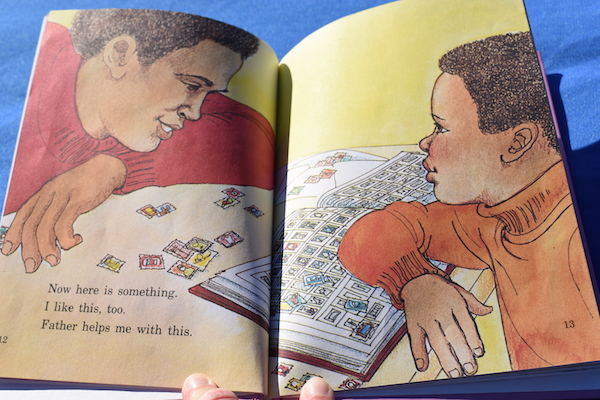
Sometimes, her father helps her with her stamp collection.  She also likes to find seashells and rocks at the beach.  Sometimes, she and her friend trade sports cards from their collections.

At the end of the story, the girl asks readers what kinds of things they like, so adults can use the story to get kids to talk about what they like to collect.

I thought it was interesting how the girl put one of the bigger rocks in her collection into a jar that was partly full of water so that the water would act as a magnifier, making the rock look bigger.

One thing I noticed is that the girl never refers to the objects in her collections by name.  Mostly, she just talks about what she does with them using very simple words.  I think that’s to make the book easier for younger children.  There is a word list in the back of the book of all of the words used in the story, and there are only 64 different words.

A Wizard’s Dozen

WizardsDozenA Wizard’s Dozen: Stories of the Fantastic edited by Michael Stearns, 1993.

This is a collection of fantasy stories (roughly middle school level) by different authors.  The tone of the stories varies from light and humorous to dark and serious.  The stories in this collection are:

The Sixty-two Curses of Caliph Arenschadd by Patricia C. Wrede

Caliph Arenschadd has a temper, but unlike other rulers, who have been known to cut off people’s head when they’re angry, Arenschadd is also a wizard.  Because he likes to show off his magic, he has thought of something more creative than executing people: a list of curses to inflict on those who anger him.  As people get him angry, he progresses through the curses in the order that he thought of them, each one worse than the last.  Worse still, he also inflicts the curses on the families of people who annoy him, which is how Imani, the young daughter of the caliph’s vizier has experienced so many at her young age.  However, the caliph has made a serious miscalculation in his latest curse.  This time, he has turned the vizier and his family into werewolves without being able to remove the curse.  As far as anyone knows, it’s impossible to cure lycanthropy.  As the vizier and his family find themselves becoming a threat to those around them, can Imani and her friend Tumpkin find a way to break the curse?

Fairy Dust by Charles De Lint

When Marina’s friend Jason manages to catch a real, live fairy in a jar, she tries to convince him to let it go, but he refuses.  He wants to keep it, just overnight.  But, the fairy ends up dying, and suddenly, Jason himself is severely ill.  Marina is sure that Jason is suffering from a fairy’s curse, but is there anything she can do to save him?

This experience touches on Marina’s absent father, an impractical dreamer, although it does turn out that he has taught Marina an important lesson, and she learns for herself that when she sees someone doing something that she knows is wrong, it is also wrong for her to keep silent.

The Princess Who Kicked Butt by Will Shetterly

In a mystical kingdom, people’s names tell everyone something about their destiny and character.  When a new princess is born in the kingdom, the Fairy Who Was Good With Names comes to bestow a new name on her.  However, the fairy sneezes and no one clearly hears the name that the fairy gave her.  Thinking that the fairy said the princess was “the Princess Who Read Books,” the king and queen make sure that she has plenty of reading material while she’s growing up and don’t give it much more thought.  Later, when the Evil Enchanter tries to force the princess to marry him and her parents to hand over the kingdom, the princess’s true name and her real skills become known.

The Sea Giants by Betty Levin

A great-grandmother translates whale songs for her family to tell them an ancient story: There was once a family that was barely surviving on small fish, small prey, and the little berries that they were able to forage for themselves.  The father wished that he were bigger, stronger, and more powerful so that he could catch bigger prey for his family.  One day, the father and mother paddled out to sea in search of food, and they met a group of giants in their own canoe.   The giants took them back to their own village and gave them food, but although the food they were offered was much larger than anything they could catch themselves, next to the giants, it was about as small as the small prey that the people ate back home.  After while, the couple returned home to their children, guided by a strange gray dog which turns out to be a porpoise.  From then on, the family’s luck begins to change, and they do become more prosperous.  However, the father is unable to forget about the giants, and he feels called to join them again.

Efrum’s Marbles by Joy Oestreicher

Efrum is a giant, but he’s no ordinary giant.  Although Efrum is big (being a giant), he hasn’t grown at all since the age of six.  He is over 30 years old, and he is still a child, which is weird, even for a giant child.  He spends his days playing with other giant children, and his favorite game is marbles.  In fact, he has a favorite marble.  No one knows quite what this marble is made of because no one has ever seen another like it.  It’s strange, and it kind of looks like . . . an eye?  Then, a young giant girl named Brinda plays marbles with Efrum, and for the first time ever, Efrum is tempted to let someone else win his precious, mysterious marble, which clever Brinda realizes may be the first step in helping Efrum to grow up.

“Come Hither” by Tappan King

Meg hates being the middle child in her family.  Her older sister is praised for being responsible, and her younger sister is pampered.  Meg feels like getting into trouble is the only way that she can get attention.  When she gets into trouble and is grounded from her older sister’s birthday party, she decides to amuse herself by messing with her sister’s computer.  She makes a mistake while typing and ends up receiving an invitation from a mysterious elf to join her for a party in his land.  Has Meg just made a serious mistake?

With His Head Tucked Underneath His Arm by Bruce Coville

In a kingdom constantly at war, few young men survive to become old.  Young Brion escapes for a time by pretending to be crippled, but one day, his pretense is exposed, and he is executed for refusing to fight.  However, Brion’s death doesn’t prevent him from returning to end the suffering of his land and hopefully save more people from his fate.

The Queen’s Mirror by Debra Doyle and James D. MacDonald

This is a re-telling of the story of Snow White.  An older servant tells the young princess about the history of the magic mirror, which belonged to the princess’s grandmother, who ordered her own daughter’s death because she feared and resented her beauty.  There are no dwarves in this version, and it’s a slightly different take on the story.  There are hints that the events in the story repeat with the generations.

The Breath of Princes by Alan P. Smale

When Stephanie is kidnapped from her town by a dragon, the dragon tries to convince her that being a dragon’s prisoner is a much better fate than the one that awaits her in small-town life: drudgery, boring marriage, children, etc.  Of course, he plans to eat her eventually, when he gets tired of her.  Young men try to rescue her, but in a way, Stephanie fears that one of them will succeed.  If they do, she will no doubt be obligated to marry the rescuer, and considering what some of them are like, it might even be worse than being eaten by a dragon.  The man she has always dreamed about is a prince she was lucky enough to meet once, but no prince has come to save her.  There may be a way for Stephanie to save herself from either fate, but she has to sacrifice her innocence in the process.

Harlyn’s Fairy by Jane Yolen

Harlyn lives with her Aunt Marilyn, and when she spots a fairy in the garden one day, her aunt begins to worry about her.  Harlyn’s mother is mentally unstable and prone to paranoid delusions, so Aunt Marilyn keeps a close eye on Harlyn.  She discourages her from reading fantasy stories (although Harlyn loves them) for fear of the effect they might have on her mind.  But, Harlyn really did see a fairy.  The question is, what is she going to do about it?

Lost Soul by Vivian Vande Velde

A young man meets a beautiful, mysterious woman by a stream.  She charms him so much that he no longer loves the woman he was going to marry.  In fact, he is so obsessed with her that he can think of nothing else.  What will he do when he realizes that she doesn’t feel the same?  Is she even . . . human?

The Way of Prophets by Dan Bennett

The royal family of the Stuard Isles has a tradition.  At the age of seventeen, each of them must make a journey alone along an old road known as The Way of Prophets.  The things that they see and the things that happen to them along their journey tell them what their destinies are.  They learn what really matters to them and find a focus for their time as rulers.  So many centuries have passed that no one can be quite sure where the original Way of Prophets was, so mostly, the journey takes on a kind of symbolic meaning, but there are stories that say that, every once in awhile, a young ruler finds their way to the true Way of Prophets, and the kingdom changes in some important way.  When Prince Ransom sets out, he hopes to find the true path himself.  However, when he does, it doesn’t turn out to be quite what he imagined, and it makes him question what he really wants most from his destiny.

I love this story for what the prince’s father told him, “When I am gone, when you take the throne, you will be powerful.  That is guaranteed.  Your knights and armies will make sure of it.  And you will be loved and respected.  That, too, is guaranteed.  No matter what you say and do, there will always be those ready to smother you with love and respect, if you let them, simply because you wear the crown.  Because of who you are, Ransom — because of who you will become when I am gone — you need never be hungry or alone.  But there is no guarantee that you will matter.”  If what Prince Ransom wants most is to matter, can the Way of Prophets make it happen?

Faith by Sherwood Smith

Faith tells her friends fantastic stories all the time.  She comes from a poor family with a lot of problems, so most people assume that she just makes up stories to try to make her life sound better than it really is and avoid thinking about the problems.  Usually, her two best friends don’t mind much, but lately, Melissa has been getting tired of hearing Faith talk about how her dog can talk or how her radio can tune in to Middle Earth.  She’s growing up and losing patience with fantasy stories.  Even the girls’ other friend wishes that Faith would stop asking them to believe these wild stories.  Then, after a visit to the trailer where Faith lives, she begins to change her mind.

The book is currently available online through Internet Archive.