On The Mayflower

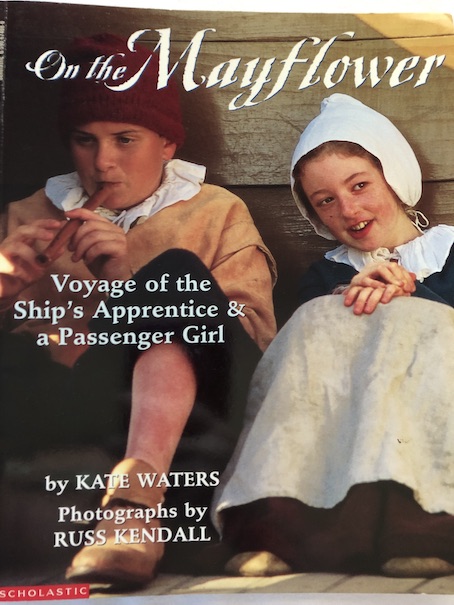
On the Mayflower by Kate Waters, 1996.
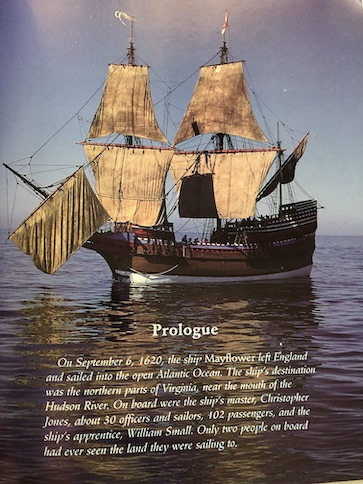
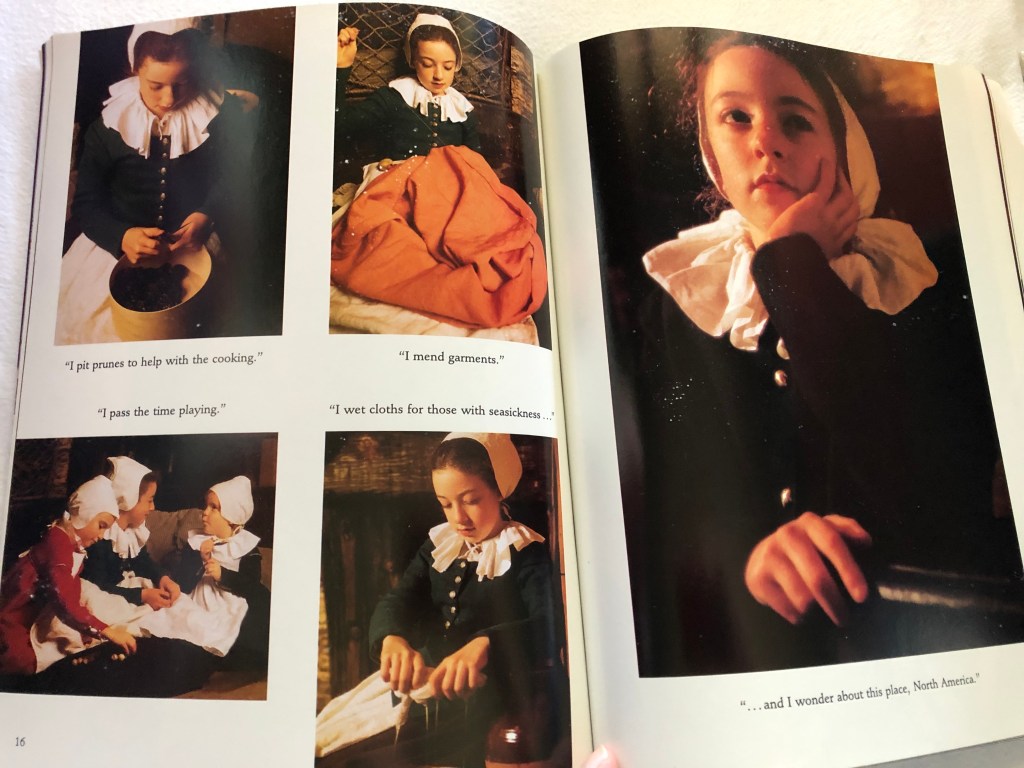
This book is part of a series by same author about children growing up in Colonial America. Each of the books is the series has photographs of historical reenactors portraying real people from Colonial history. This book focuses on two children who are traveling on the Mayflower in 1620, heading to what would become the Plymouth colony. One of the children is a girl who is a passenger on the ship, and the other is a boy who is part of the crew, a ship’s apprentice. In the section of historical information in the back of the book, the author explains that the girl was based on a real girl who was a passenger on the Mayflower, although the boy was not based on a specific apprentice; he is just meant to show what a ship’s apprentice would have been like at that time and to help explain the duties of the various crew members as he assists them.

The ship’s apprentice is called William Small. He is specifically apprenticed to the ship’s master, Christopher Jones (historical character). As an apprentice, he is learning basic navigation skills and assists the regular crew members with various tasks, including serving food.

The girl is named Ellen Moore. She and the other passengers are traveling in cramped quarters, and people are often seasick or trying to find ways to keep themselves occupied during the long journey. Ellen is traveling with younger siblings, and she plays with them in between performing routine chores, like sewing and preparing food.
During the voyage, there is a terrible storm, and the passengers are all confined below deck without light because lanterns and candles would pose too much risk of fire while the ship is rocked during the storm. William has to help the ship’s carpenter to repair leaks. Before the storm is fully over, Mrs. Hopkins, one of the passengers, gives birth to a baby she names Oceanus (historical person, the real Oceanus made it through the voyage although he sadly died young, possibly about age six, but the date of his death is uncertain).

The book ends with their arrival in the Americas. Because the storm blew them off course, the Mayflower did not arrive at its intended destination in Virginia but further north at Cape Cod in what is now Massachusetts. Because winter was setting in, the passengers decided not to risk further travel and established their colony there, 65 days after their ship first left England.

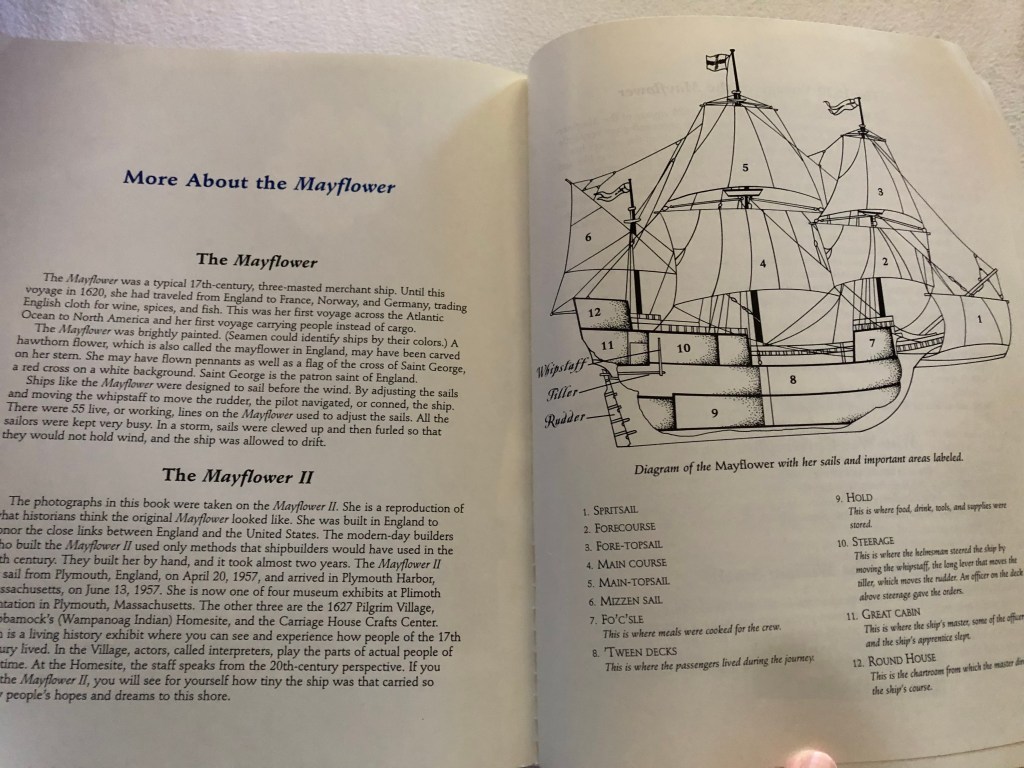
In the back of the book, the section with historical information explains more about both the characters in the story and the reenactors. The historical Ellen Moore and her siblings were traveling to the colony without their parents, under the guardianship of the other families, acting as young servants in their employment. The book mentions that the Moore children were without their parents because of a family tragedy but is not specific about what it was. I looked it up, and the story is both sad and bizarre. I can see why the author didn’t want to explain it in a children’s book. Apparently, the children’s parents had an arranged marriage and were not happy being married to each other. The children’s mother had a long love affair with another man, and also apparently, all of the children were the biological children of her lover. The mother’s husband began to notice that the children physically resembled his wife’s lover. The couple bitterly divorced, and after the husband was granted custody of the children (which, apparently, weren’t his anyway), he decided to send them away to the Americas with the departing pilgrims, paying for them to be taken on the voyage, never seeing them again. Sadly, Ellen probably did not survive the first winter at the Plymouth colony because she disappears from the historical record during that time. Out of the four Moore children traveling on the Mayflower, only one survived to adulthood, Ellen’s young brother Richard. Richard married twice in his life and had seven children of his own. He became a sailor and ship’s captain and eventually died an elderly man in Salem, Massachusetts, during the 1690s, not long after the Salem witch trials. None of this information about Richard is mentioned in the book, but I thought it was interesting background information. In the book, there is also additional information about the ship, The Mayflower, and the reproduction ship used in the pictures, The Mayflower II.
The book is available to borrow for free online through Internet Archive.

Pocahontas

Pocahontas

Pocahontas by Jan Gleiter and Kathleen Thompson, 1985.

The story about the life of the young Native American woman known as Pocahontas (“Pocahontas” was really a nickname, which the book mentions, although it doesn’t say that her original name was Matoaka) has been told many times in many forms, but this particular book is somewhat sentimental for me because it was the first one I ever read about her when I was a kid. It’s part of a series about famous and legendary figures in history and myth. Pocahontas was a real, historical person, but aspects of her life have taken on the characteristics of legend (as well as providing material for a Disney movie, although the Disney movie takes liberties with the real life of Matoaka/Pocahontas and the movie was not based on this particular rendition of her story).

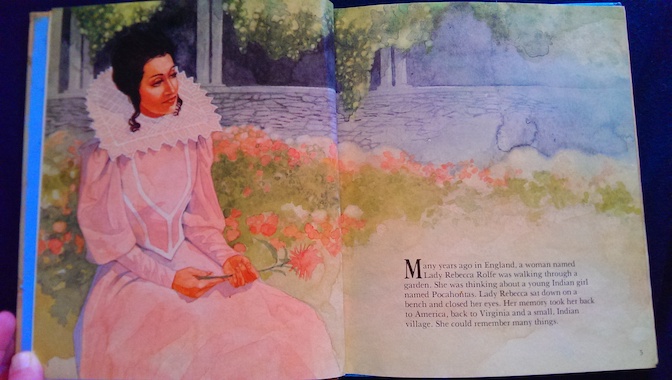
When this particular book begins, Pocahontas is a grown, married woman going by the name of Lady Rebecca Rolfe. While living in England, she reflects back on her life and youth, remembering when she first met Europeans.

PocahontasEngland

When she was ten years old, she heard her father, Powhatan (who was the chief of their tribe) and other men talking about the white men. Although Pocahontas hears that the white people had betrayed her people’s trust and even killed some of them, she is curious to get a look at them.

PocahontasSettlerChildren

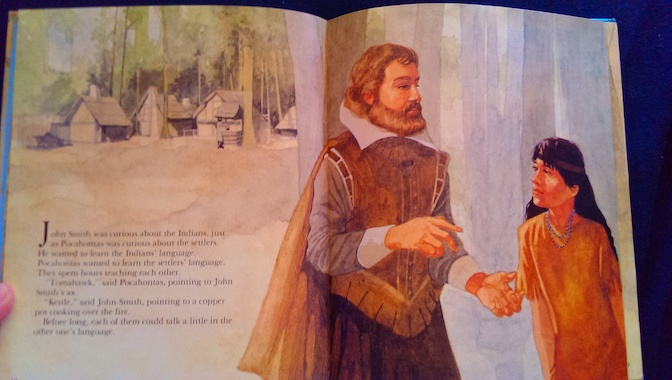
She ends up meeting with a group of boys from Jamestown and playing with them. She begins making friends with people in Jamestown and visiting them from time to time. A man named John Smith becomes curious about the girl and her people and gets Pocahontas to teach him some of her language.  (The book is more accurate than the Disney version here, showing that there is a significant age difference between Pocahontas and John Smith, with Pocahontas being a child at their first meeting.)

PocahontasJohnSmith

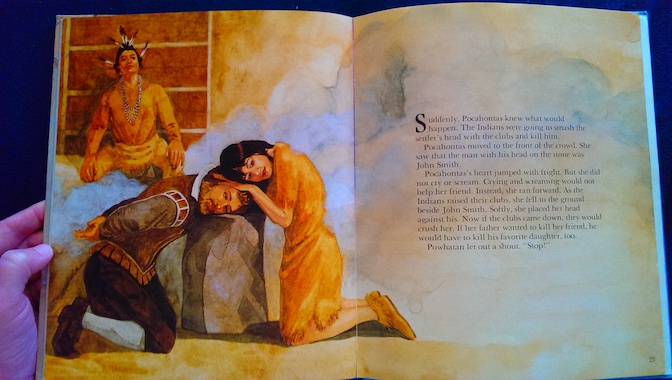
Then, one day, there is a feast in Pocahontas’s village, and some of the men of the tribe bring a white man who was caught trespassing in their territory. Pocahontas recognizes the white man as John Smith and, upon realizing that he is about to be executed, intervenes to save his life. (This is one of the most famous parts of the story of Pocahontas’s life, although the exact circumstances surrounding the real-life incident are a little confusing and may have actually been part of a more complex ritual that John Smith didn’t fully understand at the time, not an actual attempt at execution, if the event actually happened at all. This book offers a simplified version of the incident, supposing that John Smith’s life was in real danger, as he described it in his account of what happened.)

PocahontasExecutionAttempt

In the end, the settlers at Jamestown kidnap Pocahontas in the hope that Powhatan would end hostilities with them, using her as a bargaining chip.  (The book says that her father wasn’t too worried because he knew that the settlers were her friends and would treat her well, but I find this part of the book pretty worrying myself, reading it as an adult.  I’m pretty sure that is not how a parent would react to a missing child in real life.  I guess that the book is trying to keep the tone light for children, but it just sounds weird.) Pocahontas remains among the settlers, living according to their lifestyle and taking the name Rebecca. Eventually, she meets a man named John Rolfe and marries him. The two of them have a son together. With her new family, she travels to England and tries to help the people there to understand her people.  (The book says this in a very optimistic way, calling her visit a “success”, although in real life, this visit was largely a propaganda move on the part of the Virginia Company of London. On the other hand, she was, evidently, very well-received in England, if something of a social curiosity.)

PocahontasWedding

The story in the book ends here, with her still in England, thinking back on her life and her reasons for being there. Part of me wishes that it had explained a little more about Pocahontas’s earlier life and some other facts behind her story. Sadly, part of the reason why they might have been reluctant to tell the rest of the story to children was that the real Pocahontas didn’t live very long after the point where the story ends.  As she was preparing to return to Virginia from England, she became very ill and died.  Her exact age at the time of her death is unknown, but she was probably about 21 years old.  Her son, Thomas Rolfe, was very young at the time she died, but they do still have living descendants today.

Overall, I’d say that this is one of those stories that becomes more interesting when you’re older and realize the full depth of it.  This picture book is a very simplified version of the story, meant for kids, but when I was young, it did inspire me to learn more about Pocahontas.  There any many missing details of Matoaka/Pocahontas/Rebecca Rolfe’s life because of the limited records of it, but what is known is fascinating.  It’s sad because she died so young, but that the story of her life lived on in so many imaginations after her death is profound.  Different people, both when she was alive and after her death, tried to use her for their own purposes, but her legend still continues, out-living them all.  I’ve never seen the Disney Pocahontas movies, and I don’t really want to.  I already know how the story ends.

The book is currently available online through Internet Archive.

Happy Birthday, Felicity!

American Girls

FelicityBirthday

Happy Birthday, Felicity! by Valerie Tripp, 1992.

FelicityBirthdayGuitarThis is part of the Felicity, An American Girl series.

It’s Felicity’s birthday, and her grandfather has given her a very special present: a guitar that once belonged to her grandmother, who is now dead. Felicity’s grandfather has heard Felicity singing and thinks that she shares her grandmother’s gift for music. He also thinks that Felicity is old enough to take proper care of the instrument, stressing the need for her to be responsible with it. Her mother tells her that she should keep the guitar safely in the parlor since she isn’t quite old enough for proper music lessons, like the ones Miss Manderly is giving Elizabeth’s older sister, Annabelle. Annabelle has been getting on Elizabeth and Felicity’s nerves by bragging about how they are still to young to even hold her guitar, although Annabelle really has no musical talent and struggles in her lessons.

Although Felicity knows that she should leave the guitar at home, she can’t resist taking it to Miss Manderly’s so that Miss Manderly can tune it for her and so that she can show it off to Elizabeth and Annabelle. Miss Manderly does tune the guitar for her and compliments her on owning such a fine instrument.

FelicityBirthdayGunpowderHowever, on the way home, something frightening happens. Felicity sees Elizabeth’s father, a known Loyalist, talking to a British soldier. She ducks into a bush so they won’t see her, and she hears them talking about the governor removing the gunpowder from the Williamsburg arsenal so the colonists can’t use it in the rebellion that has been threatening to come for some time.

Felicity hurries home to tell her family what she has heard, but when her mother and grandfather see that she has taken the guitar out of the house and gotten it wet and dirty while she was hiding, they refuse to listen to her. Her grandfather, also a Loyalist, particularly thinks that she’s making up stories to cover her irresponsibility about the guitar.

But, Felicity knows what she heard, and the situation is serious. What can she do to prove it to everyone?

In the back of the book, there is a section with historical information about how children were raised in Colonial America.  Another good book on the same topic is Going to School in 1776.

The book is currently available online through Internet Archive.

Giving Thanks

GivingThanks

Giving Thanks by Kate Waters, 2001.

This book describes the feast of 1621 that we think of as “the first Thanksgiving” from the point of view of two boys: Resolved White (a six-year-old English colonist) and Dancing Moccasins (a fourteen-year-old Wampanoag).  The book explains that the reality of this feast is somewhat different from the way many people think of it.  For one thing, the exact date is unknown, and it wasn’t really a single meal but a kind of harvest celebration that took place over several days.  The events of that celebration were re-created using reenactors from the Plimoth Plantation living history museum.

In the beginning of the book, Dancing Moccasins explains that his family has been harvesting their crops and preparing to move to the place where they live in the winter. Wampanoag lived in different places depending on the time of year, moving between them when the seasons changed.  At their winter home, they would continue hunting and fishing, returning to the place where they planted their crops at the end of winter.

GivingThanksBeginning

Similarly, Resolved’s family has finished harvesting their crops and have stored up food for the winter.  Now that most of the hard work is over, they have time to relax and celebrate.  The community is planning a feast.  Resolved and his friend, Bartle, follow some of the men, who are going out hunting and target-shooting.

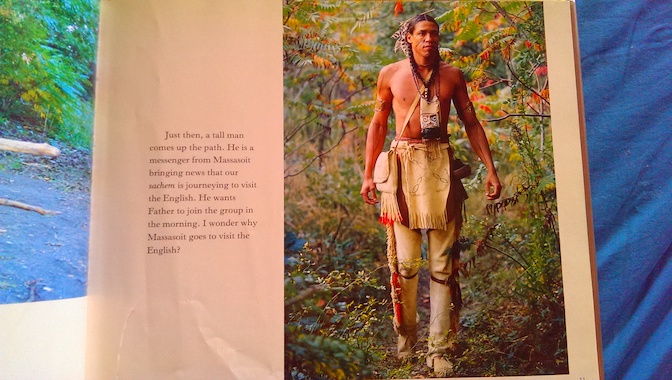
The colonists meet up with some of the Wampanoag, which is how Dancing Moccasins and Resolved first see each other.  Dancing Moccasins returns home and tells his father what he has seen.  Then, a messenger arrives from their chief, Massasoit, saying that he will be visiting the colonists soon, and Dancing Moccasins’s father is invited to come.

GivingThanksMessenger

Just as Dancing Moccasins is wondering about the purpose of this visit, Resolved is wondering the same thing because word has reached the colonists that they will soon be visited by the chief and representatives of the tribe.  (The book explains in the back that the exact reasons for the Wampanoag visit to the colonists are unknown today, only that it happened at the same time that the colonists were planning their harvest feast.) The two boys meet again when Dancing Moccasins accompanies his father on the visit to the colonists’ village.

GivingThanksGovernorDinner

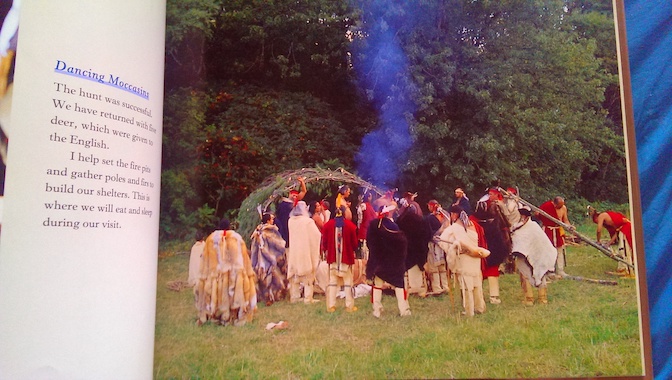
When the Wampanoag arrive at the village, they are treated as honored guests, and some of the Wampanoag go deer-hunting to provide a present for their hosts.  The chief dines with the governor of the colonists.  The Wampanoag build shelters for themselves, where they will stay during their visit.

GivingThanksShelters

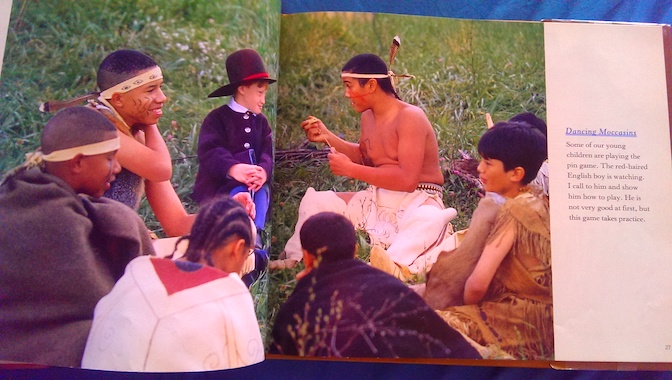
Eventually, Dancing Moccassins invites Resolved to play a game with him and some other Wampanoag boys when he sees him watching them.  Some of the Wampanoag men also join in the games that the English men play, like competing to see who can throw a log the farthest.

GivingThanksGames

At the end of the day, Dancing Moccassins and Resolved each eat with their own families, but there is plenty for everyone.

There is a section in the back with historical information about the harvest feast, traditions about giving thanks among both the colonists and the Wampanoag, and how Thanksgiving eventually became a national holiday in the United States.  There is also information about food and clothing in the time of the story and a recipe for samp (a kind of corn pottage eaten by the Wampanoag and later adopted by the English colonists).  The book also has some information about the Plimoth Plantation living history museum and the reeanctors.  It is part of a series of books by the same author about the lives of children in Colonial America.

The book is available to borrow and read for free online through Internet Archive.

Samuel Eaton’s Day

Samuel Eaton's Day

Samuel Eaton’s Day: A Day in the Life of a Pilgrim Boy by Kate Waters, 1993.

This is the story of a boy who traveled to America from England on the Mayflower and whose family lived in Plymouth, Massachusetts. The book focuses particularly on how a boy like Samuel would have helped with a harvest during the year 1627.  The role of Samuel in the book is played by a boy who is one of the reenactors at the Plimoth Plantation living history museum.

Samuel’s mother died when he was a baby, but his father remarried, and he now has a stepmother (whom he calls “Mam”) and a younger half-sister, Rachel.  Now that Samuel is seven years old, he is considered old enough to help the men bring in the rye harvest.  Samuel is eager to help because he wants to prove that he is no longer just a little boy and that he is capable of doing a man’s work.

The book begins with Samuel waking up and getting dressed in the morning.  He has a few routine chores to perform, such as getting water, gathering firewood, and checking a snare that he has set for catching wild game, before he and his father go to the fields to help with the harvest.  After breakfast, Samuel and his father meet up with a neighbor, Robert Bartlett, and go to the fields with the other men.

SamuelEatonBinding

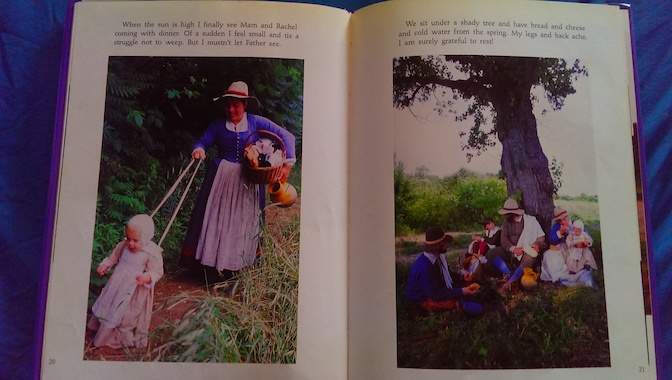
Robert Bartlett tells Samuel that it will take a few days for them to complete the harvest.  Samuel isn’t considered old enough to wield a sickle by himself, so he is given the task of gathering up the rye that his father and Bartlett cut and binding it into sheaves.  It’s hard work, and at times, Samuel wonders if he’s really up to the task.  When his Mam comes with lunch, she gives Samuel the chance to come home with her, if he is too tired, but Samuel is determined to stay and finish out the day.

SamuelEatonLunch

At the end of the day, Samuel is very tired and has blisters, but he is proud of the work he has done, and the men congratulate him.

The end of the book has a section that explains a little about the real Samuel Eaton, who eventually had his own farm when he grew up, and the boy who reenacted his life, Roger Burns.  There is also information about the clothing of the period, the Wampanoag people (seen briefly when Samuel is helping to gather mussels for the family’s dinner), the rye harvest, and the Plimoth Plantation living history museum.  The book also provides the lyrics to the song that Samuel and the others sing to entertain themselves while they’re working in the fields, The Marriage of the Frog and the Mouse.

Sarah Morton, a girl who was featured in an earlier book in the series, also appears briefly in this book.

The book is currently available online through Internet Archive.

SamuelEatonSarah

ColSec Rebellion

ColSecRebellionColSec Rebellion by Douglas Hill, 1985.

This is the final book in the ColSec Trilogy, a sci-fi series.

In a future where Earth is controlled by an oppressive government, dissidents are exiled to distant planets to start colonies whose resources can be exploited by the government.  However, the colonists have been plotting to take their destinies into their own hands.

Cord MaKiy and his friends, once exiled colonists on the planet Klydor, have joined up with the resistance movement.  They hijack a ColSec ship and return to Earth to gather allies for the rebellion against Earth’s government, called The Organization.

Once on Earth, they turn to the societies that they came from, little groups of outcasts on the fringes of Earth’s society. Cord’s people, the Highlanders who live in the wild areas of Scotland without modern technology, welcome them, and many of the young people are interested in joining the colonies, seeing other worlds, and living in freedom. Similarly, the rebels find more friends among the Vampires, the youth gang that lives in the Bunkers (what’s left of the old subway system under London).

However, the Streeters (a youth gang in the Chicago area) are a different story. Although many of them want to escape their little hideouts in the urban jungle called Limbo, their leader, Tuller, is unwilling to give up his relatively comfortable position of power. When he betrays the rebels to the government, the others have to decide where they stand and if they’re willing to take the risks necessary to gain their freedom.

In a way, the colonists seem to gain their ultimate freedom more easily than expected, but that’s partly a product of the type of repressive government that controls Earth. It isn’t really a military dictatorship, although they do use deadly force against their enemies; it’s more of a greedy corporate structure, designed to bring vast amounts of wealth to the people at the top of the structure, while keeping the lower levels in line to do their bidding.  In the end, as Lathan had guessed in the previous book, The Organization is more concerned with profit and loss than anything else, and the rebels manage to cut them a deal after showing them that fighting would only bring heavy losses with no material gain.

There’s plenty of action in the story as the young rebels struggle to prove themselves to potential allies on Earth and flee the forces of ColSec to return to Klydor, where they issue their ultimatum.  The negotiations with Earth are summed up fairly quickly, and although there are no more books in the series, the ending sets it up for Cord and his friends to continue their life of exploration on other worlds, seeking out new places for people who want to flee the dull repression that still exists on Earth.

The Caves of Klydor

CavesKlydorThe Caves of Klydor by Douglas Hill, 1984.

This is the second book in a sci-fi series, the ColSec Trilogy.

The five remaining colonists on the planet Klydor have been exploring their new planet and trying to survive and to decide what they will do when the government department that exiled them to this planet, ColSec, sends its ship to check on their progress.  Under Earth’s repressive government, dissents are sent into exile to become colonists on alien planets so that the government can later reap the benefits of anything they find or produce.

They get worried when a ship arrives on their planet earlier than expected.  While searching for the ship to see who it is, the colonists encounter Bren Lathan, the best space explorer that works for ColSec.  It’s his job to seek out new planets for ColSec to colonize.  But, it turns out that he’s not there on an assignment for ColSec.  He’s crash-landed on the planet, apparently frightened of pursuers, who may be the people in the space ship now on the planet.

Unfortunately, it turns out that Lathan is being hunted by CeeDees (Civil Defenders, the harsh law enforcement department that Earth’s government uses to keep the civilian population in line).  Worst still, these ones are Crushers, a group known for using extreme force and not leaving survivors.  They spot Cord and Samella, and they think that the two of them killed one of their people (who was actually killed by an alien creature).  Cord and Samella manage to get awhile, stealing one of the CeeDee’s weapons.

Then, they discover that the reason that the CeeDees are after Lathan is that he is involved with a rebellion against the government of Earth, a rebellion that these colonists would very much like to join.

The themes of the story are still survival and teamwork.  The colonists often have differing opinions about how to solve their problems, but they have to work them out because they only have each other to rely on.  Lathan, who is much older than they are, doesn’t really respect them much at first or want to involve them in his plans, comes to realize that their skills and ideas are valuable and that they may be just the people he needs.

The book is available to borrow and read for free online through Internet Archive.
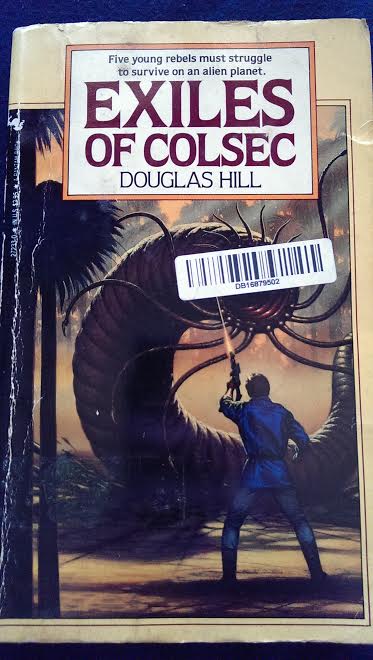
Exiles of Colsec

ExilesColSecExiles of ColSec by Douglas Hill, 1984.

This is the first book in a sci-fi series, the ColSec Trilogy.

In the future, Earth is controlled by a repressive government that sends criminals and dissidents (especially strong youths) into exile on other planets. These exiles are assigned to different planets to form colonies by ColSec (short for Colonization Section). The government then reaps the benefits of whatever resources the colonists find or produce, all while keeping them at a safe distance to prevent them from starting rebellions.

The system works very well as far as the government is concerned, but this time, things don’t go according to plan.  The ship of dissident colonists destined for the planet Klydor crashes, killing most of the people on board.  There are only six survivors, all teenagers:

Cord — A boy from the Scottish Highlands, an area more wild and uncontrolled than most areas of Earth.

Samella — From the area once known as Minnesota (or possibly Manitoba, even the people who live there aren’t sure of the old name).  She lived as part of a commune until a harsh winter brought them to the brink of starvation, and her own family sold her into slavery.  On Klydor, she begins to discover that she has ESP.

Heleth — From the Bunkers, the old Underground tunnels under Old London.  She belonged to a gang called the Vampires, who purposely dye their skin jet black to blend into the darkness of their hidden homes.

Jeko and Rontal — a pair of Free Streeters, gang members from Limbo, in the area of what was once Chicago.

Lamprey — The most dangerous of all, a homicidal maniac who quickly forces the others to do his bidding for fear that he will kill them.

These few survivors are alone on a strange world, where they will have to figure out how to continue to survive and somehow create a life for themselves . . . if Lamprey doesn’t kill them all first.  The other rebels from Earth decide that they will have to stage a rebellion within their own group to get rid of Lamprey, and Cord finds himself appointed to be their leader.

But, it turns out that they aren’t quite as alone on Klydor as they thought, and possibly the most formidable creatures on the planet might be . . . the trees.

This is largely a story of survival as the colonists work together to protect themselves from Lamprey and uncover the secrets of their new world that will allow them to survive.  Samella’s ESP is what allows them to realize the truth about the forest where they have crashed.

The book is available to borrow and read for free online through Internet Archive.
Sarah Morton’s Day

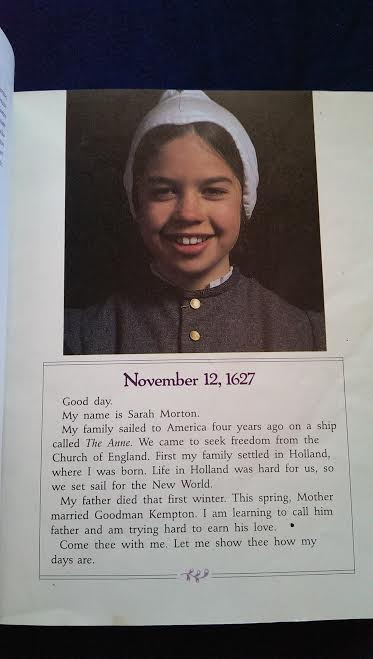
sarahmortonSarah Morton’s Day: A Day in the Life of a Pilgrim Girl by Kate Waters, 1989.

This book is part of a series of historical picture books. It features a young girl who was an historical interpreter at Plimoth Plantation, a living history museum, playing the part of a real pilgrim girl who lived in 17th century Plymouth.  The pilgrim girl’s name was Sarah Morton, and she was nine years old in 1627, the year that Plimoth Plantation reenacts.

As Sarah Morton, the girl takes readers through a typical day in her life.  She demonstrates the chores that a pilgrim girl would have to perform.  She explains the clothes that a pilgrim girl would wear and what people ate.  There is a recipe for 17th Century Indian Corn Bread, a simple recipe that readers can make at home, but it warns that modern people wouldn’t think that it tastes very good.  It’s basically just water and cornmeal grits.

sarahmortonpic1Although much of Sarah Morton’s day is taken up with chores, she also discusses her relationship with her mother and her new stepfather.  The death of a parent was something that pilgrim children often experienced.  After her father’s death, Sarah’s mother remarried, and Sarah is concerned about whether her new father likes her.

However, her stepfather is a good man who cares about her.  He gives her lessons in reading and writing, something that not every pilgrim girl would have.  He also gives her a special toy: a knicker box, which is a wooden box with arches for rolling marbles through as a game.  She gets to play with her friend, Elizabeth.

The two girls are also excited about a ship that has been sighted out at sea.  Soon, new people will be coming to their colony, and they wonder if the ship is also carrying letters from England or special goods that they would like, like a new bolt of cloth.

In the back of the book, there are sections explaining a little about the Plimoth Plantation living history museum, the real Sarah Morton, and the girl portraying Sarah Morton, Amelia Poole. The Plimoth Plantation site has more information about the real Sarah’s Morton’s life, including what happened to her when she grew up.  If you’re curious about what Amelia Poole is doing today, she is a fiber artist and lives in Maine.

The book is available to borrow and read for free online through Internet Archive.

sarahmortonpic2

The Green Book

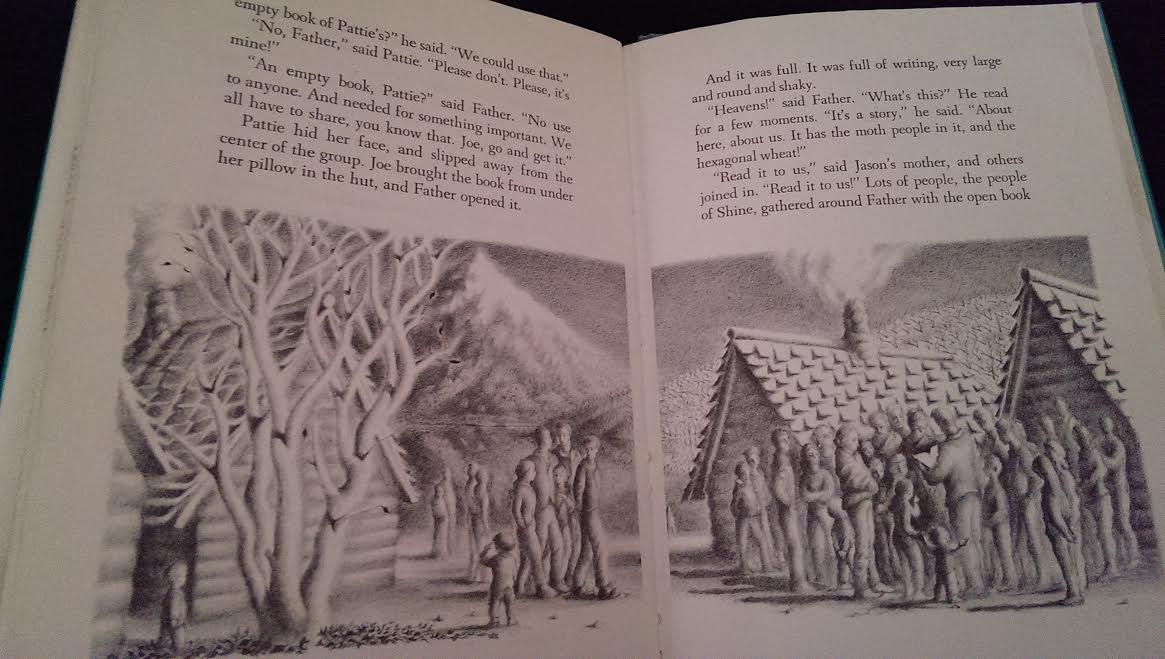
greenbookThe Green Book by Jill Paton Walsh, 1982.

The story takes place at an indeterminate time in the future. Earth is dying as the sun grows dimmer. The only hope for humans is to find new homes on other planets. In one of the last ships to leave Earth is a father and his three children: Joe, Sarah, and Pattie. They can take very little with them, only a few practical things, a couple of small keepsakes, and a single book each.

The journey to their new planet takes years, and people quickly go through their own books. Pattie, who is very young, brings a blank book with a green cover, which the others criticize and tease her about.  What use is a book with nothing in it that you can’t even read?

When they finally arrive on their new planet, everything is strange. The native plants seem to have a glass-like quality which makes them sharp, shiny, and dangerous to eat. Their guide came equipped with a set of rules to help them get their colony established, but soon they run out of rules and are completely on their own. Survival is a constant struggle, and everything involves a new discovery.

At first, it seems like they aren’t going to make it, but the children’s willingness to take a chance saves the day. Also, the little green book that Pattie brought gives the colonists hope. As they have exhausted all the old stories, she provides them with the first new one on their new world.

The book is currently available online through Internet Archive.

greenbookpic