The Silver Spoon Mystery

The Silver Spoon Mystery by Dorothy Sterling, 1958.

A group of families move into the new suburb built on The Hill overlooking the town of Dwighton. The kids in the new neighborhood become close friends, visiting each other’s houses, playing games, and running around town together. It’s idyllic, but then the boys in the group start playing baseball together, and they begin excluding the girls from the group, even though they’ve all played baseball together before and the girls are good at it. The boys also stop working on the tree house that the kids were all making together, taking some of the tools and materials and building themselves a clubhouse near the baseball field with a sign that says, “NO GIRLS ALLOWED.”
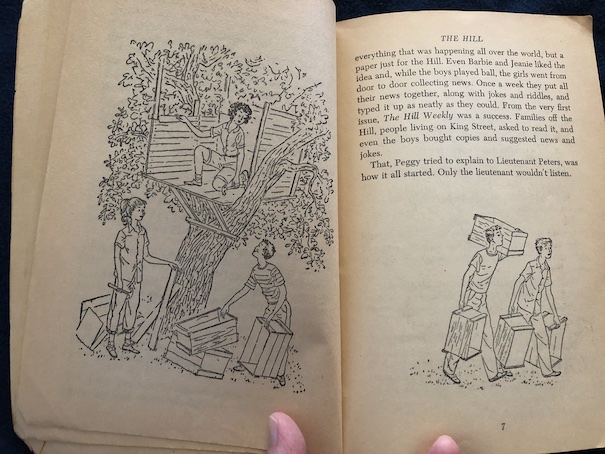
The girls are offended at suddenly being shunned by the boys, so they decide that they need to have some special project, something that will show the boys that girls are just as good as they are and that the girls don’t have to rely on the boys to have some fun. They decide to start a neighborhood newspaper, writing about local events and having fun stuff, like jokes. The newspaper is a success, and adult neighbors buy copies. Then, the boys decide to start a competing newspaper themselves. One of the girls, Peggy, is upset because she’s sure that the boys’ newspaper will be more successful. Some of the boys are older than the girls so they might write better, there are more boys than girls in the group so they have more people to gather news and sell papers, Davey is better at drawing cartoons than the girls are, and worst of all, the boys splurged to buy a hectograph, which uses a gelatin substance for making copies of writing and drawings (as in this video) and will allow the boys to print papers by the hundred (“hecto” means one hundred, and that’s how many copies a hectograph makes at a time). (This is before home computers, so the characters have to rely on manual printing methods. People used hectographs to make copies before modern copy machines, but modern hectographs still exist, and some people use them for artwork or tattoo stencils.)

Peggy’s afraid that the girls won’t be able to compete with the boys’ advantages and thinks that the boys are mean for trying to steal their business. Peggy’s mother tells her that she shouldn’t worry about being better than the boys but focus on being different. She says that the girls should make sure that their paper has different content from the boys’ paper so people will still have a reason to buy theirs even if they’ve already bought the boys’ paper. If the boys’ paper has cartoons, the girls’ paper should have things the boys wouldn’t think to include, like recipes, poems, and fictional stories that could be written and submitted by local people.

Peggy gets an idea from what her mother says, but it’s not a good one. Peggy still wants to show up the boys, and she thinks that the best way to do it is to get a “scoop”, meaning printing an exiting news story that the boys won’t have in their paper. The problem is that the girls don’t know where they’re going to get an exciting news story that the boys don’t know anything about. Nothing that exciting is happening in their town anyway. There haven’t been any shocking events, no murders, no robberies. Peggy tells the other girls that means that they have write about something that hasn’t happened yet. Peggy poses the idea of writing about someone stealing the silver on display at the local library that was made by the silversmith who was the founder of their town. Of course, the problem with that is that the silver hasn’t actually been stolen. One of the girls, Ellen, objects to writing a story about something that hasn’t happened because that’s not actually “news.” However, Peggy talks the other girls into it by saying that they would be writing about it as fiction because people write fictional books all the time, and that’s allowed. Ellen still isn’t convinced, but Peggy goes ahead and writes the story anyway. (Basically, she’s turning the girls’ newspaper into a tabloid, although the kids don’t seem to quite get the difference, even though Ellen can tell that this isn’t right for a newspaper.) The girls all discuss how they would go about stealing the silver spoons from the library, if they were going to do it, and Peggy writes the story from their speculations.
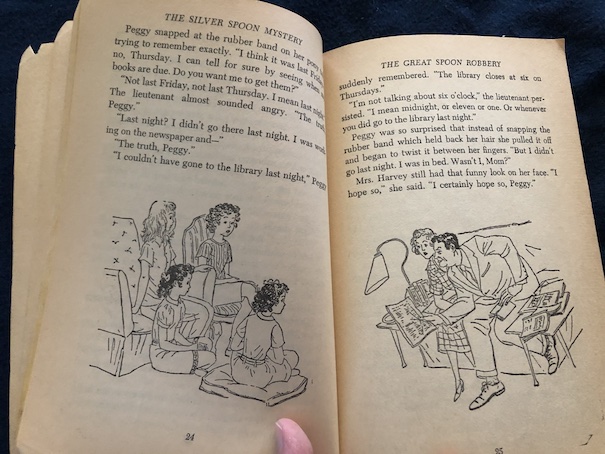
You just know that there’s going to be trouble with Peggy trying to sell a story that everyone knows didn’t happen, but what actually happens is even stranger. After the girls sell their paper with the spoon theft story, Peggy gets home to find a policeman, Lieutenant Peters, waiting for her with her mother. Lieutenant Peters wants to talk to Peggy about the robbery at the library because it turns out that the very night when Peggy was writing her big fictional scoop about silver spoons being stolen from the library, someone was in fact stealing silver spoons from the library, and this thief apparently did it the way Peggy described in her story. Lieutenant Peters wants to know everything that Peggy knows about the theft, and he won’t believe that Peggy wasn’t there to witness it because her description of what happened is so accurate. She even has a description of the thief in her story. Since the theft happened in the middle of the night, Peggy points out that she was asleep in bed, but even Peggy’s mother isn’t sure that Peggy didn’t sneak out. When Peggy’s friends show up at her house, Lieutenant Peters questions them too and comes to the conclusion that Peggy and maybe also her friends stole the spoons themselves to make their story true. Lieutenant Peters says that they’ll be forgiven if they give the spoons back, but the girls can’t do that because they don’t have them.

As Lieutenant Peters and Peggy’s mother continue to question the girls about their story, the girls admit that they made up the whole thing as a fictional story just to attract attention to their paper. Lieutenant Peters catches the boys listening in on their conversation and questions them about what they know about the situation. The boys don’t really know anything about the theft, either, but they were pretty sure that Peggy made up the story she wrote, and they’re fascinated that she might be about to be arrested and taken to “children’s jail.” Peggy’s mother believes her that she just made up the story and it’s all a coincidence that someone happened to steal the silver spoons from the library around the same time, but Lieutenant Peters isn’t convinced.

Word of the spoon theft spreads across town quickly, partly because of Peggy’s story in the neighborhood newspaper and partly because of the story in the regular news. People call Peggy’s house to ask for details, and kids at school look at Peggy and her friends suspiciously, wondering how much they had to do with the theft. Peggy is especially offended when Davey says that his father thinks that it’s an unlikely coincidence that Peggy would write a story about the theft and then the theft would just happen. Before the boys started their “no girls allowed” stuff, Peggy and Davey used to be close friends. However, Davey assures her that he doesn’t think that she’s responsible for the theft. He also tells her that he and the other boys are sorry about pushing the girls by trying to compete with their paper, and they’ve decided to give up theirs and let the girls use the hectograph. The kids discuss trying to investigate the crime themselves because, until the real thief is found, people are going to keep looking at the girls suspiciously.

Most of the neighborhood kids, both boys and girls, join the investigation as the “Hill Detective Club”, except for one of the older girls who is studying for exams and Davey’s older brother, Allen, the only boy who’s mad at the other boys because they don’t want to play baseball now. (Allen is apparently the one who started all the “no girls allowed” stuff because he didn’t make the high school baseball team and he’s been ultra-serious about practicing during the neighborhood games. He’s trying to organize a game between the boys in the neighborhood and their fathers. The book doesn’t explicitly say so, but there might also be an element of embarrassment for him that some of the girls play better than he does. Peggy is described as being the fastest runner in the neighborhood, and Ellen is a good batter.) As they begin their investigation, the kids visit the scene of the crime and study the ways the thief could have gotten into the library, starting to separate the made-up details from Peggy’s fictional story from the real facts and circumstances of the case. Peggy admits that her mind is biased because she still thinks of her story as the way things happened and her fictional suspect as the type of thief they’re looking for, but the truth is that they don’t know for sure how the crime actually happened or what type of person they’re looking for.

When the kids talk to one of the librarians, Miss Bancroft, they learn that the police did find a few sets of fingerprints on the case that held the silver spoons: Miss Lowell, the head librarian; Mrs. Simpson, a descendant of the town’s founding father and part of the local antiquarian society; and Mr. Weatherspoon, who owns a local antique store. Could one of these people be the thief?

The book is available to borrow and read for free online through Internet Archive.

My Reaction

To begin with, this book seems like it’s meant for fairly young elementary students. It tries to teach readers the meaning of some of the words in the story because some of the characters don’t know the meanings of various words the other characters use or words that they encounter in various places, like “descendant” or “optometrist.” The kids in the story are a variety of ages even though they all play together in the neighborhood, and I could understand why some of the younger kids would struggle with bigger words, but there were times when I thought that they were carrying it a little far. Peggy is twelve years old, so it seems like she should have been old enough to know what an optometrist is. Has she never had her eyes checked before? Actually, maybe she never has. If her vision is good or seems good, maybe her family just doesn’t bother. I guess it’s educational for young readers just branching out into chapter books.

I like books that bring up interesting historical topics. The parts about older printing/copying techniques and Mrs. Simpson’s old electric car with the steering stick instead of a steering wheel (possibly a Baker Electric, like the one Jay Leno owns, or something very similar – this video explains the history of the Baker Electric and shows what it’s like to drive it) were interesting, and one of the characters in the story explains more about the history of the town’s famous silver spoons to the kids. Although the town, its founder, and the spoons are all fiction, spoons of this sort did exist in real life. The silver spoons are specifically christening spoons. It used to be traditional to give presents made of silver to new babies and their parents for the child’s christening. One of the most popular presents of this type was small silver baby spoons, especially with special designs or engravings to remember the child’s birth. The character explains why this particular set of spoons is so distinctive, talking about their unique design, how antique dealers would be able to look them up in a reference book and learn their history, and how each of the of the spoons is marked with the maker’s hallmark, the special symbol that the maker would use to identify himself.

Part of the mystery hinges on the coincidence of the theft occurring just when Peggy decides to write a sensational story about an imaginary theft to get attention for her neighborhood newspaper. For readers, the question is whether the timing of the actual theft is really just coincidental or if there’s a direct connection between the story of the theft and the theft itself. I would have been very disappointed in the book if it was just a coincidence, so I immediately approached the story with the idea that the timing of the theft was a clue. I enjoyed considering different possibilities. My first thought, when the theft happened mysteriously immediately after Peggy and her friends invented their theft story, was that someone overheard the girls talking about how they would commit a theft like that and decided to use their imaginary scheme as their own. However, the conversation between Peggy and her friends took place in Peggy’s room, which was pretty private. For someone to overhear them, it would have to be someone in Peggy’s own house, possibly family or a neighborhood friend, or someone listening in from outside, probably one of the neighborhood kids. Those possibilities didn’t seem likely. Then, I remembered the Nero Wolfe murder mystery story Not Quite Dead Enough. What if the theft didn’t occur when the police thought it did (mostly because they believed Peggy’s original story) but actually at the point where the theft was supposedly discovered? The person who claimed to discover the theft was one of the people with the strongest motives to commit it, and this person could have done it after reading the fake news story, seeing an opportunity to make it true and cast suspicion on Peggy’s fictional suspect. The mystery is simple enough to figure out for an adult who likes mystery stories, but probably much more mysterious for kids. Once the kids realize who has the spoons, there is also the additional challenge of proving it and getting the spoons back without getting everyone in trouble.

I thought it was interesting that the story shows some of the problems with sensationalist or tabloid style “news” stories, or “yellow journalism“, as it used to be called. It’s the sort of “news” that relies on flashy and misleading headlines, buzzwords and catch phrases that appeal to its fans and rile them up emotionally, hyperbole and emotionally-charged language, conspiracy theories, pseudoscience, and poorly-qualified or debunked “experts”, to draw readership and advertising money. Basically, they aren’t really “news.” They don’t try to describe things as they actually happened for informative purposes. These are “news” stories that are less about fact than about entertaining their audience or shocking people and stirring up strong emotions to grab people’s attention. That’s basically what Peggy was trying to do with her fake news story, even if she wasn’t quite thinking about it in those terms. Just like tabloid or sensationalist news, Peggy’s story was almost a kind of fan fiction based on the real world. That is, she took real things and situations that she knew existed (the silver display at the library) and wrote an exciting conspiracy story around them that didn’t actually happen (the made-up theft) as a shocking, attention-getting entertainment piece to encourage people to buy the paper she and the other girls were selling. She thought what she was doing was like harmless entertainment, but it wasn’t because it was based on something real, and her made-up story had real consequences. Not only is there a direct connection between the fake story and the real theft, but Peggy’s fake story confuses people, including the local police and insurance investigator, because they have trouble telling how much of Peggy’s story is false, and it biases their minds and the direction of their investigations. Even Peggy herself sometimes gets confused during the investigation, mixing up details from her made-up story with real events. Even though she wrote the fictional story herself, knowing it was fictional, she gets hung up on the way she imagined things would happen when she invented the story and needs to be occasionally reminded to look at the situation as it actually exists, not as she imagined it would be. If the author of the fictional news story can’t even keep her own fiction and the real facts straight in her mind at first, how can the police or anyone else?

Sensationalist journalism can and has led to real problems in real life, setting up dangerous situations by stirring up the emotions of people who may already be unbalanced and suggesting unrealistic events or courses of action that interfere with people’s sense of reality and ability to make informed, reasoned decisions (something else that ties in with the story). In a famous real life case from the early 1900s, the famous newspaper publisher William Randolph Hearst had his own reputation seriously damaged when he published articles written by two of his columnists smearing President McKinley’s reputation and seemingly recommending his assassination. (“If bad institutions and bad men can be got rid of only by killing, then the killing must be done.”) These articles were published only months before President McKinley was actually assassinated. Hearst had used yellow journalism in his papers for years to manipulate public opinion to further his political causes and gain readership. (“War makes for great circulation,” Hearst said after successfully urging public opinion in favor of the Spanish-American War.) After the assassination of the president, people made a connection between the assassination the articles in Hearst’s papers seemed to be advocating (although they called it a “mental exercise” and a joke) and the assassination that actually happened. Whether Hearst actually wanted McKinley to be killed by someone or whether the man who assassinated McKinley was directly inspired by those sensationalist articles is questionable, but the suspicion that was what happened, in a sort of “Will no one rid me of this turbulent priest?” kind of moment, did seriously damage Hearst’s own political ambitions. Hearst did intentionally want to smear McKinley’s reputation, but his lack of consideration for the possible results of his stories, which seemed to be advocating an actual murder that did occur soon after, caused the public to turn against Hearst himself.

We frequently caution people to be careful of what they read because you can’t trust everything, which is sensible advice, but I’d go a little further and say, be careful of why you choose to read what you’re reading and why believe what you read. Was it because the information was presented logically and authoritatively, or is it because you decided ahead of time what you were going to read because of something you already believed or something you already knew you really wanted to do? Picking the right information source is good, but it may be even better to ask yourself what you, as an individual, plan to actually do because of the news sources you’re following. Is it a good thing to do that’s going to help someone or something that’s going to hurt people? Take a look in the mirror once in a while and question your motives as one of your own primary sources of information. You are the one who chooses what news sources you consume. You are the one who decides what you believe because you always have the choice to accept or reject anything you hear from someone else. You are the one who decides what your standards are and where your limits are set. You are the one person who knows exactly what you’re willing to do to accomplish your goals. You are the one who moves your body to the locations you decide to go and makes your mouth say the things it says and your body do the things it does. You are the one who has ability to say “yes” or “no”, not only to other people but yourself when necessary. Anything you may decide to do involves not just a single choice but multiple choices along the way that can only be made by you, so you’re going to have to be your own fact checker at every step, not just about what other people are telling you but what you’re telling yourself and why.

Sensationalist news stories are intentionally emotionally manipulative in order to get people hooked on reading that source, but you’re the only one who gets to decide if you’re hooked and what you’re going to do about it. The next time you read something that makes you really mad at somebody, before you do whatever you’re considering doing about it, pause a moment to ask, not just whether the source you just read might be wrong, but “What if I’m wrong? What if I’m wrong about this situation, and I’m about to do the wrong thing? Am I prepared to face the consequences for my actions if this turns out to be serious?” The reason for asking these questions is, if the consequences of what you’re planning to do are serious, there will be a point where people won’t want to hear about what you believed or thought you believed or what someone else told you earlier. If you’re the one who did the thing, you’re the one who’s going to be facing the consequences for that thing. There’s a point where everyone has to accept the consequences for themselves all by themselves. (To put a finer point on it, riot and people will riot with you, but you’ll be tried as an adult alone.)

The Son of the Slime Who Ate Cleveland

The Son of the Slime Who Ate Cleveland by Marjorie Weinman Sharmat, 1985.

Frank is the first to admit that he’s a bit eccentric and that his mind doesn’t quite work like other kids’. He’s a bit more imaginative, more daring. When he thinks of something, he can’t resist doing it, even pulling pranks on his best friends, Jack and Lee. He sees it as a way of expressing himself, and he wants to go into show business someday.

One day, the boys spot a jelly bean counting contest at the mall. The prize is two tickets to a move called Monster Mayhem and all the jelly beans they can eat in two hours. Frank isn’t really interested in counting contests. Jack and Lee, who have ambitions to go into law and banking, are more interested in counting things and competing with each other. Jack and Lee both come up with the exact same number of jelly beans that they think are in the jar, and they start arguing about which of them came up with the estimate first. Frank can’t decide which of them was first, so he just tells them that they’re both wrong and guesses his own random number without even trying to count the jelly beans. All three of them enter the contest.

That could have been the end of it, but Frank can’t resist telling other people about the contest. Not only does he tell them that he and his friends have entered the contest, but he tells them the exact number that Jack and Lee both guessed.

A classmate, Bianca, invites everyone to a party at her house where everyone has to come dressed as their favorite monster. Her parents are also there, dressed as Mr. and Mrs. Slime Who Ate Cleveland. Bianca’s parents are both psychologists, and they think it’s emotionally healthy for kids to expend their energies and go wild at parties, so they’re very permissive with Bianca and her friends. At the party, Bianca’s father takes an interest in Frank, calling him “son” (hence the name of the book) and telling him that he should mingle more with the other kids and be less of a loner. He offers to help Frank with vocational counseling for his future, which Frank is not eager to accept from a guy who is currently dressed as a Slime Who Ate Cleveland and who actively encourages the kids to have a potato sack race in the living room. Frank thinks an indoor potato sack race sounds crazy, Jack thinks it sounds dumb, but Lee is all for it. When Jack and Lee argue about the potato sack race, Bianca brings up the story that Frank told her earlier about the jelly bean counting contest and the boys’ argument over which of them guessed the answer first, putting it to a vote among the party guests. Lee wins the vote (which doesn’t mean much since the other party guests weren’t even there when they made their guesses), and Bianca switches her attentions from her current crush, Jack, to Lee (who doesn’t want Bianca’s attentions and becomes afraid to answer the phone when she keeps calling him).

Jack and Lee both get irritated with Frank for turning the jelly bean counting contest into a big deal and ask him to stop telling people about it because neither of them really even expects to win. However, the incident doesn’t even stop there, because it turns out that both Jack and Lee are declared the winners of the contest because their identical guesses are the closest to the real answer. The contest judges decide to award the prize jointly to the two of them – a movie ticket each and all the jelly beans that each of them could eat in an hour.

Sharing the prize could have resolved the incident, but Jack and Lee still have a competitive streak. Even though Frank congratulates them both as winners, Jack and Lee still argue about which of them is the “real” winner for coming up with the answer first. Frank tries to point out that each of them really only needs one movie ticket anyway, so what difference does it make if the other friend gets the other one? That doesn’t do any good, though. Jack and Lee both want to be acknowledged as the “real” winner, and thanks to the vote at Bianca’s party, other kids at school are taking sides to support their votes.

The entire jelly bean counting situation has gotten completely out of control! Jack and Lee won’t stop arguing with each other about who really won the contest, and both of them are mad at Frank for spreading the word about it and turning it into a bigger deal than it had to be. Frank needs to find a way to solve the argument and reconcile with his two best friends. Meanwhile, Bianca’s father, Mr. Wasserman, keeps calling Frank “son” and trying to talk to him about his vocational future, which makes Frank feel as green as the Son of the Slime Who Ate Cleveland.

Just when Frank thinks he’s got everything solved, a new contest threatens to set Jack and Lee against each other again. Frank tries one more outlandish scheme that exposes Jack and Lee’s arguments to an even wider audience than before. It takes some sincere friendship from Bianca, some words that actually make sense from her mother, and some “perfectly frank” talk from Jack and Lee to help Frank to recognize how his own behavior has contributed to the problems and how his friends really feel about some of the things he’s said and done.

The book is humorous, but Frank does develop some empathy through the course of the story, coming to a better understanding of how the people in his life really think and feel and the effects that his various pranks and stunts have had on people around him. Frank learns not just what it means to be “Perfectly Frank”, as he puts it, but what it really takes to be a sincere and honest friend. One of the best parts of the book is the banter between the various eccentric characters, from Frank’s straight-forward responses to the strange offers of advice from Bianca’s well-meaning slime monster father to the school principal’s attempts to convince Frank to take up paper clip collecting as a hobby to keep him out of trouble to the frank discussion of friendship Frank and Bianca have when Bianca asks Frank to kiss her.

The book is available to borrow and read online through Internet Archive.

Sixteen and Away from Home

Sixteen and Away from Home by Arleta Richardson, 1985.

The year is 1889. Mabel O’Dell turns 16 years old at the beginning of the book, and her mother gives her a journal as a present. Soon, she and her best friend, Sarah Jane Clark, will be starting the final years of their education at the academy in town. Mabel worries about going to the academy, first whether they’ll pass the entrance exams, and then whether they’ll be homesick because they will have to board in town. Sarah Jane assures her that it will be okay because they’ll be going together, and they’ll probably be too busy at school to think about homesickness much. Mabel’s mother is a little worried about the foolishness that young women can get into when they’re on their own. However, the girls do pass their exams and are admitted to the academy, and their parents agree to let them go.

In town, the girls will be staying with Sarah Jane’s Aunt Rhoda. Aunt Rhoda’s housekeeper, Lettie, seems to resent the girls being there for reasons they don’t understand. When school begins, the girls are shocked to learn that they’ll have to wear bloomers for “physical culture” classes. The teacher gives them a sewing pattern so they can make the uniform themselves. The girls imagine that their parents would be shocked to see them running around without skirts on. Fortunately, Mabel and Sarah Jane will have all the same classes, along with all of the other first year students. They have to take Grammar and Rhetoric, Biology, Latin, History, Calculus, and Physical Culture (physical education or PE).

They also quickly realize that the class troublemaker is going to be Clarice Owens, who unfortunately sits near Mabel because they all sit in alphabetical order by last name. Clarice deliberately picks on Mabel and Sarah Jane for coming from the countryside, calling them “hayseeds.” Mabel is disgusted because she can never think of a good comeback until after Clarice walks away. (Yeah, I’ve been there before.) Sarah Jane thinks she’s jealous of Mabel for being prettier. Mabel doesn’t really believe that, but she appreciates the thought. Molly, one of the other town girls, is friendlier. She says that she knows Clarice has always thought she was better than everyone, but she’s not usually this deliberately mean. Mabel says that maybe it would help if they knew the reason.

Through the rest of the school year, Clarice tries one scheme after another to cause trouble for the girls, especially Mabel. Mabel tries to be as patient as she can with Clarice, trying to let her know that she’d rather be a friend than an enemy, but Clarice gets angry and upset when Mabel tells her that she forgives her for all the awful stuff she does. Mabel thinks that there’s something hurting Clarice and affecting her behavior, although Molly tells her that she shouldn’t waste her sympathy on Clarice because “she gets what she wants.” Molly thinks that they should just be grateful for those times when Clarice isn’t immediately stepping on them to get what she wants because that happens, too.

When Mabel is injured in a sledding accident and has to stay in bed for awhile, she worries about falling behind in her classes. Lettie talks to her and brings into question the reason why she’s so concerned about her standing in class. Is it really because she loves learning, or is it because she’s trying to compete with the other students? Mabel starts to consider how too much competitiveness can spoil a person’s attitude and take the enjoyment out of things. Competition has much to do with Clarice and her attitude.

Things get worse when Clarice’s grandmother becomes ill and her parents arrange for her to stay in the house with Mabel and Sarah Jane while they go to see her grandmother. Clarice is rude to the servants in Aunt Rhoda’s house and sneaks out of the house during the night. Lettie tells the girls that Clarice’s mother was strong-willed as a girl, and she’s given a lot of her attitude to Clarice. There was a boy that Clarice’s mother had always wanted for herself, but he married someone else. Although Clarice’s mother also married and had a child, she never completely got over losing her first choice to someone else. Since the man she originally loved has a son the age of her daughter, Russell Bradley, she might be hoping that Clarice will marry him. Clarice certainly is interested is Russ … who is apparently more interested in Mabel.

Mabel considers that allowing Clarice to be with Russ and not trying to compete with her would help settle things between them, but as Sarah Jane says, Russ’s feelings on the issue matter. To get the most out of her education, Mabel needs to focus on her love of learning instead of comparing herself to her classmates, and to get the most out of their relationships with other people, all of the girls need to focus on caring about other people and their feelings.

The book is part of the Grandma’s Attic series. It is available to borrow and fread for free online through Internet Archive.

My Reaction

The problem with Clarice and her mother and their attitudes and expectations is that they do not take anyone else’s feelings into account other than their own and don’t even inform people of what they really want, yet they expect everyone else to somehow accommodate their wishes and feel toward them exactly how they want them to feel. These are not reasonable expectations at all. For most of the book, Mabel is completely unaware that Clarice’s meanness comes from the fact that she sees her as competition, and even then, it’s not really clear at first what Clarice is trying to compete for. Mabel didn’t ask or agree to be Clarice’s competitor in anything, and she’s not even trying to be. In fact, she’s been trying everything that she can to avoid it. Russ also apparently has no idea what Clarice is really after because he doesn’t have the same feelings about Clarice that she has about him. He’s just trying to live his life and focus on his own feelings and interests, and as far as he’s concerned, Clarice doesn’t really enter into it. Russ has no obligations to Clarice and her mother, and even Mabel doesn’t have the right to tell him how to feel or what to do to get rid of Clarice’s ire.

When Clarice pulls one last trick on Mabel, and she still forgives her, Clarice finally tells her that she gives up because, “You can’t go on disliking someone who refuses to be disliked.” I have to admit that I found the end to be a bit unbelievable. I’ve never encountered anybody who was that much of a pain and who ever let someone else’s kind behavior stand in the way being a pain. The response that I’ve usually seen is that they congratulate themselves on finding someone who’s never going to fight back and use that opportunity to run roughshod over them. They usually blame the kind person for making it easy to take advantage of them. As even the book says, people cannot decide how anyone else should feel or force them to feel anything in particular. It just doesn’t work. Mabel cannot “refuse to be disliked” because what Clarice likes or dislikes is all in her own mind. All that Mabel can decide is how she feels and what she’s going to do about it.

What Mabel really does decide is that, whether she likes or dislikes Clarice, she’s not going to compete with her and try to fight or match her meanness. It isn’t so much a matter of likes and dislikes in the end as Clarice discovering that she’s running a race with no other runners. If there’s no one to race against, there isn’t really a race at all, and no one cares if you walk off with the trophy or not. Maybe there was never even a trophy there to begin with.

If I’ve said it once, I’ve said it a million times, I don’t like bullying or one-upmanship, and I have no interest in sympathizing with anyone who does those things. Part of the trouble I have with overly-competitive personality traits is the same trouble that actors sometimes suffer when they’re out in public: they don’t always know when to stop acting, stop posing, or stop performing. Overly-competitive people don’t know went to stop competing. Where does the one-upmanship end and the human person actually begin? Or is that their personality all by itself? Do they have any interests outside of being competitive, or are they only about competition just for the sake of competition? Do they wan to be good at something for a purpose or because they just love it, like the love of learning, or is everything they do just about trying to look better than someone? I was reading this article recently, about how trying to keep up an image all the time too often leads to a person having no real substance or sense of self.

By herself, Clarice doesn’t present much to connect with or sympathize with. Clarice doesn’t really seem like a real person to me. She’s rather a one-dimensional character. This is a problem with a lot of bullies in children’s books. She apparently has very generic family issues that are supposed to explain her behavior with little insight into how she really feels about anything. At least, that was how she seemed to me. The explanation behind these family issues comes from a youthful romantic trauma of her mother’s, but what does that really mean to Clarice herself? She seems to have some kind of fear of being second-best, possibly because her mother has pushed her in that direction, but again, we return to the question of second-best at what? Is it that she fears being rejected by classmates or potential boyfriends, or does she fear not living up to her mother’s expectations? If her mother is still pining for her first boyfriend, what does that say about her parents’ relationship with each other? Does her mother view her own husband as second-best, the consolation prize in the contest of life, and what does that mean for Clarice’s relationship with her father? What does Clarice really want out of life and what, specifically does she want to be the best at doing? The idea of romance with Russell may be wish-fulfillment for her mother, but what do she and Russell really have in common? What does she have in common with anybody, when we mainly see her in competition with everyone?

I wouldn’t have nearly as much patience with her as Mabel because, when it comes right down to it, I wouldn’t see Clarice’s friendship as a prize worth winning. Mabel went through quite a lot to get through to Clarice, but her efforts only pay off right before the end of the book, so we don’t really see much of what Clarice is like after she says that she’s giving up the competitive mean girl act. Apparently, Mabel will get the benefit of not having to put up with Clarice’s mean tricks from now on, which is something, but if Clarice isn’t being mean and sneaky, what is she? Who is she, really?

In real life, people have hobbies, interests, and life goals, but Clarice doesn’t seem to have much that really interests her. Are Clarice’s goals really hers or her mother’s, as they hint? What does Clarice want, or has she even thought about what she wants? In modern times, a sixteen-year-old still has years of education ahead of her because more people attend college these days, but once Clarice finishes at the academy in town, her education is likely over. She only has a couple of years left to think about a direction for her life before she has to get on and live it as a full adult. Even if her destiny seems to be someone’s wife and mother, connecting with someone emotionally to the point where they would want to be married and sharing a life with her would be difficult for someone who has no real interests to connect to or a sense of how to build a shared life with someone else. For a while, she seemed to do well at memorizing the reading from Alice in Wonderland that she was going to perform with Mabel at the end of the school year, but that was just another part of her tricks so that she could back out at the last minute and let Mabel down. It was all part of an act by itself. Does Clarice really like acting? Does she like books? Does she like anything?

Clarice doesn’t even seem to have any close friends of her own, which is very unlike the real-life bullies I’ve known. Most of them do have friends and hangers-on who enjoy their mean humor (the thing that often binds them together and bolsters their bad behavior) or who put up with it because of some other benefit they get from that friendship, but Clarice doesn’t seem to have anybody and isn’t really offering anything. It just doesn’t seem realistic and makes me feel like Clarice is there mostly to be the cardboard cut-out of a nemesis. That may be why she gives up so easily in the end.

I would have found her change more believable if Russ had straight-up told her that her mean tricks and selfish attitude are the reasons why he doesn’t like her and isn’t interested in her. That would have been motivation for Clarice to change because it would give her both something to lose by not changing (Russ and others getting angry and saying they’ve had enough of her attitude) and something to gain by taking on different habits (like the possibility that Russ might change his mind if she can demonstrate that she can do as many unselfish deeds as Mabel, something that might actually appeal to Clarice’s competitive personality). I would also have found it believable if Clarice changed her mind about Russ because she ultimately realized that Russ is what her mother wants for her, not what she wants for herself, and that there are other possibilities that she likes better. I would also have liked it if Clarice had been planning to back out on the reading of Alice in Wonderland in order to ruin the presentation for Mabel but changed her mind at the last minute because she realized that she loves the story or performing so much that she just can’t bring herself to miss the event, that she has found something that she loves doing more than causing problems for someone else. Reassessing the consequences of behavior or finding different goals are the kinds of self-motivation that provoke real people to change.

On the other hand, maybe the real issue is Clarice has sensed that she’s fighting a losing battle for Russ, and as Sarah Jane noted, you can’t control the way other people feel. If Russ doesn’t love Clarice, he’s just not going to love her. Perhaps she can tell, even when he’s with her, that he’s not thinking of her and just isn’t going to be interested in her the way she is with him. There’s only so much effort that a person can pour into getting someone’s attention before it starts to get really awkward when they don’t get the attention they’re looking for. Even if Russ doesn’t spell it out for her, she can probably tell that she doesn’t want to be with someone who clearly doesn’t want to be with her. Clarice still might not know quite what she really wants yet, but she might have figured out that’s one thing she doesn’t want, to be with someone who doesn’t think of her as his first choice or even much of a choice at all. All along, she’s been trying to compete with someone who doesn’t even want to compete for a prize that doesn’t want to be won by her because he’s already picking another winner. It brings us back to the idea of one person attempting to run a race all alone. It’s not really a race, it’s just one person running down the street, getting sweaty and tired, with no real prize to win, and who is there to care when they start or stop? That might actually be the most believable explanation of them all.

The books in this series have Christian themes, including this one. As the characters discuss the problem of Clarice and other situations, they often turn to the Bible for inspiration, sometimes discussing specific quotes that relate to the concepts they consider, like forgiveness and revenge.

On a fun note, I liked the description of the Halloween party activities. I was born around Halloween, and I often have a Halloween-themed birthday party. I’m sometimes fascinated by the traditions of Halloweens past. In the book, they call it a Halloween party, but the activities are more harvest-themed than spooky. They bob for apples and run races with apples balanced on their heads, and they also play tug-of-war and Skip to My Lou.

Color War

Camp Sunnyside Friends

ColorWar#3 Color War! by Marilyn Kaye, 1989.

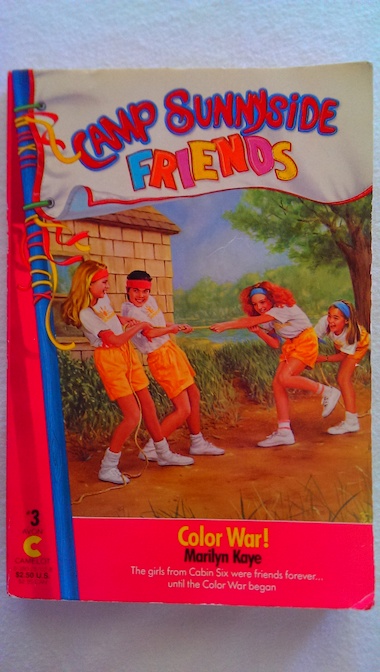
Usually, the girls of Cabin 6 at Camp Sunnyside have fun during the camp’s annual competition.  Every year, the girls at camp are divided up into two teams, red and blue, and they compete against each other in a series of contests.  Ms. Winkle, the camp director, cautions the girls at the beginning of the Color War not to let themselves be carried away by the competition, to remember that they’re all still friends and members of the same camp, and to keep the contests friendly.  Usually, that isn’t a problem for the girls of Cabin 6.  They each have their favorite activities, and every year, they’re always on the same team, working together against other cabins.  However, this year is different.

When the girls of Cabin Six are split up and put on different teams, the competition between them threatens to ruin their friendship.  Some of the girls of Cabin 6 are more competitive than others, especially Katie, who likes to be a leader and hates to lose at anything.  Trina, on the other hand, values loyalty and friendship more than competition.  She looks on the other girls in her cabin as being almost family because they’ve spent so much time together and considers Katie to be her best friend at camp.  There is an unexpected clash between the two girls when Katie turns out to be the captain of the blue team, and Trina ends up on the red team.

Both Trina and Katie are disappointed about the team assignments.  Trina had helped to campaign for Katie during the elections that were held for the team captains, before the teams were even assigned, and Katie had told her that she wanted her to be her assistant.  But, teams are assigned randomly after the entire camp elects two captains to lead them, and none of the girls had any say in it when Trina and Erin were both placed on the red team, under the leadership of Maura, a snobby older girl who is even more competitive than Katie and not above stooping to some mean tricks to get ahead.  Switching teams is against the rules, so there’s nothing to be done about it.

Trina feels badly that she can’t be on Katie’s team and still thinks of her as her friend.  But, she notices that, from the moment when the teams are assigned (the girls each have a dot of a different color paint on their foreheads when they wake up one morning, indicating what their team will be), Katie starts behaving awkwardly around Trina, treating her almost as a suspicious stranger, or worse, an enemy.  When Katie tries to play on Trina’s sympathies, getting her to let her have an edge at certain contests or even bow out so Katie’s team can win, Trina is willing to go along with it at first because she likes Katie and wants to see her win, if it’s important to her.  But, gradually, Katie’s pushy competitiveness begins to wear on Trina, especially when she sees her taking advantage of her and other friends without regard for their feelings.  When someone tries to deliberately sabotage an activity that Trina is taking part in, it seems like Katie is willing to stoop to some dirty tricks and even cheating against her “best friend” in order to win, and it doubly hurts.

With Katie expecting Trina to give her advantages and inside information on demand and then shutting her out immediately afterward and acting suspicious of her, even accusing her of doing some of the things Katie herself is doing, Trina is fed up!  Katie’s seeming sabotage is the last straw, and Trina decides from that point on, she’s going to treat the Color War as the serious competition Katie acts like it is.  The girls’ unfriendly attitudes toward what are supposed to be fun games turns the Color War into a real war with friend against friend.  When people as well as friendships seem to be getting hurt, the girls have to decide what’s really important to them and what the cost of winning is going to be.

The book is currently available online through Internet Archive.

My Reaction and Spoilers

Although I liked this book when I was a kid, it frustrates and even angers me now.  I have a long-standing contempt for one-upmanship in all of its forms, and I lose respect for anyone I see using one-upmanship tactics.  (I didn’t write this, but I agree with it, especially the part that says, “You really do not need to be the winner every single time.” Seriously.)  As a character, Katie is my least favorite of the girls because of her overly-competitive attitude and lack of consideration for others.  It’s all the more aggravating because, as much as Katie likes to be the leader and the other characters follow her, she isn’t actually good at leading.  She’s mainly good at being bossy and manipulative.  As soon as Katie gets put into a leadership role in a competitive atmosphere, her usual standards of behavior go straight out the window, and she uses even close friends as mere tools to her glorious victory.  Note that she isn’t focusing on leading her troops to victory.  The victory is all about her and the trophy she wnats, regardless of what it does to people around her, and that’s why she’s not good at leading.  In this story, she’s mainly just selfish.  Some people can enjoy some harmless competition without losing their scruples, but sadly, Katie is not one of them.  Now that I’m an adult with more experience with this personality type, I have less patience for it than I ever did.

It’s true that Katie isn’t as bad as Maura, who we learn later actually did some of the worst things that Katie and Trina suspect each other of doing.  Neither Katie nor Trina actually sabotaged each other’s activities.  Maura did that both to give her team an edge and also to stir up Trina’s anger against Katie.  Maura saw that Trina wasn’t a competitive person and was willing to let Katie win just for the sake of friendship, and she realized that the only way to get Trina to even try to win would be to make her fighting mad.

Maura’s lying and acts of sabotage were worse than what Katie did because it was direct cheating, but Katie’s tactics were also a kind of cheating.  Katie persuades Trina to let her have the better horse for the riding contest, even though Trina was supposed to ride that horse, and she tries to convince her to fake an injury so that she can bow out of a gymnastics contest, which she knows Trina loves, just because she knows that Trina is likely to win that activity.

Supposedly, Katie’s a nice person most of the time, but you wouldn’t know it to see her in this contest.  Almost from the word go, Katie turns into a rabid little win-monster, ready to shove even her closest friends under a bus to win . . . at summer camp games.  At one point, she tries to make Sarah compete in a pie-eating contest because she knows Sarah is normally a big eater, but Sarah gets upset because she’s been dieting, and it was just starting to pay off, and she doesn’t want to ruin what she’s done just for the sake of some dumb contest.  When Trina sees how upset Sarah is, she tells her to be honest with Katie about how she feels, and Katie flies off the handle irrationally, as if she had never heard of Sarah’s diet before (she had, a lot, because Sarah had been talking a lot about how hard it was to fight temptation) and accuses Trina of trying to make her lose.  Katie can’t stand the idea of not winning, in case you couldn’t tell, and she doesn’t care about what her friends stand to lose in the pursuit of her personal victory or what the lasting consequences might be after the contest ends.

You might be wondering why winning is so important to Katie.  What’s really at stake for her in this summer camp contest?  I was wondering this a lot, all through the book.  It turns out that winning is important because the alternative, not winning, will make Katie feel like a loser, and people might think she was lame.  And . . . nothing.  That’s it.  Whoopty doo.  Katie fears getting jeered as the loser at the end of the contest, which is silly because no one does jeer the loser at the end, and most of the younger girls they talk to while campaigning for Katie to be one of the team captains in the beginning were kind of unenthusiastic about the games, not because they feared losing, but because they figured that the older girls wouldn’t let them try any of the more fun stuff, saving all the best parts for themselves.  In other words, very few people beyond Katie and Maura were at all concerned about who won or lost, they just wanted to take part.  Mostly, it seems that what Katie is really afraid of is coming up against an opponent, or even other teammates, who are just like her.  Katie is the manipulator who uses her friends; her friends are not trying to manipulate her or make her lose.  Katie is the rude one who jeers at losers.  Ultimately, she’s afraid of what she does to other people coming back on her.

Part of the reason Katie was hoping that Trina would be her assistant on her team was because Katie remembered that the year before some of the girls had ganged up on their team’s captain over a part of the competition that had gone badly.  Trina remembers that Katie had been the main instigator of the rebellion.  Katie’s scared of getting a taste of what she dished out to someone else before.  She fears getting jeered because that’s what she does to others when they lose.  She fears teammates getting down on her for not winning because she does that herself, to them.  And as the reader, we’re supposed to like her and hope she wins against awful Maura?  I have pity for her former team captain, getting stuck with this bratty little girl who ruins fun and makes people miserable because she can’t win at everything.  It must have been like babysitting, unpaid, while she’s supposed to be on vacation.  Have I mentioned how much I hate one-upmanship?

It’s funny, but by the end of the book, I had more contempt for Katie than I did for Maura.  It’s not that I liked Maura at all.  Maura’s tactics were definitely worse.  If I were in charge of the kids, she would be punished worse for what she did.  My anger at Katie is because of her sense of entitlement and because she’s still considered one of the “good guys” at the end, and I don’t think she deserves either.  She saw nothing wrong with manipulating her friends and forcing them to do what she wanted for her own personal glory, even when some of what she asked them to do would have been actually harmful to some of them, like interfering with Sarah’s diet. She plays on their feelings of friendship but with no feelings of friendship returned.  If she feels real friendship for them, it all evaporates the moment the possibility of being a “winner” is on the horizon.  Even if it’s just a dinky summer camp contest.  Worst of all, Katie routinely does things to others that she fears and resents having done to her. She does them more frequently to others than anyone does them to her, and often, she’s the first to do them, so she can’t even say that it was retaliation.  Part of Maura’s justification for her bad behavior is that Katie would do the same things she’s doing.  While Katie might not stoop quite as low as Maura does, the sad part is, Maura’s not that far off in her assessment of Katie.  Even though Trina doesn’t like Maura and sees her behavior as worse than Katie’s, she admits that Maura is pretty good at reading people and understanding their motivations.

In the end, Katie does acknowledge to Trina that the situation was really all of her fault and that she intentionally tried to make Trina feel bad about being on the opposite team because she genuine feared that Trina would win against her.  I don’t have any sympathy for Katie at all, and her apology falls flat for me.  Trina genuinely cared about about Katie.  She let her win when she didn’t have to and was actually happy when she did well.  All the time, Katie just cared about Katie and winning and that was about it.  Even after her apology to Trina, Katie says that she still wants to win.  Dang it, girl, don’t you have any other priorities in your life or any other dimensions to your character?  I would have found Katie more interesting as a character if she liked winning but had exceptions where the price of winning was just too high.  I wish she had limits.

The one part of the book that makes me feel better is when Trina is taking part in the gymnastics competition, and she realizes that if she made a mistake on a very difficult part, she could hand victory to Katie and no one would know that it was intentional.  At that moment, Trina realizes that she can’t do that because it wouldn’t be honest.  She says to herself, “You don’t have to prove your friendship this way . . .  If Katie expects you to, then she’s not a true friend.  And if you intentionally give this away, you’re not being a friend either – you’re trying to buy a friend. And that’s not what it’s all about.”  Bravo, Trina, for growing a backbone and some self-respect!  Katie also shows that she’s happy when Trina does well, and that’s something, a kind of progress for her, learning to care about someone else and be happy when they succeed at something that isn’t also a personal win for her . . . but dang it, that silly, shallow, win-monster still annoys me.  I didn’t really want Maura to win, but I have to admit that I wasn’t entirely happy that Katie’s team won, either.  I didn’t feel like either one of them really deserved it.

Since I disliked both Maura and Katie, I suppose it’s a given that I was going to be disappointed no matter which of them won.  But, I keep thinking of ways that the story could have ended which would have been better.  What if . . . no one won?  Suppose it was a tie?  Trina would have been happy since she doesn’t like to see people lose and doesn’t really care who wins.  In a tie, no one wins, but no one loses, either.  Also, it might bring it home to both of the team captains that the real goal of the contest, which they both somewhat failed, was to make the contest fun for their teammates.  Instead, people on both teams repeatedly remark that the contest is so much nastier this year with both Maura and Katie in charge and everyone feels awkward about it.  Nobody really enjoyed this contest except maybe Katie, because she won the trophy she was hungering for.  Then, when Katie has her pretty trophy at the end, she doesn’t even acknowledge her teammates’ hard work or how they helped her to win.  Many people would be thanking their teammates and talking about this trophy belongs to everyone because everyone won it together, but not Katie.  She was just happy that she had her trophy.  It’s her trophy, hers.  Whee.

I understand that we’re supposed to learn from both Katie and Maura what not to do in competitions, but watching them do what they do is painful and frustrating, a slow train wreck on Katie’s way to victory, and I hated seeing her friends just letting her obsessive meanness slide in the beginning.  In the end, the only person I felt was a real winner was Trina.  She never cared that much about winning the contest because her self-esteem doesn’t depend on it.  Trina is a valuable person and a true friend whether she wins a contest or not.  She knows what’s really important to her, and nothing important changes if she wins a game or not.  I think the world needs more people like Trina, who aren’t in it for the winning but are willing to work cooperatively with others to make good things happen for everyone.  By contrast, Katie needs to win because she is . . . just a winner.  At summer camp.  She’s got a trophy now.  Winner, winner, chicken dinner.

In spite of the fact that a large part of this review is me venting about the frustration, I actually did like this series when I was a kid.  This is the only book in it that I’ve been able to get my hands on recently, and it happens to be the one I find most frustrating.