Dig for a Treasure

This is the second book in The Invisible Island series. It begins with the arrival of the Lennox family and their two children, Hugh and Barbie. The Lennox family has been staying with various relatives since the father got out of the army, but now, they’ve found a house to rent in the small town of Anchorage, Connecticut. The children are looking forward to having a yard to play in, and the mother wants to have a garden.

Unfortunately, when they arrive they are shocked to see that the house they were going to rent has been destroyed by fire. Their landlord, Mr. Prentice, is also on the scene, and he regretfully tells them that the fire just happened, although they don’t know the cause, and that there are no other houses in the area to rent. At first, they think that they will have to go back to staying with relatives, but Mrs. Lennox says firmly that they won’t. The family has had enough of staying with relatives, and they desperately need a place of their own. It’s summer, so her idea is that they can camp out on the property of the burned house for a few months while they look around for another place to rent. The children are excited about the idea of a camp-out. Mr. Prentice says that he wouldn’t have any problem with the family camping on the land, and he returns their rent deposit to them, saying that they can stay at his house that night and get some camping equipment the next day.

While Hugh and Barbie are exploring the area and looking for their cat, who ran off, they meet the children from the first book in the series. Hugh is about the age of David Guthrie, and Barbie is about the same age as Winkie Guthrie, the youngest of the children who play on the island they call “The Invisible Island.” Since the previous book in the series, they have finished their stone hut, and it has a grass and sod roof and four built-in beds for the four Guthrie children. Mr. Guthrie is an architect, and he helped the children build the house.

Hugh and Barbie admire the hut, and they say that they wish they had a stone house like that because it couldn’t catch fire. They explain to the other children what happened to the house that their family was going to rent, and they ask the children if they would consider renting the stone hut to their family until they can find another place to live. Mr. Lennox isn’t really happy about the idea of camping in tents because he lived out of tents when he was in the army.

At first, the Guthrie children and the Leigh children aren’t sure that they want to rent out their stone hut. They spend a lot of time there, and they’ve been trying to save up money to add improvements. The hut really belongs to the Guthries, who built it, but they want to add an extra room for the Leighs. However, after thinking it over, they realize that they can earn more money as rent from the Lennox family than they can by just doing chores, and while the Lennox family stays in the hut, they can camp out on other parts of their little island, like the woods that they call “Sherwood Forest.”

Since the little hut is just a one-room hut with no bathroom or other amenities, the children aren’t sure at first whether the Lennox adults would want to stay there or not. However, staying in a stone hut does sound better than in a tent, where they would also have no bathroom or amenities. Mr. Lennox is also intrigued by the pond, where he can go fishing. The children and the Lennox family talk things over with Mr. Prentice and the Guthrie children’s parents, and they all agree to renting the stone hut to the Lennox family.

The Lennox family still isn’t sure whether or not they’ll find another house for sale or rent in the area. They want to stay in the area because Mr. Lennox has a job nearby and Mrs. Lennox knows that some of her ancestors used to live in the area, although she doesn’t know much about them. However, Anchorage is a small town, and most of the houses already have people living in them. There is only one empty house in the area, but the owner has always refused to rent it or sell it. Mr. Prentice explains that the owner believes that there is a treasure in the house or nearby, a necklace that once belonged to a queen, and she’s been looking for it for years. Mr. Prentice doesn’t think that there really is a necklace or, if there once was, it’s probably long gone, but the owner insists that it exists and is still there, somewhere.

The children are fascinated, and they ask Mr. Prentice to tell them the story of the queen’s necklace. He says that during the time of Queen Elizabeth (Tudor), the ancestors of the Winthrop family who owned the house did something for Queen Elizabeth that caused her to reward them with a golden necklace that was passed down through the family for generations. When the Winthrops came to the colonies in America around 1650, they brought that necklace with them. However, when they came to this area and settled there, they had problems with the local Indians (Native Americans).

Mr. Prentice says that he can’t blame the American Indians for resenting strangers coming and taking over their lands and hunting grounds or for them trying to stand up for their rights, but the situation escalated with increasing violence. David Guthrie protests that American Indians scalped people and that, if he’d been there at the time, he’d “show them.” Mr. Prentice explains that was exactly the problem – everybody who was there at the time thought he’d “show them”, and that’s why the violence escalated. As for the scalping, Mr. Prentice says that white people committed their share of atrocities, too, and when David is older and learns more about it, he might not feel so proud of his side in this battle. (I thought that was an amazingly honest and self-aware interlude about European colonization and its effects on Native Americans for a book written in the late 1940s, when cowboy and western shows were becoming popular, and American Indians were mainly portrayed as violent enemies to be defeated. I was a little concerned at first when “Indians” entered the story, but I was relieved that the author took this attitude.)

Continuing with the local legend, Mr. Prentice explains that the colonists received warning one day that the local tribe was going to attack. In preparation for the attack, some families hid valuable items that they didn’t want stolen or destroyed in the coming battle. Some people buried valuables, and others hid their valuables in wells or caves. Presumably, the Winthrops hid their necklace, called the Queen’s Chain, during this time, but nobody really knows what happened to it. The colonists fled the area, and the American Indians burned the entire village to the ground. Every man-made structure was destroyed during this attack. Although people later returned to the area and rebuilt the town, it’s unknown what valuables they retrieved or when or if they ever retrieved them from their hiding places. Because all the buildings and some of the trees were burned, many landmarks were destroyed, so some people might not have found their hidden valuables again, even if they managed to return to look for them.

Mr. Prentice is related to the Winthrop family, and so is his cousin, Lizzie, who currently owns the rebuilt house known as the Winthrop house. Lizzie is firmly convinced that the Queen’s Chain is still there, somewhere. She thinks it was never hidden during the attack that destroyed the first house and was passed down through the family but hidden by a later generation, which is why she won’t sell or rent the house. Mr. Prentice, on the other hand, thinks that the necklace is lost forever. He thinks that either the necklace was hidden with other valuables that were never retrieved after the attack or that the family found the necklace and sold it to get money to rebuild the farm that was destroyed. Mrs. Prentice, on the other hand, sides with Lizzie, saying that nobody in the Winthrop family would have sold the necklace because it was part of a family trust.

The children are fascinated by the story, and they immediately begin thinking about searching for the necklace themselves. They talk to Miss Lizzie about the story Mr. Prentice told them and use some of the descriptions that she gives them of the old Winthrop property and the plants that once grew in their herb garden to see if they can pinpoint the exact location of the original house and the hiding place that the Winthrops might have used for their valuables. Even though everything manmade was destroyed in the attack, some plants have a way of coming back, and the remains of the old herb garden might still be there, even almost 300 years later.

The treasure hunt takes on greater importance when the Guthrie children learn that their family might not be able to buy the island from Mr. Prentice. Mr. Prentice is also the Guthrie family’s landlord, and the family has been saving up to buy their house from him. They had also hoped to be able to buy the island where the children have been spending so much time, but Mr. Prentice is reluctant to sell it. Lumber is valuable, and he’s thinking of cutting down the pine trees on the island to sell the wood. The children are horrified at the thought that their beloved “Sherwood Forest” might be cut down! Perhaps, if they can find the missing treasure, they can persuade Mr. Prentice to sell the land to them and Miss Lizzie to rent her house to the Lennox family.

The book is available to borrow and read online through Internet Archive (in audio form!).

There isn’t as much imaginary play as “castaways” in this book as their was in the first book in the series, but the theme still shows up in some ways. The kids still go camping on the island. They use tents when the Lennox family is living in their hut. The children’s search for treasure also offers plenty of outdoor adventure, and I really enjoyed the element of mystery in the story.

The children approach the treasure hunt from the assumption that the necklace is still hidden wherever the Winthrops hid their valuables. They do find that spot and recover some relics of the 17th century, but the necklace is not among them. Readers probably won’t guess exactly where the necklace has really been hidden, but there are a few clues to notice along the way. Mrs. Lennox says at the beginning that her ancestors were from this town, even though she doesn’t know much about them. I had guessed that they might have a connection to the Winthrops, especially when Miss Lizzie explains that the name of the girl who hid the family’s valuables before the attack was Elizabeth, and there are other Elizabeths in the family. Besides Miss Lizzie, Mrs. Lennox is called “Betty” when her husband addresses her by her first name, and Betty is another nickname for Elizabeth. When Barbie recognizes something that Miss Lizzie has as being like something her family owns, Miss Lizzie realizes that the Lennox family is related to her. By comparing what each of them has and what Miss Lizzie knows about their family, they figure out what really happened to the necklace. It not only solves the mystery of the necklace, but once Miss Lizzie realizes that the members of the Lennox family are relatives, she’s happy to have them living in the old Winthrop house.

The problem of what will happen to the children’s island and the trees on it is solved when the children win a bet with Mr. Prentice. In the first book, the children called their island “The Invisible Island” because it isn’t obvious at first that it really is an island, surrounded by water on all sides. So far, the children have kept the knowledge to themselves and their parents. When the children accidentally refer to the island in Mr. Prentice’s presence and realize that Mr. Prentice isn’t aware that it’s really an island, they start to explain. Mr. Prentice can’t believe that there’s actually an island on his land, and he says that he will give up ownership if they can prove that it’s really an island. The children easily demonstrate that it’s truly an island, showing him all of the waterways and bodies of water around it, and Mr. Prentice says that they’ve won. The Guthries end up with control of the island and the trees on it.

The Invisible Island

The four Guthrie children (Dit, Allen, David, and Winkie – short for Winifred) find it difficult to play in their family’s apartment, where they always have to be careful not to disturb the neighbors. One rainy day, while their mother is at a dentist appointment, the children act out a scene from The Swiss Family Robinson, where they’re throwing the animals overboard from the shipwreck to swim to the desert island when they accidentally break part of the floor, which is also the same as breaking part of the ceiling for the neighbors underneath. When they get a knock at their door, shortly after, they figure that the neighbors have come to complain.

However, it turns out that their visitor is the neighbors’ cousin, who is staying with them. The children explain about The Swiss Family Robinson, the shipwreck, and how they were throwing particularly heavy ducks overboard from their wrecked ship. The neighbors’ cousin is a good-natured man who enjoys talking to the children. When the children’s mother comes home, she apologizes for the damage and explains that she and her husband are currently looking for a new house with more room for the children to play, but they haven’t found a place yet. The cousin says that he comes from a smaller town himself, Anchorage, Connecticut, and he might be able to help them find a place to buy there.

The Guthries do rent a house in that town that has some land attached to it, and the children are excited about the move. They want to be able to camp out on their land, like castaways from their favorite book. When they stop in town to buy some supplies before heading to their new house, they are surprised that there don’t seem to be any children around. The shopkeeper explains that there’s a measles epidemic going around town, and most of the children have it right now. He asks the Guthries if their children have had measles before, and their mother says they have … except for the youngest, Winkie. She decides that, for safety’s sake, she should keep the children close to home until the epidemic is over, and the kids should wait to try to make some new friends in town.

The children are hoping to find some new friends, but there’s plenty to do at their new house in the countryside to keep them occupied for a while. On their first day there, they are delighted to find out that there’s a brook and a lake on their property. The children convince their father to come exploring with them, and he has them help him to make a map of the area, knowing that they will want to camp out later. After walking around a piece of land that’s bordered by the lake and the brook, they realize that it’s actually an island because it is bordered on every side by water. The lake is on one side, the brook on another, and there are two more brooks or streams on the other sides that separate it from the land around it and make it into a sort of oblong-shaped island. They call it “The Invisible Island” because it isn’t obvious that it is actually an island until someone walks all the way around it and realizes that it’s actually surrounded by water on all sides. As far as they know, nobody else besides them is even aware that it’s an island.

The children’s mother has some reservations about the children camping out on the island, but the children agree to some safety rules and bringing along some practical camping supplies. They make a raft to carry their supplies across the water to the island. The children begin calling their new house “The Wreck”, imagining that they are rescuing supplies from a shipwreck, like The Swiss Family Robinson. They create a hiding place for their tents, and they find a spring on the island, although their father won’t let them drink from it until he has the water tested to make sure that it’s safe.

The children have enough supplies to camp on the island for a week, and they begin having an idyllic summer, with little adult supervision. They swim and bathe in the lake, using colorful soap on a rope that Winkie found when the family bought supplies at the store in town. They feed the birds, explore, and pick wild strawberries. They get ideas for how castaways are supposed to act from The Swiss Family Robinson and The Mysterious Island.

Their parents do come to visit them and check on them, playing along with the shipwreck theme by calling themselves friendly “savages” when they visit the camp. Their father helps the children to bring stones from a quarry to build a hut. Their mother tells them that she has started to meet the neighbors, and they have some nice children who could make good friends for the Guthries, once they’re out of quarantine from the measles. Both the nice man who helped them find the house to rent and the local doctor have nieces and nephews. The children don’t care that their mother thinks the children are well-mannered. They’re more concerned about whether or not they’ll be adventurous types, who would have fun with them on their special island. They think that they would hate to share their island with “apron-string children” who would be too tied to their parents and home and wouldn’t appreciate the independence and adventure the island allows. The truth is that the children have been enjoying their freedom on the island so much that they’re not sure that they want to give it up yet to make friends with the local children, and in a way, they’re grateful to the quarantine for giving them this time to explore by themselves.

However, there are some strange things that the children have started to notice about the island. One day, Winkie’s soap on a rope disappears and reappears in a different place, strangely looking less used than when they last saw it. The children’s wishes also seem to be granted by a mysterious, unknown person. When they wish aloud for a book about castaways that they haven’t read before and book about birds so they know more about the birds they’ve been seeing, they soon find a wooden box that contains books matching that exact description. When they wish that they had more strawberries, they suddenly find more strawberries in their icebox that they can tell came from a store instead of the wild strawberry patch. Winkie has a bizarre encounter with a “dryad”, and the footprint of a 6-toed giant suddenly appears on the beach. Maybe they’re not as alone on the island as they thought, but who else is there with them?

The book is available to borrow and read for free online through Internet Archive (in audio form!)

Copies of this book are difficult to find now. It’s become a collector’s item, and copies go for hundreds of dollars on Amazon at the time of this writing. It’s a shame because it’s really a charming story, and I think it would really appeal to fans of Cottagecore. If I hadn’t found a copy on Internet Archive, I couldn’t even talk about this book at all.

There were many children’s book series published in the mid-20th century about children having adventures in the countryside and independent of their parents and guardians, like The Boxcar Children series or many of the books by Enid Blyton. Some of these books and series seem a little more realistic than others. Most require the children’s families to be at least middle-class or wealthy to be able to set the children up for their adventures. Some books, particularly the ones by Enid Blyton, feature parents who are preoccupied with their own problems or activities and seem less concerned with the children’s welfare than about getting the kids out of their hair. I thought The Invisible Island had a good balance of independence for the children and adult supervision.

The adults in this book know that the children have been camping before, so they have some basic camping skills, and they come to visit the children about every two days, to see how they’re doing and make sure they aren’t having any problems. The kids pride themselves on their independence (they brag that they’re “not apron-string children”), but at the same time, their parents do regularly check on them and are aware of developments on the island, sometimes more so than the children realize. The children confide to their parents some of the strange things they’ve noticed on the island, but not everything because they’re enjoying their adventure so much that “the castaways” don’t want to be “rescued.” Eventually, readers come to understand that the parents know who’s been hanging around the island and that the children are not in any danger.

Adults will probably realize pretty quickly that some of the neighbor children are also camping out in the area, and that these children are the ones moving things around, giving them things, and staging fantastical stunts, like the appearance of the “dryad” and the giant’s footprint. It’s just that they can’t introduce themselves to the Guthrie children yet because the quarantine is still on, and they have to stay mostly separate. As the quarantine ends, they’re able to let the Guthrie children see them and interact with them more, although the game doesn’t completely end until the official end of the quarantine and the surprise party they hold to celebrate. The book ends with the children and their new friends making plans for more adventures that summer.

One of the great things about this book is that it’s one of those children’s books that reference other children’s books. There are other vintage children’s books like this, where the child characters take their inspiration for their games of imagination from their favorite books. The books are named throughout the story, and presumably, child readers from the time when this book was originally printed, would also know these stories and identify with the children’s pretend play. The main favorite book of the Guthrie children is the classic The Swiss Family Robinson, which inspires them not just to camp out but to turn their camping trip into one big game of imagination in which they’re shipwrecked. Most of the things they do in the story are based around that concept, although some fantasy elements also creep in, like fairies and dryads and granted wishes, because the children also enjoy fantasy books and poems. The new friends they make in the area turn out to enjoy similar stories, so some of the mysterious incidents they stage are also based on those stories, further appealing to the children’s imaginations as well as their sense of adventure.

I wasn’t completely sure if the book that their new friends gave to the Guthrie children was meant to be a real book because there are many books with titles like The Smuggler’s Island, and I had trouble locating a book from before 1948 with that exact title. Since the other books and poems they reference are real, The Smuggler’s Island might be real, too. If anybody knows what it is and who wrote it, please let me know. On the other hand, that book, because the children say they’ve never read it before, might just be invented by the author to represent that general genre of children’s fiction.

Other real books, stories, and poems referenced by this story include The Mysterious Island by Jules Verne (which is a sequel to both his Twenty Thousand Leagues Under the Sea and In Search of the Castaways), The Hunting of the Snark by Lewis Carroll (at one point, David recites the lines from the poem, “His intimate friends called him “Candle-ends”, And his enemies “Toasted-cheese”), and the poem Overheard on a Saltmarsh by Harold Munro (which was the inspiration for the dryad scene because it contains a nymph and a goblin and a necklace of green glass beads).

The concept of a quarantine probably would have made this an excellent story for the coronavirus pandemic, but the setting is idyllic and enchanting for any time. The children are clever in the way they set up their camp, trying to keep it as secret as possible. Their island also includes a spring (which is safe to drink from) and a cave, and they start building a stone hut in this book.

There’s only one thing I can think of to complain about in this book, and that’s the concept of the “savages.” When the parents describe themselves as “savages” when they visit the children, they’re playing on themes from earlier vintage books with islands and shipwrecks. “Natives” and “savages” in those stories can either be helpful or, more commonly, threats to the castaways. I’ve complained about this before in previous book reviews with similar themes because there are stereotypes around these generic “natives” and “savages”, and modern children should be taught not to talk about people in those ways. However, there is no malice behind it in this story. The characters aren’t making fun of anyone or disparaging anybody for being “primitive.” It’s just that they’re playing a game of imagination built on these earlier stories, and they’re using this concept as a plot device to work themselves into the story as something other than visiting parents, preserving both the children’s sense of independence and the imaginary world of the children’s game. Anybody who can understand that should be fine with this book.

My only other complaint is that this book is so rare and so long out of print. I really do think it would appeal to modern audiences, especially fans of cottagecore.

Mystery of the Angry Idol

Mystery of the Angry Idol by Phyllis A. Whitney, 1965.

Janice Pendleton is sad and nervous because the rest of her family will be moving overseas for at least a year, and she is staying in the United States to go to school. Her father is a consultant to the government, and his latest assignment is in Saigon in Vietnam. (This book is set contemporary to the time when it was written, in the 1960s. The Vietnam War lasted from 1955 to 1975, which is probably why Jan’s father is going there, although he is going as some kind of government consultant instead of an ordinary soldier. This book was written after the Bay of Pigs Invasion and President Johnson’s continuing escalation of the conflict in Vietnam.) However, things are dangerous in Saigon, so Jan’s mother and younger brothers, a pair of twins, will be living in Okinawa, Japan, so her father will able to visit them sometimes. (There’s a US Air Force base in Okinawa, Japan, and I know it existed and was in operation during the 1960s because, coincidentally, my older cousin was born there while my uncle was stationed in Japan in the 1960s. The book doesn’t mention this, but I thought I’d tell you that there’s an American presence there, including civilian relatives of military personnel, so Jan’s mother and brothers will likely be among other Americans during their stay there.) Twelve-year-old Jan could have gone to Japan with them, but she is much more advanced in school than her young brothers. They are so young than their education won’t be disrupted much by living in another country for a year or two, but Jan is older, and her family was worried about her losing her place in school.

Instead of going to Japan, Jan will be living with her grandmother and great-grandmother in Mystic, Connecticut and attending school there while her family is gone. It’s summer now, so until school starts, she will be spending her time adjusting to her new living situation and getting to know her relatives. Jan doesn’t know her grandmother very well, and she’s never even met her great-grandmother before. At least when she’s with them, she will be with family. However, her grandmother is a little worried about her great-grandmother’s health. Great-grandmother Althea doesn’t really leave her upstairs rooms anymore, and although she was much more lively and interested in people when she was younger, she doesn’t seem to have much stamina for meeting and talking to people these days. Jan is told that she will have to be careful and behave herself because, if she upsets her great-grandmother too much, she won’t be allowed to stay with them in Connecticut anymore. Instead, she would have to attend a boarding school in Boston. If she goes to Boston, she will be there alone, without any friends and family nearby, and she is nervous about that. She already knows that, by going to Connecticut, she will be removed from her parents and siblings and her friends in California, where she grew up.

To help her feel better, her father tells her more about her family’s history and great-grandmother Althea. When she was younger, Althea traveled through Asia because her father, Jan’s great-great-grandfather, was a merchant dealing in Asian art. (This is very similar to what the author’s father did for a living and why she spent most of her youth in Asia. More about that below.) Althea spent years living in China with her parents while her father bought and commissioned pieces of Chinese art and sculpture that he could sell and collect for himself. However, after her mother died, Althea was sent to a boarding school in Boston. Her father was later killed during the Boxer Rebellion. Althea was in China at the time when they realized that trouble was coming. She survived and escaped to the United States because her father sent her to stay with some friends of his. She took some of the smaller pieces from his collection with her.

Now, Great-grandmother Althea has an impressive collection of Asian art herself, including some of the pieces that she managed to smuggle out of China when she had to flee. There is one piece in her collection that seems particularly mysterious, an ugly statue in the style of a Chinese idol that she keeps turned to the wall. (The “idol” was never used as an object of worship, for those worried that Althea’s father may have looted a temple or appropriated a Chinese national treasure of some kind. Althea says that one of his artist friends made the statue specifically for him. It’s important to the story that it is in the style of an idol but that it is also genuinely ugly and of little intrinsic value.) Jan’s father implies that there is some kind of mystery surrounding that statue, but he doesn’t really explain what it is. Jan’s father worries a little about Althea because she always used to be such a lively woman, and he says that, in her old age, she has become a kind of hermit who has shut herself away from the world and lives like a “vegetable.” He hopes that Jan’s youthful presence in the house will help her become more interested in life again, although Jan doesn’t see how that can happen when she risks being sent away to boarding school if she “bothers” Althea too much.

When Jan arrives in Connecticut, everything is awkward because she doesn’t get her own room in the house. Instead, she has to sleep on a cot in the living room. Her great-grandmother doesn’t even want to see her right away. There is a storm that night, and Jan has trouble sleeping. The next day, she sees a neighbor boy outside and decides to try making friends with him because she really needs someone her own age to talk to. The boy, Neil, doesn’t seem entirely friendly, but he does talk to her down by the nearby boat dock. He tells her that, the night before, he noticed a strange, suspicious-looking man hanging around her family’s house, and he wonders if anything from the house was stolen. Jan says that she doesn’t think so and that she didn’t hear anyone come in, but because of the noise from the storm, it’s hard to say for sure if someone tried to get into the house. Neil points out that the mysterious stranger is still hanging around the house, and Jan sees a man with a beard hanging around nearby.

Their conversation is interrupted by the arrival of a boy in a boat. Neil and the boy in the boat don’t seem to like each other, and the boy in the boat seems to immediately resent Jan for talking to Neil. He tells her that she’d better not try to get into his boat because Neil tried to get in uninvited earlier. Jan is insulted by this rude boy and returns to her relatives’ house. There, she learns two surprising things. The first is that the boy with the boat, Patrick, is actually the son of Mrs. Marshall, the housekeeper, so they will be seeing a lot of each other. Jan’s grandmother had hoped that Jan and Patrick would be friends. (So far, they haven’t gotten off to a good start.) The second is that it looks like something may have been stolen from the house last night. The mysterious statue is missing. Jan tells her grandmother and Patrick about the strange man that she saw and what Neil said. Her grandmother has trouble believing that a theft really occurred. She thinks that great-grandmother Althea may have just moved the statue and forgotten, but Patrick is interested in the mysterious man.

When Jan goes upstairs to meet her great-grandmother for the first time, she discovers that Althea is not the “vegetable” that she’s been lead to expect. Althea is physically feeble and stays upstairs because her knees are bad and can’t handle stairs anymore. However, she is mentally sharp and highly observant. She talks to Jan about her family’s past and her own past. She understands that Jan didn’t really want to come to Mystic and be separated from her family, but her father wanted her to come and learn more about her family’s history. Althea explains that she spent a large part of her youth living in Shanghai until her mother’s death, when her father sent her to a school in Boston, and she really hated it. This is reassuring because Althea is less likely to send Jan away, remembering her own youth.

Althea also explains that she isn’t unhappy with her relatively isolated life in the upper rooms of the house, surrounded by the pieces of Asian art in her collection. She says that it’s just another phase of life. Life moves in phases, and a person knows when they’re ready for the next phase. When she was a little girl, she loved paper dolls and couldn’t imagine life without them, but as she got older, playing with paper dolls became dull, and she was ready for new activities. Similarly, when she was young and active, she couldn’t imagine a life without travel and meeting other people. Now that she can’t get around as well as she used to, she has entered a new phase of life where she enjoys quiet time alone and thinking and remembering. She is still somewhat in touch with the world because her rooms have a nice view of the Mystic Seaport, but she no longer has to deal with crowds and traffic and bothersome household chores and schedules. Jan is still young and active, so she has trouble fully understanding Althea’s isolated life of reflection, but Althea says that she will understand someday, when she’s ready for that phase herself.

Jan is interested in the objects in Althea’s collection, and Althea shows her some pieces and explains a little about their history. There are some pieces of scrimshaw that Jan’s great-grandfather carved himself, like a carving of a woman’s hand that Althea says was originally meant as a paperweight but which she had mounted on the head of one of her canes. Her other cane has a carved cat. Althea also owns a chess board with red and white pieces made of ivory and cinnabar, with the figures carved in an Asian style. Jan notices an empty shelf in the room and wonders if that’s where the missing statue is supposed to be.

While Jan and her grandmother are standing on an upper porch, looking at the view, they look down and see the mysterious man talking to Mrs. Marshall, who seems worried and upset. Mrs. Marshall and the man notice that they’re being watched, and the man waves to Althea and greets her. Even though the greeting is friendly, the man seems to upset Althea. When Jan asks about him and tells Althea what Neil said, Althea says that the man’s name is Eddie. She loved Eddie when he was a little boy, but she thinks he’s become a scoundrel. She says that Eddie came to see her the night before, but she didn’t want to see him and sent him away. Althea thinks he probably took the missing Chinese idol, but she also says that she always hated that statue. It had such a reproachful expression on its face that she turned it to the wall so she wouldn’t have to see it. Rather than dealing with Eddie or discussing the situation further, Althea says that she would rather just forget about it all.

Jan spends more time with Althea, until Althea gets tired. Althea shows Jan other pieces from her father’s collection of jade objects, explaining the different colors of jade and their relative values and the connections the pieces in the collection have to Chinese folklore and mythology. She says that her daughter-in-law, Jan’s grandmother, worries about robbers breaking into the house to steal these things, but Althea prefers to keep her collection close rather than locked away somewhere. The pieces in the collection bring back happy memories for her.

Jan’s grandmother owns a book store in a local historical district. When Jan goes to see the book store, her grandmother allows her to explore the area and tells her to be sure to visit Patrick’s grandfather at the rope walk (the place where they make rope). Jan goes there and encounters Eddie again. Eddie seems to want to speak to her, but Jan is afraid of him and avoids him. Grandfather Marshall had just been arguing with Eddie, and he’s in a bad mood when Jan darts inside. At first, he snaps at her when she rushes in. When Jan introduces herself and explains that she was startled by Eddie, Grandfather Marshall calms down and apologizes for snapping at her. Jan tries to ask him more about Eddie, but all he says is that he doesn’t want to talk to him, and he advises her to keep avoiding him. He shows her around the rope walk and explains to her how rope is made, and he also shows her a model ship he’s making for Althea that looks like the sailboat her husband used to own called the Happy Heart.

On her way back to her grandmother’s book store, Jan meets Eddie again. He explains to her that he’s actually Patrick’s older brother and the black sheep of their family. He also used to be friends with Jan’s father when they were both young, although Jan’s father was older than he was. Eddie badly wants to communicate with Patrick. He asks Jan if she’ll take a message to Patrick for him, and he hands her a note, leaving quickly before she can say anything. Jan shows the note to her grandmother and asks her what she should do about it. Without going into specifics, Jan’s grandmother says that Eddie was always a wild child, and years ago, he did something that was very scandalous, and he had to leave town. That’s why most people in town don’t want to see him or talk about him in public, although there’s been plenty of private gossip about what he did. The Marshalls have been friends with the Pendletons for years, and Jan’s grandmother thinks that it’s probably time to forgive and forget what Eddie did, which is why she doesn’t want to pass on gossip about him and make things harder for him and his family. She tells Jan that it’s fine to give Patrick the note from Eddie.

Jan’s delivery of the note thaws her relationship with Patrick a little, and he gives her a ride back across the river to her family’s home in his boat. There, Mrs. Marshall tells Jan that, because her meeting with her great-grandmother went well, Althea has decided that she can be trusted, so she will now have a room upstairs in the house. Jan just needs to be quiet whenever she’s upstairs because Althea likes to nap. Jan begins to feel a little more at home and less like an awkward visitor.

However, strange things are still happening in and around the house. Eddie is still lurking around, and nobody wants to tell Jan what he did to turn himself into such a black sheep. She overhears a late night conversation between Althea and Eddie where the two of them seem to be discussing secrets and playing cat and mouse with each other. Yet, Althea gives Eddie a job doing yard work and seems to be trying to help him redeem himself. He returns the statue that Althea never liked but seems to take other things. Althea tries to send him away when he causes problems, but he insists on hanging around and claims that he’s trying to help Althea. Like others, he believes that there is a secret behind the ugly statue that seems to make Althea nervous, although Althea doesn’t think that the statue contains any real mystery.

As Jan struggles to understand what’s happening around her, she risks getting on the bad side of the reclusive and temperamental Althea just as her great-grandmother seems like she’s becoming fond of her. The Pendleton house isn’t entirely a happy one, and the reasons why are buried in Althea’s past as well as Eddie’s. The clues have been right in front of Althea the entire time, but although Althea is intelligent and thinks she understands everything, there’s something critical that she’s overlooked all along, which changes everything.

My Reaction and Spoilers

Background of the Book

Many of the themes of Phyllis A. Whitney‘s juvenile mysteries come from her own life. When she was young, she lived with her family in Japan and other countries in Asia because her own father was working overseas. She was born in Japan, and her middle initial stands for Ayame (the Japanese form of the name Iris). Whitney’s parents were American, but she didn’t live in the United States until she was a teenager. Both of her parents died while she was a teenager, and she went to live with an aunt in Chicago, so she understood the feelings that kids could have, moving around, living in different countries, being separated from parents, and living with relatives. Because of her upbringing in Asia, many of her books, even those set in the United States, include some mention or aspects of Asian art or culture, especially Japan.

I think both Jan and Althea are reflections of the author and her life. They both share some aspects of their lives with the author, but Jan is probably more like the author in her youth, and Althea is the older version, looking back on her life and remembering what it was like to be young with the knowledge of what it’s like to be old.

The Atmosphere

I really liked the atmosphere of the story! It’s a lovely, old-fashioned house. Althea’s museum-like collection room is fascinating, and the room that she gives to Jan is cozy. Jan’s upstairs room has rosebud wallpaper and a four-poster bed and rocking chair. The room is a little worn and shabby, but Jan loves it. Her grandmother gives her milk and gingerbread on a china plate decorated with violets as a bedtime snack, and she reads old-fashioned children’s books, like A Little Princess by Frances Hodgson Burnett. Jan doesn’t usually read older children’s books, but there’s a collection of them in the house, left by the generations of children in her family who had grown up there.

Relationships

When Jan first meets Neil and Patrick, she realizes that neither of them is really the ideal friend for her. She continues to associate with them partly because she can’t help it. They’re both always around because Patrick’s mother is the housekeeper at Jan’s relatives’ house, and Neil’s family lives next door. Also, Jan doesn’t have anyone else her own age to talk to, although she is realistic and thinks that she should look for other friends in this town because both of the boys are difficult in different ways. Patrick is impulsive and temperamental (a bit like his grandfather the day Jan meets him – snapping at her just because he’s in a bad mood at someone else), and he has a chip on his shoulder because of his brother’s troubles.

However, Neil is even more temperamental. Jan quickly notices how Neil’s mood can abruptly shift from pleasant to irritable and how he doesn’t seem to have much compassion for other people. She later realizes that he’s most charming when he wants something from her or someone else. Neil’s ambition in life is to be a radio interviewer. His uncle is a radio announcer and has encouraged Neil’s ambition. Neil’s hobby is interviewing people and recording his interviews for practice. Some of his teachers have found his interviews fascinating and have played them in class because, while he has never interviewed anyone famous, Neil has interviewed people who have done some really interesting things, like the janitor who was once a prisoner of war during WWII. Neil’s also a little sensitive about his interviews because his father doesn’t think much about his ambitions and would rather that Neil go into his business when he grows up, and sometimes, other kids tease him. Part of the reason why Neil is interested in being friends with Jan is that he would love to interview her great-grandmother because she had a fascinating early life in China. He is also aware that there is some secret about the angry-looking idol in her collection, which she has always felt compelled to keep even though she doesn’t like it. Neil is obsessed with his life’s ambition and is willing to do just about anything to promote it. He also has a chip on his shoulder toward Patrick and Eddie and others who have made fun of what’s important to him and tried to discourage him from doing what he wants to do.

In the end, as Jan comes to know the two boys better and both confronts them over their behavior and helps them through the troubling situations they have, the relationships between the three of them improve. After everything that happens, they all come to realize that each of them has done something wrong or misjudged someone else. This doesn’t completely absolve any of them from things they’ve done because some of them could have had serious consequences for other people as well as themselves. There are things that each of them has to do to make things right, but because each of them has something they need to do to fix things, something to learn, or something they need to apologize for, they realize that they are willing to let each other make amends and to accept each other’s efforts to change. These feelings also extend to others in the story, especially Althea and Eddie. Everyone in the story has misjudged someone or the situation, and everyone has something they need to learn, understand, and change.

Happiness and Redemption

Themes about happiness and redemption run all the way through the story. Eddie’s part of the story focuses on redemption. Part of his troubles are of his own making, but Jan learns that he’s also been falsely accused and badly misjudged. Like others in his family, he has a quick temper and needs more impulse control, and he used to be pretty wild and hung out with a bad crowd. What others know about him and are initially reluctant to tell Jan is that Eddie went to prison for being involved in a robbery and is now out on parole. However, as both Patrick and Eddie explain, Eddie wasn’t actually involved in the robbery. Some of the friends he used to hang out with did it, and they implicated him out of spite when they got caught because he refused to go along with their plan. Althea believed him when he said he didn’t do the robbery and paid for his legal defense, but he was convicted anyway because of his history with the people who committed the crime and because witnesses misidentified him as one of the people who was there.

Althea still doesn’t really believe Eddie was involved in the robbery, but she does know that he causes trouble because he lacks self-control and has lingering resentment about the way people look at him because of the trouble he’s been in. Eddie later says that he’s unfriendly to other people because they’re not friendly with him, although I think it’s fair to point out that people believe badly of him because he’s lived the kind of life where everything he’s been accused of doing are completely credible. That means that, even before he was falsely accused of robbery, the way he lived and the way he treated other people made almost everyone he knows in his home town willing to believe that he was a criminal. There seem to have been significant lifestyle and behavioral choices on Eddie’s part that created his bad boy image and led up to this situation. He may not look at it this way, but he kind of set himself up almost as much as his supposed friends did because of the choices he made with his life, his choice of friends, and his neglect of people who once might have believed in him. Even his own parents believe the worst of him at the beginning of the story, and the way he’s been acting ever since he reappeared in Mystic supports the view that he’s still the kind of person he used to be and people think he is.

As my grandfather used to say, it’s easier to keep a good reputation than to redeem a bad one. It’s not impossible to redeem a bad reputation, but it takes both work and time, and Eddie doesn’t have much patience with the people whose patience he’s already exhausted. He’s only just reappeared in town, but he’s already angry that people are looking at him suspiciously for just showing up. He’s upset that other people aren’t giving him a chance or instant forgiveness and acceptance, but at the same time, he really isn’t giving them much of a chance to see that he’s changed or giving himself enough time to demonstrate that change. Fortunately, some people, like Jan’s grandmother, are willing to drop the matter and give Eddie the chance to prove that he’s changed, and Althea tries to help Eddie by giving him jobs and letting him stay with them in the house for a while.

For a while, Eddie tries to prove that he’s a hard worker and a steady person, but, when Eddie loses his temper with Neil for carelessly wrecking his yard work while trying to catch his runaway dog and turns the garden hose on Neil, Miss Althea starts to think that she’s made a mistake. She craves peace and solitude, and Eddie is one disaster and temper explosion after another. At one point, she tries to send him away, telling him that it would be easier for him to start over somewhere else, where people don’t know his history, and he can cultivate a completely new life and image. Eddie moves out of her house, but he refuses to leave town. He has another job now, thanks to Althea’s recommendation, and he refuses to leave town as if he’s in disgrace when he hasn’t done anything wrong. I didn’t really like Eddie, particularly in the beginning, because he doesn’t really see the way he has made his own reputation and provoked other people, but I think his redeeming characteristics are his determination and perseverance. His attempts to change his reputation are clumsy and impatient. I think he expects too much of other people too soon as he tries to rebuild his relationships with the people he’s offended and pushed away before, but I appreciate that he still cares enough to keep trying until he gets it right.

In facing up to the situation with Eddie and with Jan’s clumsy efforts to figure out what’s going on and make things right, Althea also comes to some realizations about herself and the way she’s been living. Enjoying some solitude and a slower pace of life is fine as a person gets older, but Althea comes to the realization that the way she’s been going about it has been selfish and has cut her off from the people around her. She is out of touch with the lives of people who were once close to her and has failed to understand them and appreciate what they’re going through because of her determination to avoid becoming involved with other people’s problems or deal with anything unpleasant.

The reason why she doesn’t like the ugly statue is because her father carved a message in the back of it, telling her to find a “happy heart.” The theme of happiness used to be one of her father’s favorite topics of discussion when he was alive, and he often lectured her on how to be happy. Althea never liked it when he would lecture that happiness is based on the way a person lives and the choices they make, pointing out times when her own choices or priorities were making her unhappy. She always thought that her father sent her that ugly statue with the “happy heart” message before his death because he wanted to tell her, yet again, to be happy, and she felt like the statue’s ugly snarl was like a rebuke every time she wasn’t happy or made bad decisions. Being lectured and rebuked doesn’t make a person feel good when they’re already feeling bad, as Eddie knows from his experiences. However, Jan and Althea both come to realize that Althea has misunderstood her father’s message and intentions on multiple levels for most of her life.

Althea gets extremely upset one day when Jan says that someone tried to steal one of her most precious jade statues. At first, Jan’s grandmother thinks that Jan’s imagination is running away with her and that her presence in the house is too disturbing for Althea to handle, talking again about sending Jan to boarding school, but Althea later explains that Jan isn’t the reason why she’s upset. She’s upset with herself. She realizes that Jan was wrong about the person taking the statue because she herself had given the statue to Eddie, telling him to sell it to get money to start over somewhere else. However, part of the reason Eddie wants to stay in town is to help Althea, to pay her back for paying his legal bills when he was in trouble. When she sees that either Eddie or Patrick returned the statue because Eddie cares more about struggling to restore his reputation and relationships than about money, she feels terrible that she tried to bribe Eddie to leave out of her own selfish desires.

Happiness and peace of mind can’t be bought, either with money or precious objects, and it doesn’t come from avoiding the parts of life that are unpleasant. Happiness comes from embracing life, all of it, even the parts that are hard, and from maintaining meaningful relationships with people you love, even through their struggles. You have to take the bad with the good to experience life fully. Once Althea comes to these revelations about the life that she’s been living and the life she really wants to live, she feels the peace of mind she’s been seeking and no longer fears the gaze of the statue or the rebukes that she thought that her father was giving her through the statue. Her life doesn’t have to be perfect, every choice she makes doesn’t have to be perfect, other people don’t have to be perfect, and her happiness doesn’t have to be perfect and constant for it to be real happiness. However, there are a couple of other mysteries surrounding the story that Jan manages to clear up, including the fact that Althea’s father had something else in mind with his last message. Althea was so sure she knew what her father was telling her that she didn’t look deeper, but Jan does and discovers the treasure that Althea has been ignoring the whole time.

The Witch of Blackbird Pond

The Witch of Blackbird Pond by Elizabeth George Speare, 1958.

This is a book that is often used in American schools or recommended to students, but because of the complexity of the story and dark subject matter, I wouldn’t recommend it to young children. It’s more appropriate for middle school level children and older.

The year is 1687, and a sixteen-year-old girl named Kit (short for Katherine) Tyler is traveling by ship from Barbados to the Connecticut Colony. Kit was born in Barbados, where her grandfather owned a plantation, which he received in a grant from the king. However, Kit was orphaned at a very young age, and now, her grandfather has died, so Kit is on her way to live with her Aunt Rachel, her mother’s sister, who is married to a Puritan and is living in Connecticut.

In Barbados, Kit was part of a prominent, slave-owning family, but in Connecticut, she’s just another girl. The people in Connecticut are Puritans, which puts Kit on the opposite site of a political conflict. Her father’s side of her family in Barbados was on the side of the Cavaliers, who supported the king against the Puritans, or “Roundheads” in the English Civil War (1642-1651). Because her Aunt Rachel has married a Puritan, Kit’s Connecticut relatives are on the side of the Roundheads. When Kit first sets off on her journey, she has very little idea of the difference between the two and what it’s going to mean for her future life.

People in Connecticut do things differently, and from the very beginning, Kit strikes them as strange and unpredictable. She is impulsive, and even her grandfather used to warn her about thinking before she acts. Kit is accustomed to living in luxury, giving orders to slaves, and generally being allowed to do as she pleases. It comes as a shock to her that not only can she no longer do these things, but others may heap harsh judgement on her for behaving oddly, even when she does it in the name of a good cause.

Kit gets her first impressions of what life in Connecticut will be like when she talks to the ship captain’s son, Nat Eaton, and an aspiring clergyman named John Holbrook. John Holbrook is the son of a tanner who has had to work by day and study by night since he was young, and he struggles to complete his education because his family doesn’t have enough money to send him to college. Because Kit’s grandfather was wealthy, Kit has never really had to think much about money before. She never had to work or even do chores when she was young, and when she tries to talk to John Holbrook about the books that she’s read, he disapproves of her choice of reading material because he thinks that reading should be reserved for the serious study of religion.

Kit’s naivety and views of slavery are challenged when Nat Eaton talks her about the horrible conditions slaves endure when they are transported from Africa to the Americas and how many of them don’t survive the experience. Kit is accustomed to owning slaves and having them work for her, but just as she has never had to think about the cost of the fancy clothes and other luxuries that her grandfather gave her, she realizes that she’s never given a thought to where slaves come from and how. Kit learns that, while there are people in the North American colonies who own slaves, there are others who vehemently disapprove of the practice, including Nat Eaton. He says that if his family had dealt in slaves, they could have a lot more money, but they’re doing fine carrying more humane cargo and passengers.

Note: Racial issues are more of a side issue than the main part of the story, and this is the part of the story that addresses the issue the most. I can’t say that Kit ever comes to reverse her early view of slaves completely, but this is the beginning of a revelation to her, one of the first indications to her that the life she previously lived is actually the exception instead of the norm, and not everyone looks favorably on people who live the way she used to live. None of the main characters in the story are black.

Kit is dismayed that there seem to be few topics from her old life (politics, money, slaves, the luxuries she owned, the relative freedom she had, not having to work, having plenty of time to read whatever books she liked whether they were useful or instructive or religious or not, etc.) that don’t cause some awkwardness, discomfort, or disapproval from the people who live in the community she is about to join and who will now be playing significant roles in her life. People don’t seem eager to be friends with her, and they look at her suspiciously as a stranger.

As her ship nears its destination, a little girl on board loses her doll overboard and Kit jumps into the water to get it back, alarming everyone. Most of the other women and girls don’t know how to swim, and they think it’s strange when Kit says that her grandfather taught her how to swim when she was little. The sea around Connecticut is too cold for swimming, so they’re not used to the idea of recreational swimming. (This time period was part of the Little Ice Age, so the area was even colder then than it is today.) Some people also consider that one of the tests for witchcraft involves seeing if a woman could float in water, and they begin whispering that Kit might be a witch.

When Kit finally arrives at the town where her Aunt Rachel and Uncle Matthew Woods live, Wethersfield, she is disappointed to see that it’s much more rural than the community where she used to live. The streets are not paved. Kit is dressed in an overly-elegant way for the community and even for her own family. When she finally meets her aunt, she thinks that she must be a servant at first because she is dressed so plainly. Aunt Rachel is happy to see her, and Kit meets her cousins, Judith and Mercy. Judith is very pretty, and Mercy walks with crutches. Kit is surprised at the very simple way they live, and they are taken aback at her fine clothes and all of the possessions she brought with her in her trunks from Barbados.

Her relatives are stunned when they find out that Kit plans to stay with them. They had not even expected her to come for a visit, and they had not heard about her grandfather’s death. Uncle Matthew asks why she didn’t write to tell them that she was coming, and Kit admits that she was afraid to write to them because she didn’t want them to tell her not to come and she didn’t have any other choice but to come to them. After her grandfather’s death, the overseer of the plantation sold off the entire crop and kept the money for himself, and all of the other plantation owners in the area presented Kit with debts her grandfather had with them that needed to be repaid, so she was forced to sell off the slaves and almost everything else to pay them. (From Kit’s description about the sudden influx of supposed debts after her grandfather’s death, I wondered whether at least some of these supposed debts were fraudulent and if Kit was simply too young and naive to challenge them, being accustomed to her grandfather handling all of the family’s money and business arrangements, but I can’t really be sure. She doesn’t go into detail about what proof the creditors offered of the debts or if she simply took them at their word, and its only real importance is in helping to provide her with a reason for going to live with her relatives.) Aunt Rachel says that Kit did the right thing by repaying the debts and coming to them, but Uncle Matthew seems less sure. He disapproves of Kit’s grandfather for being a royalist and seems reluctant to take on a now impoverished relative accustomed to a luxurious life.

Kit tries to share some of her fancy clothes with her cousins when they admire them, and Judith and Mercy love the new clothes, but Uncle Matthew puts a stop to it. He disapproves of Kit’s clothes because they are just too fancy and he thinks they encourage vanity. Uncle Matthew is very direct with Kit, explaining to her that people in this family and in this community live a very different life from the one she is used to, and she is going to have to adjust to their ways if she wants to live with them. Adjusting to this new life, which is so different from everything she knew before, is a major struggle for Kit throughout the story.

Privately, Kit confides in Mercy that she had another reason for wanting to leave Barbados. There was a man there who was a friend of her grandfather’s. Her grandfather also owed money to him, but he would have forgiven the debt and paid the other debts if Kit had agreed to marry him. Other people in Barbados said that it was a smart match and that she should marry him, but he was fifty years old, and Kit couldn’t bring herself to marry someone so much older than herself. That’s why she wanted to leave Barbados in such a hurry and didn’t want to wait even long enough to write to her relatives. (The issue of the girls’ marriage options and what they mean for their family and future lives is a major focus of the story. It is taken for granted throughout the story that all of the girls will get married at some point and that their primary future occupation will be being someone’s wife. However, what being a wife means for them depends on who they marry, what their husband’s occupation and position in society are, and the type of lifestyle they can support.) Mercy says that Kit did the right thing by leaving Barbados and that her Uncle Matthew will get used to her being there if she can demonstrate that she can be useful (an important factor in the occupation of being a wife or daughter of a Puritan family).

Being useful is a problem for Kit, who is unaccustomed to doing work of any kind. She doesn’t know how to do even basic chores. People need to explain to her how to do everything, and even then, Kit is extremely clumsy and lacks the patience to follow their instructions properly. Judith loses her patience trying to teach her and isn’t happy to learn that they’re now going to have to share a bed. Kit appreciates Mercy for her understanding and her quiet strength. Even though some people disregard Mercy because of her disability, Kit knows that Mercy has valuable skills and that she can work as hard as anyone. Life with the Woods family is a monotonous series of chores that previously Kit would have thought of only as labor for slaves that she would never have to do.

Then, there are religious differences between her and her relatives. When Kit lived with her grandfather, they never attended regular church services, but Uncle Matthew’s Puritan household is strictly religious, so Kit is expected to go to church with the family. At the church services, she sees that other people in the community are wearing clothes that are about as fashionable as her own, so not everyone in the community is as strict in their dress as the Woods family is. However, Kit is bored by the services (which last all day), the other parishioners don’t seem very friendly, and it seems like word has spread that Kit is a charity case that her aunt and uncle have taken in. However, she does attract the attention of a young man named William Ashby, and Judith meets John Holbrook for the first time.

As Kit spends more time with her relatives, she discovers that Uncle Matthew is a local selectman but that he has political disagreements with some of the other men in town, and some of them think that he is less loyal to the king than he should be. Kit also becomes involved in the romantic interests of her cousins and confronted with some choices she needs to make about her own future. William Ashby is from a wealthy and socially prominent family, but Uncle Matthew dislikes the Ashby family for being Royalists. Kit learns that Judith was interested in William Ashby before she came, and she worries that Judith will be angry with her for attracting his attention, but Judith tells her not to worry about it because she is now in love with John Holbrook. Kit still feels uncomfortable at William’s sudden interest in her because she has only just come to live in the area, she knows very little about William, and the two of them don’t seem to have much to talk about during his visits with her. However, Aunt Rachel and her cousins encourage her to pursue the relationship because William Ashby’s family is prosperous and he can provide a good living for her. Kit is flattered by William’s attention because he admires her whether she is “useful” or not. With his family’s money and position, William Ashby could give Kit a life similar to the one she had before with her grandfather with nice clothes and relative freedom from routine household chores.

However, Kit’s views and ambitions in life begin to change when she starts helping her cousin Mercy to teach young children in the community’s dame school. Basically, a dame school was when a woman of the community would teach children basic lessons, such as reading and writing, informally in her own home for a fee. (For more information, see Going to School in 1776.) Mercy explains that after children learn to read in the dame school, they can go on to the more advanced lessons in the community’s formal grammar school. Kit always enjoyed reading and discovers that she likes working with the children. As a dame school teacher, Kit earns fees from the students and performs a useful service that she enjoys much more than weeding gardens, scrubbing floors, and other household chores. Kit was not raised to have a profession, but there is more than one kind of work in the world and even in this small community, and this particular kind of work suits her. It pleases Kit that the students appreciate her and enjoy her lessons and stories.

The girls’ romantic dreams and life decisions as they come of age and begin making lives for themselves in the community could make for an interesting historical novel by themselves, but there is more to this story. This is a witch trial story. Kit has already had people making witch comments about her because of her odd behavior, but through her work at the dame school, she demonstrates other odd habits that cause her to get on the wrong side of community members. When she gets the idea of having students act out the story of the Good Samaritan instead of simply listening to it, the situation gets out of hand. She is criticized for using the Bible for play-acting, and the dame school is temporarily closed. Then, Kit befriends Hannah Tupper, a somewhat eccentric widow who lives in an undesirable area near Blackbird Pond that often floods. Nobody understands why she wants to live out there, all alone with her cats, and people in the area say that she’s probably a witch. The truth is that she is known to be a Quaker, and the Puritan community doesn’t like to associate with her because of her religion. Kit likes Hannah because she is kind and understanding to her and calms her when she is upset, but her family doesn’t like her to associate with Hannah, saying that evil can seem innocent at first. Kit also realizes that, while William Ashby admires her, he is also scandalized by her behavior. Hannah, on the other hand, is supportive of Kit and helps her continue to secretly teach a young girl whose mother doesn’t want her to have reading lessons.

Kit’s friendship with Hannah gets her into trouble with community and even puts her life in danger. People in Wethersfield start to die from a disease that has struck the community, and Hannah is blamed. Kit risks her life to save her from an angry mob. Although she successfully gets Hannah to safety, Kit is also accused of witchcraft and put on trial.

I often find stories of people falsely accused frustrating, but this one has a good ending. There is a note in the back of the book that explains the historical background behind the story. Kit Tyler is a fictional character, but there are some real historical characters in the book, and the political situation involving the colony’s charter is real.

The book is a Newbery Award Winner. It’s available to borrow and read for free online through Internet Archive (multiple copies).

My Reaction

The time period of the story is a time of witchcraft suspicions, like those that sparked the infamous Salem Witch Trials in Massachusetts (1692-1693). Historically, suspicions of witchcraft and actual witch trials were more likely to occur in communities suffering from internal divisions and instability, especially when the community suffered some further calamity with no apparent explanation, such as a sudden epidemic of illness (possibly ergotism in Salem), heaping panic on top of existing community tension and anger. Then, the community would take out its feelings on someone who was generally disliked by a majority of community members, usually targeting someone who lacked resources to fight back against the allegations of witchcraft, like a poor woman or a widow. Basically, the community wanted someone who could serve as a convenient scapegoat (as described by the Salem Witch Museum) or whipping boy for the commu,nity’s roiling emotions and real problems that they either didn’t want to address or lacked the means to address. Even when it became obvious in hindsight that they had killed innocent people, most of those involved wouldn’t even suffer feeling guilty or bad about themselves for murder because there was always Satan and his trickery to blame for their own actions and decisions. No one could prove that they hadn’t been honestly deceived by the devil, so they would not be held responsible by their friends, who liked them personally and had been actively involved in the entire episode themselves. The community would already be accomplished at mental blame-shifting, so their minds would be relatively untroubled by personal responsibility. Knowing that they didn’t experience regret or remorse for their actions, that they felt right and good about their personal choices, doesn’t help the people they killed, the families of their victims, or people vicariously experiencing the injustice through history or historical novels. Miscarriages of justice are deeply frustrating, which is why I don’t normally like this type of story, although in the past, I’ve been fascinated by the historical background of this incidents, which is why I wrote a couple of papers on witchcraft trials, both American and European, in college, back when I majored in history. (Don’t make the mistake of saying anyone was burned at the stake for witchcraft in America. It’s not true, not even at Salem. The accused were hanged, and some were pressed to death with heavy rocks, but nobody was burned at the stake for witchcraft in the American colonies. That happened in Europe but not America, and it always annoys me when people get that wrong.)

In the book, the community in Wethersfield has all of the historical elements necessary for producing a witch hysteria. From the beginning, Kit notes the the political divisions in the community. Particularly, her uncle is at odds with other prominent community members about specific local issues and the amount of loyalty owed to the king, and there is also a conflict over the colony’s charter. Even though Kit would be the side of those favoring the king, more so than her uncle, the feelings that community members have about her uncle’s political position would give them a natural prejudice and suspicion toward what they would view as the strangest and most problematic member of her uncle’s family. Then, there is a sudden sickness that causes community members to die. The community also has an outcast who would make a convenient scapegoat, Hannah Tupper. When Kit first hears about her, her cousin Judith tells her that some people already think that she may be a witch. As both a widow and a Quaker outcast, she would have been unable to save herself from the townspeople without Kit’s help. When Kit provided that help, and the community lost their first choice of scapegoat, they picked Kit as their second choice, an acceptable substitute.

On the one hand, my own anger at the injustices of the past leads me to return the witch hunters’ judgement with some harsh judgement of my own. Some of the world’s most judgemental people are so unaware of any other emotions besides their own that they are shocked to discover that other people actually have minds and feelings and an equal ability to look back at them and assess what they see. I suppose that these people wouldn’t have guessed what future people would think when they looked back at them because their views of themselves wouldn’t match what independent observers, seeing their actions and the consequences across time, would see. Human beings often have internal fantasies about themselves where they are more brave, clever, attractive, and on the side of moral right than they actually are, and I think the witch hunters are a definite example of that. I don’t like people who wriggle out of personal responsibility, no matter why they do it, and if I’ve said it once, I’ve said it a thousand times, I only consider people as “good” as their own personal behavior and the way they affect other people around them. Nobody’s “good” simply because they say they are or like to think of themselves that way, especially if their real actions say otherwise. Actions speak louder than words. There are many things about the people in the community in this story (as well as in real historical communities) that don’t live up to my high personal standards. Offending me isn’t a criminal offense, and there aren’t many consequences for doing it, but it does provoke a lot of griping.

I think that there’s little point in having standards if you don’t actively live them, and although I think some of that sentiment would have been in the witch hunters’ thoughts, I further believe that everyone has an equal responsibility for both the standards they have and how they choose to demonstrate them. If people would give more thought to the “hows” of their actions and the consequences of what they do, I think there would be fewer problems in the world in general. I also think letting people get away with harmful behavior and not at least clearly criticizing it sets a terrible precedent that is likely to lead to further harm. In the book, once Kit’s name is cleared, she is inclined to forgive her accusers, although she is offered the opportunity to charge them with slander. I understand the reasons why Kit would decide not to pursue these charges, but at the same time, there is clearly one person in the story who was more responsible than the others for the charges brought against Kit and who has also been shown to be hostile toward her own innocent young daughter, and this person does not receive punishment for her actions in this story. I did feel better that the father of the child, realizing that his wife has been wrong about their daughter, falsely labeling her as a half-wit and keeping her from the education that she should have, stands up for the child and her continued education in the end, but I still kind of wanted to see the rest of the community give the mother more of a direct, official warning or censure to bring it home to her that there would be consequences for further misbehavior on her part because of the serious consequences, even possible death, that she almost imposed on others. Sometimes, I feel like this sort of conflict comes to an end too quickly and easily in stories with kind of an air of “We’re all good here now” without some of the underlying problems really being confronted or resolved. It happens sometimes like this in real life, but it’s not very satisfying, and just because some people say “We’re all good here now” doesn’t mean that everything is really fine and everybody involved is really fine. I’m never comfortable with pretending that things are okay that are clearly not. The mother of the child seems to have some mental issues of her own and some kind of emotional conflict over her own child that gives her a warped view of reality. That isn’t fully explained or resolved in the story, probably because the other characters don’t fully understand it, either.

Perceptions are important, but a person’s perceptions don’t stop reality from being, well, real. I know that, in real life, all or many of the supposed witch threats probably seemed real to the individual accusers in the middle of their personal panic, but the reality of the situation is that they did a great deal of harm to innocent people who were unable to stop them. In fact, they specifically targeted people they knew couldn’t stop them, which sounds pretty calculating. They did it because of their own personal problems and the demons that lived in their own minds, whether or not those mental demons had any supernatural help. It’s frustrating because you can’t communicate completely rationally with determinedly irrational people any more than you communicate can with dead people or fictional people and convince them to change their minds. There are times when there’s just nothing you can do when there is no way for the other person to receive new information or they’re just determined not to and no way to help someone who not only doesn’t want help but doesn’t think they need it and would be deeply offended and suspicious at the mere offer. On the other hand, the psychology of such incidents is kind of interesting.

Years ago, I attended a talk given by a team of professional ghost hunters where they said that people who call them to investigate hauntings in their homes tend to be people who are already troubled about something else in their life, such as money problems, marital problems, health problems (mental and/or physical), problems with their kids, or some combination of these. Then, when something happens that seems strange and inexplicable, they get startled by it because they’re already on edge. People who are more secure in their lives and are generally happy might brush off one or two odd things that happen as just rare oddities and forget about them, but people who are already upset about something else tend to seize on them. They become hyper-vigilant. They start noticing more and more odd things that they might otherwise have overlooked and draw connections between these things in their minds, actively looking for more. Soon, they have themselves convinced that they’ve got a full-blown haunting in their house, when at least some of what they’ve experienced is just the ghosts in their own minds. In one case, they said that a man was troubled by a mask he bought at a garage sale. He thought it was cursed because, soon after he got it, a bunch of bad things happened to him. (As I recall, his wife divorced him, he lost his job, and he had health problems.) The ghost hunters said, “To be fair, we don’t think that this mask was cursed when the man bought it. We think it became cursed because he bought it, and he continually blamed it for every bad thing that happened to him around that time, even though these things were probably going to happen anyway.” This is basically the same process that leads to witchcraft trials, except that in witchcraft trials, it happens on a larger scale. Witchcraft trials involve whole troubled communities instead of just a single troubled household.

This still happens in modern communities, but in places where people don’t believe in witches, it’s more likely to take the form of a kind of moral panic, where people get upset about a possible infiltration or excess of people seen as some kind of disruptive moral deviants, rather than a witch hysteria. In both cases, the community experiences extreme fear or paranoia about some perceived threat, but in moral panics, the perceived threat comes from some part of human society, like Communists during the Red Scare or some variety of criminal, not a supernatural force. Actually, I believe that we’ve been living in a state of moral panic in the US for at least the last few years, probably longer, on more than one front. I can’t help but notice that much of what’s been happening in modern times fits all the criteria and follows the typical stages of a moral panic, particularly the parts about the “hidden dangers of modern technology“, a belief in “a ‘hidden world’ of anonymous evil people“, and fear of an “evil stranger manipulating the innocent” (which, weirdly, is what I think is behind the willingness of some people to believe conspiracy theories in the first place as they accept stories that come from apparent “friends”, or at least people who look like people they might want to get a beer with or something – some people use them as their primary source of media, thus checking another box in the requirements for a moral panic and leading up to the final point). In my experience, the fear is particularly about evil people who want to “control” others and tell them what to do, the ultimate community boogeymen where I live. I’ve heard a lot about it for years from real people who habitually like to tell me what to do and how I should feel about things themselves.

This is kind of a digression from the story, but I put it here to illustrate that we might not have to question how people can get themselves into community hysteria over perceived threats, most of which prove to be not that threatening in the long term. Most people might not believe in witches anymore, but they’ve found plenty of creative substitutes for the same basic process over the years. A complete list would take too long to compile, but if you spend any amount of time on social media, you can come up with several “evil” or “deviant” groups or ideological concepts that people hate and fear in the space of a few minutes. Thanks to modern technology, you don’t have to wonder what’s going on in people’s heads. You can Google it. Many people will just tell you right up front what boogeymen are lurking in their minds, and they’ll gladly share that information with untold numbers of total strangers through Twitter, Facebook, and Quora, feeling validated and supported if faceless usernames agree and spread their stories, no matter why they do, and often raging against sinister forces trying to spy on them at the same time. It’s not rational, but it is recognizable. I put it to you that a few moments of honest self-reflection, considering not how you feel but what you’re actually going to do and what it’s going to mean in real terms, can be the stitch in time that saves nine. There are dangers to modern technology, but I don’t think they’re really that hidden. They’re the same dangers human society has caused itself in the past, just much faster, and they come mostly from the demons in the minds of the people involved. There is nothing online that wasn’t designed, written, promoted, spread around, and ultimately accepted by individual humans. It’s when people lose touch with the realities of the situation and the consequences that their actions have for real people around them in the real world that I really worry. It seems to me that blaming the Internet or the media for the things people have decided to do themselves has become the 21st century version of “The devil made me do it.”

The Courage of Sarah Noble

SarahNoble

The Courage of Sarah Noble by Alice Dalgliesh, 1954.

SarahNobleCookingIn 1707, a man living in Massachusetts named John Noble bought some land in Connecticut which had recently been purchased from a tribe of Indians (Native Americans) living nearby.  He planned to move his family there and start a new homestead, but with his children so young and the baby somewhat sickly, it was decided that he would travel to the new land ahead of his family and start building a new house there.  The only family member to accompany him was his eight-year-old daughter, Sarah, who came along to cook for him.  Before they leave home, Sarah’s mother tells her to “Keep up your courage,” something which Sarah repeats to herself from time to time.

SarahNobleFamilyOn the way to their new property, Sarah and her father have to camp out in the wilderness, although they do manage to stay one night with a family called Robinson.  The Robinson boys tease Sarah, saying that where she’s going, the Indians will probably chop off her head and eat her or do other horrible things.  Their sister tells Sarah not to worry because her brothers just like to tease.  Sarah’s father and Mistress Robinson also reassure her that the Indians in the area are friendly and that they sold their land knowing that new people would come there.
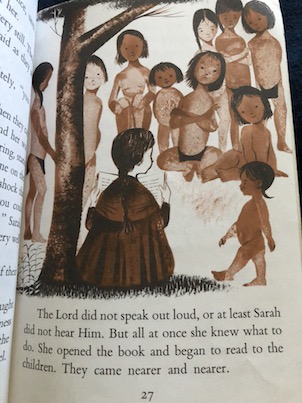
The Robinsons make Sarah uncomfortable.  Sarah later says to her father that there doesn’t seem to be love in the Robinson house. Her father agrees with the observation and says that the Robinsons should learn to watch their words and teach their children to do the same, adding “there are people in this world who do not help others along the way, Sarah, while there are those who do. In our home all will be treated with kindness-always, Sarah. The Indians, too, and they will not harm us.”  Although the Robinsons allowed the Nobles to stay the night in their house, they didn’t exactly make them feel welcome, and both of them realize that the things the boys were saying and their rough manner were clues to the Robinsons’ real attitudes and the kinds of things the parents talk about when no one else is around.

SarahNobleReadingWhen Sarah and her father reach the land that is to be their new home, they take refuge in a hollow place in a hillside, and John begins building their new house.  However, Sarah is still very nervous and lonely.  Then, while Sarah sits, reading the Bible, some curious Indian children from the nearby tribe come to see her.  She reads a Bible story aloud to them, and they listen, but she when she finishes the story, she can tell that they didn’t understand what she was saying.  Sarah can’t understand them, either, when they try to talk to her.  She gets impatient and snaps at them for not knowing English, and they run away from her.  Sarah is sorry about that because she realizes that she shouldn’t have been so irritable, and even if they couldn’t talk to each other, it was still nice to have people around.
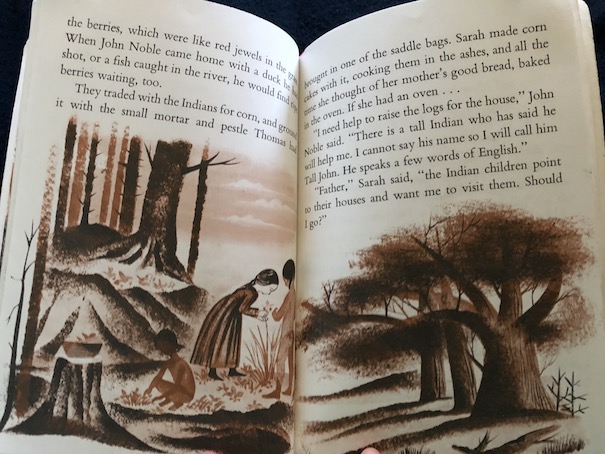
Fortunately, the Indian children come back to see her again, and they become friends.  She tries to teach them English, but they don’t make much progress at first.  Even without being able to talk to each other, though, they can still do things like picking berries together.

SarahNobleNativeAmericanChildren

Sarah’s father also becomes friends with an Indian he nicknames “Tall John” because he can’t figure out how to pronounce his real name.  John and Tall John trade with each other, and John allows Sarah to visit Tall John’s home to play with his children.

When John finishes building the house and it is time for him to go and fetch the rest of their family, he decides that it would be better for Sarah not to make the long journey again, so he leaves her in the care of Tall John and his family.

SarahNobleStaysBehind

At first, Sarah is a little worried about living with the Indians.  Being friends and visiting during the day is one thing, but what would it be like to actually live with them?  Although Sarah likes her Indian friends, it’s obvious that the stories that she’s heard all her life about “savage” Indians bother her, and she still has some prejudices and misconceptions to overcome.  There are also the worries that often accompany children who are staying with someone other than their parents: what if something bad happens, her father never comes back, and she never sees her family again?  Sarah worries that, even though the tribe that lives nearby is nice, there are other Indians who aren’t, and some of them might attack while her father is away.

Fortunately, things go well during Sarah’s time with the Indians.  She finds some of their habits strange, and she notices that Tall John’s children (nicknamed “Small John” and “Mary”) find some of her habits strange, like the clothes she wears and the way she prays at night.  Tall John’s family gives Sarah some deerskin clothing, like they wear, and some moccasins, which she finds surprisingly comfortable.  There is a scare about a possible attack, but that passes without incident, and Sarah ends up enjoying her time with her Indian friends, playing games and participating in chores with them.  Tall John and his wife treat Sarah like one of their own children.

When it’s time for her to rejoin her family, Sarah changes back to her old clothes, but they no longer seem as comfortable to her, and she decides to keep wearing the moccasins.  A little of her Indian friends has rubbed off on her, and she is a different person because of her experiences.  Sarah’s mother expresses some concern about her daughter having lived with “savages” (her word), but Sarah is quick to defend them, saying that they aren’t savages and that they’re friends.  Her father agrees that Tall John and his family are good people who took good care of Sarah.

This book is a Newbery Honor Book.  It is currently available online through Internet Archive (multiple copies).

My Reaction

Throughout the story, various characters have obvious prejudices about American Indians, and the language used isn’t what we would use today (ex. “Indians” instead of “Native Americans” and nobody says “squaw” anymore (or shouldn’t – white people used to think it simply meant “woman” but it has other connotations as well, better to just say “woman” when that’s what you mean)), but these are fitting with the time period when the story takes place.  The overall attitude of the story, especially Sarah’s evolving attitudes toward her new Native American friends, is good.  Sarah begins by being frightened because of all of the scary things people have told her about Indians, but once she begins spending time with them and living among them, she sees that the things she heard before weren’t true, and she values their friendship.  The parts where characters behave in prejudiced or condescending ways are uncomfortable, but you can’t have a story about improvement without someone behaving or thinking wrongly in the first place.  At least, that was my interpretation.  I understand that there are others who are more concerned.  At the end of the story, Sarah’s mother doesn’t seem convinced about the Indians, but I like to think that experience may change her as it did Sarah.  I think Sarah’s mother represents where Sarah came from but not where she ends up.  I think it’s important to explain to children the historical context of the story and put the emphasis on Sarah’s changing opinions.  Sarah’s experiences help her to see the truth about her new neighbors.

The author’s note in the beginning of the book explains that the story of Sarah Noble is based on the life of the real Sarah Noble, who did accompany her father to the family’s new homestead when the community of New Milford was forming in order to cook for him while he built the family’s new house.  The real Sarah did live with the nearby tribe of Native Americans for a time, although the author of the story had to invent some of the details of her stay.  It also says that the real Sarah maintained a friendship with the Indian the book refers to as “Tall John.”  The real Sarah become a school teacher as an adult, as the Sarah in the story said that she wanted.  She also married and had children.