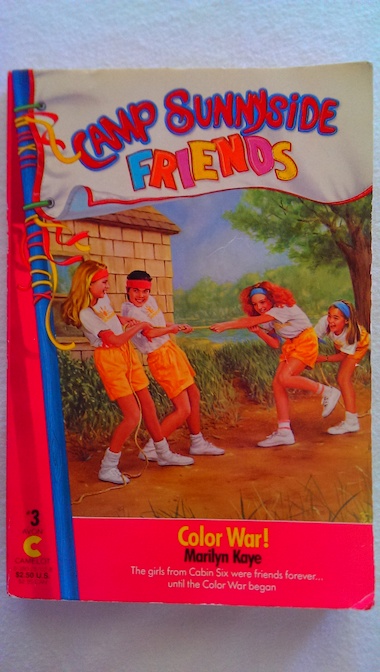
 #3 Color War! by Marilyn Kaye, 1989.
Usually, the girls of Cabin 6 at Camp Sunnyside have fun during the camp’s annual competition. Every year, the girls at camp are divided up into two teams, red and blue, and they compete against each other in a series of contests. Ms. Winkle, the camp director, cautions the girls at the beginning of the Color War not to let themselves be carried away by the competition, to remember that they’re all still friends and members of the same camp, and to keep the contests friendly. Usually, that isn’t a problem for the girls of Cabin 6. They each have their favorite activities, and every year, they’re always on the same team, working together against other cabins. However, this year is different.
When the girls of Cabin Six are split up and put on different teams, the competition between them threatens to ruin their friendship. Some of the girls of Cabin 6 are more competitive than others, especially Katie, who likes to be a leader and hates to lose at anything. Trina, on the other hand, values loyalty and friendship more than competition. She looks on the other girls in her cabin as being almost family because they’ve spent so much time together and considers Katie to be her best friend at camp. There is an unexpected clash between the two girls when Katie turns out to be the captain of the blue team, and Trina ends up on the red team.
Both Trina and Katie are disappointed about the team assignments. Trina had helped to campaign for Katie during the elections that were held for the team captains, before the teams were even assigned, and Katie had told her that she wanted her to be her assistant. But, teams are assigned randomly after the entire camp elects two captains to lead them, and none of the girls had any say in it when Trina and Erin were both placed on the red team, under the leadership of Maura, a snobby older girl who is even more competitive than Katie and not above stooping to some mean tricks to get ahead. Switching teams is against the rules, so there’s nothing to be done about it.
Trina feels badly that she can’t be on Katie’s team and still thinks of her as her friend. But, she notices that, from the moment when the teams are assigned (the girls each have a dot of a different color paint on their foreheads when they wake up one morning, indicating what their team will be), Katie starts behaving awkwardly around Trina, treating her almost as a suspicious stranger, or worse, an enemy. When Katie tries to play on Trina’s sympathies, getting her to let her have an edge at certain contests or even bow out so Katie’s team can win, Trina is willing to go along with it at first because she likes Katie and wants to see her win, if it’s important to her. But, gradually, Katie’s pushy competitiveness begins to wear on Trina, especially when she sees her taking advantage of her and other friends without regard for their feelings. When someone tries to deliberately sabotage an activity that Trina is taking part in, it seems like Katie is willing to stoop to some dirty tricks and even cheating against her “best friend” in order to win, and it doubly hurts.
With Katie expecting Trina to give her advantages and inside information on demand and then shutting her out immediately afterward and acting suspicious of her, even accusing her of doing some of the things Katie herself is doing, Trina is fed up! Katie’s seeming sabotage is the last straw, and Trina decides from that point on, she’s going to treat the Color War as the serious competition Katie acts like it is. The girls’ unfriendly attitudes toward what are supposed to be fun games turns the Color War into a real war with friend against friend. When people as well as friendships seem to be getting hurt, the girls have to decide what’s really important to them and what the cost of winning is going to be.
The book is currently available online through Internet Archive.
My Reaction and Spoilers
Although I liked this book when I was a kid, it frustrates and even angers me now. I have a long-standing contempt for one-upmanship in all of its forms, and I lose respect for anyone I see using one-upmanship tactics. (I didn’t write this, but I agree with it, especially the part that says, “You really do not need to be the winner every single time.” Seriously.) As a character, Katie is my least favorite of the girls because of her overly-competitive attitude and lack of consideration for others. It’s all the more aggravating because, as much as Katie likes to be the leader and the other characters follow her, she isn’t actually good at leading. She’s mainly good at being bossy and manipulative. As soon as Katie gets put into a leadership role in a competitive atmosphere, her usual standards of behavior go straight out the window, and she uses even close friends as mere tools to her glorious victory. Note that she isn’t focusing on leading her troops to victory. The victory is all about her and the trophy she wnats, regardless of what it does to people around her, and that’s why she’s not good at leading. In this story, she’s mainly just selfish. Some people can enjoy some harmless competition without losing their scruples, but sadly, Katie is not one of them. Now that I’m an adult with more experience with this personality type, I have less patience for it than I ever did.
It’s true that Katie isn’t as bad as Maura, who we learn later actually did some of the worst things that Katie and Trina suspect each other of doing. Neither Katie nor Trina actually sabotaged each other’s activities. Maura did that both to give her team an edge and also to stir up Trina’s anger against Katie. Maura saw that Trina wasn’t a competitive person and was willing to let Katie win just for the sake of friendship, and she realized that the only way to get Trina to even try to win would be to make her fighting mad.
Maura’s lying and acts of sabotage were worse than what Katie did because it was direct cheating, but Katie’s tactics were also a kind of cheating. Katie persuades Trina to let her have the better horse for the riding contest, even though Trina was supposed to ride that horse, and she tries to convince her to fake an injury so that she can bow out of a gymnastics contest, which she knows Trina loves, just because she knows that Trina is likely to win that activity.
Supposedly, Katie’s a nice person most of the time, but you wouldn’t know it to see her in this contest. Almost from the word go, Katie turns into a rabid little win-monster, ready to shove even her closest friends under a bus to win . . . at summer camp games. At one point, she tries to make Sarah compete in a pie-eating contest because she knows Sarah is normally a big eater, but Sarah gets upset because she’s been dieting, and it was just starting to pay off, and she doesn’t want to ruin what she’s done just for the sake of some dumb contest. When Trina sees how upset Sarah is, she tells her to be honest with Katie about how she feels, and Katie flies off the handle irrationally, as if she had never heard of Sarah’s diet before (she had, a lot, because Sarah had been talking a lot about how hard it was to fight temptation) and accuses Trina of trying to make her lose. Katie can’t stand the idea of not winning, in case you couldn’t tell, and she doesn’t care about what her friends stand to lose in the pursuit of her personal victory or what the lasting consequences might be after the contest ends.
You might be wondering why winning is so important to Katie. What’s really at stake for her in this summer camp contest? I was wondering this a lot, all through the book. It turns out that winning is important because the alternative, not winning, will make Katie feel like a loser, and people might think she was lame. And . . . nothing. That’s it. Whoopty doo. Katie fears getting jeered as the loser at the end of the contest, which is silly because no one does jeer the loser at the end, and most of the younger girls they talk to while campaigning for Katie to be one of the team captains in the beginning were kind of unenthusiastic about the games, not because they feared losing, but because they figured that the older girls wouldn’t let them try any of the more fun stuff, saving all the best parts for themselves. In other words, very few people beyond Katie and Maura were at all concerned about who won or lost, they just wanted to take part. Mostly, it seems that what Katie is really afraid of is coming up against an opponent, or even other teammates, who are just like her. Katie is the manipulator who uses her friends; her friends are not trying to manipulate her or make her lose. Katie is the rude one who jeers at losers. Ultimately, she’s afraid of what she does to other people coming back on her.
Part of the reason Katie was hoping that Trina would be her assistant on her team was because Katie remembered that the year before some of the girls had ganged up on their team’s captain over a part of the competition that had gone badly. Trina remembers that Katie had been the main instigator of the rebellion. Katie’s scared of getting a taste of what she dished out to someone else before. She fears getting jeered because that’s what she does to others when they lose. She fears teammates getting down on her for not winning because she does that herself, to them. And as the reader, we’re supposed to like her and hope she wins against awful Maura? I have pity for her former team captain, getting stuck with this bratty little girl who ruins fun and makes people miserable because she can’t win at everything. It must have been like babysitting, unpaid, while she’s supposed to be on vacation. Have I mentioned how much I hate one-upmanship?
It’s funny, but by the end of the book, I had more contempt for Katie than I did for Maura. It’s not that I liked Maura at all. Maura’s tactics were definitely worse. If I were in charge of the kids, she would be punished worse for what she did. My anger at Katie is because of her sense of entitlement and because she’s still considered one of the “good guys” at the end, and I don’t think she deserves either. She saw nothing wrong with manipulating her friends and forcing them to do what she wanted for her own personal glory, even when some of what she asked them to do would have been actually harmful to some of them, like interfering with Sarah’s diet. She plays on their feelings of friendship but with no feelings of friendship returned. If she feels real friendship for them, it all evaporates the moment the possibility of being a “winner” is on the horizon. Even if it’s just a dinky summer camp contest. Worst of all, Katie routinely does things to others that she fears and resents having done to her. She does them more frequently to others than anyone does them to her, and often, she’s the first to do them, so she can’t even say that it was retaliation. Part of Maura’s justification for her bad behavior is that Katie would do the same things she’s doing. While Katie might not stoop quite as low as Maura does, the sad part is, Maura’s not that far off in her assessment of Katie. Even though Trina doesn’t like Maura and sees her behavior as worse than Katie’s, she admits that Maura is pretty good at reading people and understanding their motivations.
In the end, Katie does acknowledge to Trina that the situation was really all of her fault and that she intentionally tried to make Trina feel bad about being on the opposite team because she genuine feared that Trina would win against her. I don’t have any sympathy for Katie at all, and her apology falls flat for me. Trina genuinely cared about about Katie. She let her win when she didn’t have to and was actually happy when she did well. All the time, Katie just cared about Katie and winning and that was about it. Even after her apology to Trina, Katie says that she still wants to win. Dang it, girl, don’t you have any other priorities in your life or any other dimensions to your character? I would have found Katie more interesting as a character if she liked winning but had exceptions where the price of winning was just too high. I wish she had limits.
The one part of the book that makes me feel better is when Trina is taking part in the gymnastics competition, and she realizes that if she made a mistake on a very difficult part, she could hand victory to Katie and no one would know that it was intentional. At that moment, Trina realizes that she can’t do that because it wouldn’t be honest. She says to herself, “You don’t have to prove your friendship this way . . . If Katie expects you to, then she’s not a true friend. And if you intentionally give this away, you’re not being a friend either – you’re trying to buy a friend. And that’s not what it’s all about.” Bravo, Trina, for growing a backbone and some self-respect! Katie also shows that she’s happy when Trina does well, and that’s something, a kind of progress for her, learning to care about someone else and be happy when they succeed at something that isn’t also a personal win for her . . . but dang it, that silly, shallow, win-monster still annoys me. I didn’t really want Maura to win, but I have to admit that I wasn’t entirely happy that Katie’s team won, either. I didn’t feel like either one of them really deserved it.
Since I disliked both Maura and Katie, I suppose it’s a given that I was going to be disappointed no matter which of them won. But, I keep thinking of ways that the story could have ended which would have been better. What if . . . no one won? Suppose it was a tie? Trina would have been happy since she doesn’t like to see people lose and doesn’t really care who wins. In a tie, no one wins, but no one loses, either. Also, it might bring it home to both of the team captains that the real goal of the contest, which they both somewhat failed, was to make the contest fun for their teammates. Instead, people on both teams repeatedly remark that the contest is so much nastier this year with both Maura and Katie in charge and everyone feels awkward about it. Nobody really enjoyed this contest except maybe Katie, because she won the trophy she was hungering for. Then, when Katie has her pretty trophy at the end, she doesn’t even acknowledge her teammates’ hard work or how they helped her to win. Many people would be thanking their teammates and talking about this trophy belongs to everyone because everyone won it together, but not Katie. She was just happy that she had her trophy. It’s her trophy, hers. Whee.
I understand that we’re supposed to learn from both Katie and Maura what not to do in competitions, but watching them do what they do is painful and frustrating, a slow train wreck on Katie’s way to victory, and I hated seeing her friends just letting her obsessive meanness slide in the beginning. In the end, the only person I felt was a real winner was Trina. She never cared that much about winning the contest because her self-esteem doesn’t depend on it. Trina is a valuable person and a true friend whether she wins a contest or not. She knows what’s really important to her, and nothing important changes if she wins a game or not. I think the world needs more people like Trina, who aren’t in it for the winning but are willing to work cooperatively with others to make good things happen for everyone. By contrast, Katie needs to win because she is . . . just a winner. At summer camp. She’s got a trophy now. Winner, winner, chicken dinner.
In spite of the fact that a large part of this review is me venting about the frustration, I actually did like this series when I was a kid. This is the only book in it that I’ve been able to get my hands on recently, and it happens to be the one I find most frustrating.





 Jestress's Forgotten Books and Stories