Cookies and Crutches

Pee Wee Scouts

This is the first book in the Pee Wee Scouts series. The children in Troop 23 meet after school on Tuesdays, and their leader is Mrs. Peters. One Tuesday, they meet at Mrs. Peters’s house to bake cookies. Mrs. Peters says that, to earn their cookie badge, they must each bake cookies at home without help and have their parents write a note that they have done it. She teaches the children an easy cookie recipe that they will use.

Roger White doesn’t want to bake cookies because he thinks that baking is for girls. Sonny Betz argues that it’s not just for girls, but many of the other children think that Sonny is a sissy because his mother still walks him to school. Sonny thinks that Roger is a creep. Mrs. Peters says that cooking is for everyone who eats. If boys can eat, they can also cook.

Mrs. Peters demonstrates making a recipe for chocolate chip cookies (and the book provides the recipe). Molly and Mary Beth ask if they can make their own batch of cookies for their badge together. They are not supposed to have adults helping them, but Mrs. Peters says that it is fine if they work with each other. In spite of their earlier argument, Roger agrees to make cookies with Sonny as a team.

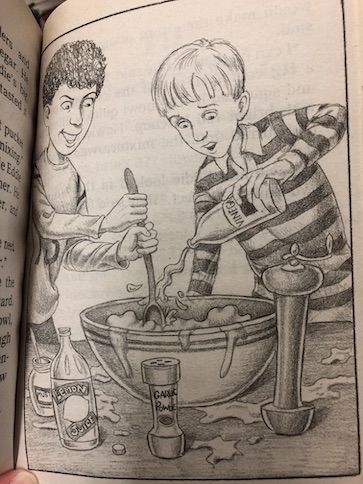
However, when Molly and Mary Beth try to bake cookies by themselves, they don’t think the cookie batter looks right. It looks too pale, and when Mrs. Peters made her cookies, the batter was more brown. To fix the color problem, they decide to pour in some root beer, which is not part of the recipe. Then, they decide that the batter is too runny, so they add some gravy mix to thicken it. Because they added things they shouldn’t have, the cookies come out all wrong, and the girls worry that they won’t get their badge.

At their next meeting, though, they learn that nobody’s cookies look like they should. Mrs. Peters has the kids make cookies together while she supervises, although she doesn’t help them directly, so they can say that they did it themselves. This time, the cookies work out, although some of them are oddly-shaped. However, all of the kids get their cookie badges together.

The scout troop then organizes an ice skating party with the kids’ fathers. It’s a little awkward because not all of the kids have fathers living at home. Most of the kids without fathers bring an uncle or brother instead, but Sonny doesn’t have either, so his mom comes. The other kids tease him about it because they think he’s already too much of a mommy’s boy.

Some of the kids are also nervous because they don’t know how to skate, and they’re not even sure that their fathers know. Molly gets into trouble because Rachel makes a big deal about her fancy skates, which she owns so she doesn’t need to rent any, and about her dainty little feet. Molly rents a pair in the same size as Rachel’s, trying to prove that her feet aren’t too big, but they’re really too small for her. She has to take off her socks to put them on, and even then, it’s a hard squeeze. She ends up spraining her ankle badly because she’s wearing the wrong skates, and she has to use crutches. Molly doesn’t get her skating badge, but she does get one that’s almost as good as a consolation.

This is one of those children’s books/series where the kids in the story, although they are part of the same troop and seem to be friends for the most part, still say insulting things about each other, like when Roger called Sonny a sissy and Sonny called Roger a creep. I know that kids do things like this sometimes, but I don’t really like books that seem to promote or are permissive about that kind of talk. What bothered me is that, even though the boys were insulting each other in front of Mrs. Peters, she didn’t tell them to stop, which makes it seem like she tacitly thinks those insults are fine. I liked it that she contradicted Roger’s assertion that cooking and baking are only for girls, but I wish that she had said something about the way the kids were insulting each other.

I knew from the beginning of the story that the way Mrs. Peters was teaching these young children to make the cookies, just by watching her, and then expecting them to do it right completely on their own, with no adult supervision, was probably going to lead to a disaster of some kind. Of course, that’s because I’m reading this from an adult perspective. Nobody learns anything complex from only having seen it done by somebody else just one, especially if they just watched and didn’t actively participate. These kids are also young, just in the first grade of elementary school. They can read, but they don’t have advanced reading skills or much experience with cooking anything before. What I’m saying is that they really needed adult supervision, and I didn’t think that telling them that they had to do this completely by themselves wasn’t a great idea. Although, it’s possible that Mrs. Peters assumed that the kids would get more supervision than they actually got, even if the adults didn’t actively help. I think a lot of adults assumed that not helping meant no supervising and no advice or intervention when the kids were about to do something wrong. I have to admit, though, that there wouldn’t be much of a story if they did everything right, and this activity went as expected.

The story has two parts to it, which aren’t directly related. I thought, at first, that the kids would be serving cookies they baked to the dads, and that would be the tie-in between the cooking baking and the party with the fathers. They didn’t, though. The skating incident and Molly’s injury are unconnected to each other. The only connection I can see to the two incidents isn’t explicitly stated, but both of this incidents involve the kids doing something they’ve never done before and not really doing it right. They need to have experiences where things go wrong to start figuring out how to do things right. Although Rachel brags about her skating ability and her skates, after Molly is injured, Rachel admits that she fell down a lot when she was younger and was first learning. Molly feels a little better, realizing that nobody does things perfectly the first time. Although getting hurt isn’t great, learning to use crutches is also something new that Molly experiences that none of the other kids have experienced before.
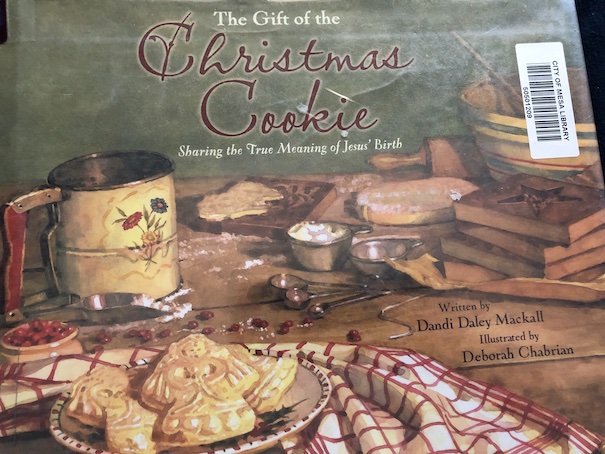
The Gift of the Christmas Cookie

The Gift of the Christmas Cookie by Dandi Daley Mackall, illustrated by Deborah Chabrian, 2008.

This is a sweet Christmas story that discusses the meaning of Christmas along with the history of Christmas cookies.

The story doesn’t provide a year, but it seems to be implied that it takes place during the Great Depression because Jack’s father is described as hopping a freight train to find work and send money home. Since then, Jack and his mother have lived alone, saving every penny that Jack’s father sends to them.

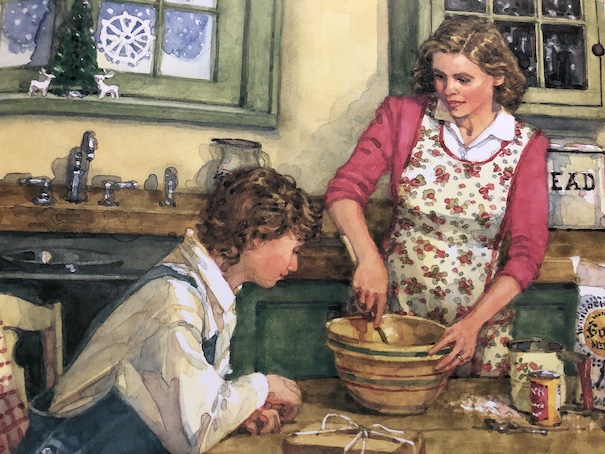
Then, before Christmas, Jack arrives home to find his mother making cookies. Jack is thrilled at the idea of having a rare treat, but his mother says that the cookies are for the needy at church. It’s disappointing because Jack has been feeling rather needy himself.

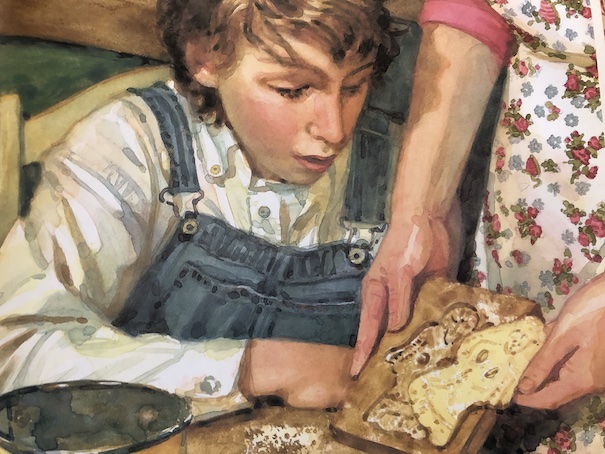
Then, his mother shows him the wooden cookie board molds that they will use. They are big with elaborate carvings of Christmas symbols. Making the cookies is labor-intensive, and Jack wonders why they’re working so hard to make such elaborate cookies that people will just eat anyway.

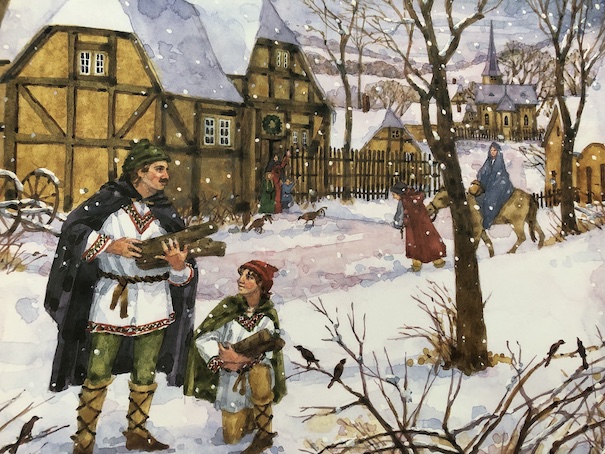
Jack’s mother tells him a story that takes place in the “Old Country” of their ancestors during the Middle Ages. (It’s in Germany, although Germany didn’t exist as the single country it is today back then.) Times were very hard, and people couldn’t afford much, but one family wanted to do something special for their neighbors for Christmas. The father of the family was a woodcarver, so he considered carving Nativity figures, but his wife said that many people were hungry, so it would be better to bake something they could eat. The woodcarver made wooden molds in the shapes of figures associated with Jesus’s birth, and his wife made the sweet dough to put in them, and they made cookies to share with their neighbors.

Jack’s mother saves one cookie from their batch in the shape of an angel for Jack so he can have a treat, but when a hungry man comes beginning for something to eat, Jack considers his own father, who might be traveling and hungry.

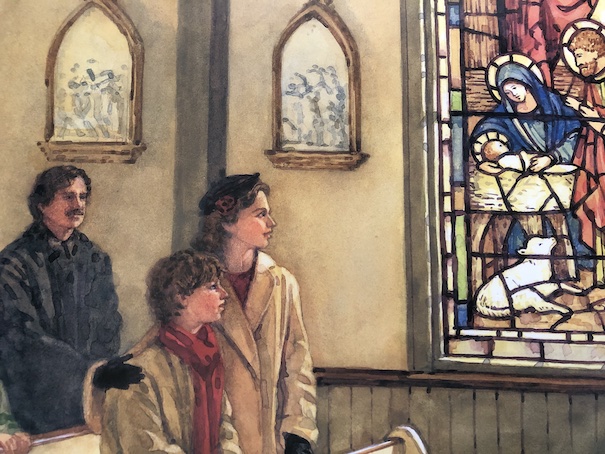
Jack is inspired to share his special Christmas cookie with someone who might need it more than he does and to pass on the story that goes with it.

My Reaction

I like stories that include some history, and I enjoyed this story about the origins of Christmas cookies and a lesson in generosity, giving to someone else as he hopes other people will be generous with his father. The invention of Christmas cookies can’t be traced back to any particular family, like the story in the book tells it, and Christmas cookies might have actually originated in Medieval monasteries because the monks would have had greater access to the sugar and spices needed than most people. However, the general concept of Christmas cookies made with molds is accurate. There is a brief note in the back of the book about the cookie boards or springerle molds that come from the Schwabian region of Germany, Switzerland, and Austria and how these molded cookies have had religious shapes since the Middle Ages. The book also notes that some cookie molds take the form of specially-carved rolling pins rather than the flat boards shown in the book, and this was the type of cookie mold that my grandmother used to use. When she made molded cookies, they were anise-flavored, which is traditional and tastes like licorice, although I prefer to make ginger cookies with my cookie mold rolling pin. The book includes a simple recipe for cookies that you can use with cookie molds or cookie cutters, and it uses the traditional anise flavoring.

The Super-Duper Cookie Caper

The Bobbsey Twins

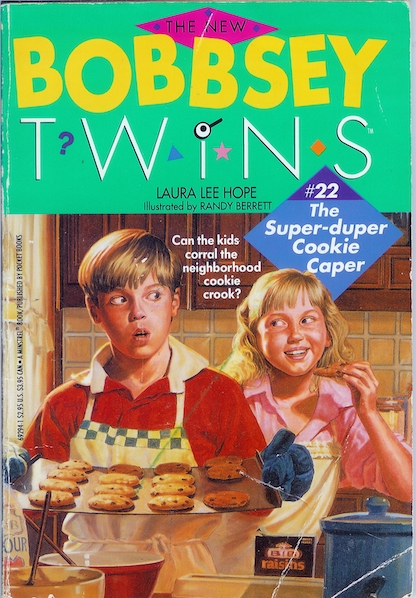
Bobbsey Twins Super-Duper Cookie Caper coverr

#22 The Super-Duper Cookie Caper by Laura Lee Hope (Stratemeyer Syndicate), 1991.

Before I begin, I’d like to acknowledge Sean Hagins, for supplying me with photos of this book! Usually, I take pictures of books myself, but I just couldn’t find a physical copy of this one. Sean is a big fan of the Bobbsey Twins, particularly the New Bobbsey Twins mysteries, and you can see some of his video reviews as well as videos about his photography work on his YouTube channel, SJHFoto. Thanks, Sean!

Freddie decides that he wants to get a new bike, and inspired by the school bake sale, he decides that he’ll make and sell cookies to raise the money. His grandmother makes really delicious oatmeal chocolate chip cookies that everybody loves, so he plans to make and sell them. He persuades his twin, Flossie, to help him by promising her part of the money from the cookie sales. Their parents approve of the plan, and their mother offers to help them because neither of them has much experience with cooking.

When Freddie and Flossie go to sell the cookies in the park, they’re pretty popular. Everyone loves the cookies, and Freddie boasts about his grandmother’s secret recipe. Their last customer is a man who gives them a dollar with some kind of white powder on it, and he doesn’t seem to think much of the cookies. Freddie doesn’t care because everyone else likes them, and they’re making money.

There are some complications to selling cookies. First, Flossie has a sweet tooth, and Freddie has to keep stopping her from eating their stock herself. Then, a boy at school, Brian, announces that he’s going to set up a rival business in the park, selling brownies. Freddie gets the idea of offering broken cookies as free samples and selling orders of cookies door-to-door.

Nan and Bert start helping with the cookie-baking, but things don’t always go well in the kitchen. There are times when they forget ingredients or let the cookies burn. Then, the children realize that the card with the recipe on it is missing! They search the kitchen and realize that there is a chocolate smudge on the kitchen window. It looks like someone reached through the window and stole the recipe!

There are a few logical suspects. It could be Brian, hoping to cash in on the success of the cookie-selling. It could be their old nemesis, local bully Danny Rugg, who stole their free samples earlier and generally likes to mess things up for the Bobbseys. Then again, there is the mysterious man who keeps showing up at the park. The Bobbsey Twins find out that he owns his own bakery. To find out who the recipe thief is, Freddie decides to invent a trap. He tells everyone that his grandmother has given him her other secret recipe for super-duper cookies that’s even better than the first one. Who will take the bait?

The book is available to borrow and read for free online through Internet Archive.

My Reaction

Sean and I were discussing earlier how later books in the New Bobbsey Twins series tended to focus more on the younger set of twins than the older Bobbsey twins and seem to involve lower-stakes mysteries. Earlier books in the series involved definite crimes, police matters, and strange phenomena. A stolen cookie recipe feels like much lower stakes. However, I thought this one was well-done for what it was. There are some definite suspects, enough to sow some doubt about who the recipe thief is. The actual thief is someone I suspected but not necessarily the most obvious suspect, and the thief’s motives do make logical sense, although I’m not sure (spoiler) any real adult would seriously consider that kind of business model. It sounds more like something a kid might do, and that’s partly what allows readers to doubt whether it’s a child or adult who took the recipe.

There is also a punchline to the story. There was one thing that I had guessed early on about the grandmother’s “secret recipe.” It’s not as “secret” as the kids think it is. I guessed that because, when I was a kid, one of my grandmothers always baked chocolate chip cookies. Those cookies were one of the highlights of going to her house. When we were little, my brother and I liked them so much that we guessed that she must have been a baker before she retired. When we were older, we found out that she’d actually been a bookkeeper and that her cookie recipe was just the Toll House recipe from the chocolate chip package. She made two versions, with and without nuts from the pecan tree in her backyard, but it was still the Toll House recipe. It’s a similar situation with the Bobbsey Twins’ grandmother’s secret recipe. The only thing the grandmother changed was the cooking time. Everyone just thought that the cookies were special because her grandchildren thought they were, and they convinced other people. Few things are as special as homemade cookies from your grandmother!

Cupid Doesn’t Flip Hamburgers

The Adventures of the Bailey School Kids

#12 Cupid Doesn’t Flip Hamburgers by Debbie Dadey and Marcia Thornton Jones, 1995.

Valentine’s Day is approaching, and Eddie is annoyed by all of the hearts and girly decorations around the school.  However, that’s nothing compared to Mrs. Rosenbloom, the new cook in the cafeteria at school.  The first time the kids meet her, she gushes about how much she loves Valentine’s Day.  Everything she serves them has a Valentine theme – lots of red foods and heart-shaped foods.  Most of the other kids don’t mind the Valentine theme because the food is better than it used to be, but Eddie resolves to do something about it.

Before Eddie can do anything, Carey, a girl Eddie normally doesn’t like, suddenly develops a crush on him after eating one of Mrs. Rosenbloom’s Valentine cookies.  The next day, Ben, the fourth-grade bully, gets a sudden crush on Issy after eating a Valentine cookie.  Even Mrs. Jeepers and Principal Davis are falling in love!  (Mrs. Jeepers is a widow.)  Eddie becomes convinced that Mrs. Rosenbloom has doctored the Valentine cookies with a love potion!  He thinks that she’s going to use it to take over the school!

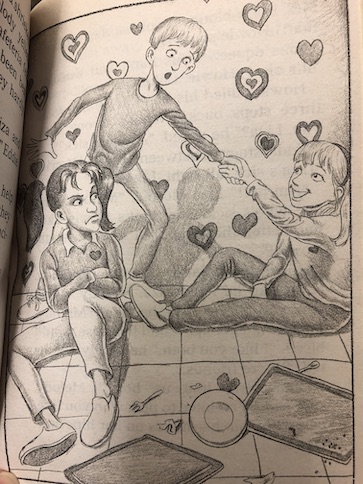
At first, the others don’t believe Eddie, and in any case, what’s wrong with spreading a little love around?  The problems start when both Melody and Liza eat Valentine cookies at the same time and both of them fall in love with Howie.  The two girls, normally best friends, start fighting over Howie.  Howie is embarrassed and worried that this weird love fight will break up their friendship.  The two boys find themselves trying to dodge the girls while starting to worry that, if the romance between Mrs. Jeepers and the principal flourishes, Mrs. Jeepers will turn Principal Davis into a vampire. (One of the things I appreciate about this series is how it draws on real folklore and mythology. The boys are right that, assuming that Mrs. Jeepers actually is a vampire, she can’t be in love with the principal without revealing it to him and probably changing him into a vampire, too.)

The boys come up with a plan to change Mrs. Rosenbloom’s cookie recipe for the worst, but before this escapade is over, even Eddie gets a taste of love.  As with other books in this series, Mrs. Rosenbloom eventually leaves the school, and things return to normal (or what passes for normal in Mrs. Jeepers’ class).

The book is available online to borrow for free through Internet Archive.

The Cookie Tree

CookieTree

The Cookie Tree by Jay Williams, 1967.

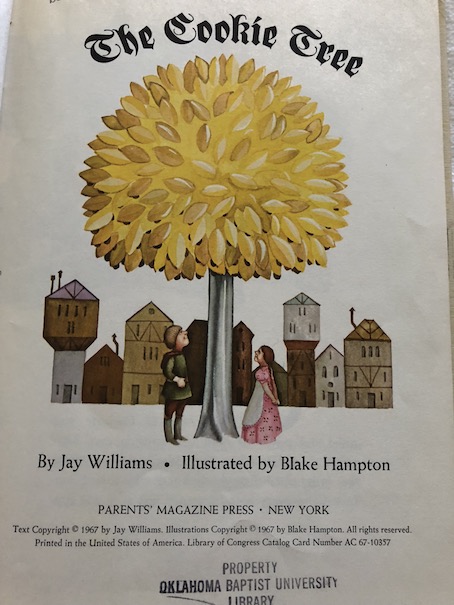
Owlgate is a very orderly little village.  Everything has a purpose and a place, and nothing unexpected happens . . . until the day the cookie tree appears in the middle of town.  The tree is silver and gold and has chocolate cookies.

CookieTreeOwlgate

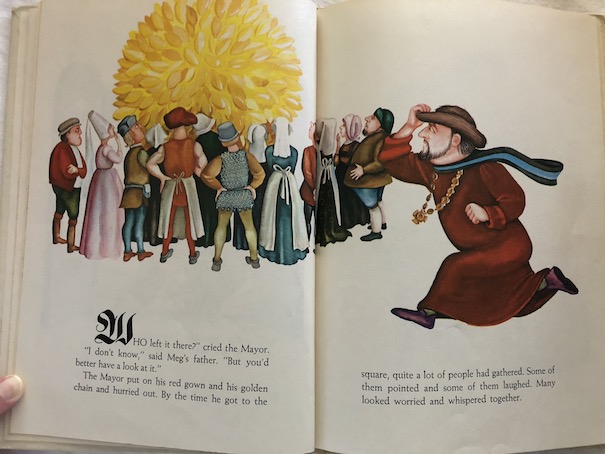
A girl named Meg notices it first, but her parents refuse to allow her to pick a cookie from the tree because they’re worried about where it came from. For all they know, the cookies could be poisonous!  Meg’s father gets the mayor to come look at the tree.

CookieTreeTownspeople

Eventually, everyone in town comes out to see the tree.  The miller thinks that the whole thing is probably a big joke, but most of the other adults are worried because it’s weird.  Some of them think maybe it’s some kind of bad omen.  Little Meg’s theory is that a magician sent it as a present for the village, just to give them cookies.  However, the adults reject that explanation, saying that it doesn’t make sense and they don’t any reason see why a magician would send them a cookie tree.

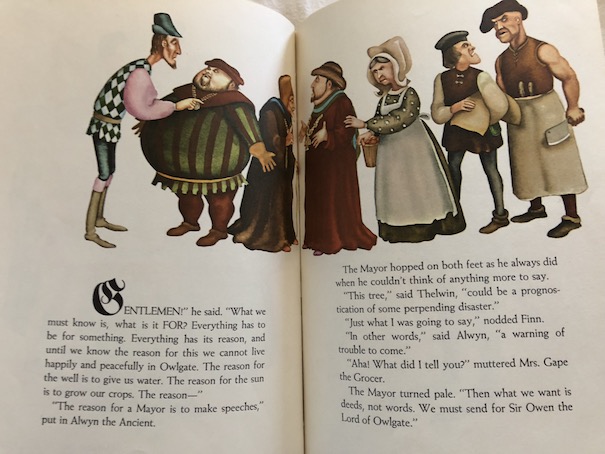
The mayor consults with the Village Councillors, but they don’t accomplish much other than to establish that there are indeed chocolate cookies growing on the tree when one of them samples a cookie.  The adults argue back and forth about what to do about the tree, but by the time they come up with a plan, the tree has vanished!

CookieTreeDebate

While the adults’ backs were turned, the children of the village ate all the cookies, and once the cookies were gone, the tree disappeared.  Apparently, Meg’s theory about the magician sending the tree just to give them cookies was correct.

One of the things that people sometimes praise children for doing is seeing things for what they are. Adults have a tendency to over-analyze things, looking for hidden meanings that may or may not exist. Sometimes, things really are just what they appear to be, and over-analyzing just confuses the issue. It can be like that with children’s books. Adults worry about every little thing in stories and possible messages being sent to children, but when people start over-analyzing stories, they can find themselves making up hidden messages and reading things into stories that aren’t really there.  Sometimes, stories and other things are just for fun, and you might as well simply enjoy them for what they are!

The book is currently available online through Internet Archive.