Sharing the Bread by Pat Zietlow Miller, illustrated by Jill McElmurry, 2015.
This is a charming picture about a family preparing for an old-fashioned Thanksgiving. The story is told in rhymes as the family begins preparing and cooking their feast.
Every member of the family gathers in their kitchen, which appears to be a late 19th century or early 20th century kitchen, with a wood-burning stove.
Everyone, including the children and grandparents, has something to do, from preparing the turkey to making bread, cranberries, and pumpkin pie and washing dishes. The children also make place mats in the form of pilgrim hats.
As they set the table, everyone is a little tired but pleased with their feast. Then, they all say grace and enjoy the feast that they have prepared, thankful for what they have and the family who made it all with love!
The book is available to borrow and read for free online through Internet Archive.
My Reaction
I thought that this story was sweet, and it had fun and simple rhymes for kids. Everyone in the family has something to do to get ready for Thanksgiving, and adults reading the book with kids can point out how each of the family members relate to each other – grandfather, grandmother, father, mother, son, daughter, brother, sister, aunt, uncle, etc.
The pictures are charming, and I love the look of the old-fashioned kitchen where this story mainly takes place! Adults can also point out to kids how this old-fashioned kitchen is different from the kitchens in modern homes, with its pump at the sink, the wood-burning stove, and the herbs hanging on the wall.
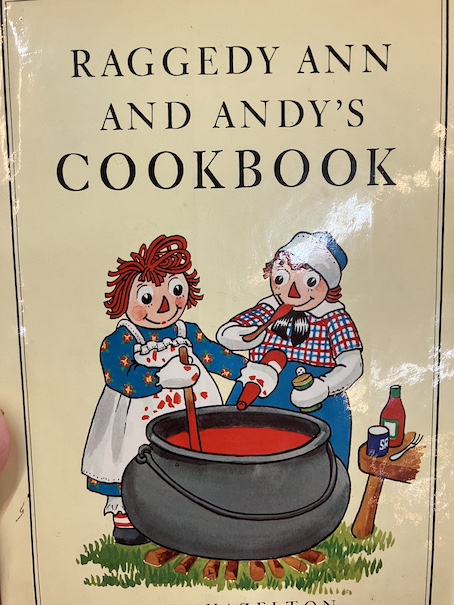
Raggedy Ann and Andy’s Cookbook by Nika Hazelton, 1975.
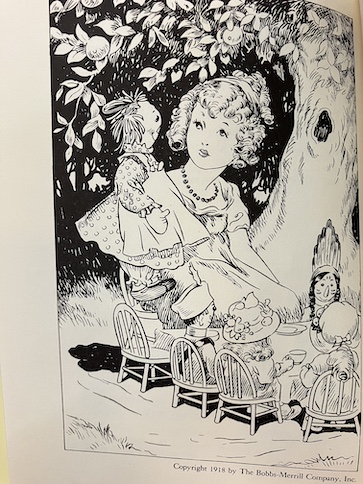
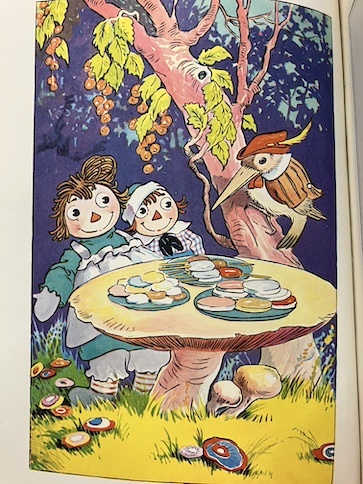
This children’s cookbook is inspired by the classic Raggedy Ann and Andy stories, and the recipes are accompanied by illustrations from the original books and quotes from the stories. I think the concept is charming, although I noticed that the quotes included with the recipes don’t always match what the recipes actually are. I think that’s because the author decided to include recipes that don’t relate to the stories directly. For example, the quote included with one of the recipes for breakfast cereal is about sausages, and there is no recipe that includes sausages in the chapter of breakfast recipes.
That being said, I thought that the book had an interesting selection of recipes. Some of the recipes are classics, like pancakes, different types of sandwiches, chicken, meatloaf, and some easy desserts. Some recipes are a little old-fashioned, like the one that is designed for an electric frying pan. I haven’t seen electric frying pans for years, and I’m not sure if people still use them. Other recipes in the book strike me as being very mid-20th century in style, such as the salads that contain some mixtures of ingredients that I think 21st century children might find odd. I noticed that the recipe for baked onions has a note that this might be a treat “for your Daddy or Mommy”, a sort of acknowledgement that an adult might enjoy a baked onion more than a kid would, although the recipe is easy enough for a kid to do, baking the onions alongside baked potatoes.
The book begins with a short chapter about cooking tips, and I was surprised by the instructions for cleaning fish that were included later in the book, with the assumption that kids might be helping to cook fish that they actually caught. It is logical that some kids might actually go fishing and catch fish, but I don’t think I’ve ever seen a cookbook for children with that assumption or those instructions. Most seem to assume that kids are using store-bought ingredients for their recipes.
The main chapters of the book are:
Beautiful Breakfasts
The recipes included in this chapter are:
Two recipes for making your own breakfast cereal
Cinnamon Toast
Pancakes
Baked Ham
Nest Egg
Electric Frying Pan Breakfast – I don’t know if people use electric frying pans anymore. I’ve seen them before but not for a long time. The breakfast included in this recipe is for bacon, eggs, and toast.
Lovely Lunches
The recipes included in this chapter are:
Cheese and Apple Sandwiches
Cream Cheese and Berry Sandwiches
Ham, Lettuce, and Cheese Sandwich
Stuffed Pita Pocket – The filling is cucumber, tomato, lettuce, and cheese.
Savory Cheese and Bread Pudding
Baked Cheesy Eggs
Super Salads
The recipes included in this chapter are:
Raggedy Ann Salad – This salad is meant to be shaped like Raggedy Ann’s face, with a canned peach half for the head, raisins for eyes, a piece of pepper for a nose, pimiento for the mouth, and grated carrot for hair.
Tossed Green Salad
French Dressing
Carrot, Apple and Raisin Salad
Tomato Salad
Guacamole Salad
Cucumber Galleons – Cucumbers are cut and decorated to look like boats with lettuce for sails.
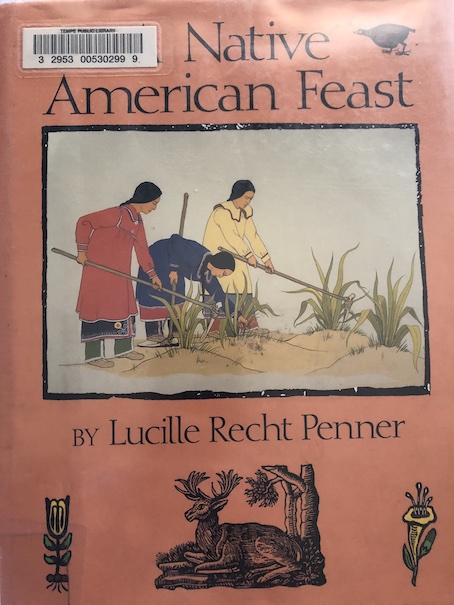
A Native American Feast by Lucille Recht Penner, 1994.
This nonfiction children’s book explains the traditional foods of different Native American tribes and how they were prepared. (Throughout the book, they are referred to both as “Native Americans” and “Indians”, but mostly, the book uses the term “Native Americans.” The focus is on Native American tribes in the area that is now the United States, but the book includes information about various tribes across the United States.)
It starts with an Introduction that explains how European settlers came to North America and how the first settlers almost starved to death because they weren’t prepared for the conditions they found and didn’t understand the plants and foods of the Americas. In those early years of the colonies, the colonists relied heavily on help from nearby Native American tribes in learning techniques for hunting and growing food in North America. These colonists had to adopt some of the Native American foods and techniques of getting food in order to survive. Not only did European colonists adopt some foods used by Native Americans, but Native Americans also adopted foods that were introduced to them from Europeans, including some plants and grains, like apples and wheat, and some domesticated animals, like sheep. The focus of this book is on Native Americans and their cooking and eating habits, both pre-colonization and post-colonization. For more information about what the colonists were cooking and eating, see The Colonial Cookbook.
The book explains how we know what we know about Native American foods and cooking. Some information was recorded by early European colonists in America and European scientists who were interested in plants of the Americas, and archaeology provides information in the form of animal bones, clamshells, and pollen from plants that Native Americans cultivated, going back hundreds and even thousands of years. Native American eating habits shifted throughout their history, although they shifted very abruptly with the European colonization of North America.
The book is available to borrow and read for free online through Internet Archive.
Contents
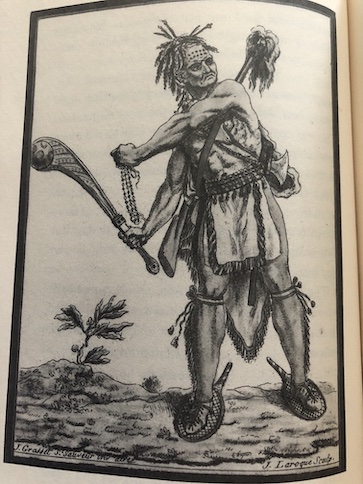
Every chapter, including the Introduction, contains recipes that readers can make at home. Some of them are easier than others. Some recipes include pieces of Native American folklore about them or the foods in the recipes. Many of the illustrations are 19th century drawings.
Rather than organizing the book based on tribe or geographic region, the chapters of the book are based around particular types of food or cooking and eating concepts:
Introduction
This section introduces how historians know about the history of food among Native American tribes and how their diets changed after the arrival of Europeans.
Recipes in this section are:
Hickory Nut Soup
Green Succotash
Pueblo Peach Crisp
Discovering America
This section includes information about the earliest known hunting and cooking habits of Native Americans. It includes a description of the “land bridge” theory of how the ancestors of Native Americans arrived in the Americas from Asia. As of the early 21st century, we still don’t have a definitive answer for precisely how ancient people first arrived in the Americas, more recent theories include the possibility of these ancient people being seafaring rather than finding a land crossing, although the land crossing theory is also still possible.
Then, it explains about the arrival of the European colonists. It doesn’t sugar coat that the arrival of the colonists and their westward expansion led to the extinction and endangerment of native animal species because these newcomers hunted them without restraint. The introduction of unfamiliar diseases, like measles and smallpox, to the Native Americans took many lives, sometimes even killing whole tribes. These drastic changes greatly impacted the lives and lifestyles of Native Americans, although some traditional habits survived, including the preparation of traditional types of foods.
There are no recipes in this chapter.
A Great Mystery
This chapter explains about hunting and gathering and the development of agriculture among ancient Native American tribes. The “mystery” is about the development of corn as we know it. It was never really a wild plant. The evidence suggests that ancient Native Americans deliberately created it by cross-pollinating different wild grass plants, but it isn’t really known which ones. Most of this chapter explains how widespread corn was as a food and the uses and folklore that different tribes had for it.
Recipes in this section are:
Roasted Corn on the Cob
Blue Pinole – a blue cornmeal-based drink with sugar and cinnamon, from the Southwest
Thumbprint Bread (Kolatquvil)
Hopi Blue Marbles – boiled balls of blue cornmeal dough, a traditional breakfast food
Wagmiza Wasna – a mixture of cornmeal and dried berries
Treasure
This section is about foods that Native Americans introduced to the rest of the world, like pumpkins, peanuts, chili peppers, sunflower seeds, maple sugar, and different varieties of beans, including kidney beans and lima beans.
Recipes in this section are:
Cherokee Bean Balls
Apache Pumpkin with Sunflower Seeds
Popped Wild Rice
Zuni Green Chili Stew
The Hunt
This chapter is about Native American hunting techniques and the animals they hunted.
Recipes in this section are:
Broiled Buffalo Steaks
Venison and Hominy Stew
Feast and Famine
This chapter is about Native Americans who lived in areas where food was scarce and ways of foraging for food during times of famine. It also explains special feast days.
Recipes in this section are:
Mouse Cache Soup – made with beef broth and seeds: sunflower seeds, sesame seeds, buckwheat groats, and millet
Iroquois Strawberry Drink
Mushrooms Cooked in Oil
Berries, Flowers, and Bear Fat
This chapter explains the seasonings that Native Americans added to food and cooking techniques that added nutrients.
Recipes in this section are:
Fried Squash Blossoms
Pemmican Cakes – the origins of beef jerky
Maple Sugar Drink
Wild Grape Dumplings
Inuit Ice Cream – a berry dessert originally made with seal oil but made with egg whites here
Wojapi – a Sioux fruit pudding
Lighting the Fire
This chapter is about how plants and animals were processed to make them ready for cooking, such as how corn and acorns were ground into flour and how animals were butchered. When they had to boil water, they often used vessels that would have been damaged if they were put directly over fire, so they would heat stones and put them into the water instead.
Recipes in this section are:
Broiled Salmon Steaks with Juniper Berries
Broiled Rabbit with Corn Dumplings
Baked Beans with Maple Sugar
A Basketful of Water
Native Americans didn’t have cooking pots and pans made out of metal or glass until after the European colonists arrived. Before that, their cooking vessels were made of wood, stone, pottery, or tightly-woven baskets. This chapter explains the different types of cooking vessels they had, including the shells of pumpkins and gourds.
Recipes in this section are:
Pumpkin Shell Soup
Good Manners
This short chapter is about eating manners, superstitions, and taboos among different tribes. There are no recipes.
Thanksgiving
This section explains how Native Americans would give thanks to their Creator or Great Spirit or Nature or to animals and plants themselves for the foods that helped keep them alive. There are no recipes in this chapter.
The Little House Cookbook by Barbara M. Walker, illustrated by Garth Williams, 1979.
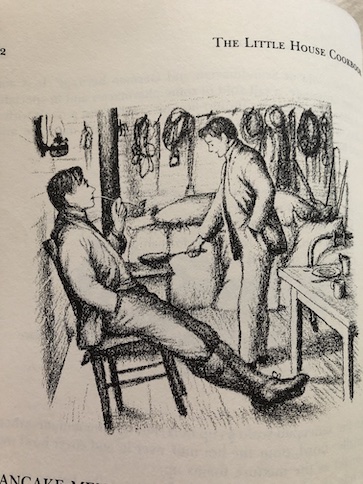
This children’s cookbook is based on the foods eaten in the Little House on the Prairie series. The series follows a farm family, and food is very important in the stories. I like the book because it provides historical explanations about the types foods that frontier families would eat. The illustrations in the books come from the original books.
The chapters in the book are:
Food in the Little Houses
The first chapter of the book explains about the life of Laura Ingalls Wilder and her family and how much of their time on the frontier was occupied with finding and producing food. The foods that they ate were ones they grew and hunted themselves. They had to prepare everything from scratch, and even the children in the family helped. When they had difficult times, there was often little to eat.
The chapter also discusses the nutrition of a pioneer diet. They didn’t understand much about the science behind vitamins and nutrition, but because their lives were based around hard physical labor, they were able to tolerate diets that were heavier in starches and sweets than most modern people would have.
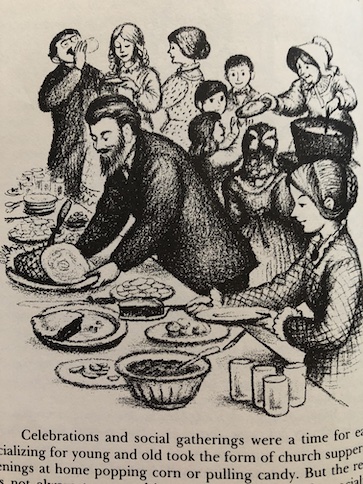
It also describes how celebrations and social occasions centered around food.
The Cook’s Domain
This chapter discusses what pioneer and farming families had in their kitchens and how they would cook and store food.
Staples from the Country Store
Although pioneers tried to be as self-sufficient as they could, nobody could ever make absolutely everything they needed. Country stores supplied a variety of good, especially the things that farmers couldn’t make by themselves, like farm tools, cooking pots, sewing supplies, guns, and some food staples that wouldn’t be produced by farms in the area or that required processing, like molasses and cornmeal. Country stores also allowed farmers to buy on credit or trade produce and other goods they had for ones they needed because they didn’t always have cash on hand.
The first two chapters were just informational, but this is the chapter where recipes start appear. Each of the recipes is accompanied by a quote from one of the Little House books where the dish is mentioned and some historical information. The recipes in this chapter are:
Fried salt pork with gravy
Hasty pudding
Fried cornmeal mush (a dish my grandmother said she ate growing up on a farm in Indiana in the 1920s and 1930s)
Johnny-cake
Corn dodgers
Cornbread
Crackling cornbread
Baked beans
Bean soup
Bean porridge
Oyster soup
Codfish balls
Foods from the Woods, Wilds, and Water
Pioneer families relied heavily on animals they could hunt and plants they could forage for food, like berries. This chapter discusses how they would process and prepare animals they hunted and what they could make with foods found in the wild. Personally, I have no interest in hunting, but the historical information is interesting. The recipes in this chapter are:
Stewed jack rabbit and dumplings
Spit-roasted wild duck
Blackbird pie
Fried fish
Roasted wild turkey with cornbread stuffing
Cranberry jelly
Blueberry pudding with a sauce
Huckleberry pie
Sun-dried wild fruit
Stewed dried fruit
Crab-apple jelly
Plum preserves
Husk-tomato preserves
Strawberry jam
Foods from Tilled Fields
This chapter discusses the crops farms produced, particularly wheat. There are recipes for different types of bread, biscuits, dumplings, crackers, doughnuts, and pancakes. There’s also a recipe for hardtack, which was a staple food for people going on long journeys because is wasn’t as perishable as other foods.
Foods from Gardens and Orchards
This chapter is about the types of fruits and vegetables that a family like the Ingalls would grow. It explains that these vegetables have changed over time because farmers developed new varieties of familiar foods, like potatoes. The flavors of these newer varieties aren’t quite the same as the old ones, but the newer varieties produce more food and are more resistant to disease.
The recipes included in this chapter are:
Mashed potatoes
Potato cakes
Fried potatoes
Hashed brown potatoes
Creamed carrots
Dried corn and creamed corn
Fried parsnips
Succotash – a dish of mixed vegetables with lima beans and corn
Lettuce leaves with vinegar and sugar
Ripe tomatoes with sugar and cream
Baked Hubbard squash
Raw turnip snacks
Mashed turnips
Stewed pumpkin
Pumpkin pie
Green pumpkin pie – It uses an unripened pumpkin, and it tastes a lot like an apple pie.
Apple turnovers
Apple pie
Birds’ Nest pudding – an apple dessert
Fried apples ‘n’ onions
Dried apples
Dried apple and raisin pie
Apple-core vinegar
Tomato preserves
Beet pickles
Green cucumber pickles
Green tomato pickles
Foods from the Barnyard
This chapter is about the types of animals kept on a farm as sources of meat, dairy, eggs, and fat.
The recipes included in this chapter are:
Lard and cracklings
Baked spareribs
Homemade sausage
Roasted pig
Mincemeat
Poached fresh eggs
Fried chicken
Chicken pie
Stuffed roasted hen
Roasted stuffed goose
Butter
Cottage cheese balls
Hard cheese
Pot roast of ox with browned flour gravy
Thirst Quenchers and Treats
This chapter covers special treats that farming families would have made or been able to buy at the general store. It explains the history and evolution of penny candies and other store-bought treats.
The recipes included in the chapter are:
Eggnog
Ginger water
Cambric tea
Lemonade
Pulled candy
Molasses-on-Snow candy
Vinegar pie
Custard pie
Heart-shaped cakes
Vanity cakes
Pound cake
Laura’s wedding cake
Sugar frosting
Ice cream
Parched corn
Popcorn
Popcorn balls
Popcorn and milk
There is a glossary in the back and a table of conversions.
One more thing I want to note is that the book refers to Native Americans as “Indians”, which is common in older books. There isn’t much information about Native Americans in the book because the focus is on pioneer farming families, but they are mentioned occasionally when there’s historical information about the origin and evolution of certain types of foods.
The book is available to borrow and read for free online through Internet Archive.
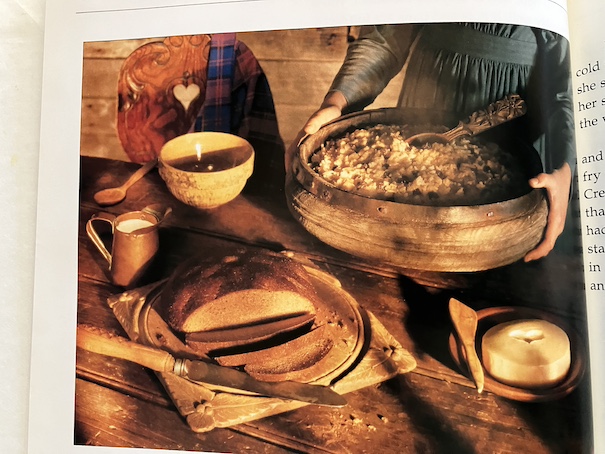
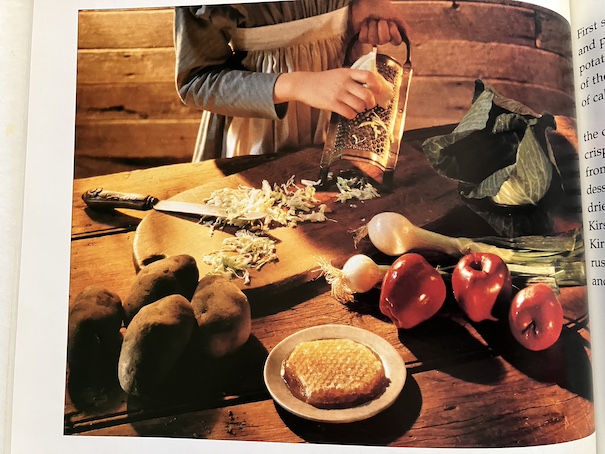
Kirsten’s Cookbook by Terri Braun, Jodi Evert, and Jeanne Thieme, 1994.
This cook book is one of the activity books that was written to accompany the Kirsten series that is part of the American Girls franchise. The American Girls books were written to help teach American history (as well as sell the accompanying dolls and accessories), so this book has recipes of the type that people would have eaten on the American frontier during the mid-1800s, when the character of Kirsten lived, and some historical information.
The book begins with some historical information about cooking on the frontier. Pioneer families like Kirsten’s family ate what they grew themselves and things they could gather from the woods around them. They ate certain foods only in the season when they could get them, and it was hard work to produce food and process it before using it in recipes. There were certain types of food that they had often because the ingredients were simple and often available, like potatoes and bread, and they rarely had time to prepare special or elaborate meals. However, they would take the time to make some special treats for holidays.
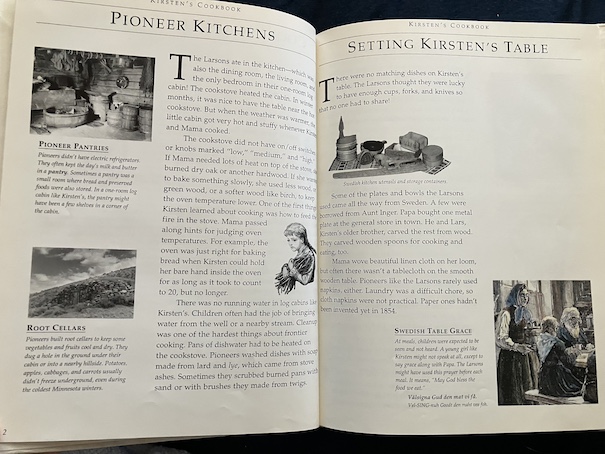
There are special sections that describe what pioneer kitchens were like and the dishes and table settings they would use. Pioneer families like Kirsten’s lived in one-room cabins, so her family cooked, ate, and slept all in that one room. They had a wood-burning cookstove, but stoves like that did not come with temperature settings. (This is why you don’t see temperatures specified in old recipes from the 19th century, although this book does include that information for modern readers.) People learned to judge roughly whether the temperature was right to bake bread or cook other recipes by feel, and could regulate the approximate temperature through the type or amount of wood they burned.
There is also a section of cooking tips and kitchen safety tips for modern child readers. Then, the recipes are organized by type of meal with a section of Kirsten’s favorite recipes. Each section and recipe is accompanied with additional historical information and trivia.
Breakfast
Pork sausage patties
Hard-boiled eggs
Swedish rice porridge
Round rye bread
Homemade butter
Ginger cookies – Although cookies seem like an odd thing to see at breakfast, a pioneer family might have them and save some for a snack in the mid-morning, before lunch, or as they called it, dinner.
Dinner
“Dinner” is usually the biggest meal of the day, but depending on when and where you live, that might be either the midday meal or the evening meal. In modern times, it tends to be the evening meal, after a family or individuals are home from work or school and have more time for a large meal. Modern people sometimes use the terms “dinner” and “supper” (the evening meal) interchangeably for that reason. In Kirsten’s time and, sometimes, in rural areas even in modern times, the biggest meal is the midday meal, what most of us would call “lunch.”
Baked ham slice
Swedish potatoes
Cabbage and apple salad
Fruit Soup
Swedish Almond Rusks – Swedish rusks are crunchy sweet breads, a little like biscotti.
Favorite Foods
This section just has an assortment of recipes for Kirsten’s favorite foods. Some of them are traditional Swedish foods, and others are more American. There is a mention in this section that pioneers learned how to make maple syrup from “Indians”, meaning Native Americans.
Potato soup – Soup with bread and cheese was a popular supper meal for farming families in the 19th century.
Swedish meatballs
Fresh applesauce
Swedish pancakes – These thin pancakes are rolled and filled with jam.
St. Lucia buns – These special buns are topped with raisins, and it’s a tradition in Sweden and other Scandinavian countries to serve them on St. Lucia Day, December 13.
Pepparkakor cookies – These are thin, spicy cookies that are cut into shapes and served at Christmas.
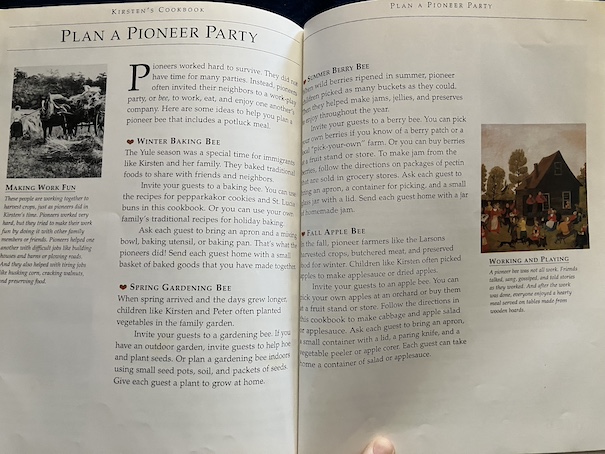
The book ends with a section of tips for having a pioneer-themed party. When real pioneers had parties, they were often organized around chores they had to do or tasks to accomplish. They called these work-play parties “bees”. Besides accomplishing a task, friends and neighbors would also bring food and share a meal, talk, and have fun. The suggestions in this section are organized seasonally. A Winter Baking Bee could involve everyone getting together to bake holiday treats, like the ones included in this book for St. Lucia Day and Christmas, or whatever the guests want to bake. At a Spring Gardening Bee, guests can get together to plant a garden or potted plants, with plants for guests to take home themselves. For a Summer Berry Bee, guests can pick berries (if they grow locally or at a “pick-your-own” farm) or make jam, with some for everyone to take home. For a Fall Apple Bee, guests can pick apples and make recipes with apples, like applesauce.
The book is available to borrow and read for free online through Internet Archive.
Samantha’s Cookbook by Polly Athan, Terri Braun, Jodi Evert, and Jeanne Thieme, 1994, 1998.
This cook book is one of the activity books that was written to accompany the Samantha series that is part of the American Girls franchise. The American Girls books were written to help teach American history (as well as sell the accompanying dolls and accessories), so this book has recipes of the type that people would have eaten during the early 1900s, when the character of Samantha lived, and some historical information about cooking and dining during that period.
The first section in the book discusses innovations that made cooking easier in Samantha’s time than it had been in earlier time periods. The kitchen in Samantha’s house had running water, a gas stove, and an icebox for refrigerating food. Because Samantha comes from a wealthy family, who can hire people to cook for them, Samantha’s education focuses more on learning how to be a good hostess, meaning that she would be more likely to be in the dining room, helping to entertain guests, rather than in the kitchen, preparing food. However, Samantha would have been familiar with cookbooks, discussing new recipes and studying sections of cookbooks that offered advice about dining etiquette. There are sections in this book that discuss the role of servants in shopping for and preparing food and the proper way to set a table for an elegant dinner party.
After that, there is a section of cooking tips and kitchen safety tips. The recipes in the book are divided into sections based on meals, followed by a section of Samantha’s favorite recipes. The recipes are also accompanied by historical information.
Breakfast
The book explains that, because Samantha is from a wealthy family, her family’s cook begins making breakfast before Samantha wakes up in the morning, so it will be ready for her as soon as she’s awake and dressed. In her time, breakfast was typically the lightest meal of the day, but wealthy households had a variety of foods at breakfast. Breakfast was typically served with hot drinks. Adults usually had coffee or tea, while children might have hot chocolate.
Strawberries with cream
Ham slice
Cheese omelet
Saratoga potatoes – These are fried potato chips, which were a relatively new innovation in Samantha’s time. The book explains that potato chips were invented by a Native American cook at a resort in Saratoga Springs, New York in 1853 after a customer complained that the fried potatoes should be thinner.
Blueberry muffins
Dinner
“Dinner” is usually the biggest meal of the day, but depending on when and where you live, that might be either the midday meal or the evening meal. In the past and in rural areas, “dinner” was often lunch. By Samantha’s time, as it typically is in modern times, it was the evening meal, after a family or individuals are home from work or school and have more time for a large meal. For wealthy families, like Samantha’s family, dinner was a very formal meal. They would often dress up for dinner, and at formal dinner parties, there would be name cards on the table to tell everyone where to sit. At a formal dinner in a household with servants, individual dishes and parts of the meal would be served in “courses”, but the number of courses could vary. Samantha’s family followed the English style, with fives courses at dinner. The book mentions Samantha’s family having soup, salad, appetizers, a main course with roasted meat, and dessert and coffee at the end of the meal. Some larger, fancier dinner parties could have many more, some as many as 18 courses!
Cream of carrot soup
Roasted beef tenderloin
Mashed potatoes
Fresh green beans
Corn oysters – These are fried corn patties.
French salad
Dressing
Ice cream snowballs – These are scoops of vanilla ice cream coated in shredded coconut.
Favorite Foods
This section has an assortment of recipes for Samantha’s favorite foods. The book explains that, while Samantha was being trained to be a hostess more than a cook, even wealthy girls like her would taught some basic cooking skills. Sometimes, Samantha would help the family’s cook in the kitchen and make some simple recipes.
Apple Brown Betty
Jelly biscuits
Cream cheese and walnut sandwiches
Chicken salad sandwiches
Gingerbread
Lemon ice
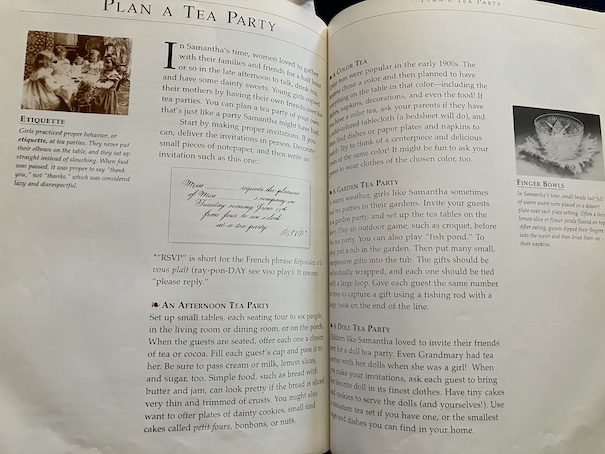
The book ends with a section about how to plan a tea party, like girls in Samantha’s time might have. The suggestions include themed tea parties, like afternoon tea, a color tea (a popular concept in the early 1900s, where everything at the party, from decorations to food, would be themed around a particular color), a garden tea party, and a doll tea party (girls would bring their dolls, and there would even be tiny treats to serve to the dolls).
The book is available to borrow and read for free online through Internet Archive.
Felicity’s Cookbook by Polly Athan, Rebecca Sample Bernstein, Terri Braun, and Jodi Evert, 1994.
This cook book is one of the activity books that was written to accompany the Felicity, An American Girl series that is part of the American Girl franchise. The American Girls books were written to help teach American history (as well as sell the accompanying dolls and accessories), so this book has recipes of the type that people would have eaten during the American Revolutionary War, when the character of Felicity lived, and some historical information.
The book starts out with some historical information about cooking in Colonial Virginia, where Felicity lived, and some general cooking tips, like measuring instructions and safety information. It includes information about late 18th century kitchens, cooking utensils, and dishes. Colonial kitchens were frequently located in an outbuilding, separate from the rest of the house. It was best to keep the kitchen a little away from the house because, rather than using stoves, their main method of cooking was a large kitchen fireplace, which made the kitchen very hot. During warm months, the heat would be uncomfortable, so keeping the kitchen separate from the house kept the house cooler. They would vent heat from the kitchen by opening the kitchen windows. On the other hand, during cool or cold months, the warmth of the kitchen fire could be pleasant, so family members might gather there. Families with servants and slaves might have them live in a loft over the kitchen, keeping them separate from the family. The kitchen fire could also be a potential fire hazard, so the kitchen typically had a brick floor or packed dirt because a wood floor might catch fire.
The types of dishes a family might have depended on their social class and what they could afford. Felicity comes from a prosperous merchant family, and a family like hers might have imported dishes from England or China as well as locally-made dishes. Wealthy people might have had silver or pewter serving dishes, while poor people had wooden dishes, often poplar or linden, which wouldn’t contribute much flavor to the food.
Hospitality was very important in Colonial Virginia. Friends, family members, and business associates frequently visited each other’s homes, and because there were no telephones, there often wasn’t much advance notice that guests were coming. People were often prepared to provide food for unexpected guests. Because she is being raised to be a gentlewoman, much of Felicity’s education focuses on how to be a good hostess, how to plan meals and social events, and how to properly prepare and serve different types of foods.
Modern people might not view these topics as being very important from an educational standpoint, but in Felicity’s day, they served a very important purpose. The book doesn’t really go into the reasons why it was important for Felicity to be a good hostess as part of her social status, but it essentially boils down to what 21st century people might call “networking.” As the daughter of a socially-prominent businessman and the potential future wife of someone with a similar social standing, being a good hostess could help her family or future spouse establish and maintain good relations with other members of the community, helping to cement business arrangements or arrange marriages between members her family (siblings or her future children) and other families of good social standing, possibly including her own. Being capable of cooking delicious food and arranging dinner parties could be for fun and family celebrations, but the ability to be a competent and charming hostess for anyone who might have business with her family or anyone her family might want to associate with could help smooth over possible social difficulties or quarrels or promote better relationships with members of their community.
In a way, Felicity’s lessons in manners, tea party etiquette, making pleasant conversation, preparing appropriate meals, and providing food and a pleasant visit for guests on short notice would have been the 18th century equivalent of taking courses in social networking. This type of social role is one that housewives have performed for centuries, both before and after Felicity’s time, and it also appears in some of the other American Girl books, such as Samantha, An American Girl, which is set in the early 1900s and focuses on a girl from a wealthy family. It’s a sort of unofficial role, not unlike that of the First Lady of the United States, who organizes social events, acts as hostess for important visitors, and promotes good causes to better the public image of the President, although the specific methods they use to do this varies based on the social standards of the day, their own tastes and abilities, and the image they want to promote. This is the type of lifestyle that Felicity’s family is preparing her to fulfill. People still do this sort of thing, even if it’s just being prepared to offer someone coffee, tea, or water when they’re visiting on business, seeing to the small social niceties to make the guest a little more comfortable and start important discussions on a positive note. It’s not just about keeping women in the kitchen and out of men’s business; there’s a purpose behind it for promoting the family’s business and social standing. Deep down, Felicity might wish that she could be the one to work in the shop and make business deals directly rather than learning the social niceties and networking skills to promote relationships, but it’s still an important and useful role that her family wants her to fill.
The recipes in the book are organized by meal. Each section and individual recipes come with historical details related to the different types of food.
Breakfast
Apple butter
Johnnycakes
Breakfast puffs
Fried ham with gravy
Dressed eggs
Dinner
“Dinner” is usually the biggest meal of the day, but depending on when and where you live, that might be either the midday meal or the evening meal. In modern times, it tends to be the evening meal, after a family or individuals are home from work or school and have more time for a large meal. Modern people sometimes use the terms “dinner” and “supper” (the evening meal) interchangeably for that reason. In Felicity’s time and, sometimes, in rural areas even in modern times, the biggest meal is the midday meal, what most of us would call “lunch.”
Chicken pudding
Veal balls
Sweet potatoes and apples
Sally Lunn bread
Green beans
Whipped Syllabub
Favorite Foods
This section just has an assortment of recipes for Felicity’s favorite foods.
Beefsteak pie
Baked pumpkin pudding
Raspberry flummery
Almond tarts
Queen cakes
Spiced nuts
Liberty tea – an herbal alternative to traditional tea, used after colonists started boycotting imported tea to avoid and protest taxes
The book ends with tips for planning a Colonial party, such as an elegant tea party or Twelfth Night party.
The book is available to borrow and read for free online through Internet Archive.
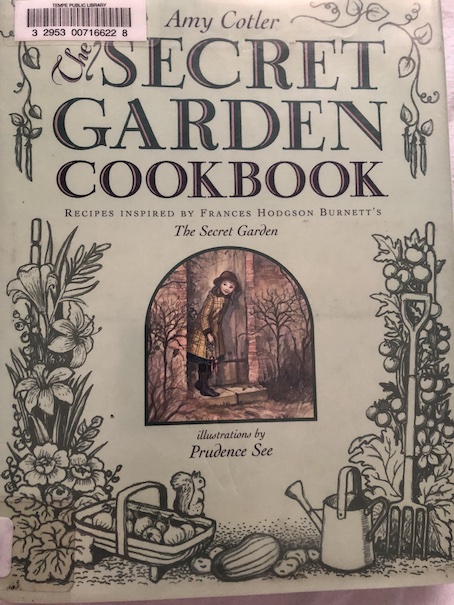
The Secret Garden Cookbook: Recipes Inspired by Frances Hodgson Burnett’s The Secret Garden by Amy Cotler, illustrations by Prudence See, 1999.
This book is a cookbook with recipes based on the types of foods eaten by characters in The Secret Garden by Frances Hodgson Burnett. Food is important in the story because Mary and Collin didn’t have any appetites when they were unhappy and unhealthy, but their appetites improve when they begin working in the garden and getting more fresh air and exercise. Most of the recipes are types of foods that are specifically named during the course of the story, but others are ones that the characters would have been likely to eat for the time and places where they lived. Because the original story focused on gardening, there is also an emphasis on using foods that would be grown in kitchen gardens
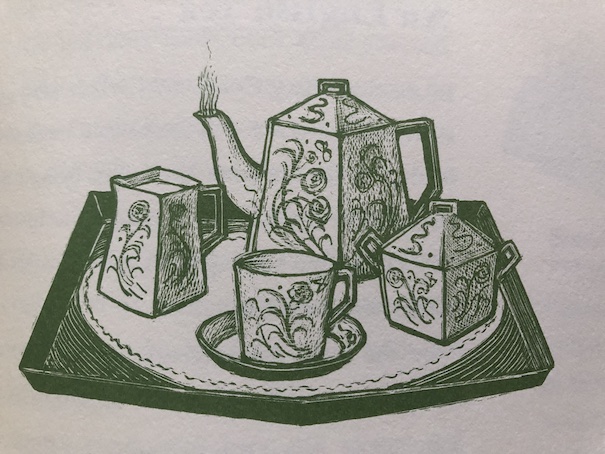
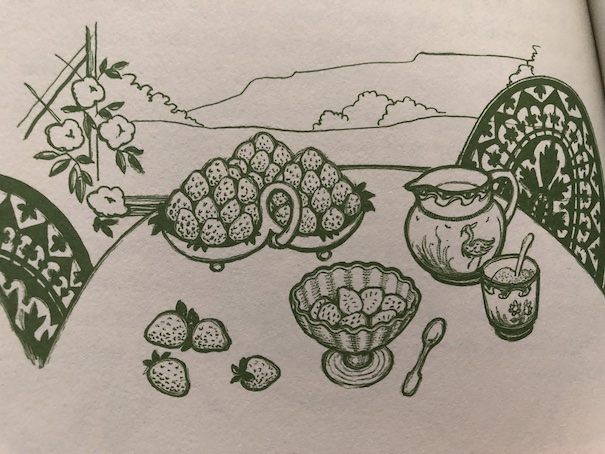
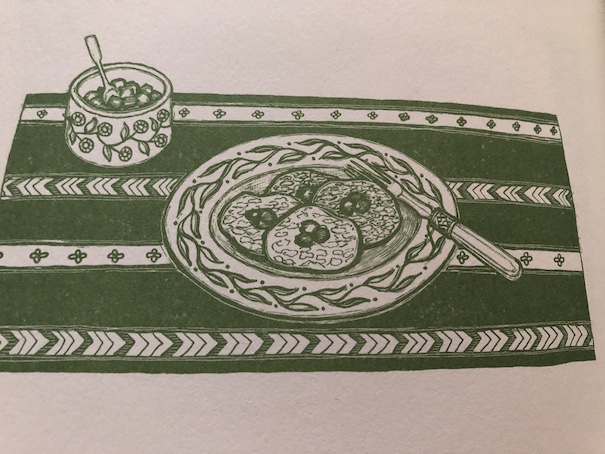
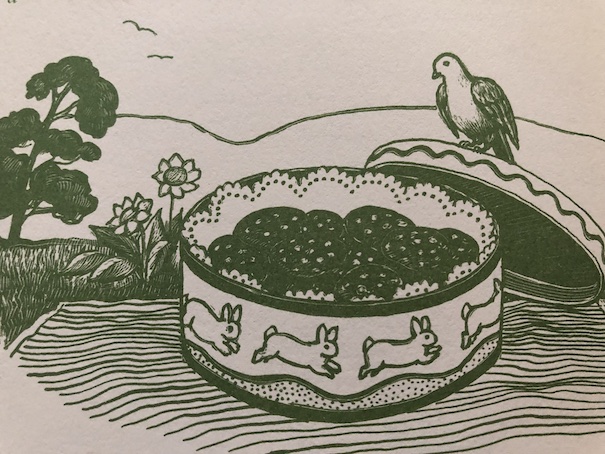
Most of the illustrations in the book are simple green and white drawings of different types of foods that accompany the recipes.
The recipes in the book are sorted into different categories, and each section has historical information about different meals and types of food. Individual recipes also have historical information, trivia, and quotes from The Secret Garden related to the dishes. Some traditional English foods need to be explained to Americans. For example, the word “pudding” refers to a specific type of dairy dessert in the US, but in England, it’s a more general word that can refer to any type of dessert.
I liked the selection of recipes, and I really liked the historical information provided with them!
The sections of the cookbook are:
Yorkshire Breakfasts
These are breakfast foods that the characters in the story ate or might have eaten during the Victorian era.
Porridge
Coddled eggs – Eggs cooked in a cup
Cheese muffins
Little sausage cakes
Cocoa
A Manor Lunch
This section explain the types of things that people of different classes ate as their mid-day meal in the Victorian era.
Yorkshire pudding – These are popovers with meat drippings.
Roasted fowl with bread sauce
Potato snow
Welsh rabbit – This is melted cheese on toast.
Cabinet pudding – This is a molded custard dessert with fruit.
Jam roly poly
An English Tea
This section explains things that Victorian people ate at afternoon tea.
A proper pot of tea
Cucumber tea sandwiches
Scones
Fruit tea loaf
Lemon curd tartlettes
Brandy snap baskets with whipped cream
The Kitchen Garden
This section is about things people would make from fruits and vegetables that they would grow in their kitchen gardens.
Fresh spring peas with mint
Glazed carrots
Summer pudding – This is a molded dessert made with bread and different kinds of berries.
Two fools – “Fools” are old-fashioned fruit-based desserts.
Raspberry jam
Raspberry vinegar
Molded spiced pears
Strawberries and cream
Dickon’s Cottage Food
Poor people, like Dickon’s family, would have eaten different things from the wealthier people in Victorian society.
Tattie broth – A potato soup.
Pease pudding
Yorkshire oatcakes
Cottage loaf – This is a basic bread recipe.
Dough-cakes with brown sugar – A basic dessert made with bread dough.
Parkin – A kind of oatmeal gingerbread.
A Taste of India
These are the types of foods that Mary might have eaten during the time she lived in India.
Fruit lassi – This is a kind of fruit shake made with yogurt.
Sooji – A hot breakfast cereal similar to cream of wheat.
Little bacon and coriander pancakes
Fresh mango chutney
Mulligatawny soup – This soup was invented in India for the British colonists. It’s curry coconut soup whose name means “pepper water.”
Florence Nightingale’s kedgeree – Florence Nightingale has nothing to do with the dish, but the Victorians named it after her because she was famous. It’s a rice and fish dish that was often made from leftovers and served for breakfast or lunch.
Garden Picnics
These are foods that can be prepared outside or are easy to pack for a picnic.
Roasted potatoes and eggs
Currant buns
Crumpets
Cornish pasties – These are savory pies or turnovers with meat and veggies, meant to be eaten with the hands. They’re sort of like larger, better-tasting Hot Pockets.
Chocolate picnic biscuits
The book is available to borrow and read for free online through Internet Archive.
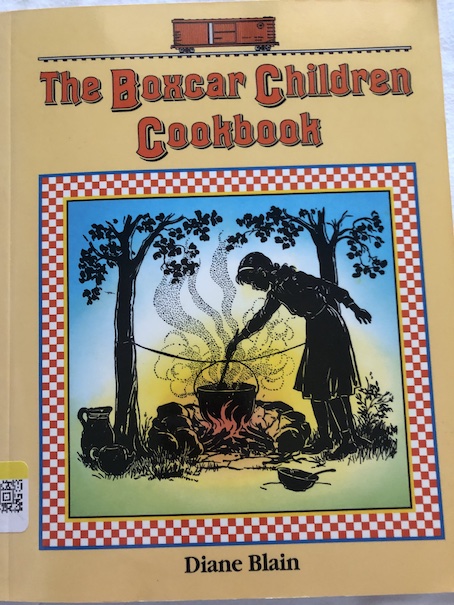
The Boxcar Children Cookbook by Diane Blain, 1991.
This book is a companion to The Boxcar Children series, written years after the original series by a different author. Most of these recipes weren’t included with the original books in the series, but the books often mention food. The children in the stories are often eating foods they like or demonstrating that they can prepare their own food. In particular, the youngest of the children, Benny, likes to eat.
The first part of the book discusses kitchen equipment, measurements, and safety rules. The recipes in the book are organized by types of dishes. There is even a section about cooking over a campfire because the children camp out in multiple books. Each of the recipes explains which story in the series mentioned that type of food. The books that the cookbook references are all part of the original 19 Boxcar Children books written by Gertrude Chandler Warner, not the later ones written by ghost writers under her name.
None of the recipes are very difficult because they’re meant for children, but they’re not overly easy, either.
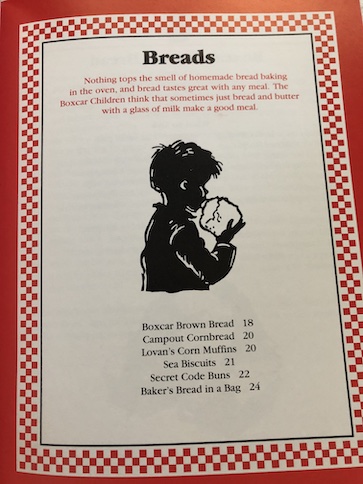
The section about beverages includes recipes for hot chocolate mix, strawberry milkshakes, lemonade, eggnog, and an orange drink. The breads section includes a recipe based on one that appeared in The Snowbound Mystery, which was a secret recipe for buns. However, the recipe in this book includes a shortcut using prepared sweet roll dough from the grocery store.
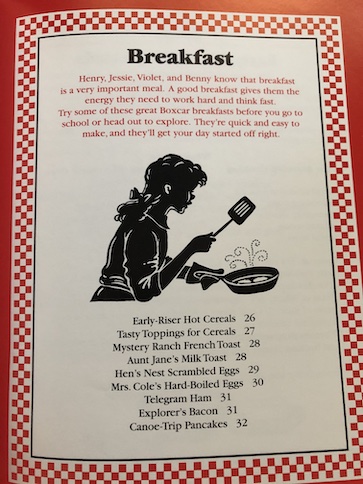
The breakfast section includes recipes for pancakes, French toast, and different types of eggs. I thought it was interesting that the page about hot cereals not only included recipes for oatmeal and cream of wheat, which are common ones but grits, hasty pudding, and cream of rice, which I had never heard of before.
There are sections for sandwiches and main dishes. There is also a section about salads and vegetables for side dishes.
The section about campfire cooking includes instructions for building a campfire and safety rules. There are also grill instructions.
Finally, there are sections for cookies, cakes and desserts. I think the cookbook is a fun way to add activities to accompany the stories. Cooking is a valuable learning experience, and many people like to experience foods similar to the ones that characters in their favorite stories enjoy.
The illustrations in the book are in silhouette form, like the illustrations from the very first Boxcar Children book, but they’re not exactly the same. Some of them have been changed to fit the recipes in the book, with characters holding foods that they weren’t holding in the original illustrations.
The book is available to borrow and read for free online through Internet Archive.
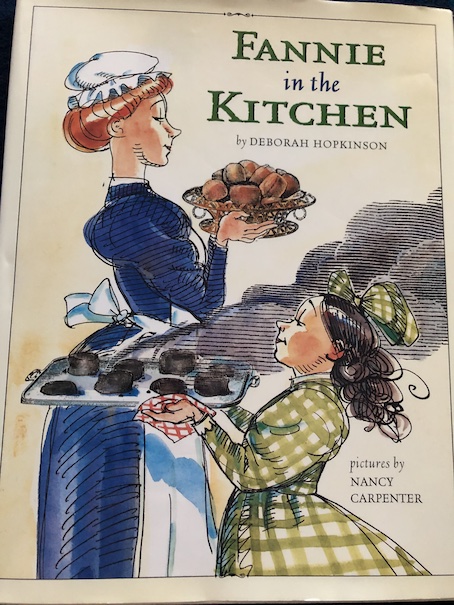
This is the story of Fannie Farmer and her famous and popular cookbook! When I first heard of the Fannie Farmer Cookbook (originally The Boston Cooking-School Cook Book (1896)), I wasn’t sure whether Fannie Farmer was a real person or if that was just a pseudonym or a marketing name for the cookbook, but Fannie Farmer was a real person in the late 19th century, and that was her real name. The story in this picture book is based on her real life, although details may be fictionalized, and the pictures give the story humorous twists.
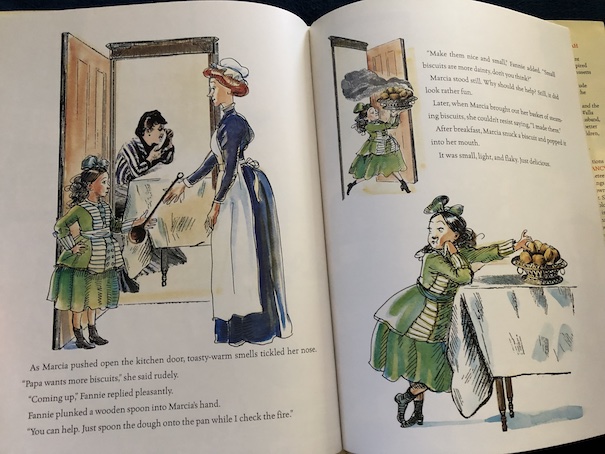
In the beginning of the story, a little girl named Marcia Shaw prides herself on how many things she can do around the house and how much help she can give to her mother. However, she’s still a little girl, and there are some things she doesn’t know how to do well. In particular, Marcia doesn’t know how to cook. Now that her mother is expecting another baby, Marcia’s mother decides that she needs to hire some extra household help, especially with the cooking.
Marcia is a little offended that her mother considers her inadequate to help by herself, but when the new help arrives, a young woman named Fannie Farmer, Marcia has to admit that she’s a good cook. Even better for Marcia, Fannie doesn’t consider her cooking techniques trade secrets. She enjoys letting Marcia help in the kitchen and teaching her cooking tips.
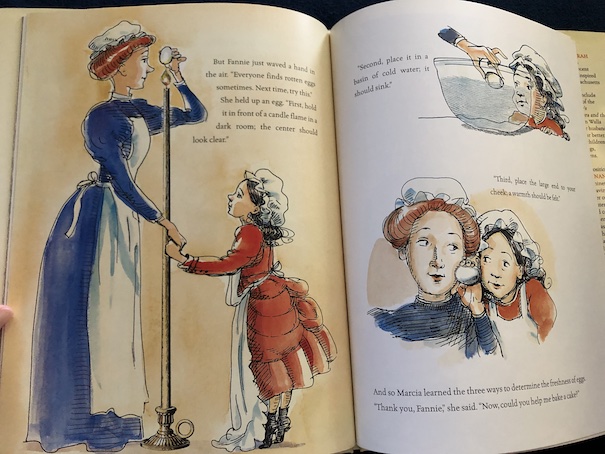
Under Fannie’s tutelage, Marcia’s cooking skills improve. Fannie teaches her many important pieces of information about cooking, like how to measure ingredients and how to tell when ingredients are fresh or if they’ve gone bad.
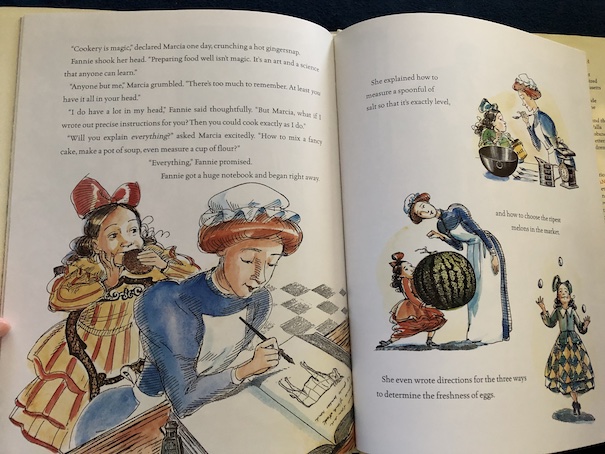
Marcia enjoys learning to cook with Fannie, but she thinks that she’ll never be as good as Fannie because there’s just too much to remember. She doubts that she’ll ever be able to memorize it all. Marcia is amazed that Fannie can keep all of that cooking information in her head. To help Marcia, Fannie decides to write out a notebook with recipes and cooking instructions, including all of the specific measurements for ingredients and detailed information about cooking techniques to make the recipes come out just right.
This is what makes Fannie Farmer and her cookbook so unique for their time period. If you’ve ever seen a very old recipe book or even just old family recipes written down, they often don’t have all of the amounts of ingredients written down, or the amounts are written in very vague terms. Old recipes also offer little to no cooking techniques, like how to tell when it’s time to turn a griddle cake over or how to tell if a cake is done baking. The assumption was that girls (usually girls for this time period) would learn to cook by watching their mothers and by learning from their examples. However, that assumes that their mothers knew all of these cooking tips themselves, that the mothers remembered to tell their daughters what they knew and explained it well enough for them to understand (some people don’t have much of a talent for teaching, even when it’s a subject they know themselves), and that the daughters understood or remembered everything their mothers said. Otherwise, the vague directions in cookbooks and family recipes were of little help, and new cooks had to learn through experimentation or trial and error. Fannie’s approach to cooking, as explained in the story, is an art and a science that anybody can learn if someone explains it well enough, so she puts her focus on recording all of the necessary details of her recipes.
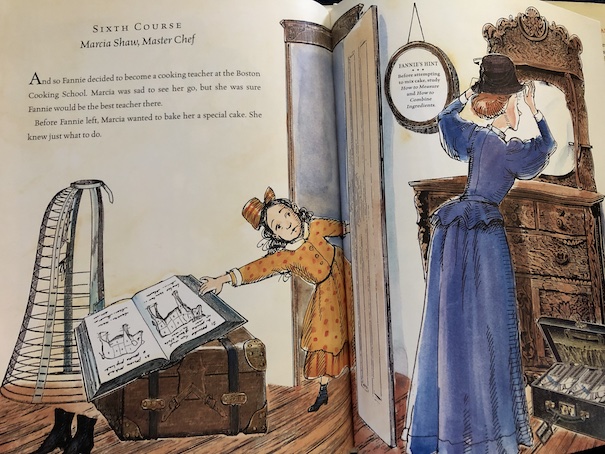
Fannie’s recipe book, started for Marcia, turns out to be very popular with both the Shaw family and their friends and neighbors. As word spreads about it, people start coming by to borrow recipes or get cooking advice. Fannie realizes that there is a lot of demand for better teaching of cooking techniques, and she really enjoys teaching cooking, so she decides to accept a job at the Boston Cooking School.
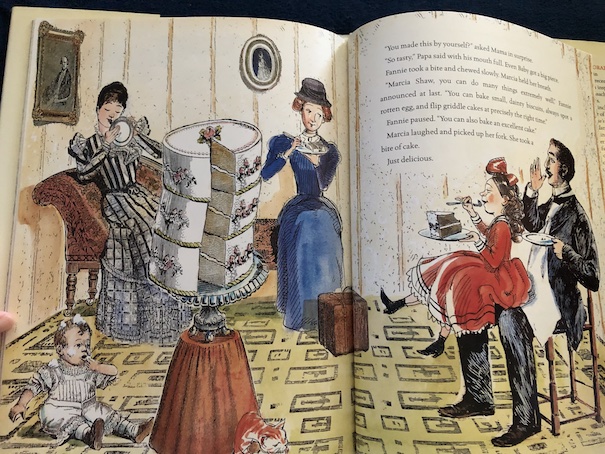
Before Fannie leaves the Shaws, Marcia borrows the cooking notebook and makes a special cake for Fannie to show her what she’s learned. The cake comes out just right because Marcia has followed Fannie’s directions.
There are hints from the Fannie Farmer cookbook throughout the book, and there is a section in the back of the book with historical information about Fannie Farmer. It also includes a sample recipe for Griddle Cakes.
The book is available to borrow and read for free online through Internet Archive (multiple copies). New and used copies are also available on Amazon. You can also buy the original Fannie Farmer Cookbook through Amazon or read it online through Internet Archive (multiple copies).
My Reaction
One of the things I liked about this book is the illustrations. There are eccentric details in the pictures that add humor to the story, like how Marcia stacks a bunch of chairs on top of each other while making candles, so she can make them extra long, and one of her extra long candles appears later, when Fannie shows her how to tell if an egg is fresh by holding it up to a light. For some reason, Marcia’s mother also has a weird habit of licking her dishes when she’s eating one of the yummy recipes, and there is one picture where it looks like she’s lost control of the baby carriage, and it’s rolling away with the baby. I’m sure these aren’t historical details and were just thrown in to be funny.
I think it’s also important to point out that the real-life Fannie Farmer lived an unconventional life for someone of her time period. She was plagued with health problems from a fairly young age. At some points in her life, she was unable to walk, possibly because of a stroke, and when she walked, she had a limp. She never married, but she built a fulfilling career around her talent for cooking. and achieved lasting fame because she wanted to share her knowledge with others. She is credited with establishing exact and level measurements in cooking in the United States, and she was also a strong believer in quality food and proper nutrition, especially for people with health problems.

























 Jestress's Forgotten Books and Stories