Thanksgiving on Thursday

Magic Tree House

There is a letter to the readers at the beginning of the book, where the author briefly describes the history of the Thanksgiving holiday and how it started as a three-day harvest festival and didn’t become a regularly-celebrated holiday until President Lincoln declared it as a national holiday of thanksgiving to be celebrated annually on the last Thursday in November in 1863. The separate prologue to the book explains that Jack and Annie have started learning magic, and they’ve been going on a series of missions to find different types of magic.

It’s Thanksgiving, and the children know that they will be leaving for their grandmother’s house soon, but they can’t resist going to the tree house to see if there’s another message from Morgan. There is a message that tells the children that they are about to find a new kind of magic. A book in the tree house takes the children back in time to the first Thanksgiving in the American colonies.
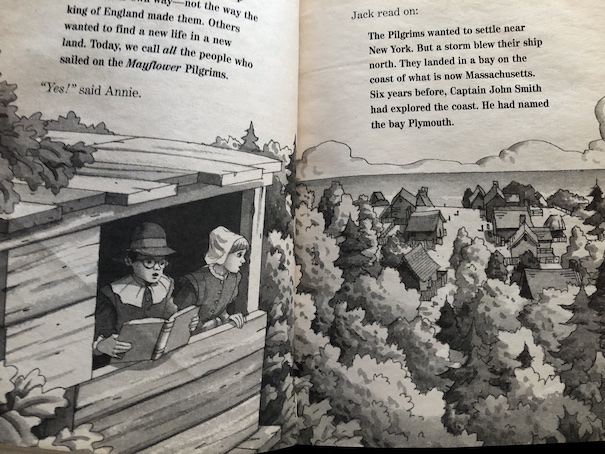
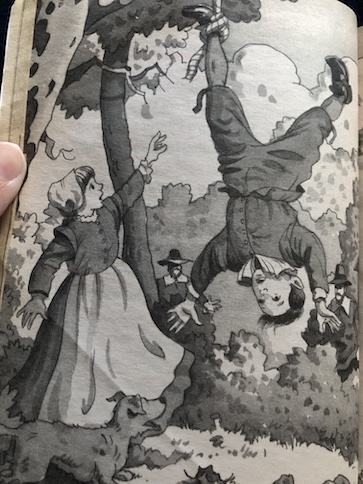
They read about the Pilgrims and the voyage of the Mayflower, and they realize that they are now in 17th century Plymouth. Annie remembers how her class at school put on a play about Thanksgiving, and she gets excited, thinking about how they’re about to meet some of the people they studied in school. She dashes off, eager to get a look at them, although Jack thinks they should pause and work out a plan before they approach anyone. Unfortunately, Jack gets caught in a hunting snare.

A group of people, Pilgrims and Native Americans, come to see what got caught in the snare, and they find Jack and Annie. When they question the children, Jack isn’t sure exactly what to say, so he tells them that they came from “a village up north” and that they’re here to learn how to grow corn. Remembering something else from the book, he claims that his parents sailed to the colonies with Captain John Smith when he and Annie were babies. Captain Standish says that Squanto knew Captain John Smith and that he might remember them. To the children’s surprise, when Governor Bradford asks Squanto if he remembers two babies called Jack and Annie who sailed with Captain John Smith, he says he does. Jack wonders if he’s mistaking them for two other children from the past.

The children witness the arrival of Chief Massasoit and his men. Priscilla tells the children that they were invited to join the harvest festival (something that historians debate), but they weren’t expecting such a large group, and they wonder if they’re going to be able to feed everyone. The Wampanoag say that they will go hunting to provide more food, but the Pilgrims say that they will also gather more food.

Jack and Annie are invited to join the food-gathering efforts, although it’s difficult for them because they’re not used to hunting and fishing, like 17th century children would be. Annie thinks it won’t be so bad because they’ve helped their parents prepare for Thanksgiving before, but the types of food at this harvest festival are very different from the “traditional” Thanksgiving food the children would have expected, and the methods of preparing them are old-fashioned. Jack and Annie find themselves trying to catch eels and find clams and trying to tend things cooking over an open fire. The children’s efforts don’t go well, and at first, they’re afraid that they’ve ruined the feast, but the magic they came to seek saves everything.
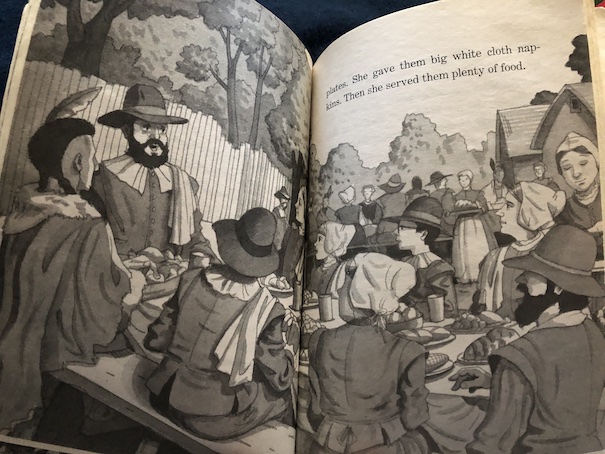
The magic that the children find is called the “magic of community.” Even though Jack and Annie think that they haven’t contributed much, and they burnt the turkey they were trying to cook, their mishaps haven’t ruined the feast because the entire community was helping all the time. Because everyone contributed something, there is enough for everyone. Besides learning how the first Thanksgiving was different from the holiday they know, Jack and Annie learn about cooperation, how people share and support each other.

At one point, Jack asks Squanto why he says that he remembered them. Squanto seems to realize that Jack and Annie aren’t quite what they said they were, but he says it wasn’t really them that he was remembering. He explains a little about his own past and what it felt like to be an outsider in a strange place, reminding the children to remember that feeling and to be kind to others in the same situation.

I liked the author’s noted about the history of the Thanksgiving holiday. For another book that explains the first Thanksgiving feast from the point of view of both the Pilgrims and their Wampanoag guests, I recommend Giving Thanks by Kate Waters.

Happy Birthday, Molly

American Girls

MollyBirthday

Happy Birthday, Molly! By Valerie Tripp, 1987.

MollyBirthdayEmily

Molly is excited because she has just learned that an English girl will be coming to stay with her family for a while.  The girl, Emily, is one of the child evacuees from London.  Really, she’s supposed to be staying with her aunt, who also lives in Molly’s town, but her aunt is in the hospital with pneumonia and won’t be able to take her for another couple of weeks.  In the meantime, Molly and her friends are eager to meet her, imagining her to be something like the English princesses, Elizabeth and Margaret Rose.

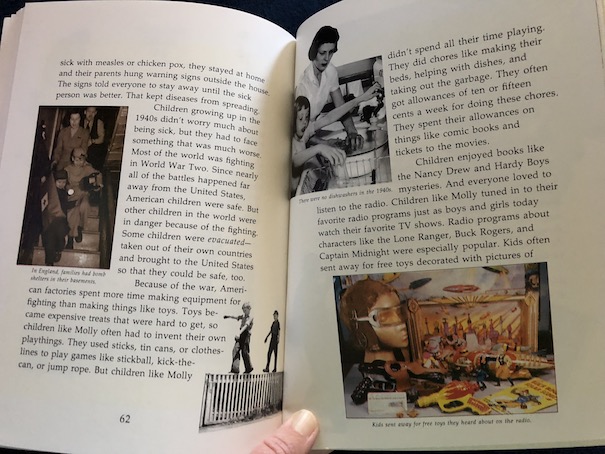
The girls have a fascination for England after all the things they’ve seen in movies and newsreels.  Recently, they saw a newsreel about bomb shelters in England.  Inspired by what they’ve seen, the girls make a pretend bomb shelter under an old table and enjoy pretending that they are like the people in the newsreel.  Molly’s brother, Ricky, says that it isn’t very realistic, and the girls say that they’ll have to ask Emily when she comes.

MollyBirthdayBlackOut

However, Emily turns out to be very shy and quiet.  She’s pale and skinny and hardly talks at first.  When the girls show her their “bomb shelter”, she doesn’t want to play in it.  Molly thinks that maybe Emily doesn’t like them, but her mother reminds her that, in World War II England, bomb shelters aren’t places to play.  Emily is the same age as Molly, and the war has been going on since she was a little kid.  Molly’s mother points out that Emily probably doesn’t remember much about life before the war.  Emily is accustomed to bombings and danger all around her, and Molly’s mother compares her to a flower “who’s not sure it’s spring yet.  It will take some time for her to realize it’s safe to come out now.”

Emily goes to Molly’s school, and their classmates are fascinated with her.  This fascination makes Emily even more shy than she would be otherwise as kids try to imitate her accent and ask her questions about what it’s like to see buildings bombed.  To the America kids, the war seems exciting, and they want to know what it’s like to see it up close, but Emily dodges their questions.

Molly finally comes to understand why Emily is so evasive when their town has a blackout drill.  When the drill starts, a siren sounds, and everyone has to go down into their basements until they get the signal that it’s all clear.  Molly is surprised to see that Emily is actually frightened by the drill, but everyone assures her that it’s just for practice, not because Illinois is actually going to be bombed.  In Molly’s family, it’s almost like a game, but Emily has memories of real bombings during the Blitz.  As they sit in the basement during the drill, Emily explains it to Molly: the fear, the explosions, destroyed buildings, people getting hurt or killed.  Molly and her friends thought it was exciting to hear about the war in newsreels, but living it is an entirely different thing.  The drill and everyone’s questions about what bombings are like bring back bad memories for Emily.

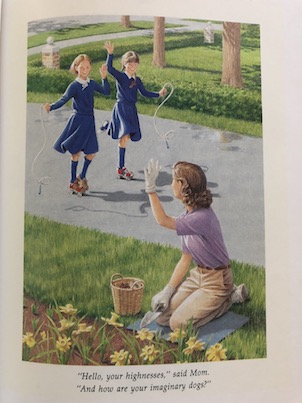
As Molly comes to understand Emily’s feelings more, Emily opens up to her.  The girls discover that they share a fascination with Princess Elizabeth and her sister Margaret Rose.  They start playing a game where they pretend to be the princesses, dressing alike in blue skirts and sweaters.  Because the princesses have pet dogs, the girls also pretend that they have dogs, using jump ropes as leashes for their imaginary pets.

MollyBirthdayPrincesses

Molly’s birthday is approaching, and she offers to let Emily share in her party and help plan it.  She’s curious about what people in England do on their birthdays, and the idea of an English tea party sounds great to her friends.  However, Molly doesn’t like the way that Emily describes English birthdays, and the types of sandwiches that the English tea with tea don’t sound very good.  Worst of all, Emily says that, at her last birthday before the war rationing started, she had a lemon tart instead of a cake.  Molly can’t imagine her birthday without a birthday cake.  Mrs. Gilford, the housekeeper, has been saving up rationed goods for her cake this year, and it’s what she’s been looking forward to the most!

Sharing things with Emily becomes more of a trial for Molly, and when the girls argue about their countries’ contributions to the war effort, they get into a fight and Molly starts thinking that she doesn’t even want Emily at her birthday party.  However, Molly’s mother points out to the girls that the war effort is a team effort.  A couple of special birthday surprises help the girls to make up, including something extra special that helps Emily to heal further from the trauma of the war.

In the Molly, An American Girl movie, Emily plays a larger role than she did in the books.  This is the only book in the series where Emily appears.  Her story was changed somewhat for the movie, too.  In the movie, she says that her mother was killed in a bombing.  In the book, her parents are both still alive, and it was her dog who was killed.  Molly doesn’t learn that until the end of the book when her family gives the girls a pair of puppies as a present, and Emily tells her about her pet dog who died.

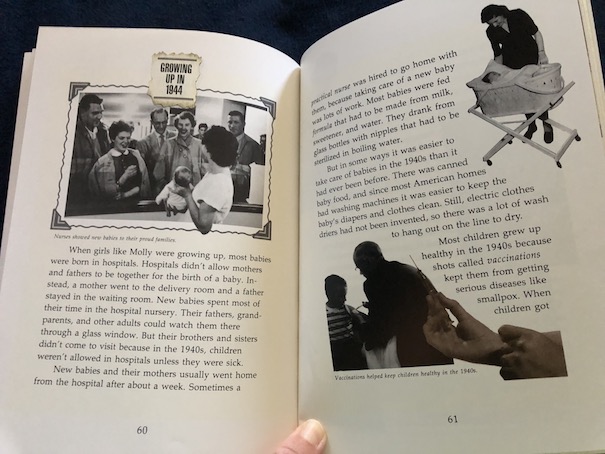
In the back of the book, there’s a section with historical information about what it was like to grow up in the 1940s.  It explains how women used to stay in the hospital for about a week after giving birth, and sometimes, they could hire a practical nurse to help them at home as well.  Canned baby food was a new invention, and vaccines helped to prevent disease.  Back then, people still got smallpox shots because the disease hadn’t been eradicated, but there was still nothing to prevent chicken pox or measles, so children with those diseases had to be kept at home with warning signs out front to tell people to stay away from the quarantined house.  (Note: My father was born in 1944, the year that this series takes place, and he said that throughout his early childhood, parents who knew of a child who had chicken pox would deliberately take their children to visit and get the disease.  It wasn’t that they really wanted their children to get sick, but since there was no way to prevent the disease at the time, they had to accept that it was inevitable that their child would catch it eventually, and chicken pox is somewhat peculiar in that there is a kind of age window in which the disease isn’t likely to be too bad.  If you waited too long, and the child got older or even to adulthood without getting it, it was bound to be much worse when they eventually caught it.  So, if your child was about the right age for getting it, in early childhood but no longer a baby, people thought it was best to get it over with so they could benefit from the lifetime immunity afterward.  This remained true even up through the 1980s, my early childhood, which is why I have a permanent scar on my face from the disease.  Now, there are vaccines to prevent it, although I understand that some people still have chicken pox parties in places where the vaccine isn’t readily available. If you have the option, go for the vaccine.  Preventing chicken pox also prevents shingles.)

MollyBirthdayHistorical1

The historical section also talks about child evacuees, like Emily, and what teenagers did during the 1940s.  It was around this time that people began looking at the teenage years as being a distinct phase of life, and businesses began specifically catering to teenagers.

The book is currently available online through Internet Archive.

MollyBirthdayHistorical2

Molly Learns a Lesson

MollyLesson

Molly Learns a Lesson by Valerie Tripp, 1986.

MollyLessonHideoutIn 1944, everyone is concerned with finding ways to help the war effort.  In Molly’s third grade class at school, her teacher announces that their class is invited to participate in the Lend-a-Hand contest.  The class will be divided in half, and each half will compete against the other to find the best way to help the war effort.  The class decides to make the contest boys against girls, and Molly immediately starts trying to figure out a spectacular idea that will impress everyone.  Unfortunately, one of the other girls says that the girls in class should knit socks for soldiers, and the teacher accepts that as the goal for the girls’ team, before Molly can say anything.

MollyLessonCollectingMolly is appalled at the idea of knitting socks.  It’s partly that she had wanted to be the one to come up with the best idea, and it’s also partly because she has tried knitting before, and she knows that socks are difficult, time-consuming projects, especially for beginning knitters.  Molly is sure that the other girls are going to find it too difficult and that, in the end, they’ll have nothing to show for their project.  Her friend Susan doesn’t think that the project sounds so bad, but Linda also dreads the idea of knitting because she’s not very good at it.  Talking it over in their secret hideout in the storage area of Molly’s garage, the three girls decide that they’ll work on a secret project by themselves, something that will save the day when the other girls’ project falls through.

At first, the idea of doing something in secret sounds exciting.  However, coming up with a good secret project and seeing it through turn out to be more difficult than they expected.  All they can think of to do is to collect bottle tops for scrap metal, and as they go door to door in the rain, asking for them, they learn that most people have already given theirs to the Boy Scouts who were collecting scrap metal.  Tired, wet, and discouraged, the Molly and her friends decide to look in on the other girls and see what progress they’re making.

MollyLessonBlanketThe other girls are certainly a lot more comfortable, knitting inside.  However, as Molly predicted, they are finding their project harder than they thought it would be.  None of them has completed an entire sock yet; all they really have are the square shapes at the top of the sock, and they’re getting discouraged.  That’s when Molly gets a better idea: why not take the squares they’ve made and turn them into a blanket?  Simple squares are much easier to make than socks, they can make a lot of them quickly with everyone helping, and the girls who can’t knit well can sew the squares together.  A blanket is still a good war effort project because Molly’s father has told her that the hospital where he works is always in need of blankets for the wounded soldiers.  With this new idea, the other girls become much more excited, and they make more progress.
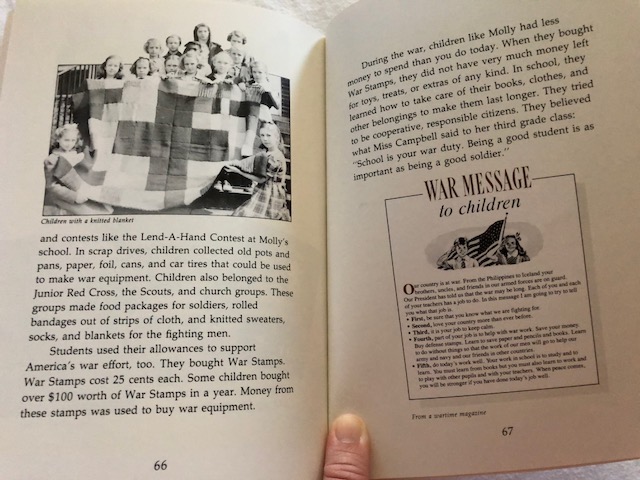
The theme of this story is that working together and sharing ideas benefits everyone more than working alone or trying to be too competitive.  Molly’s first ideas weren’t very good by themselves, and neither was the sock-knitting idea.  However, when Molly and her friends join the other girls, Molly finds a way to help them build on the idea that they already had (knitting) and take it in a better direction.  Molly and her friends also explain to the other girls about the bottle tops they were trying to collect, and some of them think of other places where Molly and her friends didn’t go for their collecting.  All of the girls working together manage to finish the blanket and collect 100 bottle tops in a single day, surprising and pleasing their teacher.

In the back of the book, there is a section with historical information about what it was like to go to school in America during World War II.  Discipline was more strict than it was in schools during the late 20th century, and there was also more separation between boys and girls.  Sometimes, boys and girls going to the same school and attending the same classes played on completely separate playgrounds, and sometimes, they even had to enter and exit the school through different doors (this is something that was also mentioned in the book Cheaper By the Dozen, which takes place during the late 1910s/early 1920s).  Teachers emphasized patriotism and taught the children about the war, why soldiers were fighting, and what life was like in other countries that were involved in the war.  It was common for schools to have drives to collect scrap metal or other materials to help the war effort.  Special projects like knitting clothing or blankets for soldiers were also popular.

The book is currently available online through Internet Archive.

MollyLessonHistory

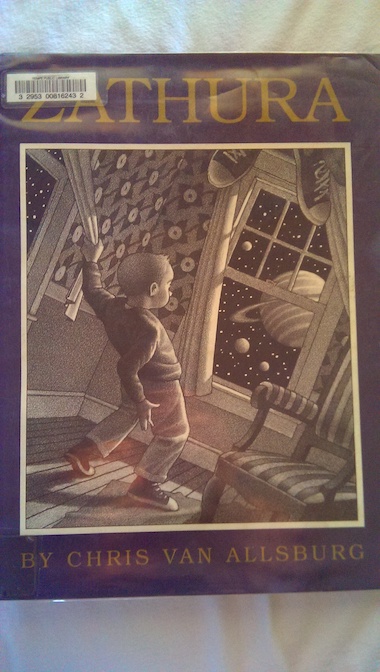
Zathura

Zathura

Zathura by Chris Van Allsburg, 2002.

This book begins where Jumanji ends. It’s not completely a sequel because it has a different set of children and a new game, but it’s connected because the two children from Jumanji left the board game in the park again after they finished it, and they saw two boys that they know pick it up and take it home.

ZathuraBrothersWrestling

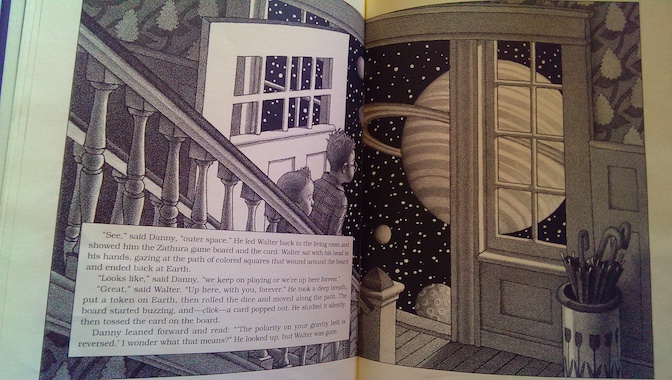
However, the two boys, Danny and Walter, don’t end up playing the same jungle board game, Jumanji, that was in the previous book. They find a second board game in the Jumanji box called Zathura and decide to try it instead. Zathura is a space-themed game where players travel a path from Earth to the planet Zathura. Like in Jumanji, elements from the board game come to life as the boys play, and someone must reach the end in order to end the game.

ZathuraStartingGame

Danny and Walter, a pair of brothers, fight a lot. Walter hates doing things with Danny. However, when Danny starts playing the game, sending their house into outer space, Walter must join in and play with his brother in order to bring the game to an end so they can go home. The two of them learn teamwork as they help each other face the dangers of the game while trying to reach Zathura.

ZathuraOuterSpace

There is a movie version of this book, but there are major differences between the original book and the movie. The conflicts between the two boys are similar in the book and the movie, but the movie added a subplot about the boys’ parents being divorced (they weren’t in the original book), an older sister for the boys (it was just the two of them originally), and a kind of alternate reality where the older boy was trapped in the game by himself for years because he wished his brother away before finishing the game until his alternate self realized that he cared about his brother and wanted to cooperate with him.  In the original book, nobody was trapped in the game.

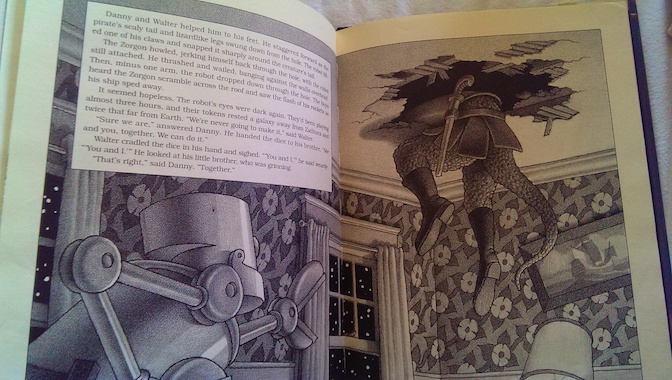
ZathuraAlienRobot

Chris Van Allsburg illustrations are always good, although I have to admit that I preferred the illustrations in Jumanji to the ones in Zathura.  It just seems to me that the pictures in Jumanji were more detailed and realistic.

The book is currently available online through Internet Archive.

ZathuraGoingHome

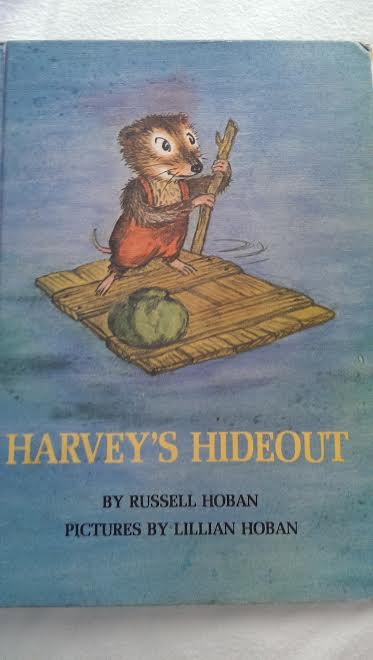
Harvey’s Hideout

HarveysHideout

Harvey’s Hideout by Russell Hoban, illustrated by Lillian Hoban, 1969.

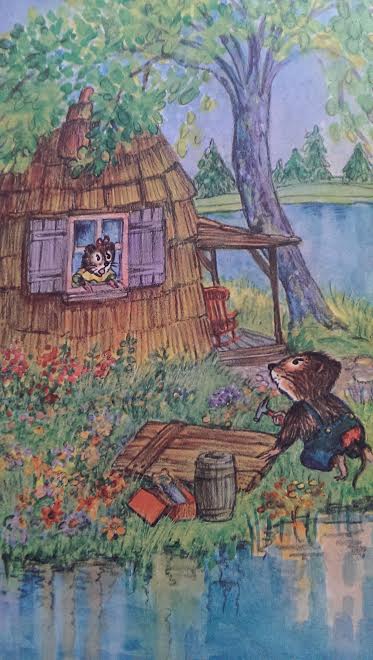
HarveysHideoutHouseSummer is difficult for the Muskrat kids this year.  Their friends are away for the summer, and Harvey and his older sister Mildred are getting on each other’s nerves.  But, there’s nothing that says they have to spend the whole summer with each other.

Harvey builds himself a raft and tells Mildred that he’s going off to meet with members of his secret club for a cookout where annoying big sisters aren’t welcome.  Mildred says that’s fine with her because she’s been invited to a party where there will be no annoying little brothers.  Harvey says that’s fine with him . . . except that it really isn’t.

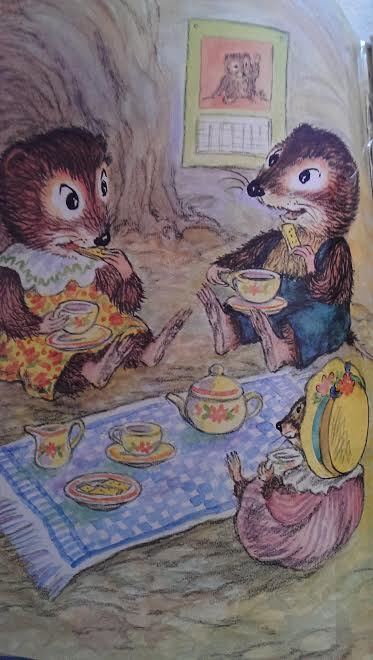
The secret hideout where Harvey has been spending his time is empty except for him and the comic books he brought with him, and his cookout is for only one person.  He just made up the story about the secret club to make Mildred jealous and to have an excuse to spend time away from the house and her.  Harvey appreciates the freedom, but he’s also bored and lonely and envies Mildred, wondering who she knows who is still in town, inviting her to parties every day.

Then, when Harvey tries to make some improvements to his secret hideout, he discovers that he’s not the only one to dig a secret hideout for himself in the area.  Harvey’s unexpected discovery leads to a change in his relationship with his sister.

HarveyHideoutSecret


The book is available to borrow and read for free online through Internet Archive, and new copies are also available to buy through Plough.  If you try it and like it, consider buying a copy to own!

HarveysHideoutFriends

My Reaction

This is a nice story about sibling rivalry and cooperation.  One of the parts I like best is early on in the story when Harvey and Mildred’s father lectures them for fighting and insulting each other. I hated that part when I was a kid, but I kind of like it now because I realize what the father is actually trying to say.  He points out that there is some truth in their insults, but they’re wrong about each other at the same time.  Part of the reason they fight is because they each have their faults (Harvey can be selfish and Mildred can be bossy), but they each unfairly assume that the other is a lost cause and that they can never be friends.  It’s only when they come to realize that they’re equally lonely (Mildred has been having tea parties with just her doll) and Harvey makes the first move in offering to share what he has with Mildred that they realize that they can each be the friends they both need this summer.

When I was a kid, I wished I had a hideout like theirs!  I also love the colorful illustrations in the story.