The Mystery of Castle Croome by Hilda Boden, 1966.
Molly Stewart, an American college student attending Oxford, is an orphan who is barely scraping by when she suddenly receives word that she has inherited an ancient castle in Scotland from her great-uncle, who has recently died. Molly’s friends, a pair of twins called Pat and Penny Roderick (short for Patricia and Penelope), go with her to have a look at the place, but right from the beginning, it seems like nobody wants her there.
Although the lawyer, Mr. Harding, is aware that Molly has been attending Oxford, he also knows that she is planning to return to the United States when she finishes her degree. He also knows that her great-uncle, Sir Malcolm, disapproved when her father married an American and moved to the United States himself, so he was surprised when Sir Malcolm’s will left his estate to his nephew or his nephew’s heirs. Mr. Harding had expected that Sir Malcolm would leave the estate to Jamie Campbell instead because Jamie has been the caretaker for years. The estate doesn’t come with much of an income, and the farms attached to it don’t have tenants, so they’re not bringing in rent money. It would take a lot of work to restore the estate. Since Mr. Harding would rather deal with Jamie Campbell anyway, he thinks that Molly would find it a better deal to just sell the castle to Jamie and use the money to finish her degree and go back to the United States. Molly asks why Jamie Campbell would want to buy the castle if it’s not worth much and needs so much work to restore. Mr. Harding says he might buy it out of sentiment, but Molly wants to have a look at the castle before agreeing to sell it. After seeing it, she might decide that it isn’t the kind of place where she could live, but she won’t know for sure until she sees it herself. Mr. Harding agrees and says that he will tell Jamie Campbell that she’s coming.
When Molly arrives with Pat and Penny, they see that the castle is isolated and rather eerie. Inside, it is run down, and living conditions are primitive. Jamie Campbell, an elderly man, isn’t happy that they’re there. There is no other staff, and while Jamie was happy to serve the old laird and nurse him through his final years, he has no intention of serving this young American grand-niece. Although there is an electrical generator at the castle, Jamie says that it hasn’t worked in years, and he and the old laird used oil lamps and candles. If Molly and her friends think he’s going to go to special efforts for their comfort, they can think again. Molly refuses to be intimidated by his disrespect, and she tells him that, because this castle has been his home for years, he is welcome to continue staying there, although Jamie Campbell thinks that she’s only extending that invitation to get a free caretaker.
Molly is studying engineering at college, and her friends think that she could probably fix the generator, but Molly tells them that she would like to wait to look at it. She hasn’t had much practical experience yet, so she wants to take time to study the situation before she does anything. She also tells her friends not to mention to Jamie Campbell that she has any engineering knowledge. She doesn’t trust Jamie, and she thinks it might be better for him to think that they’re more helpless than they actually are.
Molly sees definite signs that Jamie Campbell hasn’t been honest with them about the real condition of the castle and about even the contents of the castle at the time that her uncle died, and she can tell that he’s deliberately trying to make life harder for them to drive them away from the castle. After Jamie Campbell tells them that there is no running water at the castle, the girls notice that soap next to a sink is still wet, indicating that Jamie has very recently washed his hands there. The girls think that he probably shut off the water right before they got there, and they also think there is probably nothing wrong with the generator, that Jamie probably just turned it off. He tries to keep them from even looking at it, and he’s reluctant to hand over the keys to the castle to Molly. Many pictures are missing from the walls of the castle, and Jamie says Molly’s uncle sold them for money, but another painting disappears during their stay, showing the girls that Jamie is the one looting artwork from the castle. Molly realizes that nobody seems to know exactly what was in the castle at the time her uncle died, making it difficult to prove that Jamie is stealing things. When Molly tries to search her uncle’s desk, she finds that it’s been completely cleared of even routine papers, and Jamie admits in a cagey way that he may have tidied up a little.
Things improve for Molly and her friends when they set out to buy some food and make contact with other people outside the castle. Jamie refuses to even feed them, saying that he barely has enough for himself. He says that he might have been able to provide something for Molly if she was alone, but he can’t be expected to feed her friends, too. Fortunately, the girls have some provisions with them that get them through their first night at the castle. When they set out in the morning to buy more food, they can’t take their care because there’s a large nail in one of the tires. They can’t prove that Jamie sabotaged the car, but they all suspect he did. They decide to set out on foot to find somewhere with a telephone or somewhere they can buy some food. They meet up with a scout troop camping nearby, and they save the girls from stumbling into a bog. They share a meal with the girls, and the girls tell them what’s been happening at the castle.
The scout leaders don’t like the sound of Jamie and the things happening at the castle, and they tell the girls that they will send a mobile shop to the castle to sell them food. There’s a van that travels among the farms in the area, selling groceries, sort of like a food truck, and it carries a surprising variety of goods. The scouts also tell the girls how they forage for wild foods, and they offer their services for changing the car’s tire and other things they might need.
That night, Molly has a frightening encounter with a ghostly white figure, although she believes that it’s just Jamie, trying to frighten her away from the castle. The next day, Molly and her friends confront Jamie about the missing painting, and he tells Molly that her great-uncle sold that painting years ago. He tries to convince her that the only reason why she thought she saw it is that she has “second sight.” He says that it was a favorite painting of her great-uncle’s and that she only saw it because she’s a member of his family and has psychically sensed the memory of the picture. Molly knows that can’t be true because her friends also saw the picture. Molly also asks Jamie about a strange roaring noise that she heard at night that sounded like machinery of some kind, and Jamie tells her that it’s the “Roar of the Stewarts.” He says it’s a bad omen, and that Stewarts hear it before something bad happens. Although none of the girls admits to having seen a “ghost” the night before, Jamie also tells them about the “Specter of the Castle”, and he insists that all of these bad omens are signs that Molly and her friends should leave the castle because it’s dangerous for them.
Molly and her friends know that Jamie badly wants to frighten them away from the castle, and part of that might be that he’s been looting objects from it since Molly’s great-uncle died, but what is the real cause of the machine noises in the night? Then, suddenly, Jamie welcomes a pair of unexpected guests into the castle as paying guests. Mr. and Mrs. Smith claim that they’re traveling tourists who think it would be exciting to stay in a real castle. Molly tries to discourage them from staying by charging them more than anyone might expect from staying in a run-down castle with primitive living conditions, but the Smiths insist that they would enjoy an authentic experience. Molly and her friends are immediately suspicious, especially when they realize that the Smiths don’t seem to have a car, and there’s no obvious way they could have even reached this out-of-the-way castle. Who are they really? Are they confederates of Jamie’s? What has Jamie really been doing at the castle, and what is he so afraid that Molly and her friends will discover if they stay?
The book is available to borrow and read for free online through Internet Archive (multiple copies).
My Reaction
I found this book recently at a used book sale, but I recognized the title because I tried to find this book when I was a kid. I wanted it because it was on a list of suggested books in the back of another mystery book I read and liked as a kid. Actually, I think I enjoyed it more as an adult than I would have has as a kid. As a kid, I would have liked the notion of a girl inheriting a spooky old castle that might be haunted, but in this story, it’s pretty obvious right away that Jamie is behind all the mysterious things happening.
This story is not like other mysteries where you have to wonder who among the suspects could be responsible for the mysterious happenings because Jamie is the only suspect from the beginning. The real mystery, for both the characters and the readers is why he’s doing it. It’s a “whydunnit” more than a “whodunnit.” Although it would have been fun and atmospheric if Molly and her friends believed that the castle was haunted and were scared, I have to admit that I loved how unimpressed the girls were when Jamie awkwardly makes up his spooky stories and excuses about “second sight”, the “Roar of the Stewarts”, and the “Specter of the Castle.” They know that he’s just making it all up. They just don’t kick him out of the castle immediately because he’s an old man who’s been there for years, and they also want to know that he’s up to.
It turns out that part of what he’s up to is obvious and part actually resembles the mystery book that had this listed as a recommended book. Readers can figure out the more obvious part themselves, but there’s a revelation later that Jamie is also involved in another crime that he can’t explain away as any misunderstanding. There’s a suspenseful part of the story where the girls are trapped in the castle with Jamie and his confederates and need to figure out how to escape or summon help. I thought that the ending part wrapped up a little quickly, but overall, I liked the story. I think I enjoyed the book more now than I would have if I’d found it when I was a kid.
Philip Mannering is spending part of his summer holidays at the home of one of his teachers, doing some extra studying, which is a bit depressing. He has fallen behind in school because he recently suffered from Scarlet Fever and Measles, and he is trying to catch up. He’s not the only boy studying at the teacher’s home, but he isn’t really friends with the others.
One day, he’s doing some studying on the hillside and hears a strange voice telling him to shut the door and not whistle. There is no door on the hillside, and he wasn’t whistling. Philip is very confused until he realizes that the voice is coming from a big, white parrot sitting in a tree. Then, he hears a child’s voice calling the parrot from the garden of the teacher’s house. Philip is happy, thinking that another boy has joined the study group, but it turns out that he’s only half right.
The voice in the garden belongs to Lucy-Ann Trent, who isn’t a student and isn’t there to study. Her brother, Jack, is the one who needs to catch up in school because he never focuses on his studies. Jack has only one interest in life, and that’s birds. Jack owns the parrot, Kiki, and wants to be an ornithologist when he grows up. He is bright but disinterested in anything that isn’t related to his chosen field. Lucy-Ann is only there to spend time with him and keep him company while he gets extra tutoring. The two of them are orphans. They don’t remember their parents because they died in a plane crash when the children were very small. Most of the time, they live at boarding school, which is why they don’t spend as much time together as they like. Usually, during their holidays, they live with a fussy uncle, which is why the parrot is always barking orders at the children.
Philip also usually lives with an aunt and uncle when he’s not at school. His father is dead. His mother is still alive, but she spends most of the time working at her art agency. He also has a sister named Dinah, but they don’t usually get along. Philip is surprised at how well Jack and Lucy-Ann get along with each other because he’s always fighting with his sister, who has a temper. (Although, admittedly, he does push Dinah to lose her temper.) Strangely, Philip finds himself wishing that Dinah were also there because, when he becomes friends with Jack and Lucy-Ann, it occurs to him that she would nicely round out the group.
Philip, Jack, and Lucy-Ann become friends by bonding over their shared love of animals. Philip likes the parrot and tells Jack and Lucy-Ann that they would probably like his aunt and uncle’s house because they live by the sea, and there are many sea birds in the area. Philip doesn’t know much about birds in general, but he likes collecting various small pets, including mice and caterpillars. The teacher isn’t too happy about these animals because they disrupt study sessions.
Then, Jack and Lucy-Ann get a letter saying that they’re going to have to continue staying with the teacher through the rest of the summer because their uncle has broken his leg and can’t take them back. The children aren’t happy about that and neither is the teacher because he had other plans after the summer tutoring session ended, even though the uncle has provided a generous check for the children’s care.
Then, Philip has a wonderful idea: maybe Jack and Lucy-Ann can come visit him and his sister at his aunt and uncle’s house. Dinah has written to him that she’s bored and lonely and misses him, even though they usually fight. She would like the company, and Philip knows that his aunt and uncle could use the money the children’s uncle is willing to offer for their boarding. Jack and Lucy-Ann like that idea, but they’re not sure that their uncle and teacher would agree to let them go because they don’t know Philip’s aunt and uncle, and they think maybe Philip’s aunt and uncle wouldn’t want two strange children staying with them. The children know their plan would be best for everyone, but since they’re not sure that they can persuade the adults, they take the attitude that it’s easier to ask for forgiveness than permission and plot for Jack and Lucy-Ann to run away and join Philip on the train home. Jack and Lucy-Ann secretly send their trunks to the train station along with Philip’s and tell the teacher that they’re just going down to the station to say goodbye to Philip when he goes. Then, they quietly buy their train tickets and leave.
When the children arrive at Philip’s home, Aunt Polly is irritated because she isn’t prepared for unexpected guests. There are no rooms or beds for them, and she says that they can’t stay. However, she is surprisingly won over by Kiki, who says, “Poor Polly!” over and over in a sad tone. Not knowing that Kiki is also sometimes called Polly, Aunt Polly thinks that the bird knows her name. She often feels overworked and rarely gets any sympathy, so she appreciates this gesture from Kiki, who repeats the phrase more often, seeing that it pleases Aunt Polly. Aunt Polly is also charmed that Polly tells people to get a handkerchief when they sniffle or sneeze because she’s always saying that to Dinah. When she telephones the children’s teacher to discuss the situation and learns about the fee the children’s uncle is willing to pay for caring for the children, she decides that maybe the children can stay after all. The relieved teacher promises to endorse the check over to her.
Aunt Polly is relieved to get the extra money, and she reveals to the children that she’s been very worried about expenses because Philip and Dinah’s mother has been ill and hasn’t been able to send the money she usually sends from her job. Her doctor says that she’s run-down and needs a rest, but her job is an important source of money to the whole family. Everyone is relying on her, but since she hasn’t been able to send her usual support money for the children, Aunt Polly is worried about how she will afford the children’s school fees. Philip bravely says that he’s willing to quit school and get a job instead to help out the family, but Aunt Polly says he’s still too young. Philip has wished before that he was old enough to be the man of the family and provide for his mother. His uncle isn’t much help with money and doesn’t pay attention to family expenses, too absorbed in his academic work. Aunt Polly says that the money she’ll get from boarding the Trent children will help out.
Philip says that part of the trouble is that the house where they live is really too large. About half the house is crumbling into ruins from neglect, and the other half is really too big for Aunt Polly to maintain. Aunt Polly agrees but says that moving would be difficult because few people would want a house like this one, crumbling and located in a rather lonely spot along the coast. Besides, the children’s uncle loves it because he knows all the history of the area, and he wouldn’t want to leave. Philip thinks the only thing that will really help is when he and Dinah are old enough to get jobs. Then, the two of them will be able to help their mother afford a place for three of them.
Philip’s aunt and uncle have a gloomy man named Joe working for them, and he tells the children that the tower room where the boys will sleep on an old mattress (a prospect that seems adventurous to them instead of an inconvenience) isn’t a good room because it’s the only room where they can see the Isle of Gloom. He says that bad things are associated with the Isle of Gloom because bad people who did terrible things lived there. Jack asks Philip about the Isle of Gloom. Philip says that it’s difficult to see, even from the tower room, and it’s always covered in mist. Nobody lives there now. Jack thinks it sounds great because the birds on the island have probably never seen people before and won’t be afraid of them, so he could get some amazing pictures. He thinks maybe he’ll even find some rare birds. Philip says that he and Dinah have never been there before themselves, and he’s not sure whether there are birds there or not.
Staying at the house by the sea isn’t easy. All of the children are expected to help with the chores. There is no electricity, and they use oil lamps that need to be cleaned. The water has to be pumped from a well. Still, Jack and Lucy-Ann think that it’s just part of the adventure. They enjoy going swimming and fishing with Philip and Dinah, and Jack has fun bird-watching, but Joe the handyman is always spying on them and acting creepy. He keeps telling the children spooky stories about things lurking in the dark. For some reason, Joe tries to discourage the children from exploring the area or going out in a boat, but they soon make an interesting discovery.
While the children are exploring a cave, Philip teases Dinah, and she hits him. He stumbles back and ends up in a hidden tunnel. Philip and Jack explore the tunnel and discover that it leads to some carved stone steps and trapdoor that leads up to a storeroom that’s part of the cellars at the house. Philip says that he never knew this part of the cellar existed. The boys discover that the door to the storeroom is usually hidden by boxes, but Joe has the key and comes in. Kiki, who is with Jack as usual, makes some sounds that terrify Joe, who thinks that there are strange and spooky things in the cellar. The boys think that it’s hilarious that Joe got scared when he’s always trying to scare them. They steal the key that Joe left in the door so they can come and go whenever they like, but they wonder why Joe even hides the door to the storeroom in the first place. Philip is sure that even his aunt doesn’t know about that storeroom, or she would have mentioned it before.
Joe is definitely doing something suspicious, going out at night in a boat, fearful that the children will find out what he’s doing. The children make friends with a nice man named Bill, who is staying in an old shack nearby. Bill says that he’s there for bird-watching, but he doesn’t seem to know that much about birds or talk about them as much as Jack does. Bill has a boat and takes the children out sailing, but he doesn’t want to take them to the island and warns them to be careful of Joe. Does Bill know something the children don’t, or does he have some dangerous secrets of his own?
The book is available to borrow and read for free online through Internet Archive (multiple copies). It was first published in Britain, and some US copies use the title Mystery Island instead. The book was made into a movie in the 1980s, and you can see it on YouTube. The movie has John Rhys-Davies as one of the villains.
My Reaction
First, I’d like to get it off my chest that I didn’t like many of the family relationships throughout the book. Aunt Polly’s marriage is a little disturbing because she doesn’t have enough money to run the household, but her husband not only says that he has none to give her and wouldn’t give her any even if he did have money. He doesn’t seem to care about the welfare of either Polly, who is eventually revealed to have a heart condition, or the children in his care. He buries himself in his study most of the time and has almost no idea of what’s going on in the rest of the house or even who’s there. He’s not just obsessed with his studies, but at times, it seems like he’s deliberately hostile toward everyone else, including his wife, like their existence in the house is a terrible inconvenience to him.
I didn’t like the way Philip and Dinah were portrayed as always fighting physically in the book. Admittedly, my brother and I got into physical fights when we were little, but Dinah is twelve years old, and Philip is older than she is. Both of them seem to be too old to be acting the way they do in the story. Dinah is very emotional and has a hair-trigger temper, and Philip, knowing this, intentionally baits her into losing his temper. He likes to put creepy-crawly creatures on her or act like he’s going to, knowing she doesn’t like it and that she’ll react, and then he’s not happy when she lashes out and hits him. While Dinah shouldn’t react by hurting people physically, I could sort of understand it if she constantly has to put up with this from Philip. Living with someone who is always baiting you and escalating his behavior until you break would probably leave anyone broken in the end, and I can’t help but think that Dinah’s emotions would stabilize more if she didn’t have to deal with someone always trying to throw her off balance. Maybe she’d still be an emotional person, but I notice that it’s particularly Philip who gets her to fight physically while nobody else does because they don’t bait her into it. I found that sibling relationship kind of disturbing because Philip seems to know exactly what he’s doing, and as I said, he’s too old to be doing this stuff innocently.
Jack and Lucy-Ann seem to have a more fond sibling relationship. Lucy-Ann sometimes seems a little clingy with Jack, but I think that might be because the children are orphans and are not fond of their stern uncle, so they don’t really have anybody else to be close to except each other.
My copy of the book is one of the later editions that had some of the names and language changed to remove racially-problematic aspects of the story. In the original version of the book, the sinister handyman was a black man called Jo-Jo, and his race was unduly emphasized. I prefer the version where he’s just a weird guy named Joe.
The mystery isn’t bad. I knew right away that Joe was suspicious because he kept acting suspiciously, but the mystery is one of those type where it’s not so much about “whodunnit” as about “What is this person doing?” Readers know that Joe is up to something, but it isn’t clear for much of the book what it is. I had a couple of ideas early in the story, but neither was right.
Bill is also an interesting addition to the story. For part of the book, he looks a little suspicious because readers can tell that he’s not the bird-watcher he pretends to be, but he doesn’t seem to be allied with Joe. Bill is actually a good character, although he’s not what he appears to be, and he becomes one of the important characters in other books in the series.
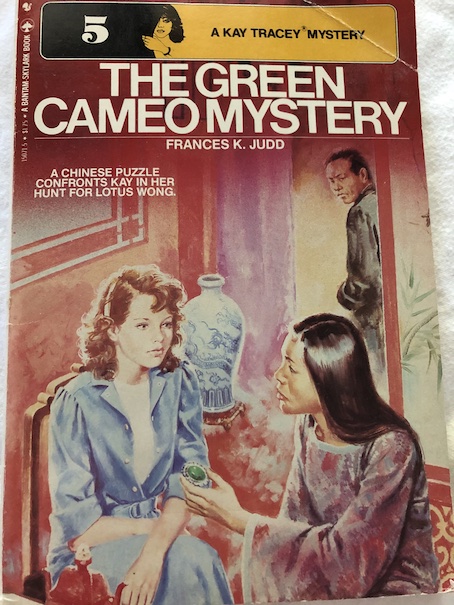
The Green Cameo Mystery by Frances K. Judd, 1952, 1980.
The story begins with Kay’s friends, Betty and Wendy, treating her to lunch, but when the girls try to pay the bill, the cashier says that their money is counterfeit. Betty and Wendy say that their mother gave them the cash, and she got those particular bills on a recent trip to San Francisco. The cashier tells them to contact the Secret Service and report the counterfeit money and tell them where it came from. (This book is old, but the Secret Service still investigates counterfeit money.)
As the girls leave the restaurant, they talk about the errands they want to run this afternoon. There is an auction Kay wants to attend because there’s a beautiful Chinese desk that she wants to get for her cousin, Bill, for his new office. However, she remembers that she needs to drop Bill’s shirt off at a laundry before they go to the auction. The laundry is a cliched Chinese laundry (connections are building in this story), but the man Kay usually sees there is absent today. The woman at the counter, Lily Wong, says that she’s the man’s sister and that her brother is unwell. Kay asks if he’s been to a doctor, and Mrs. Wong fearfully says that she doesn’t think that there’s anything a doctor could do against the green cameo. She explains that her husband got the green cameo in Shanghai, but it’s cursed, and it brings misfortune to her family every three years. While the girls are talking to the woman, she gets a phone call from someone who tells her that her daughter Lotus is now missing, having disappeared from the college she attends. (Yeah, Lotus. I don’t know if that’s a name that Chinese people actually use, but many of the Chinese names in this book struck me as being made up. I could be wrong because I’m not an expert on Chinese names, but they have that look.)
Mrs. Wong tells Kay that she tried to hire a medium named Cara Noma to break the curse of the green cameo, but she hasn’t been able to do it. Right away, Kay is sure that Cara Noma is a fraud. Kay volunteers to help find Lotus. A prime motive for her disappearance is Lotus’s impending arranged marriage to an older but wealthy businessman named Foochow. (I Googled that name, and apparently, it’s a romanized version of a place name, not a last name.) Kay’s first thought is that Lotus may have run away because she decided that she didn’t want to participate in this arranged marriage. Mrs. Wong also tells Kay that Cara Noma claims that her daughter has sold a jewel box with a green lotus cameo on the lid that Mr. Wong gave her as a betrothal gift.
The medium Cara Noma shows up while Kay is discussing the situation with Mrs. Wong and starts into her mystical act about how she’s going to break the curse. Kay impatiently tells her that it’s all nonsense and that she’s just taking poor Mrs. Wong’s money. Even Mrs. Wong agrees because, so far, Cara Noma hasn’t produced any results, and Kay is nice enough to offer to help her for free. Angrily, Cara Noma grabs both Kay and Mrs. Wong and uses some blood from a cut on Mrs. Wong’s finger to draw a red X on Kay’s forehead. She declares that she has transferred the curse of the green cameo to Kay and that Kay will soon see that the curse is real.
Kay still doesn’t think that the curse is real, and she and her friends head over to the auction where she wants to buy that desk for her cousin. Before the auction begins, Kay and her friends are looking over the items for sale when Kay discovers that the desk she wants to buy has a secret compartment in it. On impulse, she puts the envelope holding her money in the secret compartment to try it out. (This is so dumb, Kay. Don’t put all of your money in the secret compartment of a desk you don’t own!) Then, she gets distracted when she spots a jewelry box matching the one described by Mrs. Wong. Then, Kay’s nemesis from school, Chris Eaton, shows up and tells her not to waste her time bidding on the jewelry box because she wants and she has more money than Kay.
It turns out that Kay is unable to buy the desk she wanted to buy because the bidding is much higher than she can afford. Then, a man named Sidney Trexler shows up and protests the auction, saying that the desk belongs to him and he doesn’t want to sell it. It turns out that he’d been storing the desk there, but the desk was being sold because he hadn’t paid his storage fees. Mr. Trexler says that he has the money to pay his fees now and wants the desk back because he’s planning to get married and will need the furniture. The man who was going to buy the desk agrees to cancel his offer to buy so Mr. Trexler can have the desk back. When the jewelry box comes up for sale, both Kay and Chris Eaton are outbid by Mr. Trexler as well. Kay is disappointed because she was hoping to get the jewelry box for Mrs. Wong.
However, the mystery is only just beginning. When Kay gets home, she finds that the envelope she thought held her money isn’t really her envelope. She did remember to retrieve the envelope from the desk before it was sold (for a moment, I was afraid that she would forget), but by mistake, she grabbed a different envelope. Is this the first bad luck of the curse? Kay knows that she has to talk to either the auction house or Mr. Trexler to get her envelope and money back! Then, a taunting comment from Chris Eaton reveals that Mr. Trexler’s fiancee is actually Lotus Wong. Now, Kay really needs to find Mr. Trexler!
The book is available to borrow and read for free online through Internet Archive.
My Reaction and Spoilers
So, right from the beginning of this story we have the mystery of the counterfeit money, the mystery of the cameo curse, the mystery of the fake medium, the mystery of the disappearance of Lotus Wong, and the mystery of Mr. Trexler and his engagement and sudden money. The girls also come to wonder about Mr. Wong. He seems to have much more money than his brother-in-law who operates the laundry, and his wife seems afraid of him. What is Mr. Wong’s business, and why doesn’t he do more for his brother-in-law? Are any or all of these things connected? Actually, yes. At first, I wasn’t sure how they were going to circle back toward the counterfeit money from the beginning of the book, but it turns out that Cara Noma is in on the counterfeiting operation. For a time, it looks like Mr. Wong might be the head of the operation, but it turns out that he’s innocent. I thought that Lotus’s reasons for running away were poorly explained. Part of it is that she doesn’t want to marry Foochow, but there’s also a side plot about Cara Noma using hypnosis to control both Lotus and her mother. I think the implication is that she was doing it to milk Mrs. Wong of money while keeping Lotus hidden from her, but it seemed like an odd complication to me since Cara Noma was also involved in the counterfeiting ring.
I’m not sure that I’d call anything in the book “racist”, although I think there may be justification for saying that parts are “stereotypical” and probably a bit culturally shallow and “tone deaf.” My first impression was that the author and the characters in the story like Chinese culture for being exciting and exotic, but in that way where there’s no real depth to their knowledge it and it comes off as being a bit like caricatures of Chinese people you might see in old movies. I’ve seen some of the old Charlie Chan mystery movies, and the way the characters in the book talked kind of reminded me of them. The Chinese names seem pretty stereotypical and so does the way they speak in broken English. They don’t do the “Engrish” thing where the ‘l’s and ‘r’s are swapped, but the Chinese characters don’t speak proper English, and they throw in phrases and expressions that I think are meant to sound quaintly foreign. At one point, Mrs. Wong says to the girls, “When you see Lotus again, tell my lovely flower not study too hard. Much study make many wrinkles.” I’m not sure whether that was just a joke or if it was supposed to be some kind of pseudo-proverb, like Charlie Chan used to make. On the other hand, some of the speech patterns I thought might be old stereotypical tropes from movies might have more grounding in real life than I’ve credited them for having. Lily Wong also sometimes refers to herself in the third person, “Lily Wong not sure,” instead of “I am not sure.” I’ve met people in real life whose first language was Chinese, and none of them do this. I thought at first that this might be another trope carried over from old movies, but I looked it up, and apparently, actual Chinese speakers can do this sometimes. The technical name for it is illeism. So, while some of the speech patterns seem like old movie tropes, they might not be completely wrong for real life.
One part of the story that bothered me is the Chinese play that Kay’s school decides to perform. Kay and her friends are told that “a delegation of foreign visitors to the United States” (no nationality/nationalities specified at first) would be visiting schools in the area, including the high school that they attend. To entertain their foreign visitors, the school decides that they’re going to put on a short play, and of course, the drama teacher picks one with an “Oriental” theme called “The Pagoda Mystery.” (“Oriental” is the word they use, which is rather vague and considered somewhat outdated now. Some people consider it demeaning because it has old associations with stereotypes that people don’t want to perpetuate. The demeaning part seems to be more in the attitudes associated with its use than in the word itself. It is a technical geographic term that refers to the Eastern Hemisphere, but my thought is that referring to an entire hemisphere is rather vague. I don’t think the book meant it badly, but in modern times, it’s generally considered more polite and a sign of being well-educated to use the most specific word possible when describing geographic regions or groups of people. When people are overly vague, it makes it sound like they don’t know what they’re talking about or what the more specific word is. If this play is specifically about China, they could have just said that.) It’s rather coincidental that they’re doing a mystery play set in China right when Kay is working on a mystery involving people from China, but those types of coincidences happen often in Kay Tracey books. I wasn’t able to find any real information about this play, so I’m pretty sure sure that it was just made up by the author of the book so the school would have just the right kind of coincidental play to perform. Also, of course, Kay gets the lead role in the play when she tries out for it, that of a beautiful Chinese maiden. If there are any Asian students at this school, they aren’t mentioned, so I don’t think there are any. Charlie Chan was also not played by Asian actors, even though other characters in the series were, which is why they bother people now and there haven’t been any new ones made since 1981. The book says, “But because of her recent experiences at the Wong home, Kay spoke her lines with special feeling and proved her familiarity with Chinese customs and people. Therefore, the leading role was given to her.” I’m not convinced that her conversations with Mrs. Wong have really given her deep knowledge of China, but they did have tea together at her house, so maybe there’s an implication that she told her more about Chinese tea customs than the book described or something.
By another coincidence, it turns out that Mrs. Wong was in a production of the same exact play in China when she was young, and she played the part that Kay is going to play, so she coaches Kay in how to play the part. (What stroke of luck! See, Kay isn’t cursed!) Mrs. Wong assures Kay that when her face is made up to look Chinese, no one will know that she isn’t really Chinese because she’s such a good actress. I suppose that people in the 1950s, when this book was originally written, would be a little more accepting of non-Asians wearing makeup to play Asians (called “yellowface“) just because it was done more often back then, and people get comfortable with things they see often. It’s not particularly comfortable for modern people because our society is sufficiently diverse to have actual Asians playing Asian roles without the help of cheesy makeup, so this part of the story is eye-rolling, especially the way everyone fawns over Kay being so authentic-seeming. Also, much of what Mrs. Wong teaches Kay seems to involve making gestures with her hands and fluttering her eyelashes when she speaks, which the drama teacher praises as being very realistically Chinese. It’s hard to know exactly what that means without seeing exactly what Kay’s doing, and the description doesn’t say much. The fluttering eyelashes make me think that she’s acting flirty, but I don’t know if that’s suppose to be part of her role in the play or not because we’re never told the full story. Again, I could be wrong, but it Kay’s apparently authentic performance seems more like something from an old movie than real life.
I think that the drama coach choosing a play from China was meant to be some kind of salute to the foreign visitors (and a coincidence that helps further the plot of Kay’s mystery), but it seems like a kind of tone-deaf choice to me, not thinking about what people really want to see and experience when they visit a foreign country. If I were the person making the decisions, I don’t think that I would be comfortable with showing visiting foreign dignitaries a high school production of a play they would already know from their own youths in their country, entirely acted by people wearing makeup to look like them, probably with varying degrees of success. It just seems awkward and might give the impression that they were being made mocked rather than honored. People travel to see new and different things, not imitations of things they already have back home. That would be like someone from New York City going to New Orleans and spending their entire time there watching productions of Broadway plays instead of touring the French Quarter or the Garden District. If you’re just going to do something you could do back home, what did you even make the trip for? Traveling is about seeing things that make different places unique. So, if I were in charge of the high school play, I think I would have picked something that had nothing to do with China, something new and original that the visitors could describe to people back home as something you could only see if you go to America. It might be an American-written play or maybe something that the students put together themselves to show their individual personalities and interests, a view of the modern American teenager, like a collection of student-written short skits or a talent show. Musical performances would be good because people can still enjoy the sounds of the music even if they don’t know all of the words. It’s pretty likely that this school has a band or orchestra, and there may be some unofficial student bands that could play. Dancing, gymnastics, and juggling acts might be good, too, if there are people who know how to do those, because people understand what they are just by looking at them. They don’t require explanations like humor that involves puns and might go over the heads of people who aren’t completely fluent in a language. I like the idea of the entertainment being a sort of variety show with music and skits because that’s a traditional form of entertainment that was still popular in the 1950s, and it’s a good format when you have a large group of people because there are multiple leading parts and solos in different acts of the show, avoiding some of the inevitable arguments about who gets the best parts. They could even have displays of artwork or science projects from students who aren’t part of the performing entertainment. It would offer variety for the visitors and give everyone a chance to contribute something.
Of course, there’s a subplot to the story about Chris Eaton, Kay’s school nemesis, trying to steal her part in the play. Chris even goes so far as to drug Kay’s food so she’ll miss the performance. First of all, I’d never be as trusting as Kay, and I wouldn’t eat anything that someone who has a history of doing nasty things gave me. If Kay’s so sharp, she should have figured that Chris would do something nasty to her food. Second, drugging somebody isn’t a harmless prank. Chris apparently slipped Kay a strong sleeping pill, and Kay didn’t even finish everything Chris gave her. We don’t know whether Chris might have accidentally overdosed Kay if she’d eaten it all. People can die from drug overdoses. Chris also couldn’t know for sure whether or not Kay might have been taking some other medication at the time that would conflict with what she gave her. People can also die from mixing the wrong medications. For some reason, Kay and her friends don’t tell on Chris, and Chris isn’t punished. I understand that people don’t like to be thought of as tattletales, but I think that there are limits to what people should be willing to put up with, and being drugged should definitely something no one should tolerate. What she did was serious, and I don’t like it that they’re pretending like it isn’t.
Overall, I found myself often thinking of the old Charlie Chan movies while reading this book, comparing what I was reading to what I’ve seen in old movies. There are reasons why the Charlie Chan movies didn’t last, and I think this book is a decent example of some of those reasons. During their heyday, the Charlie Chan books and movies were welcomed as one of the first portrayals of an Asian hero in American culture who was kind, intelligent, and upheld justice. Even though Charlie Chan was a stereotypical character, he was a stereotype of all that was good, which was a welcome break from previous stereotypes of Asians as devious, evil characters, like the fictional villain Fu Manchu. Charlie Chan was one of the first fictional characters to encourage the American public to see Asian people in a friendly light and even as people to be admired. The Charlie Chan series encouraged a positive interest in Chinese people and culture, even though it was also somewhat shallow and stereotypical. As I said, the actors who portrayed Charlie Chan in movies were not Asian themselves. Hollywood back in the day couldn’t bring itself to put an Asian in the leading role. Culturally speaking, it’s probably best to look at that series as a stepping stone to better things. Once people have been introduced to a concept, we expect them to eventually gain more depth and understanding. Charlie Chan helped people to break away from old, toxic ideas and prejudices, but that doesn’t mean that people should stay at that level of cultural understanding and portrayals. People progress. They grow and learn, and so do societies and cultures.
What I’m saying is that nothing in this story related to China or Chinese culture is educational for children. They won’t learn anything from this book, and most of the books that I read as a child specifically included real facts about other countries and culture to be at least factually-correct or semi-educational. This book doesn’t even define the word “pagoda” for anyone who doesn’t already know it. There are no Chinese words in the story, and when Kay and her friends have tea with Mrs. Wong, they don’t say whether there are any special tea customs they observe. What the book tells you about Chinese people is very general – that they have some interesting antique furniture and art objects, they drink tea, they might be superstitious, not all of them speak good English, some are friendly and helpful while others are sinister criminals, and if you want to act like one on stage, hand gestures and fluttering eyes are pretty important (whatever that means). Some of that stuff is true, particularly the parts about tea, the fascinating antiques, and the fact that some can be good and some bad, like human beings in general. But, there’s not much concrete, factual knowledge here, and some parts might give kids the wrong impression. I had the feeling the whole time I was reading it that the person who wrote it was a fan of old movies and didn’t really know much about Chinese culture to tell anybody in a factual, educational way. The old Scooby-Doo cartoons were kind of like this when they talked about other countries and cultures, too, because many of them were written as kind of spoofs on movies that people would have known when they were first made. If you’re into old movies, you can recognize the references, but they weren’t meant to teach anything or include any real information. If you compare the older Scooby-Doo series to the more modern ones, you’ll notice that some of the modern ones make more of an effort to include some real, educational facts. Scooby-Doo isn’t an educational show, but I have noticed a slight shift in how they talk about other countries and cultures. That’s more the standard of children’s literature and entertainment I’m accustomed to – when someone says something about another country or culture, I expect it to be something factual that shows that the author did at least a little basic research and knows something about what they’re talking about. It’s grating to me sometimes that older, vintage children’s series don’t always do this. Some of them even shamelessly make things up about other countries and cultures just because they think it would make the story more exciting, assuming that the kids reading the books won’t notice or care. If this book sparked an interest and encouraged kids to learn more about China or Chinese culture, it’s not too bad, but by itself, it doesn’t demonstrate any helpful level of cultural knowledge and information.
Jenny Blair is a gloomy gus who often gets premonitions of impending doom, much to the annoyance of her siblings. They poke fun at her pessimism, but some of those premonitions start to come true when her youngest brother falls ill on a family vacation to the beach and needs to be taken to the hospital.
Jenny and her twin brother, Chris, accompany their older teenage brother and sister as they start the long drive home while their parents tend to their younger brother at the hospital. On the way home, the kids accidentally become stranded during a storm and seek out help from a large old house that they had mistaken for a hotel. With a fallen tree blocking the road, the inhabitants of the house reluctantly agree to take them in until they can continue their trip home, but all of the kids can tell that there is something sinister about their hosts. Miss Cliff makes it obvious that she resents the children’s presence, and Dr. Cliff is a peculiar kind of scientist working on . . . something . . . in the basement.
They tell the kids that the house is supposed to be haunted and people can often hear the ghost of Andrea Cliff calling out in the night. The kids soon hear this spooky voice themselves, calling for help. Trapped in the house with the ghost and unfriendly people, the Blairs decide that they have to figure out what’s really going on, but the danger is worse than they know, and Jenny’s premonition of doom is getting stronger all the time . .
The book is available to borrow and read for free online through Internet Archive, but the version there does not have pictures.
My Reaction:
This creepy little book has been a favorite of mine for years!
Young people trapped in a spooky old house with a ghost story during a storm is a common trope of spooky stories, but this one is a particular favorite because of the way it’s done. I like the implication that Dr. Cliff might be some kind of mad scientist. Mad scientists appear in other books in children’s literature, but it’s an element that provides a nice twist on the ghost story and allows readers to wonder whether Dr. Cliff or the ghost might be the bigger threat.
The ghost story and the mysterious voice the kids hear is also well done, and they confront the problem very practically. For those who like the Scooby-Doo style of mystery, where the “ghosts” turn out to be people, and there’s an explanation for everything . . . you’ll love this story. Not all copies of the book have pictures, but my book contains a few black and white illustrations. The one I used in my review is the scene where the kids hear the ghost’s voice for the first time.
There is one final twist at the end of the story that readers might see coming if they pay close attention to the story. There’s even a clue to this twist that is shown in pictures if you have a copy with pictures, but I’m not going to spoil it here.



 The Ghost that Came Alive by Vic Crume, 1975.
 They tell the kids that the house is supposed to be haunted and people can often hear the ghost of Andrea Cliff calling out in the night. The kids soon hear this spooky voice themselves, calling for help. Trapped in the house with the ghost and unfriendly people, the Blairs decide that they have to figure out what’s really going on, but the danger is worse than they know, and Jenny’s premonition of doom is getting stronger all the time . .
  Jestress's Forgotten Books and Stories