The Railway Children

Railway Children Cover

The Railway Children by E. Nesbit, 1906.

Railway Children toy train explodes

Three children in England live a comfortable and happy life with their parents. Roberta is the eldest, followed by Peter and Phyllis, the youngest. Their family has servants, their mother enjoys helping the children with their lessons and making up stories for them, and their father is clever at fixing broken toys. When Peter turns 10 years old, he is given an electric toy train (a relatively recent innovation for their time and the type of toy only a wealthy family could afford), which is a wonderful present because Peter wants to become a mechanical engineer. However, something goes wrong with the toy train, and it explodes at his birthday party! When Peter’s father comes home, he looks at the toy train and says that he thinks he can fix it, but before he can say much more, some strange men come to the house and want to talk to him. They spend a long time talking while the children’s mother takes the children upstairs. Then, their mother goes downstairs to see their father. When she returns, she seems very upset, but she doesn’t want to discuss it with the children. She only says that their father has been called away and that the children should go to bed.

The next day, their mother is gone for a long time, and the children are worried about what is happening with their parents. Their mother finally returns in the evening, tired and still upset. She tells the children that the men who came the night before brought very bad news and that their father will be away for some time, so she is going to need them to help her. She says that there will be times when she will have to be away for long periods and that she wants them to behave themselves and not fight while she’s gone. She doesn’t want to tell the children what the problem is or for them to ask her or anyone else any questions about it. She only says it’s about their father’s business and none of them really understand their father’s business. They know that their father works in a government office, so his business has something to do with the government, but their mother doesn’t want to say more than that.

Over the next several weeks, their mother is gone for long periods, leaving the children with the servants and with an older aunt who will soon be taking up a position as a governess for another family overseas. The children don’t get along with their strict aunt. The servants are usually more pleasant, but the children have the uncomfortable feeling that the servants know more about their father’s situation than they do. One day, in spite of his promise to behave himself for their mother’s sake, Peter plays a prank on the parlor maid, and the parlor maid angrily tells him that if he doesn’t fix his behavior he’ll go where his father has gone. The children don’t know what she’s talking about, and when they ask their mother, she dismisses the parlor maid. She wasn’t going to keep the parlor maid much longer anyway because she tells the children that they’re going to move to the country.

When they move, they can’t take everything from their house with them because the house in the country is smaller, and their mother says that they have to take the most useful things, leaving many of their prettier things behind. She tells the children that they’re going to have to “play at being Poor.” Readers will understand that they’re not just playing, but the children’s mother tries to frame their move as a great adventure rather than the misfortune it really is. For the children, it is a kind of adventure.

They take a train to the countryside, but when they arrive, they have to walk from the trains station to their new little house because there are no cabs there. A man brings their luggage in a cart. When they arrive at the house, which is called Three Chimneys, it is night, and the woman the mother hired to clean up the house and make supper for them is gone. The man with the cart says that she probably left because their train was late and that she probably left the house key for them under the door step, as people in the countryside tend to do. The key is there, but they discover that the woman hasn’t really done any cleaning for them, and she didn’t make supper. Fortunately, they do have some provisions, packed by the strict but thoughtful aunt, so they are able to put together a small meal for themselves.

Railway Children falling asleep outside

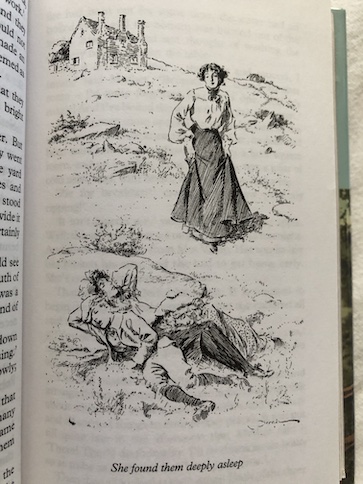
In the morning, Roberta wakes Phyllis and points out that they have no servants in this new house, so they had better get up and make themselves useful. They get things together as best they can for breakfast, although they don’t really know what they’re doing or where everything is. They start the kettle going too soon, burn the kettle, and let the fire go out. The children explore the house’s yard and garden. They can see the train tracks and a tunnel down the hill from the house, and they fall asleep outside because they got up too early. When their mother wakes up, she gets everything ready, fixing their clumsy efforts, and finds a note from Mrs. Viney, the cleaning woman. In her note, Mrs. Viney apologizes for not having everything ready for them the night before because there was a family emergency. She had to leave early because her son-in-law broke his arm, but she promises to be there later that morning to help them.

Life in the country is very different from life in their old home. Their mother now tells them that they are really poor. It’s summer, and the children are not going to school, and their mother spends most of her time writing because she wants to sell stories for money. The children still don’t know where their father is, and it still worries them, but they gradually get used to their new life and to not asking questions about their father. Deep down, Roberta knows that something terrible has happened and that their mother is very upset about it, but because her mother seems like she would be even more upset if the children knew the full truth or just how upset she is, Roberta makes a deliberate decision not to notice anything that her mother doesn’t want her to notice. Whenever it seems like her mother has been upset or crying or whenever there’s been any hint about her father, Roberta deliberately looks away and pretends that she didn’t see anything. She tries to keep cheerful and enjoy this “adventure” that they’re living.

The children develop a fascination for the trains that run by their house, and they go to have another look at the train station. They are not accustomed to being at train stations just to observe them, only to either catch trains or arrive on trains. They are fascinated to notice the details of the station and the train signals. They notice a white mark where the coal is stored, and Peter asks the porter what the mark is for. The porter tells him it’s to mark the level of the coal so they can tell if someone has taken some, giving them a friendly warning not to steal any.

The children’s new poverty doesn’t mean much to them at first because they still have plenty to eat, but when there’s a wet and chilly morning and Peter wants to light a fire, their mother tells him that they can’t afford to light fires in June and that they must save their coal for when it’s really cold. There are other little economies that the family must make. The mother tells the children that they can have either butter or jam on bread, but not both at the same time. If they eat too much at once, they’ll run out before they can afford more.

Railway Children station master

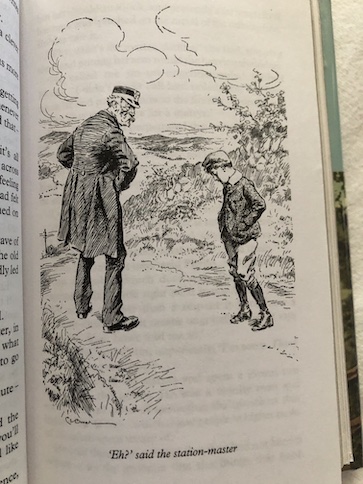
These small things that they can no longer afford give Peter an idea. He decides to stage a daring raid on the coal at the train station for the sake of their family. Although he knows that it isn’t really right, he doesn’t think of it as stealing but more like coal mining because he digs through the coal pile for the pieces underneath, which he figures they won’t miss. However, the station master catches him and insists that he and his sisters come into the train station and explain themselves. Peter explains how his family used to be able to afford fires on wet and cold days, but now they can’t because they’re poor. The station master becomes a little more sympathetic, but he gives the children a lecture about taking things that don’t belong to them. It’s still stealing, even if they think of it by another name. He lets the children keep what they’ve taken so far and lets them go with a warning not to do it again. Peter is horribly embarrassed by the incident, and he is uneasy for a while whenever he sees the station master, but the station master eventually lets him know that he is forgiven and gives them permission to visit the train station again.

The children enjoy visiting the train station and asking the friendly porter questions about the trains and how they work. The porter, whose name is Perks, likes chatting with them and answering their questions. The children watch the trains so much that they begin to recognize that each train is distinctive in its appearance. The trains no longer look all the same to them, and they start giving them nicknames, like the Green Dragon, because it’s pulled by a green engine. When Peter notices that individual trains have numbers written on them, Perks introduces him to the hobby of train-spotting, where people write down the numbers of trains that they’ve seen in a little notebook. (He doesn’t call it by that name, but that’s what he describes.)

The children become especially fond of the train they call the Green Dragon. Every day, they wave to this train, imagining that it’s a magical dragon that will carry their love to their father, wherever he is. Every day, a pleasant-looking older man who rides that train sees them and waves back to them. They begin to think of the man as a friend, waving to him and imagining that he’s also going somewhere to work on “business”, possibly with their father.

Railway Children Phyllis with note

Their new train friend turns out to be very important. When their mother becomes ill with a serious case of influenza, the doctor gives them a list of things they should get for her, most of which they just can’t afford. The children are willing to make do with a diet of bread and water to get her some of the things she needs, but even doing that won’t get her everything she should have. Then, the children come up with a desperate plan. They use a sheet to make a sign to tell the old man on the Green Dragon to look out at the station. When the train comes through the next time, everyone on that side of the train sees the sign, and they all look out at the station, confused because they don’t see anything unusual. It’s just Phyllis at the station, and she slips a note to the old man, explaining their situation and asking if he could get the things they need for their sick mother. The children promise that their father will pay him back or, if he’s lost all his money (as the children are starting to suppose is the case), Peter will pay him back when he’s a man. The nice older man is amused and touched by the message, and he sends them a package with all the things they asked for, plus a few more that he thought of himself. In the note accompanying the package, he says that they should tell their mother only that a friend who heard she was ill sent these things, although they should tell her the full story when she’s feeling well enough to hear it. The old man says that he knows their mother probably won’t be happy that they asked a stranger for help, especially not without asking her first, but he says that he thinks the children did the right thing.

The old man is right about their mother’s feelings. When their mother is well and realizes what the children did, she is angry, and she starts to cry. She says that, while they’re poor, they’re not destitute, and they shouldn’t go around asking strangers for things. Part of that is personal pride and shame at their family’s reduced circumstances. She still can’t bring herself to talk about what really happened to the children’s father and why they’re so poor now. However, they do come to rely on help from strangers and new friends, and they learn that people will help others if they’re asked. Even when they’re not rich themselves and could use some extra money, some people, like the local doctor, still let them them have services at reduced rates and take some pride in their ability to help someone who needs it and who appreciates the help.

Railway Children train engineers

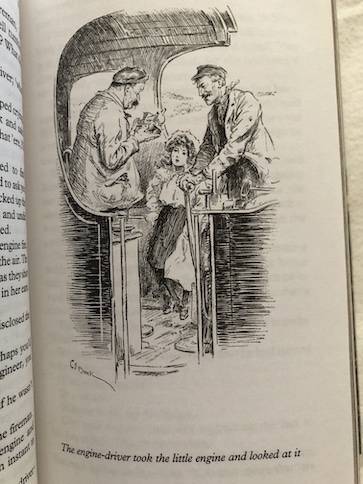
When Roberta decides to get help to fix Peter’s broken toy train, she accidentally hitches a ride on a train engine because she thinks that the train engineers know how to fix trains. The book explains that there are different types of engineers, from people who build engines to people who drive train engines and people who build things like bridges. Not all engineers do the same things, and the people who drive the engines don’t repair them. Fortunately, one of the train engineers has a relative who can fix things. Touched at the young girl’s request for help fixing her brother’s toy, he arranges for his relative to fix it.

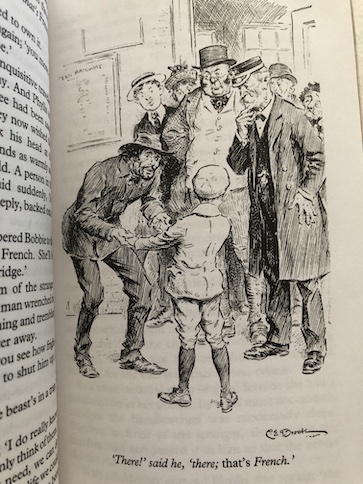
The family also comes to experience what it’s like to help someone else who’s less fortunate when a man gets off at their train station, obviously ill and speaking a language that nobody understands or even recognizes. The only language the children have studied in school is French, so they decide to ask him if he speaks any French, even though they can tell that’s not the language he’s speaking. It turns out that the man does also speak French. Their mother speaks better French than the children do, and when she speaks to the man, she recognizes who he is. He is an author from Russia. He wrote a book about the plight of poor people and how to help them, which the mother has read and really appreciates. However, this book put him on the wrong side of the ruling class in Russia, and he spent time in jail as a political prisoner. He was later exiled to Siberia and put in a forced labor camp. The mother is surprisingly frank about the conditions in the camp and the forced marches where prisoners were whipped and left to die if they couldn’t go on. Since this man was able to get away, he has come to England in search of his wife and child. He heard that they had fled to England after his arrest, but he doesn’t know exactly where they are in England. At the train station, he was trying to explain that he was ill and that he lost his train ticket. The family lets him stay with them for a time while he recovers his health.

Railway Children flags

The children become heroes to the railroad when they witness a landslide that blocks the tracks and use the girls’ red flannel petticoats to make warning flags to stop the train. The children averted a terrible accident, and they are publicly thanked and given gold watches as a reward. The old gentleman from the Green Dragon is there, and the children learn that he is a railway director. They write him another note, asking if they can talk to him about an unfortunate prisoner.

The old gentleman meets with the children at their train station the next time his train comes through, and the children tell him about the Russian author, who is still looking for his missing family. The children say that the gold watches are a wonderful reward, but they’re willing to sell them or trade them back to the old gentleman in exchange for help locating the author’s wife and children. The old gentleman recognizes the author’s name and says that he has also read his book. The old gentleman knows some people in the Russian community in London, and since the author is a famous man, people in the Russian community are likely to know where his wife is currently living. He’s happy that the children’s mother is helping the author, and he says he will be glad to make some inquiries on his behalf. The old gentleman also asks the children for more information about themselves. He soon follows through on his promise to help the author, bringing the man’s wife and child to him.

Much of the book is about giving and the ways people help each other. When the children arrange a birthday surprise for Perks, he gets angry at first because he thinks they’re giving him charity. He changes his mind when the children tell him how they collected the birthday presents from various people in the community because they wanted to show him how much they all appreciate him and help that he’s given them in the past. His wife says that he’s been ungrateful for rejecting the presents, but Perks says that it’s not just about being given things but how and why they’re being given. If people gave him things because they thought that he couldn’t afford them or couldn’t work for them, it would have been an insult because he works very hard. If they’re given out of friendship and returned favors, it’s different.

Railway Children Bobbie learns the secret

In the background of the story, there is always the question of what happened to the children’s father and why they had to leave their old home. At one point, their mother worries about why the children have stopped talking about their father and is afraid that the children are forgetting about him. Roberta admits that they talk about him when their mother can’t hear them because she can tell that their mother is sad whenever they mention him around her. Their mother admits that’s true, and she still doesn’t want to tell them the full reason why, only that something bad did happen, and it will be a while before their father can be with them again. The reason for the father’s disappearance adds an element of mystery to the story, although most of the book focuses on the children’s adventures in the countryside. There are clues along the way, from the men who came to get their father to the clothes that Roberta discovers that her mother is keeping for him. There is her mother’s reluctance to be sociable with other people and the way she talks when she describes how awful it is to be in prison, away from your family, and the reasons why a person might be arrested, which aren’t quite the same in England as the reason why the Russian author went to prison. These are the things that Roberta tries to ignore … until she finds something that starkly tells her what all of the adults already know. When Roberta understands the real problem, she can only think of one person who might be able to help: the kind old gentleman who helped them before.

The book is now public domain, so it is available to read online through Project Gutenberg and Internet Archive (multiple copies). There is also a LibriVox Audiobook on YouTube. It’s been made into a movie multiple times, and you can see the 2000 version online through Amazon Prime. It fits well with the cottagecore aesthetic! There is also a sequel movie, not based on an E. Nesbit book, which takes place during WWII, when the children in this story are adults and other children are evacuated to the countryside from London.

My Reaction and Spoilers

The Children’s Father

There are clues all the way through the story to what happened to the children’s father. He was framed for being a spy and a traitor in relation to his work with the government, although he didn’t do was he was accused of doing. People thought he was a traitor because there were letters found in his office that incriminated him, placed there by some unknown person, and these letters convinced the jury at his trial that he was guilty. The trial was conducted during those weeks when the children were at their old home with their aunt and were being told not to ask any questions. They left for the country after he was sentenced to prison. Their mother turns to writing, something that she already enjoyed, to earn money to support herself and the children, and she doesn’t want to see much of anyone because she doesn’t want to face their questions about her husband.

Railway Children the old gentleman

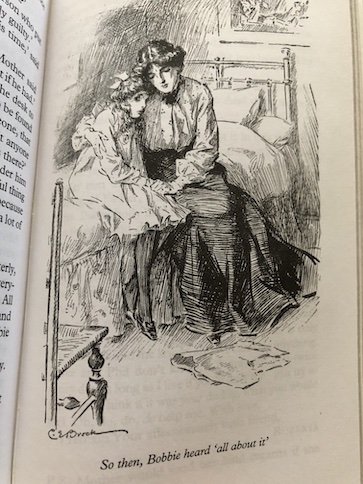
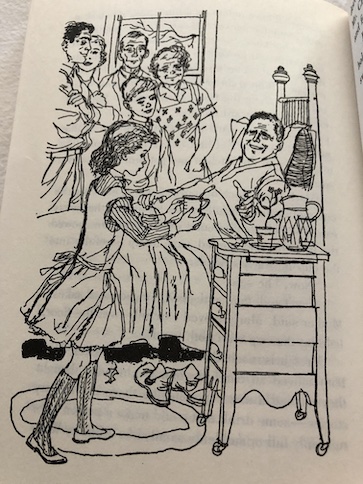
Roberta learns the truth about her father when Perks gives her some old papers with pictures in them to amuse Peter after he is injured by a rake the children were fighting over. The newspaper that is wrapped around the bundle has an article about her father. Roberta reads the article and then asks her mother for the full story. Roberta understands why her mother didn’t want to tell the children what happened because she also can’t bring herself to tell Peter and Phyllis what she now knows, but Roberta still wants to understand the situation herself, now that she knows about it. Her mother tells her that her father suspects that the real traitor and the person who framed him is the man who took his job when he went to prison, but he can’t prove it, and nobody believes him. Although her mother has told her not to ask people for things, the situation is dire, and Roberta can’t let her father stay in prison for a crime he didn’t commit, so she asks the kind old gentleman if he can make some inquiries into the situation on behalf of her father. She just can’t keep the matter to herself, and he’s the only person she knows who seems to have some authority and connections and might be able to do something. The old gentleman is happy to help, especially after the children help his grandson when he is injured.

In the end, the real villain is discovered, and the father is released from prison, but the readers and the children don’t see exactly how that happens because the old gentleman seems to take care of it in London, away from the children and their mother. The book ends with the father arriving at Three Chimneys, so the family is happily reunited, but we also don’t see what their lives are going to be like after that point. They no longer have their old home, and I find it difficult to believe that the father would want to return to his old job, like nothing had happened. If all of your co-workers believed that you were some kind of traitorous spy and seemed to like the guy who framed you, returning to that office would be far too awkward. It’s a life-altering event that might have potentially been life-destroying, not just a small misunderstanding. In the end, it seems like the family will be okay. The family has a wealthy supporter now, so the old gentleman might be able to help the father find a new job. The family has also come to enjoy living in the country and has some friends there, and the mother indicates that she wants to continue her writing, so they might not move somewhere else, at least not right away. It will take the family some time to sort out what they’re going to do, rebuild their family finances, and move on from this incident. We just don’t get to see all of that happening as readers. The book ends on the happy note that things are being set right, and the family is reunited.

The Meaning of Charity and Helping Others

I’d like to point out that there is a theme of rich people coming to the rescue of deserving poor people in many books from the 19th century and early 20th century, like in this book and The Five Little Peppers. People in these stories take pride in being self-sufficient and doing their best on their own, but in the end, it’s the recognition of their worthiness from someone with money and authority who is willing to supply support them that really makes a difference in their lives and saves the day. I’ve thought sometimes that the rich-person-to-the-rescue theme seems to contradict the do-it-all-yourself attitudes that the characters in these stories often have, but I think the key to understanding it is in what Perks says about his birthday surprises – it matters how and why gifts are given.

The same gift or act of kindness can take on different meanings, depending on the motives and attitudes of the giver. Perks would have been insulted if people gave him charity because, to him, it would be like people telling him that he was incompetent at getting things for himself and his family, which isn’t true. However, the same gifts take on different meanings when they’re meant as a salute to his friendship and helpfulness to others because he can tell himself that he did things to earn them. The children in this story earn the help they get from the kind old gentleman (who is never named in the story) and others in the community through their acts of kindness and heroism to the community, so they are demonstrating their usefulness and competence instead of asking for things they haven’t earned and don’t deserve. They can take pride in their competence and good deeds, so they’re not mere “charity” cases, who take without giving. At least, I think these are the implications of stories like this. I get the concept about personal pride, but I don’t feel the same way about it because I think there are more important priorities.

Railway Children Perks' birthday

Personally, I don’t have negative associations with the concept of “charity”, either giving or receiving. I’m more like Perks’s wife, who’s just grateful that somebody cares and that people think of them and are willing to give. I appreciate when things are getting accomplished, people are being helped, and objects are being put to good use by people who will actually use them. In situations like that, I’m more oriented toward the results than concerned about image. (My personal image has always been that of an oddball eccentric anyway. A basically pleasant and helpful oddball, but still an oddball. I like to maintain a certain level of eccentricity because I’ve discovered that there’s a kind of freedom in that. It’s like choosing to be a character actor instead of a teen heartthrob. Nobody can be a teen heartthrob forever, but being a character lasts a lifetime, and the ways you can do it are almost endless.) I have no objection to people giving me things I need or helping me accomplish things I want to do, and I’ve done the same for other people. It’s just life to me, and I think it’s best to focus on the good being accomplished and get on with doing things. (By the way, if you enjoy my nostalgic children’s book blog, please consider buying me a coffee to support the site! Proceeds will help support my book addiction, site maintenance, and future reviews and would be greatly appreciated.)

I’ve worked for nonprofits before, and people who work for nonprofits are there to do good and get the job done. They see needs in their communities, and they want to step in and supply them. There are people who make their lives and careers around making positive change. I certainly wouldn’t want people trying to stop those who are trying to do something good for others just because they have a negative attitude and no plan or effort for accomplishing positive change themselves. Of course, when you have a nonprofit or work for one, people come to you for things they need or to support your cause. They come to you because they’re in the mindset for making positive changes to their own lives or in the community, and that can also play into the concept of how giving is done. If someone just isn’t in the mindset of accepting help or gifts or making positive changes, there isn’t much to be done about it until they are in the mindset to do something.

Railway Children the Russian author

I think this book actually does a good job of presenting that concept. The mother’s and Perks’s sense of pride and attitude toward the concept of charity contrast with the old gentleman, who seems willing to just go ahead and get the job accomplished when he sees what people need or what they’re trying to do. Both Perks and the mother seem to feel a blow to their pride when someone helps them or gives them something, yet both of them are happy to offer help to others who need it. Being the one offering something rather than receiving it seems to make them feel like they’re in a position of strength and competence. The mother takes in both the ill Russian author and the old gentleman’s injured grandson, not seeing those as insulting acts of charity. It’s when she’s both poor and ill herself and doesn’t feel strong or competent that receiving help from someone seems to remind her that she’s vulnerable. I think that’s the feeling that gives her a negative attitude toward charity – perhaps not that she’s fine without help but the thought that she’s in a position to need some help is scary. While she’s sick and has a high fever, Roberta tends to her through the night, and she hears her mother calling out for her own mother. It’s a moment of revelation to Roberta that, no matter how old a person gets, they still have moments of vulnerability, when they need someone else to comfort and help them, like a mother would. It can be a bit humbling to go through those vulnerable moments and have someone see you being vulnerable, but it’s human. The revelation that mothers are also humans who sometimes need other adults doesn’t make Roberta love or respect her mother any less. In fact, it makes her appreciate her mother more for what she goes through for her family and makes her more determined to be helpful and supportive to her mother.

Railway Children Perks

I think Perks experiences a similar a similar attitude to the children’s mother. There are hints that he’s had a rough life himself and has worked hard for the level of stability he has now. When the children try to give Perks money for carrying the old gentleman’s gift to their mother to the house, he gruffly refuses it because he doesn’t want to take money for helping their sick mother. His refusal of their money for his service could be seen as an act of charity to them, but it’s framed more that he’s doing a personal favor or like Perks thinks that the children are offering him a kind of charity by trying to pay him for a service he is willing to provide for free. He also helps other people in the community, and helping others makes him feel strong and competent. Receiving something from others makes him feel like there’s something wrong with him or his life or like other people think there is. Perhaps it reminds him of hard times in his youth. It really seems like it’s only the attitudes of the giver and the receiver that determines what forms of giving are acceptable, and it’s bit subjective. The old gentleman understands that when he writes the note to the children that he sends with his gift to their mother, but he also says that he thinks they did the right thing. Maybe there are some kinds of giving or asking for help that are objectively good or right for reasons other than people’s opinions.

This is a good time to point out that the author of this story, E. (Edith) Nesbit, believed in socialism, although she wasn’t a radical on the subject. I think that’s why she examines the subject of helping others and receiving help from the point of view of people from different classes in society in this story. All of the adults in the story take some pride in their positions in society and in maintaining the appearances associated with those position. Victorian society was very class-based, but the family’s poor circumstances take them out of their usual class and changes the situation for them and others. The children and their mother sometimes really do need the help of other people, whether they like it or not, but they still have the capacity to help others in different ways. One of the themes in the story seems to be that everyone needs something from other people at some times. There are times when what they need might be help and support from others, and there are times when it might be a chance to show that they have the capacity to help others or appreciation for help they’ve already given.

This story raises many questions about giving which don’t have firm answers and can be viewed from different perspectives. Are all of the various forms of giving and receiving only different forms of charity, or are they just the interactions of human beings who all care about each other? Are people’s intentions or the image of giving really what’s important, or is it the giving itself? It may be better to give than to receive, but without someone willing to receive, what is the point of the act of giving?

For another early 20th century book that considers the differences between different classes of people and the meaning and benefits of charity, I recommend Daddy-Long-Legs, which is about an orphan whose college education is funded by a mysterious benefactor. That book is set in upstate New York, and it falls under the Light Academia aesthetic.

Fun Stuff

I always like seeing old books and historical books with scenes where people are playing games because I made a website about Historical Games. In this book, the children play a game that resembles Dumb Crambo (which was a precursor to modern Charades) called the Advertisement Game. In the Advertisement Game, the children act out characters they’ve seen in advertisements for each other to guess. There is also a scene with some boys from a nearby boarding school having a Paper Chase, which is a cross-country outdoor game. One player is the Hare, and he leaves a trail of bits of paper for other players to follow as the Hounds.

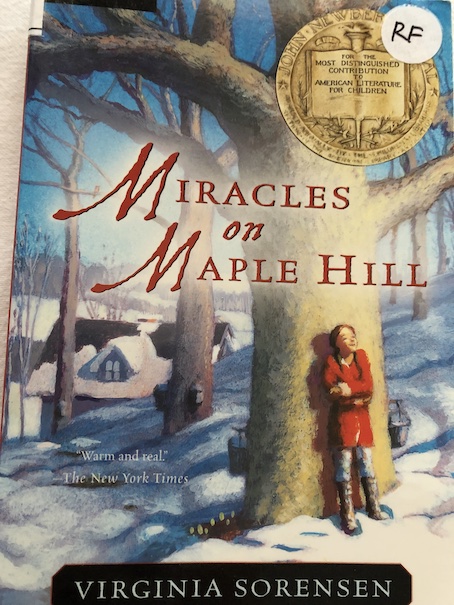
Miracles On Maple Hill

Miracles On Maple Hill by Virginia Sorensen, 1956.

Ten-year-old Marly and her family are moving from Pittsburgh to the countryside, to Marly’s mother’s grandmother’s old house on Maple Hill. They’re making the move for Marly’s father’s sake. Marly’s father was a soldier and prisoner of war, and everyone says he was lucky to return home from the war. (The book doesn’t specify which war, and no date is given for the story, but the book was written during the 1950s. If it was set slightly earlier than the time of writing, it could be WWII, and if it’s in the 1950s, it would be the Korean War. Not giving the story a date gives it a timeless feel.) Since then, he has suffered from the stress of his experiences. He is frequently tired and irritable. He is easily startled by loud noises, even a door slamming, and he finds arguments between Marly and her older brother Joe too much to handle. On Christmas, he can’t even bring himself to get out of bed to celebrate with his family. (He is suffering from shell shock or PTSD, although the characters in the book don’t use those terms. Mostly, they just describe the symptoms they see in him without giving it a name. Much of our modern understanding of what PTSD is and how to treat it came out of the World Wars and following conflicts, like the Korean War and the Vietnam War. During the 1950s, they had a general sense of what it was, and they called it different names, like “battle fatigue” or “combat stress reaction” or “gross stress reaction,” but not everyone fully understood it or how to treat it. They didn’t have as many resources for dealing with it, so this family is trying to find their own solution by giving the father a quiet place to rest and process his feelings.) Marly’s mother thinks that the peace of the countryside will do him good.

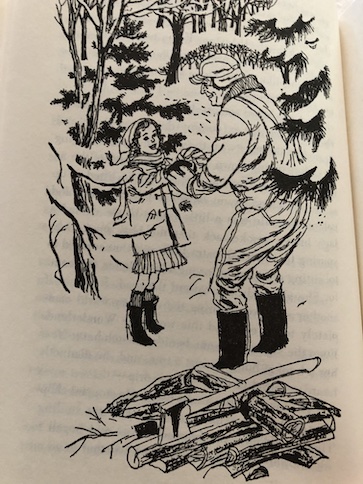
It’s March when the family makes their first trip to Maple Hill, and there is still snow on the ground. Their car gets stuck in the snow before they reach the house. Joe and Marly both get out of the car to find help. Twelve-year-old Joe initially didn’t want Marly to come with him because he’s in a phase where he likes to show off and make a big deal about how much better he is at doing things than his younger sister, but Marly sets off by herself and meets their friendly neighbor, Mr. Chris. Joe is a little offended that Marly saved the day instead of him, but Mr. Chris and his wife are very friendly and helpful. They remember the children’s mother from when she used to visit her grandmother as a child, and they welcome the family like they’re relatives themselves. Marly likes Mr. and Mrs. Chris, but her father finds their friendliness a little overwhelming. He feels like what he really needs is time alone, and he doesn’t feel much like chatting with people.

The old house at Maple Hill is a little run down because no one has lived there for years. The family has a lot of fixing-up to do, but Marly’s mother thinks that the work will be good for the children’s father. Marly and Joe aren’t used to living in the countryside, and they find some parts of it fascinating. They use a pump for water for the first time and take baths in an old tub. The house contains a Franklin stove (and Marly references the story Ben and Me by Robert Lawson).

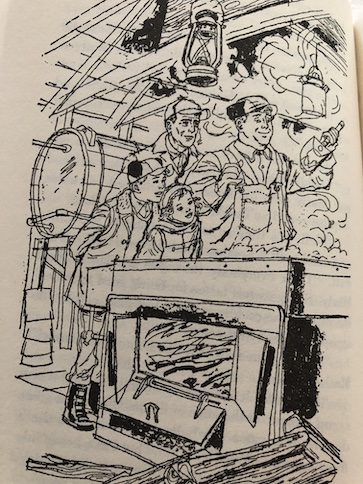
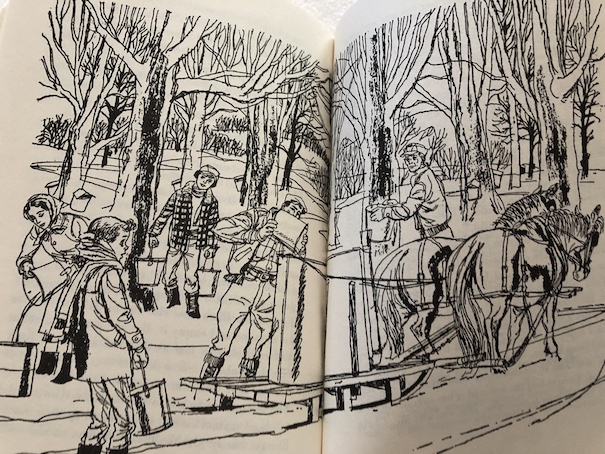
Marly is upset when her family kills a nest of baby mice, although they tell her that mice are pests, and they have to get rid of them or be overrun by them. Marly loves animals, and she would have loved to keep the cute little mice as pets. Marly talks about her feelings with Mr. Chris when he shows them how he processes maple syrup. Mr. Chris says that he understands how Marly feels. He also has a soft spot for small animals. Although he doesn’t tell his wife about it, he has a little mouse friend who visits him every day. Marly’s family is there for the conversation, and they say that Marly makes too big a deal out of getting rid of pests, but Mr. Chris says that there’s nothing wrong with Marly for caring and gives her an extra taste of the maple sap. To Marly’s surprise, her father takes her on his lap and says that the only thing wrong with Marly caring too much is that she’ll have to spent her life crying more than she would otherwise have to. Feeling an emotional attachment to people or animals can mean having your feelings hurt when you lose them, and what Marly’s father has been through is about the most extreme version of having hurt feelings that human beings experience.

Marly’s father stays at Maple Hill alone for a couple of months while his wife and children return to the city so the children can finish the school year. In spite of her father’s reluctance to be around people, he does become friends with Mr. and Mrs. Chris in their absence. He sometimes calls his family from the phone at their house. Mr. and Mrs. Chris help him adjust to living in the countryside. He discovers how much life in the countryside is influence by changes in the weather, much more so than life in the city, where people spend more of their time indoors, and Mr. Chris gives him an almanac to use. Mr. Chris tells Marly that, when she and her brother return to the countryside in the summer, he’ll take her around and show her everything, and he’ll show her all the “miracles” at Maple Hill, meaning the wonders of the natural world.

However, even people in the peaceful countryside have their troubles. Marly overhears her mother talking to Mrs. Chris, and Mrs. Chris says that she’s worried about Mr. Chris’s health. Jolly Mr. Chris has suffered a heart attack before, and he hasn’t been taking it easy. He’s always been a hard worker, and Mrs. Chris worries that he pushes himself too hard.

Over the summer, when Marly and her brother and mother return to Maple Hill, Marly has to get used to life in the countryside, as her father has. One morning, when she tries to make pancakes for her family by herself, she accidentally fills the kitchen with smoke because she doesn’t really know how to use the old-fashioned stove. Her father comes in and helps her, and at first, Marly is worried that he’s going to get really angry, the way he often has when things go wrong because of his stress from the war. However, this time, he reacts much more calmly because he knows how to handle the situation, and he admits that he did the same thing himself when he first used that stove. It’s one of the first signs that Marly’s father has been improving in the peaceful countryside.

As Mr. Chris promised, he shows Marly the wonders of the countryside and introduces her to different types of plants and animals. Joe likes to show off what he knows about plants and animals and their scientific names from his books, but Marly enjoys learning the colloquial names for plants from Mr. Chris and observing them directly. However, she realizes that she and her brother Joe have to be careful not to overtax Mr. Chris. When Mr. Chris gets really enthusiastic about something, he pushes himself harder than he should.

As the summer comes to an end, Marly’s parents discuss whether the mother should return to the city with the children for school or if they should stay at Maple Hill year-round now. Marly’s father loves life in the country. He has been growing crops on the farm, and he feels better in the peaceful countryside. He wants to stay there for at least for one year before trying city life again. Marly is eager to stay, although Joe is reluctant because he really likes his old school and the museums and theaters of the city. However, even Joe finds some parts of country life fun and fulfilling, so he is persuaded to give it a try. It helps that boys Joe’s age take the bus to the bigger school in the next town, and that school has a marching band, because Joe had wanted to join the band at his old school.

Staying in the country year-round gives the children the opportunity to experience the changes in nature and farm life through the seasons. However, as it reaches a year since they first came to Maple Hill, Mr. Chris suffers another heart attack. While he is in the hospital, Marly’s family steps in to help harvest and process the maple sap crop, turning it into maple syrup. It’s hard work because the family also has their own crop to tend to, but helping Mr. Chris helps Marly’s family as well. Through hard work for the sake of helping someone else and the relationships they build with their new community, Marly’s father’s old tiredness and harshness turns to gentleness, further healing his spirit.

The book is a Newbery Medal winner. It’s available to borrow and read for free online through Internet Archive (multiple copies, including one translated into Chinese).

My Reaction

Cottagecore Style

This book is a gentle story that would appeal to people who enjoy Cottagecore Style Books. It’s full of the wonders of nature and life in the countryside, and the family’s little farmhouse is cozy and charmingly old-fashioned. The “miracles” in the book refer to changes in the natural world that take place over time and with the changing of the seasons. Even Marly’s father’s recovery is natural and gradually takes place over time during the course of the story.

The book doesn’t go into detail about what Marly’s father experienced as a soldier, but it does a good job of showing how the war has affected him. He is tense, nervous, and angry because of his experiences, but not in a way that would be too frightening for children. Getting away from the chaos of the city and working outside in nature does help him. The physical activity of working outdoors gives him an outlet for his stress, and the slower pace of life and limited number of people he sees in the country give the chance he needs to rest.

Cottagecore as a genre and aesthetic became very popular during the Coronavirus Pandemic of the early 2020s. I explained when I wrote my list of books that fit the genre how the pandemic forced many people to change the way they were living. During the height of the pandemic, when there were lockdowns and quarantines, people didn’t get out as much. Many people worked from home, if they could, and limited the number of people they would see. This caused some people to feel stressed and cooped up, but one of the ways they were able to alleviate that feeling was to spend time outside, whether it was in their own gardens or in public parks or in the open countryside. When people were outside, there was less risk of contagion because they either wouldn’t encounter other people or could encounter them from a safe distance. Being out in nature, as much as they could manage, helped people feel a little more free. It gave them a welcome break from being inside their own homes all the time, and seeing beauty in the natural world can be soothing for all kinds of stress.

I mention this because that’s similar to the way Marly’s father and the rest of their family felt when they decided to go to the country. Marly’s father’s condition was hard on his family as well as himself because they were worried about him and because he would become moody and irritable at small things they would do which ordinarily wouldn’t have bothered him much. For a long time since he came back from the war, everyone had to be extremely careful about what they did around him because they didn’t want to upset him. In the countryside, without other distractions and causes of stress, everyone in the family was able to relax more. That’s why books of this kind became so popular during the pandemic; people saw in them feelings that they were experiencing themselves because of the stressful situation everyone was going through. I noticed that the people who handled the social distancing of the pandemic the best were the ones who used it as an opportunity to enjoy a slower pace of life and simple pleasures and to strengthen their connections with a small number of important people, like the people in this story do. Of course, individual circumstances varied, and some people had a greater ability to do this than others, but I think it’s interesting and helpful to note these common ways that people have of dealing with trauma and stress, even when the trauma and stress come from different sources.

Life and Death of Animals and War

There is a subplot that continues all the way through the book about how Marly feels about animals and how her feelings clash with both the way her family feels and the realities of life in the country. She gets very upset when her family destroys the nest with baby mice, and she bonds with Mr. Chris about their caring for small animals. However, Mr. Chris shocks her when he talks about hunting a family of foxes. Marly cares about the foxes because they have five babies, and she can’t imagine how a caring man like Mr. Chris would hunt baby animals. What is the difference between cute little baby mice and baby foxes? Mr. Chris explains that the foxes have been hunting his chickens, and they also eat mice. By eliminating the foxes, he can save the lives of other animals. The area has too many foxes already, and there is a bounty on their pelts. What Mr. Chris and the rest of Marly’s family understand, and which Marly struggles to come to terms with, is that sometimes animals pose a risk to other animals and even to humans. The mice would carry disease if they were allowed to live in the house with humans, and the foxes are killing the chickens. In a perfect world, everything would be able to live peacefully side-by-side without hurting each other, but the world isn’t perfect, and circumstances mean that something that poses a risk to something else sometimes has to be killed. It’s a good metaphor for war.

Marly’s father didn’t go to war because he wanted to. He was sent to war because the government decided it was necessary to prevent something even worse from happening. People don’t normally want to hurt and kill each other, but when faced with someone who poses a real threat, they will. Part of the reason why Marly’s father has suffered is that he had to endure things that went against his natural instincts. Ordinarily, he wouldn’t want to hurt or kill other people, but he had to as a soldier, and he had to survive other people’s attempts to hurt or kill him. To survive those circumstances, he had to change his way of thinking, and now that it’s over, he’s struggling to get back into the mindset of peace, where not every loud sound is a threat, conflicts are minor, and it’s okay to care about people and be sentimental about things. During their time at Maple Hill, the family also meets a hermit who came to the countryside while he was recovering from shell shock from a previous war. The book doesn’t say what war that was, but he’s been in the area for years. If Marly’s father was in either WWII or the Korean War, this man could have been a soldier during WWI, given the time period. The hermit’s experiences show the family and readers that the trauma of war affects people in similar ways across generations and between conflicts, and that what Marly’s father experienced is an inherently human reaction. It also points to the similar ways people have of responding to that type of trauma. Both Marly’s father and the hermit found solace in nature and the peaceful countryside.

Fortunately, Marly and her brother figure out a way to save the foxes from being hunted by scaring them away from their den. If you can get past the early point in the book where they destroy the nest of mice, no further animals were harmed during the course of the story. There is a point where Marly gets some chickens of her own to care for, and I was worried that the foxes would come and eat them, to prove her family’s point that some animals have to be hunted, but I was glad that didn’t happen. Marly does reflect more on how animals eat each other later in the book without needing to have anything else killed. She thinks about how she and her brother saw small animal bones and fur around the foxes’ den and how her own family eats meat and eggs. Mr. Chris says that everything needs to eat something to survive, and that helps Marly to understand the cycles of life and death in the animal kingdom and in farming. The lessons in the book are pretty gentle even though they touch on serious topics.

Boys vs Girls

One of the criticisms that I’ve sometimes seen about this book is the stereotypical gender roles in the story, but I think that’s a little unfair because Marly in particular questions the ways boys act and how other people view boys and girls. It starts very early in the story when the family’s car gets stuck and Joe doesn’t want Marly to go with him to get help. When Marly goes on her own and finds help first because she’s put a little more thought into where to go for help, Joe feels a little bad that his younger sister did better than he did. There’s a kind of competition between them that mostly seems to come from Joe, and Marly gets a little offended sometimes when he tries to leave her out of things so he can be first to do something.

I thought that it was perceptive of her to realize that boys try to prove that they’re better at things than girls because they “seemed afraid they’d stop being boys altogether if they couldn’t be first at everything.” Marly knows that boys aren’t treated the same as girls, and I think her comment comes pretty close to the reason why. The boys have a stronger idea of what they’re supposed to be, relative to girls, and in a way, they’re more threatened when either they’re not as good at something as a girl is or a girl does something that they think is supposed to be a boys’ activity. I’ve noticed men and boys with this sort of attitude even in the 21st century, and it’s ironic that they don’t seem to realize that very attitude puts them at a disadvantage by making their sense of self more fragile and dependent on someone else’s relative skills and interests.

Marly realizes this sense of fragility later in the story when she thinks about how she really likes being a girl better than she would like being a boy. Although some people might tell girls that they can’t do certain things or think of girls as being silly compared to boys, Marly realizes that there is a greater amount of freedom for girls in her time and society to simply be human beings than the boys experience. In some ways, the boys of her time seem like they’re being raised to be like little soldiers, possibly to prepare them for the day when they might be drafted, like their fathers. Boys are urged to be tough, competitive, and unsentimental. Marly knows that her brother cries sometimes, but he doesn’t want to be seen crying. Joe is not expected to care about animals or feel anything about killing them. By contrast, Marly can feel emotions and show them freely about anything she wants because she’s a girl. She realizes that people sometimes laugh when a girl does something silly or makes a mistake or asks what seems like a dumb question or is overly emotional about something, but girls are still allowed to do these things without people thinking much of it. They can do all of these things without anyone questioning their identities as girls or human beings in general. Really, everyone does these things once in a while, but Marly realizes that a boy doing one of these very human things is likely to get more criticism and might even be called “girly.” People of this time would question a boy’s identity as a boy in ways that they wouldn’t question a girl’s identity as a girl, and that’s why Joe acts the way he does sometimes, like he has something to prove to everybody. Boys of her time may have more opportunities in some ways, but in some ways, girls are more free to simply be human. Joe acts like he’s competing with his sister sometimes and trying to show her up, but in reality, he’s competing with society’s expectations for him and his own expectations for himself because of what he’s been told that boys are or have to be.

Toward the end of the story, Marly and Joe are so busy trying to help their family and the Chrises with their maple syrup processing that they miss some time in school. The local truant officer comes to check up on them and find out if they’ve been ill, and she is fascinated when she finds out that they’ve been helping to make maple syrup. She admits that, even though she’s lived in the area her whole life, she’s never actually helped to make maple syrup herself or eve watched it being done. She spends some time with the family, watching them work and asking them questions about the process. Based on what she’s seen, she decides that the children are engaging in a practical and educational experience because they are learning something that is culturally and historically relevant to the area that is not taught in classrooms. In fact, she thinks that this is such a great educational opportunity that she not only makes sure that the children are excused from classes until the work is done but also arranges for field trips of other children from the area to come to the farms and help, giving the two families the extra help they really need and the children’s classmates a unique experience. I thought that was a great example of how a disruption to the usual routine can be an exciting and valuable learning experience, something that I think is also relevant to the changes people had to make to their routines and education during the pandemic, but it also brings up the topic of boys’ work vs girls’ work again.

Throughout the book, there are certain types of work that are considered for men or women, and Marly is happy when her mother counts her among the “women” doing work in the kitchen because it makes her feel grown-up. However, there are times when she boldly speaks up about how girls should be allowed to do other things that boys also do. The truant officer is a woman, but when she arranges the field trips of students visiting the farm to help out, she specifically invites only boys at first. Marly asks her why she didn’t invite the girls because she’d like some other girls on the farm. The truant officer admits that she didn’t think of it as something the girls would want to do, but finding the process interesting herself, she decides that she’ll ask the girls to see if they’re interested. Joe dismisses the idea that girls would help out with the maple syrup because farm work is men’s work. Marly points out that she’s been doing this work the entire time herself, and Joe says that she’s different because she’s kind of a “tomboy” (meaning a girl with boyish qualities or who enjoys activities that boys typically enjoy). Marly insists that she’s not a tomboy because she’s very comfortable with her identity as a girl, and she just thinks that other people are wrong about the range of things that girls can do or be expected to enjoy. It turns out that she’s right that other girls are interested in the farm work and making maple syrup and do want to come on the field trips. They just didn’t before because nobody asked them.

I haven’t actually heard anybody say the word “tomboy” in a long time. When I was a kid in the 1980s and 1990s, it referred to a girl who acted like a boy and liked things boys liked, and it was a term far older than my childhood. In the 21st century, I more often hear about girls who are described, or more often, describe themselves as being “not like other girls.” There is still a concept that “typical” boys and “typical” girls like or do certain kinds of things and that people who don’t like or do the typical things are different somehow, although I think that concept isn’t as strict as it once was. I think that 21st century society has a more expansive notion of the types of things people of different genders like and do and a greater recognition of the varying interests people can have. Some people still leap to the conclusion that, just because someone doesn’t do or like what’s “typical”, they might be homosexual or trans (which I think might be part of that fear that Marly described about boys worrying that they’d “stop being boys altogether” if they couldn’t be first and best at everything compared to girls), but that’s not always the case. Humans come in many variations, and in the grand scheme of life, figuring out what’s “typical” for boys or girls doesn’t really tell you much about any particular individual person’s interests or feelings. (If you’ve ever tried to buy Christmas or birthday presents for a kid based on general recommendations for boys or girls their age and guessed wrong for that person, you know what I’m talking about.) There are some things that can really only be decided on an individual level. Marly is not a “tomboy.” She knows who and what she is, and she’s a girl who also likes to do outdoor activities and farm work. That’s really all there is to it, and there are more girls like her who find that appealing, when people bother to ask them how they feel.

History and Language

There aren’t many issues with language in the story, but there is one incident that I thought I would mention. There are a couple of points in the story where the characters discuss the history of making maple syrup. Mr. Chris says that one of his ancestors learned how to do it from some “Indians” in the area, meaning Native Americans, and his family has continued using the same process ever since. The truant officer is intrigued when Marly’s family tells her that, and she wonders how the Native Americans first realized that they could process tree sap into a food product. She does a little research and later tells the family a story about how a Native American woman used tree sap in making a kind of mush for her husband, and he liked the flavor, so they continued cooking with it.

Using the term “Indians” instead of “Native Americans” is very common in older children’s books, especially those from the 1950s or 1960s and earlier. This book isn’t unusual for doing that because it was written in the 1950s, although “Native American” is the preferred term of the late 20th and early 21st centuries when referring to “American Indians.” I think it’s generally better to use the most specific term possible in descriptors because it’s both more accurate and less confusing, and most people find it more polite and respectful. When I was a kid, I remember finding the term “Indian” a little confusing sometimes because I was aware that “Indians” are also people from India, although I could usually tell by context which kind of “Indians” authors meant.

(By the way, if anybody out there know which kind of “Indian” is meant when someone is sitting “Indian style”, meaning cross-legged or what some teachers now call “criss-cross applesauce”, do let me know. I asked one of my teachers when they first taught us to do it when I was a little kid, and I never got an answer. She rudely ignored the question, probably because she didn’t know the answer, either. I thought at the time it was probably based on Native Americans because of where we were living, but I was curious which tribe it was. The more I thought about it, I also realized that I couldn’t rule out India as the source because people sit crossed-legged for yoga, and yoga comes from India. Personally, I prefer to just call that kind of sitting as “sitting cross-legged” because that describes exactly what you’re supposed to do, and both of those other terms require more explanation of what they mean than I think should be necessary for just telling someone how to sit.)

The use of “Indian” instead of “Native American” sounds outdated and can be a little irritating to some people, but there is one instance where the truant officer uses the word “squaw” to refer to the Native American woman who discovered how to cook with sap from the maple tree. “Squaw” is a controversial word because, apparently, it can mean “woman” in a generic sense in some Native American languages, but in other Native American languages, it can mean something more vulgar and offensive. The word is only used briefly in that one part of the story and not in any insulting manner, but if you’re going to read this to children or have them read this story, I think it’s important for them to understand that this is not a word they should use themselves in conversation. If they want to refer to a Native American woman, they should just call her a woman and not use an ambiguous term that may seem insulting to some people. If they can understand that, sometimes, a word can mean different things to different people and that it’s important to consider your audience’s feelings when choosing what to say and how to describe other people, I don’t think this will be a serious issue with this story.

One final note that I thought of adding is about Marly’s name. Nobody in the story ever calls her anything but “Marly”, but I think that’s a nickname. In the early 21st century, there’s been a trend of giving children, especially girls, surnames as first names as a form of “gender neutral” name, but that wasn’t common back in the 1950s, and the surname of “Marley” is usually spelled with an ‘e’, unlike Marly’s name. Marly’s name could just be “Marly” as a variant of “Marley”, but I suspect, although I can’t prove it, that “Marly” is a nickname for Marlene or a similar name. I think her name is probably Marlene because there was a famous actress during the 1930s named Marlene Dietrich, and there was a spike in popularity for the name Marlene during the mid-20th century, probably because of her. Marlene Dietrich was known for defying traditional gender roles, both in her acting career and in her private life. Although she was considered a fashion icon in her time, when she described her sense of fashion in 1960, she said, “I dress for the image. Not for myself, not for the public, not for fashion, not for men. If I dressed for myself I wouldn’t bother at all. Clothes bore me. I’d wear jeans. I adore jeans. I get them in a public store—men’s, of course; I can’t wear women’s trousers. But I dress for the profession.” That sounds like the kind of girl Marly is. She knows that she’s a girl, but she’s her own kind of girl, who knows what she likes and doesn’t like.