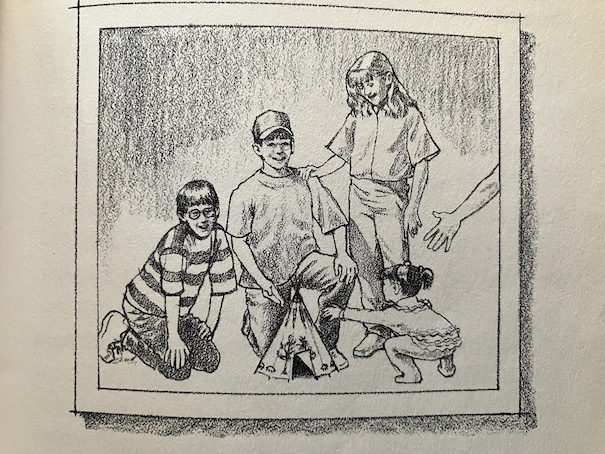
#9 The Mystery of the Eagle Feather by Elspeth Campbell Murphy, 1995.
Timothy is excited because he has a chance to meet his pen pal, Anthony Two Trees, for the first time. Anthony is a Native American, and he will be dancing at a powwow. Timothy’s cousins get to come along on the trip, too.
Soon after they arrive, though, they learn that someone has been taking pieces of the dancers’ costumes, like fans or headdresses made of eagle feathers. Who could be taking the costume pieces and why?
The costume pieces and the eagle feathers they contain are very expensive, and the kids realize that the thief might be thinking of selling them. It is illegal to deal in eagle feathers because eagles are an endangered species. Even the Native American dancers have to write to the government in order to get eagle feathers for their costumes from eagles that died in zoos. Therefore, the costumes are expensive and require a lot of effort to put together, and losing them is a real blow. The rarity and cost of the feathers might prove to be a temptation to a thief.
The theme of the story is self-control.
The book is available to borrow and read for free online through Internet Archive.
My Reaction
I wasn’t sure if I was going to like this story. I understand the fascination kids have with Native Americans and their costumes and dances. I felt like that when I was a kid, too, but there’s also an element of cringe to it. The cringiness comes from kids (and even adults) who get wrapped up in the fascination of the appearance of other people’s traditions and treat them more like playing dress-up than traditions with deeper, underlying meaning and significance or depicting Native Americans as being stereotypes from old movies and books rather than real, living people.
Fortunately, I was pleased at how this story shows that Timothy’s friend, Anthony, is a regular boy who shares his interest in baseball. They emphasize that Native Americans don’t live in tepees any more, and they don’t treat the Native American characters like stereotypes. I enjoyed some of the facts the story provided about Native American dances and costumes, like the regulations regarding the use of eagle feathers.
#10 The Mystery of the Silly Goose by Elspeth Campbell Murphy, 1996.
As soon as they arrive home from their trip to the powwow in the previous book, the cousins are approached by Timothy’s neighbor, the snobby 13-year-old Lyddie, with another mystery. While they were out of town, someone went around the neighborhood, stealing lawn ornaments. Lyddie is concerned because her grandmother has come to live with her and her parents, and her lawn geese were stolen. One of the geese was the mother goose with a silly-looking bonnet on her head, and the others were her goslings. Lyddie’s grandmother is rather attached to the geese because they were a present from someone.
The three cousins don’t really like Lyddie because she and her friends are usually unfriendly and too concerned with being “cool” all the time. However, they feel sorry for her grandmother and agree to take the case. To their surprise, most of the lawn ornaments are actually pretty easy to find. They were hidden in some obvious places around the neighborhood. The only ones that are difficult to find are the geese. Who hid the lawn ornaments and why?
The theme of this story is Proverbs 24:3-4, “It takes wisdom to have a good family. It takes understanding to make it strong. It takes knowledge to fill a home with rare and beautiful treasures.”
The book is available to borrow and read for free online through Internet Archive (multiple copies).
My Reaction
Part of the mystery has to do with image, but it also has to do with sentimental attachment. Lyddie is very obsessed with image because she and her friends try so hard to maintain their cool image. Although she calls in the cousins to find the missing lawn ornaments, she only does it because her grandmother takes the loss of the mother goose so hard. Lyddie doesn’t see why the goose is so important, although she knows that her grandmother is attached to it because it was a present from someone.
The situation changes when Lyddie’s grandmother reveals the full story behind the lawn geese and her own understanding of the situation. Lyddie cares for her grandmother, and she comes to see the geese in a new light once she understands why they matter to her grandmother. It’s not the value of the geese, and it’s not about how the geese look. It’s all about the person her grandmother associates with them. Fortunately, Lyddie’s grandmother is a very understanding woman, and when the lawn ornament thief explains the issue, they work things out to everyone’s satisfaction.
#7 The Mystery of the Haunted Lighthouse by Elspeth Campbell Murphy, 1995.
Sarah-Jane’s parents have been planning a trip, and her cousins, Titus and Timothy are coming, too. At the request of an old family friend, Ned, they are going to visit him and take a look at an old lighthouse that he is thinking of buying. He wants to turn the lighthouse into a bed and breakfast.
However, strange things have started happening at the lighthouse. Someone has vandalized the outside, and Sarah-Jane sees a frightening face up in the tower. Could the old lighthouse be haunted?
The theme of the story is faithfulness.
The book is available to borrow and read for free online through Internet Archive.
My Reaction and Themes
Since this is a Christian-themed mystery, readers can guess that there won’t be any real ghosts. This is more of a light, pseudo-ghost story, like Scooby-Doo mysteries, with another explanation for what’s happening.
There’s more than one kind of haunting. People can be haunted by memories, and living humans are also attached to the places associated with their happy memories. There is someone who has an attachment to the lighthouse and is unhappy that it’s being sold. This person needs to reconcile their feelings to the situation.
Some Christians don’t like the concept of ghost stories at all. In the book, Sarah-Jane likes hearing ghost stories, although she admits that she doesn’t like remembering them later, when she’s alone at night. She enjoys a little spooky excitement, as long as she knows it’s just a story, and she’s hearing it in a safe setting.
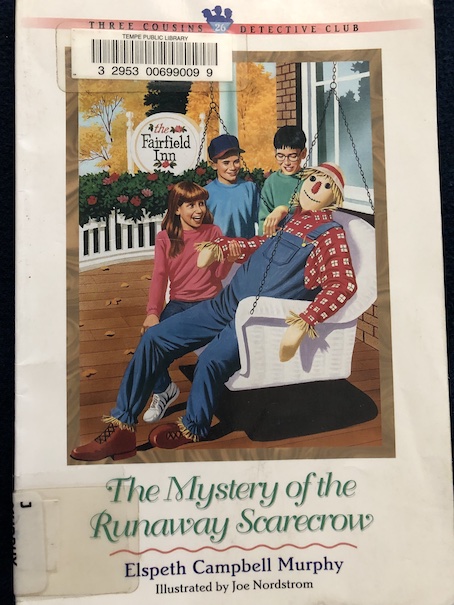
#26 The Mystery of the Runaway Scarecrow by Elspeth Campbell Murphy, 1999.
Sarah-Jane astonishes her cousins when she tells them that Buster, the scarecrow her mother made, which has been sitting outside of a local restaurant, has gone “on vacation. Scarecrows don’t just get up and go on vacation, and when they say that, Sarah-Jane says that Buster left a note saying that he had gone on vacation. The boys don’t believe scarecrows can write notes any more than they can go on vacation. Sarah-Jane admits that scarecrows don’t write notes, but someone else wrote a note on Buster’s behalf and left it behind when Buster disappeared. The note says that Buster is going on vacation and will be back when someone figures out where he’s gone. That’s weird enough, but Sarah-Jane says that Mr. Wesley, who owns the restaurant where Buster was, has been receiving pictures of Buster on his trip in the mail since he disappeared.
It seems like someone is playing a bizarre prank or maybe setting up some kind of treasure hunt involving the scarecrow. The town mayor says that Buster’s “vacation” has created more publicity for the town’s upcoming Fall Festival, so it could even be a publicity stunt. However, it’s been a few days since the last pictures of Buster arrived, and Mr. Wesley is inviting Sarah-Jane and her cousins to investigate Buster’s disappearance and find him because he knows that they like to solve mysteries.
The kids study the pictures for clues to Buster’s whereabouts, but the pictures are pretty generic. They show him outside a motel, at a gift shop, and at a gas station, but the locations aren’t very distinctive and could be found in any number of cities. The postmarks on the envelopes that pictures came in are all still in the area, so it seems like Buster didn’t go very far. They need to hurry if they’re going to find Buster in time for the town’s parade because the parade is tomorrow!
Then, Sarah-Jane reveals that something else mysterious has happened in the area recently. Someone stole a rare coin from Mr. Clark. This is also an intriguing mystery, but they don’t have many clues to start. Mr. Clark isn’t exactly sure when the coin disappeared because he doesn’t get out his coin collection very often.
For some strange reason, an older boy in Sarah-Jane’s neighborhood, Billy, seems very concerned about whether Sarah-Jane and her cousins have made any progress in finding Buster. Could Buster’s disappearance also have something to do with the missing coin?
Theme of the Story:
“The land has produced its harvest; God, our God, has blessed us.”
Psalm 67:6
The book is available to borrow and read for free online through Internet Archive.
My Reaction and Spoilers
I liked the way the person who took the scarecrow used the pictures to provide clues to their treasure hunt. Readers won’t be able to figure it out right away without explanation from the characters because the book doesn’t show all the pictures, but I liked the concept for how the culprit worked a series of clues into the pictures. There’s also a fun backstory behind the scheme. The prankster doesn’t have a sinister motive. The scarecrow caper is meant as a kind of prank/game/harmless publicity stunt.
I guessed pretty quickly who had taken the scarecrow, based on motive, but I liked the addition of Billy and the coin because it complicated the story and provided a second mystery on top of the first. There is a genuine crime in the story, but it’s not the one that the kids start out investigating.
The story takes place during October, but it’s not on Halloween. The town’s Fall Festival just seems to kick off the fall season in general.
The original cover is public domain and available through Wikimedia Commons
The Windy Hill by Cornelia Meigs, 1921.
Oliver and Janet are spending the summer with their mother’s cousin, Jasper, who is a wealthier man than the rest of their family. Janet is enjoying the visit and Jasper’s grand house so far, but Oliver is very uneasy there. Oliver doesn’t like the vast, empty house, and he’s noticed that Jasper’s manner seems different from he remembers the last time they saw him. Oliver senses that something is troubling Jasper, something that he doesn’t want to discuss. Jasper is usually a cheerful person who enjoys his cousin’s children, but during this visit, he hardly pays attention to them and never smiles. Janet finds things to do to keep herself occupied, but Oliver is terribly bored and bothered by Jasper’s odd behavior.
Then, one evening, Jasper sees Oliver looking at a nearby house. He says that the people who live in that house are also cousins of theirs, but he’s been too busy lately to see much of them. Jasper apologizes for having neglected Janet and Oliver during their visit so far, and he says that he will invite Eleanor, the daughter of the cousin who lives in that house, to lunch the next day. Eleanor is close in age to Janet and Oliver, and Jasper thinks that they will be friends and that a visit from her will liven up the visit for them. Janet is pleased at the idea of another girl cousin visiting, but Oliver is at that phase where he doesn’t like girls. He can’t imagine that he would have anything in common with this unknown girl cousin, and he thinks he’ll be bored while Janet and Eleanor have fun together. He tries to tell Jasper as much, but Jasper is just amused by his attitude and tells him that, if he is afraid of girls, the sooner he gets over it, the better.
When Jasper orders his car and driver to take Janet and Oliver to see Eleanor, Oliver decides to rebel by going to the train station and trying to get a train home. However, while he is waiting at the train station, he becomes curious about the countryside around him and the nearby river he hasn’t yet investigated. He wanders off to explore a little and encounters a man and a girl at a nearby cottage. The man and the girl ask him to help them with their beehives. Oliver is a little nervous of the bees at first, but he follows the beekeeper’s directions and finds himself enjoying the work. The beekeeper and his daughter, Polly, invite him to join them for lunch afterward. After a lunch of biscuits, honey, and iced cocoa, Oliver feels much better about everything.
Polly thinks that she and her father have somewhere they need to be after lunch, but her father tells her not to worry about that. Instead, he entertains Oliver and Polly with a story about a Native American medicine man, a boy who is curious about what lies beyond the ocean, and their first encounter with white people. By the time the story is over, Oliver realizes that he has missed his train. He decides to return to Jasper’s house, where he is told that Janet didn’t go to see Eleanor because Eleanor was delayed somewhere. (Guess where.)
More and more, Jasper’s odd mood becomes apparent. His servants have also noticed how worried he’s been, and it seems like he’s always more upset after a mysterious and disagreeable man comes to see him. Nobody knows who he is or what his visits are about. Oliver knows how to drive, and Jasper has Oliver drive him out on a mysterious errand one evening to see someone. Oliver doesn’t know who Jasper talks to or what they say to each other, but the visit takes a long time, and it makes Jasper angry.
Oliver’s visit with Jasper gets better because Jasper allows him to use the car by himself from that point on. He takes Janet to visit the Beeman and Polly. Although Oliver is still not enthusiastic about girls, he likes Polly because she is very different from how he imagines that cousin Eleanor must be. The Beeman says that they have to pick up some new beehives that day, and Oliver volunteers to take the girls to get the hives from a man named John Massey. John Massey complains about his landlord, who hasn’t been maintaining the dikes. Massey has had to take it on himself, and the burden is becoming too great for him to bear.
It turns out that Massey’s landlord is Anthony Crawford, the unpleasant man who has been troubling Jasper. Crawford also seems more than happy to let Olive and Janet know that he is also a cousin of theirs. He seems to be under the impression that Jasper has cheated him in some way. Jasper says that he’s already given him what he’s entitled to have, but Crawford says that his share should be more than that. Crawford says that, if Jasper doesn’t give him what he really owes him, he can take everything Jasper has and destroy his reputation in the process. There are secrets in their family’s past that would cause a scandal if the public knew about them, and Crawford says that if people knew that there was one crook in their family, they would all be suspicious that Jasper is much the same way.
Oliver doesn’t know what to think of Crawford’s insinuations or his threats. Not knowing who else to turn to, Oliver explains the situation to the kindly Beeman and asks him what he should do to help Jasper. The Beeman knows far more about everything that’s been happening than Oliver knows, and he say that Crawford has unknowingly been laying a trap for himself. Crawford thinks he’s pretty sharp in his dealings with other people, but he’s been neglecting something very important. Actually, multiple things.
In a series of stories that the Beeman shares with the children, he indirectly tells the children the history of their family and quarrels that go back generations. He tells them about a family with a shipping business that restored their lost fortunes during the War of 1812 by turning to piracy. He tells them about siblings divided by quarrels over money during the Gold Rush. Although the Beeman doesn’t admit to the children that all of his stories are true in the beginning, they soon come to realize that they are and that they are directly connected to the them and the current situation.
Toward the end of the book, the Beeman ties all the pieces of the puzzle together before telling them the final story, the one about three cousins named Jasper, Anthony, and Thomas, who were all raised together and were very close, until they had a falling-out over Anthony’s scheming and his unethical dealings. There are reasons for everyone to resent Anthony for his meanness and greed, but the Beeman is correct that Anthony has set himself up for a fall. He really should have listened when everyone tried to tell him to fix the dike.
The book is available to borrow and read for free online through Internet Archive (multiple copies) and Project Gutenberg. Because it is in the public domain, there is also a LibriVox Audiobook recording.
My Reaction and Spoilers
The Family’s Story
In some ways, the story of the family in the book is also a celebration of American stories. The short stories about different generations in their family are set at turning points in American history. Something that fascinated me about these stories was that they were not all glowing about these points in American history and their associated legends. There are parts of the stories that emphasize the bold American values of adventure and ingenuity, but there are also dark sides and downsides to the stories and flawed characters. The family fortunes were set partly by piracy, but one of the heroes of the family was the man who realized when it was time to stop. Members of their family have been consumed by greed and quarrels, although some have overcome their flaws and misconceptions to come together and be a family again. Again, the Gold Rush story resolves happily when the brothers involved also realize the folly of endlessly pursuing riches at the expense of relationships with the people they love. There is even a slight rebuke against the westward expansion of the United States – portrayed heroically but also as highly costly as people died and killed others over land and gold and promoting an endless, unhappy quest for more and more, with people living their whole lives never feeling satisfied. In short, the family, like the stories and American history itself, is a mixed bag, and they are at their best when they realize their wrongs and make the decision to change. For a book from the early 1920s, a period of heightened patriotism and prejudice after WWI, it seems remarkably insightful and self-aware.
It was Anthony’s decision to forge a relative’s name to get money to cover his unethical dealings that ruined his relationship with his family. It was only by their charity and intervention that he wasn’t charged with his crime and sent to prison. He’s fully aware of that, but he’s been resentful about it rather than grateful. Even from a young age, Anthony had always coveted what other people had. Even if he didn’t really want things for their own sake, he would go through elaborate schemes and bitter fights to get what someone else had, just because someone else had it. Out of greed and spite, he has resurrected old property quarrels in their family. He not only got the old house that was originally willed to Jasper, but he has been scheming to get Jasper’s new house. The Beeman (who is the third cousin in the last story and father of Eleanor, who is called Polly as a nickname) says that Anthony should have headed the lessons learned by their family during the Gold Rush, that always reaching and reaching for greater prizes means never being satisfied with what one has and risking its loss in pursuit of the unattainable.
In the end, when Anthony’s scheming and corner-cutting leave him with no one to turn to but the family members he has harassed and schemed against, he finally experiences a change of heart. I find stories where the villain has a sudden change of heart after long-term villainy to be unrealistic, but the crisis that Anthony realizes he caused is sudden and serious. Because he has neglected the dike and driven away the people who were helping to cover his negligence at their own expense, he suddenly realized that he has endangered many lives, and everyone knows that it’s all his fault. He schemed to get control of that land but didn’t take care of it when he had it. Everyone knows what he did, nobody’s going to cover for him, and while he’s unscrupulous enough to scheme to get others’ property, he doesn’t want to be responsible for killing people. It’s enough to make him swallow his pride and acknowledge the reality of the situation to his cousins. They help him for the sake of the people in danger, and in return, he decides to leave the area.
In the end, Anthony takes a hard look at himself and his life, and he realizes that he and his wife and children were better off when they lived in another community, where he was forced to work for a living instead of by his schemes. He now fully understands his weaknesses and temptations, and rather than continuing to resent the things and people in his life that stop him from furthering his schemes, he has come to welcome them as the guiding forces that keep him from making destructive decisions. The way he phrases it struck me as a little corny, almost like the end of a PSA, but I approved of the sentiment. His family members made him angry because they saw him for who and what he was, but the point is that he now understands who and what he is himself. Although the others are willing to allow him some leniency because of the way he handles the crisis, Anthony realizes that he must give himself the discipline he needs and be the changing force in his own life.
Overall, I thought it was a pretty good story, although there are a few issues with racial language related to Native Americans. I’m not sure if there is a modern revised version of this story or not. The version that I’m reviewing is the original from the 1920s.
Native Americans in the Story
I found the first story the Beeman tells, the one about the Native Americans, fascinating because the story contains the concept that Native Americans arrived in the Americas by crossing the Pacific Ocean and moving eastward across the continent. I know that’s the modern concept of the origins of Native Americans, but I was surprised to find the concept in a book from the early 1920s. I didn’t realize that people in the 1920s had that concept because I thought the older theory was that Native Americans crossed a land bridge.
During the story about the Native American medicine man, the book uses the term “squaw”, which is a controversial term because, although it apparently can mean just “woman” in some Native American languages, it can mean something vulgar in others. Modern books avoid the use of the word, but it appears in some older books, like this one, because white people weren’t always aware of the connotations the word could have. This is the danger of using words you don’t fully understand. It isn’t meant in an insulting way in this book, but be aware that the word appears here and that it isn’t a good word to use yourself. If you’re referring to a Native American woman, just say “Native American woman”, and leave it at that.
The book also uses the word “Indian” instead of Native American, something that also appears in older books. I’ve explained before that this hearkens back to a much earlier misunderstanding about who Native American peoples were, and the nickname has stuck to a certain degree. However, modern convention is just to say “Native Americans” because it’s both a more accurate description and less confusing than explaining American Indians vs. Indians from India. I don’t mind the use of that term too much because it isn’t insulting. However, the book also occasionally uses the term “Red Man” to refer to Native Americans. The characters saying that don’t seem to use it out of malice, but I still think it’s inappropriate. I think that sort of thing went over my head when I was a little kid because I knew people were referred to as “white people” and “black people”, but after I was old enough to understand that there were other connotations to the term it became one of those terms that I think of as “derailing terms.” Even if the characters use it in a non-hostile way or kind of thoughtless way, we (the readers) know that there are hostile or demeaning connotations to the term. It just derails the train of thought of readers like me because we stop to process whether or not the character is trying to be insulting or demeaning, and it just distracts from the rest of the sentence and the thread of the story. I’m generally in favor of reprintings of books like this, with the racial terms updated because, provided that the author and characters are not trying to be demeaning or insulting, a change in the language can clarify attitudes and put the readers’ attention back where it belongs – on the story itself.
Native Americans also appear in the story about the Gold Rush, as risks encountered by westward travelers. Their appearance in the story is minimal, if stereotypical.
Fritz (real name Richard) and Helen Price are twins, and their mother runs a seaside guesthouse. Their younger cousin Jonathan, called Tubs (a nickname that annoys him), comes to visit during the summer, although the twins find him annoying. It isn’t really Tubs’s fault; it’s just that he’s three years younger than they are, and they find him childish. Then, one day, Tubs tells them that Uncle Grigorian is coming to visit.
Fritz and Helen say that they’ve never heard of Uncle Grigorian before, and they ask their mother about him. She says that Uncle Grigorian hasn’t come to see them since the twins’ father died in a car crash, and Uncle Grigorian came to the funeral. The twins’ father originally came from Poland as “more or less an orphan”, and his family was split apart during “the war.” Even he wasn’t sure exactly how many brothers he had, and he never heard from the rest of his family after he arrived in Britain.
(The implication is that he was probably one of the children brought to Britain by the Kindertransport, which transported refugee children from Nazi Germany and Germany-occupied territories, including Poland, to Britain between 1938 and 1940 and placed them with foster families or in temporary homes. The Kindertransport prioritized particularly vulnerable children, especially Jewish children whose parents were already in concentration camps or who were homeless, living in poverty, or were already orphans. The hope was that many of these children would be reunited with their parents after the war, but many of them never saw their families again and continued living with their foster families because their parents were likely killed during the Holocaust. The father in this story was likely very young at this time or even an infant and so didn’t understand his family’s full situation, didn’t have many memories of them, and never learned their ultimate fate. None of this is stated explicitly in the story, but it fits with the father’s apparent age, the time period, and Poland during “the war.”)
Uncle Grigorian was living in Germany at the time the father died about 10 years earlier, but he said that he happened to be on a business trip in England at the time the father died and saw the notice in the newspaper, so he came to pay his respects and check on the family. Now, Uncle Grigorian has bought a farm in Wales, and since he will be living in Britain, he would like to spend more time with the children and get to know them better. Although Tubs is related to the twins on their mother’s side rather than their fathers and isn’t a blood relation to Uncle Grigorian, Uncle Grigorian invites all three children to visit him on his farm. The children’s mother admits that the guesthouse is very busy at this time of year, and a family has shown up with more children than they originally said they would bring, so it would be helpful if the children went on a visit, and the children are excited about seeing the farm.
At first, this seems like just a fun farm visit. Uncle Grigorian is indulgent with the children, letting them eat as many chocolate cookies as they want, teaching the boys how to drive a tractor, and letting Helen play with the lambs. A man named Mr. Rhys manages the farm, and Mrs. Rhys is his cook and housekeeper, making them all a big, traditional, full English breakfast. Things get complicated when Tubs asks Uncle Grigorian what he does while Mr. Rhys manages the farm.
Uncle Grigorian shows the children his office in the farmhouse. At first, it just seems like an ordinary office. Then, Uncle Grigorian opens the filing cabinet, which contains dials and switches instead of files. The room changes so the ceiling and walls become transparent, and the children have a view of Earth from space. Tubs says that it looks like they’re on the moon. Fritz thinks that it’s just a trick with projectors, but Uncle Grigorian says that Tubs is actually correct, and they are on the moon. At first, Fritz doesn’t believe him, so Uncle Grigorian changes their location again, taking them to Trafalgar Square in London. Since they’re on Earth now, he invites Fritz to step outside and check their location. He does, and to his astonishment, they really are in Trafalgar Square. He buys a newspaper, and it has the current date on it.
Uncle Grigorian explains to the astonished children that the office actually contains his spaceship, which is about the same size as the room itself. He can travel through space easily, but traveling around Earth is more tricky because he can’t risk colliding with other objects. He has to know the exact coordinates for where to land, so it’s best for him to go to rooms that he has already rented as office space, where he will know the exact coordinates and knows that the room will be the right size for the spaceship.
At this point, Fritz begins to suspect that Uncle Grigorian, whose oddly-positioned thumbs were already a source of curiosity for them, might not actually be human. Tubs had earlier joked about those thumbs meaning that he’s from outer space, and once again, Tubs is more right than anyone else suspected. Uncle Grigorian admits to the children that they’re not actually related at all. Uncle Grigorian is a kind of sociologist from a planet called Klipst, and he’s also a kind of secret agent for the Galactic Empire. He studies societies on different planets and keeps an eye on planets that are just starting to discover space travel. He latched onto the children’s family as a cover for his identity and activities, specifically because their father had been a war orphan who didn’t know much about his family or what happened to them. Most people would be suspicious about an unknown relative suddenly turning up, but with their family, it would be entirely plausible for them to have an uncle they knew nothing about. He says that Earth is getting close to discovering hyperdrive travel, and when it does, the Galactic Empire will need to decide whether or not to admit Earth to the community of planets.
The reason why Uncle Grigorian is telling them all of this is that he needs the children’s help. There is a dispute that needs to be settled between planets, and he asks the children to be arbiters in the dispute. The planets involved specifically want the arbiters to come from outside the Empire, and they don’t want politicians, who would probably be motivated by biases and self-interest. They have decided that they want child arbiters to hear the dispute because children have a great sense of fairness, and adults are often hardened to the unfairness of life in general. Children would be completely unbiased in this situation and not have a jaded point of view. Uncle Grigorian tells the children that it’s up to them whether they would be willing to accept this mission or not. Tubs is eager to accept and go to outer space, but the twins are more hesitant. They’re not sure if they know enough or would be able to be arbiters in an intergalactic dispute. Uncle Grigorian tells them that, if they accept the mission, he will give them something that will change that, and they decide to accept.
Uncle Grigorian says that he will give them “the Powers”, which is a special mental weapon that’s only been recently developed. It works a little different for everyone, but it enhances people’s mental abilities. Anything that a person has as talent will be enhanced so they become a natural expert in it. To gain these powers, the children have to sleep for the night in Uncle Grigorian’s spaceship while wearing special earpieces.
In the morning, he checks on them and asks them if they notice anything different about themselves. Helen can tell right away that Fritz isn’t telling the truth when he says no because she has acquired the ability to read people’s emotions and body-language like an expert. Uncle Grigorian calls her a Reader because of her ability to read people. Further, Helen can tell that the reason why he denied noticing anything was because he wanted to hear what the others would say first. Fritz admits that this is true. He says that what he has noticed is that he went to sleep trying to figure out how the ship can travel such long distances so quickly, and when he woke up, the answers just came to him. Uncle Grigorian calls him a Synthesist, someone who can put together pieces of information quickly, seeing how things relate to each other and how they work.
At first, Tubs can’t figure out if anything about him has changed or not, but Uncle Grigorian tries giving him a small, round, fuzzy creature called a Petball. (Sort of like one of the Tribbles from Star Trek.) Tubs loves it immediately. It also seems to like him, and Tubs gives it the name Glob. Uncle Gregorian says that his attachment to the creature is a sign that he’s a Maverick. Petballs are strange creatures, and they don’t like everyone, but they do like Mavericks. Maverick Powers are difficult to understand because people who have them have an odd way of saying or doing unusual things that turn out to be the right decision or reaching conclusions that turn out to be unexpectedly correct. It’s hard to say exactly when or how Tubs will use his Power, other than getting along well with Glob, but Uncle Gregorian says that it will be there at the right time for him to use it.
Tubs’s Power begins to show after they arrive at Palassan, the capital of the Galactic Empire. A strange girl comes up to them soon after their arrival and tries to offer a flower to Helen. Without him being able to explain exactly why, Tubs automatically reaches out and knocks the flower to the ground. When it hits the ground, it breaks, and they realize that is it really an electronic device that was supposed to transmit a subliminal message to Helen. Someone is already trying to influence the children as arbiters in the dispute. Soon after that, Fritz begins to notice how closely they’re being guarded, but are the guards there for their safety or because they’re now prisoners?
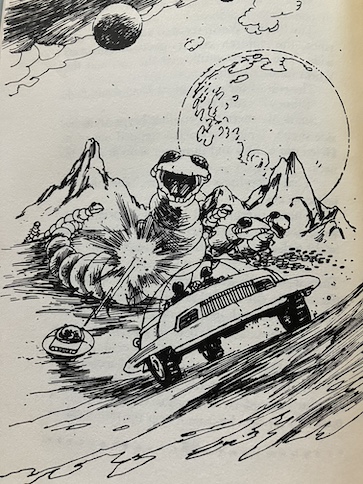
When the kids begin hearing about the dispute, they are told that a new planet has been discovered in a place where there has not been any planet before. It is not near any star, and there doesn’t seem to be any explanation of how it got there. An expedition to the planet discovered that what looks like “clouds” is actually some kind of vegetation that emits light, and there are worm-like creatures living on the surface. The problem is that these large Worms spin a substance called Unilon, which is very valuable. Since the Worm World was discovered, people have flocked to the planet to harvest it for selling. Some of them have captured Worms and forced them to spin continually until they die. The League of Life says that it is concerned about the welfare of these creatures, and the Unilon Harvesters Association says that it’s concerned about jobs. With her Power, Helen can tell that neither side in this dispute is telling the truth. Fritz does some research and uncovers some ulterior motives and hidden sides to both sides of the dispute. He decides that finding a solution means going to the Worm World itself, but learning the secrets of the mysterious world will put them all in danger.
The book is available to borrow and read for free online through Internet Archive.
My Reaction and Spoilers
I thought that the premise of this story was interesting, a mysterious “uncle” who is actually an alien in disguise who gives the kids a mission in space and special powers. The secret of the Worm World is also intriguing. It turns out (spoiler) that the world itself is alive, and they have to find a way to communicate with it. It’s a plot that sounds a little like some of the early Star Trek episodes or maybe inspired by them.
Most of the emphasis of the story is on the twins, even though there are three kids involved. Tubs helps in the story, but I was expecting that he would be more central to the solution of the problem or that the solution would be more of a cooperative effort than it was. I was a little disappointed at how quickly the story ended.
One thing I’d like to point out that, even with their enhanced “Powers”, the kids aren’t perfect at them. Fritz puts information together pretty easily, but he still has to do research and observe things directly to get the information he needs. Even when he has it, he doesn’t necessarily understand its full significance right away. His comment about how it looks like they’re being held prisoner rather than being simply guarded for their protection turns out to be more accurate than I thought it might be at first, but he doesn’t seem to have fully realized the reason why or who they can’t trust. Even Helen, with her ability to read people’s emotions and body-language doesn’t realize at first that their guard isn’t trustworthy. She could tell that he was uneasy, but she attributed his uneasiness to the wrong reason.
Actually, I think the part about Helen not being perfect at reading people is a good callback to the argument between the children about Tubs’ nickname at the beginning of the story. Helen argues that Tubs shouldn’t mind his nickname because Fritz never complains about his, but Helen hasn’t accurately read even her own twin’s feelings about his nickname. The truth is that Fritz doesn’t like his nickname any more than Tubs likes his, but the book says that he’s old enough to have figured out that, if he makes a fuss about not liking it, people will use it even more. I know that people can be like that, but being even older than Fritz is, I’m old to have figured out that this rule only holds true as long as the people involved decide it does. This isn’t something everyone does naturally or all the time; it’s a thing that some people do habitually because they’re pushy and like provoking reactions from people. When they get a negative reaction from someone, they just push harder to get more reactions rather than realize that they’re getting on that person’s nerves and cutting it out. What I’m saying is that Fritz seems to have correctly realized that Helen is that type of pushy person, which is why he doesn’t complain to her about how much he hates his nickname, while Helen has totally missed both Fritz’s real feelings and the fact that he’s figured her out. We’re supposed to accept that Helen already had a natural ability to read people even before getting her enhanced “Powers”, but the whole nickname incident had me rolling my eyes about Helen’s ability to read even her own family members and wishing that she would get a clue.
I expected that the characters would eventually revisit this situation with Tubs’ nickname before the end of the book and that Tubs would do something to help the situation that would earn his cousins’ respect. However, neither of those things happened. Fritz is the one who mainly solves the problem, and he does so rather quickly toward the end of the book. I was surprised at how quickly the book ended. Because the kids all keep their powers and Tubs is able to keep Glob at the end of the story, I wondered if maybe the book was originally intended to be the first in a series, with further adventures and more character development in later books, but if that was the case, I can’t seem to find anything about it.
I found the issue of language in the story interesting. People in the Galactic Empire speak a common language that Uncle Gregorian describes as being sort of like Esperanto, no matter what planet they come from. The treatment that gave the children their powers also gave them the ability to speak and understand this language, even when they’re not fully aware that they’re doing it. I liked the idea of a common language that’s a kind of conglomerate of other languages with Esperanto as the inspiration. Because the characters aren’t fully aware of that they’re hearing or speaking this language, we don’t have any hints of what it would be like, but I just thought the concept was interesting.
#30 The Mystery of the Golden Reindeer by Elspeth Campbell Murphy, 2000.
Titus doesn’t really like to go Christmas shopping. The department store is always crowded around Christmastime, and he’d really rather just stay home, where it’s comfortable and quiet, and eat popcorn and watch videos. However, his mother really wants to go to the department store and so do his cousins, so they persuade him to come along. The three cousins are allowed to browse in the toys without adult supervision, as long as they stay together. They make arrangements to meet Titus’s mother for lunch in the store’s restaurant.
When they get to the toy department, they hear an announcement about a lost child, and to their surprise, their younger cousin, Patience, suddenly appears. She had been shopping with her grandmother when she spotted her cousins and started following them. As far as Patience is concerned, she wasn’t lost because she knew where she was. It was her grandmother who was lost, and she points out that she found her cousins instead of them finding her. The cousins manage to find Patience’s grandmother and reunite the two of them, and they invite them to come to the restaurant with them for lunch.
When they meet up with Titus’s mother, they all are surprised when she tells off Titus for wandering around the department store by himself when he was supposed to stay with his cousins. They all insist that Titus was with them the entire time. Titus’s mother was sure that she saw him riding the escalator alone, but none of them were on the escalator because Patience is afraid of escalators. Patience suddenly speaks up and says that she must have seen the “other Titus”, not the “real Titus.”
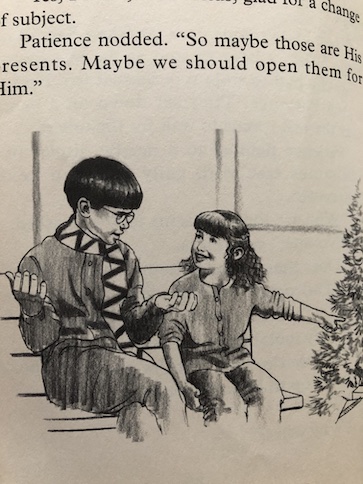
They enjoy the restaurant, which has a large Christmas tree, decorated with golden reindeer. During lunch, Patience tries to point out the “other Titus” to them, but nobody else spots who she’s pointing to. Patience is known for having an imaginary friend named Amy and for making up tall tales. She sometimes mixed up things she’s imagined with things that are real, so they’re not sure if she really saw the “other Titus” or not. (Personally, I thought this was silly on their part because they already know that Titus’s mother saw someone who looked a lot like him. Titus is wearing a distinctive black-and-white scarf, so I figured at this point that there’s someone wearing a scarf that’s also black-and-white.) Titus feels a little uneasy that there might be another him wandering around.
Titus’s mother wants to look at some furniture after lunch, and she asks Patience’s grandmother if she could come with her and give her opinion. The three cousins would rather go look at store windows instead of furniture, and Patience insists that they take her with them. The older cousins know that Patience can be a handful to look after, but Sarah-Jane knows that she would feel badly if they didn’t take Patience somewhere where she would have more fun than she would have looking at furniture. Patience promises that she’ll stay with her cousins and not run off anywhere, so the adults agree to let her go with them.
While Titus and Patience are looking at the Christmas tree together, Titus is surprised by a teenage boy who comes up to him and starts talking to him as if he knows him. The teenager says that he has a message for him and tells him, “Happy Birthday. The golden reindeer. Dish towels. Christmas tree.” Titus asks him what he’s talking about, and the teenager says that he was paid to deliver that message to him and that he must have been expecting him. When the other cousins come back from the restrooms, Titus and Patience tells them what happened, and they’re equally confused. All they can think is that this bizarre message was meant for the “other Titus.” But, who is the “other Titus”, and what does the message mean?
Theme of the Story:
“What you get from wisdom is better than the finest gold.”
Proverbs 8:19
The book is available to borrow and read for free online through Internet Archive.
My Reaction and Spoilers
This mystery does involve a lookalike for Titus. However, the mystery doesn’t quite end when they meet the other boy. He tells them that he got a phone call telling him to come to the department store for a special message about something that belongs to his family that was stolen. When the other kids tell him the message that was given to Titus, he finds it just as confusing as they do.
It’s Patience who really solves the mystery of what the clues in the message mean, and that’s both because she is nosy and because, as a young child, she doesn’t take certain things for granted, the way an adult or older child would. Sometimes, people see not what’s actually there but what they expect to see. Titus’s mother didn’t really see him on the escalator alone; she saw the other boy, who happened to be wearing a different black-and-white scarf. She just figured it was Titus because she expected the boy with the black-and-white scarf would be her son, and she didn’t look closer to notice that it wasn’t the same boy and that the scarf actually had a different pattern. It was the same with the teenager who was looking for the other boy. In the case of the clues, all of the older kids assume that the packages underneath the decorative Christmas trees in the department store are just empty boxes, wrapped up for decoration. Because Patience wants to check to see if they’re all empty, she’s the one who realizes that one of the packages isn’t like the others.
We never learn who stole the object that the other boy was looking for, but he does get it back. Also, Patience learns to get over her fear of the escalator.
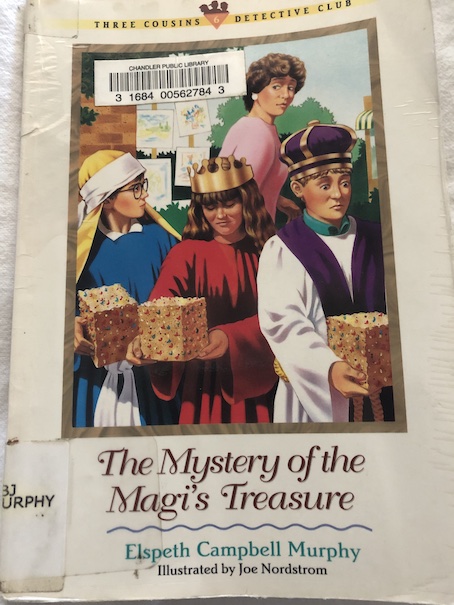
#6 The Mystery of the Magi’s Treasure by Elspeth Campbell Murphy, 1995.
Timothy, Titus, and Sarah-Jane go to visit their grandparents in the resort town where they live over the summer. Their grandfather is the pastor of a church, and in their Sunday school class, there are three boys, all named Kevin, who are close friends and have a reputation for being troublemakers and goofs. The three cousins have little to do with the three Kevins, but it’s because of the three Kevins that they are recruited to help with the community’s Christmas in July art fair.
The community holds an art fair every summer, and this year, they’ve chosen Christmas in July as their theme. Some of the local churches are holding a special concert of Christmas music as part of the event, and someone through it would be a fun idea to have children dressed in costumes from the Nativity play, like shepherds and angels, to hand out flyers for the concert. The three Kevins get the roles of the Three Wise Men, but it becomes obvious pretty quickly that this arrangement isn’t going to work because they’re more like the Three Stooges than stately wise men. The choir director says that they need more reliable children to be the Three Wise Men, so naturally, he gives the roles to the three cousins. After all, their grandfather is the pastor, and their grandmother is always bragging about how well-behaved they are.
As soon as they put on the wise men costumes, Timothy realizes that there’s method to the Kevins’ madness. If you get a reputation for being reliable and doing good work, people give you more work. If you get a reputation for not doing anything right, nobody will even let you do certain jobs. The job of being wise men in July is anything but fun. The robes are too heavy and hot for summer. They can’t even complain because everyone says they look adorable, which is humiliating, and their grandmother keeps telling everyone how proud she is of them. It’s almost like they’re being punished for being good, and they can’t say a thing about it without disappointing Grandma.
Then, something really strange happens while they’re passing out flyers. A woman they’ve never seen before runs up to them and gives them three boxes. She says that they’re supposed to be part of their costumes, the gifts for Baby Jesus. She seems a little flustered and has trouble remembering exactly what the gifts are supposed to be, forgetting the words “frankincense” and “myrrh.” She tells the kids that she’s in charge of the props and that they have to take good care of these boxes and only return them to her. Then, she rushes off again.
The kids think that it’s an inconvenience to have to carry around the boxes as well as pass out flyers, but the woman’s manner struck them as strange. When they look more closely at the boxes, the workmanship also seems unusually good for objects used only for a Nativity play.
Then, the kids overhear a couple of artists talking about some artwork stolen from a fellow artist. Suddenly, they have an uncomfortable feeling that they know what was stolen, who took it, and where it is now. The big problem is that the thief is watching them.
Theme of the Story: Goodness.
The book is available to borrow and read for free online through Internet Archive.
My Reaction and Spoilers
After the kids hear about an artist’s work getting stolen, it doesn’t take them long to realize that the boxes they were give were probably the stolen artwork and that the “prop” lady who didn’t seem to know what she was doing was the thief. She was just looking for a convenient place to leave her stolen goods so she wouldn’t be caught walking around with them, and she happened to spot the children in their wise men costumes. Three fancy boxes look like what people would expect the gifts of the Three Wise Men to look like, so the thief could essentially hide the stolen goods in plain sight. The artists talking about the theft were uncertain exactly what type of art was stolen, so most people at the fair also wouldn’t know what to look for and would just assume that the boxes were props.
The Kevins got them into this mess in the first place, and they turn out to be the way out of it, too. The thief was counting on the kids being easy for her to watch because they stand out in their costumes but almost invisible to bystanders because everyone else just disregards them as being in costume and doesn’t look closer. What the kids realize is that maybe she also hasn’t looked closely enough to really recognize them and is only following the costumes, no matter who happens to be wearing them. Once the cousins explain to the Kevins what’s happening, it’s exciting enough for the Kevins to be more than happy to participate. They finally put their playacting and thrill-seeking to a good purpose!
Weirdly, the thief also unintentionally did a good deed for the artist. The artist has been doubting herself and the quality of her work. While stealing from her was a bad thing to do, the thief unintentionally confirmed that her work was so good that she was willing to steal it! It reminded me of a funny line from an old episode of Remington Steele with an artist whose work was stolen: “I’ve finally hit the big time! I’ve been stolen!”
The theme of “goodness” sounds somewhat generic, but the story is really about turning something bad into something good. The kids didn’t really like getting the roles of the Three Wise Men, but if they hadn’t taken them, they wouldn’t have found this mystery and saved the stolen artwork. Instead of goofing off and messing up like usual, the Kevins came through when it was really important. The woman who tried to take something that didn’t belong to her proved that it was something with value. The boxes themselves were made from pieces of junk, but they’re beautiful. It doesn’t mean that stealing becomes right if it unintentionally accomplishes something good, but the kids come to realize that even things that don’t seem like they’re worth anything can have unexpected good sides. Even Baby Jesus was born in a humble stable.
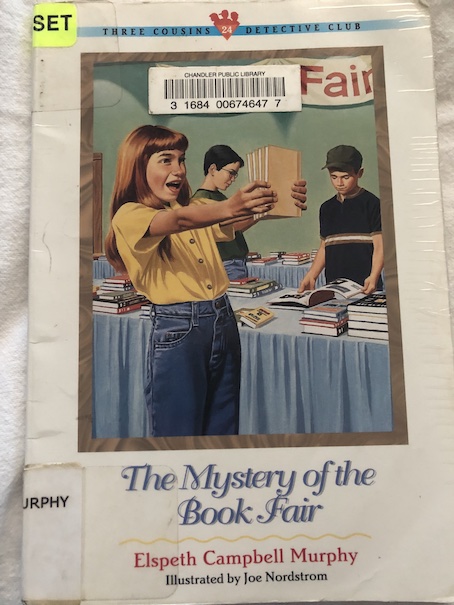
#24 The Mystery of the Book Fair by Elspeth Campbell Murphy, 1999.
Sarah-Jane is excited about the book fair being held in the public library. She helped to collect donations of books for the sale, and she wants to be first in line so that she can buy a set of old Winnie-the-Pooh books that she’s had her eye on.
But from the moment that she claims the books, people keep coming up to her and trying to get her to let them have them or buy them from her. Another volunteer at the sale, who is also a book dealer, looks over the books and tells Sarah-Jane that they are rare first editions that are worth a lot of money.
Even though Sarah-Jane bought the books in good faith from the library, she and her cousins feel that they ought to try to find the original owner to make sure that he really meant to donate them. The trouble is that Sarah-Jane remembers that the donor of the books behaved rather strangely and seemed very nervous. When he gave them the books, he even called them by the wrong name, “Winkie-the-Pooh.” What kind of book collector wouldn’t know the value of his own collection or even the correct name of the books? Did the books even really belong to him at all? Then, more than one person shows up at the library, claiming to own the books. Who is the original owner?
The theme of the story is Proverbs 3:3, “Don’t ever stop being kind and truthful. Let kindness and truth show in all you do. Write them down in your mind as if on a tablet.”
The book is available to borrow and read for free online through Internet Archive.
My Reaction and Spoilers
Sarah-Jane wanted the books not only because she likes Winnie-the-Pooh but because she likes old things, and she found the old copies of the books charming. Although she did not originally collect old books, these particular books inspire her to start an old book collection. Many people have discovered their love of collecting old books thanks to the popularity of recent aesethics, like Cottagecore and Dark Academia.
However, as the book dealer in the story explains, most old books are not the rare collectors’ items that these first edition copies are. The dealer explains that the value of an old book depends on many factors, like the condition of the book, its rarity, and the number of people who would be interested in acquiring it. I’ve encountered this myself in collecting old children’s books. Many of the books that I cover on this site would be worth very little to other collectors because they are not rare, first edition classics, but they’re worth something to me because there are elements of the stories that I find interesting. I don’t have the funds to buy most of the really rare books, although I’ve occasionally managed to buy books that would ordinarily be out of my price range at used book sales or as library discards or as damaged books. I think the most expensive books I have are ones that would be worth perhaps $100 or $200 if they were in pristine condition, which none of my books are. I’ve never encountered anything that would be worth thousands of dollar, like the Winnie-the-Pooh books in the story. The Winnie-the-Pooh books are worth that much because they are not only first editions but they are in near mint condition and they are extremely popular classic books.
One of the adults who tries to pressure Sarah-Jane into selling the books to her is a woman who tries to make Sarah-Jane feel bad for buying books that are for younger kids. The woman says that she wants to buy them for a young child, but the nice dealer recognizes her as a fellow book dealer and knows that she’s trying to cheat Sarah-Jane because she has recognized the books for what they are and knows their value. The woman wasn’t being honest in anything she said. She wasn’t really interested in the books just for their own sake, as a book lover or as a present for a real child, but only for their monetary value. That makes her different from Sarah-Jane, who fell in love with the books for their own sake. I’m not the only one who collects old books, even old children’s books, just because I appreciate them for what they are. It’s a feeling that doesn’t know any particular age. The real owner of the bookss turns out to be an elderly man who was born the year that the first Winnie-the-Pooh book was published and who has had the books since they were new. He loves them not just because they’re collectors’ items but because of their sentimental value.
The books were stolen from the house of the book collector along with some other things. One of the thieves donated the books to the library because he thought they were worthless. His partner in crime knew that they were worth a lot of money and came to the sale to try to get them back. He runs away when the real owner of the books shows up looking for them. Sarah-Jane calls the police and tells them what happened. The books are returned to their rightful owner, and as a reward, he buys another rare book of fairy tales that was donated to the sale (on purpose, by the owner) and gives it to Sarah-Jane.
Uncle Quentin and Aunt Fanny are expecting their daughter George and her three cousins and dog to come for a visit because their parents are going away on a cruise when Uncle Quentin hears from a friend of his, a professor, who also wants to come for a visit to discuss his latest invention. Aunt Fanny says that they won’t be able to accommodate the children and the professor at the same time, and Uncle Quentin had better tell the professor not to come. However, Professor Haling is already on his way, and he’s bringing his son with him. The children have also already left home, so there’s nothing for them to do but try to accommodate their guests as well as they can.
It’s not going to be an easy visit. Uncle Quentin and Professor Haling both want quiet to discuss their work, but the professor’s nine-year-old son, Tinker, is obsessed with cars and keeps making noises to imitate them. Tinker has also brought his pet monkey, Mischief, with him. At first, Mischief and George’s dog, Timmy, don’t get along with each other. The animals eventually make peace with each other, but Uncle Quentin and Professor Haling decide that they can’t put up with the children’s noise. Uncle Quentin insists that Aunt Fanny send the children away somewhere so they can continue their important work.
Aunt Fanny doesn’t like it that such important men, who are admittedly working on things that will help people, don’t seem as interested in making their families happy, and George points out the hypocrisy that Uncle Quentin can’t stand their noise when he often slams doors that interrupt her studies and that he wants to push her out of the home where she lives, too. Aunt Fanny says that part of the problem is that George and her father are too much alike, but the noise issue and overcrowding in the house are still problems that have to be solved.
The children ask if they can go camping, but Aunt Fanny says that it’s too cold for that. Tinker suggests that they could all go to his lighthouse. They ask him what he means by “his” lighthouse, and Tinker happily explains that he owns a lighthouse. Actually, his father bought it when he was working on an important project and wanted a quiet place to stay where he wouldn’t be interrupted by phone calls or visitors or other distractions. When his project was finished, he no longer cared about the lighthouse, but Tinker love it, so his father gave him the key and told him that it could be his lighthouse now. The other children are amazed at the idea of a private lighthouse, and they agree to go there. Aunt Fanny agrees to let them go, and they begin planning for the trip. It’s at a place called Demon’s Rocks.
On the way to the lighthouse, their taxi driver, who was born at Demon’s Rocks tells them a little about the history and legends of the place. He says that it’s called Demon’s Rocks because there are formidable rocks there that people say could only have been placed by demons. The old lighthouse was meant to steer ships away from the rocks, but one time, some wreckers captured the lighthouse keeper and turned off the light to intentionally wreck a ship so they could raid the wreck for its cargo. The driver says that his great-grandfather still lives in the area, and if they ask him, he can tell them more stories about the place and maybe show them the cave where the wreckers used to hide out.
When the children meet the taxi driver’s great-grandfather, Jeremiah, he is an eccentric old man, but he likes children and even knows how to get along with Mischief the monkey. The children ask him about the wreckers, and he tells them the story about how One-Ear Bill and his wreckers put out the light in the lighthouse and used a lamp to misdirect a ship to make it crash. Jeremiah says he witnessed what they did and reported them, sending One-Ear Bill to prison. But, he says that One-Ear Bill didn’t care that much about going to prison because he hid the treasure that he took from the wrecked ship and expected to be rich when he got out. However, he died in prison, and nobody ever found the hidden treasure. The relatives of the other wreckers have tried to find it, but nobody has ever succeeded. The children are fascinated by the story and ask Jeremiah if he will show them the wreckers’ cave, and he agrees to show them sometime.
A local shopkeeper says that there is a kind of rivalry between Jeremiah and the descendants of the wreckers because the wreckers’ descendants make a marginal living by giving paid tours of the wreckers’ cave. The children don’t really expect that there’s still a treasure hidden in or around the cave. They think that, probably, someone found the treasure years ago and didn’t tell anyone or that the treasure might have been in some insecure spot and got washed out to sea.
However, strange things soon start happening. Someone steals the key to the lighthouse when Tinker leaves it in the lock and some other things from the lighthouse. The local police discover one of the wreckers’ descendants, Jacob, stole the things from the lighthouse, and the children get them back, but they can’t find the key on Jacob.
Then, when Jeremiah gives the children a tour of the cave, Mischief gets lost and finds a gold coin. The children aren’t sure where Mischief found the coin or if there are any others, but they begin to think that maybe the treasure is still in the cave after all. They also begin to consider that there may be a tunnel that leads from the lighthouse to the cave. However, someone else seems to have the same idea, and they’re trying to stop the children from finding the treasure before they do!
My Reaction
Part of the concept of the Famous Five series is that the children are very independent and have adventures that are unsupervised by adults. Children like stories about independent kids, but as an adult, I’m still struck by the family relationships the children have. I’ve noticed that the adults in Enid Blyton’s stories often have personal issues or dysfunctional relationships.
The reason why the children are having their independent adventure in this story is that the children’s fathers are too absorbed in their work and bothered by the presence of the children, so they just want them out of the house. Although George likes having adventures with her cousins, she does feel a little resentful that her father is basically pushing her and the others out of the house. I particularly noticed the part where Aunt Fanny reflects that important men who are working on things that will help people, don’t seem as interested in making their families happy. Uncle Quentin seems oblivious about the effect he has on his family, and when the children are getting ready to go to the lighthouse, he seems confused about where they are going, apparently having even forgotten that they were going anywhere. I keep getting the feeling that part of the reason why the children are so independent is that the adults in their family aren’t particularly nurturing and don’t make their home lives very pleasant.
Tinker’s home life isn’t terribly happy, either. His father is very permissive, letting him have a pet monkey and even giving him the lighthouse, but he also seems pretty oblivious to the things Tinker does. The other children find out that Tinker’s mother died giving birth to him, and with his father so utterly absorbed in his work, Tinker hasn’t had much supervision or guidance in how to behave, which is why he’s so wild. Tinker’s father takes him places and lets him have things or do things that other children can’t, but he doesn’t seem to get much personal attention or affection from his father. At one point, the other children are sending post cards home, and Tinker says there’s no point in sending one to his father because he won’t read it. That says a lot, and the other children feel sorry for him.
What I’m saying is, while I like the adventure and would have loved that sense of freedom as a kid, as an adult, I recognize that behind the children’s independence in many of the stories are some unresolved family issues and self-absorbed adults. The adults don’t worry as much about the children as most parents would, not only because they trust them on their own, but because they seem too absorbed in their own issues to think that much about what the children are doing and what could happen to them. The children go to boarding school much of the time, but their parents don’t seem too eager to spend time with them and bond as a family during their breaks, content to let them go off by themselves so they can get back to what they were doing. This also seems to be the case in other series by Blyton, like the Adventure series, which starts off with a pair of siblings going to stay with an aunt and uncle who seem to have a dysfunctional marriage and a pair of orphans who live with a strict uncle who seems to see them as a nuisance. Since the kids are fictional and the children’s circumstances are only there to set up their adventures, it’s not that big of an issue to enjoying the adventure, but yet, as an adult, these things do jump out at me.
















 Jestress's Forgotten Books and Stories