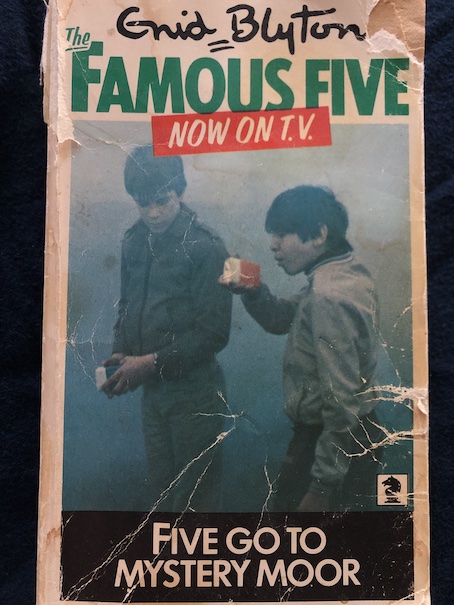
Five Go to Mystery Moor

The Famous Five

Five Go to Mystery Moor by Enid Blyton, 1954, 1974.

The girls, George and Anne are attending a riding school, and the boys, Julian and Dick, are camping when George receives a letter that her father is ill, and her mother wants the girls to stay on at the riding school for a while longer. The girls are disappointed and think that the boys will probably stay on at their camp, but they soon get a letter that the boys will be coming to the riding school to join the girls. The children are hoping that they will find another adventure when they’re all together again.
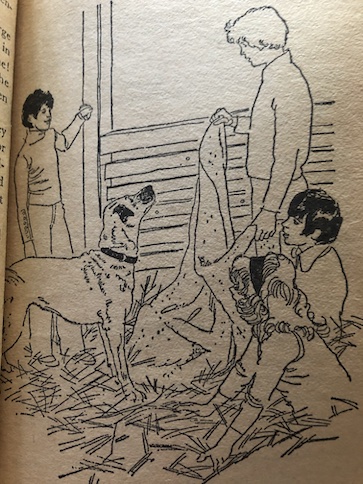
At the riding school, George has developed a rivalry with another girl called Henry. Henry’s real name is Henrietta, like George’s real name is Georgina, and like George, Henry likes to dress and act like a boy. However, rather than bonding over their shared interests and styles, George and Henry resent each other. (George makes a big deal of not liking to be a girl and wanting other people to look at her and refer to her as a boy. I’ve wondered whether the implication is that she’s actually transgender, without using that word to describe her, or if she’s merely a tomboy who things girl things are sissy stuff. Enid Blyton’s books are often full of the implication that boys are tougher and braver than girls, and it seems to be a mark of praise for a girl to be like a boy. In this particular book, it seems like both George and Henry are trying hard to be “not like other girls“, and the reason why they resent each other is that they’re both disgruntled to realize that at least one other girl is like them, making each of them seem less exceptional. They each seem to feel like the other is horning in on their shtick.) In spite of the rivalry between George and Henry, the other children like Henry. Eventually, George and Henry settle their differences. Henry joins the other children on some of their rides and explorations.

While the children are still at the riding school, a gypsy boy comes to the stables with an injured horse, asking for help. (They’re referred to as “gypsies” all throughout the book, although that’s considered a kind of insult. The proper name is really Romani, and they’re also sometimes called “Travelers.” The name “Gypsy” comes from an earlier misunderstanding that their ancestors were originally from Egypt, kind of like how Native Americans were mistakenly referred to as “Indians”, and the name stuck. I only use the word “gypsy” here because the author does, and I want to make sure that fans of the original book understand what I’m talking about. This note is here to clarify the difference. Gypsies are stock characters in Enid Blyton books, and they’re all pretty stereotypical.) The boy is told that it will take a few days before the horse is able to walk, let alone pull a caravan wagon. The boy is very upset because his father has a nasty temper, and he’s not willing to wait. The other children soon see how abusive the boy’s father is, and they’re sympathetic to him. Julian and Dick catch the father trying to steal a horse or reclaim his in spite of its injury during the night. When they ask him why he needs a horse so badly and can’t wait until his is properly healed, and he tells them that his group needs to go to Mystery Moor. Seeing that he’s not going to get another horse, the father decides to move on with other members of their party, leaving his son behind to tend to their horse and catch up to them when he can.

Julian, Dick, George, and Anne are intrigued by Mystery Moor, although they can’t imagine what could be there that would make someone so desperate to go there. The name of the place intrigues them, and they are told that it used to be called Misty Moor until some strange things happened there years ago. A wealthy family established a sand quarry there and built a small railroad line that crossed the moor, but they had a dispute with the gypsies who lived on the moor. The gypsies sabotaged the railroad, and when the sons of the family went to deal with the situation, they all vanished and were never seen again. The local rumor is that the gypsies probably murdered the sons, but nothing was ever proven, and to be honest, nobody really misses the sons because they weren’t nice to anybody else, either.

The children think that this is the adventure that they’ve been looking for, and when the riding school becomes crowded because of the arrival of new students, they decide that they want to go camping on Mystery Moor. They look forward to heading out onto the moor to see if they can find any traces of what happened to the missing family. However, there’s a modern mystery on the moor as well. The children spot a plane that flies low and circles the area, seemingly guided by a mysterious light. The children discover that the plane dropped a package, and that package is stuffed with packets of US money! Who would drop that much money from an airplane, and who was supposed to come pick it up?

The book is available to borrow and read for free online through Internet Archive (multiple copies). There is also an audiobook on YouTube. As the cover of the book notes, the Famous Five series was made into a television series, and you can sometimes find clips or episodes on YouTube.

My Reaction and Spoilers

Old and New Versions

I find that many of Enid Blyton’s mystery/adventure stories, no matter which series, are very much on par with Stratemeyer Syndicate books (Bobbsey Twins, Hardy Boys, Nancy Drew, etc.), especially the earlier ones. On the one hand, they contain many of the elements that children love in stories – mystery and adventure, independence from parents and other adults, spooky and mysterious happenings, kids who save the day, and a lovable dog. On the other, both Enid Blyton’s books and the Stratemeyer Syndicate books were revised in later reprintings to update the language and to remove or alter racially-insensitive and offensive terms.

I didn’t know how much some of the Stratemeyer books I read as a kid had changed from their original versions because I was born in the late 20th century, after many of these revisions had already taken place and didn’t read some of the original editions until I was an adult. I was surprised. Since I grew up in the US, I didn’t read any Enid Blyton books as a child at all. They’re available here, but not nearly as popular as the various Stratemeyer Syndicate series, and many American children don’t know about them at all. I’d heard of Enid Blyton books because they were referred in other books and movies I saw, but I didn’t read any until I was an adult. By that time, I wasn’t too shocked at some of the more problematic parts of the books.

“Gypsy” isn’t really a shocking word for me because there’s less emotional baggage attached to that word from the time and place where I grew up than there is attached to certain other racial words that I’d rather not mention. When I was a kid, I thought it was a more neutral, generic word than it really is, although someone did explain to me at some point what the name comes from and that it’s not really the proper name. However, when you find out that something really bothers people or that they don’t want to be called certain things, it’s better to just call them whatever they like to call themselves. I think the later reprintings of this book use the word Traveller (British spelling) instead, like this audiobook on YouTube.

As with Stratemeyer Syndicate books, I think the revised reprintings are fine for modern children, and the earlier versions are best kept for adults with an interest in vintage and nostalgic children’s literature. I find these books interesting particularly because they have the classic setup of a mystery-solving group of children and their dog, just like the Scooby-Doo mysteries, which is something that I grew up loving! The Scooby-Doo mysteries have a similar format to the Famous Five, and the working title for the original concept of the cartoon series was Mysteries Five, which might be an indication that the writers had Enid Blyton’s books in mind.

Interesting Information

One interesting piece of trivia is that the book discusses patrins, signs that the Travellers leave for each other to indicate which way they’re going. During the course of the story, the Traveller boy leaves patrins to help the other children.

The Mystery and spoilers

Like many vintage children’s mysteries, the story leans a little more toward adventure than mystery. The Travellers are definitely the ones who are there to get the dropped packets of money, and that’s why they were so worried about getting out on the moor in time. The real mystery is why they’re doing this and where the money comes from.

Toward the end of the book, the police reveal that the money is counterfeit, and that’s why it had to be smuggled into the country. Henry is helpful to the others at a point when they’re in danger, and that helps George to reconcile with her. Because the Traveller boy’s father is abusive and is about to be arrested for smuggling counterfeit money, he is likely to be sent to a foster home, which is actually good news for him because he was unhappy with his father and afraid of him. He says he would like to live a settled life in a house where he can ride his bike to school, and George promises to give him a bicycle as a reward for helping them when they needed it.
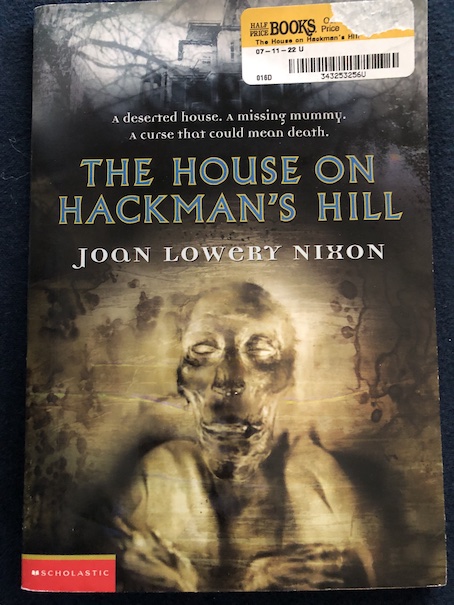
The House on Hackman’s Hill

House on Hackman's Hill cover

The House on Hackman’s Hill by Joan Lowery Nixon, 1985.

This creepy book is interesting partly because it is told in two parts. About half the story is a flashback that explains the history of the house and the mummy inside it, and the rest continues in the present day.

The very beginning of the story is in the present, starting with a pair of cousins. While they are visiting their grandparents, Jeff tells his cousin Debbie that he’s found out about an old, abandoned house nearby that supposedly contains a hidden mummy and that there’s a reward for anybody who finds it. Debbie doesn’t believe him at first, but he says that he heard all about it from their grandparents’ neighbor, Mr. Karsten. Jeff persuades Debbie to come with him to check out the old house. Debbie comes and takes pictures of it because she’s interested in entering a photo contest.

The place looks really creepy, and they have the odd feeling like somebody is watching them, even though the house is supposed to be empty. Debbie says that they should ask their grandparents what they know about the old house. At first, the grandparents don’t want to talk about it. They just say that it’s an old house and not very interesting. Debbie asks them directly about the mummy, and they say that there are a lot of rumors about the old place, but they don’t really believe them. The kids decide to talk to old Mr. Karsten again. Mr. Karsten says that he knows all about the old house on Hackman’s Hill because he lived there for awhile when he was young, back in 1911.

Paul Karsten’s Story

Paul Karsten’s mother was a secretary, and she went to work for Dr. Hackman, the former owner of the house, after the death of her husband. Dr. Hackman was a strange man with changeable moods. He was pleasant enough to Mrs. Karsten, but he hated children and didn’t really like having her son Paul in his house. Dr. Hackman was a history professor, specializing in Egyptology. He was approaching retirement, and he wanted to devote himself to his papers and his collection of Egyptian artifacts. Mrs. Karsten’s job was to help him catalog his collection, and Dr. Hackman offered such a good salary, Mrs. Karsten couldn’t refuse. The mummy was delivered the same day that Paul and his mother moved into the house.

Paul was given a room in the tower of the house, and while he thought that it had a great view at first, he got nervous when he noticed how the tower room was situated on the edge of a cliff. One of Dr. Hackman’s servants, Jules, makes a comment about how Paul should be careful because they don’t want “another accident”, refusing to say more about whatever “accident” occurred there before. Paul was uncomfortable with the house and with Dr. Hackman. He tells his mother that the house frightens him and that he wants to leave, but his mother reassures him that the place only looks strange because of the Egyptian artifacts. Paul found the artifacts he once saw at a museum exhibit frightening and he’s particularly disturbed by a statue that Dr. Hackman has of a man with an animal head, but his mother says that’s just a statue of an Egyptian god.

Paul had notice earlier that a long box had been delivered to the house, and he gives into temptation and tries to look inside. However, he is stopped by Jules. Jules and his wife Anna warn Paul that this house isn’t very good for children and that Dr. Hackman doesn’t like people nosing around or messing with any of part his collection. At dinner, Paul admits to Dr. Hackman that he tried to look in the box and apologizes for his curiosity. Dr. Hackman accepts the apology, and before Paul goes to bed that evening, Dr. Hackman shows him the mummy case that was in the box. Paul asks him if it’s real, and Dr. Hackman says it is. Paul says that he heard that it’s illegal to take real mummies out of Egypt, but Dr. Hackman says that there are ways, if you’re willing to pay for it, and he was. Dr. Hackman says that his eventual goal is to turn his house into a museum of Egyptian artifacts so that scholars will come there to study them and read his papers, and he will be famous. He also says that he knows how to protect himself from the mummy’s curse. The talk of curses scares Paul, but Dr. Hackman says that nothing has ever happened to him personally because of any tomb curses … implying that something might have happened to someone else.

When Paul tells his mother that Dr. Hackman has a real mummy, she is worried and upset. She doesn’t like the idea of people obtaining artifacts through unethical or illegal means, although she knows that the laws are poorly enforced. Mrs. Karsten doesn’t believe in superstitious curses, but soon, strange things begin to happen. While putting away his things in his room, Paul discovers a strange, triangular piece of gold metal with some kind of design on it. When he goes up to bed, he feels like someone is there in the room, although he can’t find anyone. During the night, he wakes up, sees that one of his windows is open, and feels an odd urge to walk toward it, but fortunately, his mother comes to check on him and stops him. Paul and his mother both realize that they were woken by the sound of a cry in the night. His mother supposes that it was some kind of night bird, but Paul knows that it was probably something to do with the curse.

Paul insists that Jules and Anna tell him about the accident that took place in his room. They say that they weren’t working for Dr. Hackman when it happened, but they know that the person who fell from the tower room was a guest of Dr. Hackman’s, he was from Egypt, he died when he fell, and his body was shipped back home. At first, Paul thinks that the gold piece he found probably belonged to the Egyptian guest, but that’s not quite it.

Dr. Hackman gives Paul the job of polishing some of his statues, knowing that they bother him. It amuses Dr. Hackman as a mean joke. However, Paul’s fear of them fades while working with them because he begins to appreciate their artistry. Dr. Hackman is surprised that Paul is able to see that and not just be afraid of the statues. Paul asks him about the statue of the man with the animal head, and he explains that it’s a statue of Anubis, the god of the dead, and scares Paul again by saying that Anubis is the one responsible for the curses on tombs. He says that Anubis’s head is a jackal head and that jackals hunt at night and have a bark like a cry. This confirms to Paul that the curse was responsible for the cry he and his mother heard.

Paul eventually comes to realize that the strange gold piece attracts the mummy and the mummy’s curse, which is why Dr. Hackman knows that he’s in no danger. Dr. Hackman put it in the tower room to make sure that the mummy’s wrath would only come to whoever was in that room … and that’s why he made sure that Paul was given that room, too. To protect himself and his mother, Paul knows that he has to get rid of that gold piece.

Mr. Karsten finishes his story by explaining to Jeff and Debbie where he hid the gold piece and how Dr. Hackman disappeared, apparently a victim of the curse. Nobody ever discovered what happened to Dr. Hackman, and the mummy disappeared that same night, but a museum has offered a reward for anybody who finds the mummy. Mr. Karsten says that various people have tried to stay in the house and find the mummy, but nobody has succeeded. Everyone has been frightened off after just a single night in the house.

Jeff doesn’t believe in curses, and Debbie agrees to accompany him into the old house to find the mummy and claim the reward.

Return to the Present

The rest of the story is about Jeff and Debbie’s adventures with the house on Hackman’s Hill. Jeff says that he thinks all the spooky curse stuff was just put on by Dr. Hackman, who was a mean old man having a joke by scaring a kid with all that talk of curses. Dr. Hackman was definitely a mean old man who enjoyed scaring young Paul Karsten, but questions still remain. How much of what Paul experienced was really real, and what happened to Dr. Hackman? If the curse was just something he made up, why did he scream the night he disappeared, and where did he go?

Jeff’s idea is that all the creepy stuff happened at night, so the best time to go look for the mummy would be during the day. (That’s actually pretty sensible. Why go to a supposedly haunted house during the night if you don’t have to?) The kids make a plan and put together a collection of useful supplies and food for their mummy hunt. They decide to go while their grandmother is busy watching her favorite soap opera and their grandfather is in town, arranging some sort of surprise for them.

When they enter the house, they discover that everything is still inside. All of the furniture and Egyptian artifacts are like Mr. Karsten described them. Debbie has an instant camera that with takes pictures that develop themselves. (No brand name mentioned, but basically, a Polaroid instant camera or something very similar. Those were popular when I was a kid in the 1980s and into the early 1990s, especially for families and amateur photographers. They’re not as popular now with the popularity of smart phones and digital photography, but they’re still around. Although police photographers now use digital cameras, instant cameras have been used in accident and crime scene photography because they produce quick results, the photos last for a long time, and because they develop immediately after being taken, they can’t be digitally altered. What I’m saying is that Debbie has made a good choice for recording their adventures and any evidence that they uncover, and it pays off almost immediately.) When Debbie takes a picture of the statues that Mr. Karsten told them about, she notices something frightening right away: the Anubis statue doesn’t show up in photographs.

Jeff discounts the photographic evidence because Debbie’s hand shook, and the picture is somewhat blurred. However, the kids start hearing noises in the house. Then, Debbie notices that a bad snow storm is approaching. She wants to leave the house immediately, but Jeff realizes that they can’t because they’d never make it back to their grandparents’ house by the time the storm hit. Night approaches, and the kids are about to see just how true Mr. Karsten’s story was. The kids are trapped in the house by the snow storm, but they’re not there alone.

The book is available to borrow and read for free online through Internet Archive (multiple copies).

My Reaction and Spoilers

I thought that this was a fun, creepy story. The creepiness is tempered somewhat in the first half of this story because it’s told in the form of a flashback. We know during the first part of the story that Paul survives his ordeals and lives to old age because he’s telling the story of what happened when he was young to Jeff and Debbie as an old man. When Jeff and Debbie go into the house themselves, it’s less certain what’s going to happen.

There are points in the story after Jeff and Debbie enter the house where it seems uncertain how much of what Paul Karsten experienced was supernatural and how much might have been due to the machinations of Dr. Hackman, who seems to have been a very disturbed man by himself. They soon discover that the house has secret passages that could allow Dr. Hackman to move around the house unseen and create some strange phenomena himself to scare or harm people in the house. There was a point where I thought perhaps everything would turn out to be part of some elaborate plot by Dr. Hackman or someone else, but (spoiler) there is real supernatural phenomena happening.

Before the end of the book, Jeff and Debbie discover both where the mummy is hidden and where Dr. Hackman hid the mummy’s golden eyes, which Anubis has been searching for all this time. They also learn what really happened to Dr. Hackman all those years ago. He apparently did become the victim of the curse that he had tried to evade by inflicting it on others. When the story ends, it seems that the curse is ended permanently, although Jeff and Debbie do manage to get some things out of the experience.

I liked how, even though the story does turn out to be supernatural, the author introduced the idea that it might not be because that element of uncertainty kept the suspense going for longer and introduced some interesting possibilities for readers to consider. It also made it a little more plausible that the kids would be willing to enter the house because they could believe that the house itself was harmless without Dr. Hackman there to continue his plots.

The Secret of the Indian

The Secret of the Indian by Lynne Reid Banks, 1989.

This is the third book in the Indian in the Cupboard series.

This book immediately picks up where the last book in the series left off, with Omri injured after witnessing the battle in Little Bear’s time and he and Patrick and their small army having just fended off the gang of local hoodlums who had tried to break into Omri’s house and rob it. Omri’s parents return home from the party they had attended and are appalled to see Omri hurt, although the story of the burglary covers up the real reason for Omri’s injuries, which the boys don’t think they can tell Omri’s parents. Omri still can’t adequately explain how part of his head got burned, but he makes up a story about him and Patrick trying to light a bonfire and accidentally getting burned. His parents are occupied, alternately angry with the babysitter who was supposed to come and didn’t and with themselves for leaving before they were sure that she had arrived. The police come to question the boys and inform the parents that the reason why the babysitter didn’t come was that she was mugged that night. Omri knows who the thieves are, but hesitates to turn them in.

First, Omri needs to deal with Little Bear and his band of warriors. Some of them were killed in the battle, and others are injured. Patrick and Omri bring the Matron who treated Little Bear before to life to help them, but although she does her best, she says that her skills aren’t adequate to help them all and that they need a real surgeon. The Matron is sharp and tells the boys that it’s useless to insist that this is all just a dream because she knows that, strange as this situation is, it’s all real and that the death and pain she’s witnessed around her are real. The boys explain to her about the key and cupboard that bring plastic figures to life, and she asks them if they can get a doctor. It’s Sunday, so the boys can’t just go buy one, but the Matron came from a set owned by Patrick’s cousin, Tamsin, and there were other medical professional figures in it. When Patrick’s other cousin, Tamsin’s twin, Emma, comes to Omri’s house to see Patrick, Omri is forced to let her in on the secret and recruit her to help him.

Meanwhile, Patrick has gone back in time with Boone the cowboy. In Boone’s time, Patrick is tiny, the size of the figures in his own time. Unfortunately, Patrick made a terrible mistake by going back to Boone’s time with Boone as a plastic figure. That meant that Boone became a real person in the chest, trapped under Patrick’s body and almost smothered to death and needs to be treated by the Matron in order to survive.

In Boone’s time, tiny Patrick ends up in the company of Ruby Lou, a woman who likes Boone. Patrick knows that Boone is unconscious in the desert and helps Ruby Lou to find him. The doctor in their time doesn’t know what’s wrong with Boone and can’t figure out why he’s unconscious, suggesting only that they let him rest for the present and recover. Ruby Lou presses Patrick for answers, and he explains everything to her about how they travel through time using the magic key and how Boone has just left his full-size body behind to go into the future in the form of a little figurine. It’s an incredible story, but Ruby Lou believes him and expresses concern about getting Boone back safely. But soon, they’re all in trouble when there’s cyclone threatening.

Also meanwhile, Mr. Johnson, the headmaster of Omri’s school, has learned about Omri’s story that won the contest. Back in the first book of this series, Mr. Johnson actually saw Little Bear. At the time, he thought that he was hallucinating, but Omri’s supposedly fictional story has now convinced him that he really saw what he saw. He demands that Omri tell him the truth about his “Red Indian.” (Omri corrects him, saying that it isn’t right to say “Red Indian” and that they prefer to be called “American Indian” or “native American”, but Mr. Johnson angrily insists that he’s always said “Red Indian” and will continue to do so, establishing him as an unsympathetic villain in the story.) Mr. Johnson is relieved to know that he wasn’t hallucinating before, but since Omri is reluctant to explain anything, he decides to call Omri’s mother. When she answers, she demands that Omri tell her where Patrick is because his mother is frantically looking for him.

Of course, Omri knows that Patrick is still in the trunk in his room, in a coma-like state because he’s still in the past and there are living miniature people in his room who will also be discovered if people start searching. Can Omri fix everything in time to rescue Patrick and his little friends and prevent their secret from being exposed?

The book is available to borrow and read for free online through Internet Archive (multiple copies).

My Reaction

Although the story takes place immediately after the previous one left off, the rules of the magic in this world have changed a little. Before, when a person from Omri and Patrick’s time went back to the past, they kind of became part of the scenery. This time, when Patrick visits the Old West, he is there as a tiny person, although no figurines of the boys exist in the past. What this book does emphasize is that the magic key does change real people from modern times into little people into people in another time and real people from other times into tiny people in modern times. At this point in the series, it’s all still mysterious why the key is magic and why the little cupboard in particular only seems to affect plastic items and people. Some of those explanations come in the next book.

I did like the parts where other people, including Patrick’s cousin Emma and Mr. Johnson in the present and Ruby Lou in the past, catch on what’s happening with Omri and Patrick and their plastic figures. In so many children’s books, the magic absolutely depends on secrecy. In this series, Patrick and Omri both know that they don’t want most people to know their secret because they don’t want people either interfering or thinking that they’re crazy. With Patrick disappearing mysteriously and other things happening because of their interactions with the little people from the past, it makes sense that people would start noticing that the boys have become involved in something really strange, even thought some of them don’t know what it is. However, the magic still works for them even when other people find out and the people who could pose a threat to their activities either never find out the truth or are distracted or apparently discredited.

At the end of this book, Omri becomes more serious about the risks of the cupboard and decides that he wants the key put away, to be give to his future children in the event of his death. However, there are other books in this series to come, so they do use the key again.

Mystery of the Fog Man

Mystery of the Fog Man by Carol Farley, 1966.

This is the first book of the Kipper and Larry mystery series. Kipper (real name Christopher) and Larry are 13-year-old cousins. The two boys meet each other for the first time in this book, when Kipper comes to visit Larry and his family in Michigan. The boys had written letters to each other before, but they were both excited to finally meet in person.

Larry and his father live in Ludington, on the shores of Lake Michigan, and Larry takes Kipper fishing soon after he arrives, which is when Kipper first encounters the mysterious figure known only as The Fog Man. This strange old man starts Kipper, and Kipper finds him eerie. Larry explains to Kipper that The Fog Man is kind of a local eccentric. He is apparently both deaf and mute. No one knows his real name. He apparently lives in the nearby forest, but during the summer, he comes to the beach to collect driftwood, which he sells to tourists, who are fascinated by this eccentric old man, and to the lady who runs the nearby gift shop, Miss Norton.

Shortly after this encounter, the boys learn that someone has stolen thousands of dollars from the safe on one of the car ferries that travel back and forth across Lake Michigan and Wisconsin. (Another book by the same author but in a different series takes place on one of these car ferries, The Case of the Vanishing Villain.) Kipper and Larry are able to see the scene of the robbery because of Larry’s father’s position as the local chief of police. However, the boys’ adventures are just beginning.

The most likely suspect in the robbery seems to be a man called Karminsky, who worked on the ferry. He disappeared around the time of the robbery, and Larry’s father thinks that he’s hiding out somewhere in the area, waiting for the police to stop looking for him so he can make his getaway. Larry is intrigued by the idea that the robber might be hiding out in the woods nearby. Although his father forbids the boys to go looking for the robber, they can’t resist checking out the woods anyway.

Larry confides in Kipper that he really wants to help his father catch this robber so that his father will be a big success and get public recognition. Larry sometimes feels bad that he and his father have been alone since his mother died when he was young. He thinks that, if his mother was still alive to help his father take care of him, his father would be able to do much more in his life and career, so Larry wants to be the help that he thinks his father really needs.

Soon, the boys think that they’ve found Karminsky’s hideout in the woods, but even though they lie in wait for him all night, they don’t manage to catch him there. The only person they see in the area is the Fog Man, and to Kipper’s shock, he sees the Fog Man walking without his characteristic limp!

When the boys later find the Fog Man’s coat and a fake white beard, they reach different conclusions about what happened. Kipper thinks that the Fog Man was involved in the robbery all along and that he was always in disguise from the beginning. However, Larry is accustomed to thinking of the Fog Man as a harmless old eccentric who has hung around town for the last few years, selling driftwood to tourists. Larry thinks that the Fog Man might be an innocent victim of Karminsky’s, that Karminsky may have killed him so he could take his place and blend in with the usual beach scene until he could make his escape.

Then, Larry’s father tells them that Karminsky has been found in another town, apparently having missed being on the ferry in the first place. So, if Karminsky was never on the ferry and never in Ludington, who stole the money and masqueraded as the Fog Man?

The book is available to borrow and read for free online through Internet Archive.

My Reaction

I bought this book because I always liked the Flee Jay and Clarice mystery story that I mentioned before and wanted to see more by the same author. I liked it because, while I thought that I understood things pretty quickly in the story, there are some surprising twists to the mystery. I thought that I had it figured out twice, but I was surprised both times, and the true identity of the Fog Man remains a mystery until the very end.

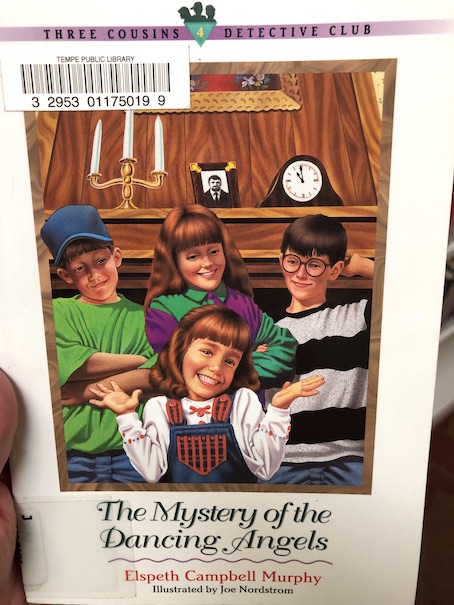
The Mystery of the Dancing Angels

Three Cousins Detective Club

#4 The Mystery of the Dancing Angels by Elspeth Campbell Murphy, 1995.

Sarah-Jane, Timothy, and Titus are visiting their grandparents over the summer when their grandmother’s cousin comes over to discuss some information she has found about their family’s genealogy. The kids’ great-great-great-grandfather was a woodcarver, and he did some work in a large house that is now being restored. There is a story that an expensive ruby necklace that belonged to the former owners of the house may be still hidden somewhere on the property.

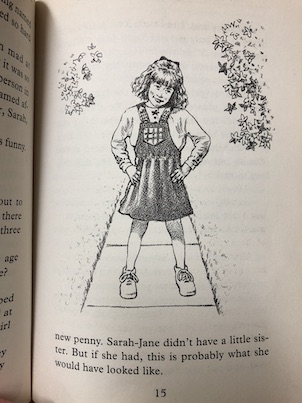
The prospect of exploring the old house and maybe finding the missing necklace sounds exciting, but the kids also must spend their time looking after their distant cousin, Patience, who is only four years old and has a tendency of getting into trouble.

When little Patience disappears inside the house, the kids are worried, but she soon returns with the answer to a riddle that has been passed down in their family for generations. Dealing with little kids requires patience, but Patience herself notices details in the woodwork in the house that the adults and older children haven’t noticed.

The theme of the story is patience.

The book is available to borrow for free online through Internet Archive.

The Mystery of the Silent Nightingale

Three Cousins Detective Club

#2 The Mystery of the Silent Nightingale by Elspeth Campbell Murphy, 1994.

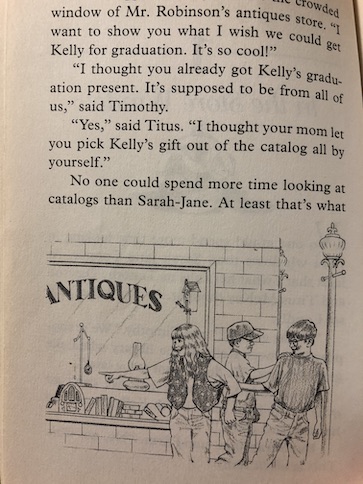
Sarah-Jane’s baby-sitter and friend, Kelly, is graduating from high school. Soon, she will be going away to college. Sarah-Jane is sad that she is leaving, but she is happy her family was able to find her a nice graduation present.

After they pick out their present, Sarah-Jane sees a locket with a nightingale on it in a store window. The nightingale is a Christian symbol for joy, and Sarah-Jane thinks that it would have made a nice present for Kelly if they didn’t already have one.

To everyone’s surprise, someone else buys the locket and leaves it at Kelly’s house. Sarah-Jane feels a little strange that someone else took the idea that she’d had for Kelly’s present. However, it is even more mysterious that there is no note or card with it to say who it is from. Kelly asks the cousins to help her find out who gave her the locket so that she can thank them. As it turns out, the present isn’t just an ordinary graduation present. It’s actually a thank you from someone who has been grateful to Kelly for a long time for a kindness she wasn’t even aware that she had done. Sarah-Jane even had a hand in it herself although she also wasn’t aware of it. Sometimes, it’s the smallest good deeds that can make the biggest difference in someone’s life.

The theme of the story is joy.

The book is available to borrow for free online through Internet Archive.

Themes and Spoilers:

The person who left the present for Kelly is Janice, who works for Kelly’s father. The kids had wondered why she seemed to recognize them when they stopped by Kelly’s father’s office early to show him Kelly’s graduation gown. It turns out that Janice has been grateful to Kelly for years for something kind that Kelly did for her when the cousins were very young. Kelly always used to read to the cousins when they were small, particularly Sarah-Jane. She took Sarah-Jane and the others to the library the day that Sarah-Jane got her first library card. That same day, Janice was also at the library.

Janice had never learned to read and was unable to finish her education. For a long time, she was ashamed to admit to anyone that she couldn’t read. Then, she heard about classes at the library for adults who had never learned to read and decided to go there. When she got to the library, she didn’t know where the classes were being held. She couldn’t read the signs, and she was too embarrassed to ask the librarian. There were some people she knew in the library, and she was so afraid of any of them finding out why she was there that she almost left. Then, Janice saw Kelly with Sarah-Jane and the boys. She saw how happy Sarah-Jane was to get her new library card, and she decided that she really wanted to learn to read, too. Janice knew that Kelly wouldn’t look down on her like some adults would, so she asked Kelly to help her find the class. Kelly helped her, even though she forgot about it later, and Janice was grateful to her for keeping her from backing out.

After Janice learned to read, she was able to finish her education. When she realized that the girl who had helped her years ago was her boss’s daughter, she wanted to give her a present. She wanted it kept secret at first because she was still embarrassed that it took her so long to learn to read. She was worried about what her boss would think of her. However, Kelly’s father doesn’t hold it against her, and Janice’s strict supervisor, Dorothy, even asks her to help tutor her grandson, who has been having learning difficulties.

Shadow in Hawthorn Bay

Shadow in Hawthorn Bay by Janet Lunn, 1986.

Mary (or “Mairi,” they spell it both ways) Urquhart and her cousin Duncan had always loved each other.  They were always close as children, feeling more like two parts of one person than separate people, and they always imagined that they would spend the rest of their lives together.  Then, Duncan’s parents, Mary’s Uncle Davie and Aunt Jean, decided that they wanted to travel to Canada, while Mary and her parents stayed at home in the Scottish Highlands.  Duncan hadn’t really wanted to go.  He was only eleven, and he promised Mary that when he was older, he would work hard to earn enough money to come back.  However, Duncan never came.  He only sent Mary a brief letter about the dark forest where he now lives.  Mary feels like the Duncan she knew is gone forever.

Four years later, in 1815, when Mary is fifteen, she has a strange feeling, like Duncan is calling to her from across the ocean.  All of her life, Mary has had a strange gift for seeing into the future or reading others’ minds.  The “gift of two sights,” people call it, but Mary doesn’t feel like it’s a gift.  It makes her uneasy, and she can’t control it.  She hears Duncan’s calls to her through her “gift,” but she is afraid because she doesn’t want to leave Scotland.  She wants Duncan to come to her.

However, she is unable to resist Duncan’s calls.  She asks her parents for help with money for her passage to Canada, but they tell her that she is wasting her time and that, even if they sold their family’s most precious heirloom to give her the money, there would not be enough for the return journey.  A family friend gives her the money instead, and although Mary doesn’t really want to accept it and doesn’t really want to go, she can’t help herself.

The journey to Canada is miserable, and when she finally arrives at the place where her aunt and uncle live, alone and without money, she learns something which she thought she had sensed during the journey: Duncan is dead.  Duncan committed suicide while Mary was still on the ship to Canada.  Mary has arrived too late.  To make matters worse, one of the family’s neighbors, Luke Anderson, tells her that her aunt and uncle gave up the idea of farming in Canada and have already begun the journey back to Scotland.  Mary has no money to follow them, and they have no idea that she’s now in Canada, alone.

Luke takes Mary to Mrs. Colliver, who tells Mary a little about her family and their life in Canada and why they decided to leave.  Mary is devastated by the loss of Duncan and tries to tell Mrs. Colliver about how she felt that Duncan had been calling out to her, but Mrs. Colliver tells her that she doesn’t believe in ghosts or things like that.  Although Mary knows that her “gift” is real and so are spirits, she learns that others in the community share Mrs. Colliver’s no-nonsense, disbelieving attitude toward such things.  Mary, in her despair, wants to rush straight back to Scotland, but Mrs. Colliver, with her practicality, points out that Mary can’t possibly get there without money.  She tells Mary that she can stay with her family, that she will give her room and board in exchange for help with chores and that she can earn extra money for weaving and spinning.  Mary is clumsy at household chores because she was always better with animals at home, but when Mrs. Colliver sees Mary’s skills with animals, she is appreciative.

Life is hard in the small farming community.  Mrs. Anderson, Luke’s mother, explains to Mary that most of the people who live there are refugees.  When they were young, their families moved there from the Thirteen Colonies that now make up the United States because they were Loyalists.  When the Revolution came, they couldn’t stay, and so had gone north to Canada, where they struggled to establish a new community for themselves with their small homesteads. During her time there, Mary witnesses the death of a baby and the hardships of this strange place, seeing why Duncan didn’t like it there.  They tell her that Duncan was a strange boy who would seem bright and happy one day, but black with depression the next, something Mary remembers in him even before he went to Canada. 

The people are kind and welcoming to Mary, although they find her a bit strange.  As Mary struggles to make a life for herself, hoping to earn enough money to return home, she slowly comes to appreciate Luke’s kindness and help.  She learns healing arts and the use of herbs from another woman in the community, developing new skills.  In helping others, she earns their appreciation and a place in their community.  Luke Anderson becomes very fond of Mary, but she still mourns for her lost Duncan.  In spite of his kindness, she doesn’t see how she can make this strange, hard, dark forest of Canada her home, where it doesn’t even seem like the spirits she believed in and that seemed to protect her when she lived in Scotland exist.

Mary is melancholy and feels like she doesn’t belong in Canada.  It distresses her that she can no longer feel Duncan’s presence . . . although she can oddly hear him calling to her sometimes.  Mary also unnerves people when she makes predictions that come true and speaks about ghosts and spirits.  When she almost gives in to her homesickness and depression and kills herself, lured to the spot where Duncan drowned himself by his ghostly calls to her, she finally sees Duncan’s death for what it really was and finds the courage to refuse to follow him down the dark path that he chose for himself and to fight for the life she has been building, the one she really wants to live.

The book is available to borrow and read for free online through Internet Archive.

My Reaction

This book is part of a loose trilogy, involving ancestors and descendants of the Anderson and Morrisay families.  All of the books take place in or near Hawthorn Bay in Canada, but at different time periods.  Some of the characters are psychic, like Mary, or have the ability to travel through time, like Susan in The Root Cellar, who is apparently Mary’s granddaughter.  The connection between Mary and Susan is never stated explicitly, but it’s implied by their last name, shared psychic abilities, and comments that a friend makes about Susan’s grandmother in The Root Cellar.  In this series, the characters from each of the books generally don’t appear in any of the others (except, perhaps, for Phoebe, who appears briefly in this book and is the main character in the third story).  Most of the time, you only know about the family connections by reading the books and taking note of the last names.  The books go backward in time as the series progresses, and the connection between the Anderson and Morrisay families is only obvious in The Root Cellar.

With the deaths that occur in the book, discussions of suicide, and the influence of Duncan’s selfish, malevolent spirit, this is not a book for young kids. I’d say that readers should be middle school level or older. There is also some implied sex and pregnancy out of wedlock when one of Luke’s brothers gets one of Mary’s friends pregnant. Her friend doesn’t give the details of what happened, but from what she says, it’s implied that Luke’s disreputable brother forced himself on the girl and that she went along with it because she didn’t know what else to do. The description of that incident is minimal, but older readers will understand what happened. There is a scandal in the community because of it, and the disreputable brother leaves rather than face the consequences of his actions.

Themes and Spoilers

I enjoyed the book for its references to Scottish folklore, which Mary believes in and seems to be in touch with through her “gift” and for Mary’s growing confidence in her abilities and more mature understanding of what her cousin was really like and what her relationship with him really was.  In some ways, I do feel sorry for Duncan because he seems to have been suffering from some kind of mental illness, possibly bipolar disorder or manic depression, which would explain how his moods could shift so abruptly and dramatically.  However, Duncan was also a selfish and controlling person.  Although Duncan’s death was sad, Mary realizes that his end was of his own making, and it’s not the future she wants for herself.  There are some disturbing scenes in the story.  Mary witnesses the deaths of others, including a baby, because it is a harsh environment, where people sometimes succumb to sickness or bad weather, although these deaths are not described in too much detail. 

There are also some frightening moments, like when Duncan’s ghost almost convinces Mary to kill herself and when he similarly lures a young boy, Luke’s younger brother, to the spot where he drowned and almost kills the boy because Mary finds the little boy comforting and Duncan doesn’t want her to be comfortable and happy.  In the beginning, readers see Duncan through Mary’s fondness for him, so the true darkness of his personality isn’t immediately apparent, although I had some misgivings about him from Mary’s first description of how they played together as children.  I didn’t like the way she described how he would tease her until she became angry or hurt and then he would sulk until she comforted him.  She says that wasn’t really fair, but to me, it was disturbing because I have seen that kind of selfish personality before, and it’s never a good sign.  It shows right from the first that Duncan doesn’t really care about Mary’s feelings.  He cares only about his own feelings, and he has no interest in changing his behavior out of consideration for her.  In fact, the very idea that he should consider her feelings seems somehow insulting to him, even though he supposedly loves her.  He just thinks that she needs to reassure him that everything he does is fine whether it is or not.  In his view, Mary is obviously wrong to feel hurt even when he tries to hurt her because he has more right to his feelings than she has to hers and he should be able to behave any way he wants with no consequences.  That’s what Mary’s first description of Duncan said to me.  As soon as I saw that, even though some might consider it just the actions of an immature child, I had some suspicions about him.

My suspicions were somewhat confirmed before Mary left home. Her mother told her that she didn’t think Duncan was worth chasing after, calling him sulky and thoughtless, but the full truth of that doesn’t strike Mary until she confronts his spirit where he died. Because people in Canada don’t like to talk about Duncan much, when Mary first hears about his death, it isn’t immediately clear that he killed himself or how.  At first, it’s just somewhat implied, but when Mary is almost lured to her death, she sees the full truth about Duncan. 

Mary comes to realize that, although everyone, including Duncan and herself, felt like the two of them were two parts of the same person, they really weren’t.  Mary sees that not only can she live without Duncan, she has been living without him for years.  She lived without him for a time in Scotland, and she’s been living without him in Canada, and she can continue to live without him wherever she chooses to live the rest of her life.  When she was younger, she had thought of Duncan as being the stronger of the two of them because he was not plagued by the same “gift” she was, but she realizes that she is actually the stronger of the two of them.  Duncan’s “love” for her had also always been a selfish one.  He couldn’t bring himself to work hard and return to Scotland for her sake, but he expected her to give up everything, even her own life, to join him in Canada and in death.

When Mary realizes all of this, Duncan’s spirit loses its hold over her, and she comes to see that the darkness in him was darker than the forests that had seemed so frightening to her before.  Free from the shadow of Duncan’s death and his selfish spirit, Mary is able to see the beauty of Canada and to be more open to the good people around her, forging a new future with a better man.

Beware the Ravens, Aunt Morbelia

This is the sequel to Aunt Morbelia and the Screaming Skulls.

Years ago, Aunt Morbelia inherited the Fearing family estate, Harrowwood, after her cousin died.  Aunt Morbelia goes to England to inspect the estate and make some decisions about its future.  The estate is in disrepair, and taxes have been eating up the funds intended for its upkeep.  Todd and his friend, Jeff, also go to England with Aunt Morbelia to see the family estate and famous places in London. 

Some of Aunt Morbelia’s fascination with creepy stories becomes apparent as she recounts the dark history of the estate and the mysterious death of her wicked, possibly murderous, uncle.  He was apparently killed by animals after his cruelty to the animals on his estate was discovered.  When they spend the night at the estate, Todd and Jeff hear a frightening howl.  They are only too happy to move on to London and go sightseeing. 

At Harrowwood, Todd finds an old journal belonging to his aunt’s cousin, Albert, and he thinks it would be interesting to see the places that he visited when he went to London years ago.  Albert was an eccentric man who died in an insane asylum because people thought he was crazy for going around town making bird sounds all the time.  Still, Todd is fascinated by the strange drawings and cryptic notes in the journal.   Before Todd can figure out what they mean, he and Jeff spot mysterious characters following them around, and someone leaves a threatening note at the bed and breakfast where they are staying.  Todd is determined to find out who their mysterious stalkers are and put and stop to it!

The book is currently available online through Internet Archive.

The first book in this two-book series wasn’t a mystery, but this one is. (The first book in the series focused more on Todd and Aunt Morbelia getting used to each other when she moved in with Todd and his parents, and it had more discussion of Todd’s dyslexia in it than this one did.) There are things that Aunt Morbelia doesn’t know about her family and the family estate. The estate has meaning for her, but it has greater meaning for someone else, and so does the journal that Todd found. The Fearings have always been an eccentric bunch, and when they learn who has been following them around, Todd and Aunt Morbelia have some suggestions that change things for the better.

Aunt Morbelia didn’t know it, but her cousin had a son before he died, and he is bitter that Morbelia inherited the estate instead of him.  He and his family have been secretly living on the estate for years, and they are afraid that Morbelia will have them thrown off.  They admit that they were trying to scare Aunt Morbelia and Todd away so they could have the estate to themselves.  They also want the journal that Todd found and has been carrying around the whole time.  The journal contains Albert’s notes of his research on birds and bird calls.  Albert believed that he had discovered the language of birds and could communicate with him.  His son wants to carry on his strange work and maybe learn to communicate with other animals, too.  Todd gives the journal back to them, and Aunt Morbelia assures them that she will not throw them off the estate.  In fact, she suggests that they give nature lessons to tourists in order to support the upkeep of the estate.  Because they demonstrated their skill with disguises and acting while following them around London, she also suggests that they put on mystery plays and host mystery weekends on the estate.  They enthusiastically agree to the plan, and Aunt Morbelia and Todd talk about visiting next year to see how things are going.

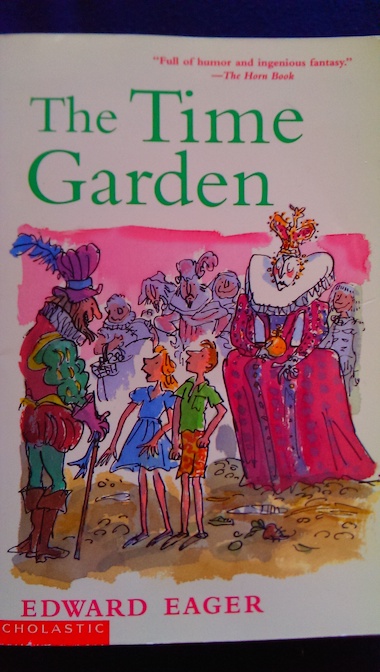
The Time Garden

TimeGarden

The Time Garden by Edward Eager, 1958.

About a year after the events in the previous book in the series, Roger and Ann are excited when their father writes a play and announces that it will be performed in England. Unfortunately, their parents aren’t planning to take the children to England with them because the trip there will be just business, focusing on getting the play together. If the play is a success, they plan to send for the children so they can do some sightseeing in England, but until then, the children will need to stay somewhere else during summer vacation. Their mother, Martha, calls her sister Katharine to see if the children can come visit their cousins, but it turns out the Katharine is also looking for a place where Eliza and Jack can spend the summer. By coincidence, Katharine and her husband are also planning a business trip to Europe.

TimeGardenMrsWhiton

The adults talk it over and end up arranging for all four children to stay with Katharine’s husband’s great aunt, Mrs. Whiton, who lives in a house by the sea, not far from Boston. The children don’t find this prospect very exciting. Then the adults tell them that Mrs. Whiton writes children’s books, Eliza is sure that she’ll be trying to analyze them for inspiration for her stories, but Mrs. Whiton turns out to be better than they thought. She is unsentimental, something that Eliza appreciates, and her house is very nice. There is a pretty garden there, and a staircase that leads right down to the beach.

One day, when Mrs. Whiton sends them out to play in the garden, they find an old sundial that has a motto written on it: “Anything Can Happen When You’ve All the Time in the World!” The children have had experience with magic before, so they begin to suspect that this garden isn’t quite what it appears . . . and they’re right. A strange, toad-like creature call the Natterjack introduces himself to the children and tells them that the thyme garden, where there are many varieties of thyme growing, is also a time garden. He explains that he and his family have helped this garden grow since his grandfather’s grandfather was brought there from England along with a shipment of primroses and that they’ve put all of their magic into the garden and its plants. If the children would like to visit another time, all they have to do is to pluck a sprig of thyme and smell it.

TimeGardenWhitonHouse

Jack, who has decided that he’s too old for magic and is now only interested in girls, refuses to try it at first, denying the existence of magic, even in spite of the talking toad. The other children try it and find themselves at the same house during the time of the American Revolution. Everyone who sees them seems to think that they are the Whiton children of that time, and they end up participating in a ride very much like Paul Revere’s, riding through the countryside to alert people that the British are coming. At first, their ride is thrilling and successful, but if you know the other books in this series, you can guess that things are going to go wrong at some point.

When the kids reach a tavern, they try to tell the drunken men inside that the British will be at Lexington soon, and they say that they don’t care. As far as they’re concerned, if the British are going to Lexington, let the guys in Lexington deal with it. The children are offended that they don’t want to help and try to appeal to their patriotism and fellowship with other Americans. It turns out that they don’t have much patriotism (the United States isn’t a separate country yet, so there is that) or feelings of fellowship because their plan for if the British are defeated is basically “every man for himself.” (I understand this scene so much more now as an adult than I did when I read this as a kid. I think I’ve met their descendants.) The children are angered at this mercenary attitude, and Ann accuses them of being pro-British. One of them insists that they’re not because, “We ain’t pro-anything.” (Yep, this is familiar. Some people just want to be contrary until there’s something in it for them to gain.)

It gets worse when the anti-British talk causes the Natterjack, in a surge of British patriotism, to cry, “Rule, Britannia!” The drunks in the tavern then decide that the kids were trying to deceive them about the British coming because they’re actually on the side of the British, trying to distract them from the British army’s real plans. When they discover that the voice actually came from a talking toad, they declare that it’s witchcraft and decide to throw the children into the pond to see if they will float (an old test in witchcraft trials).

In a bizarre twist, they are saved by a band of attacking American Indians. (Native Americans ex Machina?) There’s no real reason for a tribe of American Indians to be attacking at this particular moment, and the kids in the story seem to realize that.  This incident, like many others in this series, is partly based on other books in classic children’s literature, especially the works of E. Nesbit, the author’s favorite children’s author.  A similar incident occurs to the children in E. Nesbit’s Five Children and It, although under different circumstances.  The author of this story frequently pokes fun at tropes of classic children’s literature in his books and makes pop culture references from the 1950s, so the more old books you’re familiar with, the more you see the jokes, although I admit that, even knowing the background, this scene still bothers me. In the grand tradition of cheesy 1950s westerns, there’s a vague description of the carnage of the attack with the requisite scalping and tomahawking (yes, they use it as verb). Ann is upset about the attack and covers her eyes, although Roger says that he doesn’t think that this attack could really have occurred in real life because they would have heard about it if it were a real, historical event. Ann worries that they somehow caused it by messing with history. When the tribe is done tomahawking their attackers, the children are worried that they’ll be next, but the Natterjack tells the children that they can escape by smelling the thyme again.

Before we move on, I should point out here that, in different books in this series, it’s never entirely clear how much of the children’s adventures occur in the real world or in some kind of magical, alternate reality or maybe in their own minds, and this is actually intentional. The idea of sniffing a magical herb and being transported through time sounds kind of trippy. The whole “savage painted Indians” (their words, not mine) trope was a staple of old western shows, the kind that kids growing in the 1950s might have watched because that genre was popular, particularly in the late 1950s, when the book was published, so the children’s experiences may be partly patterned after what a 1950s kid might have imagined after watching those shows. (Sort of like the Arabian fantasies that their mothers had in previous books in the series, probably inspired by The Sheik.) So, this incident in the book is partly a take-off on similar ones in other children’s books, but it might also be the author’s commentary on the types of shows that were popular and children’s expectations.  Perhaps some of the implication is that the children’s expectations, based on things they’ve read or seen on tv are what caused this weird, otherwise inexplicable attack in the first place. (It’s like on tv, kiddos, and now you can see it in full color!  You expected it, so you got it.  Still think this stuff is fun?) Part of the problem with this scene for me is that it’s difficult to tell exactly how the author means it. I can guess a little, given the author’s taste for making literary references and parodying tropes of children’s stories, but even as a parody, it’s uncomfortable by modern standards and still makes very little sense why it’s even happening at all. This scene is just plain needless and cringe-worthy in my opinion, but you sometimes run into things like that with older children’s books.  It’s some consolation that this is the worst scene in the entire book, so it’s good to get it out of the way early.

Before we return to the main plot again, I’d also like to say that the children themselves don’t seem to understand exactly how the magic works (like other children in this series) or whether what happened to them was completely real or not.  They debate about it periodically and wonder about the children that they replaced on this adventure (and on later ones as well). They never quite know if those children went somewhere else while they took their place or if both sets of children were just living out the same adventure at the same time, just seeing it in slightly different ways.  These time travel questions are fun to ponder, but are never really explained, just theorized.

When the children get back to their own time from the Revolutionary War period, the Natterjack apologizes for getting them into trouble and asks them to put the plant sprig back in the ground, where it grows again (no “wasting thyme”, ha, ha). He also further explains that the name of the particular variety of thyme they pick in the garden is important because it has some bearing on where in time they will go. The thyme they had chosen was “wild thyme”, and they had to admit that their time was pretty wild. Ann borrows a gardening catalog from Mrs. Whiton’s old gardener and begins studying the different varieties of thyme. When they ask the Natterjack about the massacre at the tavern, he tells them that the mistakes they make or bad consequences of their interference will be erased by the good deeds they do, so their timely warnings about the British coming will have an effect, but that massacre has been erased from history. (Too bad it’s still in the book.  There’s still no real reason for it to be there, dang western trope.) Good deeds performed during their adventures will earn them more adventures, so they have to remember to do some good in every time they visit.

So, while Jack spends most of his time getting to know the local teenage girls and doing normal teenage things and trying to ignore his sister and cousins when they talk about magic, the others get to spend their summer having magical time adventures. The next variety of thyme they pick is “splendid thyme.” Once again, they are taken back in the history of the house, where they are again mistaken for past Whiton children. The time period is around the Civil War, and the house is being used as a station on the Underground Railroad. The children help some escaping slaves to flee to Canada. (Their sentiments are strongly anti-slavery, which is a relief after that massacre scene. The escaping slaves aren’t portrayed too badly, although mostly, they’re in hiding during the adventure and are oddly unquestioning of how the kids managed to use magic to get them to Canada so fast, just embarrassingly grateful for it.)

TimeGardenCrossOver

After that, Eliza wants to know if they’re restricted to historical adventures only or if they can visit times that are fictional as well, referencing their adventures with Ivanhoe in the previous book. It turns out that the time garden is very accommodating, and they are able to go back in fictional time to visit the characters in Little Women (which, fortunately, took place not far from where they are staying), especially since Louisa May Alcott based the characters on herself and her sisters, giving the book a sense of semi-reality. Jack, who has been denying the magic all along, comes with them on this adventure, and spends all of his time fawning over the teenage Meg and Jo. The children help to reform an ungrateful family that has been taking advantage of the girls’ generosity (and, as Jo says, reforming “is punishment enough”).

Sharing in this adventure with the other children is enough to get Jack to admit that they’re having adventures, although he still refuses to look at it as being magic, preferring more scientific terms. At one point, he describes a theory of time as looking down on the world from an airplane. From high above, you can see many different places at once, but it would take a person on the ground a long time to get from one place to another. Similarly, Jack thinks that everything in history is happening all at once, but it just takes people a long time to get from one event to another because of their vantage point.

TimeGardenElizaLondon

Then, the children get the idea to go visit their mothers in England. However, when they use Common Thyme with their wish, they end up seeing their mothers in the past, not the present. This is the point in the story where it crosses over with their mothers’ magical adventures as children in Magic By the Lake.

Eliza then gets the idea of using thyme seeds to travel through time instead of using a full-grown plant. She and Jack end up traveling to England. However, they end up in the wrong period of history, and because the magical rules are broken, everyone sees them as the modern children they really are and not as people from the appropriate time period. When Eliza manages to offend Queen Elizabeth I and ends up in the Tower of London, they need the help of Ann, Roger, and the Natterjack to straighten things out!

I think my favorite part of the story is really the thyme/time garden itself. Not only is it a fun pun, but I thought that it was clever how the titles of particular varieties of thyme relate to the times and places where the children end up. Different varieties of thyme plants really do have some incredible names in real life. At the end of the book, after the children go to England to join their parents because the play was successful, the Natterjack waits in the garden for the next set of children who will go on adventures, and after looking up other varieties of thyme that the book never mentioned, the possibilities for new adventures are tantalizing: Leprechaun Thyme (for adventures with leprechauns), Elfin Thyme (either for adventures with elves or maybe becoming smaller?), and Woolly Thyme (Want to go see a woolly mammoth? On the other hand, maybe it just goes to a sheep farm. This magic stuff never works like you think it will).

The book is currently available online through Internet Archive.

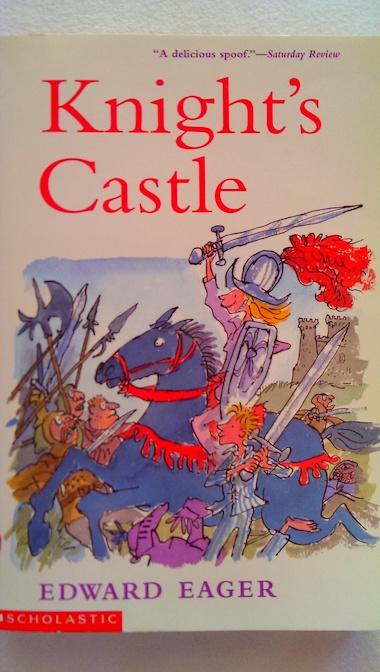
Knight’s Castle

Knight's Castle

Knight’s Castle by Edward Eager, 1956.

Roger and Ann are the children of Martha from the previous two books in the series. Like their mother’s family when they were growing up, they live in Toledo, Ohio. Their Aunt Katharine (one of Martha’s older sisters) used to live close to them in the Midwest but now lives in Baltimore, Maryland. Roger and Ann don’t particularly get along with Aunt Katharine’s children, Eliza and Jack, because Eliza is bossy and Jack is only interested in photography. However, the four children end up spending the summer together when Roger and Ann’s father needs to have an operation at a hospital in Baltimore.

Like their mother and her siblings when they were young, Roger and Ann also like fantasy stories, which their father likes to read to them. Roger starts to believe in real magic when it seems like one of his toy soldiers comes to life at night. Roger collects toy soldiers, and he has over 200 of them, but this one is special because his father says that its been handed down in their family for generations. Roger calls it the Old One. It’s rather worn, so it isn’t obvious at first, but the Old One is actually a knight. Worried about his father’s illness, Roger takes the Old One to bed with him (which he thinks is more manly than taking a teddy bear to bed), and then feels it wriggling in his hand.

Knight's Castle Roger

Realizing that the Old One is magic and is coming to life when he holds him, Roger asks him if it’s part of his magic to grant wishes. If it is, then he wishes for his father to get well, and if possible, for him and his sister to have an adventure in Baltimore over the summer. The Old One doesn’t answer him immediately, but over time, he makes it clear to Roger that wishes have to be earned, and that will be the source of his summer adventure.

When the children arrive in Baltimore to stay with wealthy Aunt Katharine while their father is in the hospital, Aunt Katharine gives them presents. Ann gets a new dollhouse, and there is a toy castle for Roger. Since Aunt Katharine has also just taken all the children to the movies to see Ivanhoe, all of them become immediately interested in playing with the castle.

That night, Roger has a strange dream that he finds himself within the story of Ivanhoe, which is being acted out in his toy castle. The Old One is there as well, although he is mainly watching the action as Roger begins to take part in the story. When Roger comes face-to-face with the villain, he accidentally lets Ivanhoe’s plans slip to him. Things are looking pretty bleak when Roger suddenly realizes that the castle is still a toy and everyone around him is just a lead soldier. This revelation ends the magical adventure and brings him back to reality. However, Roger is disappointed that he ended the adventure so early when perhaps he could have done something really heroic.

Seeing the toy soldiers scattered around instead of poised for the battle they were planning the night before, Eliza and Ann think that Roger was just playing with the castle without them, but he explains to them what happened. The girls were just reading The Magic City by E. Nesbit, and they start building their own “magic city” out of random things from around the house, surrounding the toy castle. Roger is upset about the city because he says that it doesn’t fit in with the Ivanhoe story, and he’s sure that it will ruin everything, maybe from preventing the magic from working again at all. The Old One tells Roger that magic works by threes, so the next opportunity for magic will be in three days.

Knight's Castle Magic City

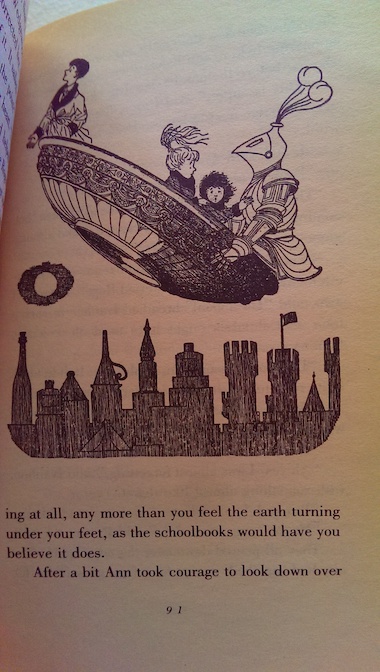
As it turns out, the city does end up becoming part of the story when the magic brings it all to life on the third night. Roger, Ann, and Eliza find themselves in the middle of the city, surrounded by knights attempting to drive modern cars. Ivanhoe has become a fan of science fiction books, via the public library in the city that the girls built. Although Ivanhoe has turned into something of a geek, the children persuade him to come on a mission to rescue the captive Rebecca, and they end up traveling in a flying saucer (made from a real saucer) to the Dolorous Tower, where the adventure ends as soon as Eliza remembers that the villain threatening them is still just a lead soldier.

Knight's Castle Flying Saucer

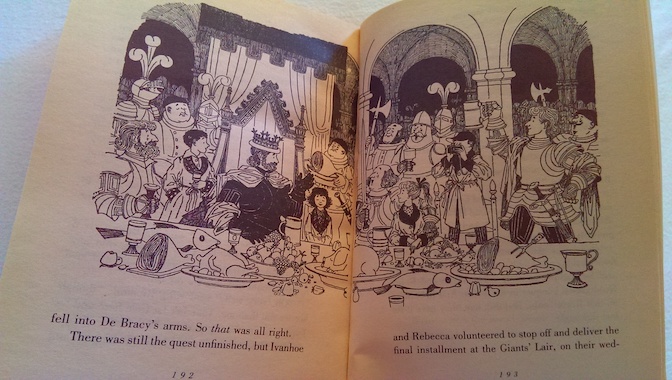
It was an even weirder adventure than Roger’s first one, but by now, the children are starting to understand the rules that go along with the magic. Jack, who says he doesn’t really believe in magic, accompanies the other children on the next adventure, as they try to prove to him that it’s real. They end up having to rescue some of the others from the “giant’s lair”, which turns out to be Ann’s new dollhouse. The dolls are angry that Ann has been neglecting them, only paying attention to the dollhouse when she and Eliza needed to borrow things for their magic city. They manage to escape again by remembering that the dolls are just dolls.

However, Roger is still worried about their father, who is about to undergo his operation. The Old One had told him that wishes needed to be earned, and he doesn’t think that they’ve managed to accomplish much in their adventures. Roger thinks that they need to do something really heroic so that his wish for his father to get better will come true. The Old One gives Roger a rhyme, hinting at what the children need to do on their next adventure, but Roger doesn’t understand what it means, and he doesn’t know if he can figure it out in time.

Actually, it is Ann who eventually realizes what the rhyme means and provides Roger with the “wisdom” that he needs to earn his wish. All throughout the story, Roger was criticizing his little sister for things she did wrong, saying that she was too little and only a girl. Because Roger thinks of her as being just his little sister, he overlooks what she has to contribute to the adventure. Roger’s acquired wisdom is to value the contributions of others and not underestimate their ability to contribute. Ann, being young and shy, frequently doubts herself, but she also learns confidence when she realizes that she has the answer to the riddle. Jack and Eliza learn lessons as well. Doubting Jack learns to believe in magic, and Eliza learns that she can’t always be the boss, that sometimes it is better to let someone else take the lead when they’re the right person for the job. (Although, she does say at the end of story, “If that wouldn’t be just like that magic’s impudence! Trying to teach me moral lessons!”)

Like other books in this series, there are a lot of references to popular pieces of children’s literature and jokes about things that happen in children’s stories.

The book is currently available online through Internet Archive.

Knight's Castle Feast