Felicity’s Craft Book

American Girls

Felicity’s Craft Book by Rebecca Sample Bernstein and Jodi Evert, 1994.

This is a companion book to the Felicity, An American Girl series.  It explains about the types of crafts that people would do in Colonial America and gives instructions for projects that readers can make at home.

In the beginning of the book, there is a brief history of crafting in America.  It explains that, in the earliest days of the American colonies, people had to get most of their goods from Europe because they had to spend their time and energy on building homes and establishing farms in order to survive.  However, as the colonies became more established, people were more able to make goods for themselves, both in their own homes and as professional craftspeople.  By the time that Felicity lived, during the late 1700s, there were many skilled craftspeople, and those craftspeople also trained new people in their professions in apprenticeships.

Before presenting craft projects that readers can make, the book also offers a few tips for safety and neatness while making things. The crafts are also divided into sections relating to topics like writing, sewing, games and toys, and scented objects that you can make with plants.
The projects explained in this book include:

A quill pen and two types of ink – The book gives instructions for making ink from different types of berries (such as raspberries, strawberries, and blackberries, which make red or purple ink) and walnut shells (which makes a brown ink).

A wax seal – To be used with sealing wax or wax from a candle. These were used to seal letters before the invention of envelopes with glue. (I know that there are people and companies that still make these because I have one myself and the sealing wax to use with it.)

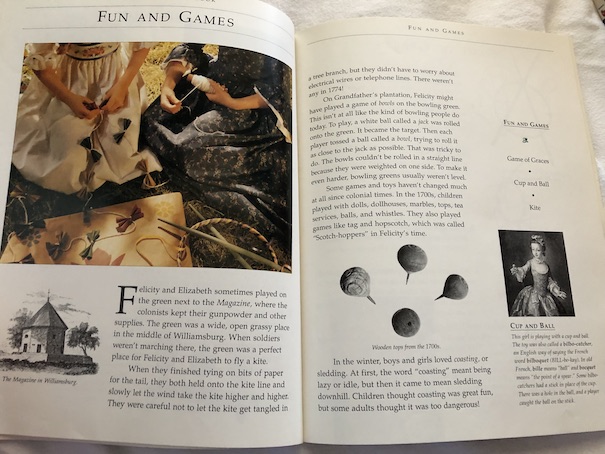
Game of Graces – A hoop with a pair of sticks that were used for a tossing game.

Cup and Ball Game – A common toy in which a cup is attached to the end of a short stick and a ball is tied to it.  Players have to move the toy around and make the ball swing into the cup.

Kites – Made with lightweight paper.

Folding Fan – Made with poster board and ribbon.

Fancy Straw Hat – Explains how to decorate a hat with flowers and ribbon.

Fruit Pyramid – Used as a table centerpiece.

Cross-Stitch Sampler – A basic sampler using only the cross-stitch. (Colonial girls would create more elaborate samplers to show off the range of stitches they could make.)

Sachet – A small bag of potpourri (sweet-smelling dried plants).  Colonists would put sachets into trunks and wardrobes where they were storing their clothes to make them smell nice.  (Some people still do this in modern times.)  In a later part of the book, they also give instructions for making potpourri with herbs and flower petals.

Friendship Pincushion – An embroidered pincushion.

Tussie-Mussie – A small bouquet, like the kind that bridesmaids and flower girls might carry.  (The book says that people in Colonial times might carry one or maybe a pomander ball if they went to visit a sick person because they had an idea that breathing bad air would spread sickness and they were trying to freshen the air with fresh scents.  That’s not quite how sickness is spread, but they were partly correct about sicknesses being airborn.)

Pomander Ball – An orange scented and decorated with spices and cloves.  Besides freshening the air, they can also make nice decorations.

In the sections about different types of projects, there is additional historical information about life and crafts in Colonial America. Because, in the books, Felicity’s grandfather owns a plantation and one of the books takes place there, the craft book also has a section about plantations that includes a brief description of plantation life and slavery, noting that the lifestyle and pastimes that plantation owners enjoyed would not have been possible without their slaves to take care of the plantation chores for them.

The book is currently available online through Internet Archive.

The Cuckoo Clock

CuckooClockStolz

The Cuckoo Clock by Mary Stolz, 1987.

Erich was a foundling, taken in by the Goddhart family as a baby after he was found on their doorstep. Frau Goddhart has a reputation for kindness, but sadly, that reputation is really all she has. She is outwardly kind, participating in local charities, only to enhance her reputation. At home, she is selfish and cruel, ruling the house with an iron fist and having tantrums when things don’t go her way. She sees Erich as an unwanted responsibility, only grudgingly raising him along with her own children because if she refused, it would ruin her reputation. Her husband is kind to Erich, but Frau Goddhart treats him more like a servant.

Erich only comes to know real love when he becomes Ula’s assistant. Ula is the town clockmaker, a master in his craft. Ula teaches Erich his craft and how to play the violin.


When Ula dies, leaving Erich his carving tools and his violin, the selfish Frau Goddhart tries to take them away, thinking that such things are too good for a mere foundling, a charity case. Before she can get these precious things, Erich runs away to seek his fortune elsewhere, but he leaves behind something that convinces the town that, although he may be the ungrateful wretch that Frau Goddhart says that he is, he has a talent that will lead him on to greater things.


One of the fascinating things about this book is the pictures, which are charming pencil drawings in a realistic style.  There is also a note in the back about the unusual typeface of the book.

CuckooClockStolzType

The Little Indian Basket Maker

BasketMaker

The Little Indian Basket Maker by Ann Nolan Clark and illustrated by Harrison Begay, 1957.

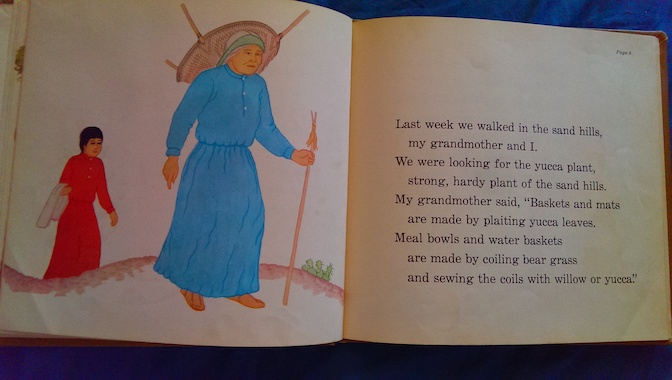
By “Indian,” the author means Native American.  This book specifically focuses on the  Papago (Tohono O’odam) who live in the Southwestern United States, specifically Arizona.  The story is about a young girl who is starting to learn the traditional art of basket-making, and the book goes into the process involved in making baskets, step by step.   Although the use of “Indian” instead of Native American is somewhat antiquated, and Tohono O’odam is really the proper name for the Papago people, the book has something of an interesting history and the picture it provides of the practice of traditional crafts is fascinating. There is a section at the beginning of the book which explains a little about the history of the Papago (Tohono O’odam) people and where they live.

BasketMakerGrandmother

A young girl explains how her grandmother teaches her the traditional craft of making baskets.  They start by gathering the types of plants that they are going to use.

BasketMakerPlants.jpg

They also need special plants for the dye they will need in order to decorate the baskets.  The girl’s grandmother explains about the different types of decorations they traditionally use.

BasketMakerDesigns

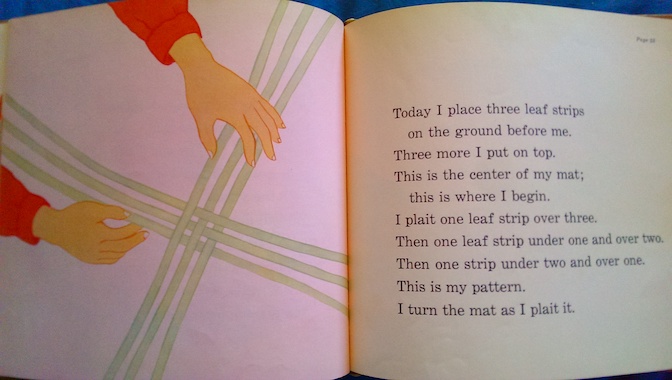
Making baskets is a long process that includes cleaning the plants and tearing them into long strips, bleaching them, soaking them to soften them, dyeing strips used in the design, and weaving them together.

BasketMakerSoftening

The girl weaves a mat that takes days to finish.  It is the first one that she’s made herself.

BasketMakerWeaving

She is very proud of herself when the mat is finished, and she is pleased with the quality of her work.

BasketMakerFinishing

I’ve owned this book since I was a young child, and it was my introduction to traditional crafts.  Later, I found a related book at a thrift store, The Little Indian Pottery Maker.  Until then, I hadn’t realized then just how old the books were and that there were more of them by the same author.

The book, which was written in the 1950s, was one of a group of stories (not exactly a series because they didn’t have a specific set of characters in common and the themes varied somewhat) written by a woman who was a teacher with the United States Indian Service.  The other books that she wrote, including The Little Indian Pottery Maker, focus on members of different Native American tribes.  She was not Native American herself, and the modern view of Indian schools is not favorable (for good reasons), so one might be a little suspicious of a book written about Native Americans by an Indian school teacher. However, these books interest me because of their explanation of traditional crafts. There are no white people in the stories at all, and they have a timeless quality to them.  Reading them, it’s hard to get a sense of exactly when the stories take place because it’s never mentioned, and there aren’t many clues (no mentions of modern technology, it’s all about the crafts).  I haven’t found any of the other books that the author wrote, but these two are very respectful in their tone, and they begin with explanations of the history of the tribes involved in the stories.  According to Andie Peterson in A Second Look: Native Americans in Children’s Books, the author was deliberately trying to write books that her Native American students could relate to.

The art style of the books vary because they had different illustrators.  The illustrator for this particular book was a Navajo painter.

The book is available to read for free online through Internet Archive.

The Little Indian Pottery Maker

PotteryMaker

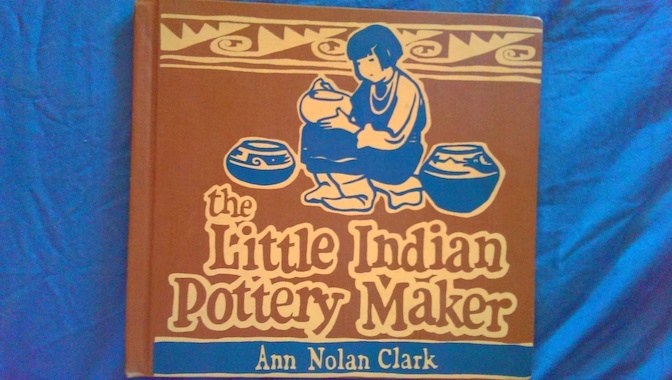
The Little Indian Pottery Maker by Ann Nolan Clark and illustrated by Don Perceval, 1955.

By “Indian,” the author means Native American.  This book specifically focuses on the Pueblo Indians who live in the Southwestern United States, specifically New Mexico and Arizona.  The story is about a young girl who is starting to learn the traditional art of pottery-making, and the book goes into the process involved in making pottery, step by step.   Although the use of “Indian” instead of Native American is somewhat anitquated, the book has something of an interesting history and the picture it provides of the practice of traditional crafts is fascinating. The beginning of the book explains a little about Pueblo Indians, their history, and where they live.

PotteryMakerGettingClay

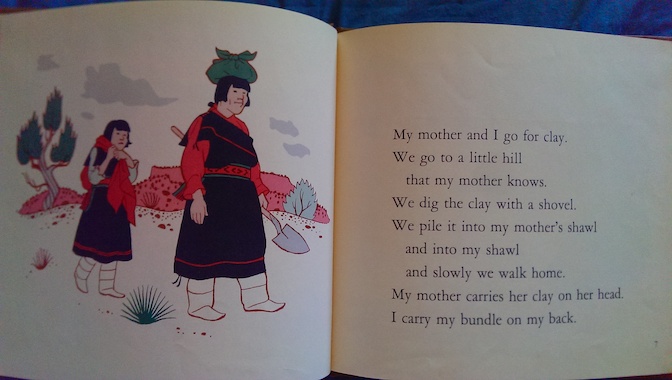
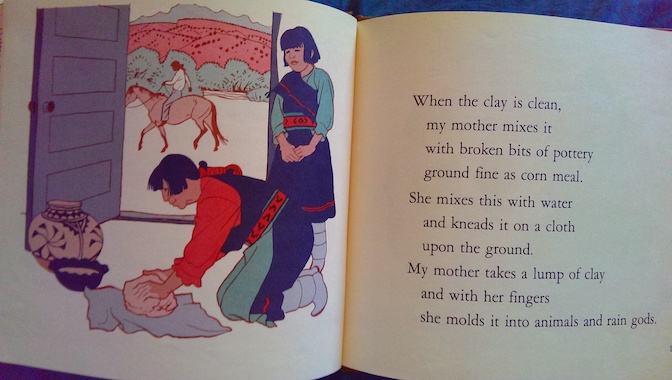
The young girl tells the story of how her mother introduces her to the traditional craft of making pottery and teaches her how to make her first pot.  She describes every step in the process, from when they collect the clay themselves from a hillside until the pot is finally complete.

PotteryMakerMixingClay

The girl’s mother explains about the different methods used to make pots, and pictures show how pots are shaped.

PotteryMakerRollingClay
PotteryMakerMakingPots

Making pottery is a long process that takes days to complete, including shaping, scraping and smoothing the sides, drying, decorating, and finally firing the pottery.  The girl is proud of the first pot she has ever made.

PotteryMakerFiringPots

I found this book at a thrift store a number of years ago and recognized it because I already owned a related book, The Little Indian Basket Maker, that I liked when I was a young child.  I hadn’t realized then just how old the books were and that there were more of them by the same author.

The book, which was written in the mid-1950s, was one of a group of stories (not exactly a series because they didn’t have a specific set of characters in common and the themes varied somewhat) written by a woman who was a teacher with the United States Indian Service.  The other books that she wrote, including The Little Indian Basket Maker, focus on members of different Native American tribes.  She was not Native American herself, and the modern view of Indian schools is not favorable (for good reasons), so one might be a little suspicious of a book written about Native Americans by an Indian school teacher. However, these books interest me because of their explanation of traditional crafts. There are no white people in the stories at all, and they have a timeless quality to them.  Reading them, it’s hard to get a sense of exactly when the stories take place because it’s never mentioned, and there aren’t many clues (no mentions of modern technology, it’s all about the crafts).  I haven’t found any of the other books that the author wrote, but these two are very respectful in their tone, and they begin with explanations of the history of the tribes involved in the stories.  According to Andie Peterson in A Second Look: Native Americans in Children’s Books, the author was deliberately trying to write books that her Native American students could relate to.

The art style of the books vary because they had different illustrators.  The illustrator for this particular book was not Native American (unlike some of the illustrators of other books), but he was adopted into a Hopi tribe, apparently as an adult because of his accomplishments in representing Hopi culture in art.

Colonial Crafts

Historic Communities

ColonialCraftsColonial Crafts by Bobbie Kalman, 1992.

In Colonial America, everything had to be made by hand.  There were people whose entire profession was to make certain types of things, and this book describes common types of craftspeople, how they learned their skills, the goods they made, and how they practiced their trades.

People who worked with their hands learned their trades directly from others in their profession by serving apprenticeships.  Schools as we know them were less common in Colonial times and were mainly for upper class families, especially the sons of wealthy men.  Girls typically learned domestic crafts such as sewing, weaving, and candle-making.  Girls were mainly expected to marry and be housewives, and boys often learned their father’s trade.  How long an apprenticeship would last depended on the trade, but apprentices usually started performing very basic chores for their masters and gradually worked their way up to more difficult tasks as they learned the trade.  At the end of an apprenticeship, the apprentice would produce a work called the “masterpiece” to show off their new skills.  Then, the apprentice would become a journeyman, traveling around and looking for work in their trade until they earned the money they needed to open a shop of their own.

ColonialCraftsBaskets

Some of the trades covered in the book are cabinetmaker, leatherworker (including related trades like shoemaker and harnessmaker), cooper (someone who makes barrels), wheelwright, blacksmith, silversmith, gunsmith, printer, and milliner (someone who could make and alter clothing and sell fashion accessories).  The descriptions for each profession include not only details about the trade and tools of the trade but interesting facts such as the fact that, in Colonial times, shoemakers did not make shoes different shoes for left and right feet.  Both shoes in a pair were shaped exactly the same because it was easier for the shoemaker and because people thought that the tracks of identical shoes looked neat.  Aside from the professional crafts, the book also explains a little about domestic crafts, the kinds of things that people made in their own homes.

The book is full of pictures of historical reenactors demonstrating different crafts and trades.  It is currently available online through Internet Archive.