Double Trouble

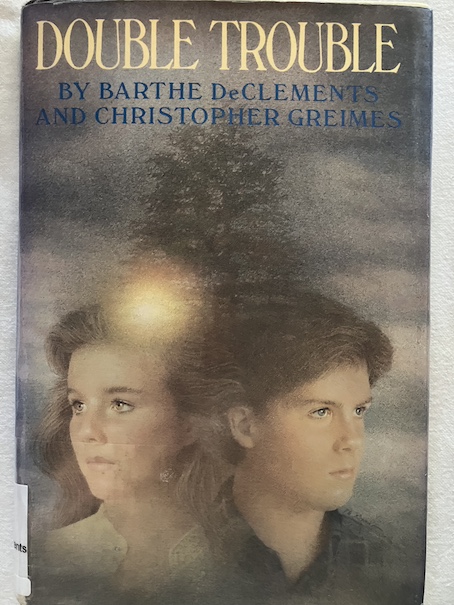
Faith and Phillip are twins and the only members of their immediate family who are alive. Their parents and their older sister were killed in a car accident. Faith was taken in by their aunt, but their aunt didn’t think that she could manage to care for two children, so Phillip was sent to a foster home. The story is written in the form of letters to each other (this is called epistolary style) after their separation.

Separating is cruel, especially when they’re orphans, but there is something about Faith and Phillip that other people don’t know. They have psychic powers, and they have the ability to communicate their feelings to each other with their minds. They have to communicate specific information to each other in writing because their psychic abilities only communicate their general mood and circumstances, but their psychic link to each other makes them feel less alone when they’re apart. Apart from dealing with their grief over the loss of their parents and the changes to their lives, each of them is also in a troubling situation.

In her first letter to Phillip, Faith tells him about a disturbing encounter with a teacher at her new school. Faith was selling candy with another classmate, Sue Ellen, to support the school band. Sue Ellen gets the idea of going by Mr. Gessert’s apartment. Mr. Gessert is their social studies teacher and is considered one of the cool teachers in school. Faith can tell that Sue Ellen has a bit of a crush on him. He buys one of their candy bars, and Sue Ellen asks to use his bathroom. When Sue Ellen seems to be taking awhile, the teacher goes to see if everything is okay, and he catches Sue Ellen snooping around. He gets especially angry when Faith is about to touch his cane near the door. He grabs both girls by the arm and throws them out of the apartment. Although snooping in someone’s private rooms is rude, the girls are startled by how angry Mr. Gessert is. Faith asks Sue Ellen what she saw in his apartment, and Sue Ellen says that she didn’t see anything. She had just started to open the door to a room when he found her. The next day, Sue Ellen brags to other kids at school about having been in the teacher’s apartment, but Faith is still concerned about how angry Mr. Gessert was.

When Phillip replies, he says that he can understand why the teacher would be annoyed at someone snooping through his stuff, and he tells Faith about his new foster parents, the Wangsleys, Howard and Cynthia. He’s now living in Seattle, about 50 miles from where Faith is living. Phillip also got picked on at school by a bully, but a girl named Roxanne spoke up for him. He thinks Roxanne is pretty, and he describes her aura as being indigo. (The twins also have the ability to see people’s auras and use them to learn things about other people.) His new foster parents don’t take his vegetarianism seriously, trying to convince him to eat meat. They say that God put animals on Earth for people to eat and that he has to eat like they do. Their house is shabby, and Howard keeps Cynthia on a tight budget. That surprises Phillip because he thinks Howard must be making decent money at the shipyards. He wonders how Howard spends his money, if it’s not on his wife or home. He knows that Howard and Cynthia belong to some kind of religious group and that, whenever they return from one of their meetings, they act strangely, and their auras are weird. He’s still grieving their parents and sister, and with all the stresses of his new home, the only time he feels better is when he’s using astral projection, to get away from it all.

The twins learned their psychic skills from their sister Madalyn and Madalyn’s friend, Roger, who is an archaeologist. Faith doesn’t quite have Phillip’s ability with astral projection, but she can sometimes get visions of other people and what they’re doing. She uses this ability to try to learn more about Mr. Gessert, and she sees that his cane is actually a gun. She watches him loading it. Why would a teacher have a cane with a hidden gun?

Faith is still angry that her aunt didn’t take Phillip, too. She also hesitates to ask her aunt for things she needs because she doesn’t want to seem like a charity case. She has a part-time job taking care of her neighbors’ dogs while the neighbor is on vacation, and she uses the money to buy a pair of second-hand boots. When Aunt Linda finds out that Faith bought second-hand shoes, she says that Faith should have told her that she needed shoes because she doesn’t want people thinking that she isn’t taking care of her niece. Still, after she cleans them up, they don’t look bad, and she gets compliments on them at school.

The next time she sees Mr. Gessert in class, he seems normal at first. He gives the class a lesson on the Donner Party of pioneers, who were trapped by a snowstorm and resorted to cannibalism to stay alive. (This is actually described in gruesome detail in the book. Some kids like a good gross-out, but I never did.) After Mr. Gessert describes all the gory details in class, one of Faith’s other classmates comments that Mr. Gessert seems crazy. Faith knows that he was telling them the truth about what happened, but she finds it disturbing how much he seemed to enjoy recounting all the grossest parts, and other classmates agree. Phillip is concerned about Faith’s description of the teacher, so he uses astral projection to spy on him, and he agrees that Mr. Gessert gives off weird vibes.

Both Faith and Phillip connect with other kids at their schools who have an interest in psychic abilities. Faith meets a boy named Jake, who is intrigued because his father has been reading a book about remote viewing, which is what Faith does. As Phillip becomes friends with Roxanne, who is interested in the topic of astral projection. When Phillip confides in her about his astral projection abilities, she asks him to teach her how to do it.

One day, when Phillip and Roxanne are at the library, they see Mr. Gessert there. Mr. Gessert has an interest in Spanish treasure, and there is a special exhibit at the library with some very valuable pieces. Soon after that, the Spanish treasure is stolen from the library. It doesn’t take a psychic to see that Mr. Gessert, who has already been established as creepy and suspicious, might have a motive to steal it, but he’s not the only suspect. Working separately, with the help of their friends, Phillip and Faith use their special mental abilities to get to the bottom of Mr. Gessert’s secrets.

The book is available to borrow and read for free online through Internet Archive.

There are a lot of metaphysical themes to this story with the kids exploring their psychic abilities. It is revealed that their old family friend, Roger, is a kind of archaeologist/treasure hunter, but he is regarded as unorthodox by his colleagues because he uses his psychic abilities to guide his discoveries. Roger is the one who taught the twins and their older sister how to use their abilities.

In the story, the people who are open to developing their psychic/spiritual/metaphysical sides are the heroes, and they thrive when they connect to other, like-minded people and share what they know with each other, helping each other to develop. However, there are unhealthy forms of spiritual development in the story. Phillip is unnerved about the Wangsleys and their religious group from the beginning because the Wangsleys always act strangely after one of their meetings. Initially, I was concerned that this group might be doing drugs or something like that, but that’s not the case. It’s a little vague exactly what group the Wangsleys are part of, but it seems to be a very conservative Christian group with a cult-like devotion to their leader, and the the Wangsleys have an unhealthy relationship with it.

I don’t think it’s an unhealthy group for being Christian, but it seems like devotion to this particular group encourages overly harsh discipline and emotional manipulation and that Howard and Cynthia’s relationship with each other is troubled because of disagreements about their level of devotion to the group’s standards. I sometimes think that people who don’t have a religion imagine that all Christian groups are like that, but I’ve been to various Christian churches throughout my life, and most are not like this. There are some extreme groups like this, but this is definitely an extreme group. It seems to be an isolated group that isn’t part of a larger denomination. It seems to have just one charismatic leader. I think it’s implied, although not directly stated, that the reason why Howard isn’t spending more money on keeping up his house is that he’s contributing a large portion of his income to this religious group. I’m a little suspicious about the money issue and the long periods that the group’s leader seems to spend in Hawaii, ostensibly on religious business. While it isn’t stated explicitly, and I could be wrong, I think there are some implications about the Hawaii trips and the money of this group that make them seem suspicious.

Besides the metaphysical elements, there are themes of children adjusting to loss and trauma and major life changes with the deaths of the twins’ parents and their adjustments to their new homes. Initially, Faith doesn’t have a very good relationship with her aunt. She’s angry that her aunt didn’t accept her twin brother and sent him into the foster system, and she finds her aunt’s manners cold. She doesn’t trust her aunt enough to ask for the things she needs, even basic clothing, and her aunt gets upset about that. Things improve between them when they learn to communicate more openly with each other. Aunt Linda does care about Faith, but she’s also dealing with her own feelings and uncertainties about raising her niece. She has never married or had children, and while she does want Faith living with her, becoming a single parent is a major adjustment for her.

The Wangsleys are completely unsuitable as guardians for Phillip. They don’t accept his vegetarianism and complain about having to make special things for him. They keep trying to convert him, both to eating meat and to their religious group. I feel like their religious affiliation should have been disclosed from the beginning and that there should have been some discussion between them, Phillip, and Phillip’s caseworker about the differences between their lifestyle and the lifestyle that Phillip is accustomed to living, so they could all reach an understanding about what living together would mean for them before he actually went to life in their house. Phillip does describe some meetings with the Wangsleys and his caseworker during his time with the Wangsleys, where the caseworker tries to mediate circumstances between them and offer suggestions, such as ways they can deal with Phillip’s vegetarianism. Cynthia does make some efforts to accommodate Phillip’s eating habits, but they’re kind of half-hearted, and the Wangsleys absolutely cannot accept that Phillip doesn’t want to join their religious group. They heavily pressure him to convert, and when they discover Phillip’s astral projection activities, they’re convinced that he’s having visions given to him by the devil and demons. They tell Phillip’s caseworker that they want to adopt him, but Phillip finally speaks out about what life with them is really like. In the end, Roger decides that he will take Phillip, and the Wangsleys are forced to relinquish him to his caseworker.

From now on, Phillip will be living with a family friend who understands him and shares his lifestyle, and there are even hints of a possible romance between Roger and Aunt Linda. The hints of romance with Roger and Aunt Linda feel awkward, partly because the kids know that Aunt Linda is about 10 years older than Roger, a significant although not insurmountable age gap. Mostly, it just feels awkward to me because it seemed like there had been a romance relationship between Roger and the twins’ deceased elder sister. Switching attention from the niece to the aunt, even if the niece is now dead, just feels odd. Although, it’s not definite that their relationship will really be romantic. It might just end up being friendly.

The authors, Barthe DeClements and Christopher Greimes, are a mother and son team, and the inspiration for this story came from their own shared interests in psychic phenomena and “nontraditional methods of expanding awareness.”

I remember reading this book when I was a kid, and I was fascinated with the idea of communicating psychically with other people or being able to do astral projection. I don’t really believe in all of the metaphysical ideas that the book presents, but I think most children go through a phase where they’re interested in things like ESP and try to test themselves to see if they can do it. I actually had an English teacher in middle school who tested the whole class for ESP after we read some science fiction or fantasy story, just for fun. I can’t remember which story that was now, although I don’t think it was this one. I think it might have been a story about a typewriter that predicts the future, although I can’t remember the name of that one. I didn’t do very well on most of the tests, although there was one in particular where I did pretty well. After thinking it over for about 30 years, I’ve decided that it wasn’t because I had any significant psychic ability. The one test I did well involved predicting another person’s actions, and I think anybody could do that fairly well if you know something about the other person’s personality. The teacher did say that people do this activity much better if they do it with close friends, implying that friends have a special connection to each other, but I think it’s more the case that friends understand each other’s thinking better.

I can’t remember whether I read this particular book before or after I was tested for ESP, but I think it was after. I still had an interest in the subject, and I remember, one night, I tried my own experiment in astral projection. When I did it, I had a vision of space aliens. It was probably because I was dozing off in bed at night, and I was going through a sci-fi phase at the time, but I got spooked. You see, the punchline to this story is that I grew up in Arizona, and the night of my experiment happened to be the night of the Phoenix Lights. I was so creeped out the next day, when people were talking about UFOs that I stopped the astral projection experiments. Although I’m sure that it was all a coincidence, just a dream brought on by my own fascination with science fiction and space aliens, I decided that, while I was curious about how such things worked, I didn’t really want them to work for me. I might have been a cowardly child with a habit of spooking herself, but I was also a cowardly child who decided that there was no point in continuing to do things that she knew would spook her. I had my fun with that phase, and then it was time to move on to my next obsession.

Sammy Keyes and the Hotel Thief

Sammy Keyes

Sammy Keyes and the Hotel Thief by Wendelin Van Draanen, 1998.

Samantha “Sammy” Keyes lives with her grandmother in her apartment because her mother (who she calls “Lady Lana”) left her with her grandmother a year before, when she left to pursue an acting career. Much of the time, Sammy doesn’t have much to do at her grandmother’s apartment, so she spends her time watching people and nearby buildings with her binoculars. Technically, Sammy isn’t supposed to be living in her grandmother’s apartment because the apartment building is for seniors only, so they have to keep her presence a secret. Sammy only keeps a few belongings that are easily hidden, and she has to hide in a closet when people they don’t know and trust come to the door. She can’t come and go as often as she wants because her grandmother’s nosy neighbor will notice and report her. One day, while looking at a seedy hotel nearby, she witnesses someone with black gloves stealing money from someone’s purse. As she watches, this man looks directly at her and can tell that she’s watching. Sammy has the strange feeling like she’s seen the man somewhere before, but she can’t think where, and she’s nervous that he saw her, too.

A little later, Sammy’s friend, Marissa, comes to the apartment and asks Sammy to help her find her younger brother, who’s missing. Sammy knows that the best place to look for Marissa’s brother is at the pet store, so the two girls hurry off to find him. On her way back to her grandmother’s apartment, Sammy sees that there are police at the hotel, so the theft has been discovered. There are other kids standing around and watching, so Sammy decides to take a look, too. She sees the police interviewing the woman whose money was stolen. As she listens to them talk and mention looking for fingerprints, she can’t help but comment that there won’t be any fingerprints because the thief wore gloves. When the police and victim all hear her say that, they realize that she’s the only witness to the crime. As they question her, she describes what she saw while giving them as little personal information as possible so her secret of living with her grandmother won’t be exposed. When the police take down her name and address, she gives them her real name but Marissa’s address in a wealthy part of town.

The next day, both Sammy and Marissa have their first day of junior high school. Sammy immediately gets the attention of the school mean girl, Heather Acosta (who becomes her school nemesis for the rest of the series). When Heather jabs Sammy in the butt with a sharp pin, Sammy punches her in the nose. Of course, the vice principal shows all kinds of sympathy to poor Heather and punishes Sammy because he claims that nobody saw Heather jab Sammy in the butt with a pin. He makes her sit alone in a tiny closet that the school calls “the Box” to think about what she’s done. Even when Marissa tells the principal what really happened, supporting what Sammy said, the principal just says that there’s never any excuse for punching anybody and that Sammy is suspended. The vice principal expects Sammy to shake hands with her rotten abuser and make peace when she returns to school. (Ooh, I hate that. I’ve got a rant for later.)

After Sammy’s suspension, she and Marissa walk home together, and Sammy tells Marissa about what she witnessed at the hotel. When the two girls stop at the store, they see the woman whose purse was robbed and learn that she’s an astrologer called Madame Nashira (real name Gina). Surprisingly, she admits that she doesn’t really believe in fortune-telling, but she does it anyway because she needs the money. She likes drawing up astrological birth charts for people, though. There’s an interesting scene in the book where she does one for Sammy and explains how it works. (I’ve never been serious about astrology, and I doubt it even more since I took an astronomy class and my teacher showed us how to use a star globe and used it to explain why people’s birth signs aren’t their real birth signs, but it was still kind of fascinating just to think about. I’ve never actually seen a real birth chart before.)

When Sammy gets back to her grandmother’s apartment, Sammy’s grandmother’s nosy neighbor, Mrs. Graybill, tries to find evidence that Sammy is living there against the rules, or Sammy has to pretend like she’s only visiting and leaves to visit a nearby friend, Hudson Graham, an old man who has a lot of books. The two of them talk about other robberies that have happened in the area recently. When Sammy gets back to the apartment, she finds Mrs. Graybill angrily telling her grandmother that Sammy wrote her a threatening note and slipped it under her door. Of course, Sammy didn’t do any such thing. When Sammy sees that the note says, “If you talk, you’ll be sorry,” she knows that the threat is actually from the thief. The thief knew that someone from the apartment building was watching him, but he accidentally delivered the threat to the wrong apartment. With a threatening thief wanting to keep her quiet, Heather and the school principal wanting her butt to suffer at home, the nosy Mrs. Graybill wanting her sent away from her grandmother’s apartment, and the police wanting Sammy at her friend Marissa’s house, Sammy’s witnessing of the theft threatens to expose her own secrets.

The book is available to borrow and read for free online through Internet Archive (multiple copies).

My Reaction

One of the things that stands out to me is that neither Marissa nor Sammy really live in the best homes. Marissa’s family has a lot more money, and they live in a big house, but her parents are busy business people who spend most of their time working and traveling, often leaving Marissa alone with her younger brother, fending for themselves with Pop Tarts and tv dinners. Marissa feels neglected, and she really is. She also doesn’t have many real friends. A lot of the other kids who play up to her, like Heather, are trying to get her to give them money because they’re aware that her parents give her a lot of spending cash, and Marissa has had trouble saying “no” to them in the past. One of the thing Marissa likes about Sammy is that she’s never asked her for money. Sammy likes Marissa for herself.

Sammy is surprised when she finds out that Marissa actually envies her because her grandmother is always there for her in ways her parents aren’t. Sammy doesn’t feel lucky because, even though her grandmother cares about her, she always lives on the edge, having to pretend like she’s not really living with her grandmother, keeping only a few belongings that are easily hidden, and ducking into a closet to avoid being caught. She can never be completely at home in her grandmother’s apartment because she isn’t supposed to be there at all. Sammy’s mother occasionally calls, but Sammy always feels uncomfortable and neglected by her mother’s abandonment of her, which is why she refers to her as “Lady Lana” instead of as her mother.

I thought at first that Sammy’s housing situation might be solved by the end of the book, but it wasn’t. At the end of the story, she’s still secretly living with her grandmother and lying to the police about being Marissa’s foster sister. However, there are hints in this book about another possible place for Sammy and her grandmother to live in the future, so that situation might change. At no point in the story does anyone mention who Sammy’s father is, where he is, or why he didn’t take Sammy when her mother left. The identity of Sammy’s father is actually an over-arching mystery in this series, something that they discuss later.

As for the book’s introduction of “Rear” Admiral Heather the Butt Poker, the book doesn’t use the phrase “rotten abuser”, but that’s my take on it. Get ready for another one of my anti-bullying rants, or skip the rest of this long paragraph and the next two after that. I always find bullying in books stressful, especially when adults take the side of the young bully. It’s not as bad when a bully is punished or at least called out for their bullying, but when adults refuse to believe the victim, it’s awful. I know from long, bitter experience how the worst, most twisted mean kids provoke fights so their victims end up looking like the bad ones when they finally snap. The abusive kids know that the adults like them and will favor them every time. I’ve seen it happen before, and the fact that situations like this end up in books like this shows that it’s a sadly common experience that many people relate to. The abusers’ behavior never changes because they never experience consequences. The adults delude themselves that the abusers are either “normal” kids or will change (somehow, magically) as they get older and gaslight the victims that the situation is their fault and that it’s possible to be friends with the abuser without the abuser changing their behavior and continuing to act the same mean way they always act. I appreciate that the book shows the unfairness of the situation by adults who just want the situation easily resolved and make the kid they don’t like as well take the brunt of it. I know that Sammy’s use of physical retaliation is what put her in trouble, but honestly, I feel more inclined as an adult to think that sometimes physical force is necessary when dealing with a physical abuser. I’ve never heard of anyone who stopped being physically or emotionally abusive because they were asked politely, and when people in authority refuse to do anything, there sadly isn’t much recourse. Heather should not be touching anyone else’s butt, not with a sharp object, not with her hands, and not with anything else. It’s someone else’s butt. Heather should NOT be touching anyone else’s butt for any reason at all, let alone inflicting pain to someone else’s butt by penetrating it with something sharp. At her age, she should be old enough to understand that sort of thing has connotations other than a kid’s prank, and if she isn’t, someone needs to have a long, serious talk with her to explain why. I know that Heather’s meant to be just a thoughtless mean kid and not molester or something, but she’s still young and someone should put a stop to this before it goes any further. Understanding of these things has to come at some point in a person’s life. If there’s any lesson that’s difficult to carry too far, it’s the concept that no one should mess with someone else’s butt and cause pain. If Heather is allowed to mess with people’s butts in this school, understand that there is absolutely nowhere else in this society where she would be allowed to do that without repercussions. There’s no shame in having some weirdo you don’t even know assault your butt, but there’s a whole world of shame for being that weirdo who can’t leave someone else’s butt alone. Also, Heather jabbed Sammy with something sharp that penetrated her skin. Am I the only adult thinking about tetanus and blood poisoning?

Kids who are bullies in school are more likely to engage in aggressive, anti-social, and criminal behavior in adulthood. Shrugging and saying “Kids will be kids” while doing nothing is one of the worst possible things to do. Bullies don’t magically get better when they hit a certain age. If no one intervenes and teaches them that there are some forms of behavior that are never acceptable and really enforce the rules, they will continue their bullying for the whole rest of their lives, seeing the whole rest of the world as being in the wrong for complaining about their behavior, causing workplace stress, family turmoil, and failed relationships. It’s a serious problem. It’s not harmless. It seems like decades past time for the school vice principal to have this explained to him as well. A school can have all kinds of anti-bullying rules, but if they never enforce them for all parties involved, they’re completely useless because it’s like they don’t even exist at all. Kids are pretty good judges of who’s a pushover and what they can get away with, so anyone who’s worked with them should realize that the only rules that matter are the ones that actually get enforced. Unless the vice principal is one of those grown-up bullies himself who never got a clue and can’t stand to realize the reality about himself, which is always a possibility. I just have no sympathy for that.

I wonder if the vice principal considered how his reaction to what Sammy told him about being jabbed in the butt by a sharp object, actively punishing Sammy for what she said and for her physical retaliation to the violation of her body, might be teaching her some terrible lessons about how to respond to a sexual assault, including the one that people in authority will never believe her and will actively punish her because it’s the easiest thing for them to do and that’s all that matters. That happens quite a lot in real life, as the #MeToo movement has shown. This video, which is rather explicit in its descriptions and not for kids, explains about university officials who act like this vice principal and the harm they do when they let sexual violators go unpunished and even rewarded, while their victims are sent jumping through hoops for justice they never plan to give them because they just want them to shut up, go away, and not make trouble for the bullies they really like. At their core, bullying and sexual violence are both about power and control over other people and using people for the perpetrator’s purpose. It’s not really surprising that there is a connection between the two and that young bullies can turn into perpetrators of sexual violence. I wonder if the vice principal’s response would have been different if it had been a boy who jabbed Sammy’s butt instead of a girl. Actually, I don’t really wonder. I’m sure he would never think of that and would spend a lot more time coming up with reasons why this situation is different is different from any form of sexual assault, so harmless, and how he shouldn’t have to think of it if someone asked him. I liked the part where Sammy offered to show him the mark from the pin if he refused to believe her, an offer the vice principal didn’t accept. I know he’s just taking the easy way out here, punishing the person who didn’t lie and deny throwing a punch and maybe sympathizing with Heather because she got noticeably hurt in a place that isn’t covered by pants and underwear, but as an adult who remembers kids like Heather, I have absolutely no respect for this vice principal for his hard-line punish-the-bullied stance. I don’t feel for Heather at all because she got what she provoked, and there was repeated provocation followed up by a physical attack before Sammy finally broke. Every human on Earth has a breaking point, anyone might snap when pushed too far, and nobody is clever for exploiting someone’s human emotions to the point where they break. Learning that is a valuable life lesson. Of course, I know Heather sticks around as a bully for other books, so she’s not learning a thing.

While Sammy is suspended, Heather and her friend Tenille start a scheme at school to get money from other students by milking their sympathy for her “broken nose” (what they call the “Help Heal Heather Fund”). Of course, her nose isn’t really broken. Sammy realizes it because she’s seen someone with a broken nose before, and the bandaging on Heather’s isn’t right. (The book doesn’t mention it, but people with a broken nose also typically get two black eyes or at least dark, obvious bruises under the eyes from the broken blood vessels. I didn’t know that as a kid, but someone told me about that as an adult, so that’s one of the first things I’d look for.) When Sammy realizes that Heather is faking a broken nose and putting bandages on herself, she figures out how to expose her scheme. She calls the office of the doctor Heather mentioned to someone else, pretending to be Heather, and has the doctor’s office call the vice principal to explain that she doesn’t really need to wear bandages, implying that the vice principal is forcing her to wear them against her will out of an abundance of caution. After the vice principal gets the call from the doctor, who chewed him out for forcing a girl to cover her nose in bandages over just a little nose bleed, he marches into the cafeteria and tells Heather to take her bandages off in front of everyone, exposing her fraud. He tells her that they’re going to have a talk in his office about her lies, and Heather tries to hit Sammy, accidentally hitting the vice principal instead. Heather gets suspended for much longer than Sammy was, and the other students are angry with both her and Tenille for taking their money. The vice principal never apologizes to Sammy for his earlier implication that she was lying and for making her sit in that little closet called “the Box” to think about it, but her reputation is restored at school.

Black and White

BlackWhite

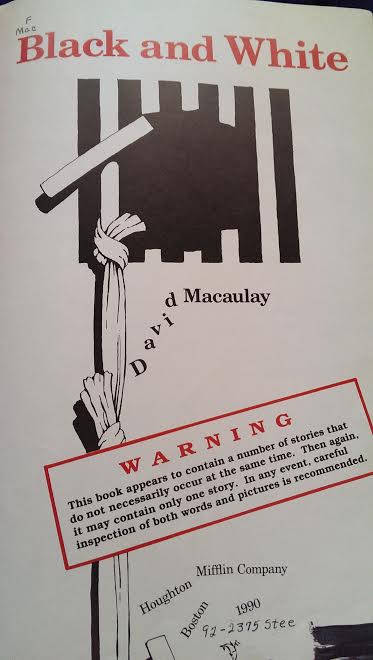
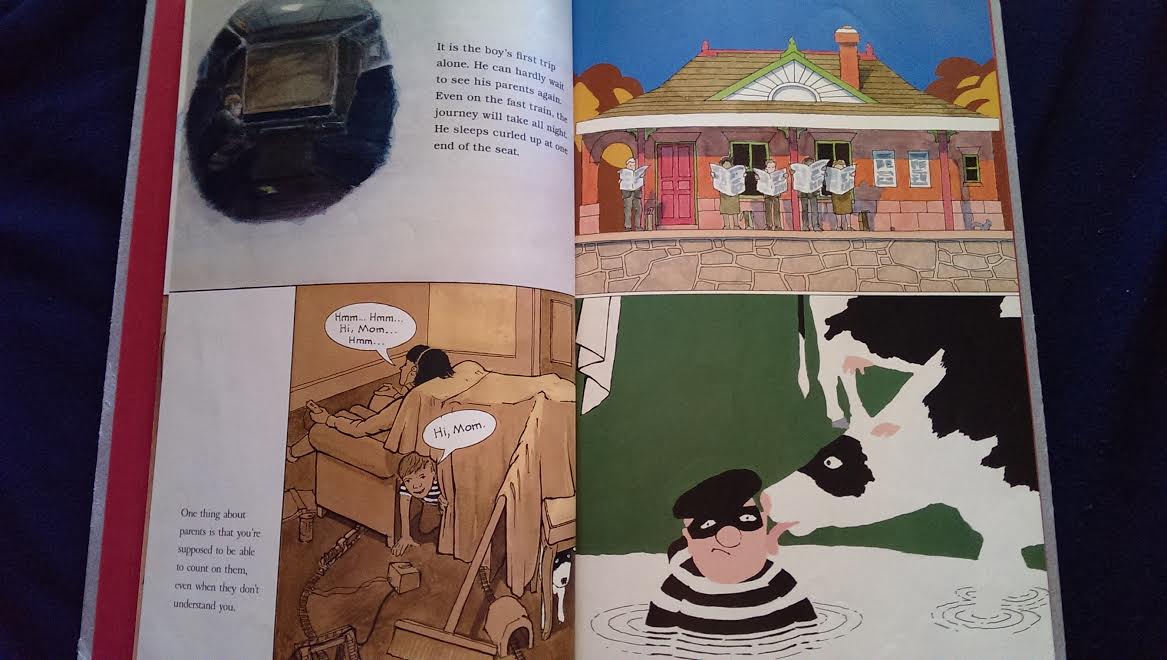
This book is unusual because there are four stories inside, being told at once, but there is one continuous storyline that joins all four of them together.  Two of the stories don’t have many words, but if you pay close attention to the pictures, the connection to the other stories becomes obvious.  The title of the book is also kind of a hint, although those colors apply to more than one aspect of the overall story.

The picture at the right is from the title page, and the title page has the message that explains the concepts behind the stories. One of the fun things about this book is reading it multiple times. You can read the stories and look at the pictures of all four stories as you go through the book the first time, but if you look at each story in isolation, you can experience the continuity of each thread of the bigger stories and notice additional details.

BlackWhiteStories.jpeg

Seeing Things — A young boy takes a train trip by himself, going home to his parents.  He sleeps through most of his long journey, but during the night, he wakes up to some strange happenings.

A Waiting Game — A group of commuters waiting for their train, which has been unexpectedly delayed, find amusing ways to entertain themselves.

Problem Parents — A girl and her brother are convinced that their parents are crazy when they arrive home from their offices in the city wearing weird outfits made of newspapers and singing.

Udder Chaos — An escaped convict hides among a herd of cows.

You might be able to get some of the connections between these stories from what I’ve said and the pictures I’ve shown, but it gets funnier if you keep going through the stories, seeing where each of them lines up with the others.

The book is currently available online through Internet Archive.

BlackWhitePic1
BlackWhitePic2
BlackWhitePic3

The Case of the Vanishing Villain

The Case of the Vanishing Villain by Carol Farley, 1986

As you can see, my copy of this book has been … well-loved.

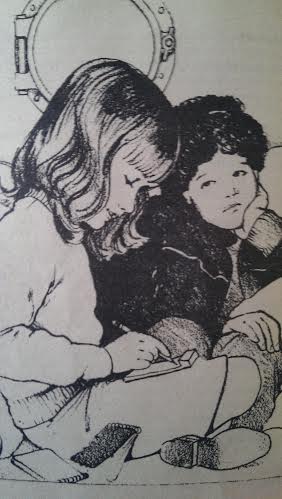
This is the first book in a series about two sisters, Flee Jay (short for Felice Jennifer) and Clarice Saylor. Twelve-year-old Flee Jay wants to be a detective, just like in the books she’s read, but her pretty younger sister is a child genius who has more aptitude for it. Clarice is somewhat eccentric for a ten-year-old, but she is also intelligent and logical and has a memory for details and obscure facts. Throughout the series, the two of them kind of compete to solve mysteries. Although Clarice usually comes up with the solution before Flee Jay, it usually takes the two of them together to get to the bottom of things because Flee Jay is an average kid who behaves like an average kid and helps Clarice understand how average people behave.

The story begins with an explanation and a request for help from Flee Jay. She and her genius younger sister, Clarice, were taking an early morning ferry from Michigan to Wisconsin to visit their grandparents when a series of strange events connected with an escaped convict took place. Clarice managed to solve the mystery, but Flee Jay wants readers to go through the events as they happened to see whether any normal person could have solved the mystery like Clarice did.

From that point on, Flee Jay describes what took place from the moment they arrived at the ferry until just before the ferry docked at its destination. She introduces all of the strange passengers on the ferry, including a family of three women who may have unwittingly brought the convict on board, a woman with an annoying barking dog, a bearded man with a guilty secret, and the overly-attentive ship’s steward, Mr. Woolsey, who is keeping an eye on the girls during the trip.

VanishingVillainPic

From the moment that Flee Jay learns about the escaped convict from Clarice, who “accidentally” overhears the police and Mr. Woolsey talking about him through a vent while standing in the sink in the ladies’ room next to Mr. Woolsey’s office, Flee Jay wants to be the one to find him. At first, they don’t really know whether he’s on the boat or not, but when the boat is underway, a woman screams that there was a strange man in her stateroom, and then, they’re pretty sure. Flee Jay and Clarice take it upon themselves to consider all the hiding places and to question the other passengers. Of course, Clarice produces the solution to the puzzle, but she does credit Flee Jay with inspiring her. According to Flee Jay, she just figured things out because she’s nosy, but that’s left to the readers to decide.

Join eccentric 10-year-old genius Clarice and her long-suffering sister as they try to put the pieces together to keep the convict from getting away right under the noses of the authorities!

The book is written with humor and is fun to read. The clues fit together neatly, and the black-and-white pictures, list of characters, and map of the inside of the ferry help readers understand the action.

The book is currently available through Internet Archive.