Tools of Native Americans

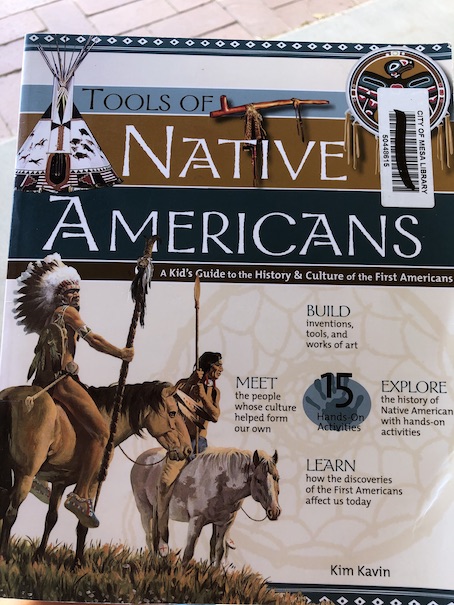
Tools of Native Americans by Kim Kavin, 2006.

This nonfiction book is part of a series recommended for kids ages 9 to 12. It provides insights into the daily lives of Native Americans of the past by explaining their tools and inventions. I was intrigued by the idea immediately because I love books that give insights into history through the lives of ordinary people.
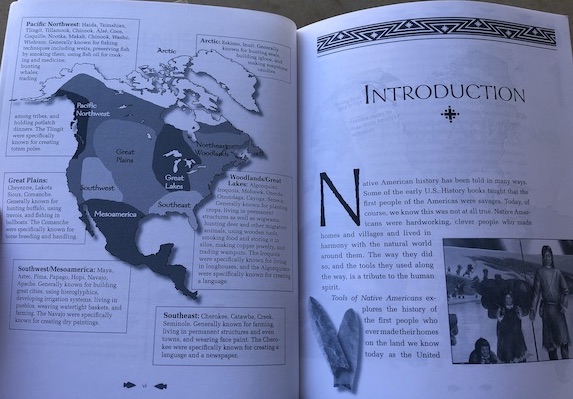
The book is divided into time periods and geographic areas of North America. At the beginning of the book, there is a timeline of important events in the history of North America and Native American culture, beginning c. 20,000 to 8000 BCE, when the ancestors of Native Americans are believed to have migrated to the continent and ending in 2006, the year the book was published. There is also a map showing major geographic regions of North America and the Native American tribes that live there. The chapters of the book are mostly grouped by region, except for the first two, which are about the First Americans and Archaic and Formative Periods.
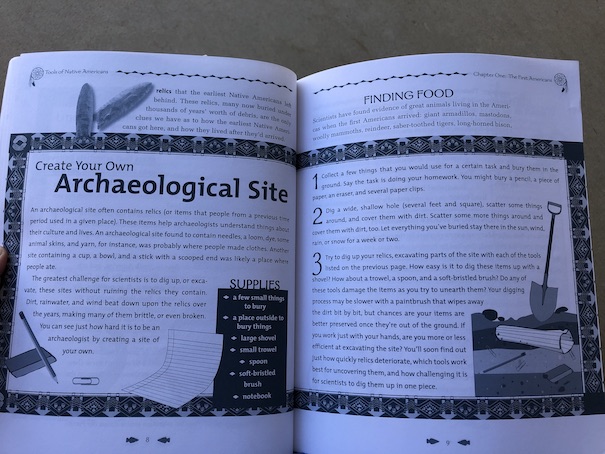
The first chapter, called The First Americans, discusses theories about how the ancestors of Native Americans first arrived on the continent from Asia. The exact circumstances of their arrival are unknown, but there are some possible migration paths that they could have taken. The chapter discusses the Ice Age that existed when this migration took place, how people found food, and Clovis culture, one of the earliest known civilizations in the Americas. One of the activities from this section is about archaeology, which is what we use to learn more about ancient civilizations that did not leave written records, and how to create an archaeological site of your own.

The next chapter is about the Archaic and Formative Periods, which were characterized by climate change as the Ice Age came to an end and many plants and animals that had thrived in the colder climate died off. The changes in the environment cause Native American groups to make changes in their own lifestyles. Rather than relying on herds of large animals for food, they began cultivating crops. They made pottery and developed new cooking techniques. They still hunted, using a device called an atlatl to throw their spears further and with more power. Civilizations like the Maya flourished.

After the second chapter, the other chapters discuss tribes by region:

The Northeast Woodland and Great Lakes Tribes – The Algonquian and Iroquois

This chapter discusses Native American tribes from the East Coast to the Midwest, around the Great Lakes, who primarily lived in woodland areas. The Iroquois and the Algonquian were both collections confederated tribes. There is information about the Algonquian language, which contributed some words to English, including moccasin, succotash, hominy, hickory, and moose. There is also an activity about creating Algonquian style pictographs and petroglyphs.

The Southeast Tribes – The Cherokee, Catawba, Creeks, and Seminoles

The tribes in this chapter lived in and around the Appalachian Mountains. It explains about Sequoyah, who developed a system of writing for the Cherokee language.

The Great Plains Tribes – The Cheyenne, Lakota Sioux, and Comanche

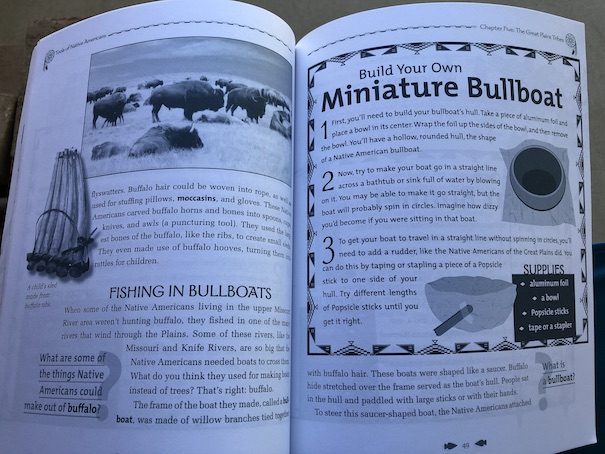
The tribes of the Great Plains were migratory, following herds of buffalo, which were a primary source of food. Because they moved often, everything they owned, from the tepees where they lived to the tools and other objects they used, had to be easily portable. The Comanche were particularly known for being expert horsemen. This chapter also discusses the Lewis and Clark Expedition and Sacagawea, who was part of the Shoshone tribe from the Rocky Mountains. She had been abducted when she was young, and when she joined the Expedition, she was able to guide Lewis and Clark and their men back to the territory she had known when she was a child and to the Pacific Ocean. Activities for this chapter include making a rattle of the kind children used as toys, making a miniature bullboat, and making a war bonnet (using pieces of poster board instead of feathers).
The Southwest and Mesoamerican Tribes – The Hohokam, Mogollon, Anasazi, Maya, Aztec, Hopi, Apache, and Navajo

I know this area because this is where I grew up. Much of it is desert, and the book is correct that there can be sharp differences in temperature between day and night. In modern Southwestern cities, buildings and pavement can hold in heat even at night, but there isn’t much to hold in heat in the open countryside, not even much humidity in the air to hold heat once the sun goes down. There is an abundance of clay in the soil in this region which local tribes used to make pottery and adobe homes.

Among the civilizations discussed in this section are the Hohokam, whose name means “Vanished Ones” (I’ve seen different versions of the translation of that name, but they’re all words to that effect – that they are gone, vanished, disappeared, etc.) because, for unknown reasons, they seem to have suddenly abandoned the area where they had previously lived and farmed for generations. They don’t seem to have died off, at least not all of them. It’s believed that they were the ancestors of the Pima and Tohono O’odham tribes, and the book discusses that a little further on in the chapter. There is a Pima story about a fierce rainstorm and a massive flood that killed many people, but The Hohokam were the ones who built the original irrigation canals for watering their crops. Later, when settlers came from the Eastern United States, they found these abandoned canals, dug them out, and started using them again. The canals are still in use today, and one of the activities in this chapter of the book is about irrigation.

This section of the book also covers the Maya and the Aztecs, who lived in what is now Mexico and Guatemala. There is an activity about creating hieroglyphs, like the kind that the Maya once used.

In the part that describes the Navajo, there are activities for sand painting and Navajo-style jewelry.

The Pacific Northwest Tribes – The Nootkas, Makahs, and Tlingits

Much of this chapter discusses hunting and fishing and the preservation of food. Because food-related work mostly took place during a single season due to the severity of the winters, there were periods of time when the members of the Pacific Northwest Tribes had time for social and artistic pursuits. The book explains the meaning of totem poles, and there is an activity for readers to create their own.

The Arctic Tribes – The Inuit

The lives of the Inuit were shaped by learning to live in a very cold environment. The book explains how they built igloos out of packed snow and ice, but really, igloos were temporary shelters. The houses they lived in long term where made of sod and were partially built underground for insulation. There are activities for building a snow cave called a quinzy (this requires that you live in a place with snow) and for playing a game called Nugluktaq.

The last chapter in the book is called New Immigrants, Manifest Destiny, and the Trail of Tears. It’s about how European settlers arrived in the Americas, the westward expansion of the United States, and the confinement of Native American tribes to reservations.

The book ends with an Appendix with further information about Native American Sites and Museums State by State. There is also a glossary, index, and bibliography.
The Time of the Forest

The Time of the Forest by Tom McGowen, 1988.

The story takes place in the prehistory of Denmark, among its earliest inhabitants.  It shows the conflict between the hunter-gatherers, who are native to the forests of that land, and the farmers, who have traveled to the area to build a new home on the edge of the forests.

When the two groups learn of each other’s existence, they become frightened of each other. The hunters are afraid that the new people will take over their hunting grounds, and they are offended that the newcomers cut down the trees to build their homes and clear land for farming. The farmers are afraid of the forest, the wild animals inside it, and the hunters, who they fear might start hunting them.

A young hunter, Wolf, watches the farmers to learn more about them, and he is fascinated by what he sees. In some ways, the two groups are alike, and Wolf finds himself wanting to know more about the ways of the farmers and maybe even make friends with the pretty girl, Bright Dawn, who he sees tending the farmers’ goats.

However, the son of Wolf’s chief has decided that the newcomers must be destroyed. When Wolf saves Bright Dawn from the chief’s son, the two of them must learn to work together and combine the skills of their different peoples in order to survive.

In the end, after a bloody clash between their respective peoples, both Wolf and Bright Dawn are each exiled from their tribes.  However, their exile actually gives them the freedom to start their own tribe that combines aspects of both of their societies.

The book is available to borrow and read for free online through Internet Archive.

My Reaction

This story was somewhat speculative about the early days of Europe, when societies were starting to shift from hunter/gatherer groups to more settled agricultural groups.  The author says that he was theorizing about the cultural clashes that may have taken place during this time.

Something I noticed about the story is that the groups, particularly the hunter/gatherer group, somewhat resembled some Native American groups around the time that they first encountered European settlers.  The author didn’t say anything about using their lifestyles as inspiration or drawing any parallels between them and early Europeans, but it did make me think about the similarities between groups that are living similar lifestyles but in different places.  In other words, it does seem reasonable that hunter/gatherers living in Europe would be living in circumstances that would be very similar to hunter/gatherer groups in the Americas.

The Light in the Forest

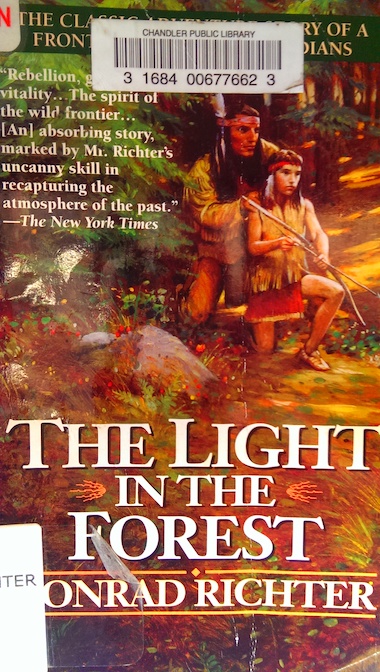
LightInTheForestThe Light in the Forest by Conrad Richter, 1953.

Although this book was adapted into a live-action Disney movie in 1958, this is not a story that I would recommend for young children because of the level of violence.  I think I was in elementary school, about 10 or 11 years old, when I read it as a kid, but I wouldn’t recommend it for anyone that young anymore.  This book is bound to be controversial, but read to the end, where I discuss my reaction to it.

This story takes place in 18th century Colonial America, specifically in Pennsylvania.  Eleven years before the story begins, four-year-old John Butler was abducted by Lenape Indians and adopted by a member of the tribe as a replacement for a Lenape boy who had died.  His new “father” names him True Son and treats him as his son.  John/True Son comes to feel that his Lenape father is his true father, although he is aware that he had another father before.  Years later, in 1764, fifteen-year-old John/True Son remembers very little about his life among white people and now considers himself Lenape.  The Lenape recognize him as a full member of the tribe as well, but a recent treaty requires them to return all white people they have taken captive, including True Son.

The tribe reluctantly hands True Son over to white soldiers to be returned to his birth family, although True Son resists, even attempting to kill himself at one point to prevent it.  However, the suicide attempt is thwarted, and True Son is brought to Fort Pitt, where he is reunited with his birth father, Harry Butler.

Harry Butler takes John/True Son home to the rest of the family, but True Son refuses to acknowledge them as his family.  He pretends like he can’t understand English anymore and continues dressing like a Lenape.  The one member of the family he bonds with is his younger brother, Gordie, whom he had never met before.  Gordie is young and has no particular prejudice against Native Americans.  He finds the things that True Son does fascinating.  (The Disney film cut out the character of Gordie in favor of giving John/True Son a love interest, but I think that is a mistake because I think that the relationship between John and Gordie and how John/True Son views young children is central to the true theme of the story.  Read on.)

The family member that True Son really hates is his Uncle Wilse, who is known to have participated in a massacre against Native Americans.  Wilse thinks that John/True Son has been brain-washed by the Lenape and doesn’t really trust him.  When Wilse tells True Son that the Lenape have taken the scalps of children as well as adults, True Son denies it. The two of them argue, and Wilse slaps him.

True Son pines for his Lenape family, and when he learns that a couple of Lenape have been asking about him in the area, he manages to meet with them in secret.  One of them turns out to be Half Arrow, True Son’s cousin among the Lenape.  When Half Arrow tells him that friends of Wilse have killed a friend of theirs named Little Crane, the boys attack Wilse and scalp him in revenge.  (Not killing him, just scalping him.  It’s disgusting, but possible.  In the Disney movie, this scene is changed to a fist fight.)

True Son returns to the Lenape tribe with Half Arrow, and the tribe furthers their revenge for Little Crane’s death with a raid on a white village.  However, John/True Son is horrified when he sees the scalps of children as well as adults after the raid, proving that members of his tribe have killed innocent children and that Wilse was correct about that much.

When his tribe attempts to get True Son, posing as an ordinary white boy, to lure an unsuspecting group of white settlers into another attack, John/True Son must decide who he really is and what he really stands for.

The book is available to borrow and read for free online through Internet Archive (multiple copies).

My Reaction and Spoilers

In the end, John/True Son decides to alert the settlers to the imminent attack and warn them away because he sees children among them (in particular, a little boy who reminds him of Gordie, which is why that character is so important to the story) and can’t stand to see them killed.  His decision results in his banishment from the Lenape tribe.  At first, they were going to kill him for his disloyalty, but his adoptive father convinces them to spare his life, although he warns True Son that if members of the tribe see him again, they will consider him an enemy, so he can never become a part of their society again.  From this point on, John/True Son is on his own, and his fate lies in his hands alone.

Modern readers may be repulsed at the discussion of scalping (I know I was), and I’ve also heard arguments about whether the practice was more a Native American thing or one more often practiced by white people against Native Americans. Both sides do this in the story, but there are debates about where exactly the practice started.  My thought is that some things are just so disgusting that I can resent anyone who does them, regardless of who started it, but that’s neither here nor there.  Before anyone goes too far in that direction, I’d like to point out that we shouldn’t make the same mistake that most of the characters in the book do: overlooking the more immediate issue, which is True Son himself.

Throughout the story, John/True Son is a victim in more ways than one.  Because of his abduction at a young age, he is not only stuck in a personal identity crisis and a clash of cultures but has become a pawn in a power struggle between two societies that have each committed atrocities against the other.  In the beginning, he understands the most that the Lenape have been victimized by white people.  He comes to despise the white culture into which he was born and empathizes with the Lenapes’ attempts to strike back at the white people. Some of this might be a kind of Stockholm Syndrome (a term I didn’t know when I first read this book), but he is correct that men like his Uncle Wilse have committed great atrocities, and he wants no part of them.  However, against his wishes, he is thrust back into the culture he came from and into the middle of the conflict as a bargaining chip in a treaty.

After his time among his white family, he begins to see the conflict from both sides and to realize that not all white people are guilty of atrocities and deserve to be punished.  At the same time, True Son is forced to acknowledge that people close to him on both sides of the conflict have each done terrible things.  In the end, his sympathy is particularly for the innocent children who, like he was as a young child, have been brought into this cycle of hate, revenge, and killing without even their knowledge, having done nothing to deserve it.

We’re not quite sure what John/True Son’s life is going to be after the end of the story.  He has been rejected by the society he knows best, where he once thought he belonged, but whether his birth family and society will accept him back after what he’s done (the scalping of his uncle) is uncertain.  There is one thing that we do know: True Son has become his own man.  In a moment where he could simply have done what others asked, what they expected him to do, he made a difficult decision to stand up for what he really believed in, the protection of the innocent, regardless of their race, knowing even as he did so that there would be dire consequences for him personally.

We hope that John Butler/True Son manages to find some acceptance somewhere (probably among white society, which is hinted at the end of the book, but also probably on the fringe of it) and settle down to a more peaceful life, but we know that because of his troubled past, it isn’t going to be easy.  I would say that the overall message of the story is for people to consider the children and the generations to come and the impact that their decisions and their quarrels will have on their future and the kind of world the young people will grow up in.  John/True Son understands more about the horrors of fighting than either of the two sides involved, and he wants better for the younger children he finds at his mercy.

When you read other reviews of this book, you’ll see that there is some lingering resentment from people who were forced to read it in school.  It is a popular book for teachers to assign students to read around the middle school level (around age 12 to 14, roughly), and I have to admit that I often resented being forced to read depressing books in school myself.  This isn’t a happy story, but it is memorable and thought-provoking, and now that I’m an adult, what I remember best about the story is how John/True son feels about younger children and how he accepts the role of protecting them.

This story is based somewhat on real-life stories of abducted children from the same time period who also found themselves pawns in the struggles around them and felt conflicted when they once again came into contact with their birth families.  There are other books written on this topic, and the author of this one also wrote a book about a girl captive called A Country of Strangers.

I Hate English

HateEnglish

I Hate English! by Ellen Levine, 1989.

When Mei Mei’s family moves from Hong Kong to New York, she finds herself forced to go to a school where no one else speaks Chinese.  She is expected to learn English and to read, write, and speak in English, and she hates it!  To her, English is a very strange language, and the writing system is nothing like Chinese.  For a time, Mei Mei refuses to speak in English, even when she understands what is being said around her, because she hates it so much.

HateEnglishArrival

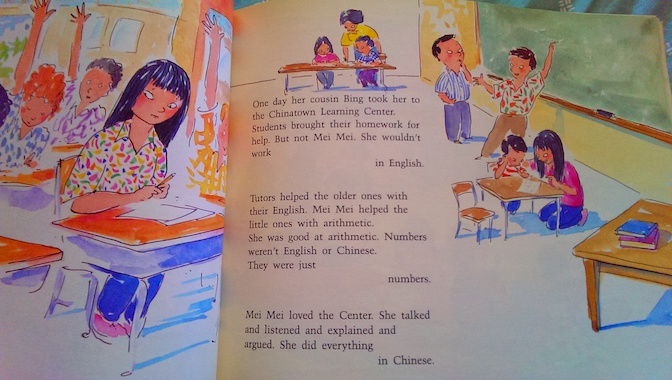
The only part of New York that Mei Mei really likes is Chinatown and the Chinatown Learning Center.  Mei Mei likes it because she is surrounded by people speaking Chinese. There, she can relax and be herself because people there understand her.

HateEnglishLearningCenter

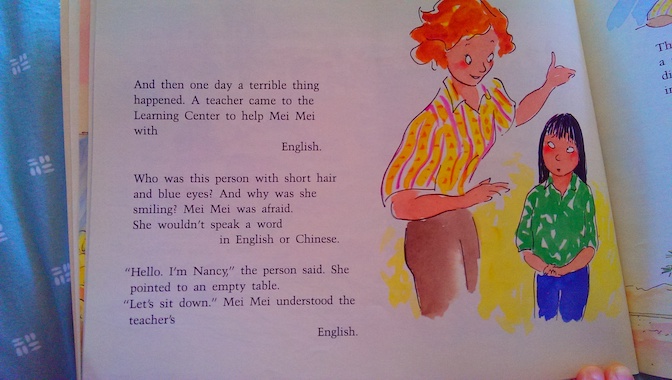
However, Mei Mei’s refusal to speak English isn’t helping her at school or anywhere else.  It’s keeping her from speaking to anyone outside of Chinatown, and it can’t continue.  When an English teacher, Nancy, comes to the Learning Center to help Mei Mei with her English, she resists learning at first.  She feels like she’ll lose her Chinese and part of her identity if she uses English.

HateEnglishNancy

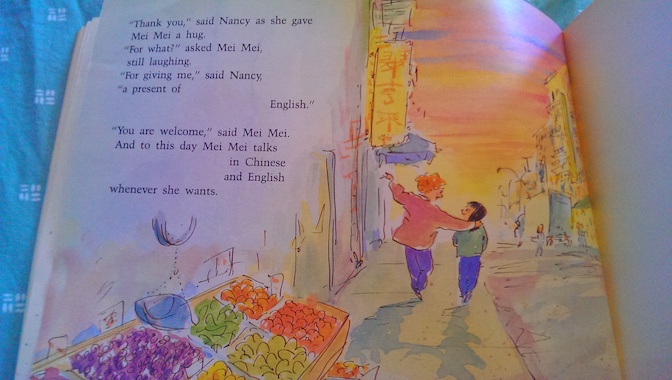
At first, Mei Mei’s worries about speaking English intensify with Nancy’s lessons.  It disturbs her how English has words that would be difficult or impossible to translate into Chinese and English words seem to be coming more easily to her, even when she doesn’t really want to speak the language.  Nancy explains to Mei Mei that English is necessary for her because she will need it to talk to many people in America, and there are many people who also want to talk to Mei Mei and be her friend, including Nancy.  It’s only when Nancy overwhelms her by constantly talking in English and Mei Mei becomes desperate to talk about herself and be understood in English that Mei Mei realizes that speaking a new language doesn’t mean losing her identity.  It’s just another way of expressing herself, and she can go back and forth between the two any time she wants.

HateEnglishNancyTalking
HateEnglishMeiMei

Mei Mei’s feelings of strangeness in her new home and the difficulties of learning a new language are relatable.  The hardest part of the experience for Mei Mei is feeling like she might be giving up a part of her past, her culture, and herself by switching from Chinese to English.  But, refusing to speak English puts Mei Mei in the position of being someone who can only listen, never talk, limiting her ability to be understood and to make friends.  In the end, she comes to realize that speaking a new language is not a matter of giving up anything, just adding to what she knows and making herself understood in a new way.  It’s the beginning of expanding her horizons and building relationships with new people.

HateEnglishFriends

My favorite part as a kid was the part where Mei Mei and her friends went to the beach and cooked shellfish that they found.  It was interesting to me because I never lived near a beach when I was young.  The lifeguard at the beach tells Mei Mei and her friends that they can’t eat the shellfish, and they realize that he thinks that because he doesn’t know how to cook them.  I never did either and still don’t, but I liked hearing about it.

The book is currently available online through Internet Archive.