The Pinhoe Egg

The Pinhoe Egg by Diana Wynne Jones, 2006.

This is the sixth and final book in the Chrestomanci series.  In this series, there are many different dimensions, and in each of those different dimensions, there is a copy of every person.  Different versions of our world can differ dramatically in their history across the dimensions, and individual people’s lives can differ dramatically between the dimensions. There is one person in each generation who has no duplicates in any of the other dimensions.  This person is called the Chrestomanci.  All of the talents, abilities, and lives that would have been spread across the other dimensions are now centered on that one person, giving that person, literally, nine lives.  The Chrestomanci fills an important role, being better able than anyone else to travel across the dimensions, and he acts to keep a balance between them and make sure that the different worlds keep their proper course.

Marianne Pinhoe and her brother, Joseph, are used to Gammer (their grandmother) telling them and everyone else in their family what to do. Gammer is the matriarch of the magical Pinhoe family, and Marianne, as the only girl born into the family in the last two generations, is expected to eventually succeed her. Joseph has magical abilities, too, but he often pretends that he can’t do things so the rest of his family won’t force him into their magical businesses. He really has a fascination for machines and would rather work with them than do magic, so he does his best to convince the rest of his family that he’s a “disappointment” to them (something that other family members appear to have done when they had interests outside the family). However, Gammer still rules the roost and she has plans in mind for both Marianne and Joseph.

One day, she calls Marianne and Joseph to her house and tells Joseph that she’s got him a job as boot boy at Chrestomanci Castle over the school break. Joseph is angry because he had other plans for the school break and doesn’t want to be a boot boy. Gammer tells him that it’s important for him to go to Chrestomanci Castle because she wants him to act as a spy there. The Pinhoe clan doesn’t live too far from the castle, and for generations, they have been careful to conceal their identities as witches from whichever Chrestomanci happens to be in charge at the time. Gammer says that if Chrestomanci (whom they carefully refer to as the “Big Man” because saying his title aloud calls him) ever found out about them, he and his crew of enchanters would (gasp!) force them to obey rules and regulations and not just use their magic any way they like whenever they feel like it. (If you’ve read all the of previous books in the series, you can see that people like the Pinhoes are part of the reason why rules exist in the first place and why just letting them do whatever they want could be a complete disaster that could tear apart the worlds someday, but oh noes, not rules and regulations and being told not to do insane things that would lead to the destruction of the worlds! We’re not talking petty micromanagement here. Basically, this is a huge red flag, right up front, that the Pinhoes are up to seriously shady stuff that may lead to people dying and/or already have involved people dying.) Gammer wants Joseph to be at the castle to find out if the Big Man has caught on to them or looks like he might be going to. (At this point, we don’t know exactly what activities they’re afraid he’s going to catch onto, but that will become more clear later.) Joseph is still angry and tells Gammer that she can’t make him do it, but something happens that changes everything.

While Marianne and Joseph are still at Gammer’s house, the Farley family comes calling, and they’re angry with Gammer, too. They say that she has somehow betrayed them, particularly Dorothea Farley. After an argument with them, suddenly Gammer seems to lose all of her reason! When she speaks, she doesn’t seem to make any sense, as if she’s completely lost her mind. Marianne thinks that the Farleys cast a spell on Gammer, but she can’t prove it. The rest of the family thinks that the strain of the argument with the Farleys just sent Gammer over the edge because she’s so old. They’re unsure whether or not Gammer is going to recover from this incident or not and how long that might take. They temporarily hire nurses to look after her, but Gammer drives them away by using her magical powers to throw things at them like a poltergeist.

The family members all argue about what to do with Gammer, and in the end, they decide that she must go live with Dinah and her husband because gentle Dinah seems like she’s the only one who can handle her. Some of the relatives argue about who will get Gammer’s house since she will no longer be living there, and Marianne’s father reveals that the house actually belongs to him and that he was just letting Gammer live there. He thinks that the house is too large for his family and that the sensible thing to do is to sell the house and use the money for Gammer’s care and other practical uses. Moving Gammer to Dinah’s house is difficult because she uses her magic to resist it, but they eventually accomplish it. In the meantime, Joseph still has to go to Chrestomanci Castle because all of the arrangements are already made and the rest of the family insists that he do it.

While all this is happening, The Chant family is just returning from their holiday in the south of France (which was in Mixed Magics), and they have no knowledge of what’s been happening with the Farleys and the Pinhoes. Julia and Janet have been reading a horse story for girls and have become obsessed with horses and the idea of owning horses of their own. Chrestomanci asks them if they wouldn’t prefer to have bicycles (Roger says he would and Chrestomanci immediately agrees he can have one), but the girls insist that they must have horses. Millie is sympathetic because she wanted a horse of her own when she was young, and they do have stables at Chrestomanci Castle. Chrestomanci reluctantly agrees and purchases a horse for the girls, with the understanding that they will learn to take care of it properly.

However, when the horse arrives, it turns out that Janet is terrified of horses when she actually meets one, and the horse only likes Eric “Cat” Chant. Initially, Cat thought that all of the horse talk was boring, but he feels a strange kinship for Syracuse the horse, and if he doesn’t take care of him, Chrestomanci might follow through on his threat to have Syracuse turned into dog food. (Chrestomanci is also secretly afraid of horses.) Cat finds riding difficult at first, but he enjoys it and becomes fond of Syracuse. Julia and Janet swear off horses in fear and disappointment and get bicycles, like Roger, so Cat becomes Syracuse’s owner.

One day, while riding Syracuse, Cat has a disturbing encounter with Mr. Farley, the gamekeeper. Mr. Farley has placed spells in the territory around his family’s property to keep people away so their magical activities won’t be noticed by anyone, especially the people at Chrestomanci Castle. Since Cat has been riding around the countryside on his horse, Mr. Farley has become paranoid about Cat snooping around. The Pinhoes have some similar worries.

Then, Jason, one of Chrestomanci’s associates, returns to the castle after having been away for years. Jason brings his new wife, Irene Pinhoe, with him. Jason is a plant expert, and he also has some plant samples. Janet and Julia are both heart-broken that Jason is married because they both had enormous crushes on him, and they are sure that Irene is going to be perfectly awful and that they won’t be able to stand her. However, when Cat meets Irene, he thinks that she seems rather nice. She’s an artist and designer, and Cat can tell that she’s using magic in her drawings. Irene admits that her father was some kind of enchanter, and she may have inherited some of his ability, although she seems oddly embarrassed about it and says that she doesn’t know much about her father’s work. Jason and Irene invite Cat to accompany them while they have a look at a house that they’re planning to buy in the area.

Gammer is still not in her right mind, and at Gammer’s request, Marianne has to look after her cat, Nutcase. This is difficult because Nutcase is hard to control, and he somehow manages to get around the spells that Marianne tries to use to control him. After Nutcase kills a bunch of baby chicks belonging to Dinah, Dinah’s husband threatens to kill Nutcase if he comes near their chickens again. Marianne tries, mostly unsuccessfully, to keep track of Nutcase and keep him out of trouble.

One day, while trying to find Nutcase, she shows up at the house that Jason and Irene are trying to buy while they are there with Cat. It happens to be the old Pinhoe house, the one Marianne’s family is selling, and the Pinhoe family would prefer a Pinhoe to buy it. It helps that Irene is a Pinhoe, and Marianne thinks that she is just like the princess that she imagined in a story that she’s writing. Jason is fascinated by the variety of magical herbs in the Pinhoes’ neglected garden, and he’s sure that he really wants the house, too.

Cat is intrigued by Marianne when they first meet because he can tell that she has powerful magical abilities. Marianne asks Cat to help her find Nutcase, and he agrees. While they’re looking for Nutcase, Cat comments to Marianne how powerful her magic is and that she should trust it more. Cat is surprised at himself for being so bold, and Marianne is surprised at how well Cat has read her.

While they look for Nutcase in the attic, Cat senses that there is something important and magical hidden there, protected by spells, and he feels compelled to figure out what it is. As they investigate further, they find a strange, large egg. Marianne says that she doesn’t really know what kind of egg it is but that Gammer told her that it was a silly joke of her grandfather’s because he claimed it was an elephant’s egg. Cat senses that it’s very important, and he asks Marianne if he can have it. Marianne decides it’s okay if Cat keeps it because nobody else ever really seemed to care about it, and the house needs to be cleaned out when they sell it.

During the night, Cat gets a visit from a large, winged creature that says it’s the egg’s mother. The mother says that a spell prevents her from reclaiming her egg, but she sensed that the egg was moved, so she came to see that it was safe. When the egg hatches, it turns out that it’s a griffin. Cat needs Millie, Crestomanci’s wife, to help with the hatching and caring for the griffin. Crestomanci questions Cat about how he got the egg, and Cat explains that it came from the Pinhoes’ old house, which seems to intrigue Crestomanci.

When Marianne’s uncles learn that Marianne gave the egg to Cat and that it’s hatched, they’re furious with her. They had put the egg in the attic themselves and placed spells on it to prevent it from hatching, although they had never told Marianne about it before.

In the mean time, Marianne has been learning that this isn’t the only secret that her family has been hiding and that things in her family are not what she’s always believed they were. Strange things are happening in the nearby village. First, someone places a bad luck spell on all the Pinhoes. Every member of the Pinhoe family falls victim to various accidents until they find the source of the spell buried in the garden of the old Pinhoe house and destroy it. Then, there’s a plague of frogs and a sudden epidemic of whooping cough that affects everyone in the county.

What Marianne comes to realize is that these curses are being cast by Gammer, who still seems to not be in her right mind. What the other relatives have been taking to be harmless, nonsense mutterings and odd little things that she does to entertain herself have actually been magic spells. The curses have been mostly directed at the Farley family, although because Gammer isn’t really in her right mind, some of them have gone astray and affected other people in the area, including the Pinhoes.

However, when Marianne tries to tell her family what Gammer is doing, nobody believes her. Marianne comes to realize that the Pinhoes themselves have also been under one of Gammer’s spells for their whole lives that cause them to view Gammer with reverence and to make excuses for bad things she does. For some reason, this spell no longer seems to be working on Marianne, even though the other members of her family are still affected. Whe’s beginning to see that Gammer has done some pretty awful things and that her own father has been taking more care of the Pinhoe family than Gammer ever has, even though Gammer has been taking the credit as the family’s leader. Because of Gammer’s spells, none of the rest of the family will listen to anything Marianne tries to say about what Gammer has been doing, and they think that it’s just malicious slander. Worse still, Marianne is in disgrace with them because she gave the griffin egg to Cat.

What is the true story behind the griffin egg, and why are the elder Pinhoes so worried about it? Marianne knows that there is a griffin and a unicorn on the family’s coat of arms. What kind of feud does Gammer have with the Farley family, and are the Farleys really responsible for her present condition? With Gammer’s spells on everyone, how can Marianne get anyone to believe her enough to help her get the answers she needs? Her family has tried hard to avoid getting the attention of Chrestomanci or anyone at Chrestomanci Castle, but they may be the very people Marianne needs now.

My Reaction and Spoilers

I love the Chrestomanci series, and I enjoyed reading this book, although the ending seemed a little confusing and fell a little flat to me. I’m starting out with some minor spoilers, including some for previous books in the series. The major spoilers are at the end. The premise of a magical family with secrets is intriguing and fits well with the rest of the series. At first, Marianne believes everything that her family says and accepts that she will probably be the one to eventually take over Gammer’s position as head of the family. However, Marianne comes to realize that members of her family aren’t what she always thought they were, and some of them are hiding dark secrets. This is also a theme in the Chrestomanci series. Other characters in the series have also discovered that members of their families were hiding dark secrets and have been been betrayed by them. In previous books, the current Chrestomanci was used and betrayed by his uncle when he was young, and Cat’s own sister used him and tried to have him killed.

When Marianne allows Cat to take the griffin egg from their family’s old house, and she begins investigating strange things happening to people in the area, she realizes that her grandmother, who seems like she isn’t in her right mind, is the cause of at least some of it. Her family is unable to accept the truth about Gammer and turns against Marianne. It turns out that even her own father has been hiding secrets from her mother and his children and that, years ago, he was involved in a terrible crime against his own father. When the terrible secrets of the Pinhoe family are finally revealed, some of the Pinhoe marriages break up because the Pinhoe wives realize that their husbands have done some terrible things and have lied to them for years about it. Although Marianne’s parents stay together, Marianne’s mother has to come to terms with the truth about her husband’s past and his lies, and she also realizes that she should improve her children’s education and her own education.

In the end, someone else takes over as the leader and adviser of the Pinhoe family, rather than Marianne, but Marianne doesn’t mind because she’s really too young for the role, and she also realizes that her talents lie elsewhere. Like other young characters in the series, she and her brother are invited to continue their magical education at Chrestomanci Castle with the Chant family children. Marianne’s father is against his children studying with the posh people at the castle because he thinks that they’re trying to be too good for their own family, and Chrestomanci tells him that the only way they’ll be too good for their family is if he decides they are and keeps telling them they are. If that’s the message their father feeds them, then someday, they’ll probably believe it and think that their family has rejected them for being better than they are. Marianne’s father grudgingly allows the children to study at the castle because he can’t stop them and also because he and his brothers have lost face in the community because their past wickedness to their own father has been revealed.

Chrestomanci puts a stop to the feud between the Pinhoes and the Farleys by revealing some of their secrets and by having his assistant take away the Farley family’s magic. He does not take away the Pinhoes’ magic, but he wants to study their unique magic style because it has to do with the life force of living things, and Cat also seems to have a talent for it. This unique style of practicing magic is one of the secrets that the Pinhoes have been trying to keep to themselves, but there are also deeper and darker secrets they’ve been hiding, some of which didn’t really make sense to me.

What is eventually revealed is that Marianne’s grandfather, who supposedly died years before, is still alive. He was imprisoned in an area that contains and hides various mythological creatures, and his own sons were the ones who imprisoned him there in an injured state, while they told the whole community and even their own spouses that he was dead. They did it because Gammer, the grandfather’s wife, and Mr. Farley told them to kill their father. They couldn’t bring themselves to actually murder him, so they just crippled and imprisoned him. The reason why they did it was because he was studying the mythological creatures and brought the griffin egg out of the hidden territory. For generations, the family has believed that it was their duty to keep the mythological creatures imprisoned and secret, so they panicked and tried to stop the grandfather when it looked like he was going to expose everything. This is the major secret of the Pinhoes that they were always afraid someone would discover.

Chrestomanci and his people reveal that the family has a hidden history where they were supposed to be the caretakers of the mythological creatures but their mission got corrupted under the influenced of a particularly fanatic religious group, which convinced past generations that the mythological creatures were “abominations” and that they needed to hide their magical abilities. This doesn’t entirely make sense because, in past books, and even in this one, the local clergy knows and accepts magic. Chrestomanci and his family regularly attend church.

The explanation that readers are given is that the past group of religious fanatics was eventually driven out by other groups that came in later, but there’s not much of an explanation of how that works. We don’t know who these fanatics were supposed to be, and the chain of events is only vaguely explained. The Pinhoes aren’t entirely convinced that any of it is true, and because there aren’t a lot of details provided and not much groundwork was laid for this revelation, I wasn’t really impressed with it, either. It also bothered me that the Pinhoes and their mission to hide mythological creatures are very local, just in the village near Chrestomanci Castle, but for reasons that are also never explained, it seems like there aren’t any other mythological creatures, like griffins and unicorns, anywhere else in England or in any other countries. Were all these mythological creatures, their entire populations, only located in this one, particular village or did this one particular village hide all of them from everywhere in the world just in their little, hidden region? Real life animal populations are generally wide-ranging, so if we accept the idea that unicorns and griffins are real and once lived out in the open, I find it hard to believe that these local families were hiding all of them just in their little woods and that nobody, anywhere else, had a clue about it before or any populations of the same creatures elsewhere. Even if all of the other mythological creatures that once existed everywhere else in the world were wiped out by “fanatics” or other causes, it seems like there should still be evidence of it somewhere, like historical accounts or archaeological evidence. If there are plant experts who study magical plants in this series, it would make sense if there were also animal experts who studied magical animals.

There are just too many plot holes here, and all of this is just kind of dumped on the readers at the end without much build-up. It would have made more sense if the children had some kind of historical lessons that included the history of these “fanatics” or the apparent destruction of mythological creatures or something to set this up before the final revelation, but we didn’t really get that. It felt more like a sudden info dump at the end.

The situation with the Pinhoe family in the book seems meant to illustrate how family stories with a very narrow focus and no outside fact checking can lead to serious misconceptions and how militantly clinging to particular ideas simply because it’s “what we’ve always done” is toxic because it can lead to a warped view of history and the places of individuals in it. The Pinhoes have not just been trying to hide their activities from the authorities, but they’ve also been shielding themselves (both intentionally and unintentionally) from anyone or anything that might put a new perspective on their activities. They’ve been worried about the authorities trying to stop them or interfere with their activities, but at no point did they consider that there might be some sound reasons why the things they’ve been doing are pretty strange and out of bounds.

In a way, I think that the message of the story does have some relevance in the real world. Misconceptions about history and historical propaganda can lead people to do some inappropriate and toxic things. I’m pretty sure that I’ve mentioned somewhere before that I resent the United Daughters of the Confederacy for their textbooks, which were largely propaganda for their personal familial pride. When you have an organization based entirely around the concept of being part of certain families involved in a particular event on a particular side, and the nature of that involvement would seem dubious to people not on that particular side because it implies either support for and/or active participation in an unsavory activity (in this case, owning slaves), you have a group of people with a vested interest in telling a version of the story that puts themselves in a positive light and possibly others in a more negative light to make themselves look better by comparison, regardless of the historical accuracy (much of which, in their case, can be easily debunked by primary sources). “Their” traditional version of the story, the one from the textbooks they produced in past decades, puts Northerners into the role of aggressors, frames the concept of slavery as some kind of noble social service project. Ever heard someone ask if the slaves were grateful that they were given jobs or heard slavery described as a kind of unpaid “job training”? People do, and the propaganda of the United Daughters of the Confederacy is a major reason why. One of their tactics was to make slavery sound like a form of indentured servitude that people to pay off a debt and that could work their way out of once they learned job skills, but in real life, slavery never ends and the people in it never had a debt to pay to the people who owned them. Their works have portrayed black people as varying degrees of incompetent and aggressive, needing to be looked after and controlled. As someone with an interest in children’s literature and a degree in history, I seriously resent this organization, its written works, and the “Catechism” based on their historical fan fiction (my term – the more scholarly one is “pseudohistorical narrative“) that they still make children recite in the 21st century (still touted on their website).

The reason why I’m going on this tangent about United Daughters of the Confederacy and their textbooks is that it’s a real life example of a similar situation to the one that the Pinhoes have during the story. For one thing, there is a generational disconnect because, while the older generations in the Pinhoe family cling to their family’s lore about what their mission is and the secrets the family keeps, they haven’t entirely passed on that legacy to the younger generation yet. There is an enchantment over members of the family that makes them obedient to Gammer, makes them look at her in glowing terms, and makes them disregard bad things Gammer does. However, for reasons that are also not fully explained, Marianne has somehow been exempt from this spell. (I think it might be because, initially, it was assumed that she would be taking over the role of Gammer someday, but it just isn’t really explained.) The older members of the family also cannot fully explain certain things to the children in the family because that would mean revealing what they did to Marianne’s grandfather. Because the direct chain of the narrative was broken, Marianne and her brother don’t look at the family and the things they do in the same way as their elders do. Marianne gave away the griffin egg because the adults tried to act like it was unimportant, to deflect interest from it, giving Marianne the impression that the egg really didn’t matter. Because Marianne has been exempt from her family’s stories about what they consider their mission to be and isn’t under the spell that controls how family members feel about Gammer, she is more open to investigating the situation and seeing the flaws in the things that her family has been saying and doing.

It’s a little like how generations who grew up reading the “textbooks” produced by the United Daughters of the Confederacy have a very different view of history from younger generations or even older people who grew up reading anything else. It sometimes leads to generational conflict as older generations cling to old family stories and the “textbooks” they read in school, and younger generations have more exposure to other ideas through a different set of textbooks and other people’s very different family stories through the Internet and other, modern forms of mass media. The issue of what Americans think about the Civil War isn’t the only time we’ve had this sort of disconnect between how professional historians explain things and how amateurs writers explain them. There was also a panic in the 1920s about how the American Revolution was explained in school textbooks and whether they were sufficiently patriotic. I have some training as an historian because I have a bachelor’s degree in history, but I admit that I didn’t go on for a masters or PhD, so I have some respect for people who are more expert in particular branches of history than I am and are responsible in citing their sources. I have no patience for people who do not reference primary sources or are deliberately misleading. I don’t expect perfection, but honesty and the highest degree of accuracy possible are important when other people depend on you for information.

In the book, Marianne’s father views her different understanding of the family and their situation as being malicious and rejecting her family, thinking herself “better” than they are for thinking that they’re wrong in their understanding of the past. Marianne comes to understand that they’ve done wrong things in defense of that historical understanding, including the way they’ve treated any family members who have disagreed with them in the past. They have been downright cruel, even to their own family members, to protect what their family has always believed and what they’ve always done, and they deliberately shut out any outside influences and interference because, on some level, they are aware that other people would stop them if they knew everything they’ve been doing. They try to keep their activities secret to avoid any interference and consequences from the authorities, and they deride younger generations for getting information or perspective from any outside sources that could offer reality checks. There are people in real life who get defensive about their understanding of history, although the Pinhoes are both a magical and extreme version of that phenomenon, and I still think that their story was explained a little clumsily toward the end of the book. I think more could have been done to build up to that ending, with more hints earlier in the story and some better, more detailed explanations toward the end. Still, I think I get the point that the author was trying to make.

I’m not saying that the author meant this book to be about the United Daughters of the Confederacy. That’s just one of my associations of this type of phenomenon of skewed historical perspective and a toxic level of attachment to family lore as a way of justifying otherwise unacceptable behavior. There are other groups of people who have done similar things, and I think it was the general behavior that the author wanted to examine in a magical setting, removed from any particular real-life group. In fact, I think that’s part of the reason why I was left with the impression that the history of the Pinhoes and their area was poorly-explained and lacked details about which group of fanatics set them on this path generations ago. I think the author didn’t want to involve real history or seem too accusing of any real groups, which would provoke emotional reactions from readers, based on their own understanding of history. (Admittedly, I’m pretty accusing of the United Daughters of the Confederacy, and I know that may rub some people the wrong way, but I’m far from the only person who has issues with their “mint julep textbooks“, the issues with the books and their version of history still exist, and I still stand by my criticism.) It occurred to me that the fanatics who dictated that magic and magical creatures were “abominations” might be early Christian missionaries or Catholics before the Protestant Reformation, but the timing of events in the explanation seemed a little vague to me, so I think, as readers, we are not supposed to care about who they were, specifically, but to see the results of what they did, which lasted for generations. From there, we can reflect on what this type of phenomenon might look like in our own societies and the need to accept some outside input for fact-checking purposes.

The Mystery of the Whispering Mummy

The Three Investigators

The Mystery of the Whispering Mummy by Robert Arthur, 1965.

In the original editions of The Three Investigators, their cases were introduced by Alfred Hitchcock. Later editions of the books in the 1990s were rewritten to remove Alfred Hitchcock, but I’m using the version of this book that includes Alfred Hitchcock’s introduction for my review.

This story begins with two letters address to The Three Investigators. One of them is from an elderly woman in a wealthy area of town, who has heard about how The Three Investigators helped a friend of hers find her lost parrot in the previous book in the series. This lady would like their help to find her missing cat. Bob and Pete thinks that sounds like a simple enough case, but their other letter is from Alfred Hitchcock, so they decide to read that before committing themselves.

Alfred Hitchcock’s letter is incredible! He tells The Three Investigators about an old house that has been turned into a private museum by an archaeology professor. His museum has relics from his archaeological digs in Egypt. Recently, a mummy has arrived at his museum from a museum in Egypt. Professor Yarbrough was the one who originally discovered that particular mummy, but since it arrived at his museum, he has noticed a bizarre phenomenon. The mummy seems to whisper! Professor Yarbrough can’t figure out how the mummy can whisper, but it seems like the mummy is trying to tell him something important. Professor Yarbrough has consulted with a friend, Professor Freeman, who is a language expert, but the mummy only seems to talk when Professor Yarbrough is alone. Knowing how crazy this predicament sounds and what his other colleagues would say if he told them, Professor Yarbrough decides to tell his friend Alfred Hitchcock instead. That is why Alfred Hitchcock decides to tell The Three Investigators and see what they make of it.

Bob and Pete think that the mummy mystery sounds exciting but creepy. Since Jupiter is away on an errand, they decide that they would rather try to find the missing cat first. However, when Jupiter returns, he already knows about their prospective cases, and as predicted, he can’t wait to investigate the mummy. At first, Professor Yarbrough doesn’t have much confidence in the boys because they’re younger than he expected, but Jupiter persuades him to let them try. The professor’s butler, Wilkins, is very nervous and tells the boys that there is a curse on the mummy. Strange things are happening that make Wilkins think that the professor is in danger from the curse. The boys are there when a large statue in the professor’s museum suddenly falls over, almost striking the professor. Wilkins would rather send the mummy back to Egypt, but the professor doesn’t believe in curses. In spite of the talking mummy, the professor is sure that there must be a logical, scientific explanation for everything.

Jupiter also believes in scientific solutions, and his first theory about the whispering is that it’s being transmitted electronically, but they can’t find any electronics on or around the mummy. His next idea is to capture some of the mummy’s speech on a recording, which is successful. Professor Freeman says that the mummy seems to be speaking a form of ancient Arabic.

Then, Wilkins sees someone walking around in a jackal costume. Someone steals the mummy, and strangely, comes back a second time to steal the mummy case. Even the missing cat puts in an appearance.

Who wants the professor to think that the mummy is whispering and believe that it’s cursed? Who wants the mummy case, and why is that case even more important to the thief than the mummy itself?

The book is available to borrow and read for free online through Internet Archive (multiple copies).

My Reaction

From the beginning of the book, I had a couple of theories about who could be responsible for the mummy’s whispering and “curse”, but I was only partially correct. There are different people involved, doing different things and for different reasons. The main villain is one of the people I suspected, but I didn’t know this person’s motive until it became clear that the mummy case is what they really want. The missing cat is part of the mystery, but don’t worry, the cat is fine and being cared for!

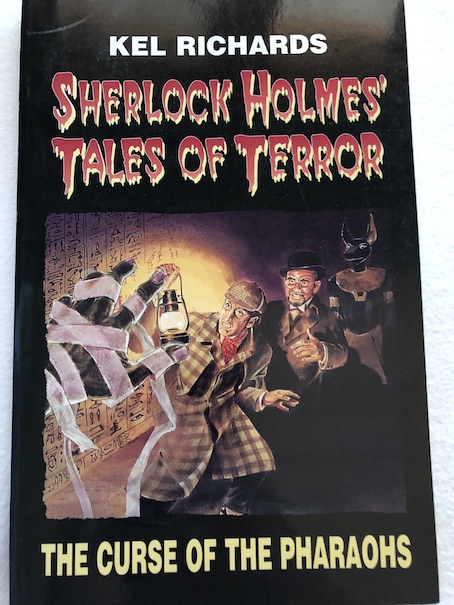
The Curse of the Pharaohs

Sherlock Holmes’ Tales of Terror

The Curse of the Pharaohs by Kel Richards, 1997.

This is the first book in a short series of spooky mysteries for children featuring Sherlock Holmes.

One foggy night, a woman named Laura Coffin comes to Baker Street to see Sherlock Holmes, and his friend, Dr. Watson. She’s very worried about her uncle, Professor Sloane Coffin, who is an Egyptologist, living in Scotland. He’s been very ill and is likely to die, but Laura is increasingly alarmed by his mental state. Her uncle has come to believe in the Ancient Egyptian religion and believes that, when he dies, he will return from the dead. He thinks this power to return from the dead and live forever will come from a diamond he found in a tomb in Egypt called the Eye of Osiris. Laura and her uncle’s doctor, Dr. Cabot, have also come to suspect that her uncle’s medical state may be due to poison, although they’re not sure who could be poisoning him. Laura has come to Sherlock Holmes because the local authorities don’t believe her.

The most likely suspects for poisoning the professor would be his lawyer, Mr. Grizzard, who has been staying in his house and seems to have a sinister and unhealthy influence over the professor; the professor’s manservant, who Laura suspects of plotting to steal her uncle’s diamond when he dies; and a mysterious Egyptian man who has been staying nearby and seems to be lurking around the professor’s property for unknown reasons. Sherlock Holmes promises Laura that he and Dr. Watson will come to Scotland and investigate her uncle’s condition. Privately, he tells Dr. Watson that he thinks that there is something else that’s bothering Laura, something that she’s not telling them.

When they arrive in Scotland, Laura is glad to see them, although Mr. Grizzard isn’t. Laura introduces them to Dr. Cabot and her uncle. Dr. Watson doesn’t recognize the disease that the professor is suffering from, and Dr. Cabot says that he can’t figure out why the professor is so sick. Based on the tests he’s done, the professor really shouldn’t be this bad, but he does look like he’s dying. The professor accuses his niece and everyone else of only being concerned about his diamond. The professor confirms that he believes everything that his niece said earlier. He says that he believes in Ancient Egyptian gods (he calls them “gods of darkness”, which doesn’t seem scholarly), and he believes that, through his diamond, they will bring him back to life, and he will live forever.

Soon after Holmes and Watson meet the professor, he suddenly dies. Mr. Grizzard explains the professor’s will and final wishes. Laura is the professor’s primary heir, but she cannot take possession of the estate until she is 21 years old, so Mr. Grizzard will be in charge of the estate as executor until then. The professor had an Egyptian-style tomb built in his backyard, and his wish was to be buried there, along with his diamond. Mr. Grizzard makes certain that the professor’s requests are carried out, including the requirement that the tomb must be able to unlock from the inside.

Holmes spots a man spying on the funeral. He and Watson take turns watching this man as he seems to be observing the tomb and waiting for something. As Watson watches this man during a storm, he sees the door of the tomb open and the professor come out! Unfortunately, Watson is knocked unconscious by a falling tree branch. When he wakes up, there is no sign of the professor, and the man who was spying on the tomb has been murdered!

Did Watson really see what he thought he saw? Did the professor really rise from his tomb and kill the man watching him? Why was this man watching the tomb in the first place? What will the professor do now, and what does he want?

My Reaction

When I first got this book, I wasn’t quite sure what to expect. Pastiches can take familiar characters in some unusual directions, and I had read a review criticizing this series for adding supernatural elements and Christian themes that weren’t found in the original Sherlock Holmes stories. I thought that the story would probably be a pseudo-ghost story, somewhat like Scooby-Doo mysteries, where it seems like something supernatural is happening, but there’s actually a rational, more physical explanation. However, I wasn’t completely sure for most of the book whether that would be the case or not. There’s room left for readers to wonder whether Professor Coffin has really risen from the dead or not.

For those who prefer the ghosts to have logical explanations … you won’t be disappointed. There is a rational explanation for everything that happens in the story, and there are multiple people who could be good candidates for the villain behind everything that happens. Some of my suspicions turned out to be correct, but there are actually multiple villains involved, which complicates the situation and offers surprises for readers.

The other reviewer was right that there are Christian themes in the story. The Christian themes don’t really come into the story until the end, when Holmes and Watson are discussing the case with Laura Coffin. Laura asks why God allows people to behave wickedly. Holmes and Watson say that it’s not so much a matter of God allowing it as people choosing to commit evil deeds, and reassuring her that, sooner or later, everyone faces the judgement of God. Laura feels disillusioned about some of the people she trusted, but they also reassure her that, as a wealthy young heiress, she has her life still ahead of her to enjoy, and she will find better people. The religious talk and the quote from the Bible do seem a little out of character because I can’t recall the characters focusing on religious morals in the original stories so much as the deductive process, but I didn’t think it was bad. It was just a brief conversation, not overdone. If the characters had talked that way all the way through the book, it might have been a bit much, but it seemed plausible enough for a brief conversation on the subject.

The themes of the story reminded me of the Sherlock Holmes computer game The Mystery of the Mummy, but the story in that computer game isn’t the same one in this book.

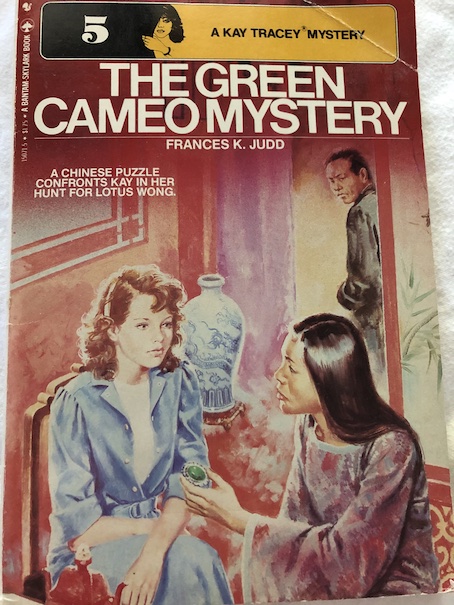
The Green Cameo Mystery

Kay Tracey

The Green Cameo Mystery by Frances K. Judd, 1952, 1980.

The story begins with Kay’s friends, Betty and Wendy, treating her to lunch, but when the girls try to pay the bill, the cashier says that their money is counterfeit. Betty and Wendy say that their mother gave them the cash, and she got those particular bills on a recent trip to San Francisco. The cashier tells them to contact the Secret Service and report the counterfeit money and tell them where it came from. (This book is old, but the Secret Service still investigates counterfeit money.)

As the girls leave the restaurant, they talk about the errands they want to run this afternoon. There is an auction Kay wants to attend because there’s a beautiful Chinese desk that she wants to get for her cousin, Bill, for his new office. However, she remembers that she needs to drop Bill’s shirt off at a laundry before they go to the auction. The laundry is a cliched Chinese laundry (connections are building in this story), but the man Kay usually sees there is absent today. The woman at the counter, Lily Wong, says that she’s the man’s sister and that her brother is unwell. Kay asks if he’s been to a doctor, and Mrs. Wong fearfully says that she doesn’t think that there’s anything a doctor could do against the green cameo. She explains that her husband got the green cameo in Shanghai, but it’s cursed, and it brings misfortune to her family every three years. While the girls are talking to the woman, she gets a phone call from someone who tells her that her daughter Lotus is now missing, having disappeared from the college she attends. (Yeah, Lotus. I don’t know if that’s a name that Chinese people actually use, but many of the Chinese names in this book struck me as being made up. I could be wrong because I’m not an expert on Chinese names, but they have that look.)

Mrs. Wong tells Kay that she tried to hire a medium named Cara Noma to break the curse of the green cameo, but she hasn’t been able to do it. Right away, Kay is sure that Cara Noma is a fraud. Kay volunteers to help find Lotus. A prime motive for her disappearance is Lotus’s impending arranged marriage to an older but wealthy businessman named Foochow. (I Googled that name, and apparently, it’s a romanized version of a place name, not a last name.) Kay’s first thought is that Lotus may have run away because she decided that she didn’t want to participate in this arranged marriage. Mrs. Wong also tells Kay that Cara Noma claims that her daughter has sold a jewel box with a green lotus cameo on the lid that Mr. Wong gave her as a betrothal gift.

The medium Cara Noma shows up while Kay is discussing the situation with Mrs. Wong and starts into her mystical act about how she’s going to break the curse. Kay impatiently tells her that it’s all nonsense and that she’s just taking poor Mrs. Wong’s money. Even Mrs. Wong agrees because, so far, Cara Noma hasn’t produced any results, and Kay is nice enough to offer to help her for free. Angrily, Cara Noma grabs both Kay and Mrs. Wong and uses some blood from a cut on Mrs. Wong’s finger to draw a red X on Kay’s forehead. She declares that she has transferred the curse of the green cameo to Kay and that Kay will soon see that the curse is real.

Kay still doesn’t think that the curse is real, and she and her friends head over to the auction where she wants to buy that desk for her cousin. Before the auction begins, Kay and her friends are looking over the items for sale when Kay discovers that the desk she wants to buy has a secret compartment in it. On impulse, she puts the envelope holding her money in the secret compartment to try it out. (This is so dumb, Kay. Don’t put all of your money in the secret compartment of a desk you don’t own!) Then, she gets distracted when she spots a jewelry box matching the one described by Mrs. Wong. Then, Kay’s nemesis from school, Chris Eaton, shows up and tells her not to waste her time bidding on the jewelry box because she wants and she has more money than Kay.

It turns out that Kay is unable to buy the desk she wanted to buy because the bidding is much higher than she can afford. Then, a man named Sidney Trexler shows up and protests the auction, saying that the desk belongs to him and he doesn’t want to sell it. It turns out that he’d been storing the desk there, but the desk was being sold because he hadn’t paid his storage fees. Mr. Trexler says that he has the money to pay his fees now and wants the desk back because he’s planning to get married and will need the furniture. The man who was going to buy the desk agrees to cancel his offer to buy so Mr. Trexler can have the desk back. When the jewelry box comes up for sale, both Kay and Chris Eaton are outbid by Mr. Trexler as well. Kay is disappointed because she was hoping to get the jewelry box for Mrs. Wong.

However, the mystery is only just beginning. When Kay gets home, she finds that the envelope she thought held her money isn’t really her envelope. She did remember to retrieve the envelope from the desk before it was sold (for a moment, I was afraid that she would forget), but by mistake, she grabbed a different envelope. Is this the first bad luck of the curse? Kay knows that she has to talk to either the auction house or Mr. Trexler to get her envelope and money back! Then, a taunting comment from Chris Eaton reveals that Mr. Trexler’s fiancee is actually Lotus Wong. Now, Kay really needs to find Mr. Trexler!

The book is available to borrow and read for free online through Internet Archive.

My Reaction and Spoilers

So, right from the beginning of this story we have the mystery of the counterfeit money, the mystery of the cameo curse, the mystery of the fake medium, the mystery of the disappearance of Lotus Wong, and the mystery of Mr. Trexler and his engagement and sudden money. The girls also come to wonder about Mr. Wong. He seems to have much more money than his brother-in-law who operates the laundry, and his wife seems afraid of him. What is Mr. Wong’s business, and why doesn’t he do more for his brother-in-law? Are any or all of these things connected? Actually, yes. At first, I wasn’t sure how they were going to circle back toward the counterfeit money from the beginning of the book, but it turns out that Cara Noma is in on the counterfeiting operation. For a time, it looks like Mr. Wong might be the head of the operation, but it turns out that he’s innocent. I thought that Lotus’s reasons for running away were poorly explained. Part of it is that she doesn’t want to marry Foochow, but there’s also a side plot about Cara Noma using hypnosis to control both Lotus and her mother. I think the implication is that she was doing it to milk Mrs. Wong of money while keeping Lotus hidden from her, but it seemed like an odd complication to me since Cara Noma was also involved in the counterfeiting ring.

I’m not sure that I’d call anything in the book “racist”, although I think there may be justification for saying that parts are “stereotypical” and probably a bit culturally shallow and “tone deaf.” My first impression was that the author and the characters in the story like Chinese culture for being exciting and exotic, but in that way where there’s no real depth to their knowledge it and it comes off as being a bit like caricatures of Chinese people you might see in old movies. I’ve seen some of the old Charlie Chan mystery movies, and the way the characters in the book talked kind of reminded me of them. The Chinese names seem pretty stereotypical and so does the way they speak in broken English. They don’t do the “Engrish” thing where the ‘l’s and ‘r’s are swapped, but the Chinese characters don’t speak proper English, and they throw in phrases and expressions that I think are meant to sound quaintly foreign. At one point, Mrs. Wong says to the girls, “When you see Lotus again, tell my lovely flower not study too hard. Much study make many wrinkles.” I’m not sure whether that was just a joke or if it was supposed to be some kind of pseudo-proverb, like Charlie Chan used to make. On the other hand, some of the speech patterns I thought might be old stereotypical tropes from movies might have more grounding in real life than I’ve credited them for having. Lily Wong also sometimes refers to herself in the third person, “Lily Wong not sure,” instead of “I am not sure.” I’ve met people in real life whose first language was Chinese, and none of them do this. I thought at first that this might be another trope carried over from old movies, but I looked it up, and apparently, actual Chinese speakers can do this sometimes. The technical name for it is illeism. So, while some of the speech patterns seem like old movie tropes, they might not be completely wrong for real life.

One part of the story that bothered me is the Chinese play that Kay’s school decides to perform. Kay and her friends are told that “a delegation of foreign visitors to the United States” (no nationality/nationalities specified at first) would be visiting schools in the area, including the high school that they attend. To entertain their foreign visitors, the school decides that they’re going to put on a short play, and of course, the drama teacher picks one with an “Oriental” theme called “The Pagoda Mystery.” (“Oriental” is the word they use, which is rather vague and considered somewhat outdated now. Some people consider it demeaning because it has old associations with stereotypes that people don’t want to perpetuate. The demeaning part seems to be more in the attitudes associated with its use than in the word itself. It is a technical geographic term that refers to the Eastern Hemisphere, but my thought is that referring to an entire hemisphere is rather vague. I don’t think the book meant it badly, but in modern times, it’s generally considered more polite and a sign of being well-educated to use the most specific word possible when describing geographic regions or groups of people. When people are overly vague, it makes it sound like they don’t know what they’re talking about or what the more specific word is. If this play is specifically about China, they could have just said that.) It’s rather coincidental that they’re doing a mystery play set in China right when Kay is working on a mystery involving people from China, but those types of coincidences happen often in Kay Tracey books. I wasn’t able to find any real information about this play, so I’m pretty sure sure that it was just made up by the author of the book so the school would have just the right kind of coincidental play to perform. Also, of course, Kay gets the lead role in the play when she tries out for it, that of a beautiful Chinese maiden. If there are any Asian students at this school, they aren’t mentioned, so I don’t think there are any. Charlie Chan was also not played by Asian actors, even though other characters in the series were, which is why they bother people now and there haven’t been any new ones made since 1981. The book says, “But because of her recent experiences at the Wong home, Kay spoke her lines with special feeling and proved her familiarity with Chinese customs and people. Therefore, the leading role was given to her.” I’m not convinced that her conversations with Mrs. Wong have really given her deep knowledge of China, but they did have tea together at her house, so maybe there’s an implication that she told her more about Chinese tea customs than the book described or something.

By another coincidence, it turns out that Mrs. Wong was in a production of the same exact play in China when she was young, and she played the part that Kay is going to play, so she coaches Kay in how to play the part. (What stroke of luck! See, Kay isn’t cursed!) Mrs. Wong assures Kay that when her face is made up to look Chinese, no one will know that she isn’t really Chinese because she’s such a good actress. I suppose that people in the 1950s, when this book was originally written, would be a little more accepting of non-Asians wearing makeup to play Asians (called “yellowface“) just because it was done more often back then, and people get comfortable with things they see often. It’s not particularly comfortable for modern people because our society is sufficiently diverse to have actual Asians playing Asian roles without the help of cheesy makeup, so this part of the story is eye-rolling, especially the way everyone fawns over Kay being so authentic-seeming. Also, much of what Mrs. Wong teaches Kay seems to involve making gestures with her hands and fluttering her eyelashes when she speaks, which the drama teacher praises as being very realistically Chinese. It’s hard to know exactly what that means without seeing exactly what Kay’s doing, and the description doesn’t say much. The fluttering eyelashes make me think that she’s acting flirty, but I don’t know if that’s suppose to be part of her role in the play or not because we’re never told the full story. Again, I could be wrong, but it Kay’s apparently authentic performance seems more like something from an old movie than real life.

I think that the drama coach choosing a play from China was meant to be some kind of salute to the foreign visitors (and a coincidence that helps further the plot of Kay’s mystery), but it seems like a kind of tone-deaf choice to me, not thinking about what people really want to see and experience when they visit a foreign country. If I were the person making the decisions, I don’t think that I would be comfortable with showing visiting foreign dignitaries a high school production of a play they would already know from their own youths in their country, entirely acted by people wearing makeup to look like them, probably with varying degrees of success. It just seems awkward and might give the impression that they were being made mocked rather than honored. People travel to see new and different things, not imitations of things they already have back home. That would be like someone from New York City going to New Orleans and spending their entire time there watching productions of Broadway plays instead of touring the French Quarter or the Garden District. If you’re just going to do something you could do back home, what did you even make the trip for? Traveling is about seeing things that make different places unique. So, if I were in charge of the high school play, I think I would have picked something that had nothing to do with China, something new and original that the visitors could describe to people back home as something you could only see if you go to America. It might be an American-written play or maybe something that the students put together themselves to show their individual personalities and interests, a view of the modern American teenager, like a collection of student-written short skits or a talent show. Musical performances would be good because people can still enjoy the sounds of the music even if they don’t know all of the words. It’s pretty likely that this school has a band or orchestra, and there may be some unofficial student bands that could play. Dancing, gymnastics, and juggling acts might be good, too, if there are people who know how to do those, because people understand what they are just by looking at them. They don’t require explanations like humor that involves puns and might go over the heads of people who aren’t completely fluent in a language. I like the idea of the entertainment being a sort of variety show with music and skits because that’s a traditional form of entertainment that was still popular in the 1950s, and it’s a good format when you have a large group of people because there are multiple leading parts and solos in different acts of the show, avoiding some of the inevitable arguments about who gets the best parts. They could even have displays of artwork or science projects from students who aren’t part of the performing entertainment. It would offer variety for the visitors and give everyone a chance to contribute something.

Of course, there’s a subplot to the story about Chris Eaton, Kay’s school nemesis, trying to steal her part in the play. Chris even goes so far as to drug Kay’s food so she’ll miss the performance. First of all, I’d never be as trusting as Kay, and I wouldn’t eat anything that someone who has a history of doing nasty things gave me. If Kay’s so sharp, she should have figured that Chris would do something nasty to her food. Second, drugging somebody isn’t a harmless prank. Chris apparently slipped Kay a strong sleeping pill, and Kay didn’t even finish everything Chris gave her. We don’t know whether Chris might have accidentally overdosed Kay if she’d eaten it all. People can die from drug overdoses. Chris also couldn’t know for sure whether or not Kay might have been taking some other medication at the time that would conflict with what she gave her. People can also die from mixing the wrong medications. For some reason, Kay and her friends don’t tell on Chris, and Chris isn’t punished. I understand that people don’t like to be thought of as tattletales, but I think that there are limits to what people should be willing to put up with, and being drugged should definitely something no one should tolerate. What she did was serious, and I don’t like it that they’re pretending like it isn’t.

Overall, I found myself often thinking of the old Charlie Chan movies while reading this book, comparing what I was reading to what I’ve seen in old movies. There are reasons why the Charlie Chan movies didn’t last, and I think this book is a decent example of some of those reasons. During their heyday, the Charlie Chan books and movies were welcomed as one of the first portrayals of an Asian hero in American culture who was kind, intelligent, and upheld justice. Even though Charlie Chan was a stereotypical character, he was a stereotype of all that was good, which was a welcome break from previous stereotypes of Asians as devious, evil characters, like the fictional villain Fu Manchu. Charlie Chan was one of the first fictional characters to encourage the American public to see Asian people in a friendly light and even as people to be admired. The Charlie Chan series encouraged a positive interest in Chinese people and culture, even though it was also somewhat shallow and stereotypical. As I said, the actors who portrayed Charlie Chan in movies were not Asian themselves. Hollywood back in the day couldn’t bring itself to put an Asian in the leading role. Culturally speaking, it’s probably best to look at that series as a stepping stone to better things. Once people have been introduced to a concept, we expect them to eventually gain more depth and understanding. Charlie Chan helped people to break away from old, toxic ideas and prejudices, but that doesn’t mean that people should stay at that level of cultural understanding and portrayals. People progress. They grow and learn, and so do societies and cultures.

What I’m saying is that nothing in this story related to China or Chinese culture is educational for children. They won’t learn anything from this book, and most of the books that I read as a child specifically included real facts about other countries and culture to be at least factually-correct or semi-educational. This book doesn’t even define the word “pagoda” for anyone who doesn’t already know it. There are no Chinese words in the story, and when Kay and her friends have tea with Mrs. Wong, they don’t say whether there are any special tea customs they observe. What the book tells you about Chinese people is very general – that they have some interesting antique furniture and art objects, they drink tea, they might be superstitious, not all of them speak good English, some are friendly and helpful while others are sinister criminals, and if you want to act like one on stage, hand gestures and fluttering eyes are pretty important (whatever that means). Some of that stuff is true, particularly the parts about tea, the fascinating antiques, and the fact that some can be good and some bad, like human beings in general. But, there’s not much concrete, factual knowledge here, and some parts might give kids the wrong impression. I had the feeling the whole time I was reading it that the person who wrote it was a fan of old movies and didn’t really know much about Chinese culture to tell anybody in a factual, educational way. The old Scooby-Doo cartoons were kind of like this when they talked about other countries and cultures, too, because many of them were written as kind of spoofs on movies that people would have known when they were first made. If you’re into old movies, you can recognize the references, but they weren’t meant to teach anything or include any real information. If you compare the older Scooby-Doo series to the more modern ones, you’ll notice that some of the modern ones make more of an effort to include some real, educational facts. Scooby-Doo isn’t an educational show, but I have noticed a slight shift in how they talk about other countries and cultures. That’s more the standard of children’s literature and entertainment I’m accustomed to – when someone says something about another country or culture, I expect it to be something factual that shows that the author did at least a little basic research and knows something about what they’re talking about. It’s grating to me sometimes that older, vintage children’s series don’t always do this. Some of them even shamelessly make things up about other countries and cultures just because they think it would make the story more exciting, assuming that the kids reading the books won’t notice or care. If this book sparked an interest and encouraged kids to learn more about China or Chinese culture, it’s not too bad, but by itself, it doesn’t demonstrate any helpful level of cultural knowledge and information.