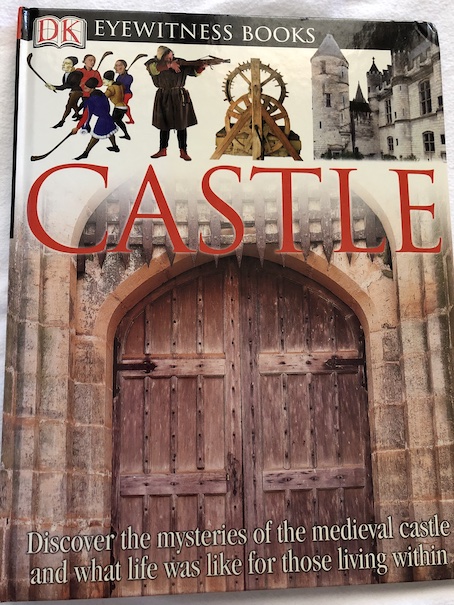
Castle by Christopher Gravett, photographed by Geoff Dann, 1994, 2004.
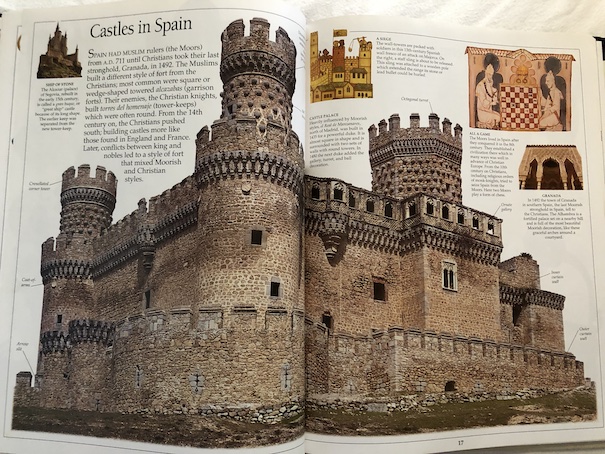
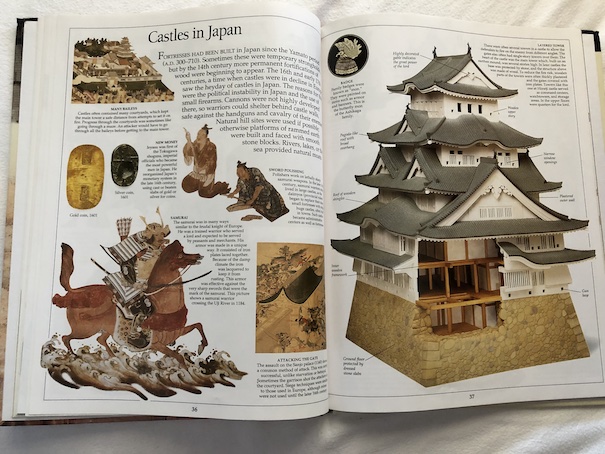
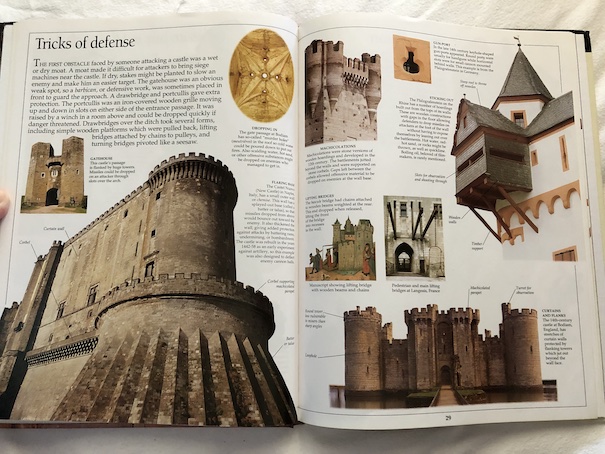
Eyewitness books are always great for the photographs that they use to illustrate the concepts in the book!
This book is all about Medieval castles. It starts by explaining the evolution of castle-building from early wooden motte-and-bailey castles to the great stone castles that we often think of as being the classic Medieval castle. However, stone castles could come in different shapes and styles, depending on where they were located.
The book shows examples of castles in different countries. Most of the focus of the book is on castles in European countries, including Spain, Germany, and France. However, the book also includes information about castles in Japan.
Castles were built for defense, and the book explains the types of defenses that castles would have, such as gatehouses, murder holes, lifting bridges, battlements with corbels and machicolations, and loopholes. It also explains what a siege was like, what types of weapons would have been used, and what knights and soldiers were like.
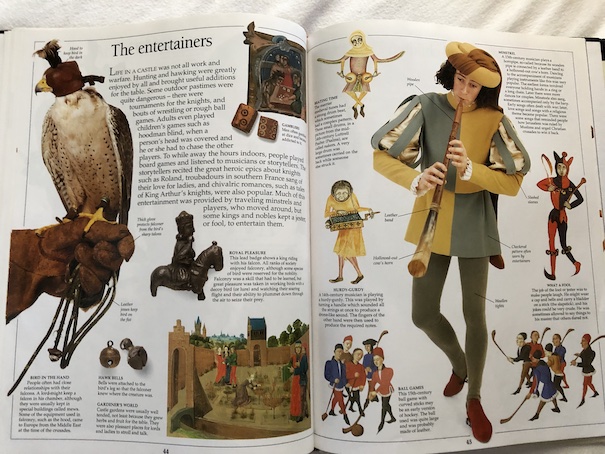
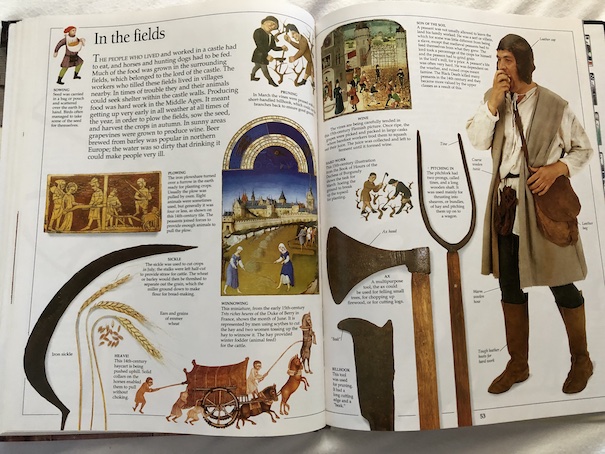
The parts of the book that I liked best were the parts that described the rooms in a castle and the daily lives of the people in a castle. Among the rooms in a castles were the great hall, kitchen, and chapel. I like how they show the objects that would be found in different rooms and how they would be used.
The book explains the lives of the lord of the castle and women and children who lived there. There is information about the types of foods they would eat in a Medieval castle and the types of games and entertainment they would have enjoyed.
There is also information about other workers in and around the castle, including the castle builders and people who tended the castle’s animals and worked in the agricultural fields around the castle, producing food and textiles for the population.
There are sections in the back of the book with additional facts and information about castles and the people who lived in them and a glossary.
The book is available to borrow and read for free online through Internet Archive (multiple copies).
The Pharaohs of Ancient Egypt by Elizabeth Payne, 1964, 1992.
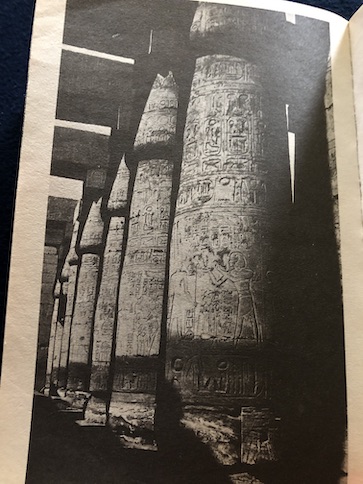
This is a book for kids about the lives of Egyptian pharaohs, including Hatshepsut, Akhnaton, and Rameses the Second. It also includes details of Ancient Egyptian history, daily life, and religion. I would put the difficulty level of the book around the middle school level. It’s a chapter book with very few pictures and more dense writing than others I’ve read in the same series. It’s one of the Landmark Books (called Step Up Biographies in earlier printings).
Egypt is among the world’s oldest civilizations, having a long history, extending over thousands of years. The Ancient Egyptians created a powerful legacy that has influenced other civilizations for millennia.
In the early days of Egyptian civilization, groups of small villages that early settlers had established along the Nile joined together to form kingdoms. At first, there were three of them:
The Bee Kingdom in Lower Egypt — at the Nile delta, on the Mediterranean
The Reed Kingdom in Middle Egypt — near the site of modern Cairo
The Hawk Kingdom in Upper Egypt — near the rapids that lay between Egypt and the Nubians to the South
If you’re wondering why “Lower Egypt” was in the northern part of Egypt and “Upper Egypt” was in the south, it’s because the Ancient Egyptians weren’t concerned about north and south with regard to their kingdoms. They lived along the Nile, their major source of water and transportation, and when they thought about the relations between cities and kingdoms, they were most concerned about whether they were upriver or downriver. So, “Upper Egypt” was the kingdom farthest upriver, and “Lower Egypt” was the one that was farthest downriver. The Nile just happens to flow from south to north.
Then, around 3200 B.C., the Hawk King known as the Scorpion conquered the kingdom in Middle Egypt. His successor Menes (also called Narmer), who ruled both Middle and Upper Egypt, conquered Lower Egypt as well, turning Egypt into a single nation with a single king. However, there were still rivalries between Upper and Lower Egypt, and the people in different regions spoke different dialects.
The Ancient Egyptians believed that their kings, called Pharaohs, were half-human and half-god. Part of the reason for this belief may have been because the Egyptians believed that a partially-divine ruler could help ensure that life in the Nile Valley could continue smoothly by appealing to his godly relations and partly because, if the king wasn’t completely human, he could be considered above the rivalries between the different regions and remain a unifying figure for the Egyptian people, no matter which region he had come from originally.
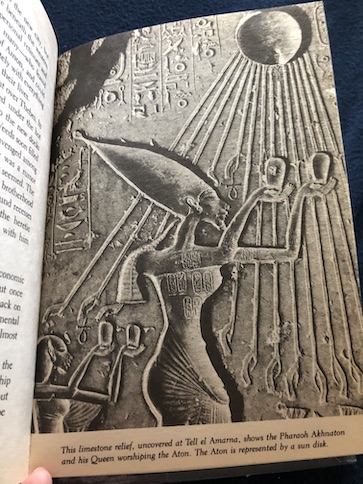
Although most Ancient Egyptians were polytheistic, like other ancient civilizations, there was one pharaoh who believed in only a single, all-powerful god. This pharaoh was Akhnaton, the father of Tutankhamen. (The book refers to Tutankhamen as a younger half brother of Akhnaton, but later sources say that he was Akhnaton’s son, although there is still some dispute about that. Either way, the two were related, and Tutankhamen was Akhnaton’s successor.) Akhnaton worshipped the sun, calling the sun god Aton. Part of the reason for this conversion to the worship of a single sun god instead of the many gods of the Ancient Egyptian pantheon may have been due to a power struggle between the pharaoh and the High Priest of Amon. However, Akhnaton seemed to genuinely believe in the Aton and was devoted to it, establishing a new capital city and outlawing worship of other gods. Unfortunately, his health was frail, and worship of the Aton didn’t extend beyond his death around the age of 42, with Egyptians returning to worship their old gods. Tutankhamen, who had been born Tutankhaton, changed his name and moved the capital away from Akhnaton’s city. Tutankhamen’s reign was short. He died in his late teens. (The cause of his death has never been precisely determined, although it seems likely that it was a combination of ill health, possibly a congenital condition due to inbreeding in the royal family, malaria, and a physical injury.) Tutankhamen’s main source of fame is his tomb, found largely intact in November, 1922.
Dynasties of Egyptian Pharaohs ruled Egypt for thousands of years, although in the later centuries of Ancient Egypt, foreign rulers moved in and took control for long periods. Then, in 332 B.C., Alexander the Great conquered Egypt, bringing it under Greek and Macedonian control and ending the reign of Egyptian Pharoahs forever.
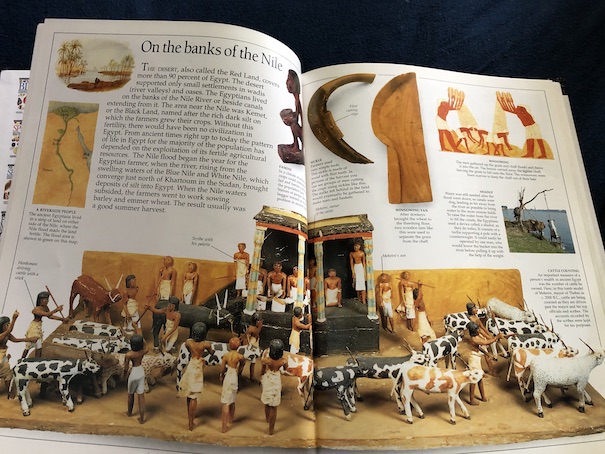
I love the way this book, like others in the Eyewitness series, shows photographs of artifacts so readers can not only read about how people lived but see the objects that they used. Each photograph in the book has a caption to explain what it is.
The book begins with an explanation about the origins of Ancient Egyptian civilization thousands of years ago, before there were pharaohs. Then, it explains about the geography of Egypt and the Nile and how the Nile floods and fertile lands along the river made Egyptian civilization possible.
The book then explains the concept of the Egyptian king as a “pharaoh.” The title of “pharaoh” comes from an Ancient Egyptian word meaning “great house”, referring to the palace where the king lived, so the king was the one who lived in the “great house.” However, the pharaoh was more than just the an important man living in a palace; he was also regarded as being a god. Most Egyptian rulers were male, although queens also sometimes ruled and were also regarded as divine. The book shows pictures of statues depicting pharaohs and explains a little more about some of the most famous pharaohs and queens. Then, it goes on to discuss life in the royal court.
Of course, no book about Ancient Egypt is complete without a discussion of mummies and tombs. Much of what we know about Ancient Egypt comes from what the Ancient Egyptians left in their tombs because Ancient Egyptians believed in life after death. They developed methods of preserving their bodies after death, and they stocked their tombs with things that they wanted to have with them in the next life. The book explains the embalming process, what pyramids and royal tombs were like, who the Egyptian gods and goddesses were, and what Egyptians believed about the journey to the afterlife.
I liked how the book not only explains different types of gods and goddesses in Ancient Egypt but also the roles of priests and temples in Egyptian society, types of religious rituals, and the role of religion and magical rituals in Ancient Egyptian medicine.
As the book covers a wide variety of different topics in Egyptian society, including scribes and writing, weaponry, and trading. I particularly like the parts focusing on daily life, like what Egyptian homes were like and some of the tools and details of different trades, like carpentry. The book has details about foods Ancient Egyptians ate, what music and dancing were like, and types of clothing and jewelry they had.
One of my favorite sections in the book is about toys and games in Ancient Egypt. We don’t know all of the details of games that were played in Ancient Egypt, but we do know that they had board games because they were found in tombs. Children’s toys were whimsical and included moving parts. Some of the games children played are similar to ones that children play today, like versions of leapfrog and tug-of-war and spinning tops.
The book is available to borrow and read for free online through Internet Archive (multiple copies, including some in different languages)
How Did They Live? Greece edited by Raymond Fawcett, 1951, 1953.
This is a non-fiction book, part of a series about life in the past, but it’s told in the form of a story where the readers are visiting a man living in ancient Athens named Simonides. The story is told from the point of view of “we” as “we” visit Simonides, and he shows us around Athens.
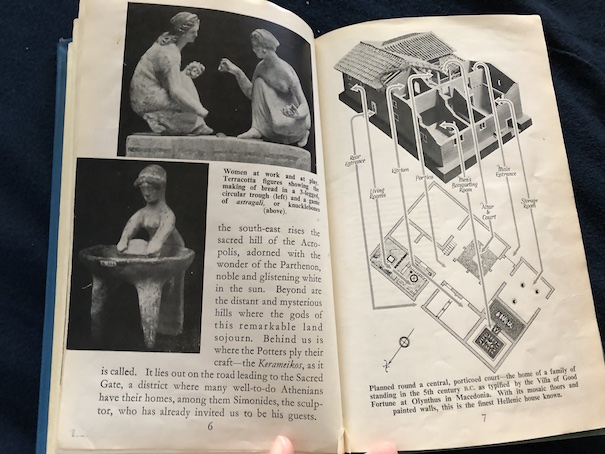
At the beginning of the story, Simonides meets us at the Temple of Hephaestus. The book provides a map and a description of the city so we know our way around. Simonides is a sculptor, and he lives in a nice house in an area of the city with well-to-do people. The book provides a map of the interior of Simonides’s home. His house is bigger and nicer than those of poorer people, and he also owns slaves. (The women playing a game on this page are playing Knucklebones, a precursor to modern Jacks but played with animal bones.)
Athens, like other cities in Greece at this time, is actually a city-state, an independent state with its own government, separate from other Greek city-states. Simonides explains that he served in Athens’s army when he was younger. Now, as a sculptor, he works with an artist producing public art in Athens. During a war with Sparta, many homes and buildings were badly damaged, so they’ve been rebuilding what was ruined and creating new public monuments.
Simonides takes his guests into a special dining room, where we can relax. Guests are only allowed into areas of the men’s quarters of the house. The women’s quarters are strictly private, and we are told that the women in Athens spend most of their time at home, tending to household tasks. Usually, they only go out for special occasions, like festivals or plays. The Athenian women do not have the rights to property and having a say in public life that the men do. However, women from wealthy families lead comfortable lives and authority with in their houses. The book puts it, “Besides running the household she has her little vanities and the universal feminine interest in dress and adornment to help her and, in spite of her seclusion, she contrives to keep herself pretty well informed about what is going on in the city.” The part about the “little vanities” seemed a little insulting to me because I personally don’t like vain and shallow women who can’t think outside of the clothes closet, and I know plenty of women who aren’t in clothes and fashion. It seems like one of those cases where interest in these things might not really be “universal” but it’s something that women do because there just isn’t that much else for them to do. If they had more options of other activities, some of them might have found other things to do. The book goes on to describe various styles of women’s dress, hair, and makeup.
As the guests, we are invited to spend the night at Simonides’s house, and the next day, slaves bring us water to wash in and a breakfast of pieces of bread in wine. Then, we visit the agora (marketplace) with Simonides. There are people hanging around, socializing with friends, and the book describes the tunics and mantles they wear. After Simonides makes his purchases, he has his slaves carry them home. As we wander through the public meeting places, Simonides explains about the local philosophical groups that meet there, like the Stoics. We even meet Socrates as a young man.
After the shopping and visiting the public meeting places, we return to Simonides’s house for the midday meal of fish, vegetables, fruit, and bread. After the meal, Simonides’s wife, Hestia, explains more about the lives of women and children in Athens. As explained before, women have fewer rights than men, and female children do not receive as much education and training as boys do. Children younger than seven are all raised in the women’s quarters of the house. They play with toys like rattles, dolls, balls, spinning tops. Girls like to play on swings and see-saws and learn to dance, while boys play with kites, hoops, and hobby-horses. They all listen to stories like Aesop’s Fables to learn moral lessons. At the age of eight, boys begin to go to school, and at the age of eighteen, they join the army. Meanwhile, girls are taught to handle domestic tasks.
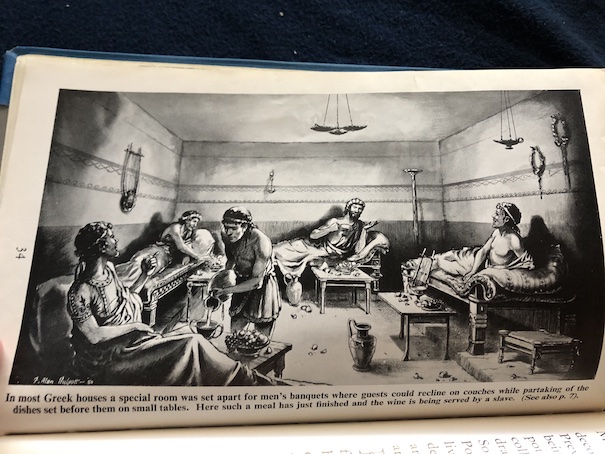
After that, we make a visit to the Acropolis to see the Parthenon, which is the Temple of Athena. The carved figures in the pediments of the building tell stories from the life of Athena. That evening, Simonides invites some friends to the house for a dinner party in his banquet room, where people eat while reclining on couches.
The next day, we learn about pottery and how it is made. The book describes the types of pictures and designs painted on pottery and says that the style with red figures painted on a black background is a newer style. Before, black figures were painted on a red background.
Toward the end of the book, we attend the Panathenaic Festival, which is meant to honor Athena. The festival includes athletic competitions and music and literature contests. There is a procession of important public officials and animals to be sacrificed to Athena. We (the guests) ask Simonides to explain more about the religion and gods of Ancient Greece, and he does. Religion is an important part of public life in Athens, but the book includes a suggestion that Simonides might not actually believe in the gods and goddesses of Ancient Greece: “We do not ask Simonides if he himself believes in these gods. But we have an idea that, like many other Grees, he may not do so, for he suggests that a knowledge of the gods has been handed down from the poets of old and the sculptors have clothed the ancient myths in beautiful forms.” That’s not much of an explanation, although I suppose it’s reasonable that people would believe in the religion of Ancient Greece to varying degrees, and there would have been at least some disbelievers. That’s found in pretty much every religion. There are also people around the world in modern times who engage in religious traditions less out of personal belief than out of civic or cultural participation (like this description of Shinto in modern Japan), which is the implication about the people in this story.
The book ends with a visit to Olympia to see the ancient Olympic Games.
My Reaction
I love books that explain daily life in different time periods, and I thought this one was pretty well done. It covers a few days in the life of Ancient Athens and also does a good job of explaining the wider society of Athens. Most of the perspective is on a fairly wealthy family and their slaves. I found parts about the descriptions of the lives of women and slaves distasteful, but the descriptions and attitudes of the people seem pretty accurate for the time and place. My feelings were more about not liking the lifestyle and circumstances than about disagreeing with the author. There are more details about the raising and schooling of children and about food and clothing than I’ve included in this description.
I particularly liked the maps of the city and the interior of the house. I also liked the way they included Greek words and explained their meanings, like kerameikos (pottery, note the resemblance to the word “ceramics“). Even though I took a philosophy class in college and learned about the Stoics, I didn’t remember the professor explaining that the origin of the word “Stoics” was the stoa, the public gathering place like a covered porch where they would meet.
I was confused for a moment when the book explained that Simonides doesn’t bow when he meets people “as we would do.” As an American, I wondered, “Who’s ‘we’?” Americans aren’t in the habit of bowing to random people we meet on the street, either. I checked, and the book was printed in England. British spellings in the book (“honour” vs. “honor”) also confirm that this is a British book. I didn’t think that people in England in the 1950s bowed to people either, except maybe during important events with royalty and nobility. The most I would ordinarily expect would be a nod or bow of the head to acknowledge other people, and people in the US do that, too.
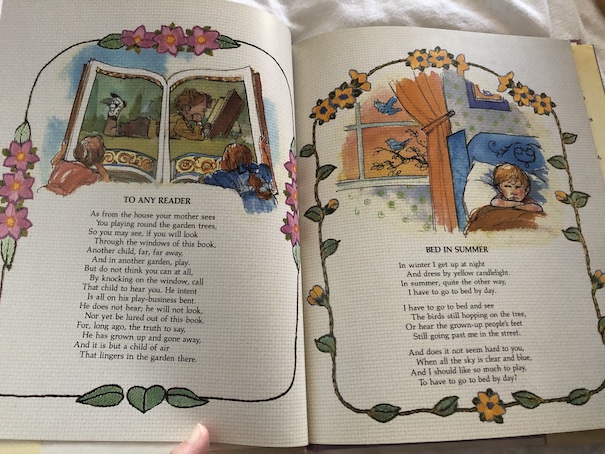
A Child’s Garden of Verses by Robert Louis Stevenson, illustrated by T. Lewis and Sara Gutierrez, 1989.
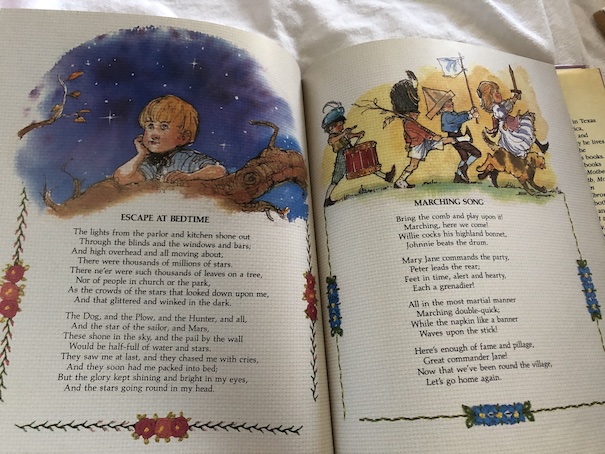
This is a reprinting of the classic collection of children’s poems by Robert Louis Stevenson first published in 1885 as Penny Whistles. What makes this edition of the book different from other printings is the illustrations, which are an unusual combination of watercolors and embroidered borders. Mary Pope Osborne, author of the Magic Tree House series wrote an introduction to the book about the life of Robert Louis Stevenson and his youth in Scotland in the 1850s, which inspired his poems for children. (See my list of Books from 1850s for the types of books children were reading during this time period, but remember that they also would have read books that were published in previous decades.)
The poems have gentle themes from the lives and fantasies of children, like games of pretend, bedtimes, and the little things that children notice and that adults often take for granted, like shadows and the beauty of stars. Some of them have things that are now anachronistic, like lamplighters, but they’re still imaginative and enjoyable for all ages.
I’ve always liked Robert Louis Stevenson’s children’s poems, and this book has my favorites! My personal favorites are:
To Any Reader – Robert Louis Stevenson speaks to children reading these poems about the child he used to be and how the poems are like a window on his childhood, although his own youth is long gone. Escape at Bedtime – About a child who sneaks out of bed at night to look at the stars. The Swing – I mentioned this one before because it’s included in another collection of poems, and I’ve often thought of it when I’ve been on swings. Picture Books in Winter – A child enjoys picture books indoors when it’s cold outside. The Land of Storybooks – About the adventures that children who love books enjoy in their imaginations.
However, my mother’s favorite children’s poem is Bed in Summer because it reminds her of her own childhood and having to go to bed while the sun was still shining in summer and other children in the neighborhood were still playing outside. (I didn’t have this experience when I was growing up because I never lived in a place that had daylight savings time, which changes the clocks by one hour, providing an extra hour of daylight before sunset. Arizona is very hot, so there’s a benefit for doing things after the sun has set, and few people have any interest in pushing back time to maximize the scorchingly hot daylight hours. My childhood memories include going to parks with my parents after the sun set and being put to bed after we got home.)
There are many copies of this book available in various printings online both at Internet Archive and Project Gutenberg because the text of the original book is now public domain. I didn’t see this particular printing with these illustrations available online, but if you just want to read the poems, there are plenty of other copies of the book to choose from!
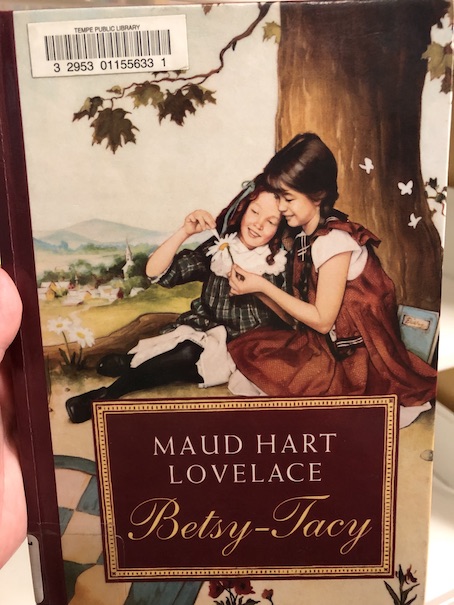
This is the first book in a series about two best friends growing up in Minnesota around the turn of the 20th century. The stories in this book and the rest of the series are based on the author’s own childhood experiences with her best friend.
At the beginning of the book, Betsy meets her best friend, Tacy (short for Anastacia), for the first time after Tacy’s family moves into a house nearby when the girls are both about five years old. Tacy is very shy and doesn’t want to talk to Betsy at first. It isn’t until Betsy’s fifth birthday party, a short time later, that the girls really get to know each other and become friends. After that, they are inseparable, almost to the point where people begin to think of them as one person, Betsy-Tacy.
Each of the chapters in the book is a short story. Some of them are about everyday things, like how Betsy would make up stories about her and her friend, how the girls would play dress up and paper dolls, or how they would have a “store” and sell bottles of colored sand to their friends. Some of the stories are touching, as the girls help each other through some of the most important times of their young lives. Betsy, the more out-going one, helps shy Tacy through the trauma of their first day of school. Tacy, who has many brothers and sisters, reassures Betsy that everything will be alright when Betsy’s younger sister is born. Both girls struggle to come to terms with the death of Tacy’s baby sister.
At the end of the story, the girls make a new friend when a family moves into the chocolate-colored house with the stained glass window that the girls had always admired.
In the 60th anniversary edition of the book, there are pictures of the author and her best friend, Bick, who is the model for Tacy in the stories, and pictures of the author’s family. There is also a description of the author’s early life and how the stories were based off her recollections of her own childhood.
This book is available to borrow for free online through Internet Archive.
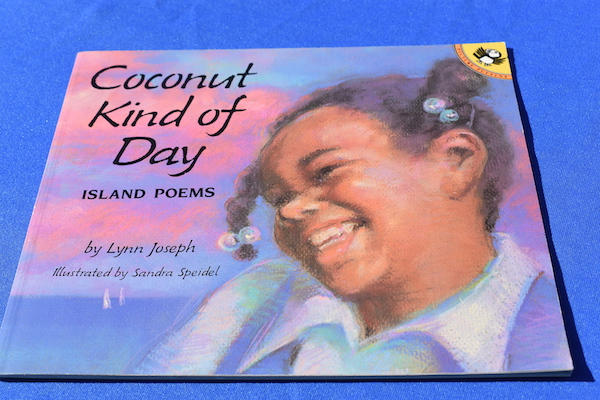
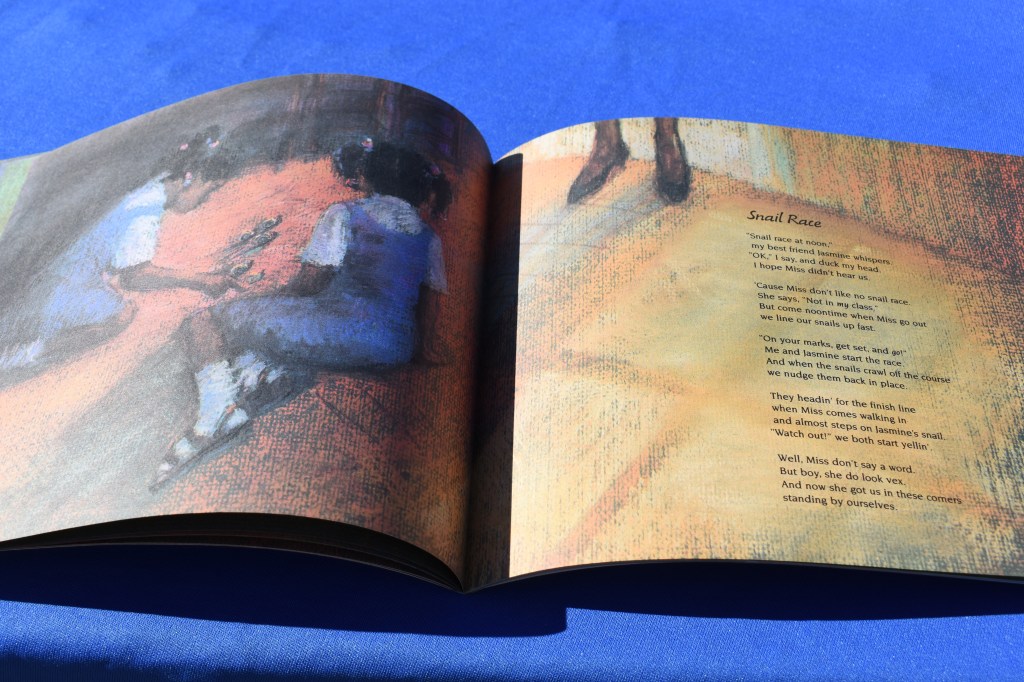
Coconut Kind of Day: Island Poems by Lynn Joseph, illustrated by Sandra Speidel, 1990.
The
author’s note in the back of the book explains that the author was originally
from Trinidad and that she wrote this book of poems about some of the things
that remembers from growing up there. She
also explains some of the terms used in the poems that people who aren’t
familiar with Trinidad might not know:
Palet man
– Ice-cream man who sells ice cream on sticks, like popsicles (I knew this one
because I’m used to the Spanish word “paletero” from growing up in Arizona.)
Soursop – A type of fruit often used as an ice cream flavor
Pullin’ seine – When the fishermen start pulling in their nets, and other people help.
Jumbi man – A bogey man. It’s popular for people to dress in a Jumbi costume at Carnival time.
Sorrel – A plant used in making a drink around Christmas
The poems are mostly about small, everyday things, like going to school or to the market or how the children play together or get ice cream from the palet man.
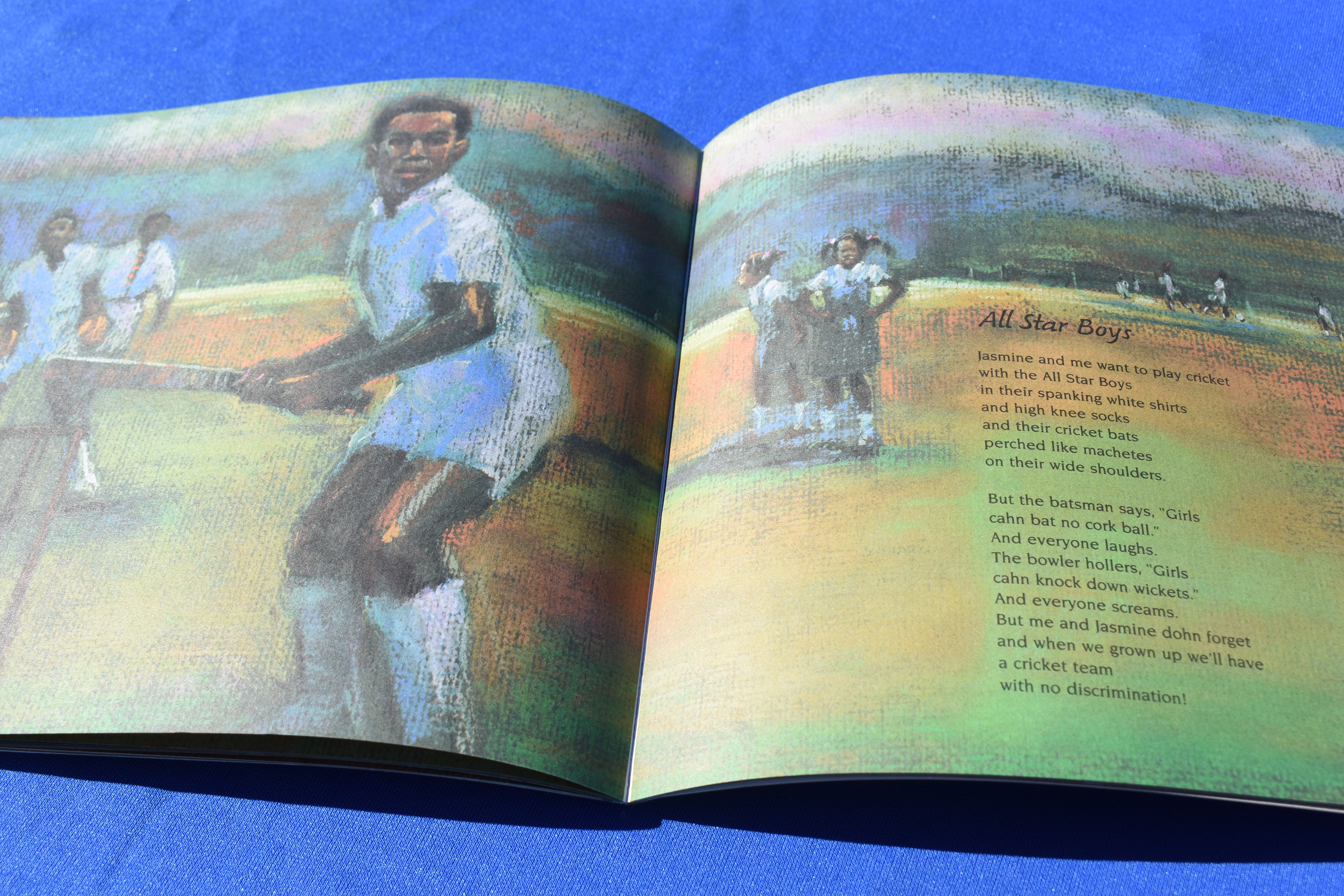
There is one poem where the girls want to play cricket with the boys, but the boys won’t let them, and they decide that when they’re older, they’ll have a cricket team of their own.
The pictures are beautiful, done in an impressionistic style.
This is the sequel to A Long Way from Chicago. The story takes place shortly after the Great Depression, in 1937.
Times are still hard, and a recession has left a lot of people out of work again. Mary Alice’s father is out of work, and her brother Joey is out west working for the Civilian Conservation Corps. Because her family has to move to a smaller apartment, fifteen-year-old Mary Alice leaves Chicago to stay with her Grandma in the country for the year. Times are hard in Grandma’s small town as well, but Mary Alice’s Grandma is as wily and eccentric as ever.
Like the first book, this book is really a series of short stories about Mary Alice’s adventures with her Grandma during their year together. The stories generally have a hilarious turn as Grandma gets the better of everyone, often in the name justice or a good cause. (Although, Grandma’s sense of justice is debatable since it involves “borrowing” pumpkins from the neighbors in the dead of night and other questionable activities.)
These stories present a detailed picture of rural life during the 1930s, from pranks played on Halloween to how Armistice Day was celebrated in the years following World War I, when people were still alive who had strong memories of that war. The stories also capture some of the personalities and politics of life in a small town, from a disreputable family of outcasts to the local elite, who have more money than the others and brag about having ancestors who fought in the Revolutionary War (which may or may not be so).
Rich Chicago Girl: Mary Alice arrives in Grandma’s small town and is enrolled in the local school. She meets the class bully, and Grandma helps her to deal with her.
Vittles and Vengeance: At Halloween, Grandma gets revenge against a group of pranksters and raids her neighbors for ingredients to make the school Halloween party better.
A Minute in the Morning: Armistice Day, November 11, has more meaning for people who have actual memories of The Great War (World War I). Grandma makes sure that those who can afford it pay what they owe to the veterans of that war and shows Mary Alice the price that some soldiers paid for supporting their country.
Away in a Manger: Mary Alice is picked to play Mary in the school’s Christmas Nativity play. The baby Jesus turns out to be a surprise for the whole town, and Grandma arranges a special surprise for Mary Alice.
Hearts and Flour: The head of the local branch of the DAR pushes Grandma to make cherry tarts for their annual tea in honor of George Washington’s birthday. Since she will neither allow Grandma to join the DAR (because Grandma doesn’t have the proper lineage) nor pay Grandma for her work (she thinks Grandma should ‘volunteer’ her services as part of her patriotic duty), Grandma insists that if she bakes, she must host the tea as well . . . with a couple of special surprise guests. Meanwhile, a handsome new boy named Royce joins Mary Alice’s class at school.
A Dangerous Man: An artist working for the WPA rents a room from Grandma, treating Mary Alice and Royce to a scandalous but hilarious sight when his subject matter gets out of hand.
Gone with the Wind: A tornado sweeps through the town, and Grandma and Mary Alice go to check on residents who live alone. Mary Alice also prepares to return home to her parents in Chicago.
Ever After: The final story in the book is about Mary Alice’s wedding, years later, toward the end of World War II.
This book is a Newbery Award winner. There are multiple copies currently available online through Internet Archive.
Escaping from World War II Europe was only the first step for the Platt family. Now that they are reunited in the United States, survival is still a struggle. They have very little money, and Lisa’s father struggles to find work and a permanent place for his family to live. Along the way, they encounter people who are prejudiced against them, some because they are Jewish and some because they are German, and are forced to confront certain prejudices that they hadn’t realized that they held as they settle into their new country and learn to live alongside people from different backgrounds who live very different lives.
Lisa describes her family’s day to day struggles and adventures with understanding. In Germany, her father had his own business, selling coats, but he has to struggle to get into the clothing business in America. Her mother, who had once had her own servants in Germany, is forced to take a job as a maid to help make ends meet. Besides the basic problems of learning a new language, dealing with a lack of money, and trying to find work, she also describes the parts of American culture that take her family by surprise. There are religious issues because most of the people around them are Christian, and Lisa’s mother is upset when her youngest daughter, Annie, ends up getting a role in her school’s Easter play. Her mother also isn’t sure what to make of the Japanese family who lives next door when Annie makes friends with their daughter.
Meanwhile, the war that they had feared is becoming a reality. People in the U.S. are starting to support the war effort, collecting materials that the army can use, starting Victory Gardens to help support themselves during food rationing, joining the army, and volunteering as nurses. The Platts also experience survivor’s guilt as they hear reports of friends and family who weren’t lucky enough to escape the Holocaust.
The Platt family is realistic, and they have their arguments as the stresses of all these changes take their toll on them. But, they are a loving family and continue to support each other through everything. The title of the book comes from a song, “Golden Days”, about looking back on happy times. When Lisa’s little sister Annie asks her if these are their “golden days”, Lisa tells her that she doesn’t think so, but she thinks that they might be silver ones, days leading up to happier times ahead.
In some ways, the children of the family have an easier time dealing with all the changes than their parents. In the beginning, they are aware that they don’t quite fit in, although they desperately want to. However, they do manage to make new friends, and Lisa and her older sister, Ruth, even find their first loves. While the world around them is changing, the three sisters also change, growing up, finding new interests, and learning more about themselves and the kind of lives they want to live in their new home.
The book is currently available online through Internet Archive.
Sarah Morton’s Day: A Day in the Life of a Pilgrim Girl by Kate Waters, 1989.
This book is part of a series of historical picture books. It features a young girl who was an historical interpreter at Plimoth Plantation, a living history museum, playing the part of a real pilgrim girl who lived in 17th century Plymouth. The pilgrim girl’s name was Sarah Morton, and she was nine years old in 1627, the year that Plimoth Plantation reenacts.
As Sarah Morton, the girl takes readers through a typical day in her life. She demonstrates the chores that a pilgrim girl would have to perform. She explains the clothes that a pilgrim girl would wear and what people ate. There is a recipe for 17th Century Indian Corn Bread, a simple recipe that readers can make at home, but it warns that modern people wouldn’t think that it tastes very good. It’s basically just water and cornmeal grits.
Although much of Sarah Morton’s day is taken up with chores, she also discusses her relationship with her mother and her new stepfather. The death of a parent was something that pilgrim children often experienced. After her father’s death, Sarah’s mother remarried, and Sarah is concerned about whether her new father likes her.
However, her stepfather is a good man who cares about her. He gives her lessons in reading and writing, something that not every pilgrim girl would have. He also gives her a special toy: a knicker box, which is a wooden box with arches for rolling marbles through as a game. She gets to play with her friend, Elizabeth.
The two girls are also excited about a ship that has been sighted out at sea. Soon, new people will be coming to their colony, and they wonder if the ship is also carrying letters from England or special goods that they would like, like a new bolt of cloth.
In the back of the book, there are sections explaining a little about the Plimoth Plantation living history museum, the real Sarah Morton, and the girl portraying Sarah Morton, Amelia Poole. The Plimoth Plantation site has more information about the real Sarah’s Morton’s life, including what happened to her when she grew up. If you’re curious about what Amelia Poole is doing today, she is a fiber artist and lives in Maine.
The book is available to borrow and read for free online through Internet Archive.

















 A Year Down Yonder by Richard Peck, 2000.
 Silver Days by Sonia Levitin, 1989.
 Sarah Morton’s Day: A Day in the Life of a Pilgrim Girl by Kate Waters, 1989.
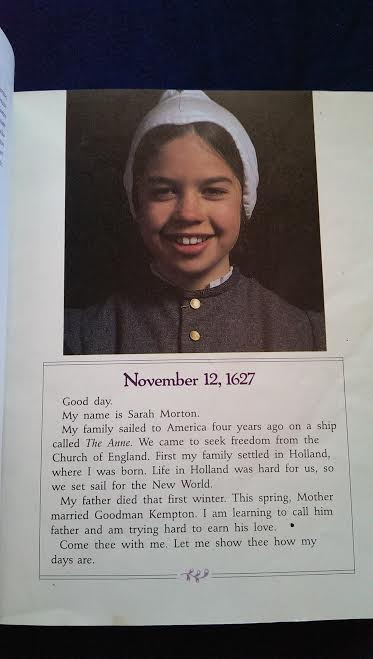 Although much of Sarah Morton’s day is taken up with chores, she also discusses her relationship with her mother and her new stepfather. The death of a parent was something that pilgrim children often experienced. After her father’s death, Sarah’s mother remarried, and Sarah is concerned about whether her new father likes her.


 Jestress's Forgotten Books and Stories