Mirandy and Brother Wind

It’s springtime, and “Brother Wind” (the wind personified) is striding through the valley. Young Mirandy is getting ready for the junior cakewalk, and she imagines that, if Brother Wind was her partner, she would be sure to win the cakewalk. Her mother says that anyone who can catch the Wind can make him do whatever they want, so Mirandy decides that she’s going to catch Brother Wind before the cakewalk and make him dance with her!

That’s easier said than done. Mirandy doesn’t know how to catch the Wind, and her grandmother doesn’t think such a thing is possible. She asks different people what to do, and she tries different ways of catching him. She tries catching him in a quilt, but he gets away.

Then, Mirandy tries visiting Mis Poinsettia, the conjure woman (a sort of witch or woman with magical knowledge), and she asks her if she has a potion that would help. Mis Poinsettia’s advice is to trap the Wind in a bottle of cider, but that doesn’t work, either.

Eventually, Mirandy manages to trap Brother Wind in the chicken coop. Once she has Brother Wind, he has to give her a wish. However, on the night of the cakewalk, Mirandy realizes that there is someone else she wants for a partner besides Brother Wind, and she asks Brother Wind for help in a different way from the one she had planned.
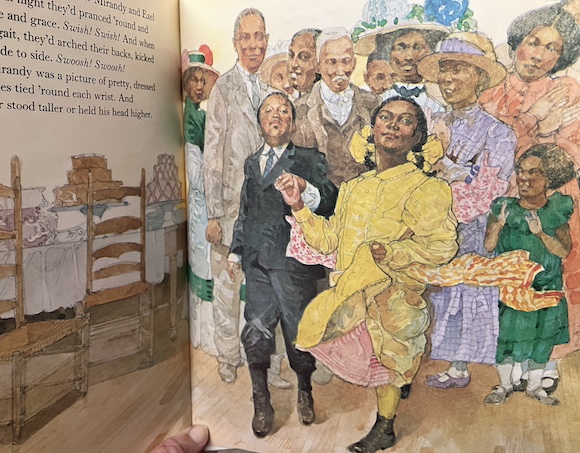
I thought this was a charming picture book, with bright, colorful illustrations that really conveyed that sense of lightness and air in the presence of Brother Wind! The old-fashioned clothing of the characters is part of the charm, and I like this sweet introduction to the concept of a traditional cakewalk. Cakewalks were a kind of traditional African American dance contest with a cake as a prize for winning. The people participating are dancing as they parade around the room, which is a little different from the cakewalks or candywalks that some modern people do at school or church carnivals as a kind of raffle game. In the game version, the players are just walking, not dancing, and they stop on numbered spots whenever the music stops, winning prizes if the number of their spot is drawn. For Mirandy, winning the cakewalk isn’t a matter of stopping in the right place but actually dancing well.

All through the book, there is a boy who likes Mirandy, but Mirandy doesn’t think of him as a dance partner because she has her heart set on Brother Wind as the perfect dance partner, and the boy is kind of clumsy. Mirandy really wants to win the contest, so it’s important to her to have the best partner she can. However, when one of the other girls at the cakewalk talks badly about the boy and his clumsiness, Mirandy can’t stand to hear him being insulted. She boldly declares that the boy will be her partner, and they will win in the contest together … with a little help from Brother Wind.

The Silver Slippers

Magic Charm Books

The Silver Slippers by Elizabeth Koda-Callan, 1989.

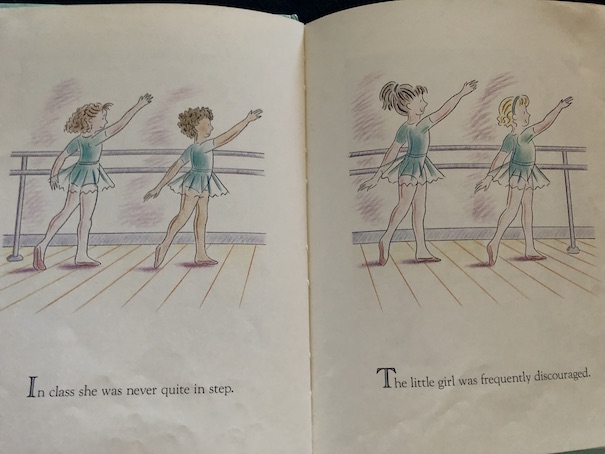
A little girl (unnamed, like the other girls in this series) wants to be a ballerina. She takes ballet classes, but she never seems quite good enough, like the ballet posters on the walls of her room. She feels discouraged because she is not perfect.

When her ballet teacher tells the class that there is going to be a dance recital and that one girl in class will be chosen to be the prima and lead the others, the girl doesn’t think that she has a chance to be chosen because her dancing isn’t good enough.

The girl tells her mother about the recital and her doubts about being chosen to be prima, and her mother tells her that it depends on how much she wants to be prima and how much she is willing to practice to improve. If the girl is willing to put in extra practice, she still has a chance to be prima. To remind her of her goals, her mother gives her a silver charm in the shape of a pair of ballet slippers.

In order to improve her dancing, the girl has to focus on her goal and give up participating in other activities to find more time to practice. However, her practicing pays off, and she gets the role of prima. On the night of the recital, she is nervous, but her silver slippers charm reminds her of her dream of being a real ballerina and gives her the courage to go on with her performance.

All of the books in this series originally came with charms like the ones described in the stories. This book originally included a little silver slippers charm for the reader to wear. The hole in the cover of the book was where the charm was displayed when the book was new. The books in the series often focus on the unnamed main character (who could represent any girl reading this story – the books were aimed at young girls) developing new self confidence, and the charms were meant to be either a sign of their new self confidence or inspiration for developing it. In this case, the charm is a reminder of the girl’s goals and how much she really loves dancing, giving her the inspiration she needs to persevere even when learning is difficult.

The book is available to borrow for free online through Internet Archive.

Changes for Molly

American Girls

MollyChanges

Changes for Molly by Valerie Tripp, 1988.

MollyChangesLetterMolly’s family has wonderful news!  Molly’s father is coming home from the war to take charge of a veterans’ hospital right in their home town!  Everyone in the McIntire is happy, but Molly has one worry: In her father’s letter, he talked about how much her brothers and sister have grown and changed since he’s been away, but not her.  Molly still feels like plain old Molly, and she thinks that her father will look at her like she’s still a dumb little kid.  What can she do to show her father that she’s grown in the last two years, like her siblings have?

One thing she can do is get the role of Miss Victory in her dance school’s performance.  She’s favored to get the party anyway because she dances it so well.  But, with her plain, old, straight braids, Molly thinks that she looks too plain and little-kid like to get the part.  What she wants more than anything is to have curls.  Miss Victory’s pretty crown would look great on a girl with a head full of curls.

MollyChangesPinCurlsHer friends try to help her by buying a box of hair permanent and offering to help her use it, but it soon becomes obvious that they really don’t know what they’re doing.  Fortunately, Molly’s older sister, Jill, catches them before their experiment goes too far and talks them out of it.  Molly’s older sister likes to trade hair tips with her friend, Dolores, and she’s more experienced with doing hair.  She says that if curls are important to Molly, she’ll help her to set her hair in pin curls until it looks the way she wants.

As Jill helps Molly with her hair, Molly talks to her about how grown up she is and how she still feels like such a kid who hasn’t changed much since their father went away.  Jill says that she doesn’t think that it’s true.  Jill is five years older than Molly, and she tells her that growing up is something that takes time.  A ten-year-old like Molly just isn’t going to be the same as a fifteen-year-old like Jill, and she shouldn’t try to be.  Jill says that the war and their father’s absence has made them all grow up a little faster than they would have otherwise.  They’ve had to become more mature, more accustomed to making little sacrifices and making do.  In a way, Jill envies Molly for having some of her childhood left to spend with their father when he comes home.  Jill has already left a lot of hers behind.  But, she says that even if Molly doesn’t look very different on the outside, she’s changed somewhat on the inside.  She’s developed a more mature outlook on the world.  She’s become more aware of some of realities of life and what’s important (at one point in the story, she and her friends talk about the people they know who have returned from the war permanently injured and some, like their teacher’s fiancé, who were killed and will never come back), and she’s starting thinking about other people more (Jill reminds Molly of how understanding and generous she became when Emily was staying with them).  Molly just wishes that she would look more mature on the outside, too.  More than anything, she hopes that her father will arrive home in time to see her as a beautiful Miss Victory!

Molly gets part of her wish in getting the role of Miss Victory, but it seems like everything is ruined when she comes down with a bad ear infection and won’t be able to be in the performance at all.  Her father’s arrival home is also delayed, so Molly is stuck at home alone while everyone else is at the performance.  But, just when Molly is feeling horrible and gloomy, what seems like a disappointment turns into something good when she is the first person to welcome her father home, a father who is glad to see her looking just the way he remembered her, braids and all!

In the back of the book, there is a section of historical information about the end of World War II and what happened when soldiers began returning home.

The book is currently available online through Internet Archive.

MollyChangesHistorical

Felicity’s Surprise

American Girls

FelicityChristmas

Felicity’s Surprise by Valerie Tripp, 1991.

FelicityChristmasBenProtestThis is part of the Felicity, An American Girl series.

Christmas is coming, and Felicity is excited. She and Miss Manderly’s other students, Elizabeth Cole and her older sister, Annabelle, have all been invited to the Christmas party at the Governor’s palace! Miss Manderly is a friend of the dancing master who has been giving the governor’s children dancing lessons, so she was able to get invitations for her students. There will be a special dance lesson for all the children who come. With food, music, and dancing at the party, Felicity and Elizabeth are looking forward to dressing up like grown-up ladies going to a ball.

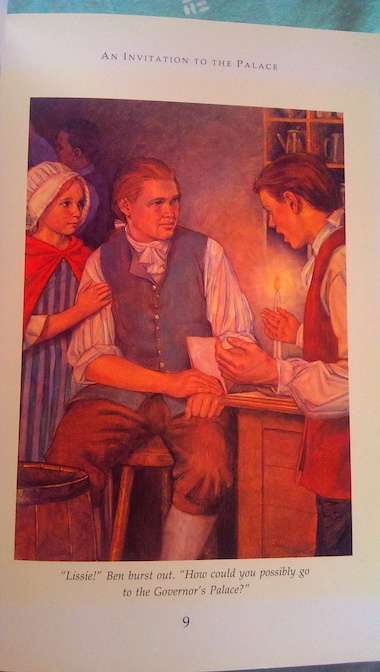
However, Ben, her father’s apprentice is against the idea of Felicity going because the Governor sides with the King and the Loyalists against the Patriots. He can’t understand why Felicity would want to attend a party with people who have treated the colonists so badly and have even boycotted her father’s store because he refuses to sell the taxed tea. However, Felicity’s father understands that the invitation was meant kindly and that it would be a special event for Felicity, so he tells her that she can go if she likes. Christmas should be a time for peace and enjoyment.

FelicityChristmasMotherIllAt Miss Manderly’s the girls start having dancing lessons, and Felicity wishes for a new gown, like the one on the elegant doll at the milliner’s shop. Since Felicity is usually not very interested in clothes, her mother decides to grant her wish.

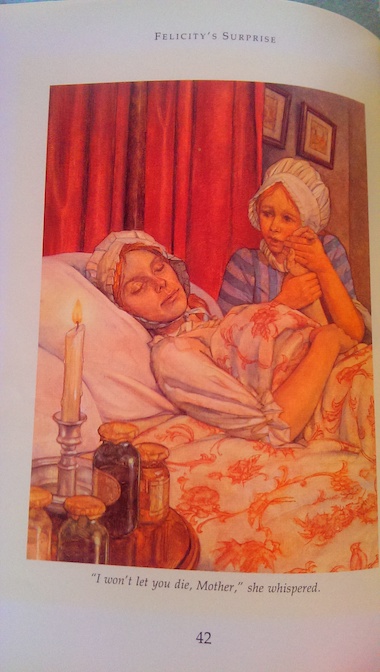
When Felicity’s mother falls ill, not only do Felicity’s Christmas dreams seem dashed, but she worries about whether her mother will recover from her illness. Everything that Felicity was concerned about before, the dress, the dancing, the party, all suddenly seems unimportant and silly in the face of something more serious. However, miracles come to those who work for them, and Felicity receives some unexpected help from friends.

There is a section in the back with historical information about how Christmas was celebrated in Colonial America.

The book is currently available online through Internet Archive.

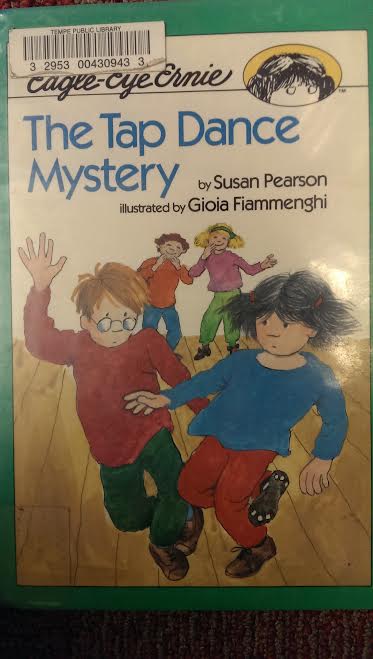
The Tap Dance Mystery

eeetapThe Tap Dance Mystery by Susan Pearson, 1990.

The kids in Ernie’s class are assigned to groups to plan different acts for the show that they will have when their parents visit the school on Parents’ Night. The Martians are assigned to different groups. R. T.’s group is going to do magic tricks. Michael’s group is going to pretend to be a music group from Jupiter and play different homemade instruments. Unfortunately, William and Ernie are in the same group as Marcie, a mean and bossy girl who always smells sticky and sweet, like Juicy Fruit gum.

Marcie convinces the others that their group should tap dance because she has been taking lessons and can teach the others. William and Ernie struggle to learn the steps and make homemade tap shoes by tacking washers onto the bottoms of their shoes. Jason, the fourth member of their group, really likes dancing and shows a lot of talent for learning the moves. Still, only Marcie really looks the part of a dancer in her fancy costume and beautiful tap shoes.

Several kids ask Marcie if they can try on her tap shoes, including Jason, but she refuses to let them. Every day, she hides her shoes in a different place in their classroom when she isn’t there to watch them. When the shoes disappear, Marcie is convinced that Jason took them, but he says he didn’t. Ernie believes him, but she has to hurry if she is going to find the shoes and clear his name before Parents’ Night.

The solution to this mystery is fairly simple, but the story also has some interesting insights into the reasons why Marcie acts the way she does and the effect that parents’ expectations can have on their children.

This is part of the Eagle-Eye Ernie series.  The book is available to borrow and read for free online through Internet Archive.