Mystery on Skull Island

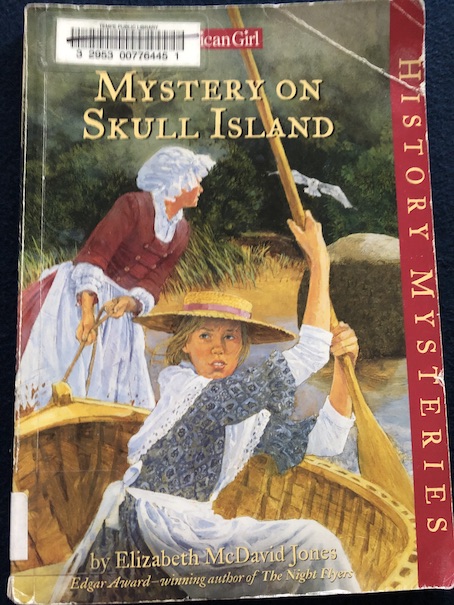
Mystery on Skull Island by Elizabeth McDavid Jones, 2001.

This book is part of the American Girl History Mysteries series.
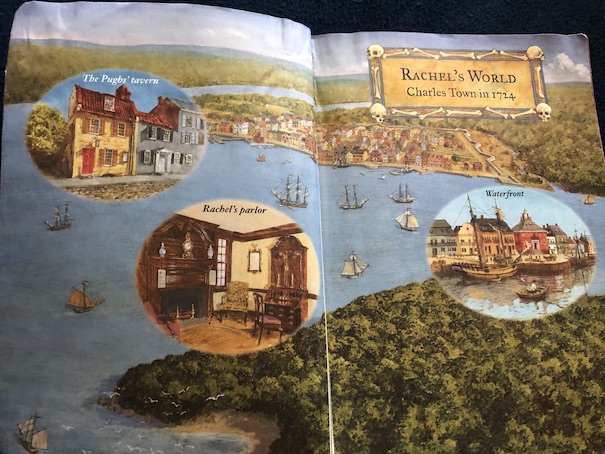
It’s 1724, and twelve-year-old Rachel Howell is traveling to where her father lives in Charles Town, South Carolina. Rachel has been living with her grandparents in New York since her mother died seven years earlier. Her father also used to live in New York, but after his wife’s death, he decided to move to South Carolina, hoping to start a new life. Now, her father has established himself in South Carolina and wants Rachel to come and live with him. Rachel has wanted to live with her father for some time, but she’s nervous because she doesn’t know what life in South Carolina will be like.

Rachel’s new life has a terrifying beginning when the ship that is taking her to Charles Town is attacked by pirates. The pirates force the passengers on board to hand over jewelry and other expensive items. They even take Rachel’s pendant, which belonged to her deceased mother. Fortunately, the pirates don’t hurt or kill anyone and let the ship go once they’ve taken everything of interest to them.

When Rachel arrives in Charles Town, she and her father have difficulty recognizing each other at first, but they are happy to finally be together. Rachel’s father is appalled when he hears about the pirates stealing Rachel’s mother’s necklace, but he is relieved that Rachel is all right. He explains that piracy has been a serious problem to shipping in the area. The local government has tried to combat the problem with harsh punishments, hanging many offenders. However, the pirates have money, and so local businesses still tolerate their presence.

The talk of pirates is shocking, but Rachel is soon in for another shock when her father tells her that he has become engaged and that Rachel will soon have a new mother. Rachel had been looking forward to having some time alone with her father to get to know him again, so she is not pleased at the news, but the engagement is the main reason why her father has sent for her. He wants Rachel to have a mother to care for her and for them to live as a complete family again. He tells Rachel that his fiance, Miranda LeBoyer, is from Philadelphia. She will be arriving in Charles Town soon with her aunt.

Rachel’s father is often busy with his work in the shipping industry, but he grants Rachel more freedom than she had with her grandparents, so she is able to explore her new town and make some new friends. The first friends she makes are the Pugh family, especially the daughter, Sally, who is about Rachel’s age. The Pughs own a local tavern, and Rachel often goes to visit them, sometimes helping with chores and learning to cook. She tells Sally about her worries about her new stepmother, but Sally says that she might not be so bad.

Like her life in South Carolina, Rachel’s first encounter with the woman her father plans to marry takes a disturbing turn. First, Miranda seems to disapprove of Sally and her brother, and Rachel fears that she will interfere with their friendship. Then, her father’s new business partner, Mr. Craven, stops by, and Rachel notices that Miranda seems to both recognize and dislike Mr. Craven. She overhears a conversation between the two of them in which Miranda calls Mr. Craven a “scoundrel” and refers to some kind of illegal dealings in his past. Yet, when Rachel’s father tries to ask Miranda what they’re talking about, Miranda lies and says that they’re discussing the weather and hurricanes that occur in Charles Town. Rachel worries about why Miranda would lie to her father and what kind of dishonest business Mr. Craven might be doing. What are the secrets that people in this town are hiding, and is Miranda really what she seems to be? With the help of her new friends, will Rachel find out the truth before it’s too late?

There is a section in the back of the book with historical information about piracy and life in South Carolina during the 18th century.
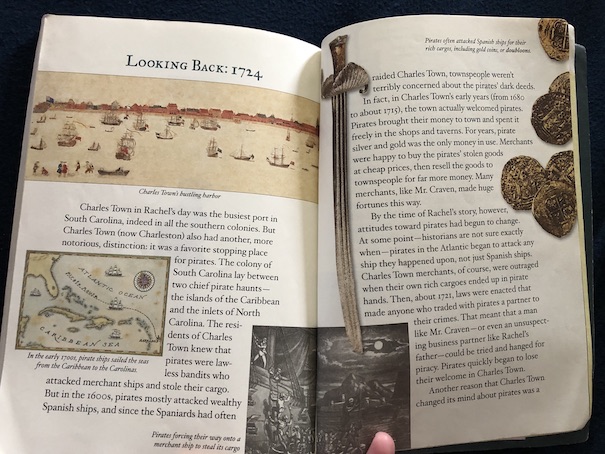
The book is available to borrow and read for free online through Internet Archive.
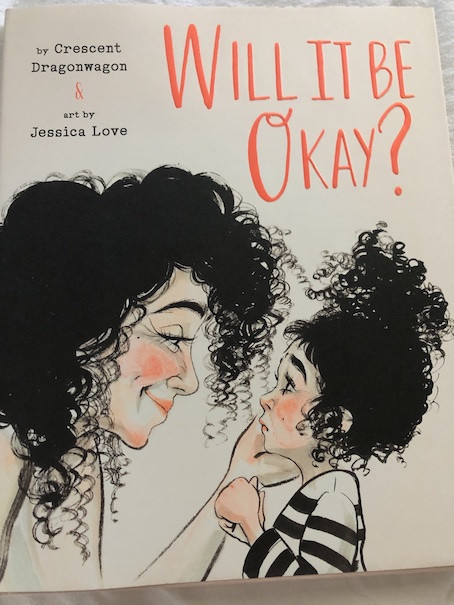
Will It Be Okay?

Will It Be Okay? by Crescent Dragonwagon, 1977, 2022.

I like to tie my book reviews into current events when I can, and I first wrote this review around the beginning of the coronavirus pandemic. It just seemed like the right time for this one. It’s a picture book, and, when I first wrote the review, my local libraries were closed because of the pandemic, so I couldn’t go find a copy to get pictures. However, the book is available to read online through Internet Archive, which is where I first encountered it.

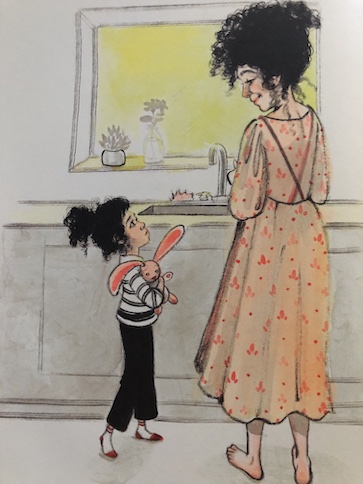
The version on Internet Archive is the older printing of the book, with its original pictures. Since then, the book has been reprinted with a set of new pictures. The pictures that appear here are from the new version. The older version of the book showed a blonde girl with a blonde mother, and the new version has a mother and daughter with black hair. Between the two, I prefer the newer illustrations, but readers can decide for themselves. I was surprised, but some of the text of the story was also changed between the versions of the book.

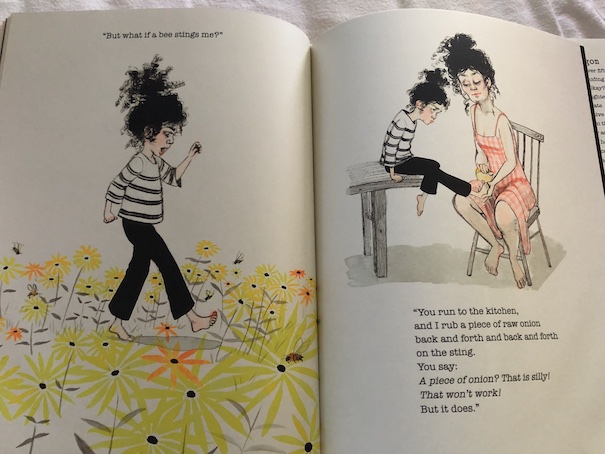
A young girl keep asking her mother about various types of problems that she might encounter, everything from storms to bee stings to forgetting her lines in the school play, and asking her what she would do if each of these things happen.

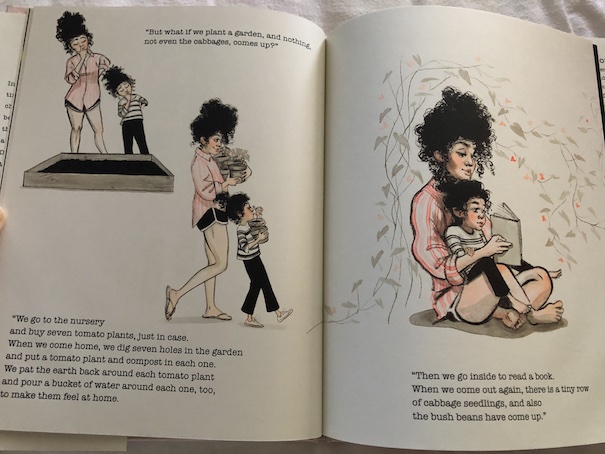
The mother gives her calm, reassuring answers. Some of them are based on common sense, like if their cabbages don’t come up, they’ll go get some tomato plants and plant tomatoes, and then their cabbages will likely come up anyway.

All of the answers have a poetic quality and answer the girl’s emotions, not taking all of the situations exactly literally, but capturing the feeling that the girl would need to have to get through life’s fears and uncertainties. When the girl asks what if no one likes her dancing, her mother describes how she can dance alone until she meets a new friend, who will dance with her and then come to her house to draw pictures and drink cocoa. I take this to mean what if people don’t like the girl instead of just her dancing, and her mother’s response to mean that she just needs to keep living her life, and she will meet people who will like her.

The last question that the girl poses to her mother is “But what if you die?” This is probably the fear that the girl has more than any of the other fears that she’s mentioned, but the mother still has a calm reply.

The mother tells her daughter that if she dies, her love will stay with her and she’ll have so much that she’ll have to give love away to other people. Her daughter will make new friends and dance with them and she’ll even come to love things like bees and thunderstorms and the other things that have frightened her. The girl will love other people in her life, and they’ll love her, too. Everything will be okay.

My Reaction

Life has many uncertainties, and bad things can happen, but there are other things that can make life better so that, in the end, we will be okay, in spite of the bad and scary things that come along. It’s not easy to believe that in the middle of scary situations, when you don’t know how it’s all going to work out, but I appreciate the sentiment. It’s always possible for things to improve. Bad things might happen, but we can handle them. It’s important to believe that we can handle situations and approach them with confidence.

The hardest, scariest thing to accept is when people die. Death is permanent. When someone has died or is facing death, it’s hard to believe that it could ever be okay because you can’t undo death. The mother in the story doesn’t try to deny that she could die at some point, but what she says is that her daughter will go on with her life and that she will always have her love. It’s what she leaves behind and what her daughter will continue to do after she is gone that will make things okay. The mother doesn’t want her daughter to focus on the sad and scary parts but to look forward with hope and confidence. As long as we can continue to move forward and love one another, things will be okay.

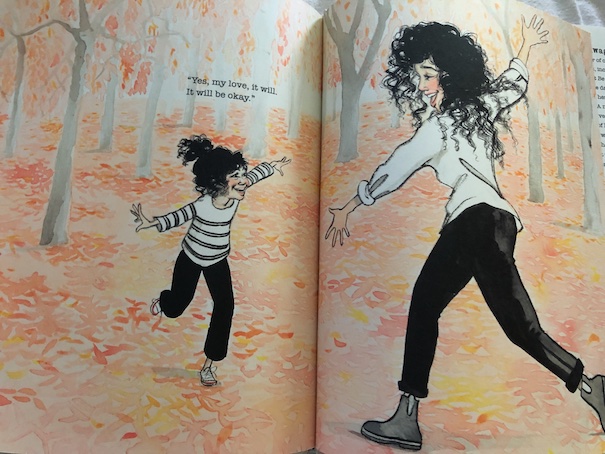
The last picture in the original version of the book is of the mother and daughter in the bathtub together, but they’re largely concealed by bubbles in the bath. Personally, I prefer the newer version of the book, which has the mother and daughter dancing in the leaves together under the trees.

Some of the situations in the book were changed between the old version and the new version of the book. In the old version of the book, the girl worries about what to do if she meets a big dog or if snakes come in the middle of the night, and neither of those were included in the new version of the book. Some answers in the old book are as improbable as the problems that the girl poses, like suggesting that the girl play a flute to charm snakes if snakes come. Both versions of the book have the scene where the girl worries that someone might hate her and her mother says that a frog will tell her that she’s lovable.

The Day Jimmy’s Boa Ate the Wash

JimmysBoa

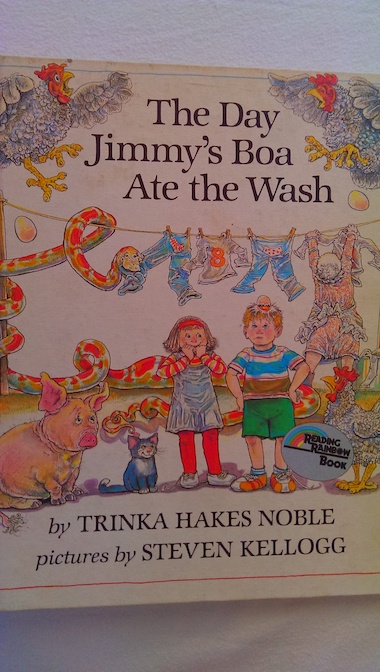
The Day Jimmy’s Boa Ate the Wash by Trinka Hakes Noble, pictures by Steven Kellogg, 1980.

The fun thing about this story is the backward way that the girl begins telling it, somewhat resembling The House that Jack Built, or better yet, the old No News Joke. The joke is really closer to the format of the story, with someone explaining the least eventful thing that happened as though it were the most important when it was just the end result of everything else.

A young girl (unnamed) arrives home, and her mother asks her how she liked her class trip to a farm that day. She says that it was boring until the cow started crying. When the mother asks her why the cow was crying, she says that the farmer wasn’t paying attention to where he was driving his tractor and knocked a haystack over on the cow.

As the mother continues to ask her daughter questions about what happened, backtracking through events, the real story begins to reveal itself:

The girl’s friend, Jimmy, had a pet boa constrictor, and he brought it along on the field trip so it could meet all the farm animals.

JimmysBoaFieldTrip

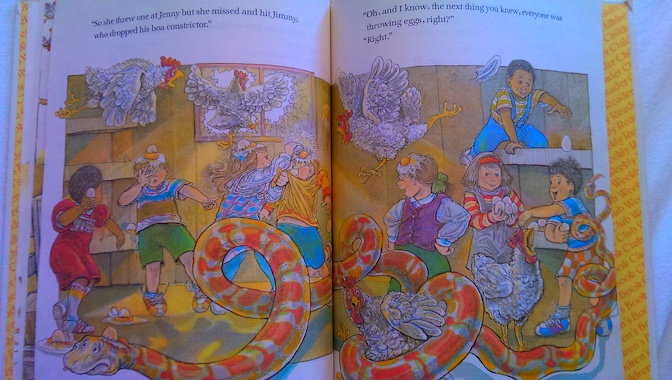
However, the chickens became frightened, and one of them laid an egg on one of their classmates. She thought that someone else threw it at her, so she threw another egg at him, which hit yet another student.

JimmysBoaEggs

From there, it turned into one big food fight, with students throwing eggs at each other, and when they ran out of eggs, they threw corn at each other. The corn was for the pigs to eat, so the pigs wandered onto the school bus and started eating the children’s lunches. From there, chaos ensued until the farmer’s wife suddenly screamed, and the children’s teacher hustled the children onto the school bus to go home.

JimmyBoaLeaving

The children never knew exactly why the farmer’s wife screamed (although the reason is actually in the title to the book), but two things quickly became evident: Jimmy accidentally left his boa constrictor behind on the farm, but he has acquired a pet pig because there was still one left on the bus.

This summary doesn’t quite do the story justice because the backwards way the story starts out is part of the fun. The pictures in the book are hilarious, and the boa constrictor is shown at the end to have become a beloved pet of the farmer and his wife, even making friends with the chickens.

This is a Reading Rainbow Book.  It is currently available online through Internet Archive.

The Haunting at Cliff House

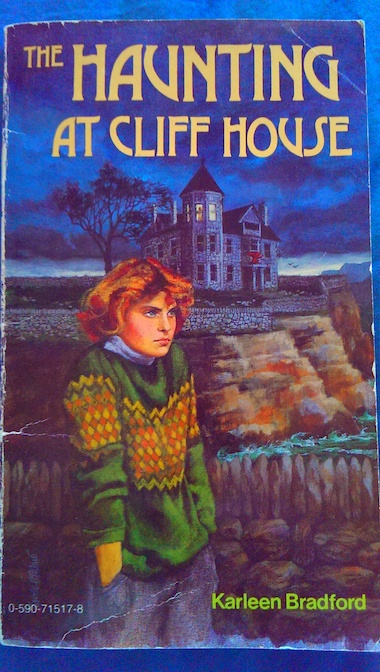
HauntingCliffHouseThe Haunting at Cliff House by Karleen Bradford, 1985.

This is a relatively short chapter book, but suspenseful, thoughtful, and well-written.

When her father inherits an old house in Wales from a distant relative, Alison, a young teenager, finds out that he plans for the two of them to spend the summer there.  Alison’s father is a university professor and is writing a book, and he thinks that the house in Wales sounds like a great place for him to get some writing done while he and Alison have a look at his new inheritance.  Alison isn’t enthusiastic about the trip, but she and her father are very close, especially because she lost her mother at a very young age.  Besides, the only place she could stay in Canada would be with her grandmother, and her grandmother didn’t seem enthusiastic about having her.

From the moment they arrive at the old house, called Pen-y-Craig or Cliff House by the locals, Alison has a bad feeling about it.  It stands on a lonely cliff by a small town.  The carved dragon over the door gives her the creeps, and there is something disturbing about a particular room in the house.  Sometimes, she can almost hear a voice calling out to her, and she has visions of another girl, about her age.  At first, she tries to tell herself that it’s all her imagination, but it soon becomes obvious that it’s not.

Some of the local people know that the house has an unhappy history, and Alison eventually learns that the great-aunt that her father inherited it from even refused to live there during her last years because it disturbed her too much.  A little more examination of the room that had disturbed her helps Alison discover the reason why.  After having a vision of a young girl hiding something behind a brick in the fireplace of one of the bedrooms, Alison searches the spot and finds a diary dating from 1810, written by a girl named Bronwen, who was the same age as Alison.  Like Alison, Bronwen was brought to the house by her widowed father and was unhappy about it, but those aren’t the only parallels between Bronwen’s life and Alison’s.

Alison becomes uncomfortable with her father’s new friendship with a Welsh neighbor, Meiriona.  Alison likes Meiriona’s younger brother, Gareth, but when it looks like her father’s friendship with Meiriona is turning into romance, Alison becomes jealous and fears changes in her close relationship with her father, a situation that mirrors Bronwen’s life when her father falls in love with her governess, Catrin.  Although Meiriona tries to be nice to Alison, Alison can’t bring herself to like her, and she argues with her father about it.

The only person who seems to understand her feelings at all is Gareth, and Alison confides her worries in him, both about Meiriona and about Bronwen, whose spirit keeps calling out to Alison to help her, although Alison doesn’t know how.  She struggles to read through the diary, whose pages are not all legible anymore because they’re damaged with age, to learn what happened to Bronwen and what Bronwen wants her to do now.  Gareth tries to reassure Alison that her father’s relationship with Meiriona will not be as bad as Alison thinks.  He thinks that the relationship would be good for both Alison’s father and Meiriona because they are both lonely, and he doesn’t think that Alison should worry about losing her father because he’s not worried about losing his sister, even if she goes to Canada to study and spend more time with Alison’s father.  At first, Alison isn’t comforted by these reassurances.  However, Gareth agrees that the matter of the ghost is serious, and he can feel her presence as well. Gareth warns Alison to be cautious about the ghost but to try to help if she can and to call out to him if she’s ever in danger.  Alison would really rather just go home to Canada, run away from her father and Meiriona, and forget the whole thing about Bronwen, but history seems to be repeating itself, and Bronwen’s voice calls out to her insistently for help that only Alison can give.

It’s a bit of a spoiler, telling you this, but although Alison at first thinks that the diary ends with Bronwen killing herself in despair, thinking that her father only loved Catrin and not her and that there was nothing left for her to live for, the truth is that Bronwen’s suicide attempt didn’t succeed and that she made another mistake that she wants Alison to help her to change.  Bronwen attempted to kill herself by going to a cave by the sea during a terrible storm, planning to allow herself to drown, but when the water started rising, she became too frightened and decided to leave by a secret entrance to the cave.  Not knowing that Bronwen was safe, Catrin attempted to save her and drowned in the cave herself.  As Bronwen was climbing to safety, she heard Catrin calling for her but was too frightened of the storm and angry at Catrin to go back for her.  Although Bronwen lived on after the incident, she could never get rid of her guilt at Catrin’s death, realizing that, even in the middle of her resentment toward Catrin, Catrin loved her more than she knew, even to the point of giving up her own life while attempting to save hers.

Now, the anniversary of Catrin’s death is approaching, and so is a storm very much like the one that killed her.  At the top of the cliff by the cave, Alison finds her time merging with Bronwen’s, and she will only have one chance to help Bronwen make the right decision the second time around.  Helping Bronwen to prevent the worst mistake of her life and to make a better choice also helps Alison to reconsider her own choices and future.  Just as Bronwen misjudged Catrin, Alison may have also misjudged Meiriona. Instead of losing her father or being forced to accept a poor substitute for her mother, Alison may be gaining a kind of sister who will love her more than she realizes.