Last Battle

The Chronicles of Narnia

Last Battle by C.S. Lewis, 1956.

This is the last book in The Chronicles of Narnia series, and this is the book that shows the final days of the land of Narnia.

In Narnia, a wily old ape called Shift lives with a donkey called Puzzle. Shift is more clever than Puzzle and often tricks Puzzle into doing all his work for him. One day, they find an old lion skin in a pool. They think that it probably belonged to a non-talking lion that a hunter killed, but talking animals still show respect to lions because of Aslan. Puzzle thinks they should give the old lion skin a decent burial, but Shift says that he will use the lion skin to make a winter coat for Puzzle. Puzzle doesn’t think that sounds like a good idea because he wouldn’t like to have people thinking that he was trying to look like Aslan. Shift says that sounds like nonsense and makes the lion skin into a coat for Puzzle. Of course, sly Shift has a more diabolical plan in mind.

When Puzzle tries the coat on, he does look like a lion. Shift says that Puzzle looks like Aslan, and if people saw him, he could tell them what to do, and everyone would do it. Puzzle is alarmed at the idea, but Shift insists that Puzzle pretend to be Alsan with him advising him about what to say. Puzzle worries that Aslan would be angry, but Shift isn’t concerned because Aslan hasn’t appeared for a long time. At that moment, there is a thunder clap and a small earthquake. Puzzle is convinced that’s a warning sign from Aslan, but Shift tries to convince Puzzle that it’s actually a sign of approval.

The last king of Narnia is King Tirian. He is a young man, and he has a unicorn friend named Jewel. Word has reached him that Aslan has reappeared in the land, and he is very excited. A centaur wants him that this story much be false because the centaurs study the stars and have not seen the signs that should precede Aslan’s arrival. He is sure that the story about Aslan appearing is an evil lie. Jewel says that it’s difficult to say because Aslan is known to not be a tame lion, and that would make him unpredictable.

Before they reach any conclusions, a dryad stumbles toward them, wailing because the talking trees are being cut down, and her kind are dying. She falls dead at their feet because her own tree is cut down in the forest. The king is appalled and horrified! He insists that he and Jewel immediately go to the forest and find out what is happening and put a stop to it. The centaur urges caution, but the king doesn’t want to wait, telling the centaur to return to Cair Paravel to assemble his troops and follow him to the forest.

When King Tirian and Jewel come to a river, they are horrified to see a river rat with a newly-built raft, floating logs down the river. The king demands to know what he’s doing and by whose authority. The river rat says that he’s taking the logs to sell in another kingdom and that he’s doing it because Aslan the lion commanded it. King Tirian and Jewel find that alarming and difficult to believe, so they continue on to the forest. There, they see men from another country, known to be cruel, chopping down trees. They have also enslaved talking horses to help them. When the king and Jewel witness a couple of men abusing a horse, they kill them on the spot. They ask the horse how he was taken captive, and the horse says that it was at the command of Aslan.

The other men and talking animals realize that the king and Jewel have killed two of their people and turn on them. The king jumps on Jewel, and they run away, but they feel guilty about the men they killed. King Tirian realizes that this impulsive killing was murder because they had not needed to defend themselves. They also worry about whether they have violated Aslan’s command. They are not sure whether the Aslan who commanded these terrible deeds is the real Aslan. None of what has happened sounds like anything Aslan would want to happen, but Aslan is known to be wild and unpredictable, so they can’t be sure. What if they have become sinners for interfering with some grand plan of Aslan’s? Although they are afraid and feel guilty, they decide that the only thing they can do is surrender themselves to the horrible band and ask to be taken before Aslan, both to see if this Aslan is the real Aslan, and if necessary, submit themselves for punishment for killing the men, even if it means their lives.

When they are captured by the men, they are taken before Shift the ape. Shift has dressed himself as a king with a paper crown, and he tells everyone that he’s a human, just that he looks like an ape because he’s very old. He refuses to let anyone see Aslan up close, saying that he will deliver any messages Aslan has for them. He threatens the other animals with dire consequences if they don’t obey all of “Alsan’s” commands. He says that Aslan will turn the country into something amazing with lots of oranges and bananas (the things Shift wants more than anything) and roads and whips and kennels. The other animals try to say that they don’t want all those things, but Shift says that they should want what Aslan wants. A small lamb wants to know why they have to work with the men of the other nation when they know that they worship a different god, one who requires human sacrifices, instead of Aslan. Shift tells the lamb he’s stupid and these other people worship Aslan as well, just under a different name. Some of the animals are fooled by this logic, but others protest. Shift has a cat who protests taken away.

The mice are nice to the captive King Tirian, bringing him food and water. They want to help him, but they are afraid to help him too much because they are afraid of opposing Aslan. King Tirian asks them if it is the real Aslan, and the mice think it is. They say that “Aslan” is in the stable. As King Tirian watches “Alsan” appear by a bonfire on the hill, he notices that the “lion” doesn’t move like a lion should, and when he thinks about what the ape said about Alsan being the same as the cruel god who wants sacrifices, he sees through the fraud. He thinks about the past king and queens of Narnia and calls out to the Pevensies to return to Narnia and help him. To his surprise, he has a vision of the Pevensies at a dinner table, and he realizes that they can see him. The High King Peter calls out to him to speak, but then, the vision fades. Still, he has managed to let the Pevensies know that Narnia is in danger and needs them one more time.

The next morning, a strange boy and girl appear before him, and he recognizes them from his vision because they were at dinner with the Pevensies. The boy is the Pevensies’ cousin, Eustace, and his friend, Jill. Eustace and Jill untie King Tirian and help him escape. When they are safe, Eustace and Jill explain some things about their past adventures. King Tirian recognizes them as the children who rescued an ancestor of his. They also explain to him about the magic rings (which were introduced in The Magician’s Nephew and which they retrieved in his book). They were going to use the rings to reach King Tirian in Narnia, but they were on a train on their way to reach them when they felt a terrible jerk and suddenly found themselves in Narnia anyway.

With the past saviors of Narnia on his side, King Tirian recruits them to help him save Jewel. Jill finds Puzzle in the stable with the lion skin tied to him. She thinks that’s hilarious, but she convinces Puzzle to come with her. At first, King Tirian wants to kill Puzzle for his deception, but Jill persuades him not to because this situation isn’t Puzzle’s fault. Puzzle explains how Shift convinced him that Aslan wanted him to do this, and he says that he doesn’t know much about what’s been happening lately because Shift doesn’t let him out of the stable much. King Tirian agrees to spare Puzzle, and he is sure that many people will change their minds about Shift and what he’s been doing once they see Puzzle in his lion disguise.

King Tirian and the others begin showing Puzzle to everyone and explaining how Shift lied to them and tricked them. Some of the dwarfs find Puzzle as laughable as Jill did, but the humans from the cruel country are angry and fight them. They end up having to kill one of them. Some of the dwarfs disbelieve King Tirian and the children. The dwarfs explain that, yes, they see that the ape’s story about Aslan was a lie, but since they’ve been fooled once already, they’re not prepared to believe anybody else about anything. They don’t want to believe that King Tirian serves the real Aslan or that the real Aslan sent the children to Narnia to help. They don’t want to hear anything more about Aslan being real from anyone, and after the ape king, they don’t want anymore kings of any kind. They know that they were used by the ape, but what’s to say that King Tirian didn’t rescue them from the ape just to use them for some selfish purpose of his own. Having been fools once, they don’t want to risk being fools again by believing in anyone or anything else again. King Tirian and his allies realize that one fake Aslan, even one that was such an obvious fake, has damaged everyone’s faith in the real one because the fraud damaged everyone’s trust. The dwarfs say that they will now be entirely for themselves first and won’t listen to anyone else.

King Tirian thought that once people saw the truth, they would go back to being the way they were before, but he had underestimated the ways people can react when they find out they’ve been tricked. Not everyone will agree that they’ve been tricked, even when presented evidence, and even those who agree that they’ve been tricked may not have faith in the people telling them the truth. Also, now that the ape’s ruse has been exposed, others have seen how trickery can help them gain power and influence over others. Before King Tirian and his friends can tell others about the fake Aslan, Shift’s cronies start spreading their own fake stories about King Tirian and Aslan. Shift accuses Puzzle of being the deceiver because he’s the one who is wearing the lion skin, and it’s difficult to prove that Shift was the one who started all this in the first place. (What’s the best way to survive a witch hunt? Be the one who starts it. Bonus points if you can accuse other people of starting it later and blame them for victimizing you.) When King Tirian and the children try to tell people the truth, they’ve already heard so many lies and conflicting stories, many either aren’t convinced of the truth or are just so confused that they don’t know what to think. Some people realize that Shift has been playing them with the entire time and turn against him, while others still listen to Shift’s explanations and try to follow the convoluted logic and the scary things he promises them if they refuse to listen to them. Some people ally with King Tirian, while others stay loyal to Shift and his cronies, and others don’t want to trust either side and prefer to just try to look out for themselves.

When news reaches them that their enemies have already taken Cair Paravel and killed everyone there, they realize that the end of Narnia is close at hand. There is only one thing left to do: face down the enemy in a final battle for truth and the very souls of Narnia.

The book is available to borrow and read for free online through Internet Archive (multiple copies).

My Reaction

I was not looking forward to this book because I don’t like apocalyptic stories, and it was difficult for me to get through. I knew that this story would be about the end of Narnia, and in the Biblical tradition, the end of Narnia’s days are full of horrible things. It’s depressing to go into a story knowing that horrible things are going to happen, followed by the end of the world, at least a world that we’ve come to like through the other books in the series. I also knew that most of the characters we’ve come to know and love get killed in this story. Still, I decided to suffer through the story just to finish off the series and discuss my feelings about it.

It is also important to realize that the last battle of Narnia isn’t really about armies facing each other so much as the battle for truth against falseness, a subject of much debate in real life. Readers of this story are in on the objective truth of the situation along with our main characters, and they see how their enemies play tricks with lies and half-truths to manipulate other people. Their aim is to confuse people so they don’t know what to think, and then, everyone will follow them because they act like they are certain they are on the side of right. People who are insecure and uncertain in themselves will follow people who act confident, regardless of whether that confidence is real or deserved or not. That is the major theme that runs through the entire book. I think it’s an important lesson, but one that also makes me angry because I have seen people doing these things in real life, especially in recent years. I don’t really think that the end of our world is immediately at hand, although I’ve seen some people speculating about that because of things that have been happening.

Life is Unpredictable, and So Is History When You Live It

I was truck by the scene with Tirian remembering past glories of Narnia and its rulers, when there were bad times, but things went right in the end. He thinks how things like that don’t happen anymore, and it seems like there is no happy ending to this story. It reminds me of people who feel nostalgic and patriotic about things like World War II, when the Allied nations united and defeated a great evil and how it seemed like all of society agreed on the vision of victory and achieved it. Some people now, in the 21st century, almost seem like they wish they could return to those days. The only reason why those times provide any comfort now is because we are looking at them in hindsight.

We know what eventually happened and that the world wasn’t destroyed, but the people who actually lived during those times didn’t know that. They had no guarantees that they were going to survive, many of them didn’t. Many people died during WWII, in combat, in bombings, in concentration camps, etc. I’m sure that none of it seemed glorious at the time. At times, it must have seemed like the end of world to the survivors. Knowing the resolution of that conflict gives the false impression that people back then knew what outcome they wanted and were united behind that vision. They weren’t. There were some people who felt like the Nazis were in the right or at least couldn’t be opposed. Even in the United States, there was a pro-Nazi rally at Madison Square Garden. (Video footage on YouTube, courtesy of PBS.) If someone had told the people at that rally on the day the rally was held what was going to eventually happen, they probably would have felt that the defeat of the Nazis would be the end of the world because they were convinced that they were the ones in the right and everyone else was in the wrong. Whether they still felt that way by the time the war actually ended is debatable, but from where they stood at that moment, what was best for the rest of the world would have seemed terrible to them.

Even in Britain, there was sympathy and support for the Nazis among the aristocracy, like the Mitfords and even members of the royal family. C. S. Lewis would have been aware of people like that during his time, and the Mitfords are a good example because they were well-known for their scandalous political views. (P. G. Wodehouse’s character, Roderick Spode, was a parody on the husband of one of the Mitford sisters, who was the leader of the British Union of Fascists during the 1930s.) Their support for Nazis changed some of their lives for the worst, and some of them probably wouldn’t have wanted everyone to remember their earlier stances after the war was over, but while the entire situation was unfolding, they were certainly very sure of themselves. They may have thought that they knew what they wanted and what was going to happen, but outcomes were never guaranteed for anyone.

Life is unpredictable, like an untamed lion. While many of us have a sense of when things are going wrong or seem unreasonable, we’re not always right, and even when we are, it can be difficult convince others of that if they think they have reason to believe otherwise. The truth is that we have never had any guarantees at any point in our history. While we like to think that God will carry us through any situation, bad things do happen along the way, often to good or normal people. Outcomes are not completely assured for anybody. Every disaster, while not bringing about the total end of the world just yet, have been the end of days for some individual people, who didn’t live through them.

The only moral I can think of from that is not to envy people from the past too much. Their problems don’t seem as bad now because we know that the survivors survived, and the world went on. But, the world didn’t go on for everyone caught up in those situations, and survival wasn’t guaranteed for everyone in the middle of the crisis. Even those who did survive in the end couldn’t know for sure whether they would or not while they were struggling along. They didn’t even always have the comfort of knowing absolutely, for certain that they were on the side of right or not not or if they were carrying out their missions in the right way. While I’m sure that they tried to do what they thought was right in spite of everything, there were voices in their ears trying to tell them that they were in the wrong and it was time to give up at every step and stage. Of course, I would argue that Nazi supporters were the ones who really needed to be told that and that they should have taken it to heart, but while the situation was in motion, everyone just had to keep playing out their chosen parts to the end. You can’t rewrite people or situations while they’re in the middle of writing their own histories themselves.

The same is also true of the rest of us. I’ve said before that history is not written by “winners” but by writers, and actions are a form of writing history. We all do it, all the time. Nothing is guaranteed for us. Whatever you stand for and whatever sides you pick to follow are the parts you’ve written for yourself by your choices. Our outcomes will all be determined by the parts we’ve chosen to play and the way we’ve written them for ourselves to act out, and unfortunately, what others choose to act out upon us. We can’t control everyone’s decisions, only our own, and that’s part of what makes life and history unpredictable.

“Fake News!”

When C. S. Lewis wrote the Narnia books, he had already lived through WWII and knew the power of propaganda. From the beginning of the story, propaganda, or more simply, lies, play a major role. It starts with Shift’s plan to put his donkey stooge into a lion costume and use him to get bananas and oranges (or, more generally, wealth that can be used to buy these things). However, along the way, Shift himself becomes a stooge for other people who see the power of his lies and want to use lies for their own purposes. As the situation spirals out of control, the concept of truth itself loses meaning for people, and many people struggle with what to believe. Oh, gee, where have I heard that before about a million times over the last several years? They think they’ve gamed the system, but their own system of lies have gamed them, and none of them are bright enough to notice until it’s far too late. From there, it’s just a slow, excruciating train wreck to watch. (By the end of that book, the metaphor is disturbingly real.)

Yeah, I know that’s a political statement these days, but if you recognize what I’m criticizing without being told directly, you must know what I’m complaining about and why. (I’m sure I’ve complained about this before somewhere on this site because I never suffer anything in silence, and I’m my only editor.) In the story, when King Tirion tries to reveal the truth about the Aslan donkey hoax to everyone, it proves harder than he expected because everyone has been so inundated with lies that they either don’t know what to think or just don’t want to think anything about anything anymore. The villains in the story start spreading their lies faster than our heroes can explain the truth to everyone, and all the villains have to do is to accuse our heroes of being the liars or let others think that they’re just as bad as everyone else telling tales. (“Fake news!”, “Election fraud!”, “All politicians lie” and “Who cares if our favorite ones lie when it benefits us and makes us feel good?” – I could go on and on, but what would be the point? People who have seen the problems with all of this already understand, and those who say they don’t have already made a decision.) Everyone is left to make up their own mind, which wouldn’t be so bad except what some of them decide to do is to let the villains make up their minds for them. When they don’t know who or what to trust, they trust in what they’re accustomed to, and some of them have become accustomed to listening to Shift and his pals because they were the ones who started the whole situation and have been yelling the loudest since.

Puzzle the donkey keeps saying that the reason why he keeps letting Shift talk him into doing things is that he knows he’s not as clever as Shift, so he thinks that he’d better let Shift make the decisions. It’s not unlike those people who assume that someone with a lot of money or a high position must have gotten there through brains. It’s not always true. Sometimes, they don’t have to be bright or talented if they just convince other people that they’re not. Puzzle is sure that Shift is smarter than he is, but actually, Shift is just more manipulative. Yes, he knows how to sew, but it’s the only talent he uses other than lying and manipulation. He wouldn’t have even half of what he’s got if he didn’t routinely talk Puzzle and others into doing things for him or giving him things. Ultimately, he’s a conman. Of course, most of the reason why Puzzle thinks he can’t be clever or competent by himself is that Shift has been telling him that and insisting on making the decisions. Puzzle doesn’t have the confidence to stand up to him, even when he knows that Shift is asking him to so something wrong. Eustace gets frustrated with Puzzle’s attitude and tells him that he wouldn’t have to worry so much about how clever he is if he just focused on being as clever as he knows how to be. If you know better, do better! It’s a Christian concept, and the Narnia stories have Christian themes. Eustace is trying to get Puzzle to listen to those doubts that he has about Shift and what Shift wants, to take them seriously, and recognize that he can say “no” to Shift when he’s asking for something unreasonable.

So, what can you actually do in a situation where you’re not sure who’s telling the truth or what the best thing to do is? There are no hard and fast answers to that, but my answer is … don’t depend on hard and fast answers at all. Never be so married to any particular stance that it would be like ripping out a part of your soul to simply change your mind and change course. Again, “Do the best you can until you know better. Then when you know better, do better.” Be open to incoming information and feedback that lets you know how you’re doing and if you’re really understanding the situation correctly. The way I look at it, all humans are capable of being fooled, but those who aren’t afraid to back up or change their minds and are open to updating the information and understanding in their own minds are likely to spend less time continuing down a wrong course, even if they were wrong before.

Also, make sure that you have personal limits. Know when someone is pushing you to your limits or over them, and know when it’s time to back off. Puzzle the donkey has no boundaries whatsoever. Shift can talk him into anything, even things that are personally risky or harmful to him or downright immoral because, while there are things that Puzzle thinks are morally wrong, there is nothing in Puzzle’s moral view that is so far wrong that it would cause Puzzle to stop listening to the person telling him what to do. The only thing Puzzle is sure of is that Shift is smarter than he is, and he clings to that in spite of all evidence to the contrary. In the end, Puzzle is a major part of what brings down all of Narnia because he was the one person who could have stopped its destruction before it started, if he had only said no when he had misgivings. He didn’t invent the scheme, but he’s the one who chose to carry it out, even when he really knew he shouldn’t.

Trains Crash, Everyone Dies

This whole book was like a slow train wreck. It’s well-written, but it’s a well-written slow train wreck. There is the figurative train wreck, where everything spirals out of control in Narnia, and the world ends. Then, there is the literal train wreck that kills most of the characters we’ve come to know and love.

Eustace and Jill die in England at the moment they enter Narnia to help Tirian. Since time in Narnia works differently from time in our world, they don’t find out that they are dead or in the middle of being killed in a train accident until they reunite with the rest of their friends in the “true” Narnia, which is part of Aslan’s Country, which represents heaven. Although the Narnia they all knew before is gone, all the best parts of it and the friends that they knew from past eras of Narnia in their previous adventures are all alive again in True Narnia. The True Narnia is also one of all the “true” versions of all of the other worlds, including ours. The Pevensie children’s parents were also on the train when it crashed, so they appear in the True England that is also part of Aslan’s Country.

The only young Pevensie who isn’t killed in the railway accident on Earth is Susan, who was more worldly than the others and wasn’t on the train. We don’t see her reaction to the deaths of her parents and siblings or learn what the rest of her life on Earth is like. Her siblings say that she has stopped believing in Narnia, remembering it only as a game that the siblings used to play. Her main interests now are parties and fashion, much like other young women. The other characters think that she has become “silly” and has lost sight of what’s important. She may have, but this part of the book gets a lot of criticism because, from the description we have of her, she is just going through a normal phase of life where she wants to have fun, make friends, and date. She might be kind of silly in the way she’s going about it, but by itself, it’s not something abnormal or deserving of scorn. As I said, we also don’t know what the rest of Susan’s life will be like. I think there is an implication that she will someday come to True Narnia, too, because she was also once a Queen of Narnia, and once someone is a King or Queen in Narnia, they will always be a King or Queen there.

The rest of the characters who died in the train accident and are now in True Narnia spend the rest of eternity exploring Aslan’s Country and having endless adventures. It’s framed as a positive because it means that they get to be young forever in the True Narnia, having amazing adventures with the people they love, but it’s still upsetting to me. It bothers me because it occurs to me that they were destined for True Narnia eventually in any case, and I would have liked for them to have lived their full lives on Earth to old age first. Yes, True Narnia is wonderful, and they will get to enjoy eternity there, but it just seems to me kind of sad that they couldn’t have put it off for a few more decades anyway. Polly and Digory are elderly when they are killed, and Mr. and Mrs. Pevensie had the chance to enjoy their marriage and children before the accident, and it just seems like a shame that the young Pevensies didn’t have those opportunities. It’s also sad to think of Susan, mourning the loss of her entire family.

Another Problem

One other thing that bothered me about this book is that the Calormenes are described as being darker physically than the human Narnians. During the final battle of the book, Narnians jeer at them and call them “Darkies.” I don’t like the idea that that the light-colored people are described as being the good ones and the dark ones as the bad ones, especially not when paired with a known racial slur. These people are set in another world, but it just echoes the racism of this world too much for me.

A Pattern of Roses

Tim Ingram has been feeling depressed since his parents decided to move from London to an old house in the country that they’re fixing up. It’s hard for him being separated from his friends and living in this overly-quiet place, where it seems like nothing ever happens, but the truth is that he was depressed even before his family moved. A large part of Tim’s problem is not knowing what he wants out of life. He works hard in school to get good grades, and his school has a reputation for getting its students into good universities, but it all seems so futile because Tim doesn’t know what he really wants to study or what he’ll do when he gets out of school. His father quit school early and went to work, working his way up the ladder in an advertising firm and becoming monetarily successful. However, Tim doesn’t feel like he has either the wit or self-confidence for starting off from practically nothing and working his way up in a direction he’s not even sure he wants to go. His father’s plans and suggestions for the future don’t excite him or make him happy. They actually make him feel more stressed and depressed when he thinks about them. His father is in a position to just give him a job with his company, so Tim does have a guaranteed job if he can’t think of anything else, but advertising doesn’t appeal to Tim. He’s not sure what does appeal to him. He fears and dreads the future, specifically his own future. He doesn’t know what to do with himself, and in this new place, it seems like there isn’t a lot he can do.

Tim has also been arguing with his parents, discovering that he has different interests and priorities in life than they do. While they’re enthusiastic about expanding onto this country house with a new and stylish modern wing, Tim prefers the older part of the house and its simpler style. He thinks the modern additions his parents made look ugly and out-of-place, ruining the natural beauty of the countryside. His parents feel like he’s unappreciative of their standards and the sort of lifestyle they’ve worked hard to build, and his mother even goes so far as to call him “perverse and awkward.” He kind of feels that way, too. Tim often feels like he’s a nobody, not very outstanding at anything. His ambitious parents are disappointed in him because they’ve invested so much in his education to show him off as another one of their achievements in life, and he doesn’t think he’s much to show off. He’s even a little disappointed with himself because, not only does he not seem to live up to his parents’ expectations, he doesn’t even have it in him to stand out as a rebel or a troublemaker, like some of his friends. He’s not an aggressive person, and it’s just not his nature to fight or get into trouble, and that makes him feel like even more of a nobody. If he neither excels at meeting people’s expectations or at deliberately flouting them, what is he? Who is he? Where does he fit in? With all of this, Tim hasn’t been feeling well, and he fakes being sicker than he is so he doesn’t have to get out of bed and deal with any of it. Since he’s been unwell, he’s also excused from school until after Christmas, leaving him with nothing to do in this countryside house but lie in bed and think about all the things that are worrying him.

Then, one day, the builder who’s been working on their house finds an old tin box hidden in the chimney of the room that Tim has chosen for his bedroom. The box catches Tim’s attention. It looks like a very old biscuit (meaning cookie, this book is British) tin decorated with a faded pattern of flowers. The builder opens the box and is disappointed to see that it just contains papers, not anything that looks really valuable. However, Tim is curious and insists that he wants to see the papers.

The papers are drawings, quite old and done in black crayon. Most of them are landscapes and buildings, but there is also a girl, who is labeled “Netty.” Netty’s name is written in a heart, so the artist must have loved her. The date on one of the drawings is February 17, 1910 (the story seems to be contemporary with the time when it was written in the early 1970s because Tim thinks that was 60 years ago), and to Tim’s surprise, the author signed with his initials: T.R.I. Tim’s full name is Timothy Reed Ingram. Tim is intrigued that the artist who lived so long ago had the same initials and apparently lived in his room.

The builder, called Jim, asks Tim if he likes to draw or knows anything about art. Tim gets good grades in art, but he’s not very self-confident about his abilities. Still, he knows enough to tell that the artist wasn’t particularly great at his art. There are places where he got the proportions of his drawings wrong, but Tim is impressed that they convey a lot of feeling. Even though the drawing of Netty isn’t perfect, Tim feels like he can tell what kind of girl she was. She looks like she’s in her early teens and has a kind of proud, somewhat naughty or daring look. Tim asks the builder if he knows anything about the artist or the people who lived in the house back in the 1910s. The builder says that was before his time, but he thinks that he remembers hearing that the family name was Inskip, and he says that he could ask his father if he knows more. Tim wonders why the drawings were hidden in the chimney and begins to imagine what the first T.R.I was like, picturing a boy close to his own age.

Tim is surprised at how real the boy he imagines seems because he’s often found it difficult to imagine old people as once having been young. He’s seen old men and known that they were part of the generation that fought in WWI but is unable to picture them as once having been soldiers. In fact, he knows that his own father flew a Spitfire during WWII, but even though he knows it happened, he has trouble picturing that of the middle-aged advertising manager his father has become. Yet, somehow, T.R.I. seems incredibly real to him, someone he can connect with, even more so than his own father. Details of this past boy’s life flash through Tim’s head without him knowing quite where they came from. However, Netty seems even more real to Tim because of her picture.

When Tim’s mother makes him get out of bed and go visit the local vicar to get a copy of the parish magazine, Tim has a strange vision of the boy artist he imagines as being named Tom Inskip passing him in the lane. It’s so real that Tim feels like Tom is actually there. As he pauses to look around the churchyard, he spots some beautiful purple roses by a gravestone. Taking a closer look, he sees that the grave has the initials T.R.I., a birth date of March 1894, and a death date of February 18, 1910. Tim is shocked to realize that the artist was not only a little less than 16 years old when he died, just a little younger than Tim is now, but that he also died the day after he drew that last picture. It seems like the boy’s death was sudden and unexpected, more like an accident than a long illness.

Tim doesn’t meet the vicar, but the vicar’s daughter, Rebecca, spots him in the churchyard and asks him if he’s all right. Tim just says that he’s there to get a parish magazine. Rebecca isn’t too cheerful or friendly, and she just gives him one and sends him on his way. Tim later learns that Rebecca is the youngest of the vicar’s children and the only one still in school. Her older siblings are all grown up and have jobs working for good causes and charity organizations.

Tim talks to Jim the builder about the grave he saw, and Jim is interested. He suggests that, since T.R.I. is buried in the churchyard, there will be church records about who he was and how he died. Tim has another vision of the boy, and the boy says, “Find out. But be careful it doesn’t happen to you.”

Tim returns to the vicarage and talks to Rebecca about T.R.I. Rebecca says that she doesn’t believe in ghosts and that she thinks the visions he’s had are just his imagination. However, Tim’s guess that the artist’s first name was Tom turns out to be correct. His full name was Thomas Robert Inskip. The records don’t say how he died, but Rebecca suggests that Tim ask an old local man called “Holy Moses.” The old man says that he remembers Tom Inskip but he doesn’t know what happened to him because he left the village to work somewhere else and didn’t come back until after Tom was dead. When Moses shows them an old photograph of all the children at the local school, Tim recognizes Tom instantly as the boy from his visions and strangely even knows the name of Tom’s friend, Arnold, standing next to him in the photograph, without being told.

From this point forward in the story, scenes with Tom alternate with scenes with Tim. Tom’s scenes start with the day the photograph was taken, when Tom was eleven years old. It was also the day that Tom first met the new vicar of the parish, Reverend Bellinger, a fire-and-brimstone kind of preacher, very different from the gentle man who was the last vicar. Like Tim, Tom was bright, imaginative, and artistic, but he was not much of a worrier. Tom fails to impress the new vicar because he is not very good with religious knowledge and often doesn’t pay attention. Tom loves to draw, but after he gets out of school and starts working, he finds that he doesn’t have time anymore. The vicar’s daughter, however, is kind and encourages him to draw because it’s a talent from God and must be used. People often underestimate her and don’t appreciate her because she has a disability, so she understands what it’s like not to have the opportunity to use and develop her talents to the fullest. It’s only sad that a tragic accident cuts Tom’s life short before they can see what he might have developed into, although when Tim and Rebecca manage to contact the people who knew and remember Tom best, one of them points out that, if Tom hadn’t died when he did, he might have been sent off to fight and die with the other young men during WWI, and with his gentle soul, he might have suffered more from the war than he did from the accident that took his life, when died young in an act of self-sacrifice.

Tim’s scenes involve his parents and school discussing his future, asking for little input from him, not caring about how he feels or what he wants. Tim actually does love art, and his art teacher thinks he should go further with it, but his teacher realistically acknowledges that, with Tim’s good grades in his other classes, his family and the school will want to push him into more lucrative and higher-status fields. But, does Tim really care about money and status as much as his parents? Is that really what he wants?

Gradually, Tim begins to consider the idea of the legacies people leave behind. Few living people remember that there was once a boy named Tom Inskip who died young, and after those people are gone, no one will remember. It occurs to Tim that few people would likely remember either him or his father as advertising workers. If all you care about is just getting money to afford the good things in life, any job could do, and there are many well-paying jobs that make little lasting or meaningful impact on the world. On the other hand, if what you want is to leave a lasting and meaningful legacy, you have to think a little deeper and maybe sacrifice some material gain. Money comes, and money goes, and one coin or bill looks like another, but what lasts as long and has as much individual character as a collection of imperfect but evocative drawings hidden away in an old tin box?

The question of what Tim wants to do with his life becomes the question of what Tim wants to leave as his life’s legacy. The quietness of the country, rather than being the torture it initially seemed, gives Tim a chance to think and really consider what he wants. Through his search for Tom’s past and consideration of Tom’s legacy, Tim finds a new vision of his own future that makes him more hopeful instead of more frightened and that may lead him to find what one of Tom’s friends called Tom’s “perfect spiritual grace.”

The book is available to borrow and read for free online through Internet Archive (multiple copies). Some US versions of the book are titled So Once Was I.

That alternate title is fitting for the theme of the story. Tom was once a living boy with choices to make in his future, much like Tim is now. That phrase also appears in the story as part of an epitaph from another tombstone, which I’ve also seen elsewhere. That same epitaph has been used in different forms in real life. It refers to the inevitability of human mortality – all those living will someday die, like every other generation before. As one of my old teachers used to say, “Nobody gets out of life alive.” But, I would also like to point out that the sentiment also refers to growing up. Every adult used to be young (although Tim has trouble picturing it), and every child will someday be an adult (if they live to grow up – Tom was unfortunate). Every person in a profession of any kind was once a student and a beginner, struggling to learn and find or make their place in the world, and every student will one day find or make some place for themselves and try to make a mark on the world. Change is inevitable. Time passes, people grow and change, and everyone moves on in one way or another. Tim won’t always be a student with his parents controlling his education. He will eventually grow up, graduate, and become an adult. That part is inevitable. What else he becomes is up to him and whatever opportunities he seeks and finds for himself. His future legacy is still in the making.

There is also a made-for-television movie version that is available to rent cheaply online through Vimeo. The movie version is notable for being Helena Bonham Carter’s first movie role. She played young Netty.

I found this story very sad, particularly Tom’s death, trying in vain to rescue beloved hunting dogs but drowning along with them in an icy lake when they all fell in. The death of the dogs was as traumatic as Tom’s, and it is described in awful detail. I also hated a part earlier in the story, where one of the dogs kills a pet cat. I love animals, and that was hard to take. It’s all a tragedy, but Tim’s story has a more hopeful ending. Besides leaving behind a box full of drawings, Tom’s effect on Tim’s life becomes a part of his legacy. Even though they lived in different periods of time, Tom and his life story helps Tim, who has been going through a personal crisis, to realize what’s really important and what he wants out of life.

Through much of the book, both Tim and Rebecca are in a similar situation when it comes to their future lives and their family’s expectations for them. As Tim gets to know Rebecca, he discovers that she has hidden depths and is inwardly quite sensitive. She often uses a blunt and abrasive manner to keep people at a distance and hide how sensitive she really is. Like Tim, she is also unimpressed by the money and business-oriented priorities of the modern world and Tim’s parents, preferring things with an old-fashioned, natural beauty – things that, sadly, are often cleared away by modern people in the name of money, business, and being modern. Yet, Rebecca also doesn’t feel like she fits with the lives that her family lives. She doesn’t have the patience to deal with the people her family tries to help, many of whom are nasty and ungrateful instead of kind and appreciative of the help they get, and she feels like her parents don’t have time for her because they spend all of their time helping everyone else. Rebecca is considering a career in social work, but it’s mostly because it’s what her parents want and expect of her. As they compare their family lives, Tim and Rebecca both realize that neither of them quite fits their families’ lifestyles and expectations. They both feel pressured. Their families are also extremes: extreme business and high-achievement vs. extreme charity. Tim and Rebecca are looking for a happy medium that neither one of them knows how to achieve. They feel overwhelmed by a world full of choices, their parents’ expectations, and their own uncertainty about what path to choose.

It occurs to them that a boy like Tom in the 1910s would have limited choices in life and expectations from his family and community. Tom died young, but if he hadn’t, he probably would have been expected to do what other young men in his community did, which was mostly farming or joining the army. In some ways, Rebecca thinks life was probably much easier for those who had no choices than it is for modern people with many more choices and little to no guidance about how to use them. Tim and Rebecca aren’t really bound to their parents expectations because there is less social stigma with being different in their time, but being young, inexperienced, and uncertain of their options in life, they aren’t sure what to do with their relative freedom. They feel trapped, but not in quite the same way as each other and in a different way from people in the past.

Perhaps all people have limits and obstacles no matter when or where they live, and nobody is ever fully in control of their destiny because they are subject to limits in knowledge, ability, and available options. Maybe not everybody is even really suited to where they end up in life. They learn that the man who was the vicar in Tom’s time was more of a bully than a loving and charitable man. Tim’s art teacher comments that he used to work in a job similar to Tim’s father before he found his calling teaching art. Having followed two different professions in his life and seen the people who thrive in each, he thinks that Tim’s personality fits better in the art world than the business world, but he can also see that Tim is going to have to learn to fight and stand up for himself to get where he really needs to be.

But, happiness in life depends on more than fighting or earning money. May, the vicar’s daughter, who is still alive and has lived a happier life than anyone expected after the death of her father, says that one of Tom’s greatest gifts was “perfect spiritual grace.” She explains that Tom never asked a lot out of life and was satisfied with what he had. His life was tragically short, but he enjoyed it to the fullest as long as he lived. Tim thinks that Tom might have gotten less satisfied with his limited prospects in life if he had lived longer, but it’s difficult to say. However, May’s description makes Tim realize that he wants that same sense of “perfect spiritual grace”, making the most of the opportunities open to him and being satisfied that he pursued those opportunities to the best of his ability.

Life has a way of taking many people in directions that they never expected. People often don’t know what they want to do with their lives when they’re young, some of us still question our career choices when we’re older, and many of us end up doing things we didn’t expect or entering fields we didn’t originally study. Tim’s new home and new acquaintances and the inspiration that he receives from Tom’s life story cause him to consider different directions that his life might take. Tim finds a job in the country as the local blacksmith’s assistant. Blacksmithing appeals to Tim’s creative side, and there is enough demand for specially-crafted decorative metal objects that Tim is confident that he can build his own business around it. He’s confident enough about it that he finds the ability to stand up to his parents and insist on the future he really wants. He probably won’t make as much money at it as his father does in his advertising firm, but he’ll be independent and creating real things that will leave the lasting legacy that he now craves. He hopes that, along the way, he’ll also find the “perfect spiritual grace” that Tom had.

Tim also comes to realize that the company that his father built was his father’s act of creation, and that’s why he takes so much pride in it, wanting Tim to continue it as his legacy. However, Tim also realizes that what his father did with his life was his decision, done for his own reasons and his own sense of fulfillment, and he doesn’t need to stifle his own creative urges to validate his father. Tim is adamant that he wants to create something of his own, to know the satisfaction of that kind of creation for himself. His parents are angry with him, seeing his decision as throwing away all that they’ve given him and all they say that they’ve sacrificed for. Still, Tim points out that the lifestyle that his parents chose was their choice, not his. He didn’t ask them to do any of it, they did it because it was what they wanted to do, and he wants the right to make his own choices. It affects their relationship, but Tim already had the feeling that their relationship was strained because of his parents’ expectations for his future, which were making him unhappy. When they argue about it, it becomes apparent that his parents have been emotionally manipulative, and having a say in his own future isn’t an unreasonable thing for Tim to ask for, even though his parents claim that it is. His parents really have been selfish and even neurotic, planning to use Tim as something to show off, ultimately depending on him to make themselves feel successful and fulfilled and validating their life choices. They make it clear to him that their support for him hinges on him doing exactly what they want him to do. Their love is conditional and transactional. In an odd way, it feels like a relief to Tim to have it all out in the open and to take control of his destiny in spite of their opposition. Whether or not his parents will eventually accept Tim’s decision and independence or whether they will remain estranged is unknown.

I don’t think I’d read this book again because of the sad and stressful parts, but it does offer a lot to think about. I’d also like to point out that this story is not for young kids because of the subject matter, and there are also instances of smoking and underage drinking.

The Christmas Tree Mystery

The Christmas Tree Mystery by Wylly Folk St. John, 1969.

A couple of days before Christmas, twelve-year-old Beth comes running to her 10-year-old sister Maggie, saying that she’s in trouble and needs her help. Beth doesn’t know whether Maggie can help at all, but she thinks she’s done something wrong and needs somebody to listen to her. Someone stole the family’s Christmas tree ornaments the day before, and Beth saw someone running out of their backyard right after the theft. She was sure that the person she saw was Pete Abel, and that’s what she told everyone. However, the girls’ older stepbrother, Trace, says that it couldn’t have been Pete. Beth thinks that it would be awful if she’s leapt to the wrong conclusion and wrongly accused Pete of theft, but then again, she can’t be sure that Trace is right, either. Trace says that Pete was somewhere else at the time, but he doesn’t want to say where because, for some reason, that might also get Pete in trouble. Beth doesn’t know whether to believe him or not.

The kids are part of a blended family that has only been together for less than a year, so the children are still getting used to each other and their new stepparents. Beth likes their new little stepsister, Pip, but teenage Trace is harder to get used to. Trace is frequently angry, and much of his anger comes from his mother’s death. Beth knows sort of how Trace feels because her father died three years ago. She knows what it’s like to miss a parent, and try to keep their memory alive. Even though Beth doesn’t think of her stepfather, Champ, as being her father, she tries to be fair toward him and accept that he’s doing his best to take care of them. Sometimes, she wishes she could talk about it all with Trace, but Trace has made it clear that he doesn’t want to talk. Trace doesn’t like to talk about his mother and gets angry when anyone else even mentions her.

Beth thinks that Pete was the thief because the boy she saw running away was wearing a jacket like the one Pete has and has the same color hair. However, she didn’t actually see his face, and Maggie points out that other kids have similar jackets. Also, they found an old handkerchief of the house with the initial ‘Z’, and that wouldn’t belong to Pete. Beth has to admit that she may have been mistaken about who she saw. However, she can’t think of anybody whose name begins with ‘Z’, either. She worries that if she was wrong to say it was Pete that she saw she may have broken one of the Ten Commandments because she was bearing false witness. All that Beth can think of to make things right is apologize to Pete for being too quick to accuse him and try to find the thief herself, but she needs Maggie’s help to do that.

Why anybody would steal Christmas ornaments right off a tree is also a mystery. Some of the ornaments that belonged to Champ had some value and could possibly be sold for money, but most did not. The thing that Beth misses the most is the little angel that she had made for the top of the tree years ago. Its only value is sentimental, and Beth worries that a thief might just throw it away if he didn’t think it was worth anything. Also, if Trace is so sure that Pete is innocent, why can’t he explain where Pete really was when the theft occurred? Trace is sneaking around and seems to have secrets of his own. Then, after the family gets some new ornaments and decorates the tree again, the ornament thief strikes again! The new set of ornaments disappears, but strangely, the thief brings back Beth’s angel and puts it on top of the tree. If it had just been a poor kid, desperate for some Christmas decorations, they should have been satisfied with the first set. Is anybody so desperate for ornaments that they would take two sets, or is it just someone who doesn’t want this family to have any? And why did the thief return the angel?

The book is available to borrow and read for free online through Internet Archive (multiple copies).

My Reaction and Spoilers

The idea of somebody stealing Christmas ornaments sounds like a whimsical mystery for the holiday, but even though I’ve read books by this author before, I forgot that Wylly Folk St. John can bring in some of the darker sides of life. Much of this story centers around getting ready for Christmas, but there are some truly serious issues in the story. This is a book that would be better for older children. For someone looking for someone for younger children or a lighter mystery for Christmas, something from the Three Cousins Detective Club series would be better. (See my list of Christmas Books for other ideas.) It’s an interesting story, and I enjoyed the book, but I wouldn’t call the mood light.

The ways this new blended family learns to get along with each other and Trace learns to cope with his grief at the loss of his mother are major themes in the book. The parents try to be conscientious of the children’s feelings, making joint decisions and rules for the children as “The Establishment” of the house so none of the children feel like a stepparent is discriminating against them. The reason why the stepfather is called Champ is because he’s a chess champion, and Beth knows that her mother gave him that nickname so the girls wouldn’t feel awkward, wondering whether to call him by his name or refer to him as their dad. Beth is grateful for the nickname because, although she likes and appreciates Champ as a person, she does feel awkward about calling anybody else “dad” while she still remembers her deceased father. Trace calls his stepmother Aunt Mary for similar reasons, and Beth understands that. What she doesn’t understand is why Trace insists on wearing the old clothes that were the last ones his mother bought for him, even though they no longer fit him. Aunt Mary has bought him some nice new clothes that would fit him better, but he won’t wear them, and he even insists on washing his clothes himself, without her help. Beth asks her mother about that, but she says it doesn’t bother her because, if Trace is willing to help with the laundry, that’s less for her to do. Beth says that they ought to just donate all of Trace’s old clothes so someone else who can actually wear them can have them, but her mother doesn’t want to be too quick to do that because she doesn’t want to upset Trace. I can understand that because Trace is still growing, and it won’t be much longer before he won’t be able to wear those old clothes anymore anyway. The day that he can’t pull one of those old shirts over his head or put on old pants without splitting them will be the day he’ll be ready to get rid of them. Time moves on, and eventually, Trace won’t be able to help himself from moving on with it, and I think Aunt Mary understands that.

Part of the secret about Trace and his grief is that his mother isn’t actually dead, although he keeps telling people that she is. The truth is that his parents are divorced and his mother left the state and has gone to live in Oklahoma with her relatives. At first, Beth’s mother doesn’t even know that Trace has been telling the girls that his mother died, but when Beth tells her mother that’s what Trace said, her mother tells her the truth. She doesn’t want to explain the full circumstances behind why Champ divorced Phyllis and why she left, but she says that she can understand why Trace might find it easier to tell himself and others that she’s dead instead of accepting the truth. There is an implication that Phyllis did something that Beth’s mother describes as something Trace would see as “disgraceful” (I had guessed that probably meant that she had an extramarital affair, but that’s not it) that lead to the divorce. So, Trace is actually feeling torn between losing his mother and learning to live without her and his anger at her for what she did. He both loves and hates his mother, and that’s why he finds it easier to think of her as dead and gone and refuse to talk about her any further than deal with these painful, conflicting emotions. Beth’s mother also indicates that Phyllis was emotionally unstable, saying that the atmosphere in the household wasn’t healthy for Trace and his little sister because Phyllis “kept them all stirred up emotionally all the time”, and that’s why she didn’t get custody of the children and isn’t allowed to see them now. It turns out that there was a lot more to it than that, and that figures into the solution to the mystery.

When I was reviewing an earlier book from the 1950s by a different author about children coping with grief and a new blended family, Mystery of the Green Cat, I talked about how books from the 1950s and earlier tended to focus on the deaths of parents when explaining why children lived in households with stepparents and step-siblings and how books from the 1960s and later started to focus more on the issue of divorce. This book kind of combines aspects of both of those types of stories. Beth understands the grief of a parent dying, and Trace has to come to terms with his parents’ divorce, which is a different kind of loss, although it’s still a loss. As I explained in my review of that earlier book, in some ways, divorce can be even more difficult for children to understand than death. Both are traumatic, but divorce involves not just loss but also abandonment (a parents who dies can’t help it that they’re no longer there, but it feels like a parent who is still living somehow could, that it’s their choice to leave their children and live apart from them, which leads to feelings of rejection) and the complicated reasons why people get divorced, including infidelity and emotional abuse. In this case, it also involves drug abuse.

I was partly right about the solution to the mystery. I guessed pretty quickly who the real thief was, but there’s something else I didn’t understand right away because I didn’t know until later in the book that Trace’s mother was still alive. Before the end of the book, Trace and Beth and everyone else has to confront the full reality of Phyllis’s problems. They get some surprising help from Pete, who has been keeping an eye on things and has more knowledge of the dark sides of life than the other children do. (Whether his father ever had a problem similar to Phyllis’s is unknown, but it seems that at least some of the people his father used to work with did, so it might be another explanation for Pete’s family’s situation.) Because Pete has seen people in a similar situation before and knows what to do. I had to agree with what Beth said that much of this trouble could have been avoided if Champ had been more direct with Trace before about his mother’s condition, but Beth’s mother says that sometimes children don’t believe things until they see them themselves. Champ was apparently trying to protect his children from Phyllis before, but because Trace had never seen his mother at her worst, he didn’t understand what was really happening with her. There is frightening part at the end where the children have to deal with a dangerous situation, but it all works out. Trace comes to accept the reality of his mother’s condition and that things will never be the same again, but he comes to appreciate the stepsisters who came to his rescue and brought help when he needed it.

Scared Stiff

Kelly Anderson and her brother Chace rarely have visitors to their house because their parents are morticians, and there is no way to even get to the children’s bedrooms without passing a dead body somewhere because the family home is the mortuary. Their house is a big, old mansion in Maryland with the mortuary on the ground floor and the family quarters above. The kids’ parents say that it’s traditional for morticians to live at the mortuary, but Kelly still thinks that it’s creepy, even though she’s been around it her whole life. She also hates it that she always has to be quiet because there might be a viewing or funeral going on. When she was little, she was always afraid that they would accidentally bury someone who was still alive. However, her brother thinks living in a mortuary is kind of cool and makes jokes about it, saying that his parents are “professional boxers” and that they live in a “body shop.”

One evening, Kelly’s parents go out to a Chamber of Commerce banquet, leaving Kelly and her brother home alone with Chace’s friend, Matt. Before her parents leave, her mother says that she’s ordered pizza for them and suggests that Kelly go down to the video shop and rent a movie. She says that Kelly can also invite a friend over, if she wants, and Kelly complains that no girls she knows want to hang out in a mortuary. In fact, kids have been teasing her mercilessly and telling her that she and her family are gross and creepy. Chace just makes jokes about these comments, but they really bother Kelly. It bothers her even more that her best friend seems to be siding with other people who keep telling her not to take it seriously, especially now that she’s dating one of Kelly’s tormentors. (Yeah, it usually is the people dishing it out who want everyone to just be cool about everything they inflict on someone else. Insert eye roll here.) Kelly just wants someone to care about her feelings.

On the other hand, some of Chace’s friend’s are morbidly fascinated by what happens at the mortuary. Chace has been giving them tours of the embalming room where they prepare bodies for burial without his parents’ knowledge or permission. Chace says that the appeal for his friends is that they like to be scared. His friends are always afraid that a dead body will come to life, so Chace likes to grab his friends’ necks so they feel like the dead body was reaching for them. Then, they get scared and run away. It thrills Chace’s friends every time, although Chace says it’s all starting to feel a little routine. The kids’ parents would punish Chace if they knew what he was up to.

Before Matt comes over, he calls Chace and asks if any new dead bodies have arrived at the mortuary. Chace promises him that, if there’s no dead body to see, they can still look at the coffins. Kelly tells Chace that, for about the last month, she’s been having some premonitions that something bad is going to happen, but she’s not sure what it is. Her premonitions start getting worse when a sudden storm comes in.

At first, Matt’s visit seems pretty normal. The kids eat the pizza (which the pizza delivery guy just flung at the door because even pizza delivery guys are afraid of the mortuary), and the boys start playing video games. Then, Kelly hears that their mother’s grandfather clock chimes the wrong number downstairs. The clock is an antique, and it does that sometimes. Chace doesn’t want to go downstairs and fix the clock because he’s playing a game. Kelly is nervous about going downstairs because the mortuary gives her the creeps, but she doesn’t want to admit that she’s nervous in front of Matt, so she goes to fix the clock anyway. While she’s fixing the clock, she gets the odd feeling that there’s a dead body in the building even though Chace had told her that they didn’t have any “customers” that day. When she takes a look in the chapel, she sees that her parents have left a red light on by the door to the embalming room, which is the signal that there’s a body there.

When Kelly goes back upstairs, she asks Chace why he said that there was no body when there is. Chace says that the light was off earlier, and the three kids go downstairs to check. The light is definitely on, and Chace says that he must have made a mistake before. He’s surprised because their dad usually tells them when a body has arrived, and he didn’t this time. Matt asks them what their parents do with the bodies, and the kids describe the process of preparing a body for burial. Matt asks if he can see the body because he’s never seen one before. Kelly says that the boys shouldn’t go in there because it’s against the law for anyone but a licensed mortician to be in there, and also the body might be in a really bad condition if it’s been in an accident. Matt thinks that just makes it sound even more cool. Chace hesitates because, while he doesn’t usually mind giving his friends secret tours, he’s starting to get an odd feeling from the situation. Things aren’t like they usually are, and he’s starting to share Kelly’s premonition.

However, Matt insists that he wants to see the see the body, so Chace says that they’ll just take a quick look. Kelly goes upstairs and locks herself in her room, and the boys go in the embalming room. Although Kelly tells most of the story, she says that Chace told her later what they saw. There is a body on one of the tables in the embalming room, covered by a sheet. The feet sticking out from the sheet have ugly yellow toenails, and the toe tag says “J. L. Torbett.” Matt asks if he can see the face of the body. Both of the boys are nervous about moving the sheet because Chace still has an odd feeling, but Chace finally pulls back the sheet. J. L. Torbett turns out to be an old man with white hair, who is oddly wearing an orange jumpsuit. Chace’s odd feeling grows when he realizes that his father hasn’t even started to work on this body. He usually starts prepping bodies immediately upon arrival. Then, the body moans. At first, Chace tells Matt not to panic because it’s probably just air escaping from the body, and that happens with dead people. (That’s true. It is probably one of the factors of human decomposition that led to stories of vampires and other undead creatures. But, this is a scary story.) Then, the body sits up on the table, and Matt screams and runs. Chace hesitates for a moment, thinking that it might just be an odd nerve impulse that caused the body to sit up, but then, its head turns toward Chace, it opens its yellow eyes to look at him, and it starts reaching for him. Chace faints.

When Matt and Kelly come to find Chace, they find him on the floor of the embalming room, disoriented, and the old guy in the jumpsuit is standing in the middle of the room, swaying like he’s trying to get his balance. Kelly demands that the guy tell them who he is and what he’s doing in there. The boys tell her that he’s the corpse, but she says that’s impossible because he’s up and walking. The kids are terrified, but the man prevents them from leaving. The kids tell him that he’s in a mortuary and he’s supposed to be dead. The man is confused because he just remembers going to sleep in his cell and waking up there. The kids realize that he must be a criminal, but the man insists that he’s not. He asks the kids what day it is, and they say that it’s Friday, November 13. (Yep, Friday the 13th!)

That date excites Torbett. He says that he has spent 50 years in prison for a murder he didn’t commit, and the day has come to take his revenge by killing the people who sent him there. Of the twelve jurors, one is still alive, and so is the judge and a key witness. The kids realize that Torbett is talking about murdering three people. They also realize that, when he smashes some bottles in his agitation, he cuts his hand … and it doesn’t bleed. The kids try to run away, and Torbett grabs Kelly. Kelly realizes that his skin is cold and his eyes are lifeless. Torbett really is a walking dead man, brought back to life by his intense need for revenge. The kids struggle with Torbett, and Torbett runs out of the room, looking the children inside.

However, the embalming room has a telephone. Kelly remembers that her friend, Gretchen, is babysitting at the house where the old judge lives, and she wants to call her and warn her, but Matt says that they need the police and calls 911. Unfortunately, when the kids try to explain what the problem is, the operator doesn’t believe them and thinks its a prank. Kelly gets angry with the 911 operator, hangs up, and calls Gretchen, but the phone line at the house is busy. Matt says that, weirdly, the embalming room is probably the safest place for them to be because it’s the last place Torbett will want to return to, but that doesn’t help much. Torbett is still out to kill people, and if and when he does come back, the kids are trapped. What are they going to do?

The book is available to borrow and read for free online through Internet Archive.

I’ve been looking for this book for awhile because I remember reading it when I was a kid in elementary school. Actually, that kind of amazes me now because I’ve always been easily spooked, and I’m still kind of surprised that I read this and remembered liking it. I was also easily grossed out as a kid, and I still am, so, while I think that it’s really interesting that the author included some real details about the morticians’ professions, I have to admit that I still find it gross. There are reasons why I got a ‘C’ in health class in high school and declared myself to be a conscientious objector about dissection and did reports instead. I’m very squeamish.

Feeling the way I do about these things, I can’t remember why I decided to read this book when I was a kid, but I know why I finished it. The book is well-written, and once you become involved with the characters’ situation, it’s compelling to keep reading and find out what happens. Actually, the only parts of the story that I remembered before I re-read it where the very beginning and the very end.

The kids manage to break out of the embalming room and try to help the people that Torbett said that he would go after. They already know that it’s too late for one of Torbett’s victims because Kelly was talking to her on the phone and trying to convince her of the danger when Torbett broke in, but they know who and where the other two possible victims are, and they decide to try to reach them before Torbett does.

Part of the story that I had forgotten is that Matt comes from a bad neighborhood. One of the people Torbett is trying to kill also lives in that neighborhood, and when they go there, Kelly says that the neighborhood gives her the creeps. Then, she realizes that she might have offended Matt in the same way people have offended her for making fun of the place where she lives, and she apologizes to him. Matt says it’s okay, and he understands because it’s not a safe neighborhood. I liked that part of the story because I thought that it was an interesting comparison. There are different reasons why someone might have to live in a place that people consider undesirable (lack of money in Matt’s case, and their parents’ profession, in Kelly and Chace’s case), and it’s not always a reflection on the person so much as their circumstances.

In case you’re wondering if maybe Torbett is actually alive and was faking that he’d been dead, no, he actually is a risen corpse. At one point, he gets shot, and the hole is big enough for the kids to look right through it, and it doesn’t stop him. Torbett also isn’t lying about not being guilty of the murder he was sentenced for. Along the way, the kids learn who the real murderer was, and it’s one of Torbett’s victims.

The story has a kind of open ending. Just after the kids think that they’ve finally dealt with Torbett by cremating him, their parents come home from their dinner, saying that they had to leave early to pick up a body … at the state prison. It’s Torbett, and as the book ends, they see his head move under the sheet.

Mystery of the Green Cat

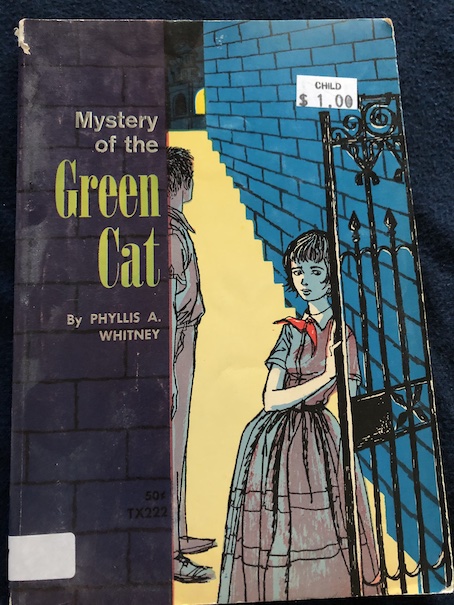
Mystery of the Green Cat by Phyllis Whitney, 1957.

Things just haven’t been the same for twins Andy and Adrian Dallas since their mother died two years ago. Now, their father has remarried to a woman he met through his work, and Adrian has been having an even harder time coping with it than Andy has. The twins have always been different from each other, not identical in appearance or personal interests, but now, Adrian is frequently angry and moody, and he’s getting on Andy’s nerves.

Their new stepmother, Emily, isn’t bad, and Andy can tell that she’s trying hard to be nice to them so that they’ll like her, but it does make the boys uneasy that their father seems to be having an easier time moving on from their mother’s death than they are. Also, Emily has two daughters, Jill and Carol, who have been living with their grandmother. Now that Emily has remarried, Jill and Carol are coming to live with her, her new husband, and the two boys in San Francisco. Emily has been saying that they’ll all be one big family now, but all of the children have misgivings about it. The twin boys have never lived with girls before, and they’re not looking forward to having a bunch of girly stuff around or Carol practicing her dancing in their new house. Meanwhile, the two girls aren’t sure that they’re really looking forward to suddenly having a couple of brothers. Carol is optimistic and thinks it might be fun, but Jill remembers that she hasn’t gotten along with the brothers of some of her friends. This new blended family is a major adjustment for everyone.

Adrian is so angry and upset about the coming of the girls that he refuses to go meet them at the airport with the rest of the family. Andy goes, although he is uneasy about meeting his new stepsisters, and Jill can tell that he’s not really happy to see them. Andy’s father explains Adrian’s absence by saying that he had a summer school art project to work on, although he does warn Jill that Adrian might need some time to get used to being around girls because he doesn’t make friends easily. Jill bluntly asks if that means that Adrian doesn’t want them around, and her stepfather says that it’s more that Adrian is still mourning his mother and having trouble adjusting to his new stepmother. But, he adds that he and his sons have really been lonely since his first wife’s death, and they’ve really needed someone like Emily in their lives, and he’s sure that Adrian will eventually realize that. He asks Jill, as the oldest girl, if she would try to make friends with Adrian. Jill’s not sure how she’s going to do that if Adrian doesn’t want to be friends with her. (This is a recurring theme in other mystery stories by Phyllis Whitney. The solution usually involves shared experiences binding people together, and this is partly the case in this book, too.)

The Dallas family house is situated on Russian Hill, and as they approach it, Jill’s mother points out another house higher on the hill, which she calls a “mystery house,” knowing that Jill loves mystery books. Her stepfather says that there are two women living there, Mrs. Wallenstein and Miss Furness. The two women are somewhat reclusive, and nobody really seems to know much about them. Andy says that Mrs. Wallenstein is a baroness, but his father says he thinks that’s just a rumor. The two elderly ladies also have a Japanese family working for them. The wife is their cook, and the husband is their gardener. Later, Jill spots someone spying on the Dallas house, peeking down from a wall surrounding their property, and Andy says that’s probably the daughter of the cook and gardener. Andy and Adrian have seen her around before, although they haven’t spoken to her much.

While they’re all sitting at the table, eating and talking, someone suddenly throws a rock through one of their windows. The rock came from the baroness’s house, so the father of the family says he’s going to call her and talk to her about it. However, when he calls, Miss Furness answers the phone, denies that anyone at her house would do such a thing, and hangs up. The boys tell Jill that this isn’t the first time someone has thrown rocks, but the last time, the rock just landed on the terrace and didn’t break anything. The boys haven’t wanted to tell the parents about the last time. Jill asks why not, and Andy refers to a “green cat” but doesn’t really explain what that means.

Later, the Japanese girl from the house next door stops by and introduces herself to Jill as Hana Tamura. (Hana’s English is imperfect, and this is one of those books where the author tries to write like the character is speaking to reflect the accent. Hana switches her ‘r’s and ‘l’s when she speaks in that stereotypical way Asians in old movies speak.) Hana admits to breaking the window and says that she did it by accident. She was just climbing the wall to see the new children who moved in next door when she kicked a stone loose from the wall that broke the window. She offers to pay for the damage. Jill’s mother says that won’t be necessary, but Hana insists that she accept some money. Jill’s mother invites her to stay and visit with Jill and Carol, but Hana says she can’t because Miss Furness doesn’t like her visiting with neighbors. Miss Furness doesn’t seem to like people much. Jill is disappointed because she could use a new friend in her new home, and Hana is interesting because she’s the first Japanese person Jill has ever met. (That’s interesting to me because Jill and Carol were originally from New York, and I would think that they’d see all sorts of people there.) Before Hana leaves, Jill asks her if she knows anything about a green cat. Hana refuses to answer, but Jill can tell that she’s a little disturbed at the mention of the cat. Jill’s mother is a little concerned that Hana isn’t being allowed to associate with neighborhood children and says that she’s going to try to talk to Miss Furness about it.

It turns out everyone has completely misunderstood the relationship between Miss Furness and Mrs. Wallenstein (“the baroness”). Rather than Miss Furness being the housekeeper for Mrs. Wallenstein, she’s actually Mrs. Wallenstein’s sister and the head of the household. When Jill spots Mrs. Wallenstein watching her with binoculars, Adrian says that she’s done that before and also finally confides that Mrs. Wallenstein was the one who threw a rock at him and Andy when they were on the terrace, not Hana. The “rock” Mrs. Wallenstein threw was actually just a little pebble, and Andy scooped it up, refusing to even show it to Adrian, although he doesn’t immediately explain why.

After a visit to the house next door to deliver a letter for Mrs. Wallenstein that was accidentally delivered to the Dallas house, Jill comes to realize that Miss Furness doesn’t treat her sister well, reading her mail and keeping people from her, and that Mrs. Wallenstein is in need of help. Andy finally explains to Jill that the rock Mrs. Wallenstein threw had a note tied to it, asking them to help her find her “little green cat.” He didn’t want to tell Adrian before because he didn’t think Adrian would take it seriously. The kids aren’t sure what the “little green cat” is, but both Jill and Andy want to help poor Mrs. Wallenstein.

Miss Furness doesn’t really mean to be mean to her sister, but she is extremely overprotective of her and keeps her isolated from other people because she has been suffering from ill health and memory problems. Mrs. Wallenstein went through hard times in her life after her husband died, and she was badly injured in an earthquake in Japan, which is why she’s now confined to a wheelchair. Sometimes, when Mrs. Wallenstein starts reminiscing about the past, she becomes confused about what’s past and what’s present, and it all begins blending into one. Her sister has been trying to shield her from past traumatic memories, but Mrs. Wallenstein has the feeling that there’s something important that she wants to remember, and she can’t quite figure out what it is. The key to unlocking Mrs. Wallenstein’s memory and learning the truth about the past lies in finding the little green cat.

The book is available to borrow and read for free online through Internet Archive.

Themes and My Reaction

Adjustment to changing family situations is a common theme in Phyllis Whitney’s young adult mystery stories, but this one is a little different from most. Most books by Phyllis Whitney are told only from the point of view of a girl, using third person limited. Even when boys play a major part in stories, the focus is usually on the girl. This book is told mostly from Jill’s perspective, but Andy is the one who begins the story, giving some insight into how he and his brother are feeling before the girls arrive. Although the boys and girls are separate when the book begins, their feelings toward each other are pretty similar. All of the children are trying to adjust to major changes in their lives and having misgivings about suddenly having new siblings of the opposite sex.

I think it’s also important to point out that, although the story focuses on a blended family, there is no divorce in the story. The two parents who are entering into a second marriage were widowed. This book was written in the 1950s, and in the first half of the 20th century, people didn’t talk about parents getting divorced as much. In children’s books of this time period, single parents and remarriages were usually the result of the death of a parent. It’s not that divorce was never mentioned; it’s just that it wasn’t nearly as prevalent in children’s literature, partly due to the social stigma against divorce at the time. I’ve sometimes thought that, in some ways, it was also probably easier for authors to explain the loss that accompanies a parent’s death, which would not have been the parent’s choice and was just a tragedy that couldn’t be helped, than the reasons why parents would willingly choose not to continue living with each other or why one parent would no longer live with the children. This is different from modern children’s books, where it’s usually more common to see divorced parents than dead ones. In fact, quite a lot of modern children’s books include divorced parents. Both death and divorce involve feelings of grief and loss, but if the loss is from a death that just couldn’t be helped, the author can avoid addressing the painful questions of “why” the separation happened. In real life, the reasons for a divorce can involve complex and sensitive issues that many adults would find difficult to discuss with children, including marital infidelity, emotional neglect, financial problems, addiction, and physical or psychological abuse. There’s never a happy reason for a divorce, so saying that the absent parents in the story died allows authors to skip over all of that. Death is sad, but it’s a little more self-explanatory. Andy and Adrian’s mother died from an unspecified long-term illness, and there’s no need for the characters to explain more than that. I could be wrong about some of my theories here, but that’s the impression that I sometimes get from older books. There is less social stigma surrounding divorce in modern times, and the prevalence of divorce in society has made it increasingly important to address children’s feelings about divorce in children’s literature, which is why there are now more books about it. That being said, the loss of a parent because of death is something that children still experience today, and the author of this story makes some important points about the feelings that someone can experience when they lose someone close to them.

As Jill gets to know Adrian, she comes to learn some of the reasons why he’s really unhappy. It’s partly because, when they moved to the new house after his dad remarried, he and Andy had to start sharing a room to make room for the two girls. Adrian and Andy have very different interests, and sharing the space has been particularly hard on Adrian. Adrian is a tidy person, and he’s very serious about art. He needs space to work on his artwork, and Andy is messy and likes to hoard pieces and parts for building things. Jill starts making friends with Adrian when she figures out how to make a better working space for him, but she upsets him again when she accidentally breaks the vase holding his brushes, which reveals the second reason why Adrian is unhappy. When the family moved to the new house, his father got rid of many of the things that used to belong to his first wife. Adrian has been blaming his stepmother for the loss of many of these sentimental reminders. Adrian doesn’t have many reminders of his mother left, and the vase was one of them, so now he blames Jill and her mother for the loss of that. As all the little reminders of his mother seem to be disappearing and Emily and her daughters are moving into the space, Adrian is afraid of losing all of the memories he has of his mother. It’s a situation that’s somewhat similar to Mrs. Wallenstein’s problem, using physical objects as a reminder of the past.

Mrs. Wallenstein has suffered sadness and trauma, which is part of the reason why her memory is so faulty. However she badly wants to remember some of the things she’s forgotten since her injury in the earthquake because they hold the key to the truth about her husband’s death. He died or disappeared under mysterious circumstances, and his business partner was murdered. Some people claimed that her husband might have actually killed his partner, but Mrs. Wallenstein doesn’t believe that. The clues to what really happened are tied up with the mysterious green cat.

However, part of the story also involves selfishness and self-centeredness. Mrs. Wallenstein’s husband’s business partner was a very selfish man, always needing to be the center of attention and taking credit for things that Mrs. Wallenstein’s husband did, and that’s tied in with the story of what happened to the two of them. In his own way, Adrian is selfish, too. It’s true that he’s still grieving for his mother, but the way he shows his grief is selfish, and Jill finally tells him so. Just because his stepmother isn’t his mother is no reason for him to be constantly cold and rude to her. Adrian is also rude and inconsiderate to other people, including Jill, their new friend Hana, and his own brother. Each of them is also dealing with something hard in their lives, but all Adrian cares about are his own feelings. While they all tiptoe around him, trying to make friends with him and be extra careful of his feelings because he’s “sensitive”, he says rude and condescending things to them or suddenly goes into a moody pout if he’s reminded of his mother’s death and/or his father’s remarriage. As Jill says, he’s sensitive, but only about himself; Adrian has no sensitivity for anyone else’s feelings. He’s even careless with Mrs. Wallenstein’s green cat after he learns that it has no monetary value, not considering what it means to her and her past. For someone who’s hyper-aware of belongings that have meaning for him, it’s an incredibly selfish thing to do. He not only doesn’t try to help the others solve the mystery of the cat, but when he finds out some information on his own, he deliberately doesn’t tell them until he can show off how clever he is while taunting the others about how they’re not as clever as they think they are. I honestly thought that he was going to be more help to the others in the story and reconcile his feelings through their shared adventure, but only Andy does that. Adrian resists right up until the very end, when Emily has a very honest talk with him about his feelings and hers.

I was a little annoyed at the way Hana’s speech was shown in the book because it always annoys me a little when authors try to show someone’s accent through spelling. It often seems to detract from what characters are actually saying, and the r/l swapping when Asians speak has a stereotypical feel to it. It’s not that Asians in real life never do the r/l swap, but it’s usually way overdone when it appears in books and movies, so it gets on my nerves. The real life r/l phenomenon is really based on the fact that Asian languages have a tendency to use the same symbol to represent r/l sounds, and the sound those symbols represent is about halfway between the two, depending on the language. In that case, it’s not really so much “swapping” the sounds as making one sound that is more in the middle than English speakers are used to hearing. The speaker may not actually be hearing the difference if they’re not accustomed to thinking of a difference between those two sounds, while listeners who are accustomed to listening for a difference in those sounds are confused about which of the two sounds they’re actually hearing when someone makes a sound that’s kind of in-between.

That being said, the perceptions of Asians, particularly Japanese people, in the book is favorable. This book was published about 12 years after WWII, so I thought it was nice that the characters were looking at the Japanese characters favorably. Jill is genuinely interested in being Hana’s friend, and Jill’s mother wants Jill to be friends with Hana. Later, Hana tells Jill and the boys a little about her own history, how her parents were married before WWII, but because her mother was unsure about coming to the United States, she ended up staying in Japan without her husband for a time. Hana was born shortly before the war started, and her father was unable to come to see her or bring his wife and child to the United States during the war. In fact, Hana and her mother were only reunited with her father a year before the story starts, so she was 13 years old the first time she met her father. Although the other children in the story have had their share of loss and family problems, Hana’s story about her own life helps to highlight that other people have their troubles, too.

The author, Phyllis A. Whitney, spent the first 15 years of her life in Asia because her father worked for an export business. She was actually born in Japan and also lived for a time in China and the Philippines. Because of all of the travel in her early life, Phyllis Whitney’s books often include travel to various countries around the world, people from different cultures, and children getting used to new homes or living among unfamiliar people, for various reasons.

There are some interesting tidbits of information about Asian cultures in the story, particularly about Japanese culture. I thought the part about how Japanese traditionally calculate age was interesting. There are also some interesting pieces of information about San Francisco and its landmarks. I’d heard of Telegraph Hill before, but I didn’t know the origin of the name until the book explained it.

I liked the book, both for the interesting tidbits of information and for the plot itself. This mystery is one of what I think of as the “mysterious circumstances” type of mystery. That’s a name I made up to describe mysteries where no crime (or at least no obvious crime) has been committed but yet there’s evidence of strange happenings and unknown events that must be figured out. I honestly wasn’t sure what direction this story was going to take when it started out, and I changed my mind several times along the way, but it has a very satisfying ending.

Shadow in Hawthorn Bay

Shadow in Hawthorn Bay by Janet Lunn, 1986.

Mary (or “Mairi,” they spell it both ways) Urquhart and her cousin Duncan had always loved each other.  They were always close as children, feeling more like two parts of one person than separate people, and they always imagined that they would spend the rest of their lives together.  Then, Duncan’s parents, Mary’s Uncle Davie and Aunt Jean, decided that they wanted to travel to Canada, while Mary and her parents stayed at home in the Scottish Highlands.  Duncan hadn’t really wanted to go.  He was only eleven, and he promised Mary that when he was older, he would work hard to earn enough money to come back.  However, Duncan never came.  He only sent Mary a brief letter about the dark forest where he now lives.  Mary feels like the Duncan she knew is gone forever.

Four years later, in 1815, when Mary is fifteen, she has a strange feeling, like Duncan is calling to her from across the ocean.  All of her life, Mary has had a strange gift for seeing into the future or reading others’ minds.  The “gift of two sights,” people call it, but Mary doesn’t feel like it’s a gift.  It makes her uneasy, and she can’t control it.  She hears Duncan’s calls to her through her “gift,” but she is afraid because she doesn’t want to leave Scotland.  She wants Duncan to come to her.

However, she is unable to resist Duncan’s calls.  She asks her parents for help with money for her passage to Canada, but they tell her that she is wasting her time and that, even if they sold their family’s most precious heirloom to give her the money, there would not be enough for the return journey.  A family friend gives her the money instead, and although Mary doesn’t really want to accept it and doesn’t really want to go, she can’t help herself.

The journey to Canada is miserable, and when she finally arrives at the place where her aunt and uncle live, alone and without money, she learns something which she thought she had sensed during the journey: Duncan is dead.  Duncan committed suicide while Mary was still on the ship to Canada.  Mary has arrived too late.  To make matters worse, one of the family’s neighbors, Luke Anderson, tells her that her aunt and uncle gave up the idea of farming in Canada and have already begun the journey back to Scotland.  Mary has no money to follow them, and they have no idea that she’s now in Canada, alone.

Luke takes Mary to Mrs. Colliver, who tells Mary a little about her family and their life in Canada and why they decided to leave.  Mary is devastated by the loss of Duncan and tries to tell Mrs. Colliver about how she felt that Duncan had been calling out to her, but Mrs. Colliver tells her that she doesn’t believe in ghosts or things like that.  Although Mary knows that her “gift” is real and so are spirits, she learns that others in the community share Mrs. Colliver’s no-nonsense, disbelieving attitude toward such things.  Mary, in her despair, wants to rush straight back to Scotland, but Mrs. Colliver, with her practicality, points out that Mary can’t possibly get there without money.  She tells Mary that she can stay with her family, that she will give her room and board in exchange for help with chores and that she can earn extra money for weaving and spinning.  Mary is clumsy at household chores because she was always better with animals at home, but when Mrs. Colliver sees Mary’s skills with animals, she is appreciative.

Life is hard in the small farming community.  Mrs. Anderson, Luke’s mother, explains to Mary that most of the people who live there are refugees.  When they were young, their families moved there from the Thirteen Colonies that now make up the United States because they were Loyalists.  When the Revolution came, they couldn’t stay, and so had gone north to Canada, where they struggled to establish a new community for themselves with their small homesteads. During her time there, Mary witnesses the death of a baby and the hardships of this strange place, seeing why Duncan didn’t like it there.  They tell her that Duncan was a strange boy who would seem bright and happy one day, but black with depression the next, something Mary remembers in him even before he went to Canada. 

The people are kind and welcoming to Mary, although they find her a bit strange.  As Mary struggles to make a life for herself, hoping to earn enough money to return home, she slowly comes to appreciate Luke’s kindness and help.  She learns healing arts and the use of herbs from another woman in the community, developing new skills.  In helping others, she earns their appreciation and a place in their community.  Luke Anderson becomes very fond of Mary, but she still mourns for her lost Duncan.  In spite of his kindness, she doesn’t see how she can make this strange, hard, dark forest of Canada her home, where it doesn’t even seem like the spirits she believed in and that seemed to protect her when she lived in Scotland exist.

Mary is melancholy and feels like she doesn’t belong in Canada.  It distresses her that she can no longer feel Duncan’s presence . . . although she can oddly hear him calling to her sometimes.  Mary also unnerves people when she makes predictions that come true and speaks about ghosts and spirits.  When she almost gives in to her homesickness and depression and kills herself, lured to the spot where Duncan drowned himself by his ghostly calls to her, she finally sees Duncan’s death for what it really was and finds the courage to refuse to follow him down the dark path that he chose for himself and to fight for the life she has been building, the one she really wants to live.

The book is available to borrow and read for free online through Internet Archive.

My Reaction

This book is part of a loose trilogy, involving ancestors and descendants of the Anderson and Morrisay families.  All of the books take place in or near Hawthorn Bay in Canada, but at different time periods.  Some of the characters are psychic, like Mary, or have the ability to travel through time, like Susan in The Root Cellar, who is apparently Mary’s granddaughter.  The connection between Mary and Susan is never stated explicitly, but it’s implied by their last name, shared psychic abilities, and comments that a friend makes about Susan’s grandmother in The Root Cellar.  In this series, the characters from each of the books generally don’t appear in any of the others (except, perhaps, for Phoebe, who appears briefly in this book and is the main character in the third story).  Most of the time, you only know about the family connections by reading the books and taking note of the last names.  The books go backward in time as the series progresses, and the connection between the Anderson and Morrisay families is only obvious in The Root Cellar.

With the deaths that occur in the book, discussions of suicide, and the influence of Duncan’s selfish, malevolent spirit, this is not a book for young kids. I’d say that readers should be middle school level or older. There is also some implied sex and pregnancy out of wedlock when one of Luke’s brothers gets one of Mary’s friends pregnant. Her friend doesn’t give the details of what happened, but from what she says, it’s implied that Luke’s disreputable brother forced himself on the girl and that she went along with it because she didn’t know what else to do. The description of that incident is minimal, but older readers will understand what happened. There is a scandal in the community because of it, and the disreputable brother leaves rather than face the consequences of his actions.

Themes and Spoilers

I enjoyed the book for its references to Scottish folklore, which Mary believes in and seems to be in touch with through her “gift” and for Mary’s growing confidence in her abilities and more mature understanding of what her cousin was really like and what her relationship with him really was.  In some ways, I do feel sorry for Duncan because he seems to have been suffering from some kind of mental illness, possibly bipolar disorder or manic depression, which would explain how his moods could shift so abruptly and dramatically.  However, Duncan was also a selfish and controlling person.  Although Duncan’s death was sad, Mary realizes that his end was of his own making, and it’s not the future she wants for herself.  There are some disturbing scenes in the story.  Mary witnesses the deaths of others, including a baby, because it is a harsh environment, where people sometimes succumb to sickness or bad weather, although these deaths are not described in too much detail. 

There are also some frightening moments, like when Duncan’s ghost almost convinces Mary to kill herself and when he similarly lures a young boy, Luke’s younger brother, to the spot where he drowned and almost kills the boy because Mary finds the little boy comforting and Duncan doesn’t want her to be comfortable and happy.  In the beginning, readers see Duncan through Mary’s fondness for him, so the true darkness of his personality isn’t immediately apparent, although I had some misgivings about him from Mary’s first description of how they played together as children.  I didn’t like the way she described how he would tease her until she became angry or hurt and then he would sulk until she comforted him.  She says that wasn’t really fair, but to me, it was disturbing because I have seen that kind of selfish personality before, and it’s never a good sign.  It shows right from the first that Duncan doesn’t really care about Mary’s feelings.  He cares only about his own feelings, and he has no interest in changing his behavior out of consideration for her.  In fact, the very idea that he should consider her feelings seems somehow insulting to him, even though he supposedly loves her.  He just thinks that she needs to reassure him that everything he does is fine whether it is or not.  In his view, Mary is obviously wrong to feel hurt even when he tries to hurt her because he has more right to his feelings than she has to hers and he should be able to behave any way he wants with no consequences.  That’s what Mary’s first description of Duncan said to me.  As soon as I saw that, even though some might consider it just the actions of an immature child, I had some suspicions about him.

My suspicions were somewhat confirmed before Mary left home. Her mother told her that she didn’t think Duncan was worth chasing after, calling him sulky and thoughtless, but the full truth of that doesn’t strike Mary until she confronts his spirit where he died. Because people in Canada don’t like to talk about Duncan much, when Mary first hears about his death, it isn’t immediately clear that he killed himself or how.  At first, it’s just somewhat implied, but when Mary is almost lured to her death, she sees the full truth about Duncan. 

Mary comes to realize that, although everyone, including Duncan and herself, felt like the two of them were two parts of the same person, they really weren’t.  Mary sees that not only can she live without Duncan, she has been living without him for years.  She lived without him for a time in Scotland, and she’s been living without him in Canada, and she can continue to live without him wherever she chooses to live the rest of her life.  When she was younger, she had thought of Duncan as being the stronger of the two of them because he was not plagued by the same “gift” she was, but she realizes that she is actually the stronger of the two of them.  Duncan’s “love” for her had also always been a selfish one.  He couldn’t bring himself to work hard and return to Scotland for her sake, but he expected her to give up everything, even her own life, to join him in Canada and in death.

When Mary realizes all of this, Duncan’s spirit loses its hold over her, and she comes to see that the darkness in him was darker than the forests that had seemed so frightening to her before.  Free from the shadow of Duncan’s death and his selfish spirit, Mary is able to see the beauty of Canada and to be more open to the good people around her, forging a new future with a better man.

Twin Spell

This book was originally called Twin Spell but was renamed Double Spell in reprintings.

Elizabeth and Jane Hubbard, a set of twelve-year-old twins, can’t really explain what made them stop to look at the little wooden doll in the window of the antiques shop.  Ordinarily, they probably wouldn’t have noticed it at all, but something seemed to draw them to it while they were supposed to be going home to look after their little brother.  The woman in the shop wasn’t going to sell the doll to them, either, but for some reason, she said that she felt that she ought to do it because it seemed like the doll belonged with them.

Buying the old doll starts off a chain of mysterious events in the twins’ lives.  On impulse, still forgetting that they’re supposed to go home and baby-sit, the girls decide to visit their Aunt Alice and show her the doll.  Aunt Alice had been living in England, but she had recently moved back to Toronto to live in the girls’ grandmother’s old house.  Aunt Alice doesn’t know what to think of the doll, except that it might be worth something as an antique.  She shows the girls around their grandmother’s old house, but Elizabeth has a sudden fall down the stairs, breaking her leg.  Strangely, a week later, Aunt Alice suffers a similar accident, breaking her hip.

Because of her accident, Aunt Alice decides that the big old house is a bit much for her to handle, and she tells the twins’ parents that they can have it to live in instead.  With five children in the family, including the twins, they could really use the larger house, and the children are excited about going to live there.

The twins find themselves thinking of odd things, as if they were old memories.  They suggest taking a “sick basket” of goodies to their aunt, thinking that maybe their mother had done something like that for someone before or maybe they had dreamed something like it.  Their brothers can’t remember any such thing happening, and it would be pretty weird for both of the girls to have the same dream.

However, the children think that a basket of goodies for their aunt would be a good idea.  They put together some stuff from their kitchen and what they can buy with their money, and they decide to include a book that she can read while she’s recovering.  Unfortunately, the book they choose from their shelves turns out to be a rare copy of a book about the history of Toronto that their father was using for a research project, so they have to get it back.  They do, and Aunt Alice tells them that she enjoyed it and that she had forgotten that an uncle had written it.

As the family moves into Aunt Alice’s old house, the twins keep thinking that there is something strange about their doll, that it seems to be influencing them, giving them visions of the past.  Besides the “sick basket” dream they both had, they have visions of a house and a blonde girl in old-fashioned clothes.  They start to think that the doll, which they both have the impulse to call “Amelia,” might be magic or something.  Jane is the more sensible of the two, and she insists that there must be some other explanation, like imagination or coincidence.  Elizabeth, the dreamier twin, insists that it’s the influence of Amelia, that they’re somehow seeing Amelia’s memories of the past.

After the girls argue about the doll and the source of their odd visions, Jane starts ignoring Elizabeth.  Elizabeth continues thinking about what they’ve seen, and the blonde girl, who she is sure is called Hester and was the former owner of Amelia.  Eventually, Jane starts agreeing with Elizabeth about Hester being the doll’s former owner, but she is dubious when Elizabeth says that Amelia wants to find the house where she once lived with Hester.  Jane doesn’t know how the two of them can do that.

They ask their father for his advice, and he suggests that they start at the museum.  There, they learn by studying the styles of old clothes that Amelia is from the 1840s.  They find an area of town with houses similar to the one they’ve seen in their minds, where Amelia once lived, but they have trouble finding the exact house they’re looking for.

Jane becomes increasingly afraid, though.  More and more, she begins to feel like something is trying to take the doll away from them.  Something that is mean and doesn’t like her is in their attic.  Something like a ghost.  Jane has an awful feeling that something horrible is about to happen.

When the Jane looks at the history book her father has been reading, the one written by her great-great-uncle, Jane suddenly has a startling revelation. The house they have been seeking in actually their house, changed over the years by new additions. Amelia came from their house, and that is where she really belongs. Through the visions, they see an old tragedy in their family reenacted, a tragedy that puts Jane’s life in danger.

The book is available to read for free online through Internet Archive. There is no need to borrow this copy and no time limit; you can just read it in your browser.

The girls had made a mistake when they first started receiving their visions.  They had assumed that Hester was Amelia’s original owner, but she wasn’t.  The glimpses they got of Hester weren’t through the doll’s eyes, but those of the doll’s real former owner.  The doll was one of a set of two that originally belonged to another set of twins in the girls’ family, Anne and Melissa.  Hester was their cousin, and she was not a nice girl.  Both Jane and Elizabeth sensed it pretty early.  During an argument with Anne years before, Hester accidentally lit Anne’s dress on fire with a candle she was holding, causing Anne to die.  Hester hadn’t actually meant to harm Anne.  The whole thing was just an accident, but Hester’s guilt and Melissa’s anger and grief at her twin’s death had caused Hester’s spirit to linger in the house.  By learning the circumstances of Anne’s death and assuring Hester that they understand that she had not meant to kill her cousin, that it was all an accident, and that she couldn’t save Anne because she was just too frightened and didn’t know what to do, they help Hester’s spirit to finally rest and to reunite Amelia with her doll twin, which Hester had hidden years before.

The scene where the girls see Anne’s death is a little scary, but mostly sad.  Hester lived on after the incident, but it was not a happy life.  She ended up having to live in Anne and Melissa’s old room, where Anne died, because she never married and had to live with family.  Aunt Alice remembers knowing her as a young child, when Hester was a bitter old woman.  Perhaps if Hester hadn’t been carrying that guilt around for so many years, her life would have been much happier, although being a nice person had never particularly been her nature.  However, the twins’ acceptance of Hester’s tragedy and assurance that they understand and forgive her for what happened set her spirit at peace.

The genealogy in the story is a little confusing, partly because certain family names repeat through the generations, but there is a chart in the back of the book to help.  There are some other loose ends in the story which are also never completely clarified.  The girls admit that they will probably never know how the doll Amelia came to be in the antiques store, but it doesn’t particularly matter because Hester, Anne, Melissa, and Amelia all seem to be at peace now.

The Halloween Tree

The Halloween Tree by Ray Bradbury, 1972.

A group of neighborhood boys want to go trick-or-treating on Halloween night, but they’re upset because it looks like a friend of their, Joe Pipkin, won’t be coming with them.  When they get to Pipkin’s house, he seems ill and is clutching his side.  His friends worry that he’s sick, but he valiantly reassures them that he’ll be fine.  He sends them on, telling them that he’ll catch up with them and that his costume will be great.  Specifically, he tells them to “head for the House” which is “the place of the Haunts.”

The house that Pipkin is talking about is the creepiest house in town.  It’s large, so large that it’s hard to tell how many rooms it has.  The boys knock on the creepy-looking door knocker on the front door, and a man answers the door.  When the boys say, “trick or treat,” the man says, “No treats.  Only—trick!”  Then, he slams the door without giving them anything.

Not knowing what else to do, the boys walk around the side of the house and see a large tree, filled with jack o’lanterns.  This is the Halloween Tree.  The strange man they saw before rises up from a pile of leaves and scares the boys, giving them the “trick” that he promised them earlier.  He finally introduces himself as Carapace Clavicle Moundshroud.  He begins talking to them about the history of Halloween and asks them if they understand the real meanings behind the costumes they have chosen.  The boys admit that they really don’t know the meanings behind their costumes, and Moundshroud points off into the distance, calling it, “The Undiscovered Country.”  He says that out there likes the past and the history of Halloween and that the boys will learn the answers if they’re willing to go there.  The boys are interested, but they say that they can’t go anywhere without Pipkin, who promised that he would come.

Pipkin suddenly appears in the distance, by a dark ravine, holding a lit pumpkin.  He says that he doesn’t feel well, but he knew that he had to come.  Pipkin trips and falls, and the light in his pumpkin goes out.  From a distance, the others hear him calling for help.  Moundshroud says that something bad has happened.  Pipkin has been taken away to The Undiscovered Country by Death.  Moundshroud says that Pipkin may not be taken permanently but perhaps held for ransom and that, if they follow Pipkin to The Undiscovered Country, they might be able to get his soul back and save his life.

Moundshroud has the boys build a kite that somewhat resembles a pterodactyl, and they use it to travel into the far distant past.  The first place they arrive is Ancient Egypt, where the boys learn about mummies and how the Ancient Egyptians viewed the dead.  They see Pipkin as a mummy, being laid to rest in a sarcophagus, surrounded by hieroglyphs, telling the story of his life.  (Or, as Moundshroud says, “Or whoever Pipkin was this time around, this year, four thousand years ago,” hinting that Pipkin has been reincarnated before and what they are seeing during their journey are his past lives and deaths.)  Pipkin calls out to his friends for help.  Moundshroud tells the boys that they can’t save Pipkin now, but they’ll have a chance later.

They continue their journey through time and around the world, seeing glimpses of Halloweens past in Ancient Rome and the British Isles, where they learn about druids, Samhain, and witches.  Moundshroud describes how the Romans supplanted druidic practices with their own polytheistic religion until that was eventually replaced by Christianity.  All along, they can still hear Pipkin calling to them, and he seems to be carried off by a witch.  As they pursue him, Moundshroud teaches them the difference between fictional witches and real-life witches, which he characterizes as being more like wise women, who don’t really do magic.

From there, they go to Notre Dame to learn about gargoyles.  They continue to see Pipkin in different forms, even as a gargoyle on the cathedral.  Pipkin tells them that he’s not dead, but that he knows that part of him is in a hospital back home.

In Mexico, the boys experience Dia de los Muertos and learn about skeletons and a different kind of mummy from the ones they saw in Egypt.  They find Pipkin, held prisoner in the catacombs by the mummies, and Moundshroud tells the boys that the only way to save him is to make a bargain, both with him and with the dead: each boy must give one year from the end of their lives so that Pipkin may live.  It is a serious decision, for as Moundshroud says, they won’t miss that year now, being only about 11 or 12 years old, but none of them knows how long they will actually live.  Some of them who were destined to die at 55 would now only make it to 54, and as they reach the end of their lives, the year will seem that much more important to them.  Even those who live longer will still want every day they can possibly have.  However, each decides that he is willing to make the sacrifice because, without that sacrifice, Pipkin has no chance, and they can’t just let him die.

They make the bargain and are soon returned home.  When they go to Pipkin’s house to check on him, they are told that Pip is in the hospital because he had his appendix taken out, just in time to save his life.  At the end of the story, Tom (who is the leader of the boys through most of the story), wonders silently who Moundshroud really was, and he hears in his mind, “I think you know, boy, I think you know.”  Tom asks him if they will meet again, and Moundshroud says that he will come for Tom many years from now, confirming that Moundshroud was Death all along, which was why they had to make the bargain with him.

I saw the animated movie version of this story long before I read the book, and it really gave me the creeps!  Moundshroud is creepy because he is kind of two-faced.  On the one hand, he seems somewhat helpful in helping the boys to find Pipkin and teaching them about the history of Halloween, but on the other, he does not admit to the children that he is Death until the very end, that he is the very thing that they need to save Pipkin from, and that they can only do it by offering a sacrifice of years from their own lives. Although it does occur to me that Moundshroud may not be quite as two-faced as he seems because Pip’s illness and potential death may not have been planned by him but simply the fated situation for Pip, and Moundshroud might have just taken it upon himself to provide a way for Pip’s friends to save him in the least painful way. By not telling them that a sacrifice of part of their lives would be necessary until the very end, after they had come to a better understanding of life and death in the history of Halloween, he may have made the choice easier for them to make. Also, he never says exactly how much time they bought for Pip with their sacrifice. The implication is that Pip is now free from his early appointed death date and will now live a full life, similar to what his friends will have. The exchange does not seem to be an even one, a year for a year, with the children needing to decide how many years they will donate to Pip. Although the kids still don’t know at the end how many years each of them will live, it seems that none of the rest of them is in danger of dying in childhood, and they will all live for many more years.

I wouldn’t recommend this book for young children (it still gives me the creeps, and I’m in my 30s), but it is interesting how they take a journey through the origins of Halloween. The book and the movie were somewhat different, partly because there were more kids in the group in the book and partly because the group of kids in the movie also had a girl in a witch costume. In the book, the kid in the witch costume was also a boy.

Both the book and the animated movie are available online through Internet Archive.

Grandfather’s Dance

Grandfather’s Dance by Patricia MachLachlan, 2006.

This is the final book in the Sarah, Plain and Tall series.

Cassie is now in the fourth grade, and things are changing in her family. Cassie has come to love her little brother, John, called Jack, who is now a young child who likes to follow their grandfather around and imitate him. Caleb has gone away to school, and Anna is getting married, which is the major event of the story. Through the planning and anticipation that precedes the wedding, Cassie still keeps her journal, with its occasional flights of fancy.

Anna’s wedding brings new excitement to the family farm and thoughts of both the future and the past. Cassie, unlike her older half-siblings, has never been to Maine or met her relatives there, but Sarah’s brother and aunts are coming to the farm for Anna’s wedding. The others remember the last time they saw these relatives, and Cassie looks forward to seeing them.

Cassie wonders about why people get married, and she can’t imagine anyone she loves enough to marry and spend her life with, except maybe her dog. She tries to picture her own future wedding, with a dog as the groom, but it bothers her that she can’t picture her grandfather at her wedding. At first, she can’t quite figure out why she’s having trouble picturing him in the future, but the more she thinks about it, the more she realizes how old her grandfather is. He even comments on his age, saying that he’s getting older every day. Her grandfather seems to be increasingly feeling his age and his heart condition. Before Anna’s wedding, Cassie and her grandfather talk about her future wedding, and her grandfather tells her that he might not be there when she is married. Cassie tries to convince him that he will be, but he says, just in case he can’t, maybe they should have a wedding for Cassie now. He has Cassie put on the nice dress that she will wear to Anna’s wedding, and they stage a mock wedding for Cassie and their dog, Nick, so her grandfather can say that he was at Cassie’s wedding, too.

Anna’s wedding is beautiful, and Cassie and the others enjoy having Sarah’s brother and aunts visit. After the wedding, they have a picture taken of the whole family together. Sadly, it is the only picture of all of them together. Soon after, Cassie’s grandfather dies. All of the wedding guests are still visiting, so they attend the funeral. Jack is still a little boy and upset and confused by their grandfather’s death, but Cassie assures him that their grandfather loved them and that they won’t forget him. The title of the book comes from a little dance that their grandfather did for Jack earlier in the story, which Jack later imitates after his death.

In the back of the book, the author explains how her family was the inspiration for the family in the book. The grandfather in the story was based on the author’s father, and part of the dedication is to him. The author’s father died two years before this book was published. The farm and landscape around it are kind of a combination of the places where her family has lived in North Dakota, Kansas, and Wyoming, which is probably why the books in the series never specify which state they’re in.

The book is available to borrow and read for free online through Internet Archive (multiple copies).

The Rag Coat

Minna is a poor girl, the daughter of a coal miner.  Her father has been ill with the miner’s cough, so Minna has to help her mother to make quilts that the family can sell for money.  She wants to attend school, but she can’t because she is needed at home and her family can’t afford a warm coat for her when winter starts.  It’s too bad because Minna really wants to make some friends her own age, and she would meet other children at school.  Her father says that he will find a solution to the problem, but he dies before he can.

After Minna’s father’s death, some of the other women in the community come to the house to work on making quilts with Minna’s mother.  When the women say that the quilt pattern they are using is named after Joseph’s Coat of Many Colors, Minna wishes again for a coat.  When the other women, who are mothers themselves, realize that Minna cannot go to school until she has a coat, they decide to make one for her.  They don’t have much money, but they do have plenty of quilting scraps.  They decide to make a new, quilted coat for Minna out of their old scraps.

Minna starts going to school and does well, although she gets some teasing because, as a new student who has never been to school before, she has to sit with the youngest children, and Shane pulls her braid.  Something that Minna particularly likes at school is Sharing Day (what my school always called “Show and Tell”), where students are given the chance to show special things to the class and talk about them.  Minna decides that when her coat is ready, she will show it to the class during Sharing Day.

As the coat is being made, Minna admires all of the beautiful colors of the cloth scraps in the coat and adds a piece of her father’s old jacket as well.  Each of the other scraps in the coat also has a story that goes with it.  The cloth pieces come from old clothes and blankets that people in the families of the quilting mothers have used, and they memories attached to them.  The mothers tell Minna all of the stories as they work on the coat, and Minna loves it.

However, when Minna wears the coat to school for the first time, the other kids make fun of her for wearing rags.  Minna is really upset and runs away into the woods.  After thinking about it, Minna remembers what her father said about how people really need other people, and she decides to go back to school.  There, she tells the other students that the rags in her coat are actually their rags, and she begins reciting the stories that go with them.

One of the scraps is from Shane’s old blanket from when he was a baby.  He was born so small that everyone was afraid that he’d die, but the blanket kept him warm, and he later carried it around with him until it fell apart.  Shane is happy, seeing the scrap of his favorite blanket again in Minna’s coat.  Everyone else gathers around Minna, looking for their scraps in the coat and listening to the stories behind them.  Each of the scraps in Minna’s coat is like an old friend that none of them ever thought they’d see again.  The other children apologize to Minna for their teasing and Minna says that friends share and that it took all of them to make her coat warm.

The book doesn’t say when this story is supposed to take place, but based on the children’s clothing, I think it’s about 100 years ago or more. It doesn’t say exactly where this story takes place, either, but a note on the dust jacket says that it takes place in Appalachia. The author said that she was inspired by Appalachian crafts that she learned from the women in her family and a patchwork coat that she wore as a child. However, years later, the author revisited this story and rewrote it in a longer version, and some of the explanations that accompany the new version of the story elaborate more on the background.

The author rewrote this story in a longer, novel form called Minna’s Patchwork Coat (2015). In the back of that book, the explanation behind the story mentions that the year of the story is 1908. It also discusses some cultural references and songs included in the expanded version of the story that were not part of the original. It states that the inspiration for this story came not only from the author’s experiences but from a song written by Dolly Parton, Coat of Many Colors, which was made into a picture book itself after the publication of this book.

There is also an expanded retelling of the story called Minna’s Patchwork Coat, and I’d like to talk about some of the differences. For example, the ending message of the story is slightly changed in the longer version, or at least the emphasis of the moral is different. The original book emphasized how much “people need people” and how the goodwill of many people (in the form of the quilting mothers and their hard work and scraps, cast-off from all of their children) changed Minna’s life. They emphasize it at the end, talking about how Minna’s coat is the warmest of all of them and that it took a lot of people to make it that way. However, in the expanded version, Minna also explains that when she started school, she liked her classmates better than they liked her because, thanks to their mothers’ stories as they made her coat, she already knew who the other children were, but none of them really knew anything about her. The message of the expanded version is that it is important to learn others’ stories to learn who they really are and to become friends with them.

Actually, I don’t like the second version of the story as well as the original. I thought that the moral and the story were stronger when the focus was on how people benefit from having relationships with other people because people can do great things when a lot of people contribute a little. Remember, it took a lot of people to make Minna’s coat warm because each of them contributed at least one scrap to it and others took the time to put them all together. It was their stories that made the coat special, more than just an ordinary coat. The expanded story has that element, too, but more emphasis is placed on Minna needing to share her story with the other children to win their respect and approval. I didn’t like the notion that Minna needed to win their approval by telling her story. Also, this story takes place in a small mining community. I find it difficult to believe that the other kids wouldn’t basically know her story already. Her mother knows their mothers. Their families see each other at church before Minna goes to school. The disease that took her father’s life isn’t terribly unusual for coal miners, and probably, a number of the other children are the children of coal miners as well. It seems to be the major industry in the area. Minna’s family might be more poor than the others’ since her father’s illness and death, but I don’t see why their circumstances would be so different and incomprehensible to people who must have seen her and her family around and who knew them from church or through their parents’ associations. One thing that small towns and communities are known for is everyone knowing everyone else and their business, so why didn’t they all know Minna’s story already? Even if the quilting mothers didn’t talk about helping to make the coat for Minna, the other kids should have known about the family’s money circumstances and the tragic death of Minna’s father. I don’t see why the other kids would have known so little about her or thought that she was so unusual.

The expanded version of the story also features a Cherokee midwife and a biracial friend for Minna who did not appear in the original story. This friend, Lester, is also something of an outcast among the other children, and Minna and the stories from her coat help the other children to be more accepting of him as well. It’s a nice thing, I guess, but it felt a little artificial to me because I knew that it wasn’t part of the original story. I hesitate to criticize it too much because the basic message of the story isn’t bad, but I guess that the way the second version came out just doesn’t have the same feel to me. The author put things into it that weren’t in the original, and with that change in emphasis on the ending, it makes the story and characters feel a little less natural to me now. I often feel the same way when I see a movie version of a story that adds things that weren’t in the original book.