
Paul Bunyan and Babe the Blue Ox by Jan Gleiter and Kathleen Thompson, 1985.
This story is based on an American folktale that was used to promote the logging industry. The book doesn’t explain the background to the story, but in a very literal sense, it is a “tall tale.” The book is part of a series about legendary figures from history and myth.
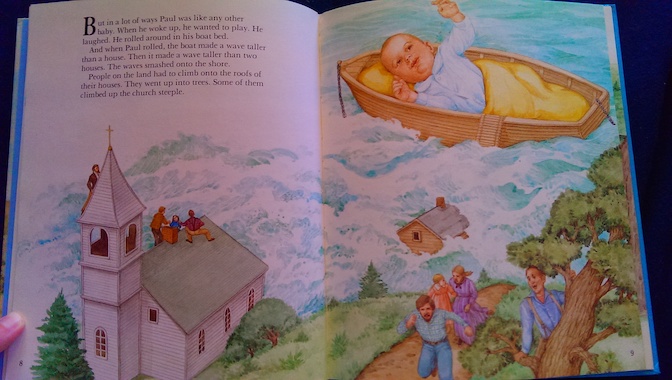
Paul Bunyan is a giant of a man, and he was a giant since he was a baby, even though his parents were both of normal human size (no explanation given). Because he was never small enough to fit in his parents’ house, they made a large boat for him to sleep in as a cradle, rocking him to sleep on a river. Needless to say, having a giant baby complicates everything and can pose a real risk to everyone. His parents had to teach him early about what he could and couldn’t do so that he would avoid hurting people.
However, Paul discovered early that he was skilled with an ax, and because of his great size and strength, he realizes that he is good at cutting down trees. Because this was the frontier days in America, good loggers were in demand because trees were plentiful and wood was needed to build houses and railroads. (Paul Bunyan would not be such a hero for cutting down whole forests today.)
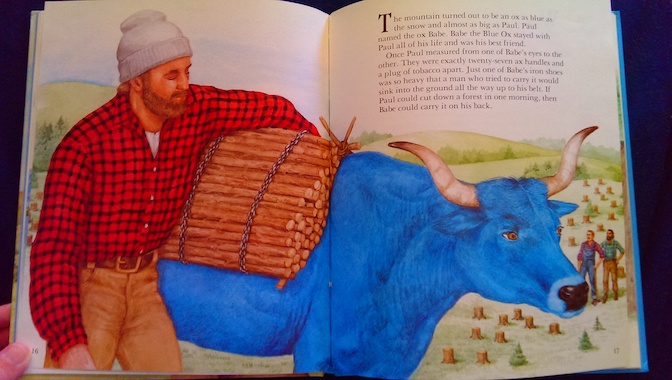
However, a giant of a man can also be lonely when there’s no one around his own size. Paul finds a companion in a giant blue ox. (Yep, that’s part of the traditional story.) He found the ox partly buried in a blizzard. After he dug it out, he named it Babe, and the two of them became lifelong friends.
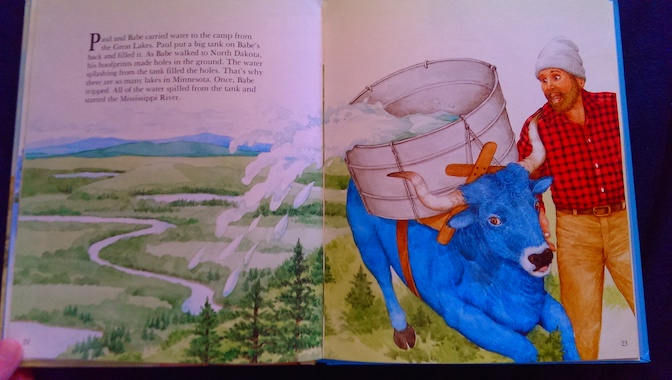
Part of the story is that the Mississippi River and all the lakes in Minnesota were caused by Babe accidentally spilling water that he was carrying on his back. Paul also supposedly dug the Grand Canyon by accident by dragging his ax behind him when he walked to California.
Paul also meets a man named Hals Halvorsen who is almost his size. After trees get cut down, Paul and Hals pound the stumps into the ground with their fists to finish clearing the land. Then, they try planting some corn to see how good the land is for farming, but the corn stalk grows up so high that Hals nearly starves to death while climbing it to try to find the top of it.

The part of the story I liked the best as a kid was when they made gigantic pancakes for Paul Bunyan and Babe, greasing their giant griddle by basically skating across its surface with grease strapped to their feet.

I can’t say that this was one of my favorite folktales as a kid, and my feelings as an adult about deforestation don’t make me feel good about it now. Still, it is an interesting piece of Americana and a little nostalgic. As a side note, Paul Bunyan was used as a mascot for a pancake restaurant in an episode of Disney’s Phineas and Ferb (which has also been done in real life). In that episode, Norm, a giant robot, accidentally gets the head of the Babe statue outside the restaurant stuck on his head, causing Phineas and Ferb to think that they are being chased by a Minotaur. Now that I think about it, this joke’s use of Paul Bunyan and Babe the Blue Ox makes me smile more than the original version of the story.
The book is currently available online through Internet Archive.



 Jestress's Forgotten Books and Stories