Mystery Madness

Mystery Madness by Otto Coontz, 1982.

While Murray’s parents are on vacation, his older sister, Blanche, is in charge of the house. One day, he calls Blanche to get a ride home from the dentist and hears what he thinks is Blanche shooting their housekeeper.

Earlier that morning, he had heard Blanche talking on the phone to someone about a gun. Then, when he calls home, a friend of Blanche’s, Harold, answers, and Murray hears a gun going off in the background and Blanche apologizing to the housekeeper and talking about blood on the carpet. When Murray gets home, his mother’s Persian rug is missing and sees what appears to be a head in a bucket under the sink in the kitchen, further proof that the housekeeper is dead and that her blood stained the carpet.

Murray doesn’t know what to do because he is sure that his sister would never shoot anyone on purpose, and he doesn’t want to see her go to jail. He consults a private detective, Mat Cloak, who he met in a doughnut shop, for help.

The detective agrees to look into the case, and along the way, he realizes that it has connections to a case that he is already investigating. What really happened to the housekeeper? Is Blanche really guilty of murder? Moreover, who is the strange man who is following Murray around?

It’s a very funny story with some twists that readers won’t be able to guess right away. Part of the mystery is pretty obvious because Blanche is a theater student, but the real mystery is one that Murray isn’t even trying to solve and the real villain is someone who Murray thinks is a victim.

The book is available to borrow and read for free online through Internet Archive.

The Mystery of King Karfu

The Mystery of King Karfu by Doug Cushman, 1996.

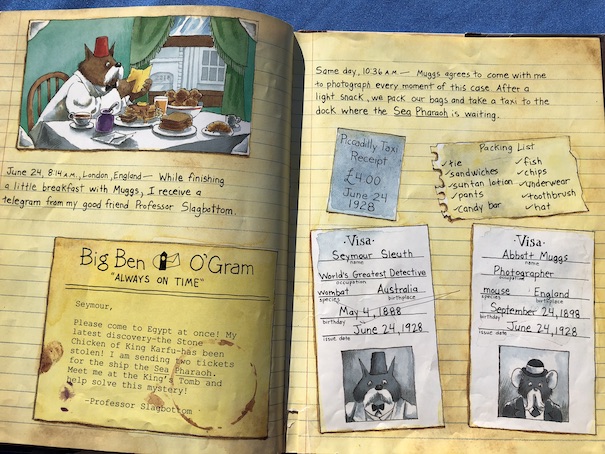
Seymour Sleuth, an Australian wombat living in London, introduces himself as “the greatest detective in the world.”  His friend, Abbott Muggs, a mouse, is a photographer who assists him in his cases and documents them.  When the story begins, Seymour receives a telegram from his friend Professor Slagbottom, who is working on an archaeological site in Egypt.  Someone has stolen one of their finds, the Stone Chicken of King Karfu, and he needs Seymour’s help to find it!  Seymour and Muggs head for Egypt!

King Karfu was a wealthy pharaoh and a wonderful cook, and the Stone Chicken may provide clues about the Lost Treasure of King Karfu, the nature of which is unknown.  When they reach the dig in Egypt, Professor Slagbottom explains that he was researching a message in code on the outside of the Chicken when it was stolen.  The suspects are the other people on the dig, who may be trying to steal King Karfu’s Treasure.

Seymour interviews the suspects one at a time and considers their connection to clues found at the scene of the crime.  As an adult, I figured out who the culprit was pretty quickly, but for the benefit of child readers, Seymour provides notes about the clues and suspects to help them understand the connections. The pictures in the story also provide important clues.  After Professor Slagbottom’s decoder is stolen, Seymour realizes who the thief is.

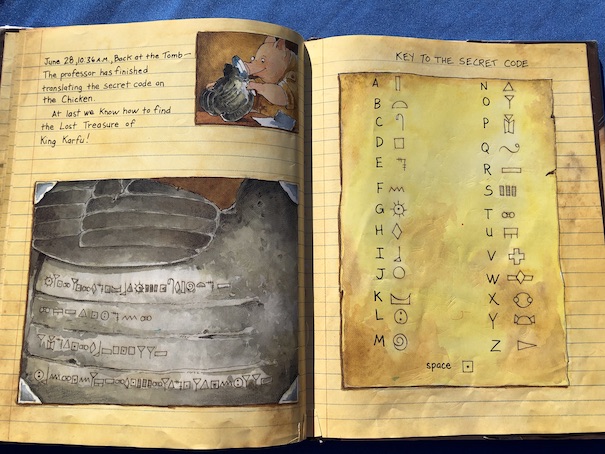
After they get the Stone Chicken back, readers can use the decoder provided to solve the code and learn where the Treasure is.  It turns out that the Treasure is actually a recipe, written in the same substitution code – for peanut butter and jelly sandwiches!

I always like mysteries that involve codes and puzzles, and this cute animal mystery would be fun and challenging for young kids.  With the key provided, it would be a good introduction to substitution codes for kids who have never seen them.  There is one other book with Seymour Sleuth, The Mystery of the Monkey’s Maze.  The author, Doug Cushman, is also the author of the Aunt Eater Mysteries.

The book is currently available online through Internet Archive.

Nate the Great Goes Undercover

NateUndercover

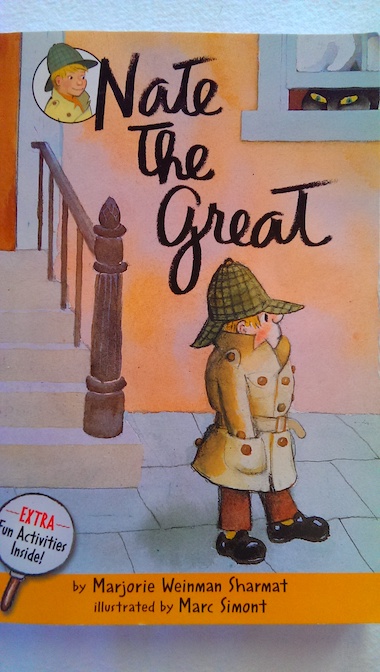
Nate the Great Goes Undercover by Marjorie Weinman Sharmat, 1974.

Nate isn’t too fond of his next-door neighbor, Oliver. He thinks Oliver is a pest. Still, when Oliver tells Nate that someone keeps getting into his garbage cans at night, knocking them over and stealing garbage, Nate is curious.

NateUndercoverOliver

Nate recently found and adopted a dog, which he calls Sludge, and he decides to take Sludge along on the case. After interviewing a couple of girls who live in the neighborhood, Rosamond and Esmeralda, Nate comes to the conclusion that no human would ever visit Oliver’s garbage cans at night. Humans are not interested in stealing someone else’s garbage or in visiting Oliver’s house because Nate is not the only person who thinks that Oliver is a pest.

So what does that leave? Perhaps some kind of animal? But what kind? There is only one way to find out, and it’s not going to be pretty. Nate has to hide out in Oliver’s garbage at night. It’s a dirty job, but, well, you know . . .

My Reaction and Spoilers

NateUndercoverNote

I think a lot of people would see the solution to this puzzle coming. I frequently debate about how many spoilers to include in these reviews/summaries (and frequently give in to the urge to offer them), but I think Sludge’s past as a stray dog and his expressions when Nate keeps feeding him pancakes really say it all.

NateUndercoverGarbageCan

Later editions of the book also have a section of activities in the back. There is information about animals that come out at night and things to do to make baths more interesting and recipes for hamburgers and ice cream (which are among the things that Rosamond says that she would rather eat than garbage).

Nate the Great

NateGreat

Nate the Great by Marjorie Weinman Sharmat, 1972.

Nate is eating his favorite breakfast, pancakes, when his friend Annie calls him from her house down the street, asking for his help in finding a lost picture. When Nate arrives at Annie’s house, she says that she painted a picture of her dog, Fang, and then left it on her desk to dry, but it disappeared.

NateGreatBreakfast

After establishing that Annie’s house has no trapdoors or secret passages, Nate declares that this will be a very dull case. But, of course, he investigates anyway.

NateGreatAnnie

Nate searches Annie’s room, and not finding the picture, asks Annie who else knew about it. Annie says that she showed it to Fang, her little brother Harry, and her friend Rosamond.

NateGreatYellow

Determining that Fang didn’t bury the picture of himself and that Rosamond is only interested in cats, that just leaves Harry. But, if Harry took Annie’s picture, why did he take it and what did he do with it?

NateGreatHarry

My Reaction

This is a fun mystery for young children, one of the first mysteries that I read as a kid. The pictures in the book have clues, and it helps if kids know how to combine colors to create new ones (hint).

Later editions of the book also have a section of activities in the back. Most of them have to do with art and color, and there is also a recipe for pancakes.

Coffin on a Case

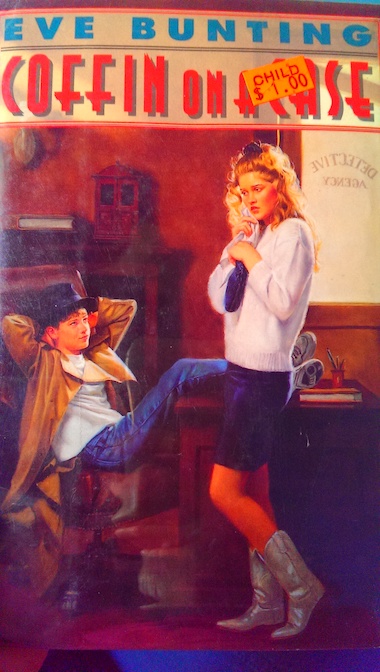
CoffinCaseCoffin on a Case by Eve Bunting, 1992.

Twelve-year-old Henry Coffin’s father is a private investigator, and Henry hopes to be one himself someday.  He’s learned a lot by watching his father in action.  One day, a sixteen-year-old girl, Lily, comes to the office and asks for help in finding her missing mother.  Lily found her mother’s car in their driveway with groceries still in it, and her mother is nowhere to be found.  She doesn’t want to go to the police because she once called the police about her mother being missing only to discover that there was a mix-up and that her mother had tried to leave her a note that she hadn’t seen.  Lily has double-checked this time to make sure that there was definitely no note from her mother and none of her mother’s friends have heard from her, but she worries that the police would think that she’s being paranoid, so she decided to consult a private investigator instead.

Henry’s father is concerned about the disappearance of Lily’s mother, but he’s unable to take the case because he has to go out of town.  He tries to refer Lily to another investigator or a friend of his who is with the police, but Lily just storms out of the office.  Henry wishes that he could take the case for his father.  His own mother abandoned him and his father when Henry was just a baby, so disappearing mothers are of great concern to him.  Later, when Lily gets in touch with him, Henry agrees to help her without telling either his father or Mrs. Sypes, the housekeeper who has looked after him since his mother left.

At first, there doesn’t seem to be much to go on.  Lily’s mother makes wooden storks that she sells as lawn decorations to people who have recently had a baby.  She was going to sell a couple before going to pick up the groceries, but Lily says that there is an extra one missing.  Somewhere between the grocery store and home, Lily’s mother made an unexpected stop . . . and there are signs that someone other than Lily’s mother drove the car to Lily’s house.  But, who was it, and what happened to Lily’s mother?

The answers to these puzzles put Henry on the trail of some dangerous thieves who would do just about anything to cover up their crime.

The book is available to borrow and read for free online through Internet Archive (multiple copies).

My Reaction

Henry shows excellent deductive reasoning as he analyzes the clues and reconstructs Lily’s mother’s trail to learn what happened to her. Both Henry and his father are inspired by the fictional character, Sam Spade, and Henry makes frequent references to him in the story, thinking what Sam Spade would say or do in certain situations.

Throughout the book, Henry also considers his own mother’s disappearance years ago.  Her abandonment of her family was her own choice, not an abduction, which makes her situation different from what happened to Lily’s mother.  Henry has no real memory of his mother, which pains him somewhat.  He sometimes dreams that she’ll return home one day for a happy ending, like in the movies, but he also realizes that’s really just a daydream.  When Lily’s mother is finally rescued, Henry and Lily continue being friends, and Henry also considers whether a relationship would be possible between his father and Lily’s mother.  It’s a nice idea, but Henry also thinks that isn’t likely, and he’s okay with that.

Basil and the Pygmy Cats

BasilPygmyCatsBasil and the Pygmy Cats by Eve Titus, 1971.

Mouse detective Basil’s arch enemy, Professor Ratigan, has taken over the Asian country of Bengistan, near India.  Basil discovers that he is holding the real ruler of the country captive so that he and his gang can loot the country for everything they can get, keeping the populace in subjugation.  Basil is determined to go there and free the rightful ruler so they can vanquish Professor Ratigan!

When Dr. Edward Hagerup of the British Mousmopolitan Museum hears that Basil is heading to Asia, he asks him to investigate an historical mystery for him.  There have been tales of a race of pygmy cats, no bigger than mice, but new evidence has been found that suggests there is more truth behind the stories than anyone has realized.  Basil has an interest in archaeology and eagerly accepts this extra task as part of their mission.  Along the way, other mice who have heard of the expedition join up to help Basil.

At first, Basil’s original mission, stopping Ratigan, seems easy.  Basil and his friend Dawson allow themselves to be captured so that they can get into the palace and find the real Maharaja of Bengistan.  After solving a secret code in the dungeon, they find the Maharaja, who tells them that another acquaintance of theirs, the opera singer, Relda, is also a prisoner in the palace.  She was giving a performance there when Ratigan and his thugs took over, and Ratigan has forced her to stay, giving private performances for him.  During one of these performances, Basil and his friends manage to take Ratigan by surprise and capture him.

BasilPygmyCatsPic1Now, Basil thinks that he and his associates are free to continue their other mission, finding the lost civilization of pygmy cats.  However, that mission is fraught with danger and surprises, and they haven’t quite heard the last of Ratigan.

The story isn’t really much of a mystery.  It’s really more an adventure story.

Basil and his friends manage to locate the island of pygmy cats with the help of Jeannie (a sea serpent related to the Loch Ness Monster who lost her way back to Scotland after a family trip — I kid you not) and the Sacred Catfish (which they bribe with catnip — I also kid you not, and his nip trip is a little disturbing).

This is my least favorite of the Basil series, partly because of the lack of mystery and also because of “primitive” nature of the pygmy cats when they find them.  Basil makes it clear that the pygmy cats are inherently less intelligent than mice and that their greatest achievements were because of the influence of royal mice who washed up on the shores of their island years ago, only to be wiped out by a volcano.  (Really?  Really.  Basil, if these mice were so superior and the pygmy cats so inferior, why were the cats able to get away from the volcano when the mice didn’t, hmm?  Why didn’t the mice just go to the part of the island where the cats were until the volcano stopped erupting?  Just what kind of bill of goods are you trying to sell us, Basil?)  Basil comes off sounding like a 19th century imperialist, and the fawning adoration he gets for his discovery is really annoying.

In general, I don’t like the Basil stories that turn out to be more adventure than mystery, and Basil’s smug superiority at various points in the story are off-putting.  It’s true that that Sherlock Holmes (which this series parodies) had an ego as well, but these sort of imperialist attitudes in a children’s story are distasteful.  Although I like recommending nostalgic books for future generations, this is one that I really can’t recommend.  The brightest spot in this book was the secret code in the dungeon, which is more in keeping with the mystery theme.  If the book had made the plot to capture Ratigan and end his reign of terror in another country without all this stuff about an “inferior” species of small cats, it would have been a much better story.

Like other books in this series, this book contains a number of jokes on the original Sherlock Holmes stories.  Read a number of the names backwards, and you’ll see some familiar names from Sherlock Holmes as well as a reference to another series by Eve Titus.

This book is available to borrow and read for free online through Internet Archive.

The Mystery in Dracula’s Castle

MysteryDraculasCastleThe Mystery in Dracula’s Castle by Vic Crume, 1973.

This is a novelization of a live action Disney movie of the same name and contains photographs of scenes from the movie. The title of the book and the movie is a little misleading because, although the main characters are unaware of what is going on for most of the story, the audience finds out pretty quickly who the bad guys are and what they’re doing. In a way, it’s kind of like a Columbo story where the suspense is in watching the hero figure it all out. Also, there is no real castle or Dracula. Sorry. 😦 In spite of these short-comings, it’s still a fun story, and although the movie has not been released on dvd, it is possible to see it on YouTube (as of this writing).

Alfie and Leonard are spending yet another summer at their family’s beach house in a small town while their mother works on the new book she’s writing. They think this summer is going to be dull, but with jewel thieves in town, it soon becomes apparent that it’s anything but!

MysteryDraculasCastlePicAlfie is an aspiring film maker. Specifically, he wants to make horror movies, and he talks his younger brother into playing the part of Dracula in his latest Super 8 film. Leonard is only a reluctant vampire because he doesn’t like horror movies. He really wants to be a detective, like Sherlock Holmes. Back home, he and his brother saw police investigating the scene of a robbery at a jewelry store, and he’s decided that he wants to investigate crimes like that. Soon after they arrive at the beach house, Leonard adopts a stray dog and names him Watson so that he can be his sidekick.

Alfie laughs at his brother’s detective fantasies, but Leonard gets his chance to prove himself when they become involved with the thieves who robbed the jewelry store. The location that Alfie has picked for his movie is an old lighthouse, which he thinks looks like Dracula’s castle, and that is where the thieves are staying.  With the sheriff’s daughter acting as their baby-sitter and the heroine of their film and the necklace ending up in Leonard’s hands by accident, the thieves struggle to get it back before Leonard realizes what it is and where it came from.

This book is currently available through Internet Archive.  When the movie first aired on tv, it was shown in two parts.  Internet Archive also has the second part of the movie, but not the first (at least, not right now).  Sometimes, you can find part or all of the movie on YouTube.