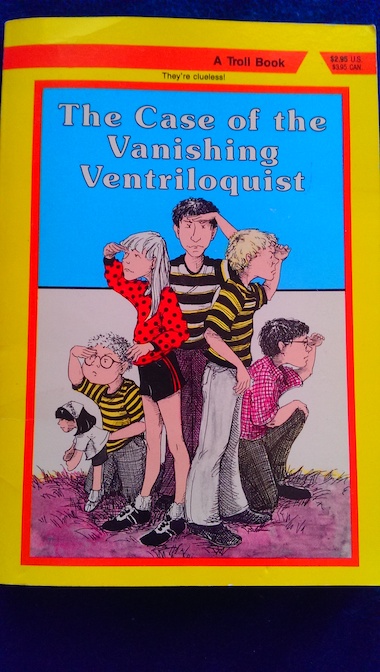
The Case of the Vanishing Ventriloquist

VanishingVentriloquist

The Case of the Vanishing Ventriloquist by E.W. Hildick, 1985.

Mari Yoshimura, Wanda’s pen pal from Osaka, Japan has just arrived in the United States, and she’s eager to meet Wanda’s friends. Mari’s father is the head of Yoshimura Electronics, and he is visiting different cities in the United States on business. While her father travels, Mari gets to enjoy an extended visit with Wanda. Wanda has told her all about the McGurk Organization, and Mari is eager to join up with them during her stay in America. Unfortunately, when she first arrives, McGurk isn’t in a very receptive mood.

McGurk tells Mari that she can’t join the organization, which hurts Mari and offends Wanda, because he has organized a series of challenges in order to decide which of the current members to give a promotion. McGurk thinks that Mari’s presence would upset the challenges, and he can’t promote her because she hasn’t actually done anything with the organization yet. However, Wanda negotiates with McGurk. Since Mari is her guest, and she can’t neglect her guest, she arranges for Mari to just follow along on the challenges, working through them herself just for fun. McGurk allows it on the condition that Mari not help Wanda because that would give Wanda an unfair advantage. Wanda and Mari agree to the arrangement, and Mari writes all of her notes for the challenges in Japanese, just to make sure that Wanda doesn’t accidentally see any of her answers.
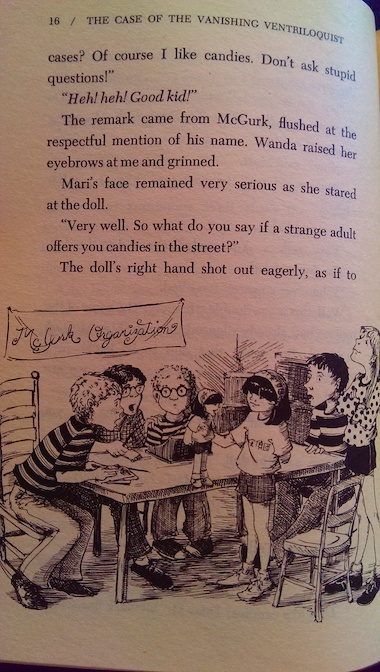
VanishingVentriloquistMariIntro

Mari turns out to be really good at the challenges that McGurk sets. When he tells the members of the organization to spend a day observing people and notice how many times people do things that would be a temptation to criminals (like leaving packages in a car, tempting someone to break in and get them), Mari ends up with more observations than anyone else. Mari also proves to be good at noticing suspicious behavior when she sees a man that no one else notices, who seems to be hanging around a bus stop for no reason, not showing any interest in getting on any of the buses.

Then, Brains accidentally discovers a real mystery that the McGurk Organization can investigate where Mari plays a special role. While Brains is working on one of his latest inventions, a new kind of portable phone for kids (this is before cell phones became popular), he accidentally gets his signals crossed and ends up overhearing part of someone else’s conversation. It sounds like the two men Brains overhears are going to target someone at the Senior Citizens’ Annual Picnic. However, because Brains didn’t hear the whole conversation, they can’t be sure what these men are going to do. They report the incident to Patrolman Cassidy at the police station, but he doesn’t think too much of it. He says that he’ll look in on the picnic but that what Brains overheard might not really have to do with a crime. He heard too little of the conversation to be sure what the men were actually talking about.
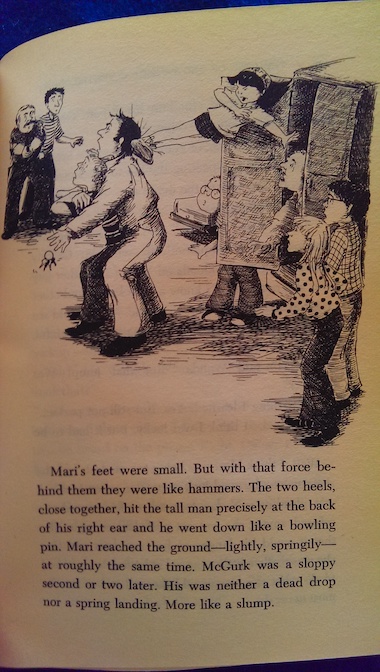
VanishingVentriloquistMariRescue

Fortunately, because Wanda’s mother is part of the committee organizing the picnic, the kids have a good opportunity to investigate the matter themselves. Wanda will be helping her mother to serve food, and Mari is going to be part of the entertainment, putting on her ventriloquist act. Mari says that the other members of the organization can be part of her act, so they can be on hand to keep an eye on things. McGurk is pleased about this and finally offers Mari a position as a trainee of the McGurk Organization.

However, it turns out that everyone has completely misjudged the situation. A very serious crime is being planned, and the McGurk Organization doesn’t realize it until Mari is kidnapped from the picnic! Mari was the target all along, and the suspicious man at the bus stop was actually there to watch her. Can the others get her back before it’s too late?

VanishingVentriloquistMariWelcome

From this book on, Mari becomes a regular character in the series and a full member of the McGurk Organization. Mari’s father decides that he wants to open one of his electronics factories in the United States, so Mari and her family will be living there for awhile to oversee it, giving Mari the chance to stay with the McGurk Organization for an extended period of time.  McGurk starts dreaming that when Mari eventually goes back to Japan, she will open a branch of the McGurk Organization there, but that would be years in the future, if it happens.  McGurk dreams big.

One of the funniest parts of this book is when the kids are supposed to be looking around for examples of suspicious behavior. Before the challenge begins, McGurk admits that what is “suspicious” is difficult to quantify and that most of what they’ll notice will have perfectly reasonable, non-criminal explanations behind it. Joey Rockaway notes that, for most of that particular challenge, the members of the McGurk Organization themselves are the ones who are acting most suspiciously, running around and spying on random people. At one point, Joey almost gets thrown out of a supermarket because the manager noticed the creepy way he kept spying on a woman who kept picking up packages of cookies and then putting them back. It turns out that the manager of the store knows that the woman is on a diet and has had trouble wrestling with temptation. She routinely gets tempted to buy cookies, picks some up, and then puts them back on the shelf when she realizes that she shouldn’t have them. Her behavior may look odd to people who don’t understand what she’s going through or what she’s doing, but perfectly understandable to those who do, like so many things.

The book is currently available online through Internet Archive.

McGurk Gets Good and Mad

McGurkMad

McGurk Gets Good and Mad by E.W. Hildick, 1982.

The members of the McGurk Organization have been planning a kind of open house in order to show the other kids from the neighborhood the kind of mystery-solving work they do. However, someone seems to be doing their best to ruin it.

It starts with the mice that the members of the Organization find in their headquarters, which have already gnawed some of the exhibits for the open house. It quickly becomes obvious that the mice didn’t find their way in by accident when someone posts a sign warning people away from the open house because of the mice. There’s no way anyone could have found out that there were mice, especially not that quickly, unless they had planted them there deliberately. The mysterious sign is signed “Agent 93,” but who is that?

While Brains works on a way to get rid of the mice, the others begin thinking about who could have it in for the McGurk Organization. They consider past cases they’ve solved and villains that they’ve unmasked as well as some of the kids they know generally from school who don’t like them or were offended when they weren’t allowed to join the Organization.

By the time of the open house, they still don’t know who the saboteur is, and when it’s time to unveil the real police handcuffs that Patrolman Cassidy gave them as an award (the highlight of the open house for the McGurk Organization), they are suddenly and inexplicably replaced by a pair of fake mice and another note from “Agent 93.”

Whatever it takes, McGurk is determined to find the guilty person and get those handcuffs back!

The book is currently available online through Internet Archive.

The Traitor’s Gate

TraitorsGate

The Traitor’s Gate by Avi, 2007.

The story is set in London, in 1849. Fourteen-year-old John Huffam lives with his parents and sister and their servant, Brigit and attends a school taught by a former military man who acts like he is still in the army and teaches them little beyond discipline and what army life would be like.

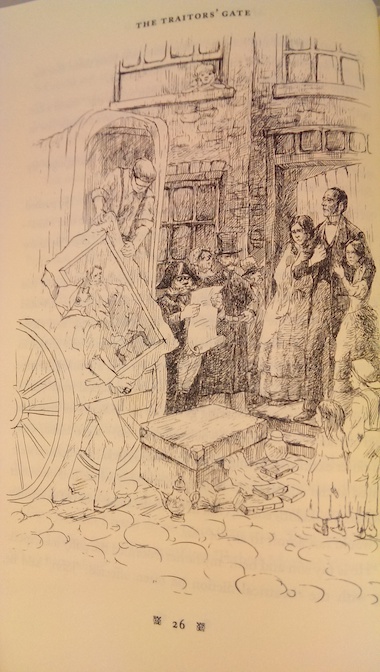
Then, one day, John is called home suddenly because of a family emergency. His family has fallen on hard times, and his father is in debt, so the family’s belongings are being confiscated. His father is summoned to appear in court, and if he cannot find the money to pay his debt, he will have to go to debtors’ prison. John’s father is shocked because he doesn’t actually owe any money to the man who is trying to call in the debt, Finnegan O’Doul.

TraitorsGateConfiscation

In spite of this, John and the rest of the Huffam family must spend the night in the bailiff’s sponging house, the Halfmoon Inn. There, John’s father again promises John that there is no debt between himself and Mr. O’Doul. He even says that he doesn’t really know O’Doul, although John doubts him. It seems like his father has had dealings of some kind with the man that he wants to keep secret.

John’s father, Wesley Huffam, was originally from a fairly well-off family, but all the family’s money ended up going to a great-aunt instead of to him (possibly because it became obvious to his relatives that he had little skill at handling money in the first place). John’s father is resentful toward the great-aunt, Euphemia Huffam, for inheriting when he thinks that, as a man, he should have been first in line for the family’s money. However, with this enormous (although possibly false) debt hanging over his head, he may be forced to appeal to Great-Aunt Euphemia for help. He persuades John to go and visit Great-Aunt Euphemia on his behalf, since he is not allowed to leave the sponging house for now and the past quarrels between him and his aunt would make it unlikely that his aunt would want to see him. John is beginning to realize that there are pieces of his father’s life and their family’s past that have been kept from him, and he doesn’t like the idea that his father has been deceiving him, but with their family in such a desperate situation, he agrees to visit Great-Aunt Euphemia.

TraitorsGateSary

The bailiff, John’s mother, and Brigid all agree that John is going to have to be instrumental in solving their family’s problems. Of all the people in his family, he is the most practical, in spite of his young age. His father is an impractical man, stuck in a vision of his family’s former glory (and his aunt’s current money, which he does not share in) that doesn’t fit their current circumstances. John’s mother thinks that her husband’s job as a clerk for the Naval Ordinance Office doesn’t provide enough money for the family to live on, even though he earns more than twice what typical London tradesmen of the time do. The real problem is that the family doesn’t live within its means (it is eventually revealed that Wesley Huffam has been withholding money from his family that he uses for gambling), and John’s father’s snobbish attitude because he thinks of his family as being more grand than the commoners around them alienates people who might otherwise be friends and help them. John knows that he’s young, and he’s not completely sure what he can do to help his family, but he knows that there is no other option but to try. In the process, he learns quite a lot about life, himself, the people in his family, and the wider issues in the world around him, including some political intrigue that hits uncomfortably close to home.

Great-Aunt Euphemia agrees to see John when he comes to her house, but their first meeting doesn’t go very well. Great-Aunt Euphemia is ill (or says she is), and she bluntly tells John that his father was always bad with money. She is not at all surprised that he is in debt and needs her help. John gets upset at the bad things that Euphemia tells him about his father, and she gets angry when John tells her the amount of the debt. At first, John is sure that she will refuse to help them completely, but Euphemia tells him not to assume anything but that he should come back the next day.  Her eventual contribution to helping John’s family in their troubles comes in the form of a job for John.

TraitorsGateRookery

As John moves around the city, he gets the feeling that he is being followed, and he is. One of the people following him turns out to be Inspector Copperfield (or so he calls himself) from Scotland Yard. When John confronts him, the inspector seems to have a pretty good idea of the difficulty that his family is in and what John himself has been doing. John asks him why he cares, and the inspector says that John’s father is suspected of a crime and that John had better learn more about what his father has been doing and share that information with him. John doesn’t believe that his father could be a criminal, but the accusation is worrying because he knows that his father is hiding something (his gambling addiction isn’t the only secret he has).

The other person following John is a young girl in ragged clothes. The girl, who calls herself Sary the Sneak, approaches John herself, freely admitting that she’s been following him. In spite of her young age, Sarah (or Sary, as she is frequently called) lives on her own and must support herself because her mother is dead and her father was transported to Australia. People don’t often notice a young girl on the street, so sometimes people will pay her to follow someone and provide information about them. The reason why she tells John about it is because she isn’t above playing both sides of the street; sometimes, she gets the people she’s been following to pay her to provide them with information about the people who hired her to spy on them. She considers it even-handed. However, John has no money to pay her for information and finds her spying distasteful, so he doesn’t want to take her up on the offer at first.

However, John does a little spying of his own when his father sneaks away from the Halfmoon Inn, which he is not supposed to do. He follows his father to a pub called the Red Lion, where he witnesses his father gambling with money that he had claimed not to have. More than that, he sees his father arguing with a man who turns out to be O’Doul, another gambler. To John’s surprise, his teacher also shows up and seems to know O’Doul. When John later confronts his father with what he saw at the Red Lion, all his father will say is that he is carrying a fortune around in his head. Later, John overhears the bailiff speaking with someone else, an Inspector Ratchet from Scotland, saying that it appears that Wesley Huffam may be a traitor involved with spies and that the Inspector Copperfield who spoke to John earlier was an imposter, probably also a spy.

Could it be true? Is John’s father really a traitor, selling naval secrets from his job? If so, who can John trust?  Conspirators seem to be around every corner, and John has the feeling that the people who are closest to him may be the biggest threats.

The book is currently available online through Internet Archive.

Emil and the Detectives

Emil

Emil and the Detectives by Erich Kastner, translated by May Massee, 1929, 1930.

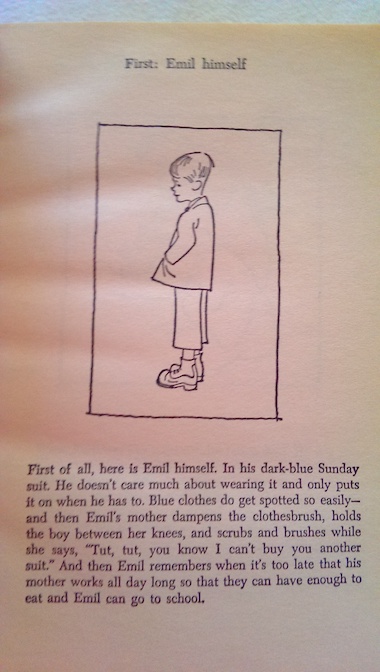
EmilHimselfThis book was originally written in German.  It was written in Germany during the period between the two World Wars.  The date of the story itself is never specified, but it may actually be earlier than when it was written, prior to World War I.  There is a sequel to the book that I haven’t read where Emil’s vacation ends early because he hears that war has broken out, an incident based on the author’s own boyhood experiences at the start of World War I.

The Emil books have an interesting history because of the time period when they were written.  This video explains how the book came to be written, the time period when it was written, and its cultural impact.  By the time the Nazis came to power, Emil and the Detectives had become popular and, as a harmless children’s book, was saved from Nazi book burnings.  The sequel story, Emil and the Three Twins, wasn’t so lucky, which is why it isn’t as well-known as the first Emil book, although it is available today.  The author, Erich Kastner, was known to be a pacifist and opposed to the Nazi government, which was why many of his works were burned during the Nazi regime and publishers were forbidden to publish new books from him.  (This video explains more about the book burnings and Kastner’s burned works.)  Although his political stance interfered with his writing, and he was questioned by the Gestapo several times, he chose to remain in Germany for the duration of the war.  Another of his children’s books, Lisa and Lottie, which was the basis for the Parent Trap movies by Disney, was written after World War II ended.

EmilTrainAt the beginning of this story, it explains that Emil Tischbein’s father died when he was very young and that his mother works hard as a hairdresser to support the two of them. When she can, she saves a little money for Emil’s grandmother as well. When the story begins, Emil is preparing for a train trip to Berlin to visit his relatives. Emil will be traveling by himself and will meet his relatives near the station when he arrives. His mother gives him some money to take to his grandmother and warns him to be careful. Emil pins the money inside his pocket for security.

On the train, Emil talks to the people who share his train compartment. One of them, who calls himself Herr Grundeis, tells him tall tales about what Berlin is like and gives him a piece of chocolate, which is apparently drugged. Emil falls asleep on the train, and when he wakes up, he realizes that he’s been robbed!

EmilGustavDetermined to get the money for his grandmother back, Emil searches for Herr Grundeis and spots him getting off the train. It’s too soon for Emil’s stop, but he follows Grundeis off the train anyway, tracking him to a café.

While Emil is trying to decide how to handle the situation, another boy who carries a horn that he likes to honk, Gustav, spots him watching Grundeis. Gustav asks Emil what he’s doing, and Emil explains the situation. Emil isn’t sure how to get the money back from Grundeis. At first, he’s afraid to tell the police what happened because of a prank he and some friends pulled at home. He worries that perhaps the police have found out about the prank and that they won’t take him seriously. Gustav is sympathetic to Emil and tells him that he can get together some friends to help.

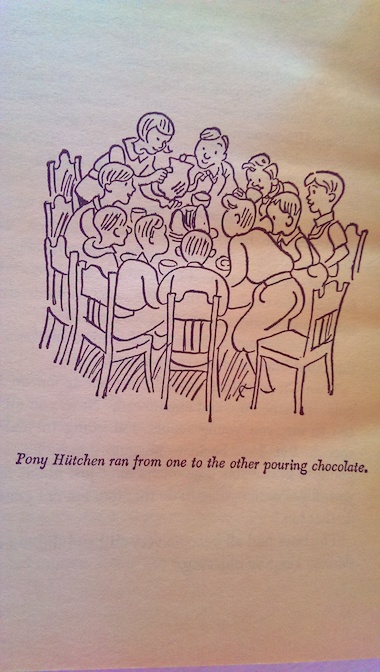
EmilPonyChocolateGustav recruits a bunch of other boys from the neighborhood, and they continue tailing Grundeis through the city to his hotel. The boys call another friend at home, who keeps track of their progress and gives them reports about what others have said.  Emil gets one of the other boys to tell his relatives that he has been delayed on important business, causing his cousin, Pony Hutchen, to come and tell him that everyone is worried and that he’s going to be in big trouble with his relatives if he doesn’t show up soon.  However, they still have the problem of deciding how to confront Grundeis and get him to return the money.  In this case, the detectives don’t need to solve the mystery of who the thief is.  The real problem is how to prove it.

This book is known around the world and has been made into movies several times, including a Disney version in 1964.  The Disney version still takes place in Germany, but for some reason, Emil’s train trip is changed to a bus trip, and the criminal’s plot is much more elaborate.  It’s available on dvd, and you can see the trailer on YouTube.

The book is currently available online through Internet Archive (multiple copies).

My Reaction and Spoilers

Overall, I liked the story, although I found the book difficult to read because the wording sounded strange and awkward in many places.  I think this is probably because of the translation between German and English.  I have the feeling that the translator was trying to be too literal in the translation instead of focusing on translating for meaning and tone.  Unfortunately, I can’t read German, so I can’t say what the original version was like.

EmilReportersThere was a note in the beginning of my copy of the book that says that many of the character names in the book are actually jokes on the part of the author. It’s not as obvious in English because the forms of the names sound reasonable for German names, but anyone who knows German would spot that they aren’t real names. For example, Emil’s last name is Tischbein, which means “table-leg,” and the thief’s alias, Grundeis, means “ground-ice.”

In the end, the boys use their numbers (they have about a hundred child detective recruits by the end of the story) to corner the thief in a bank, and when they confront him in front of the bank personnel, they manage to prove that Emil is the owner of the money using the pin holes in the bills, where Emil had pinned it to his jacket.  The author of the book also appears briefly in the story as a journalist who interviews Emil and his friends for a newspaper story about how they caught the thief. (I think he’s the one standing at the back of the group of reporters in the picture because the man’s hair looks like Kastner’s, combed back.)

Like in another of Kastner’s books, Lisa and Lottie, there is the theme of a child who behaves well because of the family’s poor circumstances.  Emil, like Lottie, is being raised by a single mother who has to work hard to support the two of them. Both Emil and Lottie understand that if they behave badly and get into trouble, it would create more hardships for their mothers.  They basically live hand-to-mouth, and the children understand that their mothers cannot take time away from work to deal with their discipline problems.  Each of them has had to shoulder some of the household burdens from an early age, and it has made them more serious and also a little closer to their mothers than many of the other children from more affluent families. Aside from Emil’s prank at home (which causes him some worry), he is obedient to his mother and also very concerned about her welfare.

Meg Mackintosh and The Case of the Missing Babe Ruth Baseball

Meg Mackintosh Mysteries

MMBaseball

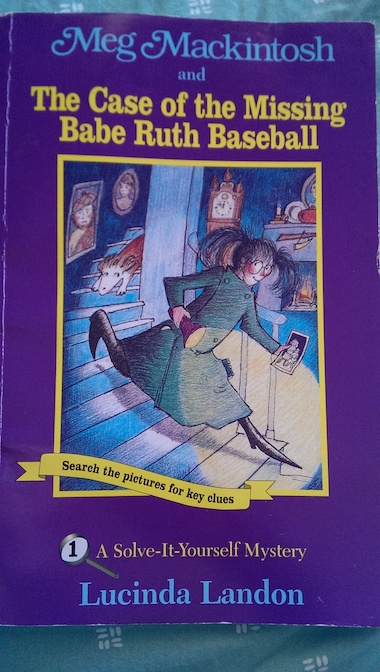
Meg Mackintosh and The Case of the Missing Babe Ruth Baseball by Lucinda Landon, 1986.

MMBaseballAlbumThis is the first book in the Meg Mackintosh series, and it was the first mystery story that I ever read, when I was about seven years old.  It started a life-long love of mysteries!

Meg’s grandfather shows Meg and her friend Liddy some old family photographs and tells them about the time when his cousin Alice took his prize possession: a baseball autographed by Babe Ruth.  Alice was a bossy girl who always liked to tease him, and so she created a kind of treasure hunt, challenging him to solve it in order to get the baseball back.  Unfortunately, he could never figure out the clues and still doesn’t know what happened to the baseball.

Meg’s brother, Peter, has a Detective Club, but he refuses to allow Meg to join, saying that she needs to prove that she can solve a mystery.  Seeing this as her chance, Meg decides that she’s going to solve this old puzzle and find the Babe Ruth baseball!  However, she also has competition from Peter, who thinks that he’s the better detective and tries to send Meg off in the wrong direction.

The book is currently available online through Internet Archive.

My Reaction

All of the books in the Meg Mackintosh series allow readers to try to solve the mysteries along with Meg, stopping periodically to ask them if they’ve noticed a clue that Meg has noticed or if they know what the significance of a clue is.  There are pictures to help, and readers are invited to stop and study the details before moving on. I think this is a good way to introduce children to puzzle-solving and help them develop critical thinking skills and an ability to notice details. I would recommend adults reading these books, or at least the first one or two along with children, so they can discuss the stories and clues with them, helping them spot clues as they begin to get used to the format of the books.

This is an excellent series for introducing children to the mystery genre for the first time! When I was young and just learning what mysteries were, I was fascinated to discover that I already had all of the knowledge I needed to solve this mystery along with Meg because all of the clues to Alice’s treasure hunt had to do with nursery rhymes. If you can recognize the rhymes in the book, you’re well on your way to solving the mystery!

Basil in the Wild West

BasilWestBasil in the Wild West by Eve Titus, 1990.

This book picks up right after the previous book in the Basil of Baker Street Series, Basil in Mexico.

After leaving Mexico, Basil and his best friend Dr. Dawson journey north into the western territories of the United States.  There, some friends of their ask them to investigate a smuggling operation.  Mice have been illegally bringing Mexican antiquities across the border.

Basil realizes that the smugglers have been smuggling the antiquities in the open, pretending that they are ordinary replicas, the kind that tourists often buy.  Because the border guards aren’t experts in antiquities, they haven’t been able to tell the difference between harmless souvenir replicas and the real thing.

When they catch one of these smugglers, they learn that the mastermind behind the scheme is a mouse called J.J. in a town called Moriarty in New Mexico (the name of the town irritates Basil).  They go to the town with the help of some friendly horses and confront J.J..  At first, they think it won’t be too difficult because, although J.J.’s house is well-guarded, he is confined to a wheel chair because of an accident.  However, the wheel chair is an act, and J.J. is no ordinary mouse.

BasilWestPic2Although J.J. escapes, Basil and Dr. Dawson decide that the smuggling ring has been defeated and it’s alright to continue their sight-seeing.  However, their adventures are not over!

Basil and Dawson want to see the Grand Canyon, but it turns out that the hotel where they are staying is being terrorized by a weird, glowing Thing.  Nobody knows what it is, but guests think it could be some kind of ghost or monster, and many of them are too afraid to stay.  The owners of the hotel ask Basil to discover what the Thing is and stop whoever may be behind it before their hotel is ruined!

This book is really two stories in one, and neither has any direct bearing on the other.  In that way, it’s kind of disjointed.

The book is currently available online through Internet Archive.
Basil and the Pygmy Cats

BasilPygmyCatsBasil and the Pygmy Cats by Eve Titus, 1971.

Mouse detective Basil’s arch enemy, Professor Ratigan, has taken over the Asian country of Bengistan, near India.  Basil discovers that he is holding the real ruler of the country captive so that he and his gang can loot the country for everything they can get, keeping the populace in subjugation.  Basil is determined to go there and free the rightful ruler so they can vanquish Professor Ratigan!

When Dr. Edward Hagerup of the British Mousmopolitan Museum hears that Basil is heading to Asia, he asks him to investigate an historical mystery for him.  There have been tales of a race of pygmy cats, no bigger than mice, but new evidence has been found that suggests there is more truth behind the stories than anyone has realized.  Basil has an interest in archaeology and eagerly accepts this extra task as part of their mission.  Along the way, other mice who have heard of the expedition join up to help Basil.

At first, Basil’s original mission, stopping Ratigan, seems easy.  Basil and his friend Dawson allow themselves to be captured so that they can get into the palace and find the real Maharaja of Bengistan.  After solving a secret code in the dungeon, they find the Maharaja, who tells them that another acquaintance of theirs, the opera singer, Relda, is also a prisoner in the palace.  She was giving a performance there when Ratigan and his thugs took over, and Ratigan has forced her to stay, giving private performances for him.  During one of these performances, Basil and his friends manage to take Ratigan by surprise and capture him.

BasilPygmyCatsPic1Now, Basil thinks that he and his associates are free to continue their other mission, finding the lost civilization of pygmy cats.  However, that mission is fraught with danger and surprises, and they haven’t quite heard the last of Ratigan.

The story isn’t really much of a mystery.  It’s really more an adventure story.

Basil and his friends manage to locate the island of pygmy cats with the help of Jeannie (a sea serpent related to the Loch Ness Monster who lost her way back to Scotland after a family trip — I kid you not) and the Sacred Catfish (which they bribe with catnip — I also kid you not, and his nip trip is a little disturbing).

This is my least favorite of the Basil series, partly because of the lack of mystery and also because of “primitive” nature of the pygmy cats when they find them.  Basil makes it clear that the pygmy cats are inherently less intelligent than mice and that their greatest achievements were because of the influence of royal mice who washed up on the shores of their island years ago, only to be wiped out by a volcano.  (Really?  Really.  Basil, if these mice were so superior and the pygmy cats so inferior, why were the cats able to get away from the volcano when the mice didn’t, hmm?  Why didn’t the mice just go to the part of the island where the cats were until the volcano stopped erupting?  Just what kind of bill of goods are you trying to sell us, Basil?)  Basil comes off sounding like a 19th century imperialist, and the fawning adoration he gets for his discovery is really annoying.

In general, I don’t like the Basil stories that turn out to be more adventure than mystery, and Basil’s smug superiority at various points in the story are off-putting.  It’s true that that Sherlock Holmes (which this series parodies) had an ego as well, but these sort of imperialist attitudes in a children’s story are distasteful.  Although I like recommending nostalgic books for future generations, this is one that I really can’t recommend.  The brightest spot in this book was the secret code in the dungeon, which is more in keeping with the mystery theme.  If the book had made the plot to capture Ratigan and end his reign of terror in another country without all this stuff about an “inferior” species of small cats, it would have been a much better story.

Like other books in this series, this book contains a number of jokes on the original Sherlock Holmes stories.  Read a number of the names backwards, and you’ll see some familiar names from Sherlock Holmes as well as a reference to another series by Eve Titus.

This book is available to borrow and read for free online through Internet Archive.

Basil and the Lost Colony

BasilLostColonyBasil and the Lost Colony by Eve Titus, 1964.

A Norwegian scholar from the British Mousmopolitan Museum approaches Basil about a letter that he has recently received along with an arrow.  The letter mentions a recent sighting of the mysterious Adorable Snowmouse (no, that’s not a typo, he’s big for a mouse, but really adorable and saves people lost in the mountains), and the arrow is evidence that points to the whereabouts of a lost colony of mice who fled Switzerland during the time of William Tell, about 600 years previously.  These particular mice lived in William Tell’s basement, and like Tell himself, the Tellmice (as they are called) left their home because they opposed the rule of a tyrant.  However, even after the tyrant’s reign ended, the Tellmice did not return home and no one knows for sure what became of them.

Basil is eager to join the expedition to search for the lost colony, but he is also concerned about opposition from his nemesis, Professor Ratigan.  Professor Ratigan has recently made attempts on his life, and he now knows about the expedition to find the lost colony, even stealing the evidence from Basil’s home.  Basil is sure that Professor Ratigan will do everything he can to prevent them from reaching the lost colony.

In Switzerland, the expedition is joined by a pretty and adventurous opera singer, Relda (a take-off on Irene Adler, from the original Sherlock Holmes stories, read her name backwards), who comes in disguise after Basil tells her that the mission is too dangerous for her.  That’s just one of the jokes on original Sherlock Holmes stories that appear in this book.  These jokes would go over the heads of kids who aren’t familiar with the original stories, but make the story more entertaining for adults.

Basil and his friends do meet up with the Adorable Snowmouse, find the lost colony, and defeat Ratigan (well, temporarily, at least).

Although the Basil of Baker Street Series is supposed to be about a mouse detective kind of like Sherlock Holmes, some of the entries in the series, like this one, are really more adventure than mystery.  The book is currently available online through Internet Archive.

The Case of the Cool-Itch Kid

Polka Dot Private Eye

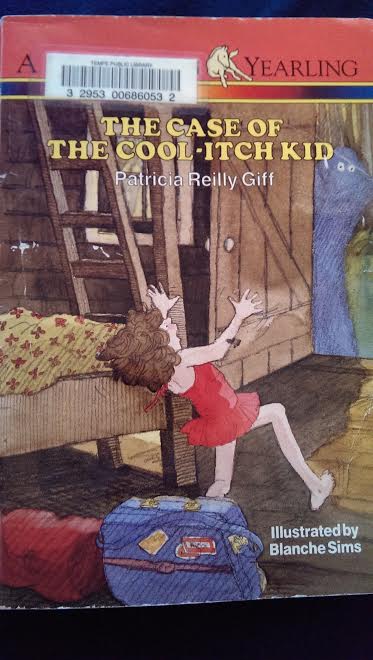
CoolItchKid#5 The Case of the Cool-Itch Kid by Patricia Reilly Giff, 1989.

Dawn heads off to summer camp!  At first, she’s not sure that she really wants to go, even though the idea of riding horses, swimming, and roasting marshmallows sounds appealing.  It turns out that there’s only one other girl from her school going, Jill Simon.  All of the other girls on the bus to camp are people she doesn’t know from another school called Coolidge (which Dawn pronounces “Cool-Itch”).

Before she leaves home, Dawn receives a package of small presents from her grandmother.  Among her grandmother’s gifts are some candy and cookies, a pin, and a small mirror surrounded by seashells that Dawn loves.  Later, after their bus stops at a rest stop, she realizes that some of these things are missing.  She particularly notices that the pin and the beautiful mirror are gone.

Who is the thief?  Could it be one of those kids from Coolidge (“Cool-Itch”)?

Dawn misses her family, especially her grandmother.  She hates the food at camp.  She’s upset about losing her grandmother’s presents.  Worst of all, she realizes that she left her Polka Dot Private Eye box at home!  How is she going to solve this mystery?

Part of the story is about the mistakes people make by jumping to conclusions.  Right from the beginning, Dawn assumes that her only friend at camp is Jill because the other kids are unfamiliar, and she thinks they’re unfriendly.  Also, she assumes that the presents disappeared because they were stolen, but actually, it’s due to a series of accidents and misunderstandings.

The book is currently available online through Internet Archive.

The Powder Puff Puzzle

The Polka Dot Private Eye

PowderPuff#4 The Powder Puff Puzzle by Patricia Reilly Giff, 1987.

Dawn is on her way to go swimming with her friend Emily Arrow when her cat, Powder Puff, is startled and jumps into a stranger’s car.  Before Dawn can do anything about it, the car drives away with her cat!

Fortunately, Dawn managed to notice a few things about the car and driver. The car is red and dented.  The driver is tall and skinny and has long, gray hair.  She was eating a jelly cookie and carrying a box and a long pole.  Her license plate had a name on it and that started with “PA,” but Dawn didn’t get to read the rest.

Emily’s father is a police officer, but he can’t trace the license plate with just the letters that Dawn was able to give him.  Instead, he has the kids make Lost Cat posters to put up in the neighborhood.  Still, that’s not enough for Dawn.  As The Polka Dot Private Eye, she should be able to figure out where her own lost cat is!

PowderPuffPicWith the help of her friends, especially Jason, Dawn uses what she knows to put together a picture of the person they’re looking for, and they try to retrace her steps through town.  Can they track down Powder Puff and get him back?

Part of the puzzle that Dawn and Jason overlook at first is the woman’s profession, which is one that the kids hadn’t really expected to find a woman doing, although Dawn spots the clues which point to what the woman was doing in the area and allow them to realize where she had to be going.  Whether more modern kids reading this book would feel the same way about the woman’s profession, I’m not sure.

The book is currently available online through Internet Archive.